Lord My Chef Daily Recipe for Soul by Fr. Nicanor F. Lalog II
Tuesday, Memorial of St. Scholastica, Virgin, 10 February 2026
1 Kings 8:22-23, 27-30     ><]]]]’> + ><]]]]’> + ><]]]]’>     Mark 7:1-13
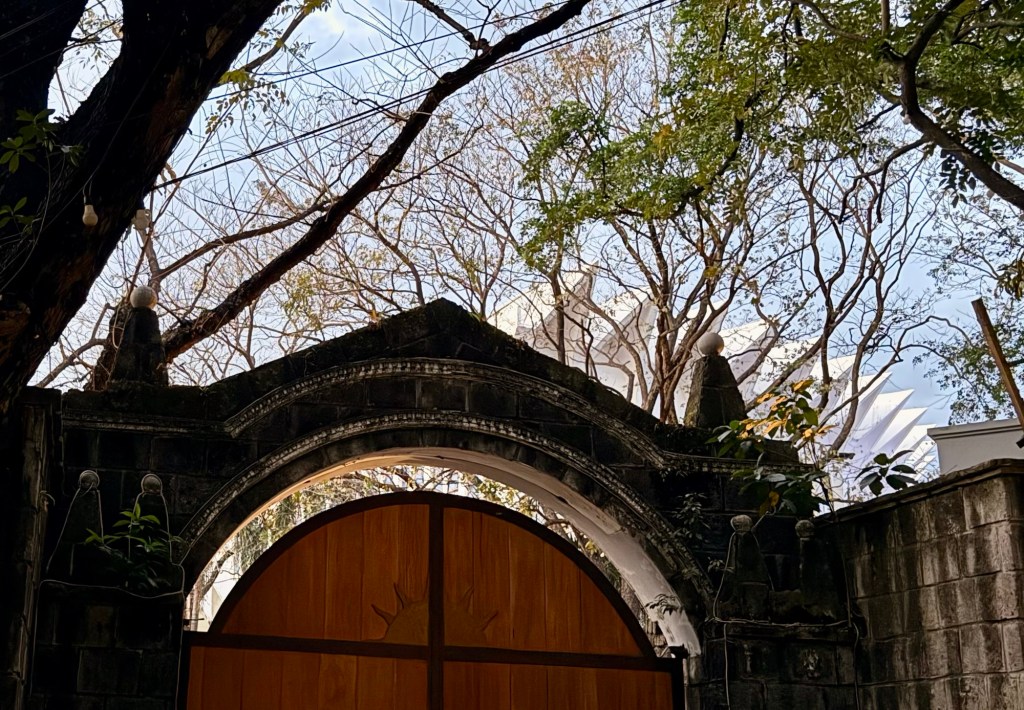
Photo by author, Museo de Valenzuela’s replica of “Arkong Bato” with the pointed facade of the National Shrine of Our Lady of Fatima as background, 21 January 2026.
How true were the words
of your great King and Servant
Solomon, O God our mighty Father,
that nothing like "the heavens
and the highest heavens"
can contain you
much less the temple he had built
or anything that we have
in this time;
yet, you have promised us
to hear our prayers when we come
to pray to you,
to call on you
in temples and churches
human hands have made
that are not enough to have you.
Forgive us, Lord,
when we try to "contain" you,
"keep" you in specific places
not just churches and temples
and oratories;
most of all,
forgive us, Lord,
when we lack
the reverence and intimacy
we must have with you
when inside the church
and other sacred places;
Jesus' words in today's gospel
cuts us to the heart of our hypocrisies,
"This people honors me with their lips,
but their hearts are far from me;
in vain do they worship me,
teachings as doctrines human precepts"
(Mark 7:6).
O dear Jesus
present in the Blessed Tabernacle,
empty me of my pride
so that You may reign
in my heart
always.
Amen.
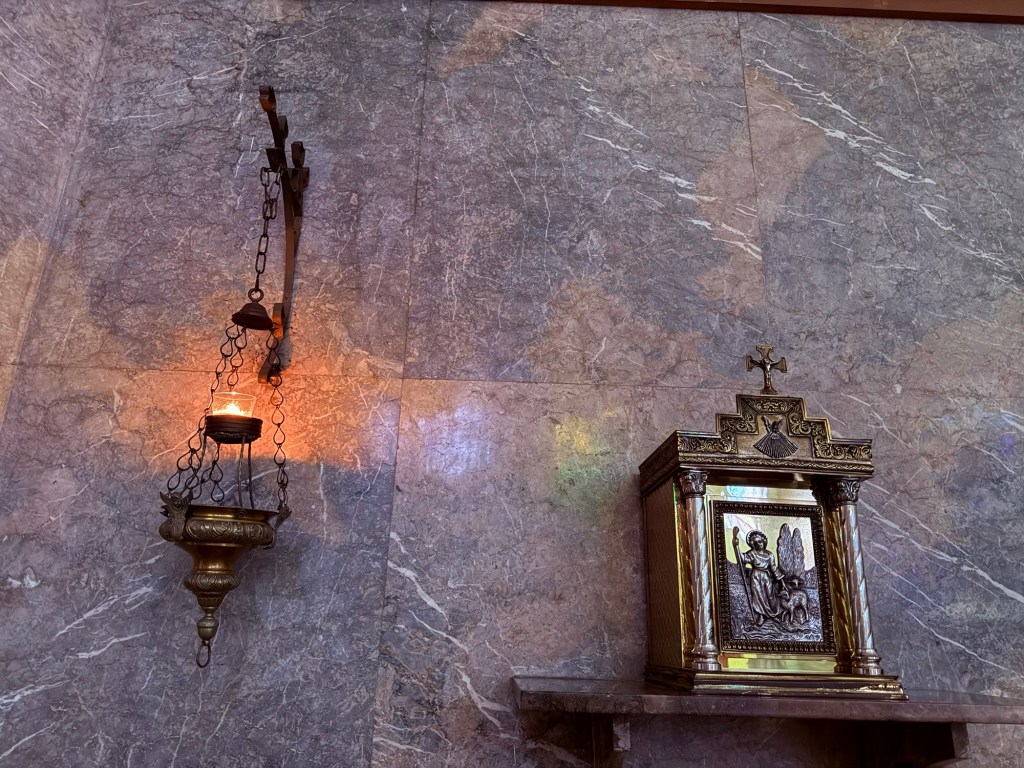
Photo by author, Chapel of the Carmel of the Holy Family Monastery, Guiguinto, Bulacan, 23 January 2026.
Lord My Chef Daily Recipe for the Soul, 30 October 2025
Thursday in the Thirtieth Week of Ordinary Time, Year I
Romans 8:31-39     ><))))*> + ><))))*> + ><))))*>     Luke 13:31-35
Brothers and sisters: If God is for us, who can be against us? What will separate us from the love of Christ? Will angusih, or distress, or persecution, or famine, or nakedness, or peril, or the sword? As it is written: For your sake we are being slain all the day; we are looked upon as a sheep to be slaughtered. No, in all these things we conquer overwhelmingly through him who loved us (Romans 8:31, 35-37).
What else can I say
to these profound words
by St. Paul?

They are so true even
with us until now
with a new kind of paganism
hostile to the official teachings
of the Church as they prefer to
worship self in their body and
in their thoughts,
overextending their rights,
redefining even gender and
other natural institutions,
glorifying wealth and fame,
protecting animal rights
and environment without
any regard for persons especially
in their weakest stages in the
womb and old age...
the list goes on, Lord
but what's most sad,
even tragic
the attacks and hostilities
are not really from unbelievers
but from those who claim to be
Christians and Catholics.
Keep us strong
and faithful, Lord Jesus,
never let us separate from you;
fill us with courage too
to remain steadfast
in your ways and teachings,
to speak the truth,
to protect fellow believers
and defenders of faith
and most of all,
to keep loving your
beloved Body,
the Church.
Amen.
Lord My Chef Daily Recipe for the Soul, 28 October 2025
Tuesday, Feast of St. Simon & St. Jude, Apostles
Ephesians 2:19-22   ><))))*> + ><))))*> + ><))))*>   Luke 6:12-16
Photo by author, Sacred Heart Novitiate, Novaliches, QC, 20 March 2025.
Brothers and sisters: You are no longer strangers and sojourners, but you are fellow citizens with the holy ones and members of the household of God built upon the foundation of the Apostles and prophets, with Christ Jesus himself as the capstone. Through him the whole structure is held together and grows into a temple sacred in the Lord; in him you are also being built together into a dwelling place of God in the Spirit (Ephesians 2:19-22).
How lovely to hear
those words of St. Paul
in these times of great divisions
among us not only in politics
but in almost every topic!
What is most painful,
O Lord Jesus Christ is how
some among us have become
numb and callous of each other,
unmindful of things they say
especially of those suffering
and in pain; with the little cellphone
each of us holding so addictively
the whole day, we have created our
own self-centered world
totally unmindful of others.
On this Feast of your
two great Apostles,
St. Simon and St. Jude
who were poles apart
in their differences
as persons and backgrounds,
may we realize that we are not
"strangers and sojourners"
but are" fellow citizens",
and "members of the
household of God" in you,
Jesus Christ who is at the center
of this household as cornerstone.
Help us, Lord Jesus,
to imitate Sts. Simon and Jude
who built up your Church,
your household of God here on earth;
fill our hearts with the zeal
and ardent love for you
and your Church like Simon
called the Zealot:
in this time when Catholics
in the country are declining
in numbers as well as in professing
their faith, may we have the enthusiasm
to make you known, Jesus,
in our loving actions of witnessing;
grant us also the strength,
clarity and courage like that of
St. Jude Thaddeus in dealing with
the many contradictions of the world
we live in today as Catholics and
Christians:
"But you, beloved,
build yourselves up on your
most holy faith; pray in the Holy Spirit;
keep yourselves in the love of God;
wait for the mercy of our Lord Jesus
Christ unto eternal life.
And convince some,
who doubt..." (Jude 20-22).
Bless us, dearest Jesus,
through the help St. Simon and
St. Jude, to rediscover
the beauty of our Christian
faith and of our Catholic Church
by working hard to build it up
without tiring through our silent
and peaceful witnessing
of the Gospel.
Amen.
Fr. Nicanor F. Lalog II
Our Lady of Fatima University
Valenzuela City
Lord My Chef Daily Recipe for the Soul, 26 September 2025
Friday, Memorial of Sts. Cosmas & Damian, Martyrs
Haggai 2:1-9     ><]]]]'> + ><]]]]'> + ><]]]]'>     Luke 9:18-22
Photo by author, the wailing wall of Jerusalem, May 2017.
God our loving Father,
we praise and thank you
for the magnificent places
of worship we have for you,
churches so beautiful,
so wide to accommodate us
especially on Sundays
to praise and worship you;
but, dear God,
forgive us when we forget
so often that its glory
is not in us nor because of us
but from your divine presence,
in the presence of Jesus Christ
not only in the Tabernacle
but among the people
as you have told us through
Haggai your prophet.
For thus says the Lord of hosts: One moment yet, a little while, and I will shake the heavens and the earth, the sea and the dry land. I will shake all the nations, and the treasures of all the nations will come in, and I will fill this house with with glory, says the Lord of hosts (Haggai 2:6-7).
That prophecy
has been fulfilled in
Jesus Christ your Son,
our Savior
who now asks us daily
with his same question
to the Twelve:
"Who do the crowds
say that I am?"

Grant us the courage
and strength you gave Peter
as well as the early Christians
to acknowledge Jesus
as the Christ -
something so
subversive at that time,
so dangerous
as it disregarded
the earthly rulers
especially the Roman emperor;
so much have changed,
Lord in our time
when the church has become
so elaborately decorated
like our faith
but deep inside
is hollow that no wonder
we can't even profess your
being Lord just before every
meal especially in public places;
grant us the same courage
you gave the brothers
Cosmas and Damian
who treated the sick for free
in your name,
who dared the powers
and stood firm
in their faith in you.
Amen.
Photo by author, Chapel of the Angel of Peace, Our Lady of Fatima University, Valenzuela City, March 2025
Fr. Nicanor F. Lalog II
Our Lady of Fatima University
Valenzuela City
(lordmychef@gmail.com)
Lord My Chef Daily Recipe for the Soul, 25 August 2025
Monday, Twenty-first Week in Ordinary Time, Year I
1 Thessalonians 1:1-5, 8-10     <*((((>< + ><))))*>     Matthew 23:13-22
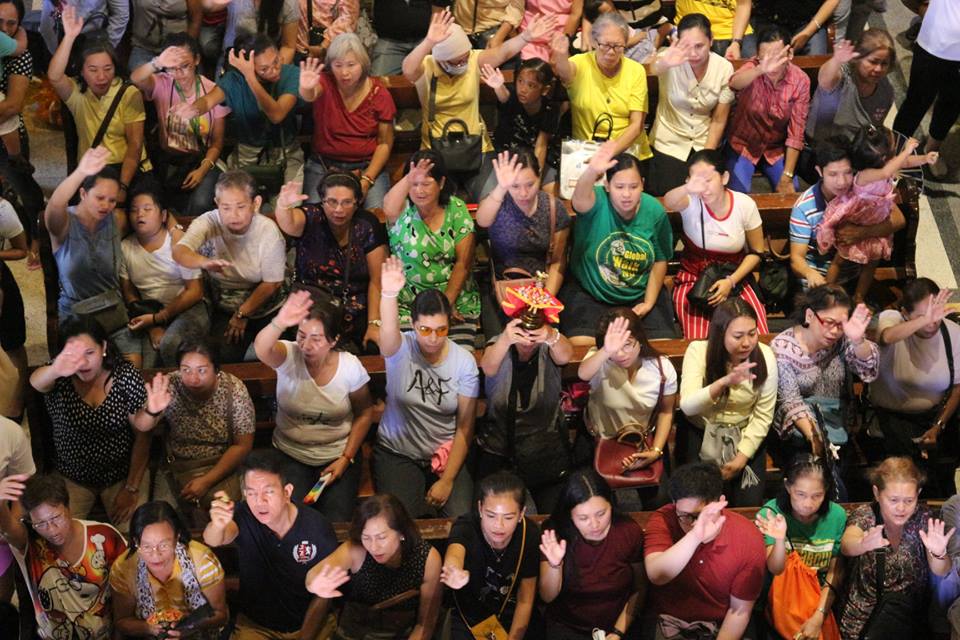
Photo from The Fatima Tribune, Red Wednesday at the Chapel of Angel of Peace, Our Lady of Fatima University, Valenzuela City, 27 November 2024.
Today I wonder,
God our Father,
what if Paul your Apostle
or Jesus Christ your Son
were to visit our church today,
what would they find out?
Would Paul be proud of us
like the Thessalonians of
his time?
We give thanks to God always for all of you, remembering you in our prayers, unceasingly calling to mind your work of faith and labor of love and endurance of hope of our Lord Jesus Christ, before our God and Father, knowing, brothers and sisters loved by God, how you were chosen… In every place your faith in God has gone forth, so that we have no need to say anything (1Thessalonians 1:2-4, 8).
Oh how I envy the Thessalonians
that Paul along with
Silvanus and Timothy
were so proud of their "faith
and labor of love
and endurance in hope";
most of all,
of their "conviction"
that he had no need
 to say anything,
as in, "walang masabi".
So beautiful!
How I wish Paul could say
the same things today to our
parish, to our community of
believers with their vibrant
faith, hope and love.
What  I dread, O Father
is when Jesus comes
and begins speaking
the same way to us
his priests and bishops:
Jesus said to the crowds and to his disciples: “Woe to you, scribes and Pharisees, you hypocrites. You lock the Kingdom of heaven before men. You do not enter yourselves, nor do you allow entrance to those trying to enter (Matthew 23:13).
Shame on us, Lord Jesus,
your priests and bishops!
If you were here today,
you would surely say the same
things to us: many of us
your priests do not pray at all
that many have forgotten to
pray properly and celebrate
liturgy meaningfully;
many would rather go on
vacation and recreation than
celebrate Mass and sacraments
for your people;
yes, Lord Jesus,
"woe to us" your servants
for many of us have no plans
of going to heaven at all with the
kind of Eucharist we celebrate
that people have lost faith
in you and your church.
Forgive us, Jesus,
your priests for being
blind fools,
following the limelight
of the world than your path
of the Cross;
lead us back to you, Jesus,
so that your flock may be
enlivened again in their
faith, hope and love
like the Thessalonians
of your great Apostle Paul.
Amen.

Fr. Nicanor F. Lalog II
Our Lady of Fatima University
Valenzuela City
(lordmychef@gmail.com)
Photo from The Fatima Tribune, Red Wednesday at the Chapel of Angel of Peace, Our Lady of Fatima University, Valenzuela City, 27 November 2024.
Salamuch again to your prayers and greetings on our priests’ day last August 4, the Memorial of our patron, St. John Baptiste Marie Vianney. With a Bible in hand in silent prayers that morning, I realized two of Jesus Christ’s important works as a priest we continue today.
First is to make God closer to people. And vice versa.
It is not my original; got it from Pope Benedict XVI’s Jesus of Nazareth series where he repeatedly mentioned Jesus Christ’s main achievement in his coming here on earth was bringing God closest to us humans. Recall how during that time in Israel when people felt God so far from them due to the legalisms of temple worship that sadly continues even in the church today that is worsened by trends in modernism like digitization that miss out the very essence of the personal aspect in our ministry of the priesthood.
Photo by author, Chapel of the Angel of Peace, Our Lady of Fatima University, Valenzuela City.
Jesus came and continues to come to us on a person to person basis. It is the foundation of our interpersonal relationships, especially for us priests. Hence, before we priests can bring God closer to others, we must be the first to be closer to him. The way priests deal with others is a reflection of the kind of relationship priests have, or do not have with Jesus. What kept the Lord so close with the people was a result of his union and intimacy with the Father. Solidarity with the poor and marginalized in the real sense is always a grace from Jesus that first comes in every priest’s intimacy with Christ in prayers.
This is the major challenge to us priests these days in an age of too much technologies that ironically set us more apart than closer with each other. We promised to be celibate to offer our whole selves for the flock but sadly, many of us have become too hyphenated with many other duties that we are more professional than personal. Some could not even affix their personal signatures on letters and documents, preferring the e-signature that is so impersonal with the usual excuse it is easier and faster, totally forgetting about our life of sacrifice in such small thing.
While we priests need to take breaks, it is a different story when the pastor becomes engrossed into sports and recreation to the detriment of the pastoral needs of parishioners. When focus is more on the minister and his needs forgetting the ministry, problems arise. Most likely, the pastor is already in a crisis like when Masses even on Sundays are passed on to other priests for dubious excuses or reasons. Watch out for those red flags among pastors of souls who are too difficult to gather for clergy meetings and sick calls but so quick in rest and recreation, especially in going out-of-town or even abroad. Watch out too when pastors are more knowledgeable in politics and telenovelas than the scriptures and the faith, when the homily is more like a sing-along concert.
The kind of our intimacy with Jesus in prayers determines the kind of our relationships with his flock entrusted to us.
According to studies, most people spend an average of seven hours a day of screen time on their cellphone. So, seven hours a day multiplied by seven days a week equals 49 hours. That means most people, including us priests, lose about two days and one hour every week by just scrolling and interacting on our cellphones! How much time is left for us, especially priests to pray and serve the parish? Some would argue that those people we interact with in our cellphones are also the same people we serve; but, whatever happened to our person-to-person interactions?
See how the gospels teem with many stories of Jesus touching, doing other gestures of personally being with the people of his time especially in healing the sick. What a tragedy that we cannot freely be that personal like Jesus with people especially children following the sex scandals that have rocked the church that was largely due to priests’ lack of a prayer life. Every genuine relationship with people starts with intimacy with God like Jesus who would always go by himself to deserted places to pray.
That is why it is also important for us priests to educate our people to value our prayer time especially at night. We priests do not have a night life. Period. We may go out sometimes with laypeople and brother priests but never all the time. Though Jesus dined with the rich and sinful during his time, it was never social in nature; his simple acts of joining meals or visiting people were always apostolic in nature that led to conversion into faithful followers of his hosts. Do we keep that apostolic character in our frequent lunch or dinner buffets in expensive restaurants that some priests post in social media without any deference to the majority of our people struggling to make ends meet?
The second important work of Christ as a priest during his time on earth we priests today must continue is to inspire and organize people in keeping his work of bringing God to people and vice versa.
How sad to see the Church has become more like a bureaucracy with some dioceses a microcosm of the Republic of the Philippines with priests and bishops acting like politicians. Maybe next to the government, the Church comes close in churning out the most documents and statements nobody reads nor cares at all to implement. Actually, there is a book on social teachings of the Church aptly called “The Church’s Best Kept Secrets”.
How can synodality happen when priests are detached from the people in the first place? This is very evident in the composition of many Parish Pastoral Councils (PPC) who are never replaced at all except only when one finally dies. Some parish workers and volunteers are as old as their parish that some of them brag “bisita pa lang ito naglilingkod na ako!”
Is it really that difficult to inspire and find new workers and volunteers in the parish? Our faith teaches us that the Lord always provides us especially with fellow workers in his vineyard. Problem is when pastors refuse – not really fail – to attract and inspire more new volunteers and workers in the parish because that will require a lot of their time and presence. A parish that does not change its sets of officers and volunteers for years and years is a dead parish. It just exists for its traditions of devotions and fiestas people see every year and are most likely so fed up too.
Photo by author, Sacred heart Novitiate, Novaliches, QC, March 2025.
This is perhaps the reason why despite our being a Christian nation that we still remain poor because even in parishes not many are given the chance to do the work of Christ. How can we imbue future leaders of both the country and the church with the gospel of Christ if we just allow a small circle, or sadly a clique involved in our parish affairs and activities? One reason Rome fell was the failure of the empire to prepare its next generation of leaders.
Likewise, “recyling” parish leaders and volunteers only continue the vicious circle among us Filipino Christians of being baptized but not evangelized. Notice how our parishes and dioceses have become mini-Republic of the Philippines that are so alive during calamities and holidays for ayudas and gifts but rarely involved in good governance and leadership or management. We priests and state officials are so good in building edifices and complex but that do not make the church nor the government at all. The more priests are personally involved with their parishioners, the more the people realize their importance in being a part and fellow builders of the Body of Christ, of the need for them to be involved in helping their pastors in bringing God to more people and in leading others to God.
Jesus gathered and formed those considered the least during his time to continue his work of bringing God closest to the people and the people closer to God. His Apostles and followers have no experiences in religion at all nor with evangelization. They simply knew how to pray and have faith in Christ above all that we priests and lay people must first do and keep on doing.
Priesthood is doing the work of Jesus Christ; it is not ours but the Lord’s. We are just his hands and limbs, mouth and body in doing his works. The good news is, Jesus our Eternal High Priest loves us so immensely that despite our weaknesses and sinfulness, he continues to call us to come to him, to find rest in him, to learn from him for he is gentle and humble in heart (Mt.11:29). Let us pray and do the work of Christ as priests with our lay people so that each day may be a Pentecost for us in the ministry. Amen.
Lawiswis ng Salita ni P. Nicanor F. Lalog II, Ika-29 ng Mayo 2025
Larawan kuha ng may-akda, St. Scholantica Retreat House, Tagaytay City, Agosto 2024.
Ito ay pagsang-ayon sa ginawang pagninilay kamakalawa ni P. Ritz Darwin Resuello ukol sa nalalapit naming lipatan ng mga pari. Malaman ang kanyang mga sinulat. At nakatutuwa ang kanyang pamagat na mayroong halong salya at padyak: GUMUGULONG LANG BA ANG ROLETA? ISANG PAGNINILAY SA NALALAPIT NA LIPATAN.
At iyon nga ang punto de vista nitong ating pagninilay din: gumugulong lang ba ang roleta sa lipatan ng mga pari?
Nakakatawa. Kasi totoo lalo nitong mga lumipas na panahon. Kung minsan nga parang hindi lang roleta kungdi tila bolang kristal na rin ang ginagamit sa lipatan.
Larawan kuha ng may akda noong Misa ng Krisma, 2025.
Hindi natin kinukuwestiyon ang pagpapasiya ng Obispo na siyang may final say ngunit gaya ng nilahad ni P. Ritz, napakinggan ba ng “may pag-galang at pag-unawa ang tunay na pangangailangang pastoral” ng parokya?
a. Pakikinig nang may paggalang at pag-unawa sa tunay na pangangailangang pastoral ng parokya: Mahalaga pong lumikha ng malugod na kapaligiran para sa lahat ng boses, lalo na sa mga direktang naapektuhan ng lipatan na ito – ang mga pari, at higit sa lahat, ang mga parokyano. Ang mga hinaing, ang mga natatanging katangian ng isang komunidad, at ang kanilang kasalukuyang pastoral na sitwasyon ay lubhang mahalaga. Ang espirituwal na kapakanan ay manatili nawang pangunahing priyoridad. Gaya ng idiniin ni Papa Francisco, ang diyalogong ito ay hindi lamang tungkol sa pagdinig kundi tungkol sa pagpapatibay ng isang tunay na pagpapalitan ng mga ideya kung saan tayo ay natututo nang sama-sama at kung saan ang bawat atas ay malinaw na tumutugon sa kung ano ang tunay na kinakailangan sa parokya (P. Ritz, aka Heinrich Atmung sa FB post, 27 mayo 2025, 8:30 ng umaga).
Noong ako ay nasa ICSB Malolos, dumating ang ilang panauhin namin na mga lingkod layko ng parokya sa UP-Diliman na pawang mga propesor sa naturang pamantasan.
Hindi tungkol sa agham at edukasyon aming naging paksa sa hapunan kungdi ang kanilang tanong: paano ba kami tinuturing at tinitingnan ng mga pari sa pagbibigay ng aming mga pastol?
Pakiramdam nila kasi na tila hindi tiningnang mabuti kanilang katayuan sa buhay bilang mananampalataya nang bigyan ng pastol na palaging naroon sa mga rally kesa nasa parokya. Bagama’t anila maraming nagrarally sa UP, hindi nila kailangan ng isa pang ralliyistang pari kungdi isang nananatili doon upang kanilang masangguni sa maraming bagay sa buhay nila ng pagtuturo at pakikisalamuha sa mga mag-aaral na mayroong natatanging pangangailangang espiritwal.
Nadarama nga ba naming mga pari ang pintig ng mga tao sa parokya? Hindi tuloy nila maiwasang magtanong bakit tila sila ginagawang “tapunan” sila ng mga paring may problema.
Iba na ang mga tao ngayon. Mulat at handang makipag-usap at suriin hindi lang mga homilya kungdi mga desisyon ng kanilang pari. They deserve nothing less, ika nga dahil nga naman sa tagal ng pag-aaral at paghubog ng mga pari bago maordenahan, pagkatapos ay puro pagpalakpak at telenovela lang kuwento sa Misa? Hinubog ang mga pari upang maging mahuhusay at masisipag sa paglilingkod kaya kawalan ng katarungan na ipapasan sa mga tao lalo na kung ituring silang maliit na parokya na puwede nang pagtiyagaan mga pari na may problema sa iba’t-ibang aspekto tulad ng pananalapi, pag-uugali, at seksuwalidad.
Kuha ng may-akda, Sacred Heart Novitiate, Novaliches, QC, 20 Marso 2025.
Nasaan ang diwa ng sinodo o sama-samang paglalakbay kung saan ay nakikinig ang lahat ng panig lalo’t higit ang mga nag-aasign ng pari? Maraming parokya nasisira dahil hindi isinaalang-alang kapakanan ng mga mananampalataya kasi nga naman yung mahusay nilang kura pinalitan ng tamad at walang pakialam o makasarili. Lahat ng pagsisikap ng naunang pari ay pilit binubura at winawasak ng sumunod na kapalit dahil sarili ang inuuna at hindi ang mga kawan. At mayroong pari na hindi maka-move on, hindi maiwanan dating parokya dahil pakiwari sa sarili ay Mesiyas!
Problema ito sa buong Simbahan maski sa ibang bansa dahil marahil sa isang pinag-uugatan: ang pagturing sa mga parokya bilang maliit o malaki, mayaman o mahirap. Hindi totoong may pangit na parokya; nasa uri ng pari iyon. Mayroong mga munting pamayanan na napapayabong ng ibang pari na tingin ng iba ay imposible.
Panahon na upang alisin sa talasalitaan ng mga pari ang label na maliit at malaki o mahirap at mayamang parokya dahil bawat pamayanan ay katipunan ng mga alagad ni Kristo. Higit sa lahat, bawat parokya ay pinanahanan ng Espiritu Santo bilang Katawan ni Kristo na dapat palaging pahalagahan ano man ang katayuan. Kung tutuusin batay sa turo ng Panginoong Jesus, iyon ngang hirap na parokya at tila pinagtampuhan ng panahon ang dapat bigyang halaga ng mga pari gaya ng mga nasa kabundukan at liblib na pook. Hindi ko malilimutan ang salita noon sa amin sa seminaryo ng dating naming Obispo na Arsobispo Emerito ng Naga, ang Lubhang kagalang-galang Rolando Tria-Tirona, “those who have less in life should have more of God.”
Ito ang sinasaad ng katagang sinodo, ang katagang palasak na ngayon ngunit hindi pa rin maramdaman dahil wala namang nakikinig at nagbibigay halaga sa bawat isa.
Kuha ng may-akda, Sacred Heart Novitiate, Novaliches, QC, 20 Marso 2025.
Usiginga… kailan nanaig kalooban ng mga kawan kesa sa kura? O ng karamihan ng mga pari kesa sa Obispo at iilan niyang upisyal?
Totoong walang demokrasya sa Simbahan sa larangan ng chain of command dahil ito ay isang hierarchy, na mayroong hanay ng mga upisyal sa pamumuno ng Santo Papa katuwang mga Obispo na kinakatawan ng mga Kura sa bawat Parokya.
Subalit, hindi ito nangangahulugang diktadura ang Simbahan. Kung tutuusin nga ay sa Simbahan dapat matagpuan ang tunay na diwa ng kalayaan na kung saan ay masinsinang tinatalakay ng lahat ang higit na makabubuti sa karamihan batay sa kalooban ng Diyos. Ito ang dahilan kaya nagpatawag ng sinodo ang yumaong Santo Papa Francisco.
Dito makikita din natin ang isang malinaw na problema ng Simbahan na hindi namin matanggap – na kaming mga pari mismo ang problema ng Simbahan. At sa Simbahan. Ngunit saka na natin iyan pag-usapan at balikan ang pagninilay ni P. Ritz na ating pinagtitibay. Wika niya muli sa kanyang FB post noong Mayo 27:
b. Pagyakap sa maagap na pastoral na karunungan: Mahalaga pong isaalang-alang kung paano nakatutulong ang bawat “assignment” sa paglago ng isang pari sa ministeryo at nagpapayaman ng kaniyang mga karanasan, laging naghahanap ng balanse sa pagitan ng mga pangangailangan ng mga parokya at ng paglago ng indibidwal na mga pari.
Mula sa cbcpnews.com.
Matalik na kalakip ng diwa ng sinodo ang kapatiran ng mga pari. Ngunit kapansin-pansin tuwing lipatan ang problema ng aming mga tampuhan at mga reklamo sa assignment. Totoo namang mayroong mga pari na namimili at mareklamo sa assignment ngunit hindi sila ang problema sa lahat ng pagkakataon tuwing may lipatan.
Ang problema ay ang sistema at patakaran – o kawalan ng mga ito.
Masakit sabihin ngunit aking pangangahasan sa pagkakataong ito na sa dalawamput-pitong taon ko sa pagiging pari, mas maayos ang lipatan at mga assignment noon kesa ngayon. Problema na rin naman noon din ngunit mas malala ngayon ang pananaw ng hindi pagiging patas o unfair sa pagpili ng mga assignment.
Hindi matatapos ang mga reklamo at hinaing sa bawat lipatan hanggat hindi naiibsan ang pananaw na ito. Hindi po salapi ang problema ng mga pari. Hindi rin naman babae o mga pogi. Ito palagi ang problema at daing natin – ang hindi patas sa maraming aspekto at pagkakataon.
Dito pumapasok ang maruming kahulugan ng “politika” sa Simbahan tulad ng barkadahan at favoritism. Mayroong napaparusahan, mayroong pinalalampas. Mayroong pinag-iinitan at mayroong kinukunsinti. Ang malungkot, mayroong mga pinangingilagan kaya pinagbibigyan lahat ng kagustuhan. Bato-bato sa langit, tamaan sapul!
Gayon pa man, on a positive note, dito makikita ang mabuti at malalim na kapatiran ng mga pari kung saan mayroong ilang maninindigan upang kausapin ang lahat kung kinakailangan alang-alang sa ilang bagay na nakakaligtaan o ayaw tingnan ng ilan sa mga kapatid naming naka-kahon na hindi makaahon sa kabila ng kanilang pag-amin at pag-ako ng kanilang pagkakasala at pagkakamali. Problema ng stigma.
Tanging hiling lang naman ng mga pari ay kausapin sila upang mapakinggan kanilang kalagayan at kalooban sa pagbibigay ng assignment. Ito yung pinupunto ni P. Ritz sa kanyang pitak. Sadya bang nasuring mabuti ang lahat ng paraan upang mapalago ang sino mang pari sa kanyang destino? Wala namang pari na likas na masuwayin kungdi ang ibig rin ay sariling ikapapanuto. Sa kabutihang-palad, mas marami pa rin ang mga paring masunurin at nagpapahalaga ng pangako ng obedience kaya sana ay naroon palagi ang fairness.
Hindi mawawala mga inggitan at siraan sa lipatan ngunit huwag mawawala ang “sense of fairness” dahil dito nakasalalay mabuting samahan at ugnayan. Susunod at susunod pa rin mga pari sa lipatan alang-alang sa obedience at faith in God ngunit palaging uusok ang isyu ng lipatan parang isang takore ng kumukulong tubig. Pakinggan natin ang sipol ng kumukulong tubig sa takore, yung tinatawag sa Inggles na tempest in teapot. Diyan pumapasok ang ikatlong punto ni P. Ritz:
c. Pagpapatibay ng malinaw at mapagmalasakit na komunikasyon: Kung posible po, ang pagbibigay ng napapanahon at “transparent” na impormasyon tungkol sa lipatan ay maaaring makapagpapagaan ng mga alalahanin at makapagpadali ng mas maayos na pagsasaayos para sa lahat – ang mga pari, kawani ng parokya, at ang mga mananampalataya. Ang isang maikli ngunit napag-isipang paliwanag ay maaaring lubos na makapagpatibay ng tiwala sa loob ng ating pamilya sa diyosesis.
Mula sa vaticannews.va.
Ang Simbahan ay komunikasyon. Kaya naman sa mga dokumento nito lalo mula nang Vatican II, sinasaad na sa Simbahan dapat masaksihan ang pinakamainam at pinakamataas na antas ng pagtatalastasan.
Ngunit taliwas palagi. Maraming pagkakataon sa mga pari kulang ang komunikasyon. Ni walang formal communication sa mga lipatan. Mayroong mga pari na atat nang lumipat na akala mo ay makikipagpalit lang ng tsinelas! Juice colored…! Kaluluwa ang pinag-uusapan habang ang antas ng aming usapan ay parang paglipat lang ng bahay kung saan ang pananaw ng ilan ay mag-impake lang ng mga gamit at damit. Kapirasong text o sulat hindi pa magawa kung hindi kayang tawagan o personal na kausapin sa mga balakin.
Kaya nga babalik tayo sa tanong ng mga tao: ano nga ba turing natin sa kanila tuwing maglilipatan kasi ang sagot dito ay siyang sagot sa tanong ano nga ba turingan naming mga pari sa isa’t isa? Hangga’t walang maayos na sagot sa mga katanungang ito, mananatili ang pananaw at paghahalintulad sa roleta na gamit sa perya ang lipatan. O bolang kristal ng mga manghuhula.
Sa diwa ng sinodo at kapatiran bilang sama-samang naglalakabay na Simbahan, patuloy tayong manalangin para sa mga pastol at kawan. At huwag din mag atubiling makilahok sa mga talakayan at usapan na ang tanging mithiin ay hanapin at sundin ang kalooban ng Diyos upang higit Siyang mapaglingkuran at masalamin dito sa lupang ibabaw. Salamuch po.
Larawan kuha ng may-akda, Chapel of the Angel of Peace, Our Lady of Fatima University, Valenzuela City, Marso 2025.
Lord My Chef Sunday Recipe for the Soul by Fr. Nicanor F. Lalog II
Sixth Sunday in Easter, Cycle C, 25 May 2025
Acts 15:1-2, 22-29 ><}}}}*> Revelation 21:10-14, 22-23 ><}}}}*> John 14:23-29
Photo by author, Chapel of the Angel of Peace, Our Lady of Fatima University, Valenzuela City, 28 March 2025.
Let us start again our Sunday reflection from the Book of Revelation where we heard last week John mentioning the word “new” four times when he saw “new heaven, new earth, new Jerusalem” coming with a voice of the Lord declaring “I make all things new” (Revelation 21:1, 2, 5).
In continuing his narration this Sunday of his visions while imprisoned in Patmos, John tells us how he not merely “saw” but also “experienced” heaven when he wrote:
The Angel took me in spirit to a great, high mountain and showed me the holy city Jerusalem coming down out of heaven from God. It gleamed with the splendor of God. Its radiance was like that of a precious stone, like jasper, clear as crystal… I saw no temple in the city, for its temple is the Lord God almighty and the Lamb (Revelation 21:10-11, 22).
I saw no temple in the city,
for its temple is the Lord God almighty
and the Lamb.
Try imagining John’s experience of heaven, almost indescribable for its beauty and majesty as the very presence of God when he specified “there is no temple in the city for its temple is the Lord God almighty and the Lamb.”
John reminds us again this Sunday that though these new heaven, new earth, new Jerusalem are the things to come at the end of time, these are already happening right now in our midst. His description of heaven like jasper and other precious stones indicate not only the incomparable beauty of heaven but the very truth that our home is in God. Thus, an invitation too for us today to live in the light of God for he dwells among us in Christ.
This “divine indwelling” has always been a part of our Catholic doctrine.
Photo by author, Cabo da Roca, Pundaquit, San Antonio, Zambales, 14 May 2025.
Recall how in the Old Testament during the chosen people’s wandering in the desert when God dwelled among them in a tent or booth called sukkoth where the Ark of the Covenant was kept. God’s presence was marked by a pillar of smoke over the tent at daytime and a pillar of fire at night. From this came their Feast of the Booths being the dwelling of God; hence, at the Transfiguration of Jesus on Mount Tabor, Peter told the Lord how they would build booths for him, Moses and Elijah as he felt they were already in heaven!
Booth or tent or temple. Or church.
These indicate the presence of God now manifest in Jesus Christ, “the word who became flesh and dwelled among us.” That is why these past three Sundays of Easter we returned to his words spoken at the Last Supper to deepen our understanding and appreciation of Easter that teaches us about our relationship in God expressed with one another.
Two Sundays ago Jesus identified himself as the Good Shepherd who knows his sheep, us; then, last Sunday he gave us his “new commandment” of love that is rooted in God, a love that leads to our communion or oneness with God like Jesus and the Father. This Sunday, Jesus deepens that relationship we all have in him in the Father which perfectly matches the vision and experience of John found in the Book of Revelation.
Jesus said to his disciples: “Whoever loves me will keep my word, and my Father will love him, and we will come to him and make our dwelling with him” (John 14:23).
Photo by author, Cabo da Roca, Pundaquit, San Antonio, Zambales, 15 May 2025.
This “dwelling” of Jesus and the Father among those who love him and keep his word is the Church, his Body which we his disciples make up.
In instructing his disciples at the Last Supper that included us today to keep his word and commandment to love, Jesus taught how this love is manifested in the Church, his Body, the indwelling of God in Jesus Christ with us his people.
Recall when the curtain in the temple was torn apart from top to bottom at his death on Good Friday that signaled the end of temple worship when people will worship in truth and in spirit as Jesus had spoken to the Samaritan woman at Jacob’s well.
When Pope Leo XIV was elected two weeks ago, one of the news that have struck me was about the presence of non-Catholics at St. Peter’s Square celebrating on that day. According to the news, the non-Catholics joined the crowds because they never felt such kind of unity where people were one in praising God, celebrating his loving presence in gifting the world – not just Catholics – with a Pope as the Vicar of Christ.
What a beautiful reality we now have of God’s dwelling among us as the Church!
Photo by author, Sacred Heart Novitiate, Novaliches, QC, 20 March 2025.
From the Hebrew concept of qahal or congregation, Jesus linked love and his dwelling with his disciples in forming a community as his Body, the new Temple he had told he would raise in three days we now call the church which in Greek is called ekklesia that literally means to lead out “ek” the people, “kaleo”. Loving and dwelling of God among us is the reality of the Church as a community of believers called to lead others out of darkness into light, out of emptiness into fullness, out of death into life in Jesus Christ – exactly what the early Church did in our first reading today when they agreed not to impose burdens on gentile converts like circumcision and other Jewish traditions.
The Church herself is a Sacrament, a visible sign of Jesus Christ’s saving presence along with the other seven sacraments we have. The challenge is how these sacraments become dynamic ways of living for us, truly a Divine indwelling and not just signs we go through.
Every Sunday in the Mass, we renew our baptismal vows as children of God, expressing our love for each other as a community, visibly the dwelling of God, making the new heaven, the new earth and the new Jerusalem not just a vision but a reality happening now. Let us pray:
Lord Jesus Christ,
dwell in us,
dwell among us
by making us follow your light
not the artificial lights of the world;
let us keep your word
by loving more like you
for where there is love,
there is God dwelling in us
because he is love himself.
Amen.
The Lord Is My Chef Daily Recipe for the Soul by Fr. Nicanor F. Lalog II
Simbang Gabi-4 Homily, 19 December 2024
Judges 13:2-7, 24-25     <*((((><  +  ><))))*>     Luke 1:5-25
Photo by author, wailing wall of Jerusalem where Jews pray until now being the section closest to the Holy Holies destroyed in year 70AD.
From Matthew, we now shift to Luke to listen to his account of Christmas which is the most complete and detailed. In fact, most artistic renditions of Christmas were inspired by Luke’s gospel.
Very surprising in his Christmas story, Luke started it with the annunciation of the birth of John the Baptist to his father Zechariah who was then serving at the temple of the Lord in Jerusalem. It is a reminder to us all these days that Advent and Christmas begin in the church, in our holy celebrations.
In the days of Herod, King of Judea, there was a priest named Zechariah of the priestly division of Abijah; his wife was from the daughters of Aaron, and her name was Elizabeth. Once when he was serving as priest in his division’s turn before God, according to the practice of the priestly service, he was chosen by lot to enter the sanctuary of the Lord to burn incense. Then, when the whole assembly of the people was praying outside at the hour of the incense offering, the angel of the Lord appeared to him, standing at the right of the altar of incense (Luke 1:5, 8-11).
Luke’s detailed account of the event is the Jewish Day of Atonement (Yom Kippur) when their priests incense yearly between September 18-24 the Holy of Holies where they used to keep the Ark of the Covenant. From this detail by Luke we got the reliable timetable in the celebration of Christmas on December 25 by considering this event as the time of Elizabeth’s conception of John who was born June 24 or nine months after. Tomorrow we shall hear in the gospel how “on the sixth month” of Elizabeth’s pregnancy which fell on March 25, the angel Gabriel announced to Mary the birth of Jesus, the Solemnity of the Annunciation we celebrate on that date. Nine months from March 25, we have December 25! Who said our Christmas date is not in the Bible? We got it here in our gospel today courtesy of Luke!
Photo by author, Parish Church of St. Joseph in Morong, Rizal, January 2021.
It may sound simple yet, it is so profound. In narrating this to us, Luke reminds us today that the Christmas story began in a holy celebration in the temple of Jerusalem now happening in our Eucharistic celebrations in every church around the world.
Many take our Sunday Masses for granted these days with so many excuses and alibis but, let us set aside all these to reflect on this simple detail from Luke’s first story on Christmas.
Photo by Mr. Jim Marpa, 2018.
First, this is a call for us all to go back to the church by finally putting a stop NOW of online Masses. Online Mass as a term is an oxymoron because it presupposes actual presence of people. There can be no virtual Mass because there is no such thing as virtual sacrament nor virtual grace. That is why God introduced Himself to Moses as “I AM WHO AM”, the One who is perfectly present, always actual never virtual.
Since the waning of the COVID virus last year, both the Pope and the CBCP have called for the ending of online Masses but unfortunately, so many priests have remained stubborn with some making “shameful profit” out of it which is strongly prohibited by Canon Law and other Church and papal documents. Unless online Masses are stopped, people will always find reasons and alibis not to go to church on Sundays.
As we reflect on Luke’s account of the celebration at that time of the annunciation of the angel to Zechariah while he was incensing the Holy of Holies, we get the feel of solemnity and sacredness that are sorely missing these days in many of our celebrations of the Mass.
Like Zechariah and the priests of the Jerusalem temple at that time who were all steeped in traditions and presumably spirituality, we have every reason to expect the same, even more, from our bishops and priests today. They are the ones who set the tone of every celebration and of life in the parish; their spirituality or lack of it is manifested in the parish life, from its building structure to its witnessing.
Photo by author, pious Jews and Rabbis in another enclosed section of the wall of the temple of Jerusalem, May 2017.
How sad when priests have lost the sense of the sacred of the Holy Mass when they disregard the solemnity of the celebration with all their antics and gimmicks; worst of all, of coming to Mass unprepared without a homily and good vestments, sometimes without having showered or shaved! What is tragic is when the priest attends all socials in proper attire, but never in the Mass.
The other day, I saw a sticker at the back of a delivery van that asks, “How’s my driving? And my grooming?” Too bad I was not able to get the name of the company of that delivery van but how great are its people must be in giving a premium on how their drivers behave and look!
Some priests shamelessly argue that what is essential is what is inside but they forget that the outward appearance is an indication of what’s inside them too. How can the people feel and experience God if their pastor comes shabbily dressed without any good vestments, so untidy as in dugyot, unprepared for the Mass, without a good homily?
What had become of our churches that have been the shining glory of architecture through the centuries but now look like malls? Some churches look like videoke bars with a lot of giant TV screens while priests serenade the people with their wonderful voices instead of delivering a homily.
How sad that many churches are untidy and ugly. Yes, ugly is the word. And kitschy, bereft of any sense of the holy that people cannot experience God except be played on their emotions with dramas and not to forget, second and third collections. Choirs are on their own with a concert, totally deaf to the fact their music is supposed to lead the congregation into prayerful reflections not to applaud them for a performance. It is about time we restore the dictum of the Roman liturgy of noble simplicity not only of the church and also of celebrations.
Photo by author, Archdiocesan Shrine of Nuestra Señora De Guia, Ermita, Manila, 28 November 2024.
Our gospel invites us today, especially us priests and bishops along with those involved in preparing our parish celebrations to be silent like Elizabeth – lest we be silenced and be made mute by the Lord like Zechariah to finally open ourselves to listen to God’s instructions about His Son’s coming.
Let’s face that sad reality of so many of us clergy and laity in the church who are like Zechariah trying to control everything including God, even playing God who give the people enough reasons to turn away from the Church completely.
Photo by author of the beautiful sacristy of the Archdiocesan Shrine of Nuestra Señora De Guia in Ermita, Manila where even a guest priest could feel at “home” with everything in order.
Like Elizabeth, let us choose to be silent in order to pray truly, awaiting God in the Holy Spirit to stir us into His Divine Plans like Samson in the first reading, “The boy grew up and the Lord blessed him; the Spirit of the Lord first stirred” (Jgs.13:24-25). We find the same thing in the gospel when Gabriel told Zechariah how John while still in Elizabeth’s womb would be filled with the Holy Spirit (Lk.1:15) in accomplishing his mission as precursor of Jesus.
If we could allow ourselves to be stirred by God first – not by fad or ulterior motives in our church celebrations – then every Mass becomes a Christmas, a coming of Christ.
Let us do away with unnecessary things in the church and in our celebrations that call attention to us, to our abilities and talents, even power like Zechariah by being more daring in silence and noble simplicity to experience God’s coming every Mass.
As we shall see in the coming days from the gospel of Luke, Christmas is both a journey into Bethlehem, Jerusalem and other places as well as into the very hearts of Joseph and Mary and of those who would recognize and accept Jesus Christ. May our churches reflect what is in our hearts as disciples of Christ, always with a space for Jesus to come and dwell inside and among us. Amen.
Photo by author, Simbang Gabi in our previous parish, 2018.
The Lord Is My Chef Daily Recipe for the Soul by Fr. Nicanor F. Lalog II
Friday, Memorial of St. John XXIII, Pope, 11 October 2024
Galatians 3:7-14     <*((((><  +  ><))))*>    Luke 11:15-26
Photo by author, Sacred Heart Novitiate, Novaliches, QC, 20 March 2024.
Lord Jesus Christ,
fill me with your Holy Spirit,
enliven my faith,
hope and love in You;
in this age of so many divisions
when we are being pulled by
the strong forces of the past
to go back to what was before
due to the excesses of modern time,
let us look for your Cross,
O Lord, to let the "finger of God"
work in us to cleanse us of
all evil and filth that make us
"scatter" than "gather".
“But if is by the finger of God that I drive out demons, then the Kingdom of God has come upon you… Whoever is not with me is against me, and whoever does not gather with me scatters. When an unclean spirit goes out of someone, it roams through arid regions searching for rest but, finding none, it says, ‘I shall return to my home from which I came.’ But upon returning, it finds it swept clean and put in order. Then it goes and brings back seven other spirits more wicked than itself who move in and dwell there, and the last condition of that person is worse than the first” (Luke 11:20, 23-26).
Let us realize,
like what St. Paul tells us
in today's first reading that
we who "have faith in You are
the children of Abraham,
that the blessing of Abraham
might be extended to the Gentiles
through Christ Jesus, so that
we might receive the promise of
the Spirit through faith"
(Galatians 3:7, 14).
Let us embrace that truth,
Jesus, that You have done everything
for our salvation,
for our freedom,
for our being children of the Father;
You have cleansed us,
come fill us with your Spirit
for us to see our similarities
not differences to build a more
humane society here on earth;
fill us with your Spirit, Jesus,
let not the bonds and shackles of sin
hold us, isolated from others,
always competing that prevent
peace in finally happening.
Help us imitate your faithful servant
St. John XXIII who convened the
Second Vatican Council to open
the windows of the Church
and welcome this modern age
so we may find You Jesus ever more
present in this changing time;
most of all, to share You, Jesus
who is still most needed
in this troubled age.

You have done everything
for us, Jesus.
Let us rest on that by
remaining in You,
doing your work
and make us stop
playing god, savior
of the world.
Amen.
Photo by Ka Ruben, new stained glass of the National Shrine of Our Lady of Fatima, Valenzuela City to be blessed on Sunday, the 107th anniversary of the last Apparition of the Virgin Mary in Fatima, Portugal.





 lordmychef.com