Lord My Chef Daily Recipe for the Soul, 22 August 2025
Friday, Memorial of the Queenship of Mary
Isaiah 9:1-6   ><}}}*> + ><}}}*> + ><}}}*>   Luke 1:39-47
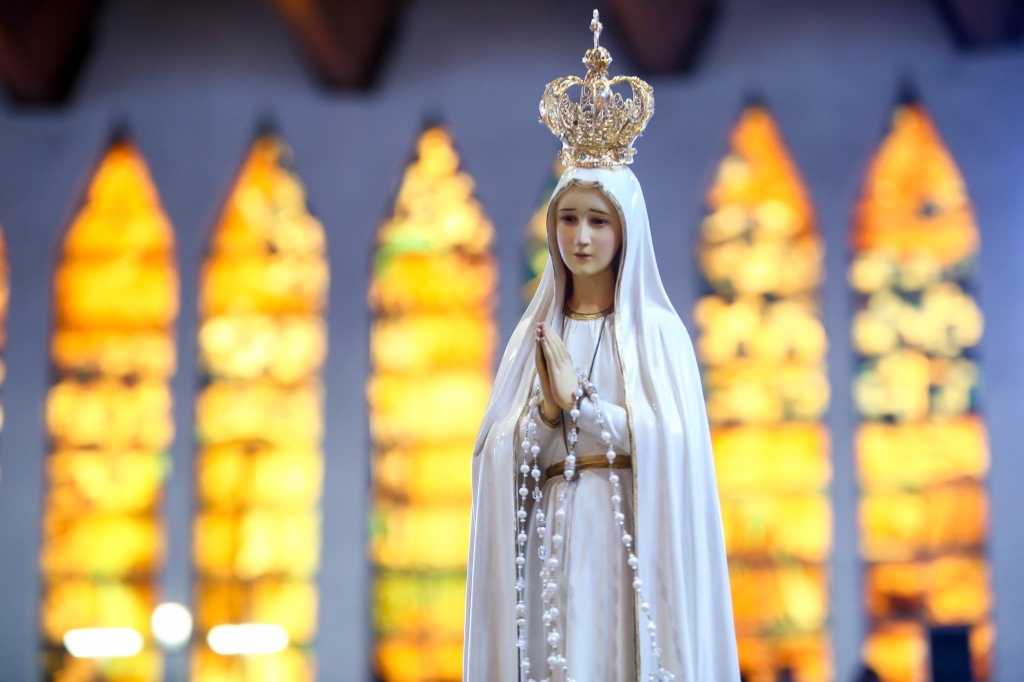
First anniversary of the Canonical Coronation of the National Pilgrm Image of Our Lady of Fatima, 25 February 2025.
Eighth days after celebrating
her glorious Assumption into heaven,
we rejoice today, O God,
for your infinite love and mercy
in giving us this Memorial of the Queenship
of the Blessed Virgin Mary;
it is a Friday, the end of school,
the end of work for most of us
and I wonder, loving Father,
what could surprise us today
like when you sent Archangel Gabriel
to Mary in Nazareth
to announce to her
the Good News?

It is raining again, Lord:
we are so drenched in bad news
for weeks while many places
are still literally under water;
we are so fed up with our
leaders who are wolves
in sheep's clothing,
now claiming to know nothing
of the scandals in either
non-existent or non-functional
flood controls.

Surprise us, O God
with your Good News.
The people who walked in darkness have seen a great light; upon those who dwelled in the land of gloom a light has shone (Isaiah 9:1).
Your light, O God,
 has never been extinguished
 despite the presence of sin and evil;
teach us to be like Mary,
humbly submitting ourselves
to you and your plan
to bring forth Jesus Christ
our true light
into this world;
surprise us,
Jesus with your grace
to say no to evil
and be firm in our yes
to what is good and just;
surprise us of your presence
in our hearts, Lord
to fill us with courage and trust
in you,
believing your words
will be fulfilled in us too;
surprise us, Jesus
with your enlightenment
to clear all doubts
and shadows
among us like Mary
sharing you with others
as our "Prince of Peace"
and "Wonder-Counsellor"
(Isaiah 9:5).
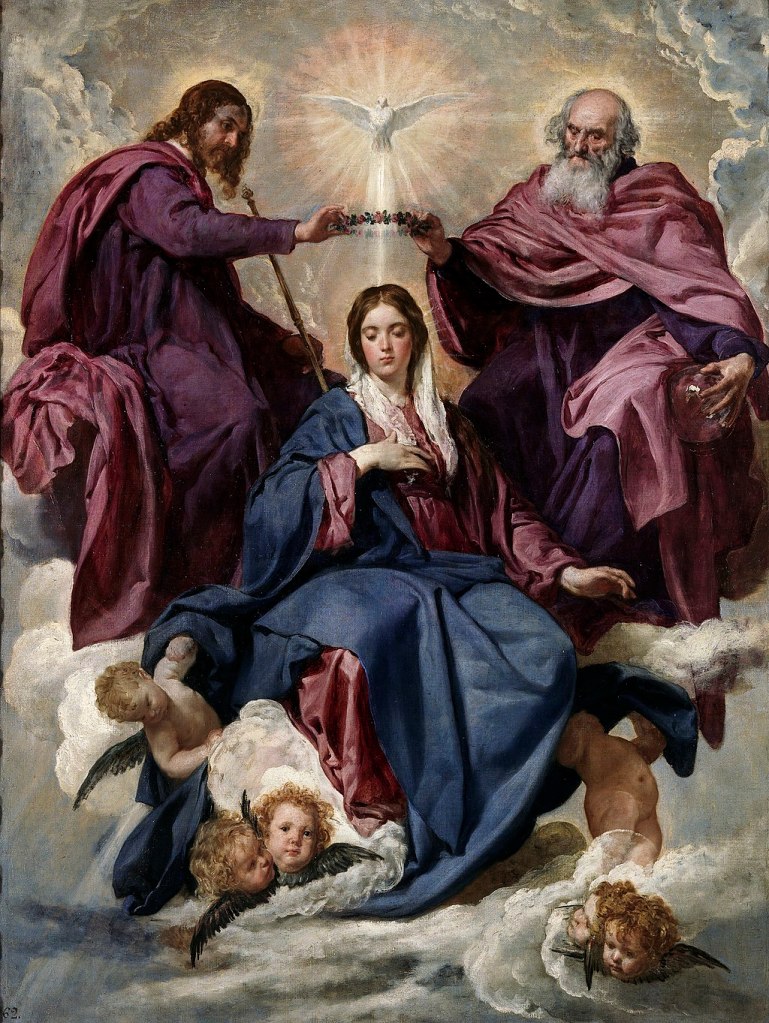
“Coronation of the Virgin” by Diego Velazquez (ca.1635/1636) from en.wikipedia.org.
O most blessed Virgin Mary,
pray that we welcome Jesus Christ
daily in our lives in order to share him
with everyone like you;
as the first of the human race in rank
before God's presence,
as the Mother of Christ our King,
you are our Queen not only as an
honor but an example of discipleship in
your Son Jesus.  Amen.

O Mary Queen of heaven,
Pray for us!
Fr. Nicanor F. Lalog II
Our Lady of Fatima University
Valenzuela City
(lordmychef@gmail.com)
The Lord Is My Chef Daily Recipe for the Soul by Fr. Nicanor F. Lalog II
Tuesday, Memorial of Our Lady of Lourdes & World Day of Sick, 11 February 2025
Isaiah 66:10-14     <'000>< + ><000'> + <'000>< + ><000'>     John 2:1-11
Photo by author, Our Lady of Lourdes Parish, Bignay, Valenzuela City, 03 February 2025.
Thank you,
dearest God our loving Father
in sending us your Son Jesus Christ
who gave us his Mother
the Blessed Virgin Mary
to be our Mother too!
From the very beginning of
his ministry to our modern time,
Mary has always been close with
Jesus who showed us your great signs
of your loving presence,
generosity and mercy,
life and joy first anticipated
at the wedding at Cana,
his first miracle.
On the third day there was a wedding in Cana in Galilee, and the mother of Jesus and his disciples were also invited to the wedding. when the wine ran short, the mother of Jesus said to him, “They have no wine.” Jesus said to her, “Woman, how does your concern affect me? My hour has not yet come.” His mother said to the servers, “Do whatever he tells you” (John 2:1-5).
From stillromancatholicafteralltheseyears.com, January 2022.
How lovely that Jesus Christ's
first sign (miracle) happened
 "on the third day" -
a prefiguration of Easter -
the fullness of your coming to us,
the fullness of our healing and salvation,
the third day after his "hour";
how prominent that
at his "hour" on the Cross,
blood and water flowed out
from Jesus' side pierced by a lance
while there at the wedding at Cana,
Jesus transformed water into
an excellent wine.
Both at Cana and at Lourdes
 there was water,
 the sign of life;
most of all,
 in both instances
 like at the Cross,
 Mary was present
bringing us healing
and joy.

At Cana,
 water became an excellent wine
 to prefigure the Lord’s Supper
 we celebrate each day in the Holy Mass
 as a foretaste of our promised glory in heaven
 while at Lourdes,
 water transformed
and healed the sick.
Photo by author, Grotto of Our Lady of Lourdes at St. Paul Spirituality Center in Pico, La Trinidad, Benguet, 06 January 2025.
Thank you
most Blessed Virgin Mary
to your witness of faith in Christ;
your example enabled us
to encounter
the gift of God in Jesus,
to create the feast of joy
of communion,
of healing,
of fulfillment
that can only be made possible
by God’s presence
and his gift of self
in Christ;
in Cana and on to Lourdes
and wherever we may be,
every day is God’s coming,
the “hour” of Jesus
in every “here” and “now”
when we experience the sign
of God’s overflowing generosity
to us all who are so tired
and exhausted
most especially
so sickly;
you, O Blessed Virgin Mary,
are the fulfillment
of Isaiah's prophecy of God
sending us a mother who shall
comfort us in moments of
sickness and darkness;
continue to help us,
most Blessed Virgin Mary of Lourdes
to get through these times
of many diseases and sickness;
get us closer to Jesus your Son
who is our true peace and joy
by doing whatever he tells us
like the servants at Cana.
Amen.
The Lord Is My Chef Daily Recipe for the Soul by Fr. Nicanor F. Lalog II
Simbang Gabi-5 Homily, 20 December 2024
Isaiah 7:10-14     <*((((><  +  ><))))*>     Luke 1:26-38
Photo by Mr. Boy Cabrido, National Shrine of Our Lady of Mt. Carmel, QC, 16 December 2024.
Last Monday at the start of Simbang Gabi, one of our priests became viral when at the recessional of their Mass while the choir was joyfully singing “Pasko na! Pasko na!”, he sarcastically sang “Hindi pa! Hindi pa!”
Many people laughed at the viral video with some commenting that Father was right because it wasn’t Christmas yet while a liturgist advised choirs to check the many choices of Advent songs now available online. But, sad to say, the people missed the whole point of the incident.
What our brother-priest did was not funny at all in putting to shame his own choir members and most of all, in destroying the solemnity of the Mass.
And the problem was not really the choir at all but the priest himself. What the priest did at the end of the Mass was a self-indictment of his lack of formation for his choir members and of any dialogue at all.
Photo by author, Advent in previous parish, 2018.
Advent is a dialogue between God and humans that led to the presence of God among us in Jesus Christ on Christmas. It is a process that continues in our own time as we are all called to be open to God and with others for dialogue like Mary in the annunciation of Christ’s birth by Archangel Gabriel.
Dialogue is more than conversing to improve relationships among people in a community or organization but a way of being with others as opposed to a way of thinking through issues and problems only. Dialogue is being present with others, of giving one’s self to feel and listen and experience the other person.
Luke shows us in his second Christmas story today how this true meaning of dialogue between God and Mary happened.
In the sixth month, the angel Gabriel was sent from God to a town of Galilee called Nazareth, to a virgin betrothed to a man named Joseph, of the house of David, and the virgin’s name was Mary. And coming of her, he said, “Hail, full of grace! Then Lord is with you.” But she was greatloy troubled at what was said and pondered what sort of greeting this might be. Then the angel said to her, “Do not be afraid, Mary, for you have found favor with God… But Mary said to the angel, “How can this be, since I have no relations with a man?” And the angel said to her in reply, “The Holy spirit will come upon you, and the power of the Most High will overshadow you. Therefore the child to be born will be called holy, the Son of God. And behold, Elizabeth, your relative, has also conceived a son in her old age, and this is the sixth month for her who was called barren; for nothing will be impossible for God” (Luke 1:26-30, 34-37).
“Cestello Annunciation” by Botticelli painted in 1490; from en.wikipedia.org.
See the artistry and genius of Luke as a storyteller. Yesterday he presented to us the annunciation of the birth of John the Baptist to his father Zechariah while incensing the Holy of Holies in the temple of Jerusalem.
Notice the great differences in the flow of conversations and dialogue in the two annunciations narrated by Luke. Both Zechariah and Mary were troubled at the coming of the angel. And who would not be in a such unprecedented event? However, there is one minute detail we find in Luke’s narration of the two annunciations that reveal something so big and deep in meaning.
According to Luke, “Zechariah was troubled by what he saw, and fear came upon him” (Lk. 1:12) while Mary “was greatly troubled at what was said and pondered what sort of greeting this might be” (Lk. 1:29). Both were troubled which is normal but their reactions differed so great with Zechariah becoming proud while Mary was humbled.
I believe that it was more than their age and differences in social status that Zechariah was simply “troubled” while Mary was “greatly troubled” but it was largely due to their dispositions and openness to God.
Zechariah was proud of his stature and of his intelligence, trying to take hold and control of everything that is why he was seized with fear. When he told the angel, “How shall I know this? For I am an old man, and my wife is advanced in years” (Lk.1:18), Zechariah was troubled and fearful because he felt challenged as a priest much respected in the community, choosing to stand proud of his position and intelligence as if having a child is all an effort of man and woman alone! There was no dialogue as Zechariah was proud that is why he was made mute by the angel. He had forgotten all about God!
Photo by author, Basilica of the Annunciation, Nazareth, Israel, May 2019.
Compare Mary’s reaction to the annunciation, “But she was greatly troubled at what was said and pondered what sort of greeting this might be.”
Luke always portrayed Mary as the listener and doer of the word, the one who ponders at the words spoken to her not only by the angel here but later at the birth of Jesus those spoken by the shepherds, then by Simeon at the Presentation and by Jesus Himself at the wedding in Cana. Mary has always been open to dialogue, to feeling the other person conversing with her. She was not concerned only with the news and information but with the persons involved.
In that sense, there is her remarkable humility and great courage at the same time. True humility is not really about being submissive but most of all being filled with courage, not with fear. Mary as the very young virgin from a poor family in a town nobody gave importance stood fearless before the angel as she took hold of herself to ponder on the words spoken to her. Despite the very unprecedented moment with an angel, Mary had that inner engagement with the words she had just heard without any violent reactions.
Photo by author, December 2018.
Unlike Zechariah, Mary was the one actually in control of herself and of her emotions. The Jedi Master Yoda of Star Wars said it so well, “fear leads to anger, anger leads to destruction”. Zechariah was afraid of losing power and control but Mary was not bothered at all. In fact, she faced the challenge head on, reflecting deep in her what is this going on? Am I awake, is this a dream would most likely be the words playing in her mind and heart. Mary had presence as she tried to feel the angel and later God that no wonder, Jesus came to her womb and we have Christmas!
The humility and courage of Mary became more evident when she said to the angel, “How can this be, since I have no relations with a man?”
She was not afraid at all to be become the Mother of God! There was already her willingness to submit, as if telling the angel, “OK let’s do it but tell me how?” whereas Zechariah was argumentative, trying to escape responsibilities? Such was the attitude too of Ahaz in the first reading, denying he won’t test God when in fact he had already aligned with other kings in the region as he feared the invading enemies near his borders.
It was at this moment when the good news became most closest to us through Mary when the angel explained of the coming of the Holy Spirit, of how the power of God would overshadow her, assuring her that nothing is impossible with God.
How wonderful is this scene for us to emulate Mary so that we experience Christmas daily in our lives, not only of God coming but being present in us and among us. Can we dare to be open before God like Mary? Have a blessed Friday!
Photo by author, Fatima Avenue, Valenzuela City, December 2024.
The Lord Is My Chef Daily Recipe for the Soul by Fr. Nicanor F. Lalog II
Prayers in the storm and after the storm, 24-25 July 2024
Photo by author, Parish of the National Shrine of Our Lady of Fatima, Valenzuela City, 24 July 2024.
We did not sleep well Tuesday night, worried with the serious impact of heavy rains to our brothers and sisters living in shanties and low-lying areas. Electricity was cut off early yesterday as we received reports of widespread flooding in the Parish. Immediately, the Parish Priest with the Parish Pastoral Council gathered dry clothings, jackets, and blankets for the evacuees in a nearby school, sending some breakfast too. This was our prayer on that rainy Wednesday:
God our loving Father,
we thank you for the rains
we have long been waiting for
to fill our dams,
to water our fields and plants,
to cool our climate;
but because of our continued
disregard for your creation
and for one another,
these blessed rains have brought
many problems too
especially floods that
are getting worse every year;
forgive us for we never learn
to respect not only nature
but especially one another;
rich and poor alike failed
to take care of each other
thinking only of one's self.
May these rains wash away
our selfishness,
cleanse our conscience
to think more of others
and enable us to finally
take concrete steps
in changing our lifestyle
as Pope Francis had long
called for in Laudato Si
so that we may finally see
our interconnectedness in this
one home and planet we call
Earth.
Amen.
Photo by author, the Fatima image we use for procession after Sunday Masses at the Shrine taking cover from the strong rains and winds yesterday.
Rains heavily poured with a lot of thunders before noon yesterday; more parishioners sent help in kind and food for the 60 evacuees near the Shrine. This we composed for our noontime prayer during that thunderstorms:
God our Father,
thank you for the midday rest
on this stormy Wednesday;
many of us are bearing with
the discomfort of no electricity,
of not being able to move around,
of idly staying at home;
forgive us for the complaints
especially when we forget there are
more who are going through severe
tests and sufferings at this time:
dilapidated and leaky homes with
still more moving to evacuation
centers; many people have nothing
at all in their pockets for these rainy days;
help us reach out to our poor brothers
and sisters especially the children
who haven’t have breakfast nor have rested
at all since last night!
Father, we pray for the daily wage earners
who could not work today
due to bad weather;
we pray also for those living alone
as well as those who could not come home.
Bless every home,
fill us with more love and kindness
to keep warm everyone in this time
of calamity.
We ask this in Jesus Christ’s name
with the Holy Spirit. Amen.

O blessed Mother Mary,
our Lady of Fatima,
Pray for us!
There was still no electricity and rains continued to pour in the afternoon with a handful people celebrating the 6PM Mass at the Shrine. Up in our rectory, our staff and PPC officers were busy preparing packed meals for the families evacuated in a nearby school. This was our prayer that afternoon:
God our loving
and merciful Father,
thank you for bringing us to the
end of this day;
thank you for the gift of life,
for the selfless people who served
in all rescue and relief efforts
for those affected by the heavy
rains that still continue;
thank you and bless those who remained
faithful to their call of duty especially
those in the police and military,
the journalists who risked their lives
to keep us informed of the situations,
our weathermen who tracked Carina
and the habagat;
most of all, we thank you
for the doctors and nurses
who came to hospitals as
extensions of your healing hands in this
time of calamity.
Keep them all safe.
Bring us all home safely tonight
guided by your light of love and care
in Jesus Christ
in the power of the Holy Spirit.
Amen.

Mary our Mother,
Our Lady of Fatima,
Pray for us.
Photo by author, Blessed Sacrament in the Chapel of Angel of Peace, RISE Tower, Our Lady of Fatima University, Valenzuela City, 26 June 2024.
Darkness enveloped the whole city of Valenzuela by nightfall as we remained without electricity but the good news of rains finally stopping with the ebbing of the floods were most welcomed news to bring joy to many among us. We continued with our prayers and this is what we shared:
Most loving Father,
many of us will not sleep tonight:
some are working overnight
to ensure tomorrow we’ll have
food and power while others are
keeping watch for everyone’s
safety and wellbeing;
bless them,
give them the strength to do their
tasks and duties,
and keep them safe.
It has been a very long,
cold, and wet day, Father;
help us set aside our worries,
to trust and hope in You
that it is always after the rains
and the storms leaves are greenest;
it is after the floods when rich top soil
are deposited, conducive for farming;
it is during calamities when love
and charity surprise us most.
Amen.

Jesus, King of Mercy,
we trust in You!

Our Lady of Fatima,
Pray for us!
Photo by author, Fatima Avenue, Valenzuela City after the storm this morning, 25 July 2024 with Our Blessed Virgin’s old statue reminding us of her motherly care.
Finally, we saw the sun at the start of this new day still with some rains and the heavy tasks of cleaning and clearing the debris left by the floods. Will we ever learn to respect nature which is actually an expression of our respect for each other too?
Our prayer after the storm:
Praise and glory to you,
God our loving Father!
Thank you for this new day,
thank you for the gift of life,
thank you for guiding us
during these stormy days.
Bless our doctors and nurses,
the selfless volunteers and staffmembers
of rescue and emergency units
along with our police and military
personnel as well as the weathermen
who continue to work and serve us
today after the storm.
Help us to do better
in responding to emergencies
next time while we finally learn
to change our lifestyles in caring
for the environment and ultimately,
for one another.
Let us appreciate
each one’s giftedness
in Christ Jesus our Lord
as we celebrate life
in the Holy Spirit
today.
Amen.

Our Lady of Fatima,
Pray for us!
St. James the Great,
Pray for us!
Photo by author, Fatima Avenue, Marulas, Valenzuela City, 25 July 2024.
The Lord Is My Chef Daily Recipe for the Soul by Fr. Nicanor F. Lalog II
Friday, Feast of the Visitation of the Blessed Virgin Mary, 31 May 2024
Romans 12:9-16     ><]]]]'> + >>]]]]'> + >>>]]]]'>     Luke 1:39-56
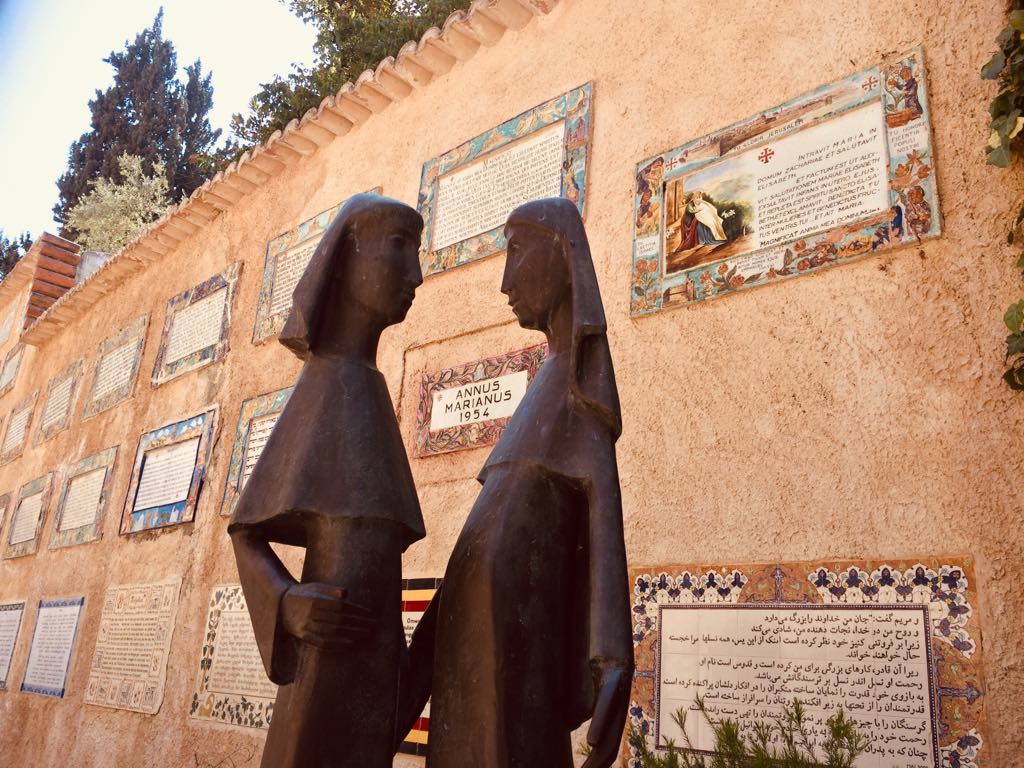
Photo by author, statues of Mary and Elizabeth at the Church of the Visitation in ein-Karem, the Holy Land, May 2017.
What a lovely way to end the month with this feast of the Blessed Virgin Mary’s Visitation of her cousin Elizabeth after starting off May on its very first day with another feast, St. Joseph the Worker that remind us of God’s coming to us in Jesus Christ.
Visit and visitation may seem to be one and the same, sharing the common Latin root word of the verb vide, videre “to see” from which came the word video.
But, a visit is more casual and informal without intimacy at all. We say it so well in Filipino, napadaan lang or just passing by which is more concerned with the place or location and site, not the person there. Napadaan lang ako kaya dinalaw na rin kita (I was just passing by and decided to see you). There was really no intention in seeing the other person there.
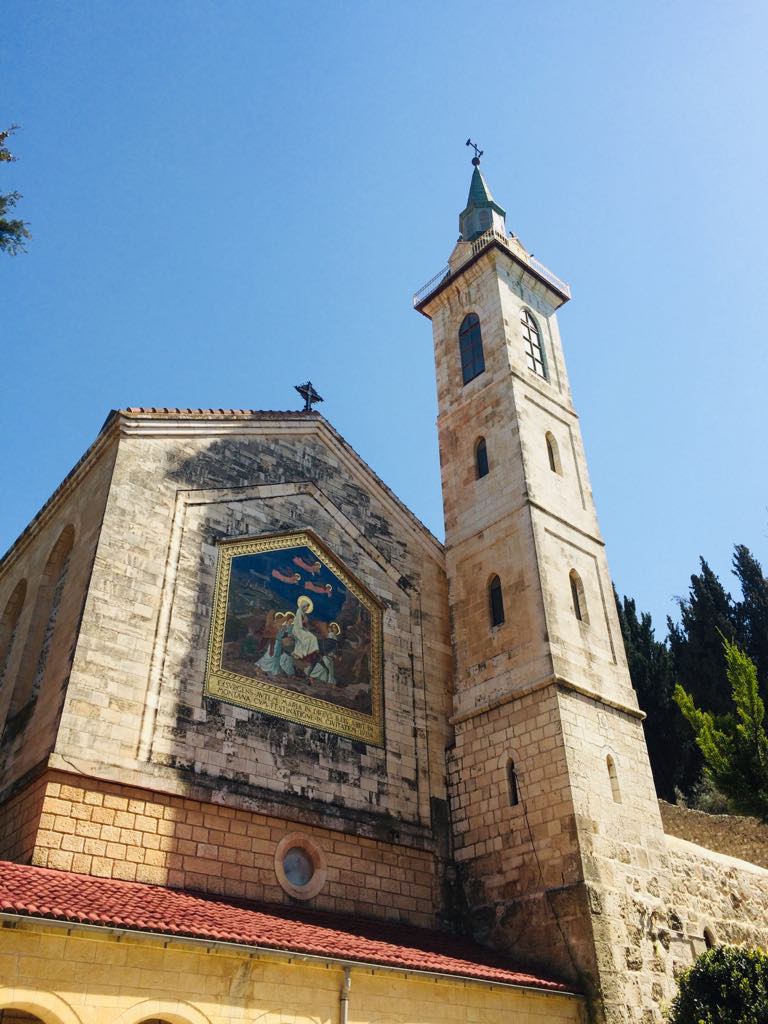
Photo by author, Church of the Visitation, Ein-Karem, Holy land, May 2017.
Visitation is more intentional. Mr. Webster described it as a more formal visit commonly used in church language like when bishop and priests come to see their parishioners. This explains why we refer to a chapel as a visita which is actually a small church in remote places that missionaries used to visit for the sacraments. Likewise, visitas became venues too for catechism classes and other religious even social gatherings in places far from the town itself where the parish is usually situated too.
Thus, visitation connotes a deeper meaning because there is an expression or implication at least of care and concern among the people, a kind of love shared by the visitor like Mary to the one visited, Elizabeth.
Visitation is more of entering into someone’s life and personhood as reported by Luke in Mary’s visitation of Elizabeth when “Mary entered the house of Zechariah and greeted Elizabeth” (Lk.1:40). There was a communion and sharing of their common experience of being blessed with the presence of God in their wombs.
Visitation is a sharing, a oneness in the joys and pains of those dear to us. The word becomes more meaningful when we examine its Filipino equivalent pagdalaw from the root word dala or something you bring like food or any gift when visiting relatives and friends. What you bring or dala is called pasalubong from the root salubong that literally means “meeting” or “encounter”. When the visitor and ones visited meet, they salubong.
Here it becomes more colorful and meaningful because more than the gifts we bring or dala in our visitations, we bring our very selves as a gift of presence. In every visitation, it is our very selves we gift, we share with those we visit, offering them our time and talent, joys and sadness and ears and heart to listen to their stories and absorb their woes and whatever they may have to unload upon us.
Photo by author, 2019.
That was what Mary did exactly in her visitation of Elizabeth with an extra gift, the most precious pasalubong to share with everyone, Jesus Christ in her womb, right in her very self and body!
We too are invited every day to be like Mary, a bringer or taga-dala of Jesus Christ to everyone we meet, the best pasalubong we can share with everyone. If we can only be like Mary in our dealings with others, trying to make every encounter a visitation that is a willful bringing and sharing of Christ with others, then we also bring with us God’s tenderness and mercy for this dark world that admires toughness and roughness.
How sad are those news of daily road rages happening almost everywhere, many times resulting in the loss of lives like the recent fatal shooting of a family driver in Makati.
Through the Blessed Mother’s humility and obedience before God, Christ came into the world to make us experience the Father’s tenderness in the many healings and miracles He performed. This tenderness of God in Jesus we saw too in Mary His Mother in the Visitation: Mary visited Elizabeth because she knew and felt her many wounds who for a long time bore no child, living in “disgrace before others” as she had claimed (Lk.1:25). A tender person like Jesus and Mary is one who comes to comfort and heal the wounds of those hurt in life, trying to lullaby the restless and sleepless, never adding insult to injuries.
Photo by author, Sacred Heart Novitiate, Novaliches, QC, 20 March 2024.
One last thing about the Visitation of Mary to her cousin Elizabeth. One of the best things we can experience from visitations and visits of family and friends like during wakes and funerals is that quality of sweetness.
Sweetness always goes with tenderness. It is the essence of God who is love. Anyone who loves is always sweet that always comes naturally from within, bringing out good vibes. It is never artificial like Splenda, always flowing freely and naturally that leaves a good taste and feeling to anyone.
In the Hail Holy Queen, Mary is portrayed as “O clement, O sweet Virgin Mary” to show her sweetness as a Mother. Recently I have seen some posts making a meme (?) of the Hail Holy Queen’s part that says “to you do we cry poor banished children of Eve”. I have not really dealt it with much attention because too often, there are a lot of generation gaps in many posts in social media; I really cannot relate much to the young perhaps due to my age. I just hope that post on the Hail Holy Queen is not derogatory. Back to our reflection…
Tenderness and sweetness are the most God-like qualities we all have but have unconsciously buried deep in our innermost selves, refusing them to surface because of our refusal to love for fears of getting hurt and left behind or lost. When Mary heard Elizabeth’s pregnancy, she simply followed her human and motherly instincts that in fact so Godly that she went in haste to hill country of Judah. How lovely!
Tomorrow it is already June, reminding us all we are halfway through the year. And it would be surprisingly quick that soon, it is already Christmas again! This feast of the Visitation reminds us of Mary’s great role in making Christmas a reality when God almighty became human, little and vulnerable like us to experience His sweetness and tenderness in Jesus Christ. Through Mary.
Let us pray:
God our loving Father,
thank for coming to us,
for staying with us,
not just visiting us;
help us imitate Your Son
Jesus Christ's Mother,
the Blessed Virgin Mary
whose "love is so sincere",
loving one another like Elizabeth
with "mutual affection,
showing honor,
fervent in spirit,
serving the Lord;
help us imitate Mary
to always rejoice in hope,
endure afflictions and
most of all, persevere in prayer"
(cf. Romans 12:9-12)
so we may always bring
Jesus Christ with everyone
we meet.
Amen.
From cbcpnews.net, 13 May 2022, at the Parish of the National Shrine of Our Lady of Fatima, Valenzuela City.
The Lord Is My Chef Easter Recipe by Fr. NIcanor F. Lalog II
Monday, Solemnity of the Annunciation of the Lord, 08 April 2024
Isaiah 7:10-14, 8:10 ><}}}}*> Hebrews 10:4-10 ><}}}}*> Luke 1:26-38
Photo by author, Our Lady of the Poor, Sacred Heart Novitiate, Novaliches, QC, 20 March 2024.
You ended it,
O blessed Mother with
"Behold, I am the handmaid
of the Lord.
May it be done to me
according to your word"
and it all set us to an
ever new beginning
happening daily
with your Son Jesus Christ's
coming!
God and man
too far apart from each other
before because of the Fall
are now so close
and near with each other
when you,
O blessed Virgin,
said yes
to His Holy Will
so that the promise of old
is fulfilled.
Brothers and sisters: It is impossible that the blood of bulls and goats take away sins. For this reason, when Christ came into the world, he said… “behold, I come to do your will, O God.” By this “will,” we have been consecrated through the offering of the Body of Jesus Christ once for all.
Hebrews 10:4, 7, 10
Chapel of Della Strada, Sacred heart Novitiate.
Pray for us,
our Mother Mary
that like you
we may be open
always to God's will,
intently listening to His voice
and most of all
obeying His word
so that like you,
we may bring Jesus Christ
to this world,
be enfleshed
in us to become His presence.
Amen.
The Lord Is My Chef Daily Recipe for the Soul by Fr. Nicanor F. Lalog II
Monday, Solemnity of Mary, Mother of God, 01 January 2024
Numbers 6:22-27 ><]]]]'> Galatians 4:4-7 ><]]]]'> Luke 2:16-21
Photo from Tetra Images/Getty Images, mosaic of Virgin Mary and Jesus in the Haghia Sophia, Istanbul, Turkey.
Just like this Christmas, we start our new year reflection with another song, also controversial for some Catholics in the US, composed by two Protestant songwriters in 1994 that had become a hit this 2023 following a cover by Pentatonix.
The song is Mary Did You Know with these following lines that say:
Mary, did you know that your baby boy Would one day walk on water? Mary, did you know that your baby boy Would save our sons and daughters? Did you know that your baby boy Has come to make you new? This child that you delivered, will soon deliver you
Before Vatican II, January first being the octave of Christmas was the feast of the Holy Name of Jesus when he was circumcised and given with that name as instructed by the angel both to Mary and to Joseph.
Yes, Mary was not totally unaware, that she knew some things about Jesus, his identity as Son of God, as the Savior and Messiah. But, she knew nothing really in particular or details like what the song says in Mary Did You Know that is why we find it so appropriate in today’s celebration of the Solemnity of Mary, Mother of God.
Photo by author, St. Scholastica Retreat Center, Baguio City, August 2023.
The only thing Mary clearly knew about her child born on Christmas Day was the name to be given him, Jesus which means “God saves”. Aside from that, there was nothing else she knew.
She never knew how Jesus would die, that he would be betrayed by one of his own apostles. She never knew Jesus would perform all those miracles like feeding thousands of people from five loaves of bread or healing the sick, restoring sight of the blind, or bringing back to life the dead.
Mary did not know Jesus would walk on water nor change water into wine. All she knew was Jesus is the Messiah. And she believed with all her heart that she followed him all throughout his ministry until his death on the Cross, one of the only three followers of Jesus who remained with him when the rest fled.
After the Ascension, Mary remained with the Apostles in praying and serving, being present with them during the coming of the Holy Spirit on Pentecost day.
Like the Blessed Mother Mary when Jesus was born, we know nothing at all of what will really happen to us this 2024. It is totally useless and insane – even sinful – to consult fortune tellers and go with all those superstitious practices every new year to make it a favorable and auspicious one for us.
Photo by author, Sacred Heart Novitiate, Novaliches, QC, March 2023.
Hence, we celebrate every January first not the New Year but the Motherhood of Mary to commemorate the Blessed Virgin’s role in cooperating with God’s plan in putting into action the mystery of salvation in the Incarnation of his Son Jesus Christ.
Like Mary as modern disciples of Christ, we are called first to cultivate within us that intimacy with Christ, of immersing ourselves in his words in a prayer life reflected in our lives. Luke said it perfectly:
And Mary kept all these things, reflecting on them in her heart.
Luke 2:19
It was not the first time that Mary “kept” things and words in her heart. First was at the Annunciation when she simply yes said to the angel and then at the Presentation when Simeon spoke of the coming mission of Jesus and her own suffering too as a consequence.
Mary remained silent and kept all those words in her heart. And when Jesus was 12 years old after he was lost and later found in the temple, Mary did not understand his words but simply kept them in her heart, reflecting very well on their meanings, trying to find God’s will and her role to play in the mission of Jesus.
“The Finding of the Savior at the Temple” painting by William Holman Hunt (1860) from en.wikipedia.org.
I love that expression of Luke, of Mary reflecting in her heart. In this age of modern technology like cellphones, we have forgotten the fact that our hearts are the best and most reliable “memory bank” in the world.
Instead of keeping pictures and videos and voices in our phones and other gadgets including iclouds, let us keep things in our hearts by savoring our experiences, reflecting on their meanings that will surely enrich us as persons and most of all as disciples of Christ.
No matter how big are the storage capacities of our gadgets, they are all prone to corruption and lost. But those stored in our hearts are guaranteed to stay, even if our brain cells suffer short circuits due to Alzheimer’s and other disorders that impair our memory because what can never be erased nor deleted in us are the memories of being loved.
We will never know everything in life ahead but we can all be assured we are loved by God. The more we experience Jesus Christ like Mary, the more we find God indeed is our loving Father – Abba as St. Paul said in the second reading. Again, please forgive me, for mentioning the movie Firefly.
From GMA Films & GMA Public Affairs.
Yesterday in the Feast of the Holy Family, I reflected on how the child named Tonton became the Christ-figure in that movie who showed the light of life and love to his three co-journeyers to the fantasy island; today let us reflect on his mother Elay played by Ms. Alessandra de Rossi.
After seeing her performance in Firefly, I am now convinced Ms. Rossi is in indeed an actress. A very good one.
I first saw her in the comedy romance Kita Kita about ten years ago maybe. In Firefly, Ms. Rossi’s performance was truly impressive that one could feel her presence in the whole story even in those parts of her narrations. It is amazing how the movie remained faithful to the story line and graphics of the award-winning children’s story book that made it so appealing.
Like Mary, Elay did not know everything from the very start, especially after she had killed in self-defense her abusive husband in their former home in the island when Tonton was still a child (sorry). They went to Tondo to begin anew in her life with Tonton in a place I believe we used to call when I was still a reporter as Isla Puting Bato, a protruding land into Manila Bay and home to thousands of informal settlers – the poorest of the poor who could not even afford electricity.
The genius and artistry of the film is found in how in the dark realities of the life of Elay and Tonton – she stricken with breast cancer, so poor in the slum area while he a favorite of the bullies – still looked so light, so promising not only with the great cinematography and effects but most of all of that deeply ingrained love of mother to her child.
Parang anak talaga ni Elay si Tonton sa Firefly kaya nakakaiyak.
From GMA Films & GMA Public Affairs.
She warned Tonton that in life, it is inevitable that separation could happen like death. But, what would keep us all together even after death is love. At the end of the film, when Tonton already an adult about to receive an award for his short story, a butterfly appeared, presumably his mother Elay. He then discarded of his prepared speech and spoke instead from his heart of the great love for him by his mother.
It is the kind of motherhood of Mary to Jesus and to us today, she still appearing to remind us of going back and being converted to her Son our Lord, of being faithful, of being loving.
In celebrating this Solemnity of Mary Mother of God at the start of the New Year, we are reminded to be like Mary to faithfully and lovingly bring forth Christ into this world so badly needed these days. In this celebration, may we imitate Mary in lovingly serving others, of being the face of God (first reading) especially to those who have never known him because they have never felt being loved at all.
Like Mary, we do not know what will happen this 2024 but we all know, and we are so sure, that God loves us that he had given us his Son Jesus Christ so that not one among us shall perish but gain eternal life. Amen. A blessed new year and still, a merry Christmas to you!
The Lord Is My Chef Daily Recipe for the Soul by Fr. Nicanor F. Lalog II
Friday, Misa De Gallo VII, 22 December 2023
1 Samuel 1:24-28 <*[[[[>< + ><]]]]*> Luke 1:46-56
Photo by author, RISE Tower, Our Lady of Fatima University, Valenzuela City, 13 December 2023.
As a chaplain of our university with six campuses and two medical centers, I have always emphasized to our deans and program coordinators that I strongly advocate a “one-party system” every December – just one Christmas party each day for me!
You know very well that we are really back to normal with the many parties going on since the start of December though, we are still strongly urged to take all necessary precautions for COVID is still with us.
Next to all the food and raffles in every party, there are always the singing and dancing that make these occasions so wonderful.
But I hope that amid all these fun and celebrations, we do not forget the other side of Christmas, of those in pain and suffering this season: those who are sick or taking care of a sick loved one, those grieving at the loss of a beloved, the poor and marginalized.
Photo by author, Fatima Avenue, Valenzuela City, 13 December 2023.
That is why I cannot stop sharing with you too the beautiful gesture of our Administrators last Monday in hosting an Appreciation Dinner last Monday for our employees in their senior years, those 60 and above still working, still teaching. I was not able to join them but have heard feelings of fulfillment, deep joy, and gratitude with a lot tears rolling in the eyes of those honored for their service, dedication and passion all these years. They all felt so special that aside from our Christmas party last December 8, there was another party hosted in their honor.
I remembered how when I was still assigned in our diocesan school in Malolos 25 years ago how we taught our students to set aside a certain amount of their budget for their Christmas party so they can host a party too for students in some selected public schools, complete with gift-giving. We wanted to instill in them the spirit of love and charity by thinking always of others during this season.
While we are singing and dancing in our Christmas party, let us not forget those who could not even go to parties because of their poverty, sickness and other limitations. See how the Blessed Virgin Mary taught us this important aspect of sharing Jesus Christ concretely during this Christmas when she visited her cousin Elizabeth.
“My soul proclaims the greatness of the Lord, my spirit rejoices in God my savior. For he has looked upon his lowly servant. From this day, all generations will call me blessed: the Almighty has done great things for me, and holy is his Name. He has mercy on those who fear him in every generation. He has shown the strength of his arm, and has scattered the proud in their conceit. He has cast down the mighty from their thrones and has lifted up the lowly. He has filled the hungry with good things, and the rich he has sent away empty. He has come to the help of servant Israel, for he has remembered his promise of mercy, the promise he made to our fathers, to Abraham and to his children forever.”
Luke 1:46-55
Photo by author, Fatima Avenue, Valenzuela City, 13 December 2023.
In a certain sense, the Visitation was like a Christmas party of the Blessed Virgin Mary and her cousin Elizabeth. There was great rejoicing in their getting together as we have reflected yesterday.
Today we heard Mary singing her praises to God in Magnificat as a response to the praises she received from Elizabeth on her Visitation. Notice that instead of returning Elizabeth’s gesture like most of us would do in our “mutual praise club” especially during parties, Mary praised God through her Magnificat his outpouring of love not only to her and Elizabeth but to the whole nation of Israel.
Actually, the Magnificat was composed by St. Luke he placed on the lips of the Virgin Mary. It is a part of his artistry, of putting songs on the lips of some of his Christmas characters like Zechariah after John’s circumcision and later on Simeon at the Presentation of Jesus in the temple.
Why? Because singing, like dancing, is the highest expression of our feelings to the one we love. Mothers sing lullabies to their infants, suitors compose and sing songs to their beloved, and we Filipinos sing and dance in whatever mood we are wherever we may be! There is always music in us from the simple gesture of washing the dishes, ironing of clothes to driving and taking a shower. When we sing and dance, we show what’s inside us as well as who we are.
Photo by author, 2019.
In singing the Magnificat which St. Luke patterned after a similar song by Hannah at the birth of her son the Prophet Samuel who’s story we heard in the first reading, the Blessed Virgin Mary expressed her joy and gratitude in the nearness of God among us not only with the coming birth of her Son Jesus Christ but also through her!
All those great things done by God to Israel as per the Magnificat – “mercy on those who fear him, showing the strength of his arm, scattering the proud in their conceit, casting down the mighty from their thrones, lifting up the lowly, filling the hungry with good things, sending the rich away empty, coming to the help of Israel, for he has remembered his promise of mercy” – happened not only in the coming of Jesus Christ but every time we share and proclaim him in words and in deeds like Mary.
The late Fr. Raymond Brown, one of the great biblical scholars of our time noted in his classic “Birth of the Messiah” that Mary as the first Christian is teaching us the essential task of every disciple of the Lord, that is, after hearing the word of God and accepting it, we must share it with others, not by simply repeating it but by interpreting it so that people can see it truly as the good news.
How are we interpreting the message of Christmas this Advent so that people would realize Jesus has come?
I hope this beautiful poem from another blog I have found a long time ago could help you sing and dance like Mary the Magnificat this Christmas.
Photo by author, Fatima Avenue, Valenzuela City, 08 December 2023.
1 Corinthians 13 Christmas Style
by Sharon Jaynes
(https://sharonjaynes.com/1-corinthians-13-christmas-style/
If I decorate my house perfectly with lovely plaid bows,
strands of twinkling lights,
and shiny glass balls,
but do not show love to my family – I’m just another decorator.

If I slave away in the kitchen,
baking dozens of Christmas cookies,
preparing gourmet meals, and arranging
a beautifully adorned table at mealtime,
but do not show love to my family – I’m just another cook.

If I work at the soup kitchen,
carol in the nursing home,
and give all that I have to charity,
but do not show love to my family – it profits me nothing.

If I trim the spruce
with shimmering angels and crocheted snowflakes,
attend a myriad of holiday parties,
and sing in the choir’s cantata
but do not focus on Christ, I have missed the point.

Love stops the cooking to hug the child.

Love sets aside the decorating to kiss the husband.

Love is kind, though harried and tired.

Love doesn’t envy another home that has coordinated Christmas china and table linens.

Love doesn’t yell at the kids to get out of your way.

Love doesn’t give only to those who are able to give in return,
but rejoices in giving to those who can’t.

Love bears all things, believes all things, hopes all things, and endures all things.

Love never fails.  Video games will break; pearl necklaces will be lost; golf clubs will rust.
But giving the gift of love will endure.
The Lord Is My Chef Daily Recipe for the Soul by Fr. Nicanor F. Lalog II
Thursday, Misa de Gallo VI, 21 December 2023
Zephaniah 3:14-18 <*{{{{>< + ><}}}}*> Luke 1:39-35
Photo by author, bronze statues of the Blessed Virgin Mary and St. Elizabeth, Church of the Visitation at Ein-Karem, Israel, April 2017.
For the third straight day since Tuesday until Saturday morning at the end of our Christmas novena, all our gospel readings will be from St. Luke, the only evangelist with the most “comprehensive coverage” of the first Christmas following his extensive research on Jesus Christ’s life and teachings (cf. Lk.1:1-4).
Hence, his gospel has the most stories and parables than the gospel accounts of Mark and Matthew. Most of all, St. Luke’s gospel account has two distinctive characteristics that showed Jesus always at prayer while at the same time gave special emphasis on women like the Blessed Virgin Mary. You must have noticed this by this time since Tuesday when we began listening to his infancy narrative.
Mary set out in those days and travelled to the hill country in haste to a town in Judah, where she entered the house of Zechariah and greeted Elizabeth. When Elizabeth heard Mary’s greeting, the infant leaped in her womb, and Elizabeth, filled with the Holy Spirit, cried out in a loud voice and said, “Most blessed are you among women, and blessed is the fruit of your womb.”
Luke 1:39-42
Photo by author, mural on the apse of the Church of the Visitation at Ein-Karem illustrating the Visitation (left panel) and how the angel helped St. Elizabeth hid the infant St. John the Baptist after King Herod ordered the murder of all children aged two and below.
It is rare in the Bible to find two women presented positively together in a single scene. Very often especially in the Old Testament, there is always a sort of animosity among them due to the prevailing patriarchal points of view of the time.
The only instance two women were presented together in good terms in the Old Testament is in the Book of Ruth that still hinted some sense of superiority of Naomi over her daughter-in-law Ruth who was like her a widow but childless.
Therefore, this scene of the Visitation only St. Luke has is a gem in itself as it speaks eloquently of the important place of women in God’s plan of salvation. It beautifully portrays to us the joy of two great women filled with God and humble before him, affirming and acknowledging the two great men in their wombs about to change the course of human history: Elizabeth with John the Baptist who would prepare the way of the Savior, Jesus Christ in the womb of Mary.
Photo by Mr. Boy Cabrido, Our Lady of Mt. Carmel, QC, Misa de Gallo, 18 December 2023.
The story of the Visitation reminds us how God works mysteriously in everyone without exceptions by linking or interconnecting us with each other in Jesus Christ our great Mediator and Savior. How lovely to see in this instance how John and Jesus already performing their mission even while in the womb of their mothers, of bringing together people. What a wonderful illustration of women as God’s vessels and carriers!
In both Mary and Elizabeth, we now “shout for joy” as Zephaniah prophesied in the first reading at how God saved us when he “removed the judgment against you, he has turned away your enemies; the Lord, your God, is in your midst, a mighty savior, who will rejoice over you with gladness, and renew you in his love… so that no one may recount your disgrace” (Zep. 3:14,15,17, 18).
Do we truly share in this shout for joy for the women of the world, for the women among us? How sad that until now women continue to suffer from all kinds of abuses not only from men but even from their fellow women.
Some spiritual writers say God is more like a woman because whatever was lacking in man, God put it in her. Perhaps that is why it is the woman who completes every man – including with us priests! But sadly, as we speak a lot about synodality in the Church these days, it is often among us priests with whom women are often taken for granted, and worst, abused.
One problem directly related today with how we regard women is the great number of people especially the youth trapped in the insidious effects of pornography due to prevalence of social media. At its core, the problem and evil with pornography is the failure of so many to recognize the lack of respect for women who are created equal with men in the image and likeness of God.
St. Joseph showed us the other day that true holiness is expressed in the way we respect women. According to an article by Papal Preacher Cardinal Cantallamessa I have read two decades ago where he cited a Dominican biblical scholar who’s name I could not recall, “the way we treat and regard women is a reflection of our relationship with God”.
That is very true.
When I review my life, I have found God making so many ways to lead me into the priesthood through the many women I have met and known, and many of them have remained my “bestest” friends like the three former executives of GMA-7 News Department who asked me to guide them in their Holy Land pilgrimage in Easter 2017.
Photo by author, Church of the Visitation, Ein Karem, Israel, April 2017.
It was my second Holy Land pilgrimage but my first time to visit the beautiful Church of the Visitation in Ein Karem.
Outside that lovely church are two bronze statues of Elizabeth and Mary conversing on how God had blessed them with sons under unique circumstances: Elizabeth was too old and barren while Mary was too young, a virgin, not yet married with Joseph.
What a beautiful reminder of God coming to us through women!
While there at Ein Karem, I prayed for all the women I have loved and have loved me before, all the women who have blessed me and have taken care so well of my vocation to the priesthood. I thanked God for the women like Elizabeth who have blessed me in believing that what was spoken to me by the Lord would be fulfilled in the priesthood. Blessed are the women who like Mary have helped me see the women’s perspectives that made my priesthood more complete especially in dealing with feminine issues. The women who taught me how to respect differences, to feel the society’s bias against them, and most especially feel their deep pains when they shared with me their ordeals of abuse and rape.
Let me end this reflection with an unforgettable anecdote at the funeral Mass for the mother of our late Bishop Jose F. Oliveros in Quezon province about ten years ago when he recalled how his mother held his right hand while still a child, and taught to make the sign of the Cross. On her deathbed, it became his turn, as a priest and a bishop, to hold his dying mother’s hands to make the sign of the Cross.
Hail to all women and mothers in the world who bring life into this dying world with their joy and perseverance, artistry and simplicity, warmth and presence of God almighty. May this story of the Blessed Virgin Mary’s Visitation of St. Elizabeth teach us to always respect women for they are the carriers of God to us. Amen.
The Lord Is My Chef Daily Recipe for the Soul by Fr. Nicanor F. Lalog II
Misa De Gallo V, Wednesday, 20 December 2023
Isaiah 7:10-14 <*((((>< + ><))))*> Luke 1:26-38
Photo by author, flower garden outside the Basilica of the Annunciation, Nazareth, Israel, May 2019.
Experts tell us that much of human communications are non-verbal in nature. And most often, people rely more to our non-verbal than verbal communication because it is more truthful by nature as actions speak louder than words.
For our reflection this fifth day of our Christmas novena, let us examine the two kinds of non-verbal communications employed by St. Luke to portray God’s immense love for us as well as his sublime uniqueness as perfect communicator. These are proxemics or the communication of spaces, of how places are designed or designated to convey something special and profound. The second i which is the use of time in non-verbal communication like time perceptions of punctuality, willingness to wait, and, “timing”.
Photo by author, Basilica of the Annunciation, Nazareth, Israel, May 2019.
See how St. Luke extensively employed these modes of non-verbal communications in his infancy narrative to show us that God is everywhere, any time.
In the sixth month, the angel Gabriel was sent from God to a town of Galilee called Nazareth, to a virgin betrothed to a man named Joseph, of the house of David, and the virgin’s name was Mary.
Luke 1:26-27
Right away St. Luke established here the direct correlation between John the Baptist and Jesus Christ, of how their respective mission are directly linked with each other that our Lord was conceived six months after his Precursor’s conception.
More than the time frame conveyed by the six month difference in their births, we find behind it a deeper meaning about their differences as well in stature and nature wherein John was completely human flowing with time while Jesus is both human and divine with God directly intervening in our time. John was born June 24, the summer solstice when days are longer and brightest while Jesus was born December 25 when nights are longest and darkest!
The chronemics and proxemics are undeniably hinting on something deep, of how our eternal God entered through our temporal time so that within we can have that cosmic experience of “the here and not yet” when time seems to stand still because we are being wrapped in God’s eternal embrace of love made possible by Christ’s birth, passion, death and resurrection. This we can see at the contrasting circumstances between the advent of John the Baptist and Jesus Christ where we find God most unique, immensely loving us.
Photo by author of the site of the Annunciation at the basement of the Basilica of the Annunciation in Nazareth, Israel, May 2019.
First, Zechariah was a priest while Mary was a commoner. It was natural for God to work through his ministers but in choosing Mary an ordinary woman was something else not because of any special quality she had but simply because God is good. The angel clearly told this to Mary, “you have found favor with God”. God does not call the qualified but he qualifies the call! Today, God is telling us Jesus is coming through us, no matter who we are or what we have gone through and did in life.
Second, God used the setting of the Temple of Jerusalem in yesterday’s account because that is where he is supposed to dwell but today, everything happened in a very simple house in Nazareth, the only place of significance and importance in the New Testament never mentioned in the Old Testament. It was a place looked down upon by many like St. Bartholomew asking Philip, “can anyone good come from Nazareth?”
The word “Nazoraios” or Nazarene mentioned by Matthew refers to the overall designation of Jesus by the prophets as the hope and fulfillment of God’s promise that there shall come forth a “shoot from the stump of Jesse” (Is. 11:1). Shoot in Hebrew is from the word nezer which is also the context used by Isaiah in chapters 7 and 9 found in Isaiah 11:1 cited by Matthew. Therefore, Jesus being called a Nazarene or Nazorean is more than a reference to his place of origin but most of all his very essence – a shoot from God, someone totally consecrated to God.
And that is also who we are! St. Paul’s letters teem with this beautiful theme of us being called and justified in Christ by God.
Today, God is telling us to never lose hope in life, to never give up because he will never give up on us because we are from him, we are his. For as long as we are alive, God will make a way to make a shoot or nezer bud forth from a stump to bring us back to life.
Yesterday, it was the imagery of barrenness of Elizabeth, of her being fruitless and therefore empty. Many times, that is just what God needs from us, an entry point, an opportunity when we are so weak so he can mightily work with his powers.
One of my hopes after Christmas is to celebrate Mass at the Quiapo Church, to cultivate a devotion to Jesus Nuestro Padre Nazareno. I just feel drawn to him as I have personally met so many people including non-Catholics with devotion to the Nazareno of Quiapo after granting them their almost impossible petitions and prayers.
Photo by Mr. Boy Cabrido, Quiapo Church, Misa de Gallo, 17 December 2023.
Third, there was a major feast going on, the Yom Kippur, with a lot of people present when Zechariah was informed of the birth of John; Mary was alone in her house when the angel came to announce to her the birth of Jesus on the sixth month after going to Zechariah. Again, here we find both the place and time conveying something deeper than mere locations and settings. This is what the Church has always been insisting, most especially lately after the lockdown during pandemic when people got the wrong impression that online Masses are enough or can replace actual participation in our Eucharistic celebrations especially on Sundays.
Yes, God comes to us personally as individuals but with Jesus Christ, we have been more interconnected than ever as we have seen how his birth was linked with John’s birth too. Faith and worship, life itself can never be relegated to just a personal matter. There is always the communal aspect of our faith and of life itself because man is a social being, created by God to relate which is what communication is all about.
Photo by author of a Filipino painting of the Annunciation scene on the facade of the Basilica of the Annunciation in Nazareth, Israel, May 2017.
In the first reading we found Ahaz refusing to ask for a sign on the pretext he did not want to offend God but actually because he did not want to show his faith like some people these days who try to see everything on the practical side, on the material side and most of all, the personal side. This is the tragedy of our time even in our Church that has become secularized in certain aspects. See those different guidelines of every diocese and archdiocese about the Simbang Gabi, with others allowing anticipated Masses we have long tried educating people that it is an oxymoron. Many times, we in the Church have overextended or over-interpreted many of our rubrics and traditions just to accommodate others in the name of inclusiveness and other woke ideas.
On this fifth day of our Simbang Gabi, the Annunciation of the birth of Christ invites us to ask ourselves how do we show others that the Lord is with us like Mary? If God is every where, all the time, how come so many have lost him or could not find him? Maybe we no longer have him. Let’s ger him back again today! Amen. Have a blessed Wednesday!
Photo by author, Basilica of the Annunciation, Nazareth, Israel, May 2019.