Quiet Storm by Fr. Nicanor F. Lalog II, 27 December 2019
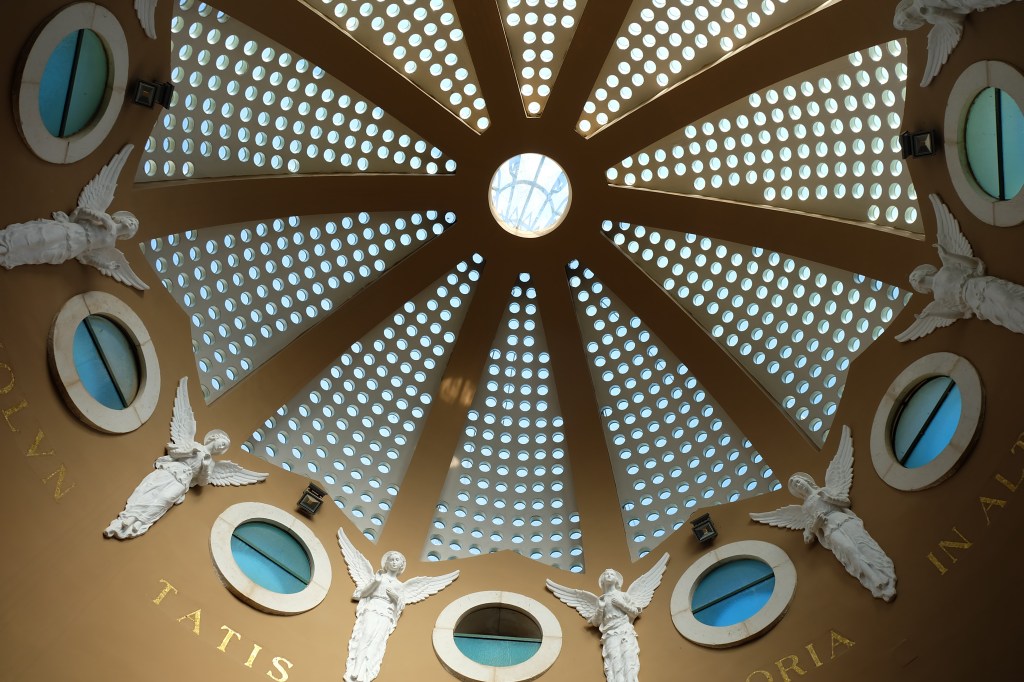
Dome of the chapel at Shepherd’s Field near Bethlehem where the angels appeared to some shepherds to announce the birth of Jesus Christ more than 2000 years ago.
By this time, many of you must have opened the gifts you have received this Christmas. Some are happy, some are not – even disappointed – while there are others who simply do not care at all with the gifts they have received.
But gifts are not everything. What really matters most are the persons and the love and thoughts that come with every gift we have received this blessed season.
Below are some spiritual gifts I feel we need to be thankful too!
The “little door” that leads into the Church of Nativity in Bethlehem that has come to mean the need to bow low and be humble in order to meet Jesus Christ not only inside but also in our daily life. Photo by author, May 2019.
The gift of hope. Hope is not thinking positively that things can get better like the weather. Hope is having a firm belief that even if things get worst, there is God who always loves us, who takes care of us. People with hope always look forward in the future whether here or in eternal life. They are also the most loving people around, the most understanding and most forgiving. They always strive, work hard to make things better for them and for others. Those without hope are the most evil: they will kill and destroy everything and everyone because they have nothing to look forward to in this life or hereafter. The kind of life we live always indicates the kind of hope we have. Or do not have.
The gift of desert. Sometimes, life becomes a desert for us, when we are desolate and so barren with everything dry and even lifeless. But it is during our desert moments in life when we not only meet our true selves but most of all, that is when we meet God. It is in this meeting with God in our desert we experience healing from all our hurts and disappointments in life. We need to withdraw once in a while to our desert to silently pray in order to hear God’s voice anew in our inner selves. In our mass mediated world today when we are bombarded with wants and needs to be rich and famous, the more we end up empty and lost. But when we dare stay in our desert and try to listen in silence, the more we are attuned with life’s realities, the more we are enriched and deepened in our lives.
The gift of intimacy. From our desert experiences of barrenness and desolation, of silence and prayer, and a lot of reflections and introspections come the great gift of intimacy with God and with others. We come to realize who our true friends are when our chips are down, when we are alone and badly bruised and beaten in life. How ironic that when we are so filled with material things, that is when life for us becomes superficial and shallow. But whenever we go through many desert storms, that is when we come to realize the most important in life – the persons who have touched us for better or for worse, the persons who make us experience to be loved and to love.
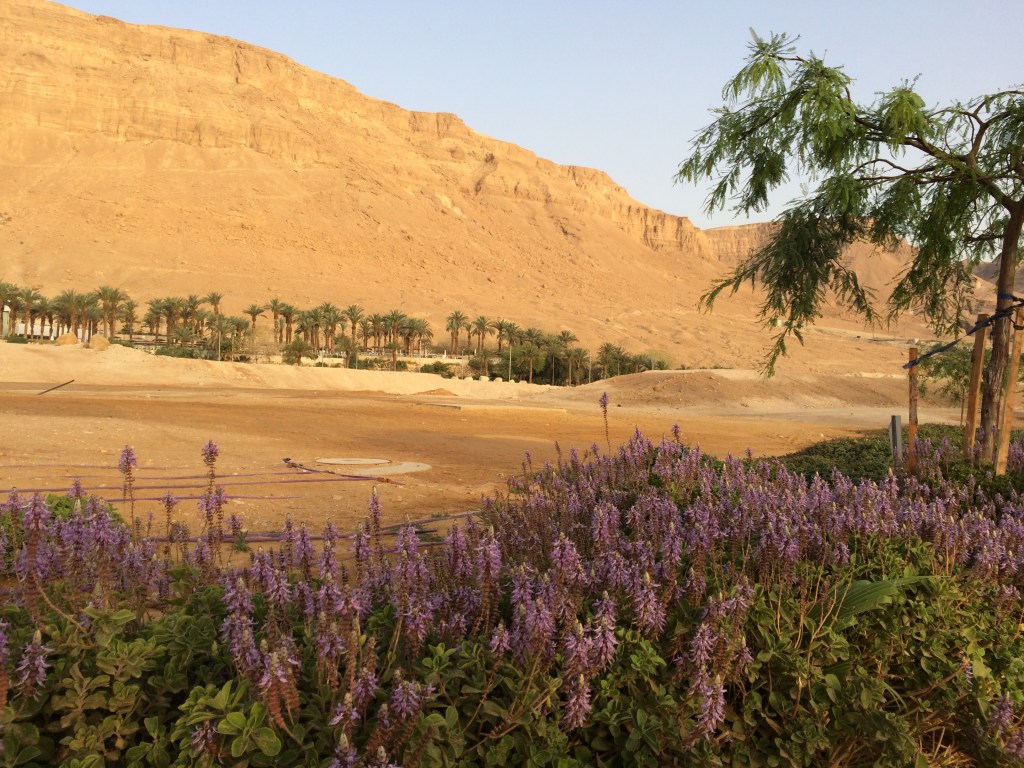
An oasis at the Dead Sea desert. Photo by author, May 2017.
We shall continue with our other lists of spiritual gifts this Christmas tomorrow.
How about you, what are the spiritual gifts you wish to share with us that may also help us deepen our Christmas celebrations this 2019?
The Lord Is My Chef Simbang Gabi Recipe, 17 December 2019
Genesis 49:2.8-10 ><)))*> ><)))*> ><)))*> Matthew 1:1-17
Parokya ng Banal na Mag-Anak, Violeta Village, Guiguinto, Bulacan. Photo by Arch. Philip Santiago.
Today we shift our focus in our Advent preparations to the first coming of Jesus Christ when he was born in Bethlehem more than 2000 years ago. Strictly speaking, the Christmas countdown officially starts only today especially with our very long but beautiful gospel from Matthew.
Maybe you are wondering what’s good with our gospel today when it is all about names that mostly sound very funny.
Importance of names: origin and mission
In ancient time, giving name to children was a very serious matter among peoples, especially the Jews.
For them, a name indicates two very important things about a person: one’s origin and mission in life, something parents of today have entirely forgotten, even ignorant because they are more concerned with fad and being unique in naming their children that always end up as a joke as it is always bizarre and weird.
And their poor kid suffers for the rest of his/her life like that man named “Fantastic”. All his life he felt so sad being called Fantastic that he told his wife when he dies, never put his name on his tombstone.
Eventually Mr. Fantastic died and the wife kept her promise not to put his name on his marker. But she felt the need to honor her beloved husband who was so good and honest that in lieu of his name, she asked a tribute written to honor him.
It said, “Here lies a very gentle and loving husband and father who never looked at other women except his wife.”
Every time passersby see and read that tribute, they would always exclaim “Fantastic!”
From Google.
Going back to the importance of giving names….
Corporations are more serious than parents in choosing names and trademarks to their products and services. Every trademark and brand always evokes deeper meanings than just being a product or entity that some of them have entered the vocabulary of many languages like Google, Xerox, and Frigidaire.
And the sad thing about this is how many babies are now being named to follow things and products than the other way around, giving more value to things than human beings!
The book of the genealogy of Jesus Christ, the son of David, the son of Abraham. Abraham became the father of Isaac, Isaac the father of Jacob, Jacob the father of Judah and his brothers.
Matthew 1:1-2
Detail of the ceiling of Parokya ng Banal na Mag-anak after the front or main door: the genealogy of Jesus Christ that starts with Abraham. Great concept by the Parish Priest, Fr. Ed Rodriguez. Photo by Arch. Philip Santiago.
Genealogy of Jesus as direction of Matthew’s Gospel
St. Matthew opens his gospel account with the genealogy of Jesus to settle right at the very start the question about the origin and mission of Jesus Christ.
Here we find the artistry and genius of St. Matthew, some 2000 years ahead of the late Stephen Covey’s third habit of highly effective people: “begin with an end in mind.”
By starting his genealogy with Abraham and David, St. Matthew gives us the whole gospel message in a glance because they are the two key figures in the beginning and realization of God’s promise to send Jesus Christ who would save us all.
Let us just focus on Abraham which means “he who is the father of many.”
It was to him that the story of God’s promise began after the dispersal of mankind following the collapse of the Tower of Babel.
From then on, Abraham points to what is ahead in God’s divine plan, not only for himself but also for the whole mankind for it is through him that blessings come to all. His journey from his birthplace of Ur into Canaan is symbolic of his journey from the present into the future, walking in faith following the Lord’s path and divine plan.
In Abraham we find God starting anew the history of mankind after the Fall that leads up to Jesus Christ who came to lead us all back into the Father.
With Abraham as the main header of Christ’s genealogy, we find not only the beginning but also the end of St. Matthew’s gospel which is the universality of God’s plan of salvation with Jesus telling his disciples to make disciples of all nations (Mt.28:19).
Detail of the ceiling near the sanctuary of Parokya ng Banal na Mag-Anak, the culmination of the genealogy of Jesus. Photo by Arch. Philip Santiago.
Imitating Abraham into our time
Last December 10 was a very important date for me and my parish: it was the ordination date of our first priest.
While waiting for the start of the Mass at the front door (which is actually the back of the Cathedral or any church), I just prayed in silence thinking about my role in the ordination of Fr. RA Valmadrid.
While I marveled at the beautiful renovations of our Cathedral, my sight was slowly moved towards the altar.
It was like an “Abraham experience” in Matthew’s genealogy for me: a wayfarer on a journey into the future, towards God, walking in faith.
In a quick glance, I kind of saw the future glory of every faithful coming to the altar to receive Jesus Christ in the sacraments especially the Holy Eucharist.
I just felt the beauty of entering the Cathedral, or any church which is more than stepping into a building but more of entering God himself, our point of origin and final destination.
Do we realize this tremendous blessing and grace of being baptized, of being a child of God, not only given with a name but most of all, of being counted into the family of God our Father?
In the first reading we have heard Jacob calling his 12 sons. What is so striking here is the blessing Jacob had bestowed upon Judah, instead of Joseph who was the best of all his sons, the holiest and most intelligent.
Like Abraham and Judah, or anyone in the genealogy of Jesus Christ, we can find our own selves too not as the vida or contravida but simply being called to be God’s instrument in fulfilling his plan in sending his Son Jesus Christ.
Truth is, God always comes in the most unexpected situations and peoples most of the time.
In Christ Jesus through our Baptism and faith, we find our genealogy – our origin and mission – as children of God.
If you want to get a feel of this reality, try reading aloud, very slowly, the genealogy of Jesus Christ. At the end, include your self, mention your name, your mother and father. Then close your eyes and let your life flash back in silence.
In the silence of your heart, do you find God coming more to you than you to God?
So amazing, is it not? We are all part of Christ’s genealogy. Let’s bring him forth into the world in our life of faithful witnessing like Abraham. Amen.
The Lord Is My Chef Simbang Gabi Recipe, 16 December 2019
Isaiah 56:1-3. 6-8 ><)))*> ><)))*> ><)))*> John 5:33-36
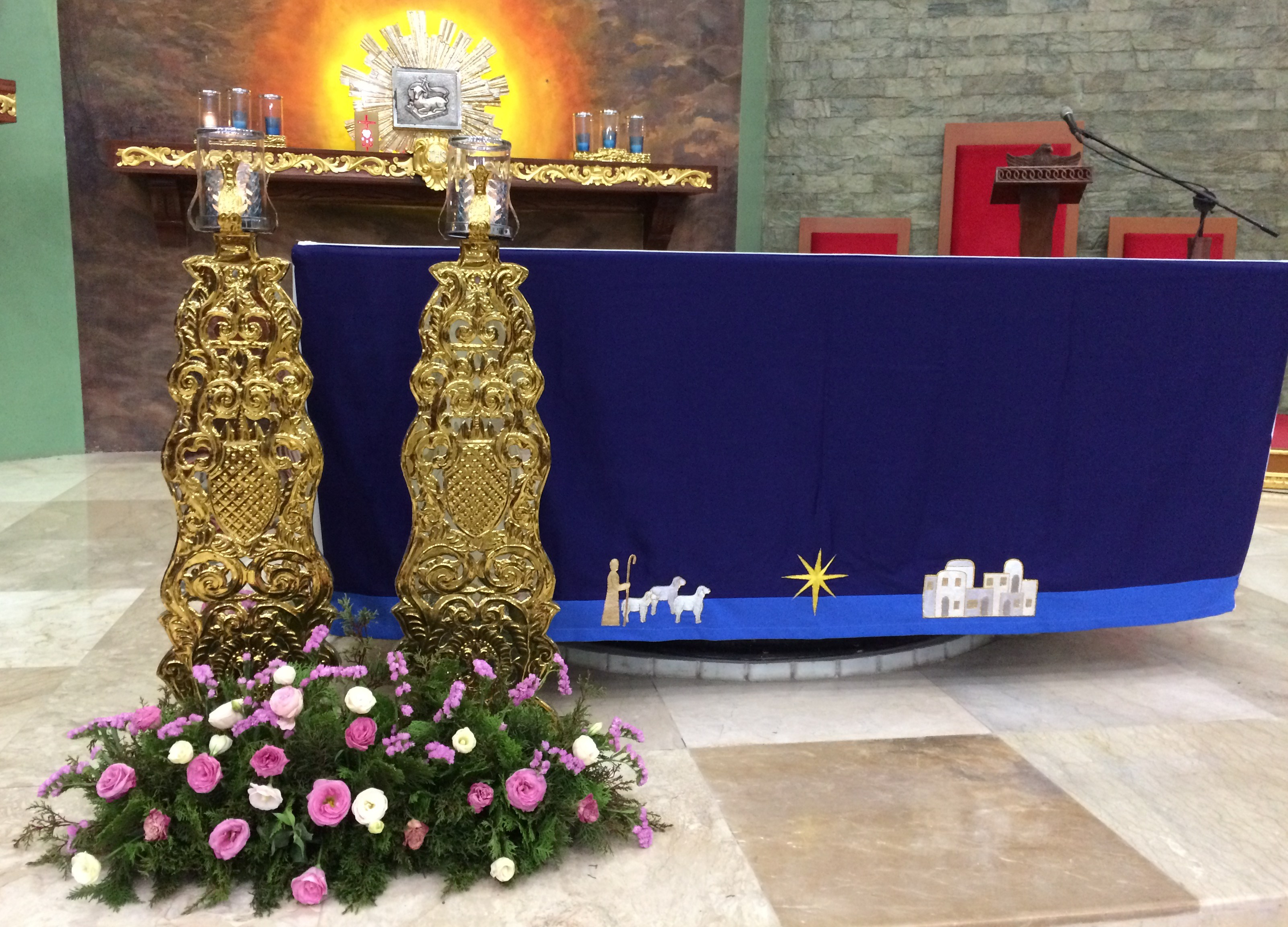
Our Parish Altar, Simbang Gabi 2018. Photo by author.
When we were still seminarians, our spiritual director became a victim of “hold-up” while walking home from an evening mass nearby. He is now a Trappist monk at Guimaras, a very kind and gentle priest we fondly call “Fr. Esteng”.
According to Fr. Esteng, everything happened so fast. But, after taking all his money, the suspect demanded Fr. Esteng’s big bag too, his “mass kit”. This time, Fr. Esteng refused to give into the demand of the hold-up man, insisting there’s nothing of value inside because they are things for celebrating the Mass of which no one would really buy.
To convince the hold-up man, Fr. Esteng got the “brilliant idea” of inviting the suspect to come with him to the seminary to get some food so he would no longer need more money.
Good that the hold up man did not accept the “invitation” of our good priest who got some “scolding” the following morning from his brother priests the following day after learning his brilliant idea, telling him to never to invite thieves into the seminary again!
“For my house shall be called a house of prayer for all peoples. Thus says the Lord God, who gathers the dispersed of Israel: Others will I gather to him besides those already gathered.”
Isaiah 56:7b-8
Inclusive God, exclusive people.
Praying at the Wall of Jerusalem Temple, 2017.
Welcome everyone!
It’s the start of our Simbang Gabi, our nine-day novena before the Lord’s birthday on Christmas.
God tells us in the first reading how he welcomes everyone into his house without any exceptions. That is how good and loving our God who is not contented in calling us all into his house but even sent us his only Son Jesus Christ to gather and lead us back to him.
Our God is very inclusive, always including everyone especially those rejected, those in the margins.
So unlike us people who are very exclusive and judgmental of others too.
We want everything exclusively ours. Just us. And when we meet strangers, those who do not look like us or do not speak and dress like us, we feel uncomfortable.
Worst is when we meet people of different faith and beliefs that we feel uneasy and even threatened simply because they are not like us!
It is good that for this final year before we celebrate our 500 years of Christianization, our bishops have dedicated 2020 to be the “Year of Ecumenism, Interreligious Dialogue, and Indigenous Peoples”.
This is to “celebrate human fraternity by promoting the culture of dialogue as a path of peace.” The Church wants to “work for unity and harmony while respecting diversity and to recognize peoples’ identities, spiritualities and ancestral domain.”
Logo for the Year of Ecumenism, Interreligious Dialogue, and Indigenous Peoples.
Jesus told the crowd, “But I have testimony greater than John’s. The works that the Father gave me to accomplish, these works that I perform testify on my behalf that the Father has sent me.”
John 5:36
See everyone and everything in Christ.
In our gospel today, Jesus was questioned by the Jews for healing a man sick for 38 years on a sabbath day at Bethesda.
Jesus was so different from them who have fallen into rituals and replaced God himself with their laws and traditions. They wanted Jesus stopped and even put to death simply because he did things so differently when, in fact, he was trying to bring back what was lost like the precedence of God and human life over laws and rituals.
Pope Francis reminds us that the Church exists to remind us that God loves and welcomes everyone. He is absolutely right that so often it happens right in our churches, in our celebrations we go on our own exclusivistic ways forgetting we are supposed to be a community.
On this first day of our Simbang Gabi, let us focus more on Jesus so we may find him among other people easily because when we are focused with our “work” and ministry, the more we see ourselves and forget Christ among the poor and marginalized.
Do we find Jesus when we serve and celebrate the liturgy or do we simply have ourselves?
Is it Jesus Christ whom we share with others in our dealings and service in the Church or our proud self?
Where is Jesus really in our lives today that we simply do things for the sake of doing it, because it is a tradition and not because of a personal conviction and relationship with him?
Quiet Storm by Fr. Nicanor F. Lalog II, 06 December 2019
Advent 2019, Parokya ng San Juan Apostol at Ebanghelista, Bagbaguin, Santa Maria, Bulacan.
Advent and Lent are two beautiful seasons in our Church calendar that prepare us for the great feasts of Christmas and Easter, respectively. Both have violet as motif though Advent is supposed to have a more bluish hue to distinguish it from Lent’s penitential character.
They both invite us to “look forward” into that future glory of Jesus Christ when he comes again at the end of time to establish “new heaven and new earth” where peace would finally reign, removing all sufferings and pains, wiping away all our tears to fill us with perfect joy.
On that day the deaf shall hear the words of a book; and out of gloom and darkness, the eyes of the blind shall see. The lowly will ever find joy in the Lord, and the poor rejoice in the Holy One of Israel.
Isaiah 29:18-19
Advent is renewed relationships
More than the promise of a new order of things in the Second Coming of Christ, Advent invites us also to look forward into renewed relationships with God through others.
Our Advent Candle 2019.
Jesus Christ comes first in our hearts, his new manger. Unfortunately, we seem to have forgotten Jesus, remembering only his birthday and its trimmings. Fanned by social media, people are going crazy as early as August with their own Christmas countdown with those memes of Jose Mari Chan poised to sing his popular “Christmas in Our hearts”, forgetting its beautiful message of opening our hearts to Jesus through one another.
How sad that more than ever, people are so excited with Christmas for the wrong reasons like gifts and money, parties and vacations but not Jesus himself.
Advent invites us to “actively wait” Christ’s coming by renewing our relationships with our family and friends in every here and now of our daily living.
As Jesus passed by, two blind men followed him, crying out, “Son of David, have pity on us!” When he entered the house, the blind men approached him and Jesus said to them, “Do you believe that I can do this?” “Yes, Lord,” they said to him. Then he touched their eyes… and their eyes were opened.
Matthew 9:27-29, 30
Need to remove our “blindness”
Advent is a season to remove our blindness to Jesus present in us and in every person we meet. Our gospel today tells us a short story of Christ’s healing of two blind men with a twist of humor.
According to St. Matthew, the two blind men kept following Jesus after teaching a crowd, begging him to restore their sight.
How they were able to follow Jesus, your guess is as wild as mine… but, most funny is how they followed Jesus home to finally heal them!
Go figure it out. How did it happen if both men were blind, following Jesus every step of the way into his home?
But they both teach us a valuable lesson not only for this Advent but for everyday living: of the need to remove our blindness so we may see Christ coming to us day in, day out.
How sad when most of us have eyes but cannot see or even refuse to see Jesus Christ coming to us personally and among other people especially our family and friends, among the ordinary and usual people we meet everyday in our lives.
Last Tuesday amid heavy rains and winds of Supertyphoon “Tisoy”, two elderly couples in the parish requested for the Sacrament of Anointing of the Sick.
After hearing their confessions, anointing them with Oil, and giving them the Holy Communion, I decided to stay longer when I found out they live by themselves despite having six children living in the vicinity with their many apos!
Making things worst for the couple are the two children living abroad: one in the States have totally cut ties with them without any communication in 15 years while the other living Down Under refusing to help them in their medical needs.
May the light of Christ heal us of our many blindness so we may see him among our families and friends.
The way we live and what we hope
I have been told the elderly couple I have visited were not really that “good parents” and neighbors as well. But, I explained to everyone after my visitation that is not important, nor the issue at hand.
What matters most is who would take care or look after these two elderly people, an arthritic father and a mother stricken with stroke? Must we allow ourselves to be blinded by past sins and hurts and pains that we fail to see Christ coming in the present?
Yes, this is easier said than done but, in this life, we only have two choices to make, either we become better or bitter. Make the right and better choice always!
Last Sunday I told my congregation that the way we live dictates our hope.
Photo by Jo Villafuerte at Atok, Benguet, 01 September 2019
Those who strive in life to do what is good, to become better in whatever form are those who truly hope. And truly love because they believe in the future, they look forward to something better if not in this life, maybe after.
But those who do nothing in this life, those who feel resigned, “enjoying” their miseries in life are the ones who do not hope. And surely do not love at all for they see only death and destruction, nothing to look forward to. They do not mind hurting even killing others because they believe there is no future at all.
Indeed, as TIME Magazine’s Lance Morrow wrote in 1991, the opposite of love is not really evil but hopelessness. Very true.
As we end this first week of Advent moving closer to Christmas, let us pray for the grace of Jesus Christ to heal us of our many blindness in life so we may see him anew in us and in others too. A blessed weekend to you!
Thursday, Memorial of the Presentation of Mary to the Temple, 21 November 2019
Zechariah 2:14-17 ><)))*> <*(((>< Matthew 12:46-50
Feast of the Presentation of Mary at the Temple originated from the Eastern Church where it is known as “The Introduction of the Theotokos (Mother of God) to the Temple”. Photo from Google.
Dearest Lord Jesus Christ:
As we celebrate the memorial of your Mother Mary’s presentation at the Temple, I am deeply struck by the gospel scene for this feast.
Someone told Jesus, “Your mother and your brothers are standing outside, asking to speak with you.” But he said in reply to the one who told him, “Who is my mother? Who are my brothers?” And stretching out his hand toward his disciples, he said, “Here are my mother and my brothers. For whoever does the will of my heavenly Father is my brother, and sister, and mother.”
Matthew 12:47-50
This is so striking to me, Lord because here you are asserting your authority outside your family circle. Here you are telling us of the need to eventually leave our family and friends in order to join you in your mission and journey.
It is very true that we find our first sense of belonging in our family and circle of friends but as we get older like you in Nazareth, our larger sense of belonging to God our Father can only happen when we break free from our family and friends.
Not because we do not love them but primarily because each of us has a calling and mission from you that must be followed and fulfilled. And to do so, we have to leave our family and friends in order to heed and follow your call, O Lord.
In this age of social media, there are some family and friends who get the wrong notion that belonging and possessing or ownership go together, that parents own their children, and friends own each other.
I pray for all parents to imitate St. Joachim and St. Anne who clearly knew they did not own Mary their daughter, that she is God’s that they have to offer her to him at the temple.
May we all grow into maturity that there comes a time when we have to leave our family and friends, even say “no” to them to be like you to freely say “yes” to the Father. Amen.
Quiet Storm by Fr. Nick F. Lalog II, 20 November 2019
A chef is basically a person who loves people. And that is why for any chef, cooking is both a passion and an art. His menu are not only meant to feed the body but most especially enrich the heart and soul of every diner.
Welcome to Netflix original series “Midnight Diner: Tokyo Stories”!
Each episode is exactly like every recipe the main character called “Master” dishes out to his patrons and customers who come from all walks of life with their unique burdens and story to share and eventually, resolve after tasting his fresh and easy to cook meals.
Midnight Diner is as Japanese as the ramen and sake the Master serves his guests. Everything is in Nihongo with English subtitles that demand one’s total attention to understand the conversations briefly interspersed with first person accounts by the Master.
At the opening, the Master gives us the warm and nice ambience of the series set at midnight until seven in the morning for people who do not wish to go home straight after their office hours.
It turns out that they are not only looking for good food but for warm company as well which the Master ably provides with his total attention and communion.
Very interesting to note that the Master is a celibate, reason why he can devote himself wholly to his diners, listening to their joys and sorrows, victories and defeats. So far, from what I have seen in its two seasons, he has no love interests although it won’t be surprising if in the third season he turns out to be a character from one of Murakami’s novels or short stories.
Though he is a fictional character, he is rightly called “Master” for his commanding presence that is not intimidating but so warm and gentle, so unlike the celebrity chefs we see on TV.
The Master can cook anything, including fancy corndogs and pancakes that are very American. He always has a “menu of the day” as title of each episode.
Should anyone ask for any kind of dish, he willingly prepares it subject to availability of ingredients that turns out he always has or sometimes, like a true chef, finds other alternatives just to fulfill a customer’s cravings. In one episode, a patron comes nightly with his own three pieces of bread so the Master can make him “yakisoba sandwiches” — exactly how we Filipinos eat pancit with another carbohydrate!
What makes the series so good is that the Master is more than a chef — he is the Tokyo counterpart of Paris’ Cafe Anglais famed lady chef “Babette” of the 1987 Danish film “Babette’s Feast” and James Taylor’s 1977 hit single “Handy Man” rolled into one.
More than the food he passionately serves, the Master delights and comforts every troubled heart and lonely soul longing for love and relationships, forgiveness and kindness they finally find in his Midnight Diner.
Most of all, neither the Master nor his food is the main focus of each episode but the story of every customer who comes to his diner at the most unholiest hours – between 12 midnight and seven in the morning – searching for food for their souls!
Mainstays of the Midnight Diner.
Helping the Master in processing every customer are his interesting mix of characters of regular patrons: LGBTQ members, career ladies mostly single, retirees, professional gamblers and of course, Yakuza gang members.
They are the Master’s “secret spices” who bring out all the flavors and aroma of every customer’s life story like a widowed lawyer searching for his lost step brother to a nightclub stripper sought and saved from miserable life by her high school teacher suffering the early stage of Alzheimer’s disease. Sometimes they act like the Master’s garnishings, adding taste and beauty with some sprinklings of life lessons to lost customers.
Though most stories are understandably peculiar to Japanese culture, they all touch a common chord within us for our basic need of acceptance which the Master warmly provides like his steaming hot dishes.
Unlike most TV series, Midnight Diner’s pacing is so fast and without any pretensions that prevent it from becoming dragging and boring. In less than 30 minutes, each episode is deftly resolved just as magically how the Master came out with a superb meal from his limited resources and tiny kitchen.
But the best attraction of the show is how the viewer eventually finds one’s self warmly welcomed into the diner, laughing or crying, sympathizing or objecting to whatever situation is presented by every guest.
It is a very lovely series that transcends language barriers and cultures because it nourishes and warms our soul that never rest nowadays due to the demands of modern living. Somehow, inside the little Midnight Diner, there is always a space welcoming everyone including us viewers to unwind and be fulfilled with good food, nice people, and meaningful conversations.
Today’s gospel speaks about the end of time, the Second Coming of Jesus Christ when he predicted the fall of Jerusalem and destruction of its Temple in 70 A.D.
Every coming of Jesus Christ is a day of judgment and salvation, a call to love, love, and love.
When Jesus comes again at the end of time, he won’t be asking us how much money we have but how much do we share?
He won’t be asking us what car do we drive but how we move people with our kindness and warmth?
Jesus will not ask us those questions we are so preoccupied in this life but instead ask us the basic question we have always avoided answering, “how much do you love”?
Everything follows from that question because only those who truly love are the ones willing to suffer and sacrifice, even give life so others may live.
And that is why we have chosen this very poetic song, When It Was Done by the famed American composer Jimmy Webb in 1969 and first recorded by Winter Wanderley that same year.
There are other artists who have covered this beautiful song but Hugo Montenegro’s version is the best, giving it a more ethereal quality despite its poignant character.
It is a story of a man’s love presumably to a very lovely woman he never had the chance to express his feelings because she had been taken by somebody else.
If I could bind your mind to mine in time, to keep you from that world of his If I could change the strangers in your kind, then I’d know where your soul is Then I’d know what song I’d have to sing, to touch that chord within you Then I would weave such wondrous songs, and when it was done, I’d win you
If I could stand with the stars on either hand, and say girl this ain’t the answer If I had been where you’re going, but then I’ll never be no dancer If I was I’d know what step to take, and laugh at what had freed me And smash the great wall down girl, and when it was done, you’d need me
Too late… but the gentleman pins his hopes to the end of time when probably on judgment day he could have the chance to finally have that lovely woman.
If I can face the fate that waits to cast me into shambles And sit across the velvet boards from God then I would gamble And if I could, I’d know what chance to take and before the devil sold you I’d bet my soul against the stars, and when it as done, I’d hold you
Of course, it is all wishful thinking. And that is why – “when all was done” – there’s no more going back because it is judgement day. So let’s do whatever good we can in the here and now where Christ comes again.
Meanwhile, enjoy this lovely piece and shower your loved ones with all the love you now have.
A friend from the mid-80’s recently invited me for lunch when in the midst of our conversation she asked me how I unwind and take breaks as a priest considering my toxic schedules.
Suddenly, I just felt so light inside being filled with joy when I answered, “good old friends like you”!
We had a hearty laugh together as we remembered those good old days and nights with our other friends, wondering together how far we have all come in life, hurdling all those many struggles of our younger years.
When I was ordained priest in 1998, I promised to “leave behind” my family and relatives as well as friends to give myself totally in serving Jesus Christ among those people entrusted to my care.
I am so glad when I recently found out that I have not really turned away from them when I embraced a lifetime service to God because they have continued to keep me too as friend!
Old friends are always special because they have stood the test of time, standing by our side, believing in us during those many dark nights we have gone through even without us knowing it!
True friends are indeed a treasure especially those we have known and kept over the years because even if we no longer see each other so often or even communicate with them despite the suffocating social media around us, we have remained good friends deep in our hearts.
It is something we mutually feel deep inside for each other because despite our separation from college and from work or residence, we have never grown apart from each other as if there is an invisible thread that links us together.
I used to tell young people in my recollections that friends are always a gift from God. Each friend is unique, each with his/her own strengths and limitations. There are no perfect friends but if we can allow our friendships to have spaces for love and kindness, respect and understanding, mercy and forgiveness, friends can truly be the best gifts we can have in life.
Friends are a gift because they are always wrapped in mystery: the moment we receive them, we really do not know what is in store for us. In a similar manner like the lyrics of a song we loved singing in our daily Masses in the Minor Seminary (high school), friends are “gifts of God to me, who come all wrapped so differently: others so tightly, others so loosely, but wrappings are not the gift.”
Our task in every friendship is to uncover a friend’s “giftedness” to us, something which we cannot change. We can nurture and cultivate our friendships but we cannot force our friends into becoming someone they are not meant to be.
Every friend’s giftedness is from God because every friend is a signpost for us to be closer with God: some eventually become partners in life as husband and wife while others become the bestest of friends as “emotional shock absorbers” or a inspirations to another.
That, my friend, is something we cannot and must not dare alter because as the saying goes, people come to our lives for a reason, for a season, and for love.
Lately I have been seeing – “catching up” – some good old friends. What I like best when we are together is the ability and gift to laugh our hearts out like never before. There is something so deep with old friends laughing together not only with old jokes and anecdotes we cannot forget but also with some new realizations that come with our age.
And we laugh together, we realize we are not alone after all. There is still somebody very much like us, somebody we continue to grow up with, somebody who understands our fears and anxieties because he/she is also going through the same phase in life or have just gone through something similar.
That is why good old friends are the best because despite our long separation, we still find each other traveling, walking through the same path albeit for sometime in parallel manner.
They are the best because good old friends eventually teach us to be more appreciative and grateful with life and with friends who continue to journey with us no matter how slow and cranky we have become.
Cheers to all our old friends! Make time to reach out to them. Your message or text or call could mean so much to them!
Nasaan na mga liham ng ating mga samahan at pagkakaibigan na ngayo'y napalitan ng maramihang balanang kaisipan at mga larawan pati katatawanan?
Walang umiiral na ugnayan bagkus mga palitan at pasahan na lamang ng sari-saring nararanasan at nararamdaman; mabuti kung iyong masasakyan maski mga kababawan.
Iba pa rin ang karanasang mararamdaman na higit mapagyayaman ng sino mang sumusulat at tumatanggap ng liham mula kay Mister Postman.
Maraming kabutihan at mga kagandahan ginagawa nating usapan sa pamamagitan ng internet kagaya ng e-mail, messenger at viber na sadya namang super ang bilis.
Ngunit kailanman hindi kayang palitan ng mga makabagong pagsusulatan ating kinagawiang mga liham na laging kinasasabikan, inaabangan.
Hindi agad binubuksan mga kamay pinupunasan at baka marumihan mamantsahan tinanggap na liham mula sa kanino man na turing ay isang kaibigan.
Itong pagsusulat maging pagtanggap ng liham maituturing nating ritwal ng ating pagkakaibigan: walang minamadali bawat sandali kinakandili pilit pinanatili sana'y kapiling kang lagi.
Nakakahinayang itong kaugalian ng pagliham napalitan, pati ating pagkakaibigan, mga ugnayan tila nakalimutan; balikan mga lumang liham nasaan hindi ba't nakatago, iniingatan upang basahin, sariwain, palalimin ating samahan?
Our gospel today helps us to further reflect the meaning of last week’s All Saints’ Day and All Souls’ Day when we honored our departed loved ones with prayers, believing and hoping that some day we shall be with them in heaven at “the resurrection of body and life everlasting”.
Every Sunday this is what we profess and so today, our readings invite us to reflect anew this last but crucial article of our faith, theresurrection of body and life everlasting.
Some Sadducees, those who deny that there is a resurrection, came forward and put this question to Jesus, saying, “Teacher, Moses wrote for us, If someone’s brother dies leaving a wife but no child, his brother must take the wife and raise up descendants for his brother. Now there were seven brothers; the first married a woman but died childless. Then the second and the third married her, and likewise all the seven died childless. Finally the woman also died. Now at the resurrection whose wife will that woman be? For all seven had been married to her.”
Luke 20:27-33
The Jewish Cemetery at the Mount of Olives facing Jerusalem, May 2019.
Jesus had finally entered Jerusalem. What an extraordinary manner for him to discuss death and resurrection right in the city he knew where he would eventually die and rise again in a few days later!
And the first to confront him there were the Sadducees, Israel’s elite from whose ranks came the high priests who later conspired with Rome to put Jesus to death.
Jews at the wailing Wall, May 2017.
Very conservative and rigorous in their practice of religion, the Sadducees were basically fundamentalists who refused to accept oral traditions on equal footing with the Pentateuch. They only accepted whatever was explicitly written on the Pentateuch, discarding anything that the Torah does not mention at all like the resurrection, existence of spiritual beings like angels and immortality of the soul.
Don’t we find ourselves into the same situation too when despite our professed religiosity, we subscribe to other beliefs like reincarnation and fortune-telling because of “proofs” we find about their veracity unlike the resurrection that seems to be so difficult to think of in the first place?
We have those vestiges of fundamentalism within, always searching and asking for proofs on so many things about our religious beliefs, especially about God and Jesus Christ.
Jesus said to them, “The children of this age marry and remarry; but those who are deemed worthy to attain to the coming age and to the resurrection of the dead neither marry nor are given in marriage. They can no longer die, for they are like angels… That the dead will rise even Moses made known in the passage about the bush, when he called ‘Lord’ the God of Abraham, the God of Isaac, and the God of Jacob; and he is not God of the dead, but of the living, for to him all are alive.”
Luke 20:34-38
Photo by Mr. Raffy Tima of GMA-7 News, 2018.
Notice how Jesus right away told them analogies and comparisons are not applicable because marriage and resurrection are of two different realms. The Sadducees were thinking on ground level when resurrection is definitely of a higher plane.
Jesus finds no need to prove anything at all to them – even to us! What he is more concerned is for us to “level-up” our thoughts, to set our sights to him, the Son of the Living God.
Now in Jerusalem to fulfill his mission, Jesus in the next two weeks will summarize for us all his teachings that lead to our coming home to the Father in heaven upon our death. Like Jesus Christ who died and rose again, we shall experience the same in the end.
How? Nobody really knows but our faith teaches us that resurrection is more than being restored to life; resurrection is life perfected in Christ. Life is surely changed and that is why it is on a different and higher level of existence.
Every time we experience our little deaths on our daily cross with Christ, we also experience our little resurrection when our lives are changed for the better. Amidst our many struggles in this life, we experience God’s loving presence, his very revelation of himself that moves us to deeper faith in him for indeed, he “is not God of the dead” – nor a dead God – because “for him all is alive” .
This faith in the resurrection is faith in the living God “who has loved us and given us everlasting encouragement and good hope through his grace” (2 Thes. 2:16) in Jesus Christ.
It is a faith borne out of our encounter with him as our loving and merciful Father that we are filled with passion to do everything for him because he is so true, so real, like in the experiences of the seven Maccabean brothers who heroically accepted death than sin against God in the first reading.
In 2013, I lost my best friend from high school to cancer.
One week before he died, I visited him three more times and that was when I noticed something so different: during the early months of his sickness, he would always cry to me, expressing his fears and anger but, during that final week of his life, I was the one crying to him while he was the one who would console and explain things to me!
Later, I experienced the same thing with some friends and parishioners I have accompanied in their final journey as a priest.
I have learned that the dying stop crying, stop fearing death because they could already see their final destination. They could feel God so close already that they no longer resist dying, so certain of their own resurrection. We who are left behind cry not only in losing our loved ones but unconsciously because we are afraid, unsure of where our lives are leading to.
In one of the beautiful scenes of the Netflix series The Kominski Method, Sandy (Michael Douglas) told his friend Norman (Alan Larkin) how everyone else is also afraid because nothing is so certain in this life. But, Sandy added, we continue to live because we have others with us journeying together in this life.
Let that Other be Jesus Christ who has come to accompany us in this life and back to the Father in heaven. Amen.