Lord My Chef Daily Recipe for the Soul, 03 July 2025
Thursday, Feast of St. Thomas the Apostles
Ephesians 2:19-22     <*{{{{>< + ><}}}}*>     John 20:24-29
Caravaggio’s painting “The Incredulity of St. Thomas” (1602) from en.wikipedia.org.
Lord Jesus,
teach me to be like you -
so understanding,
so caring,
so loving
to those who are doubting
you like Thomas your Apostle;
poor Thomas -
he has been called "Doubting"
when the evangelists simply
referred to him as "Didymus"
or twin; however, it is so lovely
too to know that doubt and
certainty are like twins because
when we doubt,
the more we seek and find
the truth which Thomas did.
When I think of my own faith
journey in you, Lord,
many times I was worst
than St. Thomas for I was not only
doubting you
but also hesitant in following you
because of fears and mistrust,
lack of confidence in my self,
and simply self-centered.
Could it be, Lord,
that in each one of us is
Thomas our twin -
doubting,
hesitating,
indecisive,
in following you?
Now a week later his disciples were again inside and Thomas was with them. Jesus came, although the doors were locked, and stood in their midst and said, “Peace be with you.” Then he said to Thomas, “Put your finger here and see my hands, and bring your hand and put it into my side, and do not be unbelieving, but believe.” Thomas answered and said to him, “My Lord and my God!” (John 20:26-28).
How nice of you,
Lord Jesus
to be so warm with Thomas
on that night
when you appeared again;
instead of engaging Thomas
into a debate or discussion,
you called him,
invited him to touch your wounds,
to feel your scars;
what an incredible courage,
Lord Jesus
to let us see and feel
closely your wounds,
to stare and look at your
sufferings, to remember and
imagine your lowest point in life
if only to show us that it is
the only way to glory;
many times, we are afraid
to admit even to ourselves
and to others our wounds and hurts,
preferring to keep them
even hide them
to keep our illusions
of greatness.
May we find
the graces of
joy and warmth,
love and kindness
that fill our many wounds
in life as a result of our
following you, Lord Jesus
for it is in our woundedness
and hurts that we become
"members of the household of God
who are built together to be
the dwelling place of God
in the Spirit" (Ephesians 2:19, 22).
Amen.

Fr. Nicanor F. Lalog II
Our Lady of Fatima University
Valenzuela City
Lord My Chef Daily Recipe for the Soul, 02 July 2025
Wednesday in the Thirteenth Week of Ordinary Time, Year I
Genesis 21:5, 8-20     <*[[[[><  +  ><]]]]*>     Matthew 8:28-34
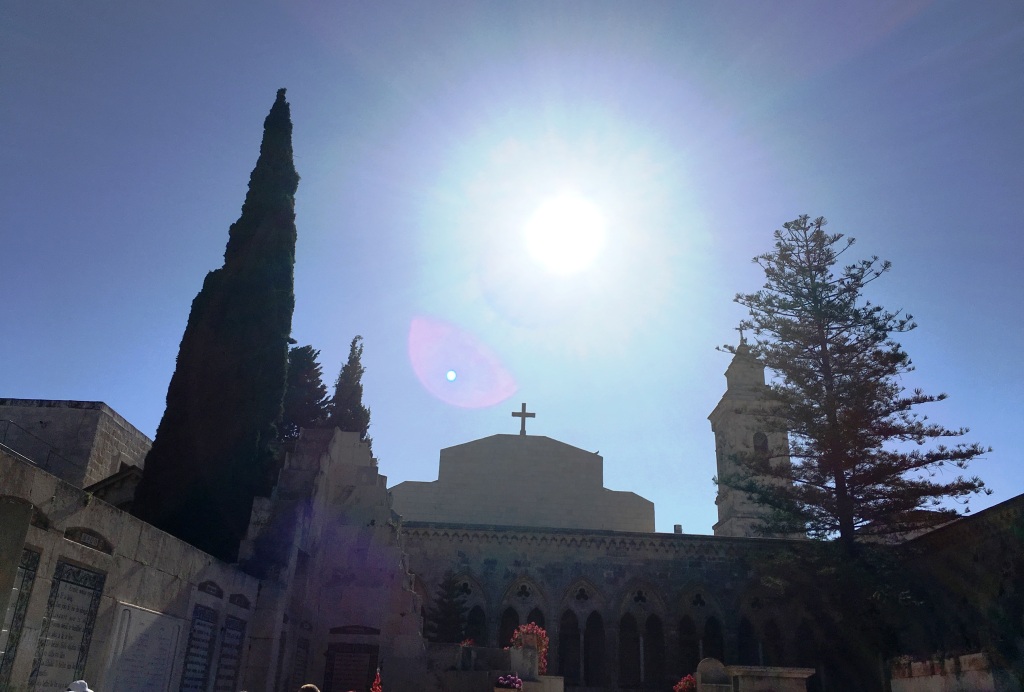
Photo by author, Pater Noster Church, the Holy Land, May 2019.
Praise and glory
to you, loving Father
for always remaining faithful
with us,
for always staying with us
especially in those times
of expulsions,
when we are driven out,
when we are shoved off
by situations and occasions,
especially by people.
Sarah noticed the son whom Hagar the Egyptian had bore to Abraham playing with her son Isaac; so she demanded of Abraham: “Drive out that slave and her son! No son of the slave is going to share the inheritance with my son Isaac!” Abraham was greatly distressed, especially on account of his son Ishmael. But God said to Abraham: “Do not be distressed about the boy or your slave woman… God heard the boy’s cry, and God’s messenger called to Hagar from heaven: “What is the matter, Hagar? Don’t be afraid; God has heard the boy’s cry in this plight of his” (Genesis 21:9-12, 17).
How lovely of you,
God our Father
to be still there,
remaining,
staying
with Abraham so distressed
with Sarah's order to drive out
his son Ishmael and his mother Hagar;
many times,
we too are caught in such a bind
and dilemma when people close
and dear to us demand us to expel
some people dear to us;
stay on our side so we can make
the right decision;
most of all,
remain with us,
hear us and follow us,
Father when we are expelled,
driven out from our comforts
into life's wilderness like
Hagar and Ishmael.
Most of all,
be with us Jesus
when people drive us out
of their lives,
of our friendships
and relationships
when like you,
after driving out the demons
from those possessed
was the one expelled from the town.
There are times,
Jesus, when after doing what
is right,
what is just,
what is proper,
it happens that we are
the ones driven out.
Remain with us,
stay with us.
Amen.

Fr. Nicanor F. Lalog II
Our Lady of Fatima University
Valenzuela City
Photo by Dra. Mylene A. Santos, MD, Katmon Nature Sanctuary & Beach Resort, Infanta, Quezon, 2020.
Lord My Chef Daily Recipe for the Soul, 01 July 2025
Tuesday in the Thirteenth Week of Ordinary Time
Genesis 19:15-29     ><)))*> + ><)))*> + ><)))*>     Matthew 8:23-27
Praise and glory to you,
God our loving Father for
this brand new month of July,
for the blessed first half of 2025!
You have been most kind to us
this year with so much grace
poured on us despite our being
undeserving while at the same time,
so merciful to have spared us from
many troubles we truly deserved
for our sins.
That is why, Father,
I hate seeing those prayers
and wishes of many
saying at the start of each month
to please be more kind to us;
you have always been kind and
generous more than enough to us
especially in giving us your Son Jesus
who have enabled us to cross many seas
and lands in this journey of life;
many times, there are storms in life
that we get so afraid like in the gospel
today....

Many times we feel
so caught in the middle of a
"violent storm on the sea" of life
where we are "swamped by waves",
so terrified,
so lost,
feeling alone when deep in our hearts
Jesus is with us,
probably "sleeping".

Then in the nick of time,
he comes, rebuking the winds
and the sea when great calm
follows just like what the angels
did to Lot and his wife when you
destroyed Sodom and Gomorrah
in the frist reading.
Photo by author, Cabo da Roca, Pundaquit, San Antonio, Zambales, 14 May 2025.
Lord Jesus,
give me that gift of a sense
of "dead calm" in you;
to be at peace and still
in you while in the midst of
a great storm when I feel
like being flattened by waves;
let me seek your peace
and kindness amidst the
the cries and shouts
when I feel like sinking,
of perishing.

This brand new month of July,
I know you will fill me again with
your blessings;
let it be enough
for me to forge on
in this remaining six months
of the year,
to continue crossing
life's many seas
to bring you,
to share you,
and simply be with you.
Amen.
Fr. Nicanor F. Lalog II
Our Lady of Fatima University
Valenzuela City
Lord My Chef Sunday Recipe for the Soul by Fr. Nicanor F. Lalog II
Solemnity of the Most Holy Body & Blood of Christ, Cycle C, 22 June 2025
Genesis 14:18-20 ><}}}}*> 1 Corinthians 11:23-26 ><}}}}*> Luke 9:11b-17
From the highest truth of our faith last Sunday which is the Blessed Trinity in one God, we now celebrate in the resumption of Sundays in Ordinary Time the Solemnity of the Most Holy Body and Blood of Christ.
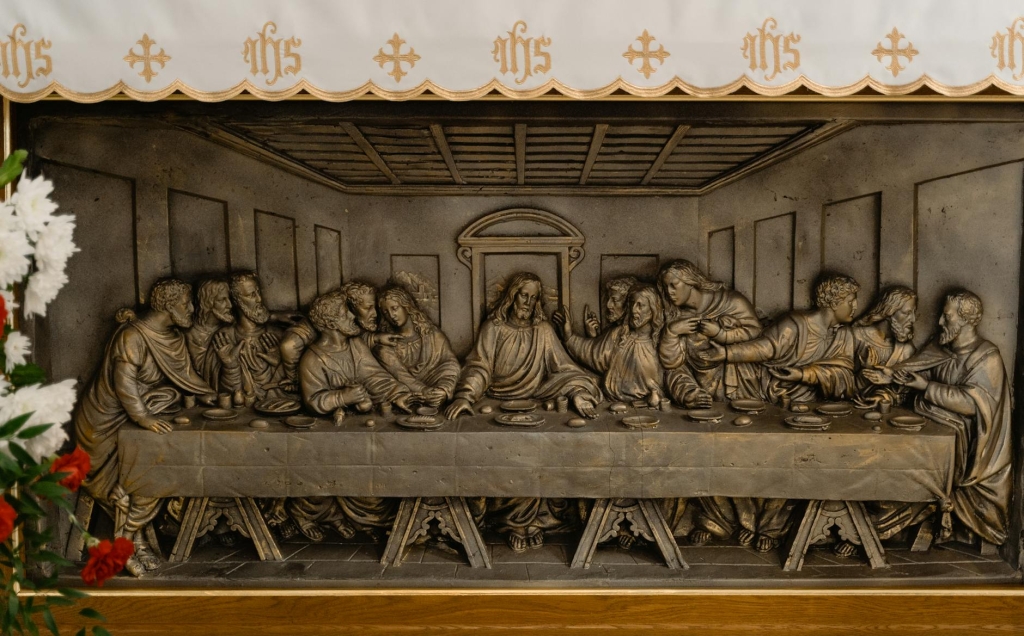
This feast highlights our faith in God who truly exists and had come to us in Christ Jesus, the Second Person of the Holy Trinity. In Christ through the Sacrament of the Eucharist he established at the Last Supper, we are given the “taste” of heaven literally speaking under the signs of bread and wine that become his Body and Blood we share. This was his command on that Holy Thursday evening to always remember him as St. Paul tells us in the second reading, the oldest account of the institution of Eucharist:
Brothers and sisters: I received from the Lord what I also handed on to you, that the Lord Jesus, on the night he was handed over, took bread, and after he had given thanks, broke it and said, “This is my body that is for you. Do this in remembrance of me.” In the same way also the cup, after supper (1 Corinthians 11:23-25).
Two words I wish to share with you on this Solemnity of the Body and Blood of Christ.
First is the word “remembering” or to remember. A very common word we use often but perhaps never aware of its deeper meaning from its root word “member” which means a part. Literally, to remember means “to make part again”. When we remember a person, an event in life, a thing from the past or long gone or not with us, we make them a part of the present moment.
The Eucharist is the highest form of remembering because literally speaking, we make Jesus a member of our present moment. When we re-remember Jesus in the Eucharist, he truly comes to us in Body and Blood! Truly present with us, in us after receiving him in the Holy Communion. Whenever we remember a loved one or a friend long gone or not with us at the moment, all we have is a memory. They become a member of the present but only in the mind unlike Jesus truly present with us, in us, and before us in his words, in his Body and Blood and in one another celebrating the Eucharist.
Photo by author, Old Jerusalem seen from Church of Dominus Flevit, May 2017.
It is not magic but a work of faith, a gift through and through from God in Jesus Christ. By his dying on the Cross and Resurrection at Easter, Jesus superseded and transcended time and space, sharing with us that sacred reality.
St. John Paul II beautifully called that “cosmic reality” when he described in his encyclical Ecclesia De Eucharistia how he felt transported in time and space when the temporal becomes divine because of God’s true presence anywhere he celebrated the Eucharist. We too experience the same cosmic reality in every Mass we celebrate when we are properly disposed, especially the priest and the servers.
That is why I always demand the highest order from priests and servers in celebrating most solemnly as possible the Holy Mass. I can stand kids playing inside the church but what gets to my nerves are servers talking or moving unnecessarily during the Mass and worst of all, when lectors proclaim the word of God incoherently and wrongly. Lest we forget also the choir members feeling so magaling forgetting they are in the Mass not in a concert that they make it a show, forgetting all about God and the people.
What a tragedy when we priests and liturgical ministers are the ones who forget to re-member Jesus in the Eucharist with our too much attention to ourselves. Exactly like the Twelve in our gospel!
As the day was drawing to a close, the Twelve approached him and said, “Dismiss the crowd so that they can go to the surrounding villages and farms and find lodging and provisions; for we are in a deserted place here.” He said to them, “Give them some food yourselves.” They replied, “Five loaves and two fish are all we have, unless we ourselves go and buy food for all these people” (Luke 9:12-13).
Imagine that scene of how the Twelve have totally “forgotten” the more than five thousand people gathered there with them. They were just thinking of themselves because they were in a “deserted place”. What a disrespect!
Respect is lost and disregarded when there is no remembering of others, when we forget others. Respect is from two Latin words re (again) and specere (to look/see) from which the words spectacle and spectacular came from. Re + specere or “respect” means to look again in order to see!
The Twelve were just concerned with themselves, not only forgetting but without respect at all with the people they have failed or refused to recognize as humans too who get tired and hungry like them. As we have cited in earlier, this continues right in our eucharistic celebrations when priests and ministers celebrate unprepared, unmindful of the sanctity of the Mass.
Remembering is not merely “thinking” of others in our mind and memory.
Remembering is making others present in our very selves!
Remembering is making every-body a some-body by giving our very selves to them to be the Body of Christ. Unless we are able to truly share our very selves in person, in body and blood too, then every Mass will remain merely a rite or a ritual. Worst, an activity we just have to fulfill.
The Eucharist is the summit of our Christian life because of this aspect of remembering Jesus Christ that leads us into a true communion of sharing of persons and experiences, in our joys and sorrows, in our hopes and belief. When this happens, then every remembering becomes a thanksgiving too.
And that is our second word I wish to instill in you today – thanksgiving which is the meaning of the Greek word eucharistia.
When there is a real experience of each others’ presence in love and mercy, kindness and care, justice and fairness, gratitude flows naturally resulting in peace and harmony. It is the whole meaning of our first reading when the priest of God named Melchizidek who was also the king of Salem which means “peace” blessed Abram after winning in a battle.
This short scene is a story of remembering God’s goodness to Abram who thanked Melchizidek by giving him a tenth of everything he had won in the battle. In the Holy Mass, what do we really share from our very selves? Not just treasures but even our very time to give totally to Christ without texting.
Now we see the series and cycle of remembering and thanksgiving in sharing of gifts of self which the Body and Blood of Christ signify to us.
This coming Friday we shall celebrate the third consecutive Solemnity in the resumption of Ordinary Time with that of the Most Sacred Heart of Jesus, a reminder to us all to make Jesus present always in ourselves with others especially at this time the world has been deleting from its every aspect God.
Lord Jesus Christ,
transform me like the
bread and wine
into your Body and Blood
to be offered and shared
with others
especially those
in most need.
Amen.
Lord My Chef Sunday Recipe for the Soul by Fr. Nicanor F. Lalog II
Solemnity of the Ascension of the Lord, Cycle C, 01 June 2025
Acts 1:1-11 ><}}}}*> Hebrews 9:24-28;10:19-23 ><}}}}*> Luke 24:46-53
Photo by author, Atok, Benguet, 26 December 2025.
We all have experienced dreams so real where we met friends and relatives even strangers that we described as “totoong-totoo” that we woke up crying or simply joyful and feeling so light. The clothes even the scent and ambiance were so real that we tried going back to sleep to continue the dream!
This is what we call as the dynamic of “presence in absence” when loved ones long dead or gone or simply far from us we still feel near and close too. It is the same familiar kind of relationship that we have with God whom we feel also as too near yet so far like what Luke described to us in the Ascension of Jesus Christ:
As he blessed them he parted from them and was taken up to heaven. They did him homage and then returned to Jerusalem with great joy, and they were continually in the temple praising God (Luke 24:51-53).
Photo by Mr. Sean Pleta in Melbourne, March 2015.
When Luke said that Jesus “As he blessed them he parted from them and was taken up to heaven”, he was describing to us Christ’s new and higher kind of relationship with all his disciples that include us today.
Jesus did not merely enter a physical reality that the author of the Letter to the Hebrews tells us in the second reading; he actually entered into a new level of relationship with us and everyone. This “leveling up” in our relationships that no longer require physical presence is the dynamic of presence in absence. We don’t have to be physically present because there are deeper ties that bind us with God and with others, both the living and the dead.
Recall how since Easter we have been reflecting on this aspect of new level of relationship with Jesus who told Mary Magdalene at their first meeting to “touch me not” because of the need for a higher level of relating with him no longer bound by time and space. This Jesus showed when on the evening of Easter he entered the locked doors where the disciples were hiding. And Luke tells us that beautiful account of Jesus walking to Emmaus with two disciples who did not recognize him but upon reaching home after the breaking of bread, the two disciples recognized Jesus who immediately disappeared from their side. It was always a case of presence in absence!
Note also that in all appearances of Jesus after Easter to his disciples, there was always joy that continued even after his Ascension when “they returned to Jerusalem with great joy, and they were continually in the temple praising God.” Normally, there is sadness after every separation and goodbye. But not with the disciples of Jesus including us!
How can you explain that even if Jesus does not seem to answer our prayers, we just keep on praying to him? Why do we remain in Jesus despite his apparent absence? That’s because deep in our hearts we are certainly sure he is always with us, that he loves us so much, that eventually, he will answer our prayers though he does answer our prayers always but not in the way we wanted it to be.
That is why we need to make that effort to deepen and cultivate our relationship with Jesus to always see his presence in his absence like what the angel told the disciples in the first reading after his Ascension, “Men of Galilee, why are you standing there looking at the sky? This Jesus who has been taken up from you into heaven will return in the same way as you have seen him going into heaven” (Acts 1:11).
Do not look up or anywhere but look inside our hearts where Jesus dwells as he had told us last Sunday if we keep his words and love one another. We need to level up in our relationship with God through prayers and good works.
We need to see more with our heart than with our eyes because the deepest truths and realities in life are seen with the heart and soul. The ancient Persian sage and poet Rumi said it so beautifully, “Goodbyes are only for those who love with their eyes. Because for those who love with heart and soul, there is no such thing as separation.”
Since Easter, we have been reflecting on the profound difference of Christ’s Resurrection with his birth on Christmas filled with external signs and symbols. Easter is characterized by absence like darkness and emptiness where we find the presence of Jesus and his light.
This presence in absence is also the reality we have in those we refer to as “low-maintenance” friendships where we have some people who do not demand anything from us nor we demand much from them. We meet when time allows and chat once in a while yet we remain the bestest friends because of the love and respect we have for each other. Basta, alam na this!
That is also the reality of our relationship with God. Do we experience the same joys in his presence in absence? Are we at home with our relationship with Christ found in darkness and emptiness, present in his apparent absence? Let us pray:
Lord Jesus,
let us rise up in our
relationships with you with others;
let us be more loving and faithful,
kind and understanding,
fair and just
even without seeing you
and one another.
Amen.
Photo by author, Anvaya Cove and Resort, Morong, Bataan, 25 May 2023.
Quiet Storm by Fr. Nicanor F. Lalog II, 28 May 2025
Photo by author, Cota da Cabo, Pundaquit, San Antonio, Zambales, 15 May 2025.
Salamuch for the very positive response to our blog Praying to “do no harm” where we underscored the need for more sensitivity among us to be able to respond to those being pushed to the limits in life (https://lordmychef.com/2025/05/27/praying-to-do-no-harm/) .
Sensitivity is the condition of a person (or thing) being sensitive that in the positive sense means someone who is quick to detect and appreciate other’s feelings while in the negative sense, one who is easily hurt or delicately affected by other’s feelings and attitudes.
For this sharing, we refer to the positive sense of the need for sensitivity especially in these days when it has become more of a rarity as more and more people seem to becoming numb and even callous. It is maybe a sign that points to one reality we have been seeing but refused to acknowledge these years – the dwindling number of people praying these days.
Prayer is more than reciting certain formal prayers we have learned by heart since childhood or reading novena prayers to a host of our devotions and practices. Prayer is primarily a relationship we keep with God. We pray because we love God.
Photo by author, Cota da Cabo, Pundaquit, San Antonio, Zambales, 15 May 2025.
This is the reason that in prayer, it does not really matter we are able to say or tell God everything because He knows them so well even before we asked Him (Mt.6:8). What really matters most in prayer as St. John Paul II used to say is that we are able to hear and listen to what God wants from us. That we surely do not know at all that is why we need to pray.
Just like in our relationships with others when we simply have to be sensitive with their presence when each one’s presence is more than enough. Or in fact, is everything!
When we pray more and cultivate a prayer life – a relationship with God – it is our sensitivity that is most heightened. The more we become sensitive of our ourselves and surroundings, we become more aware of God’s presence in us and among us. The more we become sensitive of ourselves and of God, then, we become sensitive of others too. Then our relationship with God flows naturally into our relationship with others which becomes the fruit of our prayers: have we become more kind and understanding, more loving and forgiving, more just?
Another beautiful thing with prayer that heightens our sensitivity is the gift of being proactive when we are able to “predict” the future without really predicting it! Our Filipino expression of magdilang-anghel says it so well that whatever we say happens or turns out to be true because we can feel everything and everyone with our heightened sensitivity.
Photo by author, Cathedral of St. Catherine of Alexandria, Dumaguete City, 07 November 2024.
Prayerful people are always sensitive in the positive sense. They are the ones most in touch with the realities of life, literally and figuratively speaking. They are always “present” like God who calls Himself “I AM WHO AM” – the perfectly present. Without sensitivity, there can be no presence at all.
See how kids these days do not mind at all nor pay respects or at least recognize anyone – whether family member or guests – when they are engrossed in their computer games or watching movies or simply scrolling their cellphones. Sorry as I find many of these kids are growing disrespectful as in, bastos.
Experts have long been warning us of the dire effects especially to children of these gadgets and social media itself that make us insensitive, numb and callous practically with the world around us.
How sad and sickening to see young people literally so absorbed and immersed as in subsob in their cellphones, wired with those pods stuck in their ears living in a world of their own, unmindful of the sounds and commotion, of the people and everything happening around them.
Going back to that beautiful scene after an earthquake shook the prison cell of Paul and Silas in yesterday’s first reading, see how the apostle’s sensitivity and presence saved and converted their jailer.
The crowd in Philippi joined in the attack on Paul and Silas… After inflicting many blows on them, they threw them into prison and instructed the jailer to guard them securely. About midnight… there was suddenly such a severe earthquake… When the jailer woke up and saw the prison doors wide open, he drew his sword and was about to kill himself, thinking that the prisoners had escaped. But Paul shouted out in a loud voice, “Do no harm to yourself; we are all here” (Acts 16:22, 23, 25, 26, 27-28).
Speaking of earthquake, I just found it quite amusing how some students did not feel at all the “jolt” when the 5.1 earthquake struck us before noon yesterday. After we have evacuated our building, I met some students who were laughing at themselves to have not felt at all the earthquake, saying they were caught by surprise when the alarm went off that signaled the evacuation.
Sorry and please excuse us as this may be extending too much the earthquake this noon but, it isn’t funny anymore when we are jolted by news of some people we hardly know taking their lives for various reasons. We wonder and even search our souls wondering what happened they “harmed” themselves until we realize that partly because, we were not there at all when they most needed us.
Photo by author, Cota da Cabo, Pundaquit, San Antonio, Zambales, 14 May 2025.
This is why we need to recover our vanishing sensitivity through prayers to be aware, to notice and feel others around us, especially those silently screaming for help when many are so absorbed in their own little worlds. Every time we become sensitive of God’s presence and reality, we become sensitive of ourselves and of others too. Let us pray:
Forgive us,
Jesus for being far
from those in pain and sufferings,
for being insensitive
to those crying in silence,
for being indifferent
to the realities of mental health
and total well-being
of everyone.

Give us a chance,
Jesus to be like Paul and Silas
of saving one life
from doing no harm to one's self
by first being sensitive
to your presence in prayers
because the more we pray,
the more we become sensitive
of you and of others.
Amen.
Lord My Chef Daily Recipe for the Soul by Fr. Nicanor F. Lalog II
Tuesday in the Sixth Week of Easter, 27 May 2025
Acts 16:22-34     <*{{{{><  +  ><}}}}*>     John 16:5-11
Photo by author, Sacred Heart Novitiate, Novaliches, QC, 20 March 2025.
Let me begin this prayer
Lord Jesus with the call of
St. Paul to their jailer,
"Do no harm to yourself;
we are all here"
following the many
sad news of people
harming themselves
and others because
of so much pains and sufferings.
The crowd in Philippi joined in the attack on Paul and Silas… After inflicting many blows on them, they threw them into prison and instructed the jailer to guard them securely. About midnight… there was suddenly such a severe earthquake… When the jailer woke up and saw the prison doors wide open, he drew his sword and was about to kill himself, thinking that the prisoners had escaped. But Paul shouted out in a loud voice, “Do no harm to yourself; we are all here” (Acts 16:22, 23, 25, 26, 27-28).
These are the words most precious
these days, Lord:
"Do no harm to yourself."

Do no harm to yourself
even if you have failed
for you are more precious than
grades and achievements.

Do no harm to yourself
despite the pains and hurts
there must be a better way
to stop the beatings.

Do no harm to yourself
because we are here...
but, alas, Lord!
We can only cry those words
after they have harmed
themselves and others.
Worst,
we call only those words
"Do no harm to yourself"
when they are gone.
Forgive us,
Jesus for being far
from those in pain and sufferings,
for being insensitive
to those crying in silence,
for being indifferent
to the realities of mental health
and total well-being
of everyone.

Give us a chance,
Jesus to be like Paul and Silas
of saving one life
from doing no harm to one's self
by first being sensitive
to your presence in prayers
because the more we pray,
the more we become sensitive
of you and of others.
Amen.
Photo by author, Sacred Heart Novitiate, Novaliches, QC, 20 March 2025.
Lord My Chef Sunday Recipe for the Soul by Fr. Nicanor F. Lalog II
Sixth Sunday in Easter, Cycle C, 25 May 2025
Acts 15:1-2, 22-29 ><}}}}*> Revelation 21:10-14, 22-23 ><}}}}*> John 14:23-29
Photo by author, Chapel of the Angel of Peace, Our Lady of Fatima University, Valenzuela City, 28 March 2025.
Let us start again our Sunday reflection from the Book of Revelation where we heard last week John mentioning the word “new” four times when he saw “new heaven, new earth, new Jerusalem” coming with a voice of the Lord declaring “I make all things new” (Revelation 21:1, 2, 5).
In continuing his narration this Sunday of his visions while imprisoned in Patmos, John tells us how he not merely “saw” but also “experienced” heaven when he wrote:
The Angel took me in spirit to a great, high mountain and showed me the holy city Jerusalem coming down out of heaven from God. It gleamed with the splendor of God. Its radiance was like that of a precious stone, like jasper, clear as crystal… I saw no temple in the city, for its temple is the Lord God almighty and the Lamb (Revelation 21:10-11, 22).
I saw no temple in the city,
for its temple is the Lord God almighty
and the Lamb.
Try imagining John’s experience of heaven, almost indescribable for its beauty and majesty as the very presence of God when he specified “there is no temple in the city for its temple is the Lord God almighty and the Lamb.”
John reminds us again this Sunday that though these new heaven, new earth, new Jerusalem are the things to come at the end of time, these are already happening right now in our midst. His description of heaven like jasper and other precious stones indicate not only the incomparable beauty of heaven but the very truth that our home is in God. Thus, an invitation too for us today to live in the light of God for he dwells among us in Christ.
This “divine indwelling” has always been a part of our Catholic doctrine.
Photo by author, Cabo da Roca, Pundaquit, San Antonio, Zambales, 14 May 2025.
Recall how in the Old Testament during the chosen people’s wandering in the desert when God dwelled among them in a tent or booth called sukkoth where the Ark of the Covenant was kept. God’s presence was marked by a pillar of smoke over the tent at daytime and a pillar of fire at night. From this came their Feast of the Booths being the dwelling of God; hence, at the Transfiguration of Jesus on Mount Tabor, Peter told the Lord how they would build booths for him, Moses and Elijah as he felt they were already in heaven!
Booth or tent or temple. Or church.
These indicate the presence of God now manifest in Jesus Christ, “the word who became flesh and dwelled among us.” That is why these past three Sundays of Easter we returned to his words spoken at the Last Supper to deepen our understanding and appreciation of Easter that teaches us about our relationship in God expressed with one another.
Two Sundays ago Jesus identified himself as the Good Shepherd who knows his sheep, us; then, last Sunday he gave us his “new commandment” of love that is rooted in God, a love that leads to our communion or oneness with God like Jesus and the Father. This Sunday, Jesus deepens that relationship we all have in him in the Father which perfectly matches the vision and experience of John found in the Book of Revelation.
Jesus said to his disciples: “Whoever loves me will keep my word, and my Father will love him, and we will come to him and make our dwelling with him” (John 14:23).
Photo by author, Cabo da Roca, Pundaquit, San Antonio, Zambales, 15 May 2025.
This “dwelling” of Jesus and the Father among those who love him and keep his word is the Church, his Body which we his disciples make up.
In instructing his disciples at the Last Supper that included us today to keep his word and commandment to love, Jesus taught how this love is manifested in the Church, his Body, the indwelling of God in Jesus Christ with us his people.
Recall when the curtain in the temple was torn apart from top to bottom at his death on Good Friday that signaled the end of temple worship when people will worship in truth and in spirit as Jesus had spoken to the Samaritan woman at Jacob’s well.
When Pope Leo XIV was elected two weeks ago, one of the news that have struck me was about the presence of non-Catholics at St. Peter’s Square celebrating on that day. According to the news, the non-Catholics joined the crowds because they never felt such kind of unity where people were one in praising God, celebrating his loving presence in gifting the world – not just Catholics – with a Pope as the Vicar of Christ.
What a beautiful reality we now have of God’s dwelling among us as the Church!
Photo by author, Sacred Heart Novitiate, Novaliches, QC, 20 March 2025.
From the Hebrew concept of qahal or congregation, Jesus linked love and his dwelling with his disciples in forming a community as his Body, the new Temple he had told he would raise in three days we now call the church which in Greek is called ekklesia that literally means to lead out “ek” the people, “kaleo”. Loving and dwelling of God among us is the reality of the Church as a community of believers called to lead others out of darkness into light, out of emptiness into fullness, out of death into life in Jesus Christ – exactly what the early Church did in our first reading today when they agreed not to impose burdens on gentile converts like circumcision and other Jewish traditions.
The Church herself is a Sacrament, a visible sign of Jesus Christ’s saving presence along with the other seven sacraments we have. The challenge is how these sacraments become dynamic ways of living for us, truly a Divine indwelling and not just signs we go through.
Every Sunday in the Mass, we renew our baptismal vows as children of God, expressing our love for each other as a community, visibly the dwelling of God, making the new heaven, the new earth and the new Jerusalem not just a vision but a reality happening now. Let us pray:
Lord Jesus Christ,
dwell in us,
dwell among us
by making us follow your light
not the artificial lights of the world;
let us keep your word
by loving more like you
for where there is love,
there is God dwelling in us
because he is love himself.
Amen.
40 Shades of Lent by Fr. Nicanor F. Lalog II
Fourth Sunday in Lent (Laetare Sunday), 30 March 2025
Joshua 5:9, 10-12 ++ 2 Corinthians 5:17-21 ++ Luke 15:1-3, 11-32
Photo by author, Chapel of Angel of Peace, RISE Tower, Our Lady of Fatima Un iversity, Valenzuela, 28 March 2025.
We enter the fourth Sunday in Lent today with shades of pink to “rejoice” not only because Easter is getting close but most of all for the joy of God’s immense love expressed in His mercy and forgiveness to us sinners.
Known as Laetare Sunday from the Latin entrance antiphon of the Mass calling us to “Rejoice!” as it is hoped that by this time, we feel nearer to God in our Lenten journey, having experienced His Mystery which our gospel presents today courtesy of Luke who invites us to enter the scene of the Parable of the Prodigal Son. Many times we find ourselves wrapped in God’s Mystery with a capital “M” while entangled too in that other mystery of sin with a small “m” as this parable shows us.
Tax collectors and sinners were all drawing near to listen to Jesus, but the Pharisees and scribes began to complain, saying, “This man welcomes sinners and eats with them.” So to them Jesus addressed this parable: “A man had two sons…” (Luke 15:1-3, 11).
Jesus came to make God closest to us as our breath. As a Mystery, God is neither a concept nor an idea we have to understand in order to have or grasp to be possessed. It is God Whom we let to possess and wrap us in His Mystery for He is totally transcendent yet so personal with each of us. We do not see Him but we feel and experience Him as all-encompassing like nature around us that can be so breath-taking and awesome yet cannot be totally captured even by cameras. God is like the presence of insects and birds in a forest we delightedly listen to but so difficult to find or see.
Photo by author, Chapel of Angel of Peace, RISE Tower, Our Lady of Fatima Un iversity, Valenzuela, 28 March 2025.
That’s God – all around us, all-encompassing. Unfortunately, we are like the youngest son, proud and feeling independent with the gall and guts to ask God for our share of everything to be on our own when we do not have anything at all.
And off we leave to live a prodigal life or “wasteful extravagance”, slaving ourselves for wealth and fame and power until we hit rock bottom when suddenly we find ourselves empty and lost, sick and even alone. That is when we remember to come “home”, to return to our roots where it all began who is God.
As we sank deep in despair, we find a glimmer of hope within us where God is, where God had never really left us, always awaiting our return right there in our heart. He has always been there though we never recognized Him. Actually, that very moment we realized we are down and out, that was when God immediately ran to meet us.
Now, that mystery with a small “m” called sin we hardly notice.
Photo by author, Sacred Heart Novitiate, Novaliches, QC, 17 March 2025.
See again Luke as master storyteller in this lovely parable he alone has. See how Luke presents in a most subtle manner the mystery of sin not only as a breaking away from God and a violation of laws but a complete refusal to love.
Feel the youngest son in his asking for his share of inheritance from his father and his leaving home was not simply a breaking away but a refusal to love, a refusal to live, a refusal to be with the father.
That happens when we sin.
We do not tell God and our family and friends that we don’t love them but our walking away from them tells that so clearly. However, as we refuse to love when we sin, that is also when we deny the love right in our hearts, that we cannot stop loving because whatever we take after we have left are actually the very love of God and of our family and friends!
There is nothing truly ours in this world and because of God’s Mystery, we never lose His gift of love within us that when things get worst in our lives, it is the same love that gives us the spark to hope and believe again. It was that love that the youngest son missed and realized despite all his dramas as he went home to his loving father just like us too.
On the other hand, the parable presents to us too another pernicious effect of sin as a mystery which is its direct effect to our personality. As a refusal to love, sin has a direct effect to our personality because every time we sin we become a less loving person that is a contradiction of our identity and nature.
Photo by author, Sacred Heart Novitiate, Novaliches, QC, 17 March 2025.
Its worst part happens when we take small sins for granted including the little decisions we make that do not seem to be evil or bad, even without any vice at all; notice how after sometime of repeatedly committing them, our personality is affected, making us a less loving person that eventually breaks out in the open and we freakout like the elder son or those people caught on cam doing all the crazy stuff in public.
He said to this father in reply, “Look, all these years I served you and not once did I disobey your orders; yet you never gave me even a young goat to feast on with my friends. But when your son returns who swallowed up your property with prostitutes, for him you slaughter the fattened calf” (Luke 15:29-30).
How often have we made the excuse para yun lang naman? That a little lying or cheating once won’t really matter, asking ano ba masama doon? (what’s bad/wrong)? as an excuse for things that seem to be not bad or sinful at all.
Recall the first Sunday of Lent, the temptation of Jesus, of how the devil is always in the details, tempting us with that device of increments, of apportioning to little things the big evil things, not showing us the whole picture like fake news peddled by demons.
A sin is always a sin, a refusal to love. Period. Whether we go big time in sins like the youngest son or small time in sins like his elder brother, sin is clearly a refusal to love that greatly affects our personality, our lives and that of others.
Photo by author, Sacred Heart Novitiate, Novaliches, QC, 17 March 2025.
We rejoice today for that great Mystery of God, of His immense love for each of us no matter how bad and how dark our sins are. God’s Mystery is His abounding love and mercy, forgiving our sins the moment we feel sorry for them.
He said to him, “My son, you are here with me always; everything I have is yours. But now we must celebrate and rejoice, because your brother was dead and has come to life again; he was lost and has been found” (Luke 15:31-32).
As I turned 60 last Saturday, the overwhelming feeling I have had inside me is that deep gratitude to God’s love for me. Everything is grace that all the more I pray, “Lord you have given me with so much but I have given so little; teach me to give more of myself, more of your love, more of you to others.”
This time, I pray it with deeper conviction as I see both with joy and fear the bright horizon ahead with a distant shore beyond. There’s no more time to waste as St. Paul had noted in the second reading, I feel life now more definitive, that God is so undeniably real. Like St. Paul, “we are ambassadors for Christ” with the mission to help people “reconcile to God” especially in this final journey in life. God reminds us today that like during the time of Joshua in the first reading, the Eucharist is our new Passover where we thank God for His abounding love and mercy for us in this life and beyond. Amen.
Photo by author, Sacred Heart Novitiate, Novaliches, QC, 17 March 2025.
40 Shades of Lent by Fr. Nicanor F. Lalog II
Wednesday, First Week in Lent, 12 March 2025
Jonah 3:1-10     + + +     Luke 11:29-32
Photo by author, Timberland Highlands Resort, San Mateo, Rizal, 08 March 2025.
Fill me, O God,
with wonder and awe
for you like Jonah!
Surprise me always
of your goodness among
your peoples;
help me in my unbelief!
The word of the Lord came to Jonah a second time: “Set out for the great city of Nineveh, and announce to it the message that I will tell you.” So Jonah made ready and went to Nineveh, according to the Lord’s bidding. Now Nineveh was an enormously large city; it took three days to go through it. Jonah began his journey through the city, and had gone but a single day’s walk announcing, “Forty days more and Nineveh shall be destroyed,” when the people of Nineveh believed God; they proclaimed a fast and all of them, great and small, put on sackcloth (Jonah 3:1-5).
Loving God our Father,
you are so great and awesome,
more wide than the great city
of Nineveh yet so mysterious
that Jonah himself could not
believe what he had seen:
the people of Nineveh believed
in you and repented
a mere half day yet
when he proclaimed
your message to them!

Many times in life,
we are like Jonah -
very reluctant in following
you, in obeying you because
your ways are so different,
even beyond comprehension
yet so real; many times,
we feel we know more
than you know; most of all,
most of the time,
we insist our own
even to you.
Sorry, Lord.
Photo by author, Hidden Valley Springs Resort, Calauan, Laguna, 20 February 2025.
In this Season of Lent,
banish our evil thoughts,
banish the many reasons
and explanations we have
to open our minds and our hearts
to your mysteries
so we may read your many
signs of presence and power,
love and mercy
for us even in this time
in the world
when it has become
more difficult to believe in you
due to modern trends,
most especially of our own
stubbornness;
grant us that same disposition
you gave Jonah who finally
believed and obeyed you
in doing your work
in the way you want it done.
Amen.








 lordmychef.com