The Lord Is My Chef Daily Recipe for the Soul by Fr. Nicanor F. Lalog II
Tuesday, Memorial of St. Sr. Faustina Kowalska, 05 October 2021
Jonah 3:1-10  ><]]]]'> + ><]]]]*> + ><]]]]'>   Luke 10:38-42
Photo by Mr. Jim Marpa, 2019.
My Lord and my God, Jesus:
as we celebrate today the memorial
of your modern saint, Sr. Faustina Kowalska
whom you have chosen to deliver
to the modern world your message
of Divine Mercy which is as old as eternity,
I have realized too how I have not
fully grown nor matured in you -
in prayer and in spirituality;
like our readings today, I can see myself
so clearly both in the persons of
Jonah in the first reading and
Martha in the gospel.
Jonah began his journey through the city, and had gone but a single day’s walk announcing, “Forty days more and Nineveh shall be destroyed,” when the people of Nineveh believed God; they proclaimed a fast and all of them, great and small, put on a sackcloth. When the news reached the king of Nineveh, he rose from his throne, laid aside his robe, covered himself with sackcloth, and sat in the ashes.
Jonah 3:4-6
Forgive me, Jesus,
for being like your prophet Jonah
in so many times and occasions:
always running away from you,
always reluctant to proclaim your words,
and always thinking of myself;
like Jonah, I pray but as much as
possible, I cannot let go of myself,
of the things I know and feel so much
that I cannot let you control
everything in me, including me!
The Lord said to her in reply, “Martha, Martha, you are anxious and worried about many things. There is need of only one thing. Mary has chosen the better part and it will not be taken from her.”
Luke 10:41-42
Forgive me again, Jesus,
for being like your friend Martha
in so many times and occasions:
always busy working for you
without really doing your work,
always looking at the shortcomings
of others without seeing mine,
and always complaining to you
of having my hands filled with
things I believe you want me to do;
like Martha, I love having you in my life,
always welcoming your coming to me,
but always forgetting the most important
of all, YOU.
Lord Jesus Christ,
help me shed off the Jonah
and Martha in me; let me be like
St. Sr. Faustina to give not from
my wealth but from my want:
too often, I just give you some
of my time, some of my money,
some of my talents, some of myself,
keeping more to maintain my security;
teach, Lord, to give more of my time,
more of my money, more of my talents
 and more of myself so that
I may truly give you the chance
to show me and let me experience
your boundless love, your Divine Mercy.
It is only in totally surrendering
myself to you can I truly pray,
"Jesus, King of Mercy,
I trust in YOU."
Amen.
The Lord Is My Chef Breakfast Recipe for the Soul by Fr. Nicanor F. Lalog II
Wednesday, Week XXV, Year I in Ordinary Time, 22 September 2021
Ezra 9:5-9     ><)))*> + ><)))'> + ><)))*>     Luke 9:1-6
Photo by author, 2010.
In this month of September,
help us remember O God our Father
our collective history as a nation
like Ezra your servant:
I said, “My God, I am too ashamed and confounded to raise my face to you, O my God, for our wicked deeds are heaped up above our heads and our guilt reaches up to heaven. From the time of our fathers even to this day great has been our guilt, and for our wicked deeds we have been delivered up, we and our kings and our priests, to the will of the kings of foreign lands, to the sword, to captivity, to pillage, and to disgrace, as is the case today.”
Ezra 9:6-7
Help us remember our sins not to blame
and deepen the wounds of the past
but to learn from the lessons of the
mistakes and abuses that have happened;
help us remember our sins
to understand its roots so we may not
repeat them again; most of all,
help us remember our sins
so we may realize your immense
love and mercy for us
in never forsaking us.
“For slaves we are, but in our servitude our God has not abandoned us; rather, he has turned the goodwill of kings of Persia toward us. Thus, he has given us new life to raise again the house of our God and restore its ruins, and has granted us a fence in Judah and Jerusalem.”
Ezra 9:9
In your strange providence,
loving God our Father,
you have used the pagan kings
of Persia to set your people free
from the Babylonian captivity;
in the same manner,
you have never left nor abandoned us
through our painful experiences
as a result of our captivity in sin and evil
to see your love and compassion,
enabling us to turn them into
opportunities for personal growth
and maturity in our spirituality
by deepening our sensitivity to
the sufferings of others caused by
evil and sin.
We pray today, O God
that we may be agents of your mercy
like King Cyrus of ancient Persia,
most especially as disciples of your Son
Jesus Christ sent out to proclaim
the coming of good news of salvation.
Amen.
The Lord Is My Chef Breakfast Recipe for the Soul by Fr. Nicanor F. Lalog II
Thursday, Memorial of St. Cornelius, Pope, and St. Cyprian, Bishop, Martyrs, 16 September 2021
1 Timothy 4:12-16   ><]]]]'> + <'[[[[>< ><]]]]'> + <'[[[[><   Luke 7:36-50
Photo by author, the Pater Noster Church, Jerusalem, May 2019.
Praise and glory to you,
God our loving Father
for the abundant grace you
bless us daily but many times
we take for granted or
fail to see and realize;
may we heed the words
of St. Paul to the young Timothy:
Beloved: Let no one have contempt for your youth, but set an example for those who believe, in speech, conduct, love, faith, and purity. Do not neglect the gift you have, which was conferred on you through the prophetic word with the imposition of hands of the presbyterate.
1 Timothy 4:12, 14
Most of all,
may we nurture
every opportunity you
give us to be holy and
better persons
like that sinful woman
who went into Simon
the Pharisee's home
to wash and anoint the
feet of your Son
Jesus Christ.
At the same time,
make us stop having that
sense of special entitlement
to your grace and salvation
for you have sent Jesus for everyone
for all time to forgive our sins,
and therefore, there is no reason
too for any of us to have contempt
on the young nor sinners.
Jesus said to Simon: “So I tell you, her many sins have been forgiven; hence, she has shown great love. But the one to whom little is forgiven, loves little.”
Luke 7:47
May we be like St. Cornelius
 when he was the Pope
supported by St. Cyprian
who was the bishop of Carthage
in welcoming back to the Church
 those who have lapsed
 in their faith during the persecution;
like them, may we recognize
that your grace works best
among the weakest and lowly;
may we stop being rigorists,
of being so stiff and harsh
with sinners and others who are weak
 like the Pharisees
 who see more of themselves
 than you in Jesus Christ
who had come
to make us whole again in you
and with one another.
We pray, dear God,
through these two great saints
during the harsh persecution
periods of the second century
that we learn some leniency
towards others,
to be more kind and understanding
in this time of the pandemic
with those who have less in life
because your grace is always
more than enough for each one of us.
Amen.
Quiet Storm by Fr. Nicanor F. Lalog II, 14 September 2021
Photo by author, St. Ildephonsus Parish, Tanay, Rizal (January 2021).
Must you, O Lord,
come and suffer
so I may see
your great love
for me?
Must you, O Lord,
be betrayed and denied thrice
so I may see
your loyalty?
Must you, O Lord,
die and rise again
so I may see
your glory?
Jesus summoned the crowd with his disciples and said to them, “Whoever wishes to come after me must deny himself, take up his cross, and follow me.”
Mark 8:34
So many times
like the young man
who came to you
I find myself asking too
"Lord, what must I do
to gain eternal life?"
But always the same
scene you repeat
again and again:
that I must deny myself,
take up my cross,
and follow you
my Lord to realize
the gravity of my sins
and the immensity of your
love and mercy for me.
Let me turn to you
and remain with you, Lord
at your Triumphant Cross
that I must raise up
over the world
to illumine the paths
that lead to life and love
into the gates of heaven
found here on earth
and not above;
must I fall and stumble,
raise me up
along with others
who are also following you
with whom I must find you too
to truly exalt your Cross!
The Lord Is My Chef Breakfast Recipe for the Soul by Fr. Nicanor F. Lalog II
Tuesday, Feast of the Exaltation of the Cross, 14 September 2021
Numbers 21:4-9 ><]]]]*> Philippians 2:6-11 ><]]]]*> John 3:13-17
Photo by author, statue of the bronze serpent mounted on a pole by Moses overlooking the Promised Land of Israel at the Franciscan Monastery on Mt. Nebo in Jordan (May 2019).
God our loving Father,
in this time of the COVID-19
pandemic when being "negative"
is actually "positive",
help us see the meaning
of celebrating your transformation
of repugnant symbols of suffering
and death into signs of glory
and majesty like the snake
and the cross.
Moses accordingly made a bronze serpent and mounted it on a pole, and whenever anyone who had been bitten by a serpent looked at the bronze serpent, he lived.
Numbers 21:9
How wonderful it is, Father
when you transformed a
dangerous snake into a
healing and saving symbol
at the desert,
prefiguring the crucifixion
of your Son Jesus Christ
who showed us personally
that the path to exaltation
 is through lowliness
or self-emptying.
Brothers and sisters: Christ Jesus, though he was in the form of God, did not regard equality with God something to be grasped. Rather, he emptied himself, taking the form of a slave, coming in human likeness; and found human in appearance, he humbled himself, becoming obedient to death, even death on a cross. Because of this, God greatly exalted him and bestowed on him the name that is above every name.
Philippians 2:6-9
Most amazing of all, dear Father
is how you have transformed in Jesus
the most cruel instrument of suffering
and death which is the cross
into a symbol of salvation.
What a beautiful transformation
you have brought in Christ's Passion,
Death, and Resurrection
when the most negative sign
has become the clearest positive sign of all!
Jesus told Nicodemus: “And just as Moses lifted up the serpent in the desert, so must the Son of Man be lifted up, so that everyone who believes in him may have eternal life.” For God so loved the world that he gave his only Son, so that everyone who believes in him might not perish but might have eternal life. For God did not send his Son into the world to condemn the world, but that the world might be saved through him.
John 3:14-17
Help us find and celebrate,
O God, in this Feast
of the Exaltation of the Cross
Christ's resurrection and glory
in heaven, instead of mourning
his death for he is Life himself;
help us focus on healing and salvation
instead of dwelling on pain and
suffering especially in this time
of the pandemic; may his Cross
be our light in guiding us through
the darkness of COVID-19,
transforming us within to see
ourselves and one another clearly
as your beloved children, dear Father,
realizing the depths of your love
and mercy while looking up to Jesus
on the Cross.  Amen.
Photo by Marc Angelo Nicolas Carpio, January 2020, Bagbaguin, Santa Maria, Bulacan.
The Lord Is My Chef Breakfast Recipe for the Soul by Fr. Nicanor F. Lalog II
Friday, Week XXIII, Year I in Ordinary Time, 10 September 2021
1 Timothy 1:1-2, 12-14   ><)))*>  +  <*(((><   Luke 6:39-42
Photo by author, April 2019.
Jesus told his disciples: “How can you say to your brother, ‘Brother, let me remove that splinter in your eye,’ when you do not even notice the wooden beam in your own eye? You hypocrite! Remove the wooded beam from your eye first; then you will see clearly to remove the splinter in your brother’s eye.'”
Luke 6:42
O God our loving Father:
So many times we act so silly
as if we have never learned
from your prophets and then your
Son Jesus Christ and down to
his Apostles and saints, notably
Paul.
So true are the words of Jesus
your Son when he told us how
we would always see the splinter
in our neighbor's eyes without
ever seeing the wooden beam
in our own eyes!
But you know, dear Father,
what makes me rejoice this Friday?
Indeed, splinter and wooden beam
we all have right in our eyes that
we cannot see or even refuse to see
and remove; yet, there you are
in your infinite mercy you sent us
Jesus Christ to remove these
splinter and wooden beam in our eyes
through his wooden Cross!
I was once a blasphemer and a persecutor and an arrogant man, but I have been mercifully treated because I acted out of ignorance in my unbelief. Indeed, the grace of our Lard has been abundant, along with the faith and love that are in Christ Jesus.
1 Timothy 1:13-14
Larger and heavier
was the wooden Cross
willingly carried by Jesus Christ
for our own sake so we may
be cleansed of our sins and
cleared of our blindness
to walk your path of holiness;
loving Father,
teach us to be like St. Paul
to admit our sinfulness,
to voluntarily remove both
the splinter and wooden beam
in our eyes so we may see you
more clearly,
love you more dearly,
and follow you more closely
in Christ Jesus.
Amen.
Homily by Fr. Nicanor F. Lalog II
Mass of the Holy Spirit for the College Department
Our Lady of Fatima University, Valenzuela City
06 September 2021
Photo by Dr. Mylene A. Santos, MD, April 2021.
"Those who seek truth seek God,
whether they realize it or not."
- St. Teresa Benedicta of the Cross
Last August 9 we celebrated the memorial of a modern saint who died at the gas chambers of Auschwitz during the Second World War. She was a German Jew named Edith Stein who became an atheist but later regained her faith as she pursued higher learning in the field of philosophy that was so rare for women at that time.
As she progressed into her philosophical studies working as an assistant to Prof. Edmund Husserl known as the “father of phenomenology”, she converted into Catholicism, eventually leaving her teaching post at a university to become a Carmelite contemplative nun, adopting the name Teresa Benedicta dela Cruz.
Congratulations, our dear students in college who dare to learn and seek the truth by enrolling in this Academic Year 2021-2022.
Students and teachers are both seekers of truth. As St. Teresa Benedicta had experienced, every search for truth leads us to God, the ultimate Truth.
This is a very difficult and trying year for us all but like St. Teresa Benedicta and all the other saints as well as great men and women of history, they all sought for the truth in the most troubled time in history. Trials and hardships in life make learning more “fun” – and an imperative at the same time. In fact, the more we must study and search the truth during critical moments in history and in our lives in order to learn more lessons that are valuable not only to us in dealing with our problems but also with the succeeding generations.
Two important virtues we need to cultivate in seeking the truth, in learning our lessons in this time of the pandemic that I hope you, teachers and students will rediscover this Academic Year: patience and humility.
This pandemic may be considered as another Pentecost,
teaching us the value of patience,
of patient waiting for everything,
reminding us that the beauty of life is best experienced
by allowing nature to take its course,
without shortcuts nor rush, to enjoy its beauty as it unfolds before us.
Photo by author, 2019.
Patience is from the Latin “patior” that means “to suffer, to bear with.”
Learning is a process. We cannot know everything right away. It requires a lot of patience on every student and teacher.
This is the reason why Jesus assured his disciples at the Last Supper that he would send them the Holy Spirit he referred to as the Advocate.
“When the Advocate comes whom I will send you from the Father, the Spirit of truth that proceeds from the Father, he will testify to me. And you also testify, because you have been with me from the beginning… I have much more to tell you, but you cannot bear it now. But when he comes, the Spirit of truth, he will guide you to all truth.
John 15:26-27, 16:12
In the last 20 years, so much have changed in our lives brought about by modern means of communication.
Great volumes of information have become so readily accessible at great speed, that many in the younger generation have seemed to have lost the virtue of patience. At the snap of your fingers, you can easily have almost everything you need aside from information and music – including food and groceries, clothes and appliances, plants and pets, even medicines and dates!
But life, most especially learning, takes time, requiring a lot of patience in waiting and searching.
Like the Apostles of Jesus who had to wait for the descent of the Holy Spirit at the Upper Room in Jerusalem.
This pandemic may be considered as another Pentecost, teaching us the value of patience, of patient waiting for everything, reminding us that the beauty of life is best experienced by allowing nature to take its course, without shortcuts, to enjoy its beauty as it unfolds before us.
Let our Lord Jesus Christ be our example in following in the path of patience, of suffering; every trial becomes a blessing, a moment of transformation when seen in the light of Jesus Christ who suffered and died for us on the Cross. His very life tells us that there can be no Easter Sunday without a Good Friday.
This pandemic period is an extended Good Friday but in between those moments of sufferings, we experience little Easter if we try to be patient like what some of you have experienced when you graduated in this time of the pandemic.
Photo by author, January 2020.
The second virtue I wish to invite you to rediscover, teachers and students alike, is humility which is again from the Latin word humus that literally means “soil”.
From humus came the words human and humor.
Man was created from clay, a kind of soil. A person with a sense of humor is one who can laugh at things because he or she is rooted on the ground. We call a person with sense of humor in Filipino as “mababaw” or shallow – not empty but close to the ground or deeply rooted.
It is very difficult to learn anything nor discover the truth unless we first become humble. Pride and ego are the greatest stumbling blocks to any kind of learning. You will find in history, even in our personal lives how many opportunities in the past were lost simply because of our pride or “ego trip”.
Pride was the very sin of Adam and Eve that led to their fall. That is why when Jesus came to save us from effects of that Fall, humility became his central teaching when he demanded us to forget ourselves and, most of all, to become like that of a child so we shall enter the kingdom of heaven.
This humility Jesus himself showed us the path by being born like us – small and helpless.
And that has always been the way of God ever since: the small and little ones, those taken for granted, the unknown and rejected are always the ones used as God’s instruments, the ones always effecting the most far-reaching changes in history and our personal lives.
Even in the story of the Pentecost, the coming of the Holy Spirit, we find the centrality of becoming small to become a part of the whole.
It is the exact opposite of the story at Babel when people in the Old Testament dared to build a tower reaching to the skies; because of their pride, God confused them by making them speak different languages that led to the collapse of their tower and ambitions. During the Pentecost, the people were all united as one despite the different languages they speak because everybody was willing to listen, to become small in themselves to give way to others.
Like during the Pentecost, let us allow the “tongues of fire” and the “strong, driving wind” of the Holy Spirit part us of our fears and indifference, pride and ego during this Academic year 2021-2022 to fully realize and learn the important lessons and truth this pandemic is teaching us.
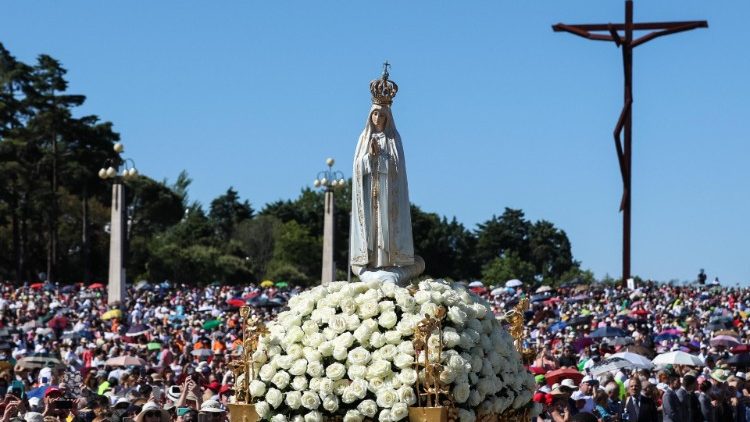
Photo from vaticannews,va, 13 May 2017.
Whenever, and wherever there is a search for truth that leads to the discovery of God through our patience and humility, there springs simultaneously the growth of a community. It is no wonder that wherever there is prayer and worship, there is always learning leading to bonding, or communing.
The first universities – from the Latin term universitas or “community of teachers and scholars” – where all offshoots of the efforts of the monks in their monastery as they evangelized peoples, teaching them not only prayers but also the basics of learning like reading and writing. Eventually monasteries had annex buildings as schools and universities that led to the establishment of towns and cities in Europe that spawned the growth of commerce and trade following the great many interactions among peoples.
Here we find the beautiful interplay of the search for truth that leads to discovery of God that bears fruit into mercy and love among people.
Another learned Saint who sought the Truth, Thomas Aquinas said that the more we learn the truth, the more we become intelligent, the more we must become holy.
How lovely it is, my dear students and teachers of Our Lady of Fatima University that wherever there is Truth which is Veritas, there is also Misericordia, the two mottos of our beloved University.
Amid the threats of COVID-19, amid the difficulties of online learning, let us continue to seek the truth, be patient and humble with one another as we try to build a community of “achievers” by “improving man as man”, “rising to the top” not to be conceited and proud but to be able to offer ourselves in the service of the country and of the world, for the praise and glory of God.
May our Patroness, the Our Lady of Fatima, lead us closer to Jesus Christ who is “the Way, the Truth and the Life.” Amen.
The Lord Is My Chef Sunday Recipe for the Soul by Fr. Nicanor F. Lalog II
Sunday XXII-B in Ordinary Time, 29 August 2021
Deuteronomy 4:1-2, 6-8 >+< James 1:17-18, 21-22, 27 >+< Mark 7:1-8, 14-15, 21-23
Photo by the author, the Holy Land, 2017.
After an interruption of five weeks, we go back to Mark’s Gospel this Sunday that shall guide us until the end of our liturgical calendar with the Solemnity of Christ the King in November. See the beauty of the Sacred Scriptures that those five weeks from John chapter six did not break the flow of narration that is so seamless!
Returning to Mark’s account today after the feeding of five thousand and the bread of life discourse at Capernaum from John, Jesus crossed the lake and proceeded with the Twelve to Gennesaret where he preached and healed until some of his enemies arrived and found an issue to raise against him.
When the Pharisees with some scribes who had come from Jerusalem gathered around Jesus, they observed that some of his disciples ate their meals with unclean, that is, unwashed hands. For the Pharisees and, in fact, all Jews, do not eat without carefully washing their hands, keeping the tradition of the elders. So the Pharisees and scribes questioned him, “Why do your disciples not follow the tradition of the elders but instead eat a meal with unclean hands?” He responded, “Well did Isaiah prophesy about you hypocrites… You disregard God’s commandment but cling to human tradition.”
Mark 7:1-3, 5-8
The Israelites have taken pride in their laws given by Moses from God at Mt. Sinai. Simply referred to as the Law or Torah, it had united them as God’s “chosen people”, making it the very center of their lives that they enlarged its meaning and scope that soon consisted of more than 600 other precepts and practices to observe and keep.
Obeying the laws and traditions became their standard for holiness so that instead of becoming a means to bring them closer to God and others, these became an end in itself that they have forgotten God and others in the process.
Photo by author, Sacred Heart Spirituality Center, Novaliches, QC, 2016.
Into our hearts and the heart of Jesus
Once again, our gospel is so timely and relevant to our situation right now we are in the midst of a pandemic when we are told to always wash our hands. And if Jesus were with us in person today, he would surely speak the same things about the hypocrisy we have in our washing of hands!
First of all, let us clarify that Jesus is not against the washing of hands before eating nor of any of their other traditions and laws; what he criticized was the greater importance given by his enemies with the outward signs of their laws and traditions, forgetting its inner dynamics and meaning. Thus, he never failed to clarify with the people that he had “not come to abolish the Law or the Prophets but to fulfill them” (Mt.5:17).
Here we find the same problem with the people at Capernaum and in our own time when people fail and refuse to look beyond material things to find the meaning of what is going on around us, of what we believe in and what we practice.
Then and now – right in the midst of this pandemic – Jesus is inviting us to deeper perspectives about our concepts and ways of doing and seeing things, of what is clean and not clean, of what is tradition and modern, of what is good and evil.
Jesus wants us to constantly examine our lives for our need of conversion of our hearts to him. He is inviting us to probe our hearts and see who or what dwells inside us because from the heart, everything flows outside not only to our mouth (cf. Lk.6:45, “out of the abundance of the heart the mouth speaks”) but also to our hands.
That is why I love that imagery of the heart between two arms and hands: the heart at the center of our being and consciousness that whatever comes out of the heart naturally flows to our arms and hands, even to our entire body. If there is something wrong in the heart, so with the messages it sends out.
He summoned the crowd again and said to them, “Hear me, all of you, and understand. Nothing that enters one from outside can defile that person; but the things that come out from within are what defile.” “From within people, from their hearts, come evil thoughts, unchastity, theft, murder, adultery, greed, malice, deceit, licentiousness, envy, blasphemy, arrogance, folly. All these evils from within and they defile.”
Mark 7:14-15, 21-23
Here we find the essential question we must ask ourselves always: Do I find Jesus Christ in my heart as the sole basis and foundation of what I believe which I also say and do?
If we cannot find Jesus at the center of the things we do and believe, most likely we do not find others in the picture too! In that case, most likely, it is all about me, mine, my, and I! Like the Pharisees and scribes of his time, washing of hands and other traditions were more of a show than something more essential which is to serve God through one another.
Jesus is now leading us to a sincere examination of our hearts,
of our interior and spiritual motivations,
of why we are doing the things we are doing,
of what we really believe in;
because, too often, many of the things we do and believe
are not really rooted in our hearts nor with God.
There are so many times in our lives
that we simply do things out of habit
and conventions without really understanding why.
Jesus is now leading us to a sincere examination of our hearts, of our interior and spiritual motivations, of why we are doing the things we are doing, of what we really believe in; because, too often, many of the things we do and believe are not really rooted in our hearts nor with God. There are so many times in our lives that we simply do things out of habit and conventions without really understanding why.
Simon Sinek said it so well in his bestselling book “Start with Why” – people buy products, patronize services, or are moved when they see the why you do things; they are willing to pay more not because of fad or prestige but more of the conviction in a belief espoused by a brand or company or by an individual.
Photo by Ezra Acayan/Getty Images in Paranaque City, 09 February 2020.
Washing of hands and eating, our hidden hypocrisies
One of the most frequently asked question by people to me as a priest these days is why despite all our prayers, God has seemed become deaf to our pleas for him to end this pandemic? The answer is simple: unless we see and accept the spiritual realities of this COVID-19 pandemic, it would linger with us longer than projected, even not be solved at all as it gets worst with new variants that have thrown back even some of the most vaccinated nations lately.
We can have all the soaps and alcohol to wash our hands during this pandemic but COVID-19 will persist for as long as we have no regard for the dignity of every person. See all the abuses and corruption going on that is more sickening than the virus itself!
That washing of hands is an imagery full of meanings we have lost since the time of Jesus. Inwardly, the washing of hands means washing of one’s heart, of cleansing ourselves of our sins and self-centeredness and other impurities.
So many times we have become like Pontius Pilate who washed his hands to free himself from any guilt in sentencing Christ to death without realizing the more he had implicated himself to the injustice by refusing to make a stand for what is true and just. Like us today, we keep on washing our hands in the hope that our conscience would be at peace or be not bothered with our indifference for what is true and good.
Photo by Mr. Red Santiago of his son, 2019.
Washing of hands has always been closely related with eating which is an act of “appropriating something we cannot fully have” like when Adam and Eve ate the forbidden fruit. They took something they cannot wholly take or “swallow” that is why all they could do was just take a “bite” that opened their eyes to something they could not fully realize and appreciate. There are so many realities in this life we just cannot fully grasp right away, requiring us to have more faith, more patience in trusting God and those above us.
But, like Adam and Eve, we keep on taking a bite, of eating whatever our limited minds and reason find as “good” to have. And we wash our hands in clear hypocrisies like the Pharisees and scribes in worship and prayer when we lead double lives, when we laugh and cheer at all kinds of lies and filth, when we silently approve attacks against human life like tokhang and abortion.
Every day we wash our hands and keep them clean to avoid contaminating our food and body in hypocrisy as we agree and support in the name of “modernism” these trends of same sex relationships, promiscuity, and divorce. Or of graft and corruption we have resigned to accept as a fact of daily life.
To wash our hands is to wash our hearts clean of all kinds of evil, of mediocrity and indifference, of taking a stand to “pass over” from sin into grace by witnessing God’s goodness in our lives as Moses reminded Israel in the first reading.
The hands and the heart always go together as expressed in the Jewish thought of “mercy of the heart” and “mercy of the hand” when God’s mercy is more than a feeling but an act of righteousness, of justice and love.
Let us heed the reminder of the Apostle in the second reading to be truly clean in our hands and in our hearts: “Be doers of the word and not hearers only, deluding yourselves. Religion that is pure and undefiled before God and the Father is this: to care for orphans and widows in their affliction and to keep oneself unstained by the world” (James 1:22, 27).
Stay safe everyone. Have a blessed week ahead! Amen.
The Lord Is My Chef Breakfast Recipe for the Soul by Fr. Nicanor F. Lalog II
Thursday, Week XIX, Year I in Ordinary Time, 12 August 2021
Joshua 3:7-10, 11, 13-17   ><]]]]'>   Matthew 18:21-19:1
Photo by author, sunrise at Lake of Tiberias (Galilee), the Holy Land, 2019.
Praise and glory to you,
O God our loving Father!
How great indeed are your
works that you do everything for
our own good even long before
we are born, preparing us
for every great moment of
trials long before we have seen
them coming or even happening!
You are always there, Father
ahead of us in every step of
the way in this life like in the
entrance of your chosen people
to your promised land preceded
by the ark of the covenant,
parting the Jordan River so that
your people may cross on dry land
reminiscent of the Exodus at Red Sea.
No sooner had these priestly bearers of the ark waded into the waters at the edge of the Jordan, which overflows all its banks during the entire season of the harvest, than the waters flowing from upstream halted, backing up in a solid mass for a very great distance indeed… While all Israel crossed over on dry ground, the priests carrying the ark of the covenant of the Lord remained motionless on dry ground in the bed of the Jordan until the whole nation had completed the passage.
Joshua 3:15-16, 17
Dear God, whenever I review my life
especially those low moments of
failures and disasters, sins and evil,
sickness or wrong decisions when I thought
everything had collapsed and totally gone,
you were always there, bringing me to safer
grounds; you were always there five steps
or more ahead of me, fixing all the problems
and troubles I have fallen into, even trapped inside.
Like in the history of Israel from Abraham to Joshua,
you never stopped surprising me
with your mighty presence and love.

But the greatest of all
marvelous things you have done
to me and us all, loving Father,
is sending us your Son Jesus Christ
to save us from all our sins with your mercy
 and forgiveness that is without end.
Like in today's parable, teach us to be
merciful and forgiving to those who have
sinned against us for we are all
forgiven sinners you love so much.
You have done so much for us, Father,
but we have done so little for you through others.
Amen.
The Lord Is My Chef Breakfast Recipe for the Soul by Fr. Nicanor F. Lalog II
Monday, Week XVI, Year I in Ordinary Time, 19 July 2021
Exodus 14:5-18   ><]]]'> ><]]]*> ><]]]'>   Matthew 12:38-42
Photo by Mr. Raffy Tima of GMA7-News, June 2020.
What a beautiful day to reflect
on your very unusual ways, O God our Father;
once again, there is that issue of
being lost in our readings today:
your people have to take a long and
circuitous route out of Egypt
going to your Promised Land only to be
caught up near the Red Sea by
their former masters pursuing them
to take them back to slavery.
But Moses answered the people,
"Fear not!  Stand your ground,
and you will see the victory
the Lord will win for you today."
Then the Lord said to Moses,
"Why are you crying out to me?
Tell the children of Israel to go forward.
And you, lift up your staff and,
with hand outstretched over the sea,
split the sea in two, that the children
of Israel may pass through it
on dry land." (Exodus 14:13,15-16)
Yes, dearest God our Father,
sometimes we need to get lost
in order to find you and one's self;
we have to be led to unfamiliar routes
and places and situations in life for indeed,
complacency breeds contempt.
Set us free from our routines and
own ways of thinking and doing
 that have unconsciously enslaved us
that we no longer trust you.
Teach us to "stand our ground"
like when Moses answered his
people amid their many complaints
that we may be consistent with our
desires to be truly free and fulfilled.
Teach us to "go forward"
as you commanded your people
to cross the Red Sea and believe in you,
follow your lead to experience
your great power and wonders.
He said to them in reply,
"An evil and unfaithful generation
seeks a sign, but no sign
will be given it except
the sign of Jonah the prophet."
(Matthew 12:39)
Forgive us, dear Jesus
in seeking so many signs from you,
doubting you, mistrusting you
despite all the love and mercy
and blessings you have showered us.
When we are lost in the many
trappings of this world,
help us find our way back
home to you, to rest anew
in your gentle mercy and love.  Amen.