The Love of Christ

Lord My Chef Daily Recipe for the Soul, 30 October 2025
Thursday in the Thirtieth Week of Ordinary Time, Year I
Romans 8:31-39 ><))))*> + ><))))*> + ><))))*> Luke 13:31-35
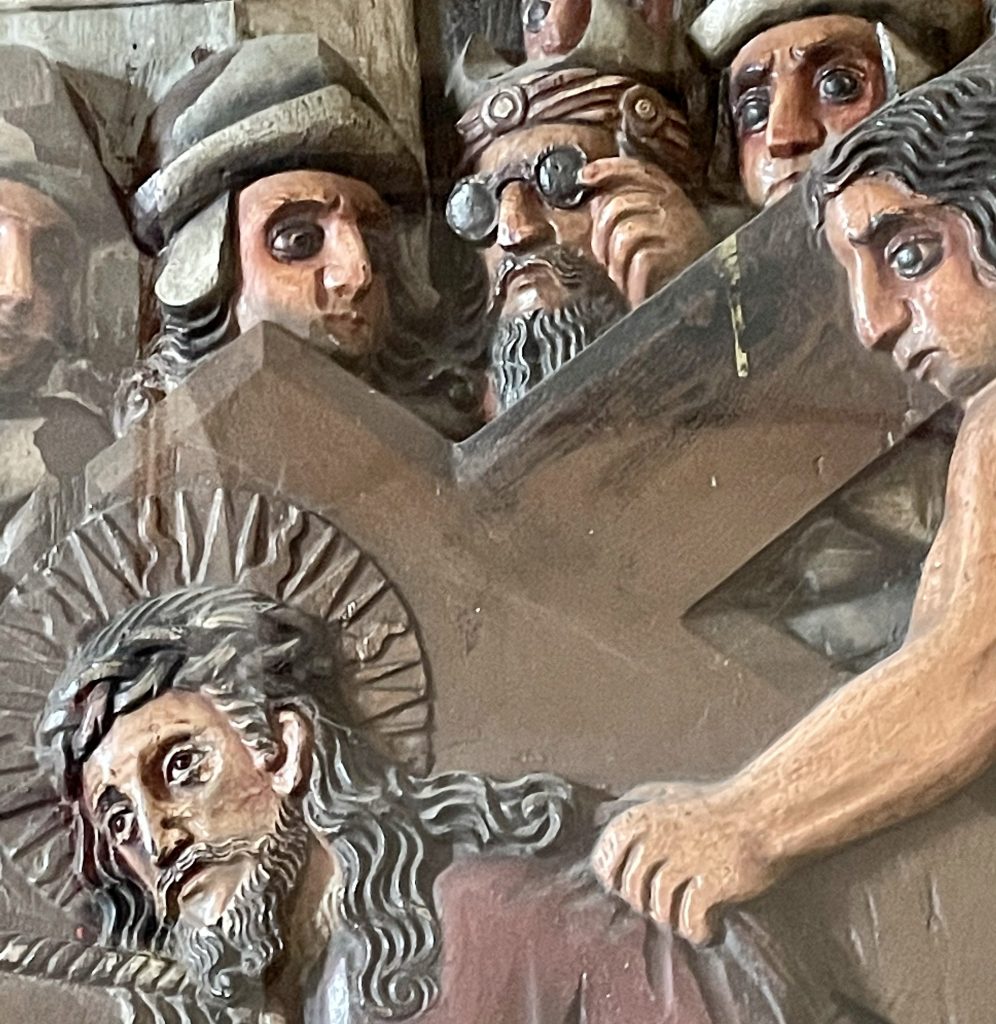
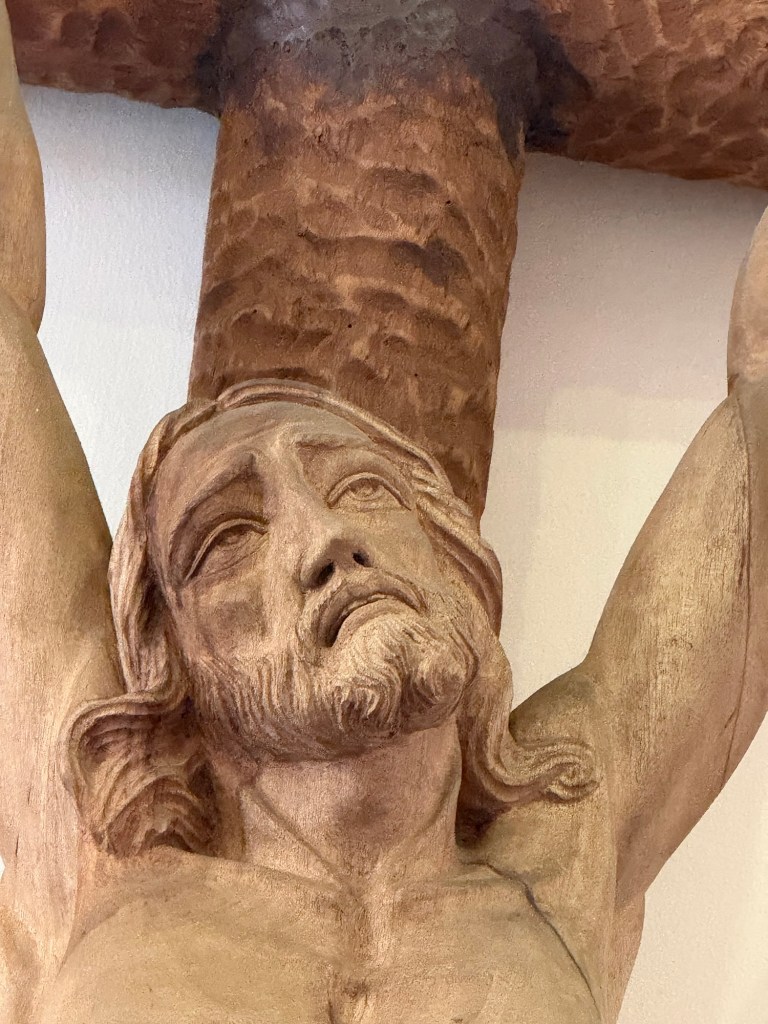
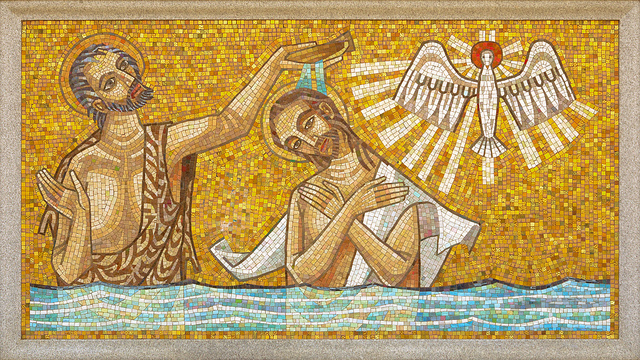
Photo by Pixabay on Pexels.com

Brothers and sisters: If God is for us, who can be against us? What will separate us from the love of Christ? Will angusih, or distress, or persecution, or famine, or nakedness, or peril, or the sword? As it is written: For your sake we are being slain all the day; we are looked upon as a sheep to be slaughtered. No, in all these things we conquer overwhelmingly through him who loved us (Romans 8:31, 35-37).

What else can I say
to these profound words
by St. Paul?

They are so true even
with us until now
with a new kind of paganism
hostile to the official teachings
of the Church as they prefer to
worship self in their body and
in their thoughts,
overextending their rights,
redefining even gender and
other natural institutions,
glorifying wealth and fame,
protecting animal rights
and environment without
any regard for persons especially
in their weakest stages in the
womb and old age...
the list goes on, Lord
but what's most sad,
even tragic
the attacks and hostilities
are not really from unbelievers
but from those who claim to be
Christians and Catholics.
Keep us strong
and faithful, Lord Jesus,
never let us separate from you;
fill us with courage too
to remain steadfast
in your ways and teachings,
to speak the truth,
to protect fellow believers
and defenders of faith
and most of all,
to keep loving your
beloved Body,
the Church.
Amen.

Discipleship is loving more

Lord My Chef Daily Recipe for the Soul, 18 September 2025
Thursday in the Twenty-Fourth Week of Ordinary Time, Year I
1 Timothy 4:12-16 <'[[[[>< + ><]]]]'> Luke 7:36-50
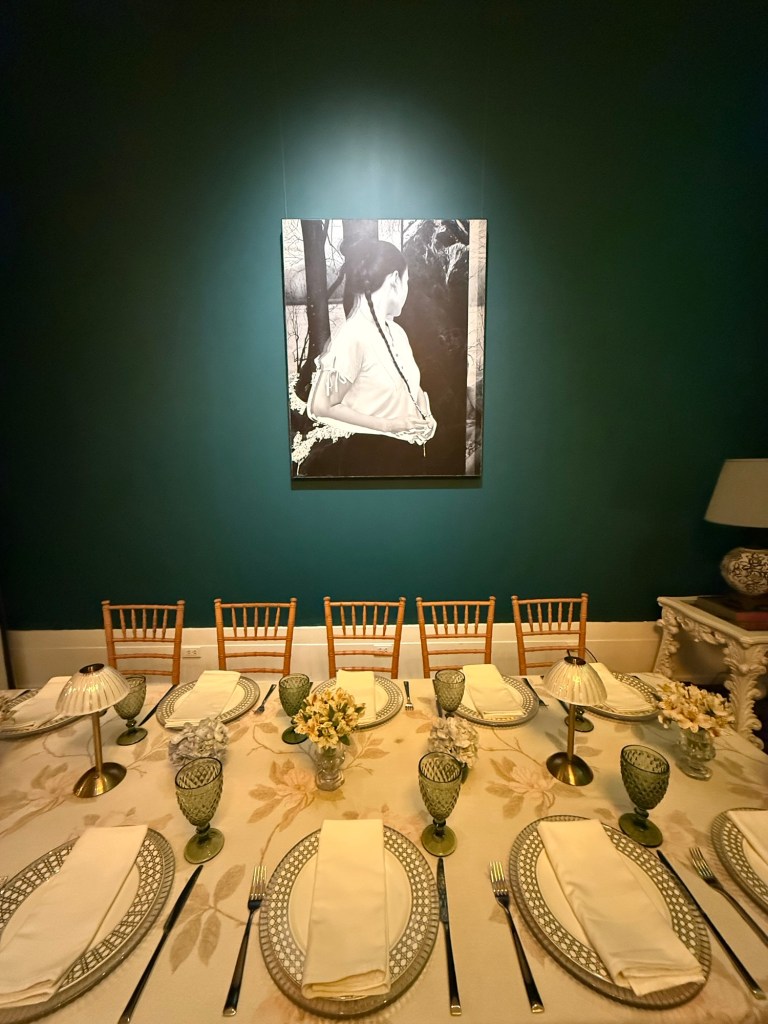
Photo by author, Manila Club, BGC, June 2025.
Your words today 
surprised me again,
Lord Jesus:
so many times I find
myself like Simon the Pharisee,
always welcoming you
into my home,
into my life,
into my meal
and many times too
like him,
I am shocked,
becoming judgmental
at times like the others
when a sinner comes
like that sinful woman
who gatecrashed
to get near you,
Lord.

When the Pharisee who had invited him saw this he said to himself, “If this man were a prophet, he would know who and what sort of woman this is who is touching him, that she is a sinner.” Jesus said to him in reply, “Simon, I have something to say to you.” “Tell me, teacher,” he said. “Two people were in debt to a certain creditor; one owed five hudnred days’ wages and the other owed fifty. Since they were unable to repay the debt, he forgave it for both. Which of them will love him more?” Simon said in reply, “The one I suppose, whose larger debt was forgive.” He said to him, “You have judged rightly” (Luke 7:39-43).

Forgive me, 
Jesus,
when I fail to see
my own sinfulness,
my past where I came from
before being with you
as a disciple:
I, too, am a sinner
like that woman who
broke all protocols
and conventions
just to get close to you,
to touch you
and be restored by you
in your mercy and forgiveness;
let me heed Paul's call to Timothy
to be "absorbed"
in your love
because
discipleship is more
than knowing you
and following you
but most of all,
loving you most
especially among
the unloveable
for we were once
like them.

Like that sinful woman,
let me go in peace today
by rejoicing
in your infinite mercy
for us all,
not just me.
Amen.
Photo by author, Manila Club, BGC, June 2025.
Fr. Nicanor F. Lalog II
Our Lady of Fatima University
Valenzuela City
(lordmychef@gmail.com)

Cross my heart?

Lord My Chef Sunday Recipe for the Soul, 14 September 2025
Feast of the Exaltation of the Cross
Numbers 21:4-9 ><]]]]'> Philippians 2:6-11 ><]]]]'> John 3:13-17
*This is a reissue of our 2023 reflection. Salamuch.
Photo by Mr. Gelo Carpio, 27 January 2020, Bagbaguin, Sta. Maria, Bulacan.

The cross is one of the most widely used but also abused and misunderstood sign in almost every generation. In fact, we are so accustomed with the cross of Jesus Christ found everywhere like in homes and offices, churches and classrooms, hospitals, restaurants and vehicles. Almost everybody carries it in our persons as an object of veneration, as a badge, or as a jewel.

On the cross we find Jesus shown in glory, peacefully sleeping in death, sometimes with his body broken by suffering. Hence, many times we use the word “cross” like in “cross my heart” to indicate our sincerity and truthfulness. But, are we truly aware of its meaning and significance in our faith, of its centrality as the symbol of God’s love for us expressed by the self-sacrificing death of Jesus Christ his Son?

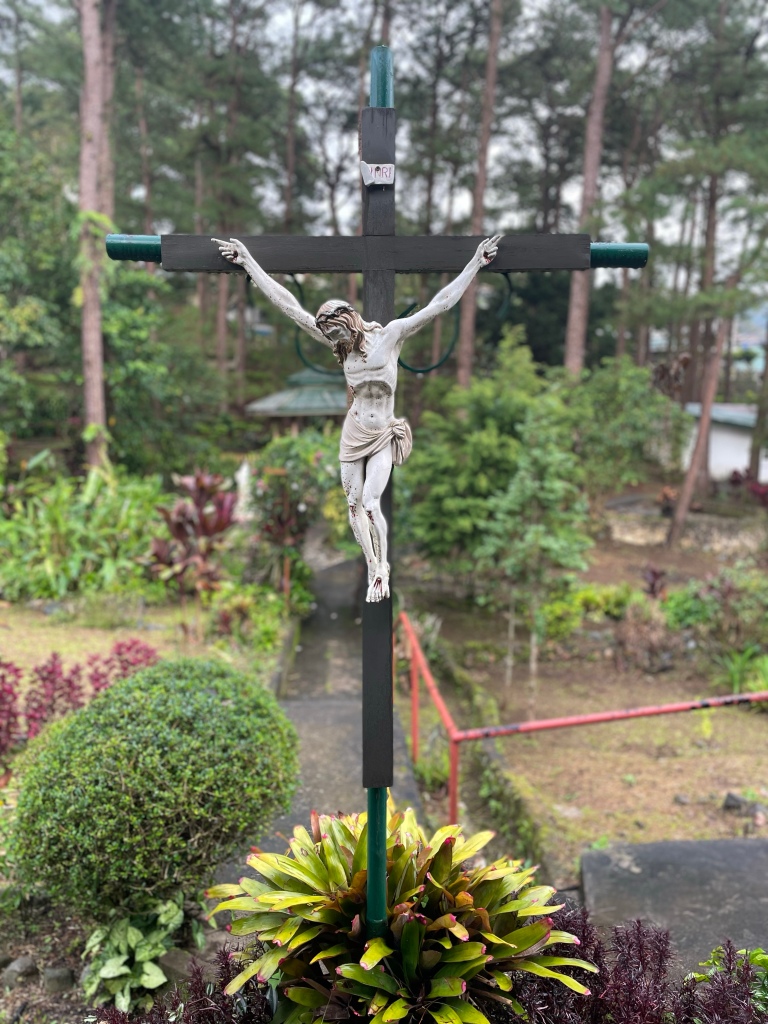
Photo by author, St. Scholastica Convent, Baguio City, 23 August 2023.

This Sunday we take a break from our cycle of readings to celebrate this Feast of the Exaltation of the Cross which falls on September 14. Due to its centrality in our faith, it is still celebrated even if the date falls on a Sunday like today.

This feast started in the fourth century with the miraculous discovery of the True Cross by Helena, mother of the Emperor Constantine, on 14 September 326, while she was on a pilgrimage to Jerusalem. She then ordered through her son the emperor the building of the Church of the Holy Sepulchre that was dedicated nine years later with a portion of the True Cross placed inside it in September 13, 335. The following day, the Cross was brought outside of the church to be venerated by the clergy and the faithful.

In the year 627, during the reign of the Emperor Heraclius I of Constantinople, the Persians conquered the city of Jerusalem and removed a major part of the Cross from its sanctuary. The emperor then launched a campaign to recover the True Cross which he regarded as the new Ark of the Covenant for the new People of God. Before embarking into war, Emperor Heraclius went to church wearing black as a sign of penance, then prostrated himself before the altar and begged God for courage. His prayer was granted as he won the war and recovered the Cross from the Persians. He brought the Cross back to Jerusalem in 641 amid great celebrations by carrying it on his shoulders. Upon reaching the gate leading to Calvary, the emperor could not go forward! Heraclius and his retinue were astonished and could not understand what had happened until the Patriarch Zachary of Jerusalem told him, “Take care, O Emperor! In truth, the imperial clothing you are wearing does not sufficiently resemble the poor and humiliated condition of Jesus carrying His cross.”

Upon hearing those words, the emperor removed his shoes and bejewelled robes, put on a poor man’s clothing and was eventually able to proceed to Calvary and replaced the Cross inside the Church of the Holy Sepulchre where a number of miracles happened during the occasion: a dead man returned to life, four paralytics were cured, ten lepers were healed, 15 blind men were given their sight, with several possessed people exorcised and many sick people totally healed!

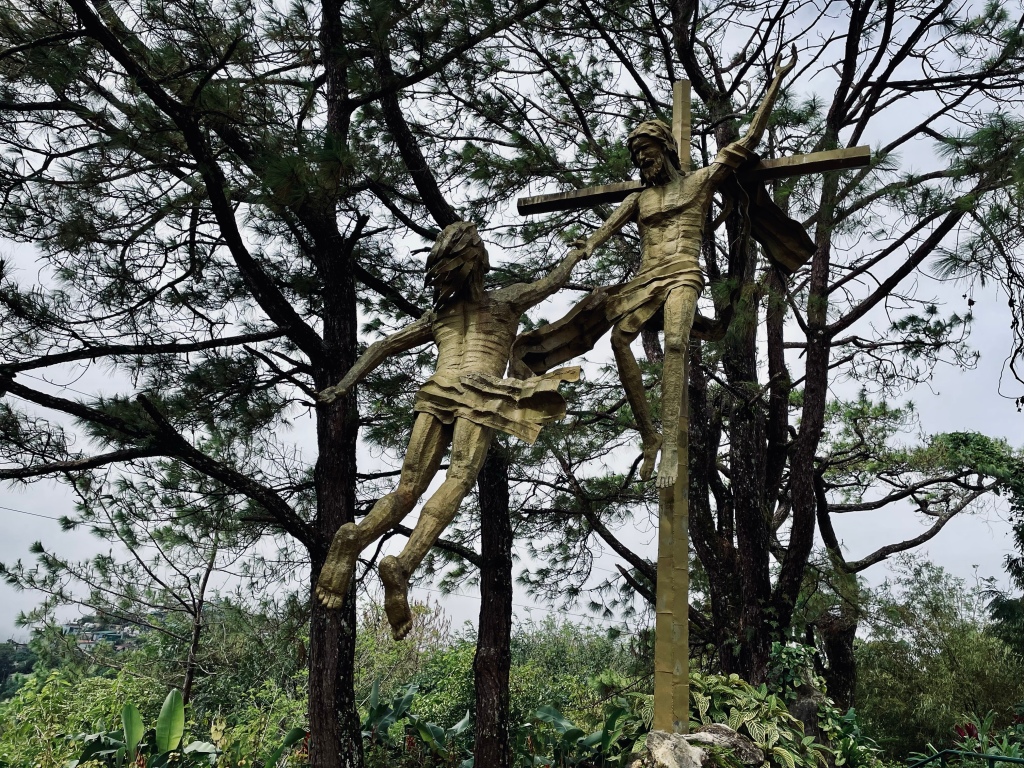
Photo by author, Mirador Jesuit Villa & Retreat House, Baguio City, 24 August 2023.

Very notable in this story were the words of the Patriarch of Jerusalem. It was only after the emperor had taken off his royal clothings and put on those of the poor was he able to carry the Cross.

It is the same thing that is asked of us today: it is so easy to display the cross inside our homes and cars, or wear it as a jewelry or even as a tattoo on our skin. But, that amounts to nothing unless we have the cross inside our hearts, our very being. More than the many signs of the cross and imaginary drawing of its lines we draw on our chest is the need for us to empty ourselves of our pride and sins so that we can be filled with Jesus Christ.

Brothers and sisters: Christ Jesus, though he was in the form of God, did not regard equality with God something to be grasped. Rather, he emptied himself, taking the form of a slave, coming in human likeness; and found human in appearance, he humbled himself, becoming obedient to death, even death on a cross (Philippians 2:6-8).

Called kenosis in Greek, self-emptying is the way of the Cross of Christ. It is choosing love and mercy than self-centeredness and self-righteousness; sacrifice than satisfaction; fairness and justice than greed and possession; bearing all the pains and perseverance than complaining and whining about difficulties and trials in life like the Israelites in the wilderness (first reading); and, thinking more of others than of one’s self.

Photo by author, 02 September 2023.

The recent COVID-19 pandemic had taught something very amusing about the positivity of being negative, when negative was actually positive – healthy and COVID free! Remember how during those days when we would always wish we would yield negative results in our swab tests for COVID?

When we look at the sign of the cross (+), it is a positive sign, a plus sign. Though the cross calls us to let go, to be detached and dispossessed, it is actually an invitation to have more of God, of life and fulfillment! In this time of affluence when everything is easily available for as long as you have the means and the resources, the sign of the Cross reminds us that life is more of letting go and of giving than of having like God who “so loved the world that he gave his only Son, so that he who believes in him might not perish but might have eternal life” (Jn.3:16). St. Francis of Assisi said it perfectly why the Cross is an exaltation, a triumph:

For it is in giving that we receive,
it is in pardoning that we are pardoned.
and it is in dying that we are born to eternal life.

Amen. Enjoy Sunday and have a blessed week ahead!

Fr. Nicanor F. Lalog II
Our Lady of Fatima University
Valenzuela City
(lordmychef@gmail.com)

Uniqueness of the Cross

Lord My Chef Sunday Recipe for the Soul, 14 September 2025
Feast of the Exaltation of the Cross
Numbers 21:4-9 ><}}}}*> Philippians 2:6-11 ><}}}}*> John 3:13-17
*This is an updated version of our reflection last year; pray for our Marriage Encounter this weekend.
Via Crucis at Fatima University Medical Center, Valenzuela City, 2025.

This Sunday we have a unique celebration, the Feast of the Exaltation of the Cross that falls on the 14th day of September. It is so important that even if it falls on a Sunday, the more it must be celebrated as it is most central in the teachings of Jesus Christ.

It is so unique because despite its being made up of two ordinary pieces of wood, the Cross is most unique with its deeply extraordinary in meaning as sign of God’s immense love for us humans through Jesus Christ’s Passion and Death.

From being the sign of the most inhuman punishment in history, the Cross is now the very sign of how God “so loved the world that he gave his only Son, so that he who believes in him might not perish but might have eternal life” (Jn.3:16). It encapsulates the whole mystery of Jesus Christ, of how this all-powerful God beyond the ordinary became weak like us in everything except sin so that we too may be like Him, divine and more than ordinary. In His suffering and death on the Cross, Jesus made the lowly wood so ordinary to be so exalted to become His sign of love and mercy, power and majesty.

Photo by author, Jerusalem, May 2017.

Hence, in the Cross is the power of God’s love to transform us to better persons.

In the Cross is God’s power to lead us closer to Him with its vertical beam and to others with its horizontal beam.

In the Cross is the power of good if we choose to embrace it with Christ Jesus as our Lord and Master.

The Cross is most unique of all signs in the world because underneath its ordinariness, that is where we see God’s glory and majesty. It was underneath the Cross of darkness and gloom on Good Friday that humanity began to see light and hope in life’s many absurdities. Most of all, it was underneath that Cross of suffering and death of Jesus Christ that we feel and experience the assurance of the Resurrection.

How?

Through our own pains and sufferings that are most uniquely ours too!

With their patience worn out by the journey, the people complained against God and Moses, “Why have you brought us up from Egypt to die in this desert, where there is no food or water? We are disgusted with this wretched food!” In punishment the Lord sent among the people saraph serpents, which bit the people so that many of them died (Numbers 21:4-6).

Photo by author, Dominican Hills, Baguio City, January 2018.

You must have heard that old story of a man who came to Jesus to return the cross given for him to carry; he asked Jesus to have it replaced with a lighter one. Jesus then led the man to a huge room with all kinds of crosses for him to choose which he prefers as the best one for him so that he would stop complaining.

After closely examining the specs of so many crosses, the man finally decided to pick one he deemed as perfect for him after considering its weight and other dimensions, only to find out from Jesus Himself that it was the same cross he had actually returned for exchange!

Many times in life we are like those people in the first reading, never ending in their complaints to God, even challenging Him, accusing Him of forsaking us, of being unfair when life becomes difficult and unbearable. There are times we feel being on the distaff side of life always like a flat tire, never on top. We cry foul to God especially with all our hurts and pains inflicted by others, asking Him where was He when most needed?

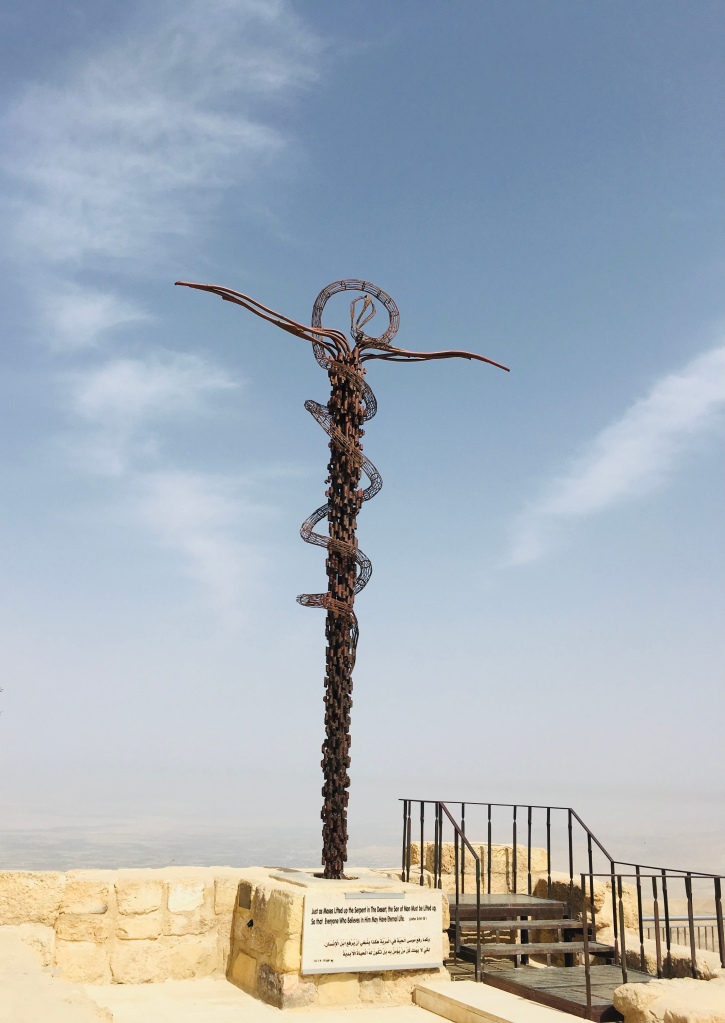
Photo by author in Jordan near the Israeli border where Moses put up the bronze serpent as instructed by God to heal those bitten by the snakes after they have complained of their conditions in the wilderness, May 2019.

While it is true life is indeed difficult, the cross reminds us of the fact that the pains and hurts we have are uniquely ours too, something we have to accept and most of all, own.

There are pains that are so deep and won’t go away that have in fact affected us dismally in our lives already. Instead of self-blaming and self-pity, we just have to ask for God’s grace to accept and own them like Jesus Christ. We just have to “bring it home” – that imagery of the Cross planted on the Calvary – into our very selves, in our being as something so true and real. And uniquely ours.

Stop thinking of others’ pains and hurts. We are not all the same. If ever we have similar experiences, the hues and shades even gravity and circumstances are not same because each pain and hurt, like the cross, is uniquely ours. Like every person, every cross is unique because it is also a gift, a mystery, and life. We have to “befriend” our pains and hurts, our own cross instead of resist it. It is in “befriending” our pains and hurts, our cross in life that we grow and mature, becoming more free to love and to be joyful because that is when the cross triumphs over its disgrace and shame in us and with others. That is when our pains and hurts, when our crosses begin to reveal to us the many beautiful truths of Easter awaiting us.

The Cross of Christ triumphed because Jesus carried it wholeheartedly, allowing those two pieces of wood to reveal not only to Him who knew everything beforehand its meaning but most of all to everyone of us the deeper truths the Cross signifies as St. Paul eloquently expressed in our second reading.

The Cross of Christ atop the church of our Lady of Lourdes in France. Photo by my former student Ar. Philip Santiago during his pilgrimage, September 2018.

One thing I realized after my mother died May last year is the fact that while there are so many pains and sufferings in this world, my own pain and suffering in losing her are most difficult to bear; hence, something I must carry because it is uniquely mine.

But, one thing so unique I noticed is that the more I see my cross following my mother’s death, the more I saw also the cross of others. The Cross of Jesus triumphed truly in me when I embraced and owned my cross, when I befriended my pains and hurts that eventually led me to recognize and see, to feel more and experience too the crosses of others.

When we become conscious of each one’s unique cross, slowly we are able to reveal to them the meaning of their personal crosses too because we become more sympathetic, more open, more silent to listen more, love more, care more and be more present with those in their own unique cross. No wonder, I find conversing more engaging with others who also grieve because we can see each other’s unique crosses!

Jesus calls us to imitate Him that by embracing and owning our cross, we too may lead others to finding the meaning of their own cross and thus experience Easter soon. Let us pray:

Give us the grace,
dear God
to always embrace the Cross
like your Son Jesus Christ
where we can all be empty
of ourselves to be filled
with your Holy Spirit
and make your love
visible in us.
Amen.
A blessed week to everyone!
Fr. Nicanor F. Lalog II
Our Lady of Fatima University
Valenzuela City
(lordmychef@gmail.com)

Seeing Jesus Christ

Lord My Chef Daily Recipe for the Soul, 22 July 2025
Tuesday, Feast of St. Mary Magdalene, Sixteenth Week in Ordinary Time
Song of Songs 3:1-4 ><}}}*> + ><}}}*> + ><}}}*> John 20:1-2, 11-18
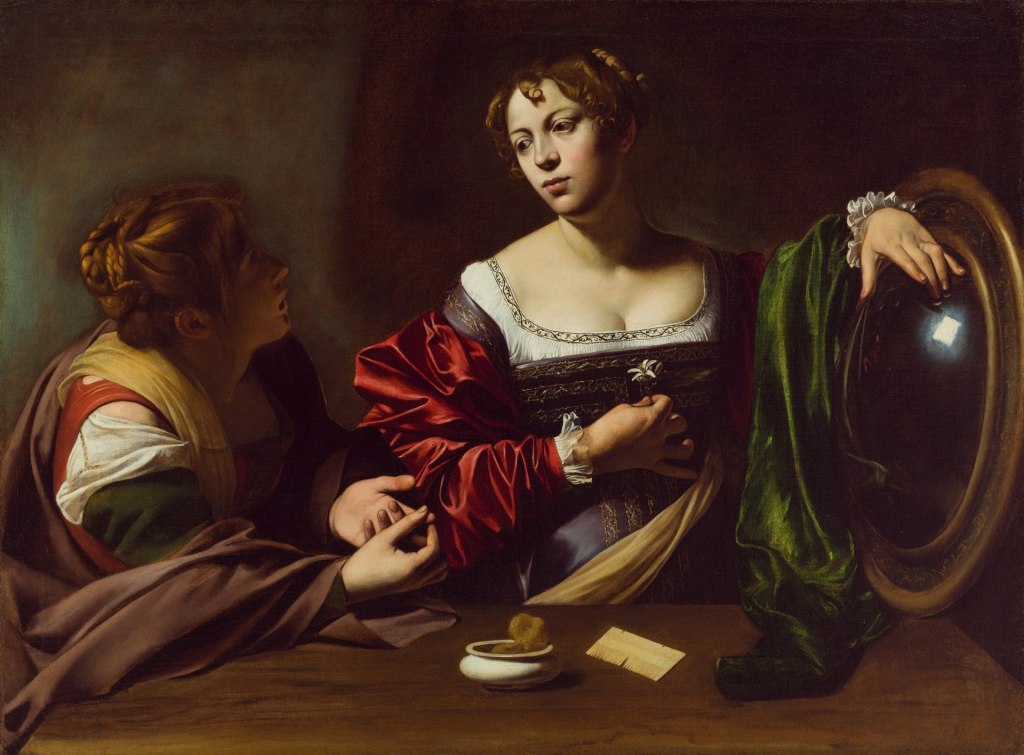
“Martha and Mary Magdalene” painting by Caravaggio (1598). The painting shows Martha of Bethany and Mary Magdalene long considered to have been sisters. Martha is in the act of converting Mary from her life of pleasure to the life of virtue in Christ. Martha, her face shadowed, leans forward, passionately arguing with Mary, who twirls an orange blossom between her fingers as she holds a mirror, symbolising the vanity she is about to give up. The power of the image lies in Mary’s face, caught at the moment when conversion begins (from en.wikipedia.org).
Thank you dear Jesus
in giving us a chance to revisit
your Resurrection with this Feast
of St. Mary Magdalene,
the Apostle to the Apostles;
she whom you love so much
by forgiving her sins and later
called her by name on that
Easter morning reminds us of
your lavish mercy and love
for each of us; how lovely that
in that crucial moment of darkness
as she grieved your death
with your body missing,
she suddenly burst into deep joy
filled with life
upon seeing you!

Mary Magdalene went and announced to the disciples, “I have seen the Lord,” and what he told her (John 20:18).

“The Appearance of Christ to Mary Magdalene” painting by Alexander Ivanov (1834-1836) at the Russian Museum, St. Petersburg, Russia from commons.wikimedia.org.
"I have seen the Lord."
I have seen you,
Jesus when I stop
clinging to my sinful past,
when I stop doubting
your mercy and forgiveness,
wondering how I could move
the huge and heavy stone of my
weaknesses and failures,
addictions and vices
that make me mistake
you into somebody else
like the gardener
because I am so preoccupied
with many things in life.

Teach me, Jesus
to stop clinging to you,
"touching" you and having you
according to my own view
and perception not as
who you really are
so that I may meet you
to personally experience you
right here inside my heart
like St. Mary Magdalene
that Easter.

The Bride says: The watchmen came upon me as they made their rounds of the city. Have you seen him whom my heart loves? I have hardly left them when I found him whom my heart loves (Song of Songs 3:1, 3-4).

"I have seen the Lord."
I have seen you,
Jesus when I love truly
like the Bride in the first reading
when I seek you in persons
not in wealth and power,
in silence not in the noise
and cacophony of vanity and fame;
let me see you Jesus
by being still,
patiently
waiting
and listening
for your coming
and calling of my name
to proclaim You are risen
to others who believe in You,
also searching You,
waiting for You.
Amen.

Fr. Nicanor F. Lalog II
Our Lady of Fatima University
Valenzuela City
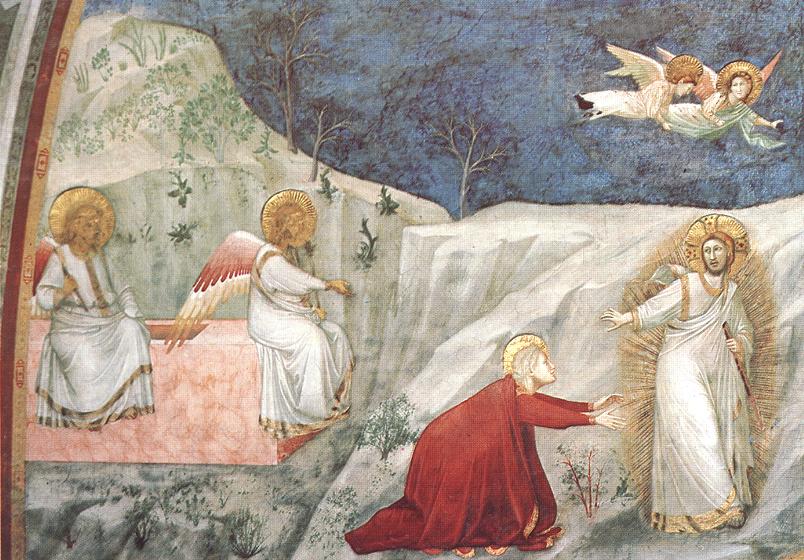
Painting by Giotto of the Risen Lord Jesus Christ appearing to St. Mary Magdalene from commons.wikimedia.org.

Pangungusap ng Puso

Lord My Chef Daily Recipe by Fr. Nicanor F. Lalog II
Sacred Heart Novena Day 2, 19 June 2025
Detalye ng painting ng Sacred Heart of Jesus sa Visitation Monastery, Marclaz, France mula sa godongphoto / Shutterstock.

Nakatutuwa itong ating wika. Mabulaklak na kahit hindi ka isang makata minsa’y di sinasadya ika’y nakakatha ng kahit maigsing tula.

Madalas ating mabasa sa mga panitikan at mapakinggan saan man kuwentuhan na tila baga itong puso ay nagsasalita gayong wala naman itong bibig. Mismo ang Panginoong Jesus noon ay nagsabi na “ano man ang bukambibig, siyang laman ng dibdib” (Mt.12:34 at Lk.6:45) upang ipakita ang pagkakadugtong ng puso at bibig tulad ng kaisahan nito sa ating kamay batay sa pagninilay kahapon.

Samakatwid, nangungusap nga itong ating puso. At iyan ang ibig kong pagnilayan ngayong ikalawang araw ng ating pagsisiyam para sa Dakilang Kapistahan ng Kamahal-Mahalang Puso ni Jesus. Ito ang sinasaad sa ating napakinggan ngayong araw na bahagi ng pangangaral ni Jesus sa mga tao mula sa kanyang sermon sa bundok.

“Sa pananalangin ninyo’y huwag kayong gagamit ngn napakaraming salita, gaya ng ginagawa ng mga Hentil. Ang akala nila’y pakikinggan sila ng Diyos dahil sa dami ng kanilang salita. Huwag ninyo silang tutularan. Sapagkat alam na ng inyong Ama ang inyong kinakailangan bago pa man ninyo hingin sa kanya. Ganito kayo mananalangin: ‘Ama naming nasa langit, sambahin nawa ang pangalan mo'” (Mateo 6:7-9).

Photo by Designecologist on Pexels.com

Isa sa mga madalas na itanong sa akin ng mga mag-aaral dito sa Our Lady of Fatima University bilang kanilang chaplain ay alin daw ba ang dapat nilang pakinggan, sigaw ng puso o sigaw ng isipan?

Palagi kong tugon sa kanila ay ang pabirong paalala na unahin nilang pakinggan lagi ang sigaw ng kanilang mga magulang.

Pagkaraan ng ilang tawanan, saka ko binabalik sa kanila ang tanong sa ibang anyo naman: humihiyaw nga ba ang puso gayong ang pagtibok nito ay napakahina? Hindi kaya sa pakikipag-usap sa atin nitong ating puso, ang ibig nito ay taimtim na pakikinig dahil kung ito ay mangusap, madalas ay pabulong.

Larawan kuha ng may-akda, Atok, Benguet, 27 Disyembre 2024.

Mag-imagine tayo kunwari ay naroon tayo sa bundok sa sermon ni Jesus. Siguradong malakas ang tinig niya sa pangangaral ngunit sa aking pakiwari mayroong indayog ang kanyang pananalita na kung saan minsan-minsan marahil siya ay bumubulong katulad nitong sa pagtuturo niya kung paano tayo mananalangin. Mahigpit ang kanyang bilin na huwag tutularan mga Hentil na napakaraming sinasabi sa Diyos sa pakiwaring sila ay pakikinggan. Hindi natin kailangang maging maingay at daanin sa dami ng sinasabi ang Diyos bagkus higit na mainam ang pananahimik upang mapakinggan sinasabi sa atin ng Diyos. Sinabi na ni Jesus na alam ng Diyos ating pangangailangan bago pa man tayo dumulog sa kanya sa pagdarasal. Kaya tayo nagdarasal ay upang pakinggan kalooban ng Diyos.

Kaya gumagamit ng stethoscope mga duktor at nurse kasi nga mahina ang tinig ng puso natin. At yon ang unang kinakailangan sa pananalangin – katahimikan upang Diyos ay mapakinggan!

Kung ang puso man ay humihiyaw, marahil wala na tayong masyadong alitan at mga kaguluhan dahil tiyak ating maririnig at mapapakinggan bawat pintig ng puso na iisa ang sinasabi kungdi ang tayo ay magmahal nang tunay. Ito ang buod ng “Ama Namin” at lahat ng mga panalangin. Ang pag-ibig ng Diyos sa ating lahat na ating tinutugunan ng pagmamahal sa ating kapwa dito sa lupang ibabaw lalo na sa pagpapatawad sa kanilang pagkakasala sa atin.

Sa Kamahal-Mahalang Puso ni Jesus, doon ay malinaw na inihahayag ang dakilang pag-ibig ng Diyos sa ating lahat ngunit walang nakikinig dahil mas nahahalina ang marami sa malalakas at maiingay na tinig ng daigdig. Ito yung ikinalulungkot ni San Pablo sa mga taga-Corinto sa unang pagbasa ngayon dahil napakadali nilang nalinlang at napasunod sa mga kakaibang turo ng ibang nangangaral sa kanila. Katulad din natin ngayon na maraming nagpapaniwala at nahahalina sa mga kung anu-anong kaisipan ng mundo gaya ng new age at wokism at iba pang mga ideya na wala nang pakialam sa Diyos at moralidad gaya ng relativism na siyang sanhi ng paniniwala sa same sex marriage at abortion.

Larawan kuha ng may-akda sa Liputan, Meycauayan, Bulacan, 31 Disyembre 2022.

Imagine din natin na first time napakinggan ang panalanging “Ama Namin.” Malamang pabulong at marahang binigkas ni Jesus ang mga titik ng panalanging ito upang tumimo ng higit sa puso at kalooban ng mga tagapakinig.

Kakaibang kaisipan noon iyon sa mga Hudyo sapagkat ang Diyos sa pagkakaalam nila ay makapangyarihan at hindi maaabot doon sa langit. Ngunit kay Jesus, malapit ang Diyos tulad ng sino mang ama sa lupa. Isang personal at mapagmahal na parang tao ang Diyos na pinakilala ni Jesus sa kanila at maging sa atin ngayon kaya mas malamang ay malumanay na malumanay ang pagbigkas ni Jesus lalo ng “Ama naming nasa langit” dahil puno ng pagmamahal at pag-galang. Hindi ba noong una tayong ma-in love ay tahimik din tayo? Hindi natin pinagsasabi yung pers lab natin?

Ayon sa mga dalubhasa sa bibliya, mas mahaba ang tala ni San Mateo sa pagtuturo ni Jesus ng “Ama namin” kesa sa bersiyon ni San Lukas; layunin anila ni San Mateo na ituro ang ating disposisyon sa pananalangin habang si San Lukas naman ang tuon ay naroon sa laman ng ating dasal.

Sa madaling sabi, pagmamahal ang disposisyon nating dapat sa pananalangin di lamang ng “Ama namin” kungdi mismo sa ating pakikipag-ugnayan sa kapwa na siyang paghahayag ng ating ugnayan sa Diyos.

Ang Ama namin at lahat ng pananalangin ay paghahayag ng ugnayan kaya ang mga ito ay dinarama, nilalasap dahil ito ay isang karanasan na pinaninindigan at pinatutunayan sa mabubuting gawa.

Noong bata pa tayo at wala pang kamuwang-muwang sa mga kalokohan at kasamaan ng mundo, napakadali nating napapakinggan bulong ng puso na magmahal, makipag-bati, magsorry, magsabi ng please at thank you, at maging mabuting tao. Subalit sa ating pagtanda, atin nang tinuturuan ang puso natin ng sariling kagustuhan na dapat laging sundin at pakinggan. Magsinungaling kung kinakailangan.

Masaklap na bunga nito ang ating pagkakawatak-watak. Hindi maramdaman ang ating ugnayan dahil maraming ayaw nang magmahal, ayaw nang kilalanin bawat isa bilang kapatid at kapwa sa iisang Ama nating Diyos.

Ngayong ikalawang araw sa ating pagnonobena sa Sacred Heart, matuto tayong muli na manahimik at makinig sa tinig at pintig ng puso natin upang muli tayong makiniig sa Diyos na Ama natin. Kapag muli nating ninamnam ang katotohanang ito, mapagtatanto na rin natin ang ating kapatiran sa iisang Ama kay Kristong kapatid natin.

Sa ating panahong napaka-ingay at kay dami-daming nag-aagawan sa ating atensiyon upang pakinggan at sundin, marahil ay humihiyaw na nga itong puso natin ng pabulong dahil hirap na itong maiahon ang katotohanan ng pag-ibig na ating ibinaon. Pagmasdan paanong palaging kalakip ng debosyon sa Mahal na Puso ni Jesus ang pagtitika sa mga kasalanan at pagbabalik-loob sa Diyos at kapwa. Kasi nga, ang magkasala ay hayagang pagtanggi natin na magmahal. Iyon ang salita at pangungusap tuwina ng puso – magmahal, magmahal, at magmahal pa rin! Manalangin tayo:

O Jesus na mayroong
maamo at mapagkumbabang Puso,
Gawin Mong ang puso nami'y
matulad sa Puso Mo!
Amen.

Loving Jesus, following Jesus

Lord My Chef Daily Recipe for the Soul by Fr. Nicanor F. Lalog II
Friday in the Seventh Week of Easter, 06 June 2025
Acts 25:13-21 <*((((>< + ><))))*> John 21:15-19
Photo by author, Cabo Da Roca, Pundaquit, San Antonio, Zambales, 15 May 2025.
I love you, Lord
And I lift my voice
To worship you
Oh, my soul rejoice
Take joy my King
In what you hear
May it be a sweet, sweet sound
in your ear...
I just felt singing that lovely
song, Jesus as I prayed
on your words today;
felt so good,
so comforting,
especially if sang
at times like when everything
is flowing smoothly in life,
when obstacles are overcome,
when there is more joy than sadness,
more triumphs and success,
more healthy than sickly;
how easy it is to say
"I love you, Lord"
unless you Jesus asks us
"do you love me" thrice.

It is different when you
are the one asking the question,
Jesus because you know everything,
you know very well how imperfect
our love while at the same time you
know so well how we try hard
in loving you by forgetting
ourselves, following you and
carrying our Cross.
Give us the courage and
strength to say "I love you, Lord"
dear Jesus for it is only in first loving you
that we are able to follow you.
Amen.

Presence in Absence

Lord My Chef Sunday Recipe for the Soul by Fr. Nicanor F. Lalog II
Solemnity of the Ascension of the Lord, Cycle C, 01 June 2025
Acts 1:1-11 ><}}}}*> Hebrews 9:24-28;10:19-23 ><}}}}*> Luke 24:46-53
Photo by author, Atok, Benguet, 26 December 2025.

We all have experienced dreams so real where we met friends and relatives even strangers that we described as “totoong-totoo” that we woke up crying or simply joyful and feeling so light. The clothes even the scent and ambiance were so real that we tried going back to sleep to continue the dream!

This is what we call as the dynamic of “presence in absence” when loved ones long dead or gone or simply far from us we still feel near and close too. It is the same familiar kind of relationship that we have with God whom we feel also as too near yet so far like what Luke described to us in the Ascension of Jesus Christ:

As he blessed them he parted from them and was taken up to heaven. They did him homage and then returned to Jerusalem with great joy, and they were continually in the temple praising God (Luke 24:51-53).

Photo by Mr. Sean Pleta in Melbourne, March 2015.

When Luke said that Jesus “As he blessed them he parted from them and was taken up to heaven”, he was describing to us Christ’s new and higher kind of relationship with all his disciples that include us today.

Jesus did not merely enter a physical reality that the author of the Letter to the Hebrews tells us in the second reading; he actually entered into a new level of relationship with us and everyone. This “leveling up” in our relationships that no longer require physical presence is the dynamic of presence in absence. We don’t have to be physically present because there are deeper ties that bind us with God and with others, both the living and the dead.

Recall how since Easter we have been reflecting on this aspect of new level of relationship with Jesus who told Mary Magdalene at their first meeting to “touch me not” because of the need for a higher level of relating with him no longer bound by time and space. This Jesus showed when on the evening of Easter he entered the locked doors where the disciples were hiding. And Luke tells us that beautiful account of Jesus walking to Emmaus with two disciples who did not recognize him but upon reaching home after the breaking of bread, the two disciples recognized Jesus who immediately disappeared from their side. It was always a case of presence in absence!

Note also that in all appearances of Jesus after Easter to his disciples, there was always joy that continued even after his Ascension when “they returned to Jerusalem with great joy, and they were continually in the temple praising God.” Normally, there is sadness after every separation and goodbye. But not with the disciples of Jesus including us!

How can you explain that even if Jesus does not seem to answer our prayers, we just keep on praying to him? Why do we remain in Jesus despite his apparent absence? That’s because deep in our hearts we are certainly sure he is always with us, that he loves us so much, that eventually, he will answer our prayers though he does answer our prayers always but not in the way we wanted it to be.

That is why we need to make that effort to deepen and cultivate our relationship with Jesus to always see his presence in his absence like what the angel told the disciples in the first reading after his Ascension, “Men of Galilee, why are you standing there looking at the sky? This Jesus who has been taken up from you into heaven will return in the same way as you have seen him going into heaven” (Acts 1:11).

Do not look up or anywhere but look inside our hearts where Jesus dwells as he had told us last Sunday if we keep his words and love one another. We need to level up in our relationship with God through prayers and good works.

We need to see more with our heart than with our eyes because the deepest truths and realities in life are seen with the heart and soul. The ancient Persian sage and poet Rumi said it so beautifully, “Goodbyes are only for those who love with their eyes. Because for those who love with heart and soul, there is no such thing as separation.”

Since Easter, we have been reflecting on the profound difference of Christ’s Resurrection with his birth on Christmas filled with external signs and symbols. Easter is characterized by absence like darkness and emptiness where we find the presence of Jesus and his light.

This presence in absence is also the reality we have in those we refer to as “low-maintenance” friendships where we have some people who do not demand anything from us nor we demand much from them. We meet when time allows and chat once in a while yet we remain the bestest friends because of the love and respect we have for each other. Basta, alam na this!

That is also the reality of our relationship with God. Do we experience the same joys in his presence in absence? Are we at home with our relationship with Christ found in darkness and emptiness, present in his apparent absence? Let us pray:

Lord Jesus,
let us rise up in our
relationships with you with others;
let us be more loving and faithful,
kind and understanding,
fair and just
even without seeing you
and one another.
Amen.
Photo by author, Anvaya Cove and Resort, Morong, Bataan, 25 May 2023.

Living Inside Your Love (1976) by Earl Klugh

Lord My Chef Sunday Music by Fr. Nicanor F. Lalog II, 25 May 2025
Photo by author, Angels’ Hills Retreat and Spirituality Center, Tagaytay City, 18 April 2025.

We shift this Sunday into jazz with Earl Klugh’s sophisticated Living Inside Your Love to slow cool down our simmering summer and to feel more the meaning of the Mass readings today as we enter the penultimate week of Easter.

We were already in our early teens when we discovered Earl Klugh along with other jazz greats with the opening of the country’s first and only jazz radio station 101.9 WK-FM in the late 70’s. Maybe it was part of growing up when we experimented on a lot of things for more adventures that I found myself venturing into jazz from rock and pop music, switching from RJ to RT and then WK.

For me, Earl Klugh was the jazz version of rock’s Eric Clapton or Carlos Santana. Klugh has that certain touch or pluck in his guitar that can make you be in love, not necessarily be in love with anyone. It is a nakaka-in love ma-in love na feeling! That is why we remembered his Living Inside Your Love piece from his second studio album released in 1976 by the legendary Blue Note Records and Liberty Records produced by another jazz great, Dave Grusin.

Actually, we just realized today Living Inside sounds like a prelude to the turn of the century’s new age music where Klugh’s masterful playing of the guitar taking the centerstage of a great symphony backed up with cool vocals repeating just a few lines and stanzas of simple verses over and over that is similar with the vision of John in this Sunday’s second reading from the Book of Revelation when he saw and experienced the “new heaven, new earth” in the great luminous light of God who is himself the temple in the city (https://lordmychef.com/2025/05/24/easter-is-god-dwelling-in-us/). See how Klugh inserted the vocals into his great guitar music enhanced by a symphony like John’s vision of heaven:

Can't get over the feeling
Living inside your love
I never want to lose the feeling
Living inside your love

Baby, you made my life so free
Living inside your love
You're just where I want to be
Living inside your love

Baby, you made my life so free
Living inside your love
You're just where I want to be
Living inside your love

Very interesting with his wonderful guitar music, Klugh’s lyrics – though sparse and repetitive – were loaded in meaning. Consider the line “living inside your love” which is exactly what Jesus said at the Last Supper, “Whoever loves me will keep my word, and my Father will love him, and we will come to him and make our dwelling with him” (John 14:23).

“Living inside one’s love” is what we call as “Divine indwelling”, that is, our home is in God – and with any one we love!

Moreover, consider also Klugh’s first line in his next stanza, “Baby, you made my life so free/ Living inside your love/ You’re where I want to be/ Living inside your love.”

When we love, we enter a relationship that becomes our dwelling, our home where we become free – free to love more, free to be faithful. When we truly love like Christ, the more we find ourselves more free to love, more free in everything because being free is choosing always what is good. We believe that more than a stroke of genius, it was also a kind of divine inspiration about true love that made Klugh at put at the end of this 1976 classic the longer stanza that actually repeated inn order to stress the truth of his first two stanzas.

Can't get over the feeling
Living inside your love
I never want to lose the feeling
Living inside your love
Can't get over the feeling
Living inside your love
I never want to lose the feeling
Living inside your love
I can't get over the feeling
Living inside your love
I never want to lose the feeling
Living inside your love
I can't get over the feeling
Living inside your love

Here is Earl Klugh’s lovely Living Inside Your Love. Have a lovely Sunday and week ahead.

From YouTube.com

Friends in Christ

Lord My Chef Daily Recipe for the Soul by Fr. Nicanor F. Lalog II
Friday in the Fifth Week of Easter, 23 May 2025
Acts 15:22-31 <'[[[[>< + ><]]]]'> John 15:12-17
Photo by author, Sacred Heart Novitiate, Novaliches, QC, 20 March 2025.
Thank you, 
dear Jesus
in choosing me
and making me your friend;
let me be a friend to others too
like you.
You said it so well,
Lord, "You are my friends
if you do what I command you" -
which is to love!
Furthermore,
you told us, "I no longer
call you slaves, because a slave
does not know what his master
is doing" (John 15:14) but,
how sad that we do the opposite:
we do not truly love one another
like you, taking each one as a friend;
worst, we make others like slaves
especially if they are not like us
in color and status, belief and gender.
Teach us,
dear Jesus,
to imitate Judas called
Barsabbas and Silas along
with Paul and Barnabas sent
to the Christians in Antioch
to deliver the letter of the Apostles
and presbyters regarding the issues
of circumcision and other Jewish
practices some wanted the Gentile
converts to undertake;
how lovely that as the faith spread
far and wide reaching many people,
the Apostles and the presbyters
decided not to burden the brothers
with Jewish customs and practices;
here we find love in action,
friendship is in taking away
the burdens of others than
putting on heavier burdens on them;
most of all,
a true friend who loves like you
Jesus is one who encourages others
in your way.
Amen.
Photo by author, Sacred Heart Novitiate, Novaliches, QC, 20 March 2025.