The Lord Is My Chef Sunday Music by Fr. Nick F. Lalog II, 21 March 2021
Photo from GMA Network of a scene from Ben&Ben’s music video “Pagtingin” with Gabbi Garcia and Khalil Ramos, 25 February 2021.
We go OPM this final Sunday in Lent to ease everyone with the alarming surge of COVID-19 infections happening in our country especially at the National Capital Region. Stay home, be safe, pray and listen to some good music from our homegrown local band Ben&Ben as we try to link the Sunday gospel to their recent hit “Pagtingin”.
I know… Ben&Ben is not my generation but that is the wonder and joy of music as food of the soul: it always strikes a chord in anyone’s heart that reaches to the soul, enabling us to see more beyond the material and natural realities.
Like with their 2019 hit called “Pagtingin” which means in English as “feelings, a sort of crush and attraction to a woman or a man.” Its Filipino root is “tingin” or “see” in English. Remember when we were growing up, feeling drawn to someone so special that we would look at her or steal glances just to see the woman we adore? And the kilig moments when your sights meet?
But of course, the moment you reveal those secret feelings, that is also when you begin to see the bigger picture: your object of pagtingin will either accept or reject you. There is always that risk because sometimes in life, what we see is not what we truly get.
Dami pang gustong sabihin Ngunit ‘wag na lang muna Hintayin na lang ang hanging Tangayin ang salita
‘Wag mo akong sisihin Mahirap ang tumaya Dagat ay sisisirin Kahit walang mapala’
Pag nilahad ang damdamin Sana ‘di magbago ang pagtingin Aminin ang mga lihim Sana ‘di magbago ang pagtingin
Bakit laging ganito? Kailangang magka-ilangan Ako ay nalilito, ooh-ooh-ooh Ooh-ooh-ooh, ooh
Seeing in the bible means believing. There are times when we see, we believe; but, ultimately, it is in believing first that we are able to see the whole picture in life especially Jesus in the light of his dying on the Cross. And this is what the song Pagtingin is hoping in the end that amid the pains and hurts with some prayers, the man with special feelings will finally see closely with him the woman he sees from afar.
Pahiwatig Sana ‘di magbago ang pagtingin Pahiwatig Sana ‘di magbago ang pagtingin
Iibig lang kapag handa na Hindi na lang kung trip-trip lang naman Iibig lang kapag handa na Hindi na lang kung trip-trip lang naman
‘Pag nilahad ang damdamin Sana ‘di magbago ang pagtingin Aminin ang mga lihim Sana ‘di magbago ang pagtingin
Subukan ang manalangin Sana ‘di magbago ang pagtingin Baka bukas, ika’y akin Sana ‘di magbago ang pagtingin
A blessed week ahead of everyone. Stay safe always. Amen.
40 Shades of Lent by Fr. Nicanor F. Lalog II
Fifth Sunday in Lent-B, 21 March 2021
Jeremiah 31:31-34  +  Hebrews 5:7-9  +  John 12:20-33
Photo by author, details of the Seventh Station of the Cross at the St. Ildephonse Parish Church in Tanay, Rizal, January 2021.
In the beautiful church of the town of Tanay in Rizal is found a most unique Seventh Station of the Cross where one of those depicted when Jesus fell for the second time is a man with dark glasses looking afar. Local residents say the man with sunglasses is Caiaphas, the chief priest during the time of Jesus who led the Sanhedrin at his trial leading to his crucifixion.
Nobody can explain exactly why the artist portrayed that man wore sunglasses that was popular among people of stature and position in the country when the carving was made in 1785. Also interesting aside from the man in shades are the soldiers with him shown with Malay features of brown color and wide eyes opened, all looking somewhere except for one looking at the Lord while clutching his garment as he fell looking heavenwards.
I remembered this piece of work of art inside the Tanay Parish Church declared by the National Museum as “National Cultural Treasure” because our gospel today speaks about a request by some pagans to see Jesus. Seeing has many meanings, always leading to believing. And sometimes, it is in believing we are able to see most of all!
Some Greeks who had come to worship at the Passover Feast came to Philip, who was from Bethsaida in Galilee, and asked him, “Sir, we would like to see Jesus.” Philip went and told Andrew; then andfrew and Philip went and told Jesus. Jesus answered them, “The hour has come for the Son of Man to be glorified. Amen, amen, I say to you, unless a grain of wheat falls to the ground and dies, it remains just a grain of wheat; but if it dies, it produces much fruit. Whoever loves his life loses it, and whoever hates his life in this world will preserve it for eternal life.”
John 12:20-25
Seeing to believe
Photo by Dr. Mylene A. Santos, MD, Infanta, Quezon 2020.
As we have been mentioning three Sundays ago, the fourth gospel uses poetic expressions and symbolisms to convey deeper truths and realities about Jesus and our very selves, our having or lacking faith in God. Like the act of seeing by those Greeks who requested Philip “to see Jesus”.
If they simply wanted to catch a glimpse of Jesus, they could have easily seen the Lord who was always at the temple area at that time. Jesus had always been available to everyone like last Sunday when Nicodemus went to see him at night.
But, John often used the verb to see in many senses that also mean to believe like in his appearance a week after Easter to his disciples along with doubting Thomas: Jesus said to him “Have you come to believe because you have seen me? Blessed are those who have not seen and have believed” (Jn.20:29).
Most mysterious for me in John’s use of the verb to see is in the call of the Lord’s first disciples led by Andrew: He said to them, “Come, and you will see.” So they went where he was staying and saw where he was staying… Andrew followed Jesus. He first found his brother Simon and told him, “We have found the Messiah” (Jn.1:39-41).
What did Andrew see that he later told his brother Simon that they have found the Messiah?
Of course, John’s most notable use of the verb to see is from that scene at the empty tomb on Easter Sunday when the perfect model of the believer is the “other disciple” whom Jesus loved “went in, and he saw and believed” (Jn.20:8).
Very clear in the mind of John that the request of those Greeks to see Jesus was one of faith, of meeting and speaking with Jesus to be enlightened more like Nicodemus last Sunday. Here we find our important role of being another Philip and Andrew, leading other people to see Jesus.
Those Greeks described as “God-fearing” were pagans attracted to the teachings of Judaism and came to Jerusalem to observe the Passover Feast. They already have faith in God that must have been awakened further when they heard the teachings of Jesus; hence, their request to see Jesus.
It happens so often that when by the grace of God people are illuminated with faith even in the most personal manner, they still need Philips and Andrews who would enable them “to see” Jesus to grow and be deepened in faith. There will always be a need for an apostle who could lead others to “see” Jesus because faith happens within a community, within the Church and through others’ mediation.
And here lies the bigger challenge for us disciples for us to make Jesus “seen” in our lives and in our community.
Jesus answered them, “The hour has come for the Son of Man to be glorified. Amen, amen, I say to you, unless a grain of wheat falls to the ground and dies, it remains just as a grain of wheat; but if it dies, it produces much fruit. Whoever loves his life loses it, and whoever hates his life in this world will preserve it for eternal life. Whoever serves me must follow me, and where I am, there also will my servant be. And when I am lifted up from the earth, I will draw everyone to myself.” He said this indicating the kind of death he would die.
John 12:23-26, 32-33
In a sudden twist, John tells us nothing if those “God-fearing” pagans saw Jesus at all because the Lord immediately went on a discourse after being told by Andrew and Philip of the request, briefly interrupted by God’s voice speaking from heaven that everybody heard in the temple area.
Speaking in the parable of the grain of wheat dying first in order to produce much fruit, Jesus tells us how we can lead others to truly see him in us and through us by having the same determination and perseverance to follow him, stay with him, and be like him by dying to ones self for others. For the grain of wheat to die and spring forth to new life, it has to be detached. And so are we.
Notice Jesus repeating that sign of his being lifted up on the cross he mentioned last Sunday to Nicodemus. John mentions it again in this part of his gospel adding an explanation at the end because for him, the Crucifixion is Christ’s greatest sign and revelation of his glory, opening a path for us back to God in his Cross, through his Cross.
In teaching us about the parable of the grain of wheat dying and linking it with his being “lifted up”, Jesus now tells us and every “God-fearing” person that we can only “see” him in the scandal of the Cross.
Did those God-fearing Greeks remained in Jerusalem and saw Jesus on the Cross?
We do not know but we are sure that anyone who requests to see Jesus always sees him if we believe first in his crucifixion which is when everyone is drawn to him as he had said. We must first believe Christ died so we may see him risen to life.
It was on Christ’s dying on the cross when God established a “new covenant” among us as prophesied by Jeremiah in our first reading today, giving us all an access to him in Jesus, through Jesus, with Jesus which we celebrate daily in the Holy Eucharist.
Photo by author, 2020.
Grappling with death to see life
We have never seen the crucifixion of Jesus except in its portrayals in the many movies we used to watch in Holy Week; but, its realities are etched and impressed in our hearts through the many trials and difficulties we have gone through in life that we believe Jesus truly died. And because of that, we have also seen him alive!
Such is the reality of seeing Jesus that every time we describe something so difficult, so trying, we equate it with death like when we say “we felt like dying” taking the exam. And the good news is when we overcome the tests that we use again the word or concept of death to describe something so good as it leads us to glory like when we say a pizza or a steak or a cake to die for.
Such is the paradox and scandal of the Cross of Jesus: we can never see him risen in glory if we avoid and refuse seeing his Passion and Death right in our own selves, in our painful experiences.
Going back to that unique Seventh Station of the Cross at the Tanay Parish Church, I realized how the unbelievers and others among us could not see Jesus as the Christ because they have refused to believe in him first especially when they are down with all kinds of problems and trials, looking somewhere else instead of seeing Jesus fallen in front of them.
Let us believe in Jesus so we may see him in this final week of Lent as we prepare for Palm Sunday next. Amen.
40 Shades of Lent by Fr. Nicanor F. Lalog II
Friday, Solemnity of St. Joseph, Spouse of the Blessed Virgin Mary
2 Samuel 7:4-5, 12-14, 16  +  Romans 4:13, 16-18, 22  +  Matthew 1:16, 18-21, 24
Photo by author of the site believed to be the workshop of St. Joseph in Nazareth, 2017.
Today’s celebration of the Solemnity of St. Joseph as most chaste spouse of the Blessed Virgin Mary is a very special one being in the “Year of Saint Joseph” that began last December 8, 2020 until December 8, 2021 in commemoration of the 150th year anniversary of Pope Pius IX’s declaration of the beloved saint as Patron of the Universal Church.
In launching this Year of Saint Jospeh last year, Pope Francis wrote in his Apostolic Letter “Patris Corde” (With a Father’s Heart) how the COVID-19 pandemic has helped us see more clearly the importance of “ordinary” people who, though far from the limelight, exercise patience and offer hope every day.
The Holy Father explained that the “ordinary” people like those who kept our lives going especially during the lockdowns resemble Saint Joseph, “the man who goes unnoticed, a daily, discreet and hidden presence,” who nonetheless played “an incomparable role in the history of salvation” (Vatican News, 12 December 2020).
I really hope you can have time to read today this very short letter by Pope Francis who is a known devotee of Saint Joseph having popularized among us during his 2015 Papal Visit the image of “Sleeping Saint Joseph”.
In Patris Corde, Pope Francis gives us some helpful points on how we can love with the heart of God our Father like Saint Joseph during this time of the COVID-19 pandemic. One of these traits the Pope invites us to imitate from Saint Joseph is his “creative courage” in loving God and loving others.
If the first stage of all interior healing is to accept our personal history and embrace even the things in life we did not choose, we must now add another important element: creative courage. This emerges especially in the way we deal with difficulties. In the face of difficulty, we can either give up and walk away, or somehow engage with it. At times, difficulties bring out resources we did not even think we had.
Pope Francis, Patris Corde #5
A creative person is always someone who is deeply in love with another person or with one’s craft, art, career or whatever passion.
The most loving person is always the most creative like Saint Joseph who sought ways expressing his love for Mary and her child by deciding to silently divorce her as the gospel tells us.
This is how the birth of Jesus Christ came about. When his mother Mary was betrothed to Jospeh, but before they lived together, she was found with child through the Holy Spirit. Joseph her husband, since he was a righteous man, yet unwilling to expose her to shame, decided to divorce her quietly.
Matthew 1:18-19
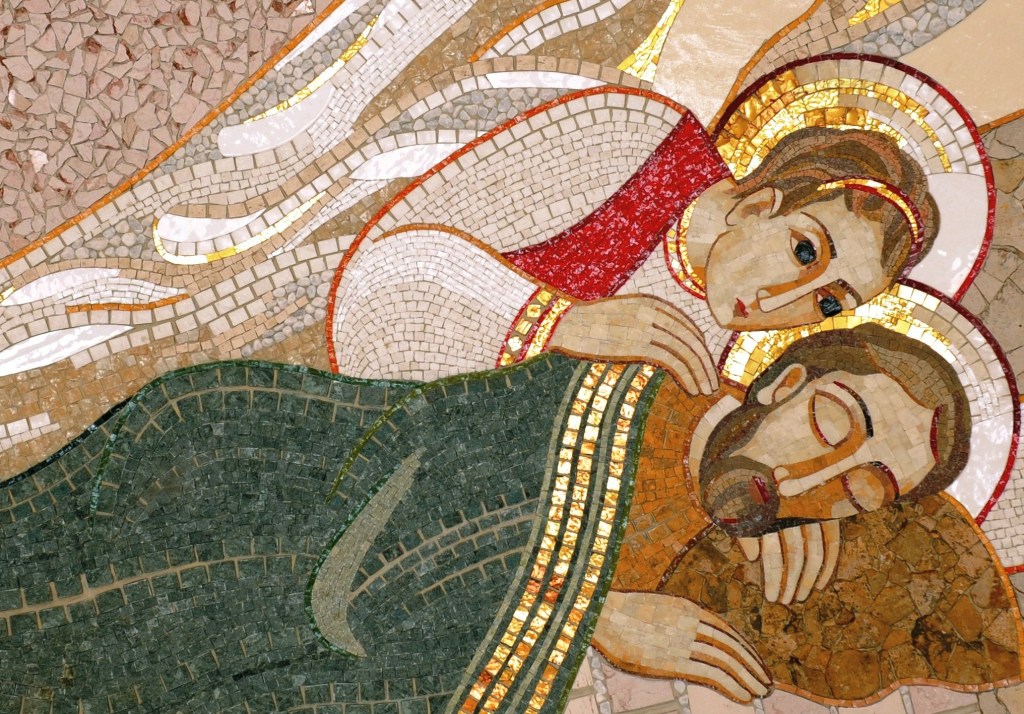
Photo by Arch. Philip Santiago of a mosaic at the San Padre Pio Shrine at Rotondo, Italy of the angel appearing to Saint Joseph in his dream.
Holiness is having creative courage like Saint Joseph.
Notice how the Pope’s description of Saint Joseph is not far from St. Matthew’s calling him a “righteous man” – a holy man – who obeys the Laws of God handed down to them by Moses, including their other traditions meant to keep them clean and pure before God.
Problem during that time is how people have lost sight of God and of others that they were so focused on the letters of the law than its spirit, becoming impersonal in the process as we have seen in instances when they would ask Jesus why he healed the sick even on sabbath day. Worst is when people brought to Jesus a woman caught committing adultery, reminding him of Moses’ instruction to stone her in public.
Such was the dilemma faced by Saint Joseph with Mary being pregnant with a child definitely not his!
In deciding to silently leave Mary, Saint Joseph expressed his righteousness or holiness wherein he showed the true interpretation of their Laws by upholding the dignity of every person, respecting life above all. Like Jesus Christ, Saint Joseph showed that real holiness is authentic love that is willing to sacrifice for the beloved by having the courage to be in pain in giving up or losing a beloved.
Here we find Saint Joseph was not only courageous in facing the painful truth about Mary having a baby not his but also very creative in the sense that because of his great love for the Blessed Virgin, he did not want her exposed to shame and public humiliation in allegedly breaking the seal of their betrothal.
Having courage is more than being able to do death-defying acts that is more on physical strength; courage is a spiritual virtue, a spiritual strength when we do extraordinary things because of higher ideals and values like the love of Jesus who offered us his life on the Cross.
Courage is from the Latin word “cor” for heart which is the seat of our being. And to have courage is to be true and loving that we have such expressions to speak from the heart, to listen to our heart, and to act from our heart when we dare to lose ourselves because of love.
Photo from Aleteia.org of “Let Mum Rest” image St. Joseph nursing the Infant Jesus while Mary sleeps, 2019.
A person who truly loves is always creative,
finding ways in expressing one's love even sometimes
it may be painful and difficult.
A “creatively courageous” person like Saint Joseph is someone so deeply in love with Mary and with God: after learning the circumstances surrounding Mary’s pregnancy, St. Matthew tells us “When Joseph awoke, he did as the angel of the Lord had commanded him and took his wife into his home” (Mt.1:24).
Saint Joseph’s love for Mary found ways to spare her all the pains and hurts that may result if found with a baby not his; but after learning the truth, the more we find him creatively courageous when he sought many ways to save Mother and Child from all harm and even death like bringing them to Egypt in the time of Herod.
See that when Saint Joseph accepted Mary, Jesus came forth to us while at the same time, when Saint Joseph accepted God through the angel as expression of his deep faith and love, he took Mary as wife.
And this is what Pope Francis further explains in Patris Corde that at the end of every account in which Saint Joseph plays a role, the Gospel tells us that he gets up and takes Jesus and Mary who are the most precious treasure of our faith.
Taking Jesus and Mary like Saint Joseph as creative courage calls us Christians to always love the Church and in loving the Church, we love the poor for whom Jesus came and Mary identified herself with in her Magnificat which she sang after accepting the Annunciation by the Angel of Christ’s birth which we celebrate next week on March 25.
In this time of the pandemic, we are called to be creatively courageous in finding Jesus among those people too familiar with us as well as with those so different from us. Don’t you find it so funny that the people we always take for granted are those either so close to us like family or completely strangers?
Being creatively courageous in this time of the pandemic means being more sensitive with others especially in our words and actions like Saint Joseph.
I was wondering during prayers why did he not ask Mary about the truth of her pregnancy so that he would have been spared with all the thinking and praying? That is when I realized the value of Saint Joseph’s silence: he did not speak at all to Mary as a sign of his love and oneness with her who must have been into some difficulties too with the situation of being the Mother of Christ. sympathy.
In his silence, Saint Joseph expressed his complete trust in Mary and in God. And in his being silent, Saint Joseph was creatively courageous expressing aloud his tenderness and care for Mary and her Child, something we need so much in this time of the pandemic.
Let us pray to Saint Joseph in this time of social distancing that like him, we may have the creative courage in touching others with the love of God, especially those who are sick and suffering, those in difficult situations, and those forgotten by their families and friends and even by the society. Have a blessed Friday, everyone!
Saint Joseph, Patron of the Universal Church, pray for us!
Photo from Vatican News, St. Joseph and the Child Jesus, 14 December 2020.
40 Shades of Lent by Fr. Nicanor F. Lalog II
Thursday, Fourth Week in Lent, 18 March 2021 (St. Cyril of Jerusalem)
Exodus 32:7-14     ><}}}*>  +  <*{{{><     John 5:31-47
Illustration from chabad.org.
God our Father in heaven, forgive us for being constantly in the same situation like your people at the wilderness when Moses was up conversing with you on Mount Sinai. So many times we are like them, creating our own golden calves, turning away from you our true God.
So many times in life, we simply want to be in total control of everything that we doubt you, even grow impatient with you because we have other agendas in life like being god like you! And so, we make golden calves of everything we like to believe in, including in our selves.
Jesus said to the Jews: “You search the Scriptures, because you think you have eternal life through them; even they testify on my behalf. But you do not want to come to me to have life. I do not accept human praise; moreover, I know that you do not have the love of God in you. I came in the name of my Father, but you do not accept me; yet if another comes in his own name, you will accept him.”
John 5:39-43
You said it perfectly right, Lord Jesus: “I know that you do not have the love of God in you. I came in the name of my Father, but you do not accept me; yet if another comes in his own name, you will accept him.”
As we turn to idolatrous worship of our selves, then we stop loving you in others both in our hearts and in our hands. When we begin manipulating everything and everyone even our very own belief system, especially your gift of faith in each of us, that is when we become gods.
When we stop believing in you, then we stop loving, we stop relating, we stop authentic living as we forget others.
Forgive us, Lord, and look kindly upon us like at Sinai, reminding us always of the many blessings the Father showers us despite our sinfulness. Teach us to be grateful always so we may learn humility and embrace our humanity to start believing in you and love again by turning away from sins.
Once again, let your tender compassion, Lord, break upon us this Lent so we may begin to love and care, be tender with those who suffer amid our own pains and trials in life. Teach us to believe in you again to realize that wherever there is loving service, tenderness, and care for the weak and lowly, there you are too! Amen.
40 Shades of Lent by Fr. Nicanor F. Lalog II
Homily, Wednesday in Lent Week IV, 17 March 2021
Isaiah 49:8-15     + ++     John 5:17-30
Photo by Mr. Jim Marpa, 2019.
Today we resumed the community Masses on a limited basis at the Our Lady of Fatima University (OLFU) and Fatima University Medical Center (FUMC) in Valenzuela where I am now serving as their chaplain.
Our aim is very simple: to share Jesus with everyone in our Fatima community including their families and friends.
Sharing Jesus means being tender and caring with one another like God our Father in heaven who gave us the loveliest description of these attributes in the first reading today by being like a mother.
Thus says the Lord: “Can a mother forget her infant, be without tenderness for the child of her womb? Even should she forget, I will never forget you.”
isaiah 49:15
If there is one thing missing in our country
 in this one year old pandemic and lockdown,
it must be tenderness.
In the gospel of St. Luke, we find Zechariah singing praises to God at the birth of his son John the Baptist:
“In the tender compassion of our God the dawn from on high shall break upon us, to shine on those who dwell in darkness and the shadow of death, to guide our feet into the path of peace.”
Luke 1:78-79
St. Luke used the Greek word “splaghna” to designate tenderness as “tender mercy of God”.
Mercy, or “misericordia” which is also our University motto is from the Latin “misereor” that means to stir, to move. More than a feeling, mercy is compassion in action wherein one is moved or stirred in the heart to go down, reach out and be one with the suffering like Jesus Christ. And that is when we are filled with tenderness of God. Then we become caring.
Tenderness of God as tender compassion is misericordia that is “tagos sa buto” as in “sagad-sagad” that even if we feel tired and hungry, or afraid and anxious, we still go out to help, to uplift, to keep company and inspire those in pain and suffering, those about to give up in life, those who are lost because of sickness, poverty, and other difficulties.
This we find and do in Jesus, through Jesus, with Jesus who said in our gospel today, “My Father is at work until now, so I am at work” (Jn.5:17).
Remember that scene of the feeding of five thousand in the wilderness when Jesus and the Twelve crossed the lake to the other side to rest but a vast crowd followed them and even got ahead of them to the site. When Jesus saw them, he was moved with pity because they were like “sheep without shepherd” that despite his being hungry and tired, he taught them many things, healed their sick, exorcised the possessed and later, fed and satisfied them all from just five loaves of bread and three pieces of fish.
Tenderness is when we are moved to help those in need while we ourselves are also suffering. Hence, it is not surprising at all to find that the most tender and caring people are also the ones who suffer most. Like moms and these days, the medical front liners who continue to serve us amid the risks they face!
Being tender and caring
are essentially the works of God
made known to us in Jesus Christ.
It has been a year since we had the longest lockdown in the world. It is fitting that as we recall those days even if dark clouds still loom above us these days that we remember the people who have cared for us and made life bearable: all those working in the hospitals supporting our doctors and nurses; the market vendors who ensured we have food on the table; the staff members of the botica we usually visited to get our medicines; the panadero who prepared our daily bread; our teachers who braved the digital world so we may continue with our schooling and learning process, and many more.
It is a tremendous grace from God to be able to be tender with someone because that means we care like Jesus Christ.
Photo from GMA-7 News of Mang Dodong.
Today, God reminds us that amid this great darkness still looming above us in this time of the pandemic, He cares for us very much and wants us to care for one another too, especially for those going through many trials and difficulties in life.
Let us give Jesus our hands and our hearts to be vessels of his divine Tender Loving Care. Amen.
40 Shades of Lent by Fr. Nicanor F. Lalog II
Wednesday, Fourth Week in Lent, 17 March 2021 (St. Patrick's Day)
Isaiah 49:8-15     <*{{{><  +  ><}}}*>     John 5:17-30
Photo by author, December 2020.
"Can a mother forget her infant,
be without tenderness for the child of her womb?
Even should she forget,
I will never forget you."
(Isaiah 49:15)
If there is one thing we terribly miss these days a year since the start of this pandemic is tenderness, your kind of Tender Loving Care (TLC) only you, God our Father, can give like a mother to her child.
How sad that in this time of difficulties when there are so many sufferings and darkness around us, there are also much arrogance and apathy afflicting many of us.
More sad is how everybody is solely focused in finding a cure to control spread of COVID-19, often in drastic measures that only worsen the plight of the weak and marginalized, many have forgotten the need for more care for everyone, not only for those sick but also for our front liners who have lost so many of their family and friends in this time of the corona.
In this continuing darkness of our lives despite the sparkle from vaccines that are still unavailable to many of us, we know you continue to work to save us in Jesus Christ your Son who assured us, “My Father is at work until now, so I am at work” (Jn.5:17).
Let us do your work, Lord, especially today as we celebrate the feast of St. Patrick. Use our hands and our hearts to tenderly serve others especially those deep in darkness with sins and sufferings.
Teach us not only to be compassionate willing to suffer with others but most of all, fill us with the Father’s tenderness to care like you so that we are moved to reach out, going down to the level of those crying, of those so tired and about to give up in life.
Soften our hearts that have been hardened with negativities and cynicisms of time.
Stir our hearts, O Lord, that like you even in our hunger and pain, we may realize there are others more hungry and more in pain than us, hoping for some comfort and care, healing and encouragement, or simply company and inspiration and reason to live.
Let our hands and our hearts, our whole selves be an extension of your tender mercy and care so that “the dawn from on high shall break upon us, to shine on those who dwell in darkness and the shadow of death, and to guide our feet into the path of peace” (Lk.1:78-79). Amen.
Quiet Storm by Fr. Nicanor F. Lalog II, 16 March 2021
Lately
 I have been feeling gladly
at how the Lord is blessing me abundantly
showing me daily
how life is a journey like Lent
bringing me to desert and valleys
where me and the holy
parry attacks by the wily
making me see the beauty
of colors mixed playfully
in a huge tapestry
woven in mystery.
What I like most in Lent
is its shades of violet
calling us to repent and relent
our ways of evil and sin
so we begin to see God again
in the face of every human being;
if Lent were a palette of spirituality,
imagine mixing white of the Father's purity
with Christ's love colored red so bloody
then everybody shall rejoice in ecstasy
with colors bursting in pink so rosy
as Easter promises it to be!
40 Shades of Lent by Fr. Nicanor F. Lalog II
Tuesday, Fourth Week in Lent, 16 March 2021
Ezekiel 47:1-9, 12  <*{{{><  +  ><}}}*>   John 5:1-16
"The man who was healed
 did not know who it was,
for Jesus had slipped away,
since there was a crowd there"
(Jn.5:13).
So many times, Lord, we do not know you like that man whom you have healed at Bethesda because like in that incident, most of the time, you slip away from the scene.
And in all those times you have healed us and slipped from us, dear Jesus, we never bothered to check on you, to get to know you nor even catch a glimpse of you. Like that man you have healed, we never tried asking about you despite your presence among us because we are so focused with our sickness and handicaps that sometimes we almost worship them, making us more blind that we could not recognize your coming and staying among us.
Like that man you have healed, we have become lame and so fixated with our plight that made us find comfort in our miseries, making these our excuses to just stay behind, creating comfort zones as self- defense mechanisms for being lame to go and find you.
Forgive us, dear Jesus. Make us dare to find you and follow you even in the midst of our sickness and other limitations in life.
May we imitate the prophet Ezekiel in his vision at the first reading, daring to follow you even in waist-deep waters to see your wondrous works on those who seek you and cultivate that beautiful relationship with you.
This Lent, may we catch up with you, find you and know you, to keep you and always be with you. Amen.
40 Shades of Lent by Fr. Nicanor F. Lalog II
Monday, Fourth Week in Lent, 15 March 2021
Isaiah 65:17-21   ><}}}*>  +  <*{{{><   John 4:43-54
Photo by author at Jaffa, Israel, May 2017.
Praise and glory to you, O God our Father for this blessed Monday as we go halfway through March, a year after the start of the longest lockdown due to COVID-19 pandemic.
Once again, we face the threats of a surge of infections after we have been unmindful that the corona virus is still among us as it comes close to our homes, infecting our family and friends with some of them now in serious condition.
We have forgotten, O Lord, that a new and better world always begins in us, when everyone changes one’s attitudes and ways of living as we continue to hold on to your promise of creating “new heavens and a new earth” (Is. 65:17).
That promise has started to be fulfilled in the coming of your Son Jesus Christ but unfortunately, until now many of us still refuse to believe in him, to live in him as we still seek signs from him like the people of his time.
Give us that same firm faith of the royal official from Capernaum who had come to Jesus in Cana, Galilee “and asked him to come down and heal his son, who was near death” (Jn.4:47).
Jesus said to him, “You may go; your son will live.” The man believed what Jesus said to him and left. while the man was on his way back, his slaves met him and told him that his boy would live. He asked them when he began to recover. They told him, “The fever left him yesterday, about one in the afternoon.” The father realized that just at that time Jesus had said to him, “Your son will live,” and he and his whole household came to believe.
John 4:50-53
So many times in life, O Lord, our faith do not match our lives. We say we believe in you only with our lips, or simply as an expression out of habit and routine. We never dare to truly believe by living out our faith, testing our faith like that royal official who was not only relieved and overjoyed when Jesus told him to go home because his son will live; he still enquired his servants who have met him along the way when exactly his son recovered from fever to confirm the faith he had placed in the words of Jesus.
Like that royal official, give us the courage to dare examine our selves, to look into the many darkness within us like fears, guilt, and anxieties mostly caused by our past sins.
Let Jesus our light dispel the many darkness within us, dear Father, so we may vibrantly live our faith in you so that your promised new heavens and a new earth begin right within us. Amen.
40 Shades of Lent by Fr. Nicanor F. Lalog II
Fourth Sunday in Lent-B (Laetare Sunday), 14 March 2021
2 Chronicles 36:14-16, 19-23 ><}}}*> Ephesians 2:4-10 ><}}}*> John 3:14-21
Photo by Dr. Mylene A. Santos, MD, in Candaba, Pampanga, February 2021
Today we burst in joyful shades of pink in our liturgy as we rejoice in this Fourth Sunday in Lent known as “Laetare Sunday” when our entrance antiphon calls us to “Rejoice, Jerusalem! Be glad for her, you who love her; rejoice with her…”
This early as we go halfway through in our journey to Easter, we are called to rejoice as we continue to experience God’s immense love for us in Jesus Christ seen in our readings and most especially, if we have truly taken into heart the spirit of Lent through prayer, fasting and abstinence, and alms-giving.
Jesus said to Nicodemus: “Just as Moses lifted up the serpent in the desert, so must the Son of Man be lifted up, so that everyone who believes in him may have eternal life. For God so loved the world he gave his only Son, so that everyone who believes in him might not perish but might have eternal life.”
John 3:14-16
Photo by author, 2018.
Path to God opened for us in Christ crucified, our light.
As we have mentioned last week, the fourth gospel is also called “the book of signs” because John refers to the miracles and words of Jesus as “signs” that point to him as the Messiah or Christ, the Anointed One of God.
This Sunday we hear John introducing to us another sign and symbol he uses in his gospel for Jesus: his being LIGHT himself.
This we must first see in the context of his crucifixion which John refers to so many times in his gospel as Jesus being lifted up or raised up on the cross.
It is very meaningful for John because the Crucifixion is Christ’s greatest sign and revelation of his glory when he opened a path for us back to God in his Cross. It is in opening this path to God in his Cross that Jesus had also shone so brightly as our light along the way.
After cleansing the temple last week, John tells us how at the start of the following third chapter of his gospel that “There was a Pharisee named Nicodemus, a ruler of the Jews” who “came to Jesus at night” (Jn.3:1,2) to discuss things he must have heard and seen about Jesus.
Remember chronemics, the non-verbal communication expressed by time and space? Again we find this employed by John in our gospel scene this Sunday in Nicodemus meeting Jesus at night.
According to biblical scholars, Nicodemus came to see Jesus at night in order to hide in darkness for he was afraid of being publicly associated with Jesus considering his being member of the Sanhedrin, the highest governing body in Israel at that time.
Photo by author, November 2020.
Moreover, his coming at night to Jesus is also symbolic, suggesting that despite his expertise in the Mosaic Law, Nicodemus felt within him a sense of still living in darkness and ignorance. If you read this whole scene, you find many instances of darkness and ignorance in Nicodemus that at one point, there is a tinge of sarcasm from the Lord telling him, “You are a teacher of Israel and you do not understand this?” (Jn.3:10)
Eventually on Good Friday, Nicodemus would come out into the open to join another secret disciple of Jesus named Joseph of Arimathea when they asked Pilate for his body to be buried in a new tomb not far from the site of the crucifixion (Jn.19:38-42).
The fourth gospel teems with many teachings as well as scenes depicting Jesus as the light dispelling the many darkness that envelops the world beginning at its Prologue.
Only John has this scene of Jesus discussing with Nicodemus his coming from heaven to dispel the darkness in our lives.
“For God did not send his Son into the world to condemn the world, but that the world might be saved through him. Whoever believes in him will not be condemned, but whoever does not believe has already been condemned, because he has not believed in the name of the only Son of God. And this is the verdict, that light came into the world, but people preferred darkness to light, because their works were evil. For everyone who does wicked things hates the light and does not come toward the light, so that his works might not be exposed. But whoever lives the truth comes to the light, so that his works may be clearly seen as done in God.”
John 3:17-21
Photo by author, Holy Family Chapel, Sacred Heart Center for Spirituality, Novaliches, QC, 2017.
Jesus enlightening us, uplifting us
This love of God for us through the coming of Jesus Christ is not only the joy of Lent but the very joy of our lives the Lord had expressed in two ways: in being our light in the many darkness of life as well as in uplifting us all from the quagmire of sins and evil.
But this joy in the Lord needs to be worked for; it does not come in handy as something given out freely in the sense that it calls us to do a Nicodemus too, of making efforts to come out from darkness, to follow the light of Jesus Christ that leads to the Cross.
And this is where it becomes more joyous, how Jesus enlightens us and lifts us up with him to the Father.
Let me explain it this way: when we talk of sin, we always find its logical connection with punishment. We see it everywhere and have always experienced it because rightly so, every sin is punished. Certainly, no one escapes punishment of sins in this life or life after. It is the law of karma that in every action, there is a corresponding reaction (excluded are other concepts like reincarnation we do not accept).
Photo by author, December 2020.
The problem arises in the question who punishes us for our sins?
Unfortunately, in any religion the finger always points at God which is very untrue and unfair!
God does not punish and would never do so because “God is love (1 Jn.4:16)”!
Those passages we find in the Old Testament of God “getting angry, punishing people” are literary devices used to convey to us deeper truths about God as a person relating with us like human. But notice too that the Sacred Scriptures itself declare in so many instances how God is “so gentle and slow to anger, full of mercy always foregoing his wrath” on the sinful.
Jesus clarified this in many instances, in words and in deeds, when he showed mercy and forgiveness to sinners like prostitutes and tax collectors who were then considered the most wretched and hopeless ones in the society. In the healing of the man born blind, Jesus clarified that sickness and disease are not a punishment from God (Jn.9:1-12).
Rest be assured in his words today to Nicodemus, “For God did not send his Son into the world to condemn the world, but that the world might be saved through him.”
St. Paul attests to this truth found in his beautiful reflection in the second reading:
Brothers and sisters: God, who is rich in mercy, because of the great love he had for us, even when we were dead in our transgressions, brought us to life with Christ — by grace you have been saved — raised us up with him, and sealed us wit him in the heavens in Christ Jesus…
Ephesians 2:4-6
Such is the great love of God for us. When something bad happens to us due to our sins or somebody else’s sins, it is not from God. It is our self-indictment of refusing to change our sinful ways that we suffer the consequences of our evil deeds: “And this is the verdict, that light came into the world, but people preferred darkness to light, because their works were evil. For everyone who does wicked things hates the light and does not come toward the light, so that his works might not be exposed.“
Photo by author, Lent 2019.
When we try to reflect deeper, we find that avoiding sins is the most practical thing we can always do in life but, unfortunately, something we refuse to do for so many reasons.
Why we prefer darkness than light is something we have always been struggling with when we know so well it is better to be out in the light.
If we reflect deeply, we realize that God has no need for us; he remains perfect even if we sin, if we do not obey him, if we abandon him. But God chose to love us, even begging us to remain good and holy so we can be fulfilled in this life.
Should something bad happens to us because of our sins or somebody else’s sins, the very good news is that God would always find ways to enlighten us to ensure it will turn out well for our own good, even if he has to use pagans and unbelievers or sinners to bring us back into light as experienced by his people with King Cyrus of Persia.
We all have a Nicodemus in us when we sometimes prefer darkness, of coming to Jesus at night because of fears of what others might say about us in following the path of the Lord, of being good, being just, being kind, and being holy.
Like Nicodemus, we try following and listening to Jesus from afar as we have been so used to staying and living in darkness when light sometimes hurt our eyes, making it difficult for us to really see and accept people and things because truth hurts.
This Sunday, let us examine the many darkness we still have within us. Like the author of the Book of Chronicles we heard in the first reading, let us try to see the religious significance of what is happening in our lives and nation to find where God is leading us.
Jesus had come to save us, not to judge us. Step out from your darkness within and let the light of Jesus enlighten and uplift you high like never before in rejoicing as you see the beauty of life in God its author. Amen.A blessed and joyful week to everyone!
Photo by author at Silang, Cavite, September 2020.













 lordmychef.com