40 Shades of Lent by Fr. Nicanor F. Lalog II
Ash Wednesday, 22 February 2023
Joel 2:12-18 ><))))*> 2 Corinthians 5:20-6:2 ><))))*> Matthew 6:1-6, 16-18
Our opening antiphon
of today's celebration of
Ash Wednesday gives hint
of the joyful tone of our Lenten journey:
"You are merciful to all, O Lord,
and despise nothing that you have made.
You overlook people's sins,
to bring them to repentance,
and you spare them,
for you are the Lord our God."
Amid the shades of violet
to signify our confession of sin
and movement of repentance
is also a profession of our faith
in your love, kindness and mercy,
O God our Father!
The joy of Lent is YOU,
O God our loving Father
who lavishes us with mercy
in Christ Jesus.
Thank you for calling us
to enter into this holy season
of Lent; let us not forget that
YOU are the center and focus
of this journey, never us despite
the good works we all have to do
like praying, fasting and alms-giving;
YOU are the one whom we must please,
not people so they may return to you;
YOU are not appeased by what we offer
and do; in fact, we are able to come to
you because you are "gracious and
merciful" - we have come to know you
by your concrete actions of love
and mercy, kindness and tenderness.
Even now, says the Lord, return to me with your whole heart, with fasting, and weeping, and mourning; rend your hearts, not your garments, and return to the Lord, your God. For gracious and merciful is he, slow to anger, rich in kindness, and relenting in punishment.
Joel 2:12-13
Rend our closed hearts, O Lord;
tear apart the hard coverings of
bitterness and rejection,
doubts and mistrust
so we may open ourselves
to your coming in Christ Jesus;
strengthen our hearts so we may
come back to you in genuine conversion,
to be reconciled to you, O God,
for "now is a very acceptable time,
the day of salvation" (2 Cor. 5:20,
6:2).
Grant us the right attitude of heart,
take away our vanities and hypocrisies
that neither deceive you nor fool people;
let us get inside ourselves to meet you
right inside us where you dwell,
waiting for us
to console us,
to refresh us,
to comfort us.
Amen.
The Lord Is My Chef Daily Recipe for the Soul by Fr. Nicanor F. Lalog II
Tuesday in the Seventh Week of Ordinary Time, Year I, 21 February 2023
Sirach 2:1-11   ><0000'> + ><0000'> + ><0000'>   Mark 9:30-37
Photo by author, 09 February 2023.
On this final day
of Ordinary Time
as we begin tomorrow
our Lenten journey into
Easter, we pray to you,
God our loving Father,
to give us the grace to stay
committed to you in your Son
Jesus Christ.
In this journey of life
which is characterized by the
40 days of Lent,
let us be focused on the words
and teachings, and life of your Son
Jesus Christ.
Let us stay committed in him,
in you like a child to his father.
They came to Capernaum and, once inside the house, he began to ask them, “What were you arguing about on the way?” But they remained silent. They had been discussing among themselves on the way who was the greatest.
Mark 9:33-34
Like the psalmist today,
we pray that we may commit
our lives to you, Lord;
let us heed the teachings of
Ben Sirach to "prepare ourselves
for trials" by being "sincere of heart
and steadfast, listening to your words"
and most especially, to "wait on God
with patience, cling to him, forsake him not"
(Sirach 2:1-2, 3).
May we truly prepare ourselves
this day internally for tomorrow's
Ash Wednesday so that we may
focus more on God than on ourselves
and on the externalities of the
rich rituals of Lent
meant to touch our hearts
and soul in order to find
you in our brothers and
sisters.

Let that be our commitment
to you today
and always.
Amen.
Quiet Storm by Fr. Nicanor F. Lalog II
Holy Wednesday, 13 April 2022
Isaiah 50:4-9   +   Matthew 26:14-25
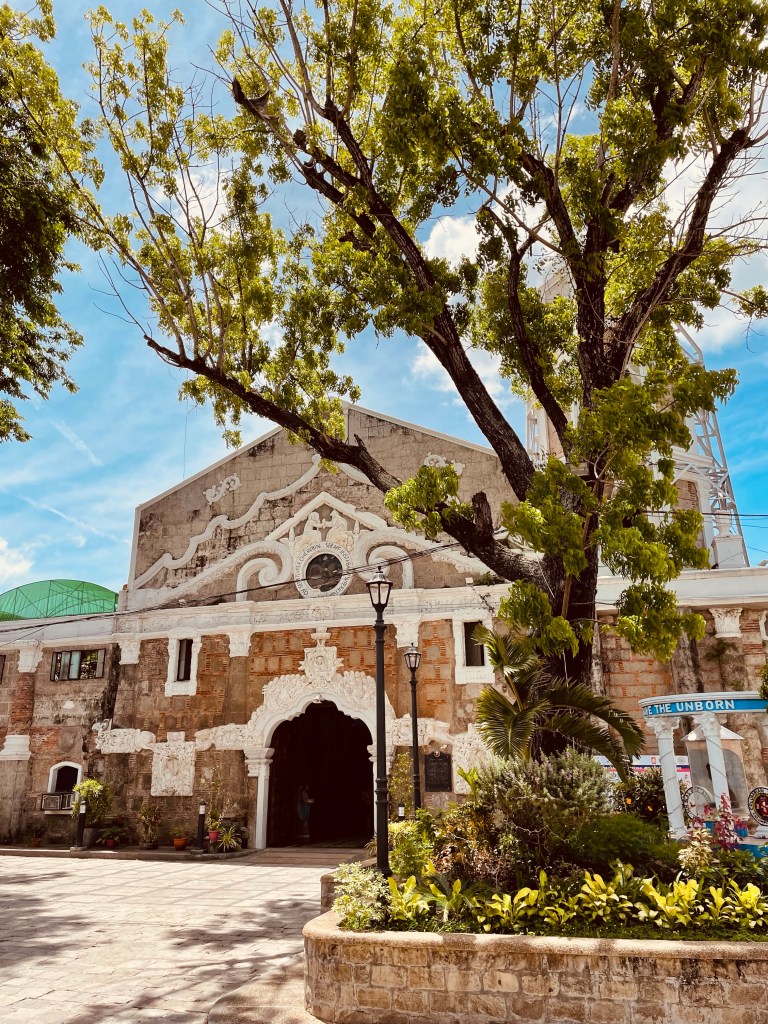
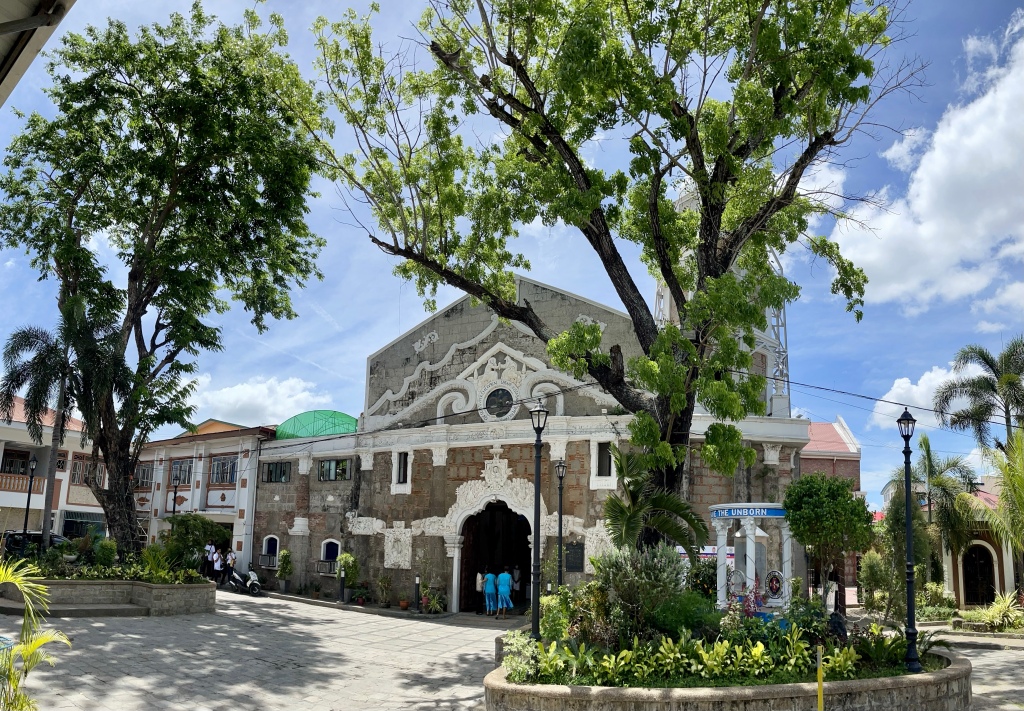
Photo by author, St. John the Baptist Parish, Calumpit, Bulacan, 31 March 2022.
It’s Holy Wednesday, also known as Spy Wednesday, the night Judas Iscariot agreed to betray Jesus Christ to the chief priests in exchange of 30 pieces of silver (Mt.26:14-15). Tonight is the night of traitors, of betrayers, of those not true to us!
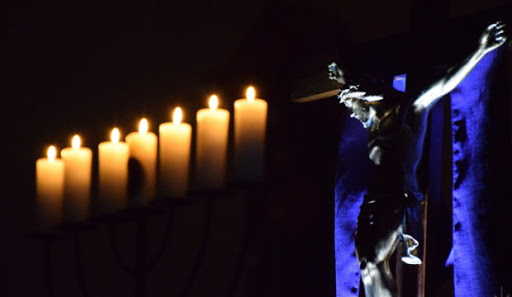
This is the reason why in most parishes after the Mass tonight, there is the ritual of tenebrae or gradual turning off of lights and extinguishing of candles in the church to show how momentarily darkness and evil prevailed in the world when Judas sold Jesus for 30 pieces of silver.
Photo from saopedroesaopaolo.com.br.
To betray literally means to hand over a loved one to pain and sufferings like when a husband is unfaithful to his wife, when we spill the secrets of our friends, when we answer back our parents or refuse to obey them, when children waste their money on their vices and other non-essential things instead of studying their lessons while their mother or father is toiling day and night abroad as an OFW.
Betrayal is so painful and most unkind because we exchange or “sell” our loved ones like commodities for someone or something less in value; imagine the pain a betrayer inflicts on the someone who gave everything, with all the love and care only to be “traded” for lesser value? It is said that during the time of Jesus, a slave can be bought for 30 pieces of silver; how foolish Judas must have been in exchanging Jesus who loved and cared for him for a slave! And that is what we are too when we betray God and our loved ones – fools to replace someone so precious for anything else!
Betrayal is rebelling against a loving God, a beloved one, turning our back from them who are most true to us. And that is the short of it: betrayal is not being true.
Holiness is being true; holiness and truth always go together.
The word true is from the Anglo-Saxon treowe or tree. For them, truth is like a tree that evokes a sense of firmness, of being rooted in the ground. When our words and actions are not firm, shaky and always changing, flimsy or “pabago-bago” as we say in Filipino, then it must not be true. It must be a lie and not true at all because it is always changing or shifting.
Photo by author, St. Paul Spirituality Center, La Trinidad, Benguet, 2019.
Truth is always firm, does not change and remains true forever. It may be concealed or covered by lies for sometime but sooner or later, truth will always come out. It cannot be deleted. That is why the Greeks referred to truth as aletheia or phusis, the blooming of a flower that cannot be hidden and would always manifest or show. Jesus himself assured us that “nothing that is hidden will not be revealed; nor anything secret that will not be known and come to light” (Lk.8:17).
Closely linked with the word true is trust which also came from treowe: the Anglo-Saxons saw in the tree not only firmness but also rootedness or connectedness. The firmer the tree, the deeper are its roots. And that is what a true person is – always trustworthy, someone who can be trusted, someone who values relationships or ties and links. Traitors betray their loved ones because they do not value their relationships; a true person is always trustworthy because he values his relationships. A true and trustworthy person is one who would always listen to God and others, not insisting on his own plans and agenda like the Suffering Servant of God.
The Lord God has given me a well-trained tongue, that I might know how to speak to the weary a word that will rouse them. Morning after morning he opens my ear that I may hear, and I have not rebelled, have not turned back. I gave my back to those who beat me, my cheeks to those who plucked my beard; my face I did not shield from buffets and spitting.
Isaiah 50:4-6
Photo from Pinterest.
Remember the scene of the scourging at the pillar in the film The Passion of the Christ (2004)? Biblical experts say that gory scene was very true as it was the most painful aspect of the Lord’s passion next to the crucifixion; every time the knuckles would hit the body of Jesus, a piece of his flesh is torn off. Pilate ordered Jesus to be flogged in the belief that people might pity him when seen so tortured and bruised, perhaps agree to let him go freely.
But it did not happen as the people shouted more for his crucifixion.
And that is what happens when we betray our loved ones, including Jesus: the more we become indecisive in life like Pilate, the more we also betray them because we could not stand for what is true. That is also when we hurt them more and ourselves in the process too.
So often, traitors are not aware of their betrayals, believing in their wrongful and misplaced convictions, forgetting the people who love them most. Many times, we absolutize the truth, forgetting that only God is absolute. Most of all, that truth is a Person, Jesus Christ who said “I am the way, the truth and the life” (Jn.16:6). Being true, being holy is always directed to a person, not just a conviction.
So be careful by being true always with one’s self, with others and with God.
What makes you forget the truth and be untrue to others?
Lord Jesus Christ,
teach me to be true and holy
not only to you but most especially
to the people you give me,
those who love me truly and dearly;
make me like a tree,
firm and reliable,
dependable and trustworthy,
most of all, deeply rooted in you
through then people I love and care and serve.
Amen.
Photo by Mr. Raffy Tima of GMA7-News, January 2022.
Quiet Storm by Fr. Nicanor F. Lalog II
Holy Tuesday, 12 April 2022
Isaiah 49:1-6   +   John 13:21-33, 36-38
Photo by Ms. Ria De Vera, Christ the King Procession, 2020.
Maybe so many times you have felt nothing seems to be happening with all your efforts in school or office, in your relationships, and even in your prayers and devotions. Everything seems to be going to nothing at all.
Have a heart. Just be faithful in your studies, in your work, with your family and friends, most especially with God.
Though I thoughts I had toiled in vain, and for nothing, uselessly, spent my strength, yet my reward is with the Lord, my recompense is with my God.
Isaiah 49:4
When I was still a seminarian, there was a moment after our class when I went straight into our chapel and slouched on a pew, complaining and whining to God for the many problems that never stopped coming my way despite my efforts to be good. With my head bowed down, I had a litany of complaints to God that I felt like packing my things, go home and forget all about the priesthood. But after getting tired with my monologue and as I raised my head, something struck me that I felt so good while looking at our huge image of the Crucifixion at the altar of the chapel. As I looked in silence, I felt myself praying,
"Lord Jesus Christ,
before all these pains and sufferings came,
before all these problems happened,
you were there first on the Cross -
suffering for me, dying for me first."
Photo by author, ICMAS Chapel (Theology Dept.), 2020.
My dear friends, holiness is being faithful to God in Jesus Christ. St. Mother Teresa perfectly said that, “We are called to be faithful, not successful.” In my 24 years in the priesthood, I have realized that many times, our success are actually failures with God while our failures are what he often considers as success!
Of course, we need to plan and set goals in life and in work but we need to focus more on Jesus Christ as center of our lives, trying to see everything in his light not in our own limited views and perceptions. There so many things in life that cannot be quantified like our spiritual and emotional well-being on which actually depend many of our other aims in our personal and professional life.
Notice how in our gospel today the Apostles were so focused on themselves instead with Jesus that they totally missed what he was telling them about his coming betrayal by “one of them”. Particularly interesting was Simon Peter who asked the beloved disciple, John, to clarify it with Jesus since he was seated closest to him.
He leaned back against Jesus’ chest and said to him, “Master, who is it?” Jesus answered, “It is the one to whom I had the morsel after I have dipped it.” So he dipped the morsel and took it and handed it to Judas, son of Simon the Iscariot. After Judas took the morsel, Satan entered him. So Jesus said to him, “What you are going to do, do quickly.” Now none of those reclining at table realized why he said this to him.
John 13:25-28
Did you see the comedy, the humor?
Everybody was so focused on everyone and with each self except with Jesus! Were they so dumb not to understand the words of Jesus that to whomever he would give the morsel dipped in wine is the one who would betray him? Not really. Most likely, they were not listening, they were not focused on Jesus but with their very selves.
Being faithful is first of all being focused on God, in Jesus.
How can God fill us with his holiness when our thoughts and our being are always somewhere else or with somebody else? How can God fill us with his holiness when we cannot spend time with him every day in prayer?
Photo by author, Mass by the shore of Galilee, the Holy Land, 2017.
How lovely is the context of Simon Peter’s question that it happened during their Last Supper because that is where our fidelity to God is first nurtured to grow and deepened – at the Holy Eucharist of the Mass.
Remember, the minimum requirement for anyone to be called a good, practicing Catholic is to go Mass every Sunday. That is the most minimum but, have we kept it? It has been more than two months since we returned to alert level 1 in this time of the pandemic with almost everybody going to the malls and many vacation spots but what a shame when many still refuse to go to churches for the Sunday Mass!
Being faithful to Jesus to become holy begins with the Sunday Eucharist where we are nourished by the words of God and by the Body and Blood of Jesus Christ himself who enables us to overcome the many trials and difficulties of this life and make it into the Father’s house in eternity.
Have you gone back to your parish church for the Sunday Masses?
Forgive us, Lord Jesus Christ,
for being unfaithful to you,
for betraying you like Judas Iscariot
right in the context of the Holy Eucharist
when we skip Sunday Masses;
when we come to Mass not for you
but for our friends to whom we listen more;
and most especially when we refuse or fail
to practice the essence of the Eucharist
of sharing the love of Christ to everyone.
Amen.
Photo by author, Parish of St. John the Baptist in Calumpit, Bulacan, 31 March 2022.
Quiet Storm by Fr. Nicanor F. Lalog II
Holy Monday, 11 April 2022
Isaiah 42:1-7   +   John 12:1-11
Photo from Pinterest.
A blessed Holy Monday to you and your loved ones!
Every year beginning with the Palm Sunday of the Passion of the Lord until the morning of Holy Thursday, the Church has regarded since the fourth century these days as holy and sacred in commemoration of the Lord’s Passion in Jerusalem.
These days, people frown and withdraw from any discussions about holiness, believing it is just for a selected few like saints and angels, and religious men and women like priests and nuns. For many, holiness is being sinless like God.
Not really.
The word holy came from the Greek holos meaning whole or perfect; holiness is being filled with God who fills in the gaps and broken corners in us, making us whole, a person of integrity and character. Holiness is an ongoing process, never a one-shot deal. That is why Jesus said “be perfect (or holy) as your heavenly Father is perfect (or holy).”
Photo by Ezra Acayan/Getty Images.
One beautiful aspect of holiness is being gentle, something that has become so rare in our highly competitive world today. Jesus described himself as being “humble and gentle of heart” in whom we can find rest for his “yoke is easy” and his “burden is light” (cf. Mt. 11:29).
Being gentle means being open to everyone, especially those burdened in life like the poor and the sick, the elderly, the orphans, the widowed, the marginalized.
Being gentle is to be welcoming or hospitable and caring of others instead of threatening and indifferent. Hospitality is from the Latin word hospis which means to welcome like hospital while hostility is from the Latin word hostes which means to hostage.
Just like Jesus who was prefigured as the Suffering Servant in today’s first reading described by God as one who “shall bring forth justice to the nations, not crying out, not shouting, not making his voice heard in the street. A bruised reed he shall not break, and a smoldering wick he shall not quench” (Is.42:1-3).
Photo by author, Sacred Heart Center for Spirituality, Novaliches, QC, 2016.
In our world where everyone has all the means to be heard and seen loudly and clearly in high definition, gentleness has become so rare, almost extinct! Lahat na lang “mema” may masabi. What is sad is how we speak and get our messages across in every media platform, from the simple text messages to the giant tarps and screaming stickers on vehicles that are always harsh and laden with insults and sarcasms.
In this world where “size always matters” while power is expressed in force and violence, gentleness is being one with the weak and the suffering, the broken ones like the “bruised reed” that the Suffering Servant “would not break or smoldering wick he shall not quench.”
Wherever there is gentleness, there is always hospitality, there is God; without gentleness, we get hostilities like war and violence.
See the attitude of Jesus in today’s gospel, how he welcomed Mary at a dinner in Bethany who anointed his feet with a liter of costly perfumed oil and later dried them with her hair that the house was filled with fragrance. Notice the hostile attitude of Judas Iscariot pretending to care for the poor when he asked “Why was this oil not sold for three hundred days’ wages and given to the poor?” (Jn.12:5).
Jesus simply told Judas to leave Mary alone with what she was doing that was a preparation for his burial soon to happen, adding, “You always have the poor with you, but you do not always have me” (Jn.12:8).
Very loaded words from the Lord, telling us to be gentle with everyone’s devotion and expression of faith and love in God while reminding us all how the poor must always be welcomed and cared for even after he had gone back to the Father.
Photo by author, Sacred Heart Center for Spirituality, Novaliches, QC, 2016.
Gentleness is more than offering a seat to an elderly or opening the door for a woman; being gentle is having that disposition to care for everyone, consciously guarding against hurting them physically and emotionally.
Gentleness is holiness because it is an act of loving others, of finding Christ in everyone because whatsoever you do to the least of his brethren, that you do unto him.
There is a beautiful saying I have found from an unknown author who said “if you have love in your heart, you have been blessed by God; if you have been loved, you have been touched by God.” So many among us could not know nor experience God because many of us refuse to be gentle with everyone; many could not understand nor imagine a loving and merciful God when everybody is hostile and violent.
This Holy Monday, let us examine ourselves, our attitude with others, if we have been welcoming, hospitable and caring. It costs us nothing to adjust ourselves, to be more gentle in words and in deeds – and looks, too! It could be your step closer to simple holiness as God fills you with himself in Christ who is humble and gentle of heart.
Lord Jesus Christ,
teach us to be gentle like you;
make us feel more our being human
and stop feeling superior with others,
always analyzing, always thinking
that in the process we have forgotten
to feel the persons around us.
Make us gentle in our thoughts
and in our words.  Amen.
The Lord Is My Chef Sunday Recipe for the Soul by Fr. Nicanor F. Lalog II
Palm Sunday of the Passion of the Lord, 10 April 2022
Isaiah 50:4-7  +++  Philippians 2:6-11  +++  Luke 23:1-49
Photo by Mr. Chester Ocampo, ICS Chapel, 2016; sculpture by National Artist Ed Castrillo.
Officially we begin today the Holy Week leading to the Triduum of the Lord with Easter, the Mother of all feasts in the Church. Today we enter the “innermost room” of the house of God our Father after our 40 day journey in Lent.
We are actually celebrating today two distinct rites merged into one, the procession and blessing of palms to commemorate Jesus Christ’s entry into Jerusalem that led to his arrest and crucifixion on Good Friday which we heard in the gospel proclaimed earlier. As early in the fourth century, Christians in Jerusalem have been commemorating the Lord’s entry to Jerusalem from the city gate while a hundred years later, the Pope ushered in the Holy Week in Rome by proclaiming the long gospel we have heard of the Lord’s crucifixion and death. With the reforms of the liturgy in 1963 at Vatican II, these two celebrations were merged as one with the designation as “Palm Sunday in the Passion of the Lord”.
More than a going back to the past, our celebration today reminds us of the ever-newness of Christ’s saving work and love for us while at the same time assuring us of the future that would bring us into the fullness of life in him with the Father in heaven. This we find in the last three words recorded to us by Luke while Jesus was on the Cross.
Photo by author, Chapel of the Holy Family, Sacred Heart Spirituality Center, Novaliches, QC, 2016.
The mercy and forgiveness of God
Then Jesus said, “Father, forgive them, they know not what they do.”
Luke 23:34
Very consistent with his theme of the mercy and forgiveness of God to us as shown the other Sunday in the parable of the merciful father, a.k.a. the parable of the prodigal son, Luke presents to us again this most wondrous and touching trait of God in Christ even while crucified.
Again, only Luke has this detail of Jesus praying forgiveness for his enemies while being reviled and mocked by them on the cross.
It is another example of Luke’s artistry in presenting to us God’s mercy and forgiveness in Christ in a sort of play of words, “Father, forgive them, they know not what they do” as we confront our selves with the question, “what do we really know?”
What do we really know at all that we continue to crucify Jesus today, nailing him on the cross with our many sins as we pretend and assume to know so many things in life?
Until now, we still have wars raging in various parts of the world, and more than half of these conflicts according to studies are ironically due to our different religious beliefs! Until now debates continue as everyone would want to have the power to decide for themselves who shall live and who shall die, from abortions to artificial contraceptives to capital punishment. Until now we pretend to know the truth and yet the more we have shown our ignorance as our problems become more complex than ever leading to more deaths, more disillusions, more anxieties and more emptiness in life.
And right there on the cross, Jesus continues to pray to the Father to forgive us for we do not know what we are doing to pave the way for the conversion of more others like Paul who realized he “acted out of ignorance in my unbelief” (1 Tim. 1:13). In his other book the Acts of the Apostles, Luke tells us how Peter said in a speech to the people how they “acted out of ignorance in putting Jesus to death” (3:17). Here we find Luke driving at the basic truth how so often it is in our sinfulness and “ignorance” that eventually we come to “know” and realize God who is always ready with his unfailing mercy and forgiveness. The key is to emulate Dimas, the good thief crucified at the other side of Jesus on that Good Friday.
Photo by author, Chapel of the Holy Family, Sacred Heart Spirituality Center, Novaliches, QC, 2016.
The promise of Paradise
He replied to him, “Amen, I say to you, today you will be with me in Paradise.”
Luke 23:43
Imagine the evil that men do portrayed by Luke in Christ’s crucifixion, of the relentless insults and mockery by the people on the ground and even up there on the cross when one of those hanging reviled Jesus, saying, “Are you not the Christ? Save yourself and us”(Lk.23:39).
See how we are not contented and satisfied in putting others to shame but would even bury them deeply with insults as we say in Filipino, “baon na baon”. But, all is not lost as there is always a glimmer of hope. especially among the sinners and the ignorant who open themselves to god’s grace like Dimas who rebuked his fellow criminal, reminding him how they deserved the punishment but not Jesus “who has done nothing criminal” (Lk.23:41). It was at that instance when he snatched heaven by telling the Lord, “Jesus, remember me when you come into your kingdom” (Lk.23:42).
And we all know the response of Jesus, “Amen, I say to you, today you will be with me in Paradise.”
What a great God do we really have in Jesus Christ! Despite the pains and sufferings of being nailed on the cross, he not only begged the Father for our forgiveness because we do not know what we are doing but most of all, readily handed our salvation, promising Paradise to anyone who would humbly surrender one’s self to him like Dimas.
See that Jesus was very precise in assuring Dimas and us with Paradise – right at the very moment we are in him, with him on the Cross of pain and suffering, of truth and righteousness – not later when they die nor on Sunday when he rises from the dead but TODAY, right now!
The very moment we open ourselves to accept Jesus Christ our Savior, that is also precisely the very moment he is very present in us and among us. The other moment Luke used the word TODAY to indicate the very moment of here and now was at the birth of Jesus when the angels told the shepherds “For today in the city of David a savior has been born for you who is Messiah and Lord” (Lk.2:11).
What a beautiful reminder to us all of God present among us in every here and now, not yesterday nor tomorrow, but today for indeed our God is “I AM WHO AM”!
Anyone who is always one in Jesus, one with Jesus is assured of Paradise, in fact already entering Paradise, our end and ultimate destination in life. This leads us to the third important words of Jesus on the Cross according to Luke…
Photo by author, Chapel of the Holy Family, Sacred Heart Spirituality Center, Novaliches, QC, 2016.
Coming home to the Father
Jesus cried out in a loud voice, “Father, into your hands I commend my spirit”; and when he had said this he breathed his last.
Luke 23:46
All four evangelists attest in their respective gospel account that Jesus died on the cross at the ninth hour or about 3:00 PM. Most of all, they tell us that Jesus died while praying.
In Luke’s account, Jesus’ final prayer was from Psalm 31:6, “Into your hands I commend my spirit.” As we have mentioned in our previous reflections, Luke presents Jesus always at prayer like during the second Sunday of Lent during his transfiguration; only Luke tells us why Jesus went up that high mountain with his three Apostles in order to pray. Inasmuch as the transfiguration was a prayer moment, the crucifixion is the Lord’s prayer moment par excellence. Recall how we truly learn to “pray” when in deep pain and trials like before a surgery, when we no longer know how to pray or even have forgotten what is prayer all about except that we give ourselves entirely to God and to our doctors.
There on the Cross at his final moments, Jesus never ceased from doing good, always praying, always united and one in his Father in heaven. In commending his spirit into the Father’s hands, Jesus shows us exactly what discipleship is all about: everything we have, all we are are God’s. We have nothing to lay claim as ours in this life and that is the challenge to us daily: to live for God in Jesus through our loving service to others.
In this long passion narrative we heard today is the gospel, the very good news of our salvation as proclaimed by Paul in the second reading of how Jesus gave his total self in love to the Father for us all.
May we keep our eyes and our hearts open to Jesus, relying only in him like the Suffering Servant for he shall never put us to shame. We cannot experience the joy of his Resurrection unless we imitate Simon Cyrene, Dimas, John and the Blessed Virgin Mary in welcoming and following him in our daily life whether in the comforts of Jerusalem or the sorrows of Calvary for that is where we truly enter Paradise with Jesus, in Jesus. On the Cross. Amen.
40 Shades of Lent by Fr. Nicanor F. Lalog II
Friday in the Fifth Week of Lent, 08 April 2022
Jeremiah 20:10-13   <*[[[[>< + ><]]]]*>   John 10:31-42
Photo by author, Lent 2020 in the midst of COVID-19 lockdown.
As we approach
the closing of Lent
this weekend with the
start of the Holy Week,
we pray, dear God our Father,
for the grace to continue to
seek and follow your Son
Jesus Christ:
They they tried again to arrest him; but he escaped from their power. He went back across the Jordan to the place where John first baptized, and there he remained. Many came to him and said, “John performed no sign, but everything John said about this man was true.” And many there began to believe in him.
John 10:39-42
Indeed, life is a daily Lent,
a constant coming of your Son
Jesus Christ accompanying us to
pass over every day from darkness
into light, from sickness into health,
and from sin into grace; Lent is
both a preparation and a fulfillment
of Easter if we believe as John
had testified in Jordan a long time ago
that Jesus is the Christ,
the one on whom the Spirit
dwells (cf. Jn.1:32-34).
Until now, O God,
many among us still doubt
you, refusing to accept Jesus
as the Christ like his enemies in
Jerusalem; no miracle will suffice
for them to be believe unless
they remove their blindness and
shed off their layers of pretensions
of knowing you even in the
scriptures; like those who have
followed Jesus at Jordan after
being stoned in Jerusalem, may we
truly believe in him by deepening
our faith in him especially in moments
of trials and tribulations like Jeremiah.
Most especially, dear God,
we pray for those who continue
to refuse to believe in you,
those who malign your good
and holy name in words and
in deeds by persecuting those
testifying to Jesus as the Christ.
Help us to witness the truth
of Jesus Christ, to tell others
of your unconditional love as
testified in the many good works
through Christ.  Amen.
40 Shades of Lent by Fr. Nicanor F. Lalog II
Thursday in the Fifth Week of Lent, 07 April 2022
Genesis 17:3-9   <*{{{{>< + ><}}}}*>   John 8:51-59
Photo by author, sunrise at the Lake of Galilee, Israel, 2017.
God our Father,
on this blessed Thursday
as we come nearer to the closing
of Lent, we rejoice in that beautiful
truth about you proclaimed in our
responsorial psalm today, "The Lord
remembers his covenant forever."
How lovely it is to recall that story
of how you called Abraham, not only
in making a promise with him
to be the father of all nations but
in entering a covenant with him to
be our God forever with us your
people; in doing so, you changed his
name from Abram to Abraham
to show us that every relationship
is built in calling with names not with
shaking of hands nor with other signs
and gestures we are used to.
So many times we forget how
all our relationships are based and
rooted in you our Father because
without you, all our ties as family
and friends will never last, will never
have meaning for we are all fragile
and weak, very erratic and so
moody unlike you, always faithful
and true.
Remove the blindness that prevents us
from finding you in every person we meet
like the Pharisees debating with Jesus
at the temple area, refusing to believe him
that "before Abraham came to be, I AM"
(Jn.8:58); enable us to grow and mature
amidst the many tensions and frictions
we experience in our relationships with
you and others for it is in pains and
sufferings our love and fidelity are
purified and harnessed, just like when
"Jesus hid and went out of the temple
area" (Jn.8:59) when his enemies tried
to stone him as they could not accept
him and his words.  Amen.
40 Shades of Lent by Fr. Nicanor F. Lalog II
Wednesday in the Fifth Week of Lent, 06 April 2022
Daniel 3:14-20, 91-92, 95   <'((((>< + ><))))'>   John 8:31-42
Photo by author, sunrise at Camp John Hay, Baguio City, 2018.
Dear God our Father:
I have heard it so often
from your Son Jesus Christ
that "the truth will set you free"
but I must admit how I feel
too far from that reality of
being truly free.
So many times in my life, despite
my strong profession of being free
like the Pharisees asserting
to Jesus they have never been
"enslaved to anyone", that is really
when I am enslaved - to sin, to ego,
to the world, to my past especially
my hurts and pains, and to a lot of
other people expecting a lot from me,
demanding so much from me
that, ironically and funnily,
I work so hard to please and fulfill
without realizing how I am in fact
enslaved!
Jesus then said to those Jews who believed in him, “If you remain in my word, you will truly be my disciples, and you will know the truth, and the truth will set you free.” They answered him, “We are descendants of Abraham and have never been enslaved to anyone. How can you say, ‘You will become free’?”
John 8:31-33
To be free, O God,
is to belong to you alone,
our loving and eternal Father;
from the very start, Jesus had
always professed his belonging to
you like when he was found by
his parents in the temple when he
told them "why are you looking for me,
don't you know I should be in my
Father's house?"; during his ministry,
he repeatedly declared his oneness with you;
to be free, therefore, is to owe nothing
to anyone at all but to you alone.
It is when I feel I owe others when I
begin to cheat and lie, when I sin
because I cannot express freely and
truly what is in me - YOU whom I
disown and betray always.
Give me, O Lord, the courage to be
my true self like Shadrach, Meshach,
and Abednego who boldly declared
to King Nebuchadnezzar they would
rather be thrown into the fiery furnace
than worship false gods; true freedom is
when we are able to accept death gladly
and wholeheartedly because that is when
nothing and no one holds us back;
we are truly free when we are able to
express our deepest longing and desires
in life which is to finally be one with our
source and end - YOU!
In these remaining days of Lent,
grant us dear Father through Jesus
the grace to shed off the many layers
of false freedom we convince ourselves
to have so that we may finally be free
to love you and follow you, free to be our
true selves as your beloved children.
Amen.
40 Shades of Lent by Fr. Nicanor F. Lalog II
Tuesday in the Fifth Week of Lent, 05 April 2022
Numbers 21:4-9   <*[[[[>< + ><]]]]*>   John 8:21-30
Photo by author, Memorial of the Bronze Serpent on Mt. Nebo, Jordan, 2019.
From Mount Hor the children of Israel set out on the Red Sea road, to bypass the land of Edom. But with their patience worn out by the journey, the people complained against God and Moses, “Why have you brought us out of Egypt to die in this desert, where there is no food or water? We are disgusted with this wretched food!”
Numbers 21:4-5
O God our Father,
I must admit like the Israelites,
I feel impatient, I feel so tired
already in this five weeks of Lent;
like a child with all sarcasm and
insults, I feel like asking "are we
there yet?"
Help me O God in this long journey
of Lent, of life itself, especially during
these two years of the pandemic;
many among us have been worn out
of staying home, of being told to quarantine,
of having those vaccines, of those sitting
all day before the computer screen for
our on line classes and work from home.
Forgive us, O God, when we get impatient
in the journey of life, when we rationalize
everything like the Pharisees when Jesus
told them, "I am going away and you will
look for me... where I am going you cannot
come" (John 8:21); forgive us, dear God,
when we can't wait for our own "hour",
in rushing everything that we miss Christ
passing by in this journey of life as
our companion.
Open our minds and our hearts,
our eyes and our arms to believe in
Jesus your Son who had come to
lead us back to you, our true home,
our "Promised Land"; remind us that
you O Lord is not a concept to be
understood but a Person - the I AM
WHO AM - to be accepted and loved.
Amen.







 lordmychef.com