The Lord Is My Chef Daily Recipe for the Soul by Fr. Nicanor F. Lalog II
Friday in the Fourth Week of Easter, 13 May 2022, Feast of Our Lady of Fatima
Acts 13:26-33   ><))))*> + <*((((><   John 14:1-6
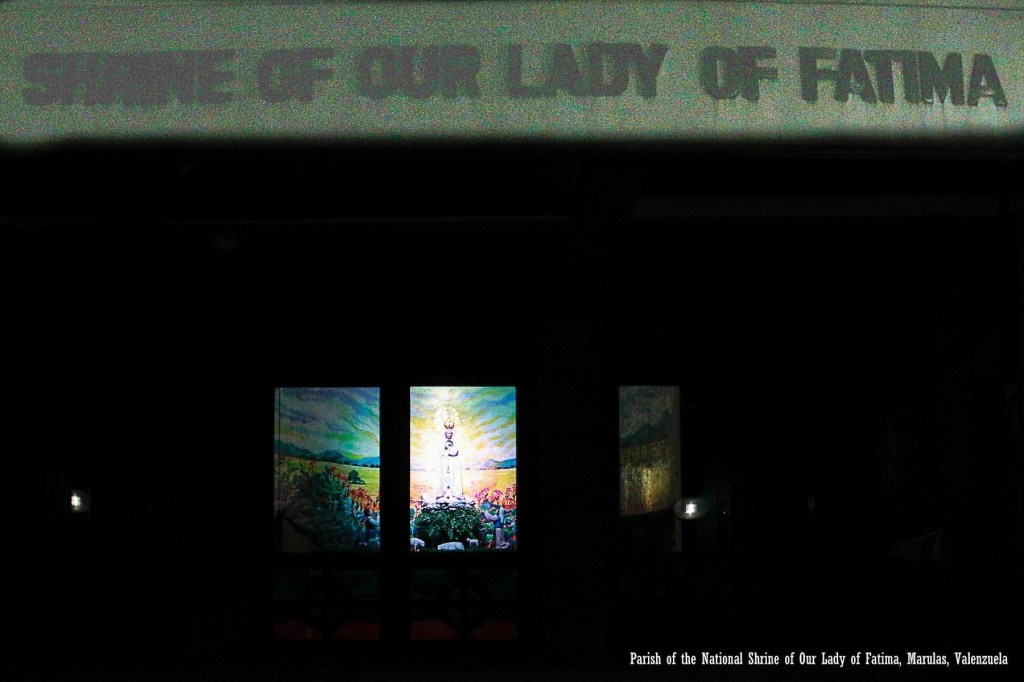
Photo from the Commission on Social Communications, National Shrine of Our Lady of Fatima, 2020.
Your words today, O Lord Jesus Christ
are so timely, so perfectly meant for us
these days:  "Do not let your hearts be
troubled. You have faith in God; have
faith also in me" (Jn.14:1).
Forgive us, dear Jesus,
in believing so much with ourselves,
forgetting you and God in the process;
help us accept the many realities
in life, help us to move on with life,
and most of all, stop from being
bitter and being unkind with others;
make us realize we cannot have the
truth when we are apart from you.
It is so timely that on this 105th
anniversary of the first apparition
of your Mother the Blessed Virgin Mary
in Fatima, Portugal that our gospel
is very much the same truth she had
revealed to the three children and
to the world:  that you alone, Jesus is
the true reality in this life for you
are "the way and the truth and the life,
that no one comes to the Father
except through you" (Jn.14:6).
It was at Fatima where your Mother
told us how your way is always
accessible and leads to fulfillment,
so unlike our many ways in this world
that change and disappear, sometimes
become obsolete.
It was at Fatima where your Mother
assured us too that there is no other
way nor a secret road in life except you,
dear Jesus.
It was at Fatima where Mary brought us
back to reality of you Lord Jesus that
no one comes to Father except through
you.
Help us dear Jesus,
through our Lady of Fatima,
to return to you again in
the sacraments of Penance
and Eucharist, to trust in you again,
to follow your Person as the way,
the truth, and the life.  Amen.
Photo from the Commission on Social Communications, National Shrine of Our Lady of Fatima, 2020.
The Lord Is My Chef Daily Recipe for the Soul by Fr. Nicanor F. Lalog II
Friday, 105th Anniversary of the Apparition of Our Lady of Fatima, 13 May 2022
Acts 13:26-33   ><]]]]'> + <'[[[[><   John 14:1-6
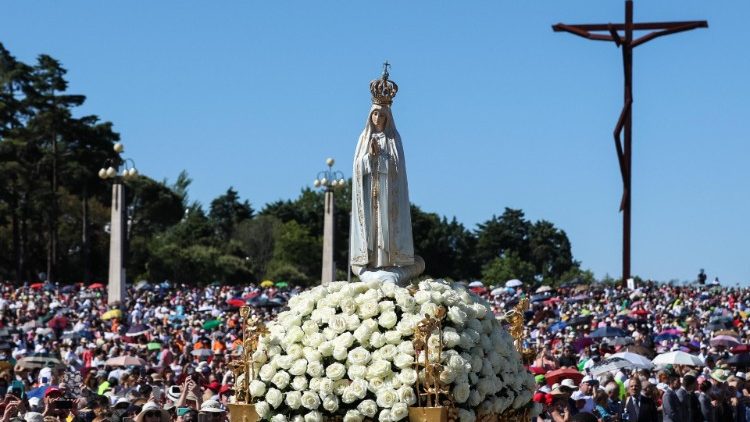
Photo from vaticannews.va, 13 May 2017.
Our gospel this 13th of May is so timely for us in the Philippines when Jesus said to his disciples shortly before his arrest at the Last Supper, “Do not let your hearts be troubled. You have faith in God; have faith also in me” (Jn.14:1).
It is the same message of the Blessed Virgin Mary when she first appeared to the three little children at Cova de Iria in Fatima, Portugal exactly 105 years ago today.
Jesus said to his disciples: “Do not let your hearts be troubled. You have faith in God; have faith also in me.”
John 14:1
Photo from vaticannews.va, 13 May 2017.
In the past 200 years, notice how the two most significant apparitions by the Blessed Virgin Mary at Lourdes in France (1858) and at Fatima in Portugal (1917) were both calls for us to renew our faith in God through Jesus Christ, something we keep on forgetting and even disregarding in these modern times.
When the Blessed Mother appeared in Fatima, the First World War was still raging with the former Soviet Union spreading its venomous doctrines of atheism and communism. Today, though the USSR has long been gone and dismantled, its ideology still lives on in Russia which had recently invaded its neighbor Ukraine.
And here in our country, the mood since Monday evening when unofficial results of the elections started to come has been like a Good Friday with so many going through some forms of emotional stress and distress.
It is very sad and disheartening when people started saying of moving to other countries abroad, casting doubts on the elections results with all the insults and other moral aspersions against the winners and their supporters.
Where is our faith in God, in Jesus Christ?
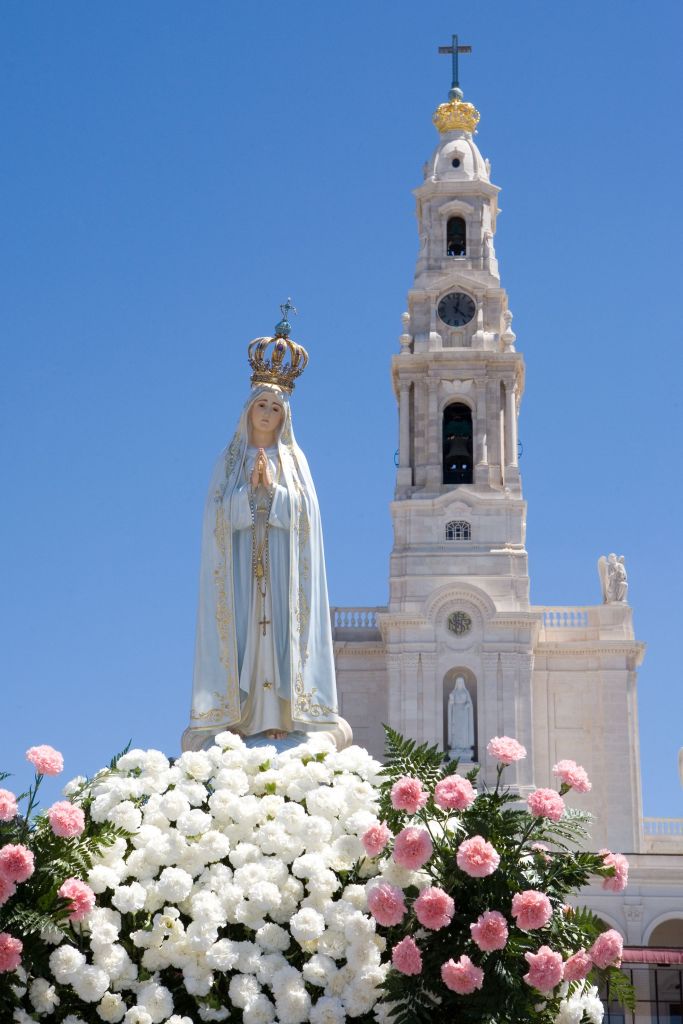
Photo from Commission on Social Communication, National Shrine of Our Lady of Fatima, 2020.
When Mary appeared in Fatima in 1917, the world was in a great transition like our time with ever increasing discoveries and inventions in the field of science and technology with the new ideas and thoughts being put forth that were so materialistic, disregarding God, spirituality and morality.
Today we are reminded anew of the ever-relevant calls of the Blessed Virgin Mary in Fatima to go back to her Son, our Lord Jesus Christ in this time characterized by so much modernities in life brought about by new technologies that also spawn more materialistic thoughts that are often relativistic.
How ironic that as we love to hate modern media, we ourselves have relied on them too these past months. We have relied more on numbers than with God, falling into the trappings of social media of all glitz and glamour that were empty and worst, not the reality at all! We have been warned long ago to never rely on what we see in media that are most often human constructs. There is only one reality in this life, in this world: Jesus Christ.
Photo from Commission on Social Communication, National Shrine of Our Lady of Fatima, 2020.
Thomas said to him, “Master, we do not know where you are going; how can we know the way?” Jesus said to him, “I am the way and the truth and the life. No one comes to the Father except through me.”
John 14:5-6
The recent events in the country speak so loud and clear of how we have forgotten Jesus Christ. We have believed so much in ourselves, especially some of us in the clergy who have crossed the lines or, moved the lines, so to speak, forgetting the most essential, the only one Real, the person of Jesus Christ and his universal message of love and salvation to everyone.
In all our efforts and endeavors in this world, especially in those advocacies and causes we passionately work for, may we not forget that ultimately, it is all about persons and not ideals. The ideals we work and stand for are good because of the persons we fight for and ultimately, because of its very roots, the Person of Jesus who called us to do his work or mission in liberating the people, especially the poor.
Jesus had told us that the way, the truth, and the life on this earth is himself, a Person. Our ways can disappear and become totally obsolete but Jesus is always relevant and accessible, most of all, infallible as we have reflected last Sunday in his being the Good Shepherd who gives us eternal life. That is why he is the way as well as the truth and the life for everything hangs together in himself.
This is the basic truth that the Blessed Mother expressed at Fatima that she insisted to the three children of the need for us to enter into an intimate relationship in Jesus Christ her Son through the Sacraments of Penance and the Holy Eucharist.
Going back to Jesus as Mama Mary had taught us is going back to prayers and the sacraments. Of course, they are not everything but what can we live on if we are empty of Jesus? The recent exchanges of insults are proofs enough of whether we have Jesus or not.
Photo from Commission on Social Communication, National Shrine of Our Lady of Fatima, 2020.
Life is filled with so many mysteries, with more questions than answers. We have had all these questions long before of actors/actresses getting elected to local posts and to both houses of Congress but until now we have refused to accept the answers that majority of voters are not like us – proof how we especially in the Church have always been detached from the rest of the people. Instead of spending too much time with politics and with social media, we must go out and reach out to those people at the margins, the poorest of the poor we find only in our countless documents but never inside the church.
When Jesus and later his Mother Mary told us the simple answer to our question verbalized by Thomas, that Jesus himself is the way and the truth and the life, we are reassured that there is no other secret path or road to fulfillment in this world and into heaven where he is preparing a room for us to dwell after this life. But for now, we have to focus on Jesus more because as he later stressed to Philip in our gospel today, “Whoever has seen me has seen the Father” (Jn.14:9) – which is a call to witnessing the gospel more than ever!
In the first reading, Paul reminds us of the wrong choices made by his countrymen and fellow Jews in crucifying Jesus Christ who rose again from the dead. His Resurrection is proof of how God continues to work for us in our favor despite and in spite of setbacks and even crushing defeats.
Never lose hope in God. Do not let your hearts be troubled. Like in 1917 when Mother Mary first appeared in Fatima, life was so difficult and truly uncertain with so many kinds of wars at all fronts like today. On this feast of Our Lady of Fatima, Mother Mary is assuring us of better days ahead despite trials and difficulties if we choose and remain in her Son Jesus Christ.
May the Blessed Mother of the Rosary, our Lady of Fatima, pray for us always. Amen.
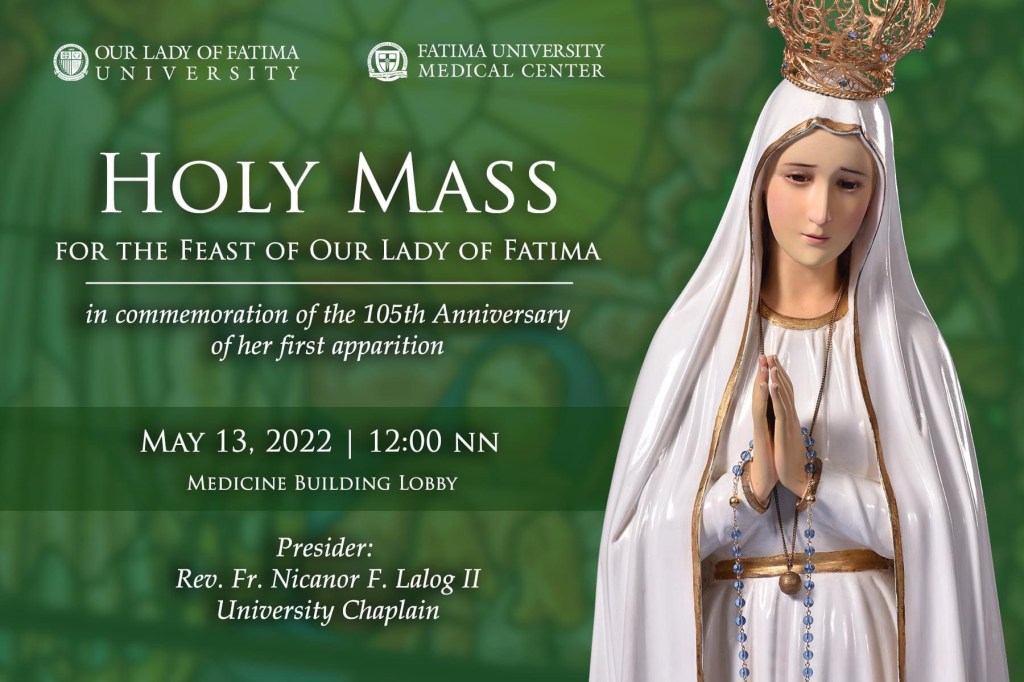
From FB of Our Lady of Fatima University and Fatima University Medical Center, 06 May 2022.
The Lord Is My Chef Daily Recipe for the Soul by Fr. Nicanor F. Lalog II
Tuesday in the Fourth Week of Easter, 10 May 2022
Acts 11:19-26   ><]]]]'> + <'[[[[><   John 10:22-30
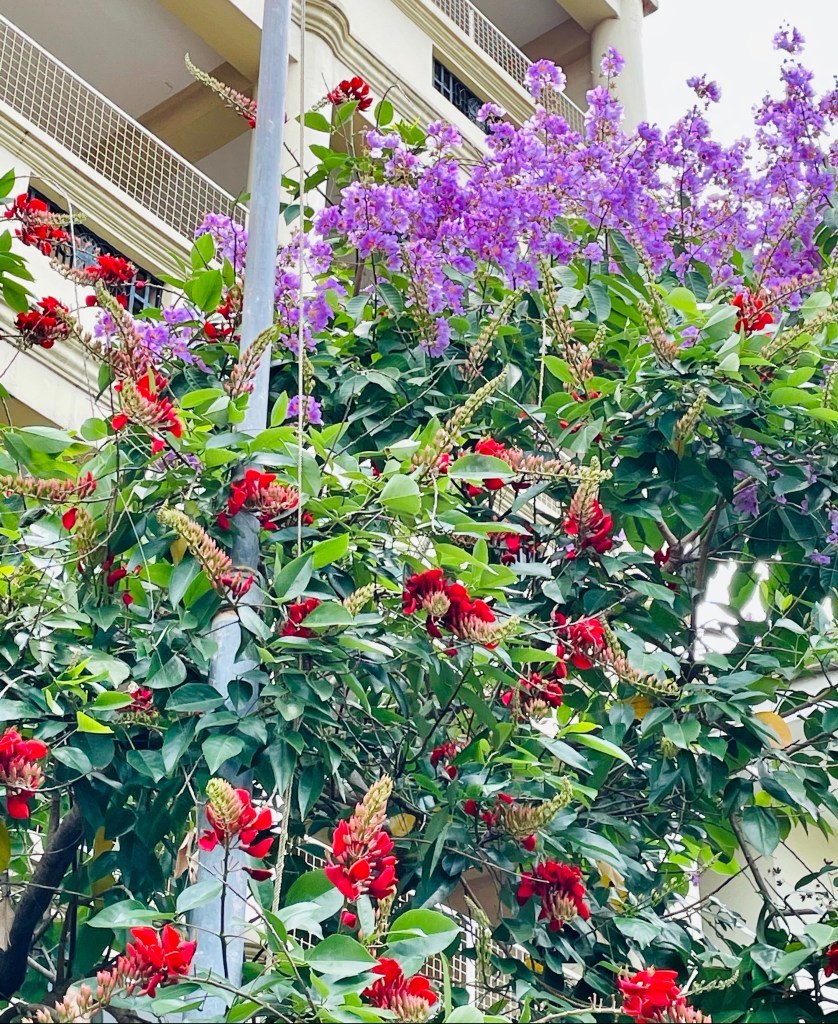
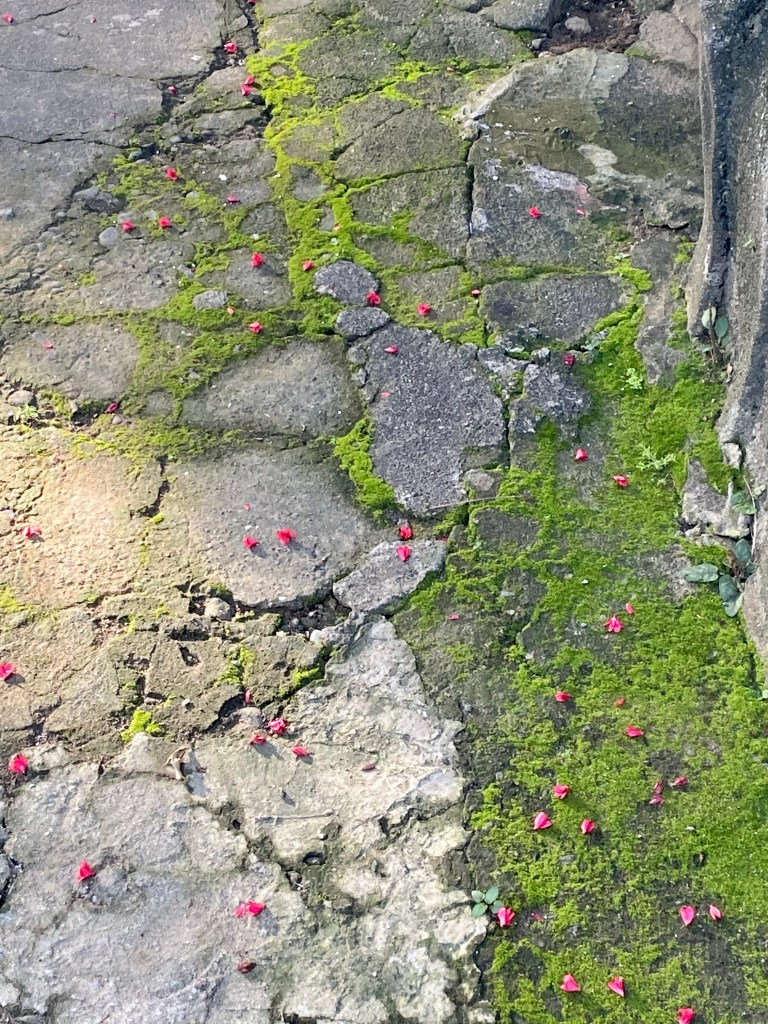
Photo by Ms. Jing Rey Henderson in Taroytoy, Aklan, 30 April 2022.
God our loving Father,
it has been almost a day
since we had perhaps our
most hotly-contested elections
so far that have divided us not
only as a nation but also as
family and friends, and sadly
as followers of your Son,
Jesus Christ.

How sad that long before
the start of the campaign period
many among us have forgotten
being Christians; it was the opposite
that have happened lately, Christians
persecuting fellow Christians simply
because they belong to different
camps in politics.
Those who ad been scattered by the persecution that arose because of Stephen went as far as Phoenicia, Cyprus, and Antioch, preaching the word to no one but Jews. The news about them reached the ears of the Church in Jerusalem, and they sent Barnabas to go to Antioch. Then he went to Tarsus to look for Saul, and when he had found him he brought him to Antioch. For a whole year they met with the Church and taught a large number of people, and it was in Antioch that the disciples were first called Christians.
Acts 11:19, 22, 25-26
Though there was the sad note
of persecution at the beginning of the Church,
it turned out to be a blessing for it helped
spread fast the good news to more
people in more places; what is most
wonderful, dear Father is the virtue of
magnanimity among the disciples and early
followers.
As they gained followers
with strong footholds especially
at Antioch where they were first called
Christians, they have always been
magnanimous in their successes.
Teach us all to be magnanimous,
Lord, especially the victors in these
elections though it is still too early;
may our words and deeds, especially
our behavior and attitudes testify
to our being Christians; enough with
our sanctimonious stance with
those opposed to us; may we
imitate Barnabas is reaching out
to others, of being open, of
being converted daily in Jesus
our Good Shepherd.  Amen.
The Lord Is My Chef Sunday Recipe for the Soul by Fr. Nicanor F. Lalog II
Fourth Sunday in Easter-C, 08 May 2022
Acts 13:14, 43-52 ><}}}}*> Revelation 7:9, 14-17 ><}}}}*> John 10:27-30
The Good Shepherd is the earliest portrayal of our Lord Jesus Christ in art. Mostly done in paintings in the catacombs of Rome, Jesus the Good Shepherd is shown as a young, muscular man to signify his eternity carrying on his shoulders a lost sheep.
But that imagery of a shepherd taking care of the lost sheep and flock was an original thought among peoples in the ancient Near East that included Israel. Kings in Babylonia and Assyria regarded themselves as shepherds tasked by their gods to care especially for the weak. This concept we also find in the Old Testament like in the Books of Psalms and of the prophets Jeremiah and Ezekiel where God promised to send true “shepherds after his own heart” (Jer. 3:15) who shall lead his flock Israel with justice back to him.
That prophecy is fulfilled in Jesus Christ who is not just a shepherd but “the good shepherd who lays down his life for the sheep” (Jn.10:11) because he is one with his flock.
Oneness is an inner sense of belongingness in personhood and experiences, a common union or communion of selves and experiences like in Jesus becoming human like us to be one in our pains and sufferings and death so that we may be like him in his glorious resurrection and eternal life.
Jesus said: “My sheep hear my voice; I know them, and they follow me. I give them eternal life, and they shall never perish. No one can take them out of my hand. The Father and I are one.”
John 10:27-28, 30
Photo from Pinterest.com.
Jesus knows us, gives us eternal life; we hear and follow him.
To know in Jewish thought is not merely an intellectual activity of having information and details especially when used in relation with persons. To know somebody means to have a relationship. Knowing is belonging.
Jesus as the Good Shepherd knows us his sheep because we belong to him, and whether we like it or not, we know him precisely because we are his! Recall that during his trial before Pilate, Jesus declared “You say I am a king. For this I was born and for this I came into the world to testify to the truth. Everyone who belongs to the truth listens to my voice” (Jn.18:37).
Photo by Dr. Mylene A. Santos, MD, 2020.
From the very start, we have always belonged to God so that out of his great love for us he sent us his Son Jesus Christ so we can find our way back home to him. We are all God’s children created in his “image and likeness” who have become in many instances prodigal sons and daughters living like lost and injured sheep who need all the care and redemption to gain our status again as the Father’s beloved.
Our “belonging” to God is different from “possessing” in the same manner we belong to our parents or spouses to their partner. Human belongingness is way different from things as belongings, although so many times, it happens that people treat persons as things and objects to be possessed than subjects to be loved and cherished.
What do we mean? Children belong to parents and spouses belong to their partner but they can never be considered as possessions or property to be used and manipulated. People belong to one another like children to parents, husband to wife, and wife to husband as most cherished possessions in the sense that they are gifts from God, so unique in one’s self, free to grow and mature as a person. We belong to one another in mutual responsibility not as property; hence, the need for us to accept and support each other in love which leads to deeper communion and oneness through intimacy that extends to eternity!
Now we see why Jesus said he knows his sheep and gives them eternal life. Here we find the image of Jesus the Good Shepherd is in fact the image of Christ the King of the universe which sheds light on his very kingship as seen by John in his vision in our second reading today “of a great multitude, which no one could count, from every nation, race, people, and tongue. They stood before the throne and before the Lamb, wearing white robes and holding palm branches in their hands” (Rev. 7:9) which is reminiscent of his triumphal entry to Jerusalem on Palm Sunday.
In the first reading we have also heard how from the very beginning, it has been God’s plan to lead all men to salvation in Jesus Christ. Despite the setbacks encountered by Paul and Barnabas in Antioch when they were rejected by their fellow Jews, their decision to turn to the gentiles to proclaim the Gospel was in fulfillment of of the Lord’s will that “have made them a light to the Gentiles to be instruments of salvation to the ends of the earth” (Acts 13:47).
The mark of a true shepherd is like a light who leads us to Jesus Christ and his values of prayer, life, persons, family, and justice among others. Here is the distinction between the true shepherd and a thief – a robber does not pass through Jesus, the gate of the sheep (Jn.10:1ff). A thief like many politicians and dictators including their handlers see the flock as things and properties they own and possess who can be bought and be forgotten, even disregarded, until the next elections. (So, vote wisely by listening more to Jesus than to anyone like the candidates’ endorsers.)
Photo by author, Sacred Heart Novitiate, Novaliches, QC, 2018.
Belonging and mutuality
Human belongingness calls for mutuality for it to truly lead to oneness and communion. Jesus said he knows us and gives us eternal life because according to him, we his sheep hear his voice and follow him (v.27).
Do we listen to him and follow him?
Today we are also celebrating Mother’s Day. What a wonderful tribute to mothers who are indeed one of the truest good shepherdess in the world – the one to whom we all belong to, having cared for us from the very beginning in their womb.
Mothers are the most loving, most merciful, and most forgiving of all persons in the world, just like Jesus our Good Shepherd but sad to say, the one we most hurt when we disrespect her, from answering her back to swearing and sadly, when we disobey her. Ironically, when things go wrong with us and our lives, the first person we go to and accepts us is our mother too!
So many times, mothers bear all pains and hardships in life just to see their children fulfilled in life, choosing to suffer and cry in silence to hide the great difficulties they face daily, both physically and emotionally. That is how loving mothers are that in the Old Testament, God introduced himself as a mother, “Can a mother forget her infant, be without tenderness for the child of her womb? Even should she forget, I will never forget you” (Is.49:15).
It is so easy to say “we love our mom” like claiming “Jesus is our Good Shepherd” but it is entirely another thing to live as a mother’s child or Christ’s sheep.
The grace of this Good Shepherd Sunday is Christ’s coming to us not only to lead us to greener pastures but to renew our relationships, our belonging to him and the Father to experience fulfillment in life. Whether at home or in our nation, may we listen more to Jesus by being mutual in our respect and love for one another and to our Motherland too!
May we have a peaceful and matured elections this Monday! Amen.
Photo by author, sunrise at the Lake of Tiberias (Galilee) in Israel, May 2019.
Our gospel last Sunday spoke of the Risen Lord’s third appearance to his disciples at the Lake of Tiberias. No one, except the beloved disciple recognized Jesus standing at the shore after he had told them to cast their net to the right side of the boat that led to their plentiful catch of fish.
When it was already dawn, Jesus was standing on the shore; but the disciples did not realize that it was Jesus. Jesus said to them, “Children, have you caught anything to eat?” They answered him, “No.” So he said to them, “Cast the net over the right side of the boat and you will find something.” So they cast it, and were not able to pull it in because of the number of fish. So the disciple whom Jesus loved said to Peter, “It is the Lord.” When Simon Peter heard that it was the Lord, he tucked in his garment, for he was lightly clad, and jumped into the sea.
John 21:4-7
Photo by author, sunrise at Lake of Tiberias, May 2017.
I love the way it is narrated. What a wonderful interplay of realities, of John the beloved recognizing Jesus standing at the shore upon seeing the many fish caught in their net!
The story speaks of the beauty of every sunrise many of us seem to take for granted, of how so many of us miss the beautiful sight and silence of the morning. It is a story of every new day filled not only with promises but in itself a blessing we can surely experience when we first recognize Christ present in us.
That is perhaps one problem with us who always prefer spectacular sights and events to find God.
Unlike sunset, sunrise does not have radiant displays of colors and shades. It is very simple which is the lesson of Easter to us, of how our great God comes to us in the simplest moments of life. Recall too that Jesus was born in the middle of the darkest night of the year when everyone was asleep and rose from the dead very, very early in the morning that no one had seen! And here lies one of the wonderful mysteries in life – the hiddenness of God!
It is in God’s hiddenness that we can find him not because he is hiding but inviting us to be hidden in him too. That is the beauty of sunrise when you have to wake up early to see the beauty of life unfolding, awaiting something we are totally unaware of what is going to happen next. It is easier to wait for the sunset because you have been up and going the whole day; you just have to stop and pause for a while to await the sun going down.
Photo by Ms. Jo Villafuerte, sunrise at Atok, Benguet, September 2019.
Sunrise is different. It is like awaiting a total stranger, compared with sunset after we have befriended the the day about to end.
Every morning when we wake up, we do not know what is in store for us. Some people are excited, others are not while the rest simply got the blues or too lazy to work and study that they would rather sleep more.
Maybe that is why sunrise is more subdued with its hues and shades. Like God, sunrise is so kind, very accommodating with everyone, no spectacular display of colors so that one could buy his own time on whether to go out and move or snuggle more in bed, alone or with somebody else.
Like a beloved someone or God himself, sunrise looks soft and calm, reassuring everyone the day ahead would be just fine for us all.
Its light is so gentle, though bursting filled with life but never insistent to the eyes, so gentle. This we feel in our favorite word and activity every morning – breakfast – which came from the literal “breaking of fast” the night before by the monks in the monasteries. We can feel this gentleness of sunrise in that Christian hymn Morning Has Broken, whether you sing it or listen to Cat Steven’s cover or to its original Gaelic Scottish tune. And along this line, we find sunrise as the sweetest breaking of all in Angela Bofil’s 1981 love song Break It To Me Gently.
Photo by author, sunrise at Camp John Hay, Baguio City, November 2018.
Sometimes, sunrise can be a bit wild, bursting with light that can penetrate one’s soul with its light traveling so fast, eager to cover the whole surrounding with the good news of life coming.
Think of the Beatles’ 1969 Here Comes the Sun with its lovely guitar introduction, assuring everyone, especially your beloved “little darling” that “it’s all right” with “smiles returning to the faces.”
Photo by author, sunrise at Bolinao, Pangasinan, 20 April 2022.
That is the most beautiful part of catching the sunrise when all is silent with you all alone, listening to Jesus whispering, “Little darling, it’s all right” because whatever had happened yesterday, with all your sins and mistakes, are all forgotten and forgiven. Today is a new beginning, like what he told Peter in last Sunday’s gospel when he asked him thrice, “Simon, son of John, do you love me?”
Photo by author, sunrise at Bolinao, Pangasinan, 20 April 2022.
Peter was distressed that Jesus had said to him a third time, “Do you love me?” and he said to him, “Lord, you know everything; you know that I love you.” Jesus said to him, “Feed my sheep… And when he had said this, he said to him, “Follow me.”John 21:17, 19
John 21:17, 19
It is said that whatever one feels in describing the sunrise is one’s perception of love – warm and refreshing, joyful and so alive, filled with hopes and raring to go.
Sunrise is beautiful because it is when we experience closest with our truest self, with those most faithful and loving to us, and most of all, with God, our very root and being. Every morning is the fulfillment of Zechariah’s prophecy of each of us becoming a John the Baptist whose name means “graciousness of God.” This we pray every morning in the Benedictus (cf. Lk.1:68-79):
In the tender compassion of our God
the dawn from on high shall break upon us,
to shine on those who dwell in darkness and the
     shadow of death,
and to guide our feet into the way of peace.
May you be blessed every morning, every day of the week. Amen.
Photo by Ms. Jing Rey Henderson, sunrise at Dumaguete City, Negros Oriental, 27 April 2022.
The Lord Is My Chef Daily Recipe for the Soul by Fr. Nicanor F. Lalog II
Thursday in the Third Week of Easter, 05 May 2022
Acts 8:26-40   ><}}}}*> + <*{{{{><   John 6:44-51
Photo by author, 2021.
Praise and thanksgiving
to you, most loving Lord,
Jesus Christ, in making us
come to you daily!
Jesus said to the crowds: “No one can come to me unless the Father who sent me draw him, and I will raise him on the last day. It is written in the prophets: They shall all be taught by God. Everyone who listen to my Father and learns from him comes to me.”
John 6:44-45
Grant me the courage
and docility of Philip your
Apostle whose feast we
celebrated yesterday to
always come to you, ready
to "get up and set out"
wherever you send us.
May we spend time,
make time daily to come to you,
Jesus, to put into practice
that grace of the Father to
meet and experience you in
prayers and the sacraments
so we may be filled with your
presence and mercy.
And wisdom.
Then the eunuch said to Philip in reply, “I beg you, about whom is the prophet saying this? About himself, or about someone else?” Then Philip opened his mouth and, beginning with this Scripture passage, he proclaimed Jesus to him.
Acts 8:34-35
First, let us come to you,
Jesus so that we may come
to share you with others.
Amen.
The Lord Is My Chef Daily Recipe for the Soul by Fr. Nicanor F. Lalog II
Wednesday in Third Week of Easter, 04 May 2022
Acts 8:1-8   ><]]]]'> + <'[[[[><   John 6:35-40
Photo by author, ICSB in Malolos City, Summer 2021.
"Sanaol" - a wish and a prayer
that all may be blessed,
that like the flowers of summer,
everyone may bloom in the Lord.
"Sanaol" was the good news
after that Pentecost when
Jesus Christ's good news of
salvation was proclaimed to all;
despite the persecutions that
began in Jerusalem and "all were
scattered throughout Judea and
Samaria, except the Apostles,
there were great joy in that
city" (Acts 8:1, 8) because
everyone was blessed,
everyone was welcomed,
everyone was accepted.
"Sanaol", Lord Jesus,
would accept you in the
Eucharist and eventually in
the person of everyone we meet;
it is you, dear Jesus, who brings
joy and fulfillment in everyone
of us whenever we receive and
welcome you in the Eucharist
and in every person we meet.
Jesus said to the crowds, “I am the bread of life; whoever comes to me will never hunger, and whoever believes in me will never thirst. But I told you that although you have seen me, you do not believe.
John 6:35-36
What has happened to us,
Lord Jesus?
We have turned away from you
and from each other, choosing to
believe in thoughts and ideas,
in personalities, and all the
fancies around them from colors
to cults that have brought us
divisions and even persecutions.

Let us seek you again, dear Jesus,
and listen more to your voice
than to all the noises barraging us
especially at this crucial time
of the elections.
"Sanaol" will listen to you again,
and find you anew in everyone.
Amen.
The Lord Is My Chef Daily Recipe for the Soul by Fr. Nicanor F. Lalog II
Monday, Memorial of St. Athanasius, Doctor of the Church, 02 May 2022
Acts 6:8-15   ><))))*> + <*((((><   John 6:22-29
Photo by Ms. Jing Rey Henderson in Taroytoy, Aklan, 29 April 2022.
In this Season of Easter,
help us, dear Lord Jesus
to know you more clearly
so that we may deepen our
faith in you and eventually do
your work of loving service
to one another; so many times
in life we seek you for selfish
and personal reasons
like the people you have fed
at the wilderness.
And when they found him across the sea they said to him, “Rabbi, when did you get here?” Jesus answered them and said, “Amen, amen, I say to you, you are looking for me not because you saw the signs but because you ate the loaves and were filled. Do not work for food that perishes but for food that endures for eternal life, which the Son of Man will give you. For on him the Father, God, has set his seal.”
John 6:25-27
Like St. Stephen in the first
reading, fill us with passion
in "working for God" which is
primarily to believe in you as
the Christ, the one he sent;
but so many times, even in this
modern age, we doubt you,
O Jesus, as the Son of God:
like those Jews, we ask
"when did you get here" -
from where are you, Jesus,
because we always doubt you
as the Son of God like our separated
brothers and sisters until now
influenced by Arianism.
Hence, it is not enough for us
to be simply passionate like St. Stephen -
grant us the academic discipline
of St. Athanasius whose memorial
we celebrate today;
his sound mental acumen formed by
his deep spirituality based on prayers
made him a pillar of the Church in
defending your truth as the Son of God.
The more he knew you more clearly,
the more he followed you closely
even if he was banished so many
times from his posts due to his rootedness
in you; most of all, in his knowledge
and wisdom, the more he loved you dearly,
Jesus, by serving the flock entrusted to him.
Amen.
The Lord Is My Chef Sunday Recipe for the Soul by Fr. Nicanor F. Lalog II
Third Sunday in Easter-C, 01 May 2022
Acts 5:27-32, 40-41 ><]]]]'> Revelation 5:11-14 ><]]]]'> John 21:1-19
Photo by author, sunrise at the Lake of Tiberias, Israel, 2017.
This is the last Sunday in this Easter Season when we shall hear a story of the Risen Lord appearing to his disciples; starting next Sunday, our gospels will be from his Last Supper discourse that were his final instructions before his Passion, Death, and Resurrection.
This is the third appearance by Jesus to his disciples that happened at the shore of Lake Tiberias (aka, Galilee) one early morning after Simon Peter and six other disciples went fishing the night before and caught nothing. The story is quite long but very remarkable with how Jesus was recognized in the blessedness of John the beloved and in the sinfulness of Peter.
Such is the beauty and power of Easter, of Jesus breaking all barriers to come to us so we may experience his love and mercy and forgiveness. As we have reflected last week, it is not the number nor length of our Risen Lord’s appearances that matter but its inexpressible intensity demanding our intense response to him which we find today in John and Simon Peter.
Photo by author, November 2018.
“It is the Lord!”
The disciples were still at a loss three weeks after the Lord had risen. Despite his twice appearances to them, they could not yet grasp Easter’s meaning; it would still be a long way to go before they understand everything when the Holy Spirit comes on Pentecost as Jesus had promised them.
Trying to pick up the pieces of their lives, the seven disciples led by Simon Peter went fishing one night but caught nothing until Jesus appeared to them unrecognized.
When it was already dawn, Jesus was standing on the shore; but the disciples did not realize that it was Jesus. Jesus said to them, “Children, have you caught anything to eat?” They answered him, “No.” So he said to them, “Cast the net over the right side of the boat and you will find something.” So they cast it, and were not able to pull it in because of the number of fish. So the disciple whom Jesus loved said to Peter, “It is the Lord.” When Simon Peter heard that it was the Lord, he tucked in his garment, for he was lightly clad, and jumped into the sea.
John 21:4-7
What a beautiful story reminding us of the need to be always in the state of grace, of being in love first with Jesus to see and recognize him in the bountiful blessings he pours upon us daily!
See how it was the disciple whom Jesus loved who first recognized the Lord upon seeing the plentiful catch of fish with a wonderful interplay of catching many fish and recognizing Jesus.
Photo by author, Puerto del Sol, Bolinao, Pangasinan, 20 April 2022.
For people truly in love with Jesus, everyday is a miracle, a day of his coming, of his loving presence among us.
Being in love with Jesus is having a prayer life in him that makes us attuned with him, becoming automatic with us to find Christ present in the various events happening in our lives, whether they are good or bad as both count as blessings to anyone who truly believes in him.
John must have been so in love with Jesus, remembering so well the first time he met the Lord with his brother James and their partners Peter and brother Andrew after a similar incident when they have caught nothing the previous night and Jesus invited them to “cast their net into the deep.” It must have been a “love at first sight” for him with the Lord that they eventually left everything including their father to follow Jesus as “fishers of men” (Lk.5:1-11, Fifth Sunday Ordinary Time, 06 February 2022).
When we love, our senses and our memories are heightened of our beloved’s words and actions that we can see and feel them around us even after they are gone. When we love, we find newness in life every day with Jesus standing at the shore every dawn waiting for us to wake up and lead us to a bountiful catch of fish daily. Of course, the fish is found only in the sea or lake but for us to catch them, we need to find Jesus first.
That is why it is necessary that we begin and end each day in Jesus praying. When we love someone, we always talk and listen, always communicating in various ways with our beloved.
Problem is when we do not pray, we get preoccupied with what we do not have – of not catching anything – of looking more into the dark or murky waters of life not seeing the light in the horizon, of Jesus at the shore.
Photo by author (2017), the shore of Lake Tiberias where Jesus asked Simon Peter thrice “Do you love me?”
“Lord, you know everything; you know that I love you.”
After bringing in their haul of “one hundred fifty-three large fish” to the shore for breakfast with Jesus, our story reaches its climax with Jesus asking Peter thrice, using his original name Simon with the question, “Do you love me?”.
Peter was distressed that Jesus had said to him a third time, “Do you love me?” and he said to him, “Lord, you know everything; you know that I love you.” Jesus said to him, “Feed my sheep… And when he had said this, he said to him, “Follow me.”
John 21:17, 19
Peter understood fully well (gets niya, as the young would say) why Jesus asked him thrice with “do you love me?” to signify the three occasions he denied knowing him while being arraigned by the Sanhedrin on the night of Holy Thursday.
This time, there was no denying on Peter’s part that he had truly sinned that night in denying Jesus three times! And he was distressed because he was deeply sorry, telling Jesus, “Lord, you know everything; you know that I love you.” See the humility and sincerity of Peter in responding to the Lord’s question as he admitted his guilt of denying Jesus; but at the same time, his love and faith in the Lord despite his sinfulness and weaknesses. In telling Jesus “Lord you know everything; you know that I love you”, Peter was declaring his deep conviction that Jesus knows very well all our sins but at the same time knows too as well how much we love him in all of our imperfections.
Sin is not really that bad at all, so to speak, in the sense that even in our sinfulness, Jesus comes to meet us, assuring us of his love, of his mercy and forgiveness.
Photo by author, September 2021.
Just like his first words when nailed on the Cross, “Father, forgive them, they know not what they do” (Lk.23:34), Jesus comes to us quickly in our moments of sin, inviting us to come back to him. Every time we feel that guilt after committing a sin, when we feel that shame within, that is the moment too when Jesus calls us personally like Simon, not only asking us if we love him but assuring us most of all that he loves us in spite and despite our sins.
Here we find a different interplay: the more Jesus directed Simon unto himself – do you love me?– the more Simon saw his sinfulness but at the same time experienced Christ’s forgiveness and love for him because like John the beloved, he had always loved Jesus from the start despite his many flaws and weaknesses that would later be smoothened by the Lord.
Remain in love with Jesus. This is the grace of this third Sunday in Easter. We cannot follow nor meet Jesus whether in our blessedness or sinfulness unless we love him first of all. Jesus perfectly knows human love is imperfect; only he can love us perfectly. We do not have to pretend to be perfect before him; just be our true selves, sinful yet sorrowful, to surely meet him who never leaves our side.
Dearest Lord Jesus,
open my heart to love you more
so that my eyes may always see you
in life's many blessings and trials
that come my way daily;
let me love you more so that
I obey God rather than men and women
who keep on demanding so many things
from me, enslaving me with their many
offers that pretend to make me perfect;
when things become difficult,
open my eyes like your Apostles
who found themselves worthy
to suffer dishonor for your sake (Acts 5:29, 31)
who alone is "worthy to receive power
and riches, wisdom and strength,
honor and glory and blessing" (Rev.5:12).
Amen.
Photo by author, Puerto del Sol, Bolinao, Pangasinan, 19 April 2022.
Quiet Storm by Fr. Nicanor F. Lalog II
Good Friday, 15 April 2022
Isaiah 52:13-53:12  +  Hebrews 4:14-16; 5:7-9  +  John 18: 1-19:42
Photo by Mr. Chester Ocampo, ICS Chapel, 2016; sculpture by National Artist Ed Castrillo.
Perhaps, today we can truly feel the meaning and gravity of our favorite expression when somebody looks so sad and gloomy, when somebody seems to have been totally lost: “Biyernes Santong Biyernes Santo”.
That is Good Friday for us – so negative in the sense it is so sad and gloomy, so painful and too difficult but, good.
Good Friday is so negative for us because it means death of the Son of God, Jesus Christ. Nothing would be more sad than that.
But thanks to this COVID-19 pandemic we have been living inversely or “baligtad” as we say. We would always pray at every swab test for the virus that we be “negative”.
Never has been thinking negative has become so positive, so good, in fact!
And it all began more than 2000 years ago at the calvary when Jesus offered himself for us on the cross.
That is why Good Friday is called “Good”: the cross of Jesus Christ is a sign not of death but of the good news, of the gospel of life, hope, and eternal life.
The cross of Jesus Christ is not a negative sign (-) but a positive sign, a plus sign (+).
We celebrate in the most solemn and unique way because the cross is no longer a sign of condemnation but honor. Before, it was a symbol of death but now a means of salvation. The cross of Christ has been the source of countless blessings for us, illuminating our path with light when our lives are so dark with sins and mistakes, sickness and disappointments. Most of all, the cross of Christ has brought us closer to God again and with one another despite our sins and past, promising us a bright a joyful Easter.
Yes, for some the cross of Christ is so negative: why display the body of the Lord everywhere in our churches and homes, bloodied and defeated, lifeless and dead?
See, my servant shall prosper, he shall be raised high and greatly exalted…for those who have not been told shall see, those who have not heard shall ponder it.
Isaiah 52:13-15
Many times in life, and we have proven this, God uses many of our “negative” experiences to lead us to more positive outcome and results.
Yes, we may be Biyernes Santong Biyernes Santo in sadness and fear, even anxieties.
But, we continue to pray and forge on with life’s trials and difficulties because we see the cross of Jesus Christ leading us to light and life, joy and celebration of his Resurrection at Easter.
In the Cross is found holiness. It is on the Cross of Christ when we are filled with God when like Jesus we are able to give up ourselves, when we are finished (Jn. 19:30) for God to start his life and work again.
I have not prepared any specific prayer this Good Friday. Just be silent and if you have a cross or crucifix with you now, let us all kneel and thank God in giving us Jesus Christ who brought out so many positive things in our lives out of the many negative experiences we have had lately in life. Amen.