The Lord Is My Chef Breakfast Recipe for the Soul by Fr. Nicanor F. Lalog II
Wednesday, Advent Week I, 02 December 2020
Isaiah 25:6-10     >><)))*>   +   <*(((><<     Matthew 15:29-37
Photo by Dr. Mylene A. Santos, MD, Katmon Harbor Nature Sanctuary, Quezon, March 2020.
O God our loving Father, as we eagerly await the coming Christmas break to finally come home and be with our loved ones, may we also pray and reflect the greatest homecoming of all when your Son Jesus Christ returns to bring us back to you in heaven, our truest home.
How interesting that Jesus must come again to finally bring us home to you; yes, he had already come and always comes to us but unfortunately, we rarely come home to you. We insist on going somewhere or to someone else who just leave us empty and disappointed.
Home is where the heart is and that is you, Father, in heaven. May we constantly search you and dwell in you while still in this world; destroy the “veil that veils all peoples, the web that is woven over all nations” (Is.25:7) that mislead and imprison us with false hopes in superficial relationships and materialistic briberies of the world.
Sometimes we have to go hungry and thirsty to realize the more essential things in life like you, dear God and the people who truly care for us and love us like our immediate family and friends.
Like the crowd who have followed Jesus in the wilderness for three days with nothing to eat: they experienced advent, the coming of God when Jesus fed them after they were first disposed to desire the longings of their soul than of their bodies. It was only then when Jesus fed them through the miraculous multiplication of the loaves of bread for the second time.
May the darkness and gloom that envelop us this season of Advent like the pandemic and other personal crises dispose us to desiring you alone, God our Father, so we may finally enter your heavenly banquet with “rich food and choice wines” (Is.25:6). Amen.
The Lord Is My Chef Breakfast Recipe for the Soul by Fr. Nicanor F. Lalog II
Monday, Feast of St. Andrew the Apostle, 30 November 2020
Romans 10:9-18     >><)))*>  +  >><)))*>  +  >><)))*>     Matthew 4:18-22
Photo by author (May 2019), shore of Galilee at Capernaum where Jesus called the brothers Peter and Andrew to come and follow him.
Praise and glory to you, Lord Jesus Christ, on this second day of Advent you have given us the feast of St. Andrew the Apostle known as the “protoclete” or protokletos, the first to be called to follow you because he was also the first to entertain be “disturbed” by you.
Grant us this grace of being disturbed, of being moved within in a positive manner to seek out the truth like St. Andrew.
The moment he first saw you when John the Baptist identified you as the “Lamb of God who takes away the sins of the world,” he was there, moved in his heart and so disturbed that he asked you, “Rabbi, where are you staying?” And when you invited him and his companion to “come and see,” he believed you are the Messiah (Jn.1:35-41)!
I wonder what did he see in you, in your home, Lord Jesus that convinced him right away you are the Christ? What disturbed him?
Then in the wilderness as you tested Philip and asked him where you could buy food to feed more than 5000 people, Andrew again felt his heart so disturbed with the situation they were into that he was moved to bring to you a boy with five loaves of bread and two pieces of fish but at the same time, sincerely admitted to you how disturbed he was when he asked you, “what good are these for so many?”
You never answered his question, dear Jesus, but Andrew remained with you and the crow until the great miracle happened when everyone was fed and satisfied with so many leftovers (Jn.6:1-15)!
St. Andrew must have been more disturbed than ever with what he had seen and experienced that he came to follow you more closely like his brother Peter!
For one believes with the heart and so is justified, and one confesses with the mouth and so is saved.
Romans 10:10
St. Andrew always believed in his heart, always allowed his heart to be disturbed with your words, with your presence, with your feelings.
And he never kept to himself those stirrings in his heart, always asking you or voicing out what he felt or thought no matter how crazy or even stupid they may be!
It was because of this openness with himself to you with his inquiries that you were made known as the Christ that eventually in his death, he chose to be crucified in the most different manner because he had truly owned your cross!
Give me that same grace, dear Jesus, to be honest in recognizing the inner stirrings in my heart no matter how crazy they may be, always telling these to you as part of carrying my cross. Like St. Andrew, may I have the courage to lovingly, faithfully and sincerely embrace your cross by expressing to you always whatever disturbs me that in the process you are more revealed in me and to others. Amen.
The Lord Is My Chef Breakfast Recipe for the Soul by Fr. Nicanor F. Lalog II
Friday, Week XXXIII, Year II in Ordinary Time, 20 November 2020
Revelation 10:8-11    >><)))*> + >><)))*> + >><)))*>     Luke 19:45-48
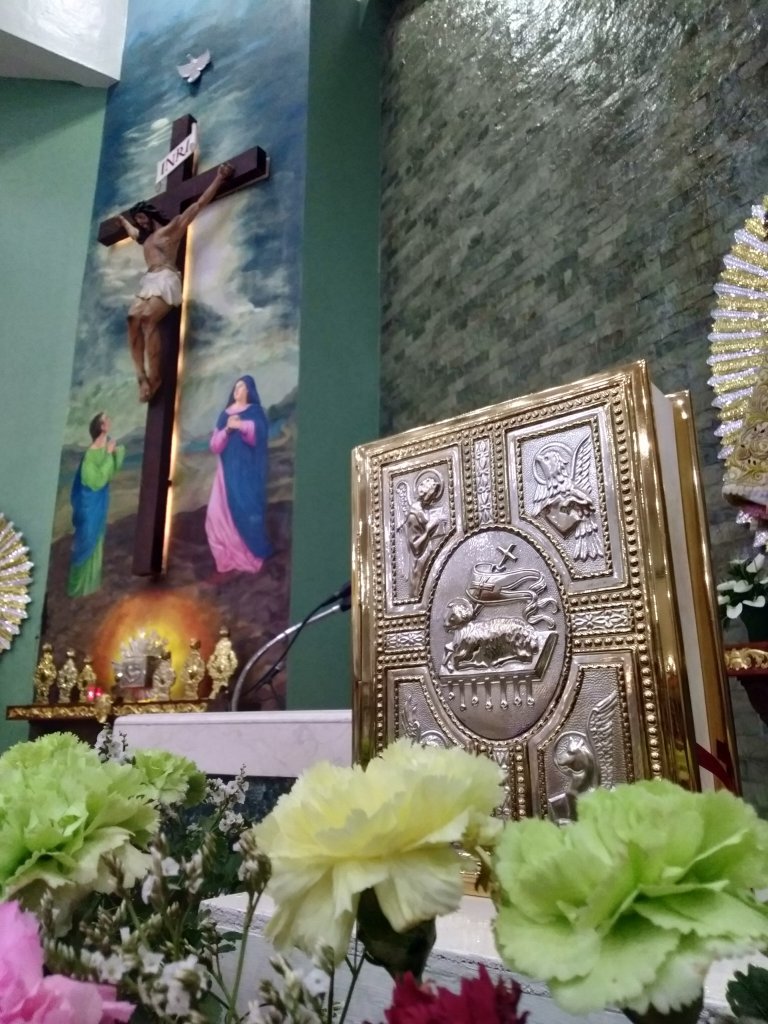
Photo by author, National Bible Sunday, 26 January 2020.
Praise and glory to you, Lord Jesus that through this pandemic, you continue to bless us, teaching us valuable lessons we have taken for granted for so long. For the past eight months, we have been doing many quarantine measures to cleanse us and keep us COVID free and healthy, reminding us of the truth of that “cleanliness is next to Godliness”.
Today’s gospel reminds us so well of this need to cleanse ourselves first before we can cleanse people and institutions.
Jesus entered the temple area and proceeded to drive out those who were selling things, saying to them, “It is written, My house shall be a house of prayer, but you have made it a den of thieves.” And every day he was teaching in the temple area. The chief priests, the scribes, and the leaders of the people, meanwhile, were seeking to put him to death, but they could find no way to accomplish their purpose because all the people were hanging on his words.
Luke 19:45-48
People were “hanging on your words”, Lord Jesus, because they could feel power and authority in them for you are the Word who became flesh and dwelt among us.
Purify us, Jesus, like you so that our words may be filled with you.
Let your words not remain sweet only on our lips as experienced by St. John when he ate the small scroll given by the angel to him; let your words disturb us, turn our stomach sour (Rev.10:10) to cleanse us first inside, emptying us of our pride so you can fill us with your Holy Spirit to proclaim your good news of salvation.
May we desire more of being disturbed by your words than being pleased with its beauty that is superficial and can be misleading.
Most of all, may we keep in mind that it is you, dear Jesus, who must increase, who must be known not us in sharing and proclaiming your words. Amen.
The Lord Is My Chef Breakfast Recipe for the Soul by Fr. Nicanor F. Lalog II
Thursday, Week XXXIII, Year II in Ordinary Time, 19 November 2020
Revelation 5:1-10     >><)))*> + <*(((><<  ||  >><)))*> + <*(((><<     Luke 19:41-44
“Mater Dolorosa” also known as “Blue Madonna” (1616) by Carlo Dolci. Photo from Wikimedia Commons.
Thank you, dear Jesus, in joining me in my tears, in my crying. I have been crying a lot lately for so many reasons. And what a wonderful feeling to cry because so often, it has become my prayers too, even my food for the soul.
In the first reading, St. John “shed many tears because no one was found worthy to open the scroll or to examine it” (Revelation 5:4); while in the gospel, you wept over Jerusalem as you drew near the city for refusing to recognize and accept you as the Messiah (Luke19:41).
In both instances, tears express the deep love within us for one another, an outpouring of love that have become like beads of prayers.
Photo by author, Dominus Flevit (The Lord Wept) Church where Jesus wept over Jerusalem, 2017. Roof is shaped like tears.
Thank you dear Jesus for enabling me to cry like you for it means that my heart is still beating, my heart is aching because it is loving.
Tears do come from ducts near the eyes but they come from the soul longing for you, Lord, forming in the heart, secreted from those many scars left open whenever we give away a part of ourselves to somebody else out of love.
Tears are always a grace from you as they cleanse us inside, clearing our eyes of the many blurs so we may see your face among the persons next to us.
Bless us as we cry, O Lord, that our tears may eventually pave the way for smiles and joys some other day when like your prayer for Jerusalem, we may recognize your visitation in the many trials and tests we endure for our loved ones. Amen.
The Lord Is My Chef Breakfast Recipe for the Soul by Fr. Nicanor F. Lalog II
Thursday, Memorial of St. Josaphat, Bishop and Martyr, 12 November 2020
Philemon 7-20     >><)))*> + >><)))*> + >><)))*>     Luke 17:20-25
Photo from TurboSquid.com
How beautiful are your words, O Lord Jesus, today from St. Paul to Philemon! So techie! So timely:
Refresh my heart in Christ.
Philemon 20
As we continue to practice some forms of quarantine with the ongoing pandemic, help us, O dear Jesus to find time to “refresh – or reset – our hearts in you” like what we do we with our devices and gadgets when they “hang” and would not function properly.
Time and again have shown us how we have had too much of technologies and social media lately that have turned us away from you and from one another.
Teach us like Philemon and Onesimus, and St. Josaphat that true faith in you and the gospel demand changes in our social circumstances and conditions when our relationships with one another go beyond gender, race, and even religions and beliefs.
Let us refresh or reset our hearts in you, Jesus, and break all barriers that keep us apart from each other, preventing us to see the coming of the kingdom of God in you even if we have to pay this with our blood like St. Josaphat in trying to unite the Ukrainian Church and Rome. Amen.
Photo by author, Sacred heart Novitiate, Novaliches, 2018.
The Lord Is My Chef Breakfast Recipe for the Soul by Fr. Nicanor F. Lalog II
Saturday, Week XXXI, Year II in Ordinary Time, 07 November 2020
Philippians 4:10-19     <*(((><<   |||+|||   >><)))*>     Luke 16:9-15
Photo by author, bas relief of Jesus at his agony in the garden in Gethsemane, the Holy Land, 2017.
Thank you very much, O God our Father for the ability to still kneel before you on many occasions daily. I have just realized how times have indeed changed these days when we rarely kneel, when the rule of each day is to always rise above, go up higher, to be on top.
We call it “upward mobility” that we try our best to get the best education, best jobs and careers so we could move up the corporate ladder, up the social strata, to be popular, to be looked up upon, be admired and followed.
But, what goes up always goes down if we have no foundation in you, dear God, as St. Paul had learned. How amazing that after going through so much sufferings and hardships in his ministry and now in prison awaiting trial and sure death that he had felt on “highest high” in his life!
I know indeed how to live in humble circumstances; I know also how to live with abundance. In every circumstance and in all things I have learned the secret of being well fed and going hungry, of living in abundance and of being in need. I have the strength for everything through him who empowers me.
Philippians 4:12-13
Photo by author, Church of St. Anne, Jerusalem, 2017.
Make us realize like St. Paul that it is in going down like Jesus Christ that we truly rise in you; it is going down, in leaving everything behind and trusting in you that we truly become most effective and fulfilled.
It is in going down when we become fruitful though not necessarily successful which is very relative.
How sad, O Lord, how we have become a clapping generation that even in our churches we always clap our hands for things we see like achievements and material things forgetting those not seen by the naked eyes like character, sensitivity with the poor and hungry and other things of the heart that you look for and always see.
And he said to them, “You justify yourselves in the sight of others, but God knows your hearts; for what is of human esteem is an abomination in the sight of God.”
Luke 16:15
Teach us, Lord, to go down further by being one with those at the bottom and margins so we may experience you in them. Amen.
The Lord Is My Chef Sunday Recipe for the Soul by Fr. Nicanor F. Lalog II
Week XXIX-A in Ordinary Time, 18 October 2020
Isaiah 45:1, 4-6  ><)))*> + <*(((><  1 Thessalonians 1:1-5 ><)))*> + <*(((><  Matthew 22:15-21
Photo by author, the Walls of Jerusalem, May 2019.
People are lonely because they build walls instead of bridges.
“I Like You Just Because” by Albert J. Nimeth, OFM
We live in a world with so many divisions of our own making. Most of the time we are divided on the things we possess not only of things like properties and borders, inheritance, and toys but also of persons like in child custody and “trading” players in sports! So many times these divisions have caused harm and destruction among us as nations and as individuals.
Sad to say, these divisions come from within us in our hearts where we always try to divide our lives between God and our very selves, especially in the realm of religion and civic life.
The Pharisees went off and plotted how they might entrap Jesus in speech. They sent their disciples to him, with the Herodians, saying, “Tell us, then, what is your opinion: Is it lawful to pay the census tax to Caesar or not?”
Matthew 22:15-16, 17
When our possessions possess us.
Today and next Sunday, Jesus is confronted by his enemies who have increased their efforts in finding faults against him in his speech to charge him with serious cases and get rid of him; but, more than dispatching his enemies with his brilliant answers to their question, Jesus brought to the fore the real score of the great divide within us.
In our gospel scene today, we can see clearly how divided within were the enemies of Jesus like the Pharisees and Herodians who joined forces to put Jesus down despite their being poles apart in their beliefs: the former who were against the Romans taking control in Israel while the latter were members of a faction supportive of the occupying forces.
As they sought the Lord’s opinion on the perceived deep divisions many still believe to exist up to this day between “Caesar” and God, Jesus brought to the open how divided inside were his enemies after all —- just like us today when we have been possessed by our very own possessions!
Knowing their malice, Jesus said, “Why are you testing me, you hypocrites? Show me the coin that pays the census tax.” Then they handed handed him the Roman coin. He said to them, “Whose image is this and whose inscription?” They replied, “Caesar’s.” At that he said to them, “Then repay to Caesar what belongs to Caesar and to God what belongs to God.”
Matthew 22:18-21
Jesus is not proposing a compromise in his answer but rather trying to heal the false divisions we have created inside us.
Aside from the silly alliance of the Pharisees and Herodians, Jesus bared how divided within they have always been when they gave him a coin used to pay taxes to the Caesar that has an image of the emperor and the inscription that says “son of god” – something that was clearly against the First Commandment of God that in fact, they should have not been carrying at all when in the temple area!
They have been divided inside because they have been possessed by their possessions like money. In telling them, and us today, to “repay to Caesar what belongs to Caesar”, Jesus reminds us that what belongs to Caesar are inanimate objects that are external to the heart of things. When a young man asked Jesus one day to tell his brother to give him his share of inheritance, the Lord stressed that he had not come to settle our disputes about money and properties (Lk.12:13). Today, Jesus is telling us that it is our responsibility and not for him to decide for us how to settle our political and other problems.
Jesus clearly points out that what belongs to God is our whole selves, our whole hearts undivided by pride, hypocrisy, and selfishness. While we must give back to Caesar what is due them as further taught by St. Paul and St. Peter in their letters to the early Christians, Jesus directly tells us that our duties to God bind all, everywhere and all the time.
Unlike the image of the Caesar found on coins, we are stamped with the image and likeness of God who created us out of his immense love. It is our duty and moral obligation to always ensure that this image of God in us is never destroyed and always upheld.
Here falls the sensitive – and false issue of “separation of Church and state” in our time like the payment of Roman tax raised by the Pharisees and Herodians. Nowhere does the concept forbid us priests nor the Church as an institution not to speak out when the very image of God is destroyed among men and women with injustice, violence and abject poverty.
What the separation of Church and state forbids is the support and endorsement of a state religion; in a sense, it promotes more harmony and unity among government and religions in their exercise of their true freedom among peoples.
Even God himself works within our own settings in this world to fulfill his plans for us. Trust him because everything works best for those who have believe wholly in God.
In the first reading from the prophet Isaiah we find the most amusing bit of history of how God had used a pagan ruler, Cyrus the king of Persia or Iran today to become his anointed savior or messiah of Israel then in their Babylonian exile. Imagine how God used an outsider, an unbeliever to free his chosen people from one of their darkest moments in history to show us that God is the master of history because everything is his.
May we heed St. Paul’s words to the Thessalonians and to us today to never doubt it was God in Jesus Christ who called us out of darkness and sin to be his new chosen people. Everything in our lives specially in our ministries and apostolate are the initiatives of God – may our hearts be undivided in giving him back everything through Jesus Christ, our life and meaning. Amen.
A blessed new week to you!
Photo by the author, view of the hills from Jerusalem temple, May 2019.
Quiet Storm by Fr. Nicanor F. Lalog II, 08 October 2020
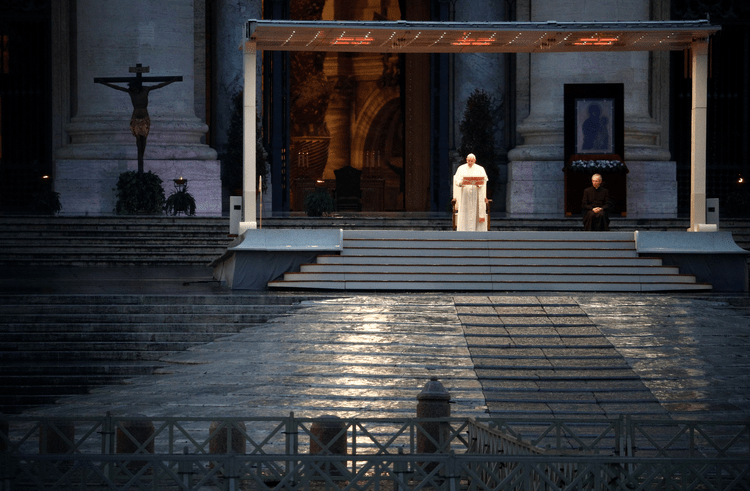
Pope Francis delivering his “Urbi et Orbi” before an empty St. Peter’s Square in Rome, 27 March 2020 at the height of COVID-19 pandemic. Photo from Vatican Media/AFP via Getty Images.
In the beginning
we were counting
the days of quarantine
but when COVID-19
spread with so many dying
then we realized this is not just passing
but could be staying
leaving the world in a standstill
shaking our very core and being
bringing us back to God
praying, surrendering everything
to him as our sole grounding.
Finding God
during this quarantine
is indeed a blessing
directing us to look within
to examine our being
where every healing must begin;
Any sickness is a dis-ease
a lack of order
when things are not pleasing
because of sin and wrong-doing
exactly what we are now seeing
with COVID-19.
Photo by Mr. Jay Javier, May 2020.
Consider the following:
Long before social distancing
we have always been so far away
even from those with whom we stay
foregoing all the loving,
replaced with twitting or texting;
When we were growing
we were taught to keep our hands clean
but we have pushed it to the extreme
refusing to dirty our hands
forgetting to work with honor and dignity
keeping them free from stains of dishonesty;
Of all the most disturbing
during this quarantine
is the mask that cover our face;
but, why be fazed, objections raised
when we have long erased
to see in every face
that tremendous grace
of God's trace?
In the midst of this calamity
when air became pollution-free
we rejoiced at Nature's beauty;
the remedy for every malady
is not found only in the pharmacy
but right in our hearts when we see
everything and everyone in harmony.
Oh how I long when that day shall be
when everyone is free with nothing to worry;
at ease shall we carry within the peace and serenity
of one big family living cleanly in God's mercy.
Lawiswis ng Salita ni P. Nicanor F. Lalog II, Ika-05 ng Oktubre 2020
Larawan kuha ng may-akda sa Shambala, Silang, Cavite, 22 Setyembre 2020.
Kay sakit isipin
sa gitna nitong COVID-19
marami pa rin sa atin
mga hirap at sakit di pansin
binibigyang daan
mga maling katuwiran kahit
mayroong nasasaktan;
pagmasdan mga karahasang umiiral
kawalan ng pakialam
sa kahirapang pinagdaraanan
pinagpipilitan maling kaisipan
kungdi kasakiman, pawang kababawan.
Hindi ba maaring pagsikapan
itong kaalaman at isipan
ay ibaba sa puso at kalooban
bigyang daan nararamdaman
upang higit na matimbang
ang mas mainam na kabutihan
kesa pairalin mga alituntunin
na hindi sumasalamin
sa tunay na katauhan natin?
Mabuti ang paghuhugas
ng mga kamay bilang lunas
at pag-iwas sa virus
ngunit kung sa katotohanan
iiwas tayo manindigan
maghuhugas kamay
upang hindi ito marungisan
mawawasak ating mga ugnayan
mapapatid ating kapatiran.
Social distancing ay mainam
ngunit huwag din nating kalilimutan
pagdadamayan, pagtutulungan;
tama ang maging abala
sa maraming mga bagay sa buhay
ngunit higit na mahalaga ang kaluluwa:
kabutihan at kagandahang-loob
ang siyang magbubuklod
papawi sa pagod, nagbibigay-lugod.
Hindi lamang medisina at bakuna
ang sagot sa ano mang pandemya
dahil ano mang sakit at karamdaman
pinagmumulan ay kasamaan
kawalan ng kaayusan sa isang may katawan;
sa puso at kalooban, malubhang kapansanan
kapag pinabayaan parang sakit sa kalingkingan
nadarama ng buong katawan, nahahawa maging sangkatauhan.
Pandemya ay lunasan ng pagmamahalan at paggalang
ibaba ang nasa isipan, dalhin sa kaibuturan
damahin, huwag isipin
makiramdam sa pintig ng ating katauhan.
Larawan kuha ni G. Raffy Tima ng GMA-7 News, Marso 2020.
The Lord Is My Chef Sunday Recipe for the Soul by Fr. Nicanor F. Lalog II
Week XXVI-A in Ordinary Time, 27 September 2020
Ezekiel 18:25-28   |+|   Philippians 2:1-11   |+|   Matthew 21:28-32
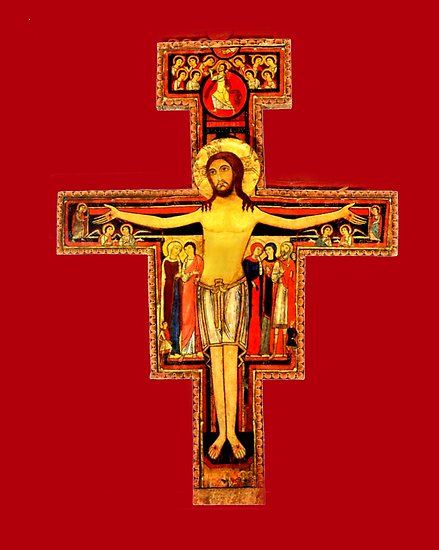
Cross of San Damiano before which St. Francis of Assisi prayed and received Christ’s commission to rebuild His Church. Photo from wikipedia.org.
Brothers and sisters: If there is any encouragement in Christ, any solace in love, any participation in the Spirit, any compassion and mercy, complete my joy by being of the same mind, with the same love, united in heart, thinking one thing. Do nothing out of selfishness or out of vainglory; rather, humbly regard others as more important than yourselves, each looking out not for his own interests, but also for those of others. Have in you the same attitude that is also yours in Christ Jesus, who, though he was in the form of God, did not regard equality with God something to be grasped. Rather, he emptied himself, taking the form of a slave, coming in human likeness; and found human in appearance, he humbled himself, becoming obedient to death, even death on a cross.
Philippians 2:1-8
We priests and religious pray this beautiful hymn by St. Paul every Saturday evening. It is also proclaimed on Palm Sunday to show us Jesus Christ’s self-emptying (kenosis in Greek) to offer himself for our salvation. It is the most important text of St. Paul’s letter to the Philippians that has played a vital role in the discussions of Christ’s preexistence.
Seen in the light of the gospel this Sunday, it is also part of St. Paul’s moral exhortation to the Philippians and us living today to be united as one in Jesus by following his pattern of kenosis that is similar with his teachings that “the first will be last, and the last will be first, that the greatest is the servant of all.”
It is the fundamental model of Christian life, the very essence of following Jesus by denying one’s self and taking up one’s cross but also the most difficult to learn and put into practice as it is exactly the opposite of the way of the world – “upward mobility” — of being rich and famous, of being in control that had divided us with massive walls of indifference, hate, and antagonisms making peace and joy more elusive.
Christ’s kenosis is the only way up in life to be back in God that leads us to unity, peace, and joy.
In this time of the pandemic when we are supposed to be more united and kind and nice with everyone, St. Paul’s call to imitate Jesus Christ’s kenosis is very timely and relevant, calling us to soften our hearts by emptying ourselves of our pride unlike the chief priests and elders of Israel to whom the Lord addressed his parable this Sunday.
Photo by author, wailing of Jerusalem, May 2017.
Our sense of entitlement
Jesus said to the chief priests and elders of the people: “What is your opinion? A man had two sons. He came to the first and said, ‘Son, go out and work in the vineyard today.’ He said in reply, ‘I will not,’ but afterwards changed his mind and went. The man came to the other son and gave the same order. He said in reply, ‘Yes, sir,’ but did not go. Which of the two did his father’s will?” They answered, “The first.” Jesus said to them, “Amen, I say to you, tax collectors and prostitutes are entering the kingdom of God before you.”
Matthew 21:28-31
Beginning today in three successive Sundays, Jesus teaches us again in parables to soften our hearts and let go of our pride that we are better than others, that we deserve more than what is due us like those early workers to the vineyard in last week’s gospel.
In a sense, today’s gospel tells us that there are too many works to be done in God’s kingdom that we have to keep going, imitating Jesus and be careful of falling into the same trap of those workers in last Sunday’s parable who felt entitled to more pay because they worked longer than others.
Notice how Jesus directly addresses his parables in these three Sundays to the same crowd of “chief priests and elders of the people” who have always felt favored by God for being of his “chosen people” since Abraham’s time. They always looked down at others specially the “tax collectors and prostitutes” considered as sinners.
They are not just people from the past who have lived during Christ’s time more than 2000 years ago. Even among us today, there are still chief priests and elders who continue to live and exist!
And here is the rub — among these people who may really be good in faithfully keeping the commandments of the Lord, praying and doing all kinds of devotions and charities are also the worst. Their religiosity are tied only to themselves and never to God, without any love at all.
Keep in mind that every time we feel entitled like the chief priests and elders of the people, it means our hearts have gone hard and cold like the elder son of the merciful father of the parable of the prodigal son or the early workers hired to the vineyard last week.
Photo by author, Mt. St. Paul Spirituality Center, La Trinidad, Benguet, March 2020.
So many times it happens that those who are supposed to be on higher moral grounds turn out to be without any roots and grounding in God at all, becoming harsh and judgmental of others, more sinful than the ones they condemn.
Like the chief priests and elders of the people in the crowd listening to Jesus, they start as the vida only to end up as the contravida like when there is a “black sheep” in the family or a “rotten tomato” in class, that instead of helping them rise from their sinfulness, they who are the ones who condemn and sink others deeper into their holes!
That is why God questions, stirs their hearts through the prophet in the first reading,
Thus says the Lord: You say, “The Lord’s way is not fair!” Hear now, house of Israel: Is it my way that is unfair, or rather, are not your ways unfair?
Ezekiel 18:25
Always examine our hearts for we must all be converted again and again.
We must keep on praising and thanking God for his mercies like in our responsorial psalm this Sunday because he gives us all the chances in life to change and become better persons. Here we find a semblance with the gospel the other Sunday why we must forgive without limits because God’s love for us is infinite.
Actions, not intentions, judge us
Last Monday we celebrated the feast of St. Matthew, the tax collector called by Jesus to become one of his Twelve Apostles who also wrote one of the four gospels. It is very interesting to know that in all gospel accounts, tax collectors and prostitutes are always grouped together because they are the worst sinners at that time.
Tax collectors not only enriched themselves with excessive collections from the people but were seen as traitors who worked for the Roman colonizers of Israel at that time. Prostitutes, on the other hand, have always been considered very low because as women supposed to give birth for the awaited Messiah, they have “dirtied” their womb. Together, tax collectors and prostitutes were seen as the worst sinners in Israel because they have sold their souls to the devil; hence, they were considered beyond redemption, beyond hope, a scourge to their families and to the community that nobody would want to deal with them.
And so, it was very radical, out-of-this-world and totally unimaginable for everybody then when they heard Jesus telling them how “tax collectors and prostitutes” were entering the kingdom of God before the chief priests and elders of the people who were considered very holy at that time!
It was a serious warning to them and us today from the Lord who reminds us that our actions judge us. The parable is an echo of his warning that “not everyone who calls him ‘Lord, Lord’ will enter heaven” (Mt.7:21). St. Matthew is very particular in his gospel account of the complete jibing together of what we say and what we do, of “walking the talk”.
We have so many sayings expressing this important lesson of today’s parable by the Lord like “A single act of good deed is always better than the grandest and best intention” and “Actions always speak louder than words.”
Photo by author, sunset in the parish, August 2020.
In this time of the pandemic when church attendance is limited and we are advised not to sing and reply aloud in the Mass, it is best that we examine how we have become mechanical in our celebrations without realizing the gravity of things we say like when we acclaim after the gospel proclamation “Praise to you, Lord Jesus Christ!”: do we really work hard in his vineyard or are we like the other son who said yes but did not go? When at the end of the Mass we are told “Go in the peace of Jesus Christ” and we say, “Thanks be to God”, do we really go home at peace or still having that festering anger or dislike to someone?
Make your joy complete. Ask Jesus to soften your heart. Take a step backwards like the first son though at first he seemed so bad to disobey his father in refusing to follow his command, do not be ashamed to take back your words and do what is right.
Be careful not with your words but with your actions for which the Lord would judge us in the end.
Find solace in St. Paul’s beautiful hymn this Sunday: the lower we go down, the higher we are lifted up like Jesus. Nobody had ever gone wrong and lost in life going down, of being humble. Many men and women have gone to oblivion, lost and forgotten when their ivory towers collapsed, burying them in the rubble.