Lawiswis ng Salita ni P. Nicanor F. Lalog II, Ika-20 ng Marso 2024
Unang Huling Wika ni Jesus sa Krus
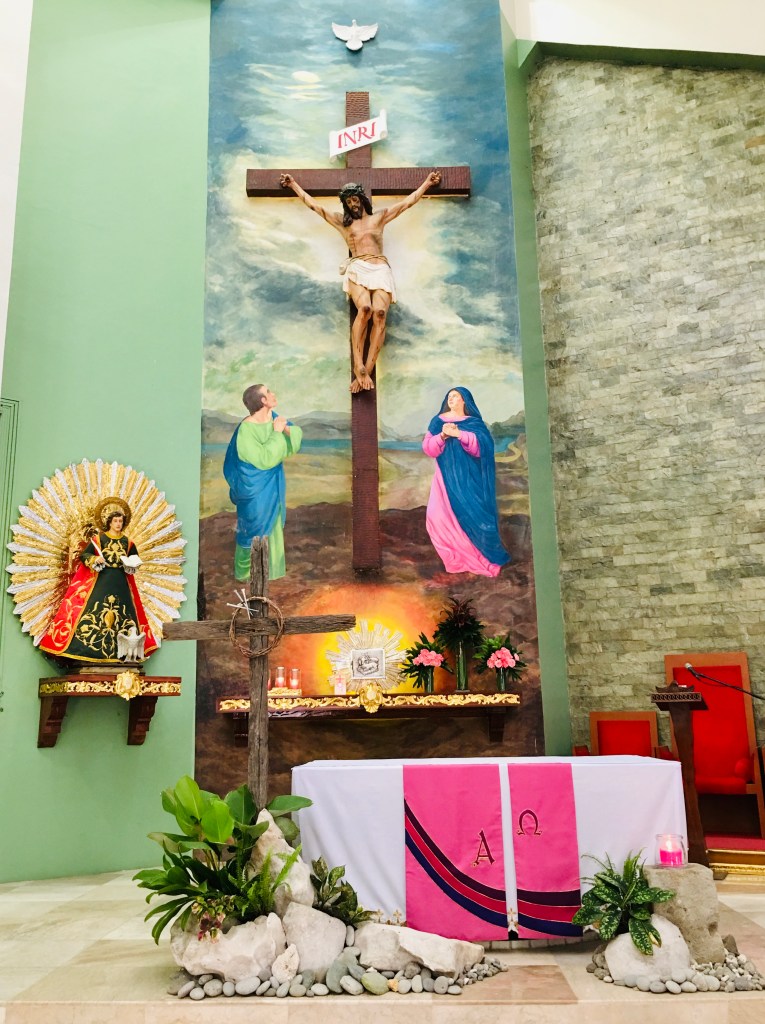
Larawan kuha ng may-akda, 2019.
Ang Unang Wika ni Jesus:
Nang dumating sila sa dakong tinatawag na Bungo, ipinako nila sa krus si Jesus. Ipinako rin ang dalawang salarin, isa sa gawing kanan at isa sa gawing kaliwa. Sinabi ni Jesus, “Ama, patawarin mo sila, sapagkat hindi nila nalalaman ang kanilang ginagawa.” At nagsapalaran sila upang malaman kung alin sa kanyang kasuutan ang mapupunta sa isa’t isa.
Lukas 23:33-34
Kay sarap isipin at namnamin na ang kauna-unahang mga salita na sinabi ni Jesus nang ipako siya ay krus ay ang kapatawaran sa ating mga kasalanan. Hindi lamang doon sa mga mismong nagpako sa kanya sa krus kungdi sa ating lahat ngayon na patuloy pa rin siyang ipinapako sa krus “sapagkat hindi natin nalalaman ating ginagawa.”
Ano nga ba iyong sinasabi ni Jesus na patawarin “sapagkat hindi nila nalalaman kanilang ginagawa”?
Sa kaisipan ng mga Judio, ang “malaman” ay hindi lamang matanto ng kaisipan ano mang data o impormasyon kungdi galaw ng puso at kalooban na pumasok sa pakikipag-ugnayan. Ang malaman ay magkaroon ng ugnayan bilang kapwa-tao sa isa’t isa.
Nang sabihin ni Jesus na “Ama, patawarin mo sila, sapagkat hindi nila nalalaman ang kanilang ginagawa”, ipinaaalala din niya sa ating lahat ang katotohanang dapat malaman natin na tayo ay magkakapatid sa kanya, iisang pamilya sa Diyos na ating Ama.
Sa tuwing sinisira natin ang ating mga ugnayan bilang magkakapatid, sa kada pagbale-wala natin sa bawat tao na tinuturing bilang kasangkapan at gamit para sa sariling kaluguran at kapakinabangan ng walang pag-galang at pagmamahal, doon tayo nagkakasala dahil pinuputol natin ating mga ugnayan.
Madalas, iyan ang hindi natin alam kapag ating inaabuso ating tungkulin at kapangyarihan na dapat ay pangalagaan kapakanan lalo ng mga maliliit at mahihina.
Nagkakasala tayo at hindi natin alam ating ginagawa kapag ating nilalapastangan ating mga magulang lalo na kapag matanda na at mahina o hindi makarinig; kapag sinasaktan ating mga kapatid sa masasakit na pananalita at ating pilit ibinababa kanilang pagkatao.
Hindi rin natin alam ating ginagawa sa tuwing tayo ay sumisira sa pangakong magmahal sa asawa at kasintahan, kapag tayo ay nagtataksil o nagbubunyag ng sikretong ipinagkatiwala sa atin at tayo ay nagiging plastik sa harap ng iba.
Pinakamasaklap sa mga hindi natin nalalaman ating ginagawang masama ay kapag nawalan tayo ng pag-asa at kumpiyansa sa mga mahal natin sa buhay kaya sila ay atin pinababayaan, ni hindi pinapansin o bigyang-halaga dahil sa paniwalang hindi na sila magbabago pa ng ugali o hindi na gagaling pa sa kanilang sakit at karamdaman lalo na kung matanda na at malapit nang mamatay.
Ngayong mga Mahal na Araw, isipin natin mga tao na ating nasaktan sa ating salita man o gawa dahil ating nalimutan o kinalimutan ituring kapatid at kapwa.
Sinu-sino din ang mga tao na nagpapasakit sa ating kalooban dahil hindi nalalaman kanilang ginagawa? Manalangin tayo:
Ipagpatawad po ninyo,
Panginoong Jesus
aking pagpapako sa iyo muli sa krus
sa tuwing hindi ko nalalaman
aking ginagawa,
kapag aking nililimot at tinatalikuran
itong pangunahing katotohanan
na igalang at mahalin bawat kapwa;
ipinapanalangin ko sa Iyong habag at awa
mga tao na aking sinaktan at tinalikuran
lalo na yaong mga binigay mo sa akin
tulad ng aking pamilya at kaibigan
at mga dapat pangalagaan;
ipinapanalangin ko rin sa Iyo,
O Jesus, yaong mga nanakit sa aking
damdamin, tumapak at yumurak
sa aking pagkatao na hanggang ngayon
aking pa ring ibig paghigantihan.
Panginoong Jesus,
huwag ko nawa malimutan
na kami ay magkakapatid,
magkakaugnay
sa iisang Ama
na siyang sinasagisag
ng Iyong Krus na Banal.
Amen.
40 Shades of Lent by Fr. Nicanor F. Lalog II
Fifth Sunday in Lent-B, 17 March 2024
Jeremiah 31:31-34  +  Hebrews 5:7-9  +  John 12:20-33
From Google.com.
We now come to the penultimate Sunday of Lent before entering the Holy Week on Palm Sunday as we listened to the final installment of John’s narration of Jesus Christ’s final six days in Jerusalem before his Passion, Death, and Resurrection.
Our gospel today is actually set on Palm Sunday when Jesus triumphantly entered Jerusalem.
Some Greeks who had come up to worship at the Passover Feast came to Philip, who was from Bethsaida in Galilee, and asked him, “Sir, we would like to see Jesus.” Philip went and told Andrew; then Andrew and Philip went and told Jesus. Jesus answered them, “The hour has come for the Son of Man to be glorified. Amen, amen, I say to you, unless a grain of wheat falls to the ground and dies, it remains just a grain of wheat; but if it dies, it produces much fruit. Whoever loves his life loses it, and whoever hates his life in this world will preserve it for eternal life. Whoever serves me must follow me, and where I am, there also will my servant be. The Father will honor whoever serves me.
John 12:20-26
Praying at the wailing wall of Jerusalem, May 2019.
As we have been telling you, John’s gospel teems with many symbolisms and hidden meanings in the way he narrated events and scenes like when those Greeks asked Philip and Andrew to see Jesus.
If they simply wanted to catch a glimpse of Jesus, they could have easily satisfied themselves because Jesus never hid at that time. He had just entered Jerusalem, so warmly welcomed by the people, even by those Greeks perhaps. Most likely, they must have heard many things about Jesus that they wanted to go farther in requesting to see him. Hence, it was more than a request to have an audience with Jesus but something about their faith in him as they were pagans converted to Judaism.
We have to remember here that John used the verb “to see” to also mean “to believe” in his gospel account like when he narrated on Easter morning how Peter and the “other disciple” ran to the empty tomb “and he saw and believed” (Jn.20:8).
Keeping that detail on Easter morning at the empty tomb, we now understand why John never told us if Jesus met at all the Greeks requesting to see him because to see and believe Jesus is to accept and embrace wholly his Passion and Death on the Cross. This is why John jumped into Christ’s monologue upon being told by Philip and Andrew on the Greeks’ request.
Photo by author, 2018.
What a beauty we have here because we are those Greek converts too, constantly searching, seeking to go farther in our faith in Jesus despite our sins. As we get older and mature, we realize how our days are numbered, that we will definitely die someday and meet God.
Lately I have been thinking why do we really have to be happy on our birthday – much less why greet celebrators a happy birthday when in fact every birthday is a step closer to death, is it not? I am not being morbid but it is the truest matter of fact in life. Life is a lifelong process of preparation for death. What comes next when we age? Death.
However, our faith in Jesus tells us it is not simply death as an end but a blessed death that leads to fullness in life, literally and figuratively speaking.
That is where the beauty of Christ’s parable of the grain of wheat lies, “Amen, amen, I say to you, unless a grain of wheat falls to the ground and dies, it remains just a grain of wheat; but if it dies, it produces much fruit.”
We do not simply die in the end or even in the in-betweens of life through those failures and losses, defeats and wrong moves. We get better in life as we forge on.
It is the undeniable truth written in our hearts as God told Jeremiah in the first reading, that we are God’s, we solely belong to him no matter how hard we try to flee from him and disobey him in our sins, he would always find us even if we get lost. St. Augustine said it so well, “You have made us for yourself, O Lord, and our heart is restless until it rests in you.”
There is always that inner longing for God our Creator and End. That is why God sent us Jesus his Son as the author of the Letter to the Hebrews explained in the second reading so that through all our darkness and confusions, sufferings and trials, especially in those daily deaths that weaken us in our desire to search and follow him we may still find to have the strength and courage to forge on in wanting to see him by being with him where he is always – at the Cross.
Photo by author, 2018.
This is the grace of this fifth Sunday in Lent: we believe so we may see, we die in order to live. Both believing and dying in order to see and to live are grace from God freely given to us even if we are not worthy at all.
The world tells us always that to see is to believe but Christ tells us that first we must believe so that we would see; it is the same thing with living – die to one’s self in order to live fully because “whoever loves his life loses it.”
When we read or watch the news, many times we feel so exasperated and hopeless with the world. Imagine a resort right in a natural wonder there in the Chocolate Hills of Bohol? Or, land developers covering swamps without any considerations for others and the environment? Or, the mess and wastage happening in our offices, schools and homes? Do not forget us your priests living far from witnessing Christ in charity and service?
It’s a crazy world! And in all these abuses, the more we have become empty and lost that is why in the process, more and more of us never stop to believe and see, to hope and pray like those Greek converts seeking Jesus, for only in him we find rest and peace. Let us pray:
Lord Jesus Christ,
many times I really do not know
where I am going;
I cannot see
the road ahead of me
while many times
I wonder if I am really
following you and doing your will;
but at least, Jesus,
I am sure it is still you
whom I wish to see,
it is you I always desire
even if many times
it does not show
because this time
I am sure
 you alone
is my God,
my life,
my fulfillment.
Therefore, like the psalmist,
"Create a clean heart for me,
O God, and a steadfast spirit
renew within me.
Cast me not out
from your presence,
and your Holy Spirit
take not from me"
(Psalm 51:12-13).
Amen.
40 Shades of Lent by Fr. Nicanor F. Lalog II
Friday in tbe Fourth Week of Lent, 15 March 2024
Wisdom 2:1, 12-22     ><}}}}*> + <*{{{{><     John 7:1-2, 10, 25-30
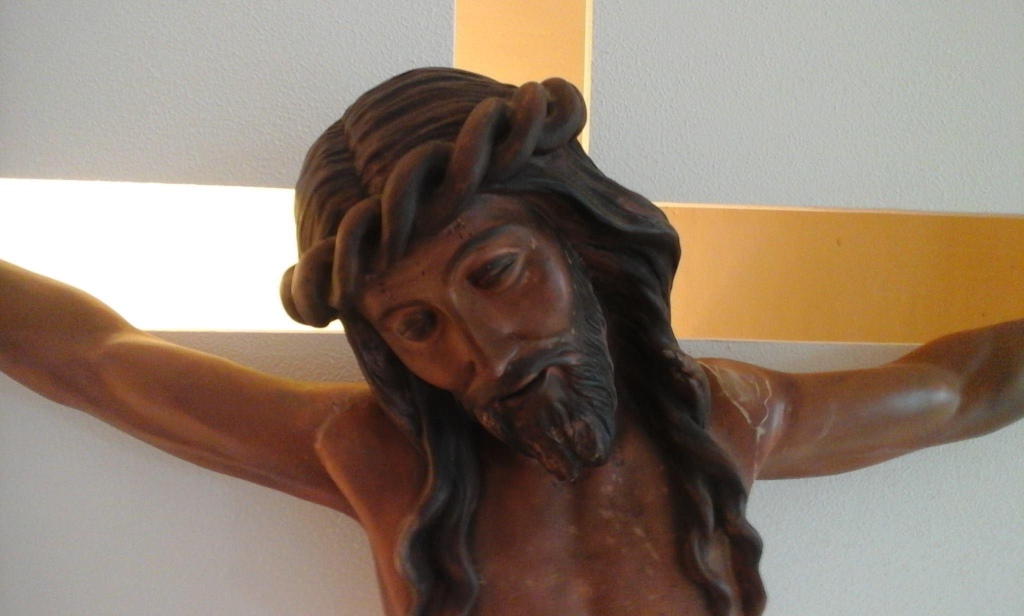
Photo by author, Theologate Chapel of the Immaculate Conception Major Seminary, Guiguinto, Bulacan, November 2020.
Loving Father,
as we come closer
to the final week of Lent,
the Cross of Christ gets clearer;
 preparing for Easter
 is facing and approaching,
embracing and owning
the Cross of Christ;
hence, grant us the courage
and strength to continue this journey
in Jesus with his Cross:
The wicked said among themselves, thinking not aright: “Let us beset the just one, because he is obnoxious to us; he sets himself against our doings, reproaches us for transgressions of the law and charges us with violations of our training… Let us see whether his words be true; let us find out what will happen to him… Let us condemn him to a shameful death; for according to his own words, God will take care of him.”
Wisdom 2:1, 12, 17, 20
Like Jesus,
let us overcome our fears
and continue to come to you,
to speak your words,
to do your works
amid the many people
"blinded by wickedness";
indeed, life is a daily Lent,
a passing over from every trial
because you are, O Lord,
"close to the brokenhearted."
Amen.
Lord My Chef Sunday Music by Fr. Nicanor F. Lalog II, 10 March 2024
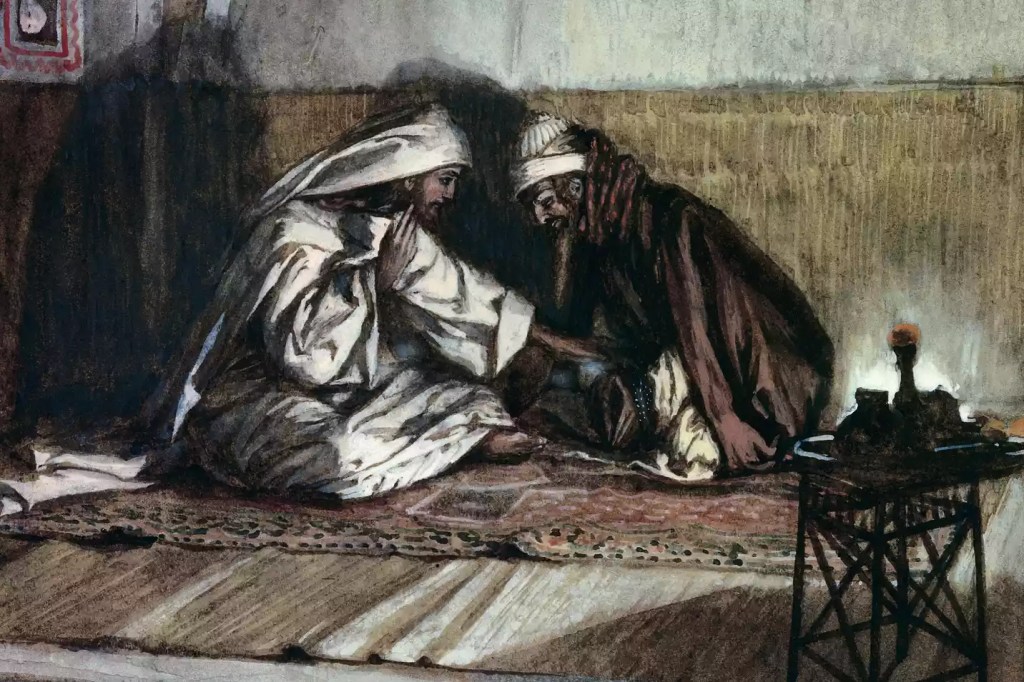
“Nicodemus and Jesus” painting by James Tissot (1836-1902) from SuperStock/GettyImages via learnreligions.com.
One of our favorite singer-songwriters James Taylor is coming next month for a one-night concert at the Mall of Asia Arena; hence, we are featuring two of his songs we find so related with the gospel message this fourth Sunday in Lent also known as Laetare or Rejoice Sunday.
But first, let us take a slight deviation from our usual manner of coming up with the music right away as we realized too the strong links between Nicodemus and James Taylor in their experiences.
Nicodemus belonged to the group of Pharisees, one of the enemies of Jesus at that time. But he admired and believed in Jesus that is why he chose to visit the Lord at night so that people would not notice. Eventually, Nicodemus became a disciple of Jesus after Good Friday after he and another Pharisee named Joseph of Arimathea took the body of Christ and buried him in a tomb (https://lordmychef.com/2024/03/09/lent-is-the-love-mercy-of-god-in-me/).
Nicodemus’ coming to see Jesus at night evoked his situation of being in the darkness of fears and confusions, trying to find directions in life which he found in Christ. It was similar with James Taylor’s plight he beautifully expressed in his 1970 hit Fire and Rain which is about the suicide of a childhood friend as well as his coping with his addiction and depression following his fame.
Just yesterday morning, they let me know you were gone. Suzanne, the plans they made put an end to you. I walked out this morning and I wrote down this song, I just can’t remember who to send it to. I’ve seen fire and I’ve seen rain. I’ve seen sunny days that I thought would never end. I’ve seen lonely times when I could not find a friend, but I always thought that I’d see you again.
Won’t you look down upon me, Jesus, You’ve got to help me make a stand. You’ve just got to see me through another day. My body’s aching and my time is at hand and I won’t make it any other way. Oh, I’ve seen fire and I’ve seen rain. I’ve seen sunny days that I thought would never end. I’ve seen lonely times when I could not find a friend, but I always thought that I’d see you again.
Many times, we find ourselves in situations like Nicodemus when everything is all dark like the night, or James Taylor going through fire and rain.
Now look, Jesus is most present with us when we are in the darkest darkness of the night, right in the middle of a raging storm. Many times we could not see him because he hugs us, embraces us to shield us from more harms.
When Jesus told Nicodemus about his coming crucifixion – “when the Son of Man is raised up” – it was an assurance to us all too that Christ is with us in our worst situation because he suffered first for us on the Cross. I am so glad that JT mentioned Jesus in his song, pleading to the Lord to “look down upon me and help me make a stand.”
That is why we rejoice this Sunday: in the midst of our troubles and sufferings, there are bursts of joy and relief from Jesus within us dwelling in our hearts. And that is why, we find JT’s 1976 hit, Shower the People, so related too with our gospel this Sunday.
When Jesus told Nicodemus how “God so loved the world that he gave his only Son, so that everyone who believes in him might not perish but might have eternal life” (Jn.3:16), it was also a call for us all to be the love and mercy of Christ in the world.
Nicodemus eventually became a disciple of Jesus while JT is still very much around, having weathered so many fires and rains or storms in his life, both telling us how God finds ways to save us, even extricate us from our worst situation. Hence, the need for us to become the presence of Christ’s joy and mercy to people especially those closest to us so that they may realize and experience that God so loved the world because of the way we shower them with love through us.
You can play the game and you can act out the part, even though you know it wasn’t written for you. Tell me, how can you stand there with your broken heart ashamed of playing the fool? One thing can lead to another; it doesn’t take any sacrifice. Oh, father and mother, sister and brother, if it feels nice, don’t think twice, just shower the people you love with love, show them the way that you feel. Things are gonna work out fine if you only will do as I say, just shower the people you love with love, show them the way you feel. Things are gonna be much better if you only will.
Here is our doubleheader from the “Sweet Baby James”. Have a blessed, lovely week ahead!
*Both materials are not ours without any intentions at all of infringing its copyrights.
40 Shades of Lent by Fr. Nicanor F. Lalog II
Sunday Recipe for the Soul, Lent IV-B, 10 March 2024
2 Chronicles 36:14-16, 19-23 ><}}}}*> Ephesians 2:4-10 ><}}}}*> John 3:14-21
Photo of pink convolvulus from the Botanical Gardens of Jerusalem, flora.org.il.
Many times during prayer periods I banter with God especially when I feel overwhelmed by his kindness and love. Like last Thursday on my way to the adoration chapel when I passed by a row of banks.
As I knelt before the Blessed Sacrament to pray, I just felt like asking God: “BDO (Banco De Oro) ka ba, Lord? Kasi…you always find ways.”
That, for me, my dear friends is the meaning of this fourth Sunday in Lent – God never stops in finding ways to reach out to us, to be with us, to make us experience his love and mercy, kindness and forgiveness despite the hardness of our hearts.
Photo by author, 2019.
Our altars burst in shades of pink this Sunday called Laetare (Latin, rejoice) Sunday from the entrance antiphon that says, “Rejoice, Jerusalem, and all who love her. Be joyful, all who were in mourning; exult and be satisfied at her consoling breast.”
It is a misconception to see Lent as dull and drab due to its penitential nature; while there is the sober tone in our liturgy, let us keep in mind that it is also a season filled with joy and excitement for the coming Easter, the mother of all feasts in the Church.
And today we rightly rejoice because John reminds us in our gospel scene only him narrates – Nicodemus meeting with Jesus in the cover of the darkness of the night – of God’s immense love for us manifested in the dying of Jesus on the Cross.
Jesus said to Nicodemus: “Just as Moses lifted up the serpent in the desert, so must the Son of Man be lifted up, so that everyone who believes in him may have eternal life.” For God so loved the world that he gave his only Son, so that everyone who believes in him might not perish but might have eternal life.”
John 3:14-16
“Nicodemus and Jesus” painting by James Tissot (1836-1902) from SuperStock/GettyImages via learnreligions.com.
John saw a deeper meaning, of a sign pointing to Jesus as the Christ in this conversation with Nicodemus at night. Nicodemus was a Pharisee afraid to come out in the open to show his admiration and belief in Jesus. He eventually joined the disciples on Good Friday with another Pharisee, Joseph of Arimathea when they buried Jesus in a tomb.
See the deep perception of John in this recalling by Jesus to Nicodemus of the bronze serpent raised by Moses in the wilderness (see Num. 21:4-9) as a prefiguration of his own crucifixion.
In the gospel of John, the “lifting up” of the Son of Man refers to Jesus on the Cross. After that scene with the woman caught committing adultery, Jesus declared, “When you lift up the Son of Man, then you will realize that I AM…” (Jn.8:28). Then on Palm Sunday while in the temple area, Jesus told the crowd “‘And when I am lifted up from the earth, I will draw everyone to myself.’ He said this indicating the kind of death he would die” (Jn.12:32-33).
John’s gospel teems with other similar passages showing the inseparability of Christ’s Cross and glory. And so with our life, that is why in the middle of Lent, we rejoice this Sunday!
Photo by author in Petra, Jordan, May 2019.
Like last Sunday, here we find again early in the gospel of John how Jesus laid his vision-mission statement of coming to save us by dying on the Cross during his conversation with Nicodemus that night.
Jesus assured Nicodemus and us today that even while we are in the darkness of life’s many confusions and fears, problems and sufferings, we just have look up to him crucified lighting up our way to life and salvation. That night in their conversation, Jesus assured Nicodemus and us today that even in the worst situations in life when “darkness is our only light and hopelessness is our only hope” as T.S. Eliot wrote in his Four Quartets, God is in us, with us and for us in Christ. Just as when the world was covered in darkness on Good Friday when Jesus died on the Cross, it was the precise moment too of Christ’s glory when he conquered death and sin in obedience to the Father.
Yes, it is true these things are easier said than done but like Nicodemus, even in the darkness of the night we have to dare come close to Jesus, to speak to him and most of all, to hear and listen to him. As one poet had said, “only the brave who walk the darkness of the night shall see the brightness of the stars above.” Most of all, Jesus calls us today to be his love and mercy, his joy and light to the many other Nicodemus groping in the darkness of sin and evil.
In my three years as chaplain in a hospital, I have experienced personally and through others that truth so clear as crystal of God most closest with us in the worst days of our lives. Sometimes, we just sigh deeply as we feel him inside us, assuring us how everything is taken cared of, that everything would be fine.
Like the Israelites in the first reading, we too have to go through an “exile”, a kind of “punishment” not from God but as a result of own our sins and wrongdoing. Many times God let bad things happen to us because we insist on our ways; as God retreats to the back or sides of our lives, he never stops finding ways to save us, even “extricate” us from our imprisonment to sin and sufferings!
Indeed, as St. Paul had said in our second reading today, God is “rich in mercy, because of the great love he had for us” (Eph.2:4). Let us not waste that gift. Even though God forgives every sin no matter how bad it may be, do not forget some of our sins have irreversible consequences we shall face and suffer. Of course, God would still be there to help and guide us but, why wait for that to happen?
There lies the joy and grace – and challenge – of this fourth Sunday in Lent: even while we are in our worst situations in life, in our darkest nights, Jesus is always there for us, in fact, the first to have suffered and died for us so that with him on Easter, we may rise again to new life.
Be the sower of his love and mercy. Be his presence. Be another Nicodemus in the night leading others to the light of Jesus. Let us, therefore, rejoice in the Lord as we pray:
Praise and glory to you,
dearest Father
in giving us your Son
Jesus Christ our Lord,
our light,
our life,
our joy;
make us, O Lord,
your love and mercy
in this world
so everyone may experience
that indeed, God loves the world
that He gives us Jesus through me;
let your Holy Sprit enlighten
my mind and my heart
like Nicodemus
leading those in darkness
into the light of Christ.
Amen.
40 Shades of Lent by Fr. Nicanor F. Lalog II
Thursday, Memorial of Sts. Perpetua & Felicity, Martyrs, 07 March 2024
Jeremiah 7:23-28   ><}}}}*> + ><}}}}*> + ><}}}}*>     Luke 11:14-23
Your words today, O God,
are too strong,
that we are so bad
and, that is so true, too.
Thus says the Lord: When you speak all these words to them, they will not listen to you either; when you call to them, they will not answer you. Say to them: This is a nation which does not listen to the voice of the Lord, its God, or take correction. Faithfulness has disappeared; the word itself is banished from their speech.
Jeremiah 7:27-28
Though we are so bad,
you are still so good to us,
Father; you continue to speak to us
even if you know we do not listen
nor heed your voice.
What is worst,
even in the coming of your Son
Jesus Christ who offered himself
on the Cross, we still refused
to listen and heed his calls,
always asking for signs.
Some of them said, “By the power of Beelzebul, the prince of demons, he drives out demons.” Others, to test him, asked him for a sign from heaven. But he knew their thoughts and said to them, “Every kingdom divided against itself will be laid waste and house will fall against house. Whoever is not with me is against me, and whoever does not gather with me scatters.”
Luke 11:15-17, 23
Lord Jesus Christ,
in your dying on the the Cross,
you have expressed to us
the Father's immense love for us;
indeed, your Cross until now remains
a sign of contradiction in the world
as your calls to love and to forgive,
to be humble and be kind,
to give than to receive
remains a foolishness and weakness
for many of us;
but you continue to speak to us
despite our being deaf and hard-hearted
because by your Cross,
you have shown us too
it is the greatest sign of reconciliation,
reminding us of the many
contradictions within and around us,
of the many contradictions
in the world that can be
reconciled and be made one
in your self-giving in love
we must imitate like your martyrs
Saints Perpetua and Felicity.

Reconcile us
in you, dear Jesus,
make us one in you
on the Cross!
Amen.
40 Shades of Lent by Fr. Nicanor F. Lalog II
Sunday Recipe for the Soul, Lent III-B, 03 March 2024
Exodus 20:1-17 ><}}}*> 1 Corinthians 1:22-25 ><}}}*> John 2:13-25
Photo by author, 2019,
It has been 19 days since we started this 40-day journey of Lent as an internal pilgrimage to God our first love. Since the first Sunday of Lent, Mark guided us to Jesus as we joined him in the desert of our poverty and sinfulness to the heights of his transfiguration through the many trials and sufferings we have gone through in life.
Beginning this third Sunday in Lent until the fifth Sunday, all our gospel readings are taken from John as we come closer with God who dwells right in our hearts, his temple within us. Keep in mind that our Lenten itinerary is actually symbolic and theological in nature than an actual road map to follow; hence, our shift to the fourth gospel that is so rich in its narration of the events leading to the Holy Week.
Since the Passover of the Jews was near, Jesus went up to Jerusalem. He found in the temple area those who sold oxen, sheep, and doves, as well the moneychangers seated there. He made a whip out of cords and drove them all out of the temple area, with the sheep and oxen, and spilled the coins of the moneychangers and overturned their tables, and to those who sold doves he said, “Take these out of here, and stop making my Father’s house a marketplace.” His disciples recalled the words of the Scripture, Zeal for your house will consume me.
John 2:13-17
Photo by author, Jerusalem, 2017.
In the Bible, the Temple is the sign of God’s presence. That is how central is the Temple of Jerusalem for the Jews even until now. And John deepens this sign of the Temple for us with his most unique narration of its cleansing by Jesus in preparation for its new meaning found in Christ when he died on the Cross.
Only John noted how the disciples recalled after Easter this episode of Jesus cleansing the Temple, linking it with that line from the Passion Psalm, “His disciples recalled the words of the Scripture, ‘Zeal for your house will consume me'”. Matthew, Mark, and Luke in their accounts identically quoted Jesus citing Isaiah 56:7 when he said, “My house shall be called a house of prayer but you have made it into a den of thieves” (Mt. 21:13; Mk. 11:17; Lk.19:46).
Here, John is reminding us – like when the Apostles remembered after Easter – that Jesus is the “just man”, the promised Messiah who not only prayed but embodied this psalm that led him to his Passion and Death on Good Friday.
Save me, God, for the waters have reached my neck. For your sake I bear insult, shame covers my face. Because zeal for your house consumes me, I am scorned by those who scorn you.
Psalm 69:2, 8, 10
Photo by author, Jerusalem, 2017.
That “zeal” of Jesus for the Temple and everything it stood for that consumed him was the zeal of his self-giving love on the Cross that we find in the following conversation he had with the Jews.
At this the Jews answered and said to him, “What sign can you show us for doing this?” Jesus answered and said to them, “Destroy this temple and in three days I will raise it up.” The Jews said, “This temple has been under construction for forty-six years, and you will raise it up in three days?” But he was speaking about the temple of his body. Therefore, when he was raised from the dead, his disciples remembered that he had said this, and they came to believe the Scripture and the word Jesus had spoken.
John 2:18-22
So beautiful! Everything now becomes so clear that Jesus is the new Temple; his cleansing of the temple in Jerusalem was a declaration of his “vision-mission” right at the start of his ministry in John’s gospel (experts say John’s narration of events in Christ’s life was more of theology than chronology).
At his Crucifixion, Jesus Christ had replaced the Temple worship with “worship in Spirit and truth” (Jn.4:23) as he had told the Samaritan woman at Jacob’s well (Third Sunday Lent-A). The synoptic gospels attest to this same view of John in their accounts that upon Christ’s death, “the veil of the sanctuary was torn from top to bottom” (Mt.27:51; Mk.15:38; Lk.23:45) that signaled the end of temple worship in Jesus Christ as the new Temple of God.
Therefore, this “zeal” of Jesus for the Temple symbolizing the Father is the same zeal every disciple must have for God, for others and his Church. It is the very same zeal laid out by God to Moses at Sinai in the Ten Commandments calling on everyone to be fair and just with each other regardless of age, color, sex, and belief. The first three commandments call us for a zeal in loving God above all expressed in the same zeal we must have in the remaining commandments for our neighbors.
Photo by author, temple of Jerusalem, 2017.
After the success of the movie The Ten Commandments in 1956, reporters asked its director Cecil B. DeMilled which of the Ten Commandments of God we often violate or disobey? DeMille said it is the first commandment because every time we commit a sin, that is when we have other gods besides our one, true God.
Very true!
This is the grace of this third Sunday in Lent as we continue this internal pilgrimage to God: that we also cleanse our hearts by examining our zeal for God and for others. The other word for “zeal” is “enthusiasm” which literally means in Greek as “to be filled with God” (from en theos). To be filled with God, to be with his zeal means to be empty of ourselves first by becoming like Jesus Christ. But, how can we proclaim Christ crucified as St. Paul asserted in the second reading when we are more concerned with money and trade, fame and prestige, especially in the Church? How can we proclaim Christ crucified when we avoid his Cross, always seeking shortcuts and instants in everything? How can we be more loving like Christ crucified when we do not have the zeal for others?
Let us pray.
Lord Jesus,
"overturn" our many excuses
and alibis of being so concerned
 with things of the world
 pretending we do them in the name
 of God and of our family and loved ones;
"overturn" our many justifications
 for not going to Mass,
 for not receiving the Sacraments,
 for not making time
 with our family and loved ones;
set us free, Jesus,
from our many addictions
 that have cut off our ties
 and relationships with You
 and real persons
like our family and friends.
Fill us, Jesus, with your zeal
 for the Father through the Church
and everyone we meet.
 Amen.
40 Shades of Lent by Fr. Nicanor F. Lalog II
Thursday After Ash Wednesday, 15 February 2024
Deuteronomy 30:15-20 +++ Luke 9:22-25
Photo from petalrepublic.com.
Our most loving
and merciful Father,
thank you
for this new season
of Lent,
in giving us this most
wonderful occasion to
reflect on life's meaning
we always confuse as
outside of us,
dependent on things,
and most of all,
perfect without pain
and sufferings.
Life is Lent.
It is the only season
that begins not on a Sunday
but on an ordinary day
of the week,
right in the midst
of our many duties
and worries
because Lent is something
within us, always asking us
to make the right choices,
of choosing life,
not death;
blessing,
not curse.

Many times, Father,
we are out of touch with
ourselves,
with life itself
which we see as outside
ourselves that we hardly live at all
without experiencing life
itself in its wholeness
that includes all the beauty
and scars,
the lights and darkness,
the glory and sorrows,
the defeats and victories,
the tears and laughter,
the Good Friday and Easter.
If, however, you turn away your hearts and will not listen, but are led astray and adore and serve other gods, I tell you now that you will certainly perish; you will not live a long life on the land that you are crossing the Jordan to enter and occupy.
Deuteronomy 30:17-18
The way to life
that you, Father, offers us
through the life and example
of Jesus Christ your Son
is the exact opposite
that the world
proposes;
help us realize that truth,
clear us of all doubts
and dilly-dallying,
of making excuses and alibis
that what the world sees
as God's ways are limiting
when in fact are liberating!
Then he said to all, “If anyone wishes to come after me, he must deny himself and take up his cross daily and follow me. For whoever wishes to save his life will lose it, but whoever loses his life for my sake will save it. What profit is there for one to gain the whole world yet lose or forfeit himself?”
Luke 9:23-25
We have seen
for ourselves many times
how the way of the world of
indulging in every desire
and pleasure like
 wealth and fame,
sex and drugs
have actually led to destruction
and death,
sorrows and miseries
than life and joy;
clear our minds
and hearts
to make the right
choice and decision
of following Jesus
to the Cross daily
because that is what
it means that life is lent,
a daily journey
 to Good Friday
that leads surely
to Easter.
Amen.
Forty Days of Lent by Fr. Nicanor F. Lalog II
Ash Wednesday, 14 February 2024
Joel 2:12-18 + 2 Corinthians 5:20-6:2 + Matthew 6:1-6, 16-18
Illustration from Archdiocese of Galveston-Houston, 14 February 2018.
This is not the first time that Valentine’s Day falls on Ash Wednesday, the start of the holy season of Lent of 40 days before Holy Week in preparation for Easter. The last time they coincided was in February 14, 2018.
Actually, there is no problem at all with both happening together on the same date. Both celebrations have the heart as its focus, inviting us to examine how much love we have in our hearts, because, ultimately when we die and face God our Creator, He will judge us on how truly we have loved while here on earth.
And because they both speak of love, Ash Wednesday and Valentine’s Day confront the reality of death.
Ash Wednesday reminds us that we all die which is the meaning of the imposition of the ash on our foreheads while the priest says, “Remember that you are dust, and to dust you shall return.” But, we do not merely die and end life on earth. Notice how the ashes imposed on us are shaped as cross because Ash Wednesday assures us that we die in the love of Jesus Christ our Savior who leads us into eternal life.
Meanwhile, Valentine’s reminds us of our undying love for those bonds of love we make throughout our lives as lovers, friends, and admirers. Lovers and couples pledge – with or without God – their love for each other “til death do us part.” Anyone who truly loves and had truly loved knows that death is love’s final test. And the whole world is filled with so many beautiful stories and magnificent buildings and structures that remind of us one’s undying love like the Taj Mahal in India.
Therefore, today is a wonderful celebration, an amazing juxtaposition of the sacred Ash Wednesday and the secular Valentine’s Day on this February 14 so that we may purify the love in our hearts, that our love is not merely expressed in words but most especially in deeds.
From Sisters of Providence of Saint-Mary-of-the-Woods.
For his Lenten Message this year, the Holy Father had chosen the theme of freedom in his reflection by going back to the Exodus experience of the Israelites. Indeed, love and freedom go together. Always.
Lent is the season of grace in which the desert can become once more – in the words of the prophet Hosea – the place of our first love (cf. Hos 2:16-17). God shapes his people, he enables us to leave our slavery behind and experience a Passover from death to life. Like a bridegroom, the Lord draws us once more to himself, whispering words of love to our hearts.
Pope Francis, “Through the Desert God Leads Us to Freedom” (Lent 2024)
Love is most true when there is freedom. We cannot truly love if we are not free. And the more we love, the more we are free, that is, free to love, free to be caring, free to be kind, free to be honest and true, free to be sincere.
From simchafisher.com.
Remember your first crush or your first love. Amid all the exciting feelings and “kilig moments” we have had every time our eyes met those of our crush or when our skin touched each other, one thing we always made sure was to keep it a secret.
During our time, it was imperative that we boys and men keep our feelings to our selves about our crush and love interests because, the moment our love, our feelings are made known, problems happen. Everyone in the class or barkada starts teasing, making us unnatural in our words and actions as they dictate us on what to do and what to say. Our crush or beloved then gets irritated and uncomfortable with all the attention she gets not really from us but from every Maritess and Marisol around!
I have realized later in life that when something so deep is so true, most often we treasure it in our hearts, keeping it in secret not for anything else but to make it grow and mature. In this case, into selfless love. People who brag their love or crush or just everything in life are often the most untrue and unfree. Everything is just a show or palabas for them, a front that is not real which is what we see on social media. Jesus tells us true love that is free is something more of the inside than of the outside appearances:
Jesus said to his disciples: ”Take care not to perform righteous deeds in order that people may see them; otherwise you will have no recompense from your heavenly Father. When you give alms, do not blow a trumpet before you… When you pray do not be like the hypocrites, who love to stand and pray in the synagogue and on street corners so that others may see them… When you fast, do not look gloomy like the hypocrites… your Father who sees what is hidden will repay you.”
Matthew 6:1-2, 5, 16, 18
Photo by author, Our Lady of Fatima University-Laguna, 19 January 2024.
Love and freedom go together. Love grows and deepens only when there is freedom because love is a grace from God that naturally flows out from us, from our being. There is no need to make noise about it or be dramatic for everyone to see. Just let your love flow as the song from the 1970’s said.
When we “manipulate” our love, we become self-conscious instead of being mutual. Love is always other centered as the late American Trappist monk Thomas Merton said, “the sign that we truly love is when we love somebody more than ourselves.” When we have so much of ourselves, when we are selfish, that is when we reject God and eventually others. That is why every sin is essentially a refusal to love which bothers us inside as we feel guilty and become unfree to be who we are, beloved and loving.
Lent invites us to love and be free through conversion, a turning of our hearts away from the wrong loves we have pursued and led us to loneliness, emptiness, and sadness within. Love and freedom come from within our hearts where God dwells; hence, the call of the Prophet Joel to turn our hearts back to God:
Photo by author, Lent 2019.
“Even now, says the Lord, return to me with your whole heart, with fasting, and weeping, and mourning; rend your hearts, not your garments, and return to the Lord, your God.”
Joel 2:12-13
To speak of the heart is to speak of the whole person whose only fulfillment is found in God. A heart that is far from God is a person separated not only from God but also from others, even from himself. Only a heart that is inclined to God is able to truly love and be truly free. A heart without God is a heart without love, a heart that is not free because it had gone cold and dead.
Conversion then leads us to reconciliation, to being one again in God in Jesus Christ as St. Paul admonished in the second reading, “We implore you on behalf of Christ, be reconciled to God” (2 Cor. 5:20). To be reconciled with God is to be one with Him in our hearts through prayer, almsgiving, and fasting that are the hallmarks of the Season of Lent that lead us to true freedom that deepens our love for God and others.
Prayer enables us to pause and regain our freedom to examine our real selves, of how truly free are we especially in this world when there are so many voices dictating us on everything that have left us alienated, lost, and confused within.
Almsgiving sets us free from greed and helps us regard our neighbors as brothers and sisters. It deepens our love for God because our daily encounters with those who beg for our help point us to God Himself who provides us with everything we need.
Fasting on the other hand weakens our tendency to be self-centered, “disarming” us of our false selves, removing the masks we put to impress others so that we can grow and mature as it makes us more attentive to God and others.
As we begin our 40 days of Lent today, let us journey into our hearts and into the heart of God so we can truly be free to love like Jesus Christ His Son who died on the Cross on Good Friday.
Ash Wednesday on a Valentine’s Day is the perfect reminder to us all that the Cross is the best expression of love symbolized by the heart that is free and willing to suffer and die for a beloved. May we “not receive the grace of God in vain” (2 cor. 6:1). Amen. Have a blessed week ahead.
The Lord Is My Chef Daily Recipe for the Soul by Fr. Nicanor F. Lalog II
Tuesday, Feast of St. Stephen, First Martyr of the Church, 26 December 2023
Acts 6:8-10, 7:54-59 <*{{{{>< + ><}}}}*> Matthew 10:17-22
Photo by author, December 2017.
Every year, dear Jesus,
you remind us a day after your birthday
to always remember the Cross looming behind
your manger in Bethlehem with the feast of
our first martyr, St. Stephen;
you remind us how in your coming
life will be more challenging
for us as your disciples.
“You will be hated by all because of my name, but whoever endures to the end will be saved.”
Matthew 10:22
Every year also, dear Jesus,
on this day we remember and reflect on
the many times life has been so difficult
for us, especially in witnessing your
Gospel in words and in deeds;
but so often, we forget how we ourselves
your disciples cause so much pains
and sufferings among other disciples
when we ourselves are the ones who
"hand over" or betray out loved ones
with our infidelities, jealousies, and greed;
so often we forget how we your disciples
"hand over" or betray our own family
members to so much agony when
couples are unfaithful to each other,
when parents disregard thier children
for their various pursuits in the guise of loving them,
when children quarrel with each other,
when children disobey their parents,
and so many other sins that make
our loved ones not be merry at all
especially this Christmas.
For all our sins,
of running away from your Cross,
dear Jesus,
in making others Christmas not merry,
forgive us and have mercy.
Amen.
















 lordmychef.com