Jesus our water of healing in Cana & Lourdes with Mary.

The Lord Is My Chef Daily Recipe for the Soul by Fr. Nicanor F. Lalog II
Tuesday, Memorial of Our Lady of Lourdes & World Day of Sick, 11 February 2025
Isaiah 66:10-14 <'000>< + ><000'> + <'000>< + ><000'> John 2:1-11
Photo by author, Our Lady of Lourdes Parish, Bignay, Valenzuela City, 03 February 2025.
Thank you, 
dearest God our loving Father
in sending us your Son Jesus Christ
who gave us his Mother
the Blessed Virgin Mary
to be our Mother too!
From the very beginning of
his ministry to our modern time,
Mary has always been close with
Jesus who showed us your great signs
of your loving presence,
generosity and mercy,
life and joy first anticipated
at the wedding at Cana,
his first miracle.

On the third day there was a wedding in Cana in Galilee, and the mother of Jesus and his disciples were also invited to the wedding. when the wine ran short, the mother of Jesus said to him, “They have no wine.” Jesus said to her, “Woman, how does your concern affect me? My hour has not yet come.” His mother said to the servers, “Do whatever he tells you(John 2:1-5).

From stillromancatholicafteralltheseyears.com, January 2022.
How lovely that Jesus Christ's
first sign (miracle) happened
"on the third day" -
a prefiguration of Easter -
the fullness of your coming to us,
the fullness of our healing and salvation,
the third day after his "hour";
how prominent that
at his "hour" on the Cross,
blood and water flowed out
from Jesus' side pierced by a lance
while there at the wedding at Cana,
Jesus transformed water into
an excellent wine.
Both at Cana and at Lourdes
there was water,
the sign of life;
most of all,
in both instances
like at the Cross,
Mary was present
bringing us healing
and joy.

At Cana,
water became an excellent wine
to prefigure the Lord’s Supper
we celebrate each day in the Holy Mass
as a foretaste of our promised glory in heaven
while at Lourdes,
water transformed
and healed the sick.
Photo by author, Grotto of Our Lady of Lourdes at St. Paul Spirituality Center in Pico, La Trinidad, Benguet, 06 January 2025.
Thank you 
most Blessed Virgin Mary
to your witness of faith in Christ;
your example enabled us
to encounter
the gift of God in Jesus,
to create the feast of joy
of communion,
of healing,
of fulfillment
that can only be made possible
by God’s presence
and his gift of self
in Christ;
in Cana and on to Lourdes
and wherever we may be,
every day is God’s coming,
the “hour” of Jesus
in every “here” and “now”
when we experience the sign
of God’s overflowing generosity
to us all who are so tired
and exhausted
most especially
so sickly;
you, O Blessed Virgin Mary,
are the fulfillment
of Isaiah's prophecy of God
sending us a mother who shall
comfort us in moments of
sickness and darkness;
continue to help us,
most Blessed Virgin Mary of Lourdes
to get through these times
of many diseases and sickness;
get us closer to Jesus your Son
who is our true peace and joy
by doing whatever he tells us
like the servants at Cana.
Amen.
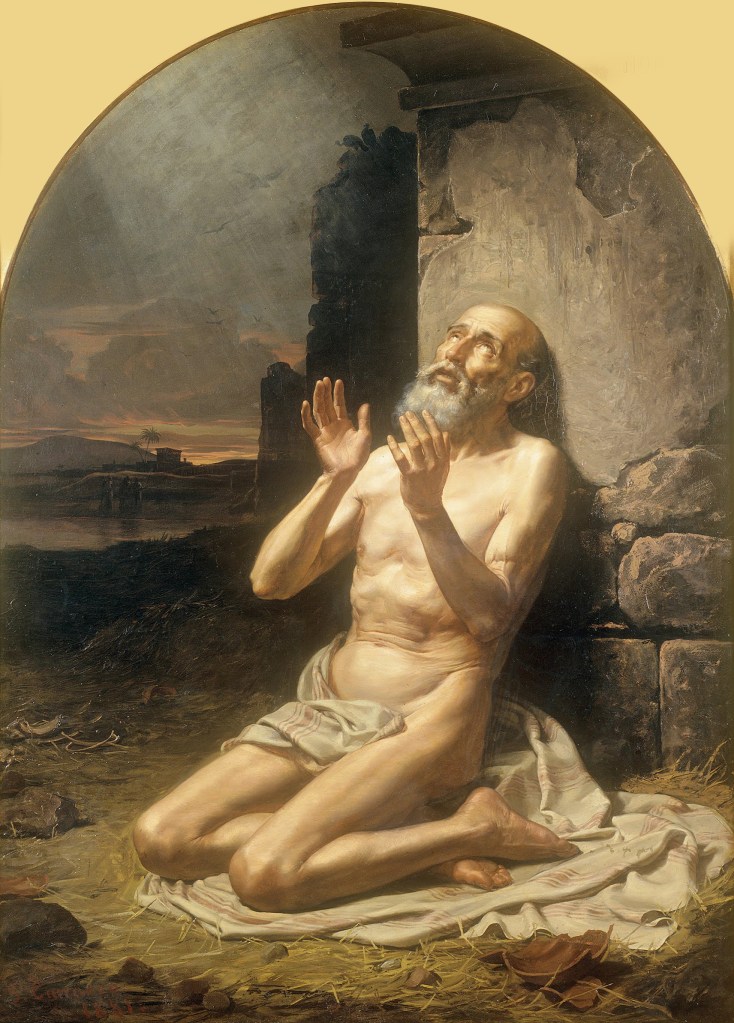
Image from http://www.oodegr.com.

Following Jesus, touching Jesus

The Lord Is My Chef Daily Recipe for the Soul by Fr. Nicanor F. Lalog II
Tuesday, Fourth Week in Ordinary Time, Year I, 04 February 2025
Hebrews 12:1-4 ><]]]]'> + ><]]]]'> + ><]]]]'> Mark 5:21-43
Photo by author, sunrise at the Sea (Lake) of Galilee, the Holy Land, 18 May 2019.

When Jesus had crossed again in the boat to the other side, a large crowd gathered around him, and he stayed close to the sea (Mark 5:21).

Lord Jesus Christ:

How lovely to hear
this story of your frequent crossing
of the sea to the other side
to reach out to more people
hungry and thirsty
for your words that comfort
and forgive, ease one's burdens
and most especially
for your healing touch.

You always come to us,
Jesus, reaching out to us
when all we have to do is follow
you and as much as possible,
be near you to touch you
like that sick woman
who touched your
clothe after Jairus
had begged you to come
to touch his sick and dying
daughter.
That's all we have to do:
follow you,
be near you,
and touch you;
but, of the large
crowd there like today,
only one dared to touch you;
only one father
had the courage to ask you
to come and lay your hands
on his daughter.
Photo by Dra. Mylene A. Santos, MD in France, 2023.
Give me Jesus
the courage to come to you,
to get near you
and touch you
with faith
and desire to meet you,
to speak to you,
to be with you;
take away my fears
of leaving the safety
of the sidewalks,
of walking the main street
that leads to your Cross
when in fact,
it was you who have
paid the price for me
by dying on the Cross.
Let the words
of the author of the Letter
to the Hebrews sink in me,
"In your struggle against sin
you have not yet resisted
to the point of shedding
blood" (12:4)
because I am
always afraid,
always hesitant
in following you,
in touching you.
Touch me, Jesus
so I may cross the sea
with you despite the storm
and giant waves;
touch me, Jesus
so I may cross the street
and walk beside you
in your arduous journey;
touch me, Jesus
so I may stand with you
at your Cross.
Amen.
Photo by author, Sacred Heart Novitiate, Novaliches, QC, 20 March 2024.

Our deepest longings…

The Lord Is My Chef Daily Recipe for the Soul by Fr. Nicanor F. Lalog II
Thursday, Week II in Ordinary Time, Year I, 23 January 2025
Hebrews 7:25-8:6 <*{{{{>< + ><}}}}*> Mark 3:7-12
Photo by author, St. Paul Spirituality Center, Pico, La Trinidad, Benguet, 06 December 2024.
Let me come to you,
Jesus, with confidence
and humility to express
to you my deepest longings
and desires,
my deepest needs
and cries you know so well
but I always deny or too shy
to tell you completely.
Though I know very well
how your death on the Cross
is the single most important event
in history for all times
and for all peoples,
I balk its realities not for lack
of faith but due to low self-esteem,
lack of self-acceptance
that you do love me truly.

The main point of what has been said is this: we have such a high priest, who has taken his seat at the right hand of the throne of Majesty in heaven, a minister of the sanctuary and of the true tabernacle that the Lord, not man, set up. Now he has obtained so much more excellent a ministry as he is a mediator of a better covenant, enacted on better promises (Hebrews 8:1-2, 6).

Let me follow you,
Jesus like the people in
the gospel:
let me not follow you only
to the sea but even to the
Cross to be one in you,
one with you
for you alone
is truly one with me
everywhere,
all the time.
Amen.
Photo by author, Mount Olis, Atok, Benguet, 27 December 2024.

Job, St. Francis of Assisi, and… Pocahontas

The Lord Is My Chef Daily Recipe for the Soul by Fr. Nicanor F. Lalog II
Friday, Memorial of St. Francis of Assisi, 04 October 2024
Job 38:1, 12-21; 40:3-5 <*{{{{>< + ><}}}}*> Luke 10:13-16
Photo by Fr. Bien Miguel, Diocese of Antipolo, 25 September 2024.

This is actually a rejoinder to our prayer earlier published today on the Memorial of St. Francis of Assisi. And how I love the first reading today, of God’s “speech” to Job’s lamentations that remind us all of the wonder and majesty of creation St. Francis of Assisi highly regarded in his life and teachings.

The Lord addressed Job out of the storm and said: “Have you ever in your lifetime commanded the morning and shown the dawn its place for taking hold of the ends of the earth, till the wicked are shaken from its surface? Have you entered into the sources of the sea, or walked about in the depths of the abyss? have the gates of death been shown to you, or have you seen the gates of darkness? Have you comprehended the breadth of the earth? Tell me, if you know all” (Job 38:1, 12-13, 16-18).

How interesting too these words written about 2700 years ago in the Middle East are echoed in our own time in theme song of the Disney movie Pocahontas, “The Color of the Wind”:

Have you ever heard the wolf cry to the blue corn moon
Or asked the grinning bobcat why he grinned?
Can you sing with all the voices of the mountain?
Can you paint with all the colors of the wind?
Photo by author, Sacred Heart Novitiate, Novaliches, QC, 20 March 2024.

Like Job, who was a fictional character, Pocahontas went through a lot of great sufferings beyond explanations which is the aim of the authors of the Book of Job – to reflect on the mystery of human sufferings and misery amid a loving God.

It is easy to understand our sufferings in life when we are the ones who have caused them like making wrong choices and decisions or simply not exerting enough efforts to our endeavors or projects.

The most painful sufferings that are really bothersome are those we feel “undeserved” at all like getting a rare cancer and disease, being offended by someone close to us despite our being good to them, or like Pocahontas who was then living in peace and quiet until the English colonizers came to America who kidnapped and gang raped her.

I have never seen that Disney movie Pocahontas that is loosely based on the life of a native American Indian woman Pocahontas whose actual name was Matoaka; she was the daughter of the Chief of the Powhatan tribe in Chesapeake, Virginia during the early 1600’s.

According to historians, there was really no romance at all between Pocahontas and the British colonizer Captain John Smith as portrayed in the Disney movie. After getting pregnant from that gangrape, Pocahontas was forced to marry the English explorer John Rolfe as a condition for her release that only made her life filled with great sufferings and humiliations until her death.

Though a work of fiction but a fruit of prayerful reflections about life’s realities unlike the Disney movie Pocahontas, Job suffered severely when he lost his children, properties and livestock in a single day. Worst of all, he was stricken with a rare disease and left to the care of a “nagging” wife and three friends who wanted him to curse God or admit his guilt for a sin for which God was punishing him.

But Job’s conscience was clear, remaining faithful to God throughout all his sufferings. His complaints and cries were actually a voicing out of his inner pains to God, an expression of his trust in Him, “But as for me, I know that my Vindicator lives, and that he will at last stand forth upon the dust… And from my flesh I shall see God; my inmost being is consumed with longing” (Job 19:25, 27).

Job like us today was not seeking any answer nor explanation at all for his sufferings; he cries to God like us because we believe only God can save us. We do not cry or air our pains to someone we do not trust or believe in; the same is true why we cry and complain to God!

God’s response to Job’s laments remind us today of the need for us to see the whole picture we are into in this vast universe, of how everyone and everything is interconnected in God through His own Son Jesus Christ.

Notice how the author structured the speech of God of seeming opposites in life: commanding the morning and being shown the dawn in verse 12; sources of the sea and depths of the abyss in verse 16; and, gates of death and gates of darkness in verse 17. Jewish thought at that time was so structured that they saw everything distinctly different like morning and dawn, sea and abyss, death and darkness. That explains why they were so strict with the letters of the law that they eventually forgot the primacy of the human person which Jesus tried to emphasized to them in His teachings and healings. Jesus came to show us how everything and everyone in this whole creation is linked together, interrelated in God through Him.

This He did when He died on the Cross.

Photo by Fr. Gerry Pascual of the fresco at the Assisi Basilica, Italy, 2019.

It is sad that St. Francis of Assisi is often “romanticized” by many nature lovers even by some “new agers” for his love for nature and animals. More than sentimental reasons, St. Francis’ love and concern for nature and animals were all the result of his deep love and devotion to Jesus Christ crucified found daily in the celebration of the Holy Eucharist.

St. Francis realized and experienced the interconnectedness of everything and everyone in his own sufferings and pains in life he humbly embraced and accepted as we see in that verse we pray at every Station of the Cross he had composed:

V. We adore You, O Lord Jesus Christ, and we bless you. R. Because by Your holy Cross, You have redeemed the world. 

For his love for the Cross and his own sufferings, Jesus blessed St. Francis with the stigmata, His five wounds at His crucifixion.

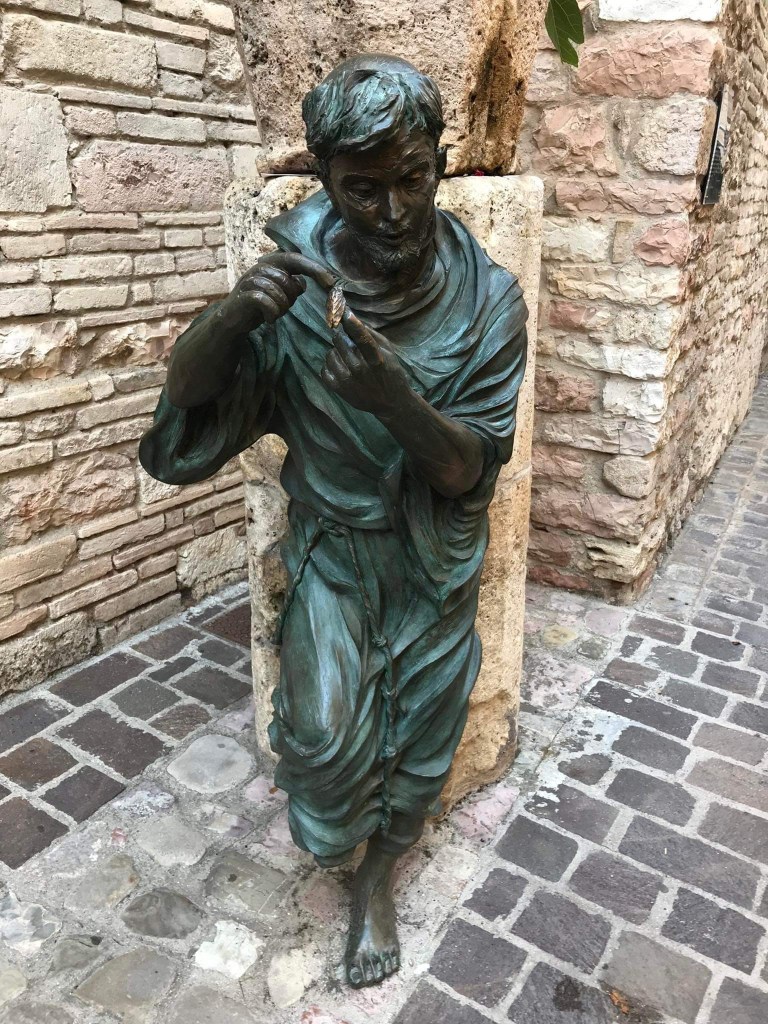
Photo by Fr. Gerry Pascual, Sculpture of the young St. Francis in Assisi, Italy, 2019.

After receiving those wounds, St. Francis was blinded as he went through severe sufferings after going through well-intentioned surgeries that went so bad. He was in his 40’s at that time and despite his great sufferings, it was during that period when he produced so many great writings we all cherish until now, notably the Canticle of the Sun where we find his famous expressions “brother sun, sister moon, and cousin death” – the very same things God expressed to Job in that speech out of the storm in our first reading today that is echoed by Disney’s Pocahontas in the theme “The Color of the Wind”.

But unlike that Disney movie that sugarcoats life’s realities of sufferings and pains, both Job and St. Francis of Assisi remind us today that the more we embrace our pains and sufferings in life like them, the more we see life’s wholeness, our oneness in God and the rest of His creations when seen in the light of the Cross of Jesus Christ.

When we see this oneness and interconnectedness in life, that is when we actually grow and mature, become fruitful as we find fulfillment in life despite the difficulties and pains we go through. Have a blessed weekend everyone! Happy feast day too to our Franciscan brothers and sisters!


From YouTube.com.

Have you…?

The Lord Is My Chef Daily Recipe for the Soul by Fr. Nicanor F. Lalog II
Friday, Memorial of St. Francis of Assisi, 04 October 2024
Job 38:1, 12-21, 40:3-5 <*{{{{>< + ><}}}}*> Luke 10:13-16
Photo by Ms. Marissa La Torre Flores in Switzerland, August 2024.
As we celebrate today the
memorial of St. Francis of Assisi
in the light of our first reading
from the Book of Job,
You open our eyes anew
O God our loving Father
into your unfathomable mystery
of majesty and love for us.

Like Job,
we ask many questions
not really because we complain
to You but simply we have no one else
to turn to; we have so many questions
in life and we are willing to wait if ever
there would be any answer at all
but one thing for sure,
we are certain You have all the answers.
Be patient with our many whys, 
O God, for we have no any reply
to any of your single question
"Have you ever in your lifetime commanded
the morning and shown the dawn its place...?
Have you entered into the sources
of the sea, or walked about in the depths
of the abyss?
Have the gates of death been shown to you,
or have you seen the gates of darkness?
Have you comprehended the breadth
of the earth? Tell me if you know all"
(Job 38:12, 16-18).
Like St. Francis of Assisi,
give us the grace to dare follow
your Son Jesus Christ not only
in humility and poverty
but most especially in His Cross;
forgive us, Father
and let us do away with all the
"sentimentality" cultivated by
nature lovers including "new agers"
on St. Francis' love for nature
rooted in Christ's sufferings and
commitment to a poor and simple life.
Like Job
and St. Francis who
lovingly embraced Jesus with
His Cross, may we also realize our
"smallness" before you, O Lord
in our trials and sufferings to experience
at the same time the joy and glory
in comprehending the "breadth
and length
and height
and depth"
of Christ's love
that surpasses knowledge
so that we may be filled with
your fullness,
dear God
(Ephesians 3:18).
Amen.
Photo by Ms. Marissa La Torre Flores in Switzerland, August 2024.

Discipleship, not membership

The Lord Is My Chef Sunday Recipe for the Soul by Fr. Nicanor F. Lalog II
Twenty-sixth Sunday in Ordinary Time, Cycle B, 29 September 2024
Numbers 11:25-29 ><}}}}*> James 5:1-6 ><}}}}*> Mark 9:38-43, 45, 47-48
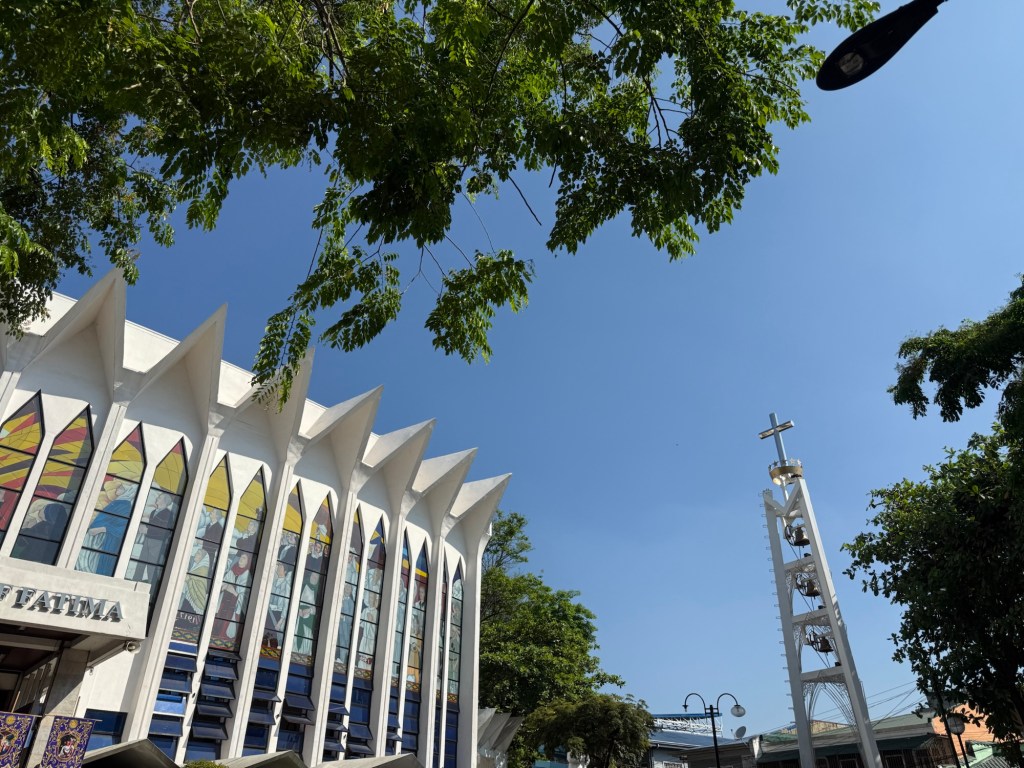
Photo by author, ongoing works on the stained glass of the National Shrine of Our Lady of Fatima, Valenzuela City, 24 July 2024.

Our Sunday gospel is getting more exciting each week as Jesus gets closer to Jerusalem in fulfillment of His mission with His Passion, Death, and Resurrection.

One thing we see these past Sundays is how Mark followed a certain series of contrasts in the trajectory of his reportage. Note the contrasting scenes with every Sunday as we find today the Twelve appeared united as one unlike last week when they debated on the way who was the greatest among them.

More than that, Mark narrated today two strongly contrasting components of the Lord’s teachings to His disciples about discipleship and membership.

Photo by author in Magalang, Pampanga, 23 September 2024.

First is His tolerance on those who do good even though they do not belong to His fold, telling us to let everyone do what is good because no one has a monopoly of serving.

At that time, John said to Jesus, “Teacher, we saw someone driving out demons in your name, and we tried to prevent him because he does not follow us.” Jesus replied, “Do not prevent him. There is no one who performs a mighty deed in my name who can at the same time speak ill of me. For whoever is not against us is for us” (Mark 9:38-40).

Then in a sudden shift, Jesus severely criticized those who cause scandal, strongly urging His disciples including us today to totally eradicate whatever that leads us to sin and evil. Rejecting sin is discipleship in essence, not membership.

“Whoever causes one of these little ones who believe in me to sin, it would be better for him if a great millstone were put around his neck and he were thrown into the sea. If your hand causes you to sin, cut it off. It is better for you to enter into life maimed than with two hands to go into Gehenna, into the un quenchable fire. And if your foot causes you to sin, cut it off. It is better for to enter into life crippled than with two feet to be thrown into Gehenna. And if your eye causes you to sin, pluck it out. Better for you to enter into the kingdom of God with one eye than with two eyes to be thrown into Gehenna” (Mark 9:42-43, 45, 47).

Jesus teaching his Twelve Apostles, from GettyImages.

What a lively discussion the Twelve must have had that day with Jesus. This scene is a favorite of many Christians when discussing the scriptures, of how they are to be understood and interpreted with our ready excuses that Jesus did not literally mean what He said about cutting off our sinful hand or sinful foot and plucking out our sinful eye.

But, have we really reflected on its meanings and implications to our lives today?

Jesus reminds us this Sunday that discipleship is more than membership because in doing what is good, “the sky is the limit” so to speak. No disciple of Christ can lay claim to a monopoly in doing what is good, serving others; moreover, no disciple of Christ can belittle the good works of others even if they do not belong to the same religion or church.

Photo by author in Magalang, Pampanga 23 September 2024.

When our good deeds become “exclusive” and selective, then, that cease to be good.

Our ability to do good is always a grace of God, a gift poured out upon us by God daily so that we can be more loving and caring, more understanding and forgiving to one another. The moment we forget that, then, we start playing God.

In telling His disciples to let that man exorcize those possessed even he were not among the Twelve was clearly a command for us to recognize all who do good as brothers and sisters even if they do not necessarily share our beliefs and traditions. It is a call to respect one another.

Recall how in John’s gospel Jesus called Himself the Good Shepherd who has other sheep not in this fold. And we cannot deny that many times those who do not belong to our Church or group are doing better in serving others than us who are so entangled with bureaucracy and programs or procedures, not to mention fame and other selfish motives.

This attitude of having a monopoly of ministries and charities is one serious malady afflicting parishes today. Very often, the people with this attitude are the cordon sanitaire of priests who most likely are a Jollibee or a pabida since they were seminarians. They are the epal for short who volunteer in everything leaving nothing else for others to do, eventually spawning more pabida and epal in the church. Many parishioners refuse to serve not because they are lazy nor indifferent nor afraid but simply they are never given a chance to serve due to the monopolistic attitudes of some. It is a sad case of ministry and service based on membership than discipleship.

Photo by author in Magalang, Pampanga 23 September 2024.

Jesus is telling us this Sunday that there should be no divisions in doing good. Allow others to do good! Give them the chance to enter heaven too with their services and charities.

God wants us all to be “prophets” as explained by Moses to Joshua in the first reading when Meldad and Eldad prophesied even though they were not present in the Lord’s meeting tent. Moses rightly identified “jealousy” as one reason for such monopolistic attitude of good works by some believers.

Sin is the only obstacle in doing good, not membership. That is why, Jesus was severely stern in His words, telling how better it is for one causing others to sin to be thrown into the sea with a great millstone around one’s neck. Or, to cut off one’s hand or foot, and pluck out one’s eye that cause anyone to sin.

Photo by author at Fatima Ave., Valenzuela City, 25 July 2024.

If doing good were “sky is the limit” among disciples of Jesus, sin definitely has no room among us.

See how in this Sunday gospel Jesus implied to John and other disciples including us today of the grave sin of pride when we have that attitude of having a monopoly of good works, of relying more on membership than discipleship. It makes us proud and bloats our ego, leading us to more sins along the way until later on, we succumb to what the Greeks called as hubris.

That is why St. James in the second reading instructed us to examine our attitudes on social ills like poverty and inequality because wealth, like fame and glory, are always stained by sin.

A good disciple is always a good member of the Church – or any team and organization for that matter. Most of all, in our own family and circle of friends!


From Caesarea Philippi down to Capernaum that began three Sundays ago, Mark has continued to show us who Jesus really is, as the Christ who invites us with a personal answer to His same question to the Twelve, “who do you say that I am?” (Mk. 8:29).

The contrasts we found in Him today are not opposed to each other like His meekness with the sick and toughness with those who cause sin. Jesus is very open with anyone doing good, being kind and helpful but amid all these contrasts, He remains firm on His demands on discipleship rooted on His Cross, not just membership or being called a Christian.

When we look on His face, on His person, we find integrity and coherence, wholeness and holiness for Jesus is the Christ who had come to make us all divine, to become holy like Him “filled with His spirit” (Num. 11:29). Amen. Have a blessed week and October ahead!

Photo by Ka Ruben, the new stained glass at the National Shrine of Our Lady of Fatima, Valenzuela City, 13 September 2024.

Seeing Jesus is seeing the Cross

The Lord Is My Chef Daily Recipe for the Soul by Fr. Nicanor F. Lalog II
Thursday in the Twenty-fifth Week of Ordinary Time, Year II, 26 September 2024
Ecclesiastes 1:2-11 <*((((>< + ><))))*> Luke 9:7-9
Photo by Pixabay on Pexels.com

Vanity of vanities, says Qoheleth, vanity of vanities! All things are vanity! What has been, that will be; what has been done, that will be done. Nothing is new under the sun (Ecclesiastes 1:2, 9).

How lovely are your words today,
God our Father:
"All things are vanity",
a mist,
a dew,
or breath
that vanish quickly,
no permanence,
and no real value at all
but because of You,
everything got meaning,
got value
especially in the coming
of Jesus Christ your Son,
our Lord and Savior.
You are no longer far from us,
dear God;
in Jesus Christ,
You have been among us,
most of all within us;
yet, many of us
could not find you
nor experience you.
Like Herod the tetrarch,
so many of us have heard
a lot about you, O God,
in Jesus Christ
but are still perplexed,
refusing to believe,
refusing to recognize,
refusing to accept
especially His Cross.
Bless us, dear Jesus,
especially those who keep
on trying to see you
but could not find you
because to see you
O Lord is to forget
one's self,
take up one's cross,
and follow You.
Amen.

Openly speaking to Jesus

The Lord Is My Chef Sunday Recipe for the Soul by Fr. Nicanor F. Lalog II
Sunday in the Twenty-fifth Week of Ordinary Time, Cycle B, 22 September 2024
Wisdom 2:12, 17-20 ><}}}}*> James 3:16-4:3 ><}}}}*> Mark 9:30-37
Photo by author in Caesarea Philippi, Israel, May 2017.

Time flies so fast these days and so does our gospel reading with Mark telling us in quick succession Jesus journeying south towards Jerusalem, passing through Galilee then making a stopover in a house in Capernaum.

Jesus is now intensifying His teachings to the Twelve – and us too today. For the second time since Sunday after being identified as the Christ, Jesus “spoke openly” of His coming Passion, Death, and Resurrection to His Apostles; but, unlike last Sunday, the Twelve remained silent and instead debated on who among them is the greatest as they grappled on the meaning of their Master’s coming Pasch.

Jesus was teaching his disciples and telling them, “The Son of Man is to be handed over to men and they will kill him, and three days after his death the Son will rise.” But they did not understand the saying, and they were afraid to question him. They came to Capernaum and, once inside the house, he began to ask them, “What were you arguing about on the way?” But they remained silent. They had been discussing among themselves on the way who was the greatest (Mark 9:31-34).

Photo by Ms. Marissa La Torre Flores in Switzerland, August 2024.

Did you notice that beautiful interplay again in the scene with the preceding Sunday?

Last Sunday, Jesus spoke openly of His coming Passion, Death, and Resurrection where Peter reacted by taking Him aside to protest. Jesus rebuked Peter, telling him how he thought in man’s ways than God’s ways.

Today, Jesus spoke openly anew of His coming Pasch but this time, the Twelve fell silent because according to Mark, “they did not understand the saying, and they were afraid to question him.”

Are we not like the Twelve so often with Jesus? We follow Him, we believe Him, we listen to Him but never understand His words and worst, so afraid to question Him?

What do we not understand in His words? Or, is it more of still refusing to accept the reality of His Passion, Death, and Resurrection like Peter last week?

We are afraid to ask Jesus the meaning of His words, of His plans for us not because they have hidden meanings but usually due to our own hidden agendas.

Photo by Mr. Jay Javier, 07 September 2024.

We find it hard to trust Jesus enough unlike the upright in the first reading especially in this age of social media and instant fame and popularity when numbers of “likes” and votes prevail over what is true, good, and beautiful. Real talents, innate goodness and whatever natural are disregarded. That is why I have never watched nor believed in any beauty or singing contest these days because winners are decided not really on their talents or beauty and intelligence but more on the votes they get from viewers and people. Life has become more of a popularity contest often seen in terms of money. Pera pera lang?

This propensity of equating number of votes and likes with what is true and good and beautiful reeks with a lot of those stinky attitudes of the wicked in the first reading. The author of the Book of Wisdom perfectly expressed the inner thoughts and dynamics of the wicked who are intolerant of contradiction in whatever form, most especially unbearable to them is the living reproach and challenge of the life of just persons in their midst. This was fulfilled in Christ Jesus, the Just One of God the wicked men have crucified.

The wicked say: Let us beset the just one, because he is obnoxious to us; he sets himself against our doings, reproaches us for transgressions of the law and charges us with violations of our training… Let us condemn him to a shameful death; for according to his own words, God will take care of him” (Wisdom 2:12, 20).

Photo by Mr. Jim Marpa, 2018.

Jesus Christ’s teaching of the Cross is the perfect spirit of being a child that runs contradictory to the ways of the world. To be like a child these days as Jesus showed the Twelve is to invite sarcasm and ridicule, unacceptable to those who live in the dictates of the world of power and force, wealth and fame that certainly lead to more divisions and destruction.

Jesus invites us this Sunday to “speak openly” to Him like a child filled with trust and enthusiasm to know and learn more about life and its meanings like our doubts and fears, incomprehension and uncertainties.

See how children’s face light up when grown-ups recognize their inquiries even without any explanations at all. The same is most true with Jesus in whom anything that is dull and drab shines brightly when seen in His light.

Photo by author, St. Scholastica Retreat Center, Baguio City,

We cannot escape the scandal of the Cross. To dwell on Easter Sunday without the Good Friday only makes our life journey difficult and tiring without any direction, a waste of time and energy circling around the ways of the world that has always been proven wrong.

The essence of Christ’s Passion, Death, and Resurrection is found in being a child in the same manner Jesus remained the Son of God there on the Cross. He has always been clear with this; though He knew His fate, Jesus was totally free in choosing to suffer and die on the Cross because He fully entrusted Himself to the Father as He prayed before dying on the Cross, “Father, into your hands I commend my spirit” (Lk.23:46).

That beautiful imagery of a child Jesus placed in their midst as He put His arms around him encapsulated perfectly His own Passion and Death:

Then he sat down, called the Twelve, and said to them, “If anyone wishes to be first, he shall be the last of all and the servant of all.” Taking a child he placed it in their midst, and putting his arms around it he said to them, “Whoever receives one child such as this in my name, receives me; and whoever receives me, receives not me but the One who sent me” (Mark 9:35-37).

Photo by Mr. Red Santiago of his son Clyde, January 2020.

Every Sunday, Jesus gathers us in the Eucharist, just like the house in Capernaum where He spoke privately to the Twelve to explain the Cross and being like a child.

Let us not be afraid to speak these openly to Jesus because in our shame or fears of questioning Him, the more we live in rivalries among each other, the more we covet and envy, the more peace becomes elusive because as St. James rightly said, “You do not possess because you do not ask. You ask but not receive, because you ask wrongly, to spend it on your passions” (James 4:2c-3).

Let us gather around Jesus every Sunday, speak openly to Him especially after receiving Him Body and Blood in Holy Communion to cast unto Him all our worries and doubts in life. Let us take time to listen to Him and be imbued with His teachings. Amen. Have a blessed week ahead, everyone.

Jesus openly speaking

The Lord Is My Chef Sunday Recipe for the Soul by Fr. Nicanor F. Lalog II
Twenty-fourth Sunday in Ordinary Time, Cycle B, 15 September 2024
Isaiah 50:5-9 <*{{{{>< James 2:14-18 ><}}}}*> Mark 8:27-35
Photo by Digital Buggu on Pexels.com

There is something very striking with the similarities and differences in our gospel last Sunday and today that greatly reveal to us the person of Jesus Christ whom we all imitate and follow as His disciples.

In Decapolis last Sunday, Jesus separated a deaf man – “took him off by himself away from the crowd” – to heal him by putting his fingers into the man’s ears, then spitted and touched his tongue as he groaned “Ephphatha” – be opened – and the man was healed as “he spoke plainly”.

Further up north of Decapolis which is the chief pagan city of Caesarea Philippi, the Apostle Peter took Jesus away from the crowd after the Lord spoke openly of His coming Passion, Death, and Resurrection.

But unlike the deaf mute healed when separated from the rest, Jesus rebuked Peter as He returned to the crowd as He continued to speak openly of His coming Passion, Death, and Resurrection.

He began to teach them that the Son of Man must suffer greatly and be rejected by the elders, the chief priests, and the scribes, and be killed, and rise after three days. He spoke this openly. Then Peter took him aside and began to rebuke him. At this he turned around and, looking at his disciples, rebuked Peter and said, “Get behind me, Satan. You are thinking not as God does, but as human beings do” (Mark 8:31-33).

Photo by author at Petra in Jordan, May 2019.

I love the contrast of these two events Mark tells us so succinctly without missing details that speak so well of God’s ways and man’s ways, of what is to think and act like Jesus and how the devil tricks us into its devious and insidious ploys.

See also how last Sunday the healed deaf-mute “spoke plainly” in Christ while today we are invited by Mark to “openly speak” like Jesus of life’s sufferings and death.

When God separates us from the rest of the people and our usual routines like what happened at Decapolis last Sunday, it is because He wants us to experience Him more closely, for us to be healed, and for us to touch base with Him anew who is the very root of our being. Like that nameless deaf man, we need to separate once in a while from the world for us to be healed of our many deafness so that we may listen more intently to God’s voice and words right in our hearts, in the scriptures, and in the cries of the poor and suffering among us.

Actually, Jesus was continuing in Caesarea Philippi His method last Sunday of “separating” when He first asked the Twelve “Who do people say that I am?” that prompted them to tell Him the many misconceptions about His identity. In a similar way with the deaf at Decapolis, Jesus took off the Twelve in Caesarea Philippi when He asked them the more specific question “But who do you say that I am?” and Peter rightly answered Him, “You are the Christ.”

Matthew has a similar story probably with some additions from other sources that we find Jesus praising Peter for his answer, entrusting to him the church, and promising him with the key to heaven. The rebuke of Peter would happen later in their journey.

Mark had none of that considering his gospel was Matthew’s basis. We find in Mark’s brief account of Peter’s confession at Caesarea Philippi Perhaps how often just as when we feel so close with God like Peter, it is the same moment when the devil comes to trick us to break away from God and follow our own ways, not His.

Photo by author near ancient city of Caesarea Philippi, May 2017.

The event at Caesarea Philippi gives us clearest sign to identify Jesus as the Christ, that is when Jesus speaks openly of His coming Passion, Death, and Resurrection.

He began to teach them that the Son of Man must suffer greatly and be rejected by the elders, the chief priests, and the scribes, and be killed, and rise after three days. He spoke this openly (Mark 8:31-32).

Jesus never hides us from the realities of life as He speaks “openly” of His Pasch. From Caesarea Philippi, Jesus and the Twelve would head back south towards Jerusalem making a stop over on Mount Tabor for the Transfiguration where Christ’s glory was revealed to Peter, James and John.

It was during His Transfiguration that that Father and the Son made clear that Christ’s glory cannot be separated from the Cross. It was after Caesarea Philippi when Jesus announced thrice to the Twelve His coming Passion, Death, and Resurrection.

Notice too that qualifier “must” – that He “must suffer greatly”.

Just one word but so powerful, showing us the consistency of Jesus in speaking about His Pasch, the Cross, and later its relationship with discipleship, of the need for us to forget ourselves, take up our cross and follow Him.

Our motorized procession of the Blessed Sacrament in our previous Parish at the start of the COVID-19 lockdown in March 2020. Photo by Ms. Anne Ramos.

It saddens me when some priests and people in the Church shy away from talking openly about life’s many sufferings. We recognize their good intentions of not forgetting the beautiful and brighter side of being a Christian but to look at the Cross negatively and all its other implications is totally unChristian.

We cannot disregard the pains and darkness that come in being a disciple of Jesus; the Cross is the life of a disciple because it is the center of Christ’s person and teachings as expressed in yesterday’s Feast of the Exaltation of the Cross. All these “health and wealth” style of many preachers even in the Church are red flags of the devil’s ploy, of Peter separating Jesus from the Cross.

We act like Peter rebuking Jesus in Caesarea Philippi whenever we try to soften or hide, even cover the corruption and abuses going on in the society and families, the Church and our communities. That is clearly thinking in man’s ways not in God’s ways.

We cannot arrive at the truth and beauty of life disregarding the falsehoods and negativities around us. That was the problem with the people in mistaking Jesus as one of the prophets who were seen more as miracle workers who instantly healed them of their sickness.

Photo by author in my previous parish, 2017.

And here lies the danger too to us that we will never be able to have a good answer to Christ’s question “But who do you say I am?” if we avoid the many passion and death of this life in Jesus.

To openly speak like Jesus and embrace the sufferings and death we must endure is our first expression of faith with works we heard in the second reading from James.

To openly speak like Jesus and embrace the sufferings and death we must endure is the fulfillment of the first reading’s Song of the Suffering Servant who is Jesus Himself.

When we openly speak and embrace life’s daily sufferings and deaths like Jesus is to trust completely in God like Him. Let us speak openly of the Cross, of love and mercy, of God like Jesus Christ! Let us pray:

Lord Jesus Christ,
let me continue to follow
you closely by separating
from the rest often
to hear you more,
to love you more,
to trust you more;
let me know you more clearly
so that I may love you more dearly
and follow you more closely
speaking plainly,
speaking openly
without sugarcoating your call,
your Cross.
Amen.

The uniqueness of the Cross

The Lord Is My Chef Daily Recipe for the Soul by Fr. Nicanor F. Lalog II
Saturday, Feast of the Exaltation of the Cross, 14 September 2024
Numbers 21:4-9 ><}}}}*> Philippians 2:6-11 ><}}}}*> John 3:13-17
Photo by author in my previous parish, 2017.

Today we celebrate a most unique Feast, the Exaltation of the Cross.

It is so unique because first of all, the cross is perhaps the most unique thing on earth made up of two pieces of wood that are so ordinary yet so deeply extraordinary in meaning, a sign of God’s immense love for us humans through Jesus Christ’s Passion and Death.

From being the sign of the most inhuman punishment in history, the Cross is now the very sign of how God “so loved the world that he gave his only Son, so that he who believes in him might not perish but might have eternal life” (Jn.3:16). It encapsulates the whole mystery of Jesus Christ, of how this all-powerful God beyond the ordinary became weak like us in everything except sin so that we too may be like Him, divine and more than ordinary. In His suffering and death on the Cross, Jesus made the lowly wood so ordinary to be so exalted to become His sign of love and mercy, power and majesty.

Photo by author, Jerusalem, May 2017.

Hence, in the Cross is the power of God’s love to transform us to better persons.

In the Cross is God’s power to lead us closer to Him with its vertical beam and to others with its horizontal beam.

In the Cross is the power of good if we choose to embrace it with Christ Jesus as our Lord and Master.

The Cross is most unique of all signs in the world because underneath its ordinariness, that is where we see God’s glory and majesty. It was underneath the Cross of darkness and gloom on Good Friday that humanity began to see light and hope in life’s many absurdities. Most of all, it was underneath that Cross of suffering and death of Jesus Christ that we feel and experience the assurance of the Resurrection.

How?

Through our own pains and sufferings that are most uniquely ours too!

With their patience worn out by the journey, the people complained against God and Moses, “Why have you brought us up from Egypt to die in this desert, where there is no food or water? We are disgusted with this wretched food!” In punishment the Lord sent among the people saraph serpents, which bit the people so that many of them died (Numbers 21:4-6).

Photo by author, Dominican Hills, Baguio City, January 2018.

You must have heard that old story of a man who came to Jesus to return the cross given for him to carry; he asked Jesus to have it replaced with a lighter one. Jesus then led the man to a huge room with all kinds of crosses for him to choose which he prefers as the best one for him so that he would stop complaining.

After closely examining the specs of so many crosses, the man finally decided to pick one he deemed as perfect for him after considering its weight and other dimensions, only to find out from Jesus Himself that it was the same cross he had actually returned for exchange!

Many times in life we are like those people in the first reading, never ending in their complaints to God, even challenging Him, accusing Him of forsaking us, of being unfair when life becomes difficult and unbearable. There are times we feel being on the distaff side of life always like a flat tire, never on top. We cry foul to God especially with all our hurts and pains inflicted by others, asking Him where was He when most needed?

Photo by author in Jordan near the Israeli border where Moses put up the bronze serpent as instructed by God to heal those bitten by the snakes after they have complained of their conditions in the wilderness, May 2019.

While it is true life is indeed difficult, the cross reminds us of the fact that the pains and hurts we have are uniquely ours too, something we have to accept and most of all, own.

There are pains that are so deep and won’t go away that have in fact affected us dismally in our lives already. Instead of self-blaming and self-pity, we just have to ask for God’s grace to accept and own them like Jesus Christ. We just have to “bring it home” – that imagery of the Cross planted on the Calvary – into our very selves, in our being as something so true and real. And uniquely ours.

Stop thinking of others’ pains and hurts. We are not all the same. If ever we have similar experiences, the hues and shades even gravity and circumstances are not same because each pain and hurt, like the cross, is uniquely ours. Like every person, every cross is unique because it is also a gift, a mystery, and life. We have to “befriend” our pains and hurts, our own cross instead of resist it. It is in “befriending” our pains and hurts, our cross in life that we grow and mature, becoming more free to love and to be joyful because that is when the cross triumphs over its disgrace and shame in us and with others. That is when our pains and hurts, when our crosses begin to reveal to us the many beautiful truths of Easter awaiting us.

The Cross of Christ triumphed because Jesus carried it wholeheartedly, allowing those two pieces of wood to reveal not only to Him who knew everything beforehand its meaning but most of all to everyone of us the deeper truths the Cross signifies as St. Paul eloquently expressed in our second reading.

The Cross of Christ atop the church of our Lady of Lourdes in France. Photo by my former student Philip Santiago during his pilgrimage, September 2018.

One thing I realized after my mother died in May is the fact that while there are so many pains and sufferings in this world, my own pain and suffering in losing her are most difficult to bear; hence, something I must carry because it is uniquely mine.

But, one thing so unique I noticed is that the more I see my cross following my mother’s death, the more I saw also the cross of others. The Cross of Jesus triumphed truly in me when I embraced and owned my cross, when I befriended my pains and hurts that eventually led me to recognize and see, to feel more and experience too the crosses of others.

When we become conscious of each one’s unique cross, slowly we are able to reveal to them the meaning of their personal crosses too because we become more sympathetic, more open, more silent to listen more, love more, care more and be more present with those in their own unique cross. No wonder, I find conversing more engaging with others who also grieve because we can see each other’s unique crosses!

Jesus calls us to imitate Him that by embracing and owning our cross, we too may lead others to finding the meaning of their own cross and thus experience Easter soon. Let us pray:

Give us the grace, O God, 
to always embrace the Cross
like your Son Jesus Christ
where we can all be empty
of ourselves to be filled
with your Holy Spirit
to make your love visible in us. 
Amen.