The Lord Is My Chef Daily Recipe for the Soul by Fr. Nicanor F. Lalog II
Monday in the Fourth Week of Ordinary Time, Year II, 29 January 2024
2 Samuel 15:13-14, 30; 16:5-13  <*((((>< + ><))))*>  Mark 5:1-20
An illustration of the healing of the Gerasenes demoniac from Pinterest.
On this final week of January
as we approach in two weeks the
Season of Lent,
you teach us today,
dear Father with many
lessons about "facing" evil;
at first, I felt evil is always
"confronted", something we always
fight head on but from the
two readings today,
your words tell me O Lord
there are times we just have
to stand firm against evil without
necessarily fighting it out right away
but not condoning it either.
But the king replied: ”What business is it of mine or of yours, sons of Zeruiah, that he curses? Suppose the Lord has told him to curse David; who then will dare say to, ‘Why are you doing this'” Then the king said to Abishai and to all his servants: ”If my own son, who came forth from loins, is seeking my life, how much more might this Benjaminite to do! Let him alone and let him curse, for the Lord has told him to. Perhaps the Lord will look upon my affliction and mae it up to me with benefits for the curses he is uttering this day.”
2 Samuel 16:10-12
Give me, O God, the same
patience of David to accept the
evils happening to me as I am guilty
of so many evils too;
like David, let me be mindful always
of my own evil ways and sins that
definitely will haunt me,
will chase me,
and will charge me later
in recompense for my own
sins too.
There are times, Lord,
that I must accept
how I deserve some evil to befall me
as a result of my own sinfulness
like David.
If ever the evils that come to me
are undeserved,
keep my cool and patience,
as well as goodwill
like Jesus Christ your Son
and our Lord;
after healing the Gerasenes demoniac,
he was driven out from the town
by the people;
many times,
people do not understand
anything at all when evils
befall us and others;
maintain my peace
within me, Lord,
that I may not react against
my accusers like you
especially when they all get it wrong;
let me tower over everyone else
with firm faith in you,
dignity in silence,
and clear conscience
when people wrongly
 accuse me of deeds
I am not guilty of
for you alone is my
salvation.
Amen.
The Lord Is My Chef Daily Recipe for the Soul by Fr. Nicanor F. Lalog II
Thursday in the Second Week of Ordinary Time, Year II, 18 January 2024
1 Samuel 18:6-9, 19:1-7  <*{{{{>< + ><}}}}*>  Mark 3:7-12
Photo by author, sunflower farm in La Trinidad, Benguet, 12 July 2023.
"In God I trust; I shall not fear."
Let those words of the psalmist
today be my prayer too, dear Father
especially when jealousy slowly
creeps into me,
when people around me do better,
when they seem to be more
loved or liked or accepted;
like King Saul in the first reading
today, there are times I am filled
with insecurities
with my own self,
with my strengths
and abilities,
most especially,
with your love.
Jealousy arises easily in our hearts… When we truly enjoy God’s unlimited generosity, we will be grateful for what our brothers and sisters receive. Jealousy will simply have no place in our hearts.
Fr. Henri Nouwen
How true were the words
of the late Fr. Henri Nouwen;
jealousy arises easily
in our hearts;
sometimes they just come
without us even
thinking about it;
problem is,
many times we entertain
and let it take over us,
feeling we are a victim
of something,
 like King Saul,
or the elder brother in
the parable of the prodigal son,
or those early workers
in the parable of the vineyard
who felt they should be paid more
than those late workers
who were paid with same wage
as theirs.
When good things happen
to others,
teach me to rejoice
with them,
let me be thankful
too for their being blessed
by you;
let me not be jealous
of whatever they have
for you never fail to bless me
too with so many things
they do not have;
let me be more trusting
in your generosity,
O God,
to never have fear of you
running out of blessings
and other good things
for each one of us
according to our own abilities;
let me rejoice
when other people
are blessed like in the gospel today
because whatever good things
that happen around us
are signs
you are with us
in Christ Jesus.

Instead of looking on what
others have,
let me look what I have,
and always,
let that be YOU
in Christ Jesus!
Amen.
The Lord Is My Chef Daily Recipe for the Soul by Fr. Nicanor F. Lalog II
Friday before the Epiphany of the Lord, 05 January 2023
1 John 3:11-21  <*((((>< + ><))))*>  John 1:43-51
Photo by Dra. Mylene A. Santos, MD, at Tagalag, Valenzuela City, 18 November 2023.
How wonderful on this fifth day
of 2024, O God our Father,
that you amaze us
first on what is truly
amazing...
"Do not be amazed, then,
brothers and sisters,
 if the world hates
you"
(1 John 3:13).
Many times we are amazed
at the evil men and women do;
we are amazed and surprised
in the negative sense
like shocked,
appalled,
even embarrassed
when others speak
and act shamelessly
against what is true,
good, and beautiful;
to be amazed in the negative sense
makes us withdraw
to examine our very selves
if we too have become callous
and shamelessly evil.
What is truly amazing,
worth of our surprise
is when we are amazed
in the positive sense
like Nathanael:
"Can anything good come from Nazareth?"
Philip said to him,
"Come and see"
(John 1:46).
Only what is truly good,
very true, and really beautiful
is amazing; nothing can make
our hearts leap even in
momentary disbelief
and amazement like Nathanael
to hear or see or experience
something so good and all good;
and that is YOU, O God,
the most amazing of all
now brought nearer to us
in Christ Jesus;
in him, we have realized
and experienced that
"God is greater than our hearts"
(1 John 3:20) because you,
O God, your love and your truth,
your mercy and your kindness
are all beyond our grasp;
nothing can be so amazing,
loving Father, for us to experience
your love far beyond anything
we could expect for ourselves;
make us believe,
let us be amazed
in you.
Amen.
The Lord Is My Chef Daily Recipe for the Soul by Fr. Nicanor F. Lalog II
Tuesday, Misa De Gallo IV, 19 December 2023
Judges 13:2-7, 24-25 <'[[[[>< + ><]]]]'> Luke 1:5-25
Here’s another beautiful story I got from a blogger I recently followed from Spain at wordpress.com. It is actually an analogy which may sound simple but very true.
You are holding a cup of coffee when someone comes along and bumps into you or shakes your arm, making you spill your coffee everywhere. Why did you spill the coffee?
"Because someone bumped into me!!!"
Wrong answer. You spilled the coffee because there was coffee in your cup. Had there been tea in the cup, you would have spilled tea. Whatever is inside the cup is what will spill out.
Therefore, when life comes along and shakes you - which surely happens all the time - whatever is inside you will come out. It's easy to fake it, until you get rattled. So, we have to ask ourselves, "what's in my cup?" When life gets tough, what spills over from me?
Photo by Mr. Boy Cabrido, Quiapo Church, Misa de Gallo, 17 December 2023.
My dear friends, we are now on the fourth day of our Misa de Gallo and I find that story/analogy so appropriate with our readings today.
How interesting that Zechariah with his wife Elizabeth – according to St. Luke – prayed so hard all their lives to have a child but when God was about to fulfill it, Zechariah doubted it despite being told by an angel from God. Like in that story/analogy we presented above, Zechariah was “rattled” by the angel’s good news. “What was inside Zechariah that he doubted the good news”?
Then Zechariah said to the angel, “How shall I know this? For I am an old man, and my wife is advanced in years.” And the angel said to him in reply, “I am Gabriel, who stand before God. I was sent to speak to you and to announce to you this good news. But now you will be speechless and unable to talk until the days these things take place, because you did not believe my words, which will be fulfilled at their proper time.”
Luke 1:18-20
Photo by author, Wailing Wall of Jerusalem, May 2017, the section of the remaining parts of the temple closest to the Holy of Holies where priests used to incense once a year.
Advent is the presence of God but sometimes when we are overburdened with so many things like anxieties and problems in life, frustrations and disappointments, sickness and death in the family, we become unaware of his divine presence even if we continue to pray and do our religious duties and devotions. Too often we lack the conscious awareness of God in our lives that we take him for granted, considering him more as a given than a presence and a reality.
This is exactly what we told you yesterday about some of us pretending to be real disciples of Christ when in reality we are merely dreaming in a sleepwalking existence. It is a kind of spiritual immaturity due to our lack of honesty and sincerity with one’s self and with God that we remain a spiritual dwarf. Like Zechariah who happened to be a priest who must be more attuned and rooted in God, we too hardly notice God’s coming or even doubt him and his powers because we want to hold on to our comfort zone or insist our own agenda.
God is never put off by our queries in life but what “irritates” him is when we question him, when we doubt him, when we ask about his character like Zechariah. That is a lack of faith in God, a lack of trust, and lack of personal relationship with him unlike St. Joseph in our reflection yesterday, truly a righteous man.
Contrast Zechariah with his wife Elizabeth who is presented by St. Luke in a better position despite her being barren. In the Bible, barrenness is a sign of lifelessness and absence of God’s blessings. Worst, it was seen as a punishment from God for one’s sins.
Yet in this opening scene of St. Luke’s infancy story beginning with the annunciation of John’s birth, we find God’s power at its fullest when we are most emptied which is exactly the imagery of Elizabeth being barren and old. She had nothing at all to be proud of unlike Zechariah who still had duties to perform as a priest.
As we have reflected yesterday too, we burst in great rejoicing actually in those moments filled with negativities, with a lot of “no” answers of rejections and failure. That was how Elizabeth felt after being pregnant with John.
After this time, his wife Elizabeth conceived, and she went into seclusion for five months, saying, “So has the Lord done for me at a time when he has seen fit to take away my disgrace before others.”
Luke 1:24-25
Earlier, we asked what was inside Zechariah that he doubted the good news of the angel; now, we imagine what was inside the barren Elizabeth who welcomed the good news rejoicing by voluntarily going into a seclusion?
The story of the elderly couple Zechariah and Elizabeth finally being blessed by God with a child shows us God’s consistency not only in keeping his promises but most of all in working best even in our worst conditions, in the most unusual circumstances. In these two stories, one from the Old Testament and in the New Testament, we find the importance of being filled with God always.
Recall our story/analogy above. What is inside us that comes out when we are shaken? What spills over from our cup, is it joy, gratitude, and peace? Or, anger, bitterness, harsh words and reactions long festering within?
In starting his Christmas story with the annunciation of the birth of John the Baptist, St. Luke is telling us an important aspect in celebrating this blessed season – the need to fill ourselves with God.
See how Zechariah was forced to be silent and made mute so that he could spend more time listening and rediscovering God anew in his heart, of filling himself with God. On the other hand, Elizabeth opted to go into seclusion also to contemplate God already dwelling in her though she may have never known before that is why she wanted to listen more intently to his other plans with the gift of John. Similarly like her in the first reading was the wife of Manoah who remained silent and open when a man of God told her she would bear a son to be called Samson, saying that “I did not ask him where he came from” (Jgs.3: 6). Advent invites us to simply be still to be filled by God, with God.
The other day I joined my nieces and nephew for lunch. After dropping me off at the parish, they asked for a nearby Starbuck’s because my nephew had to buy a coffee mug for his exchange gift in their class. When I asked him why he had to give a Starbuck’s mug as gift, it turned out that is now the way it is in class Christmas party – your exchange gift partner can make a wish for the gift to receive for as long as it is within the agreed budget by the class.
Anyway, our life gives us the cup or the mug. We make the decision, the choice to fill it with coffee or chocolate or tea, in the same manner we fill ourselves with joy or bitterness, anger or serenity, gratitude or complaints. Or God.
Like Zechariah in the gospel today, we could be so tired already of doing so much, of banging our heads on the wall to solve everything, to answer everything. In this final stretch before Christmas, let us empty our cups or mugs of our selves and fill it with God who alone can truly fill us with life despite our dryness and barrenness. Amen.Have a blessed Tuesday!
The Lord Is My Chef Daily Recipe for the Soul by Fr. Nicanor F. Lalog II
Wednesday in the First Week of Advent, 06 December 2023
Isaiah 25:6-10   ><))))*> + ><))))*> + ><))))*>   Matthew 15:29-37
Photo by author, St. Scholastica Retreat House, Baguio City, 23 August 2023.
God our loving Father,
may we go back to you our very life;
forgive us who have easily forgotten
you especially after these difficult years of the pandemic;
now that COVID has waned and life is back to "normal",
we are back to our unholy ways.
May we always search you, Father,
and dwell in you;
 destroy the “veil that veils all peoples,
the web that is woven over all nations” (Is.25:7)
that mislead and imprison us
with false hopes in superficial relationships
and materialistic briberies of this world.
Let us go "hungry and thirsty"
to realize the most essential in life
 are you, dear God and the people who truly
care for us and love us like our family and friends.
Like the crowd who have followed Jesus
in the wilderness for three days
with nothing to eat:
they experienced advent,
your coming, O God,
when Jesus fed them
after they were finally disposed
to desire the longings
of their soul than of their bodies;
it was only then when Jesus fed them
through the miraculous multiplication
of the loaves of bread for the second time.
May the darkness and gloom
that envelop us this season of Advent
like the wars in Gaza and Ukraine
and other military show of force
by other nations and groups elsewhere,
the barbaric terror attack last Sunday in Marawi
and the frequent earthquakes we have been experiencing
along with our other personal crises
dispose us to desiring you alone,
God our Father, so we may finally enter
your heavenly banquet in the Holy Eucharist
with “rich food and choice wines” (Is.25:6). Amen.
The Lord Is My Chef Sunday recipe for the Soul by Fr. Nicanor F. Lalog II
First Sunday in the Season of Advent, Cycle B, 03 December 2023
Isaiah 63:16-17, 19; 64:2-7 ><}}}*> 1 Corinthians 1:3-9 ><}}}*> Mark 13:33-37
Photo by author, National Shrine of Our Lady of Fatima, 08 December 2022.
I was literally waiting the “advent” or coming of my doctors last Thursday as I wrote this homily for this first Sunday of Advent, the new year in our Church calendar. It was a hazy morning with some drizzle when I arrived for my doctors’ appointments.
But, it was a graceful moment too as I rediscovered the virtue of patience by being a patient myself again.
Sick people are called patients precisely because healing requires a lot of patience. Tons of patience in fact, especially if we are incapacitated or too weak to move. And the most difficult part of patience is waiting, from the simple waiting for doctors and nurses, waiting for the end of the day to waiting for our complete healing until we are well again.
Photo by author, First Sunday of Advent 2021, Basic Education Department, Our Lady of Fatima University, Valenzuela City.
The difficult part of waiting is that we are so conscious of time which we find to be flowing so slowly, making us irritable even doubtful if ever the one we are awaiting would ever come or materialize at all. That is why patience has become a virtue so rare these days.
Many people reject, even abhor patience in this age of instants when everybody wants to bear fruit but resent how it takes time to ripen. We want to have everything now na! We do not want to wait because we are no longer contented with whatever comes to us so that we advance our salaries and buy things in credit cards. Worst is this notorious practice of advancing public holidays to other dates closest to weekends to have “long weekend” celebrations. Even Christmas is not spared from our impatience! See how malls and local government buildings, homes and radio stations could not wait after the Halloween with all the lighting of Christmas trees and decors everywhere.
Unknown to us, we are robbing ourselves of very essence of the event of Christ’s coming to us when we manipulate time and its natural flow. When we lose patience, we stop waiting, then we miss the essence of life, of persons, of everything because we think waiting is being empty.
That is not true! Waiting is never empty. On the contrary, waiting is actually fullness because the very fact that we wait means we have.
Photo by author, lanterns for sale in San Fernando, Pampanga, November 2020.
When we were growing up, we loved waiting for dad’s coming home from work. We were filled with joy the moment we heard jeepneys stopping, hoping it was dad. Even if he would come home later in the evening when it was dark, we always felt so sure and excited of his arrival with pasalubong because he was always in our hearts.
That is the greatest joy of patient waiting – it is fullness of love due to our relationships. People who can’t wait, who are impatient are often loners, even complainers because they always feel empty within without any regard at all for relationships. Most likely, they have no relationships at all!
Photo by author, lanterns for sale in San Fernando, Pampanga, November 2020.
The first reading reminds us of this great beauty of patient waiting, of already having God himself within us with Isaiah calling God “our father, our redeemer” that both indicate kinship and relationships with him.
You, Lord, are our father, our redeemer you are named forever.
Isaiah 63:16
Very notable is the word “redeemer” that is go’el in the Hebrew language – the family relative who pays off debts or redeems a foreclosed property so that their family or tribe could keep it.
That is exactly what Jesus came for – to redeem us, to ransom us from our debt we could not repay God which is love. By dying on the Cross, Jesus saved us, redeemed us from the clutches of death and evil to be filled with life again. And that is why he is coming again to ultimately vanish all evil and sin to bring us to new heaven and new earth.
Physically we do not see Jesus but realistically, spiritually, we are certain he is with us, within us. Therefore, our waiting for him is never empty but always full of Jesus precisely due to the relationship we have in him and with him.
Photo by author, Advent 2019 in our former parish.
Waiting for Jesus is an expression of our faith. And we wait with him, just like the apostles in the agony of the garden. Notice how Mark narrated to us this calls for being watchful by Jesus; unlike Matthew, Mark mentions the time of Christ’s coming – at night.
Jesus said to his disciples: “Be watchful! Be alert! You do not know when the time will come… whether in the evening, or at midnight, or at cockcrow, or in the morning. May he not come suddenly and find you sleeping. What I say to you, I say to all: ‘Watch!'”
Mark 13:33, 35-37
This may be a minute detail for us but not for Mark who was the first to write the gospel of Jesus which happens to be the shortest and most concise. Night time in the Bible evokes darkness when evil seems to dominate the time which we continue to think of in the present.
But, we are children of light as St. Paul reminds us in one of his letters. And this Sunday he assures us in the second reading that “God is faithful” who “called us to fellowship” in him through Jesus Christ (1 Cor. 1:9). Let us not be afraid of the dark and long waiting for Jesus because he had conquered it when he walked on water, when he stilled the storm in the sea, when he rose again on Easter. Do not forget too that Jesus was born during the darkest night of the year, a reminder and assurance to us that no matter how dark our lives may be, Jesus is near, Jesus is here. So, have no fear in him, our brother and kin who had saved us!
Photo by author, Advent 2019 in our former parish.
Watch and be on guard on Christ’s coming and presence in darkness because too often, we are the ones who miss the Lord. Keep in mind that it is at night, it is in darkness when it is best to believe in the light. Here, we again find that waiting even in darkness in never empty because that is when we are so sure there would be great light bursting forth soon as Isaiah had prophesied that was eventually fulfilled in Jesus Christ. Sometimes, we get bored even impatient or sleepy waiting for Jesus like the five wise virgins who brought extra oil waiting for the groom to arrive. The key is to remain in Jesus, only Jesus, always Jesus as we pray like John the Beloved, Maranatha, “Come, Lord Jesus!” Amen.
The Lord Is My Chef Daily Recipe for Soul by Fr. Nicanor F. Lalog II
Monday in the Thirty-fourth Week of Ordinary Time, Year I, 27 November 2023
Daniel 1:1-6, 8-20   ><}}}}*> + ><}}}}*> + ><}}}}*>   Luke 21:1-4
Photo by Dra. Mylene A. Santos, MD in Tagalag, Valenzuela City, 17 November 2023.
Praise and glory to you,
our loving Father!
Thank you
in bringing us closer to you
in Jesus everyday
especially in this final stretch
of our church calendar
as we come to prepare for Christmas soon.
But, rather than focusing
on the outside appearances
and material inclinations
of our Christmas feelings,
teach us to empty ourselves
to be filled by you in Jesus Christ!
Let us be poor, O God!
Let us embrace poverty
 and simplicity
 to experience you,
your coming,
 your presence
in Jesus,
our Emmanuel!
Let us treasure poverty
for it is our true wealth
in this life
like that “poor old widow”
who gave everything she had
into the temple collection box;
let us realize that it is in poverty
that we find true wisdom
and strength
like what Daniel and his companions
have taught the chief chamberlain
of King Nebuchadnezzar
(Daniel 1:11-20).
Let us be poor, O God,
like Jesus Christ to find
power and strength in weakness,
glory and honor in humility,
and life in death.
 Amen.
The Lord Is My Chef Sunday Recipe for the Soul by Fr. Nicanor F. Lalog II
Solemnity of Our Lord Jesus, King of the Universe, Cycle A, 26 November 2023
Ezekiel 14:11-12, 15-17 ><}}}*> 1 Corinthians 15:20-26, 28 ><}}}*> Matthew 25:31-46
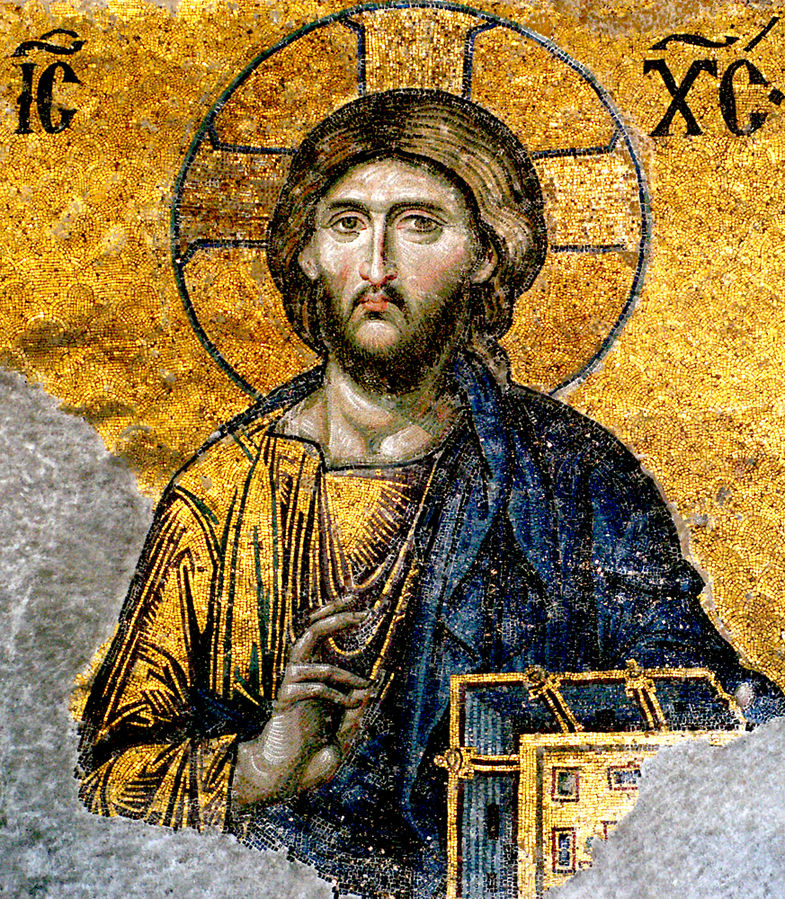
Detail of Jesus Christ at the Hagia Sophia in Istanbul, Turkey; photo from wikipedia.org.
We now come to the final Sunday celebration of the year, the Solemnity of Christ the King. See how we close the liturgical calendar celebrating Christ’s kingship, only to open it anew next Sunday with Advent Season in preparation for Christmas, the birth of the King of kings.
Far from the connotations of power and authority of kings of the world, Christ’s kingship is more pastoral in nature by taking its cue from the image of a shepherd prevalent in the ancient Middle Eastern culture. In fact, Jesus is more perfect than any shepherd being the Good Shepherd himself, the fulfillment of the promise of God we heard in the first reading who would come to personally tend his flock.
As I prayed over our readings of this Solemnity which is one of the youngest feasts we have in the church at less than 100 years old since its introduction in 1925 by Pope Pius XI, my thoughts wandered during that first year of the COVID-19 pandemic in 2020 when churches were closed and public Masses were prohibited.
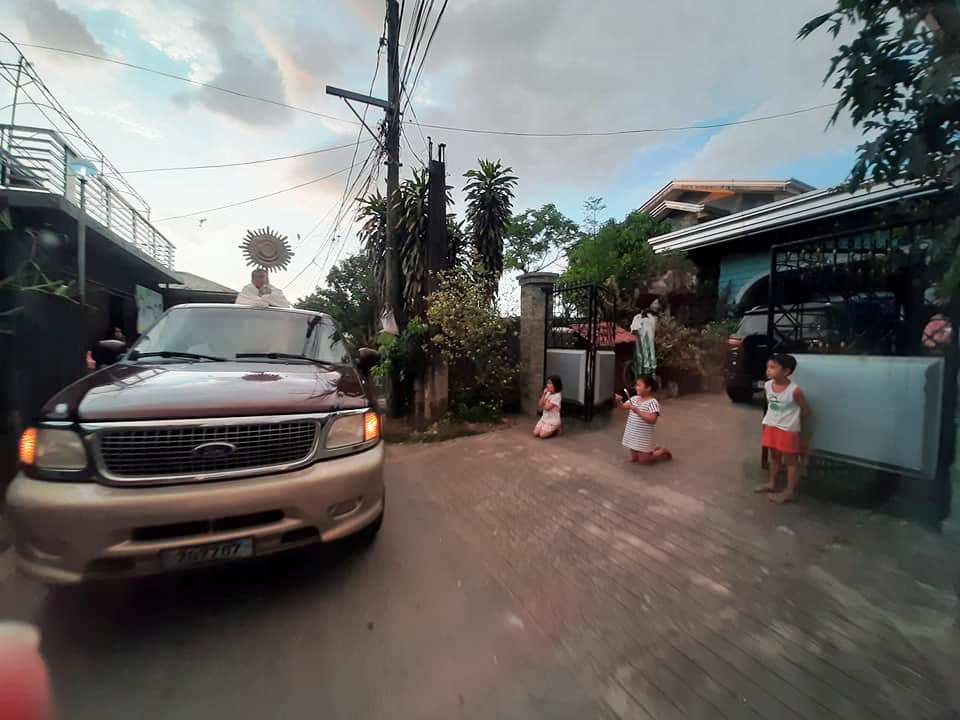
Photo by Ms. Ria De Vera, Christ the King celebration in our former parish during pandemic, November 2020.
Right on the first Sunday when lockdown was imposed, we started our weekly “motorized procession” of the Blessed Sacrament around our former parish in Bulacan. I was so moved at the piety of our parishioners who knelt on the streets whenever we passed by.
We continued the practice until the Solemnity of Christ the King on that year of 2020. As usual, the people knelt on the streets when we passed by with the Blessed Sacrament. Even passengers of buses and other vehicles that chanced upon our procession paid homage to Jesus in the Blessed Sacrament.
Photo by Ms. Anne Ramos, March 2020.
Looking back to those days during my prayer periods this week, I realized that it was on that first year of the pandemic when we had the most meaningful liturgical celebrations in the Church when people felt intensely the need for God, when they clearly had Jesus alone as King and Lord.
Everyone’s faith was put to test as we were all gripped in fears and uncertainties with the deadly effects of COVID virus. Almost every family prayed the Rosary daily or nightly, so many trying to sneak inside churches to attend Mass celebrations. Of course, there were still some who went on their evil ways during those difficult times with the tokhang still implemented while those in power shamelessly grabbed the opportunity to rake in millions of pesos from corruption at the expense of the poor and suffering people.
When we recall that year 2020 of the pandemic, it was at that time we experienced Christ’s Second Coming as everyday was a judgment day, the end of the world — though not entirely fearful because it was also during that time we felt closest to God in Jesus our Lord and King!
Behind all those acts of kindness and goodness of the people are the immense love and mercy of God in Jesus Christ we have experienced in the recovery of infected loved ones or in the simple negative results of our COVID tests.
It was during those days when we experienced and felt Jesus truly present in us and among us that we simply radiated him on many occasions. That first year of the pandemic proved to many of us that being good, being kind, being helpful would never destroy nor diminish our person but had actually strengthened us as individuals and as a community. Recall how the “community pantry” caught the whole country on fire in just a matter of weeks when a young lady started it in their neighborhood at Maguinhawa Street, UP Village in Quezon City.
When families and communities banded together in love and kindness to help the poor and needy, the sick and those who have lost loved ones, the experience did not pulverize them but actually crystallized them as family or friends or neighbors. Walang nadurog sa pagdadamayan bagkus nabuo ang lahat ng nagtulungan!
That is the kingship of Jesus Christ. His power and authority were never meant to destroy us. In fact, when he came to us, he showed us and made us experience that the power and authority of his kingship is found not in force but in love and mercy that sadly many see these days as weaknesses.
Then the righteous will answer him and say, ‘Lord, when did we see you hungry and feed you, or thirsty and give you drink? When did we see you a stranger and welcome you, or naked and clothe you? When did we see you ill or in prison, and visit you?’ And the king will say to them in reply, ‘Amen, I say to you, whatever you did for one of these least brothers of mine, you did for me.’
Matthew 25:37-40
Photo by Ms. Marivic Tribiana, April 2020.
Christ the King today reminds us that true authority and power lead to humility which is more than being lowly but also of seeing the other person as another human in need, vulnerable and weak. Being humble is not only accepting our humanity but recognizing the humanity of those around us who need to be respected, loved and cared too.
Moreover, Christ the King reminds us that whatever authority and power we have is a sharing in God’s power and authority; hence, these must be used to help others, not lord over them. True power and authority lead to compassion, enabling us to feel the sufferings of others that move us to do something for them like Jesus.
This is what St. Paul reminds us in the second reading: the kingship of Jesus Christ – his power and authority – are a sharing in God. Unlike the worldly kings, Christ’s kingship is intimately related to the rule of God and ultimately subjected to the Father that is why it is transformative and performative to borrow one of Pope Benedict XVI’s favorite terms.
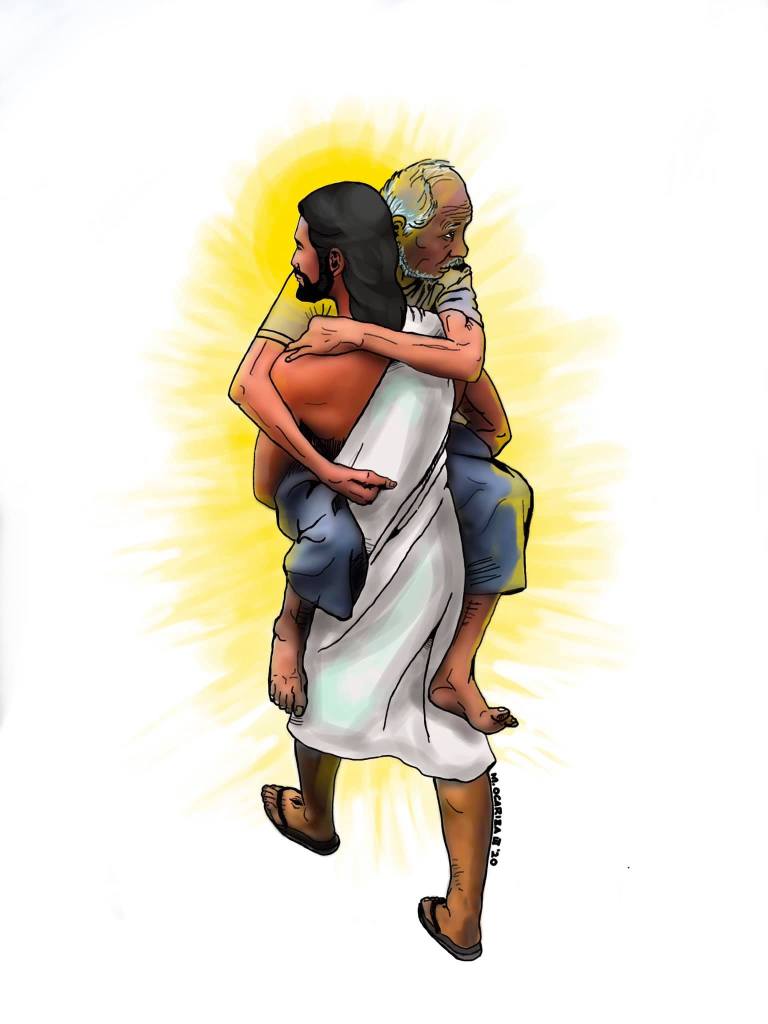
Artwork by Fr. Marc Ocariza based on Ms. Tribiana’s photo, April 2020.
The Kingship of Jesus Christ is the power to love, the most potent force in the universe. Yes, there are still evil and sin in the world today but soon, they shall be finally removed in Christ’s return as king. The present moment calls us to see Jesus in everyone we meet so that we act like him in loving service to others.
Notice how Jesus ended today his teachings at the temple area with a parable of the judgment of nations where people are separated according to their deeds. At the end of time, that is what Jesus will ask and judge us: how much have we loved like him? What have we done in this world, in life?
For us to better answer that, let us keep in mind what Jesus had done and still does to us and for us, of how much he loves us as our King and Protector. Recall the countless times he poured us his love for us. The moment we see his kingship in God’s way, then we follow Christ’s power and authority in the name of love and mercy, kindness and gentleness. Amen. Have a blessed week ahead!
The Lord Is My Chef Daily Recipe for the Soul by Fr. Nicanor F. Lalog II
Friday, Memorial of St. Elizabeth of Hungary, Religious, 17 November 2023
Wisdom 13:1-9  <'[[[[>< <'[[[[><  +  ><]]]]'> ><]]]]'>   Luke 17:26-37
Photo by author, St. Scholastica Retreat House, Baguio City, 23 August 2023.
Arouse us, dear God,
our loving Father,
awake us from our sleep,
let us open our eyes,
our hearts,
our very selves
to your divine presence
around us and within us;
let us bask in this most
lovely divine milieu
so many have tried so hard
to negate and discard
as not true.
How true are your words
again this day from the
Book of Wisdom:
All men were by nature foolish who were in ignorance of God, and who from the good things seen did not succeed in knowing him who is, and from studying the works did not discern the artisan.
Wisdom 13:1
How foolish have we become
to reject you, to abandon you,
to not believe nor recognize
you, O God, who can be gleaned
from nature and creation,
most especially in our studies
and search for truth and meaning;
but twice foolish are those who
believe only in themselves,
playing gods, worshipping their
body and beauty,
amazed with their strength and power
full of conceit and self-centeredness
(cf. Wisdom 13:2-4).
Keep us simple, Father,
to find you in little things,
in the unseen realities of this life
that point us to your divine milieu;
let us not wait for that sign
of gathering of vultures
when we lay wasted,
and dead to sin
and blindness.
Amen.
The Lord Is My Chef Daily Recipe for the Soul by Fr. Nicanor F. Lalog II
Thursday in the Thirty-Second Week of Ordinary Time, Year I, 16 November 2023
Wisdom 7:22-8:1   <*(((>< + ><)))*> = <*(((>< + ><)))*>   Luke 17:20-25
Photo by Dra. Eunice Nikki A. Vergara, MD in Victoria, Laguna, 2020.
Your words are so lovely
today, O God our Father,
citing to us your many attributes
as Wisdom, "a spirit intelligent,
holy, unique, manifold, subtle"
and some 30 others that beautifully
present to us your transcendence
and immanence not only around us
but most of all within us!
What I like most, O God,
are these:
For Wisdom is mobile beyond all motion, and she penetrates and pervades all things by reason of her purity. And she, who is one, can do all things, and renews everything while herself perduring; and passing into holy souls from age to age, she produces friends of God and prophets.
Wisdom 7:24, 27
You are so great and awesome,
dear God, yet so close to us your
mere creatures like our breath,
so personal indeed as a friend,
so loved and always forgiven,
renewed and made pure
in your presence.
Forgive us for those moments
when like the Pharisees in
the gospel continue to ask you
for visible signs of the Kingdom of God;
we just have to feel you inside us,
we just have to recognize your dwelling
in us in Jesus Christ,
we just have to open our selves,
our minds and our hearts
to your little comings
until we have grown so big
in you and your presence,
in your love and mercy.
Amen.