40 Shades of Lent by Fr. Nicanor F. Lalog II
Tuesday in the First Week of Lent, 20 February 2024
Isaiah 55:10-11   <*((((>< + + + ><))))*>     Matthew 6:7-15
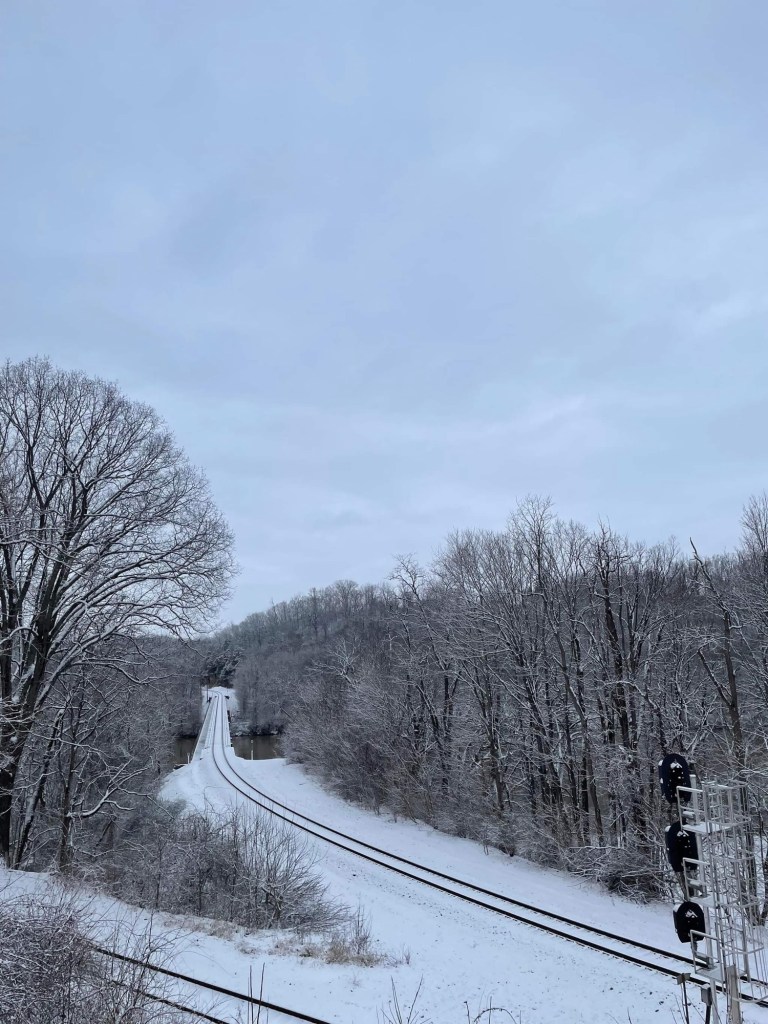
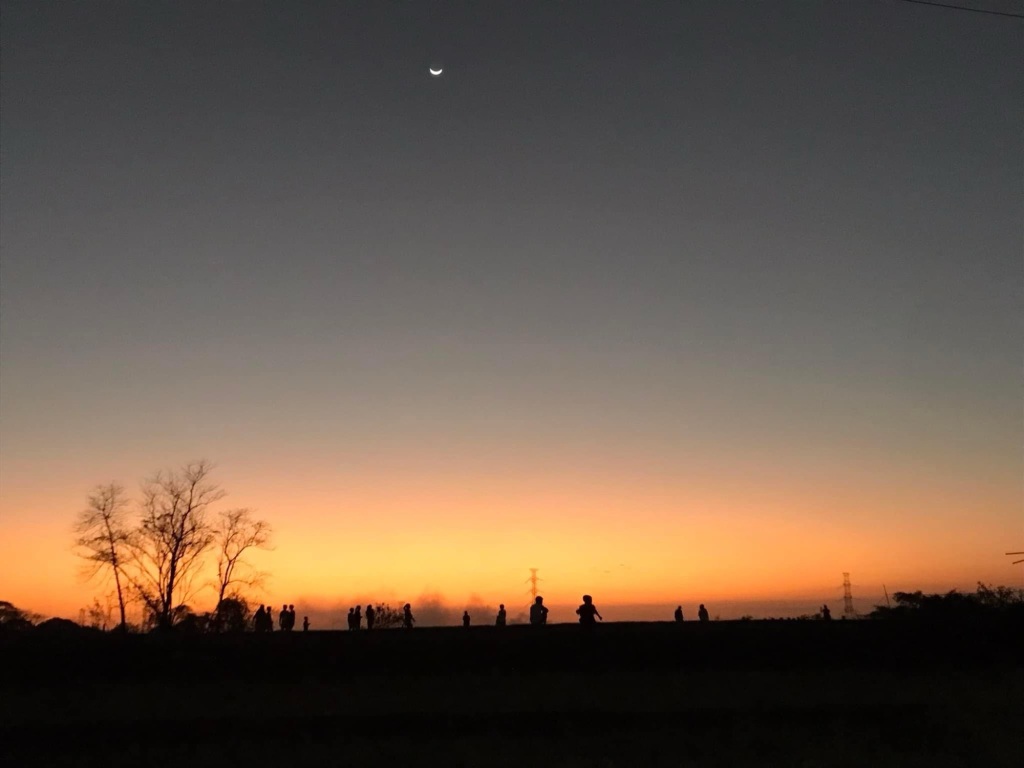
Photo by author, 2019.
Jesus said to his disciples:
"In praying,
do not babble like the pagans,
who think that they will be heard
because of their many words.
Do not be like them.
Your Father knows what you need
before you ask him.
This is how you are to pray:
Our Father in heaven,
hallowed be thy name,"
(Matthew 6:7-9).

What a great segue,
so seamless!

Jesus said you know
what we need before we ask you
yet he tells us too
how we must pray
by calling you "Our Father"!
If you know what we need, Father,
then, why should
 we pray
at all?
In this blessed season of
Lent, teach us Lord
to go back to you
in prayer
because in prayer,
you let us know
what we really need
to be fulfilled,
to be at peace,
to be fruitful
and that is you,
dear Jesus;
in prayer,
you make us realize
that more than things,
what we really need
is a relationship
with you
who loves,
who feels,
who is like us
in everything except sin;
in prayer,
we are disarmed
of our many defenses
and pretensions,
making us humble
to be more loving
while in need of a lot of loving too
only you can give.
Yes, God,
you know everything we need
before we pray to you
but we need to pray
because we simply need you
whose words are "like
the rain and snow
that come down
 and do not return there
till they have watered
the earth,
making it fertile and fruitful,
giving us seeds
and bread
to eat,
achieving the end
for which
you sent your
word"
(cf. Isaiah 55:10-11).
Amen.
Photo by Mr. Vigie Ongleo in Virginia, January 2024.
The Lord Is My Chef Daily Recipe for the Soul by Fr. Nicanor F. Lalog II
Monday in the First Week of Lent, 19 February 2024
Leviticus 19:1-2, 11-18   ><))))*> + + + <*((((><     Matthew 25:31-46
Photo by Mr. Jay Javier in Quiapo, Manila, 09 January 2024.
Today I pray dear God
to your directive since the
Old Testament until the coming
of your Son Jesus Christ:
"Be holy , for I, the Lord your God,
am holy" (Leviticus 19:2).
But, what is really to be holy,
what is to be like you,
God?
There are so many other
traits and characteristics I can think
of you as being holy,
O God,
that we have to imitate
to be like
you
that makes holiness
 so difficult,
elusive,
and impossible!

Who can really be like you
when we are so different from you?
But, thank you in sending us
Jesus who not only made it
possible for us to be holy
like you, God,
but also made it
simpler:
“Amen, I say to you, whatever you did for one of these least brothers of mine, you did for me… Amen, I say to you, what you did not do for one of these least one, you did not do for me.”
Matthew 25:40, 45
On this blessed season
of Lent,
teach us to fast
and be empty of ourselves,
of our pride,
and of our sins
so we may be filled with YOU;
holiness is first of all
being filled
with you, O God,
that we feel,
we see,
we think
of others like you,
that is, of seeing you
in each one of us.
When we begin to
realize and experience
that you fill us, O God,
then we learn to be
generous in sharing
more of ourselves,
of our time,
of our talent,
of our treasure,
and most of all,
of you dear God
dwelling in us
with others;
we can only be holy
not when we try being
like you but more of finding
you first in us
in order to find you
in others too!

Then,
maybe we stop
fighting,
committing every sin
against each other
if only we can see you
dwelling,
filling
each one of us.
Amen.
The Lord Is My Chef Sunday Music by Fr. Nicanor F. Lalog II, 18 February 2024
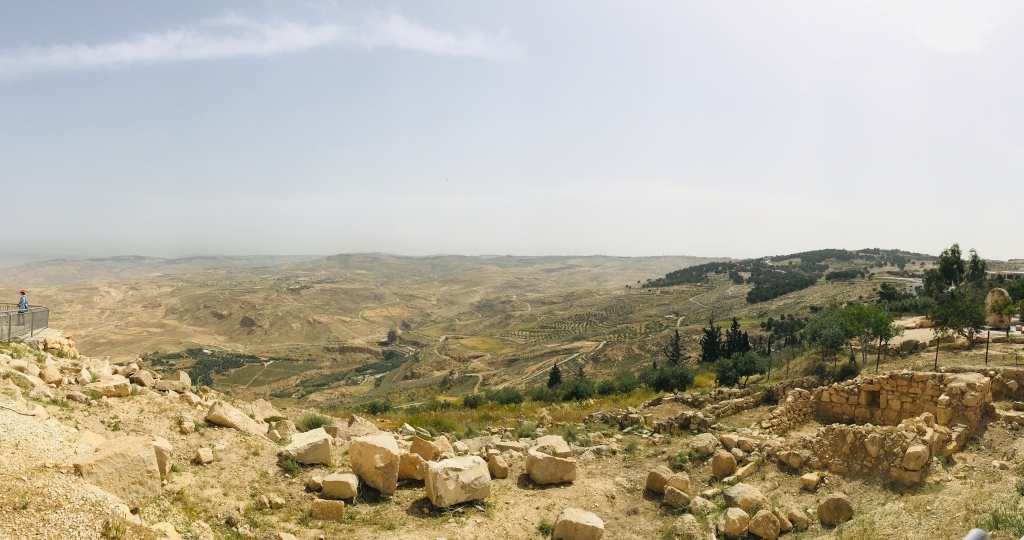
Photo by author, view of Israel from side of Jordan, May 2019.
It is the first week of Lent where the gospel is always about the temptation of Jesus by the devil in the desert. Naturally, the other thing that came to our mind while praying was the song A Horse With No Name by three young Americans who called themselves “America”.
It was still the great heydays of rock n’ roll and even though we were still too young at the time when this was playing on the airwaves, we just knew it was a great music especially when every grown up man was listening to it, humming it and even plucking its chords in their guitars. At that time, we just loved the melody and poetry of the lyrics, beginning with the unusual title A Horse With No Name with its very propitious guitars that kicked our imaginations of a far away journey in the desert.
On the first part of the journey I was looking at all the life There were plants and birds and rocks and things There was sand and hills and rings
The first thing I met was a fly with a buzz And the sky with no clouds The heat was hot and the ground was dry But the air was full of sound
I’ve been through the desert on a horse with no name It felt good to be out of the rain In the desert you can’t remember your name ‘Cause there ain’t no one for to give you no pain La la la la la la…
The desert is more than a place in the Bible. It was more of a setting for meeting and experiencing God amid its dryness and wilderness. Every great prophet in the Old Testament went to the desert to pray and meet God; hence, in the New Testament, Jesus was shown as going first to the desert before launching his mission.
How ironic yet amazing that it is in the desert of our life’s poverty and limitations, sickness and weakness, dryness and weariness when we actually meet God, when we experience fulfillment and meaning in life (https://lordmychef.com/2024/02/17/lent-a-pilgrimage-to-god/). This biblical meaning of the desert was not far from the views of the song’s composer, Dewel Bunnell who explained later that A Horse With No Name was “a metaphor for a vehicle to get away from life’s confusion into a quiet, peaceful place” (from Wikipedia).
However, we remember too how when we were in high school (early 80’s) while listening to “American Top 40” on 99.5RT-FM when Casey Kasem claimed Bunnell saying that they were simply playing with words and chords when they came up with A Horse With No Name!
Whatever… but the music has become a classic because of its sincere message about life as a mystery not meant to be solved at all (because it is unsolvable!). For five decades since releasing A Horse With No Name, the trio of America had taught us how to deal with life’s mysteries by simply allowing ourselves to be wrapped by these mysteries, keeping our hearts and minds open in awaiting new revelations unfolding before us daily. Don’t forget too to have that sense of awe while being wrapped by life’s mysteries which is actually what Lent is asking us during this season as we return to God, our very root and grounding in order to find ourselves anew who are so lost in this world of so many disguises.
After nine days I let the horse run free ‘Cause the desert had turned to sea There were plants and birds and rocks and things There was sand and hills and rings
The ocean is a desert with its life underground And a perfect disguise above Under the cities lies a heart made of ground But the humans will give no love
Here’s America with their first hit A Horse With No Name. Sing along, reflect and, pray. Have a blessed week ahead in this desert of life!
40 Shades of Lent by Fr. Nicanor F. Lalog II
Sunday Recipe for the Soul, Lent I-B, 18 February 2024
Genesis 9:8-15 + + 1 Peter 3:18-22 + + Mark 1:12-15
Pope Benedict XVI eloquently described Lent in his first papal Lenten message in 2006 when he wrote, “Lent is a privileged time of interior pilgrimage towards Him Who is the fount of mercy. It is a pilgrimage in which He Himself accompanies us through the desert of our poverty, sustaining us on our way towards the intense joy of Easter.”
What a beautiful picture too of the short gospel from Mark we heard this first Sunday in Lent that briefly describes the temptation of Jesus so unlike the detailed versions by Matthew and Luke. Nonetheless, Mark’s terse account is loaded heavily in rich symbols and meanings.
The Spirit drove Jesus out into the desert, and he remained in the desert for forty days, tempted by Satan. He was among the wild beasts, and the angels ministered to him. After John had been arrested, Jesus came to Galilee proclaiming the gospel of God: “This is the time of fulfillment. The kingdom of god is at hand. Repent, and believe in the gospel.”
Mark 1:12-15
This scene comes right after the baptism of Jesus by John at the Jordan. It is sad that our liturgical texts have not yet adopted the new revised editions of major Catholic bibles wherein Mark noted how “immediately” or “at once” after his baptism, Jesus was tempted in the desert.
(At once) The Spirit drove Jesus out into the desert tempted by Satan.
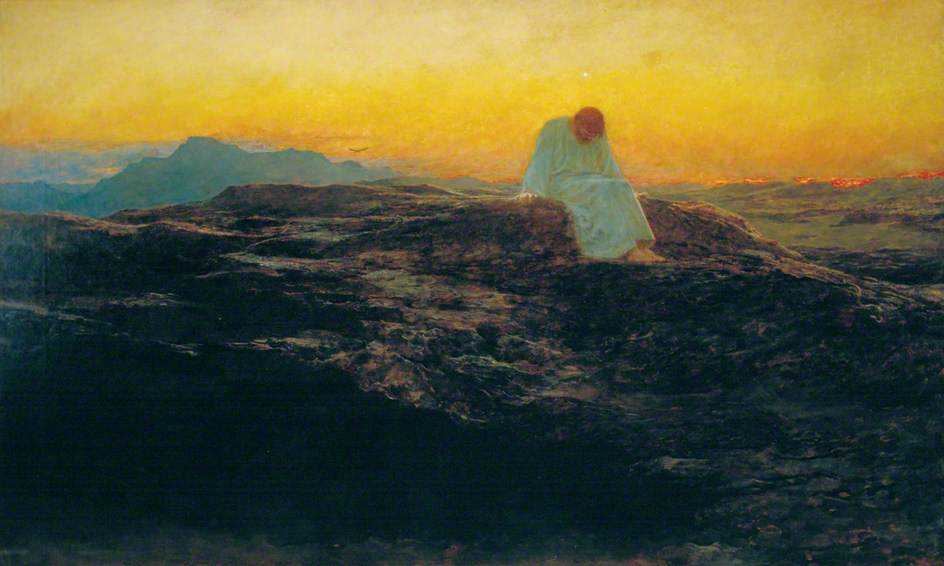
“Temptation in the Wilderness” painting by Briton Riviere (1840-1920) from commons.wikimedia.org.
Do we not experience the same thing daily in life when even right in the moment we are trying to pray, trying to become better when temptations come our way like when we decided to pray or go celebrate the Mass, something else would distract or prevent us from fulfilling it?
See how difficult it is to go on diet when suddenly mother cooks your favorite meal or somebody comes for a visit with burgers and sodas and cakes! Just when you have decided to quit a vice, at once the temptation comes to pick it up again, as we plea to make it our “last” cigarette or joint, last shot of alcohol, last look at pornography, last gamble and so many other lasts that never really ended! Recall those times we decided to finally embark on any religious or spiritual endeavor when at once we are intensely challenged by carnal and material desires.
It is a reality of life that Jesus faced too like us, being tempted immediately by Satan after his baptism when God identified him as his beloved Son with whom he is well pleased. Mark warns us today how Satan is bent on tempting us to abandon God, be lost and just be ordinary without meaning and fulfillment in life and existence. The five Sundays in Lent depict to us our internal pilgrimage and journey into God’s inner room to be with him in Christ Jesus. It is a pilgrimage as we return to our very root and grounding who is God. Let us not waste the grace of this blessed season to become like God again, truly his image and likeness marred by sin and evil.
Oh what a joy to be one with God again, to regain our true selves – contented and fulfilled in our very selves minus all the trappings of this world’s artificialities of fake selves with fake faces and skin, of fake lives glamorized in social media. It is a pilgrimage in the desert where we are invited to leave everything behind, to be bare and nothing for we solely need only God to truly see again our selves as true, good, and beautiful. Not with cosmetics nor food nor even modern thoughts and ideas pretending to be just and fair that deceive us and leave us more empty and lost.
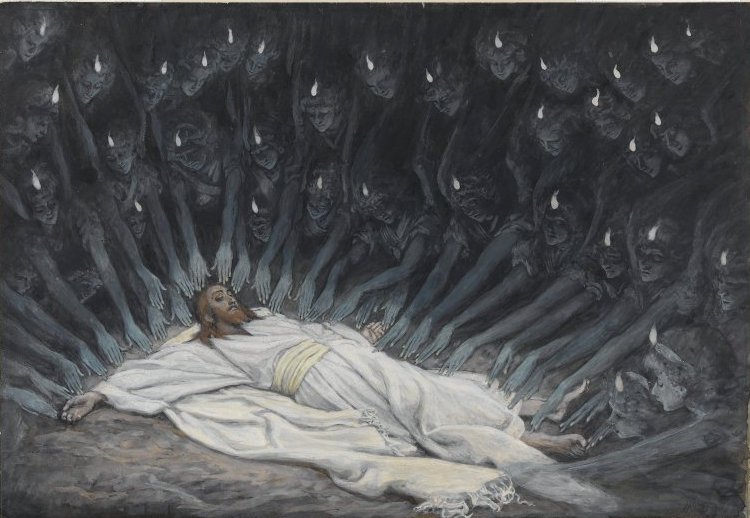
He was among the wild beasts, and the angels ministered to him.
“Jesus Ministered to by Angels” painting by James Tissot (1836-1902) from commons.wikipedia.org.
Lent is an interior pilgrimage to God lived in the wilderness too, an invitation for us to go back to Paradise even in the midst of the chaos around us. This we do every Sunday in the Mass when we go back to God, to his Church and the sacraments.
This is why Lent is the time for more prayers, fasting and alms-giving as they all strengthen our spiritual resolve to become better persons, to become who we really are – beloved children of God with dignity, meaning and purpose found in him.
Despite the fall of Adam and Eve, God never abandoned us because he loves us so much that he sent us Jesus Christ his Son to accompany and show us how among the wild beasts around us, there are angels attending to our needs at all times. Everyone has a struggle, a problem dealing with. Nobody is without any crisis nor lives perfectly. That’s the imagery of the desert, a wilderness with the wildest beasts that are most ferocious and most poisonous.
Yet, God has assured us even right after the Fall that we are his most precious creation that he takes the initiative always to save us from every danger of sickness and death. Most of all, of sin like when Cain was so jealous of his brother Abel, the Lord said to him, “Why are you angry? Why are you dejected? If you act rightly, you will be accepted; but if not, sin lies in wait at the door; its urge is for you, yet you can rule over it” (Gen. 4:6-7).
In the first reading we heard how God acted like human, so fed up with our sinfulness that he sent a great flood to wipe the earth clean again. However, do not forget that before sending the great flood, God sent first Noah and his family. Again, that is exactly how our life is!
Unknown to us, long before any problem and sufferings come to us, there is always God preparing already a remedy, a solution, an exit plan for us in the first place like when he sent Noah and his family to ensure there would still be good people left after the flood. This reached its highest point in Jesus whom the Father sent to become the new rainbow of the sky when Christ stretched out his arms on the Cross to save us. Peter beautifully explained this truth in our second reading today, reminding us how the great flood at Noah’s time was a prefiguring of our baptism in Jesus Christ when we become the Father’s beloved and forgiven children.
Never lose hope when things seem to be so bad and miserable in life. Remember how the silver linings appear always after the heavy rains or how the leaves are greenest after the storm. Yes, life is like a desert, a wilderness with so many wild beasts that may times we could not escape temptations and fall into sins. But God is greater than our hearts, sending us more than enough angels even his only begotten Son so we may overcome temptations and sins, downfalls and defeats in life. Go back to God, go back to paradise in prayers and the Mass. Handle life with prayer, always PUSH, that is, Pray Until Something Happens.
After John had been arrested,
Jesus came to Galilee proclaiming the gospel of God:
"This is the time of fulfillment.
The kingdom of God is at hand.
Repent, and believe in the gospel."
This is the most unique feature in Mark’s brief account of the temptation of Jesus by Satan. Mark began his gospel just like the three other evangelists linking the life and mission of Jesus with John the Baptist; however, he abruptly removed John from this scene by simply saying “after John had been arrested, Jesus came to Galilee proclaiming the gospel of God.”
“Ganun lang yon?” we might ask in Filipino. It would take five more chapters before Mark explains to us the fate of John the Baptist.
And yes, that’s the way it is with us too! We never stop with our mission like Jesus amid all the storms and darkness hovering above us. There will always be sufferings and trials coming and these in itself are the reasons for us to continue with our mission like Jesus.
Inasmuch as the lives and fate of Jesus and John are intertwined, so are our lives and fate as disciples of Christ with him! It is during trials and difficulties when our proclamation of God’s kingdom are loudest and most credible. Most of all, it is in our sufferings when we go back to our internal desert when we truly experience the time of fulfillment if we remain faithful to God like Jesus Christ.
Let us pray:
Dearest Jesus:
accompany us
on this first week of Lent
into the Father's house;
make us stop all whining
and complaining on the many
desert experiences we are going
through for that is how life is -
like a wilderness with many wild beasts!
Let us never lose sight of your
loving presence among us, Lord,
of your angels ministering to us,
assuring us of the colorful rainbow
of life in the horizon if we remain
faithful and true.
Amen.
Photo by Ms. Annalyn Dela Torre, Bgy. Caypombo, Santa Maria, Bulacan, 14 February 2024.
40 Shades of Lent by Fr. Nicanor F. Lalog II
Friday after Ash Wednesday, 16 February 2024
Isaiah 58:1-9  + + +  Matthew 9:14-15
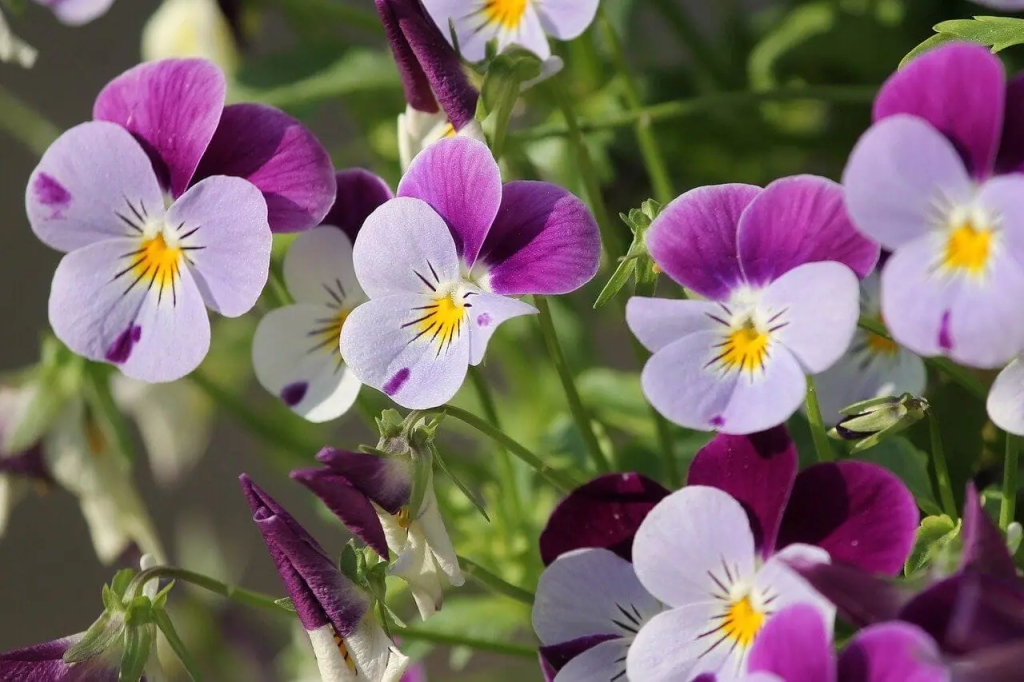
Photo by author, 2020.
Thank you, dear Father
for this lovely season of Lent
when everything is in hue
of violets representing the future,
the imagination and dreams,
while spiritually calming
our emotions to attain
spiritual enlightenment
while at the same time
keeping us grounded in you,
O God,
our very first love.
Give us the courage
in Christ Jesus your Son
to confront our very selves,
to accept who we
really are before you
minus all the pretensions
and alibis and excuses:
forgive us, Lord
because very often we look so
highly of ourselves,
unconsciously or consciously
playing god,
keeping ourselves
as standard and measure
of what is right and proper,
even of truth; worst,
many times, we demand you
to conform to us
than we conforming to you.
Thus says the Lord God: Cry out full-throated and unsparingly, lift up your voice like a trumpet blast; tell my people their wickedness, and the house of Jacob their sins. They seek me day after day, and desire to know my ways, like a nation that has done what is just and not abandoned the law of their God; they ask me to declare what is due them, pleased to gain access to God.
Isaiah 58:1-2
Let us be your prophets
especially in this age when
we no longer fast nor abstain,
no longer praying individually
and communally,
so contented with online Masses,
so that we have forgotten not only
you, Father but even those
around us, both those nearest
to us in the family circle
and those outside our margins;
Father, in this age with
so much emphasis
on individual rights,
we have forgotten about
others: we have refused to
see each others plight
and condition in life
because we have bloated
our egos,
has failed to look at the mirror
to confront our own dirt
and smudges,
questioning everyone
even you, O Lord,
except our very selves.
Amen.
40 Shades of Lent by Fr. Nicanor F. Lalog II
Thursday After Ash Wednesday, 15 February 2024
Deuteronomy 30:15-20 +++ Luke 9:22-25
Photo from petalrepublic.com.
Our most loving
and merciful Father,
thank you
for this new season
of Lent,
in giving us this most
wonderful occasion to
reflect on life's meaning
we always confuse as
outside of us,
dependent on things,
and most of all,
perfect without pain
and sufferings.
Life is Lent.
It is the only season
that begins not on a Sunday
but on an ordinary day
of the week,
right in the midst
of our many duties
and worries
because Lent is something
within us, always asking us
to make the right choices,
of choosing life,
not death;
blessing,
not curse.

Many times, Father,
we are out of touch with
ourselves,
with life itself
which we see as outside
ourselves that we hardly live at all
without experiencing life
itself in its wholeness
that includes all the beauty
and scars,
the lights and darkness,
the glory and sorrows,
the defeats and victories,
the tears and laughter,
the Good Friday and Easter.
If, however, you turn away your hearts and will not listen, but are led astray and adore and serve other gods, I tell you now that you will certainly perish; you will not live a long life on the land that you are crossing the Jordan to enter and occupy.
Deuteronomy 30:17-18
The way to life
that you, Father, offers us
through the life and example
of Jesus Christ your Son
is the exact opposite
that the world
proposes;
help us realize that truth,
clear us of all doubts
and dilly-dallying,
of making excuses and alibis
that what the world sees
as God's ways are limiting
when in fact are liberating!
Then he said to all, “If anyone wishes to come after me, he must deny himself and take up his cross daily and follow me. For whoever wishes to save his life will lose it, but whoever loses his life for my sake will save it. What profit is there for one to gain the whole world yet lose or forfeit himself?”
Luke 9:23-25
We have seen
for ourselves many times
how the way of the world of
indulging in every desire
and pleasure like
 wealth and fame,
sex and drugs
have actually led to destruction
and death,
sorrows and miseries
than life and joy;
clear our minds
and hearts
to make the right
choice and decision
of following Jesus
to the Cross daily
because that is what
it means that life is lent,
a daily journey
 to Good Friday
that leads surely
to Easter.
Amen.
Forty Days of Lent by Fr. Nicanor F. Lalog II
Ash Wednesday, 14 February 2024
Joel 2:12-18 + 2 Corinthians 5:20-6:2 + Matthew 6:1-6, 16-18
Illustration from Archdiocese of Galveston-Houston, 14 February 2018.
This is not the first time that Valentine’s Day falls on Ash Wednesday, the start of the holy season of Lent of 40 days before Holy Week in preparation for Easter. The last time they coincided was in February 14, 2018.
Actually, there is no problem at all with both happening together on the same date. Both celebrations have the heart as its focus, inviting us to examine how much love we have in our hearts, because, ultimately when we die and face God our Creator, He will judge us on how truly we have loved while here on earth.
And because they both speak of love, Ash Wednesday and Valentine’s Day confront the reality of death.
Ash Wednesday reminds us that we all die which is the meaning of the imposition of the ash on our foreheads while the priest says, “Remember that you are dust, and to dust you shall return.” But, we do not merely die and end life on earth. Notice how the ashes imposed on us are shaped as cross because Ash Wednesday assures us that we die in the love of Jesus Christ our Savior who leads us into eternal life.
Meanwhile, Valentine’s reminds us of our undying love for those bonds of love we make throughout our lives as lovers, friends, and admirers. Lovers and couples pledge – with or without God – their love for each other “til death do us part.” Anyone who truly loves and had truly loved knows that death is love’s final test. And the whole world is filled with so many beautiful stories and magnificent buildings and structures that remind of us one’s undying love like the Taj Mahal in India.
Therefore, today is a wonderful celebration, an amazing juxtaposition of the sacred Ash Wednesday and the secular Valentine’s Day on this February 14 so that we may purify the love in our hearts, that our love is not merely expressed in words but most especially in deeds.
From Sisters of Providence of Saint-Mary-of-the-Woods.
For his Lenten Message this year, the Holy Father had chosen the theme of freedom in his reflection by going back to the Exodus experience of the Israelites. Indeed, love and freedom go together. Always.
Lent is the season of grace in which the desert can become once more – in the words of the prophet Hosea – the place of our first love (cf. Hos 2:16-17). God shapes his people, he enables us to leave our slavery behind and experience a Passover from death to life. Like a bridegroom, the Lord draws us once more to himself, whispering words of love to our hearts.
Pope Francis, “Through the Desert God Leads Us to Freedom” (Lent 2024)
Love is most true when there is freedom. We cannot truly love if we are not free. And the more we love, the more we are free, that is, free to love, free to be caring, free to be kind, free to be honest and true, free to be sincere.
From simchafisher.com.
Remember your first crush or your first love. Amid all the exciting feelings and “kilig moments” we have had every time our eyes met those of our crush or when our skin touched each other, one thing we always made sure was to keep it a secret.
During our time, it was imperative that we boys and men keep our feelings to our selves about our crush and love interests because, the moment our love, our feelings are made known, problems happen. Everyone in the class or barkada starts teasing, making us unnatural in our words and actions as they dictate us on what to do and what to say. Our crush or beloved then gets irritated and uncomfortable with all the attention she gets not really from us but from every Maritess and Marisol around!
I have realized later in life that when something so deep is so true, most often we treasure it in our hearts, keeping it in secret not for anything else but to make it grow and mature. In this case, into selfless love. People who brag their love or crush or just everything in life are often the most untrue and unfree. Everything is just a show or palabas for them, a front that is not real which is what we see on social media. Jesus tells us true love that is free is something more of the inside than of the outside appearances:
Jesus said to his disciples: ”Take care not to perform righteous deeds in order that people may see them; otherwise you will have no recompense from your heavenly Father. When you give alms, do not blow a trumpet before you… When you pray do not be like the hypocrites, who love to stand and pray in the synagogue and on street corners so that others may see them… When you fast, do not look gloomy like the hypocrites… your Father who sees what is hidden will repay you.”
Matthew 6:1-2, 5, 16, 18
Photo by author, Our Lady of Fatima University-Laguna, 19 January 2024.
Love and freedom go together. Love grows and deepens only when there is freedom because love is a grace from God that naturally flows out from us, from our being. There is no need to make noise about it or be dramatic for everyone to see. Just let your love flow as the song from the 1970’s said.
When we “manipulate” our love, we become self-conscious instead of being mutual. Love is always other centered as the late American Trappist monk Thomas Merton said, “the sign that we truly love is when we love somebody more than ourselves.” When we have so much of ourselves, when we are selfish, that is when we reject God and eventually others. That is why every sin is essentially a refusal to love which bothers us inside as we feel guilty and become unfree to be who we are, beloved and loving.
Lent invites us to love and be free through conversion, a turning of our hearts away from the wrong loves we have pursued and led us to loneliness, emptiness, and sadness within. Love and freedom come from within our hearts where God dwells; hence, the call of the Prophet Joel to turn our hearts back to God:
Photo by author, Lent 2019.
“Even now, says the Lord, return to me with your whole heart, with fasting, and weeping, and mourning; rend your hearts, not your garments, and return to the Lord, your God.”
Joel 2:12-13
To speak of the heart is to speak of the whole person whose only fulfillment is found in God. A heart that is far from God is a person separated not only from God but also from others, even from himself. Only a heart that is inclined to God is able to truly love and be truly free. A heart without God is a heart without love, a heart that is not free because it had gone cold and dead.
Conversion then leads us to reconciliation, to being one again in God in Jesus Christ as St. Paul admonished in the second reading, “We implore you on behalf of Christ, be reconciled to God” (2 Cor. 5:20). To be reconciled with God is to be one with Him in our hearts through prayer, almsgiving, and fasting that are the hallmarks of the Season of Lent that lead us to true freedom that deepens our love for God and others.
Prayer enables us to pause and regain our freedom to examine our real selves, of how truly free are we especially in this world when there are so many voices dictating us on everything that have left us alienated, lost, and confused within.
Almsgiving sets us free from greed and helps us regard our neighbors as brothers and sisters. It deepens our love for God because our daily encounters with those who beg for our help point us to God Himself who provides us with everything we need.
Fasting on the other hand weakens our tendency to be self-centered, “disarming” us of our false selves, removing the masks we put to impress others so that we can grow and mature as it makes us more attentive to God and others.
As we begin our 40 days of Lent today, let us journey into our hearts and into the heart of God so we can truly be free to love like Jesus Christ His Son who died on the Cross on Good Friday.
Ash Wednesday on a Valentine’s Day is the perfect reminder to us all that the Cross is the best expression of love symbolized by the heart that is free and willing to suffer and die for a beloved. May we “not receive the grace of God in vain” (2 cor. 6:1). Amen. Have a blessed week ahead.
The Lord Is My Chef Daily Recipe for the Soul by Fr. Nicanor F. Lalog II
Tuesday in the Sixth Week of Ordinary Time, Year II, 13 February 2024
James 1:12-18 <*((((>< + ><))))*> + <*((((>< + ><))))*>  Mark 8:14-21
Photo by Dra. Mylene A. Santos, MD, at Bgy. Tagalag, Valenzuela City, 2023.
On this eve of Ash Wednesday,
help us, dear God,
to prepare for a
meaningful start tomorrow
of our Lenten journey of
40 days to Easter;
banish from our minds
and hearts all thoughts
and apprehensions
about the coming days
of fasting and abstinence,
prayers and penance,
and alms-giving;
forgive us, Father,
when our attention goes
to the details and technicalities
of Lent that we set aside
the most essential
which is to return to you -
our very first love.

Enlighten our minds
and our hearts, Father in your
Son Jesus Christ,
to understand fully the
meaning of Lent which is
having less of ourselves
and of the world
to have more of you
and of the Spirit;
until now, we have not
yet understood Christ's coming
and teachings as we are still bothered
by our scarcity and poverty,
never comprehending at all
how despite the affluence and
abundance of material things
these days, the more we have
become empty and lost in life.
When he became aware of this he said to them, “Why do you conclude that it is because you have no bread? Do you not yet understand or comprehend? Are your hearts hardened? Do you have eyes and not see, ears and not hear? And do you not remember, when I broke the five loaves for the five thousand, how many wicker baskets full of fragments you picked up?” They answered him, “Twelve.” When I broke the seven loaves for the four thousand, how many full baskets of fragments did younpick up?” They answered him, “Seven.” He said to them, “Do you not still understand?”
Mark 8:17-21
Worst,
we got it all wrong that
our sinful temptations are
from God, not realizing these
come from our own worldly
desires.
Rather, each person is tempted when he is lured and enticed by his desire. Then desire conceives and brings forth sin, and when sin reaches maturity it gives birth to death. do not be deceived, my beloved brothers and sisters: all good giving and every perfect gift is from above, coming down from the Father of lights, with whom there is no alteration or shadow caused by change.
James 1:14-17
On this Tuesday
before Ash Wednesday,
we pray, O God,
for us to understand
the sources of temptations
and sins within us;
give us the courage
and strength to confront our
true selves,
to be sincere before you
so that we may be
transformed into your
image and likeness
that Christ had restored
in us.
Amen.
The Lord Is My Chef Daily Recipe for the Soul by Fr. Nicanor F. Lalog II
Monday in the Sixth Week of Ordinary Time, Year II, 12 February 2023
James 1:1-11  ><))))*> + ><))))*> + ><))))*>  Mark 8:11-13
Photo by author, Lake of Galilee in Israel, May 2019.
Dear Jesus:
I love that word "kind"
from the responsorial psalm
"Be kind to me, Lord,
and I shall live"
and that scene from the
Gospel when you "sighed":
the word "kind"
is from the root "kin"
or "kindred", that is,
someone like us,
from the same family,
or the same tribe;
being kind is treating others
as one's family or kin
and that is how you are to us -
kind!
And you were most like one of us,
and kind, dear Jesus
 when you "sighed from the depth
 of your spirit" (Mk. 8:12)
after the Pharisees
asked you for sign from heaven
 to prove you were the Christ;
of course, that meant nothing
for the Pharisees but for us
who believe in you, it was something;
like you, dear Jesus,
many times we sigh out of
exasperation and exhaustion,
acceptance and surrender,
hope and inspiration
to persevere,
to keep on,
to forge on in life.
You became like us,
dear Jesus,
in everything except sin
but, when you sighed
we felt you being so kind too,
truly a brother to us
like when St. James
addressed us 15 times
as "brothers and sisters"
in his short letter
while teaching us the important
lesson of bearing all trials
in life as you did at your
Crucifixion, Lord.
Whenever we sigh,
may we remember your kindness,
your being one with us, Jesus
because you too sighed
during those amazing moments
of difficulties and trials,
powerlessness and poverty
when we most gain character
and depth as person,
not when we are strong
and powerful
or successful.
Amen.
The Lord Is My Chef Sunday Music by Fr. Nicanor F. Lalog II, 11 February 2024
Photo by Mr. Vigie Ongleo in Virginia, 02 February 2024.
It’s the final Sunday in Ordinary Time before we begin our 40-day journey of Lent this Ash Wednesday which falls on February 14th, Valentine’s Day. That is why we have chosen a music that is light and easy and romantic, though poignant about those big what ifs in life, What Might Have Been by Grammy-nominated Lou Pardini.
Co-written with jazz vocalist Ms. Kevyn Lettau, What Might Have Been is Pardini’s most popular song especially here in the Philippines and Asia that was included in his first solo album Live and Let Live released in 1996. Unknown to many, Pardini’s first composition ever recorded was also Smokey Robinson’s most popular song, Just To See Her released in 1987. It earned Robinson a Grammy while Pardini was nominated to a Grammy too for the composition. From 2009-2022, Pardini was the lead vocalist and keyboardist of Rock and Roll Hall of Fame band Chicago. He had collaborated too with almost major bands and vocalists in his career with some stints in Hollywood providing music in some movies and TV shows.
What Might Have Been tells us the story of a love lost and the resulting regrets by the singer. Most of all, it touches one of everyone’s favorite subject and theme or question in life: ”what might have been” our lives be had we made the right choices or have been better or wiser, perhaps more faithful or understanding?
Somewhere lost in the wind I’m watching you Sunlight touching your hair And I remember
Somehow We said that we would never stray But somehow we lost our way Promises to often spoken
Are easily broken apart I’m ready this time I know that I’m No longer undecided
Don’t want to be a fool wondering… … What might have been Trace of forever lingering Drawing me closer to you
A new beginning Now I know There is no doubt I understand
Just how fragile love can be I can’t forget Your memory found me Now I know where I belong…
I’m ready this time I know that I’m No longer undecided Don’t want to be a fool wondering…
… What might have been
I love that last stanza saying, “I’m ready this time/I know that I’m/No longer undecided/Don’t want to be a fool wondering…/What might have been/.” We find this stanza so appropriate and close with the lessons of this Sunday’s gospel when a leper approached Jesus, knelt before him and begged, “If you wish, you can make me clean.” Moved with pity, Jesus stretched out his hand, touched him, and said to him, “I do will it. Be made clean” (Mk. 1:40-41).
Many times in life, we are afraid of approaching the love of our life, even God, for so many reasons but later we find them not important at all. Worst, there were times the other person was just waiting for us to make the move or to approach her/him or them.
Jesus is passing by everyday in our lives, welcoming us even in our worst selves or situations like that leper (https://lordmychef.com/2024/02/10/approaching-jesus-approachable-like-jesus/). Let us approach him, go to him and express what’s deepest in our hearts no matter what these may be. Jesus loves us so much. He wants us to come to him and join him in his journey. Let us leave our comfort zones like our past with all of its mistakes and failures, pains and hurts to start anew in him again. It is Christ’s will too that we be better.
Like in that beautiful lines by Pardini, let us be ready this time, decide once and for all to come to Jesus and follow him instead of wondering what might have been. Don’t let this chance to pass again. Jesus is waiting for us. Have a lovely Sunday, friends!