If You Don’t Know Me By Now (1989) cover by Simply Red

Lord My Chef Sunday Music, Fr. Nicanor F. Lalog II, 11 May 2025
Photo by author, Hidden Valley Spring Resort, Calauan, Laguna, February 2025.

It is the Good Shepherd Sunday and also the eve of local elections in our country. Clearly God is speaking to us today of the need to vote wisely by choosing candidates who can be like good shepherds who will lead our nation to greener pastures.

What a tragedy that despite our being a predominantly Christian nation not only in Asia but in the whole world, we have continued to lag in growth and development because we have consistently put into office corrupt and inept officials.

That is why this Sunday we have chosen Simply Red’s 1989 cover of Harold Melvin & the Blue Notes’ original hit in 1972, If You Don’t Know Me by Now. It is a love song of a man’s lament of how his beloved has failed to “know” him so well that they quarrel so often.

Sing the song everybody, c'mon
If you don't know me by now (Moldova!)
You will never never never know me, ooh

Now all the things that we've been through
You should understand me like I understand you
Now girl I know the difference between right and wrong
I ain't gonna do nothing to upset our happy home

Oh, don't get so excited
When I come home a little late at night
You know, we only act like children
When we argue, fuss and fight

Are we not like that in the Philippines? We cannot move forward as we keep on quarreling because we put the wrong people in government. We never think of the greater majority and of the future generations. Worst, we refuse to accept what we know! We know the candidate as corrupt and shallow yet many still vote for them. We know that the candidates are just popular as actors and actresses without any background at all in governance yet many still elect them into office doing nothing except to entertain.

In a deeper sense, it is in knowing that we are able to love most like Jesus Christ in today’s gospel when he declared “My sheep hear my voice. I know them, and they follow me. I give them eternal life, and they shall never perish” (Jn.10:27-28). For the Jews, knowing another person is more of the heart than of the mind; knowing another person is having a relationship not just being aware of one’s name and address.

Knowing and loving work hand in hand: only Jesus can love us immensely despite his knowing of our flaws and weaknesses and sins. Though it is difficult for us humans to imitate, the most we can do is first of all within ourselves to have that self-knowledge that leads us to accept who we really are to become a better person. Anyone who truly loves God and the country will always choose the best candidate for any office after an effort of knowing everything about them. To hear and follow the Good Shepherd means we choose the best, we reject the worst who are often the most sinful.

Candidates who truly love the country, on the other hand, will never pursue an office if they know in themselves they are not capable of the job ahead. It is something they must learn to accept despite their popularity or desire to be in any position.

Like what the song says, nobody’s perfect but if we work hard to know the other person including ourselves, things can get better for more understanding and acceptance. And love.

We all got our own funny moods
I've got mine, I'll bet you woman, you got yours too
You better trust in me, like I trust in you
As long as we'll be together, it should be so easy to do

Just get yourself together
Or we might as well say goodbye
What good is a love affair
When you can't see eye to eye? Oh
If you don't know me by now (if you don't know me, baby)
You will never, never, never know me (no you won't) ooh
No you won't, no you won't, no you won't
If you don't know me by now (twenty long years, we've been together)
You will never, never, never know me ooh (oh)
If you don't know me by now
You will never, never, never know me (no you won't) ooh

We love the original but we find Simply Red Mick Hucknall’s version so moving, especially the live one from Sydney Opera House in 2010. Enjoy.

From Youtube.com

*Please, know your candidates tomorrow and vote wisely. Together let us build a better tomorrow for all of us despite our flaws and weaknesses.

“My Ever ChangingMoods” (1984) by the Style Council

Lord My Chef Sunday Music by Fr. Nicanor F. Lalog II, 13 April 2025
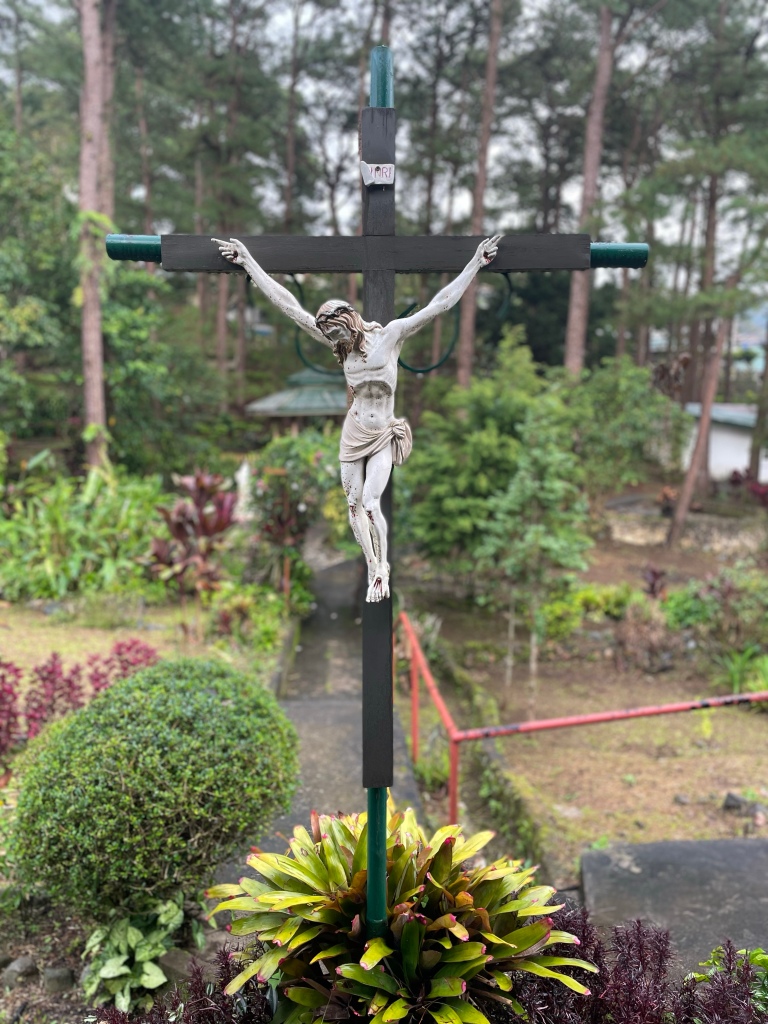
Photo by author, Sacred Heart Novitiate, Novaliches, QC, 17 March 2025.

Today we begin the Holy Week with the celebration of Palm Sunday in the Lord’s Passion.

See how since the entry of Jesus to Jerusalem more than 2000 years ago, nothing much have really changed among us – we are still the same fickle-minded people who would sing “Hosanna in the highest” and later shout “crucify him! crucify him!”.

Everybody wants to become better, each one wishing for so many things without really realizing the good things we are hoping for are all right in front us if we could just open our eyes or listen more or perhaps have a change of heart to realize everyday is a Palm Sunday too for us when God comes right into us to fulfill us.

However, many times whether in our wishful thinking or future-looking and planning, it is highly probable that what we long for is already present to us.

As we begin the Holy Week with the celebration of Palm Sunday in the Lord’s Passion, we are reminded by the liturgy with its long readings how so often in life, we just need to see with different eyes, hear with different ears, expect with different hearts to find fulfillment, peace and joy.

The sad truth is that many times, we really do not know what we want and most of all, we also do not know what we are doing because we are so far from Jesus Christ. https://lordmychef.com/2025/04/12/when-we-do-not-know-what-we-are-doing/

The night before I wrote my homily yesterday, I was posting some reels in my Instagram account when one of the music I used was the Style Council’s 1984 hit “My Ever Changing Moods”. Composed by the group founder Paul Weller who shot to fame in the 1970’s as lead singer and guitarist of the British rock band The Jam, “My Ever Changing Moods” is the Style Council’s fifth single.

Aside from Weller’s superb vocals, “My Ever Changing Moods” is so remarkable in what shall we describe as “subtle intensity” – ang tindi ng dating as we say. Despite the message conveyed by its title, the song is heavy in meanings that can stir one’s soul with its light and easy poetry yet so penetrating. That is why we right away felt its direct link with Palm Sunday.

Daylight turns to moonlight and I'm at my best
Praising the way it all works, and gazing upon the rest, yeah
The cool before the warm, the calm after the storm

I wish to stay forever, letting this be my food
Oh, but I'm caught up in a whirlwind
And my ever changing moods, yeah

Many times in life, we forget that reality of how everything is like the weather that shifts and changes in a rhythmic pattern, “Daylight turns to moonlight…the cool before the warm, the calm after the storm.” The key is openness to these changes happening in us and around us.

Though Weller and critics claim of the song’s political undertones, we see something deeper, something spiritual that we find it so appropriate in this time as we enter the holiest days of the year. Notice these final four stanzas how they convey love and order, something so similar to Jesus Christ’s first words when crucified more than 2000 years ago, “Father, forgive them for they know not what they do” (Lk.23:24).

Teardrops turn to children who've never had the time
To commit the sins they pay for through another's evil mind
The love after the hate, the love we leave too late

I wish we'd wake up one day, an' everyone feel moved
Oh, but we're caught up in the dailies
And an ever changing mood, yeah

Evil turns to statues and masses form a line
But I know which way I'd run to, if the choice was mine
The past is knowledge, the present our mistake
And the future we always leave too late

I wish we'd come to our senses and see there is no truth
In those who promote the confusion
For this ever changing mood, yeah
Photo by author, Sacred Heart Novitiate, Novaliches, QC, 17 March 2025.

What do we really know at all that we continue to crucify Jesus today, nailing him on the cross with our many sins as we pretend and assume to know so many things in life?

To know in the Jewish mind is to have a relationship, an activity more of the heart than of the mind. To know is to love, to care. Therefore, when Jesus prayed to the Father to forgive them for they know not what they do is to forgive them because they refuse to love which is what sin is all about. And that is what we still do not know until now – to love, to care for one another that we keep on crucifying Jesus Christ.

Until now, we pretend to know a lot that some nations resort to wars while some blind followers insist on what they know as right while evading the truth with their fake news being spread to cover crimes and atrocities. Until now we pretend to know what we are doing that everyday everywhere is a road rage happening often costing lives senselessly because many insist on their rights. And the confusions and quarrels and deaths continue because we do not know what we are doing. Like Paul Weller, we pray to Jesus that we’d come to our senses and see there is no truth// In those who promote the confusion// For this ever changing mood, yeah.

For this piece, we chose the slow version on piano of Style Council’s “My Ever Changing Moods” to be more attuned with Palm Sunday; you may check their original music video which is equally excellent.

From YouTube.com

“I Don’t Know How to Love Him” (1971) by Yvonne Elliman

Lord My Chef Sunday Music by Fr. Nicanor F. Lalog II, 06 April 2025

This is the second time we have featured Ms. Yvonne Elliman’s I Don’t Know How to Love Him in our Sunday Music at this time of the year when the Sunday gospel is about the woman caught committing adultery.

Every time that story comes up, my mind automatically links it with this song sang by Ms. Elliman in both the Broadway and movie versions of the rock-opera Jesus Christ, Superstar where she played the role as Mary Magdalene who was believed for a long time as the woman caught committing adultery. Modern biblical scholarships have long debunked that belief but that song by Andrew Lloyd Weber and Tim Rice plus Elliman’s amazing interpretation has given us with so many perspectives about the gospel itself.

One thing we realized this year is how we – like the woman caught committing adultery meet Jesus Christ face-to-face to experience his immense love and mercy and forgiveness.

We encounter Jesus when we disarm ourselves of our false securities and pretenses, masks and camouflages that all cover our sins. It is when we come face-to-face with our sinful self when we eventually meet Jesus face-to-face too because that is when we surrender in silence like the woman caught in adultery and the mob to some degree because all the charges against us are true.

See also that it is only the fourth gospel that Jesus is portrayed “bending” low – first here before the woman caught committing adultery and secondly at the washing of the feet of his Apostles at their Last Supper. How lovely is that sight to behold, dear friends! Imagine God bending before us, giving us like the sinful woman and the mob that space for us to confront our true self, to realize and accept the whole realities we are all interconnected in love.

Only the woman remained – like the eleven Apostles at the Last Supper – because she was the only one willing to change, probably sorrowful and contrite for her sins. Contrary to our fears, Jesus has only love and mercy, kindness and forgiveness to anyone contrite and sorrowful of one’s sin that so unlike with the people’s wrath and anger, judgment and condemnation. St. Augustine perfectly described that moment in today’s gospel, Relicti sunt duo; misera et miserecordia (Two were left; misery and mercy). https://lordmychef.com/2025/04/05/lent-is-encountering-jesus/

Now, look at the first two stanzas of I Don’t Know How to Love Him:

I don't know how to love him
What to do, how to move him
I've been changed, yes really changed
In these past few days
When I've seen myself
I seem like someone else

I don't know how to take this
I don't see why he moves me
He's a man
He's just a man
And I've had so many
Men before
In very many ways
He's just one more

See the conversion and transformation of the woman caught in adultery expressed by Ms. Elliman in the song: I’ve been changed, yes really changed/ In these past few days/ When I’ve seen myself/ I seem like someone else. It is one of the great ironies in life: when we are most vulnerable and weakest, that is when we are also most truest to our self, that is when we truly grow and mature in life!

And this was all possible because of the gift of love and mercy of Jesus Christ, of encountering the Lord and Savior Himself in our own brokenness which the song and the singer captured so perfectly, He’s just a man/ And I’ve had so many men before/ In very many ways/ He’s just one more.

How amazing that the lyrics and the rendition blended perfectly, making us realize how Jesus is just like any other man but not just another additional man; Jesus is MORE than any one because He is the only who truly loves us most, offering us forgiveness once we strip ourselves naked before Him of all our sins and pride and pretensions. God’s love in Jesus Christ is beyond imagining. This we have seen in the parable of the prodigal son and now in the story of the woman caught committing adultery. Do not let your past sins prevent you from meeting Jesus face-to-face to finally experience that inner peace and joy you have been missing and searching for so long.

We are now in the final Sunday in Lent, next week is Palm Sunday, the start of the Holy Week. We can never experience the joy of Easter unless we join Christ’s Passion of emptying ourselves of sins and pride to be filled with His humility, justice and love.

Here is the lovely Ms. Elliman with her superb singing of I Don’t Know How to Love Him, hoping this helps you prepare in this final week of Lent.

From YouTube.com.

The Prophet Isaiah and Tears for Fears

40 Shades of Lent by Fr. Nicanor F. Lalog II, 07 March 2025
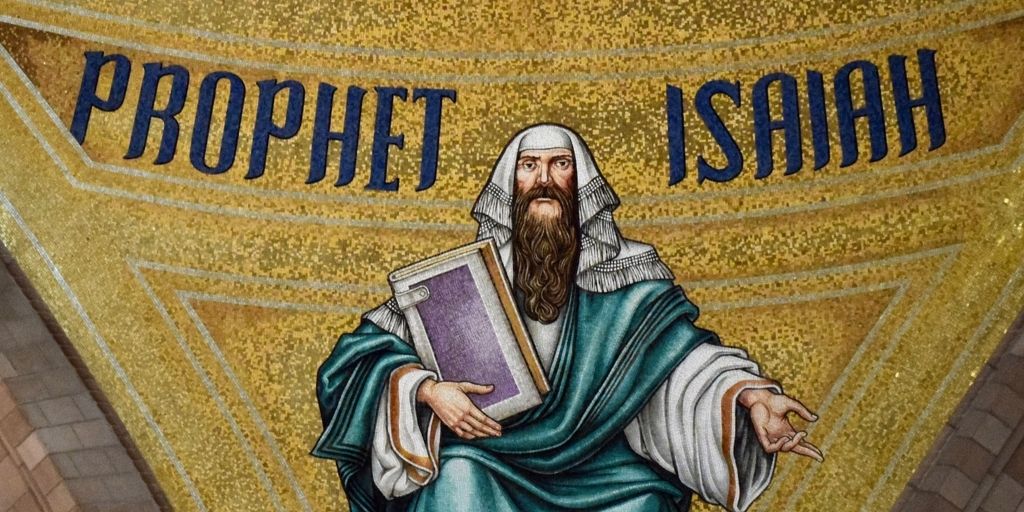
Photo from nationalshrine.org of Prophet Isaiah at the crypt church inside the Basilica of the National Shrine of the Immaculate Conception in Washington DC.

While praying last night the first reading this Friday after Ash Wednesday, my attention was drawn to the Prophet Isaiah’s very strong words declaring, Thus says the Lord God: Cry out full-throated and unsparingly, lift up your voice like a trumpet blast; tell my people their wickedness, and the house of Jacob their sins” (Is. 58:1-9).

Immediately my imaginations ran high with images of Formula cars racing full-throttle on tracks with their deafening sound waxed by the odorous burning of their tires that segued into the cool, opening synth music later with drums and bass of Tears of Fears’ 1984 hit Shout.

Whoa! It was really a rock and roll moment with the Lord last night that was suddenly punctuated with an emergency sick call in the ICU of our hospital where I serve as chaplain. After half an hour when I got back in my room, I finished my prayer and listened to more music by Tears for Fears that I realized Roland Orzabal and Curt Smith are modern Isaiahs!

But first, the Prophet Isaiah who is one of the four major prophets of the Old Testament.

Photo from nationalshrine.org of Prophet Isaiah at the south entrance of the Basilica of the National Shrine of the Immaculate Conception in Washington DC.

While in third year high school seminary in the early 80’s, our religion teacher Msgr. Narsing Sampana assigned me to report this great prophet. I thought it was a punishment because the Book of Isaiah is one of the longest and most difficult in the whole Bible. But looking back as I would always tell Msgr. Narsing, I learned a lot from him that after nine years of leaving the seminary, I have always loved Prophet Isaiah and his book that eventually helped me rediscovered my priestly vocation later in life.

It was Isaiah who prophesied the birth of the Messiah by the Blessed Virgin that he is widely read during the Advent Season as he warned the people too of the coming judgment of God for their sins; hence, his frequent reading in this season of Lent.

It was from his book that the lyrics were taken in one of the most loved Filipino Church music Hindi Kita Malilimutan by Jesuit Father Manoling Francisco that came out on the year we graduated in high school, 1982.

Isaiah was a very bold prophet who spoke strongly against evil and sins particularly injustice among the Israelites of his time, including of their king. He minced no words in speaking for God like today when he said “Cry out full-throated” which is to express confidently through shouting, with strong feeling and without limits.

That was Isaiah, a bold speaker yet also spoke with words filled with hope in God’s love and mercy on us. He is the kind of witness we need these days when many Christians especially Catholics disturbingly quiet about the many issues going on like wokism pretending to be for equality and justice through the social media.

Photo by Denniz Futalan on Pexels.com

In the Church, we need an Isaiah with some bishops and priests selectively silent in disciplining the clergy so immersed in abuses not only sexual in nature but also pertaining to finances and even our liturgy. How sad when bishops and priests attack government officials and politicians for their corruption but keep their eyes and mouth shut with clerical abuses in all forms. These rampant abuses within the Church is manifested in the ever growing abuses of the liturgy itself. Check your social media feeds to see how some priests contradicted the very spirit of Lent with their pompous novelties in imposing ashes on the faithful two days ago. No wonder, even those in other sects and cults came out in the streets with their “own” kind of Ash Wednesday rituals as if it is kanya-kanya lang style like what some priests did.

An Isaiah is what we really need in the Church in this time of synodality that sadly this early could end up as another set of documents to gather dust in parish bodegas.

Photo from bbc.com 2022 before the release of Tears for Fears “The Tipping Point”, their first since 2004.

This is where we find the enduring duo of Orzabal and Smith who make up Tears for Fears a modern Isaiah with their prophetic songs.

With everybody wanting to rule the world – pun intended – their Shout is so Lenten in nature. It is exactly what Isaiah meant 2800 years ago when he said “cry out full-throated” that Tears for Fears perfectly first sang in 1984:

Shout
Shout
Let it all out
These are the things I can do without
Come on
I'm talking to you
Come on

Shout
Shout
Let it all out
These are the things I can do without
Come on
I'm talking to you
Come on

In violent times
You shouldn't have to sell your soul
In black and white
They really, really ought to know

Those one track minds
That took you for a working boy
Kiss them goodbye
You shouldn't have to jump for joy

Shout
Shout
Let it all out
These are the things I can do without
Come on
I'm talking to you
Come on

They gave you life
And in return you gave them hell
As cold as ice
I hope we live to tell the tale
From imdb.com.

From their second album Songs from the Big Chair, Shout is Tears for Fears second biggest hit after Everybody Wants to Rule the World released in 1985. Orzabal admitted on many occasions that Shout was a “simple song about protest”.

Their lyrics are clearly prophetic, a witnessing of their very lives since the 80’s until now. We are so glad that Tears for Fears have rereleased Shout recently with both of them still having the energy and conviction in playing this song despite their shorter and white hair. Being prophetic is witnessing or walking our talk like Orzabal and Smith. Like a good wine, they sound better in their latest music videos with their song taking a life of its own that gladly many young people have embraced too like us 40 years ago.

Let us join Tears for Fears shouting and standing for the same calls for justice they first shouted in 1984 that was also shouted full-throated by Isaiah in 800 BC. Have a blessed weekend, everyone!

Here’s Tears for Fears original music video for Shout for your rock and roll reflection this first Friday of Lent 2025.

From YouTube.com.

An august month, not a ghost month

Quiet Storm by Fr. Nicanor F. Lalog II, 09 August 2024
Photo by author, Parish of the National Shrine of Our Lady of Fatima, Valenzuela City, 24 July 2024.

I was recently asked to bless a little store the other day, the seventh day of August. My schedule was toxic with another appointment in another city but the owner begged because she believed it is the most auspicious date for blessing.

How I wanted to ask her why have a blessing at all if you believe in luck than in God? Para wala nang gulo, I blessed her store but explained the meaning of blessing and of superstitions during the rites. It is one of those occasions when all we can do is sigh, saying haynaku and Juice colored!

What a sad reality in our Catholic Christian country where the kind of religiosity that binds most of us is more on rites and rituals but lacking in roots and spirituality, centered on ourselves to be assured of every kind of material blessings, forgetting all about the very object of faith who is God expressed in our concern for one another.

And in the light of all these things going on especially the never ending topics in social media, we ask, pera pera na lang ba talaga ang lahat sa buhay natin?

From catholicapostolatecenter.org.

Consider the name of this month August which was borrowed from the Roman Caesar Augustus that signifies reverence or to hold someone in high regard. As an adjective, august means “respected and impressive” like when we say “in this august hall of men and women of science”.

August is not a ghost month nor any other month of the year.

Like the days of the week, every month is a blessed one. No day nor date nor time is malas because these were all created by God who is all good. Nothing bad can come from God. Period.

Moreover, when God became human like us in the coming of Jesus Christ, life has become holy, filled with God, debunking those ancient beliefs of the Divine being seen in various cosmic forces. Pope Benedict explained this so well in his second encyclical:

Photo by author, St.Scholastica Retreat House, Baguio City, 2023.

In this regard a text by Saint Gregory Nazianzen is enlightening. He says that at the very moment when the Magi, guided by the star, adored Christ the new king, astrology came to an end, because the stars were now moving in the orbit determined by Christ[2]. This scene, in fact, overturns the world-view of that time, which in a different way has become fashionable once again today. It is not the elemental spirits of the universe, the laws of matter, which ultimately govern the world and mankind, but a personal God governs the stars, that is, the universe; it is not the laws of matter and of evolution that have the final say, but reason, will, love—a Person. And if we know this Person and he knows us, then truly the inexorable power of material elements no longer has the last word; we are not slaves of the universe and of its laws, we are free. In ancient times, honest enquiring minds were aware of this. Heaven is not empty. Life is not a simple product of laws and the randomness of matter, but within everything and at the same time above everything, there is a personal will, there is a Spirit who in Jesus has revealed himself as Love[3]. (#5, Spe Salvi (Saved in Hope) by Pope Benedict XVI, 30 November 2007)

Photo by author, Sacred Heart Novitiate, Novaliches, QC, 20 March 2024.

I love this part of his encyclical, “It is not the elemental spirits of the universe, the laws of matter, which ultimately govern the world and mankind, but a personal God governs the stars, that is, the universe; it is not the laws of matter and of evolution that have the final say, but reason, will, love—a Person.”

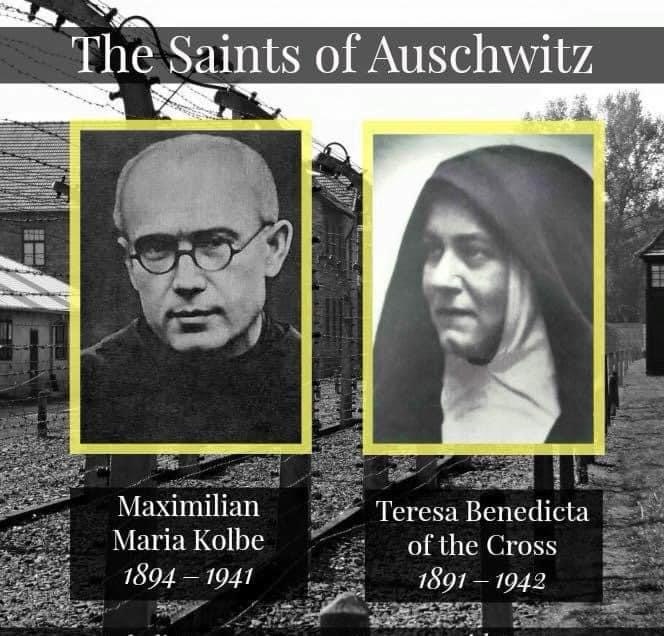
It was this Person of Jesus Christ why so many great men and women then and now have abandoned their previous ways of life to lead holy lives even in the face of death. Very interesting in this modern time are two great saints we celebrate on this month of August, St. Teresa Benedicta of the Cross (August 09) and St. Maximilian Kolbe (August 14) who died at the gas chambers of Auschwitz during the Second World War. Let’s reflect first on St. Teresa Benedicta whose memorial we celebrate today.

Photo from FB page of Scott Hahn, 09 August 2024.

St. Teresa Benedicta is the German philosopher Edith Stein. She came from a prosperous Jewish family gifted with great mind becoming one of the first female university student and later professor in Germany.

An associate of the famed Edmund Husserl of the philosophical method of phenomenology, St. Teresa Benedicta became an atheist during her teenage years; but, upon further studies and prayer, converted into Catholicism, becoming a Carmelite nun where she adopted her new name. She wrote that “Those who seek truth seek God, whether they realize it or not“.

She actually had all the chances to leave for South America and then to Switzerland to escape the Nazis but opted to stay in their monastery in the Netherlands with her younger sister Rosa who had also converted as Catholic and joined the Third Order Carmelite. When they were arrested on August 2, 1942, she told her, “Come, Rosa… we go for our people.”

St. Teresa Benedicta honored her Jewish roots by dying among them as a martyr of Christ, one who had “learned to live in God’s hands” according to Sr. Josephine Koeppel, OCD, a translator of much of her works. According to various accounts, St. Teresa Benedicta showed great inner strength by encouraging her fellow prisoners to have faith in God while helping in looking after the small children when their mothers were so distressed to do so. One woman who survived the war wrote: “Every time I think of her sitting in the barracks, the same picture comes to mind: a Pieta without the Christ.”

Dying ahead of her in Auschwitz on August 14, 1941 was St. Maximilian Kolbe, a Franciscan priest who was arrested for his writings against the evil Nazis. It was actually his second time to be arrested.

When a prisoner had escaped from the camp, authorities rounded up ten men to die in exchange of the lone escapee. Fr. Kolbe volunteered to take the place of a married man with children. They were all tortured and starved in order to die slowly in pain. A devotee of the Blessed Virgin Mary, St. Maximilian was injected with carbolic acid on the eve of the Assumption after guards found him along with three other prisoners still alive, without any signs of fear like screaming but silently praying.

Photo of Auschwitz from Google.

We no longer have gas chambers but atrocities against human life continue in our time, hiding in the pretext of science and laws. Until now, men and women, young and old alike including those not yet born in their mother’s womb are hunted and killed to correct what many perceived as excesses and wrongs in the society. Just like what Hitler and his men have thought of the Jews at that time.

The Nazi officers and soldiers of Auschwitz remind us the true “ghosts” and evil spirits of our time sowing hatred and deaths are people who may be well-dressed, even educated in the best schools, and come from devout or “normal” families. They sow evil every day without choosing any particular month, blindly following orders without much thinking and reflections or introspection.

Photo by author, James Alberione Center, QC, 08 August 2024.

Many times, they insist on following or speaking the truth – a truth so empty of the person of Jesus Christ. As we have been saying amid this growing trend of wokism and inclusivity that have badly infected the Olympics, people tend to exaggerate the truth they believe or follow when actually, they are just exaggerating themselves.

By the lives of the many great saints of August, or of any other month for that matter, we are reminded that holiness is not being sinless but simply being filled with God, being converted daily to the truth of Jesus Christ by allowing that holiness to spill over and flow onto others with our lives of authenticity expressed in charity and mercy, kindness and justice, humility and openness with one another.

Let us make every month holy and blessed with our good deeds to make everyone aware of Christ’s presence among us. Have a blessed weekend!

“Is It Over” by Ronnie Milsap (1983)

The Lord Is My Chef Sunday Music, 31 March 2024
Photo by author, Sacred Heart Novitiate, Novaliches, QC, 20 March 2024.

Blessed happy Easter everyone! We take a melancholic love song on this day of celebrating the triumph of love in Jesus Christ’s Resurrection because Easter is a continuing journey with Him, in Him and through Him amid darkness and emptiness in life (https://lordmychef.com/2024/03/30/easter-is-signs-scripture-together-always/).

Like the story of that first Easter morning while still dark when Mary Magdalene and later Simon Peter with the beloved disciple found the tomb of Jesus empty except for His burial cloths neatly folded to indicate the Lord’s rising from the dead, Ronnie Milsap’s 1983 hit Is It Over speaks a lot of the essence of Easter about faith in the love of Jesus Christ.

Milsap’s Is it Over invites his beloved to sincerely search her heart to get over her former relationship so that theirs would flourish and grow; in the same manner, we need to get over our Good Fridays in order to experience the glory of Easter Sundays in life.

Is it over, are you really over him
Is it over, or will you take him back again
If it’s over you can let his memory in
Come on over, we’ll let our love begin.

You say you can’t count the times that he’s hurt you
And he’s hurt you for the last time
Now you say I’m the one that you’re needing
But is the need in your heart or just in your mind.

Is it over, are you really over him
Is it over, or will you take him back again
If it’s over you can let his memory in
Come on over, we’ll let our love begin.

Like Jesus calling us every day in our lives to come over to Him by leaving behind our past hurts, Is it Over tells on the need to move on in life, to embrace the present by learning from the past. Most of all, of the need to confront one’s true self in the heart, not just in the mind in order to move on in life.

Milsap’s music and voice are uniquely refreshing that sound very Easter perhaps due to his personal experiences. Born partially blind and abandoned by his mother after birth, Milsap grew up in poverty with his grandparents in the Smoky Mountains of North Carolina. Despite his handicap and poverty, he was found exceptionally brilliant and talented even while in his early childhood when he was sent to a school for the blind at the age of five where he developed his musical talent at age seven. He was later sent to Governor Moorehead to formally begin studies in classical music. It was there in his early teens when Mislap learned to play several musical instruments and chose to master the piano.

At age 14, Milsap became totally blind after being slapped on his left eye by one of the houseparents but that never affected his pursuits in learning as well as music. He was able to finish college through scholarships and was already in law school as a full scholar when he decided to leave to concentrate in music in 1964.

He met his wife Joyce Reeves in one of their gigs the following year, got married and remained together until her death in 2021 due to cancer. They had a son, Ronald who died in 2019 aged 49 apparently due to a medical condition

Is It Over follows the style of Milsap’s earlier and biggest breakthrough in 1977, It Was almost Like a Song that topped the Billboard charts in many categories. Both songs are very popular among us Filipinos who are certified romantics.

Now aged 81, Milsap remains active in the music scene as a composer, collaborating with some of the biggest names in the industry. His life is a beautiful example of the Easter glory amid many darkness and emptiness. Although officially retired, it isn’t over yet for Mislap as he continues to record and busies himself with a podcast as well as an amateur radio enthusiast.

Here now is Milsap’s lovely song, Is It Over.

From YouTube.com

Light a candle to pray better.

Quiet Storm by Fr. Nicanor F. Lalog II, 08 February 2024
Photo by Irina Anastasiu on Pexels.com

Last Friday was the Feast of the Presentation of Jesus to the Temple (February 2) also known as the Feast of the Candlemass wherein candles were blessed outside the church after which the people led by the priest enters to begin the Mass in a procession with lighted candles. 

Candlemass is a beautiful celebration, especially when done properly by priests. Its origin dates back to more than 1500 years ago in France where it started when people incorporated the blessing of candles into the Feast of the Presentation then known with its Eastern title as “the Encounter” to refer to how Simeon with the Prophetess Anna met the child Jesus being offered by his parents Joseph and Mary to the temple 40 days after Christmas. According to St. Luke, Simeon sang the following upon meeting the child Jesus Christ.

Presentation in the Temple painting by Fra Angelico from fineartamerica.com.

“Now, Master, you may let your servant go in peace, according to your word, for my eyes have seen your salvation, which you have prepared in sight of all the peoples, a light for revelation to the Gentiles, and glory for your people Israel.”

Luke 2:29-32

In proclaiming Jesus Christ as the “light” of salvation for the nations, the early French Christians thought of having the blessing of candles and procession of lighted candles to signify Jesus as the only and true light of the world. Thanks be to God for those pious early French Christians!

Photo by icon0.com on Pexels.com

Though candles are no longer used as a major source of lighting in homes and other places, it is still used in almost all churches, monasteries and other houses of worship around the world, gaining a renewed popularity among the younger generation. It is a most welcomed development in our modern time as more and more people are rediscovering the need for spiritual growth of whatever label. And right in the midst of this is the candle as a tool for better prayer periods. 

Unfortunately, this beautiful tradition of the candles is dying in our country. How ironic that we who belong to the Third World have switched to electric vigil lamps and candles while those in the First World still use the traditional candles in their homes and churches. 

Go abroad like in North America and Europe, one finds a plethora of all kinds of beautiful candles used and sold even in the simplest churches and stores! During a Holy Land pilgrimage in the 2017 Easter Season, one of the things I appreciated and admired next to the pilgrim sites were the lovely and regal designs of paschal candles in the churches we visited that made me wonder why nobody makes them here in our predominantly Catholic country. 

Candles have always have a special place in the life of our faith and the Church since its early beginnings. From the Latin words candere and candela that mean “to shine”, it evolved into the Middle and Old English words candele and candel.

Aside from lighting the gatherings of the early Christians especially in the catacombs to evade arrests during the persecution, candles have always been used to signify Christ as the light of the world guiding our paths as Christians in every celebration, from Baptism to Weddings and Funerals.

Candles do not only make rooms shine but most especially the souls and the hearts of those who cultivate a prayer life. It has that unique warmth that can soothe and calm those who are agitated or worried with life’s many trials and challenges.

Every time we light a candle during prayer periods, our inner selves are made brighter as they evoke in us so much feelings of the Divine presence. Their little lights that flicker remind us of our feeble selves whose life could be easily snuffed out with a single blow. 

The scent of burning candle permeates our senses, calming us within, inviting us to leave all our worries in life as we lay our cards out in the open to God. A candles warmth can dissolve every hardness within us, purifying us within and becoming empty and open for God’s grace to work in us.

Photo by Emre Kuzu on Pexels.com

In a sense, candles may be considered as a sacrament too which is defined as a visible sign with invisible power.  

The very act of lighting a candle is already the start of prayer, something like the making of the sign of the Cross. I strongly recommend for those who wish to aid their prayer periods with candles to use matches not lighters that are artificial. 

Lighting up a candle for prayer especially in the morning can rouse our senses. The striking of the match with its sudden burst of light to kindle the candle is like an angel had suddenly come down to assure us that our prayer is heard by God, that God is with us at the very moment or at least reminds us we have turned into the mode of praying. 

The strong scent of the burning matchstick also adds flavor and aroma to the prayer period especially in the early morning when the whole world is still dark and everyone still asleep with you as the only one awake with God. Lighting a candle first thing first upon waking up can help us avoid from getting our cellphones or turning on the radio or the TV. A lighted candle can prevent us from being distracted by these modern gadgets that keep us away from God and from one another.

My altar with lighted candle at night; see the candle snuffer at the foreground.

Lighting a candle during a prayer period in our room or home works like the candlelight dinner that sets us to a lovely communion with God our beloved. The slow burning of a candle reminds us even in our busiest morning that we are at prayer in the presence of God, that we need to slow down too in our lives, to be conscious of our selves, surroundings and time so we can set our sights to God alone like a beloved in a candlelight dinner date.

At night time, the sight of the candle burning in one’s room is most dramatic as we close the day. Actually, it is during night time that the Church prays the Canticle of Simeon. 

Imagine that scene at the temple when Simeon sang as he held the Child Jesus in his arms – of his readiness to die, to go in peace, after seeing Christ the light of salvation. In the darkness of the night punctuated only by a burning candle, we are able to examine our hearts of the many things we have done and failed to do the whole day. These become clearer in the light of the candle that penetrates our hearts and conscience, piercing and rending our souls to remove the darkness within us, exposing the festering anger or bitterness and sadness hiding inside, melting them away with its warmth so we may go to sleep clean and ready to continue with life – here or hereafter like Simeon.

By Kay Bratt in Facebook, 13 December 2023.

One last note about candles as we end this reflection. Monks use a candle snuffer in extinguishing candles in their chapels and monasteries.  These are long metal instruments with tips like a bell that monks hover above a candle, slowly covering it until its light is snuffed out, hence, the name candle snuffer. 

If you want to be serious in praying better with lighted candles, you may buy those small candle snuffers for home use available at some candle shops in the malls. If there is no candle snuffer, one may use the cover of the candle to snuff out the light. What is important is that as we close our prayers with the lighted candle as companion, we don’t simply blow its light to abruptly end its glow. 

When blowing the candle used in prayer, do it slowly as if you are whispering. Do it with solemnity. Every candle used at prayer becomes blessed, demanding some sort of reverence as companions in our prayer life and journey. Of course, it would be good if you can have your candles blessed by the priest for use at home to ward off negative vibes but more important than that is we grow in our prayer life, we become like lighted candles who give light to others in Christ. Like our candles, we also become a prayer to God in our very selves. Amen.Have a blessed Thursday.

“Touch & Go” by Rupert Holmes (1976)

The Lord Is My Chef Sunday Music by Fr. Nicanor F. Lalog II, 04 February 2024
Photo by author, Our Lady of Fatima University-Laguna Campus in Sta. Rosa, 19 February 2024.

Our gospel this Sunday speaks a lot about the importance of person-to-person communication, of the healing wonders of the sense of touch and its deeper implications in our relationships when Jesus healed the mother-in-law of Simon Peter.

On leaving the synagogue Jesus entered the house of Simon and Andrew with James and John. Simon’s mother-in-law lay sick with a fever. They immediately told him about her. He approached, grasped her hand, and helped her up. Then the fever left her and she waited on them.

Mark 1:29-31

See how the evangelist narrated in details the healing by Jesus who “approached, grasped her hand, and helped her up.” More than the actual touching and face-to-face or actual encounter, the scene speaks so well of deep personal relationships among us. That is why we have chosen Rupert Holmes’ 1976 single Touch and Go.

Nobody said that
Life is always fair
Sometimes it clips your wings
While you’re in mid-air
But there’s a thread
Between your life and mine
And when you’re losin’ hope
This rope won’t unwind

REFRAIN:
Hold on tight
‘Cause life is touch and go
It’s sink and swim
But never doubt
If you’re out on a limb
I’ll get the call
To break your fall
I’ll never leave you
Even when life
Is touch and go
Or hit and run
We’ll never break
If we take it as one
I’m here to stay,
I pray you know
I’ll never touch
I’ll never touch and go

Someday you’ll find
There’s nothin’ in the night
That wasn’t there before
You turned out the light
Straight from your mind
The monster ‘neath your bed
The voices in the hall
They’re all in your head

A gifted musician with a knack in story-telling, Holmes’ songs are always imbued with his deep insights about life he had gathered from ordinary experiences like his earlier hit Terminal (1974) and his two hit singles Escape (The Piña Colada Song) in 1979 and Him in 1980. These three are all dashed with humor that can tickle our bones but disturb our conscience too.

In Touch and Go, Holmes goes philosophical, sounding a bit like Job in today’s first reading of how life can sometimes be unfair that “Sometimes it clips your wings while you’re on mid-air” while assuring his beloved of his deep love and dedication that no matter what happens, he would always be there by her side to save her.

That is exactly what Jesus tells us in the gospel this Sunday, of how he would always approach us, grasp our hand and help us up when we are down. The question is, are we in touch with Jesus too? Or, we always go and leave him especially when things are doing great in our lives?

If us humans like Holmes can boldly assure our beloved of always being there, of being in touch and connected especially in times of trials and sufferings, all the more is Jesus Christ who had come to empower us by connecting us with God and one another always in loving service (https://lordmychef.com/2024/02/03/real-power-empowers/).

It is a Sunday. Don’t forget to celebrate Mass or go to your places of worship to get in touch with God and with others in your community. Here is Rupert Holmes to help you chill more on this cool February Sunday amidst life’s many “touch and go, sink and swim” situations.

From Youtube.com.