Our “Nunc Dimittis” experience

Quiet Storm by Fr. Nick F. Lalog II, 03 February 2020

Detail of the Presentation painting by Italian artist Andrea Mantegna (1431-1506) with Mary handing the Child Jesus to Simeon at the temple of Jerusalem (man at the middle Mary’s husband, Joseph).

As we come to close today’s Feast of the Presentation of the Lord, I wish to share with you a Quiet Storm brewing within me which I call “the Nunc Dimittis experience”.

Nunc dimittis is the Latin opening line of Simeon’s Canticle that says “Now you dismiss” when he was filled with joy by the Holy Spirit upon meeting our Lord and Savior on his presentation at the temple.

According to St. Luke’s account, God had promised Simeon that “he would not see death before he had seen the Christ of the Lord” (Lk. 2:26). Hence, the overflowing joy of Simeon when he finally met the Child Jesus at the temple 40 days after Christmas!

Part of St. Luke’s artistry in his Christmas story is to put songs on the lips of some of its important characters to express their profound joys in their unique experiences of the coming of Christ.

The Nunc Dimittis is the fourth canticle in the Lucan Christmas story: first is Mary’s Magnificat when she visited her cousin Elizabeth who was six months pregnant with St. John the Baptizer; second is the Benedictus by Zechariah when he regained his speech after naming his son John; and third is the Gloria sang by the angels when Christ was born in Bethlehem.

Simeon bursting in joy as depicted by American illustrator Ron DiCianni’s “Simeon’s Moment”. From http://www.tapestryproductions.com

Of these four canticles recorded by St. Luke, Simeon’s Nunc Dimittis sounds the highest level of all, the fulfillment of time within each one of us when we personally recognize and meet Jesus the Christ our Savior like Simeon.

And so often, when we are overjoyed in experiencing Jesus Christ, that is also when we feel like saying “now I am ready to go, ready to die” exactly like Simeon because we have met the Lord.

That is why I call it “the Nunc Dimittis experience”: real joy can only come from that experience and intimacy with Jesus Christ, when we feel so close with him. It does not really matter whether we experience him here in this life or hereafter. What matters most is we feel so close with him, as if embracing him, here and now.

This may be a religious experience like after listening to a homily that really touched us, or after a good confession, or while attending a wonderful retreat or recollection. It may also happen when we feel so loved and accepted, when we are vindicated, or when assured of support and trust and confidence while going through difficult trials in life.

Our Nunc dimittis experience always comes at the end of each day, when we feel despite our failures and shortcomings, we are in God’s loving presence.

Simeon’s Canticle, our Night Prayer

Since the early sixth century during the time of St. Benedict, the “Nunc Dimittis” has been sung in the monks’ night prayer or “compline” from the Latin completorium or completion of the working day. Eventually, it was adopted into the Liturgy of the Hours or the prayers of the Church usually recited by priests and religious. (St. John Paul II had suggested in his encyclical Novo Millennio Innuete after the Great Jubilee of 2000 that the lay faithful also pray the Liturgy of the Hours.)

After the praying of the psalms and meditation of the Sacred Scriptures, there is a Responsory that declares, “Into your hands, Lord, I commend my spirit.” Like Jesus before he died on the Cross, we offer to God our very selves. This is takes on a beautiful dimension especially if we have done a good examination of conscience at the start of the compline, before the psalms and readings.

Then, we recite the antiphon that introduces the Nunc dimittis: “Protect us, Lord, as we stay awake; watch over us as we sleep, that awake, we may keep watch with Christ, and asleep, rest in his peace.”

The antiphon in itself is already a prayer!

It is after the antiphon that we chant or recite Simeon’s Canticle:

Lord, now you let your servant go in peace; your word has been fulfilled: my own eyes have seen the salvation which you have prepared in the sight of every people: a light to reveal you to the nations and the glory of your people Israel.

From the Compline of the Breviary

The antiphon is repeated and immediately followed by the Closing Prayer.

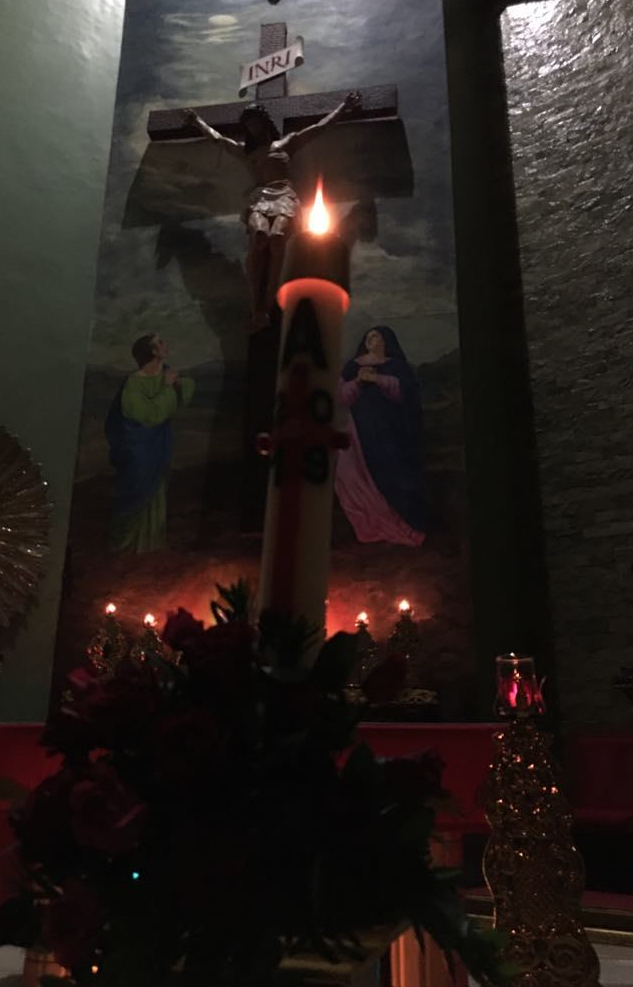
The cross atop our parish church at night with the moon above taken with my iPhone camera, 02 February 2020.

Capping the compline is the blessing at the end that says: “May the all-powerful Lord grant us a restful night and a peaceful death. Amen.”

Usually, a hymn to Mary is sung, then all the lights are turned off and the great silence (magnum silencium) begins until the morning prayers or lauds (Latin for praise).

See how our night prayer or the compline is oriented towards meeting God, or to put it bluntly, towards death.

Yes, it is always easy to say we are ready to die. It is a lot whole different when we are already face to face with death itself.

But, when we come to think of it, we realize that indeed, in death, “there is nothing to fear but fear itself”.

When we die, everything happens so fast. We may not even feel anything at all. And unknown to us, every night when we go to sleep, we rehearse our death, so to speak!

And what a tremendous joy to keep in mind how every night, the Lord fills us with joy and faith within us even if we often forget him. Every night when we sleep, it is automatic within us to entrust everything to God “unconsciously” without even thinking we may never wake up!

It is a “Nunc Dimittis” experience too because most of us go to bed filled with joy, full of hope the following morning would be a better day than today. And that is Jesus still coming to us at the end of the day to assure us of his love and concern, never bothering us at all of this tremendous grace gratuitously given to us.

Next time you sleep, remember how blessed you are to have come to the end of another day, blessed and loved.

Pray, and start experiencing Jesus more from the beginning to the end of each day and forevermore. Amen.

“I Saw the Light” by Todd Rundgren (1972)

The Lord Is My Chef Sunday Music, 02 February 2020

Photo by Mr. Jim Marpa, Bohol, 2019.

Welcome, followers and readers to this Sunday edition of our The Lord Is My Chef Sunday Music as we feature a double-header from singer-composer Todd Rundgren: his first solid hit “I Saw the Light” and “Hello It’s Me” that are both from his 1972 album Something/Anything?

We are featuring two songs today because both are related with our celebration of the Feast of the Presentation of the Lord which falls on February second.

And besides, Todd’s music has always been my favorite while growing up in the 1970’s.

First, we choose I Saw the Light because it is very close to our liturgical feast today also known as Candlemass or Candelaria with Jesus Christ being the Light of the world. St. Luke tells us when Joseph and Mary brought the child Jesus to the temple in Jerusalem 40 days after Christmas, an old man of God named Simeon carried him in his arms and sang:

“Now, Master, you may let your servant go in peace, according to your word, for my eyes have seen your salvation, which you prepared in sight of all the peoples, a light for revelation to the Gentiles, and glory of your people Israel.”

Luke 2:29-32

Jesus is the Light of the world, the only one who can dispel all darkness in our lives.

In I Saw the Light, Todd tells us the story of a young man probably groping in some darkness in his relationship – actually a fling according to the song – with a girl and he does not know if that is really love.

Though we had our fling
I just never would suspect a thing
‘Til that little bell began to ring in my head
In my head
But I tried to run,
though I knew it wouldn’t help me none
‘Cause I couldn’t ever love no one, or so I said
But my feelings for you
were just something I never knew
‘Til I saw the light in your eyes
But I love you best
It’s not something that I say in jest
‘Cause you’re different, girl, from all the rest
In my eyes
And I ran out before but I won’t do it anymore
Can’t you see the light in my eyes

Meanwhile, in our second song Hello It’s Me, we find another man so in love with a woman who is also into some darkness.

Like in I Saw the Light, there is no recognition and hence, no meeting here in Hello It’s Me.

Hello, it’s me
I’ve thought about us for a long, long time
Maybe I think too much but something’s wrong
There’s something here that doesn’t last too long
Maybe I shouldn’t think of you as mine
Seeing you, or seeing anything as much as I do you
I take for granted that you’re always there
I take for granted that you just don’t care
Sometimes I can’t help seeing all the way through
It’s important to me
That you know you are free
‘Cause I never want to make you change for me

Both songs show us the important lesson taught to us by the Feast of the Presentation of the Lord: like anyone else, Jesus also comes but we on our part have to cultivate a relationship with him in order to always recognize him and eventually meet him to be one with him.

Just like the people we love.

Have a wonderful Sunday of prayer, food and drinks, and good music.

Recognizing, meeting, and sharing Jesus, the Light of the world

The Lord Is My Chef Sunday Recipe for the Soul, Feast of the Presentation of the Lord, 02 February 2020

Malachi 3:1-4 ><)))*> Hebrews 2:14-18 ><)))*> Luke 2:22-40

Photo by author of Baby Jesus at the Bishop’s Chapel, Malolos Cathedral, 07 January 2020.

We take a break from our Ordinary Sunday to celebrate today the Feast of the Presentation of the Lord at the temple, 40 days after Christmas. It is a prolongation of the celebration of the Lord’s Nativity with a paschal undertone recognizing Christ as Light who had come to us to lead us back to the Father through his Passion, Death, and Resurrection.

This feast used to be known in the East as the Ypapante or the Encounter of Jesus by the two elderly people at the temple, Simeon and Anna. When it reached Europe, it came to be known as the “Purification of the Blessed Virgin Mary” based on St. Luke’s description, evolving into Candlemass or Candelaria when Pope Sergius I in Rome adopted in the eighth century the French tradition of procession of lighted candles at dawn before the Mass to signify Jesus as the light of the world who had come to bring us back to the Father expressed by Simeon in his canticle.

“Now, Master, you may let your servant go in peace, according to your word, for my eyes have seen your salvation, which you prepared in sight of all the peoples, a light for revelation to the Gentiles, and glory for your people Israel.”

Luke 2:29-32

Despite its evolution through the ages with its many names and practices, the Feast of the Presentation of the Lord is a good reminder to us in recognizing, meeting, and sharing Jesus Christ to everyone as the light of the world.

Photo by author of a view from the Temple of Jerusalem, May 2017.

Being devout leads us to recognize and meet Jesus

Only St. Luke reports the story of the Presentation of Jesus at the temple because he wanted to show his audience who were Gentiles or pagan converts that Jesus came not only for the Jews but for everyone.

This remains true to us especially in these modern times when people live in artificial lights and “Klieg lights” that put us on the centerstage only to leave us later groping in the dark, even blinded to false hopes of virtual realities.

St. Luke invites us today to emulate both Simeon and Anna in recognizing and meeting Jesus, the only Light of the world who dispels darkness within and around us.

Now there was a man in Jerusalem whose name was Simeon. This man was righteous and devout, awaiting the consolation of Israel, and the Holy Spirit was upon him. It had been revealed to him by the Holy Spirit that he should not see death before he head seen the Christ of the Lord. He came in the Spirit into the temple; and when the parents brought in the cild Jesus to perform the custom of the law in regard to him, he took him into his arms and blessed God.

Luke 2:25-28
“Simeon’s Moment” by American illustrator Ron DiCianni. From http://www.tapestryproductions.com

Recall how during our Simbang Gabi that for the Jews, a “righteous” person is someone who is holy because he faithfully keeps the Laws of God like St. Joseph, the husband of Mary.

But more than being holy and just, St. Luke also described to us Simeon – as well as Anna implicitly – as “devout” Jews. It is a word rarely used in the Bible. In fact, St. Luke used it only four times: once here in this scene and thrice in the Acts of the Apostles.

In Acts 2:5, St. Luke called the Jews who came to Jerusalem for Pentecost as “devout” ones; then in 8:2, he said “devout men buried” the first martyr of the Church, St. Stephen; and finally in 22:12, he gave the distinction to Ananias as “a devout observer of the law” who came upon instructions from God to pray over and heal Saul who was blinded by Christ’s light on the way to Damascus.

In all four instances, St. Luke described people as “devout” including Simeon and Anna as those of “good heart, ready to believe, and then to act openly and with courage” (Timothy Clayton, Exploring Advent with Luke; page 125). Devout people or devoted persons are a notch higher than just being faithful because they do not merely wait but look forward to the fulfillment of what they believe.

Devoted people make things happen; they do not wait for things to unfold. And that is why they are always at the right place in the right time. Like Simeon and Anna, they give themselves to God wholly to stay attuned with the Holy Spirit and be ready to follow its promptings and leads.

Anna meeting Jesus from catholicfunfacts.com.

See the common trait of both Simeon and Anna as devout people — the presence of the Holy Spirit in them that amid the crowd in the temple on that day, they were able to spot the Child and Savior Jesus Christ being presented by his parents Mary and Joseph!

There was also a prophetess, Anna, the daughter of Phanuel, of the tribe of Asher. She was advanced in years, having lived seven years with her husband after her marriage, and then as a widow until she was eighty-four. She never left the temple, but worshipped night and day with fasting and prayer. And coming forward at that very time, she gave thanks to God and spoke about the child to all who were awaiting the redemption of Jerusalem.

Luke 2:36-38

Jesus comes to us everyday in various ways, in many occasions. He is always passing by, calling us. We have to be on guard in these moments so that we do not miss him. Like reporters following the news, we have to be focused or “tutok” and immersed or “babad” so that nothing or no one escapes us.

Three ways of being devout like Simeon and Anna

It is imperative that we have to be devout first with God so that we recognize and meet his Son Jesus Christ coming to us so we may eventually share him to enlighten everyone. Simeon and Anna show us three important things to keep for us to be devoted to God to encounter Jesus Christ.

First, we have to be faithful in our prayer life. There is no other way in meeting Christ except in having a life of prayer which is a discipline. It is something we do as a habit, every day, every night. Not just once a year like those going to Quiapo every January 9 or completing any novena and then the whole year does nothing.

Devotion is more than collecting images of Jesus, the Virgin Mary, and the saints, joining processions during fiesta or Holy Week, then nothing. Devotion is life, not a show.

Like Simeon and Anna, we have to grow intimately with the Lord by cultivating personal prayers and joining communal activities like the Sunday Mass so that we may know personally and vibrantly God who always leads us to various directions and mission. God is never static but dynamic, unlike us people who keep on insisting on some of our traditions and ways no longer applicable.

Notice how in the first reading the Prophet Malachi said the Lord will suddenly come in the temple, calling on people to always await him (Mal.3:1).

The Old Jerusalem from the inside of the Church of Dominus Flevit (The Lord Cried) at the Mount of Olives, Jerusalem. Photo by author, May 2017.

Second, we can only recognize, meet and share Jesus Christ as Light when we care, love, and respect others. See how Simeon spoke to Mary about his coming mission and its harsh realities. He recognized not only Jesus but also Mary and Joseph. Simeon’s speaking to Mary and Joseph means he recognized the important roles of the parents in being instrumental that he met the Lord.

Any devotion to God and his saints and the blessed Mother Mary without any concern for the people especially the poor and the needy is merely a show and a pageantry of clerical and liturgical excesses. It is triumphalism in its purest sense and hypocrisy at its worst.

We meet Jesus among other people not only within us. This is the gist of the author of the Letter to the Hebrews today when he claimed how Jesus suffered and endured sufferings and death to help those facing trials and tests in life.

Third, we can only recognize, meet, and share Jesus Christ as Light when there is joy in our hearts. And not just being joyful but overflowing with joy like Simeon and Anna that upon encountering the Child Jesus, the more they felt eager to share the good news with others. In fact, they were overjoyed that they even felt so ready to die.

Our parish church on a Sunday afternoon. Photo by Angelo Nicolas Carpio, 12 January 2020.

Fruit of devotion is finally embracing Jesus Christ

Every night before we priests and religious pray Simeon’s Canticle in our Compline (Night prayer), we recite a responsory that says, “Into your hands, Lord, I commend my spirit”. And after that, the antiphon: “Protect us, Lord, as we stay awake; watch over us as we sleep, that awake, we may keep watch with Christ, and asleep, rest in his peace.”

It is only then that we recite or chant Simeon’s Canticle or Nunc Dimittis. It is then followed by the final prayer closed with a blessing that says, “May the all-powerful Lord grant us a restful night and peaceful death. Amen.”

Without sounding morbid or anything, it is my most favorite prayer of all our prayers because it is filled with joy, filled with Jesus, filled with Light. At the end of the day, what a consolation to be filled with joy of Christ that you have had a glimpse of him that you rest in peace hoping to meet him again as well as share him with others too.

I think it is only when we are overflowing with joy that we realize its fullness is found only in Christ, whether in this life or in eternal life. Amen.

Blessed Sunday to you!