Our imperfect love: a Maundy Thursday reflection

Quiet Storm by Fr. Nicanor F. Lalog II, 17 April 2025

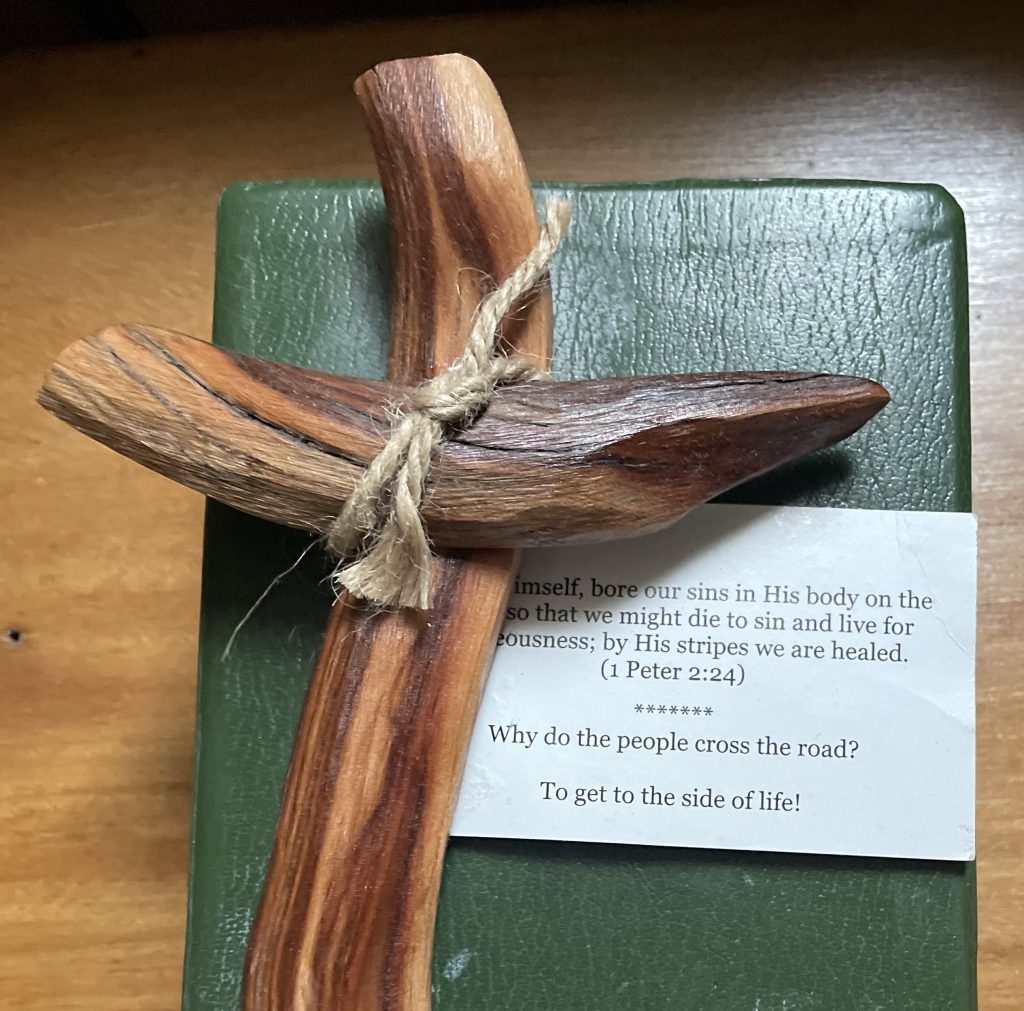
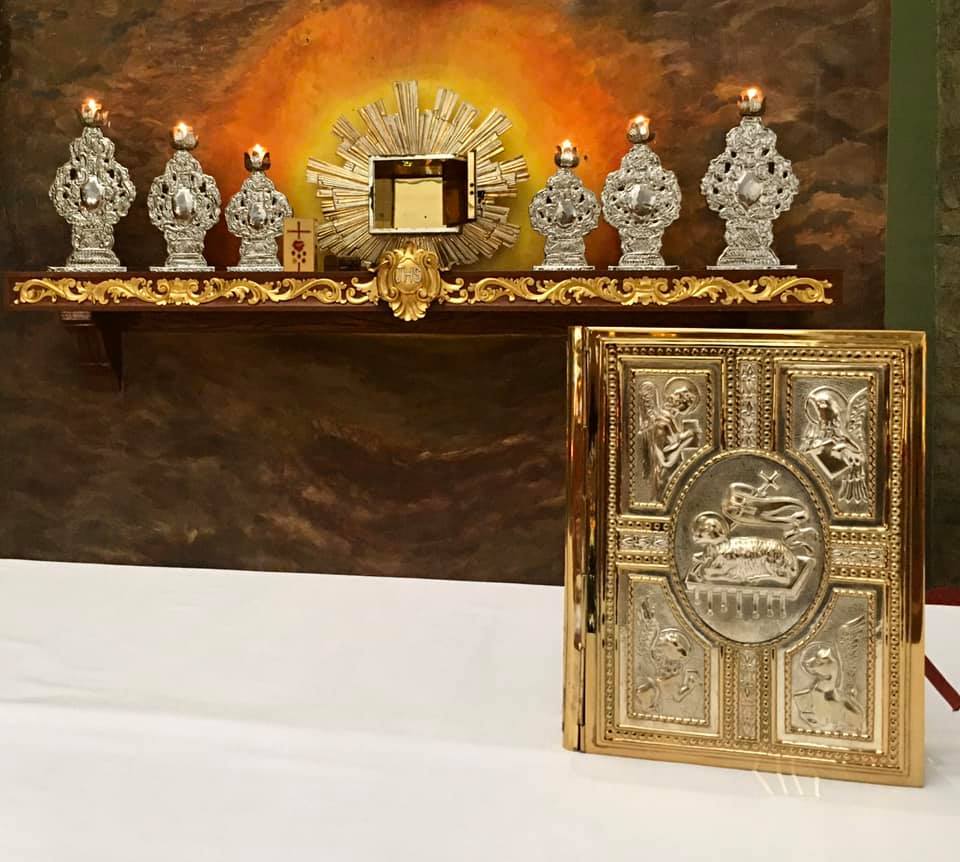
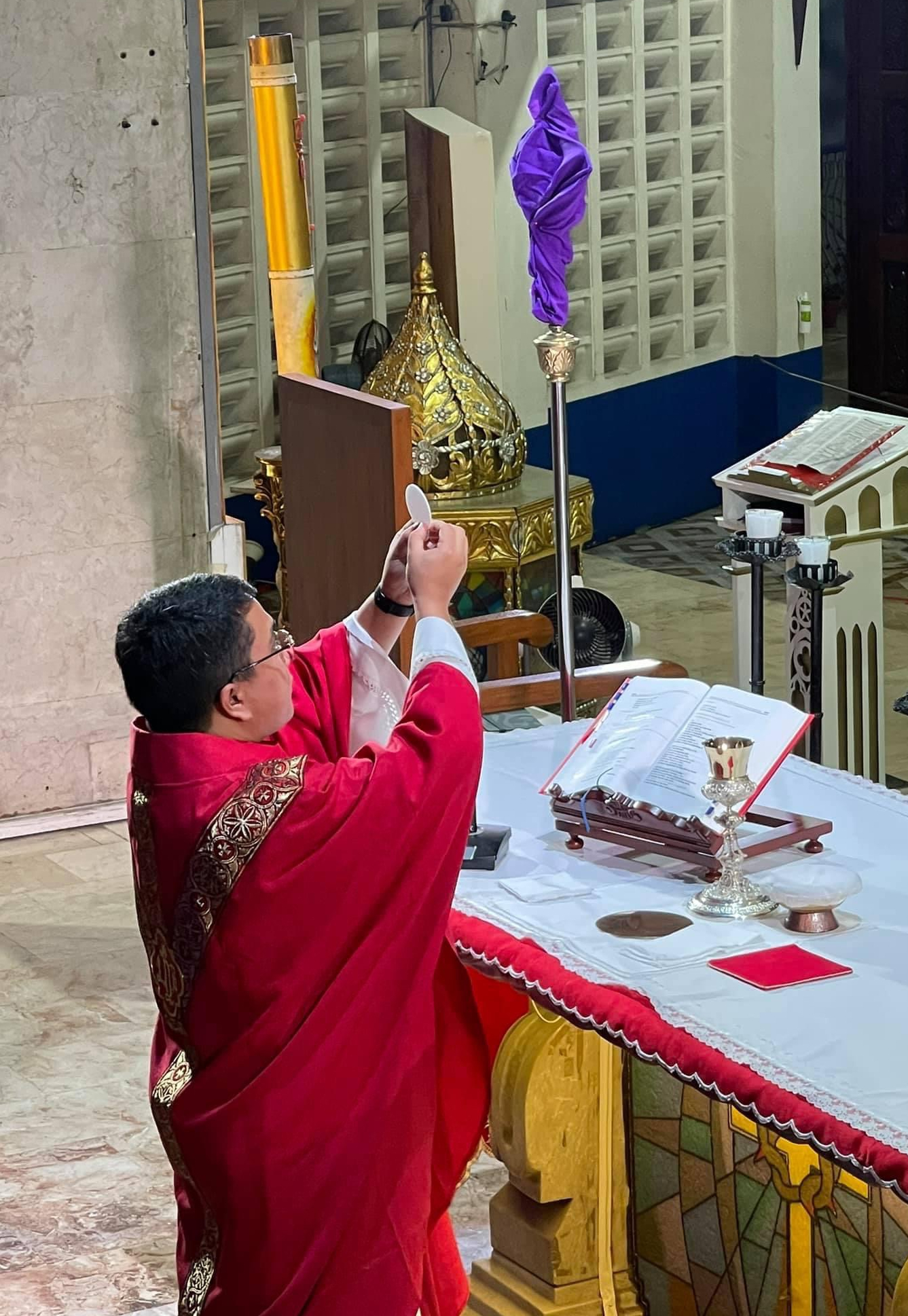
Photo by author, Sacred heart Novitiate, Novaliches, QC, 17 March 2025.

I have always loved Thursday since my first job in 1986 at GMA-7 News and Public Affairs. It was the day-off given to me by our office because I have to write news for our radio stations DZBB-AM and DWLS-FM even on Saturdays and cover news for television on Sundays.

After resigning from my job to enter the seminary in 1991 and got ordained as priest in 1998, I still chose Thursday as my day off from the ministry.

The reason for this is from a news I have found from the wires of United Press International during my GMA days that reported the findings by researchers in a US university that people are more kind on Thursday. According to the report which I used in our two radio stations, people are normally grouchy on Monday because of hangover from the weekend. They only start working on Tuesday, getting so tired on Wednesday, the two most toxic days in the week. Friday is TGIF when employees shelve their work in preparation for the weekend.

It is only on Thursday when people are most human and kind as they wanted to get everything done before TGIF. Hence, it is also the best day in the week to ask for a raise or to ask for favors from anyone. It is also on Thursdays when traffic is lighter because people are more relaxed, not so stressed out than the other days of weekday.

Photo from wikipediacommons.org of Christ’s washing of feet of Apostles at Monreale Cathedral in Palermo, Italy.

Perhaps it is no coincidence at all, in fact truly a part of the mystery of Jesus Christ’s Incarnation, i.e., his becoming human like us in everything except sin that he gave us his new commandment during their last supper also on a Thursday.

“I give you a new commandment: love one another. As I have loved you, so you also should love one another. This is how all will know that you are my disciples, if you have love for one another” (John 13:34-35).

This is the reason Holy Thursday is called Maundy Thursday from the Latin word mandatum or commandment when Jesus gave us his commandment of love.

Love is the only thing we all have to do in life. This love is expressed in our love for God through one another. That is why Jesus clarified that during his ministry: love of God is always expressed in our love for one another. Love as a commandment is like a face with two cheeks always together. Isang mukha, dalawang pisngi.

Every time we sin, it is not only a breaking of a law of God or human but most of all a refusal to love, a refusal to obey Christ’s commandment to love. Our Tagalog word for sin says it all: kasalanan from the root word sala which is “to miss” or “to fail”. Every sin – a kasalanan – is a failure, a missing (sala) of our one task which is to love. Every time we sin, we become less of a loving person.

It is indeed a very tall order from the Lord, to love like the way he loves us.

So when he had washed their feet and put his garments back on and reclined at table again, he said to them, “Do you realize what I have done for you? You call me ‘teacher’ and ‘master’, and rightly so, for indeed I am. If I, therefore, the master ands teacher, have washed your feet, you ought to wash one another’s feet. I have given you a model to follow, so that as I have done for you, you shouild also do” (John 13:12-15).

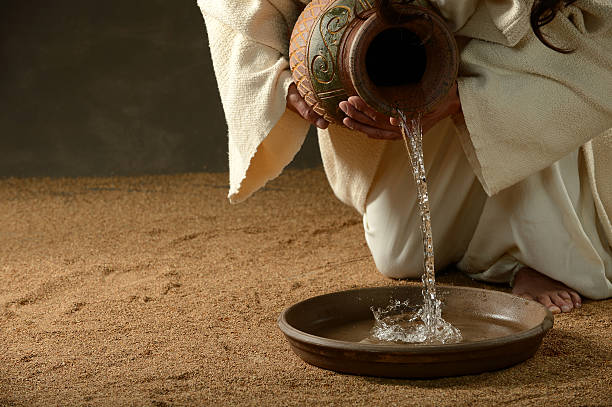
From gettyimages.com.

However, Jesus is not the stiff nor strict at all in demanding that we totally be like him right away in our love for one another. All he asks us is to try, to persevere in his love. He knows very well that our love is imperfect, that only him can love us perfectly.

Many times we complain (rightly so!) as we get hurt emotionally, physically and even spiritually from people we look up to like priests and teachers and to those supposed to love us most like parents and siblings and friends.

It is part of the mystery of life and of love specifically that the ones we love most are the ones we hurt most too and vice versa. That pain is from that love that ironically fails always. And that is because we are not God. Our love is always imperfect. We need to have some room within us for others’ sins and failures.

Photo by author, last supper scene of our youth’s senakulo, 15 April 2025.

We are all imperfect that is why our love is also imperfect. There are times we think the love we share or give is the very best but to our beloved, it could be misconstrued as not love at all like parents being too strict with their children. There are times when we think our beloved would love our gifts as expression of our love but unknown to us they were expecting something else.

Only God can love us perfectly. That is the love of Jesus Christ for us on the Cross so vividly portrayed in his last supper on Holy Thursday evening when he washed the feet of his disciples.

Jesus washed the disciples’ feet because he knew they would get dirty again. And that would need constant washing by those he would leave behind, including us. To wash another’s feet is the highest or deepest form and expression of love because it is an imitation of Jesus Christ.

Imagine how Jesus bowed down to each of the Twelve that Holy Thursday evening. Every day, Jesus does that to us too!

Normally, we look up to God in the heavens to pray, to beg his mercy, to ask for his favors, to praise and thank him. Jesus reversed this at his last supper: with him washing our feet, Jesus is the one looking up to us mere mortals and sinners?!

That is the love of Christ for us he proved the following Good Friday when he plunged himself to the lowest point of life, of dying on the Cross because of his immense love for each of us that led to his Resurrection at Easter.
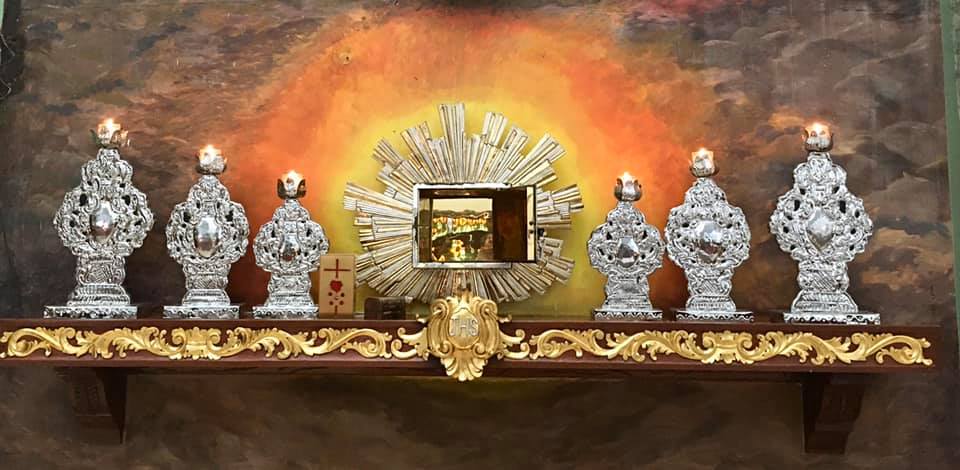
Photo by author, Holy Thursday 2020.

At the start of the Mass of the Lord’s Supper this afternoon before sundown, the rubrics instructs that “the tabernacle should be entirely empty, but a sufficient amount of bread should be consecrated in this Mass for the Communion of the Clergy and the people on this and the following day.”

This is a beautiful reminder too for us as we come for the celebration of Jesus Christ’s supper and sacrifice, we too must empty ourselves of our pride, to accept our own imperfections in order to have some room for others also imperfect just like us. Let us empty ourselves of our sins for us to be filled with Christ’s love and mercy, kindness and forgiveness.

This Maundy Thursday, let us reflect on how deep is our love for Christ and for one another. Look at your feet and admit how difficult it is to even wash our own feet. Whose feet do not get dirty in this life’s journey? Everyone does. Let’s admit that and start helping each other in washing our feet. That is love. We do not stop loving because that is all we have to do in life and afterlife. Amen.
Priesthood is the Cross

The Lord Is My Chef Daily Recipe for the Soul by Fr. Nicanor F. Lalog II
Thursday, Feast of Our Lord Jesus Christ, the Eternal High Priest, 23 May 2024
Hebrews 10:11-18 <*{{{{>< + <*{{{{>< + ><}}}}*> + ><}}}}*> Mark 14:22-25
Praise and glory to You,
Lord Jesus Christ for reminding us
this Thursday after the Pentecost
of Your call for us to be like You,
our Eternal High Priest,
in gentleness and mercy,
kindness and love;
and the good news is
all these are already in us
when we were baptized
to share in Your priesthood
the Father had promised
to Jeremiah fulfilled in You:

The holy Spirit also testifiesd to us, for after saying: “This is the covenant I will establish with them after those days, says the Lord: ‘I will put my laws in their hearts, and I will write them upon their minds,'” he also says: “Their sins and their evildoing I will remember no more.” Where there is forgiveness of these, there is no longer offering for sin.

Hebrews 10:15-18
Two Sundays ago,
we celebrated Your Ascension
that is more relational in nature
than spatial, the leveling up of
our relationships with You and
with one another that is affirmed
today by this feast of You,
Jesus our Eternal High Priest
and Mediator when You
established the New Covenant
on that Last Supper:

As they were eating, Jesus took bread, and blessed, and broke it, and gave it to them, and said, “Take; this is my body.” And he took a cup, and when he had given thanks, he gave it to them, and they all drank of it. And he said to them, “This is my blood of the covenant, which is poured out for many.”

Mark 14:22-24
Photo by author, Chapel of St. Francis Xavier, Sacred Heart Novitiate, Novaliches, QC, 20 March 2024.
These words, dear Jesus
You fulfilled on the Cross
the following Good Friday;
in Your self-offering on the Cross,
You fulfilled the temple worship
by putting an end to
those bloody sacrifices,
rites and rituals of the Old that
were empty due to the sins
and weaknesses of
the priests and people;
in Your dying on the Cross
as fulfillment of Your words at
the Last Supper as our
Eternal High Priest and Mediator,
You have consecrated us as
Your holy people;
this perfect offering
is what we celebrate,
what we remember,
what we make present daily
in the Holy Eucharist;
help us, therefore, dear Jesus,
to be faithful and true to You
by being more loving with one
another as we face the Father
in the Sacrifice of the Mass
in You, through You and with You
Jesus by sharing in Your Priesthood,
help us laity and priests alike
to be true in our witnessing,
in our loving sacrifices for each other.

Every priest stands daily at his ministry, offering frequently those same sacrifices that can never take away sins. But this one offered one sacrifice for sins, and took his seat forever at the right hand of God. For by one offering he has made perfect those who are being consecrated.

Hebrews 10:11-12, 14
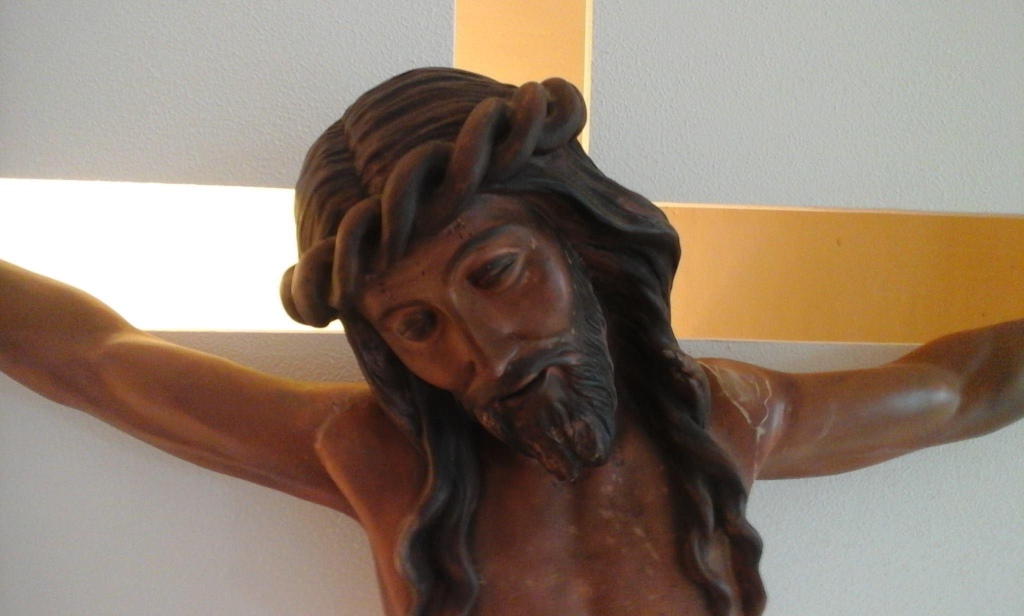
Photo by author, 2023.
Forgive us,
Your priests and bishops,
dearest Jesus
whom You have called
to act in "persona Christi"
but have become more like
the priests of the Old Testament
so concerned with our
name and position,
power and wealth;
forgive us, Lord Jesus,
when we Your priests and bishops
look and move like matinee idols
or think and speak like managers
than pastors of souls;
forgive us, O Lord,
when we Your priests and bishops
have no more time to kneel daily
be with You in prayers
because we prefer
to socialize and party
with the rich and powerful
that we miserably fail
in finding You
among the poor
and the suffering.

Transform us
priests and bishops
to be more like You
Jesus Christ,
our Eternal Priest and Mediator
in thinking,
in speaking,
in doing,
in living,
most especially in loving.

Let us not forget
that You saved mankind
by suffering and dying on the Cross,
not with with programs
and activities
because Your glory
can only be found on the Cross
where death is conquered
and led to life and light.
Amen.
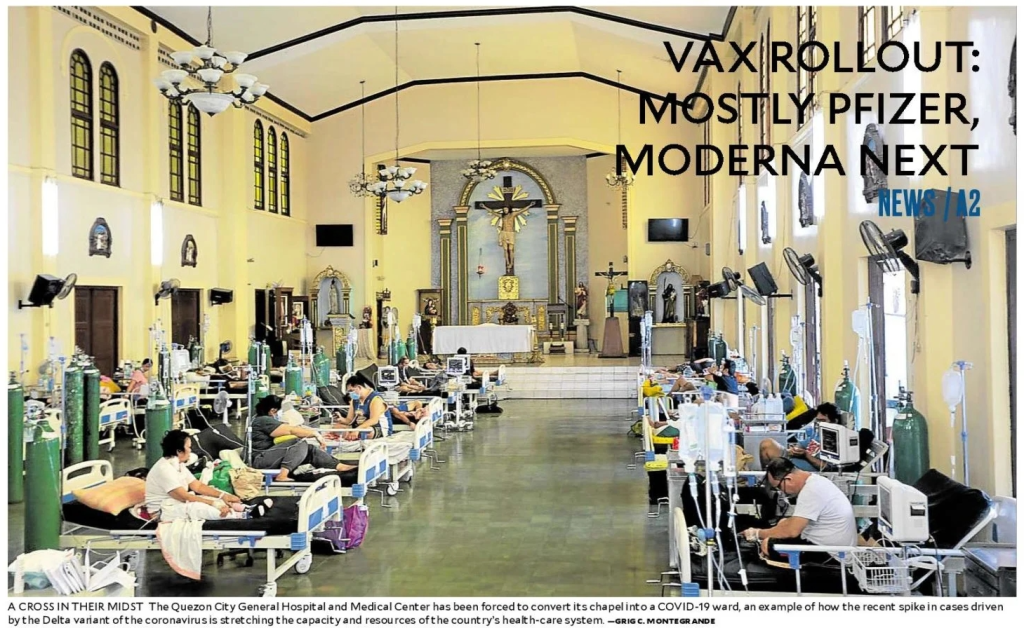
From inquirer.net, 20 August 2021.

Walking with Jesus

The Lord Is My Chef Holy Thursday Recipe, 28 March 2024
Exodus 12:1-8, 11-14 > + < 1 Corinthians 11:23-26 > + < John 13:1-15
Photo from wikipediacommons.org of Christ’s washing of feet of Apostles at Monreale Cathedral in Palermo, Italy.

Tonight we start the Easter Triduum – the three holy days of the Passion, Death, and Resurrection of Jesus Christ with the Mass of the Lord’s Supper and Washing of the Feet. 

In our Mass tonight, there will be no dismissal after Holy Communion that is immediately followed by a short procession inside the church of the Blessed Sacrament to its repository that will be the focus of “Visita Iglesia” (not Stations of the Cross) when people “visit” at least seven churches to pray to the Divine Presence of Jesus. Tomorrow in most parishes is the “via Crucis” or Way of the Cross then in the afternoon after the Veneration of the Holy Cross is the Procession of the Burial of the Lord. 

See how on these most holy days of the year, much of our activities involve a lot of walking – and rightly so because Jesus Christ was always walking even to His Crucifixion and after Resurrection.

Hence, on the night He was betrayed after Supper, He washed the feet of His disciples including us today because He had also known how difficult and tiring it is to always walk in this life.

“…fully aware that the Father had put everything into his power and that he had come from God and was returning to God, he rose from supper and took off his outer garments.  He took a towel and tied it around his waist.  Then he poured water into a basin and began to wash the disciples’ feet and dry them with the towel around his waist.”

John 13:3-5
From IStock/GettyImages.

More than reenacting the washing of the feet, tonight we are reminded by Jesus of the journey ahead to his Crucifixion when – with apologies to Robert Frost – we still have to walk “miles to go before we sleep” by choosing the road less travelled “that made the difference.”

And here lies the problem of our time: with the advancement of technology, our modes of transportation like communication have greatly affected our relationships with others, for better and for worse.  From being peripatetic persons, we have become more accustomed to riding, of getting fast and effortless to our destination that we no longer walk that much unlike before that has affected even our relationships with one another.  How can we continue the work of Jesus when we no longer walk that much? 

Photo by Mr. Raffy Tima of GMA-7 News, 2020.

Observe how it has become so difficult to ask for directions these days because nobody is walking anymore.  Most of us are ensconced in our own vehicles that have become our own little world and tiny universe every time we travel even if it were just a “walking distance”.  Aside from breaking apart from the rest of humanity, we have also become very impersonal in the sense that we now rely more with Google maps and other travel apps than with the ordinary “man on the street.” Worst, we rarely touch the ground with our bare feet that if ever we would walk, it has been relegated to mere physical fitness often done alone with earphones as companions.  We have not only grown apart from others but have also lost touch with earth because we no longer walk that much like Jesus and His disciples.

Two weeks ago during my retreat, I walked around the vast grounds and mini-forests of the Sacred Heart Novitiate in Novaliches when I realized that priesthood is peripatetic in nature because it is a ministry that walks to reach out, search for the missing sheep as per instruction of the Lord.  Jesus even added that in fulfilling our mission, we must carry nothing when we walk except a staff and sandals. 

Walking with our parishioners in the Via Crucis, 01 March 2024.

Moreover, priesthood is a ministry of being companions as shepherds in the journey of the people. That is why Jesus is our Good Shepherd because He is the One who truly journeys with us in this life.  He is the One who continues to walk with us in our many ups and downs, in the many dusty trails and harsh realities of life that no gadget or wealth or media platform could bring comfort and security to any weary traveler. 

It is only in walking when we could truly journey with others in life to converse with them and listen to their doubts and frustrations like the two disciples walking back to Emmaus three days after Good Friday.  It is only in walking can we truly meet the sick, the orphaned and the widowed, the blind and the lame, the sinners and the misfits the world had left behind or pushed onto the margins of the society, far from our superhighways. 

Most of all, when we walk we touch ground, we feel the earth called “humus” in Latin, the origin of the words human and humility.  Could it be that we have become less humble today partly because of our refusal to walk more often?

Forgive us your priests when we have refused to walk with you especially when you are troubled and lost.  Forgive us your priests as we have ceased to be like Jesus who walked most of the time because we have been so obsessed riding and travelling most of the time in our cars and SUV’s as well as mountain bikes and big bikes that have insulated us from your cries and anguish.  We have not only lost the art of walking but have totally forgotten about walking the extra mile to pray and commune with our Lord and Master Jesus Christ found among the poor and the sick, the marginalized peoples forgotten in our upwardly, mobile society. 

Photo by author, Sacred Heart Novitiate, Novaliches 20 March 2024.

We always hear the expression “life is a journey.”  Our first reading tonight attested to this reality when God reminded the chosen people preparing for exodus from Egypt “to eat and dress like those who are in flight”(Ex.12:11). 

The original concept of the restaurant is not just a place where people stop to eat during a long journey.  Restaurants were truly “rest stops” where travelers could rest their feet by soaking them in warm water so that they could travel again to reach their destination. 

The Holy Eucharist is a “sacred restaurant” where we eat and drink the Body and Blood of Christ who nourishes us in our life journey.  Most of all, in the Eucharist and Sacrament of Reconciliation, Jesus continues to wash our feet to cleanse us from our sins and burdens to make this journey of life lighter and easier.  When we receive Him in the Holy Communion, we make Him our “companion” in life filled with darkness and pains, uncertainties and lack of direction.  The word companion literally means “someone you break bread with” – a beautiful picture of the Eucharist described to us by St. Paul in the second reading. 

From istock/GettyImages.

In washing the feet of His disciples, Jesus Christ showed us in His humble gesture that He is indeed our Savior who went down so low even unto death on the Cross to express His immense love and mercy for each of us.  Everything that transpired on the night He was betrayed prefigured the events of Good Friday which we make present every time we celebrate the Eucharist that is summed up in loving service for one another. 

Do we still walk?  And if we walk, who is our companion, the one we break bread with?  Likewise, do we walk our talk of our faith?

May we never leave behind Jesus among our family and friends as we walk through this life.  A blessed Holy Thursday to everyone. Amen.

Opening to God

Quiet Storm by Fr. Nicanor F. Lalog II, 28 March 2024
Photo by author, sunrise at the Sacred Heart Novitiate in Novaliches, QC, 20 March 2024.

As we now enter the holiest parts of the Holy Week called the Sacred Triduum of Holy Thursday, Good Friday and Easter Vigil beginning tonight with the Mass of the Lord’s Supper, please find time to have some silent moments of prayer and reflections.

Do not let this Holy Week pass as one of those days so unique because of the great sights and sounds that have filled our cameras with so much photos and videos but have ironically left us empty inside. Don’t you notice the more we fill ourselves with photos and videos on the pretext and excuse of keeping memories and remembrances, the more we are left empty, lost and alienated because we have missed experiencing the moment itself?

From forbesmagazine.com

The reason images are covered and no flowers adorn our church altars during Lent until Holy Saturday is for us to focus more inside ourselves than outside.

Lent and the Holy Week remind us that basic truth in life that what is most essential is the inside not the outside we aptly call in Filipino as palabas.

How ironic that despite all the technologies and comforts they have brought humans, we are more lost and empty these days than before with more suicides, more depressions, and more social problems and issues.

Lent invites us to return to our very first love of all, God who patiently awaits us always, right in our hearts. Pray as much as possible today to experience God and your very self this Holy Thursday. Just pray. Very often, the most difficult prayer is also the most meritorious.

And when you pray, I strongly recommend Jesuit Father Eduardo Hontiveros’ classic Buksan Ang Aming Puso, the most beautiful and touching church music that is a prayer in itself during this season of Lent and the Holy Week.

Buksan ang aming puso
Turuan mong mag-alab
Sa bawat pagkukuro
Lahat ay makayakap

Buksan ang aming isip
Sikatan ng liwanag
Nang kusang matangkilik
Tungkuling mabanaag

Buksan ang aming palad
Sarili'y maialay
Tulungan mong ihanap
Kami ng bagong malay
Photo by author, Sacred Heart Novitiate, Novaliches, QC, 18 March 2024.

I love its progression from opening of heart, then of mind, then of the hand which signifies our whole person.

Our hands is a microcosm of our very selves that is why we shake hands, with give high fives to signify the giving of our total selves in friendship. Fortune tellers read our palms because they signify our whole person. We Filipinos have a beautiful expression during pamanhikan when parents of the groom meet their future balae to ask for the hand of their daughter in marriage, “hihingin namin ang kamay ng inyong anak.”

What is in our hands?

Remember the word betrayal that literally means to hand over from the Greek word paradidomi? Again, our Tagalog translation renders its deepest meaning especially when we recall how Jesus was handed over by Judas to the soldiers who handed Him over to the Sanhedrin who then handed Him over to Pilate who finally handed Him over to the people to be crucified. That repeated handing over of Jesus – or betrayal – is perfectly said in our own expression of “pinagpasa-pasahan si Jesus.”

That is how dirty our hands are with sin and evil when we repeatedly hand over Jesus through our own family and friends whom we take as things to be passed on for something or someone else more useful.

Opening to God becomes complete, from the mind and the heart, when we are able to open our hands to Him, the only One we can really hold on in this life. When we die, we cannot hold and bring anything from this life. Like Jesus, we die with hands opened to God, praying, “Into your hands, I commend my spirit.”

Photo by author, Sacred Heart Novitiate, Novaliches, QC, 20 March 2024.

You will notice this afternoon when you come for the Mass, the tabernacle is opened and empty. The Sacred Hosts we shall receive later in the Holy Communion are the ones to be consecrated during the Mass.

Are we also empty to receive Jesus? That is the beauty of Communion by hands when we hold nothing else, we open our hands positioned across our heart supposed to be clean to receive Jesus wholly and responsibly.

As you receive Jesus in the Holy Communion tonight, pray Buksan Ang Aming Puso and ask God to give you a new consciousness (bagong malay) that you are loved and forgiven so you can love and forgive others too.

Ask Jesus to empty your heart of pride so He would reign there to fill you with more of His humility, justice, and love.

Most of all, ask Jesus to dwell in your heart so that every decision you make may come from your heart not from the hatred and bitterness that have covered it all these years.

Be the new person tonight in Jesus as He wash you clean of sins. Amen.

*Usiginanga… you may open your phone to listen and pray Buksan Ang Aming Puso.

From YouTube.com

Love is perfection of life

Quiet Storm by Fr. Nicanor F. Lalog II
The Seven Last Words, 06 April 2023
Photo by author, Chapel of the Holy Family, Sacred Heart Novitiate, Novaliches, Quezon City, 2014.

There was a vessel filled with common wine. So they put a sponge soaked in wine on a sprig of hyssop and put it up to his mouth. When Jesus had taken the wine, he said, “It is finished.” And bowing his head, he handed over the spirit.

John 19:29-30

Every Maundy Thursday, people await that most unique part of the Mass every year when the priest washes the feet of some members of the community. As a priest, it is one of the most humbling experiences I have had when a brother priest washed my feet on that Mass I attended in 2008 and 2021.

But there is something more beautiful to the ritual washing of feet. It is the context and words that accompany that: “Before the feast of Passover, Jesus knew that his hour had come to pass from this world to the Father. He loved his own in the world and he loved them to the end” (John 13:1).

The Greek word for the “end” is telos which is not just a terminal end in itself but indicates or connotes direction. Or fulfillment and perfection, not just a ceasing or end or stoppage of life or any operation.

When Jesus said on the Cross “It is finished”, he meant he had fulfilled his mission, that is, he had perfectly loved us to the end by giving us his very life.

At his death on the Cross, Jesus showed us perfectly in no uncertain terms his love for us, the Father’s love for us that he had told to Nicodemus at the start of the fourth gospel that “God so loved the world that he gave his only Son” (Jn. 3:16).

There on the Cross this was definitively fulfilled and perfected more than ever. Jesus did not have to die on the Cross but he chose to go through it because of his love for us.

Here we find the beautiful meaning of love. It is not just obeying the commandments nor being good and kind with everyone. Love in its totality is the perfection of life. It is our only destiny in life, our call to life from the very beginning. Love, love, love. Keep on loving until it hurts. Until the end.

Beloved, if God so loved us, we also must love one another. No one has ever seen God. yet, if we love one another, God remains in us, and his love is brought to perfection in us.

1 John 4:11-12

From that same letter, John declared at the very start that God is love which according to Pope Benedict XVI in his first encyclical is the most profound statement about God found only in Christianity.

My dear friends, only God can love us perfectly. Only Jesus can love us perfectly like what he did on the Cross. Human love is always imperfect. In our imperfect love, let us find Jesus filling up, making whole, perfecting our love for each other. Let us die in our selves sometimes when we have to let go with each one’s imperfection like when they make side comments. Forget all about revenge. Forgive. Understand the shortcomings of everyone. Accept and own the pains and hurts inflicted on us by our loved ones like our mom and dad, your former wife or husband, your friends, of those who have hurt you in words and deeds. That is being like Christ, dying on the Cross because of love.

Let us pray for those we love and those who love us despite our imperfections.

Lord Jesus Christ,
how I wish I could love until the end,
how I wish I could say too like you
"It is finished";
forgive me because many times with me,
the pains and hurts I have had are not yet
finished, even festering inside me,
eating me up, rotting inside me
that I could not grow and bloom in you.
Forgive me and teach me to forgive too
for it is in forgiving we truly love
perfectly like you.
Amen.
Photo by my former student, Ms. April Oliveros on their ascent to Mt. Pulag, 25 March 2023.

Loving to the end

The Lord Is My Chef Recipe for the Soul by Fr. Nicanor F. Lalog II
Maundy Thursday, 06 April 2023
Exodus 12:1-8, 11-14  +  1 Corinthians 11:23-26  +  John 13:1-15
Photo by author, Holy Thursday 2019, Parokya ni San Juan Apostol at Ebanghelista, Bagbaguin, Sta. Maria, Bulacan.

Tonight we begin the most solemn days of the year called the “Holy Triduum” of Maundy Thursday, Good Friday, and Easter Vigil. All roads rightly lead to the Parish Church at sundown for the celebration of the Holy Eucharist that begins with the Tabernacle empty. There will be no dismissal at the end of the Mass, it is open ended. Most of unique of all in tonight’s Mass is the ritual of the washing of feet of some members of the community.

But there is something more beautiful to the ritual washing of feet. It is the context and words from John’s gospel that set the mood of tonight’s mood and tone of celebration as well as the hint of the meaning of Good Friday too.

Before the feast of Passover, Jesus knew that his hour had come to pass from this world to the Father. He loved his own in the world and he loved them to the end.

John 13:1
Photo by author, Holy Thursday 2019, Parokya ni San Juan Apostol at Ebanghelista, Bagbaguin, Sta. Maria, Bulacan.

First thing we have to consider here is the fact that “Jesus knew his hour had come to pass from this world to the Father.” He was never caught by surprise. Jesus knew everything, was never taken over by events. Luke said it beautifully after his identification as the Christ at Caesarea Philippi, When the days for his being taken up were fulfilled, he resolutely determined to journey to Jerusalem (Lk. 9:51).

We have heard in the first reading the story of the exodus of the Israelites, their passover from Egypt to the Promised Land, their passover from slavery to freedom that was perfected by Christ’s own pasch beginning tonight with his Passion, Death and Resurrection. This is our call, to live Christ’s Paschal Mystery daily, to be one in him, one with him, one through him in passing over life’s many challenges and trials.

To passover means to grow, to mature, to overcome, to hurdle. Every day we go through many series of passovers, from sickness to health, from sinfulness to forgiveness, from failures to victory, from our little deaths to our daily rising to new life in Jesus. This we can only accomplish with love, the kind of love by Jesus Christ.

That is the second, most important thing we must consider in John’s brief introduction to our gospel tonight, Jesus “loved his own in the world and he loved them to the end”. The Greek word for the “end” is telos which is not just a terminal end in itself but indicates or connotes direction. Or fulfillment and perfection, not just a ceasing or end or stoppage of life or any operation. Jesus knew everything that is why his life here on earth had direction which is back to the Father, with us. Everything he said and did was out of love for the Father and for us.

From google.

Love is the sole reason Jesus came to the world to save us because we have failed to love from the very beginning. It is love that Jesus showed us on that Holy Thursday evening to be fully expressed on Good Friday when he died on the Cross. His whole life was love because he himself is love. This he showed when he washed the apostles feet and after that, asked them and us to do the same with each other. That is love’s highest point when we are able to get to our lowest point of service and love. In our daily passover, it is love that moves us to keep on going with life’s many ups and downs because we love our parents, our siblings, your wife or husband, your children. Our vocation and the people entrusted to us. We go through our passover we because we love.

When Jesus died on the Cross, he said, “It is finished” – meaning, he had fulfilled his mission, that is, he had perfectly loved us to the end by giving us his very life. At his death on the Cross, Jesus showed us perfectly his love for us, the Father’s love for us that he had told to Nicodemus at the start of John’s gospel that “God so loved the world that he gave his only Son” (Jn. 3:16).

This is the love Jesus spoke of during that supper that rightly prompted St. Paul to put into writing, the very first one to do so in the New Testament:

Photo by author, 2019.

Brothers and sisters: I received from the Lord what I also handed on to you, that the Lord Jesus, on the night he was handed over, took bread, and, after he had given thanks broke it and said, “This is my body that is for you…” In the same way also the cup, after supper, saying, “This cup is the new covenant in my blood. Do this in remembrance of me.”

1 Corinthians 11:23-24, 25

There on the Cross this was definitively fulfilled and perfected more than ever. Jesus did not have to die on the Cross but he chose to go through it because of his love for us.

Here we find the beautiful meaning of love expressed to us in the celebration of the Holy Eucharist. More than obedience to commandments and keeping the laws of God by being good and kind with everyone, love is the perfection of life.

Love is our true destiny – end – in life, our call to life from the very beginning.

Keep on loving until it hurts. Until the end because God is love as John wrote in his first letter where he beautifully expressed, Beloved, if God so loved us, we also must love one another. No one has ever seen God. yet, if we love one another, God remains in us, and his love is brought to perfection in us (1 Jn. 4:11-12).

Love, love, love.

Photo by Ms. April Oliveros, Mt. Pulag, 25 March 2023.

My dear friends, only God can love us perfectly. Only Jesus can love us perfectly like what he did on the Cross.

Human love is always imperfect. That is why Jesus showed us the example of washing the feet of his apostles at the Last Supper.

In the Holy Mass, we all bow down before God and with everyone at the start to confess our sins, to admit our sinfulness “in what we have done and failed to do.”

In the Eucharist, Jesus fills up, completes our imperfect love with his love found in his words, in his peace we share with others, and most especially in his Body and Blood we receive.

St. Paul rightly reminded us of this meaning of the Eucharist, For as often as you eat this bread and drink the cup, you proclaim the death of the Lord until he comes (1 Cor. 11:26). This is why we have to celebrate Mass every Sunday. Most especially on holy days like tonight and Easter. Please, complete the Holy Triduum until Easter. Go on vacation some other date. Give these days to God who gave us his Son Jesus Christ by dying on the Cross for us.

Let us pray silently, be wrapped and awed by that mystery of the Eucharist Jesus established on that Holy Thursday evening at the Upper room.

Dearest Jesus,
teach us to love you more
by imitating your love,
of humbly going down to serve
even those who betray us,
of bending our hearts
to forego all bitterness
and festering anger within,
"let our tongues sing the 
mysteries telling of your Body, 
price excelling of your Blood"
in a life of loving service,
of daily dying in you
with you and
through you.
Amen.

Have a blessed and meaningful Holy Triduum. Please pray and reflect on God’s love for us these days at home, in the church.

Holiness is companionship in Christ

Quiet Storm by Fr. Nicanor F. Lalog II
Holy Thursday, 14 April 2022
Exodus 12:1-8, 11-14  +  1 Corinthians 11:23-26  +  John13:1-15
Photo from inquirer.net, 20 August 2021.

A blessed Holy Thursday everyone.  Tonight we begin the most holiest days of the year, the Holy Triduum of the Lord’s Passion, Death, and Resurrection known as the pasch of the Lord. From the Hebrew word pesach, a pasch is a passing over, the journey of the Hebrew people from Egypt into the promised land of God.

A journey does not necessarily involve physical distance as it can be something within one’s self like an inner journey to God dwelling within us. Journey is a process that leads us to growth and maturity from the many difficulties and trials we experience as we travel in life.

And whatever journey we take outside or within ourselves, we always need a companion to travel with. From the Latin words cum panis that literally mean “someone you break bread with”, a companion is someone who helps us in our journey, a friend who shares life with us, guiding us, protecting us. Like the bread we break and share, a companion sustains and nourishes us in our journey.

That is exactly the companionship of Jesus which is holiness. Having Jesus as our companion in life’s journey is to have him as our daily Bread who fills us with God in every celebration of the Holy Eucharist. I used to tell our students in elementary school that every Mass is a journey into heaven, a dress rehearsal of our entrance into heaven when we have a foretaste of eternal life we all hope for until Christ comes again. That is why last Tuesday we said the first test of our fidelity in found in our celebration of the Sunday Eucharist.

We are all travellers and journeyers on earth; our true home is in heaven with God our Father.  We are merely passing over this planet temporarily.  That is why we always say life is a daily lent, a daily passing over.

By celebrating the Lord’s Supper that Thursday evening with his disciples who represented all peoples of all time, Jesus established for us the everlasting memorial of his loving presence as our companion and our very Bread and Wine in the journey back to the Father that is often dark and difficult.

What he did that Thursday evening foreshadowed what he would do on Good Friday when he did his greatest act of love for us by dying on the Cross. What is most beautiful meaning we can find here is the importance of communion, of oneness as a community, as a family that are expressions of our companionship in Jesus. Every journey becomes wonderful when done in the context of a community, with true companions beginning in our very family.

At the very core of every companionship, of every community is LOVE. To become bread for someone in a journey is to become LOVE – like Jesus Christ at the last supper.

Love can never be defined for it has no limits; love can only be described like how Jesus described to us in his actions on that night of his supper, his kind of love we all must emulate:

So, during supper, fully aware that the Father had put everything into his power and that he had come from God and was returning to God, he rose from supper and took off his outer garments. He took a towel and tied it around his waist. Then he poured water into a basin and began to wash the disciples’ feet and dry them with the towel around his waist.

John 13:3-5
Photo from GettyImages/iStockPhotos.

During the time of Christ, restaurants were stops not only for meals but for rest that consisted of soaking their feet on a basin of water. It was therapeutic that gave travelers enough strength to travel far again as there were no other modes of transportation at that time and not everybody could afford an animal to ride on. Any hiker and mountaineer can attest that after so much trekking, one thing you would always hope for is a stream or tiny brook with cool, crisp, running water to dip your feet and rest!

This Holy Thursday, let us be a companion in Jesus Christ with others, beginning with our family members. Do not get tired of being broken and shared like bread, of loving and caring when the journey becomes so tiring like in this time of pandemic that seems to be still far from over.

“Do you realize what I have done for you? You call me ‘teacher’ and ‘master,’ and rightly so, for indeed I am. If I, therefore, the master and teacher, have washed your feet, you ought to wash one another’s feet. I have given you a model to follow, so that as I have done for you, you should also do.”

John 13:12-15

Lord Jesus Christ,
may we never get tired 
walking in love 
as a companion and 
bread to one another like you 
by giving rest to others 
already tired and about to give up. 
Let us all be together in welcoming Easter! 
Amen.

Photo by Pixabay on Pexels.com

Love is going down, not up

The Lord Is My Chef Recipe for Holy Thursday by Fr. Nicanor F. Lalog II, 14 April 2022
Exodus 12:1-8, 11-14  ><}}}}*>  1 Corinthians 11:23-26  ><}}}}*>  John 13:1-15
Photo from aleteia.org, Cathedral of Monreale, Italy.

Tonight we enter the holiest three days of the year, the Triduum of the Passion, Death and Resurrection of Jesus Christ with the Mass of the Lord’s Supper that leads us into Easter on Sunday, the mother of all our feasts.

It was during the Lord’s Supper on Thursday evening before he was arrested when he gave us the commandment to “do this in memory of me” referring to the celebration of the Holy Eucharist which is the sacrament of love because on that Supper of the Lord, it was then when Jesus gave himself to us in signs what he would do on Good Friday. It was during that supper known as the Last Supper when Jesus showed His “love in action” for us in all time made present in every celebration of the Eucharist. This is the reason why Holy Thursday is also known as “Maundy Thursday” from the Latin word mandatus, mandatum or commandment/law.

Unlike in the Gospel accounts of Matthew, Mark, and Luke along with Paul who mentioned the institution narrative of the Eucharist in our second reading tonight, John opted to tell us what we might describe as a “sidelight” to Holy Thursday, the washing of the feet of the disciples; but for John, the “beloved disciple” of Jesus, the washing of the feet is the core and essence of the Last Supper – not a sidelight – for it shows us and even makes us experience how Jesus “loves us to the end.”

“Before the feast of Passover, Jesus knew that his hour had come to pass from this world to the Father. He loved his own in the world and he loved them to the end…He rose from supper and took off his outer garments. He took a towel and then tied it around his waist. Then he poured water into a basin and began to wash the disciples’ feet and dry them with the towel around his waist.”

John 13:1, 4-5
The lower we go down, the greater our love is.

True love is always a downward movement. Unlike in our society today when love is equated with selfish interests and materialism that calls for “upward mobility” for more wealth and power, knowledge and freedom and fame measured in likes and followers, true love is actually a “passing over”, a pasch or a passion like that with Jesus Christ.

When we let go of our positions, of our titles, of our very selves to go down with the rest, to go down with our students, with our followers, with our subordinates — that is when we truly love like Jesus Christ. It is what we mentioned last Fifth Sunday in Lent (03 April 2022) when Jesus bended down twice, first before the woman caught committing adultery and second to her accusers who left the scene when Jesus dared the sinless among them to cast the first stone on her. Now at the washing of his disciples’ feet at the last supper, Jesus again bended down reaching his lowest bending tomorrow on the Cross.

In all the bending down by Jesus – to the woman caught committing adultery, to her accusers, to the washing of feet of the Twelve and to his crucifixion – he shows us his immense love and mercy to us sinners, bending down to save our face and uplift those down in shame and pain among us (https://lordmychef.com/2022/04/02/the-joy-of-meeting-god/).

Note the movements by Jesus at the washing of his disciples’ feet were in itself a “passing over”, expressions of his love: “he rose from supper, took off his outer garments, took towel then tied it around his waist, poured water into a basin and began to wash his disciples’ feet and dry them with the towel around his waist.”

In Israel at that time, washing their master’s feet was not part of the servants’ “job description” because it was – and still – demeaning. But for those who truly love, for those who love to the end like Jesus, the most demeaning acts can also be the highest expression of love! When you take care of your sick parent, when you give yourself in service to people you hardly know and would not care for at all, when you try to bear all the pains and hurts in silence – these can be all so demeaning but meaningful to others and to God.

Photo from GettyImages/iStockPhotos.

Imagine the great love of Jesus for us, no matter how sinful we may be like Judas Iscariot whose feet Jesus still washed before betraying him. In its original Greek, “to betray” means to hand over a beloved to extreme pain and suffering, the opposite of Passover when we go down to love; to hand over is to break away, to break ties, to discard, to stop loving.

And this is the good news of this Holy Thursday: we have all been cleansed by Jesus in his pasch, in our baptism, and for those who have gone to confession, in the Sacrament of Reconciliation. Would we still remain to be in sin, outside of Jesus?

Tonight, there are two persons with supporting roles in the Supper of Jesus Christ: Peter and Judas. The former denied the Lord thrice while the latter betrayed Jesus. Peter repented and thus became the Rock of the Church while Judas grieved and took his own life.

We too can be either Peter or Judas when we deny or betray friends and loved ones or when they deny or betray us. It may have taken some time for Peter to finally stoop down before Jesus at the shore of the Lake of Tiberias to admit his sin of denying the Lord three times. But the fact remains that he bent low before Jesus in repentance that before the flock could be entrusted to him, the Lord asked him thrice if he loves Him. In Peter we have seen that before we could love the Church, the sheep, we must first of all love the Lord. Judas remained high in his pride; though he felt sorry for his sins, he could not go down on his knees before Jesus for he had lost his love for Him that made him decide to take his life instead.


Lord Jesus Christ, you love us so much 
and yet we love you so little;
you have gone so low for us, 
not only emptying yourself 
by taking the form of a slave 
to come in our human likeness 
but even humbled yourself in obedience until death. 
We always try to look so strong and powerful, 
refusing to bend our knees to go down before You and others, 
always trying to save face and honor; 
but, the truth is we are so weak inside, 
so ashamed to admit our faults and sinfulness. 
Give us the grace this Holy Thursday 
to be one with you again, 
to go down in you with our brothers and sisters, 
especially those whom we have denied or betrayed. 
Give us the grace to imitate your love 
and be heralds of your gospel of salvation to others. 
Amen.

Photo by author, 2016.

Postscript to Holy Thursday: that non-essential “lugaw” is essential!

Quiet Storm by Fr. Nicanor F. Lalog II, 05 April 2021
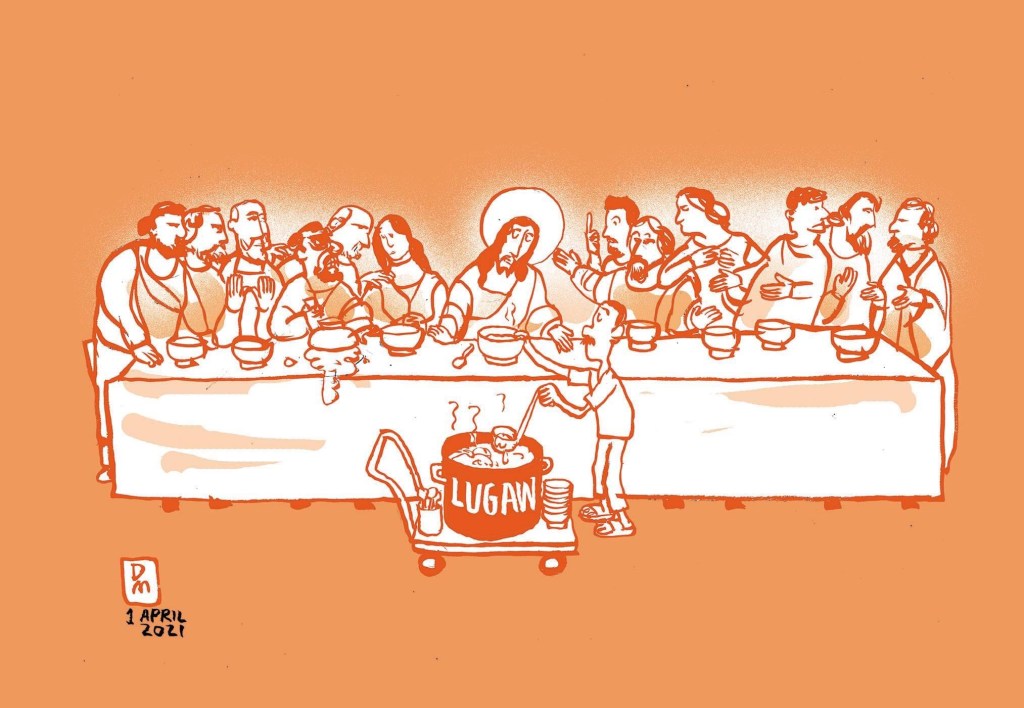
“An Essential Holy Thursday Transubstantiation” by artist DengCoy Miel posted on his Facebook, 01 April 2021.

It was a Holy Wednesday when the incident went viral as picked up by network news that evening when the previous night some barangay officials in Muzon, San Jose Del Monte, Bulacan insisted that lugaw is “not essential”, that man can live even without lugaw.

The timing was so perfect being a “Spy Wednesday” or the night of traitors when Judas Iscariot struck a deal with the chief priests to hand them over Jesus for 30 pieces of silver (Mt.26:15).

And so, there were the three barangay officials handing over to their power trip the common lugaw not knowing they have in fact betrayed us Filipinos in their arrogant insistence that lugaw is a non essential food.

The following Holy Thursday, another Judas Iscariot not only betrayed but crucified si lugaw as non-essential without knowing his remark was a self-indictment of this government’s preoccupation with politics, disregard for the people and lack of any definitive plan regarding the year-old pandemic. Trying to sound a smart aleck and clown rolled into one this administration has too much of, his explanations only made him look like the lowest kind of lugaw – rice leftovers boiled in water.

The benighted souls who have denigrated our favorite food have just proven that this pandemic is something we have to see in the light of spirituality and morality, not just a medical and social issue to be addressed.


Any food is always essential because every food signifies a person, has life and sustains life.

Recall that during his Last Supper on the night before he was betrayed, Jesus had chosen the most ordinary but very essential food to be the sign of his loving presence among us until the end of time – the bread. An unleavened bread, to be exact, which was the food taken by the Jews during their exodus from Egypt at the time of Moses.

The bible teems with so many references to the lowly food of bread as something divine with deeper meaning as a sign.

Consider that Jesus was born on a manger which is an open box or a trough for animals like horses and cattle to eat from to signify his being our very food in this life journey. He was born in Bethlehem that literally means “house of bread”; thus, at his last supper, Jesus gave himself to us under the sign of a bread.

In establishing the Sacrament of the Holy Eucharist which St. John Paul II emphasized in 2002 by adding the Mysteries of Light in praying the Rosary, Jesus elevated the meal into the most sublime human activity making our food divine and holy. As a result, the table had become one of the most intimate places in our lives that every time there is a meeting or any gathering, there is always the meal to be shared. I used to tell my students before that every first date is always in a restaurant – if possible a fine dining one – because what matters most is the moment to be shared together by you and your date.

It is always easy to know when couples and parents are not in good terms with each other: they never eat together or during meals, they do not talk or speak to each other. The same is true when people decline our invitations for dinner or party or simple meal: they do not want to be with us. Period. That is why Judas Iscariot had to leave and not finish the Lord’s supper!

See that we never call people as “enemies”: like Jesus Christ, as much as possible we welcome everyone to our table to share meal with us and it is only then when we realize who is our enemy when like Judas, some people stab us in our backs while sharing meal.

When we eat and share food and drinks, we actually share our very selves to our guests and friends. We host parties because we want to share our very selves with our family and friends, to share and be a part of our lives, of our achievements, of our important stages in life. Their coming signify the same willingness to share us their lives too.

Photo by desiringgod.org, April 2019.

The food we share are signs of our bonding, of our relationships, of how we care and respect for one another. It does not really matter what food we share. More often, the most simple and ordinary food are the ones that truly delight us like tuyo. Or lugaw!

How I wish parents today would bring back those days of old when nobody is supposed to waste not even a single grain of rice or any food for that matter because it is from God.

When we were growing up, every meal was the most awaited family time not because of the food but more of the bonding and exchanging of stories. As we age, it has become more truer than ever! That is why we all wish this pandemic would end so we could all eat together as families and friends, is it not?

Any food is always essential because every food signifies a person who has life and sustains life of others.

Every one of us is a companion to each other. From the two Latin words “cum panis” that mean someone you break bread with, a companion is a friend, a fellow traveler who sustains and nourishes you like food in your journey!

In that beautiful story of the road to Emmaus when Jesus appeared to two disciples disappointed with his death and news of his empty tomb on Easter, they recognized him only after he had broken bread but simultaneously disappeared because at the table of the Lord, we also become his Body meant to be shared with everybody.

The recent issue that went viral on whether lugaw is a non-essential or not is a tragic indication of the kind of people we are, of how we categorize persons like food.


There seems to be a direct correlation 
between food and humans:  
when there are plenty of food, 
that is when people are taken for granted, 
while where there is scarcity of food, people are valued. 

Take the case of ice cream. When somebody is rich and young and beautiful or handsome, they are the “flavor of the month” or the “all-time favorite” and “classic” or “premium”.

Photo by Marc Schulte on Pexels.com

And how do we call our ordinary ice cream peddled by Mamang Sorbetero? “Dirty ice cream” – dirty because ordinary and cheap like the street kids, the poor, the “wa-class” and opposite of the more expensive sosyal ice cream.

Worse, with so much food available these days unlike before when we valued every food so much because we can only have apples (and softdrinks) when sick or chocolates when relatives from the States sent packages or some rich neighbors brought you as pasalubong from Dau’s PX stores outside Clark Air Base in Pampanga, things today have also changed in the way we relate with one another.

There seems to be a direct correlation between food and humans: when there are plenty of food, that is when people are taken for granted while where there is scarcity of food, people are valued.

As more food are readily available these days, the more we have become choosy, the more we categorize food as essential and non-essential that at the same time, the more we denigrate humans.

Such was the plan of Satan with his first temptation to Jesus – turn stones into bread after fasting for 40 days in the wilderness.

For Satan, let us have more food and things to satisfy our body so we forget God and one another, and everything of higher value. When food is retained in the stomach and becomes an end in itself, it then becomes an occasion for sin like gluttony, exactly what Satan was pushing for so that we just keep on filling our stomachs with food, satisfying the cravings and desires of the body until we destroy ourselves and our image as likeness of God.

Jesus put food into the right perspective that God is our real and true food that in two instances at least, he fed vast crowds of people in the wilderness after seeing them rightly disposed for material food.

Call it as generation gap but I am shocked when I hear some people especially the young describing handsome men and pretty women as “yummy” and “delicious” like food. Problem with that kind of mentality is how it shows we have come to regard everybody like food that if we are no longer “fresh” or “new”, becoming “old” and stacked in the cold fridge, later to be discarded or thrown out like old people being sent to retirement homes totally unknown to us 40 years ago.

Worst of all is how this administration launched its bloody campaign against drugs when addicts and other criminals were considered as non-essentials to be eliminated or killed like animals – exactly the deeper implication of what that government official kept saying last Holy Thursday that “non essential si lugaw”!

Since last year’s Holy Week when we first went into this lockdown, I have been telling friends to avoid as much as possible posting their lavish food on Facebook as a sensitivity to others with almost nothing to eat. And I maintain it is still valid to this time of this worsening crisis.

Let us be food to everyone as source of strength and nourishment, of inspiration. We do not have to make extraordinary efforts. Simply be human as yourself. Be present with a text or a phone call to those suffering. Pray for them and let them know you care for them.

Be a lugaw who could warm someone’s cold body freezing in fear and anxiety, offering quick relief from whatever suffering others may be going through.

Most of all like a hot, steamy lugaw, giving hope that Jesus is with us, his salvation is coming soon.

Remember, friends, lugaw is essential.

And so is everyone.

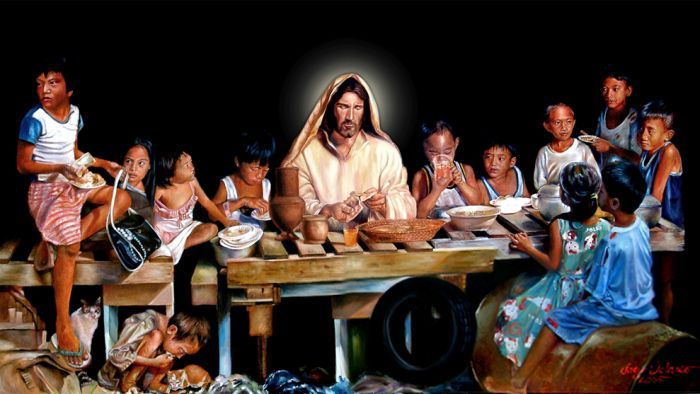
The late Joey Velasco’s 2005 painting “Hapag ng pag-Asa”.

Companionship in Christ

The Lord Is My Chef Easter Triduum Recipe by Fr. Nicanor F. Lalog II
Maundy Thursday, 01 April 2021
Exodus 12:1-8, 11-14 ><)))*> 1Corinthians 11:23-26 ><)))*> John 13:1-25
Photo by d0n mil0 on Pexels.com
"A journey of a thousand miles
begins with a single step."
- Lao Tzu

We often hear and use this wise saying that is also most applicable to our celebration of the Holy Triduum of the Lord’s Passion, Death and Resurrection also known as the “Sacred Paschal Triduum”.

From the Hebrew word pesach, a pasch is a passing over. It is a journey which is a long trip taken over long period of time to different places. A journey does not necessarily involve physical distance as it can be something within one’s self like an inner journey to God dwelling within us. Hence, a journey is also a process that leads us to growth and maturity from the many difficulties and trials we experience as we travel, entailing a lot of sacrifices from us.

And whatever journey we take outside or within our selves, we always need a companion to travel with. From the Latin words cum panis that literally mean “someone you break bread with”, a companion is someone who helps us in our journey, a friend who shares life with us, guiding us, protecting us. Like the bread we break and share, a companion sustains and nourishes us in our journey.

Let us keep these three words of journey, companion, and bread in reflecting our celebration tonight of the Lord’s Supper that begins the Sacred Triduum.

We are all pilgrims on a journey to heaven

More than 40 days ago on Ash Wednesday, we said Lent is a daily journey to Easter where we find our very selves, others, and God who is our ultimate origin and end. It is a journey that reaches its summit in the Holy Eucharist where we make present the pasch or passover of Jesus Christ

Every Mass is a journey into heaven, a dress rehearsal of our entrance into heaven when we have a foretaste of eternal life we all hope for until Christ comes again. It is the Passover of the New Testament, a perfection of the Jewish Passover when God’s chosen people led by Moses went into exodus from Egypt into the Promised Land.

This “heavenly” journey had its ancient roots among nomadic Semites who used to celebrate a feast on the first full moon of spring as they prepared to lead their flocks to summer pastures. They ate a roasted lamb from the flock with unleavened bread and bitter herbs. It was an important event of migration filled with many dangers for those nomads who marked their tent-pegs with the blood of the lamb to keep their journey safe.

Eventually this found place in the Jewish Passover which we heard in our first reading when God told his chosen people to begin their journey of exodus from Egypt “on the tenth of their first month” that happens on the second full moon of the spring equinox.

Notice that it happens at night that is coincidentally the usual start of every journey we usually make!

Before their Exodus, each family was told to roast an unblemished lamb to be eaten with unleavened bread and bitter herbs “with your loins girt, sandals on your feet and your staff in hand, you shall eat like those who are in flight. It is the passover of the Lord” (Ex.12:11). It has to be done in a hurry, as in a flight, a journey.

And to keep them safe in their journey, God instructed them to paint their door posts with the blood of the slaughtered lamb so that when his angel comes at night to strike death of every first born male child and animal, their homes would be “passed over” and be saved from death that night.


We are all travelers and journeyers on earth;
our true home is in heaven with God our Father.  
We are merely "passing over" this planet temporarily.

Photo by author, Egypt, 2019.

Jesus our companion and family in the journey

The Jewish Passover or Exodus became the actual event of God’s covenant with Israel as his people on a journey to their Promised Land. Unfortunately, they would break this covenant with God so many times that it would take them 40 years of wandering in the desert before finally got into the Promised Land.

And their stubbornness continued when they would always turn away from God with sins that led to the division of their nation until its conquest by foreign powers that led them anew into another exile. God would restore them as a nation but, again, they would turn away from him until the Romans ruled over them when Jesus came to perfect God’s covenant.

In perfecting and fulfilling the Jewish Passover, Jesus became the new and everlasting Lamb, perfect without any blemish, offering himself to God for the forgiveness of our sins and our liberation from all forms of evil especially sickness and death. It is no longer the blood of the lamb that we now offer but Jesus Christ’s Body and Blood which he established in the Sacrament of the Eucharist “on the night before he was betrayed” on Holy Thursday.

By celebrating the Lord’s Supper that Thursday evening with his disciples who represented all peoples of all time, Jesus established for us the everlasting memorial of his loving presence as our companion and our very Bread and Wine in the journey back to the Father always filled with darkness and sufferings.

What he did that Thursday evening foreshadowed what he would do on Good Friday when he did his greatest act of love for us by dying on the Cross at about 3PM, the same time when the lambs were being slaughtered in the temple for the coming passover feast.

Brothers and sisters: I received from the Lord what I also handed on to you, that the Lord Jesus, on the night he was handed over, took bread, and, after he had given thanks, broke it and said, “This is my body that is for you. Do this in remembrance of me.” In the same way also the cup, after supper, saying, “This cup is the new covenant in my blood. ?Do this in remembrance of me.”

1 Corinthians 11:23-25

Here we find again the darkness of the night as the beginning of our journey back to God perfected by Jesus Christ as our companion and very bread of life to sustain and nourish us.

What is most beautiful meaning we can find here is the importance of communion, of oneness as a community, as a family.

In the Old Testament, God instructed his people to take the passover meal together as a family; at the Lord’s supper, Jesus celebrated it with his “friends”, the Twelve Apostles. Even Judas Iscariot was present at the start but had to leave in the “darkness of the night” when he broke off from the unity of Jesus.

Perhaps, one reason why we are again together this Holy Thursday not in churches but in our homes, with our family so we may be one again in Jesus Christ in prayers and celebrating Mass on-line.

Therefore, do not be a Judas Iscariot! Go back to your family, to your loved ones – your most faithful and truest companions in this journey of life. You’ll never get to heaven, as Dionne Warwick sang, if you break somebody’s heart, when you refuse to love by turning your back from those who love you.


Holy Thursday reminds us in the Eucharist  
that no one is saved alone. 
Every journey becomes wonderful
when done in the context of a community, 
with true companions beginning in our very family.

Photo from wikipediacommons.org of Christ’s washing of feet of Apostles at Montreale Cathedral in Palermo, Italy

The commandment of love

Completing the picture of our celebration tonight with the key concepts of journey, companion and bread is LOVE, the very essence of everything in this life, the reason why we are in a journey in the first place since the Exodus up to this time.

At the very core of every companionship, of every community is LOVE.

To become bread for someone in a journey is to become LOVE.

Jesus Christ as the bread broken, as the cup of wine shared is essentially LOVE.

Love can never be defined but merely described.

And on the night before he was betrayed, Jesus described to us in his actions a very beautiful expression of his love we all must imitate:

So, during supper, fully aware that the Father had put everything into his power and that he had come from God and was returning to God, he rose from supper and took off his outer garments. He took a towel and tied it around his waist. Then he poured water into a basin and began to wash the disciples’ feet and dry them with the towel around his waist.

John 13:3-5

When Jesus washed his disciples’ feet, he showed us one beautiful aspect of LOVE which is tenderness.

Yes, I have been speaking about tenderness lately as something we badly need these days of the pandemic. Tenderness is an expression of love when we realize amid our own suffering the sufferings of others too. To be tender and loving amidst many sufferings is to offer rest to fellow journeyers like what Jesus did on that Holy Thursday evening.

Again, we find here something prevalent during that time which is the concept of “restaurants” where travelers used to stop during their journey not only to eat but to rest that meant soaking their feet on a basin of water. It was therapeutic that gave travelers enough strength to travel far again.

Remember there were no other modes of transportation at that time and not everybody could afford an animal to ride on. Any hiker and mountaineer can attest that after so much trekking, one thing you would always hope for is a stream or tiny brook with cool, crisp, running water to dip your feet and rest!

Photo by Mr. Raffy Tima of GMA-7 News, April 2020.

Everybody is tired of this journey in the pandemic, almost exhausted.

What a shame especially when local officials like that one who refused food delivery because she considered the lowly lugaw as non essential. Lest we forget, Jesus chose one of the most lowly food, the unleavened bread, as the sign of his loving presence among us until the end of time when he comes again.

Indeed, this could be the holiest Holy Week of our lives in this most unholy time of history as it gives us great opportunities to love.

Just be tender with those around you!

Never get tired of loving, of understanding, of caring as everyone is already tired with this journey of ours in the pandemic that seems to be still far from over.

“Do you realize what I have done for you? You call me ‘teacher’ and ‘master’, and rightly so, for indeed I am. If I, therefore, the master and teacher, have washed your feet, you ought to wash one another’s feet. I have given you a model to follow, so that as I have done for you, you should also do.”

John 13:12-15

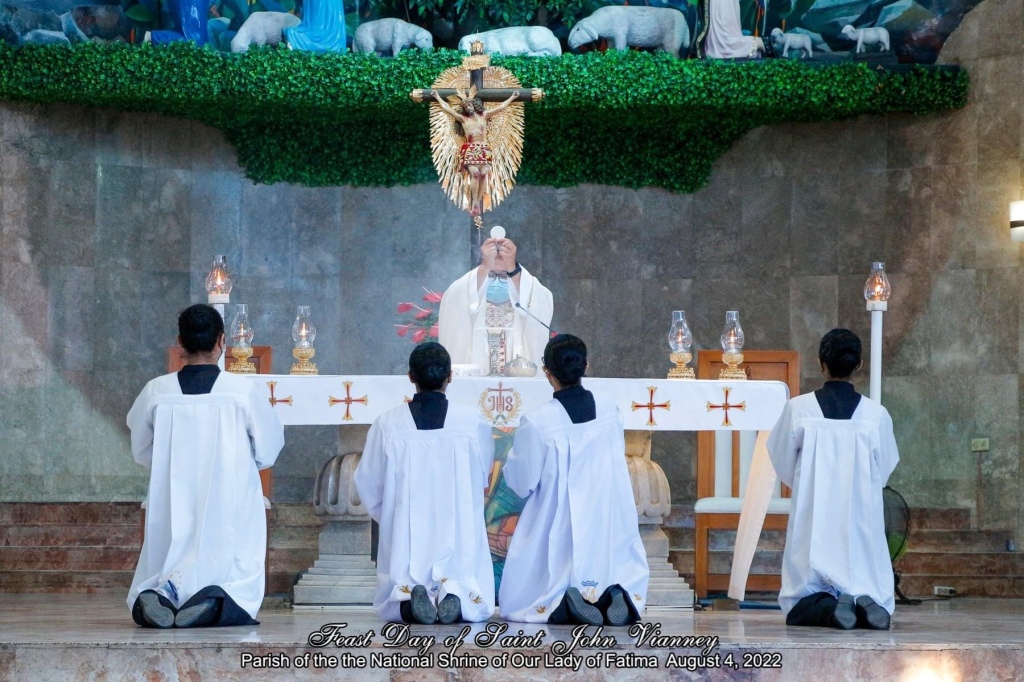
One of the most moving images of the pandemic for me lately is the one taken by our parishioner on the first day of the ECQ last March 22 when our Parochial Vicar, Fr. Howard John celebrated Mass without a congregation. He said, “the table of the Lord is full, but the pews are empty.”

And that is what we will continue to do in this pandemic. Even without the people, we shall continue to journey in Christ by still celebrating the Mass to give us all nourishment and sustenance and rest in this prolonged journey in the pandemic.

May we never get tired walking in love as a companion and bread to one another in Christ and like Christ by giving rest to others already tired and about to give up. Let us all be together in welcoming Easter! Amen.


El anda que en amor ni cansa ni se cansa.
(The soul that walks in love neither tires others nor grows tired.)
Saint John of the Cross 

Photo by Ms. Kysia Cruz, National Shrine of Our Lady of Fatima, Valenzuela City.