Friday, St. John Bosco, Priest, Patron of the Youth, 31 January 2020
2 Samuel 11:1-4, 5-10,13-17 ><)))*> 0 <*(((>< Mark 4:26-34
Pilgrims waiting for their turn into the Ascension Chapel at the Mount of Olives outside Jerusalem in Israel. Photo by author, May 2019.
On this last day of January 2020, we thank you God our Father for the grace of being alive and safe, for not forsaking us in this most trying first month of the year where we have seen and experienced many calamities here and abroad, deaths and sickness even among our relatives and friends as well people we look up to for inspirations.
It was a very trying month, Lord, that have sent many of us down into our knees in prayer and reflection, making us realize the many moments you have talked to us “in private” – the same way you did to your Apostles to explain the parables you have narrated (Mk.4:34).
How lovely are those words indeed, evoking a sense of kinship and intimacy with you and the Twelve. You know very well everything in our hearts, our innermost thoughts and feelings that you talk to us personally, in private.
What a shame, O Lord, when we commit despicable sins, believing we do them “in private” like David who had relations with Bathsheba and caused the death of her husband Uriah to cover up his sins.
So many times, Lord, we act like David as if nobody would ever know our sins and evil ways except us alone in private – “walang makakaalam kungdi ako lang” -as if you are not all-powerful (omnipotent), all-knowing (omniscient), and ever-present (omnipresent).
It is so foolish of us, Lord! And we are sorry.
Remind us that our most private moments are in fact the time you are most present with us, and in us. That there is no other path to follow in this life except your path, O Lord. Walk us through, Lord.
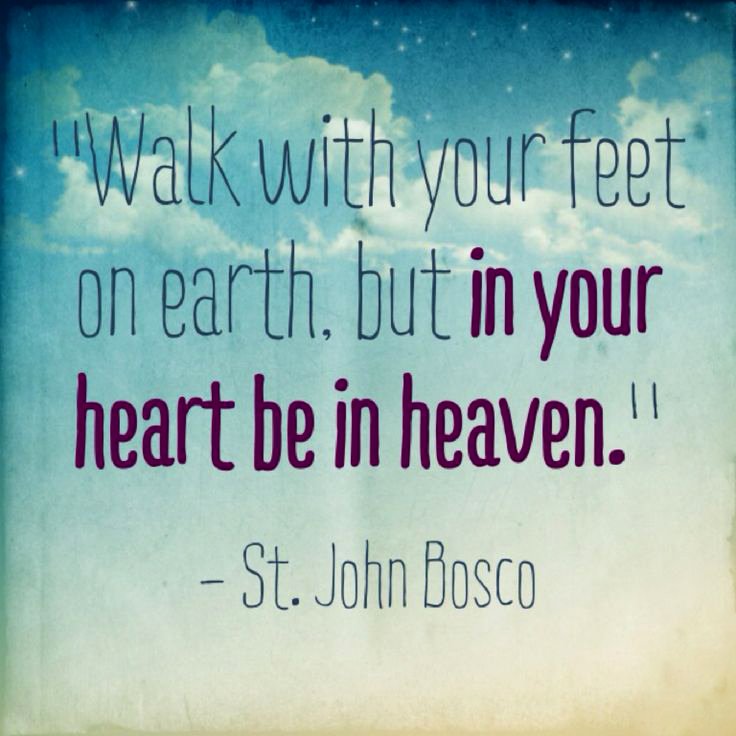
Like St. John Bosco, instill in our hearts this beautiful lesson he had taught us with:
From twitter.com
Like St. John Bosco, may we “always have fun in life, but never sin”, thinking only the glory of heaven as the ultimate end of everything we do in life! Amen.
Friday, Memorial of St. Anthony, Abbot, 17 January 2020
1 Samuel 8:4-7, 10-22 ><)))*> ><)))*> ><)))*> Mark 2:1-12
Grotto, Baguio City, January 2019.
Thank you very much, O God for another week of work and school about to close this day. Most of all, thank you for for the rest you have given us these past few days from our restive Taal Volcano. Continue to keep everyone safe and ready for any worst eventuality.
Today we pray, O Lord, for those people who have rejected us, those who have rejected our friendships, those who continue to reject our peace offerings, those who still reject the mercy and forgiveness we have given them.
Our lives have all been marred with so many rejections. Too often, we do not complain and just take them as part of life, the risk in any relationships, though, deep inside, we are hurt.
But, so often, we also forget how we have always rejected you, O God, in our lives. Of how we would rather choose our own ways that often lead us into sins and destruction, rejecting your wonderful plans that simply ask us to trust in you, to believe in you, and to rely in you.
Samuel was displeased when they asked for a king to judge them. He prayed to the Lord, however, who said in answer: “Grant the people’s every request. It is not you they reject, they are rejecting me as their king.”
1 Samuel 8:6-7
Teach us, O God, to open up to you again. To be open to your love and mercy, to your mercy and forgiveness brought to us by your Son Jesus Christ.
Help us to break this cycle of rejections we within that lead us to sin.
Every time we reject you, O Lord, or our brothers and sisters in love and mercy to insist on our own ways, our own ideas and thoughts, and beliefs, that is when we often sin.
Help us to be like St. Antony who left everything in life to be a hermit in the desert in order to find you and follow you. Help us find our own desert of desolation where we can always be alone with you to rely only in you, to accept your truths to guide us in our daily life. Amen.
St. Anthony the Abbot, a.k.a. the Great, pray for us!
Photo by the author. Baguio City Cathedral, January 2019.
We have reflected last Sunday that prayer is an expression of our faith.
Where there is faith and prayer, there is always love.
And when we have prayer, faith and love, we have a relationship and community of two or three and more persons together as one, rooted in God.
Today we hear another parable by Jesus only St. Luke has, that of the Pharisee and the tax collector to show us another dimension of faith expressed in prayer.
Photo by the author at the Wall of Jerusalem, May 2017.
Like last week, St. Luke tells us anew the Lord’s purpose in narrating this parable:
Jesus addressed this parable to those who were convinced of their own righteousness and despised everyone else.
Luke 18:9
Were you moved or affected in any way upon hearing our parable today?
Did you feel a silent but swift, sharp thud inside your heart while your mind tried to reason out that the parable is not meant for you?
Listen again and pause, let the Lord’s words sink deeper into your heart:
“Two people went to the temple area to pray; one was a Pharisee and the other was a tax collector. The Pharisee took up his position and spoke this prayer to himself, ‘O God, I thank you that I am not like the rest of humanity — greedy, dishonest, adulterous —- or even like this tax collector. I fast twice a week, and I pay tithes on my whole income.’ But the tax collector stood off at a distance and would not even raise his eyes to heaven but beat his breast and prayed, ‘O God, be merciful to me a sinner.’
Luke 18:10-13
If prayer creates a relationship, Jesus is teaching us today the right attitude we must have to keep this communion we have in faith and love. Any relationship is bound to fail, or would not even exist at all despite the formalities of having ties and links like what we see or even have in our various social circles where roles are just acted out.
We call it “plastic” or fake. Untrue!
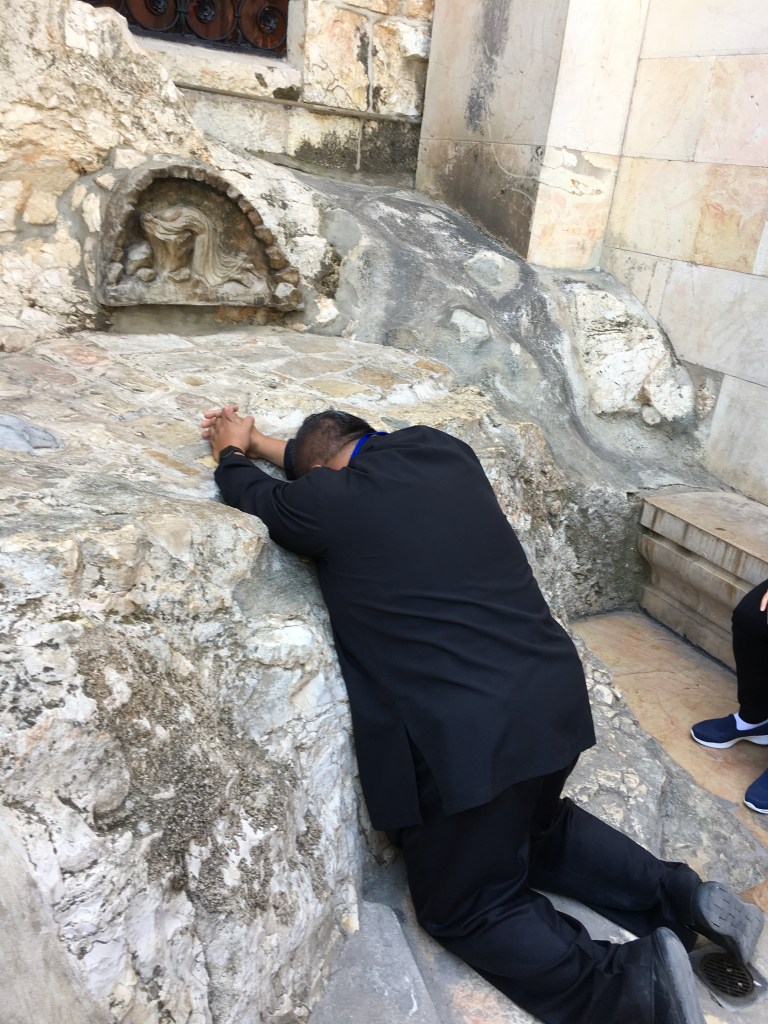
Praying at the Garden of Gethsemane, May 2019.
Prayer to be efficacious like any relationship must always be true.
Here Jesus directs our attention in the “where” when we pray – not just the location or locus of our prayer but our “place” in that relationship first with God who is our very foundation.
When all we see is our self in prayer like in any relationship, there is always a problem. It is clearly a one way street, a monologue.
Worst of all, it is an indication of the absence of God or even others because the pray-er is so preoccupied with his or her very self!
The Pharisee was clearly not in God even if he were in front of the temple. His very self was very far from God and all he had was his bloated ego. He may be a very pious person but not really good at all for he has no space for God and for others. He is a very closed man without any room for others.
The tax collector, on the other hand, may be physically far outside the temple but was the one actually nearest to God with his self-acceptance and ownership of his sinfulness, of his need for God. He was closest to God because he was more open with God and with others by admitting his own sinfulness.
Again we find the key to tis Sunday’s parable towards the end:
(Jesus said) ‘I tell you, the latter (tax collector) went home justified, not the former; for whoever exalts himself will be humbled, and the one who humbles himself will be exalted.'”
Luke 18:14
Photo by Dra. Mai B. Dela Pena, Germany, 2016.
Prayer is more than entering a church or a prayer room, or finding our most suitable spot or space to pray.
Prayer is being one with God, of being suffused in God.
“Where” are we when we pray?
First, we become one with God, one in him in prayer when we first admit our sinfulness, when we confess our sins to him, and own them without any “ifs” and “buts”.
God always comes to those who truly open themselves to him by emptying themselves of their sins and inadequacies.
The tax collector was justified in his prayer more than the Pharisee because in confessing his sins, he admitted his need for God. He knew very well his place, so unlike the Pharisee who felt God owes him so much!
When Pope Francis granted his first media interview (to their Jesuit Magazine!), the first question asked of him was, “who is Jose Mario Bergoglio?”
The Holy Father quickly answered, “I am a sinner.”
No wonder when he was elected Pope on March 13, 2013 at the Vatican, he first asked for prayers from the huge crowd gathered before he bestowed his apostolic blessing to them. It clearly showed that despite his holding the highest post in the Church, he considers himself a sinner, so weak needing prayers from the people.
I always tell couples during weddings that when they have a quarrel, the first one to speak and make the move for reconciliation is the one with most love, the one who is most willing to bow to start anew.
Most often in life, friendships and relationships are kept when we are willing to take the lower stance, not necessarily admitting fault or guilt in any misunderstanding because being lowly indicates the person’s need for the other person and of one’s love to work on that relationship despite its fragility.
Ordination of deacons, Malolos Cathedral, 12 June 2019.
Second, we are in God and with God in prayer when we have that attitude and inner disposition of being poor and lowly. Being lowly or poor means having the conviction to leave everything behind and go down with God into the lowest point because one is so confident of the efficacy of prayer like what Ben Sirach tells us in the first reading.
Most of all, like Mary the Mother of Jesus during the Annunciation of the Christ’s birth.
The one who serves God willingly is heard; his petition reaches the heaven. The prayer of the lowly pierces the clouds; it does not rest till it reaches its goal.
And thirdly, we are in God in prayer when there is an offering daily of one’s self to God.
It is not enough to be lowly and sorry for our sins in prayer. It has to be sustained because prayer is also a discipline like any sport. In the second reading, St. Paul calls us to persevere and endure until the end for Jesus Christ.
We need to be passionate with our prayer life, willing to go to all extent to offer everything for the Lord, to fulfill his will “who shall award us with the crown of righteousness in heaven.”
We are all sinners forgiven and beloved by God.
May we find ourselves in God and with God always both in our sinfulness and lowliness. Amen.
Thursday, Feast of St. Dominic de Guzman, 08 August 2019
Numbers 20:1-13 >< )))*> <*((( >< Matthew 16:13-23
From Google.
A blessed Thursday, O Lord, especially to the Dominicans spread across the globe proclaiming your good news of salvation in words and in deeds.
Thank you very much, Lord, for the gift of St. Dominic whose name – Domini canis – literally means “hound of the Lord” or “dog of the Lord” .
Teach us to be like St. Dominic who was faithful and true to you, Jesus.
May we be like him in that dog in his mother’s dream who brought the torch of truth to dispel the great darkness of sin and evil in the world.
Today, there is a great plague of darkness infecting the modern means of communications where trolls and cyberbullies spread lies and falsehoods like fake news and misinformation to manipulate and mislead the minds of some into taking violent and truncated views about life and persons.
Make us your modern St. Dominic – Domini canes – to bring that torch of reason and decency, charity and truth to dispel this darkness engulfing us and have actually led to many forms of violence and animosities among peoples here and abroad lately.
Help us contemplate your person, Lord Jesus Christ like St. Dominic so we would know you more clearly, love you more dearly, and follow you more closely.
May we realise that whenever we fail to show who you really are, when we cannot personally confess like St. Peter that “you are the Christ, the Son of the living God” (Mt.16: 16), troubles begin to happen not only in the Church but also in the world like racism, gender inequality, and many forms of injustice.
When we your followers do not truly know you as the Christ, then we cease to become Christians when we stop respecting others who are not like us in color, creed, and culture; when we disregard the value of life, and finally, when we stop seeing each other as brothers and sisters in you.
How sad that until now, many Christians say many different things about you, Jesus, because we have miserably failed in being your faithful witnesses.
Help us Lord to “think more as God does, not as human beings do” (Mt.16:23) by imitating St. Dominic who spent much time “at the foot of your Cross.”Amen.
According to tradition, when the mother of St. Dominic was pregnant with him, she dreamt of a dog running their dark streets at night with a torch in its mouth, foretelling his future mission of bringing the light of Christ through education by founding the Order of Preachers.
40 Shades of Lent, 5th Sunday-C, 07 April 2019
Isaiah 43:16-21///Philippians 3:8-14///John 8:1-11
From Google.
Sunrise at Lake of Galilee. Photo by author April 2017.
Today is the last Sunday of Lent. It is hoped that by this time since Ash Wednesday, we have slowly acquired or even regained our contemplative spirit of prayerful silence. It is something very essential not only during these 40 days and in the coming Holy Week. It is only in silent prayers can we truly find balance in life as we discover what is valuable and what is worthless, things that last and things that pass. Prayerful silence teaches us to slow down, to be more discerning, and more trusting. The contemplative spirit thus leads us to grow deeper in our faith, hope and love in God. It is in the contemplative spirit where God works best in us.
We find this invitation to a contemplative spirit in our beautiful gospel today of a woman caught committing adultery whom Jesus refused to condemn. Unlike the previous four weeks when we heard all gospels taken from Luke, this Sunday’s story is from John that perfectly fits last week’s parable of the prodigal son to show us God’s immense love and mercy for us sinners. Every conversion, every contrition of sins presupposes silence. Recall how the lost son last Sunday realized his sinfulness while silently tending swine in a far away land.
From Google.
Jesus went to the Mount of Olives. But early in the morning he arrived again in the temple area, and all the people started coming to him, and he sat down and taught them. Then the scribes and the Pharisees brought a woman who had been caught in adultery and made her stand in the middle. They said to him, “Teacher, this woman was caught in the very act of committing adultery. Now in the law, Moses commanded us to stone such women. So what do you say?” They said this to test him, so that they could have some charge to bring against him. Jesus bent down and began to write on the ground with his finger.
John 8:1-6
From Google.
We have seen how Jesus foiled other insidious plots against him through tricky questions but this one involving a woman caught committing adultery shows us a fine image of him as the Christ. His silence, his bending down and his writing on the ground are moving moments that touch our hearts and make us wonder all the more, who is this man?
More than addressing a question that concerns the many dilemmas we face in life, this episode shows us that it is something that directly concerns Jesus Christ himself, his being our Savior. Notice at the start of the story where Jesus is presented always going to the Mount of Olives to pray, to be one with the Father. This episode happened after he had entered Jerusalem on Palm Sunday, showing us how Jesus became more intense in praying, in being one with the Father when his final days were approaching. That is the contemplative spirit.
Now feel the atmosphere of those tense moments when people brought the woman caught committing adultery to Jesus: everybody was saying something, emotions were running high, just like us in our own time with social media around us. We live in so much noises where everybody and everything is talking that we fail to listen to our very selves, to others and most especially to God always silent. See how Jesus was so cool – or “chillax” as young people would say. It was an astonishing reaction to the situation. Only a person with deep contemplative spirit like Jesus can be so composed and silent in a tense situation like that. It is always easier to react and say something than be silent to weigh everything. Too often in the world today, words are so empty that they have to be shouted all around and repeated so often in the hope they become true, exactly what every election candidate is doing!
From Bing.com.
Jesus chose to be silent so we may realize that issues of sin and evil are best resolved in a contemplative spirit where we find the value of every person that we condemn the sin not the sinner. History has shown time and again how wars and violence or any other harsh methods like death penalty have proven ineffective in correcting any injustice or wrongdoing and preventing crimes. Where there is severity in measures against evil, we find only more deaths and burials happening but never peace and justice.
Now more than ever in Jesus Christ, we have found and experienced God’s mercy so abounding and closest to us sinners if we are truly sorry and ready to change. Like the woman caught committing adultery or the prodigal son last Sunday, we have to reach out to Christ to be forgiven from our sins. He assures us of never being condemned, of deleting our past sins and assuring us with a bright future to receive his promises if we “go and sin no more.”
We have to stress that Jesus does not approve sins. Never. He recognized the sinfulness of the woman when he told her “go and sin no more.” Likewise, Jesus never asked us to stop fighting sins. When he dared the people of whoever has no sin be the first to cast the stone, Jesus never meant us to be silent with the evil and wrongdoings happening around us. This encounter between Jesus and the woman committing adultery invites us to examine first, our own attitudes toward others guilty of serious sins. And secondly, to examine our own reactions when our misery meets with God’s mercy especially in the sacrament of penance or reconciliation.
Do we choose to be harsh like the crowd or be gentle like Christ?
How sad that even with our very selves we are so unforgiving, so severe that we hardly move on in life. Only in a contemplative spirit can we truly experience God’s liberating mercy and forgiveness within us and with others. The contemplative spirit enables us to trust God that no matter how sinful we are, his love and mercy are more powerful, able to transform us all into better persons, even saints! This is the promise of God in the first reading that he would do something greater than what he had done in liberating his people from Egypt – that he would send our Savior not only to forgive our many sins but even to share in his glory as saints.
Assumption Sabbath Baguio, January 2019.
St. Paul in the second reading could speak of “considering everything as a loss in knowing Christ Jesus” because of the contemplative spirit he acquired after his conversion. His letters all reveal to us St. Paul’s contemplative spirit and intimacy with Jesus Christ that flowed out into his daily life, reaching its summit in his martyrdom.
As the season of Lent comes to a close on this fifth Sunday, we are reminded of the path of conversion we have followed these past four weeks under St. Luke’s guidance. Conversion leads to contemplation, a daily communion with God in prayerful silence and allow him to suffuse us with his love. Its fruits are seen in our daily lives. It is the work of God, not us. It is God who renews us in silence into a new creation. We simply have to remain in Christ and strive always “to go and sin no more”. Amen.
We know it deep in our hearts, Lord. We knew it all along because we have felt being the object of their evil thoughts and plans:
The wicked said among themselves, thinking not aright: “Let us beset the just one, because he is obnoxious to us; he sets himself against our doings, reproaches us for transgressions of the law and charges us with violations of our training.”
These were their thoughts, but they erred; for their wickedness blinded them, and they knew not the hidden counsels of God; neither did they count on a recompense of holiness nor discern the innocent of souls’ reward.
Wisdom 2:1, 12,21-22
When will the evil people ever stop plotting all plans against us, O Lord? When will they realize their errors, their mistakes, their sins? When will they ever get tired with the unnecessary burdens of thinking evil against others?
On this first Friday of April, O God, we pray for those who persecute us, for those who malign us, for those who make life so difficult for us without realizing the goodwill we have for them. We pray for the wicked who are bent on crushing us but would never truly succeed because you would never allow evil to triumph over what is good.
So many times, they are all talk because they never have the guts and courage to be true and honest. They are always hiding. Like Jesus openly exposing Himself at the temple area, yet nobody could lay their hands on Him because it was not yet His hour.
Our merciful Father, grant us the courage and strength to endure every evil and lies when our time finally comes to stand up for you like Jesus. Amen.
Sin can be mysterious at times because it can also be a religious experience that leads us back to God and holiness. We have a saying that “every saint has a sinful past and every sinner can have a saintly future.” So many men and women who were so notorious in their lives have proven this so true like St. Paul and St. Augustine.
After reflecting on the call for conversion last Sunday, our gospel today tells us a lot about the nature of sin. Unless we understand what is sin and why we sin, then we get imprisoned by sin as we keep on committing it no matter how hard we try to be better persons. But once we understand even a little bit of it, its hows and whys, then we sin less often as we slowly break free from its bondage.
“A man had two sons, and the younger son said to his father, ‘Father, give me the share of your estate that should come to me.’ So the father divided the property between them.”
Luke 15:11-12
Sin is when we separate from the Father like the younger son when we ask for our “share of your estate that should come to me” referring to that part of this whole life only God can have in its fullness. We always have the idea that it must be so vast and huge that even just a part of it would be more than enough for us. We want to be on our own that we break away from Him, thinking wrongly that the share we have is more than enough for us without truly realizing how great and so vast is the Father’s estate which is life itself!
And so it happens, we break away from God and live on our own that sooner or later, our share dissipates until we lose everything.
This estate, this very life of God will never be gone like Him, will never diminish nor dissipate. We shall always have it, enjoy it for as long as we are with Him, our loving Father! This is also the point of the Father to the elder son when he refused to join their celebration when his younger brother returned. Life, love, kindness, family, everything that is good dissipates when held individually away from God. But when we share it with the Father through Christ, it is like the river that never runs dry.
When he had freely spent everything, a severe famine struck that country, and he found himself in dire need… And he longed to eat his fill of the pods on which the swine fed, but nobody gave him any.
Luke 15:14,16
Sin always gives us the sense of “freedom” like the young son who “freely spent everything”. There is always that wrong understanding of freedom as the ability to do everything and anything, feeling that everything in this life is ours alone. Freedom is first of all choosing what is truly good. To be free is to be loving, being a part of the whole and never separated from the whole. To be truly free is always to be one. This explains why when we are deep into sin and all alone, separated from others, we suddenly long to be one with others. The sense of belonging suddenly pops up within us because we find ourselves incomplete when in sin.
“My son, you are here with me always; everything I have is yours.”
Luke 15:31
Here lies the problem also with the elder son who has always been present with their father but had never been one with him, never belonging to him. He is guilty of “sin of omission” when he felt nothing seems to be wrong with him as he breaks no rules of their father – except their relationship and ties. The apostle James wrote in his letter that “a person is tempted when he is lured and enticed by own desire” (Jas.1:14). Sin is always the desire to be sufficiently alone, to be powerful, to be God! See how since the beginning, we have never outgrown that sin of Adam and Eve of becoming like God, of playing god.
My dear sisters and brothers, like Paul in our second reading today, let us be reconciled to God in Christ. To be reconciled is to be one, to belong, to become a part again of God. In the dryness and desolation of sin like the desert in the experience of Joshua and the Hebrew people, God continues to bless us with so many gifts, so many blessings. The two brothers in the parable are both sinners but loved by their father. And so are we.
More than avoiding sins, our gospel parable this Sunday invites us to love God more by seeking His will always. Yes, we have all been hurt by someone else’s sins and we have also caused pain on others with our sins. Let us focus more on this vast gift of life and love expressed in God’s mercy and forgiveness that no sin could ever diminish. And the good news is that it is all free and totally being given to us by Jesus Christ especially in our Sunday Eucharist. A blessed week to you!
40 Shades of Lent, Thursday, Week III, 28 March 2019
Jeremiah 7:23-28///Luke 11:14-23
What a shame, dear God, to read in the gospel today your Son Jesus Christ busy confronting evil, driving out a demon that was mute from a man while we in this age deny its very existence.
In the name of modernity and keeping up with the time, we have taken sin and evil for granted, short of imitating the contemporaries of Jesus of accusing Him of driving out demons by the power of Beelzebul, the prince of demons.
How true were the words of your prophet Jeremiah that “we have walked in the hardness of our hearts and turned our back, not our faces, to you. Faithfulness has disappeared, even the very word from our speech.” (Jer.7:24,28)
Let us heed today’s responsorial psalm, “If today you hear his voice, harden not your hearts.”
Give us the courage, O God, to be like your Son Jesus Christ fighting evil and sin by being firm in keeping your commandments. Amen.
Images from Google; above is The Temptations of Christ, a 12th century mosaic at St. Mark’s Basilica, Venice, Italy.
40 Shades of Lent, Friday, Week-1, 15 March 2019 Ezekiel 18:21-28///Matthew 5:20-26
Lord Jesus Christ, it is “the Ides of March” and like “Friday the 13th” some of us are thinking of so many misfortunes and bad things that could befall us on this date made notorious by the assassination of the Roman emperor Julius Ceasar. Forgive us in professing our faith in you yet continue to subscribe to so many superstitious beliefs.
Remind us O Lord of the ironic twist that the Ides of March is not gone if we continue to live in sin, or, if after leading a virtuous life we turn into evil deeds because in both instances we shall die. It is true that you “never derive joy in the death of the wicked” (Ez. 18:23) because you have come to forgive us from our sins so we can lead holy lives as children of the Father.
Indeed, Shakespeare was absolutely right when Cassius voiced out in his play Julius Caesar that “the fault my dear Brutus is not in the stars but in ourselves.”
Give us the courage to look into our hearts to examine our lives and see if our worship of You and our dealing with others are in congruent with each other. Let us stop our attitudes of blaming and complaining to start changing our ways according to your will O Lord. Amen.
40 Shades of Lent, Monday, Week 1, 11 March 2019
Leviticus 19:1-2, 11-18///Matthew 25:31-46
Your readings today, O Lord, invite us to examine the choices we have made recently in our lives. It is always easy to say “I love you, Lord” but when we examine the decisions we have made, it seem to show we really do not love you at all because we have been selfish. Most of the time in making choices, we think first of our self. And that is when we sin.
Every time we have more of our selves – that big, personal, pronoun “I” – in every choice and decision we make, we s-I-n.
When we refuse to be like you who is holy, when we disregard you as our Lord and God whom we must see in everyone, we s-I-n because we see only our self.
When we disregard the hungry and the thirsty, the stranger and the naked, when we do not care at all to those ill or in prison, we s-I-n because we refuse to love.
Help us, Lord Jesus, to have less of our self and more of your Holy Spirit so that we may be attentive and docile to the Father speaking to us in our hearts and crying out to us among the suffering people around us. Amen.








 lordmychef.com