The Lord Is My Chef Daily Recipe for the Soul by Fr. Nicanor F. Lalog II
Friday, Sixth Week in Ordinary Time, Year I, 21 February 2025
Genesis 11:1-9     <'[[[[><  +  ><]]]]'>     Mark 8:34-9:1
What a blessed Friday,
Lord Jesus!
You are still with us,
about to cross the week
into another new set of
seven days but,
here you are again
reminding us
of our journey
that's not to a party
and all fun
but to the Cross:
Jesus summoned the crowd with his disciples and said to them, “Whoever wishes to come after me must deny himself, take up his cross, and follow me. For whoever wishes to save his life will lose it, but whoever loses his life for my sake and that of the Gospel will save it” (Mark 8:34-35).
As I prayed on this scene,
Jesus,
I could hear both the murmuring
and deafening silence
of people in the crowd
especially when you spoke
of denying, losing one's self
and that dreaded Roman
punishment, the cross!
But, yes, Jesus,
even deep down in me,
I felt at a loss...
OK na sana Lord ang lahat,
bakit may paglimot pa ng sarili
at pagpapasan ng krus?
Forgive me,
Jesus for being so used
to your words without really
appreciating them,
masticating them enough
to extract their meaning
and timeliness;
many times,
I have that attitude of the
the Tower of Babel
when all we want is to be on top,
to be in control
that is why you confused
them with many languages at that time
because we always forget
you speak only one language
in Jesus:
the language of love
by self-giving,
by self-sacrifice,
by being one in you in
the Holy Spirit.

Take us to the streets,
Jesus, to keep your words
your language
lived and spoken
especially among
the poor
and suffering.
Amen.
Photographer: Veejay Villafranca/Bloomberg via Getty Images
Quiet Storm by Fr. Nicanor F. Lalog II, 24 October 2024
Photo by Maria Tan, ABS-CBN News, 27 July 2024.
Classes are still suspended due to severe tropical storm Kristine. While scrolling through Facebook, I chanced upon a funny post supposed to be the cry of many employees. And teachers as well:
"We are trained to work
under pressure but,
please, not in low pressure."
As we come to close October dedicated worldwide as “Teachers’ Month”, my thoughts are into this most noble profession of teaching during these two days of the storm, of how blessed I am to have been taught by selfless teachers and mentors now also a teacher myself being assigned 26 years ago in a school, now as a chaplain in the university.
I never dreamt of becoming a teacher for I am not the studious type – always the certified crammer, forever classified as “under-achiever” from elementary to graduate school. The only subjects I really loved were literature, social studies, and history.
But what a tremendous blessing from God my being assigned in a school and now a university, of meeting and working with teachers who have taught me so many valuable lessons in life and my ministry. Many of them have become some of my truest friends. Most of all, the academe opened my eyes to the wonderful ministry of teaching, of forming young people, of finding Jesus, bringing Jesus in the classroom.
Photo from wikipediacommons.org of Christ’s washing of feet of Apostles at Monreale Cathedral in Palermo, Italy.
Every time I give talks and recollections/retreats to teachers, I first remind them of the fact that when Jesus Christ came to the world more than 2000 years ago, He chose to be a teacher.
Jesus was never born to the class of priests and scholars of the scriptures nor any other professions like the physicians and accountants of His time except for a while, He worked with His foster-father St. Joseph as a carpenter. This alone is every teacher’s primary source of pride and honor in being called by Jesus to teach like Him.
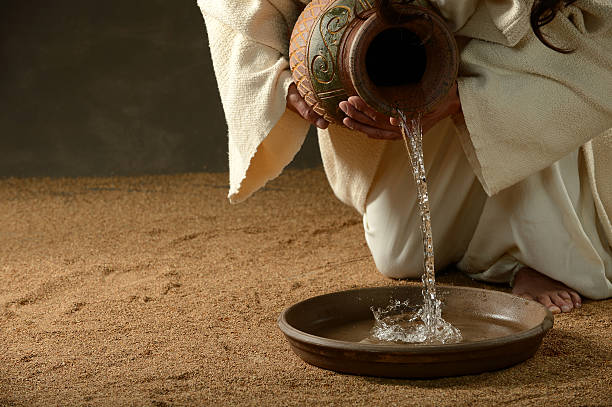
From Gettyimages.com.
So when he had washed their feet and put his garments back on and reclined at the table again, he said to them, “Do you realize what I have done for you? You call me ‘teacher’ and ‘master,’ and rightly so, for indeed I am. If I, therefore, the master and teacher, have washed your feet, you ought to wash one another’s feet. I have given you a model to follow, so that as I have done for you, you should also do” (John 13:12-15).
Unlike the teachers of His time, Jesus as a teacher was not for “hire” who got paid for His teachings. Jesus taught not for money but in fulfillment of His mission. He taught more than lessons in life but gave His very life to others.
And that is where the nobility of the teaching profession lies.
The best teachers are the ones who teach life by giving and sharing their very lives like Jesus Christ, our Good and Model Teacher. Teaching is both a mission and a vocation, a call. That is why there can never be a “pay” or “compensation” enough for teachers because they share life. What they teach cannot be quantified nor measured like in number of sales or length of roads built. Like Jesus, teachers give everything, never apiece. When a teacher repeats or elaborates a lesson, he/she cannot charge it as overtime or get an extra pay for their extra efforts in guiding students.
Jesus teaching his disciples, a painting by James Tissot from commons.wikimedia.org.
The true reward of every teacher is to find one’s students so fruitful in life! The more fruitful and successful they are, the more rewarding for us teachers. Now I know the feeling of parents having a son growing into a fine gentleman or a daughter blooming into a fine lady and woman.
For me, I feel so proud when I learn my students reaching great heights in life and in their careers like reading their works published here and abroad, even speaking other languages as professors and lecturers, diplomats, OFW’s and responsible parents raising great children with hobbies so varied making me wish I could be young again to join them. Our greatest joy as teachers is when our students are most joyful. They do not have to be rich and famous. Basta joyful with a loving wife or husband, lovely kids, fruitful life.
Photo from amazon.com.
During the fourth century in Carthage, a Deacon and catechist named Deogratias asked St. Augustine for some tips on teaching catechumens or people being prepared for Baptism.
A very talented teacher himself, St. Augustine wrote at length the methods and many other tips of teaching to Deogratias that these were compiled into a book now a Christian classic called “De Catechizandis de Rudibus” (On Instructing Beginners in Faith).
St. Augustine gave practical tips like first identifying the kind of audience or students so that the catechist and teacher may adjust his/her approach in teaching. He then told Deogratias to always narrate stories from the Bible, especially the creation, the lives of the great men and women in the Old Testament, and most of all, the many gospel scenes of Jesus Christ’s own teachings and parables.
At the end of the very long book of instructions, St. Augustine reminded Deogratias that the “catechist/teacher is always the lesson himself/herself.”
So true and beautiful!
The teacher is the lesson himself/herself because no book nor experiment nor equation will suffice to open the mind and heart of any student when the very person of the teacher is closed or worst, incongruent with wisdom and knowledge, virtues and life.
A true teacher is a witness of Jesus Christ, of how the Lord had transformed him/her into a better person now teaching others to grow and mature in life. A teacher is one who walks the talks, exactly what St. Pope Paul VI wrote in 1975, “Modern man listens more willingly to witnesses than to teachers, and if he does listen to teachers, it is because they are witnesses” (Evangelii Nuntiandi #41).
A true teacher as a lesson himself/herself is one who does not complicate but simplifies life, one who knows when to stop and be contented with what we have.
A true teacher is one who opens the minds and hearts of students to have that drive and passion to learn and find not just answer to questions but also to explore possibilities of finding meaning in life amid the many mysteries and unsolved problems that surround us.
A true teacher is one who does not compete with his/her students but journeys with them as companion, someone who breaks “bread” – life – with them.
A true teacher is one who sets students free from their many fears in life, showing them courage to tackle problems and situations, one who is not afraid to cry when sad and hurt, but always ready to smile and laugh with life’s simple joys and pleasures or kababawan.
A true teacher is one who shows students the realities of life such as failures and mistakes not as obstacles but launching pads for new lessons in life.
Photo by author, September 2024.
The teacher as the lesson himself/herself is one who brings out the giftedness of every student as a beautiful lesson in themselves too for others to learn.
The teacher as a lesson himself/herself need not be perfect, does not need to know an answer to all questions nor everything but someone who celebrates life, values life as a gift from God meant to be shared with others.
Think of your favorite teacher or unforgettable teacher. Most likely, she or he is the one who shares life with you. Thank a teacher today in sharing us, giving us his/her life especially during storms, when we are under low pressure areas. God bless all the teachers!
The Lord Is My Chef Daily Recipe for the Soul by Fr. Nicanor F. Lalog II
Friday, Solemnity of the Most Sacred Heart of Jesus-B, 07 June 2024
Hosea 11:1, 3-4, 8-9 ><}}}*> Ephesians 3:8-12, 14-19 ><}}}*> John 19:31-37
You must be wondering why this photo of a quote from Tom Hanks’ 1994 character Forrest Gump on the Solemnity of the Most Sacred Heart of Jesus. What’s with shoes and the Sacred Heart of Jesus? Let me explain…
Last Tuesday while checking on my Facebook, I saw the post of a former seminarian who said, “Buying us shoes has been the love language of my parents to us… It will not change.” Posted below were photos of him buying two kids with new pairs of shoes.
How I admired him for being a father to those less fortunate kids! And that’s why I remembered Forrest Gump too who said how his mother used to tell him that shoes tell a lot about people, “Where they are going. Where they been.”
There’s something special with our feet, with the shoes we wear. Or do not wear. One is clear, though: our feet being at the lowest part of our body are most cared when we are growing up but later forgotten though overworked. That is why, it is so wonderful to go back to those days of childhood when our parents used to buy us with new pair of shoes, of how they would stoop down to help us fit the right ones for us. Just like God who is a Father to each one of us!
Thus says the Lord: when Israel was a child I loved him, out of Egypt I called my son. Yet it was I who taught Ephraim to walk, who took them in my arms; I drew them with human cords, with bands of love; I fostered them like one who raises an infant to his cheeks; Yet, though I stooped to feed my child, they did not know that I was their healer.
That’s the tenderness of God, so Fatherly to us in taking care of us, teaching us to walk, taking us to his arms, lovingly raising us to his cheeks while we burst in laughter. Try reading that whole quotation to include the second verse skipped by our lectionary today, the more you can feel God’s tenderness. And our sinfulness.
Thus says the Lord: When Israel was a child I loved him, out of Egypt I called my son. The more I called them, the farther they went away from me.
Hosea 11:1-2
Is it not this is how our love relationship is with our parents and family including God?
When we were kids, we loved running to our parents, taking pride for being their son or daughter, always clinging to their big hands. Or, like couples at their early years in marriage who seem to be inseparable and always together. Then, as years passed by as we find new friends and new relationships, we drift apart from our parents or spouse, including God. And worst, we drive them away, even feeling ashamed of them especially when they come near us with their gestures of love and concern. But, when problems arise like betrayal and infidelity, failures and losses, we return to our parents or to our original spouse or family, and most especially to God, rediscovering their genuine love that is so tender and very comforting again: “I took you in my arms, drew you with human cords with bands of love. I fostered you like one who raises an infant to his cheeks; yet, though I stooped to feed you my child, you did not know I am your healer” (Hos.11:3-7).
From GettyImages.com.
That “stooping down” by God He had spoken to Hosea hundreds of years earlier took its deepest plunge when He sent us Jesus Christ His Son as our Savior by dying on the Cross. In fact, Jesus literally “stooped down” on the night He was betrayed when He washed the feet of His disciples to portray to them the depth of His love for us all.
From His birth to His passion and death, Jesus Christ, therefore, is the Father’s love language.
This was very evident on Good Friday as John narrated how the soldiers broke the legs of the other two thieves crucified with Jesus to hasten their death; but, when they saw Jesus “already dead, they did not break his legs, but one soldier thrust his lance into his side, and immediately blood and water flowed out. For this happened so that the Scripture passage might be fulfilled: Not a bone of it will be broken. And again another passage says: They will look upon him whom they have pierced” (Jn.19:33-34, 36-37).
Jesus Christ is the Father’s love language to us all because His death on the Cross is the most tender moment of love in history when our God who personally loves us by becoming like us in everything except sin loved us until the last drop of His blood because we are His beloved brothers and sisters in His loving and faithful Father in heaven we have always deserted in our many sins.
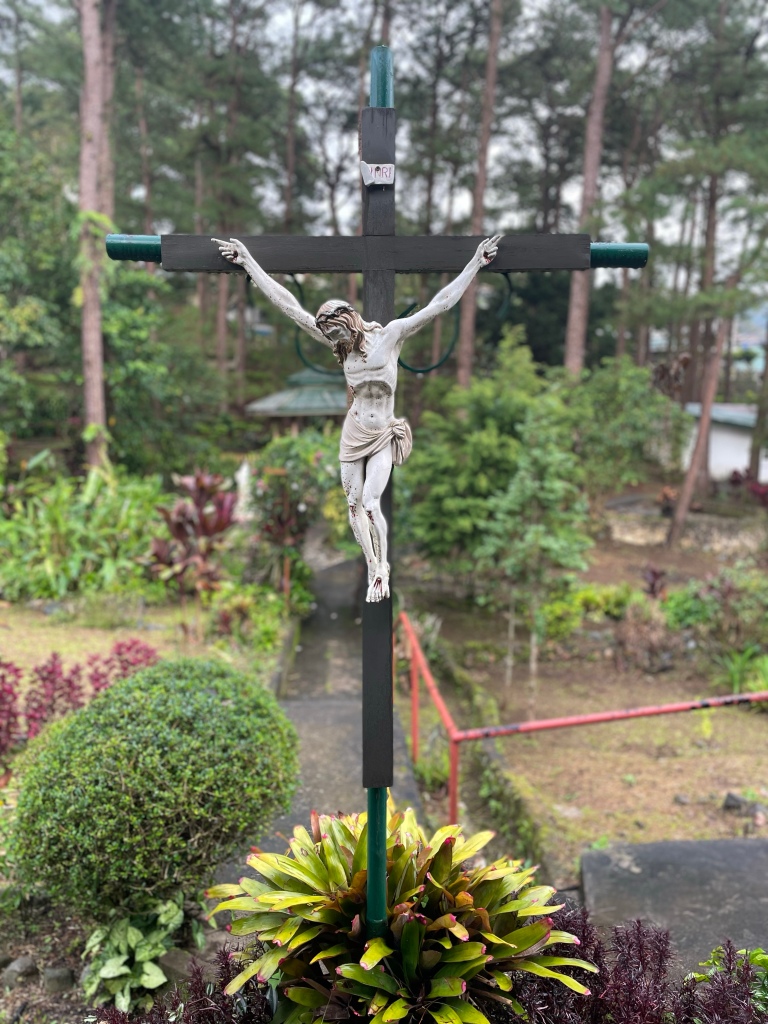
Photo by author, Baguio City, 2023.
Indeed, when blood and water flowed out from His pierced side on the Cross, the ocean of Divine Mercy flowed out for us, forgiving our most grievous sins, regardless of our many weaknesses.
In His Most Sacred heart, Jesus is inviting us to have tender moments with Him, to have the same “love language” of sacrifice and giving of self for others so that “He may dwell also in our hearts through faith so that once we are rooted and grounded in His love, we may have the strength to comprehend the breadth and length and height and depth of His love that surpasses knowledge and be filled with the fullness of God”(Eph.3:17-19).
Unlike us humans, God makes no mistakes in loving. He remains faithful to us with His love, even “allowing” us often to sin and commit mistakes so that eventually, when we hit rock bottom, we rediscover Him and His love that is so real and so personal.
That is why we must heed St. Paul’s admonition in the second reading to be “rooted and grounded in His love” because human love is always imperfect. Only God can love us perfectly in Christ Jesus who offered Himself on the Cross to fulfill what we have failed since the beginning – that is, to love God and others.
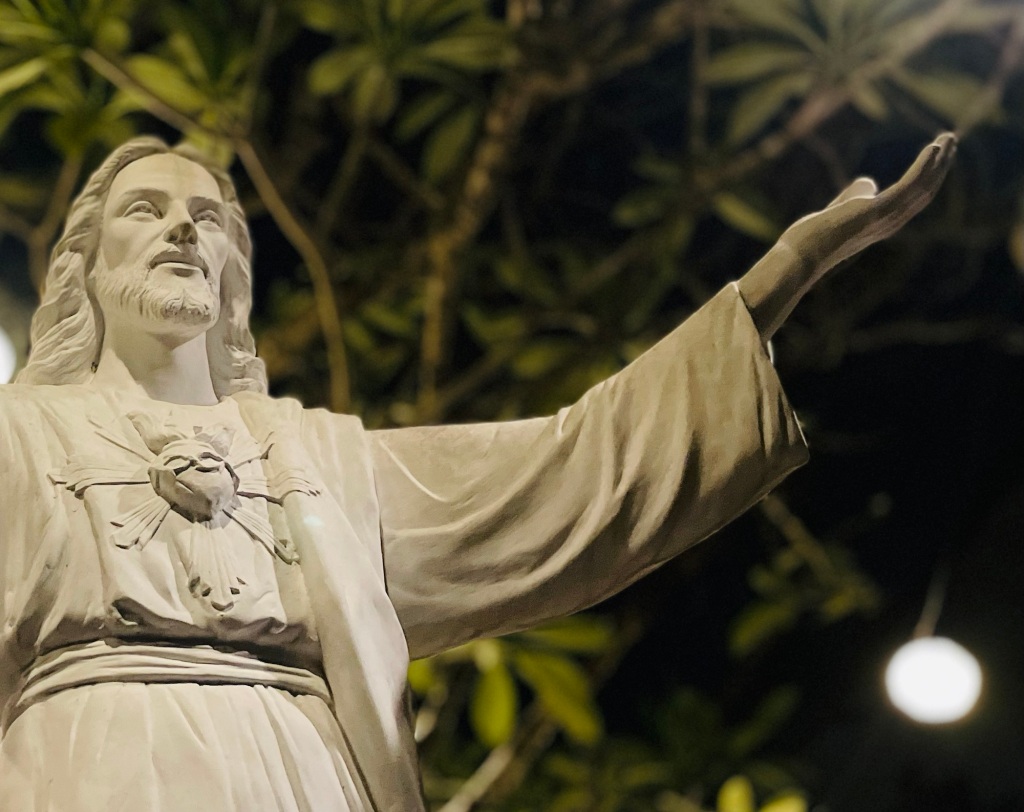
Photo by author, Sacred Heart Novitiate, Novaliches, QC, 20 March 2024.
Today we complete the series of three Solemnities in Ordinary Time right after the great season of Easter: Trinity, Body and Blood of Christ, and now, the Most Sacred Heart of Jesus. All three Solemnities tell us how great is this God we believe in, someone so immense and powerful, yet so loving and so gentle; most of all, a God so personal that He is much like us but at the same time so different from us.
This Solemnity of the Sacred Heart of Jesus is an occasion for us to meditate deeply on how God touches us in the most intimate manner when He stooped down in Christ through the Cross to experience His love and mercy so that we could make others feel that too.
Like John who witnessed everything on the Cross, we need to see more with the eyes of faith the realities of God’s immense love for us who gave His Son Jesus as the new Lamb offered for our many sins and that is why, in accordance with the Jewish law and with the Old Testament, not one of His bones were broken on the Cross. May we learn to stoop down like God in Jesus by looking down to our feet by first examining our hearts as we pray, Jesus meek and humble heart make my heart like thine! Amen.
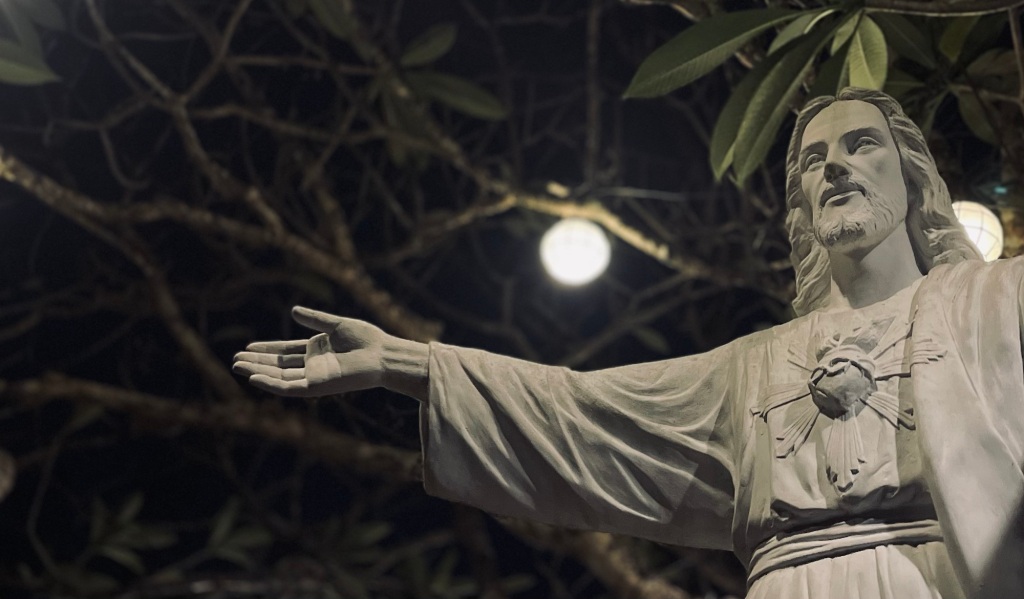
Photo by author, Sacred Heart Novitiate, Novaliches, QC, 20 March 2024.
The Lord Is My Chef Easter Recipe for the Soul by Fr. Nicanor F. Lalog II
Fourth Sunday in the Easter Season, Cycle B, 21 April 2024
Acts 4:8-12 ><}}}}*> 1 John 3:1-2 ><}}}}*> John 10:1-10
Photo by author, dusk at Anvaya Cove in Bataan, 15 April 2024.
My kinakapatid is turning 60 this week with a dinner to be prepared by an Italian chef. His sister texted me for my main course and I chose lamb chops. And immediately she replied, “Pareho tayo. Mary’s little pet… the one who takes away the sins of the world.” Her wit floored me that I had to agree with a text, “Right. The most biblical and holiest food.”
Sorry for some little bragging as we celebrate this fourth Sunday in Easter as “Good Shepherd Sunday”…
We Filipinos have a hard time getting the “feel” of the shepherd because we have never had that image in our culture. Hence, it is a most welcomed development that there is now a growing popularity in tending sheep in the country while the Filipino palate had finally discovered a taste for lamb.
Come to think of this: the sheep exists only for two reasons, for food and clothing. They are meant to be slaughtered unlike dogs or cats or birds kept as pets. Another notable thing with sheep is the fact it is the only land animal that go against the flow when crossing a river like the salmon!
Photo by Dra. Mylene A. Santos, MD, at Katmon Nature Sanctuary & Beach Resort in Infanta, Quezon, 03 April 2024.
I love those characteristics of the sheep, for slaughtering which is almost like offering and always going against the tide. Exactly just like our Lord Jesus Christ who identified Himself as the good shepherd.
Jesus said: “I am the good shepherd. A good shepherd lays down his life for the sheep… This is why the Father loves me, because I lay down my life in order to take it up again. No one takes it from me, but I lay it down on my own. I have power to lay it down, and power to raise it up again. This command I have received from my Father (John 10:11, 17-18).
First we notice here His use of the “I AM” which for the Jews refers to God when He told Moses “I AM WHO AM.” Clearly, Jesus was declaring to the people at that time that He is the Son of God, the awaited Messiah or Christ.
This scene was shortly before the feast of the dedication of the Jews after Jesus had healed a man born blind, a miracle never heard of at that time. It was a big issue then as authorities refused to accept that Jesus did indeed healed the man born blind.
Secondly, Jesus mentioned four times in just three verses the act of “laying down his life for the sheep” (vv. 11, 17, and 18). It sounded so good to hear how Jesus loves us so much that He would lay down His life for us his sheep; but, those were not just mere words Jesus expressed but a reality that happened at the Cross on Good Friday that He actually explained after this discourse at their Last Supper!
Keep in mind that we are now going back to the earlier discourses and teachings of Jesus that only became clear to the disciples including us today after Easter. We shall be having a lot of these “flashbacks” to understand and love Jesus more and His teachings.
According to Pope Benedict XVI in his first book of the Jesus of Nazareth series, “The Cross is at the center of the shepherd discourse” (page 280). When Jesus said “This is my Body… This is my Blood”, He meant really Himself being given for us; Jesus did not merely give something for us but His very self as seen on the Cross on Good Friday.
That is how Jesus gives life – by giving up His life for us so that when He arose, we then share in His being a good shepherd through our little dying to ourselves because of love, giving life to those around us.
As the good shepherd, Jesus was the first to enter death, to be slaughtered but this time minus the violence and gore of the Cross that was the worst punishment of all time when He said “I lay down my life in order to take it up again”. No one takes it from me, but I lay it down on my own.”
Yes, there was victimhood but more than that was His being an offering never forced nor imposed by anyone or by circumstances. Jesus did it all for love!
Though He was handed over (paradidomi) and betrayed by Judas, Jesus was totally free, actively passive went to his Passion and Death because He was very certain of His Resurrection.
We experience the same thing many times in life when we have to make great sacrifices like when we have to allow a loved one to die after a long illness. Death is a grace and a blessing when freely given too by those around the dying, freeing the dying person of any guilt when he/she finally goes.
The same thing is true when friends and lovers separate either because they have found other loves to pursue or worst, have fallen out of love with us despite all our love for them. It is the most unkindest cut of all breakups and separations, excruciatingly painful as we blindly give up our relationships ironically for love. More than the persons and circumstances involved, we freely choose to let go – magparaya in Filipino – because deep in our wounded and hollowed heart is the hope they may grow in their new love.
Here we are like Jesus the Good Shepherd because even in the death of our relationships is still found our love. Like Jesus Christ, we do not simply give something but our very selves. The Jesuit theologian Karl Rahner beautifully expressed this when he described Jesus is both “the Gift and the Giver.”
Photo by Dra. Mylene A. Santos, MD of the sheep’s wool, 03 April 2024.
Love is better shown than said. Love cannot be defined but only be described for it is so wide and vast in its nature and scope. Love simply shows itself. That is why when we speak of love, we use comparisons and analogies and yet, they are not enough. How much more when we speak of the love of God?!
This Sunday, Jesus spoke of His love like every human being using the language of parable and allegories. But truly Divine, we find so much more when He claimed “I AM the good shepherd.” It is His total person and self, His being both the Gift and the Giver.
The good news is, because of His giving of self, we too have become like Him able to give ourselves wholly in love. Like Peter in the first reading, we experienced great powers within us not innately ours but God working in us, enabling us to empower others by healing them not literally but figuratively speaking.
When Jesus declared “I AM the good shepherd”, He reminds us of being the children of God, His indwelling, our being an “I AM” of God Himself. Like Him, we are good shepherds able to love in Christ to the point of being foolish as St. Paul experienced.
Like the sheep, let us continue to forge on with life’s many difficulties, even if many times we have to go against the flow of the world that is always selfish and misleading. Let us pray:
Dearest Jesus,
help me to give more of myself
not just of something from me;
help me to lay down my life
for my friends even if it means
not just losing myself but
losing them in order to gain You;
help me to remain in You,
my Good Shepherd,
to never go astray
because life and love
are found only in You,
the Gift and Giver.
Amen.
Have a blessed week ahead!






 lordmychef.com