Lord My Chef Daily Recipe for the Soul, 28 August 2025
Thursday, Memorial of St. Augustine, Bishop & Doctor of the Church
1 Thessalonians 3:7-13     <*((((>< + ><))))*>     Matthew 24:42-51
Photo by author, St. Paul Center for Renewal, Alfonso, Cavite, 20 August 2025.
Praise and glory to you,
Lord Jesus Christ
as you continue
to touch us,
comfort us,
and inspire us
with the words of St. Paul
to the Thessalonians;
yesterday he addressed
them like a father encouraging
them his children in faith;
today he referred to them
as "brothers and sisters"
to "increase and
abound in love".
Now may God himself, our Father, and our Lord Jesus direct our way to you, and may the Lord make you increase and abound in love for one another and for all, just as we have for you, so as to strengthen your hearts, to be blameless in holiness before our God and Father at the coming of our Lord Jesus with all his holy ones. Amen. (1Thessalonians 3:11-13)
What a beautiful lesson
about our relationships
as a community of your
believers and followers,
of how we must regard
one another as children
with love and care of a parent,
respect and goodwill as
brothers and sisters!

Most of all,
of wishing everyone to
"increase and abound
in love for one another"!

This is something we rarely
hear these days,
wishing others to increase
and abound in love for one
another; all we hear are
prayers and wishes for more
material blessings not realizing
the superiority of love above all gifts;
to pray to increase and abound
in love is the noblest prayer
we can offer for anyone
because it means
to be holy,
to be closest to God,
to be like Christ;
to increase and abound in love
is exactly what St. Augustine,
our saint today, preached,
"Love and do what you will."
Like St. Augustine,
let our love increase and
abound so that we do nothing
to displease you Lord and
our neighbors; increase and abound
us in love, Jesus
so we may be transformed
in you.
Amen.

Fr. Nicanor F. Lalog II
Our Lady of Fatima University
Valenzuela City
(lordmychef@gmail.com)
Photo by author, St. Paul Center for Renewal, Alfonso, Cavite, 20 August 2025.
Lord My Chef Daily Recipe for the Soul, 25 August 2025
Monday, Twenty-first Week in Ordinary Time, Year I
1 Thessalonians 1:1-5, 8-10     <*((((>< + ><))))*>     Matthew 23:13-22
Photo from The Fatima Tribune, Red Wednesday at the Chapel of Angel of Peace, Our Lady of Fatima University, Valenzuela City, 27 November 2024.
Today I wonder,
God our Father,
what if Paul your Apostle
or Jesus Christ your Son
were to visit our church today,
what would they find out?
Would Paul be proud of us
like the Thessalonians of
his time?
We give thanks to God always for all of you, remembering you in our prayers, unceasingly calling to mind your work of faith and labor of love and endurance of hope of our Lord Jesus Christ, before our God and Father, knowing, brothers and sisters loved by God, how you were chosen… In every place your faith in God has gone forth, so that we have no need to say anything (1Thessalonians 1:2-4, 8).
Oh how I envy the Thessalonians
that Paul along with
Silvanus and Timothy
were so proud of their "faith
and labor of love
and endurance in hope";
most of all,
of their "conviction"
that he had no need
 to say anything,
as in, "walang masabi".
So beautiful!
How I wish Paul could say
the same things today to our
parish, to our community of
believers with their vibrant
faith, hope and love.
What  I dread, O Father
is when Jesus comes
and begins speaking
the same way to us
his priests and bishops:
Jesus said to the crowds and to his disciples: “Woe to you, scribes and Pharisees, you hypocrites. You lock the Kingdom of heaven before men. You do not enter yourselves, nor do you allow entrance to those trying to enter (Matthew 23:13).
Shame on us, Lord Jesus,
your priests and bishops!
If you were here today,
you would surely say the same
things to us: many of us
your priests do not pray at all
that many have forgotten to
pray properly and celebrate
liturgy meaningfully;
many would rather go on
vacation and recreation than
celebrate Mass and sacraments
for your people;
yes, Lord Jesus,
"woe to us" your servants
for many of us have no plans
of going to heaven at all with the
kind of Eucharist we celebrate
that people have lost faith
in you and your church.
Forgive us, Jesus,
your priests for being
blind fools,
following the limelight
of the world than your path
of the Cross;
lead us back to you, Jesus,
so that your flock may be
enlivened again in their
faith, hope and love
like the Thessalonians
of your great Apostle Paul.
Amen.

Fr. Nicanor F. Lalog II
Our Lady of Fatima University
Valenzuela City
(lordmychef@gmail.com)
Photo from The Fatima Tribune, Red Wednesday at the Chapel of Angel of Peace, Our Lady of Fatima University, Valenzuela City, 27 November 2024.
Lord My Chef Daily Recipe for the Soul, 19 August 2025
Tuesday, Memorial of St. Ezechiel Moreno, Bishop
Judges 6:11-24     ><))))*> + ><))))*> + ><))))*>     Matthew 19:23-30
Photo by author, RISE Tower, Our Lady of Fatima University, Valenzuela City, 09 August 2025.
God our loving Father,
today I feel like Gideon:
in our beautiful story today
of your call for him to be a judge
of your people,
you have taught me
that discipleship is not
about work like
an apprenticeship
but a relationship
because a disciple's
first task is to love you,
O Lord, our Master
that is why despite the
great dangers during his time,
Gideon continued to work
even in hiding from their enemies
because he believed in you,
he trusted you,
he loved you.
Discipleship is relationship
because it is more of
looking at you,
Lord Almighty
the Caller,
the Believer,
and the Sender
of my poor me!
Discipleship is not
about me that is why,
after that meeting with
Gideon, he built an altar
to you and called it
Yahweh-shalom.
Gideon, now aware that it had been the angel of the Lord, said, “Alas, Lord God, that I have seen the angel of the Lord face to face!” The Lord answered Gideon, “Be calm, do not fear. You shall not die.” So Gideon built there an altar to the Lord and called it Yahweh-shalom (Judges 6:22-23).
Shalom is peace
and you are our peace,
our total well-being
O God
 that can only come
 from a relationship
with you,
in you;
this is what your Son
our Lord Jesus Christ
tells us today through Peter,
of the need to leave everything
and everyone in order to have you.
Calm me,
Lord,
 like Gideon
for only one thing is
necessary: that we remain
in you who is our peace
so that even there are
turmoils in our ministry,
we continue
because of our relationship
than of work.
Amen.
Fr. Nicanor F. Lalog II
Our Lady of Fatima University
Valenzuela City
(lordmychef@gmail.com)
Photo by author, RISE Tower, Our Lady of Fatima University, Valenzuela City, 09 August 2025.
Quiet Storm by Fr. Nicanor F. Lalog II, 18 August 2025
Photo by author, pilgrims awaiting their turn inside the Ascension site of Jesus outside Jerusalem, May 2019.
It has been a month since I have taken a break from my daily walking following that fall in our garage when I hurt my left knee that still aches to this day. But as I rested my onehod (twohod if both knees), I have realized in prayers that there are just two important steps we have to take for a fuller life instead of those 10,000 steps daily.
The first is to always step back one or two steps backwards and stop to make a space for God and for others in our life. Though life is a constant moving forward, it is essential that once in a while we step back and stop to see everything in ourselves and around us. Let God direct you because life is more of adjusting to the many shiftings and transitions that happen every day (https://lordmychef.com/2025/08/11/god-in-our-many-transitions/). Stepping back is being flexible in life.
Since turning 18, we have all been taking charge of our lives, each of us demanding a driver’s license, but, as we approach the age of 60, our interest in driving wane that we prefer more to be a passenger than being on the steering wheel. I have semi-retired from driving last year as I leave my car behind six days a week to take ride-hailing and ride-sharing services. Aside from reasons of convenience, taking a Grab car makes me more productive and most of all, relaxed in getting to my destinations and back home.
When life is so confusing, so dark and you feel so lost, step back and stop. Many times in life what really happens is that we unconsciously eject God from our lives as we go on with our responsibilities and projects even apostolates and ministry thinking we are doing the work of God. The moment things go wrong, when failures and problems happen, we then question God where he is or why did he allow bad things to happen with us. Truth is, God never left us, has always been with us but we never recognized him because we were so busy. Hence, the need to step back and stop to meet him. Finally.
Moses went up from the plains of Moab to Mount Nebo, the headland of Pisgah which faces Jericho, and the Lord showed him all the land… The Lord then said to him, “This is the land which I swore to Abraham, Isaac, and Jacob that I would give to your descendants, I have let you feast your eyes upon it, but you shall not cross over.” So there, in the land of Moab, Moses, the servant of the Lord, died as the Lord had said (Deuteronomy 34:1, 4).
See how Moses was portrayed in the first readings last week, slowly stepping back from the daily scene among the Israelites in the wilderness as he passed leadership to Joshua his successor. It is perhaps the earliest account in the Bible of the virtue of “ageing gracefully” in the Lord by Moses.
It is a virtue so needed these days in modern time that Pope Benedict XVI taught us in 2013 when he resigned, taking that bold step backward to stop from his active duties to spend the rest of his life in prayers. That move proved beyond doubts the true humility and holiness of Pope Benedict XVI who peacefully died right at the transition of the year on December 31, 2022.
Not only successions proceed smoothly when we learn to step back and stop as seen in Moses and Pope Benedict. Stepping back to stop and allow God to do his work among us strengthen and make better our human relationships often strained by those into sin and evil. See these as the steps proposed by Jesus in his instructions when one commits sin:
Jesus said to his disciples: “If your brother sins against you, go and tell him his fault between you and him alone… If he does not listen, take one or two others along with you, so that every fact may be established on the testimony of two or three witnesses. If he refuses to listen to them, tell the Church. If he refuses to listen even to the Church, then treat him as you would a Gentile or a tax collector” (Matthew 18:15,16-17).
Relationships are shattered when we “overstep” on family and friends into sinful situations where stepping backward is the more prudent choice to take. Stepping backward allows us to learn more the situation and avoid making rash judgments against anyone that often starts, then gets aggravated in social media. Stepping back is not just being circumspect at all but simply trying to be more fair and accurate where social media is filled with inaccurate and totally false reports or fake news.
Photo by Dra. Mylene A. Santos, MD, 2023.
The second important step that literally brings us closer to God and others is taking that first bold step into water. Yes. Stepping on water is the other special step we need to learn and make for a fuller life in God.
Recall whenever you go swimming at the pool or the beach. There is always that someone in the family or among friends or even our very self so timid or wary of the cold water who would ask that stupid question, is the water cold?
Of course – you will never know how cold the water in the pool or the sea until you take that plunge! It may sound simple but, many times we are afraid to take the first step forward into any body of water or even the shower due to the chills that quickly follow. But we also know very well from experience the great feelings that come after every plunge into water!
The spiritual value of making this crucial step forward into water is found in the first reading last Thursday at the crossing of the Jordan River by the Israelites into the Promised Land under Joshua. Leading them were the priests carrying the ark of the covenant who took the first steps on the banks of Jordan River that caused it to part and enabled the people to cross into the other side, reminiscent of the crossing of the Red Sea during their exodus from Egypt with Moses (https://lordmychef.com/2025/08/14/praying-to-step-forward-in-christ/).
Photo by Mr. Jim Marpa, 2019.
The people struck their tents to cross the Jordan, with the priests carrying the ark of the covenant ahead of them. No sooner had these priestly bearers of the ark waded into the waters at the edge of the Jordan…than the waters flowing from upstream halted, backing up in a solid mass for every great distance indeed… while those flowing downstream toward the Salt Sea of the Arabah disappeared entirely. Thus the people crossed over opposite Jericho (Joshua 3:14-15, 16).
Water is life but it also evokes death at the same time. Too much water can drown and kill us that is why we are afraid to take the first step forward into the river or the sea. We fear, we doubt even mistrust God, others and our self in taking the first step forward into water without realizing how that step could be the only thing left for us to move on in life. Stepping into water and allowing our feet to get wet in order to cross a stream or a river is one of the boldest moves we can make in life because that could be the very moment when God is actually making a way for us when our usual routes are impassable.
That is why I tried linking that first reading with the story of the saint of that day, St. Maximilian Kolbe (August 14) who “stepped forward” to their prison guards to take the place of a married man to be executed as a punishment following the escape of a prisoner at Auschwitz. Like the priests of Joshua, St. Maximilian carried the ark of the covenant – Jesus Christ – inside the gas chambers that ignited the flames of courage and faith in God to other prisoners at that time.
Photo by Mr. Jim Marpa, 2019.
These days, we need more men and women of faith, hope and love in God willing to step forward into waters that can be dark and murky, even lethal with unknown substances like the modern miseries of human trafficking, substance abuse, sex slavery, extreme poverty and other systematic inhuman conditions that now afflict mankind. Taking that bold step into water carrying Christ across the river is enabling the others to pass through from death to life, from grief to joy, and from hopelessness to love.
Pray for us your priests in the Diocese of Malolos as we go on retreat today until Thursday that we may truly step backwards and stop these days to let God take charge of our lives and ministry anew. Most of all, that we may have the grace of fervor and courage to carry and follow Jesus in crossing the many rivers and streams of life when the usual routes are impassable due to sickness and other miseries. Amen. Have a fulfilling week ahead.
Lord My Chef Daily Recipe for the Soul, 15 August 2025
Friday, Solemnity of the Assumption of the Blessed Virgin Mary
Revelation 11:19, 12:1-6, 10 ><}}}*> 1 Corinthian 15:20-27 ><}}}*> Luke 1:39-56
“The Assumption of the Virgin” by Italian Renaissance painter Titian completed in 1518 for the main altar of Frari church in Venice. Photo from wikidata.org.
Thank you,
Most Blessed Virgin Mary
for being our Mother
and most of all,
our model disciple
in your Son Jesus Christ.
As we celebrate today
the Solemnity of your Assumption
into heaven,
we also celebrate our blessed
assurance and hope
that someday
we too may join you with God
body and soul
if we remain one and united
in Jesus Christ our Savior.
Pray for me,
O Blessed Mother
that I too may rejoice in God
for all that he does for me
while seeing my lowliness
not my pride.
Mary set out and travelled to the hill country in haste to a town of Judah, where she entered the house of Zechariah and greeted Elizabeth (Luke 1:39-40).
Pray for me,
Blessed Mother
to go in haste
filled with joy
and excitement in the Lord,
determined and committed
to the mission to proclaim
the coming of our Savior Jesus Christ;
pray for me, dear Mary
to go in haste
filled with joy
and excitement in the Lord
for his love for me I have to share
with everyone like you;
pray for me,
Blessed Mother
to go in haste
celebrating the Christ's
presence and coming,
our fulfillment in him.
When Elizabeth heard Mary’s greeting, the infant leaped in her womb, and Elizabeth, filled with the Holy Spirit, cried out in a loud voice and said, “Blessed are you among women, and blessed is the fruit of your womb…Blessed are you who believed that what was spoken to you by the Lord would be fulfilled.” And Mary said: “My soul proclaims the greatness of the Lord; my Spirit rejoices in God my Savior” (Luke 1:41-42, 45-47).
Dear Jesus,
forgive me when I am filled
with pride,
doubts,
and mistrust in you
that slow me
from sharing
you with others and
the world;
fill me with humility
like Mary,
that I may sing too
a magnificat to you,
singing your saving grace
because every time
we rejoice in you
and your works in us
that is when we experience
heaven
our ultimate end
when in body and soul
we shall celebrate you
with Mary our Mother too.
Amen.

Fr. Nicanor F. Lalog II
Our Lady of Fatima University
Valenzuela City
(lordmychef@gmail.com)
Lord My Chef Daily Recipe for the Soul, 13 August 2025
Wednesday, Memorial of Sts. Pontian & Hippolytus, Priests & Martyrs
Deuteronomy 34:1-12     ><)))*> + ><)))*> + ><)))*>     Matthew 18:15-20
Photo by author, Franciscan Monastery on Mt. Nebo in Jordan believed to be where Moses was shown by God the view of the Promised Land he was not allowed to enter into.
God our loving Father,
teach me to be like Moses:
teach me
 to let go,
let God;
how lovely
that between letting go
and letting God lies
just the small letter "d"
which is to die everyday in myself
so that you prevail,
O God when I accept
your will
and your plans.
Like Moses,
let me share and
be content in the joy
of knowing or seeing
the fulfillment of your promise
in others without ever
holding nor experiencing
its very fruit;
fill me with
the Holy Spirit
to guide my heart
especially at this stage
in my life as a senior citizen
to learn to step aside
to make a space for you
and for others like the
younger ones who would take
charge from what I have to leave
behind; let me realize
that simply being a part
of your mission is more than enough
with no need for me
to be recognized
or be in control always.
It is the same process
I need to learn
and imbibe,
to let go and let God
regarding sins of another
brother or sister -
of making a room
for you to work in the heart
of a wayward,
erring fellow disciple
instead of taking it into
my hands that are dirty
with sins too;
unlike during the time
of Saints Pontian
and Hippolytus,
there is no need for me to
go through a bloody death
except to let go of my ego
and pride
so that you take command
in Christ our Lord.
Amen.

Fr. Nicanor F. Lalog II
Our Lady of Fatima University
Valenzuela City
(lordmychef@gmail.com)
Photo by author, entrance to the Franciscan. Monastery on Mt. Nebo in Jordan believed to be where Moses was shown by God the view of the Promised Land he was not allowed to enter into.
Lord My Chef Daily Recipe for the Soul, 12 August 2025
Tuesday in the Nineteenth Week of Ordinary Time, Year I
Deuteronomy 31:1-8     <*((((>< + ><))))*>     Matthew 18:1-5, 10, 12-14
Photo by author, the Grotto in Baguio City, February 2019.
How I love your words today,
Lord Jesus Christ;
we all remain little children
after all; though like the Twelve
we often debate on "who is the
greatest", in the end, we remain
that little child you called
and placed in their midst.

Yes, Jesus,
we remain like children -
weak and fearful
especially in old age
when we prefer to remain
in our "comfort zones" yet,
like Moses in Jordan,
time catches on us when we
have to go - whether for good
or not - with our many transitions
in life.
Then Moses summoned Joshua and in the presence of all Israel said to him, “Be brave and steadfast… It is the Lord who marches before you; he will be with you and will never fail or forsake you. So do not fear or be dismayed” (Deuteronomy 31:7, 8).
Lord Jesus,
as I age and get old and weak,
the more I doubt,
the more I am afraid than ever;
indeed,
we all remain
 like little children
before you;
fill me with more courage
to step forward in you
when my sight grows dim,
my muscles ache
 and joints weaken
in life's journey;
teach me to trust more
the younger generation as they
take charge from us in this life;
let me be more silent
and deeply aware of your presence
in life's many transitions
that continue to happen
as we advance in age;
deepen our faith and hope
in you, Lord
for you march ahead of us,
never forsaking us,
nor failed us.
Amen.

Fr. Nicanor F. Lalog II
Our Lady of Fatima University
Valenzuela City
(lordmychef@gmail.com)
Photo by author, Tam-Awan Village in Baguio City, February 2019.
Lord My Chef Daily Recipe for the Soul, 11 August 2025
Monday, Memorial of St. Clare, Virgin
Deuteronomy 10:12-22     <*((((><  +  ><))))*>     Matthew 17:22-27
Photo by author, Sonnen Berg Mountain View, Marilog, Davao City, August 2018.
What a beautiful way
to start our first day in school
and work this week
examining our attitudes
with our rights and privileges
vis-a-vis your example of compassion
and solidarity,
Lord Jesus.
Moses said to the people: “For the Lord, your God, is the God of gods, the Lord of lords, the great God, mighty and awesome, who has no favorites, accepts no bribes… So you too must befriend the alien, for you were once aliens yourselves in the land of Egypt” (Deuteronomy 10:12, 17,19).
You play no favorites,
indeed, Lord
but many times your love
and blessings get into our heads
that we not only forget others
but even you in the process;
we forget what we have gone through,
we disregard our wounds
especially how you saved us
that we think more
 of our rights and privileges
 than of our responsibilities
that come with every good gift
from you.
When they came to Capernaum, the collectors of the temple tax approached Peter and said, “Does not your teacher pay the temple tax?” “Yes,” he said. When he came into the house, before he had time to speak, Jesus asked him, “What is your opinion, Simon? From whom do the kings of the earth take tolls or census tax? From their subjects or from foreigners?” When he said, “From foreigners,” Jesus said to him, “Then the subjects are exempt. But that we may not offend them, go to the sea, drop in a hook, and take the first fish that comes up. Open its mouth and you will find a coin worth twice the temple tax. Give that to them for me and for you” (Matthew 17:24-27).
What a shame,
Lord Jesus!
In this world where
everyone insists on each one's
rights and privileges,
so many are maligned,
and much more are misled
by some people specially in media
with bloated egos;
in this world that had shrunk
into a global village,
many brains have shrunk too
with hearts turned into stone
without any compassion and
sense of true solidarity at all!
Instruct me,
dear Jesus,
like Peter to drop in
a hook to catch the
first fish that comes up
for surely,
many times
I have missed finding
a "coin" inside its mouth
worth than what we are required;
many times,
I see only myself,
my rights and my privileges
that I forget to be compassionate
and be one with others;
teach me to be like you:
totally "indifferent" in a positive
sense in whatever the world offers
choosing only the Father's will
for God's glory.
Amen.

Fr. Nicanor F. Lalog II
Our Lady of Fatima University
Valenzuela City
(lordmychef@gmail.com)
Photo by author, Sonnen Berg Mountain View, Marilog, Davao City, August 2018.
Lord My Chef Daily Recipe for the Soul, 06 August 2025
Wednesday, Feast of Transfiguration of the Lord, Cycle C
Daniel 7:9-10, 13-14 ><)))*> 2Peter 1:16-19 ><)))*> Luke 9:28-36
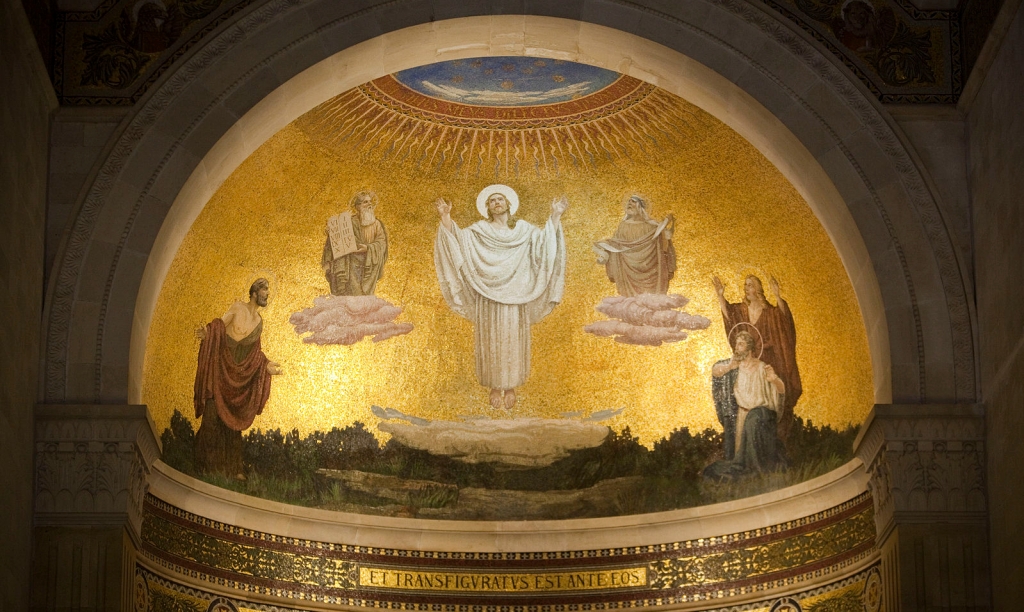
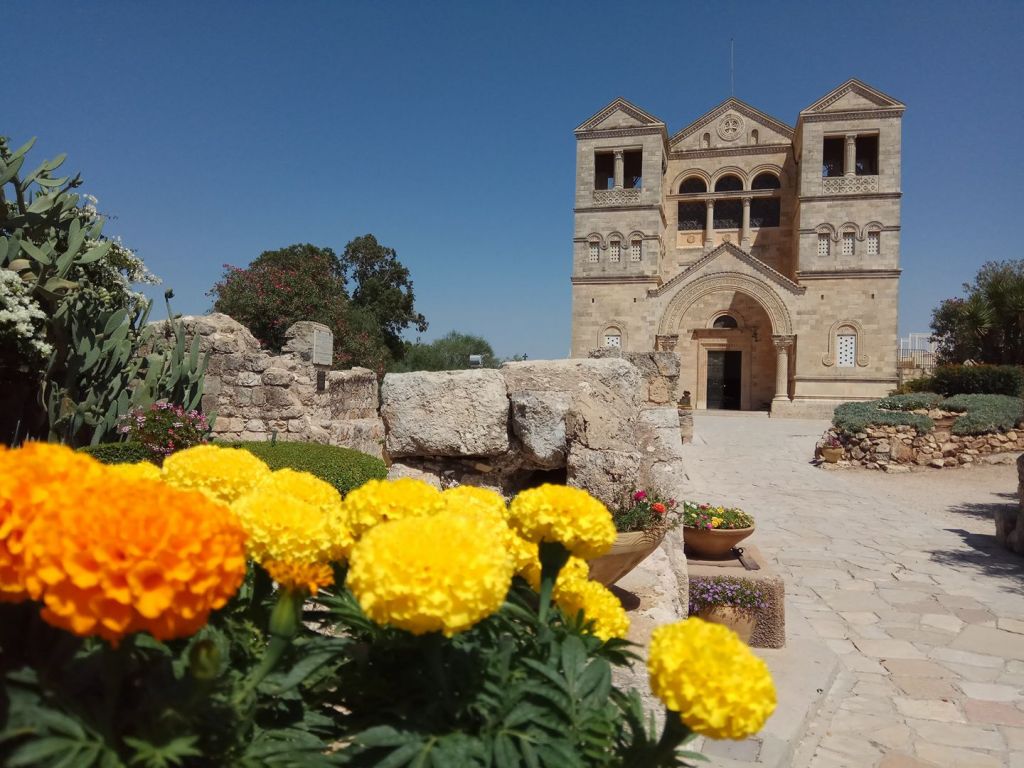
Apse of the Transfiguration Church at the Holy Land from wikimedia.org.
Jesus took Peter, John, and James and went up the mountain to pray. While he was praying his face changed in appearance and his clothing became dazzling white. And behold, two men were conversing with him, Moses and Elijah, who appeared in glory and spoke of his exodus that he was going to accomplish in Jerusalem (Luke 9:28-31).
Lord Jesus,
I feel afraid in this scene;
how difficult it must have
been to the three Apostles
privileged to join you up on
Mount Tabor at your Transfiguration
for it was not all glory -
I could imagine the fear
and sadness hearing
Moses and Elijah speaking
about your coming
"exodus",
your Passion,
Death, and Resurrection.
Why do you have to go through
those sufferings and death?
Why do you have to leave
and depart from us?

Like Peter,
I would have said the
same to you, "Master,
it is good that we are here;
let us make three tents,
one for you,
one for Moses,
and one for Elijah"
so that we could just stay
and remain up there in glory.
You know it so well,
Jesus how when we are
so wrapped in joy and glory
and mystery,
we hardly understand
a thing except the experience
of being overwhelmed,
of finding you,
of seeing you,
and being with you;
lead us down the mountain
into life's daily realities
where we you want us to
bring that light to many others
going through darkness in life.
We ourselves heard this voice come from heaven while we were with him on the holy mountain. Moreover, we possess the prophetic message that is altogether reliable. You will do well to be attentive to it, as to a lamp shining in a dark place, until day dawns and the morning star rises in your hearts (2 Peter 1:18-19).
Spring blooming of poppies in Galilee near the Nazareth, against the background biblical Mount Tabor, Israel; photo from iStockphoto.com.
Enlighten our minds
and our hearts,
Jesus, like Peter
to realize the deeper truths
of your transfiguration
and of our own transfiguration
that begin always in a prayer life,
an intimate relationship with you
that gets clearer
when we are in darkness,
when with you at the Cross;
let us take seriously
every Mount Tabor experience
proclaiming it as
"altogether reliable"
like Peter because
 we experienced you,
we heard you
and was with you;
guide and strengthen us,
Jesus
when we are in darkness
for that is when you transfigure us
into yourself,
when you speak to us of our
own "departure";
most of all,
keep us "attentive" to you
in those dark moments
to be like a
"lamp shining in a dark place"
(2 Peter 1:19).
Amen.

 Fr. Nicanor F. Lalog II
Our Lady of Fatima University
Valenzuela City
(lordmychef@gmail.com)
Church of the Transfiguration, Mount Tabor, Holy Land; from custodia.org.
Lord My Chef Daily Recipe for the Soul, 29 July 2025
Tuesday, Memorial of Sts. Martha, Mary and Lazarus, Siblings
1 John 4:7-16     <'[[[[><  +  ><]]]]'>     John 11:19-27
“The Raising of Lazarus”, 1311 painting by Duccio de Buoninsegna from commons.wikimedia.org
What a beautiful reminder to us,
dear Jesus on this day as we celebrate
the Memorial of the Holy Siblings
Saints Martha, Mary and Lazarus:
the only time they are presented as one
and complete was during the raising of
Lazarus; you were there in their most
sorrowful moment in life as brother and
sisters because you have always been there
with them in good times when they were
all alive and well.
I pray,
dear Jesus,
for all siblings like
Saints Martha, Mary and Lazarus
to remain one as a family after
their parents have been gone;
so many times in such deep sorrow,
we are like Martha telling you Lord,
"if you had been here my brother -
or sister or parents -would not have
died" (John 11:21); but, your response
to her and to us was so rich in meaning
we can only summarize in love,
"your brother will rise... I am the resurrection
and the life; whoever believes in me,
even if he dies, will live, and anyone
who lives and believes in me will never die.
Do you believe this?"
(John 11:23, 25-26)
Help me believe
like Martha,
Jesus;
help me believe by being
more loving and caring
with my family while still alive
and well;
help me believe by being
more understanding
and forgiving,
more kind and sensitive
with my brother or sister
while still alive;
please help, Jesus
 the siblings
at odds with each other,
not talking with each other,
grouping together against each other
because of betrayals
and dishonesty in their share
of inheritance;
help them seek your face
to be more just and loving
because "love is of God"
(1 John 4:7);
let siblings be like
Saints Martha, Mary and Lazarus
be one in you, Jesus
in faith,
hope
and love
while still alive
so that in their death
they remain one in you.
Amen.

Fr. Nicanor F. Lalog II
Our Lady of Fatima University
Valenzuela City
(lordmychef@gmail.com)
An icon of Jesus visiting his friends, the siblings Sts. Lazarus, Mary and Martha. Photo from crossroadsinitiative.com.