Christ comes in the Mass

Lord My Chef Simbang Gabi Recipe for the Soul by Fr. Nicanor F. Lalog II
Friday, Simbang Gabi-IV, 19 December 2025
Judges 13:2-7, 24-25 <*((((>< + ><))))*> Luke 1:5-25
View of a decorated Christmas tree and tower of the Franciscan Monastery of St Saviour locally also known as San Salvador monastery in the Christian Quarter Old city East Jerusalem

From Matthew, we now shift to Luke’s account of the story of Christmas which is the most complete and detailed of all gospel accounts. In fact, most artistic renditions of Christmas were inspired by Luke’s gospel.

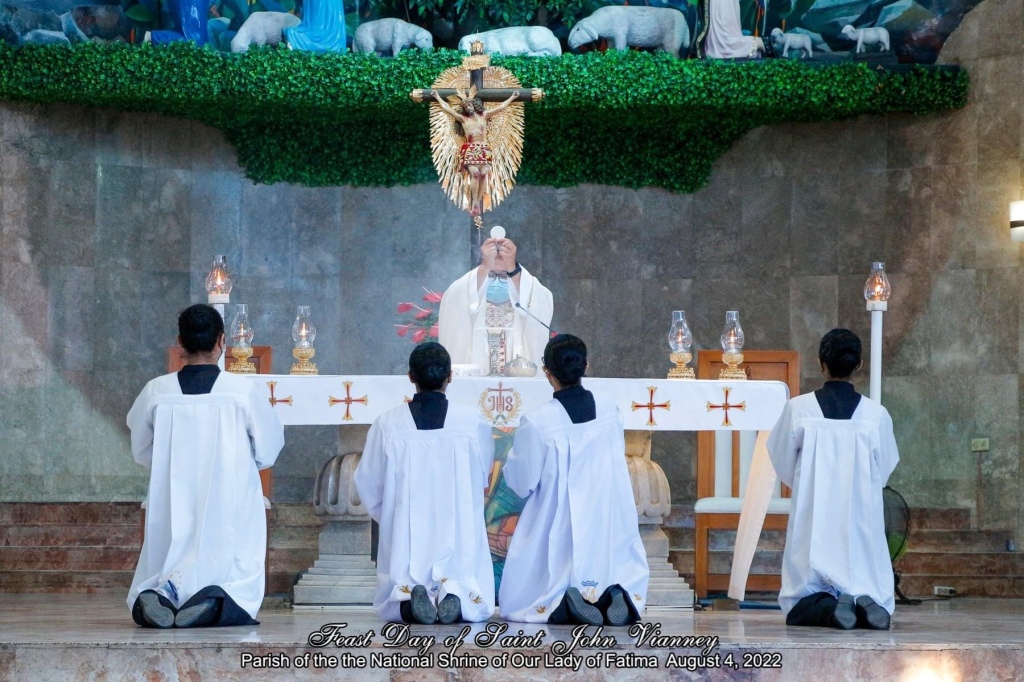
Very surprising in his Christmas story, Luke started it with the annunciation of the birth of John the Baptist to his father Zechariah who was then serving at the temple of the Lord in Jerusalem, a beautiful reminder to us all these days that Christ comes in our Holy Mass.

And I wonder – what if I imitate Zechariah in the gospel on this Simbang Gabi: come out late in the altar… totally silent, unable to speak?

Meanwhile the people were waiting for Zechariah and were amazed that he stayed so long in the sanctuary. But when he came out, he was unable to speak to them, and they realized that he had seen a vision in the sanctuary. He was gesturing to them but remained mute. Then, when his days of ministry were completed, he went home (Luke 1:21-23).

Photo by author, December 2023.

A priest recently posted on Facebook an appeal to us all priests to truly pray and reflect to have a good homily this Simbang Gabi and Christmas Season because the people deserve more than jokes, hugot lines and gimicks during these ten days of celebrating the Mass.

And we totally agree with him!

Let us accept the fact that majority of Catholics in the world – not only in the Philippines – celebrate Mass only on Christmas. At least in our country, there is the Simbang Gabi when many Catholics try to complete its nine-days of Masses plus the Christmas Day itself and, that’s it for them – ten consecutive days in December and absent every Sunday from January to November with a few who would return to Mass on Palm Sunday, fiestas and birthdays. Especially these days, most people have no qualms at all of skipping Sunday Masses while there are still some who wrongly believe the online Mass suffices.

The challenge and call for us priests this season is indeed very true when we are able to pray and prepare well our homilies to catechize the once-a-year-Catholics so that they may experience the love and mercy of God in Jesus Christ who had come and continues to come during our celebrations of the Mass and other sacraments.

Problem is, very often we priests are indeed so much like Zechariah on that day when he doubted the good news of John’s birth announced by an Angel. Not only are many priests notoriously late in their Mass schedule, worst of all as the people complain, either they have nothing or too much to say during their homily!

Photo by Ar. Philip Santiago, Jerusalem, October 2025.

Like the people awaiting Zechariah during that important feast, people are amazed today why some priests could not say anything substantial at all except to continuously ask people to clap their hands and praise God with such cues as “God is good…” and “all the time…” and soon enough what’s next, collection, then after communion special collection!

On the other hand, like the people awaiting Zechariah during that feast, people are also amazed when their priests speak a lot without any sense at all. Worst, many times, the priests are like Jollibee – puro pabida either by converting the altar into a stage for his stand-up jokes and entertainment or turn the sanctuary into a videoke bar because Father is so bilib in his voice.

Sorry, my brother priests. Let’s listen to what people are saying. Let’s listen especially to God when he speaks to us. Or, do we have time to listen to him in prayers?

One truth we priests could not admit or refuse to admit despite its glaring realities is that many of us have become just like politicians – so corrupted that we simply entertain people, keep them ignorant of the more essential things in life and about God because many of us do not pray or are not even interested of going to heaven at all.

Maybe like Zechariah, many priests have been burned out not only of the tasks and living in near isolation but also due to the long wait for answers to our prayers coupled with the many pains and hurts that came along with the ministry that has become more of duties than relationship with the Caller, Jesus Christ.

Photo by Lara Jameson on Pexels.com

In telling us this story of the annunciation to Zechariah, Luke had touched on something very timely and sensitive among us priests including the faithful in this age of social media: we have been so detached from God and the divine, many times so impersonal with one another, and, worst of all, so attached with material and worldly things.

As a result, many people have stopped looking up to some priests as models and inspiration for upright living because we have become so much like them in almost every aspect from clothing to speaking and even thinking!

“Pari pala yun!” is what some people often remark these days when they find priests making tambay dis oras ng gabi in almost every cafe or worst, in places we should not even go like casinos and bars, whether with GRO’s or macho dancers.

A growing concern among us these days is the complaint of lay faithful who feel lost and could not guidance like find definitive answers from their pastors about moral issues so blurred by the modern technologies and Western thoughts like wokism. Imagine a Catholic school allowing gay pride festivities? Or relativistic priests to issues of abortion and contraceptives, sex change and gender manipulations, even cases of pornography and other modern addictions. A growing number of laypeople openly express their disappointment at how lately priests have become so lenient with sins that they are already confused on what to confess!

Photo by author, March 2024.

Zechariah and us priests today face the same problem before God: we talk too much and pray so little that perhaps, we need to be silenced too in order to pray more, to listen more to God, his words, his plans and his people as envisioned by synodality now in oblivion.

Imagine all his life as a priest, Zechariah had been praying for a son but when it was finally answered by God, he refused to believe it. Suddenly, he was so lost at what he was supposed to be an expert like spirituality and prayer, most of all, of God’s goodness.

What happened to Zechariah?

And that is what our gospel is asking us priests today, what happened Father?

In the first reading we have heard of the wife of Manoah who felt “a man of God” approached and told her of the good news of the birth of a son (Samson); how lovely if people could feel the same way like in the old days of their priests as “man of God”!

It is very sad when laypeople complain their priests have become so “ordinary” without any sense of holiness or at least of the holy, from simplest wearing of clerical shirt and proper Mass vestments to good grooming and tidiness.

Maybe because we priests have been so concerned so much with palabas than of paloob, when like the social influencers, many among us are so carried away by media chasing content than substance, especially theology.

Photo by author, Jerusalem, May 2017.

One of the most painful cuts in the ministry today that hurts so bad is when priests striving to be holy, speaking and doing what is right and proper would then be called as pharisaical. This is very evident in the celebration of the Mass as some priests would belittle even insult those who follow rubrics as well put on proper vestments.

Luke invites us today, both ordained priests and laypeople who share in the priestly office of Jesus in their baptism, that we look into ourselves, into our hearts amid our worship of God like Zechariah in the very presence of God in the Holy of holies: are we present in the Lord?

Do others feel Christ’s coming in our presence especially in the word and later in our life of witnessing and loving service to them?

Let us strive to have meaningful celebrations of the Mass and other communal worship not only this Advent and Christmas because people await from us ministers of the altar like Zechariah of old the good news of the coming of Christ in every Mass we celebrate with them. Help us your priests, our dear lay faithful by giving us the chance to pray more and serve more instead of inviting us in your activities and other affairs we are not needed. Amen. Have a blessed Friday!

When Jesus is “stressed”

Lord My Chef Daily Recipe for the Soul, 23 October 2025
Thursday in Twenty-Ninth Week of Ordinary Time, Year I
Romans 16:19-23 <'[[[[>< + ><]]]]'> Luke 12:49-53
Photo by Dra. Mai B. Dela Peña, Japan, 2016.
I may be struggling with
stress daily like most
people these days,
Lord Jesus,
but today's gospel made me
realize how you too experienced
"stress" like us because,
after all , you are
truly human
like us.

Jesus said to his disciples: “I have come to set the earth on fire, and how I wish it were already blazing! There is a baptism with which I must be baptized, and how great is my anguish until it is accomplished! Do you think that I have come to establish peace on the earth? No, I tell you, but rather division (Luke 12:49-51).

How good it is to realize
that you, Lord Jesus,
was also stressed -
"I have come to set the earth
on fire...
There is a baptism with which
I must be baptized...";
like you, we could feel
the weight of things to be done,
of mission to be accomplished;
like you, we too could feel
the great responsibilities
on our shoulders.

Thank you,
Jesus,
thank you
for being one with us
in our stress.
Teach us Lord your
way of handling stress
so we can put these
challenges into good use,
into more evangelical in nature
by first accepting and embracing
like you our mission and
responsibilities when you said,
"how I wish it were already blazing"
and "how great is my anguish
until it is accomplished";
many times what we do
is as much as possible avoid
our mission and responsibilities
or, if not, delay acting on them
that eventually stress us further;
give us also the courage like you,
Jesus,
to face and deal with our
many divisions in life
that stress us,
of learning to bridge the many
gaps between the ideal
and the sad realities
we are into
as well as the many
limitations and handicaps
we have.
Photo by Dra. Mai B. Dela Peña, Mt. Carmel, Israel, 2015.
Make us whole,
Lord Jesus
in your love and 
kindness and peace
by claiming our 
blessedness in your
gift of salvation
and sanctification
as we pursue
holiness
according to
St. Paul's advice
in the first reading.
Amen.

Fr. Nicanor F. Lalog II
Our Lady of Fatima University
Valenzuela City
(lordmychef@gmail.com)

Praying to be gentle & tenacious

Lord My Chef Daily Recipe for the Soul, 26 August 2025
Tuesday in the Twenty-first Week of Ordinary Time, Year I
1 Thessalonians 2:1-8 <*{{{{>< + ><}}}}*> Matthew 23:23-26
Photo by Pixabay on Pexels.com
Thang you very much,
dear Jesus for the gift of
St. Paul your Apostle:
yesterday we heard how
he encouraged the church
at Thessalonica,
of how impressed he was
with their deep conviction
of faith;
today he described his
approach to starting the
church at Thessalonica:
so candidly speaking
how he did it while still
remaining tender and gentle
to them,
so sure he had taken
the right course of action.

You yourselves know, brothers and sisters, that our reception among you was not without effect. Rather, after we had suffered and been insolently treated, as you know, in Philippi, we drew courage through our God to speak to you the Gospel of God with much struggle. Our exhortation was not from delusion or impure motives, or did it work through deception. But as we were judged worthy by God to be entrusted with the Gospel, that is how we speak, not as trying to please men, but rather God, who judges our hearts (1Thessalonians 2:1-4).

As I pray,
Lord Jesus on these
words of St. Paul,
I cannot stop wondering
our many excuses
and "side trips" today
as your apostles;
how did St. Paul unwind
or recreate in his time
compared to our many
forms of rest and recreation;
so many of us cannot move on
with life and ministry
from whatever experiences
we have had in our previous
assignments unlike St. Paul
who simply kept the lessons
learned from his past experiences
at Philippi; most of all,
I could feel the intense love
of St. Paul to you, Lord Jesus
and his ministry with his
deep personal relationship
in you in prayers
so unlike us today
with so many excuses
in not praying at all.
What I love most
is St. Paul's
tenderness and gentleness
to his church
with his tenacious
hold on you Jesus.

although we were able to impose our weight as Apostles of Christ. Rather, we were gentle among you, as a nursling mother cares for her children. With such affection for you, we were determined to share with you not only the Gospel of God, but our very selves as well, as dearly beloved had you become to us (1Thessalonians 2:7-8).

Dearest Jesus,
may your word
be always alive and
active in me
flowing in my tender
and gentle service to your flock
so unlike the Pharisees you
have condemned again in
today's gospel
for being blind guides
of the people.
Amen.

Fr. Nicanor F. Lalog II
Our Lady of Fatima University
Valenzuela City
(lordmychef@gmail.com)
Photo by author, 2018.

Full presence in Christ

Lord My Chef Sunday Recipe for the Soul, 20 July 2025
Sunday in the Sixteenth Week of Ordinary Time, Cycle C
Genesis 18:1-10 ><}}}*> Colossians 1:24-28 ><}}}*> Luke 10:38-42
Photo by author, Tagaytay City, February 2023.

After telling us what we must do to inherit eternal life through his parable of the Good Samaritan last Sunday, Jesus continued his journey to Jerusalem with his disciples with a stop over today in the home of the sisters Martha and Mary.

The visit became an occasion for Jesus – the Good Samaritan – to expound on the more important things we his disciples must “do” as exemplified in the contrasting attitudes of the two sisters.

“Jesus in the House of Martha and Mary”, painting by Johannes Vermeer (1654) from en.wikipedia.org.

Jesus entered a village where a woman whose name was Martha welcomed him. She had a sister named Mary who sat beside the Lord at his feet listening to him speak. Martha, burdened with much serving, came to him and said, “Lord, do you not care that my sister has left me by myself to do the serving? Tell her to help me.” The Lord said to her in reply, “Martha, Martha, you are anxious and worried about many things. There is need of only one thing. Mary had chosen the better part and it will not be taken from her” (Luke 10:38-42).

This is the third consecutive Sunday Jesus gives us the top things we his disciples must always “do”: two Sundays ago he instructed us to represent him well by greeting everyone with peace while proclaiming that the kingdom of God is at hand (14th Sunday); last week, Jesus asked us to consider everyone especially those in need as a “neighbor” with whom we must show mercy at all times.

Today’s teaching of Jesus is of capital importance in this series on discipleship before the Lord caps it next Sunday with the very foundation of discipleship which is prayer.

An icon of Jesus visiting his friends, the siblings Sts. Lazarus, Mary and Martha. Photo from crossroadsinitiative.com.
"Martha, 
burdened with much serving,
came to him and said..."

Only Luke has this unique story in the home of Martha and Mary.

Far from the simplistic views of a distinction between “contemplative” and “active” approaches in discipleship, Luke invites us not only to enter the home of Martha and Mary but most of all our Lord and Master Jesus Christ to experience and realize the deeper realities of being his disciple.

There is more at issue here than a conflict of duties of listening to the Word like Mary and doing the work like Martha. Jesus is not telling us to be like Mary listening more to the word – and forget all about the work to be done and accomplished? Not at all.

Jesus reproached Martha for being anxious and upset about many things in life that she had forgotten the more essential which is to listen to Christ himself.

Luke’s gospel teems with instances where we find Jesus warning his disciples against being overwhelmed with cares of the world like in the parable of the sower where he mentioned those seeds that fell among thorns were choked by the anxieties and pleasures of the world that they failed to be fruitful (Lk.8:14). In chapter 12 we find Jesus twice repeating in asking his disciples “not to worry” on how to answer their persecutors for the Holy Spirit will teach them (Lk.12:11-12) and immediately after that, “not to worry” again about what to eat or wear for life is more than food and body is more than clothing (Lk.12:22-23). There are many other instances in all gospel accounts we find Jesus denouncing too much focus on things of the world that are passing and worst, detract us his disciples in confessing faith in him as the Christ who had come and will come again at the end of time.

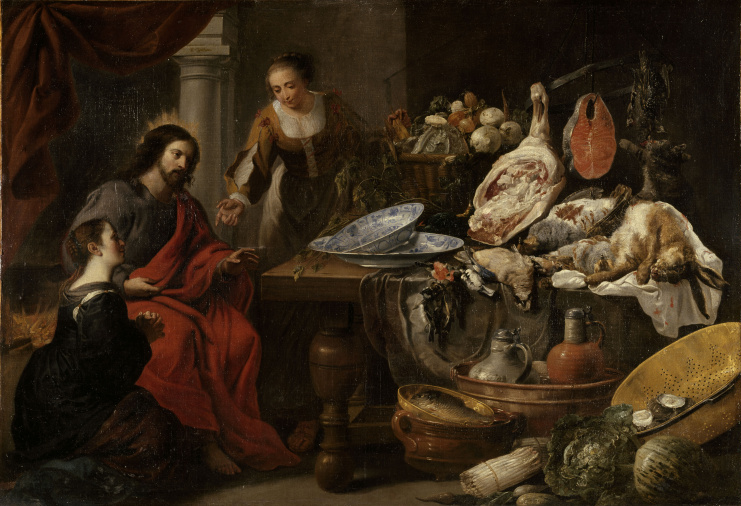
“Jesus in the House of Martha and Mary”, painting by Erasmus Quellinus II and Jan Fyt (1650) from en.wikipedia.org. See the folly of Martha’s worries and distractions with the enormous amount of food being prepared.

Jesus clarifies in the example of Mary that the first priority of every disciple is to listen to the Word who is himself. More than the division of time allotted for “contemplation” and “action” by every disciple, Jesus reminds us that the more we listen to him, the more we do his work; and the more we do his work, the more we desire to return to him and listen again and again to him.

Contemplation and action always go together. We cannot overdo the other and neglect the other. The moment we make a distinction between the two, problems arise like what we find in the church.

When priests and bishops concentrate only in contemplation, oblivious to the social conditions of the people, their proclamation of the Gospel is diluted as they fail to represent well Jesus as the Christ, the Son of the living God. When they are so immersed into social action and advocacies, business endeavors including entertainment in the Mass without contemplation, Christ is detached from the whole picture that people could no longer see nor feel the spiritual nature of the Church with everything becoming a show, empty of any sense of the divine and sacred. In both instances of abuses, either of contemplation or action in the Church, it is her credibility that is eroded as the Body of Christ with a growing number of the faithful disillusioned with priests and bishops more identified with the rich and powerful.

"There is need of only one thing."

Abraham in today’s first reading showed us the most beautiful example of discipleship. Like Martha, Abraham was also gracious in receiving his visitors at Mamre believed to be the Blessed Trinity in the form of angels; but, unlike Martha who was so concerned with her chores that she had forgotten Jesus, Abraham was intently focused on his visitors as “he waited on them under the tree while they ate” (Gen.18:8).

Like Mary listening at the feet of Jesus, Abraham was fully present in God while in Mamre. That is discipleship – to have that full presence in the Lord which is the “only one thing needed” of us which is to receive God’s gift of himself to us, of his Word who became flesh Jesus Christ who enables us to do his works by first recognizing him in ourselves and in one another as our neighbor.

This is the reason why even inside prison, St. Paul felt Jesus Christ’s coming and presence that he rejoiced in his sufferings as part of his ministry in proclaiming Christ as the hope for glory (Col.1:24, 27).

Photo by author, Sacred Heart Novitiate, Novaliches, QC, 20 March 2025.

Last week I read in one of the blogs I follow by an American nun, of how she attended many years ago to a delivery man who died of a heart attack in the ER of a Philadelphia hospital. Part of her ministry was to gather the things found in the chest pocket of the man’s shirt so she could inform the relatives of his death: there was a well-used prayer book, a thin wallet with a few dollars inside, a lottery ticket and a picture of his grandchildren. It was so touching how she narrated these simple things found in the man’s chest pocket as those closest to his heart (https://lavishmercy.com/2025/07/12/the-amoroso-man/).

That hit me so hard because even in this age of smartphones, I still carry a little notebook and pen in my chest pocket where I write my schedules as well as occasional notes on everything I notice and read. Deep inside me after reading that blog, I wondered where is Jesus Christ in all those notes and activities in my pocket notebook closest to my heart.

Dearest Lord Jesus,
make me fully present before
you always, even in my activities
and distractions for it is only in you
I am fulfilled. Amen.

Fr. Nicanor F. Lalog II
Our Lady of Fatima University
Valenzuela City

Sad Jesus

Quiet Storm by Fr. Nicanor F. Lalog II, 19 August 2024
“Christ and Rich Young Ruler” by Heinrich Hofmann from en.wikipedia.org.

The volcanic smog from Taal that has shrouded the south since early Monday morning inspired me tonight to share with you this short reflection from the gospel:

Jesus said to him,”If you wish to be perfect, go, sell what you have and give to the poor, and you will have treasure in heaven. Then come, follow me.” When the young man heard this statement, he went away sad, for he had many possessions (Matthew 19:21-22).

I have been trying to imagine not only the sad face of the young man but most of all, the sadness of Jesus. Most often, the first image of a sad Jesus who comes to our mind is when he was in His Passion and Crucifixion.

That’s understandable.

Try imagining, reflecting Jesus sad when we are sad like at the death of His friend Lazarus. The beloved disciple tells us in his gospel account that upon seeing the sisters Mary and Marta, Jesus became more sad not only with the death of a good friend.

If there is one thing we can always be sure of, Jesus shares our feelings too! When we are sad, Jesus must be most sad too. And how unfair when we fail to see the sadness too of Jesus as if we suffer or grieve alone. Perhaps, it is a part of our pa-victim syndrome, of us being on the distaff side always of the story. Let us not forget Jesus because failing to experience and realize the sadness of Christ means we are still filled with pride, so self-centered and most likely, after overcoming our sadness, we would still keep our “possessions”. What a tragedy that has become a vicious circle with us priests.

Photo by author, Chapel of the Angel of Peace, 25 June 2024.

When is Jesus sad?

As we begin our retreat tonight here in Tagaytay, I feel Jesus saddest when we His priests are sad in celebrating the Mass and other sacraments, in doing our ministry. Jesus cries so hard in shame when we priests are not only sad but also angry, even insolently ministering to the people especially when they are poor.

How easy it is for us priests to readily identify with the young man being sad even with our admission or confession of having many possessions. That’s very easy, like saying sorry from the nose. But, are we ready to let go of our attachments so we become joyful in Christ again as seen in the way we celebrate especially the Mass?

When we priests are sad in our ministry, people are more sad that makes Jesus most sad of all! In the first place, no one – nobody – among the people must be saddened by priests or by the Church as an institution. Priesthood is the joy of Jesus Christ!

It is a grave contradiction that we ever be that rich young man in the gospel portrayed as sad due to many possessions. Its deepest pain and cut is found in the very reason of this sadness: Jesus is most sad when we priests are sad because He knows very well we are no longer His.

Photo by author, St. Scholastica Spiritual Center, Baguio City, August 2023.

This kind of sadness which is so negative (because we can be sad too like everyone) starts subtly when we priests are inconvenienced, when we have to sacrifice and suffer, forgetting that it is the life we have freely embraced in the first place. Some priests presumed we can suspend for a while our commitments and vows, and simply be human, whatever that means. So, they stop praying, stop sacrificing, stop living out the vows of poverty, obedience and celibacy.

As priests sink deeper into sadness, they find themselves already trapped in a festering evil and sin, becoming angry and lazy, making so many alibis and excuses from celebrating the Mass especially funerals for poor parishioners.

When there is the confluence of sloth and anger, then it becomes a point of no return because sadness detaches us priests from Jesus and His people. That is the saddest part of this sadness, of priests living in their make-believe world of vanities and all kinds of possessions. Worst part of this is how the sad priests are totally oblivious to the fact they have infected with their sadness the people they were sent to help liberated from burdens and miseries. That is when people come to the Mass and sacraments because they just have to fulfill an obligation to God that is most sad because God sent priests to bring joy, not sadness.

If a priest is making you sad, pray hard for that priest. You are not alone. Priests are sad when their brother-priests are sad in the ministry too.

But, Jesus is most sad when His priest is sad. Pray hard for His priests especially those who seem to enjoy and laugh with the “good life” but sadly empty inside. A priest is supposed to be a leaven to the people, someone who would help others to rise and grow. And glow in Jesus. Let us pray:

Lord Jesus Christ,
our Eternal Priest,
sorry for making you sad;
most of all,
for being sad because
of my many possessions;
help me find my way back
to you to be filled anew with
your joy.
Amen.

Abundant harvest?

The Lord Is My Chef Daily Recipe for the Soul by Fr. Nicanor F. Lalog II
Tuesday in the Fourteenth Week of Ordinary Time, Year II, 09 July 2024
Hose 8:4-7, 11-13 ><))))*> + <*((((>< Matthew 9:32-38
Photo by Onnye on Pexels.com

Then he said to his disciples, “The harvest is abundant but the laborers are few; so ask the master of the harvest to sent out more laborers for his harvest” (Matthew 9:38).

Lord Jesus,
teach us to examine
again the meaning of your words
"the harvest is abundant" -
how do we look at,
what do we see at
this abundant harvest
of your people,
"troubled and abandoned,
like sheep without a shepherd"?
What do we see at your flock,
at your people?
Forgive us, Lord Jesus,
when we are like the wayward
kings of Israel of Hosea's time
who misled the people away
from God; what an abundant harvest
laid to waste by corrupt
and sinful laborers some of whom
were never sent by God while
others turned away from God.
Forgive the laborers among us
who see the abundant harvest more
as a business venture,
a shameful tourist attraction
for the display of our delusions of grandeur;
forgive us, Lord when some of us
your laborers label others
as troublemakers,
as oppositionists,
even daring to call declare
others using the power of the devil
like You!
Nothing much had changed
since the time of Hosea and
your time, Lord Jesus:
your abundant harvest wasted
by selfish laborers who see only
themselves and their well-being
instead of seeing your people as a
gift and a responsibility entrusted
to our care; help us, O Lord, to value
your abundant harvest meant for
your greater glory
not ours.
Amen.

We are all St. Barnabas!

The Lord Is My Chef Daily Recipe for the Soul by Fr. Nicanor F. Lalog II
Tuesday, Memorial of St. Barnabas, Apostle, 11 June 2024
Acts 11:21-26, 13:1-3 ><]]]]'> + <'[[[[>< Matthew 10:7-13
Photo by author, Mt. St. Paul, La Trinidad, Benguet, 2016.
Praise and glory
to You, God our loving Father
for this memorial of St. Barnabas,
one of the first to embrace Christianity
after the Resurrection of your Son
Jesus Christ.

A Levite Jew born in Cyprus,
his original name was Joseph but
upon joining the Apostles in Jerusalem,
he was nicknamed Barnabas
which means "son of encouragement"
or "son of consolation" whom
St. Luke described as "a good man,
filled with the Holy Spirit and faith"
(Acts 11:24).
Fill us, dear Jesus 
with the same goodness and faith
of St. Barnabas, truly children of
encouragement and consolation,
believing in our brothers and
sisters especially those have withdrawn
from the ministry and apostolate
for various reasons
including shame and embarrassment
for past mistakes and sins like St. Paul.

Then he (Barnabas) went to Tarsus to look for Saul, and when he had found him he brought him to Antioch. For a whole year they met with the church and taught a large number of people, and it was in Antioch that the disciples were first called Christians.

Fill us with your gift
of peace, Lord Jesus,
to imitate St. Barnabas
who vouched for St. Paul's sincerity
of conversion
as well as in encouraging
and consoling the early Christians
who were persecuted for their
faith in You.
Help us imitate St. Barnabas
in his beautiful disposition of
focusing more on You, Jesus
than in the problems and personalities
we encounter in fulfilling your mission;
most of all,
grant us the humility of St. Barnabas
to reconcile later with St. Paul
after a serious disagreement
that led to their parting of ways
as companions in their mission.
Make us realize,
Jesus,
that saints like St. Barnabas
do not fall from Heaven
but are people like us who have many
and complicated problems in life;
let us arise from our sins
and mistakes like St. Barnabas
who showed in his life that holiness
is not being sinless but being humble
to admit one's sins and faults,
going through conversion daily
with a willingness to forgive others
to be reconciled anew
in You, Jesus.
Amen.

St. Barnabas,
Pray for us!
Photo by Ms. Analyn Dela Torre, March 2024.

The ones we miss most

The Lord Is My Chef Daily Recipe for the Soul by Fr. Nicanor F. Lalog II
Friday, Memorial of St. Leo the Great, Pope & Doctor of the Church, 10 November 2023
Romans 15:14-21 ><]]]]’> + ><]]]]’> + ><]]]]’> Luke 16:1-8
Photo by author, San Juan, La Union, July 2023.
I just realized today,
God our Father,
how the word “miss”
has a variety of meanings:
as something we failed or
something or someone we remember
or, someone or something we
forget and neglected.
How sad that very often,
the people we miss -
those we forget,
even taken for granted
because they are common,
are those nearest to us like
family and friends,
those in our inner circles.

Thus I aspire to proclaim the Gospel not where Christ has already been named, so that I do not build on another’s foundation, but as it is written: Those who have never been told of him shall see, and those who have never heard of him shall understand.

Romans 15:20-21
Is it not so funny that the 
ones we meet inside the church
every day and every Sunday are
also the very ones who are
like us - evangelized or simply
know Jesus and his teachings;
but, where are the rest?
the unchurched?
the ones we say who must hear the
good news?
Lord Jesus Christ,
teach us to be wise like
that steward in your parable today:
to save face and himself, he went to
see his master’s debtors he himself
must have missed,
disregarded and never given any
importance at all because they
were common, below him in stature;
let us realize like that shrewd steward,
like St. Paul to look for those we
miss most because of proximity
and ordinariness; they could be our
family members who have stopped praying
or celebrating Mass
or those living closest to our church
or chapel and have lost interest in the
sacraments and liturgy
or former colleagues in the ministry
who have lapsed in their practice
of faith.
Let us go out today
to find them and make them
feel and experience they are
loved,
they are missed most
in Christ Jesus.
Amen.