Thank you… and forgive us also, Lord Jesus, in this time of the corona virus.
Thank you in giving us the much needed time to be with you and with our loved ones in this time of quarantine. Thank you most of all, Lord, in giving us this chance to meet our true selves too.
The enhanced community quarantine has brought out the best in us, like with St. Stephen in the first reading who was filled with the Holy Spirit while being stoned to death by the people in proclaiming your gospel.
Thank you for the gifts of humility and courage to confront our true selves to see your true glory.
Forgive us also, Lord, because this same quarantine period has brought out the worst in us: every day in the news we see disturbing reports of people getting into all kinds of troubles displaying arrogance and pride that have wounded many bloated egos and, sadly even led to death.
We have been playing gods more than ever in this time of the corona virus, Lord Jesus.
Are we the ones also being referred to by St. Stephen in the first reading?
Stephen said to the people, the elders, and the scribes: “You stiff-necked people, uncircumcised in heart and ears, you always oppose the Holy Spirit; you are just like your ancestors.”
Acts of the Apostle 7:51
On the other hand, sometimes we act like the people of your time in Capernaum who, despite the many signs you have shown as being the Christ, we continue to doubt you, Lord Jesus, even daring you to do more than Moses and others!
The crowd said to Jesus: “What sign can you do, that we may see and believe in you? What can you do? Our ancestors ate manna in the desert, as it is written: He gave them bread from heaven to eat.”
John 6:30-31
Forgive us, Lord Jesus in playing gods when we neither see you among others nor in your very self because the sad truth, all we can see, that we choose and insist on seeing is only our very selves.
Open our eyes, dear Jesus. And if needed, humiliate us so we may be humble again to see you are our Lord and our God and nobody else before we end up inflicting more harm to one another than the corona virus . Amen.
The Lord Is My Chef Sunday Recipe, Easter Week III-A, 26 April 2020
Acts of the Apostles 2:14.22-33 ><)))*> 1 Peter 1:17-21 ><)))*> Luke 24:13-35
Photo by author, sunset at Laguna de Bay (Los Banõs), February 2020.
I am sure all of us can identify with the two disciples going home to Emmaus on that evening of Easter. And surely, as we accept with a heavy heart the extension of this enhanced community quarantine (ECQ) until May 15, we pray like them, saying, “Stay with us, Lord.”
As they approached the village to which they were going, he (Jesus) gave the impression that he was going on farther. But they urged him, “Stay with us, for it is nearly evening and the day is almost over.” So he went in to stay with them. And it happened that, while he was with them at table, he took bread, said the blessing, broke it, and gave it to them. With that their eyes were opened and they recognized him, but he vanished from their sight. Then they said to each other, “Were not our hearts were burning within us while he spoke to us on the way and opened the Scriptures to us?”
Jesus always walking with us, without us recognizing him
Once again we see the presence of darkness in this story of Easter found only in St. Luke’s gospel. And that is the beauty of Easter – like Christmas – showing us the immense love of God for us that he sent us his Son Jesus Christ in the darkest moments of our lives to lead us to light and life.
And it always happens when we least expect it like that Easter evening when Cleopas and his companion were on their way to Emmaus.
Jesus comes to us as a stranger and most of all, joins us in the “wrong direction” to bring us back to the right path we must take especially when things go against our plans and expectations.
Until now, we cannot still believe how these things are happening to us: the lockdown, the sufferings and uncertainty of life when everything is on a “wait-and-see” situation especially in business and education while houses of worship remain closed and mass gatherings prohibited to control the spread of COVID-19.
But, if we look back and see how we are today, do we not also feel our “hearts burning within” that despite all the sickness and deaths almost everywhere, we are still here, alive, forging on in darkness, and most of all, somehow being led by Jesus even though we do not recognize him right away to be always on our side?
Yes, we worry, we ache deep inside but, more than these, we hope, we love, we live because we firmly believe in the Risen Lord present in us, present among us.
Deep in our hearts we experience Jesus with us, feeling with us, listening to our cries and worries just like that Easter evening to Emmaus. As we would say in Filipino, “ah basta!” that means without doubt, we are certain of someone or something from deep within not visibly seen.
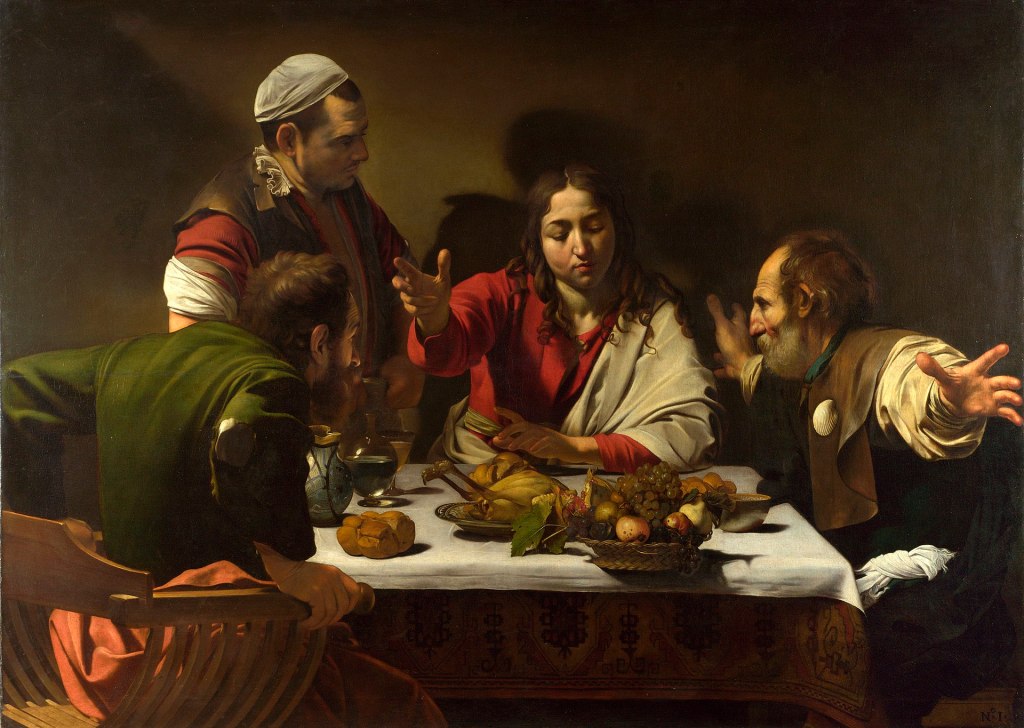
“Supper at Emmaus” by renowned painter Caravaggio. See the emotion depicted by Caravaggio with his trademark of masterful play of light and shadows. At the center is the Risen Lord blessing the bread that caught the two disciples who are seated in disbelief, one outstretching his arms and the others pushing back in his chair. The third character in the painting is the innkeeper unaware of the significance of the gesture of Jesus. It was at this instance that the two disciples recognized Christ as the travelling man with them to Emmaus.
Our inner recognition of Christ in the breaking of bread
Notice that in all resurrection stories, the followers of Jesus did not recognize him immediately. There is always that feeling within them, like what we feel when we see somebody and we try to recall where we have met him/her, trying to dig into our memories when and how did we get to know the seemingly not “stranger” before us.
It is a funny feeling that is finally resolved with a very simple memory of an instance long ago or a small detail that leads into an “inner recognition” of the person before us.
This is how the disciples of Jesus recognized him — not through his external appearances but more from within like when Cleopas and his companion invited him into their home in Emmaus or when the seven apostles led by Simon Peter met him by the shore of the lake when no one would dare ask who he is because deep within, they knew it was the Lord (Jn.21;12-14).
And this happens always in the context of a meal, a table fellowship when Jesus instituted the Sacrament of the Eucharist on Holy Thursday evening before he was arrested to be crucified.
Here we find the mystery of this sign left to us by Jesus to be his very presence among us in his Body and Blood under the perceptible signs of bread and wine as well as the Sacred Scriptures proclaimed in every liturgical gathering: the more we do not see his outward appearances, the more we recognize Jesus!
Every time we celebrate the Mass and listen to the scriptures proclaimed, we realize within us like the people of Jerusalem in the first reading that this Jesus of Nazareth is a true person present in our lives fulfilling his works of salvation despite our sinfulness.
Like some people we meet, we recognize Jesus Christ not with the outward appearances but from within, from what we have experienced beyond explanations that gives us always a sense of awe because as St. Peter tells us in the second reading, “he had ransomed us from our futile conduct with his most precious blood” (1 Pt. 1:18-19) which is affirmed to us in every celebration of the Holy Eucharist.
The Easter mystery of recognizing Jesus when he vanishes
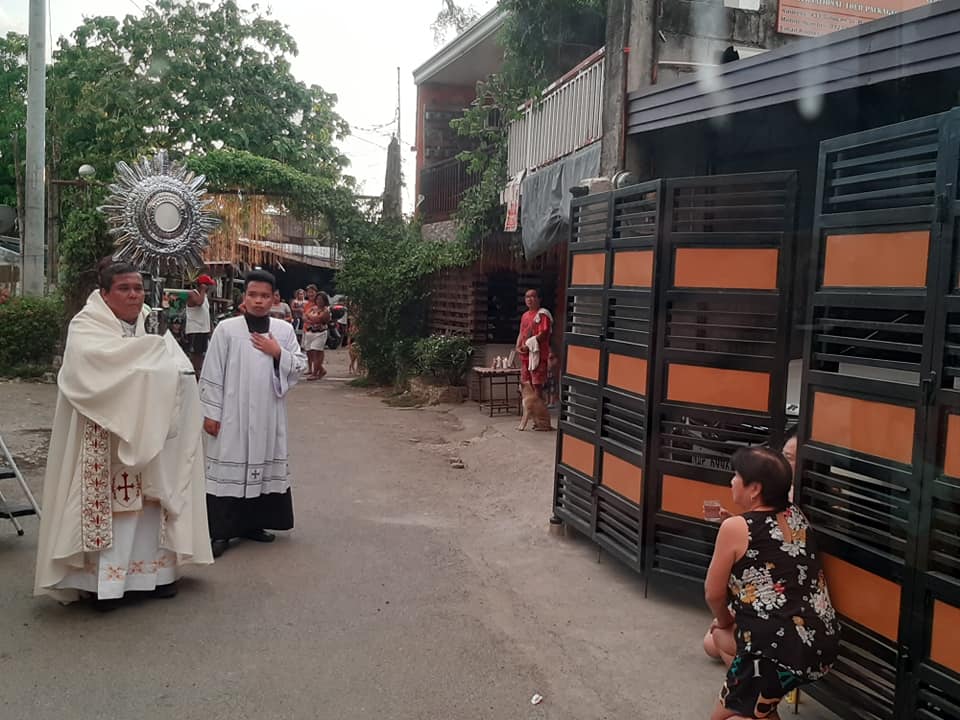
Every Sunday afternoon since this lockdown began due to COVID-19, we have been bringing the Blessed Sacrament around our Parish to remind the people of Christ’s presence among us.
And every Sunday, I am amazed at the faith of the people who would kneel on the side of the road, totally believing that it is Jesus himself who visits them in the Blessed Sacrament.
The sight is so moving with people from all walks of life bowing their heads or raising their hands, recognizing Jesus in the Blessed Sacrament as they pray in silence with others crying. The few motorists passing by stop at the side of the road to see Jesus and be blessed while others get near our truck for a blessing.
Here lies the great mystery of Easter: Jesus need not appear to us in person because as he vanishes in the Blessed Sacrament, that is when we recognize him!
In the most simple gestures of the Mass under the most simple signs of bread and wine, Jesus vanishes from our outward view and through this vanishing our interior or inner recognition opens up that we “see” him in the many instances he had touched us especially in our “heart-breaking” experiences in the past.
We know with certainty that “it is the Lord” – Dominus est – present in every breaking of bread because part of the Easter mystery tells us deep within that it is only in his vanishing that he truly becomes recognizable to us.
What a shame and a tragedy especially in these days of live television or internet Mass when priests do all the gimmicks and antics to wow the people as if they are audience in a show than faithful in a sacred gathering.
May we not forget this mystery of Easter that, the more Jesus vanishes, the more we recognize him because Jesus is more than enough than anybody or anything else especially in the Mass. And when we pray “Stay with us, Lord”, we actually ask for more faith to believe in him to see him in his vanishing. Amen.
A blessed week ahead to everyone! Stay safe, stay in the Lord.
Photo by author, Laguna Lake, Los Baños, Laguna, 13 February 2020.
How often does it still happen today, Lord Jesus Christ, that like in our gospel today you would “sigh from the depth of your heart” after we, your people, would ask you for more signs from heaven?
Have mercy on us, Lord, for our lack of faith in you after all these years.
Forgive us for being “unstable in all our ways” with you, always “a man of two minds” as St. James would describe us (James 1:8) in seeking wisdom and things from you.
Forgive us for those moments we doubt your presence and power especially when we fail to win your favor, to get your blessings for our particular prayers and supplications.
The fault is really on us, Lord.
If sighing is your way of keeping your patience with our being so stubborn, teach us to reach out to you in the depths of our hearts, to remember those countless occasions you have saved us.
That instead of asking for signs from you, we may just sigh deep inside us to experience you again. Amen.
Isaiah 26:1-6 ><)))*> ><)))*> ><)))*> Matthew 7:21, 24-27
Chandelier of the Malolos Cathedral, 04 December 2019.
Let me stay in your “house”, O Lord, and help me keep your house rules, too. I am sorry when most of the time I simply want to rest and drop by your “house” with no plans of really living there, of listening to your words and doing your will.
Jesus said to his disciples: “Not everyone who says to me, ‘Lord, Lord,’ will enter the Kingdom of heaven, but only the one who does the will of my Father in heaven.”
Matthew 7:21
Forgive me Lord when I have become so complacent as your disciple, as a Christian, relying solely on my name and affiliation with you without working so hard to be like you.
Help me to be holy like God our Father, listening to your words intently and faithfully acting on it at all time so that I may be wise and most of all, be filled with your peace:
A nation of firm purpose you keep in peace; in peace, for its trust in you. Trust in the Lord forever! For the Lord is an eternal Rock!
Isaiah 26:3-4
So many times, Lord Jesus, we take you for granted… just like the people in our own homes. But when things go wrong, they are the only people we can count on to receive us, to love us, and to forgive us. Very much like you, Jesus.
May this Season of Advent make us more open to you not only to receive you but also to keep you. Amen.
Isaiah 25:6-10 ><)))*> ><)))*> ><)))*> Matthew 15:29-37
The Manor House, Camp John Hay, Baguio City, 2017.
Praise and glory to you, O Lord Jesus Christ for coming to us, in fulfilling our lives, in making our joy complete. Unfortunately, no one seem to be waiting for you or worst, we live as if you have not come at all.
How sad, O Lord, that often even if we are so excited with Christmas, it does not necessarily mean we are excited of you as a person coming to us. Even if we love to sing and hear that carol “Joy to the World”, we are not really joyful because our hearts are far from you.
Forgive us, Jesus, in being focused with time and dates, than with your person and with your coming.
The more we get focused with dates and gifts and carols and other trimmings of Christmas, the less we think of you and of others too.
Open our hearts to receive you in us.
On that day it will be said: “Behold our God, to whom we looked to save us! This is the Lord for whom we looked; let us rejoice and be glad that he has saved us!” For the hand of the Lord will rest on this mountain.
Isaiah 25:9-10
Open our hearts to you, Jesus, that you are more than enough than anything we could wish for.
Make us desire more of you than of things so we may always have an abundance of you as our “bread” or everything in this life. Amen.
The Cross is the throne of our Lord Jesus Christ, King of the Universe. It is also a lesson in itself, the most profound Jesus has given us that continues to unfold and unravel the “depth and breath” of God’s love for each of us.
Through his Cross, Jesus did not only enter humanity but also allowed humanity to enter him by putting into his heart its very symbolism which is death we all deny and are afraid of. By dying on the Cross, Jesus turned it into a blessing to now become the symbol of life.
Let’s make an illustration.
Yes, it is Bruce Willis from a scene in one of his popular series, “Die Hard” which I continue to watch whenever possible.
What I like most with Bruce Willis in all of his movies is his being so “human” – very vulnerable physically, emotionally and even psychologically. His roles never hide his being a frail human being despite his muscular strength and tactical acumen. Bruce never hides his weaknesses that he can get shot and wounded, dumped and divorced or cheated by his wife like in “The Last Boy Scout”, making him more believable than the other action stars.
And that’s our point here: Jesus never hid his humanity from us. The all-powerful God on whose everything was created according to St. Paul in the second reading became human like us in every aspect except sin.
He is the image of the invisible God, the firstborn of all creation. For in him were created all things in heaven and on earth… He is before all things, and in him all things hold together. He is the head of the body, the church. He is the beginning, the firstborn from the dead, that in all things he himself might be preeminent. For in him all the fullness was pleased to dwell, and through him to reconcile all things for him, making peace by the blood of his cross through him, whether those on earth or those in heaven.
Colossians 1:15-19
Carmelite Monastery, Guiguinto, Bulacan, 12 November 2019.
In becoming human like us, Jesus entered our humanity. He who is the Son of God became an infant and child so weak, entrusting himself to us humans.
And when he had grown into a man, he experienced leaving home and family to fulfill his mission like almost everybody. He had friends, some eventually became faithful while another had betrayed him.
Jesus went to almost every gathering like weddings and banquets, met everybody from the “who’s who” to the nobody like sinners and marginalized. He was manly enough to relate with every kind of people, be they children or women, rich and poor alike.
He had wept at the death of a good friend and the impending destruction of his beloved city of Jerusalem, felt hunger and thirst, got angry and was surprised in some occasions.
Jesus is truly human that we can also identify with him but in his dying on the cross, we were able to enter him to become like him when on his Resurrection, he took away the curse of death and turned it into pure grace in him.
Cross at the Dominican Hill in Baguio City, January 2019.
A very unique characteristic of Jesus as a human is his being a radical in its truest essence and meaning. From the Latin word “radix” that means roots, Jesus brought us back to our very roots, to our grounding of being who is God himself.
Too often, we think of radical people as rebels and revolutionaries leading movements and many changes in the society. They are the “game changers” because they radically change things to show us the more essential.
But in reality, radicals do not change things: they restore things to its original state and being. They get into the roots or “radix” of things to bring out its true meanings by doing away with the unimportant accidentals that have taken over the realities.
That is why Jesus is a radical: by dying on the Cross, he firmly reestablished his throne as King of the Universe because that is where evil ended and death is conquered.
It is on the Cross his throne where every new life begins because it is our very rootedness and “grounding of being” as beloved children of God in him.
Most of all, it is on the Cross his throne, our root and grounding from which comes our sole focus and attention in life – God in Christ Jesus.
The rulers sneered at Jesus… even the soldiers jeered at him. Now one of the criminals hanging there reviled Jesus, saying, “Are you not the Christ? Save yourself and us.” The other, however, rebuking him, said in reply, “Have you no fear of God, for you are subject to the same condemnation? And indeed, we have been condemned justly, for the sentence we received corresponds to our crimes, but this man has done nothing criminal.” Then he said, “Jesus, remember me when you come into your kingdom.” He replied to him, “Amen, I say to you, today you will be with me in Paradise.”
Luke 23:35, 36, 39-43
We have a beautiful expression in Filipino about a person described as “malalim” or deep. A radical is the truly deep person because he is rooted and grounded in his being who is God!
Anyone who truly recognizes Jesus Christ becomes a radical person too, a person of depth because he is rooted in God like the other thief hanging on the cross with Jesus.
See how the rulers or the elite like the priests and elders of Israel who sneered at Jesus: the more they poked fun on him as “the Christ of God”, the more they indict themselves of the grave crime of putting Jesus to death. Eventually at the death of Jesus, the Temple curtain would be torn from top to bottom to signal the end of temple worship and the start of worshipping God in “truth and spirit” in Christ.
The soldiers jeered Jesus too because they “know not what they were doing” because they were all pagans. But again, upon Christ’s death, we find one soldier there at the scene declaring “truly this is the Son of God.”
In any case, some members of Israel’s rulers and Roman soldiers eventually followed Jesus after the Resurrection to show us how the Cross is indeed the throne of Christ the King: it is also a door that opens anyone to conversion, to accept his reign and kingdom!
Most of all, the “good thief”, usually referred to as Dimas, shows us how at the cross any one can become radical like the Lord. While agonizing with Jesus on the cross, Dimas must have examined his life and got into his very core, his roots and realized that basic truth inside him was right there suffering also with him — Jesus whose name means “Yahweh saves”.
What is so surprising with his request from Jesus “to remember him he gets into his kingdom” is the fact that in the Old Testament, it is God who always remembers his people, remembers his promise, remembers his covenant.
Man always forgets God and his covenant that we always turn away from him to live in sin. But at the cross, the throne of Jesus our King, he enables us to remember our roots, our being children of God, our being loved and forgiven that we finally find our way back home.
And that home is God in eternity: “Today you shall be with me in Paradise.”
Every time we are at the cross, when we are getting through so many pains and sufferings, failures and disappointments, even darkness and sin, get into your roots – Jesus Christ – and you will never get lost.
Long before we got into all these crosses in life, remember Jesus was there first for us to suffer and die on his Cross. And that is why he is our King for he rose again so we can become like him in eternity. Amen.
Friday, Memorial of St. Albert the Great, 15 November 2019
Wisdom 13:1-9 <*(((>< ><)))*> Luke 17:26-37
A street performer in Tamsui, Taiwan delights tourists and residents alike, January 2019.
How true are these words by Shakespeare and other men of letters: we have all to be careful because not all that is shiny and impressive is valuable.
Looks can always be deceiving that we must always probe deeper until we find the Ultimate Good, God.
For they search busily among his works, but are distracted by what they see, because the things seen are fair. But again, not even these are pardonable. For if they so far succeeded in knowledge that they could speculate about the world how did they not more quickly find its Lord?
Wisdom 13:7-9
From Google.
May the Universal Doctor, St. Albert the Great, guide us and enlighten our minds and our hearts to seek first Jesus Christ in the most Holy Eucharist “because it bestows the fullness of grace on us in this life” (Breviary, November 15, commentary by St. Albert the Great on the gospel of St. Luke).
I also thank you Most Sweet Jesus on this day as we celebrate our 22nd anniversary of ordination as Deacons. I still remember the great fear and fright I felt thinking of the immense responsibilities as a Deacon in preparation to our ordination to the Priesthood.
And yes, Lord Jesus, there were many occasions since then until now when we are blinded by so many shining things in the ministry that are not really you nor the Father.
Send us your Holy Spirit that we may seek you always and follow you by lovingly serving others in your name. Amen.
“If Christ Jesus dwells in a man as his friend and noble leader, that man can endure all things, for Christ helps and strengthens us and never abandon us. He is a true friend.
Many, many times I have perceived this through experience. The Lord has told it to me. I have definitely seen that we must enter by this gate if we wish his Sovereign Majesty to reveal to us great and hidden mysteries. A person should desire no other path, even if he is at the summit of contemplation… All blessings come to us through our Lord. He will teach us, for in beholding his life we find that he is the best example.
St. Teresa of Avila, from the Breviary
Many times in our lives we have always believed that holiness is just for a few people you have chosen, O God. We feel excluded from holiness, from being a saint.
Because we refuse to try to get near you, doubting you despite our belief in you as God!
“For what can be known about God is evident to them, because God made it evident to them.
They exchanged the truth of God for a lie and revered and worshipped the creature rather than the creator, who is blessed forever. Amen.”
Romans 1:19, 25
Sometimes we have tried befriending you through Jesus Christ your Son.
And like the saints, we have indeed experienced your presence, your reality, your blessedness but unfortunately we stopped striving further as St. Teresa tells us.
O dear Jesus, you always come to me, you always make me experience you but I always try explaining everything, letting my mind work more than my heart and soul that I fail to feel and experience you inside me like those Pharisees bent on finding faults in you.
Give me the grace to be silent and still in you, to wait for you as a friend full of love and trust like St. Teresa of Avila. Amen.
Zechariah 8:1-8 ><)))*> ><)))*> ><)))*> Luke 9:46-50
St. Jerome painting by El Greco portrayed as wearing the Cardinal’s robe to represent his highly esteemed works and contributions to the Church as one of the Four Western Fathers along with St. Augustine, St. Ambrose of Milan, and St. Gregory the Great. Photo from Google.
Praise and glory to you, God our loving Father! Thank you very much for giving us saints, men and women like us who were sinners with so many weaknesses but through your grace were able to lead holy lives.
Through your saints, you give us so much hope to be become better persons despite our many imperfections like our great Doctor of the Church, St. Jerome, the Father of Catholic biblical studies who immersed himself in the study and prayer of the Sacred Writings right in the Holy Land.
Considered as one of the great theologians of the Church, St. Jerome is said to be approachable but notorious for being a difficult person too due to his temper as well as sarcasm and being argumentative at times.
I confess, O God, that I am exactly the opposite of the kind of person Jesus Christ is telling us to be like – a child. Instead of being childlike, many times I have become childish, difficult to handle with my burst of temper and sometimes annoying sarcasm.
Like St. Jerome, fill me with your grace, with courage and willpower to conquer my irascibility and direct all my negative energies in pursuing you in prayers and good works.
Help me to follow St. Jerome in his call to “let us translate the words of the Scriptures into deeds.”
Fill me with your words, O Lord, cleanse me of my sins and iniquities so that your Holy Spirit may dwell in me, suffuse me with your holiness. Amen.
My favorite depiction of St. Jerome by Italian painter Antonello da Messina (c.1430-79), “St. Jerome in his Study.” Again, we see St. Jerome in red robe and hat like a Cardinal at his study desk with his faithful lion in the background which tradition says he had helped in the forest by removing a thorn in its paw. At the foreground are two birds: a peacock which is an ancient Christian symbol of eternal life that our saint meditated often (reason why he always has a skull in other paintings), and a partridge, a reference to St. Jerome’s notorious temper as the bird often represents jealous rage. Photo from Google.
The Lord Is My Chef Sunday Recipe XXVI-C, 29 September 2019
Amos 6:1.4-7 ><)))*> 1 Timothy 6:11-16 . ><)))*> Luke 16:19-31
Photo by Mr. Jim Marpa, 2018.
Last Sunday we focused on our hands that we use to pray and serve in reflecting the parable of the wise steward. Today, let us “look” into our eyes that see God in others as we reflect on another parable only St. Luke has, the rich man and Lazarus.
Eyes are the “windows of one’s soul”.
Eyes reveal what is inside us: how we look and move our eyes, the sparkle or dullness in our eyes indicate the kind of person within. Eyes never lie for they reveal if we are telling the truth or not. Most of all, eyes do not only direct us to sights outside but even visions to beyond what we can see.
This is very clear in the parable of the rich man and Lazarus, inviting us to take a deeper look into ourselves, on others, and with the things we possess like money and wealth.
Jesus said to the Pharisees: “There was a rich man who dressed in purple garments and fine linen and dined sumptuously each day. And lying at his door was a poor man named Lazarus, covered with sores, who would gladly have eaten his fill of scraps that fell from the rich man’s table. Dogs even used to come and lick his sores. When the poor man died, he was carried away by angels to the bosom of Abraham. The rich man also died and was buried, and from the netherworld, where he was in torment, he raised his eyes and saw Abraham far off and Lazarus at his side.”
Luke 16:19-23
Photo by Mr. Jim Marpa, September 2019.
For the third consecutive Sunday, we again heard another well-known parable proper to St. Luke like the prodigal son two weeks ago and the wise steward last Sunday. Today’s parable of the rich man and Lazarus follows the same thread of last week’s wise steward which is about the thorny issue of money. But again, there is something deeper than that which is the call for daily conversion by always looking beyond what we can see.
In this parable, Jesus never said the rich man was bad that is why he went to hell or the “netherworld”. Neither did he also claim that the poor man was holy that led him into the “bosom of Abraham” which is heaven. Jesus only described their daily life: the rich man lived in affluence with fine clothings and sumptuous meals while the poor was very destitute feeding on scraps falling from the former’s table as dogs licked the sores that covered his body.
The only critical clues Jesus gives us are the name of the poor man – Lazarus – which means “God has rescued” or El’azar in Hebrew and the final scene in the afterlife.
Let it be clear that the issue here is how people, rich and poor alike, can be blinded by money and wealth that they fail or even refuse to see God and others as brothers and sisters that lead them into evil and sins.
Abraham replied (to the rich man), “My child, remember that you received what was good during your lifetime while Lazarus likewise received what was bad; but now he is comforted here, whereas you are tormented. Moreover, between us and you a great chasm is established to prevent anyone from crossing who might wish to go from our side to yours or from your side to ours.”
The sad reality is that this parable continues to happen in our days when so many of us are oblivious of the poverty and miseries afflicting many of the poor among us.
We are that rich man who has no name but have eyes that refuse to see and recognize Jesus in everyone especially the poor and suffering. How tragic in this age of social media where everything and everyone is exposed and seen, we have become blind to the plight of those around us. No need to look far but right in our own family when members are on their own without bothering to know how everyone is doing in life.
In my 21 years of priesthood, I have realized that most often, the people who truly suffer are often the Lazarus among us who prefer to be silent, to bear all their pains trusting only in God who would vindicate and raise them in the end. The Lazarus are the poor not just in material wealth but “poor in spirit for theirs is the kingdom of heaven” (Mt. 5:3) who completely trust in God.
Reading further that version of the Beatitudes of St. Matthew, we find Jesus saying
Blessed are the clean of heart, for they will see God.
The clean of heart are the Lazarus, the poor who try to find God in this life even amid the many sufferings. Our minds and intellect, including our eyes can never see God. As the Little Prince would say, “what is essential is invisible to the eye; it is only with the heart that one can truly see”. Very true!
A clean heart is a loving heart. When we speak of the heart, we also mean person for the heart embodies the whole person. Therefore, a loving heart is the Lazarus, the one who tries to see God, the one who envisions the end that he is willing to sacrifice, to forgive and to welcome the lost.
Lazarus the poor beggar went to heaven because he has a clean heart unlike the rich man who refused to see beyond himself and his affluence. They are the ones being reprimanded in the first reading by the Prophet Amos, the “complacent” people who may have also included the priestly class of Israel unmindful of the real situation of the people because they have been insulated from realities by the perks and good life of wealth and power (Amos 6:1).
Most people have eyes that have sights but only a few have a vision in life. People with a vision in life are the ones who can see beyond the ordinary, they are the dreamers who dream with eyes wide open working hard to make their dreams happen in reality.
Lazarus is a visionary and a dreamer who saw beyond the door of the rich man, beyond his hunger and sickness the glory of God in eternal life. The rich man on the other hand only had sights for what is “here and now”; and, that is what he is so afraid of with his five brothers still alive who have no vision of the afterlife, no vision of God among others in the present life like him.
My dear friends, Jesus is inviting us today while there is still time to go back to the path of conversion, to see beyond ordinary things and see the more essential, the more lasting things that according to St. Paul in the second reading prepare us for eternal life like “righteousness, devotion, faith, love, patience, and gentleness” (1Tim. 6:11).
Let us listen to the words of God found in the Sacred Scriptures that Abraham referred to in the parable as “Moses and the prophets” (Lk.16:29).
Most of all, let us listen to Jesus Christ, the only one who had risen from the dead (cf. Lk. 16:31) who enables us to see him on the face of everyone we meet, giving us a vision of heaven by helping us in fulfilling our mission as his disciples in proclaiming the coming of the kingdom of God. Amen.