Lord My Chef Daily Recipe for the Soul, 16 September 2025
Tuesday, Memorial of Sts. Cornelius, Pope & Cyprian, Bishop, Martyrs
1 Timothy 3:1-13     <*((((><  +. ><))))*>     Luke 7:11-17
Beloved, this saying is trustworthy: whoever aspires to the office of bishop desires a noble task (1 Timothy 3:1).
How timely
 are your words today,
Lord Jesus:
definitely it is about your
servants in the church;
but, it applies very much
with all other leaders
in the government
and civil society
who have pledged
to serve the poor
and needy.
Give us a prophetic bishop
who is most in touch with
our humanity,
not merely concerned
with one's self
and ego.
We pray,
dear Jesus for bishops
and government leaders
who are decisive
with what is true and good
and what is just most of all;
give us bishops
who act decisively
as a father,
a teacher,
and disciplinarian
not those concerned
with their status
and ego.
Jesus journeyed to a city called Nain, and his disciples and a large crowd accompanied him. As he drew near to the gate of the city, a man who had died was being carried our, the only son of his mother, and she was a widow. A large crowd from the city was with her (Luke 7:11-12).
How amazing,
dear Jesus,
that despite
the "large crowd"
you were still able to spot
the grieving widow
at the funeral of her only son
because you are so in touch
with our humanity
unlike with some bishops
and most leaders in government;
grant us prophetic leaders
who are in touch and amazed
with the dignity and honor of
persons as image and likeness
of God that like you, Lord,
they could feel
and be one
in the sorrow
of those in pain
and sufferings.
In this point
in our nation's history,
we need so badly,
dearest Lord Jesus,
a prophetic bishop,
even just one who could rally
the other bishops and priests
with the many faithful
to effect change,
to speak of the truth
so people would be shaken
and realize like the crowd
in Nain who exclaimed
after you have raised the dead boy
to life, "A great prophet has
arisen in our midst."
Amen.

Fr. Nicanor F. Lalog II
Our Lady of Fatima University
Valenzuela City
(lordmychef@gmail.com)
Lord My Chef Daily Recipe for the Soul, 11 September 2025
Thursday, Twenty-third Week in Ordinary Time, Year I
Colossians 3:12-17     <*((((><  +  ><))))*>     Luke 6:27-38
Photo by Ms. Jo Villafuerte in Atok, Benguet, September 2019.
Your words today
Lord Jesus are very soothing,
so personal,
so YOU!
Brothers and sisters: Put on, as God’s chosen ones, holy and beloved, heartfelt compassion, kindness, humility, gentleness, and patience, bearing with one another and forgiving one another… And over all these put on love, that is, the bond of perfection (Colossians 3:12-13, 14).
A disciple should be like
the one he follows
and much of this words
by St. Paul describe you,
Lord Jesus Christ -
and how I miserably fail!
Forgive me for not being
compassionate and kind,
humble and gentle,
patient and forgiving like you,
Jesus; help me to put on
more love so that I may look like
you, my Lord and Master.
Amen.

Fr. Nicanor F. Lalog II
Our Lady of Fatima University
Valenzuela City
(lordmychef@gmail.com)
Lord My Chef Sunday Recipe for the Soul, 07 September 2025
Twenty-Third Sunday in Ordinary Time, Cycle C
Wisdom 9:13-18 ><}}}}*> Philemon 9-10, 12-17 ><}}}}*> Luke 14:25-33
“Napasarap ang kuwentuhan” is how we would describe the scene last Sunday continuing to today’s gospel as Jesus pushed through in his journey to Jerusalem.
Recall Jesus dined at the home of a leading Pharisee last Sunday where “people observed him carefully” while “he noticed them” choosing seats of honor at the party that he told them a short parable on humility. One of the guests liked it that Jesus narrated another parable about coming to a banquet where everybody is invited. Many were impressed with his second parable that Luke now tells us great crowds followed Jesus after that dinner on a sabbath.
Great crowds were traveling with Jesus, and he turned and addressed them, “If anyone comes to me without hating his father and mother, wife and children, brothers and sisters, and even his own life, he cannot be my disciples. Whoever does not carry his own cross and come after me cannot be my disciple. Which of you wishing to construct a tower does not first sit down and calculate the cost to see if there is enough for its completion? Otherwise, after laying the foundation and finding himself unable to finish the work the onlookers should laugh at him and say, ‘This one began to build but did not have the resources to finish'” (Luke 14:25-30).
Photo by Mr. Jay Javier in Quiapo, 09 January 2020.
Keep in mind that Jesus “resolutely determined to journey to Jerusalem” (Lk.9:51) to fulfill his mission of offering himself on the cross. This is the second time since he embarked on that journey that he had told those wishing to become his disciples must forget themselves, take up their cross and follow him.
During that time, the cross was the Roman empire’s worst punishment – most humiliating and excruciatingly painful leading to a slow death. Imagine how the audience of Jesus must have felt hearing his words about taking up one’s cross, whether in its literal or figurative meaning. Jesus completely changed that on Good Friday when he totally and freely offered himself to die on the cross because of his immense love for us and the Father. From being a sign of cruelty and shame, the Cross became the sign of love and honor as Jesus the Son of God became one of us in passion and death so that we may be like him in his glorious resurrection.
And that is what Jesus wants for us, to be holy like him that is why he invites us to do the same, “take up your cross and follow me” which we may call as the “Christ project” wherein destruction leads to new creation, death to life, and self-giving to true love.
Here we find the wisdom and gentle mastery of Jesus as a teacher in using a “building project” as an example of discipleship, a world apart from the shameless, scandalous ghost projects of DPWH with some contractors through manipulations by lawmakers stole billions of pesos from the poor people without doing any flood control facilities at all.
Photo by author, Church of St. Anne in Jerusalem, May 2017.
The Christ project is the most noble “building project” of all where everyone becomes God’s masterpiece: “Which of you wishing to construct a tower does not first sit down and calculate the cost to see if there is enough for its completion? Otherwise, after laying the foundation and finding himself unable to finish the work the onlookers should laugh at him and say, ‘This one began to build but did not have the resources to finish'” (Lk.14:28-30).
What is Jesus longing to “construct” in your life?
We have all been disciples of Christ since baptism but many times in life, we have taken for granted his call to follow him and journey in him, with him, and through him. See that in his two parables today, Jesus did not say that we have to be “like them” in preparing to build a tower or go to war; instead at the ending, Jesus said, “In the same way, anyone who does not renounce all his possessions cannot be my disciple” (Lk.14:33).
We are all disciples of Christ. It is an inescapable reality in life, an honor and a responsibility because whether we like it or not, our discipleship in Christ plays a major role in our life direction. Or lack of direction. If you are feeling lost, most likely you have veered away from Christ in life’s journey. When life is in a mess, Christ is missing.
The author of the Book of Wisdom tells us how God in his infinite wisdom slowly unfolds to us his grand plans for us as his disciples, his beloved children. See that our most meaningful and fulfilling moments in life were those we were closest to God – not really when we were drowning in wealth and fame and material things. See the simplicity and sincerity of the common folks betrayed by this system of corruption – they can look straight the camera lens without hiding not like the fake, empty fronts of the the well dressed senators, contractors and DPWH officials in the hearings.
Photo by author, Our Lady of Fatima University, Valenzuela City, September 2023.
All our lives we must become a disciple of Christ that is why we must constantly reflect on his demands not only to examine how far we have gone by looking in the past but most especially to renew our commitment to him so we can move forward, nearer to the Father and to one another in loving service. This is what St. Paul was asking Philemon in accepting anew his escaped slave Onesimus.
Jesus invites us this Sunday to stop and reflect about his plans, his project for us to be God’s masterpiece. Discipleship is a call to self-emptying, to daily crucifixion of forgetting one’s self, of always choosing Jesus, choosing what is true and good and just. Of course it is easier said than done but that is the way it is. Better to make the choice freely than wait later when it would be imposed on us by the circumstances.
This is the meaning of our Care for Creation celebration this Sunday when we are called to see the unity of everyone and everything in “Christ Jesus… the image of the invisible God… in him were created all things in heaven and earth, the visible and invisible… For in him all the fullness was pleased to dwell, and through him to reconcile all things for him, making peace by the Blood of his cross through him, whether those on earth or those in heaven” (Col.1:15, 16, 19-20).
Caring for creation and environment is discipleship in action as Pope Francis called on us in his 2015 encyclical Laudato Si of the need to have an inner change, an “ecological conversion” wherein we do our individual part of sacrifice and care for God’s creation. It is always easy to join the many green movements and environmental crusades but if deep in our hearts remain our own comfort and convenience, nothing would ever change in the world around us as we continue with our insatiable consumption of so much goods. What we need is a “shift” in our perspectives in life, to see it wholly as interconnected.
We require a new and universal solidarity. As the bishops of Southern Africa have stated: “Everyone’s talents and involvement are needed to redress the damage caused by human abuse of God’s creation”. All of us can cooperate as instruments of God for the care of creation, each according to his or her own culture, experience, involvements and talents. (Laudato si’, #14)
Caring for creation is discipleship when we choose to follow Jesus in implementing his grand design and project for a better world where peace truly reigns in all creation. Amen. A blessed week ahead of everyone. Fr. Nicanor F. Lalog II, Our Lady of Fatima University, Valenzuela City (lordmychef@gmail.com)
Photo by Mr. Raffy Tima of GMA7 News in Batanes, September 2018.
Lord My Chef Daily Recipe for the Soul, 04 September 2025
Thursday in the Twenty-Second Week of Ordinary Time, Year I
Colossians 1:9-14     <*((((><  +  ><))))*>     Luke 5:1-11
Photo by Mr. Raffy Tima of GMA7 News in Batanes, September 2018.
Today's gospel story
of your first meeting with
Simon reminds me
of how your presence
made a difference in my life
when I finally said "yes"
to your call
to give my vocation
to the priesthood
a second chance in 1991
when I resigned from my job
to enter the seminary again;
it was pure joy at first that later
became more intense,
more deep and wonderful
as the going got tough and rough;
it was never easy following you,
Jesus but you have never forsaken me
since then until now though many times
I have balked and even backed out
from you as you kept telling me
those same words you told Simon,
"Do not be afraid" (Luke 5:10).
Fill me, Jesus,
"with the knowledge of God's will
through all spiritual wisdom
and understanding to walk
in a manner worthy of the Lord,
so as to be fully pleasing,
in every good work
bearing fruit nd growing
in the knowledge of God"
(Colossians 1:9-10);
teach me to trust you more
by surrendering, giving up
my total self to you
so that I may continue
casting my net into the deep;
though I have given up a lot,
I still feel I have not given up
that much of myself to you -
take away from me, Jesus
whatever I still hold on deep inside,
help me surrender
myself to you totally so that
I may know you more clearly,
love you more dearly,
follow you most closely daily
for it is in your presence
when I am most fulfilled.
Amen.
Lord My Chef Sunday Recipe for the Soul, 24 August 2025
Twenty-first Sunday in Ordinary Time, Cycle C
Isaiah 66:18-21 ><}}}*> Hebrews 12:5-7, 11-13 ><}}}*> Luke 13:22-30
Phot by author of pilgrims trying to enter through the narrow door of the Church of the Nativity in Bethlehem, the Holy Land.
Anyone who had gone on a pilgrimage to the Holy Land must have heard the story of the fabled “narrow door” at the entrance of the Church of the Nativity in Bethlehem, of how it was reduced into that small door a very long time ago to prevent pilgrims from bringing their horses and camels inside the church that made a lot mess and stench.
Photo by author, narrow doors from the inside of the Church of the Nativity in Bethlehem, the Holy Land, May 2019.
That little door of the Church of the Nativity later became symbolic of the humble gesture of bowing low first to enter and see the Savior’s birthplace, eventually heaven as Jesus had been teaching us these past Sundays.
We are now in the final installment of the teachings by Jesus about the coming End, of what must we do to gain eternal life. He is now halfway through his long journey to Jerusalem since he started eight Sundays ago.
Along the way, he had met every kind of people, proclaiming to them the same message – that the kingdom of God is at hand where everyone is welcomed like what Isaiah prophesied in the first reading.
Jesus passed through towns and villages, teaching as he went and making his way to Jerusalem. Someone asked him, “Lord, will only a few people be saved?” He answered them, “Strive to enter through the narrow gate, for many, I tell you, will attempt to enter but will not be strong enough. After the master of the house had arisen and locked the door, then will you stand outside knocking and saying…” (Luke 13:22-25).
Photo by author, Angels’ Hills Retreat Center, Tagaytay City, April 2025.
In his teachings these past three Sundays, Jesus had been warning us against too much focus on things of the world that perish like material wealth, telling us to be more concerned of things of heaven that lead to eternal life. He had been clear that it would not be easy at all with the demands of being his disciples.
It was in this context that someone in the crowd asked Jesus today on his way to Jerusalem if only a few people would be saved. The question sounds very amusing not only because Jesus had always been clear that heaven does not come cheap as we must learn to renounce our self, take up his cross and follow him. That someone in the crowd who asked that question is actually us! And we know so well why until now we keep asking that same question: because we lack the discipline within to truly follow Christ. We always want what is easy and convenient, preferring shortcuts, avoiding sacrifices, as much as possible, no pains and sufferings. Hence, despite our knowing what it takes to gain eternal life, we still keep on doing the opposite.
It is the same with our physical well-being wherein we know so well what is healthy but we still keep doing, eating and drinking what is unhealthy. The sad truth of this lack of discipline in our body and soul is how we start shaping ourselves only when we are already sick and close to dying! That is when we feel sorry and start telling God like those in the parable that “we ate and drank in your company.”
Jesus had no intentions of dodging the question of that someone – and us in many occasions when we realize how difficult it is to follow his path of simplicity and humility, of love and kindness, of mercy and forgiveness. See how he neither gave a number nor a percentage of those who would be saved in the End. Jesus simply told the people including us today to do everything to make it into the Kingdom of God that is like a “narrow gate” and a “locked door”.
Following Jesus is more than being in his company but more of being like him. On this final Sunday of his teaching on the End, of entering the Kingdom of God in eternity, Jesus reminds us to shape up, body and soul so that we can squeeze ourselves into heaven’s “narrow gate” and “locked door”. Here we find again the second reading giving us more light into the meaning of the gospel this Sunday.
Brothers and sisters, you have also forgotten the exhortation addressed to you as children: “My son, do not disdain the discipline of the Lord or lose heart when reproved by him; for whom the Lord loves, he disciplines; he scourges every son he acknowledges.” Endure your trials as discipline… At the time, all discipline seems a cause not for joy but for pain, yet later it brings the peaceful fruit of righteousness to those who are trained by it. So strengthen your drooping hands and your weak knees. Make straight the paths for your feet, that what is lame may not be dislocated but healed (Hebrews 12:5-7, 11-13).
Discipline is a word so misunderstood these days that too often, it is frowned upon, even feared by many. In this age of so much “freedom” without any regard to “responsibility”, discipline has become its main casualty.
From the Latin verb discere which is “to learn” and “to follow”, its noun form disciplina means teaching or learning from which came the word discipulus for disciple, a follower or a pupil. Therefore, a person of discipline is one who follows or obeys teachings. Contrary to the wrong idea of many today that discipline limits freedom which they see as the ability to do whatever one wishes, the more disciplined a person is, the more free the person actually becomes!
When we discipline ourselves in every aspect of our lives like in food and drink intake, in using our time wisely, in budgeting our money and resources among other things, the more we become free to many other things in life. Remove discipline and do whatever you like in your life, eventually you become “unfree” because definitely you will miss your responsibilities and obligations like studies in school and duties at home and the office.
The same is true in our spiritual life: without discipline like prayer life, disorder and sin happen. It is discipline that literally and figuratively shapes us into persons able to squeeze through the narrow gate and locked door of freedom and salvation!
Photo by author, St. Catherine Monastery, Mt. Sinai, Egypt, May 2019.
In following the reflection of the author of Hebrews, we find that discipline is not just a human effort but the work of God too. As St. Augustine wrote, “grace builds on nature” – the more we discipline ourselves, the more blessed we become because God’s grace and gifts in us are perfected. See how discipline is like a built-in “app” God installed in each of us to ensure that we have all the means to reach heaven in Jesus Christ.
Looking back to the past four weeks, we find Jesus as the perfect example of a disciplined person, of leading a disciplined life focused on the mission from the Father. Since he started this long journey, Luke noted in chapter nine how Jesus was “resolutely determined” to go to Jerusalem, teaching us along the way to be like him focused on things of heaven than of earth, always vigilant of the coming End. Since the resumption of Sundays in Ordinary Time last July 06, Luke showed Jesus frequenting the synagogue on sabbath to worship and to preach. Most of all, Jesus prayed a lot which prompted his disciples to ask him to teach them how to pray too. Our celebrating the Sunday Mass in the church is a discipline of highest order because every Eucharistic celebration is a dress rehearsal of our entrance into heaven. Always come until we all gather together in eternity. Amen. Have a blessed and disciplined week ahead everyone. Fr. Nicanor F. Lalog II, Our Lady of Fatima University, Valenzuela City (lordmychef@gmail.com).
Lord My Chef Daily Recipe for the Soul, 19 August 2025
Tuesday, Memorial of St. Ezechiel Moreno, Bishop
Judges 6:11-24     ><))))*> + ><))))*> + ><))))*>     Matthew 19:23-30
Photo by author, RISE Tower, Our Lady of Fatima University, Valenzuela City, 09 August 2025.
God our loving Father,
today I feel like Gideon:
in our beautiful story today
of your call for him to be a judge
of your people,
you have taught me
that discipleship is not
about work like
an apprenticeship
but a relationship
because a disciple's
first task is to love you,
O Lord, our Master
that is why despite the
great dangers during his time,
Gideon continued to work
even in hiding from their enemies
because he believed in you,
he trusted you,
he loved you.
Discipleship is relationship
because it is more of
looking at you,
Lord Almighty
the Caller,
the Believer,
and the Sender
of my poor me!
Discipleship is not
about me that is why,
after that meeting with
Gideon, he built an altar
to you and called it
Yahweh-shalom.
Gideon, now aware that it had been the angel of the Lord, said, “Alas, Lord God, that I have seen the angel of the Lord face to face!” The Lord answered Gideon, “Be calm, do not fear. You shall not die.” So Gideon built there an altar to the Lord and called it Yahweh-shalom (Judges 6:22-23).
Shalom is peace
and you are our peace,
our total well-being
O God
 that can only come
 from a relationship
with you,
in you;
this is what your Son
our Lord Jesus Christ
tells us today through Peter,
of the need to leave everything
and everyone in order to have you.
Calm me,
Lord,
 like Gideon
for only one thing is
necessary: that we remain
in you who is our peace
so that even there are
turmoils in our ministry,
we continue
because of our relationship
than of work.
Amen.
Fr. Nicanor F. Lalog II
Our Lady of Fatima University
Valenzuela City
(lordmychef@gmail.com)
Photo by author, RISE Tower, Our Lady of Fatima University, Valenzuela City, 09 August 2025.
Lord My Chef Sunday Recipe for the Soul, 27 July 2025
Seventeenth Sunday in Ordinary Time, Cycle C
Genesis 18:20-32 ><}}}*> Colossians 2:12-14 ><}}}*> Luke 11:1-13
Photo by author, the “Our Father” Church outside Jerusalem where he is believed to have taught his disciples how to pray.
From the home of Martha and Mary, Jesus and his disciples proceeded on their journey to Jerusalem when the disciples saw him at prayer.
Of the four evangelists, Luke is the one who presents Jesus most at prayer, always making time to pray. The disciples noticed this importance of prayer for Jesus that they asked him to teach them how to pray.
More than teaching them the “Our Father”, Jesus again took the occasion to give the Twelve another lesson of things “to do” as a disciple we have seen in the past four weeks like greeting peace every home they visit as they proclaim the Kingdom of God is at hand (July 6, 14th Sunday); being a neighbor to everyone especially those in need in order to gain eternal life (July 13, 15th Sunday); and last week of choosing always the “only one thing needed” by every disciple which is to listen to him and his words.
This Sunday, Jesus deepens that by teaching us his disciples to always pray.
Photo by author, Jerusalem Temple, May 2017.
“And I tell you, ask and you will receive; seek and you will find; knock and the door will be opened to you. For everyone who asks, receives; one who seeks, finds; and to the one who knocks, the door will be opened. What father among you would hand his son a snake when he asks for a fish? Or hand him a scorpion when he asks for an egg? If you then, who are wicked, know how to give good gifts to your children, how much more will the Father in heaven give the Holy Spirit to those who ask him?” (Luke 11:9-13)
More than the mere recitation of a prayer like the “Our Father”, Jesus shows us this Sunday that prayer is the essence of discipleship that is also a relationship with God. That is why he began his lesson in prayer by telling the Twelve, “when you pray, say: Father” that clearly indicates a relationship.
During his time, God was regarded as Someone totally powerful, far from humans whose name could not even be mentioned for its holiness or “otherness”. When Jesus taught to call God “Abba” which is the equivalent to our “dad” or “daddy”, people were scandalized for God is above all to be accorded with the highest respect, never taken on a personal level with such terms of endearment like in human relationships.
Jesus clarified in many instances not only here that though our God is all-powerful and all-knowing, he is a person like us who relates with others, who is so loving and merciful to us he considers his beloved children because he is our Father. Here we find Jesus already bringing God closest to us not only as “God-with-us” but also “God-in-us” so close with each of us as our breath in the Holy Spirit! Jesus proved all these teachings on Good Friday when he died on the Cross.
Photo by author, a bass relief of Jesus Christ’s “agony in the garden” at Gethsemane, May 2019.
Prayer as a relationship is more than telling God what we need which he already knows even before we pray; prayer is more of listening to God for what he wants from us which is to become one in him in Jesus Christ.
I have realized even before my ordination to the priesthood that Jesus calls us not really for tasks he wants us to do but primarily that we may be one in him in an intimate relationship. That is why since my theological studies, I have stopped praying anything for me because God knows what I need most; I pray more for my family and friends while praying only one thing for me – that in every here and now, I am in him until my death.
This intimacy with God in prayer calls for openness that after teaching them the Our Father, Jesus encouraged the disciples to persevere in prayer with a parable of a friend asking for bread, “I tell you, if he does not get up to give the visitor the loaves because of their friendship, he will get up to give him whatever he needs because of his persistence” (Lk.11:8).
Perseverance in prayer is not a kind of “holy nagging” of God in order to change his mind so that he gives our requests. Perseverance in prayer opens us to God’s gifts and plans we acquiesce to with joy. Many complain of God not granting their prayers when in fact, the problem is many hardly pray at all, wearing God with their words without listening to him who has better plans for us by giving us something better than what we are asking for!
Photo by author, a bass relief of Jesus Christ’s “agony in the garden” at Gethsemane, May 2019.
And the best we can have is always him – God himself.
See how Jesus used the transitive verbs “to ask” and “to seek” that both require a direct object when he simply declared “ask and you shall receive, seek and you shall find.” What shall we ask for or seek at all? He did not indicate its direct objects because the answer is only God, as in ask only for God, seek only God.
When we are open to God and into a relationship in him, we are fulfilled, needing nothing at all except him who is everything.
Prayer changes us, not things and situations. There will always be sickness and death, calamities and trials in our lives which prayer cannot prevent from happening. What prayer does is make us stronger in dealing with the storms in our lives, making us better persons and disciples.
No saint had become holy without prayer which is the gateway and foundation of discipleship. This is the whole point of Abraham “bargaining” with God in the first reading: Sodom and Gomorrah were eventually destroyed because no one was left praying and therefore, no one was doing good in the forsaken cities. In their lack of any prayer at all, they have become insensitive of others and of nature that led to their destruction. These are the same dangers our present generation is falling into – a complete disregard of God and others including nature. We have become insensitive of our selves, of others and of the world that we find it so bad, so filled with evil, and so sick. How sad that fewer and fewer people are left praying with so many others not having any qualms at all in missing the Sunday Mass these days.
I have always loved this photo by our friend Ms. JJ Jimeno of GMA-7 News of a man who seemed to have lost his head in deep prayer inside the Prayer Room of the Holy Sacrifice Parish in UP Diliman last June 2019.
Prayer makes us sensitive of God, of our self and of others where we discern what is good and evil, learning what God has in store for us. The more we pray, the more we become sensitive of ourselves and of others and of the world. Yes, we lose ourselves in prayer so that it is Christ who lives in us as St. Paul asserted (Gal.2:20). Contrary to claims by some, prayer is not a flight from reality but actually a dive into the true realities of life as St. Paul tells us in today’s second reading: when we are “raised to life in Christ” (Col. 2:13) in prayers, we are abled to follow Jesus with our own crosses sustained by the gifts of the Holy Spirit in making our society more humane and just.
When we pray, we lose ourselves and we are filled with God so that his kingdom comes when his will is done here on earth as it is in heaven. Amen. Have a blessed week ahead, everyone!
Fr. Nicanor F. Lalog II
Our Lady of Fatima University
Valenzuela City
(lordmychef@gmail.com)
Lord My Chef Sunday Recipe for the Soul, 20 July 2025
Sunday in the Sixteenth Week of Ordinary Time, Cycle C
Genesis 18:1-10 ><}}}*> Colossians 1:24-28 ><}}}*> Luke 10:38-42
Photo by author, Tagaytay City, February 2023.
After telling us what we must do to inherit eternal life through his parable of the Good Samaritan last Sunday, Jesus continued his journey to Jerusalem with his disciples with a stop over today in the home of the sisters Martha and Mary.
The visit became an occasion for Jesus – the Good Samaritan – to expound on the more important things we his disciples must “do” as exemplified in the contrasting attitudes of the two sisters.
“Jesus in the House of Martha and Mary”, painting by Johannes Vermeer (1654) from en.wikipedia.org.
Jesus entered a village where a woman whose name was Martha welcomed him. She had a sister named Mary who sat beside the Lord at his feet listening to him speak. Martha, burdened with much serving, came to him and said, “Lord, do you not care that my sister has left me by myself to do the serving? Tell her to help me.” The Lord said to her in reply, “Martha, Martha, you are anxious and worried about many things. There is need of only one thing. Mary had chosen the better part and it will not be taken from her” (Luke 10:38-42).
This is the third consecutive Sunday Jesus gives us the top things we his disciples must always “do”: two Sundays ago he instructed us to represent him well by greeting everyone with peace while proclaiming that the kingdom of God is at hand (14th Sunday); last week, Jesus asked us to consider everyone especially those in need as a “neighbor” with whom we must show mercy at all times.
Today’s teaching of Jesus is of capital importance in this series on discipleship before the Lord caps it next Sunday with the very foundation of discipleship which is prayer.
An icon of Jesus visiting his friends, the siblings Sts. Lazarus, Mary and Martha. Photo from crossroadsinitiative.com.
"Martha,
burdened with much serving,
came to him and said..."
Only Luke has this unique story in the home of Martha and Mary.
Far from the simplistic views of a distinction between “contemplative” and “active” approaches in discipleship, Luke invites us not only to enter the home of Martha and Mary but most of all our Lord and Master Jesus Christ to experience and realize the deeper realities of being his disciple.
There is more at issue here than a conflict of duties of listening to the Word like Mary and doing the work like Martha. Jesus is not telling us to be like Mary listening more to the word – and forget all about the work to be done and accomplished? Not at all.
Jesus reproached Martha for being anxious and upset about many things in life that she had forgotten the more essential which is to listen to Christ himself.
Luke’s gospel teems with instances where we find Jesus warning his disciples against being overwhelmed with cares of the world like in the parable of the sower where he mentioned those seeds that fell among thorns were choked by the anxieties and pleasures of the world that they failed to be fruitful (Lk.8:14). In chapter 12 we find Jesus twice repeating in asking his disciples “not to worry” on how to answer their persecutors for the Holy Spirit will teach them (Lk.12:11-12) and immediately after that, “not to worry” again about what to eat or wear for life is more than food and body is more than clothing (Lk.12:22-23). There are many other instances in all gospel accounts we find Jesus denouncing too much focus on things of the world that are passing and worst, detract us his disciples in confessing faith in him as the Christ who had come and will come again at the end of time.
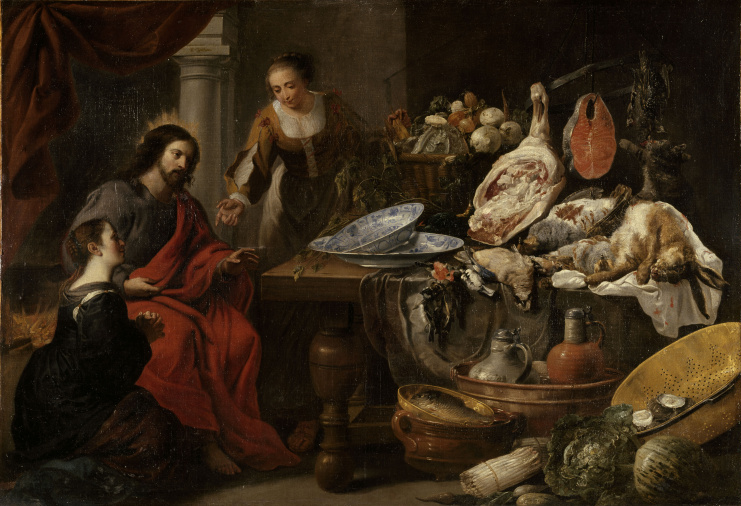
“Jesus in the House of Martha and Mary”, painting by Erasmus Quellinus II and Jan Fyt (1650) from en.wikipedia.org. See the folly of Martha’s worries and distractions with the enormous amount of food being prepared.
Jesus clarifies in the example of Mary that the first priority of every disciple is to listen to the Word who is himself. More than the division of time allotted for “contemplation” and “action” by every disciple, Jesus reminds us that the more we listen to him, the more we do his work; and the more we do his work, the more we desire to return to him and listen again and again to him.
Contemplation and action always go together. We cannot overdo the other and neglect the other. The moment we make a distinction between the two, problems arise like what we find in the church.
When priests and bishops concentrate only in contemplation, oblivious to the social conditions of the people, their proclamation of the Gospel is diluted as they fail to represent well Jesus as the Christ, the Son of the living God. When they are so immersed into social action and advocacies, business endeavors including entertainment in the Mass without contemplation, Christ is detached from the whole picture that people could no longer see nor feel the spiritual nature of the Church with everything becoming a show, empty of any sense of the divine and sacred. In both instances of abuses, either of contemplation or action in the Church, it is her credibility that is eroded as the Body of Christ with a growing number of the faithful disillusioned with priests and bishops more identified with the rich and powerful.
"There is need of only one thing."
Abraham in today’s first reading showed us the most beautiful example of discipleship. Like Martha, Abraham was also gracious in receiving his visitors at Mamre believed to be the Blessed Trinity in the form of angels; but, unlike Martha who was so concerned with her chores that she had forgotten Jesus, Abraham was intently focused on his visitors as “he waited on them under the tree while they ate” (Gen.18:8).
Like Mary listening at the feet of Jesus, Abraham was fully present in God while in Mamre. That is discipleship – to have that full presence in the Lord which is the “only one thing needed” of us which is to receive God’s gift of himself to us, of his Word who became flesh Jesus Christ who enables us to do his works by first recognizing him in ourselves and in one another as our neighbor.
This is the reason why even inside prison, St. Paul felt Jesus Christ’s coming and presence that he rejoiced in his sufferings as part of his ministry in proclaiming Christ as the hope for glory (Col.1:24, 27).
Photo by author, Sacred Heart Novitiate, Novaliches, QC, 20 March 2025.
Last week I read in one of the blogs I follow by an American nun, of how she attended many years ago to a delivery man who died of a heart attack in the ER of a Philadelphia hospital. Part of her ministry was to gather the things found in the chest pocket of the man’s shirt so she could inform the relatives of his death: there was a well-used prayer book, a thin wallet with a few dollars inside, a lottery ticket and a picture of his grandchildren. It was so touching how she narrated these simple things found in the man’s chest pocket as those closest to his heart (https://lavishmercy.com/2025/07/12/the-amoroso-man/).
That hit me so hard because even in this age of smartphones, I still carry a little notebook and pen in my chest pocket where I write my schedules as well as occasional notes on everything I notice and read. Deep inside me after reading that blog, I wondered where is Jesus Christ in all those notes and activities in my pocket notebook closest to my heart.
Dearest Lord Jesus,
make me fully present before
you always, even in my activities
and distractions for it is only in you
I am fulfilled. Amen.

Fr. Nicanor F. Lalog II
Our Lady of Fatima University
Valenzuela City
Lord My Chef Sunday Recipe, 06 July 2025
Fourteenth Sunday in Ordinary Time, Cycle C
Isaiah 66:10-14 ><}}}*> Galatians 6:14-18 ><}}}*> Luke 10:1-12
Photo by author, Atok, Benguet, 27 December 2024.
Finally, we hit the fourteenth Sunday in Ordinary Time with Luke as our guide after a month of Solemnities.
We are at the turning point in the gospel of Luke – chapter 9 and first half of chapter 10 – where Jesus was identified by Peter as the Messiah (9:20) while Jesus for the first time made known his coming pasch (9:22). From this point on, Luke tells us of how Jesus “resolutely determined to journey to Jerusalem” (9:51) to fulfill his mission as they took a detour from a Samaritan town that had refused them passage (9:53). After this scene comes our gospel this Sunday.
At that time the Lord appointed seventy-two others whom he sent ahead of him in pairs to every town and place he intended to visit. He said to them, “The harvest is abundant but the laborers are few; so ask the master of harvest to send out laborers for his harvest. Go on your way; behold, I am sending you like lambs among wolves. Carry no money bag, no sack, no sandals; greet no one along the way. Into whatever house you enter, first say, ‘Peace to this household’… Stay in the same house and eat and drink what is offered to you, for the laborer deserves his payment. Do not move about from one house to another. Whatever town you and enter and they welcome you, eat what is set before you, cure the sick in it and say to them, ‘The kingdom of God is at hand for you.'” (Luke 10:1-5, 7-9)
First thing we notice about discipleship according to Jesus is that it is never easy, “behold, I am sending you like lambs among wolves.” Disciples need to be “resolutely determined” in the mission like Jesus, focused only on Jesus.
Early in his teachings during the Sermon on the Plain, Jesus enunciated in his Beatitudes the contradictions of his life and teachings to the ways of the world his followers have to imitate. Hence, his list of “do’s” and “don’ts” of discipleship in today’s gospel.
Do’s: greet peace every household they entered; stay in same house; eat and drink whatever is offered; cure the sick; and proclaim “the kingdom of God is at hand.”
Don’ts: no money, no sack, no sandals, no greetings along the way, and do not move about from one house to another.
Notice there are five do’s and five don’ts. And there are only two “do’s” that require speaking: to greet every household with peace and then the other is to proclaim to everyone the kingdom of God is at hand (10:5, 9) which is the sum of discipleship in Christ.
Photo by author, Sacred Heart Novitiate, Novaliches, QC, 20 March 2025.
“Into whatever house you enter, first say, ‘Peace to this household'”…
The only valuable we as disciples of Christ must have is peace that we have to offer generously to everyone.
Peace is the work of the Holy Spirit, a sign of the coming of the Kingdom of God as the angels proclaimed on Christmas, “on earth peace to those on whom his favor rests” (Lk. 2:14). Most of all, peace is the fruit of Easter that the Risen Lord offered his disciples upon seeing them on that evening, “Peace be with you” (Jn.20:19).
Vatican II defined peace “is not merely the absence of war… but the fruit of love which goes beyond what justice can provide” (Gaudium et Spes 78). Peace is something we all have to work and strive for, entailing wounds and sacrifices for us to achieve it by cooperating with the grace of Jesus Christ in overcoming sin and evil. It is a process that never stops, calling for perseverance and daily conversion on our part.
Peace comes when we disciples are open for Christ, for others, and for change and transformation. That is why Jesus insisted us his disciples not to bring anything material that may influence our dealings with others, especially with those who are poor.
The great irony of our time is that the more we have grown affluent with wealth and material things, the more we have become empty in meaning and directions in life. So many are disturbed, longing for peace but could not have it because we the disciples are also lost in the things and the ways of the world.
Photo by author, Sacred Heart Novitiate, Novaliches, QC, 20 March 2025.
“…cure the sick in it and say to them, ‘The kingdom of God is at hand for you.'”
In the Luminous Mysteries of the Holy Rosary introduced by St. John Paul in 2002 is its third mystery, the proclamation of the Kingdom of God.
It is truly a mystery of light because Jesus is the Kingdom of God! To proclaim the coming of the Kingdom of God is to proclaim the coming of Jesus Christ in our midst. When John the Baptist’s disciples asked Jesus if he was the One they were waiting for or had to wait for another, Jesus said in reply, “Go and tell John what you have seen and heard: the blind regain their sight, the lame walk, lepers are cleansed, the deaf hear, the dead are raised, the poor have the good news proclaimed to them” (Lk.7:22).
Where there is healing, there is new life, there is proclamation of the good news, there is Jesus Christ! Proclaiming the Kingdom of God is representing Jesus in our lives, in our mission.
From vaticannews.va
In the previous chapter and scenes before our gospel this Sunday, Jesus asked his disciples what people said about him, the very same gospel we have last Sunday during the Solemnity of Sts. Peter and Paul.
Recall how Jesus was mistaken for John the Baptist, Elijah and Jeremiah or one of the prophets.
That’s the problem we still have today: many followers of Jesus do not represent him well that people are lost at who he really is! And it first happens right in the Sunday Eucharist as noted by a Facebook group called Catholic Fortress in its series this past week.
Many reacted positively for the series that was really good and timely for us priests and ministers at the altar who have unconsciously abused the Mass, unknowingly deviating from Christ himself who could no longer be found and experienced by the people. Truly the Mass is about Jesus; but, when it becomes like a showbiz with so many ek-ek and palabas by the priest, the servers and ministers and the choir, then it leads us away from Jesus who is paloob or inside our hearts.
In 400 AD, St. Augustine wrote the first manual for catechism called De Catechizandis De Rudibus (On Instructing Beginners) detailing, step by step the many things to consider and lessons to teach people being prepared for Baptism. From a simple request by his deacon named Deogratias, St. Augustine came up with an entire book on how to catechize with a final lesson that is the heart of his book when he wrote, “Remember, the catechist is the lesson himself.”
The same thing is very true with us priests and altar ministers and every disciple of Jesus Christ! Do we have Jesus Christ or not especially in the celebration of the Holy Mass where we proclaim the Kingdom of God is at hand and share peace with everyone?
How can there be peace of Christ among us when priests fail to love first of all Jesus in prayers as reflected in his love for the people by preparing for the Mass so that the sick and the burdened may experience Jesus – not an actor or actress of a telenovela no matter how popular it may be?
Where is the Kingdom of God when people have to bear the tantrums and antics and hangups of their priest as they already have so much burdens in life? Or, when people have a hard time tightening their belts and the priest keeps on asking for collections without any reports?
Where is the Kingdom of God when priests play favorites among the parishioners and servers, when some support Pride Movement and corrupt officials?
How can there be peace when all we have in the Mass is clapping of hands that we never have time to listen to God speaking to us in silence?
Photo by author, St. Joseph’s Chapel of the Order of Friars, Tagaytay City, 17 January 2025.
This Sunday, Jesus invites us to examine our faith journey in him if we are still following him or somebody else.
Let us pray for that grace to represent Jesus well always in our lives as priests and laity alike that we truly become the Body of Christ, his presence on earth.
It is the relationships that we have with God that matters in discipleship which Isaiah likened to that of a mother and child in the first reading. This finds it fulfillment when like St. Paul in the second reading, it is Christ’s Cross that we carry in ourselves – not bags nor money nor self and fame. Amen. Fr. Nicanor F. Lalog II, Our Lady of Fatima University, Valenzuela City.
Lord My Chef Daily Recipe for the Soul
Monday, Memorial of the First Martyrs of Rome, 30 June 2025
Genesis 18:16-33     <*((((><  +  ><))))*>     Matthew 8:18-22
Photo by author, Cabo Da Roca, Pundaqit, San Antonio, Zambales, 15 May 2025.
*Apostle, from "apostolein",
to be sent forth;
Disciple, from "discipulous",
to follow.
A day after celebrating the
Solemnity of your Apostles
Saints Peter and Paul,
you gave us today Jesus the
memorial of the first martyrs
of the Holy Roman Church
who were killed during the reign
of Nero in 64 A.D.; many of them
were literally used as torches and
lamps when their mutilated bodies
were burned to light the city of Rome.
How inspiring,
dear Jesus to hear their
story of witnessing their faith
in you at that time;
grant us the same courage today
to always follow you, Jesus,
to follow your footsteps by doing
your work and most specially,
in carrying your Cross;
let us seek sanctity regardless
of our social status, age or
skills.
Let us imitate Abraham in
the first reading who walked
with God, his visitors at Mamre;
like Abraham walking with you,
following you, Lord,
let us work more for the conversion
of others not their judgment;
in following you, Jesus,
let us think more of how to save
followers lost in their directions
in life; instead of leaving them behind
on their own in their evil ways,
may we appeal to God for their
conversion.
May we not be like
the two hesitant disciples
in today's gospel: though
willing to follow you, Jesus,
one was impulsive
and the other was cautious;
give us courage to do a
sincere reality check today of our
discipleship in you:
help us bring back the joy
and zeal of following you,
Jesus when we started to heed
your call of discipleship;
let us dare again to leave the sides
to walk at the middle of the road
following you Jesus even to the Cross;
help us bring back that desire
to go near you, Jesus,
to always seek you and follow you
by forgetting our selves;
and like Abraham,
let us be gracious always
to one another as your followers.
Amen.
Fr. Nicanor F. Lalog II
Our Lady of Fatima University
Valenzuela City
First Martyrs of the Holy Roman Church photo from ucatholic.com.