40 Shades of Lent, Saturday after Ash Wednesday, 29 February 2020
Isaiah 58:9-14 +++ 0 +++ Luke 5:27-32
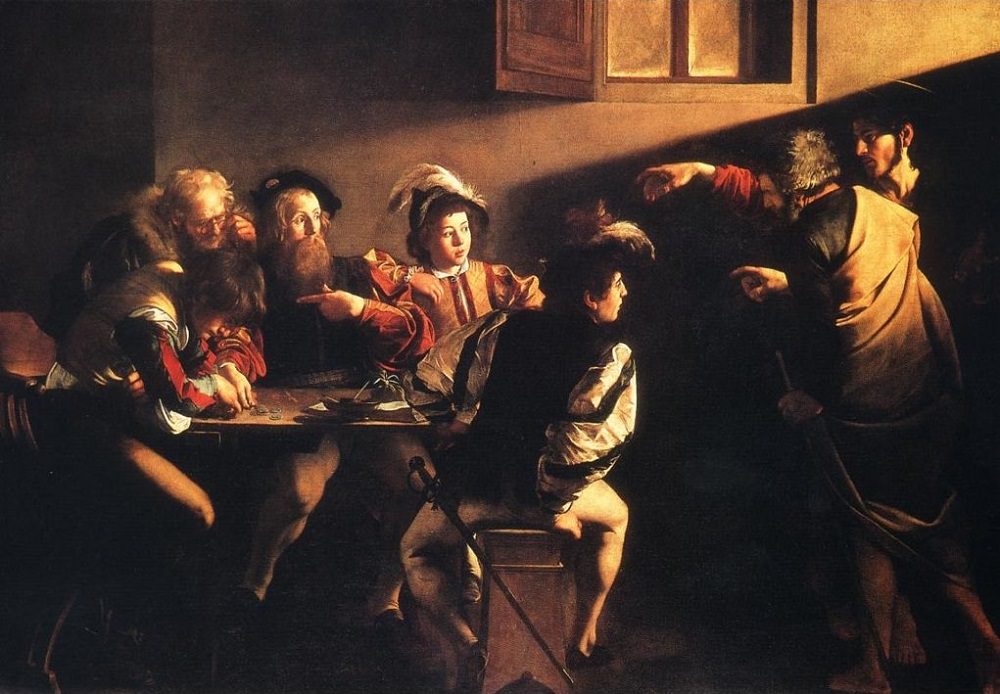
“The Calling of St. Matthew” by Caravaggio. From Google.
Dearest Jesus: I have been imagining in prayer of myself being Levi the tax collector sitting at his post.
It must be so lonely being like him, rich but deep inside longing for something deeper and meaningful than money and wealth. He had been thinking of making a “lifestyle shift” but he felt hopeless with nobody to help him.
Like in the first reading, your invitation Lord through the Prophet Isaiah seem to be too good to be true that anyone like Levi – or me – could make a big difference in life by “giving food to someone hungrier, abandoning my own comfort to care for someone afflicted, substituting a kind word for a malicious gossip, and worshipping you than pursuing my own interests”(Is.58:10,13).
I felt like Levi – there in his little customs post – that is impossible because everything is hopeless and there is no chance to change. Everything is doomed, especially for me, a sinner, Lord.
Then, suddenly you came, saying, “Follow me” (Lk.5:27).
How I love looking back, Lord, to those dark days when you suddenly came calling me to follow you!
It was so simple.
Like Levi, I just stood and followed you and everything changed in my life!
That was so nice of you, Lord Jesus, to take such a bold step of coming to Levi’s post to call him and, me. It was – and still is – a gamble on your part to call us sinners to follow you. And since then, you have never stopped calling us sinners Lord Jesus to follow you, even on our darkest and lowest days and hours, Lord, when everything seemed to be so doomed.
As we prepare for the first Sunday of Lent, remind me, O Lord, that this holy season is not all that drab and dry. After all, Lent originally means “springtime”, the coming joy of Easter which happens every time we turn our hearts to you like Levi. Amen.
40 Shades of Lent, Ash Wednesday, 26 February 2020
Joel 2:12-18 + + + 2 Corinthians 5:20-6:2 + + + Matthew 6:1-6,16-18
From Google.
We begin today the Season of Lent, the 40 days of prayers and fasting, contrition and alms-giving in preparation for Easter Sunday. It is the only season in our liturgical calendar that starts on an ordinary day, Ash Wednesday when we are reminded of that basic truth in life we have always evaded: that we all die and go back to God.
“Remember man that dust thou art, and unto dust shalt thou return.”
In this age of social media where many practically live in media making known to everyone everything happening to them from confinement to hospital to drinking coffee somewhere or simply saying “thank you” to someone just beside for a gift they have received, the more we need this blessed season to recover the essential realities in life like our true self and God.
So unlike Adam and Eve who went into hiding after their fall, modern men and women have shamelessly flaunt everything they think they have that actually indicate what they lack – depth and meaning, sense and respect.
Ash Wednesday enables us to find anew our bearings in life that must be centered in God, our very life and meaning of being and existence.
Life is a daily Lent.
From Google.
St. Benedict tells his followers in his Rule that “the life of a monk ought to be a continuous Lent”. And this is also very true for every Christian who follows Jesus Christ as Lord and Master.
Our life is a daily Exodus from darkness into light, from sin into grace, from failure into victory, from slavery into freedom when we experience the Paschal mystery of Jesus Christ even if we are not aware of it.
And the sooner we become aware of this reality, the better for us because that is when we find more meaning in life, the deeper our existence becomes.
Pope Francis tells us in his Lenten Message this year that “Jesus’ Pasch is not a past event; rather, through the power of the Holy Spirit it is ever present, enabling us to see and touch with faith the flesh of Christ in those who suffer.”
Life is all about God. This life we live is a sharing in his very life and the more are aware of this reality and link, the more we discover its beauty because we get to know God more in Jesus Christ who have come in flesh and blood for us.
“Brothers and sisters: We are ambassadors for Christ, as if God were appealing through us. We implore you on behalf of Christ, be reconciled to God.”
2 Corinthians 5:20
To be reconciled to God is to be one in God in Christ Jesus through daily conversion. This we achieve through the many sacrifices and corporal and spiritual works of mercy during this season. Fact is, these pious practices are meant to be done even outside the Lenten season so we never lose sight that life is all about God, not us.
From Google.
Lent is a journey into our hearts, and into the heart of God, too!
In these 40 days of Lent, we try little by little to “rend our hearts, not our garments to return to the Lord our God” (Joel 2:13) through prayers and sacrifices. These are done not for others to see but primarily for us to find and meet God waiting for us always to experience his love and mercy, his life and his fullness right in our hearts.
Like in our gospels these past two weeks when we reflected on the “education of the heart”, it is the truth of the heart that is being worked out in Lent. It is our heart that must be strengthened and converted by all these religious practices of the season.
It is in our hearts where God dwells and resides though we often try to bury and disregard.
All these fasting and abstinence, confessions and alms-giving as well as other works of mercy are meant to create a space in our hearts for God and for others. Without the proper attitude in our hearts, everything then becomes a hypocrisy that neither deceives God nor fools humans.
See how Jesus in the gospel which is also a part of his Sermon on the Mount which we have been reflecting these past three Sundays of Ordinary Time have painstakingly reminded us to guard against pleasing humans than God.
Jesus said to his disciples: “Take care not to perform righteous deeds in order that people may see them; otherwise, you will have no recompense from your heavenly Father.”
Matthew 6:1
It is not that we are encouraged to give alms, pray and fast to get rewards from God that Jesus is telling us to practice these pieties but in order to be more focused with the Father. Ultimately, getting into heaven is the reason why Jesus came to save us, to assure us of this reward of being with the Father eternally. There is nothing else greater than that.
This is why Lent is all about God, not us.
From Google.
In our journey to him this season, both as an individual and as a community, Lent enables us to free ourselves from our strong individualistic drives within so we can truly experience conversion in the midst of a community of believers.
The more we see God, we see our sinful selves, and that is when we are converted and renewed in Christ.
This is always marked with a deep realization that we are not alone, that there are also others suffering with whom we must share with God’s rich mercy and love rather than keep these for ourselves alone.
That is what that ash on our forehead reminds us, of God who loves us all, dwelling within each one of us, renewing us, loving us, and most of all, forgiving us. Amen.
Saturday, Feast of the Conversion of St. Paul, Apostle, 25 January 2020
Acts 22:3-16 ><)))*> ><)))*> ><)))*> Mark 16:15-18
Photo by Lorenzo Atienza, Malolos Cathedral, 29 June 2019.
Glory and praise to you, O Lord Jesus Christ!
Thank you Lord for not leaving us alone, for continuing to live with us, calling us and sending us to your mission in the Church, your blessed Body!
As we celebrate today the Feast of the Conversion of your great Apostle St. Paul, we do not merely recall this personal event of his in the past but most of all, we try to listen to you with him anew in our own time and situation.
Nothing much had changed, O Lord Jesus since that day in Damascus when St. Paul was on his way to persecute your early followers.
Many of us continue to persecute you because of lack of faith in you, of pride, and yes, because of wrong beliefs all premised in that great lie we have the truth, just like St. Paul who was called Saul then.
I fell to the ground and heard a voice saying to me, ‘Saul, Saul, why are you persecuting me?’ I replied, ‘Who are you, sir?’ And he said to me, ‘I am Jesus the Nazorean whom you are persecuting.'”
Acts 22:7-8
It was the single event that converted St. Paul to become your most dynamic Apostle, Lord.
In that short instance, Lord, you remind us of how you personally call each one of us in our own name, no ifs nor buts, everything that is good and bad, even the worst in us.
Like St. Paul, we always hear your personal call but unlike him, we rarely have the courage to answer you, even enter into a dialogue with you just for a brief moment. We would rather stay on top of our horse, only to heed you when we have fallen and blinded by the world.
Likewise, Lord Jesus, in that brief encounter, you taught St. Paul and us today that basic reality of you identifying with the Church, your Body!
Every day, Lord, you continue to call us like St. Paul, asking us the same question, “why do you persecute me?”
O great St. Paul the Apostle, thank you for reminding us always in your letters how Jesus ceaselessly draws us into his Body the Church through the Holy Eucharist that for him is the center of Christian life where we experience Christ’s love in the most personal manner by giving himself for me.
Dearest St. Paul, pray for me that the love of Christ may always be my law and guide in life even to point of offering myself to him who had called me to a life of holiness. Amen.
Friday, Memorial of St. Francis de Sales, Doctor of the Church, 24 January 2020
1 Samuel 24:3-21 ><)))*> ><)))*> ><)))*> Mark 3:13-19
Photo by author, Malolos Cathedral, December 2019.
Blessed are you, O God our loving Father! Thank you for the gift of self, the gift of everything especially our temperament.
Many times it is our temperament that lead us to a lot of troubles as well as to holiness like in the story of David today, the appointment of 12 Apostles by Jesus in the gospel, and the life of St. Francis de Sales whose memorial we celebrate today.
Thank you, Lord, for making us all too complex that despite the four types of temperament – sanguine, phlegmatic, melancholy, and choleric – there is really no clear cut category for each one of us.
Thank you for making us that way to have enough room for you to work on us, to help us subdue ourselves to your will and be holy.
How wonderful was the attitude of David not to harm Saul while they were hiding inside the cave: he chose to be kind and even magnanimous by “cutting off an end of Saul’s mantle” to show his goodwill (1 Sm.24:5).
In doing so, he earned the respect of his enemy, Saul who declared, “And now, I know that you shall surely be king and that sovereignty over Israel shall come into your possession” (1Sm.24:21).
Our newly ordained priest kneeling at prayer on his first Mass, 11 December 2019.
In the gospel, your Son’s choice of the 12 Apostles are very revealing of your love and mercy to us: a mix of different people of different even extreme backgrounds and temperament but all given with the chance to be a part of Jesus Christ’s mission.
Last but not least, O God, the choleric and fiery temperament of St. Francis de Sales was a lifelong struggle for himself even in is old age but he never stopped subduing himself to serve you best by effecting the return of about 70,000 Protestants into Catholicism in Switzerland, not to mention the millions of souls touched until today by his 21,000 letters and writings as well as the 4,000 sermons he had left that still inspire people today.
Indeed, he who conquers and masters himself for you, O God, is the victorious of all! Amen.
1 Samuel 4:1-11 ><)))*> ><)))*> ><)))*> Mark 1:40-45
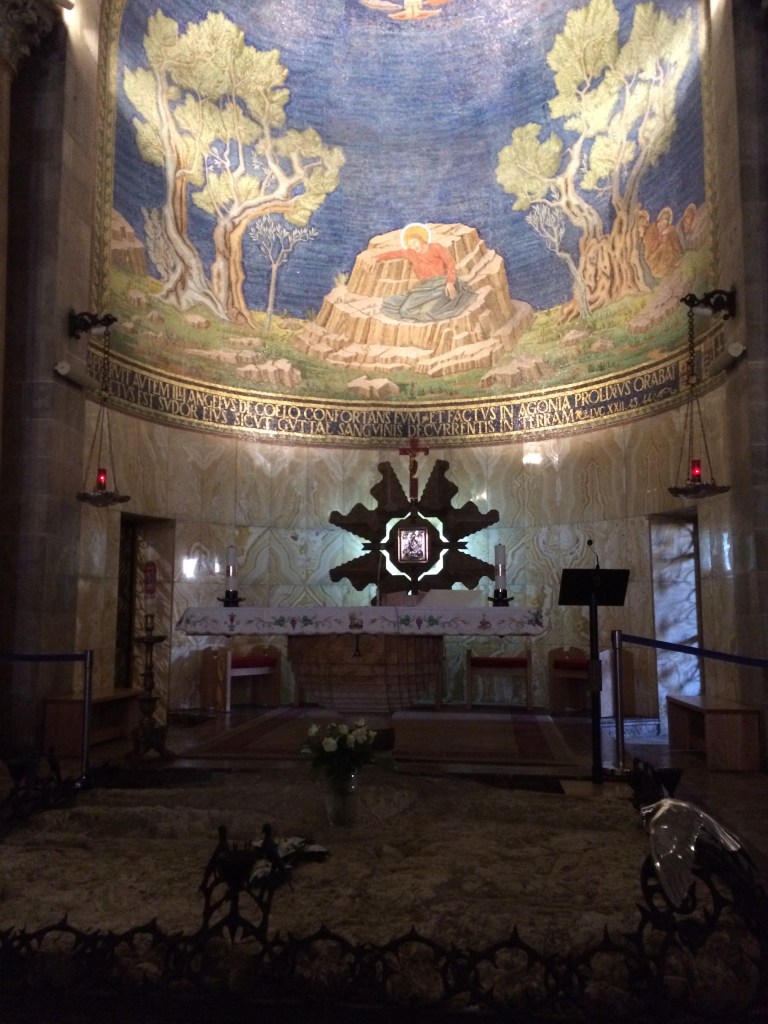
Altar of the Church of All Nations beside the Garden of Gethsemane in Jerusalem where Jesus prayed before his arrest on Holy Thursday. Photo by author May 2019.
Lord Jesus Christ, our Master and Divine Teacher, please teach us how to pray like you. Teach us how to truly pray that is pleasing to the Father not in the social media as many of us seem to be doing these days amid the eruptions of Taal Volcano recently.
May we be reminded of the experience of the Israelites in the first reading that despite the presence of God’s Ark of the Covenant in their battle with the Philistines, they were defeated.
Worst, the Ark of the Covenant was captured and among those dead were Eli’s sons, Hophni and Phinehas (1Sm.4:10-11)!
Remind us that it is the Holy Spirit within us who prays and calls out to you, O God, because we do not really know how to pray. Dispose ourselves unto your will, O God, like that who came and knelt to beg before Jesus, saying,
“If you wish, you can make me clean.” Moved with pity, Jesus stretched out his hand, touched the leper, and said to him, “I do will it. Be made clean.” The leprosy left him immediately, and he was made clean.
Mark 1:40-42
Dear God, may we heed the calls of Pope Francis in Laudato Si that each of us seriously change our own ways of living, to have a shift in our lifestyles that respects nature as part of your creation, part of our lives.
We have long disrespected you and nature, O God.
Cleanse our hearts, strengthen us in facing Taal’s fury and heed her voice hereafter to take care of her. Amen.
Isaiah 11:1-10 ><}}}*> Romans 15:4-9 ><}}}*> Matthew 3:1-12
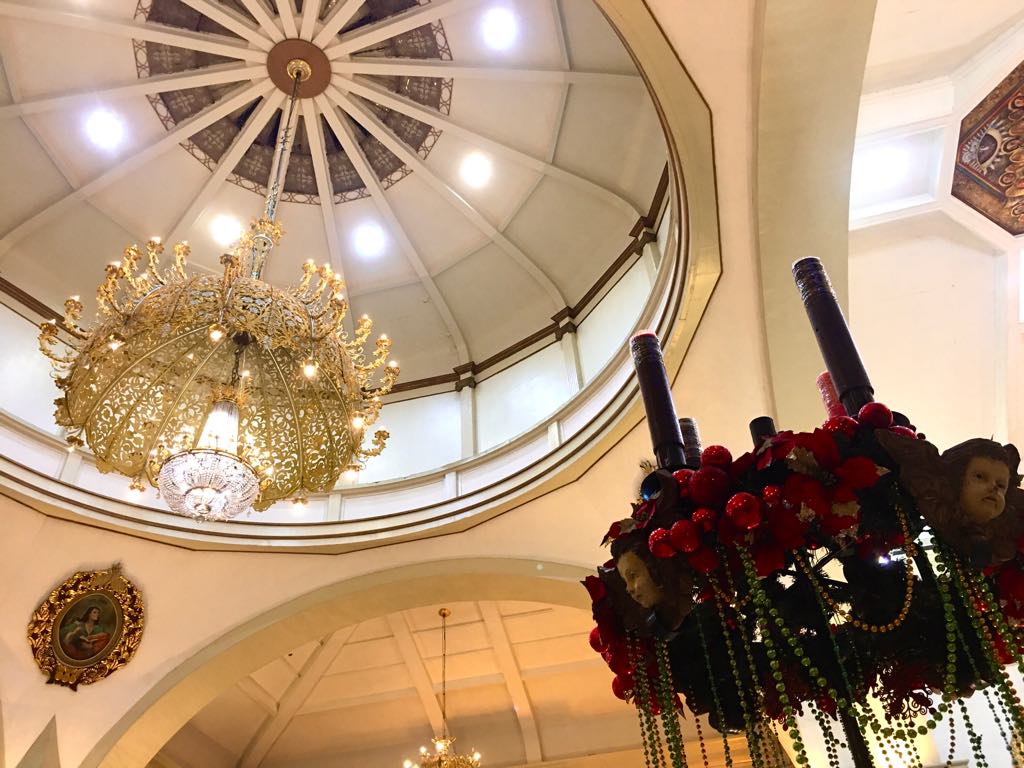
Cathedral Basilica Minore of the Immaculate Conception, Malolos City, Advent 2019.
Advent is a season we are invited to look forward, to dream of the ideal, of the best things we wish we all have in this destructive world we live in.
It is the time for healing our wounds and brokenness as we look forward to the fulfillment of God’s promise of lasting peace brought by Jesus Christ’s coming more than 2000 years ago.
On that day, a shoot shall sprout from the stump of Jesse, and from his roots a bud shall blossom. The spirit of the Lord shall rest upon him… Not by appearance shall he judge, nor by hearsay shall he decide, but he shall judge the poor with justice, and decide aright for the land’s afflicted… Justice shall be the band around his waist, and faithfulness a belt upon his hips. Then the wolf shall be a guest of the lamb, and the leopard shall lie down with the kid; the calf and young lion shall browse together, with a little child to guide them. The cow and the bear shall be neighbors, together their young shall rest; the lion shall eat hay like ox. The baby shall play by the cobra’s den, and the child lay his hand on the adder’s lair. There shall be no harm or ruin on my holy mountain; for the earth shall be filled with knowledge of the Lord, as water covers the sea.
Isaiah 11:1-2, 3, 4, 5-9
“Peaceable Kingdom”, a painting based on Is.11:1-10 by American Edward Hicks, a Quaker pastor (1780-1849).
Jesus is coming again to heal our destructive world
Last November 28 we celebrated Red Wednesday to remember the more than 300 million Christians worldwide persecuted in various forms because of their faith in Jesus Christ. Many of them were tortured and/or murdered while others were denied of work, housing and liberty for carrying the cross and confessing their faith and love for Jesus Christ.
According to some reports, about 80% of wars and conflicts in the world today are due to religion. How tragic – and scandalous – that religion is tearing us apart than bringing us together as peoples believing in a God who is loving and merciful!
But despite all these destructions going on, Isaiah’s prophecy challenges us to keep our hopes alive for a better future, to look forward for the coming again of Jesus Christ, “the shoot that shall sprout from the stump of Jesse” to heal our destructive world.
Advent assures us that it is never too late for the Lord to make peace and justice spring forth in our dying world like a stump of tree.
Isaiah’s vision is an imagery of God’s test of faith to us all to make it Jesus Christ’s peace a reality in this fragmented world, calling us into conversion so that we shall be “filled with knowledge of the Lord, as water covers the sea.”
It is a call made louder and clearer by St. John the Baptist at the wilderness that still echoes to our own time today.
Healing our destructive world starts within me
Photo by Mr. Jim Marpa, September 2019.
When he saw many of the Pharisees and Sadducees coming to his baptism, he said to them, “You brood of vipers! Who warned you to flee from the coming wrath? Produce good fruit as evidence of your repentance… Even now the ax lies at the root of the trees. Therefore every tree that does not bear good fruit will be cut down and thrown into the fire.
Matthew 3:7-8,10
The season of Advent is not only inviting us to look forward for a new world order where there would be lasting peace and justice, when all our tears would be wiped out, with perfect joy replacing our pains and sufferings. Advent is calling on us to look forward in renewing our relationships with God and with one another by beginning within our own hearts.
And make no mistake that St. John’s preaching and call were not only meant for the Pharisees and Sadducees of his time but also to us all Christians of today to “produce good fruit of our repentance” because being sorry for our sins is just the first step to conversion.
Whenever there is true repentance in our hearts, there must also be a change in our very selves, in our living. And only then can we expect of a better and more beautiful world coming like Isaiah’s vision because from true repentance comes justice and mercy.
St. John was very clear: it is Jesus Christ who is coming whom we shall await and prepare to meet right in our hearts. He is coming not to destroy the world – and us – but to restore everything into life anew.
Skies over the desert of Sinai in Egypt, May 2019.
Meeting Christ in the desert
Sometimes we get discouraged by some people and many situations that throw us off-balanced, tempting us to abandon all our efforts to be healed of our wounds and brokenness, in striving to become better persons.
Like St. John the Baptist, we have our own desert of desolation and bareness that purifies us further in preparing the way of the Lord, in meeting the Lord to be healed.
It is in our own desert of desolation and bareness where we are healed as we learn to be empty of ourselves like St. John in order to conquer first our selfish desires with silence and prayer, not with activities as we are all bent in doing these days.
In our world saturated in media with cacophony of voices telling us to do everything to be rich and popular and famous, the more we become empty and lost, broken and wounded.
“St. John the Baptist Preaching in the Wilderness” by German painter Anton Raphael Mengs (1728-1779). From Google.
Like St. John the Baptist, we have to break free from the trappings of the world by retreating into our own desert right inside our hearts in order to listen more to the voice of the coming Christ we must proclaim fearlessly in words and in deeds.
St. Paul assures us that all that scripture foretold in the past has been fulfilled in Jesus Christ who is coming again at the end of time. Despite the many destructions in this world, despite the many setbacks we have in life, may we imitate St. John the Baptist in awaiting Christ in our own desert for he is most faithful in his promise and presence. Amen.
The Lord Is My Chef Sunday Music, 03 November 2019
My cousin Joyce Pollard-Lopez with Tony during their honeymoon 40 years ago in Greece, still together and very much in love with each other!
It’s the end of a long weekend of bonding and prayers for the All Saints’ Day and All Souls’ Day that ushered in the penultimate month of every year that is November.
Let us not forget that on these days dedicated for our departed loved ones, we are also reminded to remember more of God and those people he sends us to experience his immense love for us.
They are the people who have profoundly changed us into who we are today, that made us live like we never existed before…
So you ask me what do I see When I look in your eyes I see things that have never existed before Shall I tell you all that I find In those beautiful eyes I can try But it never existed before
The silvery moon… a walk in the park The tunnel of love… a kiss in the dark The light of the stars… the clouds in the sky The fireworks on the fourth of july And you ask me what do I hear When you whisper my name Music plays that has never existed before
Oh, and I don’t know why But it’s there just the same And it’s plain that it never existed before The song of the rain the flowers in spring The wind in the willow trees murmuring The laughter that falls the children at play Like church bells that call all the people to pray So you ask me why do I glow Well, I think you should know I’m in love and I never existed before
Minnie Riperton co-wrote this song released in May 9, 1979 as part of her fifth and final album called Minnie.
Two months later, Minnie died of cancer at the age of 31.
Never Existed Before speaks so well of how Minnie had experienced the great love of her husband Richard Rudolph especially in her long struggle against cancer.
The song leaves no trace of her great sufferings as Minnie herself was filled with joy by actively working for her advocacies in cancer prevention and research.
Beautiful voice, beautiful woman, and beautiful song.
Just like Zacchaeus.
He only had one desire – to see Jesus who surprised him by coming into his house as a guest!
It is a story of faith, no matter how little it may be for as long as there is that desire for God.
Jesus comes first in our hearts, to those who truly seek him in their hearts.
And the mark of being saved and loved by Jesus is to be filled with joy like Zacchaeus who promised to change his life and even repay those he had cheated.
Truly, any encounter with the Lord Jesus Christ can change us deeply to live differently, like we never existed before.
The Lord Is My Chef Sunday Recipe, Week XXXI-C, 03 November 2019
Wisdom 11:22-12:2 ><}}}*> 2 Thessalonians 1:11-2:2 ><}}}*> Luke 19:1-10
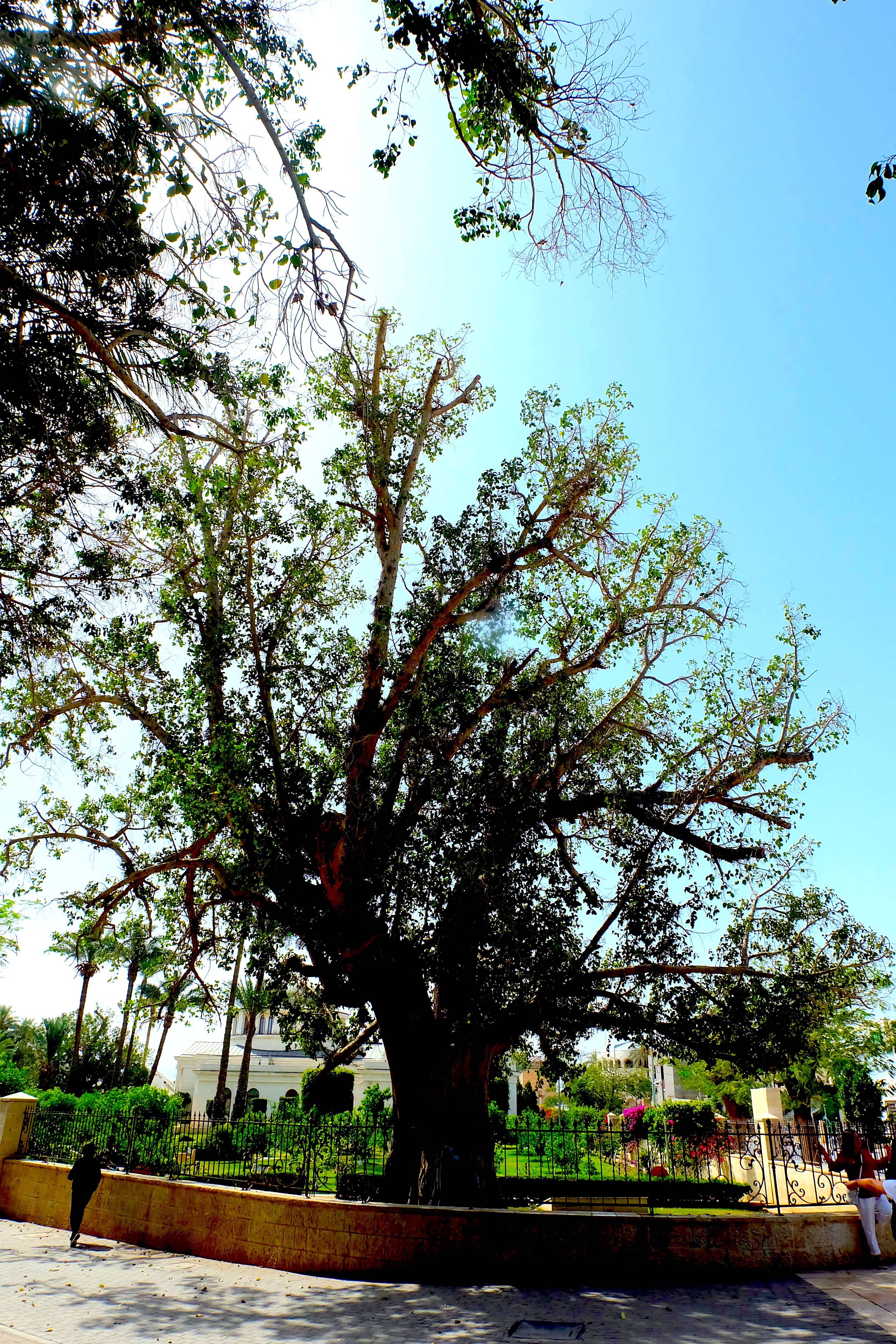
A giant sycamore tree at the center of Jericho, the world’s oldest city. Photo by author, May 2019.
Jesus is now on the final leg of his “resolute journey to Jerusalem” as he passed by the world’s oldest city of Jericho. Next week, he would be teaching at the Temple area in Jerusalem where his enemies would gang up against him, eventually sending him to death as we shall hear on the 24th of this month, the Solemnity of Christ the King.
Today we find a very interesting story that is in stark contrast with last Sunday’s parable of the Pharisee and tax collector praying at the Temple.
And this time, our story is not a fiction but an event found only in St. Luke’s gospel about a real tax collector named Zacchaeus, a very wealthy man indeed.
The fictional Pharisee Jesus narrated in his parable last week was a very proud one, of high stature literally and figuratively speaking that he would always stand and pray inside the Temple to be seen by everyone.
He was a self-righteous man who despised everyone else, especially tax collectors.
But, according to Jesus, the Pharisee’s prayer was not heard by God because he was not really seeking God but seeking adulation for himself!
Treetop of a sycamore tree in Jericho today.
Contrast that Pharisee with the chief tax collector in Jericho named Zacchaeus: he was of small stature, literally and figuratively speaking, that he had to climb a sycamore tree in order to see “who Jesus was” (Lk.19:3).
We can safely surmise that from St. Luke’s narration, nobody loved Zacchaeus in Jericho: he must be really so small in their eyes that he is hardly noticed maybe except when people paid taxes.
And that is why when he learned Jesus of Nazareth was passing by their city, he went to climb a sycamore tree to have a glimpse of the man he must have heard so often performing miracles and doing all good things for sinners like him.
Then, a strange thing happened…
When he reached the place, Jesus looked up and said, “Zacchaeus, come down quickly, for today I must stay at your house.” And he came down quickly and received him with joy. When they all saw this, they began to grumble, saying, “He has gone to stay at the house of a sinner.” But Zacchaeus stood there and said to the Lord, “Behold, half of my possessions, Lord, I shall give to the poor, and if I have extorted anything from anyone I shall repay it four times over.” And Jesus said to him, “Today salvation has come to this house because this man too is a descendant of Abraham. For the Son of Man has come to seek and to save what was lost.”
Luke 19:5-10
Was it serendipity or divine destiny?
Jesus was just passing through Jericho while Zacchaeus was merely interested in seeing the Lord. Never in his wildest dream, so to speak, did he intend to meet him personally.
From Google.
But, as we all believe and have realised, there are no coincidences or accidents in life.
Everything that happens in our lives has a purpose, a meaning that may either make us or unmake us.
It all depends on us whether we make the right decision in making the most out of whatever life offers us, of what comes to us. Either we become better or bitter – so choose wisely.
More so with salvation from God who never stops coming to us everywhere, anytime like with Zacchaeus when Jesus suddenly came to meet him.
The Catholic Parish Church in Jericho run by the Franciscans, May 2019.
Here we find again a story about faith that leads to conversion and salvation or justification.
It does not really matter how little faith we have like when the Apostles asked Jesus on the first Sunday of October, “Lord, increase our faith in God” (Lk. 17:5,Wk. 27). What matters is that we always have that option for God, a desire for God.
This is specially true as St. Paul assures us in the second reading that Christ will come again at the end of time. Nobody knows when or how he will come again but like Zacchaeus, we must have that desire for Jesus who first comes into our hearts before entering into our homes or churches, no matter how grandiose they may be.
Every desire for God in itself is an expression of faith in him. And God comes to those who truly seek him because that is how great God is: not in his power to do everything but to be small and forgiving!
Before the Lord, the whole universe is as a grain from a balance, or a drop of morning dew come down upon the earth. But you have mercy on all, because you can do all things; and you overlook people’s sins that they may repent. But you spare all things, because they are yours, O Lord and lover of souls.
Wisdom 11:22-23, 26
Inside the Catholic Parish of the Good Shepherd in Jericho, May 2019.
Like in the parable of the persevering widow and judge as well as that of the Pharisee and tax collector praying at the temple last Sunday, today’s story of Zacchaeus meeting Jesus shows us how God never abandons us his children, always ready to grant our desires and wishes even beyond what we are asking for — if we have faith in him.
Our salvation depends solely in our faith to God in Christ Jesus, like Abraham in the Old Testament that we can now rightly be called as his children like Zacchaeus.
No one is excluded from this tremendous grace of God brought to us through Jesus Christ who had come to seek those who are lost.
Like Zacchaeus upon receiving salvation from the Lord on that simple day, may we joyfully turn away from sins and most of all, cheerfully rid ourselves of so many other things that hamper us from following Jesus resolutely to Jerusalem. Amen.
Photo by the author. Baguio City Cathedral, January 2019.
We have reflected last Sunday that prayer is an expression of our faith.
Where there is faith and prayer, there is always love.
And when we have prayer, faith and love, we have a relationship and community of two or three and more persons together as one, rooted in God.
Today we hear another parable by Jesus only St. Luke has, that of the Pharisee and the tax collector to show us another dimension of faith expressed in prayer.
Photo by the author at the Wall of Jerusalem, May 2017.
Like last week, St. Luke tells us anew the Lord’s purpose in narrating this parable:
Jesus addressed this parable to those who were convinced of their own righteousness and despised everyone else.
Luke 18:9
Were you moved or affected in any way upon hearing our parable today?
Did you feel a silent but swift, sharp thud inside your heart while your mind tried to reason out that the parable is not meant for you?
Listen again and pause, let the Lord’s words sink deeper into your heart:
“Two people went to the temple area to pray; one was a Pharisee and the other was a tax collector. The Pharisee took up his position and spoke this prayer to himself, ‘O God, I thank you that I am not like the rest of humanity — greedy, dishonest, adulterous —- or even like this tax collector. I fast twice a week, and I pay tithes on my whole income.’ But the tax collector stood off at a distance and would not even raise his eyes to heaven but beat his breast and prayed, ‘O God, be merciful to me a sinner.’
Luke 18:10-13
If prayer creates a relationship, Jesus is teaching us today the right attitude we must have to keep this communion we have in faith and love. Any relationship is bound to fail, or would not even exist at all despite the formalities of having ties and links like what we see or even have in our various social circles where roles are just acted out.
We call it “plastic” or fake. Untrue!
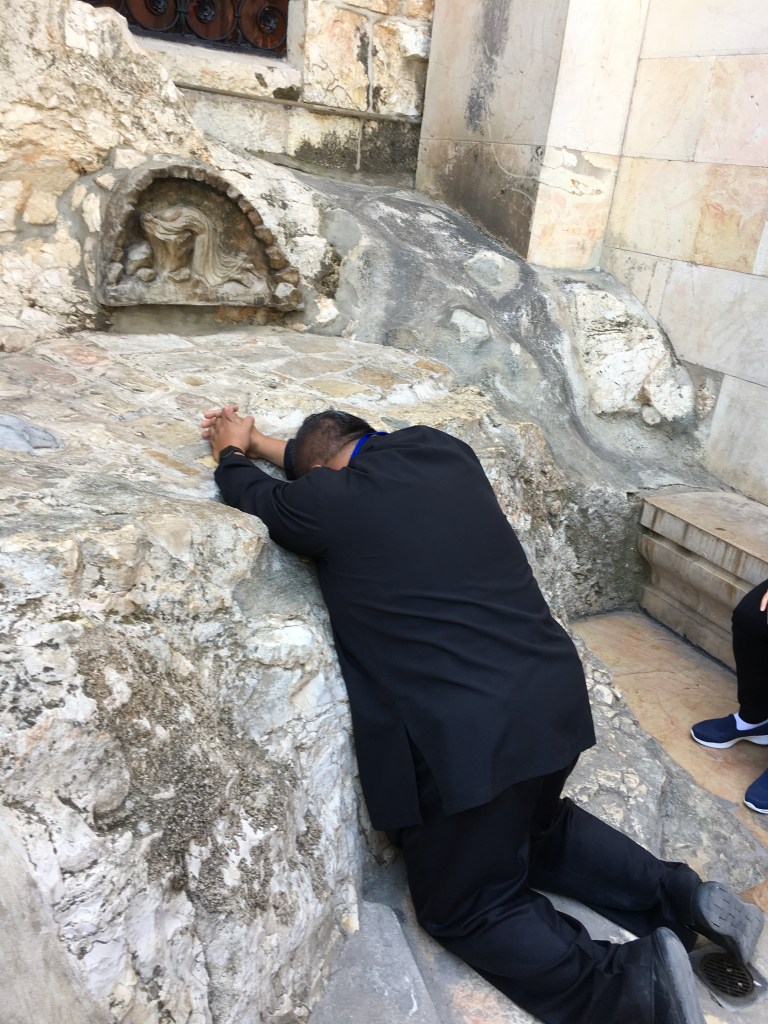
Praying at the Garden of Gethsemane, May 2019.
Prayer to be efficacious like any relationship must always be true.
Here Jesus directs our attention in the “where” when we pray – not just the location or locus of our prayer but our “place” in that relationship first with God who is our very foundation.
When all we see is our self in prayer like in any relationship, there is always a problem. It is clearly a one way street, a monologue.
Worst of all, it is an indication of the absence of God or even others because the pray-er is so preoccupied with his or her very self!
The Pharisee was clearly not in God even if he were in front of the temple. His very self was very far from God and all he had was his bloated ego. He may be a very pious person but not really good at all for he has no space for God and for others. He is a very closed man without any room for others.
The tax collector, on the other hand, may be physically far outside the temple but was the one actually nearest to God with his self-acceptance and ownership of his sinfulness, of his need for God. He was closest to God because he was more open with God and with others by admitting his own sinfulness.
Again we find the key to tis Sunday’s parable towards the end:
(Jesus said) ‘I tell you, the latter (tax collector) went home justified, not the former; for whoever exalts himself will be humbled, and the one who humbles himself will be exalted.'”
Luke 18:14
Photo by Dra. Mai B. Dela Pena, Germany, 2016.
Prayer is more than entering a church or a prayer room, or finding our most suitable spot or space to pray.
Prayer is being one with God, of being suffused in God.
“Where” are we when we pray?
First, we become one with God, one in him in prayer when we first admit our sinfulness, when we confess our sins to him, and own them without any “ifs” and “buts”.
God always comes to those who truly open themselves to him by emptying themselves of their sins and inadequacies.
The tax collector was justified in his prayer more than the Pharisee because in confessing his sins, he admitted his need for God. He knew very well his place, so unlike the Pharisee who felt God owes him so much!
When Pope Francis granted his first media interview (to their Jesuit Magazine!), the first question asked of him was, “who is Jose Mario Bergoglio?”
The Holy Father quickly answered, “I am a sinner.”
No wonder when he was elected Pope on March 13, 2013 at the Vatican, he first asked for prayers from the huge crowd gathered before he bestowed his apostolic blessing to them. It clearly showed that despite his holding the highest post in the Church, he considers himself a sinner, so weak needing prayers from the people.
I always tell couples during weddings that when they have a quarrel, the first one to speak and make the move for reconciliation is the one with most love, the one who is most willing to bow to start anew.
Most often in life, friendships and relationships are kept when we are willing to take the lower stance, not necessarily admitting fault or guilt in any misunderstanding because being lowly indicates the person’s need for the other person and of one’s love to work on that relationship despite its fragility.
Ordination of deacons, Malolos Cathedral, 12 June 2019.
Second, we are in God and with God in prayer when we have that attitude and inner disposition of being poor and lowly. Being lowly or poor means having the conviction to leave everything behind and go down with God into the lowest point because one is so confident of the efficacy of prayer like what Ben Sirach tells us in the first reading.
Most of all, like Mary the Mother of Jesus during the Annunciation of the Christ’s birth.
The one who serves God willingly is heard; his petition reaches the heaven. The prayer of the lowly pierces the clouds; it does not rest till it reaches its goal.
And thirdly, we are in God in prayer when there is an offering daily of one’s self to God.
It is not enough to be lowly and sorry for our sins in prayer. It has to be sustained because prayer is also a discipline like any sport. In the second reading, St. Paul calls us to persevere and endure until the end for Jesus Christ.
We need to be passionate with our prayer life, willing to go to all extent to offer everything for the Lord, to fulfill his will “who shall award us with the crown of righteousness in heaven.”
We are all sinners forgiven and beloved by God.
May we find ourselves in God and with God always both in our sinfulness and lowliness. Amen.
Zechariah 8:1-8 ><)))*> ><)))*> ><)))*> Luke 9:46-50
St. Jerome painting by El Greco portrayed as wearing the Cardinal’s robe to represent his highly esteemed works and contributions to the Church as one of the Four Western Fathers along with St. Augustine, St. Ambrose of Milan, and St. Gregory the Great. Photo from Google.
Praise and glory to you, God our loving Father! Thank you very much for giving us saints, men and women like us who were sinners with so many weaknesses but through your grace were able to lead holy lives.
Through your saints, you give us so much hope to be become better persons despite our many imperfections like our great Doctor of the Church, St. Jerome, the Father of Catholic biblical studies who immersed himself in the study and prayer of the Sacred Writings right in the Holy Land.
Considered as one of the great theologians of the Church, St. Jerome is said to be approachable but notorious for being a difficult person too due to his temper as well as sarcasm and being argumentative at times.
I confess, O God, that I am exactly the opposite of the kind of person Jesus Christ is telling us to be like – a child. Instead of being childlike, many times I have become childish, difficult to handle with my burst of temper and sometimes annoying sarcasm.
Like St. Jerome, fill me with your grace, with courage and willpower to conquer my irascibility and direct all my negative energies in pursuing you in prayers and good works.
Help me to follow St. Jerome in his call to “let us translate the words of the Scriptures into deeds.”
Fill me with your words, O Lord, cleanse me of my sins and iniquities so that your Holy Spirit may dwell in me, suffuse me with your holiness. Amen.
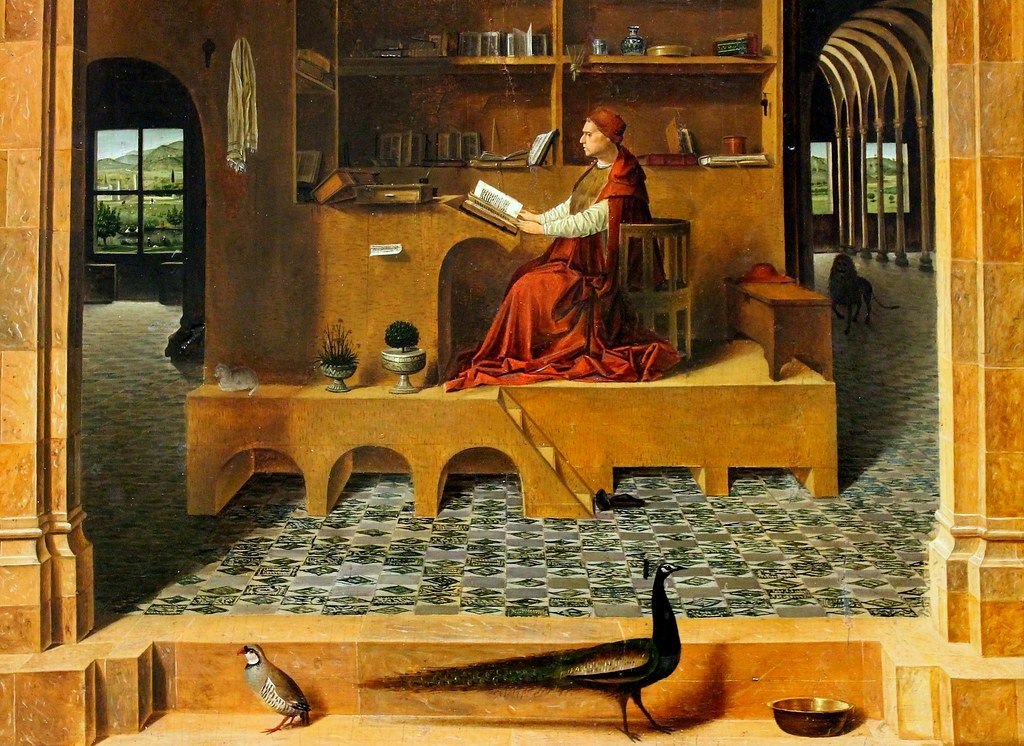
My favorite depiction of St. Jerome by Italian painter Antonello da Messina (c.1430-79), “St. Jerome in his Study.” Again, we see St. Jerome in red robe and hat like a Cardinal at his study desk with his faithful lion in the background which tradition says he had helped in the forest by removing a thorn in its paw. At the foreground are two birds: a peacock which is an ancient Christian symbol of eternal life that our saint meditated often (reason why he always has a skull in other paintings), and a partridge, a reference to St. Jerome’s notorious temper as the bird often represents jealous rage. Photo from Google.













 lordmychef.com