Alfie, poster, Michael Caine, 1966. (Photo by LMPC via Getty Images)
Sorry for being out for a long time with our Sunday music collection we try to relate with the Sunday gospel. But on this Fourth Sunday of Lent, we can’t let it past without coming up with our choice that perfectly matches the parable of the prodigal son – “Alfie” from the 1966 classic film of the same title.
Written by the formidable tandem of Burt Bacharach and Hal David, “Alfie” is the main character played by Michael Caine in the film about a young man who played on so many women and almost everyone without any regard for persons and relationships. Alfie is practically like the prodigal son in today’s gospel who also in the end realized the mess and waste of life he had done to himself and others (https://lordmychef.com/2022/03/26/the-joy-of-coming-home-in-the-father/).
I never had the chance to watch the classic film except the 2004 version that starred Jude Law but the song remains so touching and meaningful then and now in our generation. It is also said to be the favorite of Bacharach among his many great songs composed with David.
Learned about the song through the music of Dionne Warwick who had interpreted most of the works of Bacharach and David; but, it was only now that I have learned the original version by Ms. Cilla Black that was released in 1966. Funny that when the movie was released in the US, the producers had the young Cher recorded it too which became the version heard in the film.
The song had been covered by so many other artists with the latest by a Japanese named Fuji Kaze but, regardless of the artist singing Alfie, it is one song everyone of us can claim as ours with its sincerity and truth that come from the heart of someone truly on a Lenten journey of coming home to self, others, and God.
What's it all about, Alfie?
Is it just for the moment we live?
What's it all about when you sort it out, Alfie?
Are we meant to take more than we give?
Or are we meant to be kind?

And if only fools are kind, Alfie
Then I guess it is wise to be cruel
And if life belongs only to the strong, Alfie
What will you lend on an old golden rule?

As sure as I believe there's a heaven above, Alfie
I know there's something much more
Something even non-believers can believe in

I believe in love, Alfie
Without true love we just exist, Alfie
Until you find the love you've missed, you're nothing, Alfie

When you walk let your heart lead the way
And you'll find love any day, Alfie
Alfie
*We have no intentions of infringing into the copyrights of this music and its uploader except to share its beauty and listening pleasure.
40 Shades of Lent by Fr. Nicanor F. Lalog II
Fourth Sunday in Lent-C a.k.a. "Laetare Sunday", 27 March 2022
Joshua 5:9, 10-12 ><}}}*> 2 Corinthians 5:17-21 ><}}}*> Luke 15:1-3, 11-32
Photo by Dr. Mylene A. Santos, MD, in Lourdes, France, 20 March 2022.
Life is a daily Lent, a coming home to the Father. As I have been telling you, the 40-days of Lent is a journey back home to God in Jesus Christ with each Sunday like a door leading us closer to Him. We rejoice this Fourth Sunday – Laetare Sunday – as we near God’s inner room, knowing Him more than ever as we experience His immense love and mercy for us like a Father welcoming his children to “enter” and celebrate home in Him.
But, are we really in the journey?
Or, are we just like the two selfish, self-centered brothers in the parable who took their father for granted by pursuing for their own very selves?
Tax collectors and sinners were all drawing near to listen to Jesus, but the Pharisees and scribes began to complain, saying, “This man welcomes sinners and eats with them.” So to them Jesus addressed this parable: “A man had two sons…”
Luke 15:1, 3, 11
Photo by author, Laetare Sunday 2019 in my former parish.
Acting like the sons…
Once again, we hear another story from Luke that is uniquely his. It is more known as the parable of the prodigal son when in fact the center of the story is the loving and merciful father giving everything including his very self to his two sons.
There are two preceding parables before this third one, that of the lost sheep and of the lost coin that are in chapter 15 of Luke’s gospel. See how Jesus developed into a rising crescendo his series of parables starting with a lost sheep, a lost coin, and finally, lost sons. The common thread running through the three parables was the great joy of the shepherd, woman and father upon having their lost ones again. Clearly, God is the shepherd, the woman, and the father looking for the lost sheep, lost coin and lost sons. And here lies the very essence of the parables, especially in this third one about the loving and merciful father: “the Pharisees and scribes who began to complain why Jesuswelcomes sinners and eats with them.”
We are those Pharisees and scribes who doubt and refuse to believe, even run away from our loving God in the belief there must be somebody else there who could love us truly by giving us what we need.
Photo by author, Laetare Sunday 2019 in my former parish.
Exactly like the younger son in the parable who sees God merely as a provider, an ATM or a Western Union counter who gives the cash we need to buy things we believe would complete us without realizing God is our life, our identity and root of being. This we find at what prompted the younger son to return home (return home, not come home which happens only when home is a person, not a place nor thing).
When he had freely spent everything, a severe famine struck that country, and he found himself in dire need. So he hired himself out to one of the local citizens who sent him to his farm to tend the swine. And he longed to eat his fill of the pods on which the swine fed, but nobody gave him any. Coming to his senses he thought, “How many of my father’s hired workers have more than enough food to eat, but here am I, dying from hunger. I shall get up and go to my father and I shall say to him, “Father, I have sinned against heaven and against you. I no longer deserve to be called your son; treat me as you would treat one of your hired workers.”
Luke 15:14-19
Sometimes we are like the younger son who returns home just to preserve one’s self – to have a roof and to have food so as not to starve, never go hungry. It is the first temptation of the devil, teasing Jesus and us to turn stones into bread because man lives to eat! That is why we keep on asserting our own power so we can do everything because we have forgotten our being-ness in God. We hate having nothing, being empty and would rather fill our bellies with whatever we can stuff our mouth with that in the process even swallow our pride and dignity to have, to possess everything, even everybody except God.
Photo by author, Laetare Sunday 2019.
On the other hand, we are like the Pharisees and scribes “complaining why Jesus welcomes sinners and eats with them” so personified by the elder son who refused to enter their house to join the celebrations at the return of his prodigal brother because his manipulative schemes have been unmasked. For him, serving his father was just a show because he was only an actor, everything was a movie or a teleserye playing one’s roles in exchange of a fee and fame.
He said to his father in reply, “Look all these years I served you and not once did I disobey your orders; yet you never gave me even a young goat to feast with my friends. But when your son returns who swallowed up your property with prostitutes, for him you slaughter the fattened calf.”
Luke 15:29-30
Again, we find here some semblance of the second and third temptations to Jesus and to us by the devil: worship him and you will be popular and powerful! We all want having the best for us to be the very best among our peers and neighbors. We are willing to buy time, even buy people just to be known and popular. We would not mind being patient over a long period of time believing in the end, we could end up having all.
When we think of our needs to be secured and safe, popular and powerful, the first that comes to our minds and consciousness are things that money can buy, food that fill stomach, and drinks that refresh the body. Like the two brothers, they were all concerned with material and physical, nothing spiritual nor emotional or even mental. A life without any depth like Alfie played by Michael Caine with music by Burt Bacharach asking, “What’s it all about, Alfie? Is it just for the moment we live?”
That’s the tragedy of our lives, of being like the Pharisees and scribes personified by the two brothers who were so lost in their own selves, refusing to see beyond to find others and God, now and eternity, earth and heaven.
Photo by author, view from the Old Jerusalem, May 2019.
…becoming like the Father
This is the grace of this fourth Sunday, its greatest joy and cause for celebration: our being home in God, being whole again in Him after realizing and accepting our broken and sinful selves.
Make no mistake that it was us who have found God; no, it is the other way around.
God is the Father always awaiting for us that He sent Jesus Christ to lead us home again in Him. In this parable, the late Fr. Henri Nouwen rightly said Jesus is the “prodigal son” who left heaven not out of rebellion but because of obedience and submission to lead us all back to the Father, the only One who loves us truly, our very “first love” for He is the one who loves us first and still loves us no matter what.
Stop seeking for the world’s basic staples of food and wealth, fame and power because the most basic truth in this life is we are loved by God who is love Himself because He is life. See Luke’s sense of humor: the prodigal son wanted only food and shelter but the father gave him back his status as son with the ring, fine clothes and slippers, and feast while the elder son was longing for a mere young goat without realizing it has long been his for everything the father has was his too! Like us in many occasions in life, we fail to see how much we already have in God that we turn away from Him to settle for lesser things.
See our foolishness in desiring the world when it has always been ours if we remain in God. That is why we need to celebrate because finally we have found what is truly basic and valuable, God who gave us his Son Jesus Christ so we can find our way back home to Him and learn what is most valuable in life.
In this parable, Jesus is asking us to “level up” our existence, to rise above our very selves and be who we really are as beloved children of the Father who is merciful and rich in kindness.
Like in the first reading, no more manna for we have entered the Promised Land where we can have real food and real drink – Jesus Christ who sustains us to eternal life. Let us keep in mind and heart Paul’s reminder and call in the second reading that “Whoever is in Christ is a new creation… so, let us be reconciled in God” (2 Cor. 5:17, 20). Only those who are reconciled in God in Jesus can experience true joy… so, stop complaining and whining of others getting close with God. Join us and celebrate! Amen.
40 Shades of Lent by Fr. Nicanor F. Lalog II
Friday in the Solemnity of the Annunciation of the Lord, 25 March 2022
Isaiah 7:10-14, 8:10 ><}}}*> Hebrews 10:4-10 ><}}}*> Luke 1:26-38
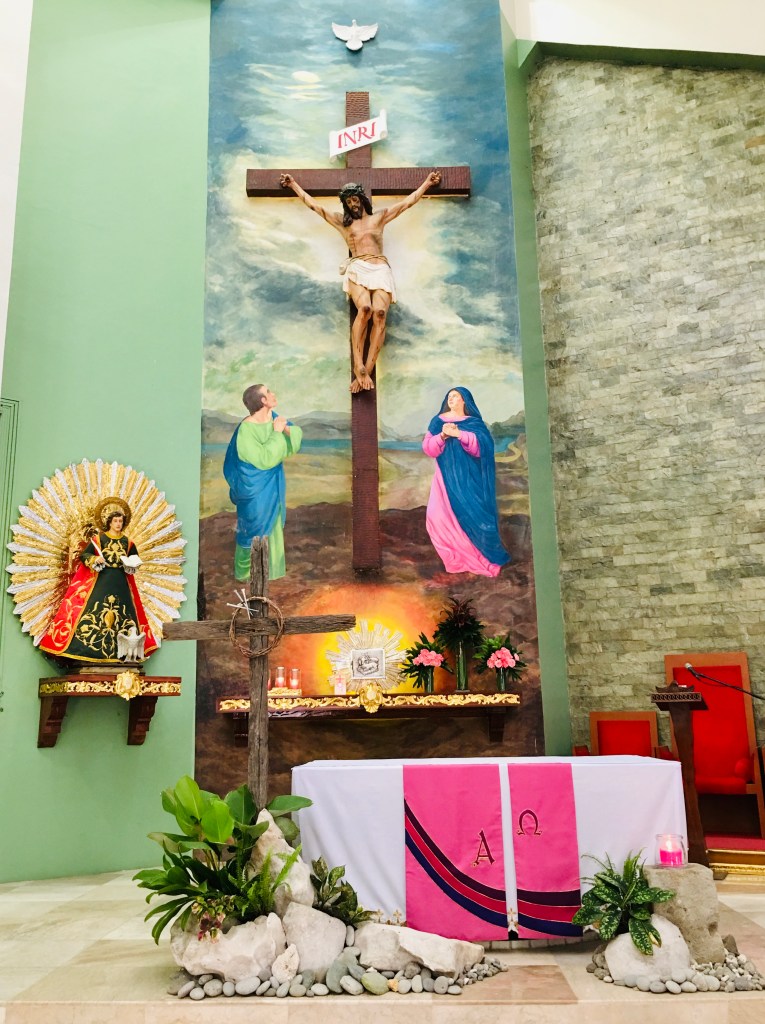
Photo by author, chapel beneath the Basilica of the Annunciation, Nazareth, Israel, May 2019.
Beneath the huge and magnificent Basilica of the Annunciation in Nazareth is a beautiful chapel where one may find a small cave converted into another little chapel with iron grills to keep off people from approaching the brightly lit altar believed to be the site where the Archangel Gabriel announced the good news of Christ’s birth to Mary.
At the base of the altar are the words, Verbum caro hic factum est, “The Word was made flesh here.”
Borrowed from John’s gospel who declared Verbum caro factum est – The Word was made flesh – the one who have thought of adding the demonstrative pronoun here to declare it as the site of the Annunciation – Verbum caro hic factum est – was definitely divinely inspired to remind us that the reality of God is something deeply ingrained in our own realities of here and now, in our very selves.
Photo by author, site of the Annunciation, May 2019.
The angel Gabriel was sent from God to a town of Galilee called Nazareth, to a virgin betrothed to a man named Joseph, of the house of David, and the virgin’s name was Mary. And coming to her, he said, “Hail, full of grace! The Lord is with you.”
Luke 1:26-28
Only Luke has this account of the Annunciation of the birth of Jesus to Mary. And true to his prologue to his gospel of “investigating everything accurately anew” about the life and teachings of Jesus, Luke tells us how the Annunciation happened with all the details like the five w’s in a news report, the who-what-where-when-why as we have heard proclaimed today.
This is very important because it tells us the factuality of the great spiritual reality that changed world history and the whole humanity when God became human, when eternity entered the temporal.
It is a beautiful presentation of this great event so profound and so touching that continues to happen within each one of us every day of our lives, of God coming to us, filling us with his grace because each of us is a beloved, a highly favored one chosen to be the indwelling of his Son, Jesus Christ like Mary.
This is the grace of this solemnity we celebrate nine months before Christmas, that God comes to us in our very humanity, always inviting us like Mary to receive Jesus, to be the vessel and instrument in fulfilling God’s great plans. We are like Mary in everything except in her being immaculately conceived – we are all poor and lowly, mostly a nobody in the society, but so loved by God!
Photo by author, flowers outside the Basilica of the Annunciation, Nazareth 2019.
God comes to us precisely where we are, in our every here and now even when we are most lowly and down, when we are deep in sin and despair, in trials and sufferings, in pains and in hurts because like Mary, even before the angel came, God had already silently started working on many things to save us.
There is always God’s perfect timing when we would meet the right people who would guide and help us.
There is always an Elizabeth that God would point us to as a signpost and proof of his reality, of his wonderful plan starting to uncover right in our very lives if we would stop like Mary to listen further to his words.
Speaking of Elizabeth, recall in Luke’s account that the angel mentioned her to Mary to allay her of her fears upon receiving the good news of Christ’s coming.
So often when God comes to us, fear naturally follows. In the Bible, it is described as “reverential fear” which comes upon an experience of the Holy; it is a feeling of being so small before the almighty God (mysterium fascinans) yet deep in this fear is a joy within about to burst because of the great honor and privilege of being loved and recognized by God. There is that normal feeling of doubts of whether we can do God’s mission or not as well as the feeling of checking the reality if it is really happening at all! Once we have verified we are not dreaming, that indeed we are called by God despite our smallness, that is when we suddenly remember our fellow mortals doing the work of God.
Then the angel said to her, “Do not be afraid, Mary, for you have found favor with God… And behold, Elizabeth, your relative, has also conceived a son in her old age and this is the sixth month for her who was called barren; for nothing will be impossible for God.” Mary said, “Behold I am the handmaid of the Lord. May it be done to me according to your word.” Then the angel departed from her.
Luke 1:36-38
Photo by author, Basilica of the Annunciation, Nazareth, 2019.
By this “will,” we have been consecrated through the offering of the body of Jesus Christ once for all.
Hebrews 10:10
Last week I underwent a surgery. It was my first time to be hospitalized and to go under the knife. Though it was a very simple procedure, I was nervous. Very nervous in fact although I tried to keep my sense of humor especially with my doctors and nurses.
The experience had taught me so many valuable lessons that I am still “masticating” them, trying to find words on how to express those learnings and realizations.
One of those is the discovery of my humanity, of my mortality. I feel I have become more human with that experience when I finally accepted my body, when slowly I have learned to look closely at my body parts I took for granted even so ashamed to look at, with all the blood and abscess and wounds.
Hindi pala puwede na hindi tayo magkakasakit, na mahina tayo, at walang perpekto sa atin na hindi kakailanganin ang tulong ng iba.
As I learned to accept my mortal body, slowly it dawned upon me how it is the true path to letting go and let God with my spiritual and emotional woundedness for it is in our humanity when God’s reality is most felt, most true. It is only when we are faced with the real threat of “harm” or being hurt, of possibly being extinct and gone from this earth when we realize what is to be afraid and finally entrust our total self to God for whatever will happen next.
That is the gift of the Incarnation of Jesus Christ that formally began in the annunciation of his birth to Mary. It is in accepting our very humanity and mortality when God truly comes, when we become one in him through Jesus Christ on the Cross. Amen.
40 Shades of Lent by Fr. Nicanor F. Lalog II
Thursday in the Third Week of Lent, 24 March 2022
Jeremiah 7:23-28   <*(((>< + ><)))*>   Luke 11:14-23
Photo by author, 11 March 2022.
Bless us, dear God our Father
this Lent which happens to be
the campaign period for our
coming elections in May, a day
of deliverance towards true
freedom and democracy,
most of all, political maturity
if we choose rightly.
But, I have long felt so saddened
at how this election campaign has
been going on, pushing aside the
beautiful and rich and meaningful
lessons of Lent:  we have not only
forgotten that we are in a 40-day journey
in you and to you with Jesus Christ
but we have forgotten to listen to
your voice.
This is the nation that does not listen to the voice of the Lord, its God, or take correction. Faithfulness has disappeared; the word itself is banished from their speech.
Jeremiah 7:28
Awake us, O Lord,
before we perish and lost again:
many among us in the Church
have taken side with candidates
pretending to take side with
truth and with you; many among
us have drag your holy name
in the pulpit, trying to be modern
prophets when our lives are not
prophetic at all, when we have forgotten
to tend the sick and poor among your flock,
when we smell more like politicians we
rub elbows so often than smell like
your sheep; worst of all, O God, is how
we hurl harsh words, spewing them like
an erupting volcano when deep within
us are all the dirt and sins
we have refused to face and clean
amid our many double standards.
How easy, indeed, for us to find
the devil, the power of Beelzebul
present in our society specially in
politics without seeing more
and presenting more your Son,
Jesus Christ to everyone that too often,
we scatter than unite; teach us to
speak and act more to unite your
people than divide them.  Amen.
40 Shades of Lent by Fr. Nicanor F. Lalog II
Tuesday in the Third Week of Lent, 22 March 2022
Daniel 3:25, 34-43   <*[[[[>< + ><]]]]*>   Matthew 18:21-35
Image from wallpaperuse.com.
Like your servant Azariah,
I praise and thank you today,
dear God our loving Father,
for delivering us always from many
dangers and trials, enabling us
to make it through many fires -
still whole, still sane, still blessed.
Yes, like Azariah and his fellow Jews
exiled in Babylon at that time, we have
turned away from you with our many
sins and transgressions:
But with contrite heart and humble spirit let us be received; as though it were burnt offerings of rams and bullocks, or thousands of fat lambs, so let our sacrifice be in your presence today as we follow you unreservedly; for those who trust in you cannot be put to shame. And now we follow you with our whole heart, we fear you you and we pray to you. Do not let us be put to shame, but deal with us in your kindness and great mercy.
Daniel 3:39-42
It is not enough, O God,
that we be sorry for our sins;
like in the parable and the very
example of your Son Jesus Christ
our Lord, penance and contrition are
meant to fix and restore our many
broken relationships with you and with
one another, especially those dearest
to us, those closest to us we have hurt or
have hurt us with words and/or deeds.
Like you dear Father,
may we realize that forgiveness is
more than deletion of sins but
most of all, about reconciliation,
of being one again as brothers and
sisters in Christ.  Amen.
40 Shades of Lent by Fr. Nicanor F. Lalog II
Monday in the Third Week of Lent, 21 March 2022
2 Kings 5:1-15  <*{{{>< + ><}}}*>  Luke 4:24-30
Photo by author, St. Catherine’s Monastery at the foot of Mt. Sinai, Egypt, May 2019.
Thank you dear Father
in bringing us to this third week
of Lent, of experiencing your loving
presence, your mystery, your
person; but, still, O God, I continue
to seek you.
Or, do I really seek you?
So many times I seek you
God like a lost object, a thing
I need at the moment like Naaman
seeking for a cure to my sickness that
in the process, I try to pull strings
around, asking help from everyone -
the more knowledgeable, the more
famous and credible, the better.
Why can't I just take the word of a believer
like that captured slave girl
in our first today?
So many times I seek you
God like an idea, merely with
an operation of my intellect
that I reason out a lot, even arguing
with all my preconceived ideas of
who you are, of what you like, even of
what must be done like Naaman
who felt insulted when your prophet Elisha
merely sent him a message to wash seven times
in Jordan river; why can't I just be like
his servants who knew better of
simply obeying orders, of keeping
things simple than our preference
for complicated ones?
Worst, O God, are the many times like
the people of Nazareth when I seek you
to dominate you, to insist myself on
you than me surrendering to you!
Remove my many blindspots,
Lord Jesus in truly seeking God
especially in this season of Lent;
teach me to seek him by surrendering
myself to his will like you,
simply believing in him who
dwells within me and in others
through my loving service
and kindness to everyone.
Amen.
40 Shades of Lent by Fr. Nicanor F. Lalog II
Third Sunday in Lent-C, 20 March 2022
Exodus 3:1-8, 13-15 ><}}}*> 1 Corinthians 10:1-6, 10-12 ><}}}*> Luke 13:1-9
Photo by author, July 2020 in Bagbaguin, Santa Maria, Bulacan.
As I have told you at the start of this 40-day journey, Lent is like a coming home to God with Ash Wednesday until Saturday after as the porch and each Sunday a door leading us into the inner rooms closer to God.
At each door these past two Sundays, we were opened to God’s majesty and wonder, love and mercy in Jesus Christ who had come to help us triumph over many temptations in life, to be transformed and transfigured in him.
With Luke as our guide this year, he had opened to us each Sunday a very unique door to experience God’s majesty and mystery, his love and mercy offered in Jesus Christ.
This becomes most pronounced this Third and Fourth Sundays when we find his gospel stories as exclusively his alone: Christ’s call to repentance following the news of Pilate’s massacre of 18 Galileans during a temple worship and the parable of the Merciful Father more known as parable of the Prodigal Son.
Some people told Jesus about the Galileans whose blood Pilate had mingled with the blood of their sacrifices. Jesus said to them in reply, “Do you think that because these Galileans suffered in this way they were greater sinners than all other Galileans? By no means! But I tell you, if you do not repent, you will all perish as they did! Or those eighteen people who were killed when the tower at Siloam fell on them – do you think they were more guilty than everyone else who lived in Jerusalem? By no means! But I tell you, if you do not repent, you will all perish as they did!”
Luke 13:1-5
Photo by author, parish Via Crucis, 11 March 2022.
Our “blaming game”
At first hearing, our gospel today sounds like a news broadcast of brutalities and mishaps, trials and sufferings happening almost daily around the world. So many times, they happen closest to us personally or within our own circles of family and friends.
Only Luke has this account of teaching by Jesus; nowhere would you find in the gospels any account of Pilate ordering this massacre of Galileans but the Jewish historian Josephus had recorded many instances of the Roman governor’s ruthless reign.
And here we find the artistry of Luke in inserting this scene in his gospel the Church has chosen as part of our Lenten itinerary. So often in life, we keep on blaming somebody else except our very selves for every negative things happening to us and around us, even considering it as “divine chastisements” or karma to those people we consider as evil.
It is true that evil begets evil, but the seeming dominion of sin and evil in the world is so wide for us to attribute blame only to certain persons as if others, including ourselves, had no part in it. It always takes two to tango!
Worst case of this “blaming game” of ours is to even link our sufferings and trials with God.
Nothing bad can ever come from God like disasters and catastrophes, sickness and turmoils because God is love. God offers only life, never death nor destruction for he does only what is good. It is very wrong to think at all that God has something to do with any of these problems happening in the world like the pandemic or in our personal lives.
Photo by author, Sinai Mountain Range in Egypt, May 2019.
This is the gist of the Lord’s response to the people bringing him the bad news of the 18 Galileans ordered massacred by Pilate, “Do you think that because these Galileans suffered in this way they were greater sinners than all other Galileans? By no means!”. God does not punish at all! Bad things happen because of sins and that is what we always have to look inside us, how have we contributed to the evil happening.
And to make it clearer that God has nothing to do whatsoever with all these bad things happening to us, Jesus added, “Or those eighteen people who were killed when the tower at Siloam fell on them – do you think they were more guilty than everyone else who lived in Jerusalem? By no means!”.
However, Jesus is not telling us to be resigned to the absurdities of the world and of humankind. We can all do something to greatly prevent and reduce all these misfortunes and sufferings around us and that is the way of repentance, of conversion – the very calls of the prophets in the Old Testament and by John the Baptist.
Now, Jesus our Savior, the Son of God, is voicing out this call of repentance with urgency and new authority not only because it is the only way back to God but precisely due to his very nature of being loving and patient, merciful and forgiving.
The kind of God we have, the only one there is
The grace of this third Sunday of Lent is the revelation of the kind of God we have, the only one there is: a very loving and patient, merciful and forgiving God who is also perfectly present among us in Jesus Christ.
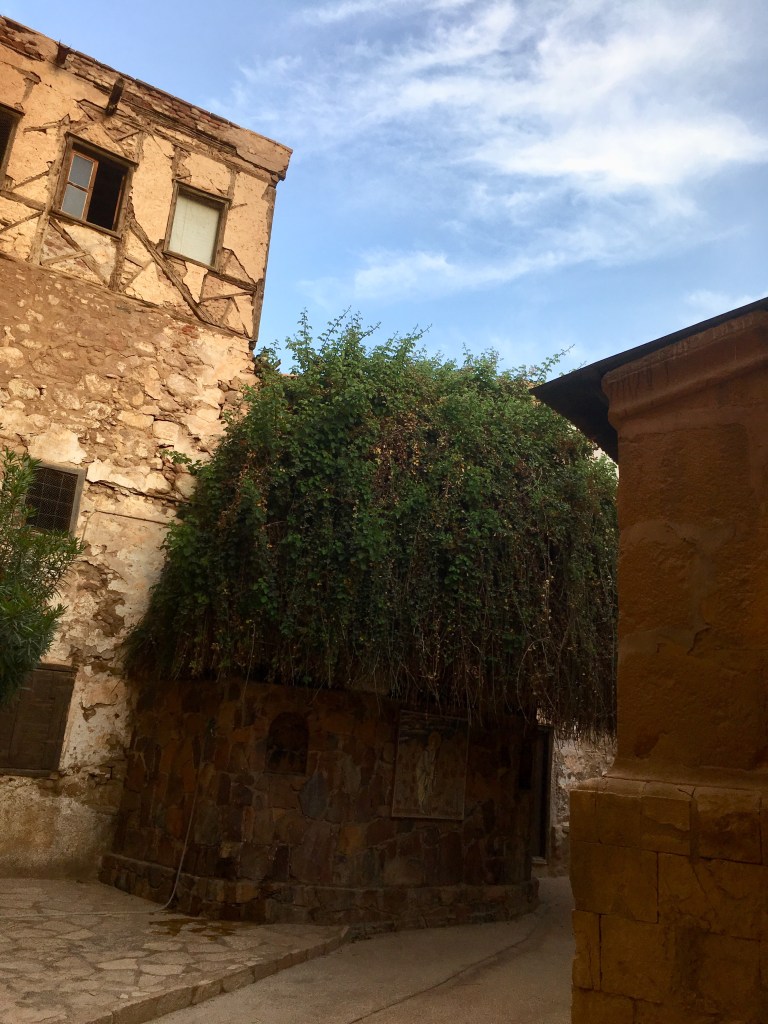
Photo by author, site of the burning bush in Sinai now inside St. Catherine’s Monastery in Egypt.
In the first reading, we are told of that unforgettable scene of Moses at the burning bush where God revealed himself as “I AM WHO AM” – the One who is always present with us in the past, in the future, and most especially in every here and now, the present moment.
When we think of God, what comes to our mind, what do we say about him?
God told Moses “Thus you say to the Israelites: The Lord, the God of your fathers, the God of Abraham, the God of Isaac, the God of Jacob, has sent me to you” (Ex. 3:15) to remind them that this God has always been present with his people.
With Abraham, God first made the promise of being the father of all nations (last Sunday’s first reading), to Isaac he revealed himself in the stairway to heaven, and to Jacob that he would bring them to Egypt and liberate them after. Now in Moses, everything is coming into fulfillment of this great nation to be set free by God, a prefiguration Christ and his saving mission.
Throughout history, God never left his people, working great marvels in the past to deliver them from slavery, a passing over and exodus, assuring us of his presence and salvation in the future by remaining at our side.
History is cyclic, everything seems to be happening again but with an upward trajectory towards God; in every repetition of history, the question is where are we standing with God, are we still the same the first time we encountered him, descending to vice and sins or have we grown in virtues and holiness?
Salvation history and secular history continue to unfold for both are one in God; hence, we must not waste every moment to return to God, to repent and be converted. Beware of Paul’s warning, “Therefore, whoever thinks he is standing secure should take care not to fall” (1 Cor. 10:12)! Remember those Galileans massacred by Pilate or those 18 people at Siloam crushed to death by tower that had fallen – anything can happen with us, so be ready. Never leave God who is always with us, assuring us with salvation in Jesus.
Beginning this Sunday, continuing to next week with the parable of the prodigal son and finally on the fifth Sunday of Lent when we skip Luke’s gospel to borrow from John for the story of the woman caught in adultery, we are being immersed into the deeper mystery of this God we call Father made known to us by Jesus Christ through his own passion, death and resurrection.
The more we enter God’s mystery every Sunday of Lent, the more his “height, breath and depth” (Eph. 3:18) appear to us, making us realize he is real, very true like another person we can feel and hear, always with us, patiently waiting for us to bear fruit like the owner of the fig tree in the parable.
How have you experienced God’s presence this past week?
What else do we need to be convinced of his love and mercy that we still refuse to repent and be converted in Jesus Christ?
The time is now, not yesterday or tomorrow for God is I AM WHO AM, one who is in the present. Amen.Have a blessed week.
Thank you for the prayers; I am home trying to recuperate from my surgery.
Photo by author, inside St. Catherine Monastery with Mt. Sinai at the background in Egypt, May 2019.
40 Shades of Lent by Fr. Nicanor F. Lalog II
Wednesday in the Second Week of Lent, 16 March 2022
Jeremiah 18:18-20   <'[[[[>< + ><]]]]'>   Matthew 20:17-28
Photo by author, Pater Noster Church outside Jerusalem, 2019.
Praise and glory to you,
O Lord our God, our loving
Father!  Thank you very much
for every blessing you send me
even in the midst of sickness,
trials and blessings.  Indeed,
everything is pure grace from you.
Cleanse my mind and my heart
of my sins and negative thoughts;
may you be alone the first and
the last in my mind and in my heart.
Like Jeremiah:
Heed me, O Lord, and listen to what my adversaries say. Must good be repaid with evil that they should dig a pit to take my life? Remember that I stood before you to speak in their behalf, to turn away your wrath from them.
Jeremiah 18:19-20
How inspiring is your prophet Jeremiah,
Lord!  Amid grave dangers as he heard
the words of his enemies whom he had
pleaded before you, the only thing he had
in his mind and his heart was you - just
to remember him.
In the same manner,
give me such courage and
lucidity to remain faithful to
you even in grave dangers!
Please, purify me in the same
manner you cleansed the brothers
James and John along with their
mother who pleaded to your Son
for power and position when he
was nearing his passion, death
and resurrection.  Turn away our
minds and hearts from things of
the world, of selfish interests
most especially in moments of
trials and difficulties.  Amen.
40 Shades of Lent by Fr. Nicanor F. Lalog II
Tuesday in the Second Week of Lent, 15 March 2022
Isaiah 1:10, 16-20   <'[[[[>< + ><]]]]'>   Matthew 23:1-12
Photo by author, Parish Via Crucis, 11 March 2022.
Come now, let us set things right, says the Lord: Though your sins be like scarlet, they may become white as snow; though they be crimson red, they may become white as wool. If you are willing, and obey, you shall eat the good things of the land; but if you refuse and resist, the sword shall consume you: for the mouth of the Lord has spoken!
Isaiah 1:18-20
Let us heed your call,
dear Lord, let us set things
right this season of Lent;
let us be sorry for our sins,
be humble for who we really are
before you and one another.
Teach us through your Son
Jesus Christ to be true to ourselves,
practicing what we preach
and doing things for you and not
for others admiration; let us realize
that authority is not for power but
for empowering and enabling others;
most of all, let us realize that
authority is service, never a way of control
or domination or a claim to special
perks and privileges.
Let us set things right, Lord,
by breaking this cycle of trying
to be someone else, of being
somebody to be admired and
looked up to when what is most
essential is for us to see one
another as brothers and sisters
in one God as our Father.  Amen.
40 Shades of Lent by Fr. Nicanor F. Lalog II
Monday in the Second Week of Lent, 14 March 2022
Daniel 9:4-10   <*(((>< + ><)))*>   Luke 6:36-38
Photo by author, Sacred Heart Novitiate, Novaliches, QC, 2017.
Praise and glory to you,
O God Our Father,
despite our sinfulness
you continue to bless us!

In this season of Lent
teach us the true meaning
of penance by getting into
the root of our sinfulness,
of being radical, shamefaced
in fact like Daniel by wholeheartedly
admitting our wickedness in
rebelling and departing from your side, Lord:
“Lord, great and awesome God, you who keep your merciful covenant toward those who love you and observe your commandments! We have sinned, been wicked and done evil; we have rebelled and departed from your commandments and your laws. We have not obeyed your servants the prophets, who spoke in your name ton our kings, our princes, our fathers, and all the people of the land. Justice, O Lord, is on your side; we are shamefaced ever to this day like our kings, our princes, and our fathers, for having sinned against you.
Daniel 9:4-7, 8
Indeed, we are shamefaced,
O Lord, even to this day
for our many sins against you
when we neglected you
in our brothers and sisters in need,
unmindful of their great sufferings
not only for their physical needs
but most especially for their emotional
and spiritual needs; we are shamefaced,
 O Lord in thinking the good times
would never end, when we lived in excesses,
bloating our egos as if we were gods.
Help us to return to you,
O God through Jesus Christ
your Son by turning our hearts
back to you, by going into the very
roots of our sins so that when we
have understood our sins, we may
no longer fall into its traps as we
get closer to you, becoming holy
and merciful like you.
Amen.












 lordmychef.com