40 Shades of Lent by Fr. Nicanor F. Lalog II
Tuesday in the First Week of Lent, 24 February 2026
Isaiah 55:10-11     + + +     Matthew 6:7-15
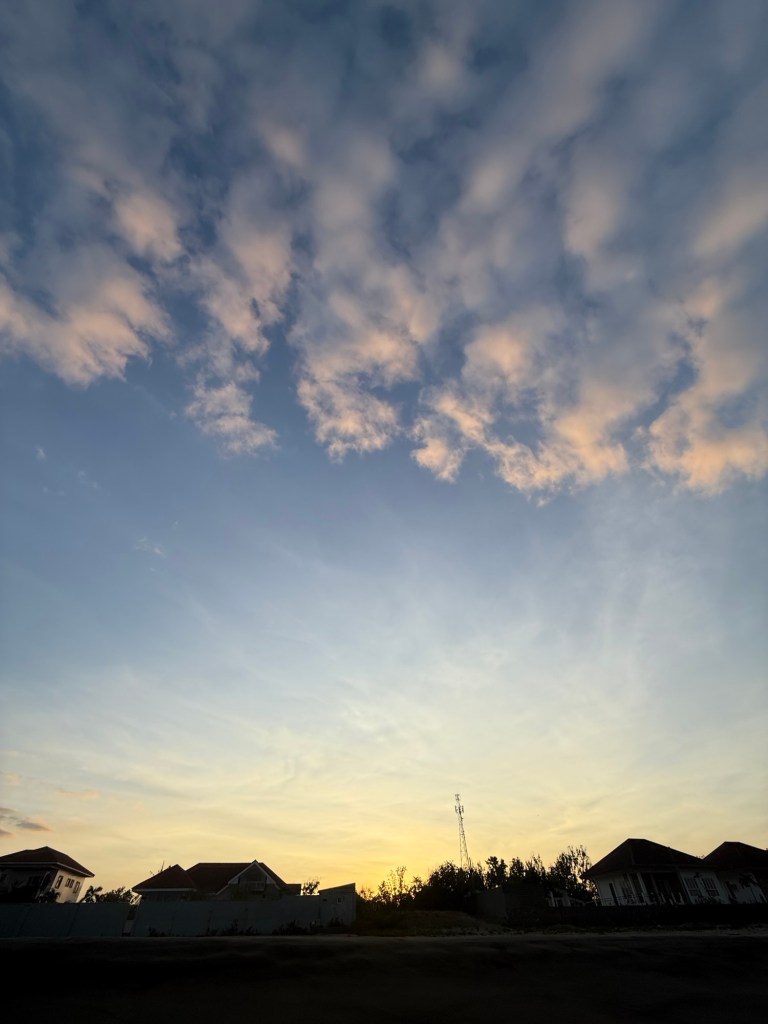
Photo by author, somewhere in the SCTEx, November 2018.
Today I borrow
the words of your servant,
Lord Jesus Christ,
the late Fr. John Main, OSB
who wrote that
"The meaning of life
is the mystery of Love.
Just as the roots of trees
hold firm in the soil,
so it is the roots of love
that hold the ground
of our being together."
Keep me rooted in you,
God our Father;
keep me rooted in your love
in Jesus Christ your Son;
water and nourish me
with your words of life
so I may grow tall,
spread my branches,
bloom and bear fruit
to share your love and
kindness and mercy
with others;
keep me rooted in you,
Lord,
strong and firm
to weather the harshest
storms and summer
in life, still full of sap,
still full of life.
Lord Jesus,
you have given me with so much
and I have given so little;
teach me to give more
of myself to you
so I can give more of you
and of your love
to others.
Amen.
Lord My Chef Sunday Recipe by Fr. Nicanor F. Lalog II
Third Sunday in Ordinary Time, Cycle A, 25 January 2026
Isaiah 8:23-9:3 ><}}}}*> 1 Corinthians 1:10-13.17 ><}}}}*> Matthew 4:12-23
Photo by author, sunrise at the Lake of Galilee, the Holy Land, May 2019.
More than a month ago at the Midnight Mass of Christmas we have heard this Sunday’s first reading, that beautiful prophecy by Isaiah fulfilled in Jesus Christ’s coming.
First the Lord degraded the land of Zebulun and the land of Naphtali; but in the end he has glorified the seaward road, the land west of Jordan, the district of the Gentiles. Anguish has taken wing, dispelled is darkness: for there is no gloom where but now there was distress. The people who walked in darkness have seen a great light; upon those who dwelt in the land of gloom a light has shone (Isaiah 8:23-9:1).
When Jesus heard that John had been arrested, he withdrew to Galilee. He left Nazareth and went to live in Capernaum by the sea, in the region of Zebulun and Naphtali, that what had been said through Isaiah the prophet might be fulfilled… (Matthew 4:12-14).
As we move forward into Ordinary Time, we hear anew one of the most beautiful promises in the Old Testament of how the coming of the Christ is the “breaking of dawn of salvation” as Zechariah sang in his Benedictus after naming his son “John” when light bursts forth to dispel the darkness that had enveloped us for a long time.
Photo by author, sunrise at the Lake of Galilee, the Holy Land, May 2017.
Notice that it is those who live and walk in darkness literally and figuratively speaking are always the first to come forward into the light like the people in Galilee at that time, especially the towns of Zebulun and Naphtali who were actually names of Jacob’s two other sons. Their tribes settled in that area of Galilee that was at the border with other pagan countries always subjected to wars and conflicts with foreigners. Their lands were literally in the dark, never at peace as if forsaken.
Here lies the good news of this Sunday: after hearing the news of John’s arrest, Jesus launched his public ministry. Notice how plain and simple was Matthew’s narration, “When Jesus heard that John had been arrested” – it was another period of darkness for the people with rampant violence and injustice. However, it was not totally dark at all: see how Jesus withdrew to Galilee; Christ’s “withdrawing” to Galilee was not something negative but actually more of a positive development. Jesus chose to begin his ministry in that forsaken province of Galilee to show his love and concern for the people long forgotten. Remember how at that time that Jerusalem was the center of everything, something like an “imperial Manila” we call these days.
Here we find again that imagery of Jesus like in his birth that happened during the darkest night of the year that 30 years later, he chose to go to the darkest region of Israel to bring light of salvation to everyone. Jesus comes to us most in moment of darkness in our lives! When we are troubled by sins and problems, never lose that spark within for Christ had come, is coming and continues to come to us! Matthew mentioned this prophecy of Isaiah of the great light shining in the land of gloom not really for his readers then and now to remember what God had done in the past but to make us all aware always that God continues to send us his Son Jesus in these dark moments of our lives. In telling us how Jesus began his ministry by withdrawing to Galilee in the land of Zebulun and Naphtali, Matthew wants us to be aware of what God has done for us, of giving us Jesus, the true Light of the world right into the many darkness we are going through in life today.
More than the news overseas that we have heard like wars and the breaking apart of world peace and order with America suddenly flexing its muscles to remind everyone they are still great and powerful or the very frustrating corrupt lawmakers of the country, we are all in some form of being in the midst of darkness in our personal lives too like a sick loved one or a problematic brother or sister.
Photo by author, San Juan, La Union, 08 January 2026.
God has delivered us from slaveries of sin and selfishness in Christ’s coming and presence among us. Surely there would always be darkness and shadows in our lives this 2026 but Jesus is telling us today in his withdrawing to Galilee after hearing John’s arrest that we need to get out of our own darkness! There is no more darkness in Christ’s coming; it is us who have darkened our lives with our selfish interests like the quarrels and animosities against one another that St. Paul warned against in the second reading.
Every time we destroy our unity, our oneness, we plunge ourselves into darkness. Whenever we refuse to bow down, when we refuse to give way, when we refuse to forgive even forgo or let go of others inanities, we go back to darkness. Inasmuch as Jesus Christ is the great light who shone on the many darkness of our lives, he is calling us like the first four disciples to bring his light to others.
Was it really that easy for the brothers Simon and Andrew, especially brothers James and John to immediately leave behind their livelihood and father so easily for Jesus? Not really. Matthew need not go into details about their call and conversion because most likely, they went through the same stages we have gone through or going through right now as we pray and reflect about our life direction. Like us today, Simon and Andrew, James and John experienced burn out, searching for meaning in life that after listening to the words of Jesus, they felt and saw him as the light enlightening everything for them. They saw in Jesus their lives and very person getting clearer that they decided to follow him and become fishers of men.
How far are we willing to repent and be converted in the light of Christ to start anew living in the land of loving God, self, and others?
Photo by author, Bolinao, Pangasinan, 19 April 2022.
I have always loved sunrise. Though sunsets are more colorful and dramatic like a spectacular show called palabas in Filipino, sunrise is different: it is more of paloob, an inside movement that is subtle yet intense when light steals into shadows as the sun is gradually breaking open the darkness to reveal what is unseen.
That is why our Filipino term for sunrise is more evocative of its deeper meaning as pagbubukang liwayway which literally means breaking of dawn. Every morning person (madrugeño in Spanish) knows so well those feelings of being up before sunrise, of exactly catching the breaking of dawn that is always joyful and liberating with a certain kind of lightness and relief from deep within because another day is given us.
Maybe it is a carry over with my having worked for three years in the graveyard shift covering the police beat while still working at GMA News in the late 1980’s. But more recently, I feel that imagery of coming forward into the light resonates most after a good confession when we deeply realize God’s immense love, that God is not that really angry at all with us because of our sins, that there is a bright light to always look forward in this life amid all the darkness and shadows enveloping us.
Today is the National Bible Sunday. It is when we prayerfully read the Sacred Scriptures everyday that we see the light of Christ in our selves, in our lives. The more we pray the Scriptures, the more we are enlightened, the more we are filled with the light of Christ that enables us to see too his light on the face of those we meet daily. Let us step out of our darkness in life this Sunday and everyday to henceforth experience and share Christ. Amen. Have a blessed, enlightening week ahead!
Lord My Chef Daily Recipe for the Soul by Fr. Nicanor F. Lalog II
Wednesday, First Week in Ordinary Time, Year II, 14 January 2026
1 Samuel 3:1-10, 19-20     <'[[[[><  +  ><]]]]'>     Mark 1:29-39
Photo by author, Bgy. Ubihan, Meycauayan City, January 2022.
How lovely are your words
today, Lord Jesus Christ,
the Word who became flesh
and dwelled among us!
Thank you very much
in sharing with us the power
of your words; in fact,
we are the only ones with whom
you have gifted with this power;
the world and everything in it
was created simply by God speaking
the words that came to exist.
Teach us, Jesus
the value of listening to you,
letting you speak first
so that like Samuel,
you may "not permit any word
we speak to be without effect"
(1 Samuel 3:19); may we truly share
in your prophetic ministry
by "enfleshing" the words we speak
by walking our talk;
likewise, heal us,
dear Jesus
of our many infirmities
and sickness due to sins
and evil that make us
speak too much
that instead of building up
others we destroy one another;
like those demons you drove out
from the sick you have cured
in today's gospel,
keep our mouths shut,
"do not permit us to speak"
(Mark 1:34)
when not necessary.
Amen.
Lord My Chef Daily Recipe by Fr. Nicanor F. Lalog II
Thursday in the First Week of Advent, 04 December 2025
Isaiah 26:1-6     <*((((><  +  ><))))*>     Matthew 7:21, 24-27
Photo by author, Malolos Cathedral, December 2019.
On that day
they will sing this song
in the land of Judah:
"A strong city have we;
he sets up walls and ramparts
to protect us. Open up the gates
to let in a nation that is just,
one that keeps faith"
(Isaiah 26:1-2).
Like most cities,
O Lord our God,
I lay in ruins:
physically, emotionally,
mentally, and spiritually;
feeling lost, almost collapsing,
trembling in so many fears
and concerns;
but my faith in you
assures me of being
"a strong city" with "walls
and ramparts" that protect me;
I may not see them now
but "open the gates" of my heart
to trust in you,
in your continuing work in me
so mysterious that leads to
victory eventually.
Give me patience
and perseverance;
enliven my hope in you,
Jesus Christ who comes to me
daily, dwelling in me to be
my "everlasting rock".
Jesus said to his disciples: “Everyone who listens to these words of mine and acts on them will be like a wise man who built his house on rock. The rains fell, the floods came, and the winds blew and buffeted the house. But it did not collapse; it had been set solidly on rock” (Matthew 7:24-25).
Keep me faithful
in you, Lord Jesus
as I rejoice in your works,
in your comfort,
in your presence
and coming.
Amen.
Lord My Chef Sunday Recipe for the Soul, 19 October 2025
Twenty-Ninth Sunday in Ordinary Time, Cycle C
Exodus 17:8-13 ><))))*> 2 Timothy 3:14-4:2 ><))))*> Luke 18:1-8
Photo by author, sunrise at Camp John Hay, Baguio City, November 2018.
There are just five more weeks remaining in our current liturgical calendar and soon after the Solemnity of Christ the King on November 23, we shall usher in the new year with the season of Advent on November 30 – the four Sundays before Christmas.
That is why today and next Sunday, as Jesus nears Jerusalem Luke tells us more teachings of the Lord about prayer not found in other gospel accounts, namely, the parables of the unjust judge and persistent widow, and the Pharisee and the tax collector.
Remember that prayer is so central in the message of Luke in his gospel account as well as in the Acts of the Apostles wherein we see Jesus and the early Church always at prayer. For Luke, prayer is more of a relationship with God than a ritual, an expression of our faith in God. Hence, the need to persist in prayer like that widow in today’s parable by Jesus.
Jesus told his disciples a parable about the necessity for them to pray always without becoming weary. He said, “There was a judge in a certain town who neither feared God nor respected any human being. And a widow in that town used to come to him and say, ‘Render a just decision for me against my adversary.’ For a long time the judge was unwilling, but eventually he thought…’because this widow keeps bothering me I shall deliver a just decision for her lest she finally come and strike me.'” (Luke 18:1-5).
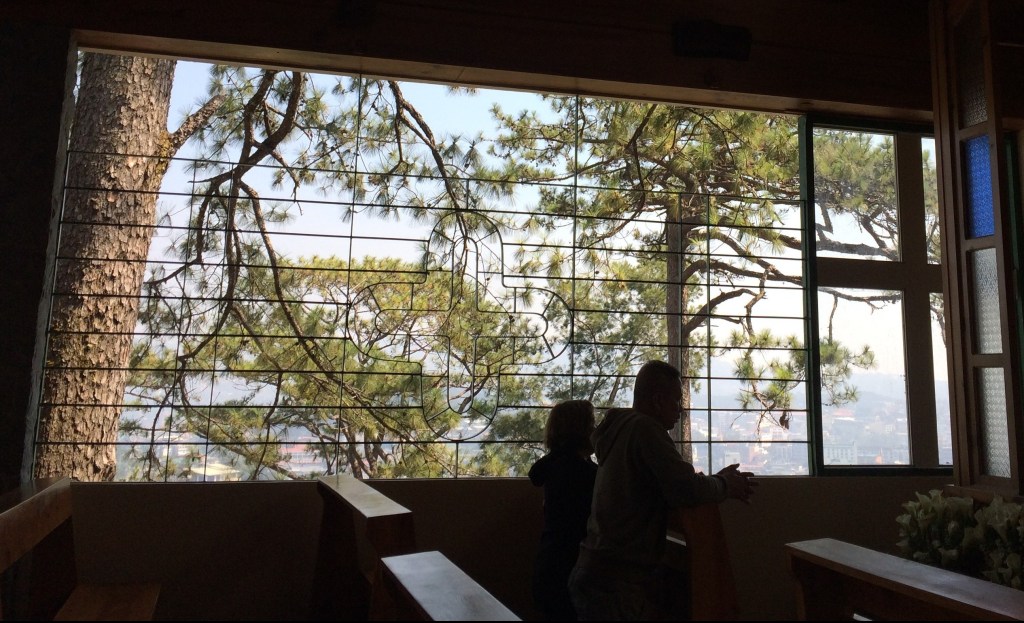
Photo by author, Our Lady of Lourdes Chapel, Baguio City, 2019.
While we are all very familiar with this parable, one thing needs to be clarified: many times we are indeed “persistent” in our prayers like that widow in the Lord’s parable but after a long time of praying, we wonder, even doubt God as nothing seems to happen to our prayers that remain unanswered.
So, what is to persist in prayer like that widow in the Lord’s parable?
The answer lies not entirely in the parable but in the conclusion by Jesus as presented by Luke:
The Lord said, “Pay attention to what the dishonest judge says. Will not God then secure the rights of his chosen ones who call out to him day and night? Will he be slow to answer them? I tell you, he will see to it that justice is done for them speedily. But when the Son of Man comes, will he find faith on earth?” (Luke 18:6-8)
We reflected last Sunday in the healing of the ten lepers that faith is a relationship expressed when we are grateful to God who blesses us as shown by the Samaritan leper healed. This Sunday, Luke deepens that truth that prayer is an expression of faith when he called Jesus as “Lord” at the conclusion of the parable.
First, we notice him telling us how “The Lord said”. Luke did not simply use his usual style of narration of “Jesus said” because in using the title “Lord”, he gives a solemn tone to the declaration by Jesus at the end of the parable where its lesson actually lies.
Moreover, it is the title “Lord” is what the disciples attributed to the Resurrected Christ; to call Jesus as “Lord” is to have complete faith in him.
Painting of “Parable of the Unjust Judge” by Pieter de Greber (1628) from Web Gallery of Art,http://www.wga.hu.
Second, when Luke wrote “The Lord said” in the conclusion of the parable, he was introducing a revelation to which we must all “pay attention” as the Lord demanded his listeners then. God is more than that unjust judge in the parable because as the Lord said, “he will see to it that justice is done for them speedily.”
Actually, the parable is not about praying unceasingly or persistently to obtain one’s favor because “the Lord said” God does not wait for his “chosen ones who call out to him day and night”; recall how Jesus had said in many instances that even before we ask God in prayers, he already knew what we needed. God is always speaking to us and we merely respond to him when we pray. That is why every time we pray, our prayer is already answered because we have responded to God. But, have we really listened to God in our prayers? This leads us to the important teaching of the Gospel this Sunday.
Third, the most important teaching in that conclusion of the parable of the persistent widow and unjust judge, Jesus our Lord teaches us that God does not only give justice but actually “does justice speedily” or swiftly.
“To do justice” in the Bible means more than rendering a fair judgment like in our courts; in fact, it means differently because “to do justice” biblically means “to justify”, “to renew”, and “to save” as Paul used extensively in his letters.
Therefore, to pray persistently is primarily to pray to be saved or justified. The main lesson of today’s parable is still faith – faith in God who saves us; faith in Jesus Christ our Lord who will come again to lead us to eternal life; and faith that must be reawakened in us always because without it, we cannot find salvation in God nor meaning in this life.
We pray not just to have things which God always knows so well even before we ask him. But, why still pray if God knows what we need? Because we do not know what God needs from us which is to pray always for him, to have him because he is our life, our salvation.
That is why we must persist in prayer and never lose heart because the moment we stop praying, the more we get discouraged in life, then we start doubting God and his love for us, his powers and beautiful plans for us. When this happens, everything falls and we alone suffer and lost.
Hence, the Lord’s challenge to each one of us today with his question at the end of the lesson of his parable, “But when the Son of Man comes, will he find faith on earth?”
To persist in prayer is not about wearing God down but of allowing our hearts to clarify our desires until we silently surrender to what God knows is best for us which is salvation, to be with him in eternity.
Since Jesus journeyed to Jerusalem, that has always been the most frequently asked question to him. And where can we find its answers? Right in the Sacred Scriptures as Paul reminded Timothy in the second reading: “All Scripture is inspired by God and is useful for teaching, for refutation, for correction, and for training in righteousness, so that one who belongs to God may be competent, equipped for every good work” (2Tim.3:16-17).
Photo by Mr. Nicko Timbol, Chapel of the Angel of Peace, OLFU-RISE, Valenzuela City, 03 October 2025.
When we fill ourselves with the Word of God, we are filled with God which is basically what holiness is. That is when we live in deep faith in God when our faith becomes so powerful and transformative because it is aligned with God and his Will as we reflected the other Sunday.
Therefore, to persist in prayers is also to align ourselves with God and his plans and agenda when we can declare like St. Paul that “It is no longer I who lives but Christ in me” (Ga. 2:20). As we have always said, prayer does not change things and situations; prayer changes the person primarily to be like Christ, to be faithful to God always.
Life is difficult, often like a battle with many enemies always attacking us. God is always with us, knows our needs so well but it is still us who shall fight the many battles in this life like the Israelites in the first reading. Without faith and prayer, we cannot fight our many battles in life like the Israelites who prevailed over the stronger forces of Amalek. We can only have the advantage in our many struggles and trials in life when we completely place ourselves under the banner of God in Jesus Christ. Amen. have a prayerful and faithful week ahead, everyone. Fr. Nicanor F. Lalog II, Our Lady of Fatima University, Valenzuela City (lordmychef@gmail.com)
Lord My Chef Daily Recipe for the Soul, 30 September 2025
Tuesday, Memorial of St. Jerome, Priest & Doctor of the Church
Zechariah 8:20-23     <*((((><  +  ><))))*>     Luke 9:51-56
Photo by author, Sacred Heart Novitiate, Novaliches, QC, 19 March 2025.
You were the first,
Lord Jesus Christ,
to teach us to have
the courage to be disliked;
you were the first
to show us true freedom
from what others say
to freely follow what God says;
you were the first
to suffer and die for love,
Lord Jesus Christ
because your being is always clear,
your mission is always clear,
and your love is most clear.
When the days for Jesus to be taken up were fulfilled, he resolutely determined to journey to Jerusalem, and he sent messengers ahead of him. On the way they entered a Samaritan village to prepare for his reception there, but they would not welcome him because the destinations of his journey was Jerusalem. When the disciples James and John saw this, they asked, “Lord, do you want us to call down fire from heaven to consume them?” Jesus turned and rebuked them, and they journeyed to another village (Luke 9:51-56).
You knew very well,
dear Jesus, what awaited you
in Jerusalem yet you "resolutely
determined to journey" there and
when trouble was brewing in a
Samaritan village, you simply
took another route to not waste
energy and time among
the Samaritans.
Grant me the same courage
and freedom, Jesus,
to be disliked,
to be rejected;
teach me to let go
of my past especially
my mistakes and failures,
choosing to be better
than bitter;
keep me anchored in you,
Jesus, of how much you love
me and believe in me so that
I do not have to seek other's
approval except that I am doing
your holy will; most of all,
teach me to be gentle and kind
with myself, that I am not God
who is perfect; like St. Jerome,
let me immerse in your words
to continue following you
despite my imperfections
as Zechariah prophesied.
Amen.

Fr. Nicanor F. Lalog II
Our Lady of Fatima University
Valenzuela City
(lordmychef@gmail.com)
Photo by author, Archdiocesan Shrine of Nuestra Señora De Guia, Ermita, Manila, 28 November 2024.
Lord My Chef Daily Recipe for Soul, 23 July 2025
Wednesday, Memorial of St. Bridget of Sweden, Religious
Exodus 16:1-5, 9-15     <*((((>< + ><))))*>     Matthew 13:1-9
Photo by Fr. Pop Dela Cruz, San Miguel, Bulacan, 2022.
Lord Jesus,
you are the Sower
and your seed is always good:
wherever it falls,
it grows;
most of all,
you are most good
as you never tire
of going out
to sow
your good seed!
“A sower went out to sow… Whoever has ears ought to hear” (Matthew 13:3,9).
“The Sower” painting by Van Gogh from en.wikipedia.org
Open my heart
and my soul, dear Jesus
to listen intently to your
word and be a "rich soil"
like St. Bridget of Sweden
whose devotion to family,
to her people especially the poor
and to Church reforms that led
to the return of the papacy to Rome
proved her to be a seed well sown;
there are times when I am just like
the path where your seeds fell
that fed only the birds;
quite often, I am like the rocky ground
so full of enthusiasm but wanes quickly
when challenges come;
worst of all, Lord Jesus,
free me from the many thorns
that steal me from you
that I stop maturing and growing;
let me be the rich soil who
receives you and your seed:
let your light of truth
and warmth of faith help me grow;
may your hope nourish me
especially when days are dark
and nights are long;
most of all,
water me with your love
and charity
to bear all
and be fruitful.
Amen.

Fr. Nicanor F. Lalog II
Our Lady of Fatima University
Valenzuela City
Lord My Chef Daily Recipe by Fr. Nicanor F. Lalog II
Sacred Heart Novena Day 2, 19 June 2025
Detalye ng painting ng Sacred Heart of Jesus sa Visitation Monastery, Marclaz, France mula sa godongphoto / Shutterstock.
Nakatutuwa itong ating wika. Mabulaklak na kahit hindi ka isang makata minsa’y di sinasadya ika’y nakakatha ng kahit maigsing tula.
Madalas ating mabasa sa mga panitikan at mapakinggan saan man kuwentuhan na tila baga itong puso ay nagsasalita gayong wala naman itong bibig. Mismo ang Panginoong Jesus noon ay nagsabi na “ano man ang bukambibig, siyang laman ng dibdib” (Mt.12:34 at Lk.6:45) upang ipakita ang pagkakadugtong ng puso at bibig tulad ng kaisahan nito sa ating kamay batay sa pagninilay kahapon.
Samakatwid, nangungusap nga itong ating puso. At iyan ang ibig kong pagnilayan ngayong ikalawang araw ng ating pagsisiyam para sa Dakilang Kapistahan ng Kamahal-Mahalang Puso ni Jesus. Ito ang sinasaad sa ating napakinggan ngayong araw na bahagi ng pangangaral ni Jesus sa mga tao mula sa kanyang sermon sa bundok.
“Sa pananalangin ninyo’y huwag kayong gagamit ngn napakaraming salita, gaya ng ginagawa ng mga Hentil. Ang akala nila’y pakikinggan sila ng Diyos dahil sa dami ng kanilang salita. Huwag ninyo silang tutularan. Sapagkat alam na ng inyong Ama ang inyong kinakailangan bago pa man ninyo hingin sa kanya. Ganito kayo mananalangin: ‘Ama naming nasa langit, sambahin nawa ang pangalan mo'” (Mateo 6:7-9).
Isa sa mga madalas na itanong sa akin ng mga mag-aaral dito sa Our Lady of Fatima University bilang kanilang chaplain ay alin daw ba ang dapat nilang pakinggan, sigaw ng puso o sigaw ng isipan?
Palagi kong tugon sa kanila ay ang pabirong paalala na unahin nilang pakinggan lagi ang sigaw ng kanilang mga magulang.
Pagkaraan ng ilang tawanan, saka ko binabalik sa kanila ang tanong sa ibang anyo naman: humihiyaw nga ba ang puso gayong ang pagtibok nito ay napakahina? Hindi kaya sa pakikipag-usap sa atin nitong ating puso, ang ibig nito ay taimtim na pakikinig dahil kung ito ay mangusap, madalas ay pabulong.
Larawan kuha ng may-akda, Atok, Benguet, 27 Disyembre 2024.
Mag-imagine tayo kunwari ay naroon tayo sa bundok sa sermon ni Jesus. Siguradong malakas ang tinig niya sa pangangaral ngunit sa aking pakiwari mayroong indayog ang kanyang pananalita na kung saan minsan-minsan marahil siya ay bumubulong katulad nitong sa pagtuturo niya kung paano tayo mananalangin. Mahigpit ang kanyang bilin na huwag tutularan mga Hentil na napakaraming sinasabi sa Diyos sa pakiwaring sila ay pakikinggan. Hindi natin kailangang maging maingay at daanin sa dami ng sinasabi ang Diyos bagkus higit na mainam ang pananahimik upang mapakinggan sinasabi sa atin ng Diyos. Sinabi na ni Jesus na alam ng Diyos ating pangangailangan bago pa man tayo dumulog sa kanya sa pagdarasal. Kaya tayo nagdarasal ay upang pakinggan kalooban ng Diyos.
Kaya gumagamit ng stethoscope mga duktor at nurse kasi nga mahina ang tinig ng puso natin. At yon ang unang kinakailangan sa pananalangin – katahimikan upang Diyos ay mapakinggan!
Kung ang puso man ay humihiyaw, marahil wala na tayong masyadong alitan at mga kaguluhan dahil tiyak ating maririnig at mapapakinggan bawat pintig ng puso na iisa ang sinasabi kungdi ang tayo ay magmahal nang tunay. Ito ang buod ng “Ama Namin” at lahat ng mga panalangin. Ang pag-ibig ng Diyos sa ating lahat na ating tinutugunan ng pagmamahal sa ating kapwa dito sa lupang ibabaw lalo na sa pagpapatawad sa kanilang pagkakasala sa atin.
Sa Kamahal-Mahalang Puso ni Jesus, doon ay malinaw na inihahayag ang dakilang pag-ibig ng Diyos sa ating lahat ngunit walang nakikinig dahil mas nahahalina ang marami sa malalakas at maiingay na tinig ng daigdig. Ito yung ikinalulungkot ni San Pablo sa mga taga-Corinto sa unang pagbasa ngayon dahil napakadali nilang nalinlang at napasunod sa mga kakaibang turo ng ibang nangangaral sa kanila. Katulad din natin ngayon na maraming nagpapaniwala at nahahalina sa mga kung anu-anong kaisipan ng mundo gaya ng new age at wokism at iba pang mga ideya na wala nang pakialam sa Diyos at moralidad gaya ng relativism na siyang sanhi ng paniniwala sa same sex marriage at abortion.
Larawan kuha ng may-akda sa Liputan, Meycauayan, Bulacan, 31 Disyembre 2022.
Imagine din natin na first time napakinggan ang panalanging “Ama Namin.” Malamang pabulong at marahang binigkas ni Jesus ang mga titik ng panalanging ito upang tumimo ng higit sa puso at kalooban ng mga tagapakinig.
Kakaibang kaisipan noon iyon sa mga Hudyo sapagkat ang Diyos sa pagkakaalam nila ay makapangyarihan at hindi maaabot doon sa langit. Ngunit kay Jesus, malapit ang Diyos tulad ng sino mang ama sa lupa. Isang personal at mapagmahal na parang tao ang Diyos na pinakilala ni Jesus sa kanila at maging sa atin ngayon kaya mas malamang ay malumanay na malumanay ang pagbigkas ni Jesus lalo ng “Ama naming nasa langit” dahil puno ng pagmamahal at pag-galang. Hindi ba noong una tayong ma-in love ay tahimik din tayo? Hindi natin pinagsasabi yung pers lab natin?
Ayon sa mga dalubhasa sa bibliya, mas mahaba ang tala ni San Mateo sa pagtuturo ni Jesus ng “Ama namin” kesa sa bersiyon ni San Lukas; layunin anila ni San Mateo na ituro ang ating disposisyon sa pananalangin habang si San Lukas naman ang tuon ay naroon sa laman ng ating dasal.
Sa madaling sabi, pagmamahal ang disposisyon nating dapat sa pananalangin di lamang ng “Ama namin” kungdi mismo sa ating pakikipag-ugnayan sa kapwa na siyang paghahayag ng ating ugnayan sa Diyos.
Ang Ama namin at lahat ng pananalangin ay paghahayag ng ugnayan kaya ang mga ito ay dinarama, nilalasap dahil ito ay isang karanasan na pinaninindigan at pinatutunayan sa mabubuting gawa.
Noong bata pa tayo at wala pang kamuwang-muwang sa mga kalokohan at kasamaan ng mundo, napakadali nating napapakinggan bulong ng puso na magmahal, makipag-bati, magsorry, magsabi ng please at thank you, at maging mabuting tao. Subalit sa ating pagtanda, atin nang tinuturuan ang puso natin ng sariling kagustuhan na dapat laging sundin at pakinggan. Magsinungaling kung kinakailangan.
Masaklap na bunga nito ang ating pagkakawatak-watak. Hindi maramdaman ang ating ugnayan dahil maraming ayaw nang magmahal, ayaw nang kilalanin bawat isa bilang kapatid at kapwa sa iisang Ama nating Diyos.
Ngayong ikalawang araw sa ating pagnonobena sa Sacred Heart, matuto tayong muli na manahimik at makinig sa tinig at pintig ng puso natin upang muli tayong makiniig sa Diyos na Ama natin. Kapag muli nating ninamnam ang katotohanang ito, mapagtatanto na rin natin ang ating kapatiran sa iisang Ama kay Kristong kapatid natin.
Sa ating panahong napaka-ingay at kay dami-daming nag-aagawan sa ating atensiyon upang pakinggan at sundin, marahil ay humihiyaw na nga itong puso natin ng pabulong dahil hirap na itong maiahon ang katotohanan ng pag-ibig na ating ibinaon. Pagmasdan paanong palaging kalakip ng debosyon sa Mahal na Puso ni Jesus ang pagtitika sa mga kasalanan at pagbabalik-loob sa Diyos at kapwa. Kasi nga, ang magkasala ay hayagang pagtanggi natin na magmahal. Iyon ang salita at pangungusap tuwina ng puso – magmahal, magmahal, at magmahal pa rin! Manalangin tayo:
O Jesus na mayroong
maamo at mapagkumbabang Puso,
Gawin Mong ang puso nami'y
matulad sa Puso Mo!
Amen.
40 Shades of Lent by Fr. Nicanor F. Lalog II
Tuesday, First Week in Lent, 11 March 2025
Isaiah 55:10-11     + + +     Matthew 6:7-15
Photo by author, 10 March 2025.
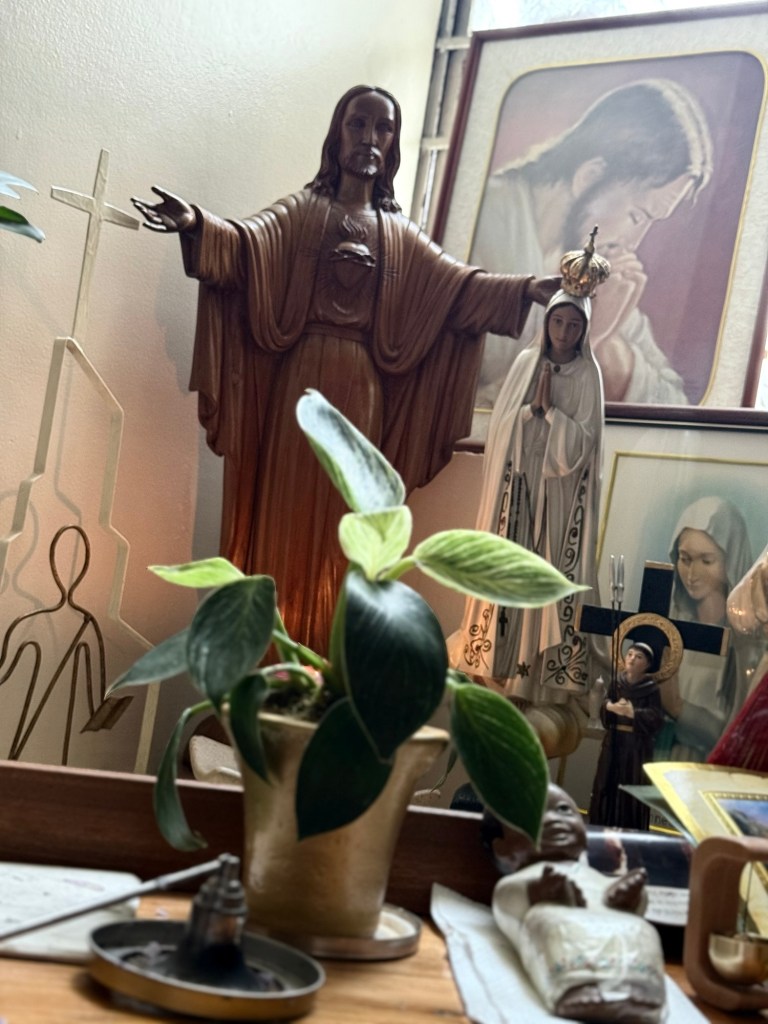
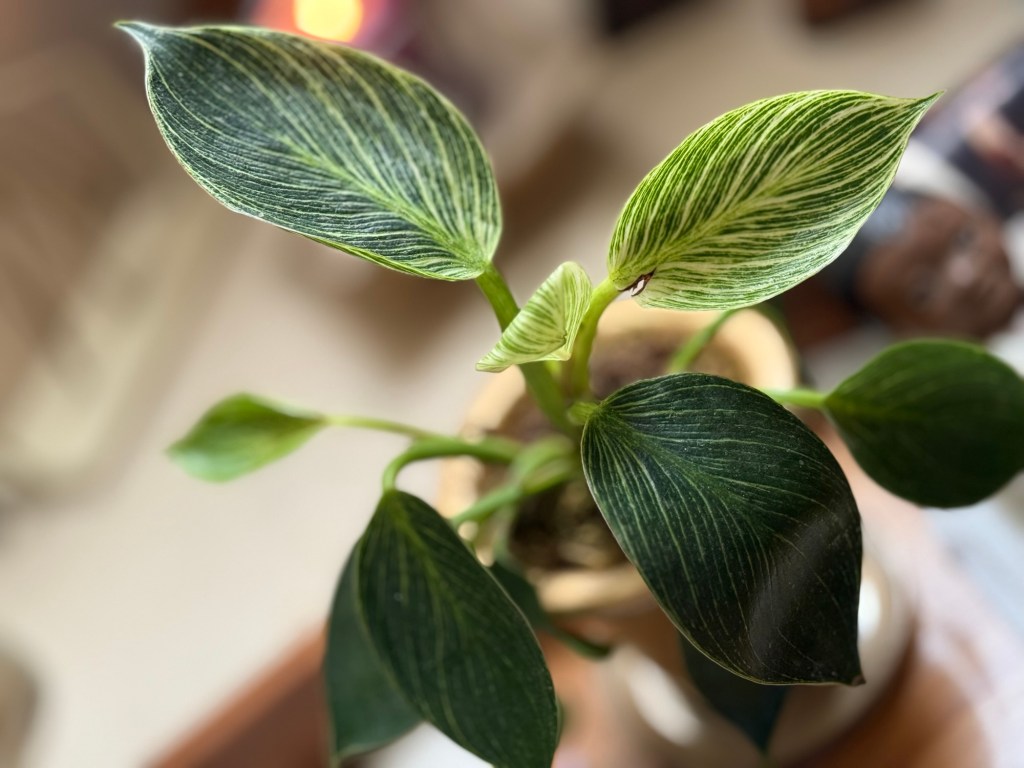
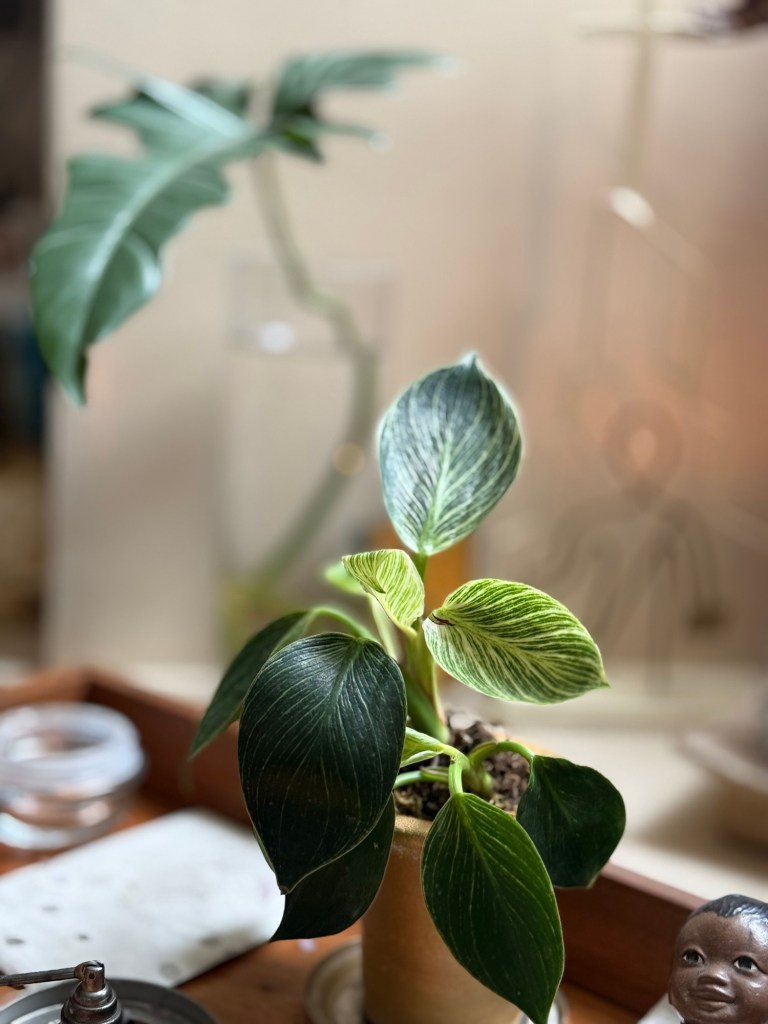
How lovely,
dear Jesus that every time
I receive a plant or flower from anyone,
automatically I offer them to you
on my prayer altar;
and here now,
my newest plant "abloom"
with my prayer today!
Thus says the Lord: Just as from the heavens the rain and snow come down and do not return there till they have watered the earth, making it fertile and fruitful, giving seed to him who sows and bread to him who eats, so shall my word be that goes forth from my mouth. It shall not return to me void, but shall do my will, achieving the end for which I send it (Isaiah 55:10-11).
Photo by author, 10 March 2025.
In a few days
I am turning 60 years old
and in a month,
I shall have been a priest for 28 years;
in all those years, Lord,
it is prayer that has sustained me,
that has nourished me,
that has always been my life
even many times I never
knew it;
you have nurtured me in prayers
that at first was like a chore
taught to me by my parents
that later like a rain -
sometimes an outpour,
many times a drizzle,
and most often just a dew
to keep me moist.
Photo by author, 10 March 2025.
Keep me fertile like
the soil, Jesus,
and keep my leaves green
even without flowers
or fruit;
just keep me soaked
in your words,
gently, subtly and
intimately to quench
my thirst for you,
for meaning,
for life
that in the end,
I come and open myself
daily to God in your prayer,
saying,
"our Father".
Amen.
The Lord Is My Chef Sunday Recipe for the Soul by Fr. Nicanor F. Lalog II
Eighth Sunday in Ordinary Time, Cycle C, 02 March 2025
Sirach 27:4-7 ><}}}}*> 1 Corinthians 15:54-58 ><}}}}*> Luke 6:39-45
The last time we have celebrated the eighth Sunday in Ordinary Time Cycle C was in 2001 when just like this year, the Season of Lent started late in March. In fact, the other last two Sundays of sixth and eighth in Cycle C were last celebrated in 2010 and 2007, respectively.
It is worth noting this because as Jesus delivered his Sermon on the Plain, we find that contrary to claims by many in this modern time, the teachings of Christ are actually taken directly from life as he reveals to us the truth in our hearts. Two Sundays ago, Jesus taught us the paradoxical happiness of our lives, of being poor, hungry, weeping, and maligned than rich, filled, laughing and well-spoken of; last Sunday, he taught us of the need to love truly that is rooted in God by loving without measure, loving even our enemies.
This Sunday, Jesus tells us something we often debate about as it usually puts us into a bind even a quandary on what to say and do.
Jesus told his disciples a parable, “Can a blind person guide a blind person? Will not both fall into a pit? Why do you notice the splinter in your brother’s eye, but do not perceive the wooden beam in your own eye? How can you say to your brother, ‘Brother, let me remove that splinter in your eye,’ when you do not even notice the wooden beam in your own eye? You hypocrite! Remove the wooden beam from your eye first; then you will see clearly to remove the splinter in your brother’s eye” (Luke 6:39, 41-42).
Photo by author, Hidden Valley Springs Resort, Calauan, Laguna, 20 February 2025.
Very often in many instances, most of us choose to be quiet than speak out against evil and other irregularities among us and in our society because of this teaching of the Lord. Many are afraid to notice the splinter in the brother’s eye lest they too might have a wooden beam blocking their views of themselves.
And that is why, evil persists everywhere that eventually, many of us become silent partners in the many sins happening around us which is very far from the demands of Jesus for us to choose what is right and good, to always make a stand for him even on the Cross.
See the flow of the Sermon on the Plain, of how Jesus is first of all never condemning nor judgmental of anyone. We have reflected his four “woes” were actually invitations for the rich et alii to change their ways in life, to think more of things that do not pass like wealth and other material things.
Secondly, last Sunday, Jesus directed our intentions into our hearts, to probe our hearts and find his grace of supernatural or divine love poured in there so that we can love selflessly without measure like him.
This Sunday, Jesus still directs us into our hearts, to examine whether we are truly his disciple or a hypocrite as someone who says something yet does the opposite. It is not opposite his exhortation last week for us to be merciful like God our Father rather a challenge to examine what we practice, our Christian praxis.
“A good tree does not bear rotten fruit, nor does a rotten tree bear a good fruit. For every tree is known by its own fruit. For people do not pick figs from thornbushes, nor do they gather grapes from brambles. A good person out of the store of goodness in his heart produces good, but an evil person out of a store of evil produces evil; for from the fullness of the heart the mouth speaks” (Luke 6:43-45).
Photo by Mr. Lorenzo Atienza, leftmost section of the stained glass at the National Shrine of Our lady of Fatima in Valenzuela City, 25 February 2025.
It is clearly a lesson in holiness, in integrity of every disciple! Do we walk our talk? The most basic norm of morality is that what we know in our mind and what we feel in our heart is what we say and therefore what we do.
Where are we now? Everybody is speaking about corruption while the devils celebrate everywhere as we are all entangled in all forms of corruption not only in the streets and government offices but even in our homes, in schools and offices and yes, right inside the church in many parishes.
Now we come full circle with Christ’s opening to his parable, Can a blind person guide a blind person? And this is what is now happening in the world, in our lives, in our country and in our parishes. Nobody would want to speak because nobody would want to examine one’s heart and follow the path of Jesus.
It is in our deeds that one is recognized as a true disciple. Let us not forget that. And let us not be afraid to examine constantly the value of our many ways and practices.
Photo by author, St. Paul Spirtuality Center, Pico, La Trinidad, Benguet, 05 January 2025.
One of the famous bishops and saint both recognized by the Eastern and Western Churches is St. John Chrysostom who served as Archbishop of Constantinople until the early 400’s. He is called the “golden mouthed” because of his gift in eloquence most true in his witnessing Christ, always meaning what he said like in this homily that sounds so 2025:
The Church is in an extremely critical state, and you think that all is going well. The fact is that we are plunged into countless sins, and we do not even know it!
You wonder why. We hav e churches, money, and everything else. There are places for assembly, people come there everyday; surely this is not nothing?
But it is not thus that we judge the state of the Church. Then how?, you ask.
Whether we lead a truly Christian life. Whether everyday we make ourselves spiritually more rich, bearing fruit, whether great or small; if we are not content simply with flfilling the law and expediting our religious duties.
Who is a better person, after having frequented the church all month?
This is what we must look for! After all, even what appears to be a good action is only a bad action, when one does not follow it up… If we bring nothing to fruition through it, it would be better to stay home (from Days of the Lord, vol. 6, page 62).
Photo by Mr. Lorenzo Atienza, 25 February 2025.
The kind of life we lead is the final test of our discipleship, the proof of what is in our hearts. St. Francis of Assisi used to tell his followers whenever they would preach to use only their mouth if necessary. Our actions speak louder than our words.
This is the biggest problem in the Church today: our lack of credibility as bishops and priests when our lives are far from what we say and teach.
God shared with us his power of the words. In the Bible, we find how his words and his being are always one since the story of creation into the coming of Jesus Christ who could heal with just mere words being the word who became flesh.
This is the whole point of Ben Sirach in our first reading this Sunday, reminding us that inasmuch as the potter knows the quality of his work after it has passed through fire, the same thing is most true with our words. We have to harness and master our speech, our words so that we walk what we talk.
We master our power of the words in our prayer life as St. Paul assured us in today’s second reading how in the Lord our labor is not in vain (1 Cor. 15:58). Let us pray to the Holy Spirit especially this Sunday as we approach the Season of Lent with Ash Wednesday. Let us keep our zeal for Christ not nonly for his words and teachings but most especially in his life and witnessing. Amen.See you at Ash Wednesday.
Campus Ministry, Our Lady of Fatima University, Valenzuela City.














 lordmychef.com