Advent is when “great things” happen from God

The Lord Is My Chef Simbang Gabi Recipe for the Soul by Fr. Nicanor F. Lalog II
Wednesday, Simbang Gabi 7, 22 December 2021
1 Samuel 1:24-28   ><]]]]'> + <`[[[[><   Luke 1:46-56
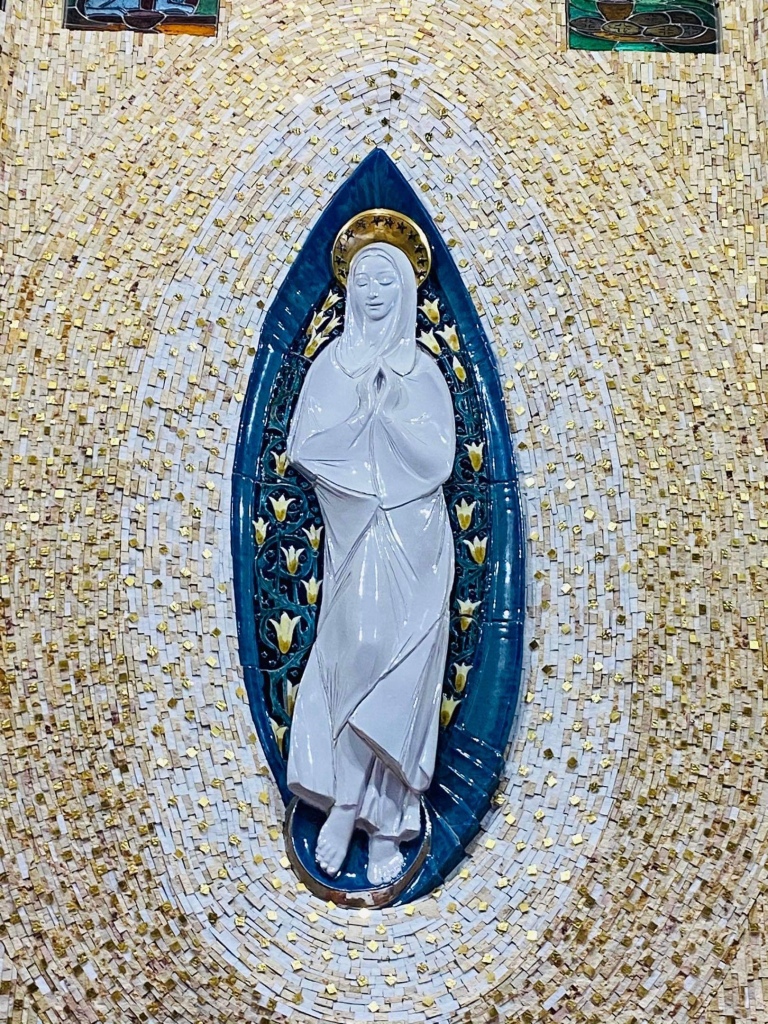
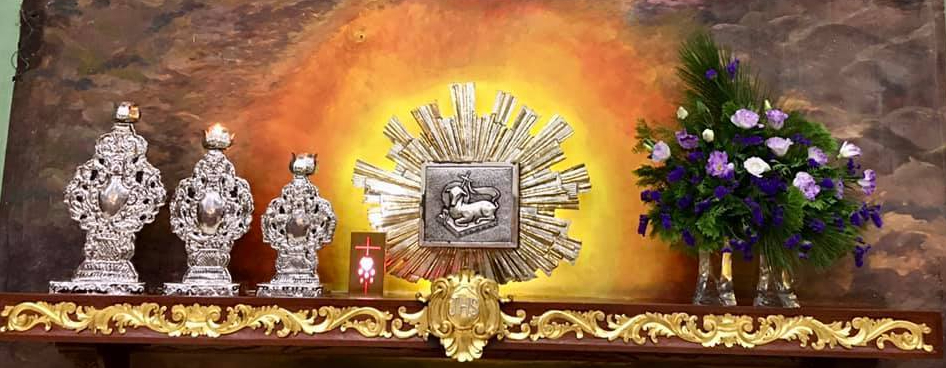
Photo by Rev. Fr. Gerry Pascual at Santuario di Greccio, Rieti, Italy in 2019.

Every evening in our Vespers or Evening Prayer, we priests along with monks and sisters and other devout men and women around the world recite or sing Mary’s Magnificat as a fitting tribute to God’s many great blessings showered upon us at the end of each day.

It is the first song or canticle Luke had placed on the lips of his three major characters in the story of Christmas: Mary, then Zechariah singing the Benedictus upon recovery of his speech after naming his child John according to the angel’s instruction, and thirdly by Simeon singing the Nunc Dimittis at the Presentation of Jesus at the Temple.

These are all praises to God who gives us his biggest blessing in his Son Jesus Christ whose birth we celebrate this Christmas. As I have told you, we sing or recite it in the evening to cap the day as a praise and thanksgiving for the wondrous things God has given us each passing day.

Mary said, “My soul proclaims the greatness of the Lord; my spirit rejoices in God my savior. For he has looked upon his lowly servant. From this day all generations will call me blessed; the Almighty has done great things for me, and holy is his name.”

Luke 1:46-49

In normal circumstances specially among us peoples, whenever we are praised by somebody else, it is customary – even obligatory – that we return their praises.

But not with Mary during her Visitation of her cousin Elizabeth.

After being praised and called as “blessed among women for she believed the words spoken to her would be fulfilled”, Mary in turn praised God instead of Elizabeth because her Magnificat was not only her song but also of Elizabeth and every believer of Jesus Christ as the Son of God who became human to redeem us.

Reminiscent of the canticle by Hannah after the birth of her son Samuel whom we heard offering him to Eli in the first reading, Mary’s Magnificat was borne out of her own experience of God doing great things to her and Elizabeth as individuals which she later widened to include the many “great things” done by God to the Israel as a nation like their Exodus from Egypt and later liberation from Babylonian exile.

“He has mercy on those who fear him in every generation. He has shown the strength of his arm, and has scattered the proud in their conceit. He has cast down the mighty from their thrones and has lifted up the lowly.”

Luke 1:50-52

Now in the advent of Jesus Christ, Mary proclaims the good news of salvation in her Magnificat by singing how God has continued doing great things to her and to everyone with something unheard of, so unique and completely different from those great things he had done in the past to give Israel – and us – a future and much to hope for:

He has filled the hungry with good things, and the rich he has sent away empty. He has come to help of his servant Israel for he has remembered his promise of mercy, the promise he made to our fathers, to Abraham and his children forever.”

Luke 1:53-55

Here we find again the artistry of Luke working so beautifully, so similar with that event at the synagogue in Capernaum where Jesus inaugurated his ministry by proclaiming the passage from Isaiah that said “The Spirit of the Lord is upon me, because he has anointed me to bring glad tidings to the poor…” (Lk.4:18ff).

In Christ’s coming through Mary, God begins a totally new beginning for everyone for all time!

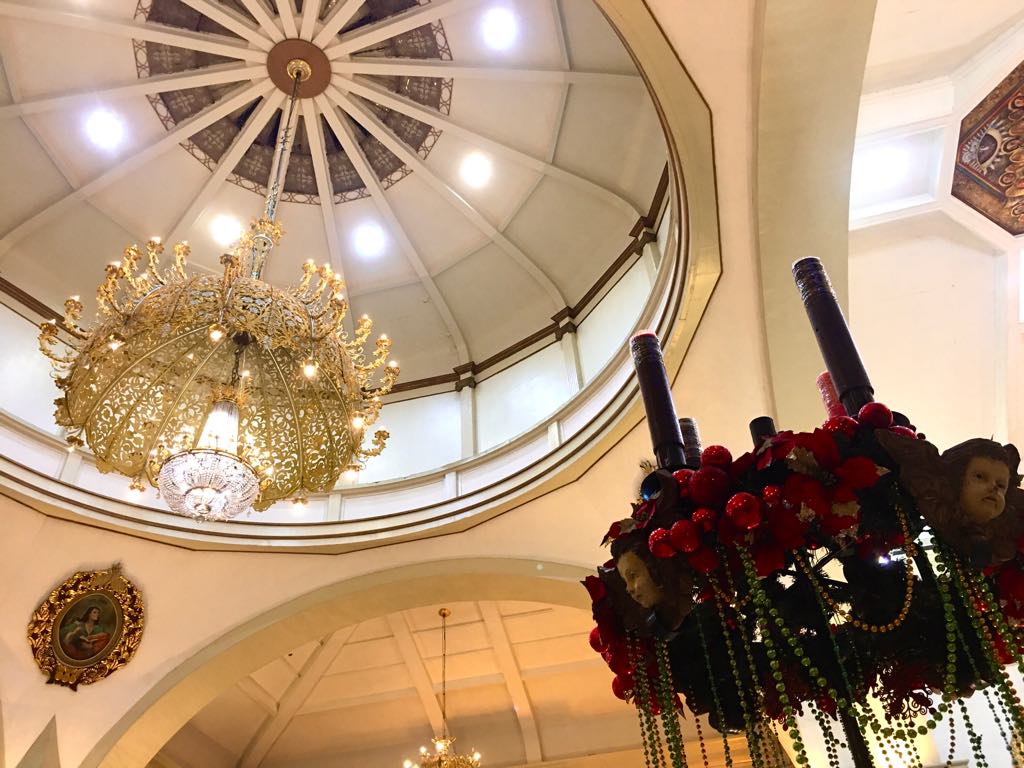
Photo by author, 20 December 2021.

This Advent, we are reminded of God’s many “great things” done to us individually and as a family, as a nation and as a community, and as a Church.

We are now celebrating the 500th year of our Christianization but does it really matter to us? Are we really thankful to God in making us not only Christians but the only Christian nation in this part of the globe? While we are still in our 500th year of Christianization, let us reflect deeply on this giftedness by God to us as a nation and the great tasks and responsibilities he had given us in spreading the good news like Mary.

But at the same time, Advent invites us to look forward to the future in every present moment when Christ comes to fulfill God’s plans of great things for us.

Are we willing to take the challenge and invitation of God to accept his Son Jesus Christ and bring him forth like Mary into this world so lost in darkness? Do we have a room or a space in our hearts where Jesus may come and grow to fulfill God’s many great things being planned for us and others?

Mary sang the Magnificat not only her lips but with her very life as a witness to God doing great things for her and for others.

May we be like her in giving praise and thanks to God with our very lives of witnessing to Christ’s presence. Amen.

Have a blessed Wednesday!

Advent is God’s transforming presence

The Lord Is My Chef Simbang Gabi Recipe for the Soul by Fr. Nicanor F. Lalog II
Monday, Simbang Gabi 5, 20 December 2021
Isaiah 7:10-14   ><)))*> + ><)))*> + ><)))*>   Luke 1:26-38
Photo by author, an altar near the Chapel at the site of the Annunciation below the Basilica of the Annunciation, Nazareth, Israel, 2019.

We are now at the final stretch of the week leading to Christmas as cash registers ring following the renewed economic activities with the lowering of COVID cases this month after a long lull since this pandemic began early last year.

Though the commercial hubbub is all around us, let us not forget that unlike the commercial green and red shades of Christmas, our Advent color is violet like Lent to signify the spirit of penance though in a more subdued manner. Amid our busy schedules, let us not forget that Advent is a preparation of our inner selves, of our interior disposition for a deeper meaning and nature of Christmas. With still a week to go, we are invited to empty our selves of sins, of pride and of other excess baggages so we can create a space for Christ’s coming right in our hearts, like our Blessed Virgin Mary.

In the sixth month, the angel Gabriel was sent from God to a town of Galilee called Nazareth, to a virgin betrothed to a man named Joseph, of the house of David, and the virgin’s name was Mary. And coming to her, he said, “Hail, full of grace! The Lord is with you.” She was greatly troubled at what was said and pondered what sort of greeting this might be.

Luke 1:26-29
Photo by author, site of the Annunciation beneath the Basilica of the Annunciation at Nazareth, Israel, 2019.

One of the most beautiful characteristic of Mary as a disciple is her openness to God. She always had that empty space in her solely for God, an inner disposition nurtured by her deep prayer life.

See the very solemn narration by Luke of the Annunciation, specifically mentioning to us the time, place, persons and circumstance involved in this “sacred moment” we have reflected yesterday. Mary must have been deeply in prayer when the angel came, a sign she was always attuned with God.

Notice that next to her surprise with the coming of the angel with the good news was her “pondering” what sort of greeting that might be. What an image of the Blessed Mother disposed to God’s calling and plans that immediately during her conversations with the angel, she was already reflecting on the meaning of the message. No hesitations or whatsoever. Just clarifications but willing to obey.

Luke tells us in other instances how Mary would “ponder” on words and events in her life like when the shepherds came to visit her newly-born child Jesus and after finding Jesus at the temple. Mary would always ponder the words and events that came her way, an indication of open acceptance, of a welcoming attitude to God’s works and wonder.

Photo by author outside Basilica of the Annunciation, Nazareth, 2019.

Her pondering on the words of the angel Gabriel was very significant; we can’t help compare her attitude to Zechariah who was made mute after questioning the angel’s announcement his wife Elizabeth would bear a child six months earlier.

There’s nothing wrong asking God and seeking clarifications with his plans for us but, never challenge and dare him like Zechariah who doubted the good news brought to him by the same angel Gabriel whose name means “the presence of God.”

But Mary said to the angel, “How can this be, since I have no relations with a man?” And the angel said said to her in reply, “The Holy Spirit will come upon you, and the power of the Most High will overshadow you. Therefore the child to be born will be called holy, the Son of God… for nothing will be impossible for God.”

Luke 1:34-35, 37

In asking the angel “How can this be”, we find in Mary an honest and sincere, an innocent question already inclined to accept and cooperate with the plan. In fact, Mary indicated no resistance at all to the plan to be the Mother of Jesus – she just wanted to know the “script” or her role in the Divine plan of the Incarnation.

It is here where we find the transforming presence of God coming upon her at that moment when the angel told her “The Holy Spirit will come upon you, and the power of the Most High will overshadow you”.

What a picturesque description that only an artist like Luke could express so vividly well.

The Holy Spirit will come upon you – God coming down to her, becoming present in her. And the power of the Most High will overshadow you – that is the clincher!

Look at the wonderful flow and unfolding of the Incarnation: a coming down, a descent of the Holy Spirit and an overshadowing of the power as some sort of being “possessed” by the Divine! Observe how Luke would repeat in his second book, the Acts of the Apostles the same sequence of coming down of the Holy Spirit and overshadowing of the Apostles with Mary!- at the Pentecost in Jerusalem. Their striking similarities remind us of the tremendous grace and power coming upon us when like Mary and later the Apostles we entrust our total self, including our future to God. It is only then when God’s transforming presence begins to work wondrously among us.

Photo by Ezra Acayan of Getty Images, February 2020 in Baclaran Church.

Too often, we feel uncomfortable and even not amenable to being overwhelmed by another. Our sense of independence is so strong, deeply ingrained in us even in childhood when we would always assert our very selves, insist on what we want that along the way, we also feel very suspicious of anyone trying to get too close, too soon with us.

It is funny that even with too much presence in social media like Facebook, we get that feeling of being violated or at least slighted by someone too close for comfort in posting and commenting on our walls.

At the Annunciation, we find Mary personally giving her yes to God, calling herself the handmaid of the Lord to let his will be done upon her. And the rest is history. That is why we have this joyous season of Christmas today when Mary allowed herself to be overwhelmed, transformed by Christ’s presence in her womb.

While we were so busy with our Simbang Gabi and Christmas preparations last week, another powerful typhoon battered the southern part of our country resulting in many losses of lives and properties. So typical of the stronger than usual typhoons hitting our country this past decade in this part of the year, it makes us wonder where is God amid all these things happening while we are in a pandemic.

Where is the transforming presence of God in this time of pandemic and calamities and inanities of so many gunning for the top positions of the land?

Photo by author, 2019.

We need not look far and beyond us. Like Mary, let us look into our hearts to see if there is room in my life for God. Recall in the Book of Genesis how out of chaos God’s transforming presence created everything good and, how in the darkness of Israel’s and mankind’s history came the Christ.

In this time of darkness and calamities, God is very much present among us, so raring to transform the world and our lives to something better. But, is there anyone among us willing to be like Mary telling God, “I am the servant of the Lord; may it be done to me according to your word”?

To transform this world into a better one, let us first be transformed in Jesus Christ. With Mary. Amen.

Have a blessed Monday!

Advent is “sacred moment” with God visiting us

The Lord Is My Chef Sunday Recipe by Fr. Nicanor F. Lalog II
Fourth Sunday of Advent-C, Day 4 of Simbang Gabi, 19 December 2021
MIcah 5:1-4  ><}}}*>  Hebrews 10:5-10  ><}}}*>  Luke 1:39-45
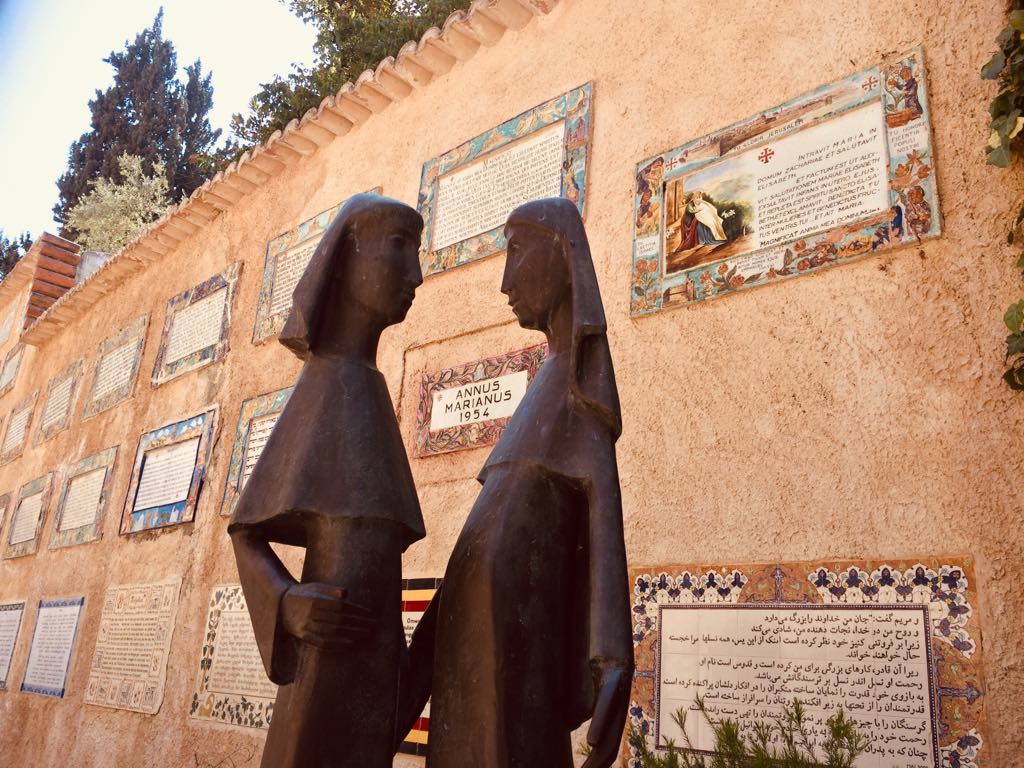
Photo by author, bronze statues of Mary and Elizabeth at the patio of the Church of the Visitation at Ein Karem, Israel, 2017.

We are now in the fourth Sunday of Advent, the final stretch leading to Christmas. Part of that shift in focus of readings and prayers since December 17, we hear today the lovely story of Mary’s Visitation of Elizabeth.

It is very rare in the bible to find a story of two women meeting and conversing, especially women of faith sharing God’s joy and blessings like Mary’s visitation of her cousin Elizabeth six months pregnant with John the Baptist, the Precursor of Jesus Christ.

It is a very wonderful occasion in this Season of Advent when God visits his people before finally coming to dwell with us at the birth of Jesus Christ.

This early through Mary, Elizabeth felt strongly God’s coming and visitation – a sacred moment, a blessed period of encountering God in our selves and through others.

When Elizabeth heard Mary’s greeting, the infant leaped in her womb, and Elizabeth, filled with the Holy Spirit, cried out in a loud voice and said, “Blessed are you among women, and blessed is the fruit of your womb. And how does this happen to me, that the mother of my Lord should come to me? For at the moment the sound of your greeting reached my ears, the infant in my womb leaped for joy. Blessed are you who believed that what was spoken to you by the Lord would be fulfilled.”

Luke 1:41-45
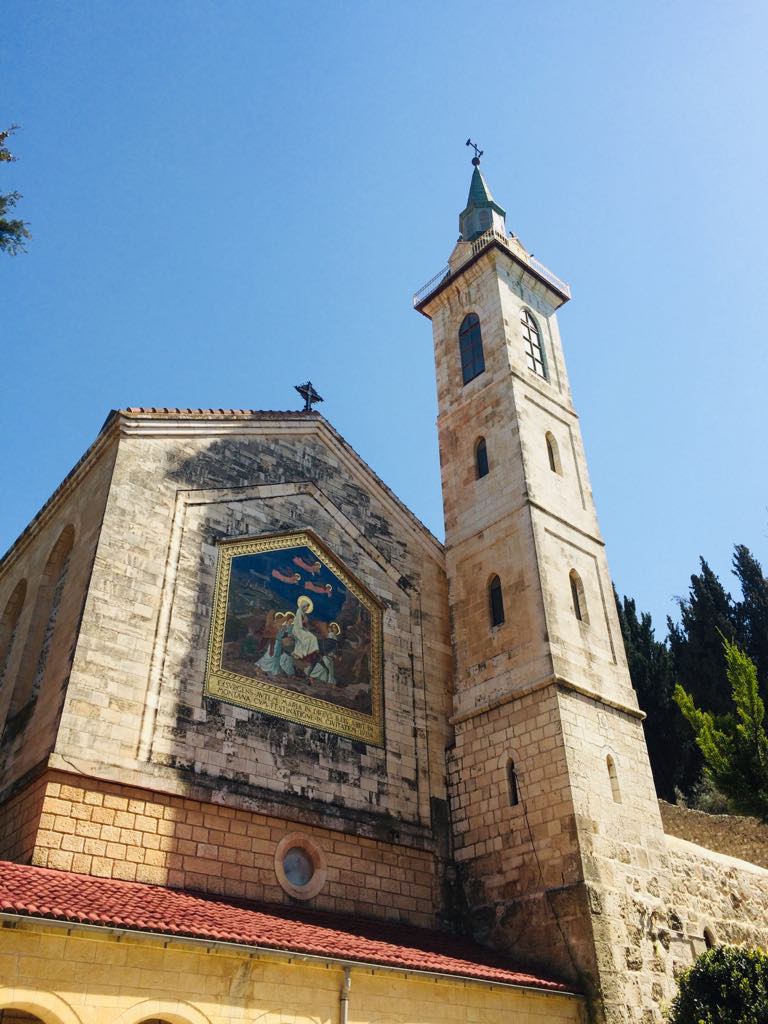
Photo by author, facade of the Church of the Visitation at Ein Karem, Israel, 2017.

Christmas is a story of love, about the meeting of lovers with God as the Great Lover who gave us His only Son because of His immense love for us. That is why it is also a sacred moment, a blessed and holy moment!

Recall that time you fell for and truly loved someone so special: every moment is so sacred and divine, so special because you know something extraordinary had happened, is happening and would soon be unfolding when this love grows and matures!

You feel humbled by the occasion why would somebody so wonderful choose to love you, recognize you, and find you special among many others. It is very touching, bringing kilig moments.

How unfortunate these days this love of Christmas so sacred has been cheapened and degraded into superficial and romantic love about mere feelings and emotions that are physical and sexual in nature as we hear in “I Saw Mommy Kissing Santa Claus”, “Last Christmas” and “Pasko na Sinta Ko”.

The word “lovers” may be too serious as a term for us to relate this with today’s gospel but, the truth is, both Mary and Elizabeth were so in love with God who clearly loved them so much with children in their womb bound to change the course of human history forever. They in turn, were also filled with love for each other as expressions of their love for God. And when there is love, there is holiness or sacredness that is always manifested in God’s tenderness which is the most endearing description of God’s love and mercy.

At the Visitation, both Mary and Elizabeth felt God working in them, doing great things in them despite their being women at that time and unfortunately until now when women are always looked down upon by our patriarchal and chauvinistic culture and society.

Both women felt so loved by God, especially Elizabeth who was filled with the Holy Spirit to say, “And how does this happen to me, that the mother of my Lord should come to me? For at the moment the sound of your greeting reached my ears, the infant in my womb leaped for joy. Blessed are you who believed that what was spoken to you by the Lord would be fulfilled.”

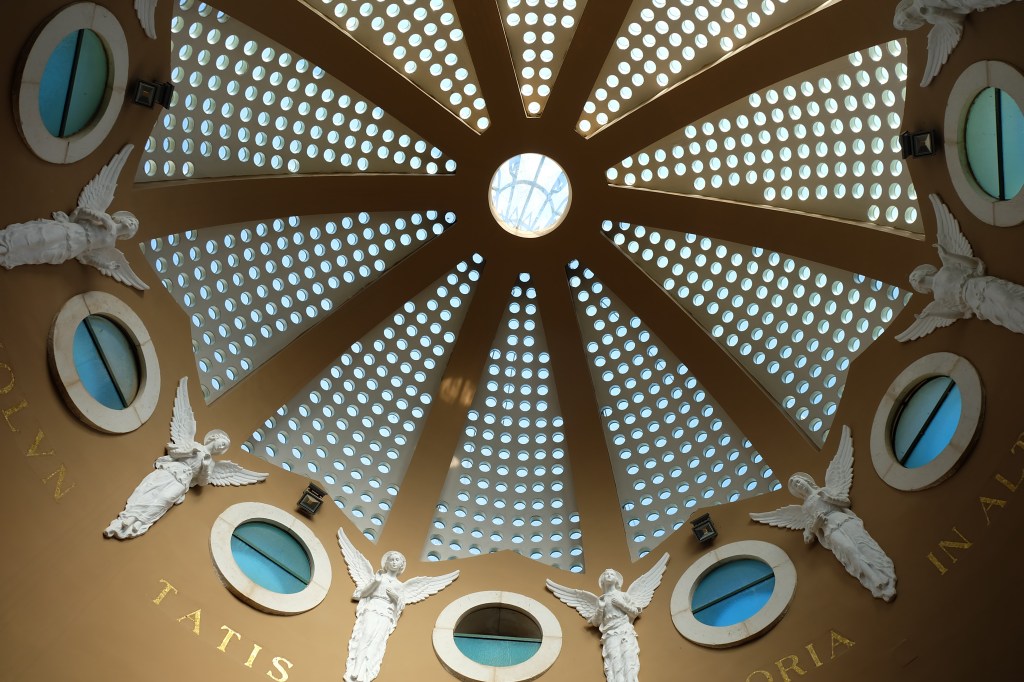
Photo by author, ceiling of the Church of the Visitation at Ein Karem, Israel, 2017.

Elizabeth had perhaps been accustomed to seeing herself as the one who was barren and therefore also shamed. All her adult life as wife of Zechariah the priest, she had carried a burden or “excess baggage” in her mind and identity that she could never forget that is why Luke tells us how she went into seclusion after conceiving John:

After this time his wife Elizabeth conceived, and she went into seclusion for five months, saying, “So has the Lord done for me at a time whe he has seen fit to take away the disgrace before others.”

Luke 1:24-25

Her life had a complete reversal and turn around when she conceived John and that is why at the Visitation, she was so amazed with God, recognizing the honor and privilege given to her to be in the story of the coming of Christ.

Elizabeth had no idea she could mean so much in the plan of God, asking “who am I?” that all these great things could happen to her, having a child at so late an age and now visited by the Mother of the Lord, wondering what is going on? Something so big, so great is happening and she just could not grasp it!

We all have such “sacred moments” with God when we felt so loved, so blessed that we feel so humbled, wondering deeply in all honesty why me, Lord? And yes, we always know so well why God should not choose us: because somebody is more smart, more patient with lesser wrong decisions in life, and simply better than us.

But that is the mystery of God explained by the angel to Mary at the Annunciation, nothing is impossible with God. He can make the barren and old like Elizabeth bear a child and so does a virgin like Mary.

God could always choose anyone like you and me because he wants us, he believes in us.

This fourth Sunday of Advent, God is visiting you with all the tenderness or “lambing” of a great lover, telling you, convincing you to value your self, value your life, value others because he has great plans for each one of us

Photo by author, 16 December 2021.

Tenderness is one God-like quality we all have but have buried deep into our innermost selves due to our refusal to love for fears of getting hurt and left behind or, even lost. When Mary heard about Elizabeth’s condition, she simply followed her human and motherly instincts that are in fact so Godly – she went in haste to visit her.  Elizabeth, in turn, welcomed her.

The question is, do we have a room to welcome God’s coming visit to us like Elizabeth?

Also on this Sunday as we listened to the beautiful story of Mary’s visitation of Elizabeth, let us remember or if we can, let us visit the important women in our lives God had chosen to share with us his Son Jesus Christ. Let us express to our mother or wife, sisters or aunties and grandmothers, female friends and colleagues our gratitude and joy for the sacred moments we have had with God in their gifts of love and presence, kindness and patience, mercy and forgiveness and a lot of inspiration to be better. Amen.

Have a blessed week preparing for Christmas!

Advent is for listening to God

The Lord Is My Chef Daily Recipe for the Soul by Fr. Nicanor F. Lalog II
Friday in the Second Week of Advent, 10 December 2021
Isaiah 48:17-19   ><]]]]*>  +  <*[[[[><   Matthew 11:16-19
Photo by author, chapel at the Shepherd’s Field, Israel, 2019.
Yesterday, dear God our Father,
you reminded us not to be stuck
with the past and instead move
on and look forward to a better
future you have for us; thank you
for telling us today how we can
fulfill your promised prosperity and
blessings to come:

Thus says the Lord, your redeemer, the Holy One of Israel: I, the Lord, your God, teach you what is for your good, and lead you on the way you should go. If you would hearken to my commandments, your prosperity would be like a river, and your vindication like the waves of the sea.

Isaiah 48:17-18
Forgive us, loving Father,
for being stubborn, for refusing
to listen with our hearts to 
obey your words; so often, we
are like your people Israel who
who were thrown into exile 
long time ago because of the
hardness of their hearts - they
listened to your words with their
ears but never took them to their
hearts which they followed into
sin; we have abused our freedom
and free will insisting what we want,
believing more to our selves than
obeying you, trusting you.
It is so true that we are like
the children "who sit in the 
marketplace and call to one 
another, 'We played the flute 
for you, but you did not dance, 
we sang a dirge but you did not
mourn'" (Mt.11:16-17):  your Son
Jesus Christ had come, always 
comes daily in our lives, and will
still come in the end of time which 
could be now and yet, we have been
deaf and blind to his presence, to his
mercy, and to his love. 
Teach us, O Lord, this Advent
to listen with our hearts to your
words, accepting them truly and
wholly to incorporate them into
our daily lives and be surprised 
with your plans for us specially 
this Christmas!  Amen.

Mary, advocate of grace and model of holiness

The Lord Is My Chef Daily Recipe for the Soul by Fr. Nicanor F. Lalog II
Wednesday, Solemnity of the Immaculate Conception, 08 December 2021
Genesis 3:9-15, 20 ><}}}*> Ephesians 1:3-6, 11-12 ><}}}*> Luke 1:26-38
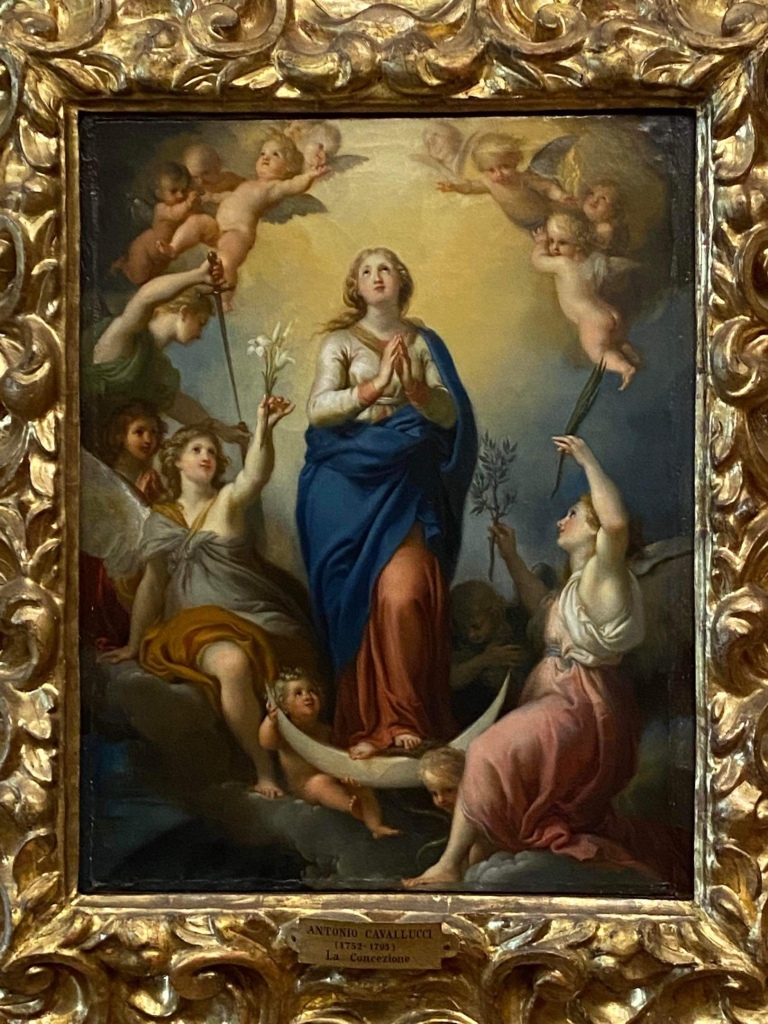
Photo by Rev. Fr. Gerry Pascual at Palazzo Borromeo, Isola Bella, Stresa, Italia, 2019.

Recently I saw on a Facebook post the photo of American model Kendall Jenner in a swimsuit showing what for many is the “perfect body” in a woman. The photo had reportedly gone viral last year.

What caught my attention was the other photo posted opposite Jenner: that of 19-year-old Alyssa Carson who became the youngest female in history to pass all NASA aerospace tests to train as astronaut for future travel to Mars! The caption said it so well, lamenting the fact how the world gives so much attention to “fashion models” with many going insane imitating their bodies forgetting the more essential like inner beauty and intelligence.

More sad is how we have fixed our human understanding and analogies of a “model” as someone who poses and remains still to be painted or photographed for glossy magazines and giant billboards that people are willing to buy or pay for just to view and let their senses feast on.

It may sound funny but those two photos accompanied me while praying and preparing for our celebration today of the Solemnity of the Immaculate Conception. Sorry, I am not going to show you the link to those photos but wha I want to share with you are the two beautiful expressions depicting Mary as “advocate of grace” and “model of holiness” found in the Preface of today’s Mass (that is the prayer before the Holy, Holy leading to the consecration): “She, the most pure Virgin, was to bring forth a Son, the innocent lamb who would wipe away our offenses; you placed her above all others to be for your people an advocate of grace and a model of holiness.”

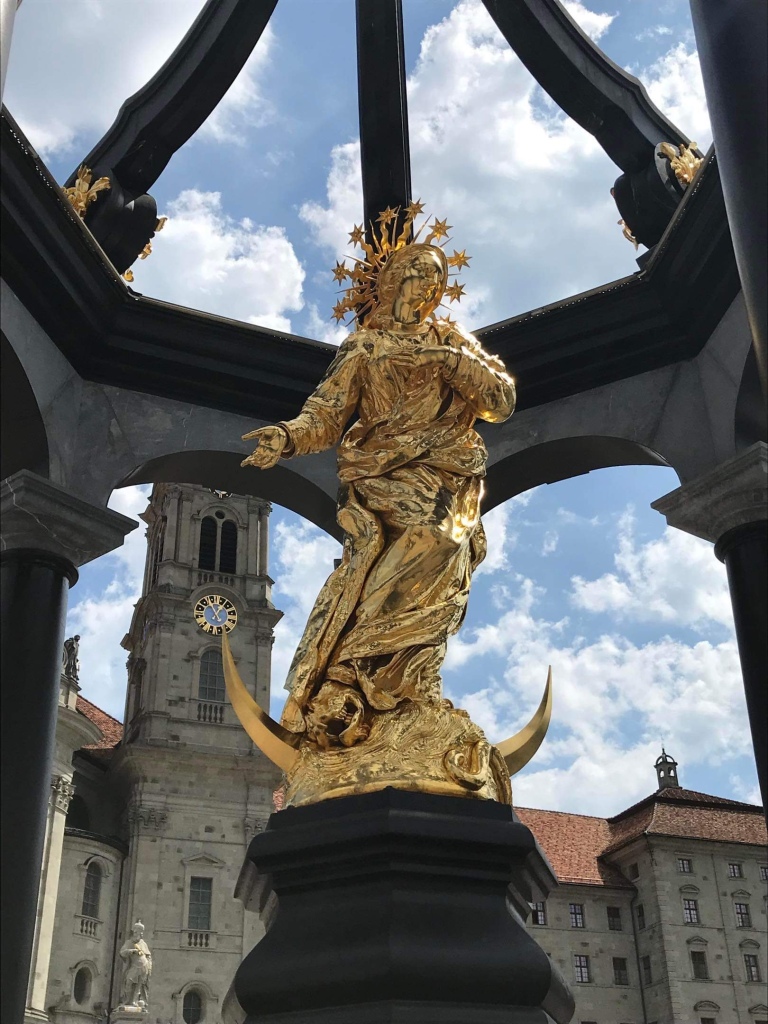
Photo by Fr. Gerry Pascual at Einsiedeln Abbey, Einsiedeln, Switzerland, 2019.

So often with Marian feasts, many people complain and find it hard to relate with the Blessed Virgin because they find them as celebrations of the privileges of Mary who was so blessed and unique, thinking she’s almost a god, not human anymore whom we cannot imitate and emulate.

That is totally untrue and baseless!

Of course, only she has the distinction of being immaculately conceived, one never stained by sin but, aside from that, Mary is like all of us, so human; and we too can be like her, full of grace and holy!

Brothers and sisters: Blessed be the God and Father of our Lord Jesus Christ, who has blessed us in Christ with every spiritual blessing in the heavens, as he chose us in him, before the foundation of the world, to be holy and without blemish before him. In love he destined us for adoption to himself through Jesus Christ, in accord with the favor of his will.

Ephesians 1:3-5

Very clear in this reflection by St. Paul in our second reading that our truest destiny is to be holy and without blemish – that is, immaculate. It is the plan of God since the beginning that we all become his people until sin came and destroyed momentarily that divine plan as we have heard in the first reading.

With the coming of Jesus through his sacrifice on the Cross, we were redeemed from sin to become God’s holy people which the same Preface mentions Mary as the “beginning of the Church”. The same prayer reiterates to us our universal calling from God which is to be holy and blameless before God through Jesus Christ. It is very doable and attainable “for nothing is impossible for God” as the Archangel Gabriel told Mary during the Annunciation (Lk.1:37). And Mary is our proof to that!

Photo by Rev. Fr. Gerry Pascual at Santuario di Greccio, Rieti, Italy in 2019.

While it is very true that nothing is impossible for God, today’s celebration of the Immaculate Conception reminds of how God “needs” us to cooperate and participate in his beautiful plans for us like Mary to be his instrument or seedbed for his Divine Word to receive and grow and bloom.

That is the meaning of Mary as “advocate of grace” who became the vessel in the coming of Jesus Christ. See how St. Luke was very clear in narrating Mary’s “supporting” role and place in the plan of God: she remains a human being – not God – like us except she was full of grace, that is, immaculately conceived.

Behold, you will conceive in your womb and bear a son, and you shall name him Jesus. He will be great and will be called Son of the Most High, and the Lord God will give him the throne of David his father, and he will rule over the house of Jacob forever, and of his kingdom there will be no end… The Holy Spirit will come upon you, and the power of the Most High will overshadow you. Therefore the child to be born will be called holy, the Son of God.”

Luke 1:31-33, 35

The Church Fathers used to call Mary as the “aquaeductus ecclesiae” or neck of the Church connecting Jesus the caput or head and us the corpus or body. Mary as an advocate of grace is that vessel of all blessings we now have in Jesus Christ because of her obedience and participation in that plan of God of sending Jesus.

Keep in mind that as advocate of grace, Mary brings us all to Jesus as the one Mediator, not away from him. True devotees of Mary bring others to Jesus not away from him for he alone is the Mediator. A true and authentic devotion to Mary always result in deeper knowledge and intimacy with Jesus and his gospel. Notice this in her apparitions especially at Fatima in 1911 where her messages call us to get closer to Jesus, not her.

Mary continues as our advocate of grace telling us the very same words she had told the servers at Cana to “do whatever he tells you” (Jn.2:5).

Do we do the same? Or, mislead others into putting Mary at par or even above Jesus her Son and Lord? In this time of pandemic, are we like Mary as an advocate of grace, a vessel and instrument of blessings to others or do we grab every credit of “charity” and “kindness”, grandstanding for more media mileage of “likes” and “followers” to be viral and trending?

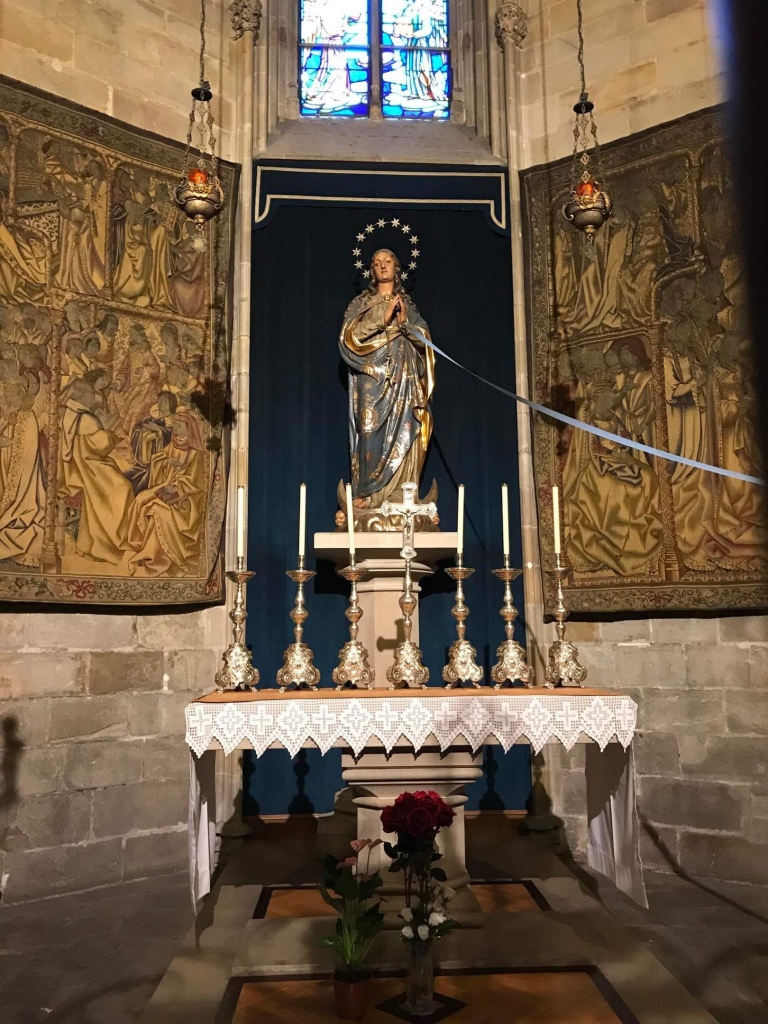
Photo by Fr. Gerry Pascual at the Cathedral of Barcelona, Spain in 2019.

From her being an “advocate of grace”, Mary thus becomes our “model of holiness” too as she reminds us of God’s original plan for us, created in his image and likeness destroyed by sin with the fall of Adam and Eve. See how God immediately promised salvation through the woman fulfilled in Mary as he reprimanded the serpent in tempting Eve:

“I will put enmity between you and the woman, and between your offspring and hers; He will strike you at your head, while you strike at his heel.”

Genesis 3:15

Because of her being the advocate of grace of God by giving birth to Jesus, Mary stands before us as the perfect reminder of Christ’s work of purification and recovery of the image of God in us. Described as the “perfect disciple” and “doer of the Word”, Mary had shown us in her very life which continues to this day in her intercessions and apparitions how discipleship is a life-long process and commitment of holiness. From giving birth to Jesus to his dying on the Cross until his burial, Mary had always been with Jesus that on Easter, it was to her that the Risen Lord first appeared because she was the first to believe totally in him.

At the Pentecost, Mary was with the Apostles awaiting the coming of the Holy Spirit that became the coming out party of the Church. In her life, Mary is the model of holiness because she keeps on working with us and in us, guiding us in following Jesus our Lord and Master so that we might be “conformed to his image” (Rom. 8:29).

Photo by author, Christmas 2020.

Holiness is not being sinless but being filled with God who is all-holy, being like Jesus Christ. Mary showed us the way to holiness is being humble before God, seeing herself as the “handmaid” or servant of the Lord.

If there is one thing the world needs now so badly in this time of the pandemic, it is holiness. Before the pandemic came, mankind was so filled with self, so arrogant and proud acting like god, manipulating everything.

How ironic that a microscopic virus with the simplest signs similar to the common colds made the world stood still for some time, reminding us that there is a God all-powerful who is in control of everything.

Through Mary, may this Solemnity of her Immaculate Conception lead us back to God to recover in us his image and likeness, cleansed and purified of our blemishes and wrinkles of sin by having an enlightened devotion to her, the servant of the Lord par excellence. Amen.

A blessed day to everyone!

Advent is being small and simple

The Lord Is My Chef Sunday Recipe for the Soul by Fr. Nicanor F. Lalog II
Second Sunday of Advent-C, 05 December 2021
Baruch 5:1-9 ><}}}*> Philippians 1:4-6, 8-11 ><}}}*> Luke 3:1-6
Photo by Mr. Jim Marpa, 2018.

From “beginning with the end” last Sunday at the start of Advent, we now move into its second week when we are reminded by the readings and gospel that “everything begins small and simple” in God and with God’s kingdom.

So often in life, God’s beauty and majesty are revealed in small, little beginnings that are hidden and obscured, things and persons we take for granted without knowing it is in them and through them that God silently continues his works of wonder among us.

Such is the reality of Christ’s coming – then and now and in the end of time – as presented by Luke who began his account this Second Sunday of Advent with the introduction of John the Baptist.

“St. John the Baptist Preaching In the Wilderness” by Anton Raphael Mengs from en.wikipedia.org.

In the fifteenth year of the reign of Tiberius Caesar, when Pontius Pilate was governor of Judea, and Herod was tetrarch of Galilee, and his brother Philip tetrarch of the region of Ituraea and Trachonitis, and Lysanias was tetrarch of Abilene, during the high priesthood of Annas and Caiaphas, the word of God came to John the son of Zechariah in the desert.

Luke 3:1-2

Feel the solemnity of Luke’s report, so formal, evoking a sense of power and might, an air of superiority with all the trappings of those in the corridors of power in government and religion.

Then abruptly, he wrote tersely, “the word of God came to John the son of Zechariah in the desert”. Boom! So simple yet elegantly emphatic.

Notice Luke’s artistry presenting a list of who’s who living in palaces and Temple with all the comfort and luxury available at that time when in a sudden shift, without losing the building up of the drama that led to the climax that is John “proclaiming a baptism of repentance for the forgiveness of sins, as it is written in the book of the words of the prophet Isaiah: A voice of one crying out in the desert: ‘Prepare the way of the Lord, make straight his paths'” (Lk.3:3-4).

In introducing to us the person of John the Baptist which started in the very first chapter of his gospel, Luke is actually telling us how John was already the presence of Christ, that aside from being his precursor, he had Jesus in himself already! For Luke, John foreshadowed Christ’s work of salvation reaching its summit at Easter even while orienting us to Christmas.

The nearness of God

Every year, the second and third Sundays of Advent narrate the preaching and baptism by John the Baptist at Jordan to remind us how Jesus comes to us whenever, wherever the word of God is heard, accepted, and proclaimed that result into repentance and forgiveness of sins.

See how Luke shows us the overlapping of salvation history with our secular history, a clear indication of the presence and nearness of God with us in Christ’s coming. Tiberius Caesar, Pontius Pilate, Herod, Philip, and Lysania with the high priests Caiaphas and Ananias were true persons who have lived in a particular time and specific places when John and Jesus lived too.

Here we find so true that God works silently and subtly in Jesus in our own personal lives and in the whole world for indeed, he is the God of history.

Photo by author, Chapel at the Basic Education Department, Our Lady of Fatima University, Valenzuela City, 28 November 2021.

This Second Sunday of Advent we are assured of God’s nearness with us in Christ, especially when there are those darkness and obscurity, hiddenness and being unknown. These little and simple things in life are occasions where God reveals himself to us! Take them to heart.

Sometimes in life it is good to be down and even unknown, away from the limelight specially in this age of social media where everything even coffee breaks and new purchases or grades and medals of children are made known to everyone with much noise like blaring trumpets.

This boom in social media is so tiring and even disgusting with nothing hidden anymore, nothing is personal, and worst, nothing sacred any more! God and faith and sacraments have become commodities, persons are cheapened and used for personal advantages that even personal messages or PM’s have become “public happenings”. No more respect and dignity to others and most of all, unknown to those so immersed in the social media, they are the ones in the losing end, losing their very selves as they lose touch and grounding with reality.

Contrast it with John the Baptist in the desert with his balanced life between solitude and community and most of all, his rootedness in God and with realities of life that he can speak about the need for repentance to renew one’s self.

The gift of Advent

It can happen that when we are so filled with our selves, when we are so spread out feeling famous, “viral” and “trending” that we are also most empty and nothing like those powerful men mentioned by Luke, from the Roman emperor to the high priests; hence, the need to be hidden and unknown, little and small once in a while to allow enough room for changes and growth, and most especially to have a room within us for Jesus to work in us.

This is the gift of Advent Season: a time for us to be like John, to withdraw from the busy and toxic world so we may be alone and at home again with one’s true self, with loved ones, and with God in Jesus, through Jesus.

In the first reading we heard the end of a poem by Baruch where God consoles his people personified by Jerusalem, giving them hope of redemption someday from their Babylonian conquerors. It was the lowest point in the Jewish history when Jerusalem and their Temple were destroyed with the entire nation exiled to Babylon as slaves. No country, no Temple, so down and so small yet, God tells them:

Photo by author, Advent 2019.

Jerusalem take off your robe of mourning and misery; put on the splendor of glory from God forever: wrapped in the cloak of justice from God, bear on your head the mitre that displays the glory of eternal name. For God will show all the earth your splendor; you will be named by God forever the peace of justice, the glory of God’s worship.

Baruch 5:1-4

See the beautiful image of God taking possession of his people exiled and enslaved, changing their lot into something so wonderful filled with splendor!

The same thing happens with us when we are down and lost for that is when God doubles his efforts in finding us, redeeming us, uplifting us. It had happened before in the coming of his Son Jesus Christ more than 2000 years ago which continues to happen now and would surely happen again in its fullness at his Parousia.

Nothing happens in life and in the world without God knowing even the minutest, single details we do not notice at all. Let us imitate the confidence of Paul this Season of Advent:

I am confident of this, that the one who began a good work in you will continue to complete it until the day of Christ Jesus. God is my witness, how I long for all of you with the affection of Christ Jesus.

Philippians 1:6, 8
Photo by author, Advent 2020.

This Second Sunday of Advent we are told that even if we do not see Jesus like in the gospel of Luke when it is still concerned with the preaching of John the Baptist, he is already with us in those small and little sacrifices we do out of love for him.

Like John, Advent invites us to withdraw to the wilderness, to the desert to be hidden from the limelight to give God a space to come to us, to be present in us.

Like John, Advent invites us to empty ourselves of our pride and sins, to repent and be washed clean by God’s loving mercy and forgiveness to be filled with his humility, justice and love.

Like John, Advent wants us to be the fulfillment of Isaiah’s prophecy: to be the voice of reason and faith in this noisy world of lies and superficialities; to make straight the path so bended with many excuses and alibis that have moved the lines of morality and propriety; to fill the valleys with sense and meaning; and, to make low every mountain and hill of human pride and arrogance that have left us more empty and lost than before.

Let us all be a John the Baptist, not only a precursor but also a presence of Jesus.

A blessed second week of Advent to everyone!

Advent is beginning with the end in sight

The Lord Is My Chef Sunday Recipe for the Soul by Fr. Nicanor F. Lalog II
First Sunday of Advent-C, 28 November 2021
Jeremiah 33:14-16 ><}}}*> 1 Thessalonians 3:12-4:2 ><}}}*> Luke 21:25-28, 34-36
Photo by author, Malolos Cathedral, 2019.

Blessed happy New Year, everyone!

Today we are celebrating a new calendar year in the Church with this First Sunday of Advent. From the Latin word adventus meaning arrival or coming, it was adapted by the early Christians from the Roman practice of preparing for the visits or assumption to power of their emperors then considered as “gods”.

It is most fitting that we prepare not only outside but most especially inside our very selves for the coming of the true God and King of kings, Jesus Christ our Lord and Savior!

Hence, Advent not only opens but also defines our whole liturgical year that is centered on Christ who has come, who comes now and will come again in the end of time. This is the reason why our gospel this Sunday is looking towards the end of time at the beginning of our Church calendar.

The three comings of Jesus Christ

Advent has two aspects: beginning today the First Sunday of Advent until December 16, all readings and prayers are oriented towards the Second Coming of Christ; from December 17 to the evening of the 24th, our focus shifts to the first coming of Jesus at Christmas.

Between these two comings of Jesus that the Season of Advent reminds us is what St. Bernard of Clairvaux called as the Lord’s “third coming” – his coming everyday into our lives, especially in the celebration of the Sacraments, particularly the Holy Eucharist.

Photo by author, 2019.

Again we find that tension of his being here but not yet. It is in that between his first coming more than 2000 years ago and his Second Coming which no one knows exactly when where we are situated daily, making everyday Christ’s Advent.

“And then they will see the Son of Man coming in a cloud with power and great glory. But when these signs begin to happen, stand erect and raise your heads because your redemption is at hand.”

Luke 21:27-28

It may sound frightening to hear Jesus spoke of the signs of his coming but at closer look and reflections, we find it filled with joy because our redemption is at hand!

Yes, every ending forebodes destruction and passing of the old but that is in order to give way to something new, something better which Jesus had promised his disciples then and us now.

The grace of this season of Advent is the reawakening of our hope in the salvation that has already come in Jesus, who still comes now, and will surely come again in the end of time which is happening in every here and now.

That is why, there is also the sense of urgency and vigilance this Advent.

We are already living in the end-time Jesus had predicted as we have seen in the wars and conflicts going on among nations, the natural calamities happening around the globe made worst by the climate change plus this pandemic we are now having. But, it does not mean the creation will end soon as portrayed in many Hollywood films because these signs are calls for us to be ready and prepared for the final end that will prelude the new beginnings of all.

The days are coming, says the Lord, when I will fulfill the promise I made to the house of Israel and Judah… In those days Judah shall be safe and Jerusalem shall dwell secure; this is what they shall call her: “The Lord our justice.”

Jeremiah 33:14, 16
Photo by author, 2018.

Meeting Jesus in Advent

Notice how Jeremiah’s prophecy so “pregnant” with meanings: more than the coming of the promised Messiah is the radical newness of the whole creation. Judah and Jerusalem, the main province and city of Israel at that time will be transformed, referring to John’s vision in the Book of Revelation of “new heaven and new earth”.

As we have said, Advent not only opens our liturgical calendar but also defines the whole year which is the daily coming of Jesus who had come over 2000 years ago and will come again at the end of time which nobody knows.

Meanwhile, in this “third coming” of Jesus everyday, we find God working in him silently and subtly in the human history and right in our individual lives.

It is in our faithful waiting when Jesus Christ comes. It is the beauty and joy expressed by Jeremiah’s words “the days are coming” that assure us no matter how dark and bleak are our days, despite all the destructions and even death around us, the days are coming when we see everything getting better because God never stops working in our midst in Jesus, the Emmanuel.

“Beware that your hearts do not become drowsy from carousing and drunkenness and the anxieties of daily life, and that day catch you by surprise like a trap. For that day will assault everyone who lives on the face of the earth. Be vigilant at all times and pray that you have the strength to escape the tribulations that are imminent and to stand before the Son of Man.”

Luke 21:34-36

Last Sunday in our celebration of the Solemnity of Christ the King we have reflected how Jesus spoke of the “truth” of his kingdom being among us, of how he had made us into his kingdom which is the reason why he was born and came into the world to testify to this truth (Jn.18:37).

See now the clearer picture of our life, of our time: we start our Church calendar preparing for the coming of Jesus our King and we end every year with the celebration of Christ the King. And we begin each new year with the end in sight of his Second Coming.

On this season of Advent, we are reminded how in our joyful waiting through prayers especially in the celebration of the Holy Eucharist that Christ’s presence is little by little being unveiled, unfolding before us, and being revealed.

It is a call for us of deepening our prayer life to truly experience Christ’s coming in our daily life. This new year in the Church, St. Luke will be our guide in our Sunday readings during the Ordinary Time; one distinction of his gospel is his portrayal of Jesus in prayer always.

Jesus comes to us first of all when we pray, when we enter into communion with him, when we listen to his voice and follow his instructions. In prayer, we are filled with God, allowing him to work his wonders in us and through us and thus make Christ’s coming a daily reality.

That is how prayer truly leads to holiness: when we are filled with God, our prayers are translated into a life of kindness and acceptance, mercy and forgiveness and most of all, of loving service to one another especially those in need.

There will always be sins and shortcomings on our part but in prayers and vigilance, we slowly “increase and abound in love for one another… strengthening our hearts to be blameless before our God our Father at the coming of our Lord Jesus with all his holy ones. Amen. (1 Thess. 3:12,13)

A blessed happy new year again and a more blessed first week of Advent to you!

Living in the End-Time

The Lord Is My Chef Daily Recipe for the Soul by Fr. Nicanor F. Lalog II
Friday, Week XXXIV, Year I in Ordinary Time, 26 November 2021
Daniel 7:2-14     ><]]]]'> + <'[[[[><     Luke 21:29-33
Photo by author, Assumption Sabbath, Baguio City, 2019.
Thank you very much for this
last Friday of November, God our
loving Father; what a beautiful 
reminder to us all as we prepare
for Advent at the closing of the
liturgical calendar tomorrow that
we are in fact living in the end-time.
All the signs of the end of time Jesus
mentioned in the gospel these past two
days are already happening like wars, 
plagues, famines, and earthquakes;
grant us the spiritual knowledge to 
learn the parable of the fig tree:  that
we have to be rooted in you, O God,
through Christ so that even while in
the midst of a destructive world, we
may get to know you more and be 
aware of your coming.
Like the Prophet Daniel in the first
reading, we may not even know at all
how the Son of Man - Jesus - would look like
when he comes amid the clouds;
give us the grace to know Jesus 
personally so that we may live in
communion with him to have 
the eyes to see and the ears to hear 
his Second Coming in 
every here and now, following
him in the path he had shown us
as truly our King and Savior. 
Remove our blindness of pride
and many excuses in seeing the
signs of your coming expressed 
in the parable of the fig tree; let
us rest in that complete trust in you,
dearest God, that whatever happens
in this world, you are always in control
and would always have the last say in
Jesus Christ.  Amen.

God is present

The Lord Is My Chef Daily Recipe for the Soul by Fr. Nicanor F. Lalog II
Thursday, Week XXXIV, Year I in Ordinary Time, 25 November 2021
Daniel 6:12-28   ><)))*> + ><)))*> + ><)))*>   Luke 21:20-28
“Daniel in the Lions’ Den” by Briton Riviere (1872) from reddit.com.
God our loving Father,
save us from severe tests 
and trials in life; make us
steadfast in our faith and 
trust in you like your prophet
Daniel who escaped death
without any harm at all when 
thrown into the lions' den.
As I prayed over that wonderful
scene I have known since a child,
it was only now have I realized
our biggest problem in being 
faithful to you in the face of death
and grave danger; of course, it is
pure grace from you to have such
great courage and serenity but 
always, we back out, we balk at the 
mere thought of suffering because
we are busy thinking of what will
happen next, we are busy focused
with the future than with the present
moment where you are with us.
That beautiful imagery of Daniel
spared by the ferocious lions evokes of 
a man so faithful to you, O Lord, living
in your presence, unmindful and undisturbed
of the past and the future because he was
present in you and with you!

Daniel answered the king: “O king, live forever! My God has sent his angel and closed the lions’ mouths so that they have not hurt me. For I have been found innocent before him; neither to you have I done any harm, O king!”

Daniel 6:22-23
Cleanse and empty us,
dear Father, of our many excess
baggage in life, our past sins
and worries of the future
so we may experience and live in
your presence in every here and now,
unmindful of whatever may happen
for we are safely secured in you
always.  Amen. 

Deus Semper Major

The Lord Is My Chef Daily Recipe for the Soul by Fr. Nicanor F. Lalog II
Tuesday, Memorial of St. Clement, Pope and Martyr, 23 November 2021
Daniel 2:31-45,   ><)))*> + ><)))*> + ><)))*>   Luke 21:5-11
Photo by Mr. Jim Marpa, 2019.
Glory and praise to you,
our loving and almighty
God and Father!
Your power and might,
majesty and grandeur are
all around us, even deep 
within each one of us and yet,
still many deny your presence, 
deny your existence.
Enter our consciousness, Lord,
enter our dreams like with 
King Nebuchadnezzar to remind us
nothing remains here on earth, 
that you are always greater, O God,
"semper major"!

In the lifetime of those kings the God of heaven will set up a kingdom that shall never be destroyed or delivered up to another people; rather, it shall break in pieces all these kingdoms and put an end t0 them, and it shall stand forever.

Daniel 2:44
Even your Son Jesus Christ
reminded us through the apostles
how everything would crumble and 
fall, including your Temple at 
Jerusalem, putting an end to everything 
until he comes again to bring upon us
new heaven and new earth.
And so, grant us, Lord,
perseverance and fidelity
to remain humble before you
like St. Clement who bore all sufferings
during the persecution but remained
faithful to you, calling on the early Church
he led as Pope at that time to remain 
one in you, our only Rock foundation
in faith, hope and love.  Amen.