Advent is rejoicing in God within us

The Lord Is My Chef Sunday Recipe for the Soul by Fr. Nicanor F. Lalog II
Third Sunday of Advent-C, 12 December 2021
Zephaniah 3:14-18 ><}}}*> Philippians 4:4-7 ><}}}*> Luke 3:10-18
Photo by author, Gaudete Sunday 2019.

Our liturgy bursts in colorful hues of pink this Third Sunday of Advent known as “Gaudete Sunday” or “Rejoice Sunday” following the calls of our readings to rejoice in God’s coming and nearness among us.

Brothers and sisters: Rejoice in the Lord always. I shall say it again – rejoice!

Philippians 4:4

We rejoice because of a person. Always. Gadgets and material things can never bring joy to us; joy is something deeper, touching one’s heart and soul.

Joy brings assurance of presence and of love; hence, joy comes only from another person for what he or she brings or for what happens to him or to her. And too often, it can happen that we share in another’s joy.

Now, imagine if the joy is coming from the Second Person, Jesus Christ the Son of God – it is “joy to the max!” as young people would say these days. Jesus, the Emmanuel or God-with-us who had come more than 2000 years ago, who always comes to us, and who will come again in the end of time.

To rejoice in the Lord as St. Paul puts it in our second reading today means to be one with Christ who is the source of “every spiritual blessing in the heavens” (Eph.1:3) in whom “nothing can ever separate us from the love of God, not even death nor any creature” (Rom. 8:38-39).

And that is the essence of joy: the firm assurance that when worst comes to worst in life, there is always Jesus Christ remaining faithful to us when our chips are down, when we are alone and abandoned by family and friends, even in death.

Joy is a result of salvation, of being free in Jesus

Joy is when the heart and soul smile even when we are in the midst of suffering. It is unlike happiness expressed by laughter or smiles that depend on external factors that trigger happiness. Joy bursts from within us, something automatic because of a deeper feeling of right there in our heart, deep in our soul dwells Jesus Christ, assuring us we shall never be alone. That is why we can rejoice while in the midst of pains and sufferings, unlike happiness.

In the first reading we heard four imperative verbs that call us to rejoice, each evoking God’s coming to save his people which is fulfilled in Jesus Christ:

Photo by author, San Fernando, Pampanga, 18 November 2021.

Shout for joy, O daughter Zion! Sing joyfully, O Israel! Be glad and exult with all your heart, O daughter Jerusalem! The Lord has removed the judgment against you, he has turned away your enemies; the King of Israel, the Lord, is in your midst, you have no further misfortune to fear.

Zephaniah 3:14-15

Here we find joy synonymous with salvation, with freedom.

The people of God at that time were in exile, feeling so low and so sad as they saw their plight as punishment for their sins.

Recall how when the angel announced to Mary the coming birth of Jesus, he told her to “Do not fear” (Lk.1:30) while Jesus himself told the same words – “Do not fear” – to the women at the tomb on Easter morning and later to his disciples (Mt. 28:10). Every time the disciples and the people were in danger and overcome with fear, Jesus always comes saying to everyone the same thing, “Do not be afraid…it is I”.

That is the most wondrous thing about joy – one experiences not only assurance of love and support, presence and security but one also becomes free specially from all sins and fears!

Such was the mood of the people when John the Baptist preached repentance and baptized people at Jordan. Even the most hopeless among them like sinners and marginalized people at that time felt joy within with John’s proclamation of the good news, of Jesus himself.

Now the people were filled with expectation, and all were asking in their hearts whether John might be the Christ. John answered them all, saying, “I am baptizing you with water, but one mightier than I is coming. I am not worthy to loosen the thongs of his sandals. He will baptize you with the Holy Spirit and fire. His winnowing fan is in his hand to clear his threshing floor and to gather the wheat into his barn, but the chaff he will burn with unquenchable fire.” Exhorting them in many other ways, he preached good news to the people.

Luke 3:15-18

Luke beautifully summarized the mission of John the Baptist by saying “he preached good news to the people” (Lk.3:18). This is the grace of the third Sunday of Advent: that the Lord is with us, that he had set us free from our sins and from all our fears. Let us go out of our toxic relationships and toxic mindset to claim this salvation in Christ!

Like John, let us experience Jesus in our selves, in our lives in order to bring hope and joy to others by proclaiming not only the coming but the very presence of Jesus Christ among us.

See how John told the crowds to live simply so that others may simply leave while at the same time, he never asked the tax collectors and soldiers to leave their jobs by them to be fair and just with everyone.

Photo by author, San Fernando, Pampanga, 18 November 2021.

So many times in life, we desire so many material things in life because of our wrong belief we can only be joyful in life with whatever money can buy that in the process, we miserably forget to love and care for the other persons, especially those nearest to us.

We sadly realize later in life that what truly prevent us from experiencing joy are these things like wealth and fame we have tried accumulating in our entire lives!

As we have said earlier, joy can only come from persons, not things. Those people in the gospel felt joy upon listening to John’s preaching and experiencing his baptism of water.

In our time, we are called to be another John the Baptist but this time to baptize people “in the name of the Father and of the Son and of the Holy Spirit” as commanded by Jesus on his Ascension. Moreover, this third Sunday of Advent calls us to emulate John in telling people to be vigilant for the final judgment when Jesus comes again at the end of time which is NOW for “His winnowing fan is in his hand to clear his threshing floor and to gather the wheat into his barn, but the chaff he will burn with unquenchable fire.” These we do with our lives of witnessing to the gospel values of Christ seen in the joy we have in our lives.

How sad that even Pope Francis had noticed early in his pontificate how many of us Christians lack joy in our lives, in our attitudes and in our faces specially when celebrating the Holy Eucharist.

Joy is the mark of every true Christian who rejoices always in the salvation and freedom Jesus had brought us. Let us share the joy of life in Christ not only today but everyday for Jesus comes to us in every person filled with joy, free from sin and worries! Amen.

Have a joyful week ahead!

Photo by author, San Fernando, Pampanga, 18 November 2021.

Touching Jesus among us

The Lord Is My Chef Sunday Recipe for the Soul by Fr. Nicanor F. Lalog II
Sunday XXXI-B in Ordinary Time, 31 October 2021
Deuteronomy 6:2-6 ><]]]]*> Hebrews 7:23-28 ><]]]]*> Mark12:28-34
Photo by Jenna Hamra on Pexels.com

Since the start of this pandemic last year, I have always have that strange feeling of COVID-19 chasing me like a mad dog that would not stop until I am dead. Even after I have had the jabs, practicing all health protocols and best efforts of being “positive” to be negative of the virus, that morbid feeling keeps on creeping.

It is depressing but, it is not that bad as the pandemic has slowly become a grace-filled moment for me like to many of you (I hope so) to discover anew and realize that GOD is absolutely the one thing most important in this life, that GOD is not just the first among all things in life but essentially the very reason of everything in life!

One of the scribes came to Jesus and asked him, “Which is the first of all the commandments?” Jesus replied, “The first is this: Hear, O Israel! The Lord our God is Lord alone! You shall love the Lord your God with all your heart, with all your soul, with all your mind, and with all your strength.”

Mark 12:28-30

Maturing and growing from fear to love.

From Jericho last Sunday, Jesus had finally reached Jerusalem, teaching in the temple area of the many valuable lessons on growing and maturing in our faith, in nurturing a personal relationship with God through him by moving from fear to love, from knowing to experiencing persons.

Like us in this time of the pandemic thrown into confusion, the scribe approached Jesus to be clarified with the many laws and precepts they were tasked to follow to lead a holy life and enter eternity. Like Bartimaeus last week, the scribe sincerely asked Jesus for enlightenment from the many darkness and blindness afflicting him.

And he was not disappointed when Jesus answered his question so differently by quoting verbatim from the most ancient prayer known by every devout Jew called the Shema Israel which we heard proclaimed at the first reading. By directly quoting Deuteronomy 6:4-5, Jesus showed that more than the question of being the “first commandment” in the list of things to follow that is always binding on all, loving God with one’s total person is actually the source of all other commandments – even of those not listed!

In his answer to the scribe’s question, Jesus perfectly showed what holiness is all about – an integration (wholeness) of one’s faith and prayer and life from which flows the very essential fact of our lives that there is no other God than our God who alone is the One.

And the good news is that this great and powerful God had chosen to be one with us in the most personal manner by residing in our hearts!

We have a beautiful expression in Tagalog, “nakialam ang Diyos” – God “intervened” in our very lives by sending us his own Son Jesus Christ, unmindful of our nothingness, because he chose to love us, to be with us, to redeem us. What an amazing and loving God is he indeed who is perfect and most holy seeking an intimate and personal relationship with the broken and imperfect, sinful humans through our Lord Jesus Christ who embraced everything in us except sin.

Photo by Ms. Mira Mandal Sibal.

In this scene, Jesus is inviting us to move away from our usual “impersonal” relationship with God that is based on laws to follow, resulting in fears to the punishments due when failed to obey them. It is not even a relationship to speak of but more like a deal or transaction wherein we look at him as God our Lord and Master who takes care of our needs as his subjects and servants. Very feudal, so far from God’s will.

Making matters worst is our Filipino psyche of “sapagkat ako ay tao lamang” where we capitalize on our being weak as humans, therefore lowly but not necessarily humble using it as an excuse for failing to “love” him accordingly, and thus, an expression of our pride and insubordination to God.

Like Bartimaeus before his healing, we prefer to stay at the roadside than join Jesus on the way, avoiding relationships that call for a commitment to love.

Jesus wants us to be involved with God through him personally for it is only through him and in him can we experience God’s immense love and mercy by letting go our selfish selves. And the more we let go our selves in love, experiencing pains and sufferings like Jesus, the more we mature and grow better as persons, realizing the need to nurture this wonderful relationship with God who is love, who is the very core of our being.

That is when we move closer to the kingdom of God which is the very person of Jesus Christ found in everyone!

“The second is this: You shall love your neighbor as yourself. There is no other commandment greater than these.” The scribe said to him, “Well said, teacher. You are right in saying, ‘He is One and there is no other than he.’ And ‘to love him with all your heart, with all your understanding, with all your strength, and to love your neighbor as yourself’ is worth more than all the burn offerings and sacrifices.”

Mark 12:31-33

Maturing and growing, loving personally

Jesus continued his answer to the scribe by explaining the evolution of commandments from God as its very source, telling us that as we appreciate his majesty and grandeur, we naturally and progressively flow to our discovery and loving too of the other persons around us.

Christ reminds us that whenever we find there is no other God than our God, we likewise discover that everyone is our neighbor, not just those like us in belief and color. The more God reveals himself to us in his grandeur and majesty, the more he also reveals himself to us in every person. Thus, it was in this moment in that encounter with the scribe that Jesus reintroduced his teaching on the universality of salvation, not just for Jews but for everyone!

In a similar manner when Bartimaeus was healed of his blindness last Sunday, today’s gospel is a wonderful story of enlightenment of the scribe who also regained his sight and vision in realizing that the love of God is also the love of one another! That is why he too cannot deny in himself the very truth that the highest form of worship, of “burnt offering and sacrifices” at the temple is personally loving God through everyone around us.

This is one of the important lessons this COVID-19 pandemic has taught us: it is always easy to say or even assume most of the time that we love, that we are loved, taking for granted the expression of our love and concern for others. We now feel so sorry how we have let days and weeks, months and years to have passed without seeing or calling family and friends or at least saying “hi” in whatever platform of social media until COVID-19 came.

Photo from inquirer.net.

While this pandemic has taught us the value of many ordinary things we have taken for granted like simple washing of hands and basic practices of cleanliness that matter so much to remain virus free and healthy, it has painfully taught us too the value of every person dear to us when one by one they were getting infected with COVID-19, some never recovered from the dreaded disease and now gone forever.

So many deaths have occurred in our circles of family and friends since last year in this pandemic; and, the saddest part is how swiftly they have left without any warning at all, denying us the chance of even a few seconds to see them and tell them how much we loved and cared for them.

It is always easy to know and say there is only One God, that he loves us so much, and that we also love him in turn. But, to move from fear to real loving, from formal knowledge to personal relationship, it is different. How true is that saying of us seeing the forest but missing the trees!

This Sunday, Jesus tells us to grow and mature in our relationships with him in prayer that must flow progressively and naturally to the people around us. It is only in finding this close link of loving God and loving neighbors that we get nearer to Jesus, who is the kingdom of God.

Tomorrow we celebrate All Saints Day in honor of all the departed already in heaven and on November 2, the All Souls Day for those awaiting in purgatory. Two great feasts that coincide with our Sunday gospel preparing us for the final destination, of being in the kingdom of God fully which is heaven.

While still here on earth not from the kingdom of God, Jesus is giving us the grace to experience heaven in our personal love in him to the Father through each other. Amen.

Have a blessed November!

My screen this quarantine – when trolls and bullies rule the earth

Quiet Storm by Fr. Nicanor F. Lalog II, 15 September 2021
Image from Pinterest.

Instead of being sick with the government’s new experiment that begins today of designating letters and numerals to our quarantine level, stay home if there is nothing really necessary for you to do outside and keep your sanity as you enjoy some series at Netflix that has become our bestest friend since this pandemic began.

Topping our recommendations are Clickbait and Blackspace that tackle relevant issues of our time, reminding us for the need to recover our sense of morals, values and virtues now becoming so rare.

What we like best with both series is its packaging into short installments of eight episodes with each running less than 50 minutes. Each episode is quick-paced, so impactful that you would be forced to finish the series in one whole day, especially if you happen to be in quarantine due to COVID-19.

Communicating responsibly

The term “clickbait” was coined by blogger Jay Geiger in December 2006 by combining the words “click” of the computer mouse and “bait” that literally means to lure the user to something in the internet. Google defines clickbait is an internet content that aims to attract attention and encourage visitors to click on a link to a particular web page.

The term has become notorious in its meaning and usage which the Netflix series Clickbait presents and explores so well that in the process every episode had in fact been a clickbait – luring you to click on the next episode to finish the series.


Clickbait is one series that may be used in computer literacy programs
 that reminds us of the Church's teaching at Vatican II that  
"Communication is more than the expression of ideas and the indication of emotion.  
At its most profound level, it is the giving of self in love" 
(Communio et Progressio, #11). 

Photo from webseriescast.com.

Australian Tony Ayres did an excellent job creating the series with its story line that kept us “clickbaiting” too to find out if Nick Brewer really “abused women” and finally, who really killed him.

And that indeed is a good question to ask as the series unfolds with so many twists and turns happening, exactly like in real life when we are so quick to jump into conclusions “whodunnit” just because everything seems to fit with what we think, with what we know, or what we believe.

In the end, we realize like Dustin Hoffman in the 1997 movie Mad City that we killed” a totally innocent man because of how we have allowed ourselves to fall into bait in abusing and mishandling the great powers of communication.

Clickbait teems with so many instances reminding us to be careful with this gift of communication which is a power God only shared with us humans. Recall how in the creation account that God spoke only with words and everything came into being; such is the power of communication. Hence, another movie, Spiderman reminds us too that with “great powers come great responsibilities”.

From Facebook, February 2020.

The series Clickbait presents so well how our pride and ego come into interplay for our dreams of greatness, of being somebody else who is famous, well-liked by everybody, building our own tower of Babel, only to crash and crumble in death and destruction because of the web of lies we have succumbed to and could no longer be stopped just like those nasty things we find trending and viral in the internet or simple rumors and gossips going out of proportion.

At the same time, Clickbait teaches us with so many values, primarily the importance of family relationships (first and foremost), fidelity, respect to elders and love among siblings, the value of life as against suicide, and most of all, the value of every person – that we in our very selves are good without any need to be famous and be liked by everybody.

It also focuses on the need for more trust among couples and siblings in this age of modern and instant communications that can never fully express who we are and what we feel deep inside us.

Clickbait is one series that may be used in computer literacy programs that reminds us of the Church’s teaching at Vatican II that “Communication is more than the expression of ideas and the indication of emotion. At its most profound level, it is the giving of self in love” (Communio et Progressio, #11).

Don’t miss this series. See it with your loved ones because Clickbait is one good mirror of who we are these days of the internet and smartphones, of how sincere and honest are we with one another and with our true selves.


Respect for each one’s dignity

One very good thing with Netflix is our being exposed to foreign movies and series we never had the chances before. It is very educating and enriching like this Israeli series Blackspace that is so bold and daring to discuss the dignity of every human person through prevailing issues not only there but in the whole world.

The series begins with a caution to viewers of the violent and disturbing scenes in its first episode that opens with a mass shooting inside a school during a memorial program.

As we have said, the series is bold to present how the Israeli police attempted to twist their investigation by coercing some workers found hiding on the school’s roof deck as primary suspects to the crime just because some were from the West Bank and non-Jewish.

But what is so entertaining and thought-provoking in Blackspace is how the chief investigator Rami Davidi played by Guri Alfi solved the case by proving himself right that it was an inside job by some students who were all victims of bullying – just like him!

Photo from netflix.fandom.com.

It was in fact a homecoming of sorts for Davidi to his old high school still with the same principal who was the assistant principal when he was bullied while a student that cost him his right eye.

Though the series is a bit slow in its pacing, it is still an excellent one where the creators have woven seamlessly various topics into a beautiful tapestry that present to us the many problems we adults and the young people are dealing with without getting into its very roots.

First is the value of respect for every person with equal rights and dignity that begins at home, at how parents treat their children and accept/reject them when their inclinations are different from theirs or when they have homosexual tendencies. It is very surprising how this series is able to weave into its storyline issues about fatherhood and single-parenthood, about suicide and drugs, and yes, the abuse and misuse of the internet and computer technologies!

“Blackspace” is supposed to be a meeting room of the students in the dark internet.

Everything is summarized towards the end like a scene between Pontius Pilate and Jesus (no pun intended) when Davidi finally solved the crime that involved a school official who told him, “There is no truth. Only consequences.”


It is amazing that 85 years ago today, Pope Pius XI wrote “good motion pictures are capable of exercising a profoundly moral influence upon those who see them. In addition to affording recreation, they are able to arouse noble ideals of life, to communicate valuable conceptions, to impart a better knowledge of the history and of the beauties of the Fatherland and of other countries, to present truth and virtue under attractive forms, to create, or at least, to favor understanding among nations, social classes and races, to champion the cause of justice, to give new life to the claims of virtue and to contribute positively to the genesis of aa just social order in the world” (Vigilanti Cura, #25).

Clickbait and Blackspace just did what the Holy Father wrote in 1936.

See you in the next flick. Have a blessed day!

Beyond “when” and “what”

The Lord Is My Chef Sunday Recipe for the Soul by Fr. Nicanor F. Lalog II
Sunday XVIII-B in Ordinary Time, 01 August 2021
Exodus 16:2-4, 12-15 ><}}}}'> Ephesians 4:17, 20-24 ><}}}}'> John 6:24-35
Photo by author, Church of Dominus Flevit overlooking Jerusalem, 2017.

Last Sunday we reflected the “where” of Jesus in asking Philip, “Where can we buy enough food” for the crowd who have followed them to a deserted place. We said that “where” of Jesus referred not to any place or location but to himself as the only one who can give “enough food” for everyone.

Today I invite you, my dear readers to join me reflecting on the “when” and “what” of the people who have followed Jesus to the other side of the lake, looking for him to have more food after that miraculous feeding last week. This time, the people are the ones asking Jesus with when and what that reveal their pride before God.

When the crowd saw that neither Jesus nor his disciples were there, they themselves got into boats and came to Capernaum looking for Jesus. And when they found him across the sea they said to him, “Rabbi, when did you get here?” Jesus answered them and said, “Amen, amen, I say to you, you are looking for me not because you saw signs but because you ate the loaves and were filled. Do not work for food that perishes but for the food that endures for eternal life, which the Son of Man will give you. For on him the Father, God, has set his seal.”

John 6:24-35
Photo by author, Capernaum’s shore at Lake Tiberias, 2017.

From a deserted place to Capernaum

To fully appreciate today’s gospel account by John, let us get its whole picture with a little help from Mark who started the story of Jesus and the Twelve crossing the lake to a deserted place to rest the other week. With his usual dash of humor, Mark told us how the people arrived to the place ahead of Jesus who was moved with pity at seeing the crowd “for they were like sheep without a shepherd that he taught them with many things.”

John continued the story last Sunday telling us how Jesus fed the people to their satisfaction with so many leftovers out of just five loaves of bread and two fish. The people were astonished that they tried to get Jesus to make him a king but he “withdrew again to the mountain alone.”

This Sunday, John continued his story telling us how the crowd finally found Jesus at Capernaum with his disciples.

How did he get there?

Photo by author, Lake of Tiberias (aka, Galilee), 2020.

According to Mark 6:45ff., after feeding the people, Jesus told the Twelve to proceed ahead of him to the other side of the lake that evening while he dismissed the crowd. Later that evening while Jesus was praying on the mountain, he saw his disciples’ boat being tossed by big waves due to strong winds. He followed them at the “fourth watch of the night” (about 3AM) by walking on water that terrified the Twelve who thought they have seen a ghost.

Upon identifying himself as the Lord, Peter asked to let him come to him by walking on water too; Peter sank when he doubted due to the strong winds until Jesus saved him and joined them on the boat going to Capernaum.

Mark’s story of Jesus walking on water after the miraculous feeding provides us the context for the people’s question to him today in John’s continuation of the story last week, “Rabbi, when did you get here?” (Jn.6:25): it was very difficult, almost impossible for anyone to have crossed the lake at night due to giant waves caused by strong winds. (Any pilgrim to the Holy Land can attest to this fact even today.)

And that was the main issue here: the people refused to see the deeper meanings behind the two events when Jesus fed them and the almost impossible crossing of the lake that night.

That is why Jesus did not answer their question by bluntly addressing their suspicious motive, “Amen, amen, I say to you, you are looking for me not because you saw signs but because you ate the loaves and were filled. Do not work for food that perishes but for the food that endures for eternal life, which the Son of Man will give you. For on him the Father, God, has set his seal.”

Ironically, while their asking of “when did you get here” implicitly acknowledged the Lord’s miraculous crossing of the lake, they still refused to accept it by downplaying everything like addressing Jesus as “Rabbi” when in fact, they were not interested with him but merely with the food he had given them!


Their question of "when" 
was not really about his time of arrival there 
but more of an inquiry on the person of Jesus....

Their question of when was not really about his time of arrival there but more of an inquiry on the person of Jesus as they wondered how could he made it across the lake that night. They have failed to recognize the deeper meaning of the sign Jesus did in feeding them with enough food which Jesus explained anew.

And the stage is now set for Jesus to reveal himself, of who he really is which his disciples were also asking and contending among themselves all these weeks and months of being with the Lord.

Photo by author(2017), ruins at Capernaum with a church built over the house where Jesus was believed to have stayed.

The need for us to be open to Jesus, our bread of life

Many times in life, our words and attitudes betray us of our inner motives, of our selfish interests to get near some people, to meet and know them not for who they are but for what we can have from them – even with God!

Remember Andrew last Sunday who did not bother to ask the boy’s name who gave the five loaves of bread and two fish from which Jesus performed his miracle? “There is a boy here with five barley loaves and two fish” – no name, just a “there” because the did not matter at all to Andrew except his food.

But there is something deeper being revealed in this attitude of forgetting the other person and being focused on material things: that is our pride, of believing only in ourselves, of playing God!

So they said to him, “What can we do to accomplish the works of God?” Jesus answered and said to them, “This is the work of God, that you believe in the one he sent.” So they said to him, “What sign can you do, that we may see and believe in you? What can you do? Our ancestors ate manna in the desert, as it is written: He gave them bread from heaven to eat.”

John 6:28-31

See how the crowd ignored Christ’s promise of giving food that endures for eternal life by following up their question with What can we do to accomplish the works of God?” – another veiled question like their when, insisting on their own achievements and abilities, on what they can.

Worst is how in a twist highlighting pride in themselves as they dared to question Jesus again with What sign can you do, that we may see and believe in you?“!!! Helloooooo….!

Photo by author at the ruins of the synagogue of Capernaum where Jesus preached his bread of life discourse, 2017.

They have gone so blinded with their pride that suddenly the miraculous feeding they have personally witnessed plus the unimaginable crossing of the lake at night remained lacking, not enough for them to believe in the powers of Jesus that they still asked for another sign.

Their “what” had become a demand from them, an insistence on Jesus the Son of God to give them signs from heaven even if they ironically preferred without them knowing how they were stuck at the lowest level of looking at things.

They have closed their eyes to seeing beyond the ordinary things happening to them since Jesus came teaching and healing. And now after feeding them, they demanded Jesus to follow them instead of them following the Lord.

Is it not the same thing happens with us when we keep on demanding God for proofs of his love and mercy, demanding so many other things from him above while we refuse to rise above ourselves, to “level up” in our lives?

This is the call by St. Paul in the second reading, that we must “be renewed in the spirit of your minds, and put on the new self, created in God’s way in righteousness and holiness of truth” (Eph. 4:23-24).


Once again, we are placed on highest level of quarantine due to a surge in COVID-19 cases with threats from the new Delta variant. Unless we learn to see this pandemic on a higher plane or level that calls for spiritual renewal among us, it will persist to disrupt and destroy lives among us.

It is more than a virus infecting us but an attitude deep within us when we have lost respect for one another and with nature. Pope Francis had long ago sounded this alarm in 2015 with his encyclical Laudato Si calling for each of us to change our lifestyle, each of us contributing for the betterment of the world because it is easiest to join advocacies but difficult to change our ways of life by having less.

With all these pandemic and climate changes going on around us, the signs are getting clearer for us to shift our perspectives, to see things on a higher plane like what Jesus had began at Capernaum declaring himself, “I am the bread of life; whoever comes to me will never hunger; and whoever believes in me will never thirst” (Jn.6:35).

Our misunderstandings with others and in life will persist unless we remove the veils and masks that cover so many insincerities of our questions in search of the many answers to the problems we face.

Like the people who have followed Jesus to Capernaum that day who were stuck in the desert experiences of Moses (first reading) that they could not see Jesus himself as the new bread from heaven; in fact, Jesus had to correct them that it was not Moses who gave the manna but God the Father in heaven who now gives Jesus to nourish us in our journey to eternal life.

Let us empty our selves of our pride to let Jesus fill us today with his words and his Body and Blood so we may realize next week the meaning and sweetness of himself as the Bread of life. A blessed week to you. Stay safe and keep praying. Amen.

Photo by author, April 2020.

“Here, There And Everywhere” by the Beatles (1966)

The Lord Is My Chef Sunday Music by Fr. Nick F. Lalog II, 25 July 2021
Photo by Pixabay on Pexels.com

It is a very “bed weather” these days here in Metro Manila, so perfect for family gatherings, sharing stories and of course, music from the yesteryears like the Beatles‘ 1966 classic romantic love song composed by Paul McCartney, Here, There and Everywhere.

To lead a better life, I need my love to be here
Here, making each day of the year
Changing my life with a wave of her hand
Nobody can deny that there's something there

There, running my hands through her hair
Both of us thinking how good it can be
Someone is speaking
But she doesn't know he's there

As I have mentioned in my homily this Sunday, this classic love song had inspired me to dwell on the demonstrative pronouns used in our gospel today when Jesus conversed with his apostles Philip and Andrew before feeding the more than 5000 people from just five loaves of bread and two pieces of fish (https://lordmychef.com/2021/07/24/when-where-and-there-are-persons-not-locations/).

McCartney admits that it is one of his favorite compositions of all time which happens to be his only song truly appreciated by his fellow composer John Lennon.

The song jibes so well with our gospel this Sunday wherein the here, there and everywhere do not merely refer to locales and locations; there are times when these demonstrative pronouns point to particular persons like in this song, McCartney’s girlfriend at that time, Ms. Jane Ashley.

Jesus remains true as our here, there and everywhere in our lives, in everything that we need. When Jesus asked Philip where can they buy food for the crowd, his where was not actually a place like a store or bakeshop but himself. It was as if telling Philip and everyone of us today, where can you find solace and peace in this time of pandemic? Where else but in Christ alone!

Every where is where God is, where Jesus is!

I want her everywhere
And if she's beside me
I know I need never care
But to love her is to need her everywhere

Knowing that love is to share
Each one believing that love never dies
Watching their eyes
And hoping I'm always there

Going back to McCartney, his relationship with Ashley did not bloom after she caught him cheating on her, in fact while in bed with another woman as the story went. He would get involved with other women that ended in divorce but probably found his here, there and everywhere most with his third wife Linda with whom he remained married until her death in 1998 due to cancer.

In today’s gospel, we find the downside of demonstrative pronouns replacing persons, when we see and value more our very selves and things than others like Andrew who never bothered to ask the name of the boy who gave his five loaves and bread and two fish that Jesus took to do his miracle.

This time of calamity, may we find in Jesus our every where as our source of strength to guide others there to safety. Have a blessed week ahead!

*We have no desire of infringing the copyrights of this song and video except to share its beautiful message and hope brighten the day of everyone.

When “where” and “there” are persons, not locations

The Lord Is My Chef Sunday Recipe for the Soul by Fr. Nicanor F. Lalog II
Sunday XVII-B in Ordinary Time, 25 July 2021
2 Kings 4:42-44 ><]]]]*> Ephesians 4:1-6 ><]]]]*> John 6:1-15
Photo by Mr. Raffy Tima of GMA7-News, Batanes after a storm, 2018.

Beginning today until August 22, 2021, our Sunday gospel will be from the sixth chapter of John who continues last week’s scene of the great crowd following Jesus and his disciples to a deserted place in order to rest after returning from their first mission.

We were told by Mark how Jesus was “moved with pity” upon seeing the people who were “like sheep without a shepherd” that he taught them with so many things (Mk.6:34); after teaching them, Jesus fed them – about 5000 men excluding children and women – from just five loaves of bread and two pieces of fish with a lot of leftovers gathered that filled 12 wicker baskets!

It is a very beautiful story found in all four gospel accounts but it is only in John’s gospel where we are presented with a more complete and detailed story of the event followed by Jesus Christ’s “bread of life discourse” at Capernaum. Let us focus at the conversations among Jesus, Philip, and Andrew before the miracle where they used the demonstrative pronouns “where” and “there” that indicate deeper meanings.

The Jewish feast of Passover was near. When Jesus raised his eyes and saw that a large crowd was coming to him, he said to Philip, “Where can we buy enough food for them to eat?” He said this to test him, because he himself knew what he was going to do. Philip answered him, “Two hundred days’ wages worth of food would not be enough for each of them to have a little bit.” One of his disciples, Andrew, the brother of Simon Peter, said to him, “There is a boy here who has five barley loaves and two fish; but what good are these for so many?”

John 6:4-9
Photo from iStock/Studio-Annika.

When all directions point to Jesus – but we miss!

While praying over today’s gospel, one song kept playing in my mind, the Beatles’ 1966 classic love song by Paul McCartney, Here, There and Everywhere. It is a very lovely music, so unique in many aspects that it is also McCartney’s most favorite as a member of the Fab Four.

What struck me with this Beatles hit are the demonstrative pronouns here, there and everywhere used not to point at directions but to a person, the girlfriend of McCartney at that time he so loved who would also be his Here, There and Everywhere!

To lead a better life, I need my love to be here
Here, making each day of the year
Changing my life with a wave of her hand
Nobody can deny that there's something there

There, running my hands through her hair
Both of us thinking how good it can be
Someone is speaking
But she doesn't know he's there

The same is so true with Jesus today asking Philip Where can we buy enough food for them to eat?”

Jesus was not asking for a store in that deserted place to buy and get food for the people. John tells us that Jesus said this to test Philip because “he himself knew what he was going to do”. He wanted Philip to look deeper, to see beyond places and things even if his answer was correct, that “two hundred days’ wages worth of food would not be enough for each of them to have a little bit.”

When odds are against us, when things are beyond us and humanly impossible, where do we go to?

Of course, we go to God!

Where else do we go when we are in deep or great troubles?

We go to prayers, we go to church, we go to the prayer room or Adoration Chapel, or wherever there is peace and silence where we can be with God.

When this pandemic started, where did we go during lockdown? To God with our online Masses at home, daily praying of the Rosary with the whole family. But when the quarantines were eased, we suddenly forgot God, regarding every where as merely a place, a location.

Every where is where God is, where Jesus is!

From Facebook, May 2020.

We now come to that second demonstrative pronoun in the same scene before the miraculous feeding of five thousand said by Simon Peter’s brother Andrew who told Jesus, “There is a boy here who has five barley loaves and two fish; but what good are these for so many?”

How unfair that the boy who actually had Jesus working on his miraculous feeding of the crowd with those five barley loaves and two fish he had given was merely referred by Andrew as there or here!

See how Andrew did not bother to ask the boy’s name because during that time, any male kid had no any significance at all except by the time they reached 13 years of age for the bar mitzvah, when boys begin to read the Torah. In fact, John noted in this narrative how the children and women were not even counted to show their grave error at that time of giving importance only to men.

How sad the same thing continues to our own time when we are taken for granted as a person, reduced to mere statistics, to mere numbers, to there and here!

Despite our insistence on the use of inclusive terms for all, it seems that the more we have actually degraded the human person into objects as we personified objects. Listen to commercials and newscasts to realize what I mean: food is described as “masarap siya” while typhoon is referred to as “siya ay lalabas ng Philippine Area of Responsibility” while persons are made into objects like handsome men called “yummy” or “delicious”. No wonder, people have become like food, good only when young and fresh but when old, discarded like trash! Sometimes, people are labelled like ice cream as “flavor of the month” or “all-time favorite” when rich and famous while ordinary folks are called “dirty ice cream”.

There is always a person to be respected and recognized in every here and there!

Let us heed St. Paul in the second reading telling us “to live in a manner worthy of the call” we have received as beloved children of God “with all humility and gentleness, with patience, bearing with one another through love, striving to preserve the unity of the spirit through the bond of peace” (cf. Eph. 4:1-3).

How sad that we cannot even look at one another as a brother and a sister, even in our own family circles because we are so focused on the bread, that is, the money and wealth we could get for ourselves. And that is the great irony in this scene: the boy was willing to let go of his five loaves of bread and two pieces of fish yet Andrew did not notice at all the face, the personhood of the boy so kind to share what he had, thinking more of others than himself!

What a tragedy in our time, in our own family and circle of friends, at work and in school, even in our parish community when some people would give more value to things than persons, who would rather maintain or keep their honor and dignity at the expense of others.

Photo by Marc Angelo Nicolas Carpio, January 2020, Bagbaguin, Santa Maria, Bulacan.

When the “where” and “there” of Jesus meet on the Cross

This story of the multiplication of bread occupies an exceptional place in all four gospels. However, it was only John who added a long discourse preached by Jesus at Capernaum after this event to reveal its full meaning.

For John, the multiplication of bread is more than a miracle but a sign, a revelation of supernatural power above the ordinary pointing to Jesus as the Christ, the Son of God who is the bread from heaven who had come down to nourish us in this journey of life to eternity like during the time of Moses in the wilderness. Or like Elisha in the first reading, Jesus multiplied the loaves of bread to satisfy the hunger of not just 100 people but over 5000 with leftovers of 12 wicker baskets.

Photo by author, March 2020.

We are reminded of other instances in the Old Testament like the Jewish feast of Passover as backgrounds of this sign by Jesus in the deserted place as a prelude to the sign of the Holy Eucharist he instituted on Holy Thursday that we celebrate daily especially on Sundays as one body, one family. This in turn will reach its highest point on Good Friday as the ultimate sign Jesus Christ’s loving presence when his being the “where” and “there” of God would be revealed in the final sign of the Crucifixion that many would still miss to recognize.

That is why in the next four weeks, we shall hear John narrating to us the discourse by Jesus to explain the full meaning of this multiplication of bread in that deserted place.

When the people saw the sign he had done, they said, “This is truly the Prophet, the one who is to come into the world.” Since Jesus knew that they were going to come and carry him 0ff to make him king, he withdrew again to the mountain alone.

John 6:14-15

Let us “capture” Jesus in the Holy Communion of the Mass later when the priest holds high the Body of Christ saying, “Behold the Lamb of God, behold him who takes away the sins of the world. Blessed are those called to the supper of the Lamb.”

Here in the Mass, it is very clear this is where Jesus is, where we get the real food to eat. Tell it to everyone, point unto Jesus, there is the Lamb of God who takes away the sins of the world like John the Baptist. Most of all, it is in the the Holy Mass where Jesus is present here, there, and everywhere – in his words proclaimed, Body and Blood shared, and with everyone celebrating!

Have a blessed week! Keep safe and stay dry. Amen.

Photo by Pixabay on Pexels.com

Praying for directions where to go

The Lord Is My Chef Breakfast Recipe for the Soul by Fr. Nicanor F. Lalog II
Wednesday, Week XIV, Year I in Ordinary Time, 07 July 2021
Genesis 41:55-57; 42:5-7, 17-24   ><)))*>+><)))*>  Matthew 10:1-7 
Photo by Alex Powell on Pexels.com
It is only now have I realized,
Lord, how far we have been travelling
in this life 
and how often have we 
truly asked you for directions;
so often in life
off we go where our desires
and plans lead us
deciding on our own
charting our own maps,
asking directions from everybody,
even non-persons like Google and Waze
and still get lost
for we never asked you directions
nor followed your direction. 
When hunger came to be felt
throughout the land of Egypt
and the people cried to Pharaoh for bread,
Pharaoh directed all the Egyptians to
go to Joseph and do whatever he told them.
(Genesis 41:55)
Jesus sent out these Twelve 
after instructing them thus, 
"Do not go into pagan territory or 
enter a Samaritan town.
Go rather to the lost sheep of the house of Israel."
(Matthew 10:5-6)
Go where, O God?
Go to persons, go to people.
Go to those with integrity and faith in you
like Joseph your servant sold to Egypt
by his own brothers.
Go to those lost and hurting,
to those who were one with us
but left us because we have hurt them
or taken them for granted
or have abandoned them.
Let us go, dear God,
where you desire us to bring you
to share you.
And find YOU.
 Amen.

We are the right person in Christ

The Lord Is My Chef Breakfast Recipe for the Soul by Fr. Nicanor F. Lalog II
First Friday of the Month, Week XIII, Year I in Ordinary Time, 02 July 2021
Genesis 23:1-4, 19-24:1-8, 62-67   ><)))'> + <'(((><   Matthew 9:9-13
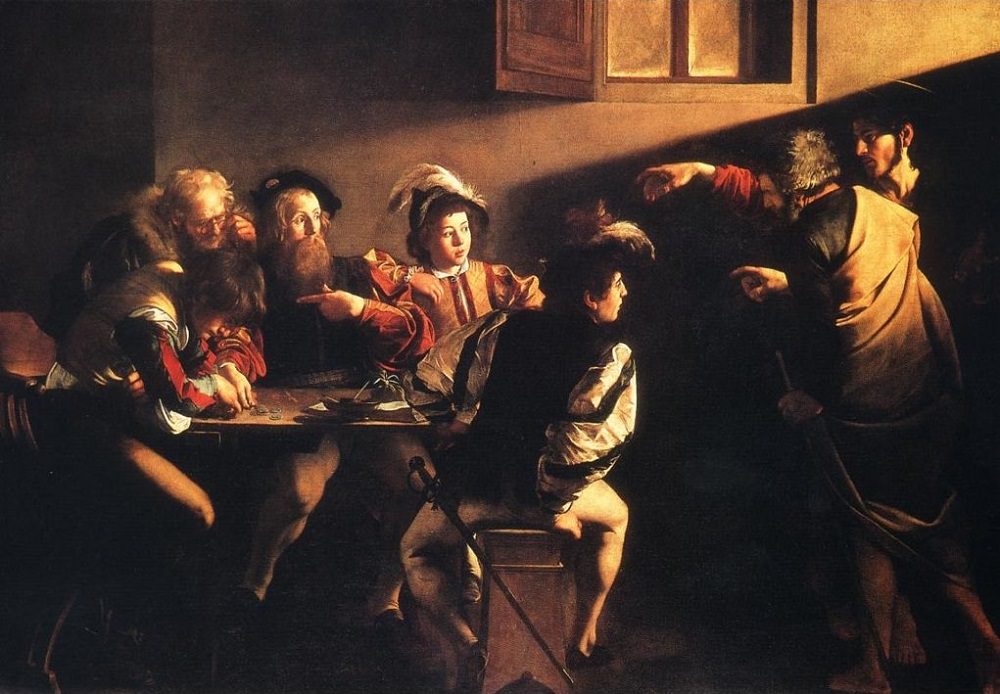
“Calling of St. Matthew” painting by Caravaggio from en.wikipedia.org.
God our loving Father in heaven,
open our eyes to see and recognize
the right persons you send us
to be our friends and colleagues,
co-workers and co-journeyers in life.
Let us not forget that first of all,
the right person we first meet from you 
is our very selves!
Thank you for believing in us.
Thank you for creating us.
Thank you in sharing with us your
truth and beauty, your image
and likeness that is very good.
As Jesus passed by,
he saw a man named Matthew
sitting at the customs post.
He said to him,
"Follow me."
And he got up and followed him.
(Matthew 9:9)
Let this scene be a constant reminder to us
of your mercy and love, dear God
that no matter how bad is the perception
of others on us, you still see the best in us.
Give us the grace to be attentive
to Jesus Christ passing by, calling us
even while we are in the darkness of our sin
indulging in luxuries and comfort,
power and fame of a sick world.
Like Matthew, let Jesus our light
make us rise to follow him
leave the damp and dark world of sin
and see again the light within
of your glow and majesty.
"Never take my son back there
for any reason," Abraham told his servant.
"the Lord, the God of heaven,
will send his messenger before you,
and you will obtain a wife for my son there."
A long time later, Isaac went to live
in the region of the Negeb.
One day toward evening
he went out in the field,
and as he looked around, 
he noticed that camels were
approaching.  Rebekah, too,
was looking about, and when she
saw him, she alighted from her camel...
Then Isaac took Rebekah into his tent;
he married her, and thus she became
his wife.  In his love for her 
Isaac found solace after the death 
of his mother Sarah.
(Genesis 24:6, 7, 62-64, 67)
What a beautiful love story
that looked like in the movie, sweet Lord
where you surely send us the right persons
at the right time
for the right reason
because of love.
We pray for those waiting for their
right persons, whether in love or profession,
or for any reason you and they alone know,
grant them the faith of Abraham
and the enlightenment of Matthew.
Amen.

Praying for those sent away

The Lord Is My Chef Breakfast Recipe for the Soul by Fr. Nicanor F. Lalog II
Wednesday, Memorial of the First Martyrs of Rome, 30 June 2021
Genesis 21:5, 8-20   ><)))*>  +  <*(((><   Matthew 8:28-34
First Martyrs of Rome, from Pinterest.com.
You touched my heart so much, 
God our loving Father
as your words spoke today
of people being sent away:
Sarah noticed the son 
whom Hagar the Egyptian 
had borne to Abraham
playing with her son Isaac;
so she demanded of Abraham:
"Drive that slave and her son!
No son of of that slave is going to share
the inheritance with my son Isaac!"
(Genesis 21:9-10)
Abraham was greatly distressed
and so am I, Lord, when I remember 
and think of those many people  
driven away, sent home or so far away 
due to anger and jealousy, 
hatred and modern forms of slavery
as well as sometimes for reasons of 
inefficiency and deficiencies.
Have mercy on us, O Lord
when we find it so easy 
to drive people away 
without realizing 
for every person sent home
or driven away
with nowhere to go
not only a job or education is lost
but most of all,
we deprive them of life and future.
And that is why we thank you O God,
in taking care of Hagar and Ishmael
after they were sent away
like those many others in our own time
sent away without the basic necessities
and worse victims of human trafficking;
We beg you, dear Father,
like Jesus in the gospel
may he set us free from the evils that
bound us today when we see more
the value of things and money
than of every person.
May the first martyrs of Rome
pray for us to be firm in standing
for the value of every person.
Amen.

Life in the Spirit

The Lord Is My Chef Breakfast Recipe for the Soul by Fr. Nicanor F. Lalog II
Wednesday, Week X in Ordinary Time, 08 June 2021
2 Corinthians 1:18-22   ><)))'> + <'(((><   Matthew 5:13-16
Photo by author, sunrise at the Lake of Galilee, the Holy Land, 2017.

Praise and thanksgiving to you, O God our loving Father, for this brand new day, so blessed and filled with many opportunities for us to change and grow in the Holy Spirit, to test our limits and see your wisdom in calling and sending us to make you known in the world.

How amazing that in every day you give us, you keep qualifying your call so that even if we are not qualified at all, you still call us because you believe in us.

Not that of ourselves
 we are qualified to take credit for anything
as coming from us; rather, our qualification
comes from God, who has indeed qualified us
as ministers of a new covenant, 
not of letter but of spirit; 
for the letter brings death,
but the Spirit gives life.
(2 Corinthians 3:5-6)

Forgive us, dear Father, when so many times we refuse to obey your laws especially when they go against our whims and caprices, claiming them to be archaic and irrelevant but at the same time, when we complain of the Church’s many changes and reforms that do not suit us, when we choose to revert to the pass than embrace the changing world.

Let us understand the gospel today where Jesus declares, “Do not think I have come to abolish the law or the prophets. I have come not to abolish but to fulfill” (Mt.5:17).

Let us live in the Holy Spirit to find and rediscover daily the person of Jesus Christ so that we may be gentle and kind like him with one another than being stuck in the rigidity and stagnation of our conservatism that make us harsh and legalistic in our relationships.

Let us live in the Holy Spirit so we may be free and faithful to you always, bubbling with spontaneity and creativity that express your glory, O Lord.

We pray today for those who choose to be sad, who insist on bringing back the past without understanding the true meaning of growing and changing in Christ, of maturing in freedom and love to fully appreciate the beauty of your gift of life. Amen.

Photo by author, 2018.