The Lord Is My Chef Breakfast Recipe for the Soul by Fr. Nicanor F. Lalog II
Friday, Solemnity of the Most Sacred Heart of Jesus, 11 June 2021
Hosea 11:1, 3-4, 8-9  +  Ephesians 3:8-12, 14-19  +  John 19:31-37
Let me begin my prayer to you, dear God,
with a confession from my heart that despite my
many years of praying, I have not really known you;
when I pray the "Our Father"
words simply pass my lips
slipping, skipping depths of my being.
On this Solemnity of Your Son's
Most Sacred Heart, please grant me
intimacy you have long offered a reality
if only our eyes can see
by looking at him whom they have pierced
blood and water flowed, our source of peace.
In that natural heart of your Son
is found your revelation
that outside of him
we find no salvation;
open our hearts, clear our doubts
to experience your love!
How sad that we cannot love
because we feel not being loved
when our Father in heaven is truly a Dad
who has never been mad when we are bad
in his boundless love for us
gave us his Son, full of tenderness and compassion!
The Lord Is My Chef Breakfast Recipe for the Soul by Fr. Nicanor F. Lalog II
Friday, Solemnity of the Most Sacred Heart of Jesus, 11 June 2021
Hosea 11:1, 3-4, 8c-9  ><)))'>  Ephesians 3:8-12, 14-19  ><)))'>  John 19:31-37
Photo by author, Sacred Heart Spirituality Center, Novaliches, QC, 2018.
So many times in life, we think we have loved so much, that we are a good and loving person when it is all an illusion because in reality, we have actually failed in truly loving the people and institutions we profess to love so much.
It is always easy to say in so many words, even to brag to our very selves and others of how much we love our family and friends, our country, our Church, and our company. But, when a little discomfort happens that result from misunderstanding or miscommunications, or a few mistakes and shortcomings, we flare up in anger expressing it in harsh words and deeds, hurting the people we supposedly love.
Not only that. Long after an unloving incident, we later hold grudges that we cannot forgive and forget, hurting us most in the process when sanity returns and see how we have broken a beautiful relationship.
But, it is not all that bad.
We all have our low moments in not showing how much we truly love like Simon Peter denied knowing the Lord three times on Holy Thursday evening while being tried by members of the Sanhedrin after their last supper. And very much like him too at the shore of Lake Tiberias eight days after Easter, we profess to Jesus and our loved ones that “you know everything; you know I love you” (Jn.21:17).
Our imperfect human love in God’s perfect love
We celebrate today the Solemnity of the Sacred Heart to be reminded of God’s immense love for us despite our failures and fears in expressing that love he continues to pour upon us through his Son Jesus Christ our Lord.
It is the third major feast of the Lord since we have resumed the Ordinary Time after Pentecost to instill in us God’s deep, personal love for us through Jesus Christ with whom we have become brothers and sisters, beloved children of the Father in heaven.
Thus says the Lord: When Israel was a child I loved him, out of Egypt I called my son. Yet it was I who taught Ephraim to walk, who took them in my arms; I drew them with human cords, with bands of love; I fostered them like one who raises an infant to his cheeks; yet, though I stooped to feed my child, they did not know that I was their healer.
Hosea 11:1, 3-4
See how God had always loved us like a loving father to his son or daughter.
Try to feel God speaking through Hosea in the first reading reminding us of his great love for us, doing everything to free us from the bondage and slavery of every form of evil.
But, like our own experiences with our parents as we grow older, the more we distance ourselves away from them and from God who always come to get nearer and intimate with us: “A child I loved you, I called you my son; and the more I called you, the farther you went away from me” (cf. Hos.11:1-2).
What have happened to us as we matured?
We have become so cerebral, thinking more, and feeling less, always trying to assert our independence, our strength, and self-reliance when the sad truth is we are all weak inside who cannot accept and believe the fact that we are truly loved by God and by others!
Imagine this lovely scene of God reminding us of his great love for us just like our Dad: “I took you in my arms with hands of love; I fostered you like one who raises an infant to his cheeks yet though I stooped to feed my child, you did not know I was your healer” (cf. Hos.11:4).
Here lies the problem with all our praying and loving that are detached from God, something like an echo of the elder brother in the parable of the prodigal son!
When our love for God is superficial, our love to our family and friends, to our institutions and other relationships become skin deep too. Our many love experiences are forgotten as we give more emphasis on others’ shortcomings and to our expectations from them.
We find it so hard and difficult
to truly love God and those dearest to us
not because we are bad and evil
but primarily we ourselves are not convinced we are loved.
Today's readings remind us
that human love is imperfect,
only God can love us perfectly.
We find it difficult to truly love unconditionally because deep inside us is a festering anger or hatred for our parents or siblings or friends who have hurt us a long time ago but we are so afraid to bring out in the open or just simply cast away or transcend so we can move forward to deeper and matured love in Christ.
Of course, there is that love remaining in our hearts but inert because we cannot accept nor be convinced that we are truly loved by God and by others.
We find it so hard and difficult to truly love God and those dearest to us not because we are bad and evil but primarily we ourselves are not convinced we are loved. Today’s readings remind us that human love is imperfect, only God can love us perfectly.
Thus says the Lord: My heart is overwhelmed, my pity is stirred. I will not give vent to my blazing anger, I will not destroy Ephraim again. For I am God and not man, the Holy One present among you. I will not let the flames consume you.
Hosea 11:8-9
Just keep on loving no matter how imperfect we may be for God perfectly knows us so well as humans with so many weaknesses and limitations.
God’s universal and personal love for us in Christ
We can never truly experience
God's personal love for us in Jesus Christ
unless we are first convinced of his great love for us
despite our sinfulness and weaknesses.
The more we doubt the love of Jesus,
the more we hurt him,
the more we hurt others,
and the more we hurt our selves.
Photo by author, St. Joseph Parish, Baras, Rizal, January 2021.
This personal and fatherly love of God is what St. Paul had always shared and elaborated in his many writings and teachings. See how he humbly introduced himself in our second reading as “the very least of all the holy ones, this grace was given, to preach to the Gentiles the inscrutable riches of Christ” (Eph.3:8).
More sinful compared to Simon Peter, Saul as he was called before his conversion persecuted the first Christians, having a direct hand in the stoning to death of our first martyr St. Stephen (Acts 8:1). Yet, in God’s fatherly love and mercy, Jesus appeared to him on the road to Damascus that led to his conversion. He would later insist in his letters how he had experienced both the universal and personal love of God through Jesus Christ.
St. Paul was so good and effective as an apostle because he was so convinced that while Jesus had died and rose for all, he also died personally for him (St. Paul) as an individual! He was the first to elaborate the universality of God’s love through Jesus Christ’s dying on the Cross and the subjectivity of his death and love for each one of us.
From being a sinner to becoming a believer, from a persecutor to an apostle, St. Paul tells us in the second reading today how he had experienced this love of Christ in himself which we can all personally experience too, praying that we may “be strengthened with the Holy Spirit to comprehend the breadth and length and height and depth, and to know the love of Christ that surpasses knowledge, so that we may be filled all the fullness of God” (Eph.3:16, 18-19).
We can never truly experience God’s personal love for us in Jesus Christ unless we are first convinced of his great love for us despite our sinfulness and weaknesses. The more we doubt the love of Jesus, the more we hurt him, the more we hurt others, and the more we hurt our selves.
Thank goodness God knows us so well that despite our doubts in him, his mercy is always stirred, not allowing his anger to consume or destroy us. On the contrary, the more we hurt God, the more he loves us until we are convinced that we are truly loved by him!
So the soldiers came and broke the legs of the first and then of the other one who was crucified with Jesus. But when they came to Jesus and saw he was already dead, they did not break his legs, but one soldier thrust his lance into his side, and immediately blood and water flowed out.
John 19:32-34
It was from this scene that we find the meaning of the Sacred Heart of Jesus that was pierced after offering himself on the Cross as the sign and symbol of God’s unique love for us all. For the evangelist, that flowing of blood and water from the pierced side of Jesus was a special “sign” pointing to the work and mission of Christ which is our own salvation.
But aside from linking the blood and water that flowed out from the Lord’s pierced side with the two prominent sacraments known by then early Christians, namely, Baptism and Eucharist, St. John as a witness to the event showed us how two natural elements that are so personal to everyone as signs of God’s intimacy with us.
On this Solemnity of the Sacred Heart, God is reminding us of his immense love for us expressed most personally in the self-sacrifice of his Son our Lord Jesus Christ in whom we have all become the Father’s beloved children.
Despite our ingratitude to his Fatherly love for us, God cannot let himself be angry to chastise us as we deserve. Instead, he kept on forgiving us for our sins, sending us his Son Jesus Christ to redeem us.
Today Jesus is inviting us to go back to our Father – our Dad who watched and guided us through life without our knowing – to be convinced of his personal love for each of us. Outside of him, we can never find peace nor joy nor fulfillment. That is why the human heart of Jesus is always here with us as the revelation of the Father’s boundless love for us.
Let us experience anew his tenderness and forgiveness so that we may grow too in our love for God through one another despite our many sins and weaknesses.
Jesus, meek and humble of heart, make our hearts like yours! Amen.
The Lord Is My Chef Breakfast Recipe for the Soul by Fr. Nicanor F. Lalog II
Thursday, Memorial of St. Charles Lwanga and Companions, 03 June 2021
Tobit 6:10-11; 7:1, 9-17; 8:4-9   ><)))'>+<'(((><   Mark 12:38-34
Photo by Fr. Pop Dela Cruz, Binuangan Is., Obando, Bulacan, May 2021.
At last! Finally! Something very positive in your words today, O God almighty Father. Asmodeus the demon was finally conquered with Sarah consummating her marriage to Tobiah while in the gospel, a scribe asked Jesus a question without any strings attached.
Like the rains brought by the typhoon yesterday, your words soothed our dried lives these days scorched with so many problems and struggles. How we wish your Son Jesus Christ would also tell us today his very words to that scribe who asked him which is the first of all the commandments:
"You are not far
from the Kingdom of God."
(Mark 12:34)
Cleanse our hearts, dear Jesus, and make us pure and simple in our search for God in our prayers like that scribe. Or better, teach us to be like Tobiah, the kind and faithful son of Tobit who beautifully expressed in a prayer his clean heart in marrying Sarah:
"Now, Lord, you know that I take
this wife of mine not because of lust,
but for a noble purpose.
Call down your mercy on me and on her,
and allow us to live together
to a happy old age."
They said together, "Amen, amen,"
and went to bed for the night.
(Tobit 8:7-9)
Enable us to learn and practice faithfully your teaching to “Love God with with all of our heart, with all of our soul, with all of our strength” by “loving our neighbor like our selves” (Mk.12:30-31).
Thank you in continuing to send us modern witnesses of faith like St. Charles Lwanga and his 21 companion martyrs of Uganda who chose to remain pure and chaste than give in to the immoralities and idolatry of their king.
Through their intercession, we pray for those among us who have succumbed to the lures of the world, those addicted with social media and those into the continued degradation of the human person with sexual abuses.
O God, bring back our senses of what is right and good, our adherence to values and decency with a deep love for you and your Kingdom. Amen.
The Lord Is My Chef Breakfast Recipe for the Soul by Fr. Nicanor F. Lalog II
Monday, Feast of the Visitation of the Blessed Virgin Mary, 31 May 2021
Romans 12:9-16     ><}}}'> + ><}}}'> + ><}}}'>     Luke 1:39-56
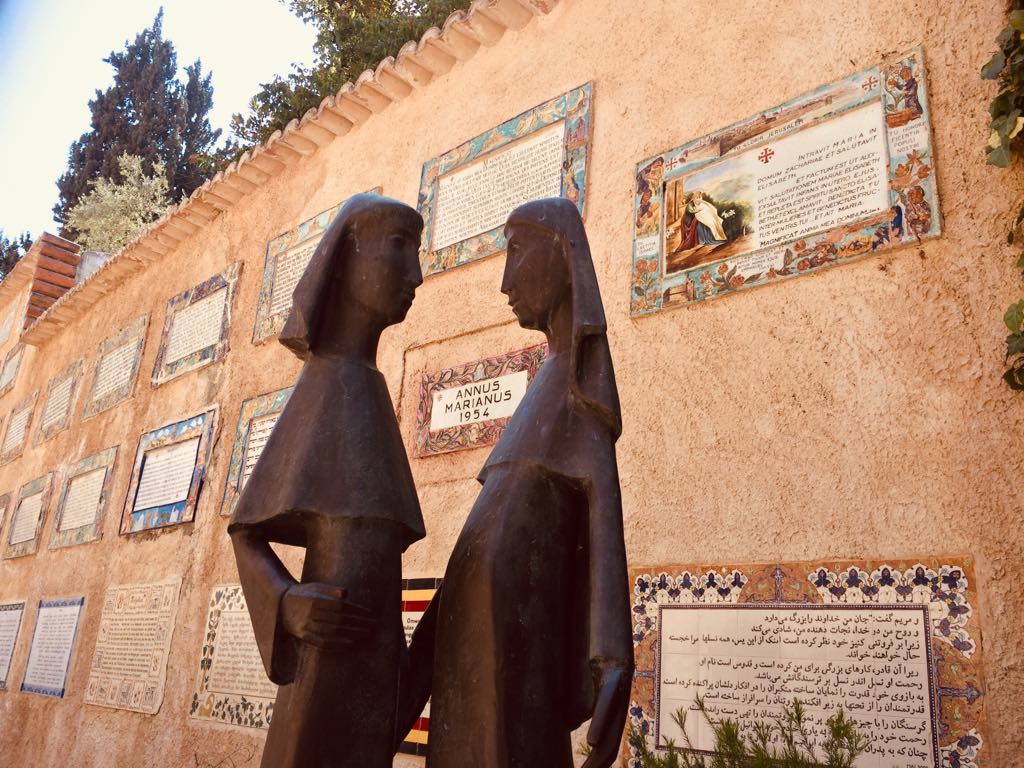
Photo by author, bronze statues of Mary and Elizabeth at the patio of the Church of the Visitation at Ein-Karem in Judah, 2017.
When Elizabeth heard Mary's greeting,
the infant leaped in her womb, and Elizabeth,
filled with the Holy Spirit, cried out in a loud voice
and said, "Most blessed are you among women,
and blessed is the fruit of your womb.
And how does this happen to me,
that the mother of my Lord should come to me?"
(Luke 1:41-43)
In this time of the pandemic with threats of COVID-19 still prevalent, we feel exactly like St. Elizabeth, O God our loving Father, asking, “how does this happen that you O Lord, should come to us?” But that is how great and tender is your mercy for us, Father!
How great indeed is your goodness and mercy for us, Father, that your ways are always so different from our own ways like with the story of the cousins Elizabeth and Mary: ideally, it should have been the elder Elizabeth who visited Mary for she was bearing your Son Jesus Christ. That early, Jesus had shown us the nature of his mission here on earth, that he had come to serve and not to be served.
You know how much we miss one another so much these days, heavenly Father. We are getting tired of being kept at home and not able to visit or even receive visitors from family and friends for fear of getting sick.
Come and send us again Jesus your Son to visit us anew like what you did when Mary visited Elizabeth.
Increase our faith, let us believe like Mary that your words would be fulfilled as you have promised.
Keep our hope aglow like Elizabeth who, despite her old age and barrenness, joyfully received the gift of motherhood to the future John the Baptist.
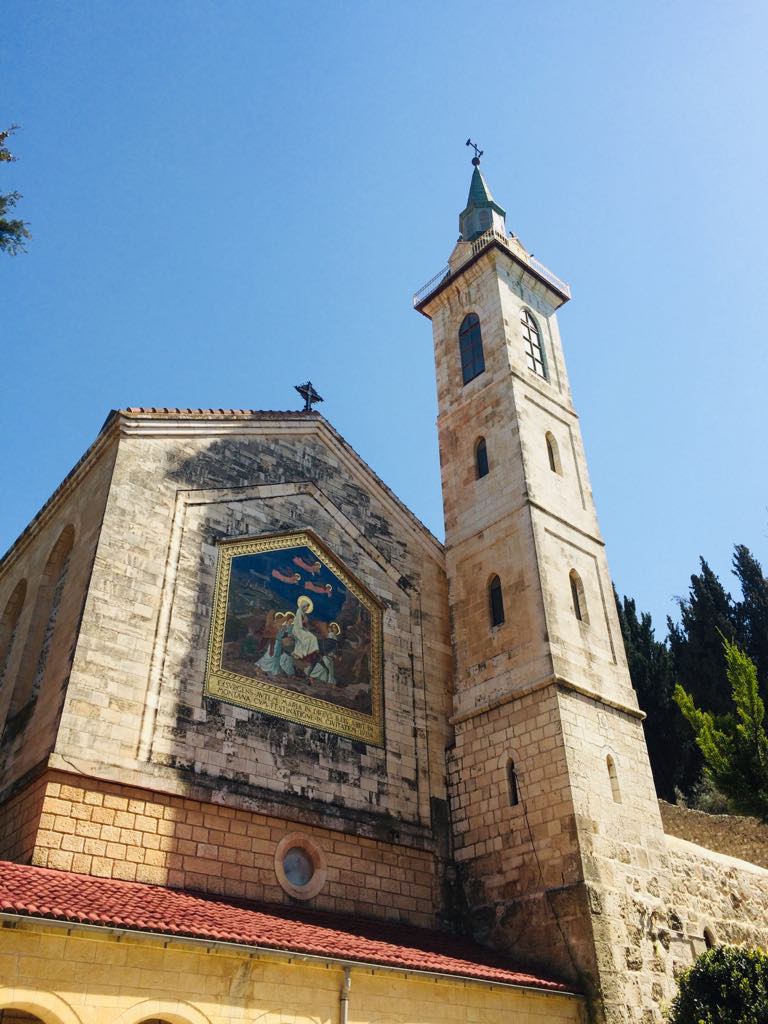
Photo by author, Church of the Visitation, Holy Land, 2017.
Most of all, keep us humble and lowly before you, dear God, like Mary, hungry and thirsty for your words so we may have a space to receive and share Jesus with others, unlike the rich and powerful so filled with their pride and ego who could not welcome Jesus Christ’s coming.
Grant us courage, Lord, so we may heed and live out the words of St. Paul today so that like Mary and Elizabeth we may live in mutual love with one another, making you present among us. How unfortunate that we cannot see your coming to us in this time of crisis because we are so filled with arrogance and pride, of our lack of love and respect for one another.
Let love be sincere; hate what is evil, hold on to what is good; love one another with mutual affection; anticipate one another in showing honor.
Romans 12:9-10
We pray for those who dwell on their evil and malicious thoughts in taking advantage of others especially the poor and powerless in this time of crisis. Please visit our political leaders, bring back their shame and sense of patriotism so they may think more of the suffering people than of their selfish motives and interests. Amen.
The Lord Is My Chef Sunday Recipe for the Soul by Fr. Nicanor F. Lalog II
Solemnity of the Pentecost, 23 May 2021
Acts 2:1-11  ><}}}*>  Galatians 5:16-25  ><}}}*>  John 15:26-27.16:12-15
Photo by Ms. Jo Villafuerte at Atok, Benguet, 2019.
Today we bring to completion our celebration of the Lord’s Paschal Mystery – his Passion, Death, and Resurrection, Ascension and Coming of the Holy Spirit to his disciples. Although this mystery is one single reality, we have stretched its celebration over a period of 50 days (hence, Pentecost) or more than seven weeks because it will never be enough to fully grasp its whole meaning for it is a continuing reality and mystery in our midst just like the Ascension last week.
Note the upward movement of the Ascension that calls us to “level up” our relationships with God and one another in Christ; today, the downward movement of the coming of the Holy Spirit calls us to being small in order for us to be broken and shared with others. Whenever there is a downward push, what happens usually is a breaking down into smaller parts to fuse with the larger whole like a mix.
...our greatness is in our sharing ourselves with others...
It is in our becoming small to participate in the whole
that we truly become great -
whether in the Church or a community,
in our personal relationships...
Jesus had taught us in his life and example especially on the Cross that our greatness is in our sharing ourselves with others like him. It is in our becoming small to participate in the whole that we truly become great – whether in the Church or a community, in our personal relationships like family and circle of friends and most especially in the union of man and woman as husband and wife in marriage.
That is why the Pentecost is called the birthday of the Church when the disciples after being filled with the Holy Spirit came out in the open to proclaim the Gospel of salvation in Jesus Christ. It was actually more of a “coming out party” of the Church that was established by Christ during his Last Supper.
See that since the very beginning, the Church started as a catholic – a whole – at the Last Supper of the Lord when he also instituted the Holy Eucharist that has become the sign of our unity from then on that enabled the disciples to recognize him at Easter at the breaking of bread.
Jesus promised them at the Last Supper how things would get clear to them when the Holy Spirit comes.
"When the Advocate comes whom I will send you
from the Father, the Spirit of truth that proceeds
from the Father, he will testify to me.  And you
also testify... I have much more to tell you,
but you cannot bear it now.  But when he comes,
the Spirit of truth, he will guide you to all truth."
(John 15:26-27. 16:12-13)
Believing in the Holy Spirit, Believing in the Church
Every Sunday in the Mass we profess our faith, declaring “I believe in the Holy Spirit, the Holy Catholic Church” but, do we really understand its meaning? To believe in God is to believe in the Holy Catholic Church, to forget one’s own agenda in life, to submit ones self to her teachings from Christ our Lord and Master.
It is a declaration of the mystery and reality of the Pentecost, reminding us that becoming Christian means receiving and embracing the whole Church!
This is the beautiful meaning of the account by St. Luke at the first reading of the coming of the Holy Spirit on Pentecost at Jerusalem when all barriers – physical, emotional, intellectual, spiritual – were broken as the disciples went around speaking in various languages to proclaim the truth of Jesus Christ.
When the time of Pentecost was fulfilled,
they were all in one place together.
And suddenly there came from the sky a noise
like a strong driving wind, and it filled the entire house
in which they were.  Then there appeared to them
tongues of fire, which parted and came to rest
on each one of them.  And they were all filled
with the Holy Spirit and began to speak in different tongues,
as the Spirit enabled them to proclaim.
(Acts 1:1-4)
Here we find the disciples of Jesus and their converts on that day of Pentecost allowing themselves to be taken up into the Church!
And how did this happen? St. Luke tells us “Then there appeared to them tongues of fire, which parted and came to rest on each one of them.” Each one was parted, was broken down from their sins and selfishness that they became open for each other, trying to understand and accept each one as brother and sister in Christ.
It was a reversal of the story of Babel in Genesis when people were so arrogant and proud building a tower that reaches to heaven who were punished to speak in different languages that led to their confusion and quarrel until they all perished along with their ambitious plan.
Pentecost was different. There were different languages, different peoples with different backgrounds yet they were united and understood each other because everybody tried to become small, to mix into the whole and thus becoming a part of the Church on that day.
Unless we are willing to be parted by the Holy Spirit’s “tongues of fire” and “strong driving wind” like a storm, we can never be filled with God and his holiness to experience his peace and his joy.
It is a lifelong process and that is why Pentecost is a daily reality, happening to us especially when we sometimes have to be shaken by so many events and circumstances that come our way.
In the second reading, we heard St. Paul reminding the Galatians, including us, to “live by the Spirit and not gratify the desire of the flesh” (Gal.5:16). At that time, some missionaries sowed confusion among the Galatians, telling them to follow Jewish practices and Mosaic prescriptions to be fully Christians like circumcision. The issue had long been settled at the Council of Jerusalem but some Jewish converts persisted.
Here, St. Paul teaches us a valuable lesson in resolving conflicts and confusions in daily life in the light of Jesus Christ, of salvation, of the Church. For St. Paul, we always have to ask the Holy Spirit in guiding us in everything, no matter how secular and mundane it may be to find the theological and spiritual implications of our experiences.
What he told the Galatians remains true to our days, that freedom is not the ability to do whatever we want but to choose and do what is good. Every person has that tendency to sin, an imperfection in the “flesh” that is always in contradiction with the “spirit”.
As we have mentioned earlier, our greatness lies in our ability to share and give ourselves to others by dying to our sins and selfish motives, precisely what St. Paul is telling us:
Now the works of the flesh are obvious: immorality, impurity, licentiousness, idolatry, sorcery, hatred, rivalry, jealousy, outbursts of fury, acts of selfishness, dissensions, factions, occasions of envy, drinking bouts, orgies, and the like.
Galatians 5:19-21
These are the things that the Holy Spirit “part” in us when it comes to us daily especially in our prayers and in the celebrations of the sacraments like the Holy Eucharist. Through the power of the Holy Spirit, we are unified as a person, we become whole and integrated that we see the value and importance of being one with God and with others. It is not longer the rituals that become the law guiding us but the interior law of love of Jesus Christ that enables us to get out of our selfishness to give ourselves in loving service to others.
When we live in the power of the Holy Spirit guided by this interior law of love, that is when we become truly free and experience the gifts and fruits mentioned by St. Paul like peace and joy.
In our world today marred by sin and so many divisions happening in our society and even in the Church, in our communities and right even in our families and personal relationships, let us pray today to the Holy Spirit to come to us, break down within us the many walls we have and lead us to surrender ourselves to God to be led by his hand in continuing the mission of love and mercy of our Lord Jesus Christ. Amen.
A blessed week ahead of everyone!
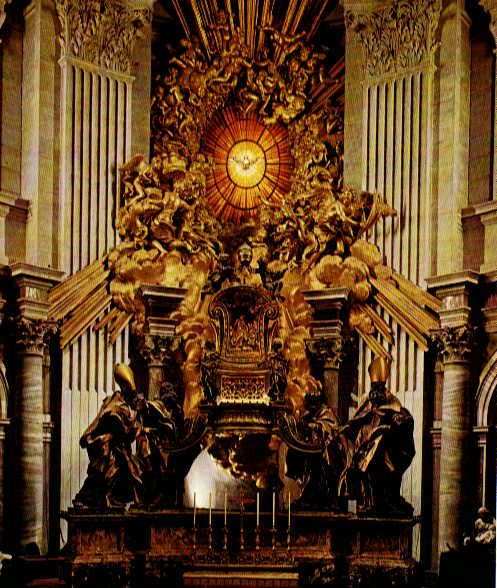
Photo of the stained glass with the Holy Spirit bringing light into the altar of St. Peter’s Basilica in Rome. Photo from wikipediacommons.org.
The Lord Is My Chef Breakfast Recipe for the Soul by Fr. Nicanor F. Lalog II
Friday in the Seventh Week of Easter, 21 May 2021
Acts 25:13-21  <'(((><  +  ><)))'>   John 21:15-19
Photo by author, St. Paul Center for Spirituality in Alfonso, Cavite, 2019.
He said to him the third time,
"Simon, son of John, do you love me?"
Peter was distressed that he had said it
to him a third time, "Do you love me?"
and he said to him, "Lord, you know everything;
you know that I love you."  Jesus said to him,
"Feed my sheep.  Amen, amen, I say to you..."
And when Jesus had said this,
he said to him, "Follow me."
(John 21:17-18, 19)
As the closing of the Easter Season fast approaches, it is getting clearer, O Lord Jesus Christ that for us to be able to follow you more closely, we first have to love you more dearly and intently. The same reality holds true in any relationship we have: love first, and everything follows!
Because when we truly love, we can do nothing but good.
You know everything and you know how much we love you, Lord.
And you know very well how imperfect is our love for you and one another.
Let us discover again the wonder and joy of loving another person by forgetting our very selves, by having the courage to dare think more of our beloved than our own good. Make us realize that pain and hurt always come when we love because it in in them when love grows and deepens.
Enkindle in us again the fire and passion of sharing the love you have made us experience despite the fears, hatred, violence and abuse we have gone through from others. Enable us to still choose love despite all these troubles in the world.
Teach us to forgive those who denied us with your love and most of all, let us learn to forgive our very selves too so we may rediscover that power of love you have in us.
Like Peter who denied you thrice out of fears and have witnessed the violence surrounding your Passion and Death, he chose to love you in his own imperfections and weaknesses. And that was enough for you to bring hope to his companions!
Awaken our hearts, dear Jesus, to love again, to shred off our pains and hurts from the past and start living in the present, savoring the love you offer us each day to drive away the prevailing negativities around us.
Like St. Paul, may we have the courage and trust in you to let your hand bring us to places and situations where we do not want to go, always believing, always hoping, and always loving you.
We pray most especially today for those who have lost a loved one. Make us realize that love is never lost at all for in the end, only love lasts. Amen.
The Lord Is My Chef Breakfast Recipe for the Soul by Fr. Nicanor F. Lalog II
Thursday in the Seventh Week of Easter, 20 May 2021
Acts 22:30-23:6-11   ><)))'>  +  <'(((><   John 17:20-26
Photo from inquirer.net
How should we pray today, Lord Jesus Christ when you are the one praying for us? How wonderful indeed that at the Last Supper, you have already thought of us who would come to believe you 2000 years later. And what a beautiful prayer you have for us all – that like you and the Father, we may all be one in love!
Lifting up his eyes to heaven,
Jesus prayed, saying:
"I pray not only for these, but also for those
who will believe in me through their word,
so that they may all be one, as you, Father,
are in me and I in you,
that they also may be in us,
that the world may believe that you sent me."
(John 17:20-21)
Yes, Lord Jesus: being one is being like you and the Father, a unity expressed in love and mutuality. It is a unity that comes from above, from you, and not simply from below or from us that is so fragile, so easily broken because of so many divisions within our very selves and among us.
Exactly what St. Paul had wittingly exposed when he spoke before the Sanhedrin – the polarity in beliefs of their religious leaders at that time, of the Pharisees who believed in resurrection and in angels and spirits and the Sadducees who refused to believe in these at all.
Teach us, Lord, to be witnesses of your love and unity in the Father in this time when unity is seen more as uniformity than oneness in diversity that spawns respect for one another.
Let your prayer be on our lips today so that in our lives of witnessing to your love and unity, the more we make you and the Father present in this world that has come to reject spirituality, accepting only what is materially tangible.
"Righteous Father,
the world does not know you,
but I know you, and they know that you sent me.
I made known to them your name
and I will make it known,
that the love with which you loved me
may be in them and I in them."
(John 17:25-26)
We pray, O Lord, for those losing hope in humanity, for those who have become cynical that we can still change and work for a better tomorrow as a Church and as a nation. Amen.
Quiet Storm by Fr. Nicanor F. Lalog II, 11 May 2021
Photo by Dr. Mylene A. Santos, MD, April 2021 at Rhode Island.
I have always been wondering
how would it be when suddenly one morning
we realize COVID-19 is gone
what song shall we sing
as we dance, celebrating its leaving
and our coming out again?
Whom shall I first see
to visit, hug and kiss
telling them how I terribly missed them
in all those months of quarantine
how my heart deep within was longing
to hear them speaking and laughing, and crying.
It would be so joyous but also
sorrowful and painful as we proceed next
to our loved one's final resting place
to offer flowers and tribute
telling them again
how we love and sorely miss them.
While waiting for that new dawning
amid this prolonged quarantine
let's keep living one moment at a time
loving and caring, smiling and forgiving
everyone is awaiting something good
may still happen amid this COVID-19.
The Lord Is My Chef Sunday Recipe for the Soul by Fr. Nicanor F. Lalog II
Sixth Sunday in Easter, Cycle B,  09 May 2021
Acts 10:25-26, 34-35, 44-48 ><}}}'>  1 John 4:7-10  ><}}}'>  John 15:9-17
Photo by author, December 2020.
Today we come full circle in our readings and teachings of the Lord since Easter, appropriately prepared last Sunday with his discourse being the true vine and we his branches who must remain in him to be fruitful in love.
Yes, love is the only fruit expected of us by God in Christ Jesus. When we die, it is the only thing the Lord would ask us, “gaano ka nagmahal” (how much have you loved)? It is the origin and the end of everything in this life, the only one that would remain in eternity (1Cor. 13:13).
God created us because of love, and because of that love as the second reading tells us, saved us by sending us Jesus Christ whose very life, words and actions are all rooted in his love for the Father and for us. That is why in our gospel today, Jesus spoke of love at every turn during the last supper to emphasize centrality of love that is rooted in God.
Jesus said to his disciples:
"As the Father loves me,
so I also love you.
Remain in my love.
If you keep my commandments,
you will remain in my love,
just as I have kept my Father's commandments
and remain in his love.
I have told you this so that my joy may be in you
and your joy may be complete."
(John 15:9-11)
Photo by Dr. Mylene A. Santos, MD, February 2021.
Love and Joy
God alone really knows what love is because “God is love” (1Jn.4:16). Notice how Jesus spoke of love in the gospel today by linking it closely with joy as he tells us that when there is love, there is also joy. Without love, there can be no joy and without joy, clearly there is no love at all!
In its truest sense, joy – like love – is more than an emotion. It is a conviction deep within us borne out of faith that no matter what happens to us, there is God who truly loves us, remaining faithful to us until end when everything and everyone is gone.
Joy is deeper than happiness that is always coming from the outside when lips smile or laugh at something or someone funny and happy. Joy is always coming from within when the heart smiles even when you are in the midst of pain and sufferings. Recall those moments when during a major setback or a struggle in life you still managed to feel joy within through a deep sigh after seeing a beautiful sunrise of sunset or a lovely flower. There is always that feeling of comfort and relief so assured that you have somebody by your side — Jesus who assures us of his love this Sunday, asking us to remain in him “so that my joy may be in you and your joy may be complete” (Jn.15:11).
Photo by author, ICSB-Malolos, 26 April 2021.
When joy is not complete and not in Christ
Our joy is not complete, not in Christ
when we refuse to love because we feel unloved.
So many times in life, we cannot experience true joy when we refuse to love another person whom we feel not loving us at all. We “hate” them because we feel they do not love us, they do not care for us, that they take us for granted.
I have seen this happening to me so many times when I suspect other people of being angry with me, of being biased against me and worst, of being “insecured” with me!
But too often, I do not have bases in believing so.
Most of all, I have realized in life that we cannot force people to love us or even like us inasmuch as I do not want being coerced to do the same too! What is most true in my experience is that when some people do not seem to love me, the challenge for me is to love them more. Not hate them or not love them.
I know this is easier said than done but try to understand that it is only in loving those who do not love us or do not care for us or even hate us when we truly love because when we do so, that is when we let God intervene to make his love work in us, through us, and with us.
When we love those who do not love us, we surrender ourselves to God which is an act of self-giving like Jesus Christ on the cross, letting him fill in whatever is lacking in us to truly love. It is the truest love we can have when our love is not reciprocated by another, thus enabling us to rediscover God, our very selves and others. In the process, we begin to experience joy because we have started truly loving without expecting anything in return by loving those who do not love us nor care for us at all.
Photo by author, 2019.
Our joy is not complete, not in Christ
when we love only those like us.
Only God can love us perfectly. Human love is always imperfect as we always have that tendency to go only with those like us – in our looks and bearing, beliefs and tastes in almost everything. In that case, we limit ourselves with the people we interact with that in the process, we never grow in love and never really become joyful because we do not love at all!
Love is always outward in movement, always to another person as we mature. As a matter of fact, we love because we want to be become like the one we love who is always someone we look up to and admire. That is why love becomes more wonderful and fulfilling when we love somebody not like us or totally different.
There lies the problem with our kind of love, especially those portrayed in the movies, television, and modern music where we love only those like us that is very selfish because we only love ourselves.
We will never experience joy completely if in our loving we seek only those who are like us or worst, twist others to become like us, fitting them into our own image so that whom we love is not them but us found in them!
Crazy but it happens so many times when we manipulate others to become like us than let them be free to become their true selves.
“Love is our true destiny.We do not find meaning of life by ourselves alone – we find it with another. We do not discover the secret of our lives merely by study and calculation in our own isolated meditations.The meaning of our life is a secret that has to be revealed to us in love, by the one we love.”
Thomas Merton, “Love and Living”
The surest sign that we have truly loved is when we have found another person to love more than our very selves.
Photo by Dr. Mylene A. Santos, MD at Rhode Island, April 2021.
Our joy is not complete, not in Christ
when we refuse to forgive those who have hurt us,
especially those we have loved so much.
It is easy to claim that we love if we do not really love at all. No matter how hard we profess that we love, its lack cannot be denied in the absence of joy in our selves, in our lives because we have been hurt by those we love.
This is more difficult than the first when we refuse to love because we feel we are not loved that may not be true at all; this is evidently clear, somebody had hurt us, had betrayed us, had been unfaithful to us.
And the saddest part of it despite all the denials is that we still love deep within us those who have hurt us! Is it not? Kaya masakit kasi nga mahal pa rin natin.
I am not talking here of a disordered or foolish love; this is something like the love of a husband or a wife to one’s partner who had fallen into infidelity for some reason. Or a prodigal son or daughter who had gone wayward in life.
This kind of love is the most difficult, but once overcome is the most sublime, the loftiest of all because the very reason why we are aching and hurting inside is because we still love. This is the kind of joy that would surely burst in fulness and completeness if we learn to forgive and let go.
Again, easier said than done but such is the power of love: the more we love, love is perfected in us that we slowly get a glimpse of God in others, and the more we become like Jesus his Son (1Jn.4:12).
So many times in life, we need to imitate St. Peter in the first reading by simply allowing God’s irresistible initiatives overtake us that while he was explaining things to the household of Cornelius, “the Holy Spirit fell upon all who were listening that he ordered them to be baptized in the name of Jesus Christ” (Acts 10:44, 48).
When we love, love freely!
Let that love flow, do not hold it, just let it go like what mothers do most of the time: even if they are hurting inside, even if they feel not loved and cared for, even if sometimes they seem to be so hard on us insisting on their own ways, they just love, love, and love.
And that is the secret of true love rooted in Christ: when we love, we can do nothing but good. Then our joy is complete.
A joy-filled week to everyone! And happy Mothers’ Day too.
Photo by Dr. Mai B. Dela Peña, Carmel at Israel, 2014.
The Lord Is My Chef Breakfast Recipe for the Soul by Fr. Nicanor F. Lalog II
Thursday in the Fifth Week of Easter, 06 May 2021
Acts 15:7-21   ><)))*>  ><)))'>  ><)))*>   John 15:9-11
Photo by author, Mount St. Paul Center for Spirituality, La Trinidad, Benguet, February 2020.
Lord Jesus Christ, teach me to rediscover joy. Teach me to be joyful again. Most of all, complete my joy in you, sweet Jesus as you have promised us before you were betrayed.
Jesus said to his disciples:
"If you keep my commandments,
you will remain in my love,
just as I have kept my Father's  commandments
and remain in his love.
I have told you this so that my joy may be in you
and your joy may be complete."
(John 15:10-11)
You know very well, Lord, how hard our lives have been since this pandemic happened last year. Aside from the difficulties and sufferings of getting sick, of avoiding COVID-19 came the many days and nights of loneliness and depression, of feelings of being alone and not cared for. Even forgotten.
Indeed, as experts claim, 2021 is the time when we are all “languishing” – not really depressed but not having zest in life, unproductive, and yes, lacking in joy.
And if we lack joy, it means only one thing: we do not have you because we do not love truly. Or at all.
Teach us to love again, Lord. To continue loving others without distinction, especially those who are not like us. Open our eyes to see the way you see everyone, that no matter what is one’s color or gender or belief or background in life is blessed and saved in you alone.
Saint Peter is absolutely right at the opening of the Council of Jerusalem in our first reading today.
"On the contrary,
we believe that we are saved
through the grace of the Lord Jesus,
in the same way as they."
(Acts 15:11)
Only you, O Lord Jesus and no one else or nothing else can ever complete our joy for it is only in truly loving you through others, especially those difficult to love, that we truly love and thus become truly joyful.
















 lordmychef.com