40 Shades of Lent by Fr. Nicanor F. Lalog II
Holy Tuesday, 30 March 2021
Isaiah 49:1-6 ><}}}*> John 13:21-33, 36-38
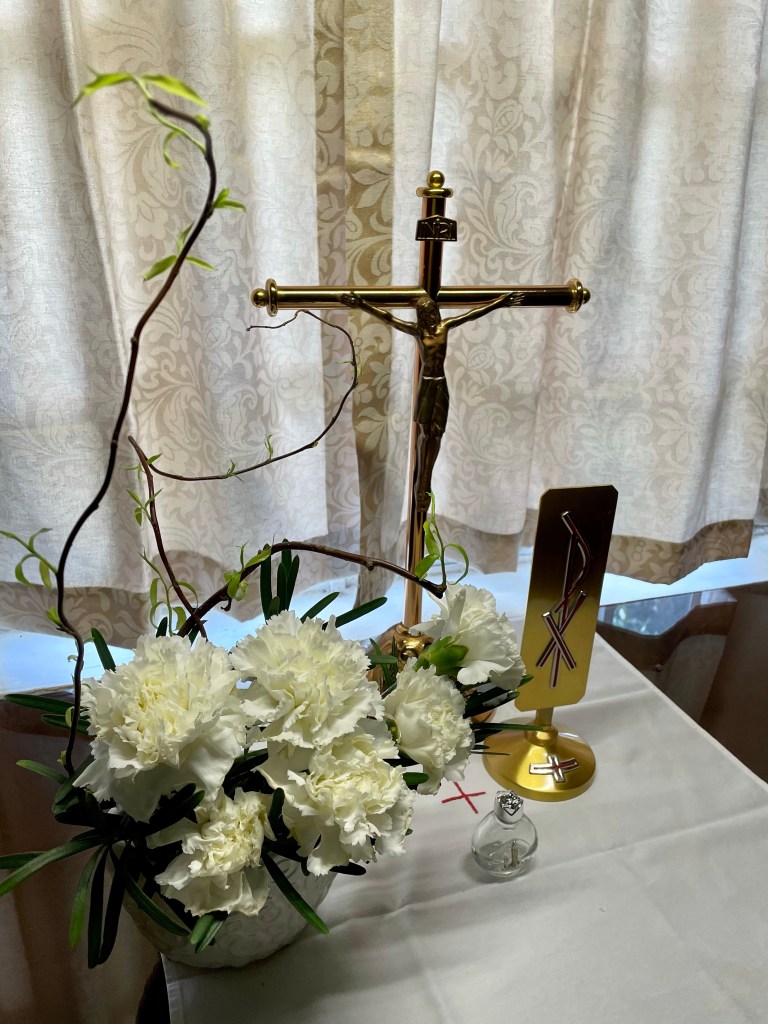
Photo by author, December 2020
Though I thought I had toiled in vain,
and for nothing, uselessly, spent my strength,
yet my reward is with the Lord,
my recompense is with my God.
(Isaiah 49:4)
So many times, dear Father in heaven, I feel like your “Suffering Servant” feeling that nothing is happening with all my efforts, with things I persevere, as if they are all useless until I realize what matters most is my being faithful to you.
Thank you for the sign of the Cross of Jesus Christ your Son, our Lord and Master: when things become so difficult and frustrating for me, I just look at him there on the cross, “dead” like me who had failed in your mission.
But as I contemplate his Cross, I remember how before all my sadness and sufferings, Jesus was there first for me to be good with others, to be kind, to be understanding, to be merciful and forgiving, to be patient, and most of all, first to be holy in being faithful to you and your call, Father.
Remind me the words of St. Mother Teresa of Calcutta that we are called to be faithful, not successful.
Let me focus more on you, Lord, instead of wondering how I have been doing, how good I have been.
Let me stop competing with others, asking who is not faithful to you, who is going to betray you like Peter during the last supper when he told the beloved disciple to clarify it with Jesus:
He leaned back against Jesus' chest
and said to him,
"Master, who is it?"
(John 13:25)
How lovely is the context of that question when what we must contemplate with is whether we have been faithful to Jesus in his Holy Eucharist.
How sad, O dear Father, that we are most unfaithful to you when we betray you right in the Eucharist – when do not listen to your words and message to us, when we do not live and practice the essence of thanksgiving to you by being faithful in witnessing Christ’s sacrifice on the Cross in our daily lives. Amen.
40 Shades of Lent by Fr. Nicanor F. Lalog II
Solemnity of the Annunciation of the Lord, 25 March 2021
Isaiah 7:10-14, 8:10 + Hebrews 10:4-10 + Luke 1:26-38
Photo by author, Basilica of the Annunciation, Nazareth, Israel, 2017.
Last Monday I celebrated my 56th birthday in quarantine after having a close contact with a person with COVID-19. The health officers were both smiling in disbelief as they took my swab test that morning after finding out after my interview it was indeed my birthday.
Between that morning and its eve – in fact since Saturday when I went on quarantine – I felt like in another scene of the Annunciation as I awaited the “good news” with my whole world standing still in animated suspension.
Earlier that morning, I celebrated Mass in my room when I looked back to my birthday last year. It was a Sunday, the first week of the lockdown when public Masses were suspended. After celebrating the Mass alone in our Parish church, I borrowed a truck and mounted the Blessed Sacrament at the back and went around our parish that afternoon to bless the people who knelt on the road with some were crying.
This year, I felt the Lord wanted me to celebrate my birthday in quarantine to be alone with him again to realize the rich meaning of this Solemnity in relation with our lives, especially with me as his priest.
Photo by Ms. Ria de Vera, 2020.
Brothers and sisters: It is impossible that the blood of bulls and goats take away sins. For this reason, When Christ came into the world, he said, “Sacrifice and offering you did not desire, but a body you prepared for me; in holocausts and sin offerings you took no delight. Then I said, ‘As is written of me in the scroll, Behold, I come to do your will, O God.'” By this “will,” we have been consecrated through the offering of the body of Jesus Christ once for all.
Hebrews 10:4-7, 10
The mystery of Christ’s coming
Notice that in Mass today at the proclamation of the Creed, we are asked to genuflect at the words “conceived by the Holy Spirit, born of the Virgin Mary” to remind us that the Incarnation of the Son of God is the fundamental mystery of our faith which the Church has always proclaimed since the beginning.
This is the gist of our short but rich reflections by the author of the Letter to the Hebrews of how Jesus truly became human born by the Blessed Virgin Mary in the power of the Holy Spirit without losing any of his divinity in the process in order to save us and make us new again before God our Father.
In his reflection, the author of the Letter mentions how the Old Testament worship was more symbolic and a preparation to the perfect offering made by Jesus on the cross.
Photo by author, Basilica of the Annunciation, Nazareth, 2019.
In the Old Testament, priests offered animals for atonement of sins with the blood symbolizing life. They offered three animals: first for their sins so they may be cleaned before God in making the sacrifices for the people for whom the second animal stood for. The third animal was usually a goat to cover all the other sins of the world from which we got “scapegoat” as term for one who takes all the blame.
Jesus Christ came to perfect the temple worship in his very body when he told the Pharisees and scribes after cleansing the temple, “Destroy this temple and in a three days I will raise again” (Jn.2:19).
By dying on the cross, Jesus fulfilled his words to the Samaritan woman at Jacob’s well that someday, people would no longer worship in just one place because through his “hour” of glory – his crucifixion – people will be able to “truly worship the Father in Spirit and truth” (Jn.4:23).
On the cross, Jesus made himself the perfect sacrifice to God by atoning for our sins. The word atonement was coined by a Protestant translator of the bible to convey the idea of salvation as being one again with the Father, or “at-one-ment”.
Following the reflection by the author of the Letter to the Hebrews, we find that the very coming of Christ announced by the angel to Mary was in fact directed toward this paschal sacrifice of Jesus.
In the gospel today we have seen the angel telling Mary to name her child “Jesus” that means “God is my savior”. The angel was more explicit in the Annunciation to Joseph who was instructed, “you are to name him Jesus, because he will save his people from their sins” (Mt.1:21).
It was from this celebration of the Annunciation of Christ’s birth that we have the tradition of praying the Angelus every 6am, 12noon and 6pm to make our day holy, reminding us of this great mystery of the Incarnation of Jesus who became both “the gift and the giver” when he offered himself on the cross for us which we remember and make present in every celebration of the Mass.
Photo by author, chapel at the site of annunciation, Basilica of the Annunciation, Nazareth, 2019.
The life of obedience in Christ
From that beautiful story of the Annunciation of Lord we find how in the coming of Jesus Christ from the very start – from heaven to its coming on earth to Mary’s virginal conception at Nazareth – the mystery of his Incarnation has always been characterized by obedience.
In being obedient to the Father, Jesus consecrated us through him in offering his body once and for all that opened for us an avenue to a life of holiness through obedience to God. And the first to have this distinction is his Mother, the Blessed Virgin Mary.
Mary said, “Behold, I am the handmaid of the Lord. May it be done to me according to your word.” Then the angel departed from her.
Luke 1:38
Next to Mary is her husband, St. Joseph whose Solemnity we celebrated last week. His “yes” to following the angel’s instruction upon waking up from his dream echoed the Blessed Mother’s obedience to God’s plan and will for everyone through Jesus Christ.
Here we find Mary and Joseph, two righteous people who allowed themselves to be instruments in the fulfillment of the divine plan in Jesus Christ, relying more in the power of God, believing in his words spoken by the angel to them.
Photo by author, Basilica of the Annunciation, Nazareth, 2019.
On this Solemnity of the Annunciation of the Lord, we are challenged and invited to be open and obedient to God, to his words we hear proclaimed in the celebration of the Mass and in our personal prayers.
Jesus is the word who became flesh and dwelled among us, present among us because of the obedience and faith of Mary and Joseph.
It is always very tempting to be like King Ahaz in the first reading, when we rely more in ourselves, in our wisdom and intelligence, expertise and experience that we sometimes feel it no longer needed to bother God at all for directions especially with “earthly” things and concerns like the economy or defense of the country.
Or, pandemic.
This is the saddest part with COVID-19: a year after it started and wreaked havoc on this planet, we still continue to consider it as a medical and social issue, refusing to see its spiritual meaning.
This pandemic is an annunciation moment when God is telling us something very important for our salvation like with Mary over 2000 years ago.
God has been sending us messengers since the start of this crisis to welcome his Word, Jesus Christ so that he can work in us to bring us back to the Father and with one another through our loving service especially with the weak and most needy.
It is easy for God to send us solutions right away to end this pandemic. In fact, he had blessed us with at least six vaccines that took only a year to develop unlike the normal course of 3-5 years.
But vaccines will not entirely solve and end this pandemic. This we can see right in our country where spas and gyms and malls are seen as more essential than religious gatherings. Its worst part is how we have modern King Ahaz so confident with themselves in addressing the issues from the pandemic. Incidentally, the main sin and mistake by King Ahaz during the time of Isaiah was his aligning himself with the superpower Assyria that eventually conquered Israel – something so similar with our dealings and reliance with China, the origin of this virus and pandemic!
How sad at how this government pinned all its hopes last year in the discovery of vaccines without working hard in other aspects of mitigating the effects of the pandemic when now that there are vaccines available, it is still at a loss in making any progress in the vaccination program especially with those most vulnerable like the medical frontliners who are doing a life of offering like Jesus Christ.
Early this year, we had our major revamp in our parish assignments in almost nine years. It was an Annunciation event for us priests as it directed us to new challenges in the ministry to continue proclaiming the mystery of Incarnation.
I was assigned as chaplain of Our Lady of Fatima University (OLFU) and Fatima University and Medical Center (FUMC). At first, I was afraid like Mary in going to a new ministry at the forefront of facing the pandemic. But like Mary, I gave my fiat to God, joyfully coming to my assignment with so many plans and dreams.
And just when I was starting to heat up in my ministry, I was suddenly sent on a quarantine. That was when I realized the meaning of this Annunciation of the Lord to me: becoming like the Body of Christ to be offered too for many.
As I heard news of more people including friends and relatives getting COVID-19, I promised God in my prayers during my “quarantined” birthday that whatever may be the result of my swab test, I will still serve him with same enthusiasm in my previous assignments.
Like the Blessed Virgin Mary, may we say yes to God everyday, relying more than ever in our relationships with him and with others in Christ than in the hopes of things getting better; should things get worst like Jesus dying on the Cross, like Mary, may we hold only on God’s loving mercy and presence in this world marred by sin. And pandemic. Amen.
Photo by author, Basilica of the Annunciation, Nazareth, 2019.
40 Shades of Lent by Fr. Nicanor F. Lalog II
Tuesday, Fourth Week in Lent, 16 March 2021
Ezekiel 47:1-9, 12 <*{{{>< + ><}}}*> John 5:1-16
"The man who was healed
did not know who it was,
for Jesus had slipped away,
since there was a crowd there"
(Jn.5:13).
So many times, Lord, we do not know you like that man whom you have healed at Bethesda because like in that incident, most of the time, you slip away from the scene.
And in all those times you have healed us and slipped from us, dear Jesus, we never bothered to check on you, to get to know you nor even catch a glimpse of you. Like that man you have healed, we never tried asking about you despite your presence among us because we are so focused with our sickness and handicaps that sometimes we almost worship them, making us more blind that we could not recognize your coming and staying among us.
Like that man you have healed, we have become lame and so fixated with our plight that made us find comfort in our miseries, making these our excuses to just stay behind, creating comfort zones as self- defense mechanisms for being lame to go and find you.
Forgive us, dear Jesus. Make us dare to find you and follow you even in the midst of our sickness and other limitations in life.
May we imitate the prophet Ezekiel in his vision at the first reading, daring to follow you even in waist-deep waters to see your wondrous works on those who seek you and cultivate that beautiful relationship with you.
This Lent, may we catch up with you, find you and know you, to keep you and always be with you. Amen.
40 Shades of Lent by Fr. Nicanor F. Lalog II, 08 March 2021
Monday, Third Week of Lent, Memorial of St. John of God
2 Kings 5:1-15 ><}}}*> + <*{{{>< Luke 4:24-30
Photo by author, NLEX in Pampanga, January 2021.
Yesterday in the gospel you were angry, Lord Jesus, when people turned the temple into a marketplace that made you drove them away along with their animals and doves being sold, scattering the coins of money changers who have set up shops in your Father’s house.
Today we find in our readings some people getting angry and we hope to learn some lessons from you regarding this misunderstood emotion in this season of Lent.
First to get angry was King Joram of Israel when he received a letter of recommendation from the Aramean king seeking a cure for Gen. Naaman’s leprosy.
When he read the letter, the king of Israel tore his garments and exclaimed: “Am I a god with power over life and death, that this man would send someone to me to be cured of leprosy? Take note! You can see he is only looking for a quarrel with me!”
2 Kings 5:7
So many times, we burst into anger not really of a present situation before us but of things that happened in the past or worst, things that are mere imaginations or suppositions we have in our minds like King Joram of Israel. Teach us to be open with the present situation before us; make us understand what is being asked of us. Disarm us of our mistrusts and suspicions of others as if people are always seeking a fight with us (when in fact we are the ones who are quarrelsome like the king of Israel).
Then, there was also the famous Syrian general Naaman who got angry when Prophet Elisha did not come out to meet him, feeling being “snubbed” despite his stature:
Naaman came with his horses and chariots and stopped at the door of Elisha’s house. The prophet sent him the message: “Go and wash seven times in Jordan, and your flesh will heal, and you will be clean. But Naaman went away angry, saying, “I thought that he would surely come out and stand there to invoke the Lord his God, and would move his hand over the spot, and thus cure the leprosy.”
2 Kings 5:9-11
Much ado about nothing! So often we are like Naaman getting angry more because of pride, of expecting so much from others on how we should be treated with importance.
Forgive us for our fits of anger just because we felt not treated with honor, forgetting the more essential things we need in life like healing than massaging our ego. There are times, Lord, we get angry when we do not get what we expect or demand from others. Teach us openness and humility too. Make us learn to be discerning on the more essential things in life like you, O Lord, the one who truly heals and blesses us!
And lastly, in the gospel we find the people getting angry with you, dear Jesus because you spoke the truth.
When the people in the synagogue heard this, they were all filled with fury. They rose up, drove him out of the town, and led him to the brow of the hill on which their town had been built, to hurl him down headlong.
Luke 4:28-29
Photo from wikipediacommons.org.
Anger is an emotion that must be released positively like with what you did at the cleansing of the temple, Jesus.
Most of the time, the devil rides on our anger to lead us into sin, even to grave sins like murder or slander because we are “hurt” by truth like those people listening to you at the synagogue. They could not handle the hard truth about their pride and bloated egos that they wanted to kill you after telling them of their lack of faith in God.
Help us get to the roots of our anger, to accept who we are so we may not be overcome by anger and thereby not sin that much anymore.
Let us control our anger and not let anger control us. Amen.
40 Shades of Lent by Fr. Nicanor F. Lalog II
Monday, Feast of the Chair of St. Peter, 22 February 2021
1 Peter 5:1-4 + + + + + Matthew 16:13-19
Dearest Lord Jesus Christ:
On this feast of the Chair of St. Peter when we celebrate the sacred office of the Papacy you have bestowed upon St. Peter as your Vicar here on earth, I pray for us your priests.
Help us your priests to heed the call of Pope Francis to “smell like your sheep” which is so attuned with the call of St. Peter himself in the first reading:
Beloved: Tend the flock of God in your midst, overseeing not by constraint but willingly, as God would have it, not for shameful profit but eagerly. Do not lord it over those assigned to you, but be examples of the flock.
1 Peter 5:2-3
Forgive us, dear Jesus, when we your priests demand so much from your flock that we forget to serve them faithfully and lovingly.
Forgive us, dear Jesus, when we your priests are allured by social media and all forms of glitz and glamor that unconsciously we have replaced you, making our selves as the new gods to be worshipped and adored by the people.
Forgive us, dear Jesus, when we your priests abandon your flock and go with the world that we look and smell like the rich and famous.
Chair of St. Peter in Rome. Photo from wikicommons.org.
Give us the courage and determination to first of all be centered in you, to pray daily and most of all, celebrate the Holy Eucharist with love and devotion so people may see you more, experience you more, hear you more and taste you more.
May we spend more time and energy with you, dear Jesus in prayers because it is you whom we must know first on a daily basis. Let us come to you always in Caesarea Philippi, your place of confronting us with that crucial question “But who do you say that I am?” that we never hear nor answer because we have left you. As a result, people are still confused of who you really are when we fail to live and serve in you.
May we keep in mind that the Primacy of St. Peter’s office, of our ministry and of every kind of leadership in our home and schools, offices and government is always the PRIMACY OF LOVE IN YOU. Amen.
Lawiswis ng Salita ni P. Nicanor F. Lalog II, Ika-19 ng Pebrero 2021
Larawan mula sa catholic.org.
Miercules de ceniza
simula ng kuwaresma,
Abo sa noo at ulo
tanda na tayo ay kay Kristo;
Nag-aayuno at sakripisyo
lahat ng hilig at tawag ng laman
ano mang nagpapalugod sa katawan
binabawasan, tinatalikuran
lalo na kung nagbubulid sa kasalanan
upang kalooban natin mawalan ng laman
at mapunan ng Diyos
ng Kanyang kabanalan
nang muling mabanaagan
kanyang larawan
sa ating mukha at katauhan.
The Lord Is My Chef Sunday Recipe for the Soul
Sixth Week in Ordinary Time, Year B, 14 February 2021
Leviticus 13:1-2, 44-46 >><)))*> 1 Corinthians 10:31-11:1 >><)))*> Mark 1:40-45
The word “touch” is a very touchy one…
It can either be literal or figurative but can mean both at the same time like when we experience that proverbial “pat on the shoulder” – we feel it literally speaking but deeply within we feel so touched that we feel so good, we feel affirmed.
We say “we are touched” by words, by gestures and sights, by acts of kindness and love, by persons, by music, by poems, by so many things that touch both our senses and innermost being.
Touch can be fleeting, sometimes so brief but its impact can last a lifetime. Experts say that 30 seconds of touch is equivalent to more than 300 words of encouragement. That is why in our liturgy and sacraments, we employ the sense of touch extensively in imitation of Jesus in his many healings and interactions with everyone during his time.
And even up to our time, Jesus continues to touch us with his words, with his Body and Blood in the Holy Mass and through our family and friends, even strangers he sends us so we may experience his love through his healing touch, his merciful touch, his tender, loving touch.
Today we hear a very touching story on this Valentine’s day of how Jesus touched a leper and touched his life forever!
A leper came to Jesus and kneeling down begged him and said, “If you wish, you can make me clean.” Moved with pity, he stretched out his hand, touched him, and said to him, “I do will it. Be made clean.” The leprosy left him immediately, and he was made clean.
Mark 1:40-42
Photo by author, Lake of Galilee, May 2019.
Leprosy: a terrible disease, an image of sin
After healing Simon’s mother-in-law and those who were sick last Sunday, Mark told us how before dawn the following day Jesus went to a deserted place to pray then left Capernaum with his four disciples to preach and heal throughout the whole of Galilee.
As they were walking, a leper came to meet Jesus and begged him to be healed. This scene is very unusual for lepers were not supposed to get near anybody during that time. They have to warn people of their presence so they can be avoided lest others get infected.
But more than the fear of contagion, the first reading tells us why people were not supposed to interact with lepers because leprosy was seen so terrible as an image of sin that anyone afflicted must see the priest first, short of saying a leper was also a sinner. See how Moses described the wounds that evoked memories of those festering boils and lesions that afflicted the Egyptians and their cattle before the Exodus. Such was the gravity and seriousness of this sickness that those afflicted were totally separated from the rest of the populace, literally and figuratively speaking.
In this scene, we find not only a glimpse of another typical day in the life of Jesus but most of all, we see his very person filled with love and compassion for the least in the society like the leper. Here again is the Lord going to unknown territories to find and heal – to touch – the poorest of the poor.
And that is precisely the good news Mark is telling us this Sunday: Jesus wills our well-being, wants to touch us to be cleansed and healed from all our infirmities whether physical or spiritual or emotional.
Like the crowds following Jesus at that time, we also have to follow the Lord in his preaching to be healed from our sickness and be cleansed from sins. Anyone who believes in his power to heal like that leper must rely in his kindness and mercy because Jesus had removed all barriers that prevent us from meeting him, touching him.
See how Mark described Jesus being “moved with pity” which is more than an emotion or feeling but a stirring within called “miserecordia” in Latin and Spanish that means to move (miseor) the heart (cor) or do something with what he had seen and felt.
Do not be afraid or shy to come to Jesus; he is very approachable, no need for appointments like us humans as he welcomes us all, very open to us all, so willing to meet and be with us in our joys and sorrows, victories and defeats, triumphs and miseries.
Then, warning him sternly, he dismissed him at once. He said to him, “See that you tell no one anything, but go, show yourself to the priest and offer for your cleansing what Moses prescribed; that will be proof for them.”
More than a healer, an exorcist, and a doer of miracles, Mark presents to us for the third consecutive Sunday the very person of Jesus Christ as our Savior. One thing we shall notice in Mark’s gospel is his extensive use of the so-called “Messianic secret” wherein he reports Jesus warning those he had healed and exorcised not to tell it to anyone, to keep it a secret lest people regard him as a miracle worker or provider of every human needs.
And that is because who Jesus Christ is really is — our Savior who gave himself up for us all to be healed by sin symbolized by leprosy. His touching and healing of that leper vividly shows us that this Jesus is the Christ who came to renew and bring us back to God as his beloved children. It is the most touching image of God becoming human like us, getting so close to us to touch us and be one with us so we can be cleansed from all dirt of sin and evil because that is how much he loves us.
To be touched by Jesus is to be loved by God. And anyone touched and loved by God becomes a brand new person who finds himself whole and one anew with others around him, sharing with them his newfound love and joy and meaning in life. That is the surest sign of being touched and being loved; hence, the command by Jesus to the leper to present himself to the priests to be reintegrated to the community and eventually commune again with others.
But the leper could not contain his joy that according to Mark, “The man went away and began to publicize the whole matter, spread the report abroad so that it was impossible for Jesus to enter a town openly, remaining outside in deserted places as people kept coming to him from everywhere” (Mk.1:45).
By his very life, the healed leper gave glory to God as admonished by Paul in our second reading today. For Paul, to glorify God in whatever we do is to imitate Jesus Christ (1Cor. 10:31) by dealing with or resolving conflicts and issues among us in the most personal manner instead of theoretical principles.
During that time, the early Christians in Corinth and elsewhere for that matter were confused if the consumption of animals offered by pagans to their idols and later sold in the market constituted their participation to idolatry.
Paul explained that idols are nothing and therefore, the sacrifice of animals in the sanctuaries does not give the meat sold in the markets any particular qualification. Those who can understand this can it eat without scruple but— if it can cause scandal among those weak in faith and understanding, they must renounce this freedom.
For Paul, morality and propriety must have their origin and motivation in God, not just any precepts or standards that sometimes difficult to accept. Again, here we have to consider sensitivity – the touchiness of certain acts and things so that when we give glory to God, even the weakest among us may be encouraged to do the same.
There is no “middle ground” as the wokes are implying these days in the US especially in that recent Super Bowl Jeep commercial with Bruce Springsteen, implying America can only be a ReUnited States through “compromises”.
Love is not like politics or diplomacy that seek detente among different parties of people as Jesus warned us to “Let your ‘yes’ be ‘yes’ and your ‘no’ be ‘no’. Anything apart from this is from the evil one” (Mt.5:37).
To love is to be touched by someone, especially by God. When we love, when we touch, there are no ifs nor buts, no middle grounds nor compromises because it is either you love or do not love. That is what Jesus showed us when he touched and healed the leper who came to him along the road.
That is also what Jesus showed us later by dying on the Cross for us so we may be cleansed from our sins and be new again so we can reach out to touch others with his immense love that is full of joy.
On this most joyous day of hearts we call Valentine’s, get real with our love by touching someone with the love of Jesus in the most concrete way of kindness and care, mercy and forgiveness. Not with flowers and chocolates that are very temporary. A blessed week to you!
The Lord Is My Chef Sunday Music by Fr. Nick F. Lalog II, 07 February 2021
Photo by author, Pililla Wind Farm in Rizal, 07 January 2021.
If I were to make a video on today’s gospel presenting to us a typical sabbath day with Jesus Christ, I would surely use this 1998 hit by The Corrs What Can I Do. So Irish and yes, for me, so Catholic, so Christian.
The music is cool and refreshingly crisp especially with its slow doo-wop style at the start, increasing in tempo interspersed with orchestral strings that soothe your mind and soul with repetitive chorus that seem like a prayer mantra inducing you into deeper reflections and meditation.
What can I do to make you love me
What can I do to make you care
What can I say to make you feel this
What can I do to get you there
In our gospel today, Mark shows us a glimpse into the life and person of Jesus who is first of all centered in God his Father, devoutly going to the synagogue every sabbath day to worship and rising early before dawn to go to a deserted place to pray by himself.
But it was not all prayer and worship for Jesus; coming from the synagogue, he came home with Simon to heal his mother-in-law then with fever by grasping her hand and raising her up from bed. That is what Jesus does to us every time we come to join him in the Sunday Masses we celebrate, touching us, holding our hands and lifting up our sagging spirits, enabling and empowering us to fulfill our mission in this life.
After sabbath that evening, crowds of sick people and those possessed by evil spirits also came to see Jesus for their healing; the Lord did not mind their number and the darkness because that is how he really is, always coming to us to heal us, to comfort us, to simply be with us to experience his love and mercy from the Father.
But, are we there to meet Jesus passing by? Do we have the discipline also of prayer life, not just uttering prayers but truly entering into union with him in silent prayers?
Imagine it is Jesus singing this song, asking us what else must he do to make us love him, love others? What else must Jesus do so we might come to him, be one with him when it is only him who can quench our innermost thirsts in life, the only one who can fulfill us?
Have a blessed Sunday and remember, you are loved.
The Lord Is My Chef Sunday Recipe for the Soul Fifth Week in Ordinary Time, Cycle B, 07 February 2021 Job 7:1-4, 6-7 >><}}}*> 1 Corinthians 9:16-19, 22-23 >><}}}*> Mark 1:29-39
Photo by author, January 2021.
Mark continues to show us a slice in the daily life and ministry of Jesus Christ. We have seen last week how everything began at the synagogue where Jesus preached and healed on a day of sabbath.
The Lord is clearly telling us that everything must begin and end in God. Always.
This Sunday we see a complete 24-hour look not only into the life and ministry of Jesus but most specially to his very person as the Christ, the Son of God as he continued his preaching while proclaiming his good news of salvation to everyone.
And to truly experience him and his gospel, we have to make that effort of meeting him.
On leaving the synagogue Jesus entered the house of Simon and Andrew with James and John. Simon’s mother-in-law lay sick with a fever. They immediately told him about her. He approached, grasped her hand, and helped her up. Then the fever left her and she waiting on them.
Mark 1:29-31
Day time with the Lord…
Photo by author, morning inside our parish church during last summer’s lockdown.
We all know by heart God’s third commandment to keep holy the sabbath day. This commandment was perfected in Jesus Christ when he rose again on Easter, the day after sabbath which is our Sunday celebration.
It is true that sabbath day is Saturday but when Jesus rose from the dead on the first day of the week, the early Christians who were all Jews shifted their day of worship to Sunday. Such shift was very remarkable, proving beyond doubt the truth of the Resurrection of Jesus for the Jewish followers of Christ to abandon their Saturday worship.
In Jesus Christ, we find sabbath not just a stop in work and everything but a return to God who is our life. Such is the centrality of God in our lives that sabbath is the day of the Lord because it is the only day without any other day at par with – walang katapat kasi walang katapat ang Diyos! See there are seven days in a week, an odd number because there is one day without any “partner day” like for example Monday-Tuesday, Wednesday-Thursday, Friday-Saturday.
Photo by author, parish altar one morning in November 2019.
Sabbath which is Sunday for us Christians is solely for the Lord!
The four disciples of Jesus must have known earlier of the fever of Simon’s mother-in-law; they must have been worried but they went along with Jesus to the synagogue to pray and worship God first, casting aside all their worries for they were with the Lord.
It was after coming from the synagogue, when Mark tells us how “they immediately told him about her” that they witnessed and experienced an outpouring of grace in their home and family.
That imagery of Jesus grasping the hand and raising her up is so rich in meaning that tells us how God helps those who help themselves.
Imagine how even if we do not pray daily nor celebrate Mass weekly yet God never fails to bless us every day. How much more if we come and meet him every Sunday!
Here we find how every true worship of God with the community extends to our families when we bring home Jesus if we are with him so we can immediately tell him our concerns in life. Jesus comes daily to us, always wanting to hold our hands and raise us up to be well and better than before like Simon’s mother-in-law but, are we willing to meet him especially in the Holy Eucharist?
In the first reading, we find Job crying to God, lamenting his many sufferings and the sad condition of life in general, something like what Qoheleth had written. It is not a cry of revolt by Job but more of a complaint coming from the heart of a faithful servant caught between despair and hope who finds life’s nothingness without God. Despite his losing all his children and workers in a day along with his properties not to mention his getting sick, Job never turned away from God and kept on calling to him in the silence of his heart from daytime to evening until the Lord heard him and blessed him fourfold.
When it was evening, after sunset, they brought to him all who were ill or possessed by demons. The whole town was gathered at the door… Rising very early before dawn, he left and went off to a deserted place, where he prayed. Simon those who were with him pursued him… He told them, “Let us go on to the nearby villages that I may preach there also. For this purpose have I come.” So he went into their synagogues, preaching and driving out demons throughout the whole of Galilee.
Mark 1:32-33, 35-36, 38-39
Remaining in the Lord even in darkness…
Photo by author of seminarians meditating in silence after their evening prayers, November 2020.
It was still Saturday but sabbath day had already ended at 5PM (having started at 5PM of Friday) that people have started to come to Jesus to seek his healing from their sickness and possessions by evil spirits.
Darkness did not stop Jesus from serving the people despite the difficulties of seeing them, of being so tired and hungry at night, even sleepy. Likewise, darkness did not prevent Jesus communing with the Father by rising before dawn to go to a deserted place to pray alone. What a very beautiful image of Jesus as our Good Shepherd lovingly serving the sick and the poor and as our Eternal Priest making time to pray, ensuring prayer as center not only of his ministry but of his life.
That is 28 hours a week, meaning we lose one whole day or 24 hours weekly just for Facebook, Instagram and other social media platforms! Not included are the hours spent watching television. How about time with God and with our loved ones?
Photo by Ms. Ria De Vera during our Christ the King procession, November 2020.
Please allow me now to be a little personal as this is also my last full week in this first parish I have served for nine years and seven months.
If there is one thing I have learned so well from here is the value and importance ofless.
Since my ordination in 1998 until 2010, I have always been celebrating Masses in major parishes like the Malolos Cathedral, the Santissima Trinidad in Malolos (a pilgrimage parish), and the Parish and National Shrine of Our Lady of Fatima in Valenzuela. Every Mass, every sacrament there was really big time with large congregations coming.
Totally the opposite here in my first parish assignment under the beloved disciple of Jesus, St. John Evangelist. Small church building without a garage nor a patio in one small baranggay with about 12000 souls to care for.
Our Patron Saint, San Juan Apostol at Ebanghelista of Bagbaguin, Santa Maria, Bulacan.
My predecessors saw this as too small that they did not have daily Masses. But I felt in my prayers that is the only thing Jesus wanted me to do here: make him present in the daily Masses and other sacraments.
We started with just five people attending our daily Masses while Sundays were half-filled. Before COVID-19, we have increased attendees to our daily Masses to about 20 people and our Sunday celebrations have become almost seating capacity.
At first I felt sad and disappointed but the people here kept on telling me it is a miracle already that “so many people” were coming for the Masses. Slowly, I have come to accept our situation that that’s the way it is. And that is where I felt God blessing us so abundantly with our less!
Modesty aside, in the past nine years we have sent more children to receiving the Sacraments of Holy Communion and Confirmation (without any fees but with free snacks) since 1998 when this started as a quasi parish. We have almost baptized every adult person who have not yet received the sacrament too.
COVID-19 stopped everything, affecting our collections so bad but we just kept on serving and proclaiming Jesus with our daily Masses seen online, motorcade of the Blessed Sacrament every week, distribution of the Holy Communion every Sunday to those who attended our online Mass including through our innovative “drive-thru” Communion.
01 November 2020.
We never beg the people for donations but they all poured in, enabling us to continue helping the poor like helping them bury their dead, even renovate our church with the finest liturgical vessels and things!
One thing has become clear with me: always begin in God, keep him as our center in everything and all else follows.
Remember those days when you were centered in Christ; despite the problems and trials, we were never forsaken by the Lord. Even if we have lost some of our life’s battles, we have still emerged victorious because we have become stronger and fulfilled inside.
We all come and go, especially us priests but, our mission as disciples of Christ remains the same everywhere which is to make Jesus present, make God known to everyone like in the gospel today. This we can only accomplish when we remain one in him, totally free for him and free from other attachments to be free for all.
Like St. Paul, may we all strive especially us your priests to be “all things to all men” -omnia omnibus (1Cor.9:22) by being free to lovingly serve others especially the weak and the poor in Christ Jesus. Amen.
Photo by Mr. Red Santiago of his son praying in our parish, November 2019.
The Lord Is My Chef Breakfast Recipe for the Soul
First Friday, Memorial of St. Agatha, 05 February 2021
Hebrews 13:1-8 >><)))*> +++ <*(((><< Mark 6:14-29
Photo by author, Silang, Cavite, September 2020.
Your words today are very disturbing, Lord Jesus. So many times I find myself like Herod perplexed at listening to your words, praying your words, analyzing and learning your words for they are so delightful to the feelings but so disturbing when I am in a state of sin.
Forgive us, dear Jesus, in making into a cliche that beautiful prayer we once in a while utter to you, “Disturb us, O Lord.” So often we hear and read this beautiful prayer without really meaning it so well like Herod in today’s gospel.
Herod feared John, knowing him to be a righteous and holy man, and kept him in custody. When he heard him speak he was very much perplexed, yet he liked to listen to him. Herodias had an opportunity one day when Herod, on his birthday, gave a banquet for his courtiers, his military officers, and the leading men of Galilee…
The girl hurried back to the king’s presence and made her request, “I want you to give me at once on a platter the head of John the Baptist.” The king was deeply distressed, but because of his oaths and the guests he did not wish to break his word to her. So he promptly dispatched an executioner with orders to bring back his head. He went off and beheaded him in the prison.
Mark 6:20-21, 25-27
Disturb us, O Lord?
So nice to read, so good to say but never easy to totally feel and live out its real meaning!
There is no doubt at how your words disturb us, dear Jesus, bothering our conscience, making us feel uncomfortable specially when we are deeply into sin and evil; but then, we would reason out with our usual alibis and justifications that eventually we find a way out of your teachings like Herod in taking the wife of his brother Philip.
Ironically, and yes, tragically, when our words are put to test by somebody else’s words, we feel more distressed like Herod when asked for the head of John after making a pledge to his daughter to ask for anything. Shamefully, that is when we are pushed to edge to finally make a decision on something so wrong simply because we felt challenged and dared to assert our position and power. We act instinctively without much thinking if we are just being taken for a ride, of being manipulated like Herod.
Beheading of John the Baptist from wikipediacommons.org.
O Lord, you know us so well. Too often in life, we would rather bear the daily hurts no matter how painful for as long as we look good among others than suffer big time in confronting and accepting our true selves before you for fear it could badly wound us, exposing our true selves and other vulnerabilities as a person like Herod. Yes, we would rather save face than save souls.
Give us the grace and courage, Lord Jesus Christ, to face up and dare ourselves to rise to your challenge of purifying ourselves into better persons like John the Baptist who truly played his role as your precursor with his prophetic preaching.
Like St. Agatha your holy virgin and martyr, may we persevere in our sufferings, not disturbed at all at what others may say except in how we may witness your Gospel of love and mercy for you are always “the same yesterday, today and forever” (Hebrews 13:8). Amen.
A mosaic of St. Agatha of Sicily whose breasts were cut off by her torturers hoping she would renounce her faith in Christ. She remained faithful to Jesus who sent St. Peter to appear to her in a vision to console her and thus became the patron saint for those with breast cancer. She eventually died a martyr while in prison as a result of the repeated cruelties inflicted to her around year 251. Photo from aleteia.org.