Quiet Storm by Fr. Nicanor F. Lalog II, 23 February 2025
Photo by author, Hidden Valley Springs Resort, Calauan, Laguna, 20 February 2025.
Jesus said to his disciples: “To you who hear I say, love your enemies, do good to those who hate you, bless those who curse, pray for those who mistreat you… But rather, love your enemies and do good to them, and lend expecting nothing back; then your reward will be great and you will be children of the Most High, for he himself is kind to the ungrateful and wicked. Be merciful, just as your Father is merciful” (Luke 6:27-28, 35-36).
yes, i hear you Lord.
love my enemies.
i have tried
and continue to strive
at loving my enemies;
but, who are my enemies?
yes, it is easier said than done,
loving my enemies
who are most easy to identify
as those i hate and do not agree with,
those who have hurt me,
those who do not believe in me,
those who simply differ with me
both outside
and inside.
as i rested in you, Jesus
i have realized
something deeper,
and pernicious:
my worst enemies
are those within me
like a sin i refuse to admit,
a sin i continue to justify,
a darkness i'm afraid to look into.
yes, Jesus!
my worst enemy
is actually myself
when i deny your love
and presence in me;
let me look deep inside me
where in my life
is God asking me to love
more like you, Jesus?
yes, it is terrifying,
disturbing and difficult
but it is only when i love more
like you Jesus
that i experience your love more
and begin loving my enemies within!
Photo by author, Hidden Valley Springs Resort, Calauan, Laguna, 20 February 2025.
The Lord Is My Chef Sunday Recipe by Fr. Nicanor F. Lalog II
Seventh Sunday in Ordinary Time, Cycle C, 23 February 2025
1 Samuel 26:2, 7-9, 12-13, 22-23 ><)))*> 1 Corinthians 15:45-49 ><)))*> Luke 6:27-38
Photo by author Santisima Trinidad Parish, Malolos City, 18 March 2023.
We continue this Sunday Jesus Christ’s Sermon on the Plain with his teachings getting more disturbing, twice telling us to love our enemies. Yes, you heard it right…
Jesus said to his disciples: “To you who hear I say, love your enemies, do good to those who hate you, bless those who curse, pray for those who mistreat you… But rather, love your enemies and do good to them, and lend expecting nothing back; then your reward will be great and you will be children of the Most High, for he himself is kind to the ungrateful and wicked. Be merciful, just as your Father is merciful” (Luke 6:27-28, 35-36).
See that after selecting Twelve from among his many disciples, Jesus will be asking more from his followers that includes us today. As we have reflected last Sunday with the four woes of Christ, there is no middle ground in being a Christian. We have to make a decision, to choose Jesus always.
This Sunday, Jesus shows us it is no simple choice we have to make because loving our enemies is easier said than done.
In this age of social media when everything is blown out of proportion with everyone dragged even into the quarrels and infidelities among celebrities, the more it is difficult to avoid making enemies with many of us easily taking sides in the petty issues that are trending.
It is the same thing with our way of loving these days with how easy it is to love people who love us too. Anyone can be so nice to people nice also to them as it comes naturally.
But real love is not really that natural.
True love as Jesus had shown us on the Cross is more than the natural flow of things. It is always supernatural, beyond the natural flow of emotions. Jesus is asking us that we go beyond what comes naturally especially with love because love is a decision, a fruit of the meeting of mind and of heart, a oneness within every person that is also a sure sign of one’s maturity, spirituality.
Loving our enemies, doing good on those who do bad against us is love of the highest order. It is not weakness but actually a strength for no weakling can muster the courage and clarity to be loving with one’s enemies.
Loving our enemies is knowing better than the rest on the repercussions, the intricacies and complexities of being adamant and insistent.
This is the beautiful example shown by David in the first reading: instead of delivering into his hands King Saul he had found sleeping unguarded inside a cave while pursuing him and his men, David spared his life out of respect for God who anointed Saul as King of Israel.
See also the practicality of Jesus in teaching us to love our enemies and those who do us bad: if you only love or care or be kind with those who love and care and are kind to us, then it is not real love and caring and kindness at all you are giving. Jesus pointed out that even criminals and bad people do it. If that is the case, then, we are no different from them if we love only those who love us!
Fatima University students spent a Sunday afternoon of prayers and fun with kids with cerebral palsy and their families, 09 February 2025.
True love, real love is never transactional, never a deal nor an agreement in this age of many marriages punctuated with pre-nuptials. True love is freely given without any reservations, no ifs nor buts. As St. Mother Teresa used to say, the true measure of love is to love without measure.
Love is something we fully give away, never kept. You never scrimp on love. It is always given in full. Scrimp on your love, you lose because the love you keep and withdraw is never kept nor save. In fact, a love not shared and given becomes stale. Or expired. Napapanis.
Like the things we love eating or using, love comes without any expiration date that says “best consumed before February 23, 2025.”
Love is best when freely given and shared. Once “opened” or given, no need to keep and refrigerate it. Consume it right away! Everything. No love is ever wasted. Walang sayang na pagmamahal, lahat may pinatutunguhan at binubungang mabuti.
Photo by author, Hidden Springs Resort, Calauan, Laguna, 20 February 2025.
Love is like a natural spring water, or the waterfalls that keep flowing, watering and refreshing countless tributaries, people, plants and animals. Just keep loving! Love, love, love!
At his Sermon on the Plain, Jesus clarifies that true love like his love is first of all not of natural level and flow but of supernatural nature, divine like him. Jesus emphasized this at his Last Supper, describing it as a “new commandment of love” because it is a love rooted in God not just in man.
The following Good Friday on the Cross, Jesus proved his love as true and real. Most of all, free.
We today experience that true love of Jesus even to this day because of his rising three days after his crucifixion at Easter. This is what Paul meant in the second reading that in Jesus Christ, we have become heavenly and spiritual. The love of Christ have made us like him, divine and heavenly. What a great honor we now have! For being so loved by God in Jesus Christ, we too must love truly and freely like him!
Photo from vaticannews.va.
Last month, I strongly reacted to a statement by Rappler’s Ms. Maria Ressa in her interview before a speech at the Vatican Jubilee of Journalists.
That night in my prayer, I felt God “disturbed” me for being so harsh and judgmental of a journalist presumably totally unaware of the meaning of “dogma” in the Church.
The following day, I got a message from the reporter who posted that story and naturally, did not like what I wrote. As days went on, I felt “disturbed” and “uneasy” with my calling her “heretic”. After three days, I edited my blog and removed the harsh word as I realized calling others with names or labels would not help at all in clarifying things especially about our faith.
Most of all, it is not the Christian way of loving others, of putting others down just to uphold our faith and beliefs. It is not love. And I felt so afraid Jesus might personally get down from his Cross to take away that harsh word I have written.
Next month, I will be turning 60 years old, a senior sixty-cent so excited with my discount card. As I reflected these days on the immense love of Jesus for me in these 60 years, 27 as his priest, I have been praying, where in my life is God asking me to love more like Christ?
Loving our enemies is not merely the people we hate, or those who have hurt us or different from us, not like us. Loving our enemies includes those darkness within us, those weaknesses we hide and cover, sins we refuse to admit or continue to justify. Many times our worst enemies are those within us, our very selves.
It is difficult. And terrifying. Loving our enemies is easier said than done. It is also disturbing but at the same time, so liberating because the more we love, the more we feel free for Christ and for others. Amen.Have a blessed, loving week ahead.
Sharing with you a video I have taken last Thursday at the Hidden Springs Resort in Laguna; the sight and scene of a waterfalls reminded me so much of God’s love that never runs out.
The Lord Is My Chef Sunday Recipe for the Soul by Fr. Nicanor F. Lalog II
Sixth Sunday in Ordinary Time, Cycle C, 16 February 2025
Jeremiah 17:5-8 ><}}}}*> 1 Corinthians 15:12, 16-20 ><}}}}* Luke 6:17, 20-26
After the call of his first disciples last Sunday, Jesus went on to preach in Galilee as great crowds followed him with some of them becoming his disciples too. From among these many disciples, Jesus chose twelve to be his Apostles after praying one night on a mountain (Lk. 6:12-16).
As they went down from the mountain, Jesus taught the Twelve along with his other disciples and crowd of people who have gathered to listen to him in what came to be known as his Sermon on the Plain.
Luke patterned his Sermon on the Plain on earlier account of Matthew’s Sermon on the Mount that portrayed Jesus like the new Moses and moreover, the new Law himself. Matthew’s Sermon on the Mount has a smaller audience that was limited to just the Twelve while Luke’s Sermon on the Plain had a wider audience of not just the Apostles but also the other disciples and the crowd of people who have been following him.
But, more than their differences in their setting and audience, the two sermons differ greatly in the message itself. Both Luke and Matthew begin with four beatitudes, but Matthew concludes with additional beatitudes while Luke matched the four beatitudes with four woes that frankly speaking, are very disturbing.
“But woe to you who are rich, for you have received your consolation. Woe to you who are filled now, for you will be hungry. Woe to you who laugh now, for you will grieve and weep. Woe to you when all speak well of you, for their ancestors treated the false prophets in this way” (Luke 6:24-26).
Again, Luke is telling us something deeper about Jesus in his version of the Sermon on the Plain that actually echoes the Blessed Virgin Mary’s Magnificat found only in his gospel too.
Recall in the Magnificat how Mary spoke of God sending the rich “away empty” (Lk.1:53) as he blessed the poor and the hungry. And here now is Jesus Christ fulfilling those words of his Mother.
The gospels and the whole Bible itself teem with many pronouncements against the rich and those in similar good fortune in life. Is God against the rich, those happy and those of good reputation? What’s wrong with being rich or well-off, of having our fill of food and laughter, and being spoken well of by others?
Photo by author, November 2024.
Nothing really.
Jesus is not against anyone for he loves everyone as he preached extensively on the need to love one another as we love God. If Jesus preached only love, he would have not been crucified, and most definitely would have not made so much enemies. But, the kind of love Jesus preached was so radical that shook not only the ways of the old but also of modern time because it is a kind of love that pulls down the mighty and favors the poor and those suffering. His Sermon on the Plain rings louder than ever today as we have not seemed learned from the lessons of the past. And believe it or not, the four woes declared by Jesus in his Sermon on the Plain are actually expressions of his magnanimous love, contrary to what others claim.
The four woes that are antitheses of the four blessings are not actually maledictions as most interpretations have expressed. A malediction is like a curse, an expression of one’s desire for someone’s harm like in calling down God’s wrath. The four woes of Jesus in his Sermon on the Plain is far from that reality nor a condemnation against anyone.
Photo by author, Church of the Beatitudes, the Holy Land, May 2017.
In calling the rich “woeful” along with those who are filled and those who laugh “now” as well as those of whom “all speak well”, Jesus is neither condemning them nor declaring them as evil-doers; in calling them “woeful”, Jesus reminds them and us today of being on the wrong and bad path in life that can lead to a fatal outcome or end.
Like in the parable of the rich man and Lazarus that only Luke has an account in his gospel, Jesus Christ’s “woes” are warnings – “red flags” – everyone must consider who might be in the wrong direction and wrong choices in “enjoying” life “now” without any concern for those who are suffering like the poor and the hungry, those who grieve and those maligned and hated.
Photo by Mr. Jay Javier, Quiapo, 09 January 2020.
The poor, the hungry, the weeping and the hated are blessed not simply because of their state in life but more of their willingness to forego so many worldly things “now” for they trust in God who shall deliver them to salvation and justice.
They are blessed because they have realized that things of the world are passing, something that the worldly could not accept. How sad that many today have lost sight of eternity and even of God, living only for the “now”.
Jesus is not asking us to be “masochists” or at the other end of the extreme, to be complacent in the face of widespread suffering and pains. Remember how in the synagogue at Nazareth one sabbath when Jesus launched his ministry by proclaiming from the Prophet Isaiah how the Spirit of God rested on him to bring glad tidings to the poor, liberty to captives, healing to the sick (3rd Sunday, Jan. 26).
By calling the poor and the suffering as “blessed”, Jesus assures them that God is with them and that justice shall be reestablished on “that day” when they enter the kingdom that has been prepared for them in eternal life. He called us “woe” to warn us while there is still enough time to change our course in life to be blessed not only now but in all eternity too!
Photo from forbes.com.
See how our readings this Sunday are actually about our making of wise choices in life: in the first reading, Jeremiah warns us of the consequences of trusting God or trusting humans while the psalms show us the ways of the just and the ways of the wicked; Paul in the second reading presents to us the grace of believing in Christ’s Resurrection and the folly of denying it while in the gospel, Jesus offers us blessing or woe in living.
These readings show us there is no middle ground in following Jesus nor grey areas in God. Our decisions in life define the course of our lives like what the Pepsi Cola ad used to say in the 1990’s, “we are made (or unmade) by the decision we make.”
Moreover, in giving us those four woes, Luke reminds us that in making our decisions, we must consider more than the moral but the Christological perspective of life to be like Jesus Christ – who is himself the “blessed” because he is the poor one, the hungry, the weeping and the hated.
Should we make the wrong decisions in life, Jesus remains magnanimous, remaining in us, telling us those woes over and over so we would still make the right choices in life. Don’t take it personally; Jesus cares for you.
In three weeks we shall be entering the Season of Lent. Incidentally, the last time we celebrated Sixth Sunday of Ordinary Time in Cycle C was in 2010, the Seventh Sunday in 2007, and the Eighth Sunday in 2001!
Our gospel readings in the coming two more Sundays before Ash Wednesday would still be taken from Jesus Christ’s Sermon on the Plain to emphasize the closeness of God with those who are poor and suffering.
As we approach the holy Season of Lent that calls us to more prayers, fasting and almsgiving, we can already start this Sixth Sunday examining our lives to see if we are aligned with the blessed ones of God or are we the woeful ones. The choice is ours. Let us pray for the grace to choose Jesus, only Jesus, always Jesus. Amen. A blessed week ahead to everyone!
The Lord Is My Chef Sunday Recipe for the Soul by Fr. Nicanor F. Lalog II
Fifth Sunday in Ordinary Time, Cycle C, 09 February 2025
Isaiah 6:1-2, 3-8 ><}}}}*> 1 Corinthians 15:1-11 ><}}}}*> Luke 5:1-11
Photo by author, sunrise at the Lake of Galilee, the Holy Land, May 2017.
In my almost 27 years in the priesthood, I have always found kids asking the most difficult questions in life than adults. What makes their questions more difficult is that there are no easy answers that you have to use some imagery.
That is why it is always good to pray in advance the coming Sunday gospel like last Tuesday when a young girl asked me why God had allowed her to be given away by her biological mother for adoption.
After a pause of silence as I reflected today’s gospel, I told her that many times we are “thrown” by God – inihahagis, iniitsa – like in baseball or basketball not to be lost but to be caught in order to be cared and loved to score points and win this game called life. God knew so well her adoptive mother is an excellent “catcher” in life who “caught” her to give her a better life like now going to a good school, being dressed properly, never gone hungry. Hence, my reflection on this Sunday’s homily is focused on that magic word “to catch”:
For astonishment at the catch of fish they had made seized him and all those with him, and likewise James and John, the sons of Zebedee, who were partners of Simon. Jesus said to Simon, “Do not be afraid; from now on you will be catching men.” When they brought their boats to the shore, they left everything and followed him (Luke 5:9-11).
Mosaic in the Church of St. Peter in Capernaum from thework-fso.org.
The word “catch” is a very catchy one (pun intended), used in various ways that could mean positively or negatively like in catching a bus or a train and catching a ball. We catch a meaning while we also catch a glance. We do a lot of catching daily in our lives like catching up with lessons and chismis that eventually we catch a cold or catch pneumonia after a kiss like in the song.
To catch means to intercept and hold, to have something or someone like when lovers are told of having a good “catch” with their girlfriend or boyfriend. That is why, it is always said that in catching, never drop what you have caught – take care, and cherish what you caught! It could be a prized catch after all.
Photo by Mr. Jim Marpa, 2019.
It is the same thing that Luke is telling us this Sunday, of how Jesus makes a marvelous catch not only with Peter and company but for all of us in the gospel.
Coming home from a night of fishing without any catch, Jesus saw Peter with his companions washing their net. They must have been very sad with nothing to bring home to their families and then came Jesus who was so keen with everyone’s feelings and situation. Jesus surely noticed the sadness in Peter that He borrowed his boat to teach the crowd who have been following Him.
After teaching and dismissing the crowd, Jesus asked Peter to go fishing again. Imagine Peter twice allowing Jesus to “catch” him: first, in borrowing his boat and second, in instructing him to “Put out into deep water and lower your nets for a catch.”
Imagine Peter so lugi (bankrupt) with Jesus borrowing his boat that could have been so worn out with holes to be His platform for teaching. Was it not insulting? Are we not like Peter sometimes? Or like his boat then borrowed by Jesus?
Good that Peter did not mind it at all but, when asked by Jesus to go out fishing again, we find a change in Peter already. Jesus had already caught Peter as he had caught the Lord’s words and teachings that he replied, “Master, we have worked hard all night and have caught nothing, but at your command I will lower the nets.”
Photo by author, Macapagal Blvd.’s dampa restaurant, 2018.
The miraculous catch of fish caught Peter and everybody by surprise. See how Peter knelt to Jesus in reaction to their great catch instead of helping his men pulled their nets.
Most of all, Peter addressed Jesus as “Lord” whereas earlier, he called Him “Master”. There was already a recognition of Jesus more than a Teacher and Master but the Son of God for how can one really explain the great catch that happened?
The greatest sign that Peter was totally caught by Jesus was his conversion, when he begged the Lord to depart from him for he was a sinful man. At that point, Peter was already all caught up by Jesus along with his brother Andrew and their companions, the brothers James and John
Many times in life Jesus catches us by surprise in the most ordinary instances of our lives like in our daily routines. But most surprising of all is when Jesus catches us in our lowest moments in life too like Peter, deep in sin or deep in trouble, even deep into debts and other darkness in life. There are times we set limits to our patience and perseverance that we are so tempted to give up and quit, saying “I’ve had enough!” or “I’m done with this!”
Don’t give up, don’t quit! Jesus is passing by. If you feel like being thrown out of the room or up in the air or even the sea, muster all your courage and trust, Jesus is around waiting to catch you as you fall. Nobody had really gone rock bottom in life without anything at all. At least, we are still alive and that’s because Jesus had caught us, always carrying us in our worst moments in life.
That is why we have to do a lot of catching up with Jesus too. Persevere in prayer. Every failure, every suffering and pain is an opportunity to grow, to succeed, to meet someone or something so surprising who could be right beside you in the Sunday Mass.
Photo by Mr. Jim Marpa, 2019.
The Sunday gospel reminds us to be like Peter and company to remain open for new things and new persons who come to our lives who may be Jesus Himself passing by.
Yes, we may feel being thrown sometimes in life but not to fall but to be caught by Jesus, the best catcher of all time.
Let us allow ourselves to be caught by Christ like Paul in the second reading and Isaiah in the first reading. Despite their flaws in themselves, especially Paul who admitted being “the least” of all apostles, both were caught in the most ordinary circumstances of their lives. And once caught, there was no turning back: Isaiah offered himself to God to be sent while Paul became the best fisher of men in the early Church.
Remember our prayer before the Holy Communion, “Lord, I am not worthy to receive you under my roof but only say the word and I shall be healed.”
Photo by author, bronze statue of Peter kneeling before Jesus after the miraculous catch of fish near the shore of Capernaum, 2017.
Every time we pray that, we admit we are caught up in Jesus, by Jesus. What a fitting confession just before we catch Jesus Body and Blood in the Holy Communion. And just like the gospel this Sunday, we find in every Mass, in every week of our lives, Jesus our Lord and Master is the most essential and prized catch we can always have.
We can go “fishing” all our lives but remain incomplete, unfulfilled and even lost without our best catch of all, Jesus who sees us too as His best catch ever. Amen.Have a blessed week ahead.
The Lord Is My Chef Sunday Recipe for the Soul by Fr. Nicanor F. Lalog II
Feast of the Presentation of the Lord, 02 February 2025
Malachi 3:1-4  ><}}}}*>  Hebrews 2:14-18  ><}}}}*>  Luke 2:22-40
“Presentation at the Temple” painting by Italian Renaissance artist Andrea Mantegna done around 1455; Mary holding Baby Jesus while St. Joseph at the middle looks on the bearded Simeon. The man at the right is said to be a self-portrait of the artist while the woman at the back of Mary could be his wife. Photo from wikipedia.org.
We take a break from our regular Sunday cycle of readings today being the second of February, the Feast of the Presentation of Jesus at the Temple which is also 40 days after His birth. That is why it is technically the end of Christmas when Joseph and Mary left Bethlehem to bring Jesus to the Temple in Jerusalem.
The Presentation of Jesus at the Temple is one of the earliest major feasts celebrated by the Church in Jerusalem in the third century that reached Rome 300 years later with the designation as the Purification of Mary. Years later as it spread to France, it came to be known as Chandeleur, or Candlemas in English speaking countries and Candelaria in Spanish when the blessing of candles with a short procession was incorporated into its liturgy due to that part of Simeon’s Canticle calling Jesus as the “light of the world” (gentiles). Following the reforms of Vatican II in 1969, St. Paul VI brought it back to its original title as the “Feast of the Presentation of the Lord” due to its Christological emphasis while retaining the traditional rite of the blessing of candles and short procession into the church.
In the Eastern Churches, this Feast is called the Encounter or the meeting of Jesus with the two elderly Simeon and Anna who were both promised by God to witness the coming of His promised salvation before they died.
One thing remains clear in its long history of celebrating the Lord’s Presentation is the beautiful assurance and sign of Jesus Christ’s presence among us enlightening us, lighting our paths, meeting us most especially in our old age as our fulfillment in life.
Now there was a man in Jerusalem whose name was Simeon. This man was righteous and devout, awaiting the consolation of Israel, and the Holy Spirit was upon him. It had been revealed to him by the Holy Spirit that he should not see death before he had seen the Christ of the Lord. He came in the Spirit into the temple; and when the parents brought in the child Jesus to perform the custom of the law in regard to him, he took him into his arms and blessed God, saying: “Now, Master, you may let your servant go in peace, according to your word, for my eyes have seen your salvation, which you prepared in sight of all the peoples, a light for revelation to the Gentiles, and glory for your people Israel” (Luke 2:25-32).
Presentation in the Temple painting by Fra Angelico from fineartamerica.com.
For our reflection, let us identify ourselves with Simeon as we dwell on his actions and words in that momentous Presentation of the Lord in the Temple.
From our long gospel account this Sunday, we get a picture of Simeon as an old man; however, not just chronologically speaking in age but also in his feeling isolated and weak deep inside, waiting for so long in faith and in hope for the coming of the Christ who would bring salvation and peace to a troubled world and a troubled self like us. Let us now reflect on Simeon’s action:
"he took him into his arms and blessed God"
(Luke 2:28)
Photo from crossroadinitiative.com.
Look at the artistry of Luke as a storyteller and a physician who knew so well how people felt when approaching death whether due to an illness or old age like Simeon and Anna. See how Luke had assembled in one scene the two old people meeting the eternally young Son of God in the temple as if telling us not only to meet Jesus Christ but also to take Him into our arms to embrace and carry Him!
To embrace and carry the Infant Jesus like Simeon and Anna is a call for us to transform and level up our way of looking at old age as a reality we must accept and appreciate than hide or avoid with many illusory tactics that only make it more difficult and leave us more fearful.
Be proud of your grey or white hair like George Clooney and Meryl Streep. Don’t be ashamed of those wrinkles for they are our badges of the many wars and battles we have fought in life, regardless whether we have won or lost. One thing is clear though and that is we are still alive. Laugh it off when our memory fails, when we get slow in everything because life is not a race nor a competition but an art that is perfected as we age.
Taking to carry Baby Jesus like Simeon and Anna is embracing old age called “ageing gracefully” – a modern virtue that calls us to deepen our prayer life as we realize and accept the fact that it is now our “boarding time” for the final Encounter with the Lord in eternity.
In my previous parish assignment, there were three elderly men I have become friends with until their death. As they declined in their health, they came to me so often and later called for me to hear their Confessions whenever they would suddenly remember sins they have committed when they were younger. It must have been a unique grace from God to have that “Simeon moment” of carrying and embracing Jesus to be cleansed and purified before they have died. And I am convinced in my four years as a hospital chaplain that everyone is gifted with this “Simeon moment” to carry Jesus just before our final Encounter with Him in the afterlife. To carry Jesus is to cultivate a spiritual life centered in prayer like Simeon and Anna and those three friends I had.
Inversely, the young are blessed too with “Simeon moment” when like Mary and Joseph they share the Christ in them with those who are old and weak by accompanying them, understanding them, and bearing with them in their old age. It is only after we have “taken” the Child Jesus into our hands to hold and carry and embrace can we sing praise to God like Simeon:
"Now, Master, you may let your servant
go in peace, according to your word,
for my eyes have seen your salvation"
(Luke 2:29-30)
A painting of Simeon with the Child Jesus from the dailyprayerblog.blogspot.com
To age gracefully by carrying and embracing the Infant Jesus like Simeon is realizing deep within us that getting old and weak is also part of our celebration of life because that is when we enter Life Himself and when we also let Him enter us completely.
How did Simeon recognize it was the Savior that the two poor couple with a pair of turtledoves or pigeons were presenting in the temple that day?
Long before Joseph and Mary came to offer Jesus at the temple that day, Simeon had already entered into God’s presence in his long period of waiting through prayers and sacrifices. When Mary and Joseph came to the temple to present Jesus, God entered Simeon through the Holy Spirit to recognize the coming of the awaited Christ. Simeon’s prayerful singing of his praise to God while holding the Infant Jesus on that day was the fulfillment and expression of his long fidelity to God, of his being attuned to the Divine presence and promptings all his life.
In this age of instants, nobody waits anymore because many think that waiting is empty, a weakness and a poverty. A waste of time and energy.
The Fourth Joyful Mystery portrayed in the Presentation Chapel of the Basilica of the National Shrine of the Immaculate Conception in Washington DC.
But Simeon shows us the exact opposite in his Canticle. It is in our waiting for God amidst the darkness and nothingness when Jesus really comes like that day in the temple. God is most present and closest with us when all we can do is cry “Lord” or “Jesus” because His very name is already His presence. If we keep that in mind like Simeon, we will surely find and embrace Jesus wherever, whenever.
As we celebrate the Jubilee of Hope this 2025, let us be reminded of Simeon along with the Prophetess Anna who were both Pilgrims of Hope who never lost sight of Christ in the midst of their long waiting. The first and second readings this Sunday assure us that God is coming, God has come in Jesus amid our many darkness and nothingness, weakness and decline.
Like Simeon and Anna, let us await to approach Jesus always for He alone matters most in this life found within us, among our family and friends and the people around us, expressed in love and mercy, kindness and forgiveness, and joy. Just be patient and wait, Jesus will appear for you to take Him and embrace Him in your arms like Simeon. Tell that to Jesus now with your other deep longings and you will not be disappointed. Amen.
Photo by author, sunrise bursting through thick fogs over Taal Lake in Bgy. Dayap Itaas, Laurel, Batangas, 17 January 2025.
The Lord Is My Chef Sunday Recipe for the Soul by Fr. Nicanor F. Lalog II
Third Sunday in Ordinary Time, Cycle C, 26 January 2025
Nehemiah 8:2-4, 5-6, 8-10 ><}}}*> 1 Corinthians 12:12-30 ><}}}*> Luke 1:1-4; 4:14-21
Doctors tell us that prolonged periods of sitting can lead to many health issues like increased risks of heart disease, diabetes, certain cancers, obesity as well as depression. They have been sounding the alarm for several decades with the rise of “couch potatoes” and now had worsened as we get tied to our seats due to continuous use of computers and other gadgets.
Along with this worsening scenario of our prolonged sitting is the growing “competition” among us these days – consciously or unconsciously – for our places of seat in jeepneys and buses or airplanes, in classrooms and offices, on dining tables, in meeting rooms and in churches. People are so concerned where to be seated not realizing that what really matters in life is where we stand than where we sit!
The verb “to stand” evokes firmness and stability not only in the physical sense but also emotionally and spiritually speaking. Very close to it is the word “stance” that indicates our “stand”, of where we “stand” with our beliefs and convictions regarding issues. Before the coming of social media where we often make our stand while seated, there were placards calling us to “make a stand”.
In this age when most people prefer to sit than to stand as well as kneel to pray, our Sunday readings today are very timely as they teem with the words and images of standing for God.
He came to Nazareth, where he had grown up, and went according to his custom into the synagogue on the sabbath day. He stood up to read and was handed a scroll of the prophet Isaiah. He unrolled the scroll and found the passage where it was written… (Luke 4:16-17).
“Jesus Unrolls Book In the Synagogue” painting by James Tissot (1886-1894), brooklynmuseum.org
We now dive into the Sunday Ordinary Time with Luke giving us a glimpse of how Jesus spent a typical sabbath day proclaiming the word of God by first “standing to read.”
It was not the first time Jesus stood to read as He always stood teaching and preaching to the people. Jesus was a man who literally stood for the Father, stood for what is true and good, stood for what is just and fair. Most of all, He stood for all of us that He died on the Cross.
This Sunday as He launched His public ministry in His hometown Nazareth in Galilee, Jesus made it clear that He is the “word who became flesh” as He stood to read the scripture, claiming what He proclaimed from the Prophet Isaiah:
“The Spirit of the Lord is upon me, because he has anointed me to bring glad tidings to the poor. He has sent me to proclaim liberty to captives and recovery of sight to the blind, to let the oppressed go free, and to proclaim a year acceptable to the Lord” (Luke 4:18-19).
Imagine present there. More than being spellbind, there must have been that feeling of fulfillment, of the true reality unfolding as Jesus clearly stood by the word of God because He is the word who became flesh.
Our Filipino word paninindigan evokes it so well like in Pinanindigan ni Jesus ang kanyang ipinahayag (Jesus stood by what He proclaimed). From its root tindig which is “to stand” in English, paninindigan is conviction. Jesus spoke with such conviction and authority that those in the synagogue were amazed with Him. Interestingly, our Filipino synonym for paninindigan is pangatawanan which is from the root katawan or “body” in English. Pangatawanan ang salita is to stand by one’s word, like Pinangatawanan ni Jesus ang Kanyang sinabi (Jesus stood by what He said).
See how our readings this Sunday are so interesting, so beautiful especially for us in the Philippines because the words of “standing” and “body” are related, capturing in our own language discipleship in Christ, our standing for Jesus and His gospel.
“Jesus Unrolls Book In the Synagogue” painting by James Tissot (1886-1894), brooklynmuseum.org
At the end of this scene in the synagogue, Luke told us how Jesus declared as He sat that His words were “fulfilled in your hearing” which amazed the people because Christ “walked the talk” even before this took place.
Anyone wishing to have any kind of fulfillment in life has to first make a stand for whatever he believes in. To walk the talk, one has to stand first. Nothing gets fulfilled by sitting. We have to make a stand for everything and everyone we care and love most.
Like Jesus, we can only bring glad tidings to the poor by standing by their side, standing with them to uplift them. In the same manner, liberty for captives and recovery of sight to the blind can only happen standing, by actually being present with them and never remotely from a distant office or setting where we are comfortably seated. The oppressed can only go free as we proclaim a jubilee like this 2025 when we stand for justice and truth instead of simply affixing our “like” to some posts “standing” for whatever causes.
Photo by author, ambo in our Chapel of the Angel of Peace, RISE Tower, Our Lady of Fatima University, Valenzuela City, 25 December 2024.
In the first reading we find the priest Ezra standing as he proclaimed the words of God from a book recovered after their exile from Jerusalem.
Ezra convinced the people so well in his proclamation of the scriptures that people cried and bowed their heads before finally prostrating themselves to God because they felt and experienced the Scriptures as so true.
The words “standing” and “stood” were repeated thrice to underscore not only the physical posture taken by Ezra and Nehemiah but most of all to indicate their emotional and spiritual bearings.
Going back to our gospel scene, see how before narrating to us Jesus in the synagogue, the Church had rightly chosen to include for this third Sunday the prologue of Luke where he laid down the reason for writing his gospel account – so that we “may realize the certainty of the teachings” about the Christ. In writing his prologue, Luke naturally sat but in mentioning that word “certainty”, he tells us a lot of standing he had to make in completing his two-volume work, the gospel and the Acts.
Here we find that like all the evangelists and saints for that matter, they spent much time standing than sitting, second only perhaps to kneeling or praying.
There is a beautiful prayer attributed to St. Teresa of Avila called “Christ has no body” which goes this way, “Christ has no body but yours, no hands, no feet on earth but yours.”
Can we make a stand for Jesus, stand with Jesus, and stand like Jesus to be His body as St. Paul explained to us in the second reading?
“Brothers and sisters: As a body is one though it has many parts, and all the parts of the body, though many, are one body, so also Christ… Now the body is not a single part, but many” (1 Corinthians 12:12, 14).
Photo by author, Chapel of Angel of Peace, RISE Tower, Our Lady of Fatima University, Valenzueal City, June 2024.
As we embark into this long journey of Ordinary Time with Luke as our guide every Sunday, may we do the work of Jesus by standing along with our fellow believers and disciples.
Together let us make that collective stand for truth and justice, for decency and reason in this time when people are so fragmented, held captive by so many thoughts and beliefs propagated from the arrogant chairs of entitlement by some lazy minds influencing the world remotely. Together we stand and experience life as it is in Jesus Christ, even at His Cross.Amen. Have a blessed week ahead as we close January 2025!
The Lord Is My Chef Sunday Recipe for the Soul by Fr. Nicanor F. Lalog II
Feast of the Sto. Niño, Cycle C, 19 January 2025
Isaiah 9:1-6  ><}}}}*>  Ephesians 1:3-6, 15-18  ><}}}}*>  Luke 2:41-52
I have never liked children especially infants not until these last twenty years of my life. Before, I could not understand when parents especially mothers giggled with joy in seeing babies, describing how handsome or pretty they are when they all look the same to me.
Everything changed when I became a priest especially when I turned 40 and had my own nieces and nephew. Suddenly, I realized how children could be so nice with their energy and laughter and wits too. As I now approach my 60th birthday serving as a chaplain in a University with a hospital since 2021, I have come to love children that I have been telling my sister to push her two daughters to get married so we could have babies again in the family!
As my attitudes with children changed, the more I understand why our Lord Jesus Christ had insisted in His teachings the need for us to become like them. Until His death, Jesus showed us the importance of being like a child not only in trusting and having faith in the Father but most of all on the true meaning of freedom.
Photo by author, Tagaytay City, 17 January 2025.
Contrary to common beliefs of many, freedom is not the ability to do whatever one likes; freedom is choosing to do what is good. That is why freedom is never absolute. In the Book of Genesis we find God telling Adam and Eve to eat every fruit of trees in Eden except the fruit of the tree in the middle of the garden (cf. Gen. 3:2-3). And we have seen how in the abuse of their freedom, they including us today have become “unfree”.
In Christ’s coming, He made us recover our freedom, giving us the grace to always choose and do what is good, to be free from sin and free to love, free to forgive, free to be kind. This essence of freedom He taught even at His early age as the true Son of God.
Each year his parents went to Jerusalem for the feast of Passover, and when he was twelve years old, they went up according to festival custom. After they had completed its days, as they were returning, the boy Jesus remained behind in Jerusalem but his parents did not know it… After three days they found in the temple, sitting in the midst of the teachers, listening to them and asking them question, and all who heard him were astounded at his understanding and his answers. When his parents saw him, they were astonished, and his mother said to him, “Son, why have you done this to us? Your father and I have been looking for you with great anxiety.” And he said to them, “Why were you looking for me? Did you not know that I must be in my Father’s house?” (Luke 2:41-43, 46-49)
“The Finding of the Savior at the Temple” painting by William Holman Hunt (1860) from en.wikipedia.org.
First thing we notice in our gospel regarding freedom as the ability to choose what is good is Luke’s portrayal of Joseph and Mary as devout Jews who regularly went on pilgrimage to Jerusalem.
Each year his parents went to Jerusalem for the feast of Passover, and when he was twelve years old, they went up according to festival custom.
What a simple expression of the essence of freedom of choosing what is good, choosing God: the parents of Jesus devoutly practiced their faith that Jesus fully imbibed. The gospels teem with many stories of Jesus regularly going to the synagogues on sabbath to proclaim the word and to preach to the people.
This is something many parents today are missing, the Sunday devotion. No wonder that many children today do not understand the meaning and importance of the Sunday Mass, even the preeminence of God in our lives. How sad that many families even on holy days of obligation choose malls and vacation than choose God to worship Him in the church.
And many have the gall to defend this as part of their freedom, an expression of unity as family. But, where is God among them? Most of all, have we really become free by not going to the Sunday Mass?
Definitely not. Even at the surface some people would not seem to have any qualms at all in skipping Sunday Masses, deep inside many are bothered. Many of them feel an emptiness within, a kind of darkness that Isaiah described in the first reading. See how despite the affluence of many people today than three decades ago yet more and more are feeling lost and depressed because they have lost their roots in God who leads us to our rootedness in ourselves and with others.
Photo by author, January 2022.
Speaking of roots, its Latin origin is radix from which the word radical came from.
When we hear the word radical, we associate it always with someone who is a revolutionary, someone who literally or figuratively “destabilizes” our status and ways of thinking like Jesus Christ.
Very often, we find Jesus presented to us as one who was radical in His teachings who was thought to have been a revolutionary member of the Zealot party that worked to overthrow the Roman occupiers in ancient Israel. It was one of the accusations hurled against Him at His trial, citing His declaration to destroy the temple that He would rebuild in three days after its cleansing. Of course, these are not true; Jesus was not a radical revolutionary like the communists or power grabbers of modern century.
However, if we examine His teachings and mission, Jesus was a radical revolutionary because He preached and worked to bring humanity back to our very “root” – radix – who is God Himself. Listen to His words to His Mother after being found in the temple…
And he said to them, "Why were you looking for me? Did you not know that I must be in my Father's house?"
Photo by author, Parish of St. Joseph, Pacdal, Baguio City, 28 December 2024.
Here Jesus showed His Mother and us today that true freedom is being one always with the Father. Jesus was a truly free person because even at His early age, He was totally united with the Father’s will.
All throughout His life and mission, Jesus helped us all attain that freedom of inner communion with God our Father to be truly free from sin and evil to be free to love, free to understand, free to serve and whatever is good.
See how Jesus spoke so plainly to Mary and Joseph, as if reminding them and us today that our roots is in God alone and that is what we must always be concerned with, of how we must remain rooted in God as His children.
In the fourth gospel, we find this imagery of remaining rooted in God in Jesus Christ so beautifully explained during the Lord’s Last Supper discourses specifically in that of the vine and the branches (Jn. 15:15:1-17).
That’s the paradox of true freedom in Christ: being one in God does not limit but rather expands one’s freedom as a person. Any freedom outside of God is a fake and most likely, leads only to bondage because it is only in doing what is good when we truly grow and mature as persons.
Photo by author, Malolos Cathedral January 2022.
This Sunday we celebrate an extra day of Christmas for the Feast of the Sto. Niño in recognition of its great role in the spread of Christianity to our country since its coming in 1521 when Magellan gifted Queen Juana of Cebu with a Sto. Niño image.
The late Nick Joaquin rightly claimed in his many writings that the Philippines was actually conquered by the Sto. Niño than by the guns and cannons of the invading Spaniards more than 500 years ago. That’s probably because of this lesson on true freedom by the Child Jesus.
Let us learn and grow in true freedom by first choosing God especially on Sundays by celebrating the Lord’s Supper, the Holy Mass. Like the Child Jesus, let us remain in the Father, be free to ask most of all to listen and learn about life.
Like Mary and Joseph, it takes time before we can truly understand the words of Jesus Christ; what matters is like them, we keep on choosing always Jesus, only Jesus because Jesus is the truth. May the Lord “enlighten the eyes of our hearts so we may know what is the hope that belongs to his call, what are the riches of glory in his inheritance” (Eph.1:18). Amen. Have a blessed and free week ahead!
The Lord Is My Chef Sunday Recipe for the Soul by Fr. Nicanor F. Lalog II
Feast of the Baptism of the Lord, Cycle C, 12January 2025
Isaiah 40:1-5, 9-11  ><}}}*>  Titus 2:11-14; 3:4-7  ><}}}*>  Luke 3:15-16, 21-22
Photo by author, San Fernando, Pampanga, November 2021.
Today is your last chance to greet “Merry Christmas” the people you have forgotten as well as claim your gifts from Santa because this Sunday’s “Feast of the Lord’s Baptism” closes the Christmas Season.
The Lord’s Baptism shows us that Jesus did not remain an infant on the manger in Bethlehem nor a child in Nazareth. It is sad to note both the religious and secular emphasis on this child imagery of Christ have reinforced the notion among people that Christmas is for children and a time for adults to return to the innocence and joy of their childhood.
Jesus grew up and matured into an adult on a mission from the Father to save us that led to His Passion, Death and Resurrection at Easter. Through our baptism in becoming the children of God, Jesus invites us to continue His Christmas story by maturing in our faith, hope and love in Him by embracing His Cross that His Baptism anticipated.
This Sunday Feast of the Lord’s Baptism is a coming to full circle of last week’s Epiphany into a theophany. Yes, they sound Greek because both are from the Greek words “epiphanes” and “theophanes”.
Epiphany is Jesus manifesting Himself to all nations through the Magi as the King of kings last Sunday; today, it is God the Father who recognizes Jesus as His Christ, His Anointed One with the voice declaring as a theophany, “You are my beloved Son; with you I am well pleased” (Lk.3:22).
Every morning as we wake up is a theophany with God telling us “You are my beloved child; with you I am well pleased.” Three things I wish to share with you for us to hear God’s daily theophany and fulfill our mission as baptized children of the Father.
Photo by author, sunrise in Atok, Benguet, 27 December 2024.
First, let us recognize and affirm our being, identity, and existence. Many times, we are more of a “zombie” than a human person who can’t find life nor experience living at all, wasting precious time to be somebody else, living in the past or living in the future.
When Luke noted “The people were filled with expectation, and all were asking in their hearts whether John might be the Messiah”(Lk.3:15), he wished to inform us how the people at that time recognized and admitted they were sinners, that they were broken, that they were sick physically, emotionally and spiritually as they all affirmed their need for salvation. They accepted and owned the realities of their lives that they needed God, they needed the Christ whom they thought was John the Baptizer.
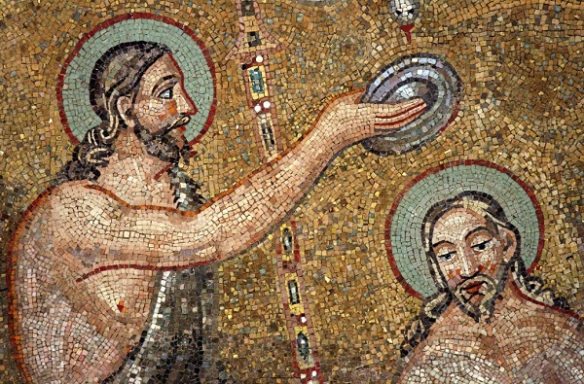
The Baptism of Christ by John the Baptist in the Jordan River. Detail of dome mosaic in the Battistero Neoniano (Orthodox Baptistery) in Ravenna, dating from 451-75. On lower right is a personification of the Jordan River as an old man rising from the water, holding a reed in one hand and offering a garment to Christ in the other. The right arm and dish of John the Baptist, the dove, and Christ’s head are 18th- and 19th-century restorations; the rest is original.
Even John the Baptizer is presented by Luke as also so sure of who he was as the precursor of the Messiah. Among the expectant people and John, we realize that indeed, growth happens the moment we accept who we are.
Examine the testimonies of many devotees of the Nazareno at Quiapo, of how they support each other in their woes and sufferings in life that we find a sort of theophanies by God, something like what we have heard from the first reading today, “Comfort, give comfort to my people, says your God”(Is.40:1). That comfort, that salvation, happened right there and then, in the now and not in a distant future.
Despite my “dislike” for their attitudes during the Traslacion, devotees of the Nazareno have always amazed me for daring to be truthful and honest with themselves, admitting their own sinfulness and weaknesses as they recognized too their need for help and most especially of their desire for God. This desire for God and admission of one’s sinfulness are very crucial to experience and hear God’s daily theophanies to us.
Photo by Mr. Jay Javier, 09 January 2019.
Second, for us to hear God’s theophany, we need to imitate Jesus Christ in taking the downward movement in life. His baptism at Jordan clearly illustrates this with His coming down to the Jordan valley through the mountains that evoked His own coming down from heaven to be born here on earth, in Bethlehem.
What is so beautiful with Jesus Christ’s downward movement is essentially a being with the sinful, the sick, the rejected, the marginalized, the poor, and those considered dirty. From being purely clean and sinless, Jesus took all our dirt to be cleansed like Him. Such is the kindness of God that Paul speaks today to Titus “so that we might become heirs in hope of eternal life”(Titus 3:7).
Our world today teaches us the opposite direction Jesus Christ had taken by climbing up the pinnacle of success, of good life, of supremacy, of power, of everything! They call it “upward mobility” that has prompted everyone even those in the Church to join the rat race for being rich and famous, of being somebody, putting on masks and taking more of the goods the world offers until we get lost in misery finding no meaning at all with one’s self because we thought life is “up there.”
Jesus Christ is not up there but down here, in our very selves, in our very hearts filled and battered with our many agonies and failures, hurts and pains, weaknesses and sins. Look down more into our very selves to find Jesus in our dirt and miseries which is the message of Jesus Nazareno.
Observe all those interviewed in Quiapo have only one prayer – well-being of a loved one. They never asked to be rich or have money. Just heal a sick child or parent was the most requested prayer of devotees. Our favorite Pope Benedict XVI explained this downward movement so well:
To accept the invitation to be baptized now means to go to the place of Jesus’ Baptism. It is to go where he identifies himself with us and to receive there our identification with him. The point where he anticipates death has now become the point where we anticipate rising again with him (Jesus of Nazareth, page 18).
Photo by author, sunset in Liputan Island, Meycauayan City, Bulacan 31 December 2022.
Last but not least for our reflection is something very peculiar with Luke alone: the theophany of Jesus happened not right after His baptism but while He was praying, “After all the people had been baptized and Jesus also had been baptized and was praying, heaven was opened and the Holy Spirit descended upon him in bodily form like a dove”(Lk.3:21-22).
In the Acts of the Apostles, Luke recorded the Pentecost happened while the Apostles with the Blessed Mother Mary were all praying when the Holy Spirit descended upon them like tongues of fires which is similar with what took place at Jesus’ Baptism. In all books of the whole Bible, divine revelation is always preceded with prayer. As we shall see this year when Luke guides us every Sunday with his gospel account, he is the one who portrayed Jesus most in prayer than any of the other evangelists.
Photo by author, Garden of Gethsemane, the Holy Land, May 2017.
If we want to hear God’s theophanies to us, let us handle life with prayer which is more of listening and being one with God. Begin and end each day with prayer. There is no other way to hear God’s voice, to hear Him affirming us, to know His plans for us until we are one with with Jesus in prayer.
In His baptism at Jordan, Jesus Christ as the Second Person in the Holy Trinity prayed not because He needed something from the Father but because He is one with Him in the Holy Spirit. That was when the Father affirmed Him as the Christ being sent on a mission.
Through the Sacrament of Baptism we have received, we are reminded today of God’s anointing of each of us as His beloved child. May we heed His voice and be one with Him for a more blessed 2025 ahead of us as we begin Ordinary Time tomorrow. Have a blessed week. Amen.
The Lord Is My Chef Christmas Recipe for the Soul by Fr. Nicanor F. Lalog II
Our Christmas Homily, 25 December 2024
Isaiah 52:7-10 ><}}}}*> Hebrews 1:1-6 ><}}}}*> John 1:1-18
From LDS_Believer on X, 23 December 2016.
A blessed merry Christmas to you and your loved ones! On this most joyous season of the year that is also the most commercialized, let us reflect about gift-giving.
During Christmas, I hear a lot of people complaining of finding it difficult in giving gifts, in finding the most suitable gift to give to their family and friends. It is the other way around for me as I find it more difficult in receiving gifts than giving.
Don’t get me wrong. I have no claims to whatsoever except that I have always preferred to be a giver than a receiver. In fact, it is my favorite “love language”. Maybe it is part of my upbringing being the eldest in the family. My father taught me the value of hard work to be independent, never to rely on others unless necessary while my mother instilled in me the importance of sacrifice and contentment as she would say, “magtiis kung ano lang mayroon at hindi lahat ng kaya ay bibilhin.”
Friends know me so well of not opening gifts immediately that so often, food given to me end up expired. That is why I always ask people if their gift is food that needs to be consumed immediately like cakes, chocolates and ice cream!
Recently I gifted a religious priest with vestments for his silver anniversary of ordination three weeks ago. Just before the Simbang Gabi started as I shopped for my Christmas vestment, I messaged him for his chasuble size (the vestment we put on top of our alb). It turned out he goes too to the same shop and told me how he had always loved one of those Roman albs made there, a surplice alb with black lining. Since he had celebrated his silver anniversary as priest, I bought one of the alb too with the chasuble delivered to him via courier that day. That afternoon, Father almost shouted in joy in his messages, thanking me for the gifts of a chasuble and a Roman alb, asking, “akala ko yung alb lang bakit may chasuble pa, Father?” I simply told him “because you are a good priest; just pray for me and don’t mention it in your posts.”
During the Simbang Gabi last week while checking on my Facebook, I saw his posts wearing my gifts in his Misa de Gallo. It looked so good on him, the nice off-white chasuble with a V-shaped design on the chest with a classic cross underneath it the surplice alb with black lining he liked. He looked so holy. And I felt so good at myself having made a brother priest so happy.
At that moment, I felt the deep sense of joy of Christmas whatever it meant, as if Jesus were touching me, speaking to me in His most genteel voice an important lesson about gifts.
Through that priest, Jesus answered my prayer at the start of the Simbang Gabi, “how can I truly share you, Lord, this Christmas?”
Through that priest, I felt Jesus speaking into my heart that for me to be able to truly share Him this Christmas, I must first receive Him. We can only be a true giver when we are a sincere and humble receiver first.
I must confess that aside from my upbringing, it is largely pride that is the reason I prefer giving than receiving. As a giver, there is that sense of pride, of having the upper-hand with power and control especially when some gifts I have received are not of my size or I already have like books. It is easier to give especially when we have so much of things without really feeling deep inside the love and freedom why we give. Very often we give to show we don’t need others because we have.
Being a receiver requires humility in the first place, that we are incomplete and dependent on others. When we are able to receive, our giving becomes meaningful because when we receive gifts, we first receive the giver, the gift of every person we must always warmly receive with joy. As I relished my joy in seeing that priest appreciating my gifts – and me – I felt God patting my shoulder, as if telling me, that is how He feels when we receive and appreciate His Christmas gift, the child Jesus on the manger, asking us to receive Him, to love Him, to take care of Him.
He came to what was his own, but his own people did not accept him (John 1:11).
Photo by author, Christmas 2022.
This Christmas, let us first realize that we are first of all receivers of God’s gift in Jesus Christ. Let us receive Him so we can share and give Him as we pray:
A most blessed happy birthday to You,
Lord Jesus Christ!
You are our most precious,
the most important gift
we have received from the Father.

Forgive me
when I refuse to receive and accept You
 among the people who love and care for me,
for the people you send me to love and care too.

Forgive me
 when I refuse to receive and accept You
among those who have hurt and offended me
that until now I have not truly forgiven,
having grudges against them.

Forgive me
 when I refuse to receive and accept You
 in my own giftedness, always doubting my goodness,
my talents that I cannot be bold enough
in sharing You because I might fail,
I might err, I might not measure up to others' standards.

Grant me the grace this Christmas,
Lord Jesus, to be small and fragile like You
as an infant, so vulnerable, trustingly accepting
even the unfavorable situations where I am
so that I can share and give You truly
to those who are willing to welcome You like me.
Amen.
The Adoration of the Shepherds”, a painting of the Nativity scene by Italian artist Giorgione before his death at a very young age of 30 in 1510. From wikipediacommons.org.
The Lord Is My Chef Daily Recipe for the Soul by Fr. Nicanor F. Lalog II
Simbang Gabi-9 Homily, 24 December 2024
2 Samuel 7:1-5, 8-12, 14, 16     <*((((><  +  ><))))*>     Luke 1:67-79
Photo by author, Advent 2022.
Finally! This may be the word and expression today, the 24th of December. Finally, a lot of you would be bragging about having completed the nine-day novena to Christmas. Finally, it would be Christmas day. And finally, we could sleep longer.
But then, finally what?
When Zechariah’s tongue was loosened after naming his son John in fulfillment of the angel’s instruction to him, it was not the word “finally” that came from his mouth but “Blessed be the Lord, the God of Israel!”(Lk.1:68). After being mute for nine months, Zechariah’s silence became praise with gratitude and wonder giving him the voice to speak again.
Zechariah his father, filled with the Holy Spirit, prophesied, saying: “Blessed be the Lord, the God of Israel, for he has come to his people and set them free. He has raised up for us a mighty Savior, born of the house of his servant David. Through his prophets he promised of old that he would save us from our enemies, from the hand of all who hate us, He promised to show mercy to our fathers and to remember his holy covenant. This was the oath he swore to our father Abraham: to set us free from the hand of enemies, free to worship him without fear (Luke 1:67-74).
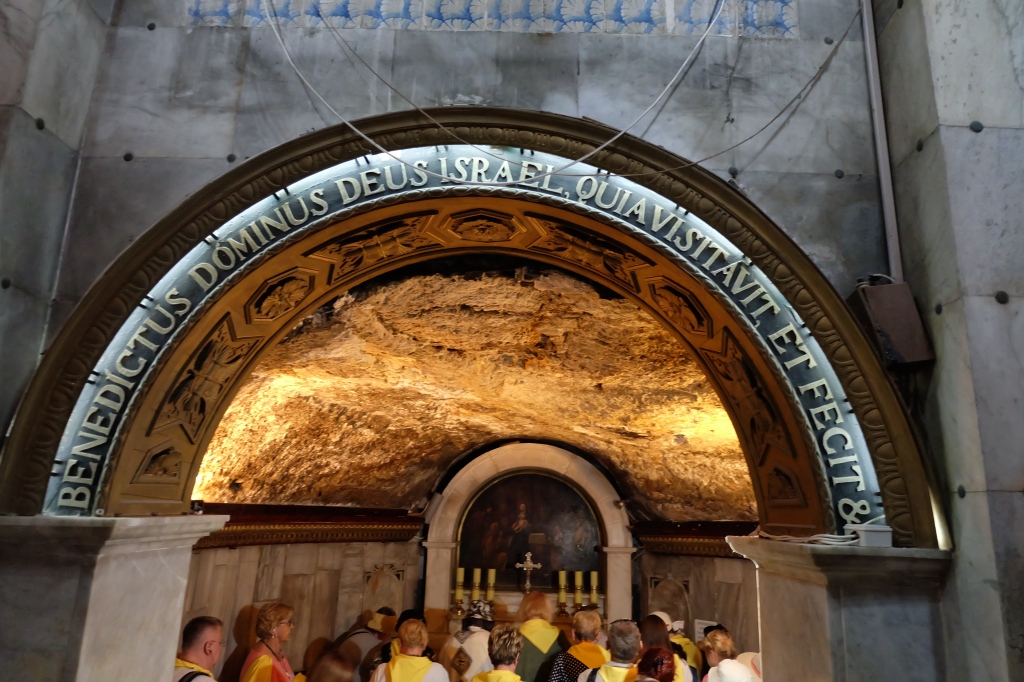
Photo by author, birthplace of St. John the Baptist underneath the church dedicated to him in Judah.
We have reflected last Thursday that Advent and Christmas is a journey that begin in the church, in the celebration of the Mass as Luke opened his Christmas story with the annunciation of John’s birth to Zechariah during their Yom Kippur at the Jerusalem Temple.
Luke’s artistry and mastery in weaving stories brought us right into every scene leading into Christmas – from Jerusalem to Nazareth then to the hill country of Judah in the home of Zechariah until John’s birth where our scene remains today. Tonight and tomorrow, he will be leading us along with Matthew and John to Bethlehem for the birth of the Lord.
But this journeys Luke recounted to us were not only about places but most of all an inner journey into our hearts. As we all know, the destination does not really matter but the journey, the trip. It is most true with our Simbang Gabi too – it is not about completing the nine-day novena that matters most but what have we become!
After tonight and tomorrow’s Masses, our churches would be empty again, only to be filled up on Ash Wednesday, and then Palm Sunday and Holy Thursday. How tragic that on Easter which is “the Mother of all feasts in the Church”, people are miserably absent because they are out in the beach and resort enjoying summer. In fact, more people come to Christmas (Pasko ng Pagsilang) than with Easter (Pasko ng Pagkabuhay) when it is actually the very foundation of our faith.
With our students after Simbang Tanghali last year at the Medicine Lobby of Our Lady of Fatima University, Valenzuela City.
So, what have we become after these nine days of waking up early or staying up late at night, praying, listening and reflecting on the word of God, sharing our material blessings in the collections and gift-giving if we stop going to Mass the whole coming new year?
American Trappist monk Thomas Merton wrote that seeking God is not like searching for a “thing” or a lost object because God is more than an intellectual pursuit or a contemplative illumination of the mind. Merton explained that God reveals Himself to us in our hearts through our communion and fellowships in the Church.
We come to church to celebrate the Mass and pray with the whole community to express our communion with one another in Jesus Christ. It is in this communal aspect of prayer we become holy, when we are transformed and as Zechariah prophesied, we are “set free” by Jesus Christ who is the main focus of his Benedictus.
Who are those enemies Zechariah mentioned twice in his Benedictus? Who are those enemies we have to be set free for God and free to love?
Photo by author, Church of St. John the Baptist, Israel, May 2019.
Again, look at this minute detail Luke used in composing Zechariah’s Benedictus when he spoke twice of the word “enemies”: first of “saving us from our enemies, from the hand of all who hate us” (Lk.1:71) and then, the fulfillment of God’s promise to Abraham “to set us free from the hand of enemies, free to worship him without fear” (Lk.1:74).
Surely, those “enemies” were not just the Romans and other pagans around Israel at that time nor the Pharisees and scribes, the priests and Sadducees of the temple who had hands in Christ’s death for they are now gone. The gospel accounts were written in the past but remain true and relevant at all time in history, especially now more than ever in our own time.
Are we the “enemies” within who think only of our selves even in our religious and spirituality, manipulating God, controlling God?
A friend asked me last week if their priest was right in saying that the Simbang Gabi is the most effective means to obtain special favors from God. I emphatically told her “no”, adding that their priest’s claim is misleading. We cannot dictate God. God blesses everyone, including sinners who do not even go to Mass. We do not need to multiply our prayers as Jesus warned us because God know’s very well our needs before we pray. Then, why pray at all?
We pray and most especially celebrate the Mass especially on Sundays to know what God wants from us because we love God. Period. And that love for God must flow in our loving service and kindness with others. If gaining favors is the main reason we go to Mass or even pray, then, we are the “enemies” who prevent ourselves to freely worship God!
Mr. Paterno Esmaquel of Rappler rightly said it in his Sunday column:
“We are a society obsessed with achievement and success, command and control… Even we who try to complete the Simbang Gabi can plead guilty. During the Simbang Gabi, for example, we are tempted to focus on achieving all the nine days and succeeding for another year. By fulfilling this tradition, we can then ask God (or “command” God, like a genie) to grant our wishes. We can therefore wield greater control over life that is otherwise unpredictable (https://www.rappler.com/voices/thought-leaders/the-wide-shot-missed-simbang-gabi-found-christmas-grace/).
And who are feeding all these misleading and erroneous thoughts on the people? We your priests and bishops!
How sad as we have mentioned last week when many priests have totally lost any sense at all of the sacred in the celebration of the Mass. Some of them not only come unprepared for the celebration without any homily, even so untidy and shabbily dressed and worst of all, make fun of almost everything and everyone that the Mass has become a cheap variety show. Online Masses continue not for evangelization for “shameful profits” in the Sacrament through “likes” and “followers” that some priests are now more concerned in finding ways to be trending and viral instead of how to effectively evangelize the people with our good liturgical celebrations flowing into our witnessing of life.
Yes, we priests and bishops are the enemies right here in the church when we align more with the rich and powerful, when we have no qualms asking/receiving gifts and favors from politicians and still, would want to collect more money and donations from people with our endless envelops that have totally alienated the poor from the church. The poor are the ones who suffer most, paying for the corruption of the politicians who help the clergy in their projects for the poor. Poor Jesus Christ!
Perhaps, on this last day of our novena to Christmas, let us all force ourselves – especially us priests and bishops – to go into silence to identify, to weed out those enemies within and outside us that prevent us from welcoming Jesus Christ in our hearts.
Let us pray to God that He may set us free from these enemies within us, around us so we can be like John the Baptist who will “go before the Lord to prepare his ways, to give his people knowledge of salvation.” Amen.See you tonight or tomorrow, Christmas in the Holy Mass!
Photo by author, Dumaguete City Cathedral, November 2024.








 lordmychef.com