Advent is patient transformation to joy

Lord My Chef Sunday Recipe for the Soul by Fr. Nicanor F. Lalog II
Third Sunday in Advent-A (Gaudete Sunday), 14 December 2025
Isaiah 35:1-6, 10 ><}}}}*> James 5:7-10 ><}}}}*> Matthew 11:2-11
Photo by author, December 2019.

Our churches are bursting in hues of pink this Third Sunday of Advent rejoicing not only in the fast approaching Christmas but most especially in the Lord’s Second Coming already happening in our midst.

Like John the Baptist in today’s gospel who was imprisoned at the time, we could feel in our own waiting for Jesus his saving presence in the many good things happening within us and around us.

When John the Baptist heard in prison of the works of the Christ, he sent his disciples to Jesus with the question, “Are you the one who is to come, or should we look for another?” Jesus said to them in reply, “Go and tell John what you hear and see: the blind regain their sight, the lame walk, lepers are cleansed, the deaf hear, the dead are raised, and the poor have the good news proclaimed to them” (Matthew 11:2-5).
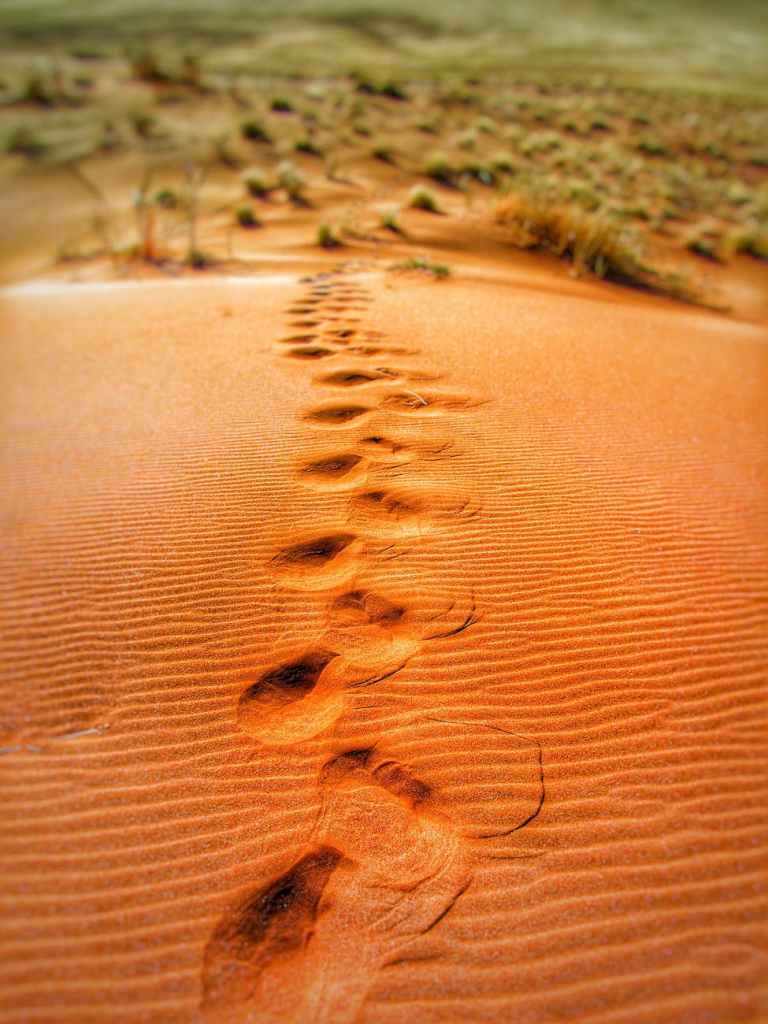
Photo by shy sol on Pexels.com

Remember our reflection last Sunday of John’s preaching in the desert of Jordan signifying our own desert where amid the dryness and emptiness Jesus comes to us, Jesus is most present with us and in us. That is because more than an imagery of nothingness and death, the desert signifies too our intimacy with God. Many times in life, God brings us or allows us to get lost in our own desert to experience his intimacy with us, his immense love for us because when we are sufficient and strong, we rarely feel him nor even desire him. But, when we are like in a desert with nothing, that is when we long for God, and most especially feel him present.

That is why every prophet in the Bible including our Lord Jesus Christ frequented the desert and wilderness to show their intimacy and communion with God. The desert is thus transformed into a greenery filled with life like what Isaiah prophesied in the first reading today:

The desert and the parched land will exult; the steppe will rejoice and bloom. They will bloom with abundant flowers, and rejoice with joyful song. The glory of Lebanon will be given them, the splendor of Carmel and Sharon; they will see the glory of the Lord, the splendor of our God… Then will the eyes of the blind be opened, the ears of the deaf be cleared; then will the lame leap like a stag, then the tongue of the dumb will sing (Isaiah 35:1-2, 5-6).

Photo by Walid Ahmad on Pexels.com

See now the transformations found in our readings: in the last two Sundays we heard Isaiah speaking of the dried and barren desert but today he spoke of its transformation into a lush and verdant stretch of land; in the gospel we find John still in the desert, firm and unchanging in his preaching though his situation had changed a lot.

Last Sunday John was freely proclaiming the coming of the Christ in the desert as he sternly warned the Pharisees and Sadducees of their judgment; this Sunday, John was still in the desert but imprisoned awaiting death when he reproached King Herod in taking his brother Philip’s wife Herodias. But despite that clear danger daily hanging on his head, John was not disturbed at all as he patiently awaited the coming of the Messiah that he sent emissaries to Jesus to ask if he is already the Christ.

Here we find something so human in John the Baptist, so much like us when we sort of doubt ourselves not because we lack faith but simply we just want to be sure of what we are hearing, what we have seen, of what God is really doing.

Photo by author, December 2021.

Let it be clear: like John, most often we doubt ourselves not really God when things happen not according to our plans or expectations. Inasmuch as life is a mystery, God is more mysterious! Most of the time, we cannot understand his ways because he moves so differently, even unpredictably from what we know and expect.

Perhaps, John had a different scenario in his mind about the arrival of the Messiah like in the Old Testament tradition of judgment day, of action-packed events punishing evil people. Recall how called the Pharisees and Sadducees “You brood of vipers…Even now the ax lies at the root of the trees. Therefore every tree that does not bear good fruit will be cut down and thrown into the fire (Mt.3:10). 

But something totally different was happening at that time as he heard while in prison – many people and their lives were being transformed. John realized something deeper than expected was going on in Judea and Galilee. And when his emissaries relayed to him the reply of Jesus, John realized that indeed the Christ he was proclaiming had arrived in Jesus. As a prophet well-versed with the scriptures, John found Jesus as the fulfillment of the prophecy by Isaiah when the blind can see, the lame can walk, dead are raised and the good news proclaimed to the poor.

It must have been a Nunc Dimittis experience of Simeon for John that soon enough, he died a martyr ahead of his Lord and Master Jesus Christ. John indeed prepared the way of the Lord in his birth and in his death, showing us the importance of patience in awaiting Christ and in experiencing the joy in his coming.

Be patient, brothers and sisters, until the coming of the Lord. See how the farmer waits for the precious fruit of the earth, being patient with it until it receives the early an the late rains. You too must be patient. Make your hearts firm, because the coming of the Lord is at hand (James 5:7-8).
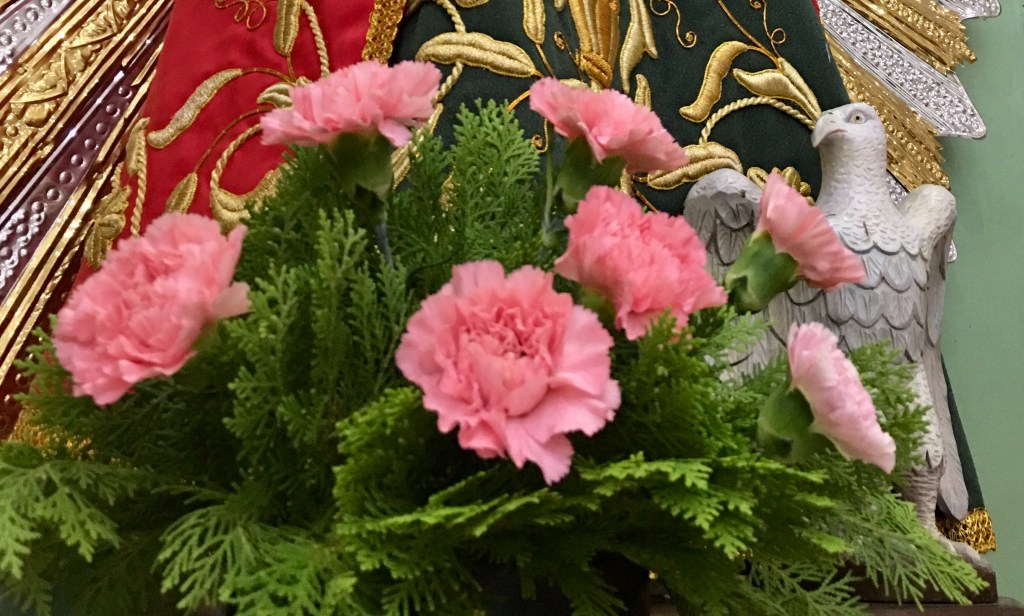
Photo by author, December 2020

Before the COVID pandemic, my brother and I used to rest at Camp John Hay in Baguio where he would buy in one of the shops there a line of local and organic perfumes. His favorite scent was called “Patience” but one time when we went there, it had ran out of stock that he said wryly, “maski ba naman pabango na patience, wala na rin?”

So true! Patience seems to have been almost extinct in this age of instants. Nobody wants to be patient anymore especially if one can have almost everything instantly. Even during the time of the early church, people have been impatient in life that St. James wrote them on the importance of patience in our journey of faith, in awaiting the Lord’s return.

From the Latin word patior that means to suffer, patience is a kind of suffering, of bearing the pain of waiting especially over a long period of time that we doubt if it is still worth the waiting at all. But we fail to “see” or realize as St. James pointed out like the farmer that waiting is never passive nor empty; there is always something wonderful happening that we do not see like the germination, growth and blooming of crops and plants. The more patient we are, the more suffering in waiting, the greater always the joy that comes when our waiting is finally fulfilled!

Advent teaches us this third Sunday that we need to be patient for waiting itself is a holy ground where we experience God’s coming and intimacy. Though patience tests our limits, it transforms us too!

Think of the stalactites and stalagmites in caves formed millions of years by drops of water. Or the great natural wonders of earth that took thousands of years of formation, transformation. Most of all, our very selves. Who we are and what we are today are long years of patient efforts to be healthy or successful or simply be alive. And that’s a great reason to rejoice.
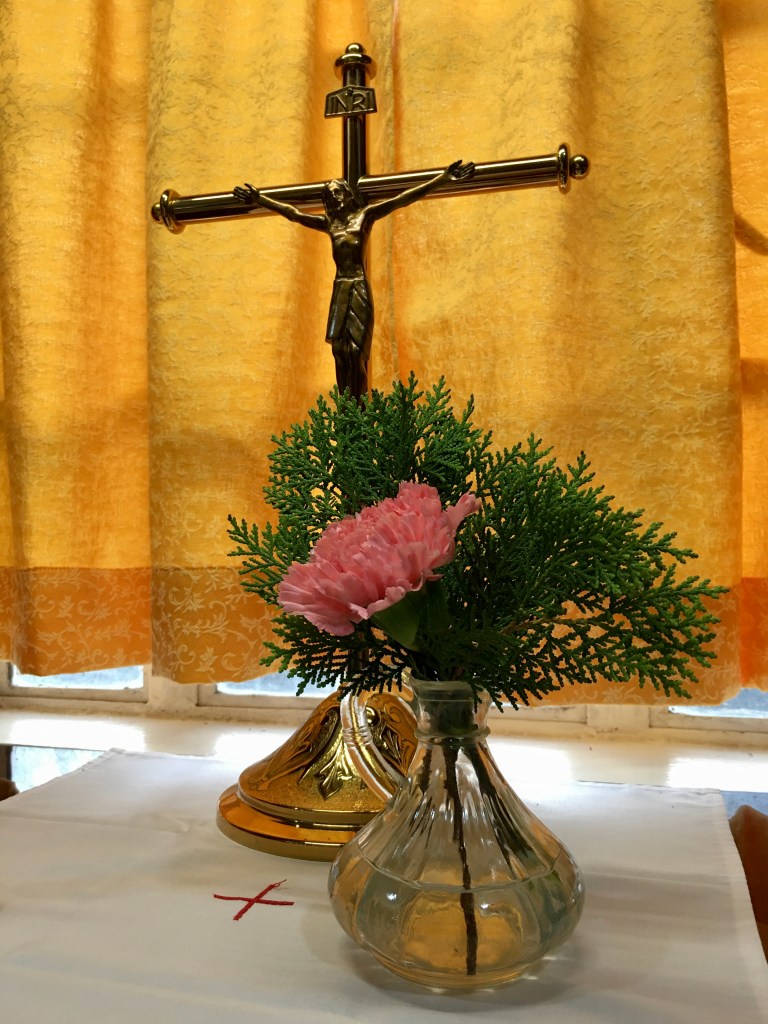
Photo by author, December 2020.

Patience is so difficult to practice like in our daily experiences of horrendous traffic everywhere but with patience, we arrive at our destination. Patience transforms us into better persons and disciples of Jesus, enabling us to rejoice no matter what is the situation we are into. It is in the midst of sufferings and waiting, of patience and impatience that Jesus calls us to experience his silent and steady presence resting upon us like the rains every farmer is so familiar with. Our joy is doubled, becoming a rejoicing when we practice patience in our endeavors, in life itself.

Let me end this reflection with a quotation I memorized as a child on the wall of our former family dentist’s office in Meycauayan, Bulacan that said:

Time is fast for people who rush;
time is slow for people who wait;
time is not for people who love.

The most loving persons are also the most patient ones. Always. And first among them is Jesus Christ who patiently awaits us to return to him so we can experience his joy. Amen. Have a joyful week ahead!

Wait for one another

The Lord Is My Chef Daily Recipe for the Soul by Fr. Nicanor F. Lalog II
Monday, Sts. Cornelius, Pope, and Cyprian, Bishop, Martyrs, 16 September 2024
1 Corinthians 11:17-26, 33 <*((((>< + ><))))*> Luke 7:1-10
Photo by author, Alfonso, Cavite, 21 April 2024.

Therefore, my brothers and sisters, when you come together to eat, wait for one another (1 Corinthians 11:33).

Lovely words, 
God our Father,
for this lovely,
cold Monday
of overcast skies
most likely with a lot of
rains ahead.
Wash us clean, O God,
with your rains of mercy
and wisdom:
it must be so easy to understand
what St. Paul meant that we
"wait for one another"
when we come to eat together
but that is exactly what has
become a rarity these days;
forgive us, Father,
for like the Corinthians
we have become like pagans,
so unChristian in our lives
especially at the Eucharist of
your Son Jesus Christ;
we no longer "wait"
for one another as in
we do not celebrate as one
due to factions and selfishness
that come in all forms;
we no longer "wait"
not serving each other
truly as brothers and sisters;
worst of all, we live for the
present moment alone,
being so unwise like unfaithful
servants not "waiting"
for Christ's return.
Let us "wait" for you,
Jesus, like the people in
Capernaum:
the locals "waiting" for the
centurion as they "strongly urged" you
to help him because of his kindness
to Jews; lovely was how
the centurion "waited"
for you, sending emissaries
asking you Jesus for the healing
of his slave; but, most wonderful of all,
was the centurion's faith in you, Lord
as he described how his slave
faithfully "waited" on him,
prompting him to tell you:

“Lord, do not trouble yourself, for I am not worthy to have you enter under my roof; but say the word and let my servant be healed. For I too am a person subject to authority, with soldiers subject to me. And I say to one ‘Go’, and he goes; and to another, ‘Come here,’ and he comes; and to my slave, ‘Do this,’ and he does it” (Luke 7:6, 7-8).

Indeed, dear Jesus,
to "wait" is to serve;
to "wait" is to be one
with others and with you;
to "wait" to find myself always
not worthy to receive you
but you chose to "wait" for us
in the Cross
with your words of mercy
and forgiveness
that we are all healed,
we are saved.
Pray for us,
holy martyrs Pope Cornelius
and Bishop Cyprian
who both waited faithfully
for their flock
especially those who have
lapsed in faith,
those who have sinned
and erred.
Amen.

Paalala ng Kuwaresma

Lawiswis ng Salita ni P. Nicanor F. Lalog II, Ika-06 ng Marso 2024
Larawan kuha ng may-akda, 2020.

Sa lahat ng panahon sa ating liturhiya ng Simbahan, bukod tangi ang Kuwaresma dahil ito lamang ang nagsisimula ng ordinaryong araw, ang Miyerkules ng Abo o Ash Wedensday at hindi araw ng Linggo.

Kapuna-puna ang nakaraang Ash Wednesday na pumatak ng Pebrero 14, Valentine’s Day na nangyari din noong 2018. Pinag-usapan ng marami sa social media kung alin ang pipiliing ipagdiwang, Valentine’s Day o Ash Wednesday?

Nakatutuwang isipin na marami pa rin ang sumagot sa survey na pipiliin nila ang mangilin sa araw ng pagpapahid ng abo kesa ang makipag-date sa Pebrero 14; iba ang ipinakita ng mga balita at ng social media kung saan panalo ang mga nagdiwang ng Araw ng mga Puso! At tila gayon nga ang nangyari o marahil, pinagsabay nating mga Pinoy ang dalawang pagdiriwang, di alintana mga panawagan ng Kuwaresma at Miyerkules ng Abo na manalangin, magtika ng mga sala, maglimos, at mag-ayuno.

Kaya nga taun-taon, ito ang laging tanong natin, ano nga ba ang kahalagahan ng Kuwaresma sa makabagong panahong ito na kung saan mga tao ay tila hindi na nag-aayuno, wala nang sakripisyo? Higit sa lahat, paunti nang paunti na mga nagsisimba.

Ang problema natin sa Pilipinas ay hindi pa naman katulad sa kanlurang Europa at hilagang Amerika na marami nang tao ang ayaw maniwala sa Diyos. Halos lahat pa rin ng mga tao sa ating bansa ay naniniwala sa Diyos ngunit naguguluhan marahil at hindi makita Kanyang kahalagahan at kaugnayan (relevance) sa buhay sa gitna ng makabagong panahon na wala nang hindi naiimbento at naso-solusyunan.  Bagama’t sasabihan ng marami naniniwala sila sa Diyos, mas tiwala kadalasan ang mga tao sa panahong ito sa agham at teknolohiya.

Narito tatlong bagay na binibigyang-diin sa panahon ng Kuwaresma na makatutulong sa ating matagpuan muli at maranasan katotohanan, kahalagahan at kaugnayan ng Diyos sa ating buhay sa gitna nitong makabagong panahon.

larawan kuha ni Walid Ahmad sa Pexels.com

Hindi lahat ay nakikita. Sa panahon ng Kuwaresma, pinag-aayuno din kung baga ang ating mga mata upang ituon ating pananaw at pansin sa ating kalooban at sa mga bagay na hindi nakikita, unang una na ang Diyos.

Kaya walang dekorasyon ang mga altar sa panahong ito, walang mga bulaklak at hangga’t maari wala ring mga halaman. “Bare” wika nga sa Inggles ang altar. Pagdating ng Biyernes Dolores bago mag-Linggo ng Palaspas, tinatakpan o binabalutan ng telang lila ang mga imahen at larawan sa simbahan sa gayon ding kadahilanan – upang tingnan natin mga mas malalim na katotohan ng ating buhay.

Sa panahong ito ng social media, lahat na lang ay ibig ipakita at ipangalandakan maski kasamaan, kabastusan, at kasalanan. Bakit nga ba nang magkasala sina Eba at Adan, sila ay nagtago dahil sa kahihiyan samantalang ngayon ipinagmamalaki pa ng ilan kanilang ginawang kasamaan?

Larawan kuha ni shy sol sa Pexels.com

Hindi lahat ng bagay sa buhay na ito ay nakikita at lalo din namang hindi lahat dapat ay ipakita. Wika nga ng Munting Prinsipe o Little Prince ni Antoine de St. Exupery, “What is essential is invisible to the eye; it is only with the heart that one can truly see.”

Lahat na lamang sa mundo ngayon ay palabas, showbiz na showbiz ang dating upang ipagyabang mga kayang kainin at bilhin, puntahan at gawin.  Ngunit, sadya bang nagbibigay ng kaganapan at katuwaan mga iyon?  Hindi ba mas masarap pa ring namnamin mga sandali nating kapiling ang mahal sa buhay? Kung tutuusin nga, kadalasan o palagi, yaong mga bagay na natatago at hindi nakikita ang siyang pinakamakahulugan, pinakamainam sa buhay.

Katulad ng Diyos: “Walang taong nakakita sa Diyos kailanman, ngunit kung tayo’y nag-iibigan, nasa atin siya at nagiging ganap sa atin ang kanyang pag-ibig” (1 Jn. 4:12).

Sa buhay, mas mainam pa rin yung simple at nakukubli, mayroong pa ring misteryo o hiwaga na natatago kaya ang lahat ay nagtataka. At minsan-minsan ay namamangha.

Larawan kuha ni Skyler Ewing sa Pexels.com

Hindi lahat ay minamadali. Kaya tinatawag na Kuwaresma ang panahong ito ng paghahanda sa Panahon ng Pasko ng Pagkabuhay ay dahil sa bilang na kuwarenta o apatnapung araw mula Miyerkules ng Abo haggang Sabado bisperas ng Palaspas (bagama’t di naman eksakto palagi) na kung tutuusin ay limang Linggo bago ang mga Mahal na Araw. Samakatwid, mayroong paghihintay dahil kailangang makabuo muna ng apatnapung araw o limang linggo.

Ito ang isang bagay na nawawala na sa mundo ngayon, ang paghihintay. Lahat mainipin kaya siguro maiinit ang ulo ng lahat na ultimo mga bata ay stressed out. Minamadali ang lahat na hindi malaman ano at sino nga ba ang hinahabol natin. Lahat ay instant – hindi lang kape at noodles pati pagkakaibigan, pag-aasawa at pagkakaroon ng baby!

Dahil sa teknolohiya, pilit na minamanipula ng tao ngayon ang panahon na madalas ay minamadali kaya marami ang hindi na maranasan ang Diyos pati sariling pagkatao at mga kapwa-tao sa pagmamadali. Hindi kataka-taka, nawawala na rin mga mabubuting ugali ng paghihintay, pagtitiyaga, pagtitimpi at pagpipigil.

Ang lahat na pangyayari sa daigdig ay nagaganap sa panahong itinakda ng Diyos. Ang panahon ng pagsilang at panahon ng pagkamatay; Ang panahon ng pagtatanim at panahon ng pagbunot ng tanim… Ano ang mapapala ng tao sa kanyang ginagawa? Alam ko na ang itinakda ng Diyos sa tao. Iniangkop niya ang lahat ng bagay sa kapanahunan. Ang tao’y binigyan niya ng pagnanasang alamin ang bukas ngunit hindi binigyan ng pakaunawa sa ginawa ng Diyos mula sa pasimula hanggang sa wakas.

Ang Mangangaral (Qoheleth) 3:1-2, 9-11

Minsan-minsa’y matutunan nating maghintay, magrelax o mag-chill wika nga ng mga kabataan. Masyado na tayong abala sa mga bagay-bagay kaya hindi natin napapansin, namamalayan ang Diyos na nagmamahal sa atin ay kapiling natin. Ang Diyos kabaligtaran natin: maski buong buhay natin hinihintay niya tayong lumapit sa kanyang muli sakaling magpasya tayong iwanan ating mga kasalanan at maling pamumuhay upang sa kanya maranasan ang kapanatagan at kapaypaan. Tinuturuan tayo ng panahon ng Kuwaresma na tumigil at manatili sandali sa buhay, maghintay sa Diyos at kanyang biyayang nakalaan para sa atin.

Larawan kuha ni Natalie Bond sa Pexels.com

Katahimikan. Sa lahat ng mahahalagang aspekto ng Kuwaresma, ito ang pinakamahalaga sapagkat hindi tayo makapagdarasal, makapagninilay, o magsisi sa ating mga kasalanan ng walang katahimikan. Bahagi ng paghihintay ang pananahimik.

Naalala ko noong bata kami tuwing bakasyon sa halamanan ng aming Lola. Maraming tutubi noon at lahat kaming magpipinsan ang unahan sa paghuli habang nag-aasaran sa kantang “tutubi tutubi huwag magpahuli sa batang mapanghi!”

Wala ka talagang mahuhuling tutubi kapag ika’y malikot at maingay ngunit sa sandaling ikaw ay pumirmi at manahimik, kusa pang lalapit ang mailap na tutubi.

Iyon ang buhay, iyon ang Kuwaresma. Manahimik tayo upang higit nating mapakinggan ating sariling kalooban na madalas hindi natin pinakikinggan dahil bantad na bantad tayo sa iba’t ibang tinig at ingay sa atin nagdidikta ng nararapat. Kaya madalas tayong lito kasi sarili natin di natin pinapansin. Gayon din naman, sa sobrang pakikinig sa mga sabi-sabi, nag-aaway away tayo kasi hindi nating pinakikinggan kapwa natin. Ang pananahimik ay hindi pagiging bingi kungdi pakikinig na mabuti; ang katahimikan ay hindi kawalan kungdi kapunuan na kahit pinakamahinang tinig ay sinisikap nating pakinggan.

Larawan mula Pixabay on Pexels.com

Tanging mga tao na kayang manahimik ang tunay na nagtitiwala sapagkat ang katahimikan ang tahanan at lunan ng pagtitiwala. Kaya ito rin ang tinig at wika ng Diyos. Sa ating pananahimik, tayo ay nagtitiwala, naghihintay maski wala tayong nakikita dahil batid natin kumikilos ang Diyos ng tahimik.

Kapag magulung-magulo ang ating buhay, tumigil tayo at manahimik. Pakinggan at higit sa lahat damhin ang sarili at buong kapaligiran upang maranasan kaganapan at katotohanan ng buhay mula sa Diyos na kadalasan ay tahimik na nangungusap sa atin. Madalas sa buhay natin, ang Diyos iyong pinakamahinang tinig na pilit bumubulong-bulong mula sa ating puso. Sikaping tumigil at manahimik, iyon ang pakinggan at sundin at tiyak, ikaw ay pagpapalain.

Sana ay huwag palampasin pagkakataon ng Kuwaresma upang Diyos ay maranasang muli at masimulan natin ugnayang kanyang matagal nang ibig para sa atin. Salamat po.