Wisdom 2:1, 12-22 ><)))*> +++ <*(((>< John 7:1-2, 10, 25-30
Photo by Ms. Ria De Vera, Parokya ni San Juan Apostol at Ebanghelista, Bagbaguin, Santa Maria, Bulacan, 22 March 2020.
“The Lord is close to the brokenhearted; and those who are crushed in spirit he saves. Many are the troubles of the just man but out of them all, the Lord delivers him.”
Psalm 34:19-20
God our heavenly Father, we come to you today, begging you for more strength, more courage, more faith in you as the pressures and stress increase and worsen due this COVID-19 pandemic the whole world is suffering with.
Like your Son Jesus Christ in today’s gospel, we can feel so strongly the tremendous pressure he was going through from his enemies in the weeks leading to his Passion, Death, and Resurrection that he could not openly go to Jerusalem.
But, still he went there in secret to continue his mission of proclaiming the good news, trusting in you, our Father in heaven, who alone designates each one’s “hour”.
So they tried to arrest him, but no one laid a hand upon him, because his hour had not yet come.
John 7:30
Give us the grace, Lord, to withstand all the pressures and stress going on within us, in our family and community as we enter the second week of lockdown.
Most especially, we pray for our frontliners in health and medicine who are subjected to intense pressures by the pandemic. Some of them have lost their lives fulfilling their mission. Bless their souls, bless their loved ones left behind.
We pray, Lord, for those who have to work today so we can have food on our table, electricity and communication lines, water, and also security we have seem to take for granted these days.
May this lockdown provide us with the much needed rest to fight all the stresses and pressures we have been carrying on our shoulders for a long time.
May this lockdown be a Sabbath for us like you have envisioned in the beginning when you created everything. Amen.
Photos by Mr. Raffy Tima of GMA-7 News, 26 March 2020. See Mt. Samat and the 1,821 feet Memorial Cross in Bataan as seen from the GMA Network Bldg. in Quezon City across the expanse of Manila Bay. Used with permission.
Photo by author, Laguna Lake, Los Baños, Laguna, 13 February 2020.
How often does it still happen today, Lord Jesus Christ, that like in our gospel today you would “sigh from the depth of your heart” after we, your people, would ask you for more signs from heaven?
Have mercy on us, Lord, for our lack of faith in you after all these years.
Forgive us for being “unstable in all our ways” with you, always “a man of two minds” as St. James would describe us (James 1:8) in seeking wisdom and things from you.
Forgive us for those moments we doubt your presence and power especially when we fail to win your favor, to get your blessings for our particular prayers and supplications.
The fault is really on us, Lord.
If sighing is your way of keeping your patience with our being so stubborn, teach us to reach out to you in the depths of our hearts, to remember those countless occasions you have saved us.
That instead of asking for signs from you, we may just sigh deep inside us to experience you again. Amen.
The Lord Is My Chef Recipe for the Soul, Sunday Week V-A, 09 February 2020
Isaiah 58:7-10 ><)))*> 1 Corinthians 2:1-5 ><)))*> Matthew 5:13-16
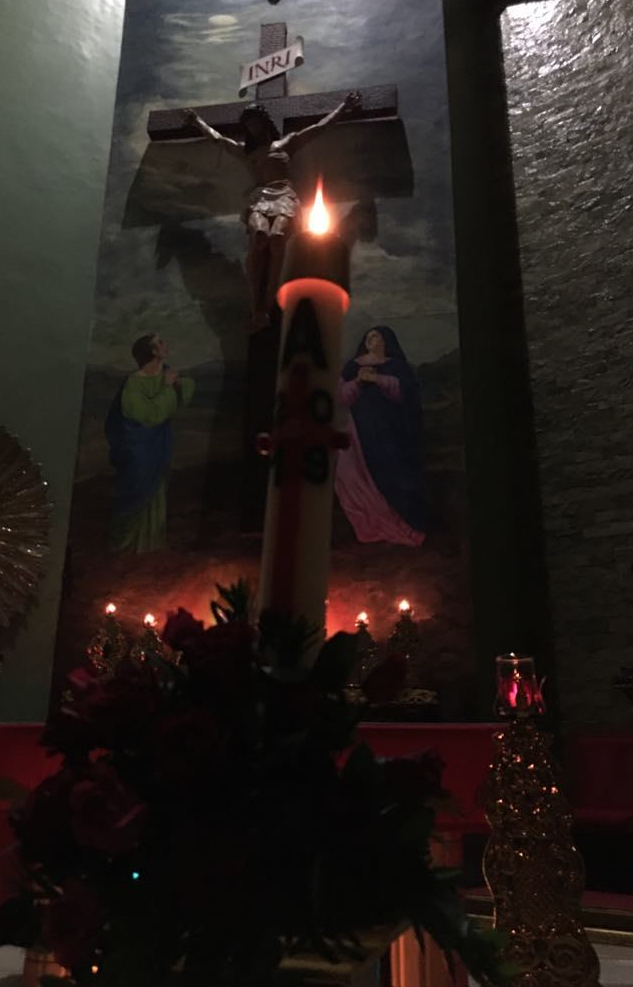
Our parish cross at night, taken with my camera phone, 02 February 2020.
For most of us, 2020 is a very tough year with all the dark clouds that have come to hover above us in January remain in this month of February.
Threats from the corona virus are growing especially in our country. And while the alert level at Taal Volcano had gone down, dangers of its major eruption remain while volcanologists observed last week a “crater glow” on Mayon Volcano, indicating a possible rising of magma in the world’s most perfect cone.
Elsewhere, more bad news are happening like the sudden deaths this week of healing priest Fr. Fernando Suarez and of our very own and beloved Fr. Danny Bermudo, just 24 hours apart due to heart attacks.
In our own circles of family and relatives, friends and colleagues are also dark clouds covering us while we go through our many trials and tests in life that seem to eclipse this early the many gains we have achieved in the whole of 2019.
Indeed, year 2020 shows us in “perfect vision” the sad realities of dark spots in life that behoove us more to heed Christ’s call to be the light of the world.
Jesus said to his disciples: “You are the light of the world. Just so, your light must shine before others, that they may see your good deeds and glorify your Heavenly Father.”
Matthew 5:14, 16
Photo by author, frost on petals, Baguio City, 04 February 2020.
Jesus is the light of the world, not us
Our gospel this Sunday follows immediately the inaugural preaching of Jesus called “the Sermon on the Mount” with the Beatitudes at its centerpiece. We have skipped that part of the gospel last Sunday due to the celebration of the Feast of the Presentation of the Lord.
For us to better appreciate this Sunday’s gospel, let us keep in mind that for Matthew, the Sermon on the Mount is the great discourse of Jesus Christ that depicts his image not only as the new Moses but as the Law himself, being both our Teacher and Savior as well.
Jesus shows us a picture of his person in the Beatitudes as someone we must imitate in being “poor in spirit, meek, and merciful” so we can follow his path to the Father. After all, as the Son of God, Jesus is “the way, the truth, and the life” (Jn. 14:6).
Hence, after enumerating the nine Beatitudes, Jesus followed up his Sermon on Mount with a call for us to be the salt and the light of the world: as salt, we merely bring out the Christ or the taste in every person and as light, it is the light of Christ that we share.
Focus remains in being like Jesus, not in replacing him who is our Savior. That is why he tells us clearly before shifting to another lesson in his Sermon that “your light must shine before others, that they may see your good deeds and glorify your Heavenly Father” (Mt.5:16).
Sharing Christ’s light with our good deeds as a community
So, how do we share the light of Jesus Christ in this age when so many others are claiming to be the light that will dispel all darkness in our lives?
As early as during the darkest period in the history of Israel in the Old Testament called the “Babylonian Captivity (or Exile)”, God had taught his people how to become light for one another during trials and sufferings.
Christ Light of the World, Red Wednesday, 27 November 2019. Photo by author.
Thus says the Lord: Share your bread with the hungry, shelter the oppressed and the homeless; clothe the naked when you see them, and do not turn your back on your own. Then your light shall break forth like the dawn… if you bestow your bread on the hungry and satisfy the afflicted; then light shall rise for you in the darkness, and the gloom shall become for you like midday.
Isaiah 58:7-8, 10
To share one’s bread with the hungry, to welcome the homeless, to clothe the hungry are some of the most concrete demands placed by God to his people since he had freed them from slavery in Egypt and later in Babylonia (Iraq today) when the third part of the Book of Isaiah was written.
Eventually, this prophecy was fulfilled in Jesus Christ who also preached exactly the same things shortly before fulfilling his mission in Jerusalem when he stressed the need to do good to one another because “whatsoever we do to one another, especially to the least among us, we also do unto him” (Mt.25:31-40).
We shall hear this part of Matthew’s gospel at the end of our current liturgical year on November 22, 2020 in the celebration of the Solemnity of Christ the King.
These instructions became the basis of our catechism’s “spiritual and corporal works of mercy” that Pope Francis stressed in 2016 during the Extraordinary Jubilee of Mercy.
From fathersofmercy.com
By saying “you are the light of the world”, Jesus is telling us that to fulfill this mission, we have to do it together as a community, as his Body, the Church!
No matter how good and holy we are, none of us is the “light of the world” on our own.
One candle or lamp, or even a light bulb today cannot produce enough light to brighten a whole town or community. But, if one Christian will be lighting just one little candle in the dark, he or she can encourage others especially those who are timid, hesitant, and indifferent until they finally set the world ablaze with Christ’s light.
Christ’s call to be the light of the world is also a call for us to be united as one community, one family, one faithful couple with all our imperfections and sinfulness. What matters is our striving to be good disciples, always charitable to one another as brothers and sisters in Christ.
Here we find the direct relationship of mission and community: every mission given by Jesus is also a call to become a community because without it, it soon becomes a cult centered on the disciple than the Lord.
Photo by Mr. Jim Marpa, 2018.
The example of St. Paul in sharing Christ’s light
St. Paul shows us the best example of being a light of Jesus is to always have it done and fulfilled in the context of a community, of the Church as the Body of Christ, avoiding chances of grabbing the light from him for personal gains.
“I came to you in weakness and fear and much trembling, and my message and my proclamation were not with persuasive words of wisdom, but with a demonstration of Spirit and power, so that your faith might rest not on human wisdom but on the power of God.”
1 Corinthians 2:3-5
It has always happened especially for us serving in the Church that in sharing the light of Christ, we get carried by our ministry and apostolate that we forget him until we claim being the light ourselves.
Sometimes, we consciously or unconsciously create clouts and personality cults for ourselves for being the best, the brightest, even the holiest and most humble of all!
We foolishly brag the great buildings and edifices we have built or the countless malnourished kids we have fed or sent to school for free through college, et cetera, et cetera, et cetera without being bothered at all where is Jesus Christ in all our efforts and projects!
How sad when we forget that what matters most in life is not what we have done or what we have achieved but what have we become as bearers of the light of Christ like St. Paul.
My dear friend, if you are going through many darkness in life today, simply be good, think only of Jesus Christ in everybody you meet and deal with. That is actually when you shine brightest as the light of Christ because people will be surprised at how calmly and gracefully you carry your cross.
In that way, you encourage others living in darkness to let their little sparks of light come out too without realizing how in their own darkness and limitations they have made Christ’s light seen. Amen.
Have a bright and blessed Sunday with your loved ones!
The Lord Is My Chef Sunday Recipe for the Soul, Feast of the Presentation of the Lord, 02 February 2020
Malachi 3:1-4 ><)))*> Hebrews 2:14-18 ><)))*> Luke 2:22-40
Photo by author of Baby Jesus at the Bishop’s Chapel, Malolos Cathedral, 07 January 2020.
We take a break from our Ordinary Sunday to celebrate today the Feast of the Presentation of the Lord at the temple, 40 days after Christmas. It is a prolongation of the celebration of the Lord’s Nativity with a paschal undertone recognizing Christ as Light who had come to us to lead us back to the Father through his Passion, Death, and Resurrection.
This feast used to be known in the East as the Ypapante or the Encounter of Jesus by the two elderly people at the temple, Simeon and Anna. When it reached Europe, it came to be known as the “Purification of the Blessed Virgin Mary” based on St. Luke’s description, evolving into Candlemass or Candelaria when Pope Sergius I in Rome adopted in the eighth century the French tradition of procession of lighted candles at dawn before the Mass to signify Jesus as the light of the world who had come to bring us back to the Father expressed by Simeon in his canticle.
“Now, Master, you may let your servant go in peace, according to your word, for my eyes have seen your salvation, which you prepared in sight of all the peoples, a light for revelation to the Gentiles, and glory for your people Israel.”
Luke 2:29-32
Despite its evolution through the ages with its many names and practices, the Feast of the Presentation of the Lord is a good reminder to us in recognizing, meeting, and sharing Jesus Christ to everyone as the light of the world.
Photo by author of a view from the Temple of Jerusalem, May 2017.
Being devout leads us to recognize and meet Jesus
Only St. Luke reports the story of the Presentation of Jesus at the temple because he wanted to show his audience who were Gentiles or pagan converts that Jesus came not only for the Jews but for everyone.
This remains true to us especially in these modern times when people live in artificial lights and “Klieg lights” that put us on the centerstage only to leave us later groping in the dark, even blinded to false hopes of virtual realities.
St. Luke invites us today to emulate both Simeon and Anna in recognizing and meeting Jesus, the only Light of the world who dispels darkness within and around us.
Now there was a man in Jerusalem whose name was Simeon. This man was righteous and devout, awaiting the consolation of Israel, and the Holy Spirit was upon him. It had been revealed to him by the Holy Spirit that he should not see death before he head seen the Christ of the Lord. He came in the Spirit into the temple; and when the parents brought in the cild Jesus to perform the custom of the law in regard to him, he took him into his arms and blessed God.
Recall how during our Simbang Gabi that for the Jews, a “righteous” person is someone who is holy because he faithfully keeps the Laws of God like St. Joseph, the husband of Mary.
But more than being holy and just, St. Luke also described to us Simeon – as well as Anna implicitly – as “devout” Jews. It is a word rarely used in the Bible. In fact, St. Luke used it only four times: once here in this scene and thrice in the Acts of the Apostles.
In Acts 2:5, St. Luke called the Jews who came to Jerusalem for Pentecost as “devout” ones; then in 8:2, he said “devout men buried” the first martyr of the Church, St. Stephen; and finally in 22:12, he gave the distinction to Ananias as “a devout observer of the law” who came upon instructions from God to pray over and heal Saul who was blinded by Christ’s light on the way to Damascus.
In all four instances, St. Luke described people as “devout” including Simeon and Anna as those of “good heart, ready to believe, and then to act openly and with courage” (Timothy Clayton, Exploring Advent with Luke; page 125). Devout people or devoted persons are a notch higher than just being faithful because they do not merely wait but look forward to the fulfillment of what they believe.
Devoted people make things happen; they do not wait for things to unfold. And that is why they are always at the right place in the right time. Like Simeon and Anna, they give themselves to God wholly to stay attuned with the Holy Spirit and be ready to follow its promptings and leads.
Anna meeting Jesus from catholicfunfacts.com.
See the common trait of both Simeon and Anna as devout people — the presence of the Holy Spirit in them that amid the crowd in the temple on that day, they were able to spot the Child and Savior Jesus Christ being presented by his parents Mary and Joseph!
There was also a prophetess, Anna, the daughter of Phanuel, of the tribe of Asher. She was advanced in years, having lived seven years with her husband after her marriage, and then as a widow until she was eighty-four. She never left the temple, but worshipped night and day with fasting and prayer. And coming forward at that very time, she gave thanks to God and spoke about the child to all who were awaiting the redemption of Jerusalem.
Luke 2:36-38
Jesus comes to us everyday in various ways, in many occasions. He is always passing by, calling us. We have to be on guard in these moments so that we do not miss him. Like reporters following the news, we have to be focused or “tutok” and immersed or “babad” so that nothing or no one escapes us.
Three ways of being devout like Simeon and Anna
It is imperative that we have to be devout first with God so that we recognize and meet his Son Jesus Christ coming to us so we may eventually share him to enlighten everyone. Simeon and Anna show us three important things to keep for us to be devoted to God to encounter Jesus Christ.
First, we have to be faithful in our prayer life. There is no other way in meeting Christ except in having a life of prayer which is a discipline. It is something we do as a habit, every day, every night. Not just once a year like those going to Quiapo every January 9 or completing any novena and then the whole year does nothing.
Devotion is more than collecting images of Jesus, the Virgin Mary, and the saints, joining processions during fiesta or Holy Week, then nothing. Devotion is life, not a show.
Like Simeon and Anna, we have to grow intimately with the Lord by cultivating personal prayers and joining communal activities like the Sunday Mass so that we may know personally and vibrantly God who always leads us to various directions and mission. God is never static but dynamic, unlike us people who keep on insisting on some of our traditions and ways no longer applicable.
Notice how in the first reading the Prophet Malachi said the Lord will suddenly come in the temple, calling on people to always await him (Mal.3:1).
The Old Jerusalem from the inside of the Church of Dominus Flevit (The Lord Cried) at the Mount of Olives, Jerusalem. Photo by author, May 2017.
Second, we can only recognize, meet and share Jesus Christ as Light when we care, love, and respect others. See how Simeon spoke to Mary about his coming mission and its harsh realities. He recognized not only Jesus but also Mary and Joseph. Simeon’s speaking to Mary and Joseph means he recognized the important roles of the parents in being instrumental that he met the Lord.
Any devotion to God and his saints and the blessed Mother Mary without any concern for the people especially the poor and the needy is merely a show and a pageantry of clerical and liturgical excesses. It is triumphalism in its purest sense and hypocrisy at its worst.
We meet Jesus among other people not only within us. This is the gist of the author of the Letter to the Hebrews today when he claimed how Jesus suffered and endured sufferings and death to help those facing trials and tests in life.
Third, we can only recognize, meet, and share Jesus Christ as Light when there is joy in our hearts. And not just being joyful but overflowing with joy like Simeon and Anna that upon encountering the Child Jesus, the more they felt eager to share the good news with others. In fact, they were overjoyed that they even felt so ready to die.
Our parish church on a Sunday afternoon. Photo by Angelo Nicolas Carpio, 12 January 2020.
Fruit of devotion is finally embracing Jesus Christ
Every night before we priests and religious pray Simeon’s Canticle in our Compline (Night prayer), we recite a responsory that says, “Into your hands, Lord, I commend my spirit”. And after that, the antiphon: “Protect us, Lord, as we stay awake; watch over us as we sleep, that awake, we may keep watch with Christ, and asleep, rest in his peace.”
It is only then that we recite or chant Simeon’s Canticle or Nunc Dimittis. It is then followed by the final prayer closed with a blessing that says, “May the all-powerful Lord grant us a restful night and peaceful death. Amen.”
Without sounding morbid or anything, it is my most favorite prayer of all our prayers because it is filled with joy, filled with Jesus, filled with Light. At the end of the day, what a consolation to be filled with joy of Christ that you have had a glimpse of him that you rest in peace hoping to meet him again as well as share him with others too.
I think it is only when we are overflowing with joy that we realize its fullness is found only in Christ, whether in this life or in eternal life. Amen.
Friday, St. John Bosco, Priest, Patron of the Youth, 31 January 2020
2 Samuel 11:1-4, 5-10,13-17 ><)))*> 0 <*(((>< Mark 4:26-34
Pilgrims waiting for their turn into the Ascension Chapel at the Mount of Olives outside Jerusalem in Israel. Photo by author, May 2019.
On this last day of January 2020, we thank you God our Father for the grace of being alive and safe, for not forsaking us in this most trying first month of the year where we have seen and experienced many calamities here and abroad, deaths and sickness even among our relatives and friends as well people we look up to for inspirations.
It was a very trying month, Lord, that have sent many of us down into our knees in prayer and reflection, making us realize the many moments you have talked to us “in private” – the same way you did to your Apostles to explain the parables you have narrated (Mk.4:34).
How lovely are those words indeed, evoking a sense of kinship and intimacy with you and the Twelve. You know very well everything in our hearts, our innermost thoughts and feelings that you talk to us personally, in private.
What a shame, O Lord, when we commit despicable sins, believing we do them “in private” like David who had relations with Bathsheba and caused the death of her husband Uriah to cover up his sins.
So many times, Lord, we act like David as if nobody would ever know our sins and evil ways except us alone in private – “walang makakaalam kungdi ako lang” -as if you are not all-powerful (omnipotent), all-knowing (omniscient), and ever-present (omnipresent).
It is so foolish of us, Lord! And we are sorry.
Remind us that our most private moments are in fact the time you are most present with us, and in us. That there is no other path to follow in this life except your path, O Lord. Walk us through, Lord.
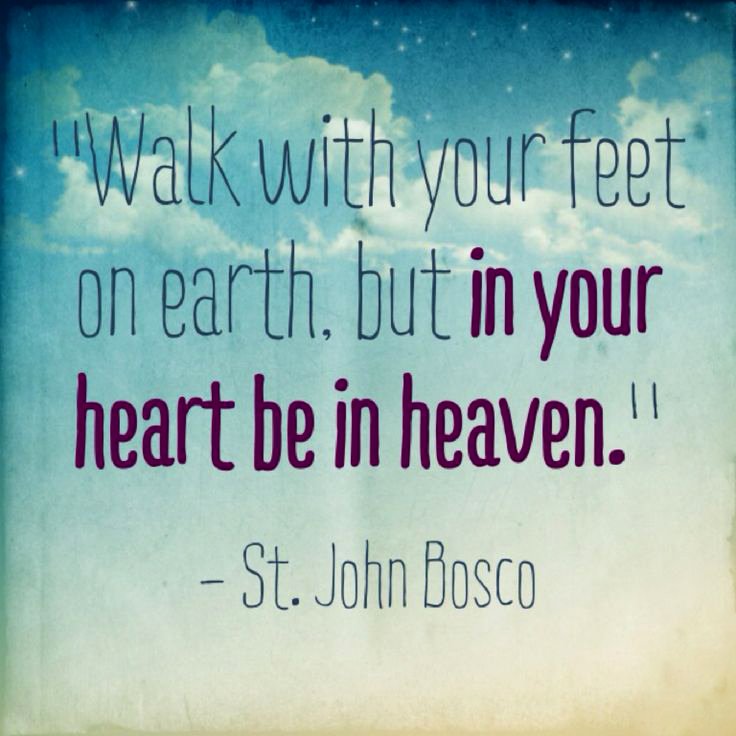
Like St. John Bosco, instill in our hearts this beautiful lesson he had taught us with:
From twitter.com
Like St. John Bosco, may we “always have fun in life, but never sin”, thinking only the glory of heaven as the ultimate end of everything we do in life! Amen.
Wednesday, Memorial of St. Vincent, Deacon and Martyr, 22 January 2020
1 Samuel 24:3-21 ><)))*> ><)))*> ><)))*> Mark 3:1-6
Cross atop our Parish church, 19 January 2020. Photo by Gelo N. Carpio.
Dearest Lord Jesus:
Today I realized something new, something different: that biblical term “hardness of the heart” may not be totally wrong at all.
It sounds negative but may mean two things also like of hardness of the heart for God or a hardness of the heart against God and others.
Hardness of the heart for God: When King Saul was trying to dissuade the young David from facing the Philistine giant Goliath, David explained:
“The Lord, who delivered me from the claws of the lion and the bear, will also keep me safe from the clutches of this Philistine.”
1 Samuel 17:37
Would it really matter, O Lord, if we face a great or little obstacle in life if we have that complete faith and trust in you, if like David we would have such heart so hard for you?
David was very insistent on fighting Goliath – he knew and was convinced that no matter what, God will fight his battle! He had a hard heart for you, O God. Very adamant in fact.
When we have total faith and trust in you, O Lord, there is no one or nothing we should be afraid of.
Hardness of the heart against God: When Jesus confronted his enemies during a sabbath at the synagogue regarding the healing of the man with a withered hand there, they chose to be silent than make a stand for what is good and right.
Then Jesus said to the Pharisees, “Is it lawful to do good on a sabbath rather than do evil, to save life rather than destroy it?” But they remained silent. Looking around at them with anger and grieved at their hardness of heart, Jesus said to the man, “Stretch out your hand.” He stretched it out and his hand was restored.
Mark 3:4-5
St. Vincent, Deacon and Martyr, pray for us!
Lord Jesus Christ, remind us always of the beautiful imagery of your Cross, of you always standing in our midst, presenting yourself before us to always choose you, side with you in making choices in life.
Give us the grace and courage like with St. Vincent, the first martyr of Spain who bore all forms of torture with silence and grace, remaining faithful to you.
Give us that grace to give you a chance to work in us.
1 Samuel 15:16-23 ><)))*> ><)))*> ><)))*> Mark 2:18-22
“Sleeping Sto.Niño” at our altar, 19 January 2020. Photo by author.
Praise and glory to you, O Lord Jesus Christ!
Let me rejoice this first day of work and school in your divine presence, O Lord. Let me celebrate your coming in my life! Let me live in your divine presence most especially when everybody feels and thinks you are not with us, that you do not care at all.
Forgive me, Lord, when I act like Saul in the first reading: obediently fulfilling your will and instructions and yet, insisting on my own ways as if you are not aware of what is in our minds and hearts.
Like Saul, I always confuse your will with my “good intentions”, with what I think as good and the best for you and for others when in fact, I am playing God, “presuming” you will approve and like whatever I deem best for you and others.
But Samuel said: “Does the Lord so delight in burnt offerings and sacrifices as in obedience to the command of the Lord? Obedience is better than sacrifice, and submission than the fat of rams. For a sin is like divination is rebellion, and presumption is the crime of idolatry.”
1 Samuel 15:22-23
Help me, sweet Jesus, to always “pour new wine into fresh wineskins”, to always see something new daily in you, to find you present among people and things I take for granted.
The Lord Is My Chef Simbang Gabi Recipe, 24 December 2019
2 Samuel 7:1-5, 8-12, 14, 16 ><)))*> <*(((>< Luke 1:67-79
Marker on the Church where St. John the Baptist is believed to have been born in Ein Karem, Jerusalem. Photo by author, May 2019.
At last!
These are most likely the two words we must be saying today on this ninth day of our Simbang Gabi.
Finally, we have completed the nine day novena to the birth of our Savior Jesus Christ for tonight will be Christmas.
But, more than being the last day of our novena, today is also the beginning of better days ahead for us all starting with Christmas!
From this day on, let us imitate Zechariah in his new found faith, hope and love in God expressed in his song of praise and thanksgiving after recovering his sense of hearing and speaking after nine months of forced silence.
“Blessed be the Lord, the God of Israel, for he has come to his people and set them free. He has raised up for us a mighty Savior, born of the house of his servant David.”
Luke 1:68-69
Sunrise at the Lake of Galilee, the Holy Land. Photo by author, May 2019.
Three canticles of praise, three prayers of faith
Popularly known as the Benedictus from its Latin opening verse “Blessed be God”, this is the second of the three canticles St. Luke tells us Zechariah had sang after naming his son “John”.
The other two songs are the Magnificat by Mary during her Visitation of Elizabeth and the third is the Nunc Dimittis by Simeon upon seeing the child Jesus during his presentation at the Temple of Jerusalem.
These canticles or songs make up the beautiful Christmas story by St. Luke who put them onto the mouths of Mary, Zechariah, and Simeon to signify their being filled with the Holy Spirit in experiencing the coming of Jesus Christ: Mary sang “my soul proclaims the greatness of the Lord” during the Visitation in response to the praises by Elizabeth (Lk.1:46-55) while Simeon the prophet prayed to God to “let him go in peace” – to die – after seeing the coming of the Savior (Lk.2:29-32).
These eventually became part of the prayers of the Church (Liturgy of the Hours) we priests and religious are obliged to pray day in, day out:
Benedictus in the morning to show how willing are we to face the new day by making our Savior Jesus Christ present in our lives like St. John the Baptizer, his precursor;
Magnificat in the evening to praise and thank God in working his salvation in us through Jesus Christ;
Nunc Dimittis at night before bedtime to signify our readiness to die and finally be one with God in Jesus Christ.
They are our “spiritual vitamins” that fill us with the Holy Spirit to strengthen and deepen our relationship with the Father in Jesus Christ which every Christian may pray too to experience and be one with God daily.
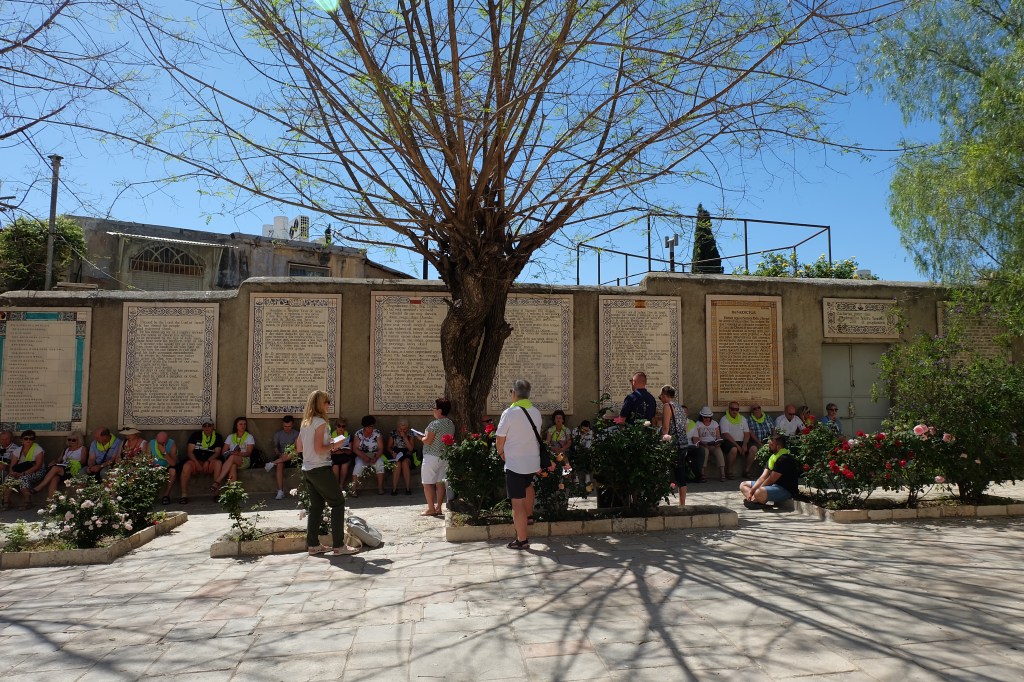
Pilgrims waiting outside the Church of St. John the Baptist in Ein Karem, Jerusalem. On the walls are the translation into different languages of the world, including Filipino, of Zechariah’s Benedictus. Photo by author, May 2019.
Why God is blessed according to Zechariah
The Benedictus signifies Zechariah’s coming to full circle after nine months of forced silence after doubting the angel’s message that he and Elizabeth would finally have a son.
Our sacristy, Advent 2019.
In singing the Benedictus, Zechariah did not only recover his power of speech but most of all showed the fruits of his nine months of silence and prayer preparing for the birth of his son John as well as, ultimately, for Christ’s coming (his song indicates it).
Finally, Zechariah has been healed of his pains and hurts that prevented him in experiencing God, in believing in his powers again, giving him more reasons to hope and be joyful.
This is the reason we also have the Advent Season when we try to dispose ourselves more to Christ’s coming to us not only at Christmas but everyday in our lives.
Zechariah mentions three powerful verbs why he praised God: for he has come to his people, set them free, and has raised up a mighty Savior.
God has come to us
Zechariah first experienced God coming to him when the angel announced to him John’s birth while incensing at the temple during the Day of Atonement. Unfortunately, he was “absent” at God’s “presence” that he questioned how Elizabeth would bear a child.
Everything now changes not only because he had seen his own son but he himself experienced God’s coming in his life.
Sometimes, our pains and hurts, frustrations and disappointments, defeats and failures blind us, numb us that we cannot see, we cannot experience God coming to us in every brand new day he gives us, through the people we meet with their smiles and greetings, with our family and friends who have have stayed with us in good times and bad.
Every morning we wake up to reminds us God has come to us. Rise and meet him in joy, entrust the new day to him, and ask for the grace to remain in him!
God has set us free
Every time God comes, there is always freedom – freedom from evil and sin, freedom from the past and all its pains and hurts, freedom from guilt feelings, freedom everything that prevents us from being truly free to be our own, good sel, to be free and faithful to love and forgive others too.
Carmelite Monastery, Guiguinto, Bulacan. Photo by author, November 2019.
Literally speaking, Zechariah felt free again to speak and express himself fully. But more than that is the experience to go and live fully in God.
We can never experience Christmas if we cannot assert this freedom Christ had won for us when he died on the Cross. Forget all those “hugot” lines and move forward with life.
The name of God is “I AM” because he is always in the PRESENT, never in the past nor in the future.
That is why each new day is a gift, a present from God who as set us free from yesterday’s mistakes and failures and sins.
Go and be free for God!
God has raised up for us a mighty Savior
Christmas is not a date but an event, a person we experience in Jesus Christ who is a dialogue himself according to Pope Emeritus Benedict XVI. Jesus is always communing with us, inviting us to be one in him in his love.
In his Benedictus, Zechariah is also professing the saving work of God in Jesus Christ who became human like us in everything except sin. God is so blessed because of his great love for us, he chose to enter, or intervene into human history to bring us into eternal life by faith in Christ Jesus.
To raise up is a strong term also indicating the Paschal mystery Christ will go through, the ultimate communion of God into our own lowliness of suffering and death to bring us into the glorious victory of his resurrection.
Every morning, every day we are reminded by Zechariah of the words of the angel Gabriel to Mary regarding the birth of John: nothing is impossible with God.
And Zechariah had experienced this first hand when his barren and old wife Elizabeth conceived their child John.
May we have a renewed faith, hope and love in God at the closing of our Simbang Gabi this year. Like David in the first reading, rest be assured of God’s plan for each of us. Let us be patient to wait and prepare always for his coming like Zechariah even in his old age. Amen.
Birthplace of St. John the Baptist at Ein Karen, Jerusalem. Photo by author, May 2019.
The Lord Is My Chef Sunday Recipe, Advent IV-A, 22 December 2019
Isaiah 7:10-14 ><}}}*> Romans 1:1-7 ><}}}*> Matthew 1:18-24
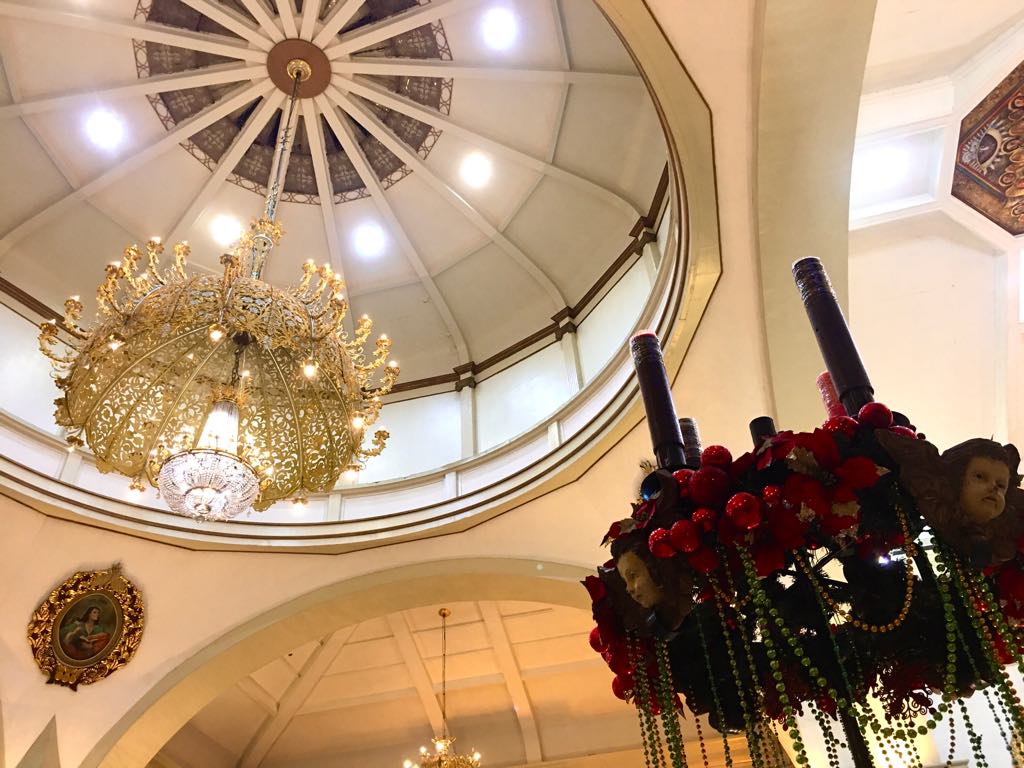
Dome of the Malolos Cathedral Basilica, Advent 2019. Photo by author.
We are now at the Fourth Sunday of Advent, the final week of preparations for Christmas happening in about three days. And we go back to the gospel of Matthew to reflect anew on the annunciation of Christ’s birth to Joseph.
This is how the birth of Jesus Christ came about. When his mother Mary was betrothed to Joseph, but before they lived together, she was found with child through the Holy Spirit. Joseph her husband, since he was a righteous man, yet unwilling to expose her to shame, decided to divorce her quietly. Such was his intention when, behold, the angel of the Lord appeared to him in a dream and said, “Joseph, son of David, do not be afraid to take Mary your wife into your home. For it is through the Holy Spirit that this child has been conceived in her. She will bear a son and you are name him Jesus, because he will save his people from their sins.” When Joseph awoke, he did as the angel of the Lord had commanded him and took his wife into his home.
Matthew 1:18-21,24
As we look toward the coming Christmas Day, the story of the annunciation to Joseph invites us to examine ourselves, to look inside and look back through the years what have we done to bring Jesus Christ into the world like him.
Though Advent celebrates God’s fidelity and constancy in fulfilling his plan of salvation for us through Jesus Christ, this coming involves a human setting among us in the present time to realize its fulfillment.
Dream of St. Joseph (oil on canvas) by Spanish painter Francisco Goya via Google.
St. Joseph’s mission, our mission too
When the angel appeared to Joseph in his dream, it was not so much to explain to him about Mary’s virginal conception but to reveal to him his mission. Very clearly, Mary’s conception of Jesus is absolutely extraordinary, a mystery directly from God himself.
And that is how it is with life: there are certain things we simply have to let ourselves be wrapped by mystery than to unravel or explain it.
Like the Blessed Virgin Mary whom he loves so much, Joseph believed in God, agreeing to what was asked of him that upon waking up, he obediently did everything the angel had instructed him.
Joseph’s acceptance of Mary and of his role in giving name to Jesus brings to an end the genealogy of “Jesus Christ, son of David, son of Abraham” because in the Jewish society, it is the father who bears much weight in recognizing one’s child.
Here we find the crucial and critical importance of Joseph’s mission in giving name to Jesus, in taking Mary as wife: it is through his “fatherhood” that Christ comes into the world as a person, and most of all, as fulfillment of God’s promise made to Abraham and David.
Last Tuesday we have reflected how through Jesus Christ’s coming we now trace our genealogy and roots with God in faith. As children of our loving Father, we too are now entrusted with the same mission like Joseph to bring Jesus Christ into the world in our own time and history.
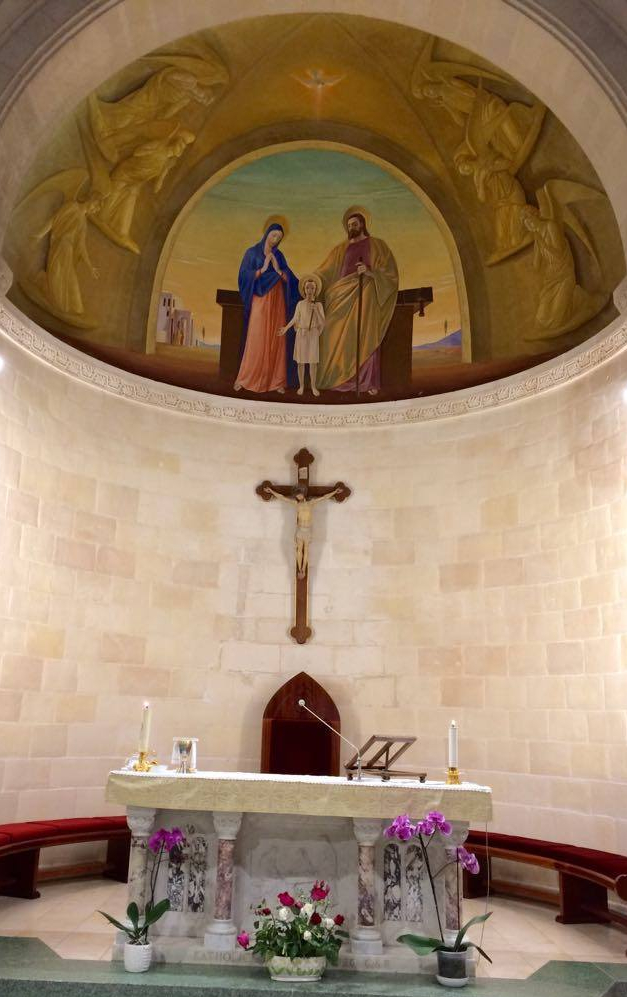
Altar of the Chapel of St. Joseph beside the Basilica of the Annunciation in Nazareth. Below the chapel are the ancient ruins of the home and shop of St. Joseph where he took care of Mary and Jesus. Photo by author May 2017.
Called to obedient faith
Salvation history continues and it is our duty to find our proper place in God’s plan like Joseph. The story of Christmas continues to our time that is why we have this Advent Season of preparation.
God has not diminished that great honor and privilege given to Joseph then and to us now of having an irreplaceable role in bringing Jesus into the world but this time, not through dream or voice of an angel. God continues to call us like Joseph to bring his plan of salvation in Jesus into fulfillment through our obedient faith through the Sacred Scriptures, the Church in her teachings and most of all, through the many situations and people we encounter in life.
We have to believe and accept this reality that “God needs us”, that the “baby Jesus” wants us to care for him, to give him a name so that “his glory would be eventually revealed for mankind to see the saving power of God” (communion antiphon of Christmas Eve).
St. Paul beautifully tells us in the second reading a very basic profession of faith affirming Jesus Christ as the Son of God descended from David through Joseph according to the flesh (Rom.1:1-4).
Through Jesus, we are called to “bring about obedience of faith” to spread this “good news to all Gentiles” or peoples of the world that they may honor and worship the Lord.
And the good news is this: despite or many flaws and weaknesses, all he needs is our complete faith and surrender to him like St. Joseph. It is Jesus Christ who shall provide us with the strength to fulfill this mission just like what he did to St. Joseph.
From Aleteia, 18 December 2019.
Hail to the fathers and men too
Last December 17 as the whole Church was proclaiming the gospel from Matthew on the genealogy of Jesus Christ, Pope Francis celebrated his 83rd birthday when he was presented with a unique Nativity scene called “Let Mum Rest” with St. Joseph taking care of the infant Jesus while Mary slept.
It went viral, and again, another unique imagery of the beloved St. Joseph courtesy of Pope Francis, a devotee of the Lord’s foster father. When he came to visit the Philippines in 2015, he narrated how he would pray to the sleeping St. Joseph and it became viral in the country.
And now this new image of St. Jospeh babysitting.
It is a very timely image at this time when there is a crisis in fatherhood, when many fathers have to make the difficult choice of leaving their families behind to work in distant places, often foreign countries just to earn decent living.
A crisis when fathers forget caring and loving their families because of the many demands of a high cost of living that along the way, they fall into many traps that sometimes make them forget their vows of marriage.
We need to pray hard for fathers and men. They too are blessed by God like St. Joseph.
We need to pray hard for fathers and men to help them remain upright like St. Joseph.
When Jesus began his ministry, he taught us the “Our Father” to show us that God is like a father because life comes from him. It is from the father that we receive the seeds of life with that genetic code called “DNA”. This is the reason why it is the father who gives name to the child at baptism like St. Joseph to Jesus.
Secondly, Jesus called God “our Father” because he is the one who protects and keeps life from dangers. He must have experienced this from St. Joseph who brought them to Egypt when Herod ordered the massacre of Holy Innocents after the visit by the Magi in Bethlehem. Fathers are often strict with children because he wants to ensure their safety.
Most of all, Jesus called God “our Father” because he is the one who brings back life to those who have lost it like the merciful father to his prodigal son (Lk.15).
How many times did our father saved us from scolding and punishment by our mother, from the simple misdemeanors to grave offenses like going wayward in life? It is often the father, ironically, despite his being strict and disciplinarian, who also has the softest heart for the prodigal child.
May St. Joseph help us men to be man enough to be faithful to God and loved ones to make everyone feel the love and mercy of the Father in heaven as revealed to us by Jesus Christ. Amen.
The Lord Is My Chef Simbang Gabi Recipe, 19 December 2019
Judges 13:2-7, 24-25 ><)))*> ><)))*> ><)))*> Luke 1:15-25
The Walls of Jerusalem, May 2019. Photo by the author.
From St. Matthew, we now move to the Christmas story by St. Luke that starts in the temple of Jerusalem. And surprisingly, not precisely with Jesus or his parents.
In the days of Herod, King of Judea, there was a priest named Zechariah of the priestly division of Abijah; his wife was from the daughters of Aaron, and her name was Elizabeth. Both were righteous in the eyes of God, observing all the commandments and ordinances of the Lord blamelessly. But they had no child, because Elizabeth was barren and both were advanced in years. Once when he was serving as priest in his division’s turn before God, according to the practice of the priestly service, he was chosen by lot to enter the sanctuary of the Lord to burn incense. Then, when the whole assembly of the people was praying outside at the hour of the incense offering, the angel of the Lord appeared to him, standing at the right of the altar of incense.
Luke 1:5-11
We know what happened, of how Zechariah doubted the good news announced to him about the birth of his son John the Baptizer.
Many times in our lives, especially in this age of too much communications in the social media where everything is exposed, we hardly notice the best and nicest things in life happening in silence, mostly in hiddenness.
And the saddest part of this present reality is that it is God whom we miss in this “overexposures” we have in social media because he always comes to us hidden in the most ordinary and simple things in life.
Yesterday St. Joseph taught us the need to value silence and stillness in the Lord as an important lesson in facing life’s many adversarial situations.
Today we hear Zechariah forcibly silenced to experience the Lord’s power and grace, his very presence in fact.
An inside section of the remaining Walls of Jerusalem. Photo by author, May 2019.
God’s presence hidden in our time and space
Advent is the season that reminds us that God comes to us always hidden in our very time and space. Unless we know how to be silent and simple, we shall never experience the Divine presence that has covered the whole world ever since.
Of the four evangelists, St. Luke is the only one who claims to have “investigated everything accurately” about the life and teachings of Jesus Christ (Lk.1:3). That is why he has the most stories and details about Christmas.
For St. Luke, Christmas begins with the coming of St. John the Baptizer, Jesus Christ’s precursor. In a very unique manner, he tells us how God’s presence came through a husband and wife yearning so much to have a child of their own, Zechariah and Elizabeth, both belonging to the upper crust of the Jewish society having descended from the priestly families.
In fact, Zechariah was a priest who was so blessed that Day of Atonement known as the Yom Kippur of the Jews that happens around September 18-24. (That is how we come to celebrate Christmas on December 25: Elizabeth conceived John in September, giving birth to him in June 24; tomorrow, we shall hear in the Annunciation to Mary that Elizabeth was six months pregnant which falls on March 24. Simple math, we arrive at December 25 as Christ’s birthdate.)
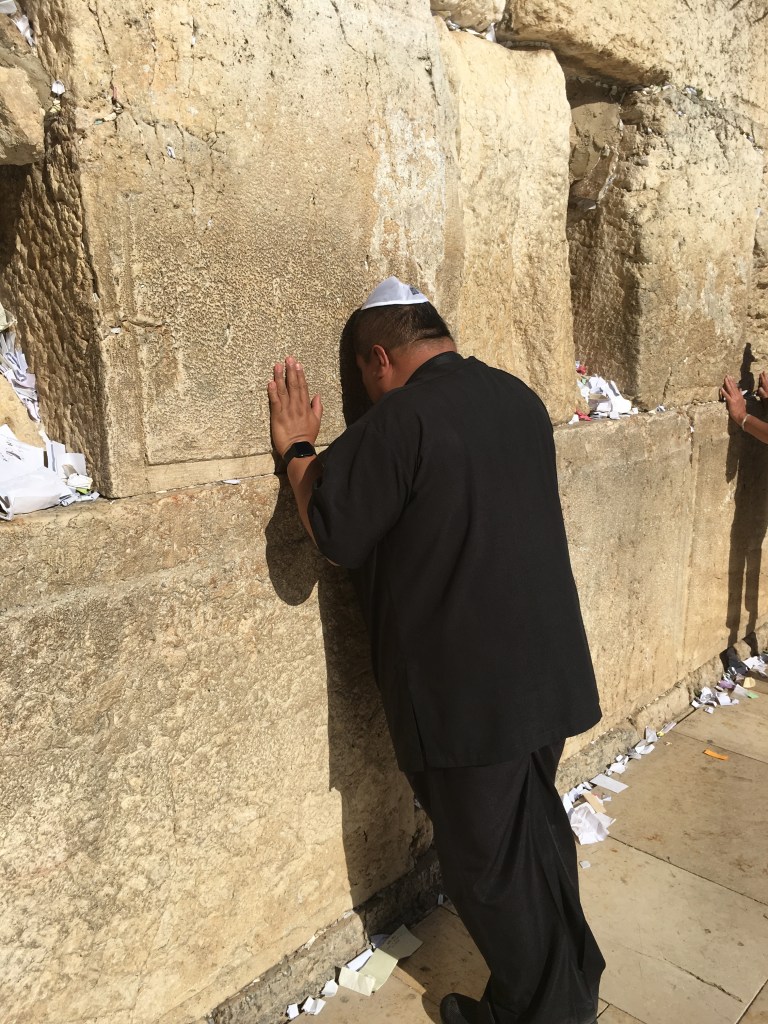
Praying at the Wall, May 2019.
During the Yom Kippur, priests drew lots on who would incense the Holy of Holies where the “Ark of the Covenant” was kept containing the stone tablets of God’s commandments given to Moses. It was the closest thing they have as signs of God’s presence among them. Hence, until now they venerate and pray at the “wailing Wall” of Jerusalem because that is supposed to be the only remaining structure of their temple destroyed in 70 AD closest to that part of the Holy of Holies.
It was so rare at that time to be assigned to incense the Holy of Holies because there were so many priests drawing lots and only one would be chosen for the rite that happens about twice daily for the whole week. It was a tremendous blessing indeed to be chosen to incense the Holy of Holies.
Here we find St. Luke setting the stage of his Christmas story to remind us all that God comes right into our time and space, in our history, in our here and now.
See his descriptions:
It happened in a specific time during during “the days of Herod, King of Judea”, when Zechariah was “chosen by lot to enter the sanctuary of the Lord to burn incense” while people were outside praying and waiting.
It happened in a specific place, the temple of Jerusalem.
Most of all, it happened to real people, “Zechariah of the priestly division of Abijah; his wife Elizabeth was from the daughters of Aaron.”
A view from the Walls of Jerusalem of the Jewish section; dome is the Moslem section, Mount of Olives at the background. Photo by author, May 2017.
The Presence of God, the Absence of Man
When we are deeply hurt and disappointed, we are usually less rational. Worst, although we try to keep our faith alive, that is also when we doubt God, refusing to recognize his presence among us, and even right in us.
In this story of the annunciation of the birth of John the Baptizer, we find God giving Zechariah the tremendous grace to approach his Divine presence by having the rare opportunity to incense the Holy of Holies.
Most of all, at their most important feast when priests gather in the temple to pray for the people and for their personal intentions, God sent Zechariah the angel Gabriel to personally tell him his and Elizabeth’s prayers have been heard and granted!
But what happened? Zechariah doubted, even questioned God!
“How shall I know this? For I am an old man, and my wife is advanced in years.”
Luke 1:18
That’s the problem with us: God is always present but we are always absent that we never meet him. And every time he comes to visit us, we are so busy with so many other things.
If we cannot see and experience God in the most ordinary things and events in our lives, nothing would be enough to convince us of his love and mercy, of his presence and power.
That is why Zechariah was silenced by the angel, who, by the way, is already the presence of God yet Zechariah doubted.
This remaining week before Christmas, let us try to have some silence, or better, let us create a space for silence and solitude to experience God’s loving presence among us, in us.
It is only in silence where we can truly learn how to trust and be intimate with God and with our loved ones because it is only in silence where we can dare to open our selves to God and to others.
Let “the spirit of the Lord stir” you like Samson in the first reading (Jgs.13:25) this Christmas by creating silent moments with Jesus. Amen.
















 lordmychef.com