Advent is allowing God to overshadow us like Mary

Lord My Chef Simbang Gabi Recipe for the Soul by Fr. Nicanor F. Lalog II
Saturday, Simbang Gabi-V, 20 December 2025
Isaiah 7:10-14 <*((((>< + ><))))*> Luke 1:26-38

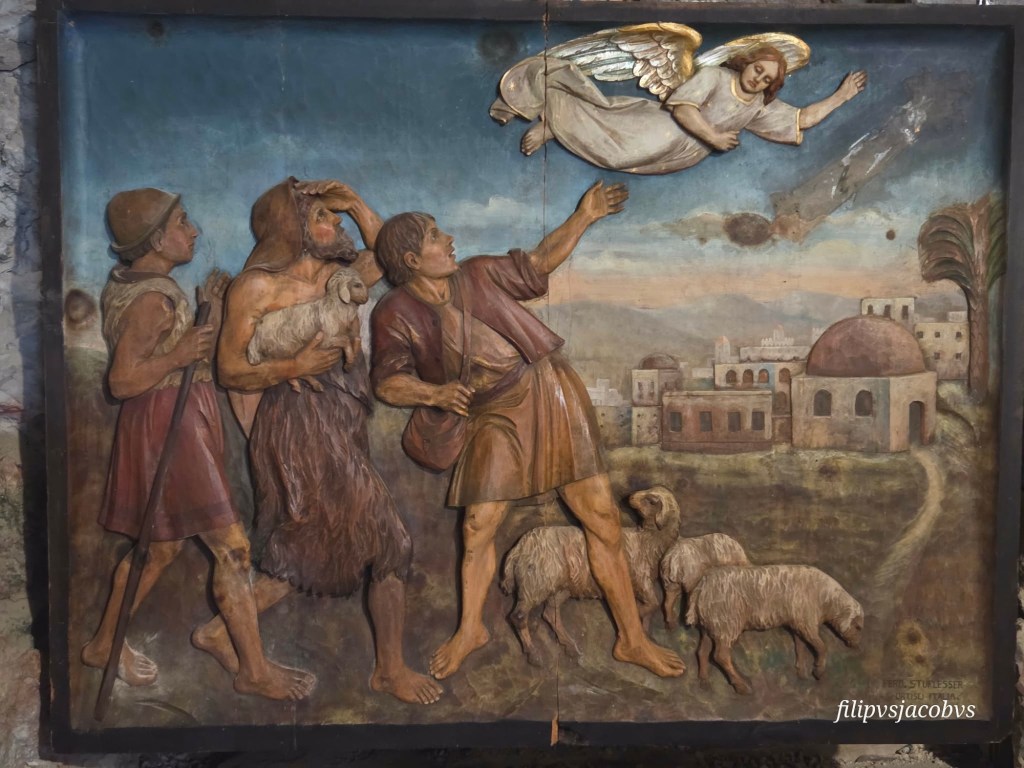
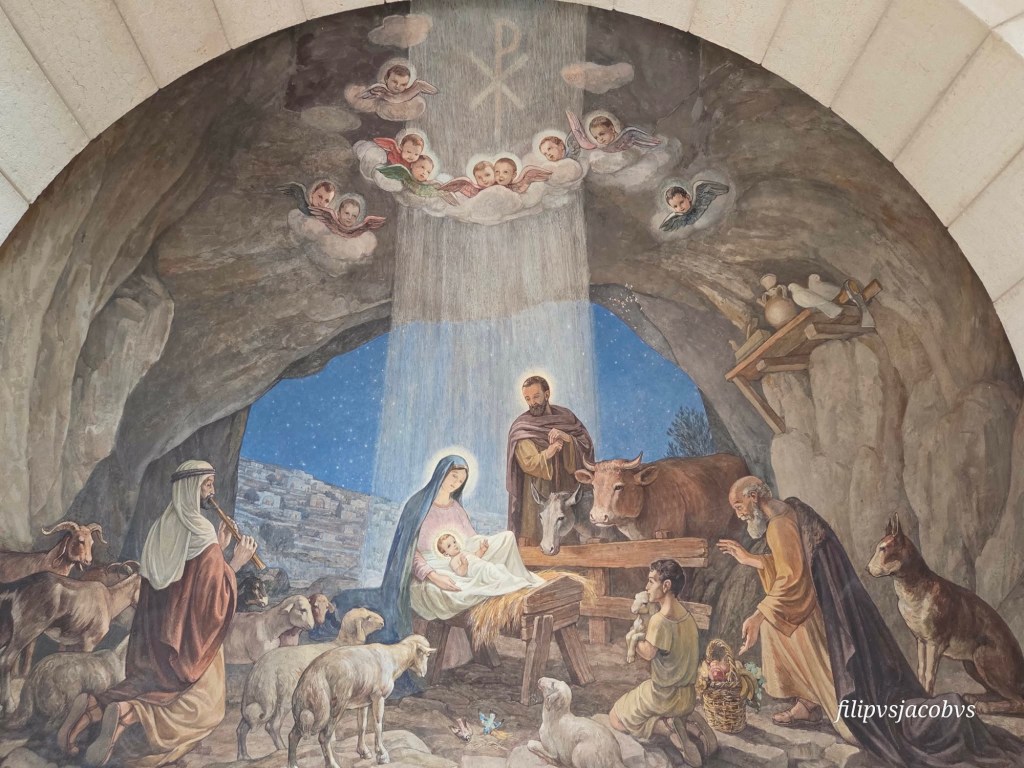
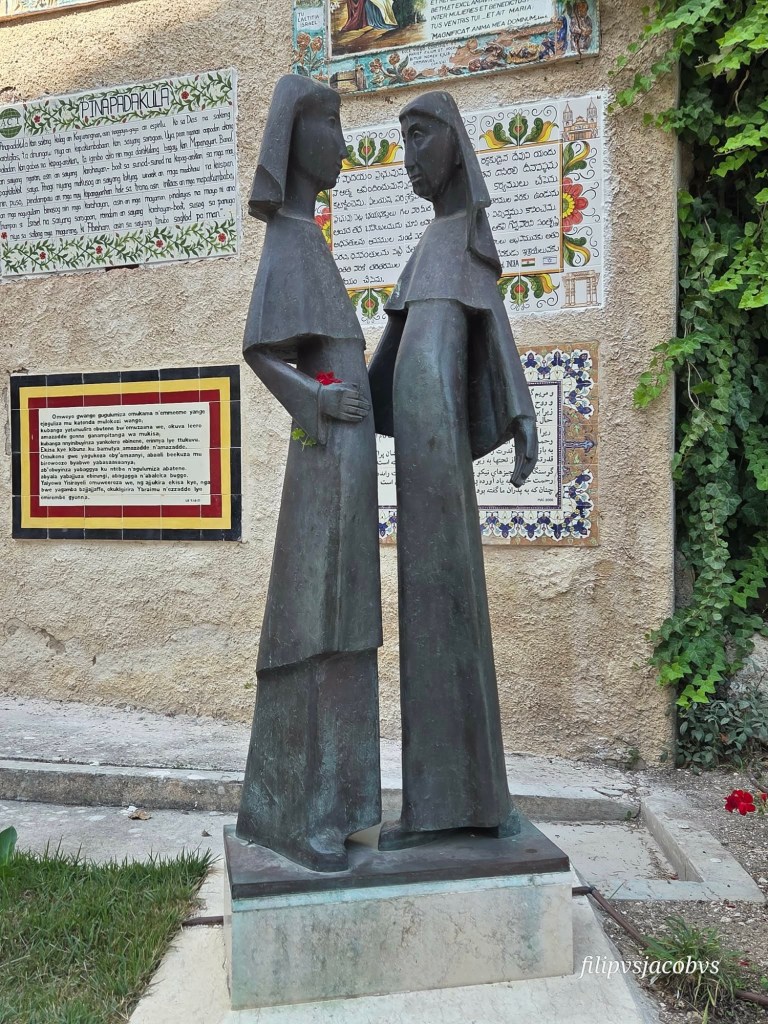
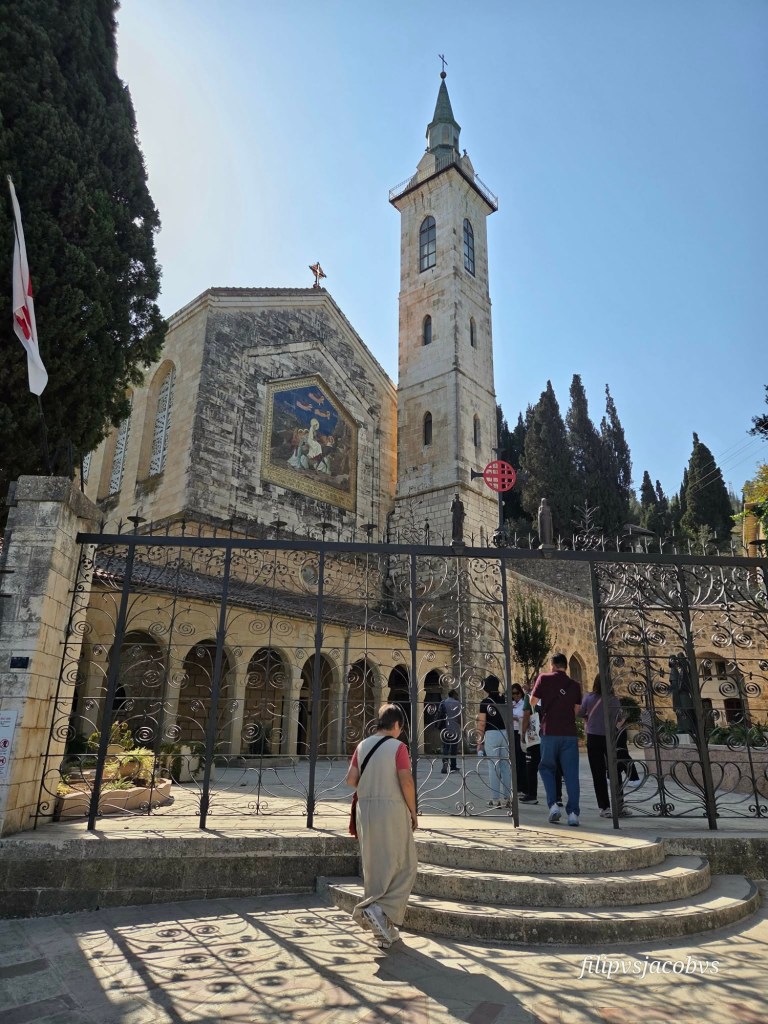
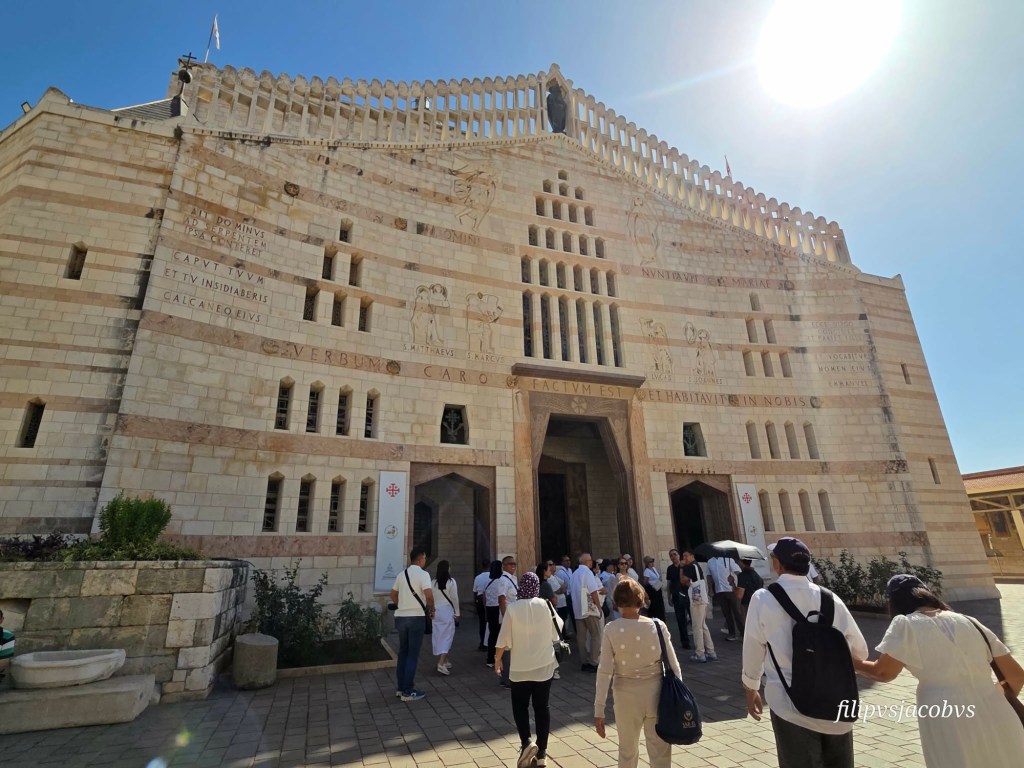
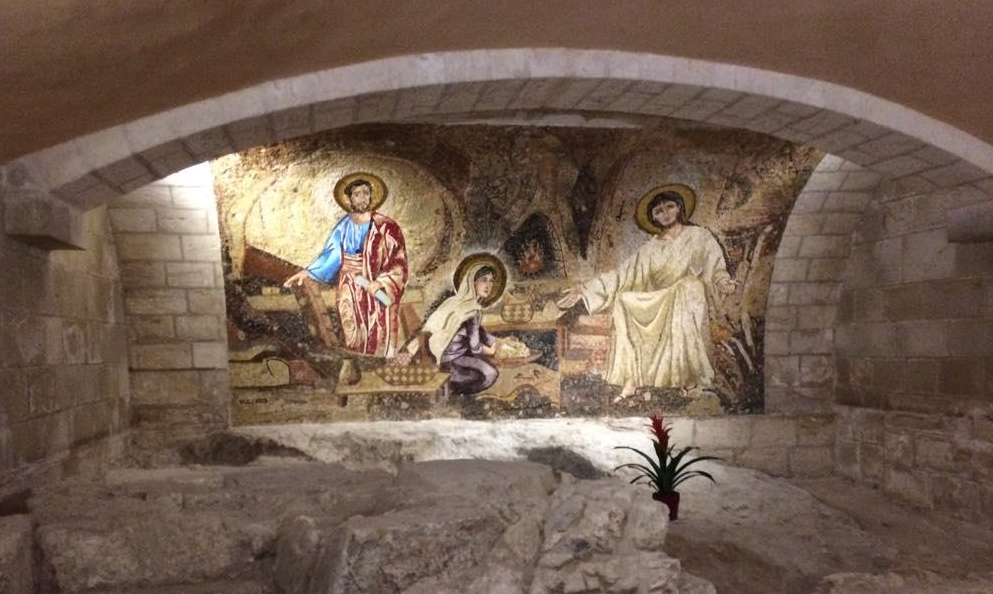
Basilica of the Annunciation in Nazareth, Israel; photo by Ar. Philip Santiago, October 2025.

On this fifth day of our Simbang Gabi we hear the second Christmas story by Luke, telling us how six months after announcing to Zechariah the coming of their son John, the angel Gabriel went to Nazareth to announce the birth of our Savior Jesus Christ to the Blessed Virgin Mary who was betrothed to St. Joseph.  Unlike Zechariah who doubted the angel’s message, Mary was more open with her response by asking how it would all take place.  

And the angel said to her in reply, “The Holy Spirit will come upon you, and the power of the Most High will overshadow you.  Therefore the child to be born will be called holy, the Son of God” (Luke 1:35).

We reflected the other day how Matthew ended his story of the genealogy of Jesus Christ with Mary to show her as the new beginning of everything in the world. Through Mary’s giving birth to Jesus, we now share with Him one common origin in faith who is God as our Father so that despite our many sins and failures, we are given with a fresh start, new opportunities in life daily. Luke bolsters this today with his account of the annunciation of the birth of Jesus to Mary. 

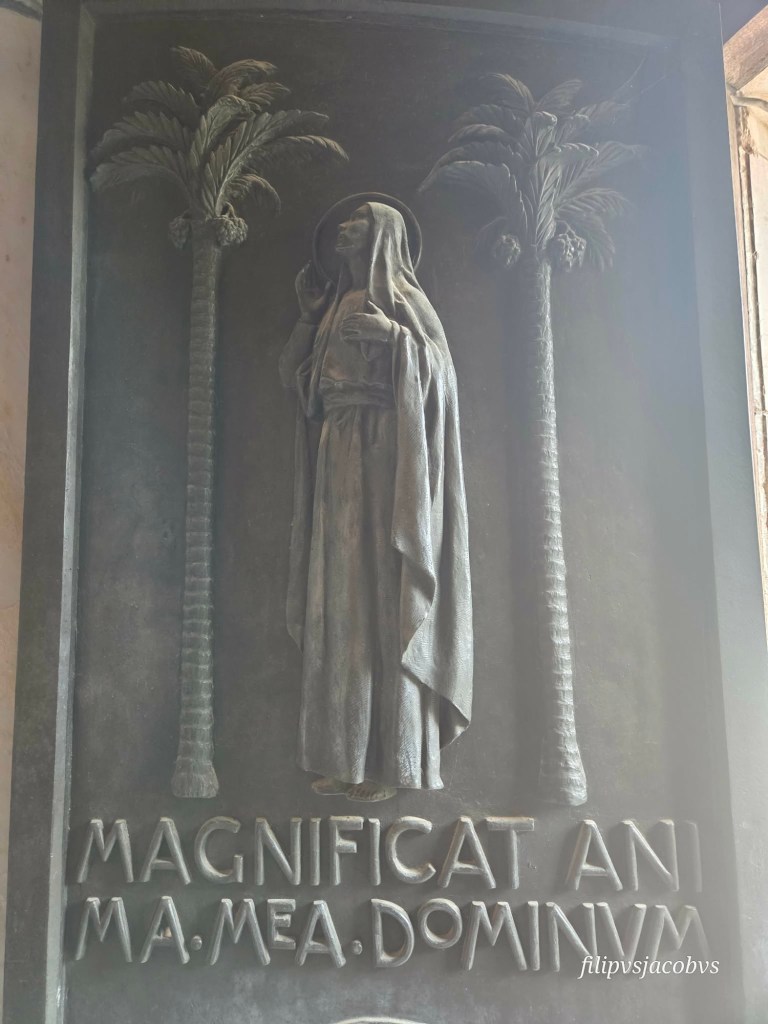
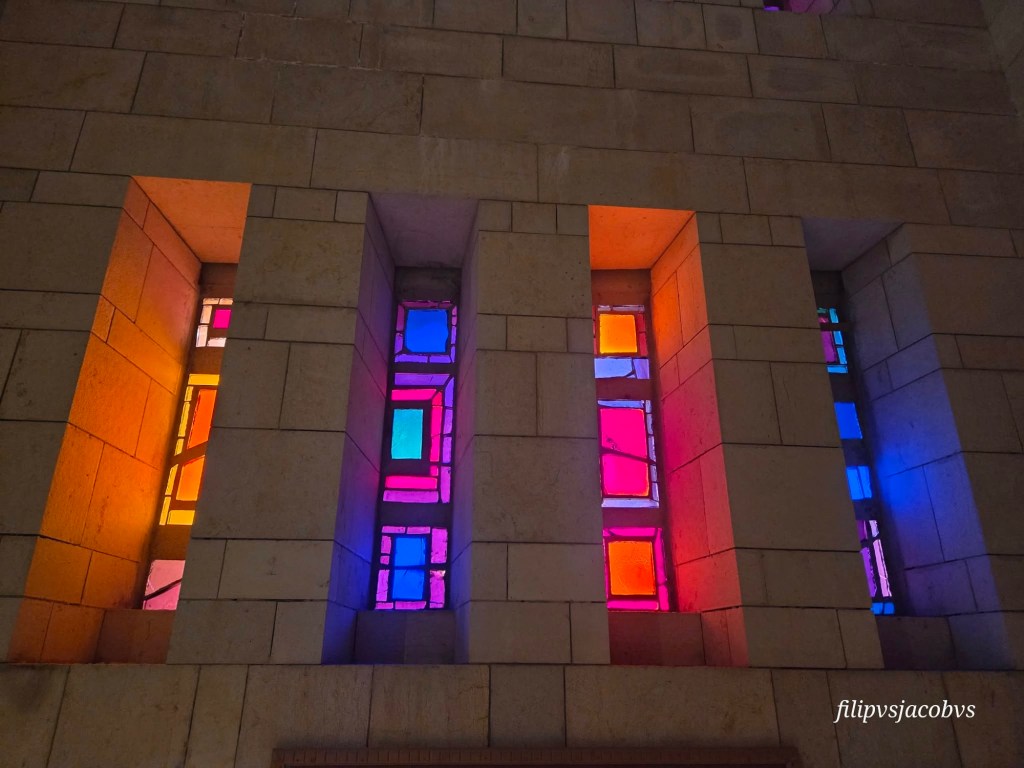
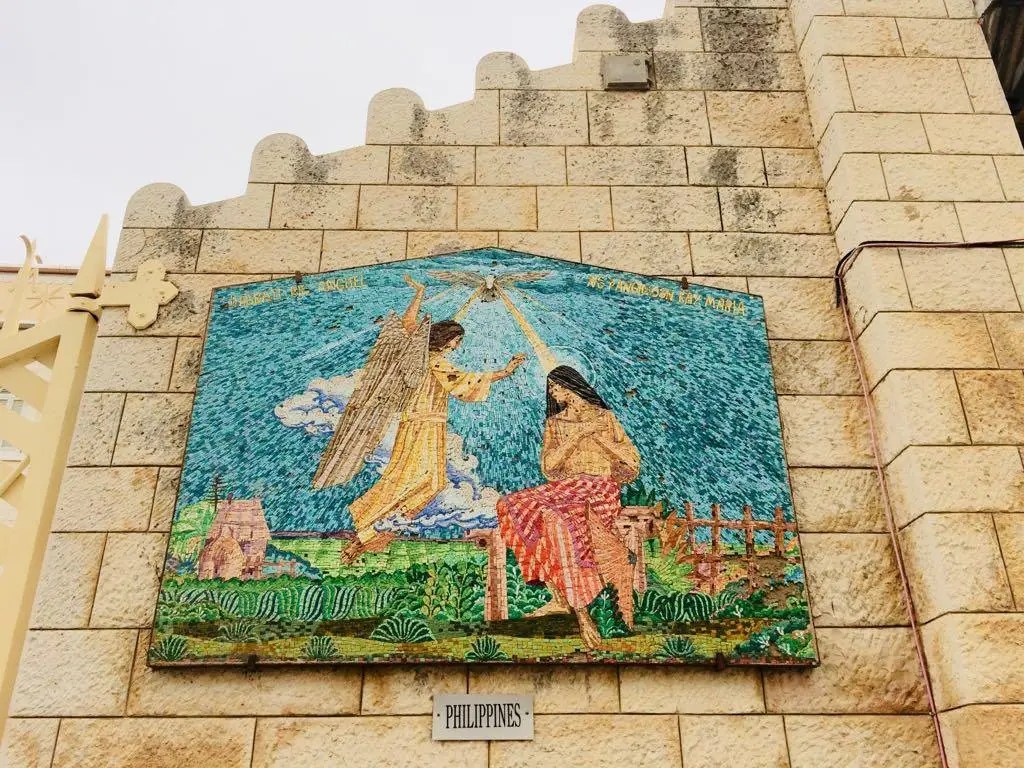
Photo by Ar. Philip Santiago, Annunciation Basilica in Nazareth, October 2025.

As a Jew, Mary must be totally aware of the words of the angel about herself being “overshadowed by the Most High” like in the Old Testament stories of God’s presence in the cloud during their journey in the wilderness after their exodus from Egypt.  Even Moses could not enter the tent when “the cloud covered it and the glory of the Lord filled the tabernacle” (Ex.40:34-38). 

To be filled and overshadowed by the presence of God is to be to be possessed by God and eventually to be transformed by God. 

Remember how in the movie “The Ten Commandments” when the face of Moses was transformed after meeting God. In the New Testament, the three synoptic gospels record a similar incident of God’s presence in a cloud hovering with Jesus during His transfiguration at Mount Tabor witnessed by Peter, James and John. The two great prophets of Israel were there, Elijah and Moses conversing with Jesus when a cloud overshadowed them with a voice declaring “this is my beloved Son, listen to Him.” Matthew, Mark and Luke tell us how the apostles were all terrified at the sight of the Transfiguration. 

And we can also surmise how terrifying it must be to experience God’s presence, to be filled with God.  But that is how grace works! 

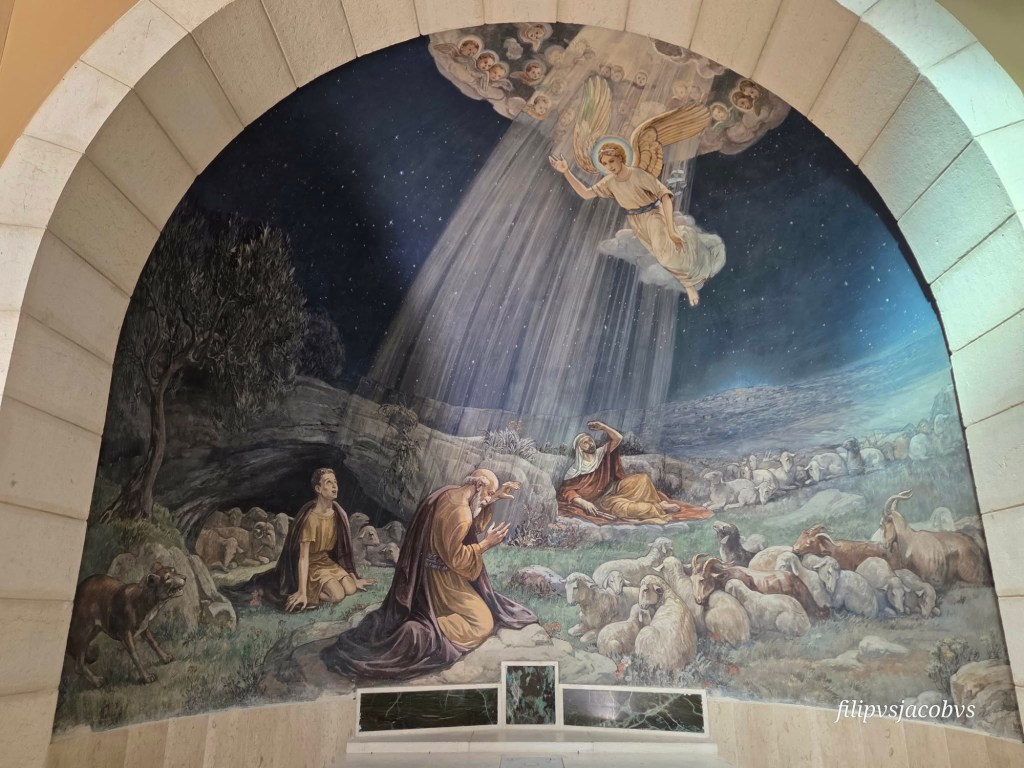
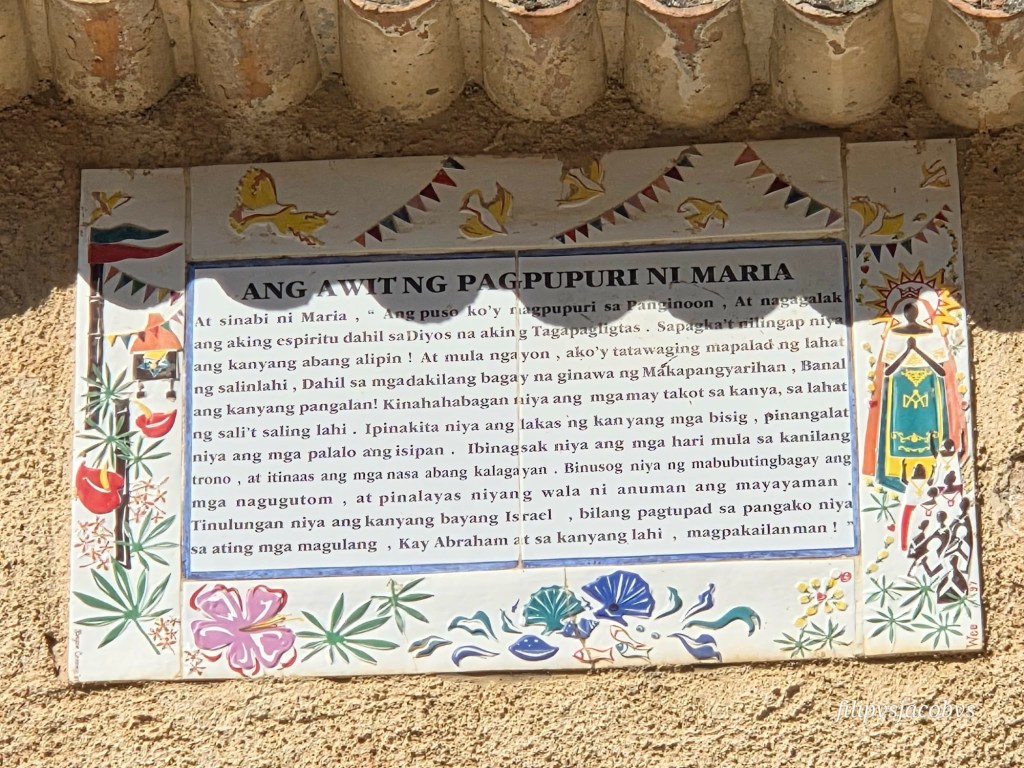
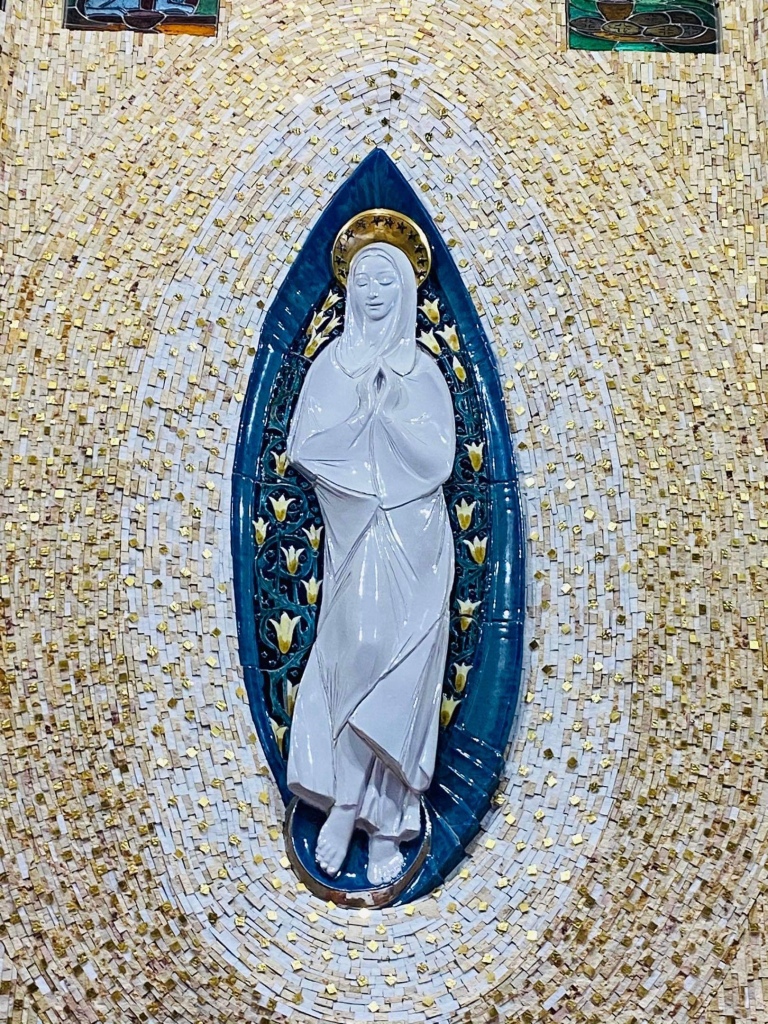
Photo by Ar. Philip Santiago, Annunciation Basilica in Nazareth, October 2025.

At the start of our Simbang Gabi we have reflected how under the light of Christ we are able to see our sinfulness and weaknesses that sometimes we feel so sorry for ourselves but that is actually when grace works in us – the moment we change our sinful ways, then we grow!

When we see our limitations as humans yet still forge on in life to achieve greater things, to become better persons, that is God working in us. That is why Luke tells us today how the angel greeted Mary during the annunciation using the Greek words “kaire” which is to rejoice and “charis” or “karis” for grace:  “Hail (or rejoice), full of grace!  The Lord is with you” (Lk.1:28). 

This is actually unusual because Jews greet each other with “shalom” for peace; why did Luke use kaire? Because wherever and whenever there is grace, surely there is rejoicing like in our Third Sunday of Advent called Gaudete Sunday: we rejoice because the Lord who is pure grace is near!

The late American spiritual writer and monk Thomas Merton rightly said, “We live in a time of no room, which is the time of the end.  The time when everyone is obsessed with lack of time, lack of space, with saving time, conquering space… The primordial blessing, ‘increase and multiply’ has suddenly become a hemorrhage of terror… In the time of the end there is no longer room for the desire to go on living.  Why?  Because they are part of a proliferation of life that is not fully alive, it is programmed for death” (Raids on the Unspeakable, pp. 70-72).

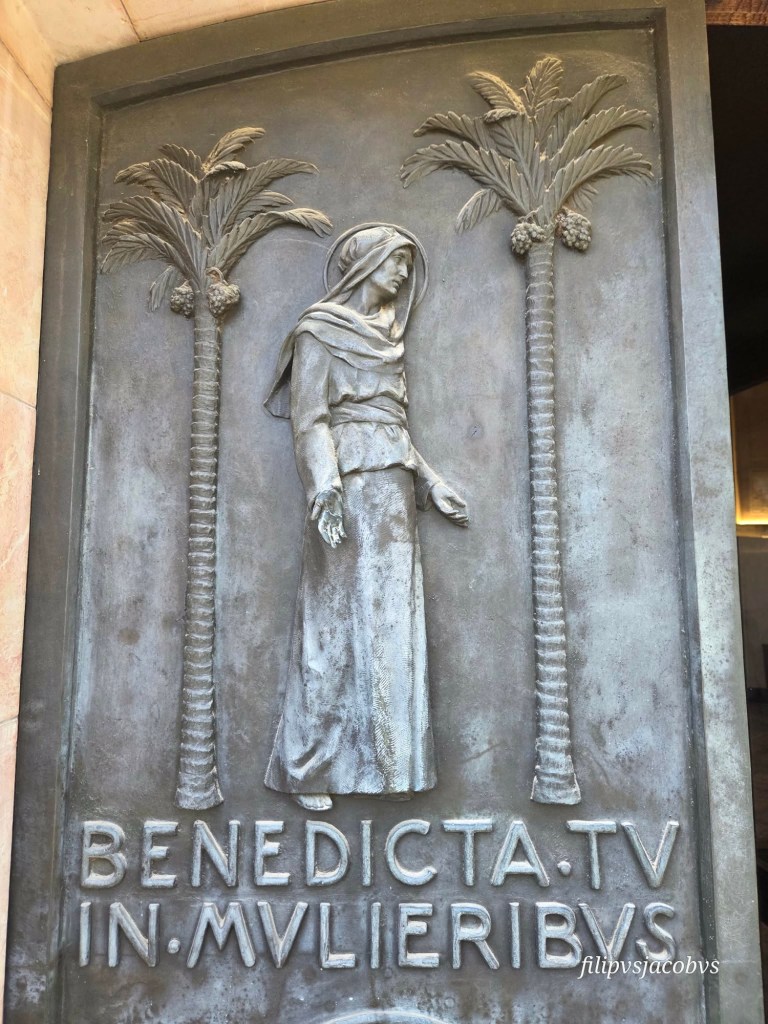
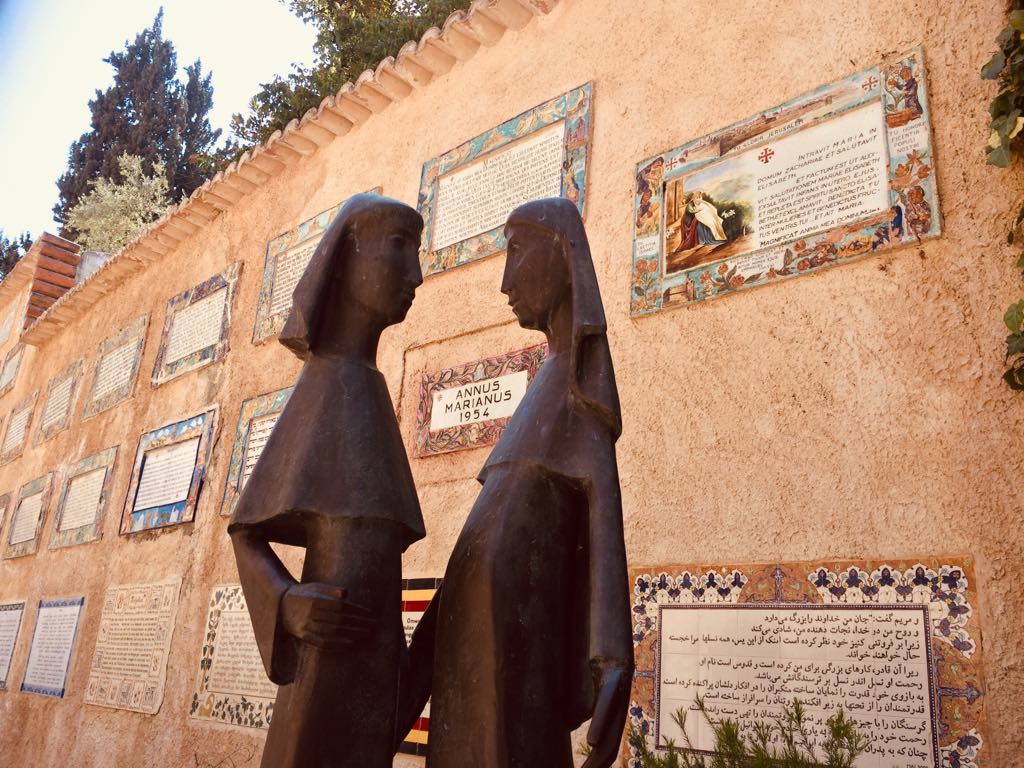
Photo by Ar. Philip Santiago, Annunciation Basilica in Nazareth, October 2025.

Advent is the time to get real, to stop pretending. Advent is the time for us to finally admit our own limitations, to create a space in our hearts and in our lives to let God fill us, to let God possess us. 

Can we, like Mary allow God’s power “hover over us” to renew our lives in welcoming Jesus Christ? This was the problem of Isaiah with King Ahaz in the first reading who pretended to refusing God giving signs of his presence when actually he had already entered into alliances with other pagan kings in the region as the Babylonians were closing in them; that is why Isaiah uttered the prophecy to insist that God is our protector: “Listen, O house of David! Is it not enough for you to weary men, must you also weary my God? Therefore the Lord himself will give you this sign: the virgin shall be with child, and bear a son, and shall name him Emmanuel” (Is.7:13-14).

Let me end this reflection by inviting you dear friends to pray for Fr. Flavie Villanueva, an SVD priest so active in caring for the poor especially the orphans left by victims of tokhang. He was recently awarded the Ramon Magsaysay Award considered as Asia’s equivalent of Nobel Peace Prize for his works for the poor.

Yes, he had a very dark past, being a former drug dependent but God used that chapter in his life to make him turn around and become a missionary priest. Fr. Flavie had never hidden nor sanitized his dark past because it was during those years when he also found the light and grace of God’s love and mercy for him. Perhaps, he is most effective in his works among the poor and the addicts precisely because he used to be one of them! He is now under attack for his works by the dark elements of the past administration, the most decadent in our history.

From Facebook via Political Insight Today, 18 December 2025.

Fr. Flavie is no Virgin Mary but like her, he opened his heart to God who eventually overshadowed him with His powers to do all these great things for the poor who now feel Christ’s presence.

Recall now the many instances in our lives where we have learned our most important lessons in life and most surely, these were also the moments we have faced many hardships and sufferings but, instead of being down, these have inspired us and transformed us into better persons.

Let us imitate Mary in saying yes to God – “Behold I am the handmaid of the Lord.  May it be done to me according to your word!”  Let us open our hearts to God so the Holy Spirit may hover on us to fill us with Jesus Christ we can share with others broken like us. Amen. A blessed weekend everyone! 

Christ comes in the Mass

Lord My Chef Simbang Gabi Recipe for the Soul by Fr. Nicanor F. Lalog II
Friday, Simbang Gabi-IV, 19 December 2025
Judges 13:2-7, 24-25 <*((((>< + ><))))*> Luke 1:5-25
View of a decorated Christmas tree and tower of the Franciscan Monastery of St Saviour locally also known as San Salvador monastery in the Christian Quarter Old city East Jerusalem

From Matthew, we now shift to Luke’s account of the story of Christmas which is the most complete and detailed of all gospel accounts. In fact, most artistic renditions of Christmas were inspired by Luke’s gospel.

Very surprising in his Christmas story, Luke started it with the annunciation of the birth of John the Baptist to his father Zechariah who was then serving at the temple of the Lord in Jerusalem, a beautiful reminder to us all these days that Christ comes in our Holy Mass.

And I wonder – what if I imitate Zechariah in the gospel on this Simbang Gabi: come out late in the altar… totally silent, unable to speak?

Meanwhile the people were waiting for Zechariah and were amazed that he stayed so long in the sanctuary. But when he came out, he was unable to speak to them, and they realized that he had seen a vision in the sanctuary. He was gesturing to them but remained mute. Then, when his days of ministry were completed, he went home (Luke 1:21-23).

Photo by author, December 2023.

A priest recently posted on Facebook an appeal to us all priests to truly pray and reflect to have a good homily this Simbang Gabi and Christmas Season because the people deserve more than jokes, hugot lines and gimicks during these ten days of celebrating the Mass.

And we totally agree with him!

Let us accept the fact that majority of Catholics in the world – not only in the Philippines – celebrate Mass only on Christmas. At least in our country, there is the Simbang Gabi when many Catholics try to complete its nine-days of Masses plus the Christmas Day itself and, that’s it for them – ten consecutive days in December and absent every Sunday from January to November with a few who would return to Mass on Palm Sunday, fiestas and birthdays. Especially these days, most people have no qualms at all of skipping Sunday Masses while there are still some who wrongly believe the online Mass suffices.

The challenge and call for us priests this season is indeed very true when we are able to pray and prepare well our homilies to catechize the once-a-year-Catholics so that they may experience the love and mercy of God in Jesus Christ who had come and continues to come during our celebrations of the Mass and other sacraments.

Problem is, very often we priests are indeed so much like Zechariah on that day when he doubted the good news of John’s birth announced by an Angel. Not only are many priests notoriously late in their Mass schedule, worst of all as the people complain, either they have nothing or too much to say during their homily!

Photo by Ar. Philip Santiago, Jerusalem, October 2025.

Like the people awaiting Zechariah during that important feast, people are amazed today why some priests could not say anything substantial at all except to continuously ask people to clap their hands and praise God with such cues as “God is good…” and “all the time…” and soon enough what’s next, collection, then after communion special collection!

On the other hand, like the people awaiting Zechariah during that feast, people are also amazed when their priests speak a lot without any sense at all. Worst, many times, the priests are like Jollibee – puro pabida either by converting the altar into a stage for his stand-up jokes and entertainment or turn the sanctuary into a videoke bar because Father is so bilib in his voice.

Sorry, my brother priests. Let’s listen to what people are saying. Let’s listen especially to God when he speaks to us. Or, do we have time to listen to him in prayers?

One truth we priests could not admit or refuse to admit despite its glaring realities is that many of us have become just like politicians – so corrupted that we simply entertain people, keep them ignorant of the more essential things in life and about God because many of us do not pray or are not even interested of going to heaven at all.

Maybe like Zechariah, many priests have been burned out not only of the tasks and living in near isolation but also due to the long wait for answers to our prayers coupled with the many pains and hurts that came along with the ministry that has become more of duties than relationship with the Caller, Jesus Christ.

Photo by Lara Jameson on Pexels.com

In telling us this story of the annunciation to Zechariah, Luke had touched on something very timely and sensitive among us priests including the faithful in this age of social media: we have been so detached from God and the divine, many times so impersonal with one another, and, worst of all, so attached with material and worldly things.

As a result, many people have stopped looking up to some priests as models and inspiration for upright living because we have become so much like them in almost every aspect from clothing to speaking and even thinking!

“Pari pala yun!” is what some people often remark these days when they find priests making tambay dis oras ng gabi in almost every cafe or worst, in places we should not even go like casinos and bars, whether with GRO’s or macho dancers.

A growing concern among us these days is the complaint of lay faithful who feel lost and could not guidance like find definitive answers from their pastors about moral issues so blurred by the modern technologies and Western thoughts like wokism. Imagine a Catholic school allowing gay pride festivities? Or relativistic priests to issues of abortion and contraceptives, sex change and gender manipulations, even cases of pornography and other modern addictions. A growing number of laypeople openly express their disappointment at how lately priests have become so lenient with sins that they are already confused on what to confess!

Photo by author, March 2024.

Zechariah and us priests today face the same problem before God: we talk too much and pray so little that perhaps, we need to be silenced too in order to pray more, to listen more to God, his words, his plans and his people as envisioned by synodality now in oblivion.

Imagine all his life as a priest, Zechariah had been praying for a son but when it was finally answered by God, he refused to believe it. Suddenly, he was so lost at what he was supposed to be an expert like spirituality and prayer, most of all, of God’s goodness.

What happened to Zechariah?

And that is what our gospel is asking us priests today, what happened Father?

In the first reading we have heard of the wife of Manoah who felt “a man of God” approached and told her of the good news of the birth of a son (Samson); how lovely if people could feel the same way like in the old days of their priests as “man of God”!

It is very sad when laypeople complain their priests have become so “ordinary” without any sense of holiness or at least of the holy, from simplest wearing of clerical shirt and proper Mass vestments to good grooming and tidiness.

Maybe because we priests have been so concerned so much with palabas than of paloob, when like the social influencers, many among us are so carried away by media chasing content than substance, especially theology.

Photo by author, Jerusalem, May 2017.

One of the most painful cuts in the ministry today that hurts so bad is when priests striving to be holy, speaking and doing what is right and proper would then be called as pharisaical. This is very evident in the celebration of the Mass as some priests would belittle even insult those who follow rubrics as well put on proper vestments.

Luke invites us today, both ordained priests and laypeople who share in the priestly office of Jesus in their baptism, that we look into ourselves, into our hearts amid our worship of God like Zechariah in the very presence of God in the Holy of holies: are we present in the Lord?

Do others feel Christ’s coming in our presence especially in the word and later in our life of witnessing and loving service to them?

Let us strive to have meaningful celebrations of the Mass and other communal worship not only this Advent and Christmas because people await from us ministers of the altar like Zechariah of old the good news of the coming of Christ in every Mass we celebrate with them. Help us your priests, our dear lay faithful by giving us the chance to pray more and serve more instead of inviting us in your activities and other affairs we are not needed. Amen. Have a blessed Friday!

Bloodlines do not bring Christmas

Lord My Chef Simbang Gabi Recipe for the Soul by Fr. Nicanor F. Lalog II
Thursday, Simbang Gabi-III, 18 December 2025
Jeremiah 23:5-8 ><}}}}*> + ><}}}}*> + ><}}}}*> Matthew 1:18-25
Photo of St. Joseph with Child Jesus from vaticannews.va.

After presenting to us the genealogy of Jesus, Matthew now gives us the very essence of Christ’s origin who is God himself making him truly Divine but at the same time coming from the lineage of Abraham and David, truly human like us in everything except sin.

But, in the light of the corruption so rampant in our country, I find Matthew’s genealogy so timely as it also shows us so clearly the need to break away from the much vaunted and abused powers of bloodlines and kinship so common in most nations and societies where key positions and status are considered as hereditary.

Sociologists call it “familism” which is too much emphasis on one’s family line that leads to abuses like nepotism in offices, dynasty in politics and even caste systems that all degrade of the value of every human person. We reflected yesterday how in the genealogy of Jesus, we are all beloved children of God; when some people cling to power and positions as if they are the only ones capable of doing things even in bringing Christmas, they are totally wrong.

See how in our country politicians shamelessly abuse their power in a family dynasty occupying all elective positions aside from controlling major businesses in their town or city, region or province. A classic example of kawalan ng kahihiyan. And thank God Jesus was not born in the Philippines!

Sorry for the rant but let us recall Matthew’s shift yesterday in the flow of Christ’s genealogy at the end: “Eliud the father of Eleazar. Eleazar became the father of Matthan, Matthan the father of Jacob, Jacob the father of Joseph, the husband of Mary, of her was born Jesus who is called the Christ” (Mt.1:15-16). See the break from the rhythmic cadence of “is the father of, is the father of” to stress that Jesus is from God, not from any man like St. Joseph, biologically speaking. This, I think, is crucial for Matthew so that no one can ever claim an exclusive family tie or bloodline in Jesus nor brag being a “relative” or even the “son” of God like that pastor now in jail in Manila.

Francisco Goya’s painting, “Dream of St. Joseph” (El Sueno de San Jose) done in 1772; from en.wikimedia.org.

With the birth of Jesus by Mary, all mankind by faith in Christ can now trace our origin in God – thanks to both St. Joseph and Blessed Virgin Mary! They showed us that Christmas did not happen by mere bloodlines but through active cooperation in the work of God.

This is how the birth of Jesus Christ came about. When his mother Mary was betrothed to Joseph, but before they lived together, she was found with child through the Holy Spirit. Joseph her husband, since he was a righteous man, yet unwilling to expose her to shame, decided to divorce her quietly. Such was his intention when, behold, the angel of the Lord appeared to him in a dream and said, “Joseph, son of David, do not be afraid to take Mary your wife into your home. For it is through the Holy Spirit that this child has been conceived in her (Matthew 1:18-20).

Photo by Deesha Chandra on Pexels.com

Men are seldom described by their relationship to a woman as it is more often the other way around like in the tradition of wives assuming their husband’s surnames.

Most notable exception anywhere in history is St. Joseph who is known more because of his connection to Mother Mary; however, it is in this unique aspect that we also find his greatness, his holiness.

Like in any patriarchal society, it is always the father who gives the identity to the child especially among the Jews. Every pilgrim who had gone to the Holy Land knows this so well when you look at the ID of tour guides and bus drivers that always include the lines that says “bar” followed by one’s father’s name as “son of so and so.” Unlike men, women easily claim motherhood for a child as part of her nature; a man would never give his name to any child not his.

But not Joseph who was really an exception for being “righteous” according to Matthew.

Photo from vaticannews.va, 2020.

Righteousness among the Jews is also holiness which is to keep and abide by the laws of God.

Here we find Matthew as a Jew writing to his fellow Jewish converts to Christianity that holiness is more than obedience to the Ten Commandments and its over 600 precepts every pious Jew must first follow.

For Matthew, righteousness or holiness is always complementary to justice which is more than legal fairness but having the character of God who is fair and merciful, compassionate and kind especially with the weak. In the first reading, we hear Jeremiah speaking about the coming Messiah to be called “the Lord is justice” who shall restore what’s broken, primarily his people.

Actually we got this thought on the complementarity of justice and righteousness from one of our favorite bloggers at WordPress, Sr. Renee Yann who in her “Lavish Mercy” issue in March 19, 2019 cited a Protestant exegete about the matter:

“Justice in the Old Testament concerns distribution in order to make sure that all members of the community have access to resources and goods for the sake of a viable life of dignity…. Righteousness concerns active intervention in social affairs, taking an initiative to intervene effectively in order to rehabilitate society, to respond to social grievance, and to correct every humanity-diminishing activity” (Walter Brueggemann, Journey to the Common Good).

That complementarity of justice and righteousness in St. Joseph is best expressed by Matthew when he said that “When Joseph awoke, he did as the angel of the Lord had commanded him and took his wife into his home.”

When Mary was found pregnant with a child not his, St. Joseph already displayed his righteousness when he took the concrete and painful step of quietly leaving her to spare her of all the shame and even punishment their laws imposed on such cases. And after the angel had explained to him everything about the pregnancy of Mary, St. Joseph all the more showed the depth and reality of his holiness or righteousness that was willing to forget his total self for the greater good of Mary and everyone!

Photo by author, “St. Joseph Protector of the Child Jesus”, 2024.

As a sign of his righteousness in accordance with his deep sense of justice, St. Joseph showed in his very life that true relationship with God is expressed in our love for others which would become later a major teaching by Jesus Christ.

Moreover, it was in accepting Mary as his wife that Jesus finally came into the world as our Savior. Today, St. Joseph is teaching us that Christmas happens whenever we respect and accept each other because that is when Christ comes in our midst like in their eventual marriage.

It was not the first time that St. Joseph displayed his kind of righteousness complemented by the virtue of justice. After the Nativity, St. Joseph took the difficult and perilous task of fleeing to Egypt to protect and save Mother Mary and the Infant Jesus from the murderous wrath of King Herod.

Twice St. Joseph acted as a righteous man in the temple: first at the presentation of Jesus when he allowed Simeon and Anna to take the Holy Infant into their arms and praised him; and second in the finding of Jesus in the temple when St. Joseph chose to step into the background to let the Child Jesus assume his teaching vocation among the learned men there, an apparent anticipation of the ministry of Jesus later. (Recall in that scene that St. Joseph was totally silent while it was the Blessed Mother who did all the talking by speaking to Jesus how worried they have been looking for him.)

Based on these few instances found in the gospel wherein the Holy Family were presented together, St. Joseph remained righteous and just during their hidden years in Nazareth as he worked hard to provide for Mary and Jesus, actively doing good for his family and community while silently fostering, forming the personality and ministry of Jesus Christ.

Let us imitate St. Joseph working hard in silence amid the great temptations of glamor in this social media age, always rooted in Christ, our only Savior and Mediator. True holiness is purely grace and part of that is our hard work in actively bringing Jesus into this world so sick, so dark with evil and sin. Amen. Have a blessed Thursday!

Photo by author, site of the Nazareth of the Holy Family underneath the Church of St. Joseph in Nazareth, Israel.

Be the light of Christ

Lord My Chef Simbang Gabi Recipe by Fr. Nicanor F. Lalog II
Simbang Gabi-1, 16 December 2025
Isaiah 56:1-3, 6-8 <*((((>< + ><))))*> John 5:33-36
From Facebook post, 14 December 2023.

2025 is a very difficult year for us Filipinos. It is mixture of many bad news with some good news coming out from them like the deeply entrenched problem of corruption in government. Actually, we knew it already long before but the recent uncovering and revelations from the ghost project scam not only confirmed our suspicions but disturbed us so much of its extent and astronomical proportions.

Napaka-sama at napaka-walang-hiya nilang lahat na natiis maghirap tayong lahat habang sila ay nagpasasa sa kayamanang nakaw. A friend told me one morning she felt not like going to work anymore, kasi siya daw magpapagod sa pagtatrabaho habang yung nasa gobyerno magnanakaw lang tapos mas mayaman pa?!

True. And that is what I am worried at this time: when many of us start losing the zest and drive to work harder for a better tomorrow in our pitiable country. Almost everybody feels like moving out of our country to work somewhere else to find more meaning in their lives.

This Simbang Gabi, let us offer prayers for each of one to never lose that spark, of being a light leading others to Christ our true Light especially those who have lost light or about to give up and simply resigned to the widespread darkness enveloping our nation at this time.

Jesus told the crowd, “He (John) was a burning and shining lamp, and for a while you were content to rejoice in his light. But I have testimony greater than John’s. The works that the Father gave me to accomplish, these works that I perform testify on my behalf that the Father has sent me” (John 5:35-36).

Photo by author, December 2021.

Next to the Nativity scene or Belen, Christmas in our country is often symbolized by the parol or lantern. From our churches to our homes, to malls and highways, the parol delights and reminds us of Jesus Christ, our true Light and only Star to follow in life.

More than to symbolize the Star of Bethlehem that guided the Magis to the newborn Christ, the parol literally used to guide early Filipinos on their way to the church for their Simbang Gabi during the Spanish period.

The parol is not the light itself itself but simply the carrier of that light which comes from a lamp inside. That is what Jesus is telling us today: John was like a parol who illumined the path of many people of his time to prepare them to meet him, the Christ, the Light himself.

The problem with us Filipinos is our ningas cogon mentality which had Jesus hinting too when he spoke of the light of John: like the cogon grass, we are easily ignited and drawn to various efforts but immediately die down without pursuing and sustaining the more essential things like reforming our lives by finding and following Jesus Christ our true Light.

Photo by author, November 2021.

Notice that Jesus was born at this time considered when the darkest nights happen. Science explains it according to the tilting position of earth but spiritually, Christmas reminds us of God’s immense love and care for each of us that he sent us his Son Jesus as our Savior in our darkest moments in life.

Finding and following Jesus Christ our Light is a long and tiring journey often in the darkness of our sins and failures, weaknesses and hurts, doubts and fears. The more we use light and follow the Light of Christ, the more we see and realize our unworthiness and sinfulness that often lead us to stop following Jesus. But that is the way in having the light of Christ – the more we see things clearer, the more we become better because we learn more of the things we must work on and change in ourselves as God told Isaiah in the first reading today.

Thus says the Lord: Observe what is right, do what is just; for my salvation is about to come, my justice, about to be revealed. Happy is the man who does this, the son of man who holds to it; who keeps the sabbath free from profanation, and his nhand from evildoing (Isaiah 56:1-2).

Photo by author, November 2022.

Two weeks ago, an English lay preacher and blogger I follow published anew one of her old reflections about their porch light.

Their two daughters have gone to party in the city with some friends. She and her husband thought their daughters would either stay overnight in the city or take the late bus trip that night. With that in mind, her husband thought it best to leave their light on at their porch but she felt otherwise and turned the light off just before bedtime. It surprised her husband – and herself too that the following morning during prayer she wrote:

Jesus reminded me that we (His followers) are the light of the world.

We carry the light of Christ.

Jesus left a light on when He went back to His Father God in Heaven – He left us.

Jesus hasn’t switched that light off yet.

I will leave a light on.

We shine as lights in the darkness of this world and point the way home to God through faith in Jesus the Son.

One day though the reality is that my earthly light will be switched off. I won’t be here anymore to shine the light for others.

I need to shine whilst I can.

Whilst I still have the time.

I hope I can leave a legacy of light behind me.

You may be the only light in your family, your friends, your colleagues, your neighbourhood, your community – the place where the Lord has put you.

Your light is really important so be encouraged and “let your light shine before men so that they may see your good works and glorify your Father in heaven.” Matthew 5:16

I really think there is someone who needs to hear this today.

Don’t give up but let your light shine – It will lead someone home to God.

Leave a light on and it will lead that person home – they may be in a dark place at moment, have wandered far from truth, be in a very very dark place but the Lord is saying:

I will leave a light on” – that light is you.

Don’t let the light go out – it will lead them home.

On this first day of our Christmas Novena, let us not forget the essence of our Simbang Gabi which is to find and follow Jesus Christ, the Light of the world. More than leaving our light on to lead others to Jesus, we also need to see ourselves and our history in the light of Christ.

Photo by author, December 2019.

Examine the light others may be sharing us that do not lead us to Christ but to their selfish motives. Be critical in reading and listening to various posts that may be feeding us with fake news that actually confuse us with truth and realities. It is only in the light of Christ when things that are dull and drab become clear, enabling us to take the right and proper decisions that can truly move us toward change and development as an individual, as a Christian and as a nation. Let us be a light leading others to the True Light Jesus Christ for he alone can lead us back home to God, to our true selves, and to our loving relationships. Amen. have a blessed and enlightening Tuesday.

Priesthood is face of Christ

Lord My Chef Daily Recipe by Fr. Nicanor F. Lalog II
Wednesday in the Second Week of Advent, 10 December 2025
Presbyteral Anniversary Homily of former parishioner and students
Isaiah 40:25-31     <*{{{{><  +  ><}}}}*>     Matthew 11:28-30
Photo by Pixabay on Pexels.com

Advent is seeking the face of God – and so is the priesthood. The joy of our priesthood to a large extent is our continuous seeking for the face of God. It is part of human nature that we always seek and associate a face behind every name and voice.

When we were called to the priesthood, we first heard a “voice” that led us into the high school seminary. That’s why priesthood is a vocation, a call from the Latin verb “voco, vocare, vocavi”.

But, we pursued further our vocation into the major seminary, some had to leave for a while while others were sent out in order to see the face behind this voice, this call because the most essential in priesthood is the Caller Jesus Christ, not really his call.

In our search for Jesus and his face, it is hoped that eventually we as priests become the face of Jesus to everyone, speaking to them those same gentle words to “Come to me, all you who labor and are burdened, and I will give you rest” (Mt.11:28).

Thank you very much for inviting me again to speak to the three of you – Fr. RA, Fr. LA, and Fr. Howard. (Can we call you as Fr. HA so that your name finally rhyme with the two as in “Hahahaha”?)

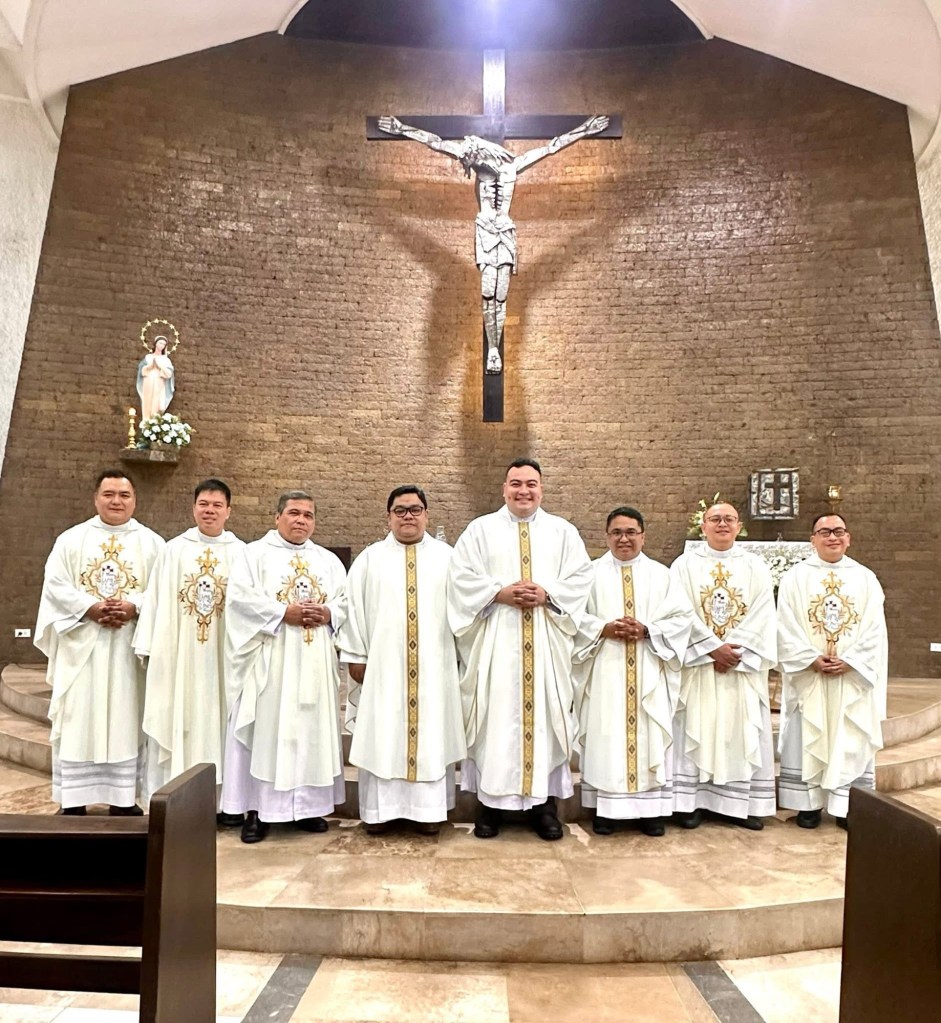
Sixth Presbyteral Anniversary of Fr. Ra, Fr. LA, and Fr. Howard, 10 December 2025, ICS Chapel.

Congratulations on your sixth presbyteral anniversary. They say the first five years of priesthood is the “honeymoon stage”; so now, you enter the reality stage when many times you will be disillusioned in the ministry, especially with your brother priests who are supposed to be the face of Christ – but not!

That is why the readings for today on your sixth presbyteral anniversary are so appropriate as they offer the Advent message of comfort and encouragement, and a promise of salvation – the message every priest needs to hear these days when our leaders in government and yes, even in the church seem to be so weak and without direction, far from Jesus our Eternal Priest.

The Lord invites us through the Prophet Isaiah to look up and pray – to see the stars in the heavens, the bright constellations that form objects and animals like “faces” on the dark skies of the night.

Photo by author from the Dominus Flevit Church overlooking Jerusalem, May 2017.

“To whom can you liken me as an equal? says the Lord” (Is.40:25).

Do we still pray and reflect on the mystery of God’s power and care? Or are the priorities of the day a constant distraction? 

We shall never see the face of Christ in ourselves nor in the people we serve no matter how dedicated we are if we do not pray. It is our prayer life, especially those intense moments of silence before the Blessed Sacrament that will show us the face of Christ. According to Abp. Fulton Sheen, the more we pray before the Blessed Sacrament, the more we look like Jesus. Before Pope Benedict XVI died, he wrote that all these sex scandals that have rocked the Church in the past decades are largely due to fewer priests making time for Christ in the Blessed Sacrament.

Before our ministry came, there was Jesus first calling us to be with him, to be one in him in prayers. Palagi nating unahin si Jesus higit sa lahat. Our efforts find meaning only in Christ as Isaiah tells us, “Though young men faint and grow weary, and youths stagger and fall, they that hope in the Lord will renew their strength, they will soar with eagles’ wings; they will run and not grow weary, walk and not grow faint” (Is.40:30-31).

It is funny that when you invited me last month Fr. RA and Fr. Howard, I asked you if it is the anniversary of our GC? Yes, these three crazy men keep a GC, just the three of them and to make it more like a group, they included me into their folly.

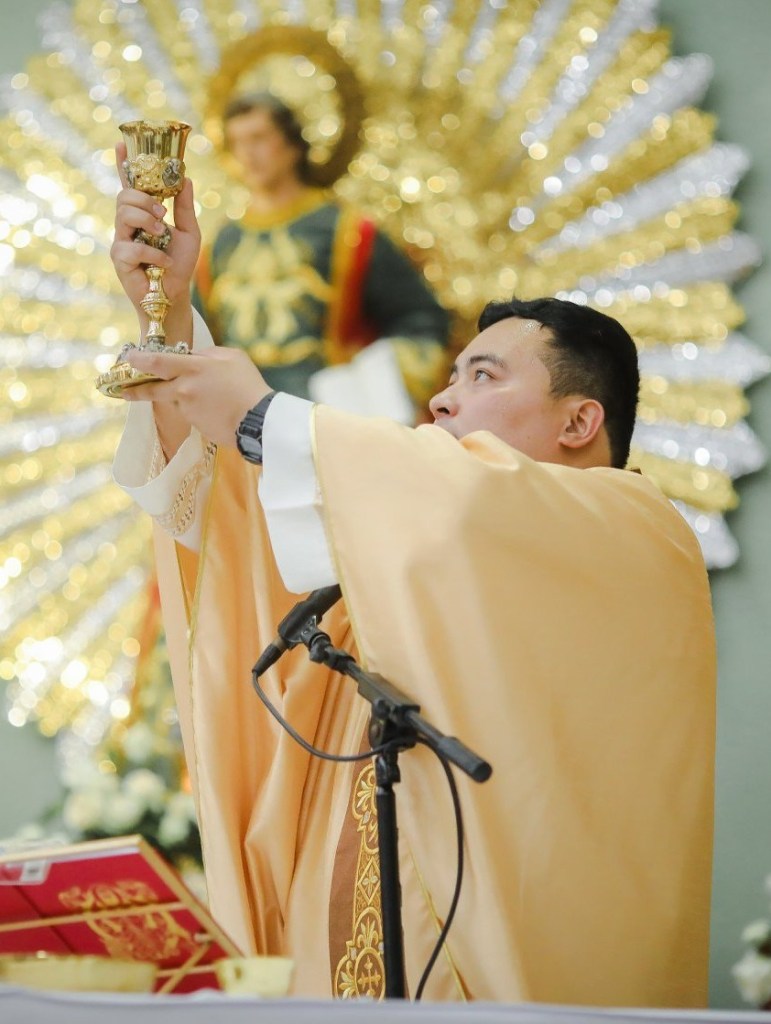
First Mass of Fr. RA in our Parish in Bagbaguin, Sta. Maria, Bulacan six years ago.

That is the landscape of our Church today when we live our faith in a mass-mediated culture where we find images especially faces so prominent more than ever as in Facebook. There lies hidden the hidden schemes of the devil to mislead us priests in exposing more our faces than being the face of Christ.

A friend in media recently asked me if those priests in that grand procession are really priests as she wondered why they wear those elaborate vestments they look like Poon and imahen.

I felt what she was driving at – rampa pa more! Isn’t she right?

Except for the Nazareno in Quiapo and Sto. Nino in Cebu, most of our Church processions have all turned into pageantries with all the pomp and gaiety of a show, a palabas.

Puro palabas na tayo, wala nang paloob which is the deeper meaning of the “face”: not as something outside o panglabas but more of the inside. Face is image and likeness, that thing that identifies us. Our identification or ID is Jesus Christ. That is the reason the new Ratio in seminary formation had renamed the theology department as “configuration” stage.

Be the face of Jesus to the people you serve, Fr. RA, Fr. LA and Fr. Howard.

First priest of St. John Evangelist Parish in Bagbaguin; actually second after Bp. Bart Santos who was ordained when Bagbaguin was still under La Purisima.

Be the face of Christ too to us priests because these days, many priests follow and show other faces than Christ’s. As I used to tell you, kapag ang pari mabuti sa kapwa pari, tiyak na mabuting tao siya; pero kapag ang pari kahit anong bait (hindi buti, ha) sa mga tao pero masama sa kapwa pari, hindi yan mabuting tao.

St. John the Evangelist, the Patron Saint of Fr. RA in Bagbaguin wrote in one of his letters that “No one has ever seen God. Yet, if we love one another, God remains in us, and his love is brought to perfection in us” (1Jn.4:12).

So beautiful! It is when we truly love, especially like Jesus our Eternal Priest, that we become the face of Christ, when we see the face of Christ. Amen. And cheers to six years in priesthood!
Immaculate Conception, Intimacy of God

Lord My Chef Daily Recipe for the Soul by Fr. Nicanor F. Lalog II
Monday, Solemnity of the Immaculate Conception, 08 December 2025
Genesis 3:9-15, 20 ><}}}}*> Ephesians 1:3-6, 11-12 ><}}}}*> Luke 1:26-38
“Cestello Annunciation” by Botticelli painted in 1490; from en.wikipedia.org.

We praise and thank God today on this Solemnity of the Immaculate Conception of Mary that formally kicked off the process of the fulfillment of his promised salvation in Jesus born by the Virgin Mother.

According to our official Church teaching called dogma, Mary was conceived by her mother St. Anne without any stain of original sin through the merits of Jesus Christ our Savior. Mary has to be pure and clean because she would bear the Son of God who is perfect and spotless.

God chose Mary to be the Mother of Jesus not because of her having any special traits but purely out of God’s goodness “who has blessed us in Christ with every spiritual blessing in the heavens” (Eph.1:3).

Hence, this feast reminds us too to imitate the Blessed Virgin in saying “yes” to God’s invitation to cooperate in his wonderful plans of bringing Jesus into this world so darkened by sin that has left us broken and fragmented from each other. Rejoice, therefore, because everyday, God sends us his angel to greet us with “Hail, full of grace! The Lord is with you” (Lk.1:26), inviting us into an intimacy with him like Mary.

Photo by author, left side of the facade of the Basilica of the Annunciation in Nazareth, Holy Land, May 2019.

Intimacy is more than being close with another; it is an expression of love that is willing to sacrifice, to suffer and get hurt for the sake of the beloved.

God was the first to express his intimacy with us not just by expressing his immense love for us in words by the prophets in the Old Testament but by sending us his Son Jesus Christ who became human like us in everything except sin. Actually, God does not need to become human like us to save us but he chose to be one of us because he loves us so much. As an expression of his intimacy and solidarity with us, Jesus suffered and died on the Cross while going through every pain and hurt we go through in life like grief and sadness in losing a friend, betrayal by a friend, abandonment by friends, no to mention being terrified, going hungry and thirsty. Jesus became like us so that we may become like God – intimately loving him through others.

Actually, God does not need us but he chose to love us, to be with us, to be intimate with us because he loves us so much. God remains God even without us. When we do not pray, when we do not go to Mass on Sundays, when we are bad and not good, God is still God. It is us humans who are lessened when we turn away from from God.

That’s the intimacy of God with us.

How about us, are we willing to be intimate with God in Jesus Christ?

Sadly, many people “create” and “force” intimacy which is a grace, a gift of God freely given to everyone. Like friendship, we cannot force intimacy into someone not meant to be. And like friendship too, intimacy begins in Christ, blooms in Christ.

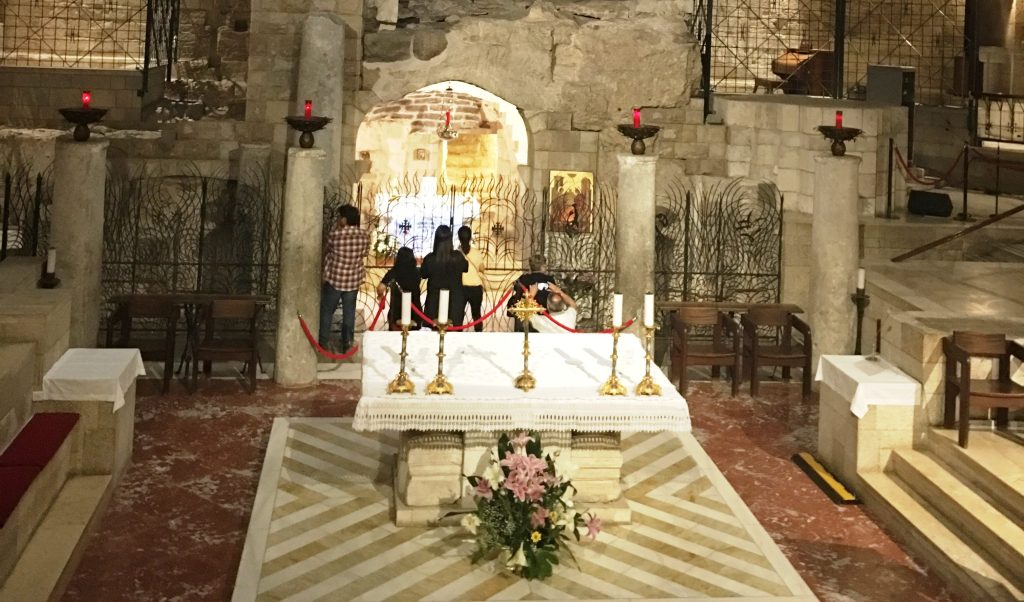
Photo by author, chapel beneath the Basilica of the Annunciation in Nazareth; see those pilgrims praying behind iron grills at the back of the sanctuary which is the site where the Angel announced to Mary the birth of Jesus Christ.

Underneath the Basilica of the Annunciation in Nazareth is a chapel near the very site where the angel is believed to have appeared to Mary to announce the coming of the Savior. At the back of the sanctuary of this chapel is that holy site of the Annunciation enclosed by iron grills with an altar table at the center with the declaration in Latin, Verbum Caro Hic Factum Est (The Word became flesh here).

Mary’s intimacy with God began long before the Annunciation to her by the Angel cultivated in her prayer life. Every time I pray this scene of the Annunciation, I always imagine Mary deeply absorbed in prayer. Most likely, she must be praying about her coming wedding to Joseph. Luke and Matthew were both consistent about their status as being “betrothed to each other” when God announced through the Angel the birth of the Christ.

Photo by author, close up of the Annunciation site beneath the Basilica of the Annunciation in Nazareth; written on the altar table that says in Latin, “The Word became flesh here.”

Imagine the excitement and joy of two faithful Jews getting married soon when suddenly the Angel appeared to them on separate occasions and diverse situations to announce God’s plan of sending his own Son Jesus Christ for the salvation of the world?

It must have been most painful to both Mary and Joseph but as being truly faithful and loving of God, they both agreed to the Divine plan! And that is the great sign of their immense love for God – eventually for each other. Moreover, in saying yes to God, both Mary and Joseph showed the kind of intimacy they have with the Divine.

Let us focus on the intimacy of Mary with God on this Solemnity of the Immaculate Conception found in our gospel account of the Annunciation.

Photo by Rev. Fr. Gerry Pascual of Iba, Zambales at Santuario di Greccio, Rieti, Italy in 2019.

Then the angel said to her, “Do not be afraid, Mary, for you ahve found favor with God. Behold, you will conceive in your womb and bear a son, and you shall name him Jesus (Luke 1:30-31).

Notice that in many scenes and prayers about the Blessed Virgin Mary, we find the prominence of her “womb” like here in the Annunciation and when Elizabeth praised her during her Visitation as “blessed is the fruit of your womb” (Lk.1:42).

In Hebrew, the word for womb is “racham, rachamin” which is their word too for “mercy” because for them, God’s mercy comes from his innermost being. Hence, whenever the Jews speak of mercy of God, they point their fingers downward into the womb or uterus and moves it upward to the heart to indicate the flow of mercy of God from his innermost being expressed in love which is he’s very being and core.

This is the reason the Church Fathers translated mercy into “misericordia” from the Latin verb to move or to stir – “misereor” – and word for heart “cor” that literally means “to move or to stir one’s heart”. It is more than a feeling like compassion; mercy is deeper as it encompasses one’s being leading to intimacy that is a communion or oneness with others which is also intimacy.

Photo by author, Church of the Visitation, Ein-Karem, Israel, May 2017.

Where there is love, there is always intimacy with the lover willing to bear all pains and hurts for the beloved. And vice versa. Like Jesus. Then Mary who was willing to sacrifice her wedding and marriage to Joseph by being the Mother of the Son of God.

But why? Because we have experienced too that true joy comes only when there is giving of self, when there is willingness to let go and suffer. At the Last Supper, Jesus described joy as like a mother in the pangs of childbirth when she goes through a lot of pains and worries and fears almost like dying but once the baby is delivered, joy happens because she had brought forth a new life into the world.

True joy is having the firm belief that no matter what happens even in the worst scenarios, God would never leave nor forsake us. Joy happens when we find new life, new directions because there is another person willing to remain with us, assuring us we are never alone. That again is intimacy when you feel not alone especially in the most trying times.

Without intimacy with God and another person, there can be no true joy because no one would dare to take risks in this life like mothers. This is what modern women are missing when they see childbearing more as a chore or a burden or a suffering they can always avoid than self-giving borne out of love which happens in the context of an intimacy. No wonder too that sex has been so trivialized, reduced to an activity and act instead of as a gift of self because there is no more responsibility and intimacy. We cannot have lasting and meaningful relationships without intimacy.

Photo by author, 2021.

On this Solemnity of the Immaculate Conception, we are reminded of God’s mercy and intimacy with us, of his loving relationship with us that continues in Christ Jesus with Mary.

Let us nurture this beautiful relationship with God that flows and bears fruit in our relationships with one another.

Like Mary, may we finally say yes to God into an intimate relationship with him through our selflessness. Like Mary, we are blessed and full of grace. The joy awaiting far outweighs the pains and sufferings we shall go through in our gift of self in our relationships. Have no fear for Jesus had suffered first before us so that we can love and be intimate like him. Amen. Have a blessed week.

Living Hope Amidst Suffering

Lord My Chef Daily Recipe by Fr. Nicanor F. Lalog II
Red Wednesday, 26 November 2025
Daniel 5:1-6, 13-14, 16-17, 23-28 <*{{{>< + ><}}}*> Luke 21:12-19
Photo from Fatima Tribune, 27 November 2024.

It’s the Wednesday after Christ the King when our churches and other religious buildings are lit in red to mark Red Wednesday, the annual campaign for persecuted Christians worldwide.

Started in 2016 by the Aid for Church in Need (ACN), it has been an annual Church celebration with other Christian groups and sects participating to heighten awareness of the continuing persecution of Christians in various parts of the world – exactly what Jesus had predicted to his disciples more than 2000 years ago.

Jesus said to the crowd: “They will seize and persecute you, they will hand you over to the synagogues and to prisons, and they will have you led before kings and governors because of my name. It will lead to your giving testimony… By your perseverance you will secure your lives” (Luke 21:12-13, 19).

Photo from Fatima Tribune, 27 November 2024.

For us in the Philippines that is majority a Christian nation, Red Wednesday is an opportune time to reflect about our “giving testimony” to Jesus Christ: how “bloody red” is our being a Christian?

Unlike in other countries in Africa or our neighbors in Asia where Christians are persecuted and harassed, we in the Philippines do not go through such sufferings and challenges. Think of any kind of opposition to the Christian faith we have encountered even in the last 100 years. None. The most serious threats ever made against our faith seem to be mere “peer pressures” of being teased as “conservative” in going to Mass and Confession frequently, or upholding the virtue of virginity. Perhaps, the most serious dilemma most of us Christians have ever had in our faith is whether or not we shall pray or at least make the Sign of the Cross when dining in a restaurant or fast food chain. In Europe and the States, chapels and churches are vandalized and burned but here in the country, those who have committed sacrileges in the past three years were “crucified” in social media with one being sued in court.

We do not wish that we also undergo similar religious persecutions like the other Christians abroad whom we pray for today on this Red Wednesday and send with our financial support as concrete actions of our solidarity with them.

In line with this year’s theme of “Living Hope Amidst Suffering” in conjunction with the Jubilee Year celebration “Pilgrims of Hope”, Red Wednesday invites us to simply witness the gospel of Jesus by standing on what is true and good especially these days our country is so deep into the ghost project scandals on flood control.

Giving testimony to Jesus Christ is letting our zeal for him burn anew within us by not bending into the ways of the world that promote a “culture of death” like abortion and contraceptives, or to the many forms of wokism that overextend personal rights contrary to God’s original plan and design like divorce, same sex marriage, and gender manipulation.

Photo by Ms. Kei Abad, Kawaguchiko Lake (Fujisan), 23 November 2025.

Witnessing Christ is being honest and just in a country of such impunity where graft and corruption is a family endeavor, a norm in public service.

Giving testimony to Christ in this time of social media where trending and viral are the new standards is to remain simple and modest even if it is looked down upon, being fair and just even if everyone chooses to disregard them while being concrete in our acts of mercy and charity for the weak and marginalized.

Red Wednesday is reigniting our hope in God which is an expression of our firm faith in him. Religious persecutions happen and abound anywhere God is negated and denied or when a particular group of people insist on their own perception of God.

We Christians are pilgrims of hope because we do believe in the one True and Only God in Heaven who was revealed to us by his own Son Jesus Christ made present up to this day until the end of time by the Holy Spirit. Hope is primarily having faith in God.

In this sense it is true that anyonbe who does not nknow God, even though he may entertain all kinds of hopes, is ultimately without hope, without the great hope that sustains the whole of life (cf. Eph. 2:12). Man’s great, true hope which holds firm in spite of all disappointments can only be God – God who has loved us and who continues to love us “to the end,” until all “is accomplished” (cf. Jn.13:1 and 19:30). (Pope Benedict XVI, Spe Salvi #27)

Hope is not optimism nor positive thinking, believing things will get better. On the contrary, true hope is actually accepting that things and situations could get worst as Jesus mentioned in his predictions of the coming upheavals and persecutions. Hope is putting all our trust in God that no matter what happens in the end when things get worst like death, there is Jesus Christ loving us, comforting us, and saving us.

That’s the kind of faith and hope Daniel expressed in our first reading despite the threats of sure death when he spoke of the God of Israel as the only true God, not the many idols and false gods of the Babylonians. Most of all, because of his fervent hope in God who would raise him up in the end, Daniel delivered his interpretation of the king’s dream of how his days were numbered as the Medians and Persians were soon to conquer them that eventually happened.

Photo by Ms. Kei Abad, Kawaguchiko Lake (Fujisan), 23 November 2025.

Many times in life, all we can have is hope in God especially when pains and sufferings become unbearable, when these get worst without any signs of getting any better.

That is why Red Wednesday’s theme this year is so appropriate, “living hope amidst suffering”.

Hope makes life more worthy and lofty because our sights are not only fixed on this world but even beyond as Jesus assured us in today’s gospel, “By your perseverance you will secure your lives” (Lk.21:19).

And there lies the beauty of hope – it is the most surprising of all virtues as the French poet, essayist and writer Charles Peguy wrote in 1911 in his long masterpiece called “The Portal of the Mystery of Hope.” In this poem, Peguy presents God as the speaker himself, reflecting about the virtue of hope in relation with the other two theological virtues of faith and love. It is so lovely because it is so true especially when I encountered it during my trying months of second year in theology in the seminary.

The faith that I love best, says God, is hope...
Faith itself does not surprise me...

Love, says God, that does not surprise me...

But Hope, says God, that is what surprises me.
I, myself, find it surprising
that my children see what happens and believe things will improve.
That is the most surprising, the most marvelous gift.
And it surprises me, myself, that my gift has such incredible strength
since it first flowed in creation as it always will.
Faith sees what is.
Hope sees what will be.
Love loves what is.
Hope loves what has not yet been
and what will be in the future and in eternity.

For those suffering, those in pain especially because of faith in Jesus Christ: keep believing, keep hoping and be ready to be surprised by God. Reignite that zeal in Christ and his gospel. Amen. A blessed Red Wednesday to you.

Photo by Ms. Kei Abad, Kawaguchiko Lake (Fujisan), 23 November 2025.

The Holy Rosary for Conversion & Peace

Lord My Chef Daily Recipe for the Soul, 07 October 2025
Tuesday, Memorial of Our Lady of the Holy Rosary
Jonah 3:1-10 <*{{{{>< + ><}}}}*> Luke 1:26-38
Photo from canningliturgicalarts.com.

On this day of the Memorial of Our Lady of the Holy Rosary, our bishops have rightly set this as the National Day of Prayer and Public Repentance in the light of the grotesque corruption and its investigations along with the natural calamities that have hit our country recently.

For hundreds of years, the Rosary has always been used to intercede for peace and conversion not only in Church but also world history. In fact, this feast has its origin in the victory of Christian forces against the Ottoman Turks in the Battle of Lepanto Bay in 1571 that decisively stopped the Moslems from occupying Europe. The first Dominican Pope, St. Pius V attributed that victory to the recitation of the Holy Rosary that further led to its popularity and devotion that greatly spread when subsequent other victories in various parts of the world like the La Naval in the Philippines were attributed to our Lady of the Most Holy Rosary. 

From Facebook post by Dr. Tony Leachon, “KLEPTOPIROSIS: When Corruption Becomes a Public Health Crisis”, 08 August 2025.

At this time when our country is again at the crossroads of great dangers and threats to its democratic institutions, it is very timely that we celebrate this feast with deep devotion and firm resolve to be converted.

Although we have a proper reading on this celebration, we have preferred to use the first reading of the day from the Book of Jonah when God sent the reluctant prophet to Nineveh to call on its people to be converted lest God destroys the city. Notice the immense love of God in this beautiful story of conversion: God never gave up on Jonah, calling him to go to Nineveh to proclaim his message.

Jonah began his journey through the city, and had gone but a single day’s work announcing, “Forty days ore and Nineveh shall be destroyed,” when the people of Nineveh believed God; they proclaimed a fast and all of them, great and small, put on sackcloth. When the news reached the king of Nineveh, he rose from his throne, laid aside his robe, covered himself with sackcloth, and sat in the ashes. When God saw by their actions how they turned from their evil way, he repented of the evil that he had threatened to do to them; he did not carry it out (Jonah 3:4-6, 10).

Photo by Aaron Favila, Associated Press, Barasoain Church, Malolos City, 22 July 2025.

Remember, God never gives up on us. That is why he keeps sending us the Blessed Virgin Mary Mother to appear on various occasions especially these past 120 years to keep on reminding us of his call for our conversion essential to having peace.

See how in all of these apparitions of Mama Mary, there has always been the praying of the Holy Rosary. At her final apparition on October 13, 1917 at Fatima, she revealed herself as the Lady of the Rosary, proving once more the great power and lessons of this devotional prayer that has proven over and over again that indeed, “More things are wrought by prayer than this world dreams of” (Lord Alfred Tennyson). How?

Photo by author, Sacred Heart Novitiate, Novaliches, 20 March 2025.

At the center of our Christian faith and spirituality is the invitation of God for us to “lose” ourselves to him, to trust him more than ourselves.

Jonah had to lose himself literally from the ship to be swallowed by the whale and spitted out after three days. And of course, the people of Nineveh from the king down to the poorest of the poor among them have to “lose” themselves by admitting their sinfulness and being sorry for them to be converted that resulted in God foregoing his plans to destroy their city. They actually won and did not lose in the process despite their sitting on ashes and wearing sackcloth.

In the gospel, we saw how Mary had to “lose” herself so that Jesus Christ may finally come by being born through her into the world when after the angel had explained to her the plan of God, she humbly said, “Behold, I am the handmaid of the Lord.  May it be done to me according to your word.”  Then the angel departed her (Lk.1:38). 

Mary “lost” herself to God and eventually became an instrument for our victory in the salvation through her Son Jesus Christ who also “lost” by dying on the Cross only to emerged gloriously victorious after three days when he rose from the dead to win over death and sin for us.

In life, it is when we “lose” that we actually “win”, something we often fail to realize, especially the corrupt government officials and lawmakers. The only peaceful path to resolving all this mess we are into and preventing further escalations of the anger of the people is for those in powers to finally “lose” themselves in humility, to repent and be converted. Snap elections will never restore the confidence of people with them unless those tainted with corruption take the high road of stepping down as a first sign of their decency and statesmanship.

Residents of Hagonoy Bulacan walk their way to flooded portions of premise surrondings St. Anne Parish as they protested following exposes of flood control anomalies. Bulacan has been under scrutiny for receiving multi million worth of flood control projects but still suffers severe flooding. (Photo by Michael Varcas)

Let us pray for their conversion; let us pray for the judges and justices of all courts be fair and just in evaluating the evidence against these people blinded by money and power. Let us pray for them to realize that for a moment, they may “lose” face and money but eventually win salvation and peace. Only God knows what awaits them, if they repent and be converted or remain proud and sinful.

Let us pray for the conversion of Sec. Recto and government economists of the need for the State to “lose” in order to “win” especially the people by cutting our so many taxes. It is about time for the government technocrats to reduce our taxes that have mostly gone to corruption without serving truly the people who have contributed these with their blood and sweat. We are the most taxed country in this part of the world while our neighbors have shown how reducing taxes actually leads to more spending by the people that partly keeps a more vibrant economy.

Let us pray also for ourselves, for one another to realize the need for us to lose ourselves for higher values than material things that are eventually lost. We as a nation, like the Prophet Baruch our bishops have cited must admit our own sins to be “flushed with shame” (Bar.1:15) that all these mess we are into is due to our sins, to our turning away from God as we focused more in pursuing power, wealth and fame that now come so easily via social media.

Photo by Pete Reyes, Sr. Porfiria “Pingping” Ocariza (+) and Sr. Teresita Burias praying the Rosary to protect mutineers during the EDSA People Power Revolt in February 1986.

When we “lose” in God, for God, it is always a “win” in everything. Of course, it is always a difficult path to take that calls for daily conversion in Christ with Mary.

The praying of the six Our Fathers, 53 Hail Mary’s and six Glory Be’s are invitations to the Rosary’s rhythm of daily conversion by meditating the joyful, luminous, sorrowful, and glorious mysteries of the life of Jesus Christ with his Blessed Mother. That is not what not Jesus referred to as “meaningless repetition” of prayers (Mt.6:7); the Rosary is also a prayer method that helps us enter into union in Christ with Mary as guide.

The Rosary, though clearly Marian in character, is at heart a Christocentric prayer. In the sobriety of its elements, it has all the depth of the Gospel message in its entirety, of which it can be said to be a compendium. It is an echo of the prayer of Mary, her perennial Magnificat for the work of the redemptive Incarnation which began in her virginal womb. With the Rosary, the Christian people sits at the school of Mary and is led to contemplate the beauty on the face of Christ and to experience the depths of his love. Through the Rosary the faithful receive abundant grace, as though from the very hands of the Mother of the Redeemer (St. John Paul II, Rosarium Virginis Mariae, #1)

True, a lot often we may seem to “lose” many battles when we try to stand for what is true and good but in the end, we actually “win” the war against evil, the greatest victory Christ had gifted us, our salvation. That is why in Marian prayers like the Rosary as well as in hymns in her honor we ask her prayer for us sinners to be saved from hell and be brought to her Son Jesus Christ in eternity.  That’s the final victory we all hope for in praying and living out the Holy Rosary with Mary. But first, lose ourselves to Jesus like Mary, even Jonah. Happy feast of our Lady of the Holy Rosary! Fr. Nicanor F. Lalog II, Our Lady of Fatima University, Valenzuela City (our email, lordmychef@gmail.com) 

Artwork by Mr. Darwin Lance Arcilla, Campus Ministry, OLFU-Valenzuela City.

The heart of the priest

Lord My Chef Daily Recipe for the Soul, 04 August 2025
Monday, Memorial of St. John Baptiste Marie Vianney, Priest
Numbers 11:4-15 <*{{{{>< + ><}}}}*> Matthew 14:13-21
St. John Baptiste Marie Vianney from https://liturgiadashoras.online/.

People complain and ask me why our patron saint, St. John Baptiste Marie Vianney is always portrayed “unattractive” as old, balding and so thin who seemed to be so tired, even sad. Para daw hirap na hirap.

Usually I smile at them because when I entered the seminary, I felt the same way too upon seeing his images. But as I learned about his life and teachings, the more I realized St. John Baptiste Marie Vianney is actually one of the original “rock star” saints of the Church with his white, balding hair so much like Jimmy Page of Led Zeppelin!

There is something so deeply within him when we try to feel and observe his portrayals in the arts as more than images but a reality and experience of a man deemed weak yet so strong with an intensity of a Michael Jordan in his life and ministry. He was another St. Paul who had truly let “Christ lived in him” (Gal. 2:20), “strongest when weakest” (2Cor.12:10) who declared with conviction that “the priesthood is the love of the heart of Jesus.” Hence in my prayers last night and today, I asked Jesus to give me a heart “so big, so wide to welcome everyone and life’s many challenges” (https://lordmychef.com/2025/08/03/praying-with-our-patron-saint-john-baptiste-marie-vianney/).

Detail of a painting of the Sacred Heart of Jesus at Visitation Monastery, Marclaz, France from godongphoto / Shutterstock.

The readings this Monday of the eighteenth week in Ordinary Time perfectly jibed the celebration of the Memorial of St. John Baptiste Marie Vianney as they spoke of the heart of the priest.

In the first reading we heard of Moses lamenting to God of the difficulty in dealing with his people who were so stubborn and refused to recognize God’s immense love for them, so similar with us priests in many occasions when we feel so frustrated and sad when parishioners fail to see the good things we are doing for them.

When Moses heard the people, family after family, crying at the entrance of their tents, so that the Lord became very angry, he was grieved. “Why do you treat your servant so badly?” Moses asked the Lord. “Why are you so displeased with me that you burden me with all this people?”… I cannot carry all this people by myself, for they are too heavy for me. If this is the way you will deal with me, then please do me the favor of killing me at once, so that I need no longer face this distress” (Numbers 11:10-11, 14-15).

Many times, we priests feel like Moses who cannot voice out problems with the people who would never understand it at all. Worst, people would even blame us priests why we work so hard or why do we bother at all with their lives. “Pabayaan na lang ninyo kami…sanay na kami” are what they often say. It can be frustrating when people refuse to match the fire and ardor of their priests.

In this scene, we find one of the many instances in the life of Moses that was centered on God in prayers. The heart of the priest is a heart in prayer. The attitude of Moses in the first reading conversing with God in prayer shows us that in our life and ministry, there is no one to turn to except God alone with whom we can be our most personal self, even dare God to “take us” or “kill us” when we are so fed up. The good news is, God never took those words seriously as he knew Moses and the prophets including us who spoke to him that way never knew what we were saying at all.

There is a saying that goes, “if you can’t bear the heat, leave the kitchen”; but, it cannot be applied with the priesthood that is neither a profession nor a job one can easily walk out from and start into another venture or career. Priesthood is a call or a “vocation” from God; however, priesthood is more of the Caller than the call. It is a life centered on prayer to become like Jesus Christ who alone feels and understands and appreciates all our ups and downs in the ministry. The more we get closer to Jesus in the Cross, the more we experience fulfillment that we would never dare to trade it for anything or anyone else, not even the prettiest woman on earth.

Photo by author, Chapel of St. Francis Xavier, Sacred Novitiate, Novaliches, QC, March 2024.

Priesthood is the love of the heart of Jesus that continues to be wounded and hurt by sins of men and women in this modern age so selfish and materialistic. Thus, every priest is called to be a “wounded healer” too like Christ who in his woundedness healed the wounds of others. We remind people of the paradox and scandal of the Cross of Jesus, of life itself by taking into heart Christ’s teaching, “For whoever wishes to save his life will lose it, but whoever loses his life for my sake will find it” (Mt. 16:25).

Let us now reflect on our gospel.

When Jesus heard of death of John the Baptist, he withdrew in a boat to a deserted place by himself. the crowds heard of this and followed him on for from their towns. When he disembarked and saw the vast crowd, his heart was moved with pity for them, and he cured their sick (Matthew 14:13-14).

Observe the brevity of Matthew in narrating the situation at the scene without losing its very soul and meaning especially for us priests: Jesus did not have any intentions to go after Herod nor to challenge him for his execution of John the Baptist who spoke the truth.

Instead, Jesus sought solitude. Like Moses in the first reading, Jesus turned to God in his grief and anguish of the death of John the Baptist. He crossed the lake to pray and be one with the Father to pour out his sadness and most of all, to reflect on what to do next after John’s death.

Jesus shows us in this scene of his going into solitude that our low points in life as priests are also our high points like Christ’s Transfiguration. Every prayer moment is a transfiguration moment because that is when we get closest with Jesus. It has been consistently proven in our collective and personal experiences as priests verified by studies that crises in the priesthood happen when we stop praying because that is detaching from Jesus Christ, our Caller.

Priesthood is not only difficult but very difficult starting with the vestments we have to wear. What a shame when priests prefer to do away with the proper vestments as well as wearing of shoes during celebrations of the Mass and other sacraments because the weather is so hot. What then are we going to bear if the weather is already a big issue for us? One of the teachings of St. John Vianney that I have always followed is the value of putting on good vestments in the celebration of Sacraments because they are a homily in themselves, proclaiming the glory and love of God for us all.

Photo by FlickrBrett Streutker from catholic365.com.

Many times, people forget priests have personal concerns and problems too, that we get hurt, get lonely, get sick and grieve at the death of family and friends. Despite all these lows in our life as priests, we go and follow the Caller Jesus Christ when people come and ask for our help and service. Woe to our brother priests who forget this and think more of themselves especially of their comfort!

See how when Jesus was praying in solitude and the crowd followed him, it was not difficult for him to forget his own worries that his heart was moved with pity upon seeing them disembarked from their boats. Despite his sadness at the death of John, Jesus taught the crowd who have followed him and healed the sick among them. And when the Twelve told him to drive away the crowd to search for their own food and lodging, Jesus told them to give them food themselves. What followed was the great miracle of the feeding of over five thousand people from five loaves of bread and two pieces of fish. It was the event that prepared the Twelve and the people to the Last Supper of the Lord and the road to Emmaus where Jesus was recognized at his “breaking of bread”.

The whole life of St. John Baptiste Marie Vianney was a prayer of praise and thanksgiving to God in Christ’s priesthood. He had a heart so big and wide, hearing confessions daily up to 16 hours! Pray for us your priests to have big hearts too to bear all the wounds and hurts because only the heart that suffers, that is “broken” can truly sing of the joys and pains of living, of the sense and meaning of serving to the point of being emptied, and of the healing and transforming power of Christ’s love and mercy. Amen. Pray for us your priests. Salamuch. Fr. Nicanor F. Lalog II, Our Lady of Fatima University, Valenzuela City (lordmychef@gmail.com).

 have not been to France nor do I know French but while searching for images of St. John Marie Vianney, I found this from the French website, https://www.notrehistoireavecmarie.com/; it is perhaps the depiction of the new pastor speaking to the young Antoine whom he asked for directions to Ars.

The inner journey in Christ of St. James the Greater

Lord My Chef Daily Recipe for the Soul, 25 July 2025
Friday, Feast of St. James the Greater, Apostle
2 Corinthians 4:7-15 <*{{{>< + ><}}}*> Matthew 20:20-28

Something struck me while praying the gospel for today’s feast of St. James the Greater – of how his mother approached Jesus with a request for him and his brother James “that these two sons of mine sit, one at your right and the other at your left, in your Kingdom” (Mt. 20:21).

It must be a very interesting company that Jesus had organized during his ministry composed not only of the Twelve and other disciples but most likely with so many others too that included their families like the mother of James and John believed to be the beloved disciple of Jesus. Traditionally known as Salome, their mom could easily be the patroness of “stage mothers” that abound most especially in the Philippines!

But kidding aside, it must be wonderful to tag along with them in following Jesus where everyone is welcomed. It is a journey not meant to cover distances and places but actually an inner journey inside one’s self that we shall see in the life of James the Greater. It is a journey that begins right here in our heart when we too, like James leave everything to follow Jesus.

For astonishment at the catch of fish they had made seized him and all those with him, and likewise James and John, the sons of Zebedee, who were partners of Simon. Jesus said to Simon, “Do not be afraid; from now on you will be catching men.” When they brought their boats to the shore, they left everything and followed him (Luke 5:9-11).

Photo by author, San Juan, La Union, 26 July 2023.

It must have been difficult for James to leave everything including their father Zebedee and follow Jesus. See that in the description by Luke of their call by Jesus, James and John as well as the brothers Simon and Andrew were all “rich kids” with their own fishing boats with hired men as workers at that time!

Clearly, money was not a problem with James and his buddies; however, one thing was missing in them – meaning and direction in life which they found in Jesus while listening to his preaching and finally in that miraculous catch of fish. I have always felt that perhaps, Zebedee allowed his two sons to leave him and their business for the same reasons so that they mature in life and be more responsible. We find this trace of attitudes or sense of entitlement in the brothers James and John when they asked Jesus to rain fire upon a Samaritan village that have refused them passage on their way to Jerusalem (Lk.9:54-56). Hence, Jesus named them as Boanerges for “sons of thunder” (Mk.3:17) due to their temperament.

In following Jesus, James had to learn the hard way the process of formation and transformation in Jesus that began in his heart. All along their journey from the shores of Galilee to Jerusalem, James remained by the side of Jesus Christ, probably unaware of that inner journey taking place right inside his heart to truly become a part of God’s Kingdom by sharing in the Lord’s Passion, Death and Resurrection. He had seen and experienced along with the other Apostles the great powers of Jesus not only in preaching but most especially in calming the storms, walking on sea, exorcising evil spirits, healing all kinds of sickness, and even raising to life some who have died.

Most of all, James was privileged to have witnessed along with his brother John and Peter the two important stops in Jesus Christ’s journey to the Calvary: first, on Mount Tabor for the Transfiguration and second, at Gethsemane for the agony in the garden. In both events in the life of our Lord, James was a privileged witness of his coming glory and then of his passion and death. Our gospel today on his Feast is sandwiched between these two major events of the Transfiguration and Agony in the Garden as this is set shortly before Palm Sunday when Jesus entered Jerusalem that led to his sacred pasch.

Jesus said in reply, “You do not know what you are asking. Can you drink the chalice that I am going to drink?” They said to him, “We can.” He replied, “My chalice you will indeed drink, but to sit at my right and at my left, this is not mine to give but if for those for whom it has been prepared by my Father.” When the ten heard this, they became indignant of the two brothers. But Jesus summoned them and said, “You know that the rulers of the Gentiles lord it over them, and the great ones make their authority over them felt. But it shall not be also among you. Rather, whoever wishes to be great among you shall be your servant; whoever wishes to be first among you shall be your slave. Just so, the Son of Man did not come to be served but to serve and to give is life as a ransom for many” (Matthew 20:22-28).

Painting by El Greco, “Pentecostes” (1597) from commons.wikimedia.org.

It would only be after Easter and the Pentecost when all these major stops in James’ personal journey with Christ would become clear to him and the other Apostles. Eventually, he became the first Apostle to be martyred as Bishop of Jerusalem during the persecution by King Herod of Agrippa in 40 AD (Acts 12:1-2), fulfilling Christ’s words to him that he would indeed “drink from his chalice” to be with him in his Kingdom.

A thousand years later, devotion to James the Greater would spread far and wide in Spain after relics of his body were discovered in Santiago de Compostela. It is one of the world’s oldest and most popular pilgrimage site known as the Camino de Santiago de Compostela (the way of St. James).

Every year, pilgrims from all over the world do the camino from various points of Europe to the Cathedral of Santiago de Compostela where the Apostle’s body is buried as a spiritual hike or retreat and journey for spiritual growth.

Like James the Greater, the camino is more than the kilometers or miles covered but the journey within one’s self that leads to deeper faith in Christ by living out his gospel as portrayed in its marker and symbols of a staff and scroll of the gospel proclaimed by the Apostle .

A marker along the camino de Santiago de Compostela.

It is my fervent prayer that some day I will be able to do a camino de Santiago de Compostela but for the mean time, we strive to continue in following the steps of James the Greater in making that inner journey within one’s self, beginning in our heart by leaving our “boats” of security to remain always at the side of Christ even if he has to smoothen our rough edges as a person and cleanse us of our sins that prevent us in drinking his chalice to be one in his Kingdom. The key is to serve, not to be served as Jesus insisted.

Sometimes in life, we just have to make “sakay” as we used to say as in “sakay lang ng sakay” or “ride on, man, ride on” without really knowing where our trip would lead us.

James the Greater simply made “sakay” in Jesus without knowing Christ was already fulfilling his wish of “drinking from his chalice” which proved that, indeed, the longest journey in life is the distance between the mind and the heart (Dag Hammarskjold). Amen. Have a blessed weekend! Fr. Nicanor F. Lalog II, Our Lady of Fatima University, Valenzuela City (lordmychef@gmail.com).

*All photos from Camino de Santiago de Compostela courtesy of Fr. Jigs Sta. Rita.