
Lord My Chef Sunday Recipe for the Soul by Fr. Nicanor F. Lalog II
Feast of the Baptism of the Lord, Cycle A, 11 January 2026
Isaiah 42:1-4, 6-7 ><}}}}*> Acts 10:34-38 ><}}}}*> Matthew 3:13-17

Still, our greeting today is a blessed Merry Christmas until the last Mass tonight when we close the Christmas Season with this Feast of the Lord’s Baptism. Tomorrow we shift into the Ordinary Time with the green motif back in our liturgy.
Most often during this time of the year, many of us make “new year’s resolutions” that always end up unfulfilled, discarded, and forgotten because these are merely based on whims or fads or anything less than a matured decision. A decision is the making up of the mind and heart to act firmly on something; hence, it connotes a sense of determination in fulfilling that decision made.
In this Feast of the Lord’s Baptism, Jesus invites us to reflect our decision-making process as we embark on another journey of twelve months in him with Matthew as our guide so we can be more matured in our faith and as a person.
Jesus came from Galilee to John at the Jordan to be baptized by him. John tried to prevent him, saying, “I need to be baptized by you, and yet you are coming to me?” Jesus said to him in reply, “Allow it now, for thus, it is fitting for us to fulfill all righteousness.” Then he allowed him (Matthew 3:13-15).
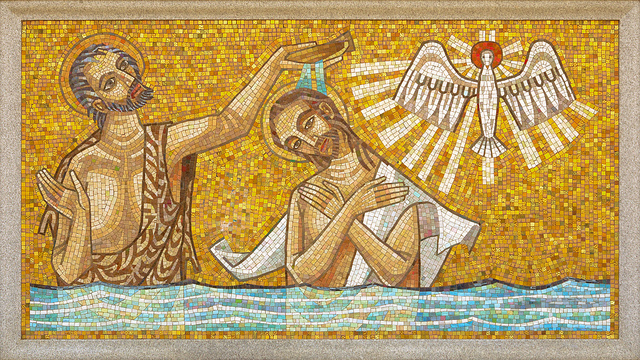
See the brief and direct reportage by Matthew of the event that immediately followed his story last Sunday of the Lord’s Epiphany to the world represented by the wise men from the East as we meet Jesus today all grown up, so matured as a man in his decisions.
And what do we find so remarkable in his decision-making process we can all emulate? His obedience to the Father!
All throughout his ministry, Jesus always made known to everyone that whatever he said and did were not his but the Father’s will. From his coming here at the first Christmas until his death on the Cross, it was all about Christ’s obedience to the Father. In fact, there was no need for him to be baptized by John for it was a baptism of repentance because Jesus is sinless, being the Son of God. Yet, he decided to be baptized “to fulfill all righteousness” as planned by the Father. In a similar manner, see John’s obedience too to Jesus and the Father when he could had insisted not to do it because Jesus is the Christ.

Fulfillment of every aspiration and mission in this life becomes difficult when we insist on what we know or what we prefer rather than what God wills for us.
Obedience is one virtue that is vanishing in this modern age so characterized by everyone wanting to be in control of everything, of one’s life and even of others expressed in those handheld gadgets as well as cars and other vehicles. See how everyone would want to “drive” one’s own life, totally disregarding those in authority especially God.
The word obedience is from two Latin words “ob audire” that literally means “to listen attentively”.
One cannot be obedient without first learning to listen that begins with our willingness to to be silent. Jesus is obedient because he always listens to the Father through frequent and long periods of prayers. Even the Blessed Mother as we reflected last January first exemplified the virtue of obedience when she listened intently and treasured in her heart the words spoken by the shepherds who came to adore the new-born Jesus in Bethlehem.
It would be nice this 2026 that we start cultivating a prayer life by embracing silence to listen attentively to God’s plans for us so that we could make the right decisions in life.

The opposite of “ob audire” in Latin is “absurdus” – exactly what we are when we make the wrong decisions and become absurd.
And sorry, that’s how we can describe this year’s Traslacion – absurd. In fact, every year, it becomes more absurd than ever and something drastic even radical has to be done in the real sense of the word, that is, by going back to its very roots.
When the devotees refused to obey the priests to stop at the San Sebastian Church and insisted on bringing the Poon Nazareno to Quiapo regardless of its many safety and practical implications, it was a clear case of misplaced devotion. It is fanaticism. Selfish and un-Christian. Despite the many defenses and theologizing by many, it is about time Nazareno devotees examine themselves about this devotion, of their panata that admittedly have been so baffling that if our faith in God is such intense, why are we still electing corrupt and evil officials?
Obedience is always a virtue because everything that is good follows when we are obedient, like being more loving at its truest sense. Whenever we decide out of obedience to God and parents and superiors, it is most often because of love.

This is the second characteristic of Jesus Christ’s decision-making process that is based on his love for the Father expressed in his love for us.
Again, there was no need for Jesus Christ to be baptized by John in the river Jordan because he is sinless but, he chose to be baptized there as a sign of his solidarity, of his oneness with us sinners and weak people. It was all because of love.
Jesus chose to be baptized even there was no need because he loves us and wants to be one with us. Jesus chose to die on the Cross, as depicted in the Black Nazarene of Quiapo, because he loves us and wants to carry our burdens. Jesus chose to be eaten as bread in the Holy Mass all because he loves us too so that we may have eternal life.
When Jesus went down to Jordan river, out of obedience and most of all out of love for all of us, he became one with us in our pains and hurts and sickness and failures and even sins which St. Peter realized personally that he declared after Pentecost that “God shows no partiality” (Acts 10:34) that we are all loved by God and are called to be obedient to him always by loving one another as he loves us. That is our mission, to love and be like Jesus Christ, the “Suffering Servant” who was “sent to bring forth justice… to open the eyes of the blind, to bring out prisoners from confinement, and from the dungeon, those who live in darkness” (Is.42:1,6-7).

In going down into the dirty waters of Jordan River that signifies this earth, this life, Jesus showed us his mission of redeeming us so that we can become like him, God’s beloved child with whom he is well pleased. Every morning when we wake up, this scene at Jordan happens anew. The choice is ours to make by being like Jesus Christ who throughout his earthly life was a total obedience and yes to God because of love.
Last week I went to Baguio to facilitate a retreat with some of my kababata or teenage friends from my hometown of Bocaue. Being the youngest among them at 60 years old, I reflected about our senior years. Two things I shared with them:
First, as senior citizens, let us stop thinking of getting old because we are already old. Stop saying pagtanda ko… matanda na nga tayo. Let us face the reality we are old and find most especially the grace of God of reaching this stage. Being senior is to look with gratitude to our youth and to our past as we look forward to finding and meeting God who continues to call us to him.
Second, I told them to stop saying or thinking about our coming death because we are already dying. Huwag na nating isipin yung “kapag namatay tayo” kasi namamatay na nga tayo. Being senior is doing away with all those bucket lists, of things to do or places to visit before we die. We are already dying; hence, do whatever you can do now!
Perhaps the same propositions are applicable to anyone of any age. What matters is how much we love God and others expressed in our obedience to them like Jesus Christ. Let us keep following Jesus in the next twelve months of this 2026 to be filled with himself. Amen. Have a blessed week ahead.















 lordmychef.com