Standing with Jesus, standing like Jesus

The Lord Is My Chef Sunday Recipe for the Soul by Fr. Nicanor F. Lalog II
Third Sunday in Ordinary Time, Cycle C, 26 January 2025
Nehemiah 8:2-4, 5-6, 8-10 ><}}}*> 1 Corinthians 12:12-30 ><}}}*> Luke 1:1-4; 4:14-21

Doctors tell us that prolonged periods of sitting can lead to many health issues like increased risks of heart disease, diabetes, certain cancers, obesity as well as depression. They have been sounding the alarm for several decades with the rise of “couch potatoes” and now had worsened as we get tied to our seats due to continuous use of computers and other gadgets.

Along with this worsening scenario of our prolonged sitting is the growing “competition” among us these days – consciously or unconsciously – for our places of seat in jeepneys and buses or airplanes, in classrooms and offices, on dining tables, in meeting rooms and in churches. People are so concerned where to be seated not realizing that what really matters in life is where we stand than where we sit!

The verb “to stand” evokes firmness and stability not only in the physical sense but also emotionally and spiritually speaking. Very close to it is the word “stance” that indicates our “stand”, of where we “stand” with our beliefs and convictions regarding issues. Before the coming of social media where we often make our stand while seated, there were placards calling us to “make a stand”.

In this age when most people prefer to sit than to stand as well as kneel to pray, our Sunday readings today are very timely as they teem with the words and images of standing for God.
He came to Nazareth, where he had grown up, and went according to his custom into the synagogue on the sabbath day. He stood up to read and was handed a scroll of the prophet Isaiah. He unrolled the scroll and found the passage where it was written… (Luke 4:16-17).

“Jesus Unrolls Book In the Synagogue” painting by James Tissot (1886-1894), brooklynmuseum.org

We now dive into the Sunday Ordinary Time with Luke giving us a glimpse of how Jesus spent a typical sabbath day proclaiming the word of God by first “standing to read.”

It was not the first time Jesus stood to read as He always stood teaching and preaching to the people. Jesus was a man who literally stood for the Father, stood for what is true and good, stood for what is just and fair. Most of all, He stood for all of us that He died on the Cross.

This Sunday as He launched His public ministry in His hometown Nazareth in Galilee, Jesus made it clear that He is the “word who became flesh” as He stood to read the scripture, claiming what He proclaimed from the Prophet Isaiah:

“The Spirit of the Lord is upon me, because he has anointed me to bring glad tidings to the poor. He has sent me to proclaim liberty to captives and recovery of sight to the blind, to let the oppressed go free, and to proclaim a year acceptable to the Lord” (Luke 4:18-19).

Imagine present there. More than being spellbind, there must have been that feeling of fulfillment, of the true reality unfolding as Jesus clearly stood by the word of God because He is the word who became flesh.

Our Filipino word paninindigan evokes it so well like in Pinanindigan ni Jesus ang kanyang ipinahayag (Jesus stood by what He proclaimed). From its root tindig which is “to stand” in English, paninindigan is conviction. Jesus spoke with such conviction and authority that those in the synagogue were amazed with Him. Interestingly, our Filipino synonym for paninindigan is pangatawanan which is from the root katawan or “body” in English. Pangatawanan ang salita is to stand by one’s word, like Pinangatawanan ni Jesus ang Kanyang sinabi (Jesus stood by what He said).

See how our readings this Sunday are so interesting, so beautiful especially for us in the Philippines because the words of “standing” and “body” are related, capturing in our own language discipleship in Christ, our standing for Jesus and His gospel.

“Jesus Unrolls Book In the Synagogue” painting by James Tissot (1886-1894), brooklynmuseum.org

At the end of this scene in the synagogue, Luke told us how Jesus declared as He sat that His words were “fulfilled in your hearing” which amazed the people because Christ “walked the talk” even before this took place.

Anyone wishing to have any kind of fulfillment in life has to first make a stand for whatever he believes in. To walk the talk, one has to stand first. Nothing gets fulfilled by sitting. We have to make a stand for everything and everyone we care and love most.

Like Jesus, we can only bring glad tidings to the poor by standing by their side, standing with them to uplift them. In the same manner, liberty for captives and recovery of sight to the blind can only happen standing, by actually being present with them and never remotely from a distant office or setting where we are comfortably seated. The oppressed can only go free as we proclaim a jubilee like this 2025 when we stand for justice and truth instead of simply affixing our “like” to some posts “standing” for whatever causes.

Photo by author, ambo in our Chapel of the Angel of Peace, RISE Tower, Our Lady of Fatima University, Valenzuela City, 25 December 2024.

In the first reading we find the priest Ezra standing as he proclaimed the words of God from a book recovered after their exile from Jerusalem.

Ezra convinced the people so well in his proclamation of the scriptures that people cried and bowed their heads before finally prostrating themselves to God because they felt and experienced the Scriptures as so true.

The words “standing” and “stood” were repeated thrice to underscore not only the physical posture taken by Ezra and Nehemiah but most of all to indicate their emotional and spiritual bearings.

Going back to our gospel scene, see how before narrating to us Jesus in the synagogue, the Church had rightly chosen to include for this third Sunday the prologue of Luke where he laid down the reason for writing his gospel account – so that we “may realize the certainty of the teachings” about the Christ. In writing his prologue, Luke naturally sat but in mentioning that word “certainty”, he tells us a lot of standing he had to make in completing his two-volume work, the gospel and the Acts.

Here we find that like all the evangelists and saints for that matter, they spent much time standing than sitting, second only perhaps to kneeling or praying.

There is a beautiful prayer attributed to St. Teresa of Avila called “Christ has no body” which goes this way, “Christ has no body but yours, no hands, no feet on earth but yours.”

Can we make a stand for Jesus, stand with Jesus, and stand like Jesus to be His body as St. Paul explained to us in the second reading?

“Brothers and sisters: As a body is one though it has many parts, and all the parts of the body, though many, are one body, so also Christ… Now the body is not a single part, but many” (1 Corinthians 12:12, 14).

Photo by author, Chapel of Angel of Peace, RISE Tower, Our Lady of Fatima University, Valenzueal City, June 2024.

As we embark into this long journey of Ordinary Time with Luke as our guide every Sunday, may we do the work of Jesus by standing along with our fellow believers and disciples.

Together let us make that collective stand for truth and justice, for decency and reason in this time when people are so fragmented, held captive by so many thoughts and beliefs propagated from the arrogant chairs of entitlement by some lazy minds influencing the world remotely. Together we stand and experience life as it is in Jesus Christ, even at His Cross. Amen. Have a blessed week ahead as we close January 2025!

True freedom is being like children

The Lord Is My Chef Sunday Recipe for the Soul by Fr. Nicanor F. Lalog II
Feast of the Sto. Niño, Cycle C, 19 January 2025
Isaiah 9:1-6 ><}}}}*> Ephesians 1:3-6, 15-18 ><}}}}*> Luke 2:41-52
Photo by Daniel Reche on Pexels.com

I have never liked children especially infants not until these last twenty years of my life. Before, I could not understand when parents especially mothers giggled with joy in seeing babies, describing how handsome or pretty they are when they all look the same to me.

Everything changed when I became a priest especially when I turned 40 and had my own nieces and nephew. Suddenly, I realized how children could be so nice with their energy and laughter and wits too. As I now approach my 60th birthday serving as a chaplain in a University with a hospital since 2021, I have come to love children that I have been telling my sister to push her two daughters to get married so we could have babies again in the family!

As my attitudes with children changed, the more I understand why our Lord Jesus Christ had insisted in His teachings the need for us to become like them. Until His death, Jesus showed us the importance of being like a child not only in trusting and having faith in the Father but most of all on the true meaning of freedom.

Photo by author, Tagaytay City, 17 January 2025.

Contrary to common beliefs of many, freedom is not the ability to do whatever one likes; freedom is choosing to do what is good. That is why freedom is never absolute. In the Book of Genesis we find God telling Adam and Eve to eat every fruit of trees in Eden except the fruit of the tree in the middle of the garden (cf. Gen. 3:2-3). And we have seen how in the abuse of their freedom, they including us today have become “unfree”.

In Christ’s coming, He made us recover our freedom, giving us the grace to always choose and do what is good, to be free from sin and free to love, free to forgive, free to be kind. This essence of freedom He taught even at His early age as the true Son of God.

Each year his parents went to Jerusalem for the feast of Passover, and when he was twelve years old, they went up according to festival custom. After they had completed its days, as they were returning, the boy Jesus remained behind in Jerusalem but his parents did not know it… After three days they found in the temple, sitting in the midst of the teachers, listening to them and asking them question, and all who heard him were astounded at his understanding and his answers. When his parents saw him, they were astonished, and his mother said to him, “Son, why have you done this to us? Your father and I have been looking for you with great anxiety.” And he said to them, “Why were you looking for me? Did you not know that I must be in my Father’s house?” (Luke 2:41-43, 46-49)

“The Finding of the Savior at the Temple” painting by William Holman Hunt (1860) from en.wikipedia.org.

First thing we notice in our gospel regarding freedom as the ability to choose what is good is Luke’s portrayal of Joseph and Mary as devout Jews who regularly went on pilgrimage to Jerusalem.

Each year his parents went to Jerusalem for the feast of Passover, and when he was twelve years old, they went up according to festival custom. 

What a simple expression of the essence of freedom of choosing what is good, choosing God: the parents of Jesus devoutly practiced their faith that Jesus fully imbibed. The gospels teem with many stories of Jesus regularly going to the synagogues on sabbath to proclaim the word and to preach to the people.

This is something many parents today are missing, the Sunday devotion. No wonder that many children today do not understand the meaning and importance of the Sunday Mass, even the preeminence of God in our lives. How sad that many families even on holy days of obligation choose malls and vacation than choose God to worship Him in the church.

And many have the gall to defend this as part of their freedom, an expression of unity as family. But, where is God among them? Most of all, have we really become free by not going to the Sunday Mass?

Definitely not. Even at the surface some people would not seem to have any qualms at all in skipping Sunday Masses, deep inside many are bothered. Many of them feel an emptiness within, a kind of darkness that Isaiah described in the first reading. See how despite the affluence of many people today than three decades ago yet more and more are feeling lost and depressed because they have lost their roots in God who leads us to our rootedness in ourselves and with others.

Photo by author, January 2022.

Speaking of roots, its Latin origin is radix from which the word radical came from.

When we hear the word radical, we associate it always with someone who is a revolutionary, someone who literally or figuratively “destabilizes” our status and ways of thinking like Jesus Christ.

Very often, we find Jesus presented to us as one who was radical in His teachings who was thought to have been a revolutionary member of the Zealot party that worked to overthrow the Roman occupiers in ancient Israel. It was one of the accusations hurled against Him at His trial, citing His declaration to destroy the temple that He would rebuild in three days after its cleansing. Of course, these are not true; Jesus was not a radical revolutionary like the communists or power grabbers of modern century.

However, if we examine His teachings and mission, Jesus was a radical revolutionary because He preached and worked to bring humanity back to our very “root” – radix – who is God Himself. Listen to His words to His Mother after being found in the temple…

And he said to them, "Why were you looking for me? Did you not know that I must be in my Father's house?" 
Photo by author, Parish of St. Joseph, Pacdal, Baguio City, 28 December 2024.

Here Jesus showed His Mother and us today that true freedom is being one always with the Father. Jesus was a truly free person because even at His early age, He was totally united with the Father’s will.

All throughout His life and mission, Jesus helped us all attain that freedom of inner communion with God our Father to be truly free from sin and evil to be free to love, free to understand, free to serve and whatever is good.

See how Jesus spoke so plainly to Mary and Joseph, as if reminding them and us today that our roots is in God alone and that is what we must always be concerned with, of how we must remain rooted in God as His children.

In the fourth gospel, we find this imagery of remaining rooted in God in Jesus Christ so beautifully explained during the Lord’s Last Supper discourses specifically in that of the vine and the branches (Jn. 15:15:1-17).

That’s the paradox of true freedom in Christ: being one in God does not limit but rather expands one’s freedom as a person. Any freedom outside of God is a fake and most likely, leads only to bondage because it is only in doing what is good when we truly grow and mature as persons.

Photo by author, Malolos Cathedral January 2022.

This Sunday we celebrate an extra day of Christmas for the Feast of the Sto. Niño in recognition of its great role in the spread of Christianity to our country since its coming in 1521 when Magellan gifted Queen Juana of Cebu with a Sto. Niño image.

The late Nick Joaquin rightly claimed in his many writings that the Philippines was actually conquered by the Sto. Niño than by the guns and cannons of the invading Spaniards more than 500 years ago. That’s probably because of this lesson on true freedom by the Child Jesus.

Let us learn and grow in true freedom by first choosing God especially on Sundays by celebrating the Lord’s Supper, the Holy Mass. Like the Child Jesus, let us remain in the Father, be free to ask most of all to listen and learn about life.

Like Mary and Joseph, it takes time before we can truly understand the words of Jesus Christ; what matters is like them, we keep on choosing always Jesus, only Jesus because Jesus is the truth. May the Lord “enlighten the eyes of our hearts so we may know what is the hope that belongs to his call, what are the riches of glory in his inheritance” (Eph.1:18). Amen. Have a blessed and free week ahead!

Photo by Mr. Jim Marpa, 2018.

End of Christmas, start of daily “theophany”

The Lord Is My Chef Sunday Recipe for the Soul by Fr. Nicanor F. Lalog II
Feast of the Baptism of the Lord, Cycle C, 12January 2025
Isaiah 40:1-5, 9-11 ><}}}*> Titus 2:11-14; 3:4-7 ><}}}*> Luke 3:15-16, 21-22
Photo by author, San Fernando, Pampanga, November 2021.

Today is your last chance to greet “Merry Christmas” the people you have forgotten as well as claim your gifts from Santa because this Sunday’s “Feast of the Lord’s Baptism” closes the Christmas Season.

The Lord’s Baptism shows us that Jesus did not remain an infant on the manger in Bethlehem nor a child in Nazareth. It is sad to note both the religious and secular emphasis on this child imagery of Christ have reinforced the notion among people that Christmas is for children and a time for adults to return to the innocence and joy of their childhood.

Jesus grew up and matured into an adult on a mission from the Father to save us that led to His Passion, Death and Resurrection at Easter. Through our baptism in becoming the children of God, Jesus invites us to continue His Christmas story by maturing in our faith, hope and love in Him by embracing His Cross that His Baptism anticipated.

This Sunday Feast of the Lord’s Baptism is a coming to full circle of last week’s Epiphany into a theophany. Yes, they sound Greek because both are from the Greek words “epiphanes” and “theophanes”.

Epiphany is Jesus manifesting Himself to all nations through the Magi as the King of kings last Sunday; today, it is God the Father who recognizes Jesus as His Christ, His Anointed One with the voice declaring as a theophany, “You are my beloved Son; with you I am well pleased(Lk.3:22).

Every morning as we wake up is a theophany with God telling us “You are my beloved child; with you I am well pleased.” Three things I wish to share with you for us to hear God’s daily theophany and fulfill our mission as baptized children of the Father.

Photo by author, sunrise in Atok, Benguet, 27 December 2024.

First, let us recognize and affirm our being, identity, and existence. Many times, we are more of a “zombie” than a human person who can’t find life nor experience living at all, wasting precious time to be somebody else, living in the past or living in the future.

When Luke noted “The people were filled with expectation, and all were asking in their hearts whether John might be the Messiah” (Lk.3:15), he wished to inform us how the people at that time recognized and admitted they were sinners, that they were broken, that they were sick physically, emotionally and spiritually as they all affirmed their need for salvation. They accepted and owned the realities of their lives that they needed God, they needed the Christ whom they thought was John the Baptizer. 

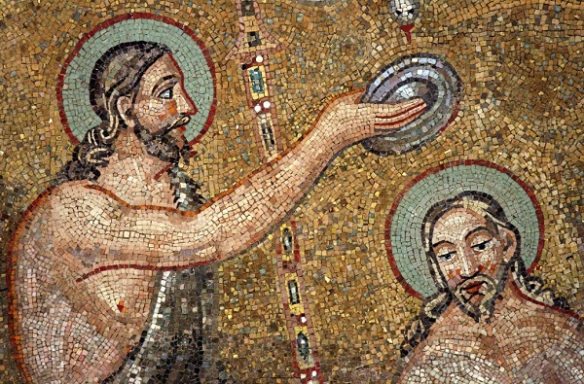
The Baptism of Christ by John the Baptist in the Jordan River. Detail of dome mosaic in the Battistero Neoniano (Orthodox Baptistery) in Ravenna, dating from 451-75. On lower right is a personification of the Jordan River as an old man rising from the water, holding a reed in one hand and offering a garment to Christ in the other. The right arm and dish of John the Baptist, the dove, and Christ’s head are 18th- and 19th-century restorations; the rest is original.

Even John the Baptizer is presented by Luke as also so sure of who he was as the precursor of the Messiah. Among the expectant people and John, we realize that indeed, growth happens the moment we accept who we are.

Examine the testimonies of many devotees of the Nazareno at Quiapo, of how they support each other in their woes and sufferings in life that we find a sort of theophanies by God, something like what we have heard from the first reading today, “Comfort, give comfort to my people, says your God” (Is.40:1). That comfort, that salvation, happened right there and then, in the now and not in a distant future.

Despite my “dislike” for their attitudes during the Traslacion, devotees of the Nazareno have always amazed me for daring to be truthful and honest with themselves, admitting their own sinfulness and weaknesses as they recognized too their need for help and most especially of their desire for God. This desire for God and admission of one’s sinfulness are very crucial to experience and hear God’s daily theophanies to us.

Photo by Mr. Jay Javier, 09 January 2019.

Second, for us to hear God’s theophany, we need to imitate Jesus Christ in taking the downward movement in life. His baptism at Jordan clearly illustrates this with His coming down to the Jordan valley through the mountains that evoked His own coming down from heaven to be born here on earth, in Bethlehem. 

What is so beautiful with Jesus Christ’s downward movement is essentially a being with the sinful, the sick, the rejected, the marginalized, the poor, and those considered dirty. From being purely clean and sinless, Jesus took all our dirt to be cleansed like Him. Such is the kindness of God that Paul speaks today to Titus “so that we might become heirs in hope of eternal life” (Titus 3:7).

Our world today teaches us the opposite direction Jesus Christ had taken by climbing up the pinnacle of success, of good life, of supremacy, of power, of everything! They call it “upward mobility” that has prompted everyone even those in the Church to join the rat race for being rich and famous, of being somebody, putting on masks and taking more of the goods the world offers until we get lost in misery finding no meaning at all with one’s self because we thought life is “up there.”

Jesus Christ is not up there but down here, in our very selves, in our very hearts filled and battered with our many agonies and failures, hurts and pains, weaknesses and sins. Look down more into our very selves to find Jesus in our dirt and miseries which is the message of Jesus Nazareno.

Observe all those interviewed in Quiapo have only one prayer – well-being of a loved one. They never asked to be rich or have money. Just heal a sick child or parent was the most requested prayer of devotees. Our favorite Pope Benedict XVI explained this downward movement so well:

To accept the invitation to be baptized now means to go to the place of Jesus’ Baptism. It is to go where he identifies himself with us and to receive there our identification with him. The point where he anticipates death has now become the point where we anticipate rising again with him (Jesus of Nazareth, page 18).

Photo by author, sunset in Liputan Island, Meycauayan City, Bulacan 31 December 2022.

Last but not least for our reflection is something very peculiar with Luke alone: the theophany of Jesus happened not right after His baptism but while He was praying, “After all the people had been baptized and Jesus also had been baptized and was praying, heaven was opened and the Holy Spirit descended upon him in bodily form like a dove” (Lk.3:21-22).

In the Acts of the Apostles, Luke recorded the Pentecost happened while the Apostles with the Blessed Mother Mary were all praying when the Holy Spirit descended upon them like tongues of fires which is similar with what took place at Jesus’ Baptism. In all books of the whole Bible, divine revelation is always preceded with prayer. As we shall see this year when Luke guides us every Sunday with his gospel account, he is the one who portrayed Jesus most in prayer than any of the other evangelists.

Photo by author, Garden of Gethsemane, the Holy Land, May 2017.

If we want to hear God’s theophanies to us, let us handle life with prayer which is more of listening and being one with God. Begin and end each day with prayer. There is no other way to hear God’s voice, to hear Him affirming us, to know His plans for us until we are one with with Jesus in prayer. 

In His baptism at Jordan, Jesus Christ as the Second Person in the Holy Trinity prayed not because He needed something from the Father but because He is one with Him in the Holy Spirit.  That was when the Father affirmed Him as the Christ being sent on a mission.

Through the Sacrament of Baptism we have received, we are reminded today of God’s anointing of each of us as His beloved child. May we heed His voice and be one with Him for a more blessed 2025 ahead of us as we begin Ordinary Time tomorrow. Have a blessed week. Amen.

Christmas is God at home with us; are we at home with God?

The Lord Is My Chef Sunday Recipe for the Soul by Fr. Nicanor F. Lalog II
Feast of the Holy Family, Cycle C, 29 December 2024
1 Samuel 1:20-22, 24-28 ><)))*> 1 John 3:1-2, 21-24 ><)))*> Luke 2:41-52
Photo by author of a depiction of the Holy Family near the main door of St. Joseph the Worker Parish in Pacdal, Baguio City, 28 December 2024.

You must have heard of the classic song “A House Is Not A Home” composed by the great tandem of Burt Bacharach and Hal David recorded by Dionne Warwick in 1964 for a movie of the same title. It went back to charts in 1981 when the late Luther Vandross covered it in his first album.

It is a very lovely ballad of a love lost, teaching us that indeed, “a house is made of walls and beams while a home is made of love and dreams”.

A chair is still a chair
Even when there's no one sitting there
But a chair is not a house
And a house is not a home
When there's no one there to hold you tight
And no one there you can kiss good night

A room is still a room
Even when there's nothing there but gloom
But a room is not a house
And a house is not a home
When the two of us are far apart
And one of us has a broken heart

But, in the Hebrew language and Jewish thought, the word “house” in itself connotes relationships. There are no distinctions between a house and a home for them that is why we find Jesus claiming the temple as His Father’s house.

Pope Francis opening the Jubiliee Door at St. Peter’s in Rome to launch the start of the Jubilee Year of 2025. Photo by Maurix/Gamma-Rapho via Getty Images.

In fact, the first letter of the Hebrew word for God (Yahweh) is actually shaped as a door or a house. That is why there is the blessing of church doors in dioceses today worldwide following the blessing and opening of the Jubilee Door at St. Peter’s in the Vatican by Pope Francis last Christmas Eve to launch the Jubilee Year. The Jubilee Door signifies our passing through, an entering into a relationship with God.

In John’s gospel we find Jesus as an adult using the word “house” twice when He cleansed the temple, telling everyone to “stop making my Father’s house a marketplace” (Jn.2:16) and at their last supper when He assured the disciples, “In my Father’s house there are many dwelling places or rooms” (Jn.14:2).

The only other occasion Jesus used the word “house” to mean the same thing as John was when He was found by His parents in the temple as we heard today on this Feast of the Holy Family.

Each year Jesus’ parents went to Jerusalem for the feast of Passover, and when he was twelve years old, they went up according to festival custom. After they had completed its days, as they were returning, the boy Jesus remained behind in Jerusalem, but his parents did not know it. After three days they found him in the temple… When his parents saw him, they were astonished, and his mother said to him, “Son, why have you done this to us? Your father and I have been looking for you with great anxiety?” And he said to them, “Why were you looking for me? Did you not know that I must be in my Father’s house?” But they did not understand what he said to them (Luke 2:41-43, 46, 48-50).

“The Finding of the Savior at the Temple” painting by William Holman Hunt (1860) from en.wikipedia.org.

We find in the story of the finding of Child Jesus in the temple that even at a very young age, Jesus had always been clear with His oneness in God by always referring to the temple as His “Father’s house”.

As we have reflected in December 19 in Luke’s first Christmas story, the annunciation of John’s birth to his father Zechariah while incensing at the temple in Jerusalem during a major Jewish feast that Christmas begins in the church where we gather to praise and worship God as a community. See how this Sunday after Christmas our many empty pews in the church. How sad that many Catholics after Christmas have totally disregarded the Sunday Mass, going to all the vacation spots here and abroad with many of them having no qualms at all that this is the “day of the Lord”, a Sunday obligation.

Again, here is Luke in his artistic narration of Christmas into Christ’s adolescence insisting on us the importance of communal worship and prayer. Not surprising that of the four evangelists, Luke is the one who presented Jesus always at prayer as an expression of His oneness or communion in the Father and he wants us hearers of his gospel account to cultivate that same communion with God in Jesus, with Jesus, and through Jesus.

Christmas is essentially Jesus Christ becoming human so that God may be “at home” with us humans as John beautifully wrote in his prologue we heard last Christmas Day, “And the Word became flesh and made his dwelling among us” (Jn.1:14).

But, are we at home with God in Jesus?

Photo by author, the small entrance door leading to the Church of the Nativity in Bethlehem where one needs to bow low literally and figuratively to enter Christ’s birthplace.

On this Feast of the Holy Family, our gospel reminds us this Sunday of how even Mary and Joseph had trouble with their adolescent son Jesus like most parents these days, a kind of family conflict so familiar with many people everywhere.

What a lovely scene today this Christmas season amid widespread reports of child kidnappings and so many children caught in the middle of many conflicts among adults like wars in many parts of the world and worst, right inside every family, right in their house, or homes where there are no relationships at all.

Luke was a physician who understood very well the anguish and sufferings of many people, especially parents during his time that continue to these days. In narrating to us this sad episode of his Christmas stories when Jesus was lost but eventually found in the temple, Luke is assuring us that despite all the darkness and troubles that engulf many families today, we have a very loving, personal God in Christ always with us.

Photo by author, picture taken from the inside of the Church of the Nativity in Bethlehem of its small entrance door.

Mary and Joseph did not understand what Jesus meant that He must be at His Father’s house but it did not deter them from exploring its meaning so that only Mary with John and two other women remained with Christ at the foot of the Cross on that Good Friday.

How lovely that Mary and those others at the foot of the Cross were the ones truly “at home” with the Lord, in the Lord! The same thing speaks so true with Joseph who in his silence was so “at home” with God in Jesus, whether awake or asleep. He kept that relationship with God alive through Mary and those others around him especially Jesus.

As an adult approaching His pasch, Jesus assured His disciples including us today of having a dwelling place or room in His Father’s house in heaven – that, despite our many sins, God would never cut off His ties with us in Jesus, with Jesus! That is how God loved us so much as the author of the Letter to the Hebrews reminds us “God is greater than our hearts and knows everything” (1Jn.3:20).

Like Hanna the mother of the child Samuel, let us start cultivating this relationship with God even while still very young. It does not really matter if we destroy and cut it so often; what matters is we keep on trying to let it grow anew for it is and would never ever get lost again. Thanks to Christmas!

That is why I personally insist in my homilies and writings that we keep greeting everyone with a Merry Christmas until January 12, the Feast of the Baptism of the Lord that closes the Christmas season. It is still Christmas after all!

Photo by author, Chapel of the Angel of Peace, RISE Tower, Our Lady of Fatma University, Valenzuela City, Christmas 2024.

Like Mary and Joseph, let us keep coming back to God symbolized by Jerusalem and its temple now replaced with our churches. Let us go back to prayer and to Sunday Masses to find Jesus again present in the signs and symbols of the liturgy and most of all, in everyone present celebrating His coming.

Let us continue the story of Christmas with our relationships with God through others, of our being at home with the Father in Jesus Christ who “advanced in wisdom and age and favor before God and man” (Lk.2:52) after this episode which closed Luke’s Christmas account.

Let us be at home with God and with one another in Jesus, with Jesus, and through Jesus. May you continue to have blessed Christmas Season. Amen.

Advent is God’s tenderness & sweetness

The Lord Is My Chef Sunday Recipe for the Soul by Fr. Nicanor F. Lalog II
Fourth Sunday in Advent-C, Simbang Gabi-7, 22 December 2024
Micah 5:1-4 ><}}}}*> Hebrews 10:5-10 ><}}}}*> Luke 1:39-45
Photo by author, Baguio City, March 2020.

Christmas is a story of love, about the meeting of lovers with God as the Great Lover who gave us His only Son because of His immense love for us. But, this love is not the kind of love conveyed by the cheesy Christmas tunes “Pasko na Sinta Ko” and “Last Christmas”.

The word “lovers” may be too serious as a term for us to relate this with today’s gospel of the Visitation of Mary to her cousin Elizabeth though both women were so in love with God who clearly loved them so much with children in their womb bound to change the course of human history forever. They were also filled with love for each other as expression of their love for God. And when there is love, there is always tenderness and sweetness that all happen in the context of a visitation that we must first clarify.

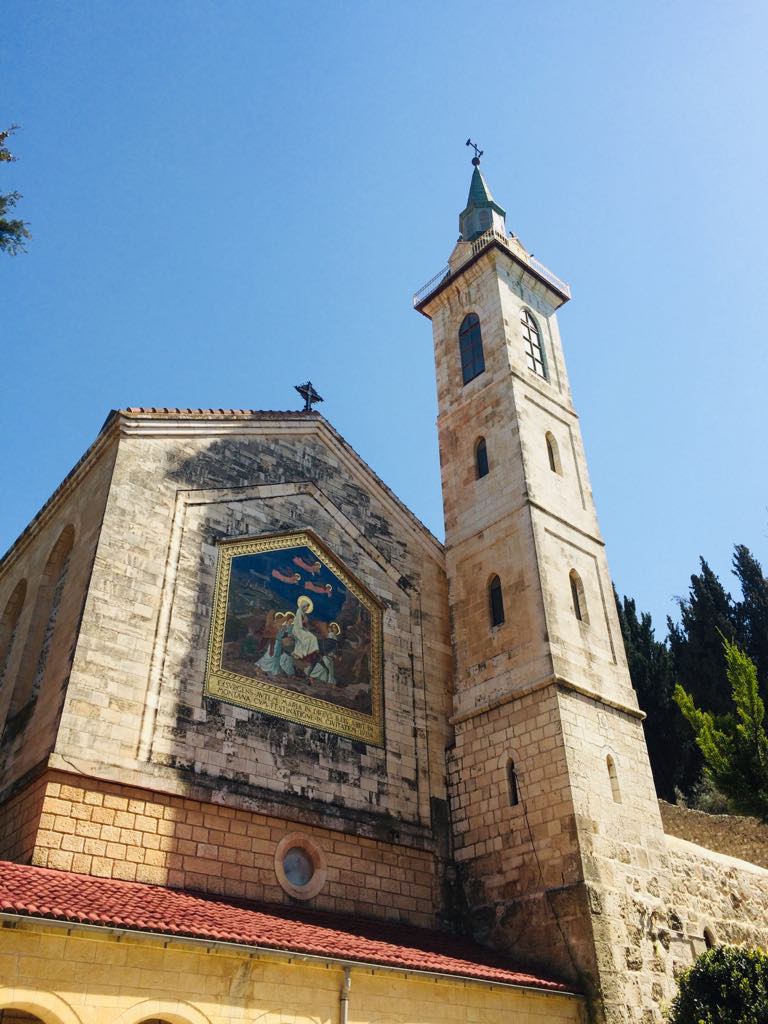
Photo by author, Church of Visitation, Israel, May 2017.

Visit and visitation may seem to be one and the same as both share the Latin root vidi, videre which is the verb “to see” as in video and visual. But, a visit is more casual and informal without intimacy because it is just “a passing by” or merely to see. It is more concerned with the place or the location and site and not the person to be visited. We say it clearly in Filipino as in “napadaan lang” when it just so happened you were passing by a place and even without any intentions, you tried seeing someone there. 

On the other hand, visitation is more commonly used in church language like when a bishop or priests come to see the parishioners in remote places; hence, a chapel is always called a visita where priests “visit” to celebrate Mass and check on the well-being of people living in areas far from the parish. Aside from being the venue for the celebration of Masses, the visita serves as classroom for catechism classes and other religious even social gatherings in remote barrios. Now as a chaplain in a University with a hospital, I do sick visitations every Sunday after our Mass to anoint and bring communion to our patients.

Thus, visitation connotes a deeper sense in meaning because there is an expression care and concern among people, a kind of love shared by the visitator/visitor and the one visited like Mary and Elizabeth. Visitation is more of entering into someone’s life or personhood as reported by Luke on Mary’s visitation to Elizabeth where Mary “entered the house of Zechariah and greeted Elizabeth” (Lk.1:40), implying communion or the sharing of a common experience.  In this case, the two women shared the great experience of being blessed with the presence of God in their wombs! 

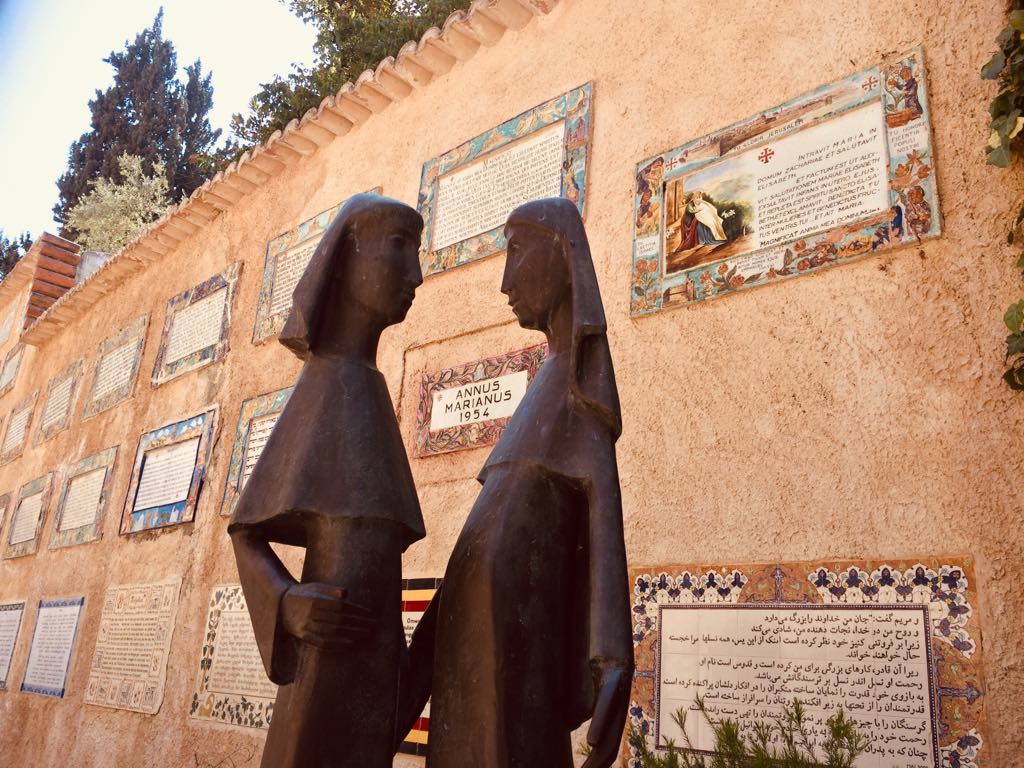
Photo by author, bronze statues of Mary and Elizabeth at the patio of the Church of Visitation, Israel, May 2017.

Visitation is a sharing or oneness in the joys and pains of those dear to us.  The word becomes more meaningful when we try to examine its Filipino equivalent –“pagdalaw” from the root word “dala” that can be something you bring or a verb to bring. 

When we come for a visitation, we dala or bring something like food or any gift. But most of all we bring our very selves like a gift of presence wherein we share our total selves with our time and talents, joys and sadness, and everything to those being visited that Mary did exactly in her visitation of Elizabeth where she brought with her the Lord Jesus Christ in her womb.

This fourth Sunday of Advent, we are invited to become like Mary in the visitation of others to bring Christmas and Jesus Himself to others by allowing our very body to be the “bringer” or taga-dala of Christ, the highest good we can bring as pasalubong in every visitation we make. Here again is another beautiful Filipino word, pasalubong that is literally the gift you bring when you visit somebody. It has a verb equivalent that is salubong or meeting/encounter. To salubong or meet another person, one has to leave one’s place, one has to leave behind one’s biases and mistrust to be empty to meet the other person.

How lovely and sweet if we can leave our negativities behind this Advent and Christmas so we can dala (bring) Jesus to family and friends and strangers to therefore salubong (meet) to experience God’s tenderness and sweetness in Jesus Christ.

Photo by author, Fourth Sunday of Advent 2022, Chapel of Basic Education, Our Lady of Fatima University, Valenzuela City.

Tenderness and sweetness in Filipino are often translated in just one word which is “malambing” from “lambing” that has no direct English translation except that it connotes a loving affection; however, both terms are more than just affections but stirrings from the heart that move us into action. 

Tenderness is very much like gentleness; the former is more focused while the latter is very general attitude. Tenderness is more than being soft and gentle but an awareness of the other person’s weaknesses, needs and vulnerabilities. A tender person is one who tries not to add more insult to one’s injuries or rub salt onto one’s wounds so to speak. A tender person is one who tries to soothe and calm a hurting person, trying to heal his/her wounds like God often portrayed in many instances in the bible in lovingly dealing with sinners filled with mercy. 

Like God, a person filled with tenderness is one who comes to comfort and heal the sick and those taking on a lot of beatings in life. When Jesus Christ came, He also personified this tenderness of God like when He was moved with pity and compassion for the sick, the widows, the women and the children and the voiceless in the society. Tenderness is coming to heal the wounds of those wounded and hurt, trying to “lullaby” the restless and sleepless. Mary visited Elizabeth because she also knew the many wounds of her cousin who for a long time bore no child, living in “disgrace before others” as she had claimed (Lk.1:25).

Photo from The Valenzuela Times, 02 July 2024.

Sweetness always goes with tenderness. It is the essence of God who is love. Anyone who loves is always sweet, something that comes naturally from within, bringing out good vibes.  It is never artificial like Splenda, always flowing freely and naturally that leaves a good taste and feeling to anyone. In the Hail Holy Queen, Mary is portrayed as “O clement, O loving, O sweet Virgin Mary” to show her sweetness as a mother. There are no pretensions and pompousness in being sweet, never needs much effort to exert in showing it for it comes out naturally and instantly.

Tenderness and sweetness are the most God-like qualities we all have but have buried deep into our innermost selves, refusing them to come out because of our refusal to love for fears of getting hurt and left behind or, even lost. When Mary heard Elizabeth’s condition, she simply followed her human and motherly instincts that are in fact so Godly – she went in haste to visit her. Tenderness and sweetness are the twin gifts of Christmas to humanity when God almighty became little and vulnerable like us so we can be great and powerful like Him in being able to love. 

Photo by author, Archdiocesan Shrine of Nuestra Señora De Guia, Ermita, Manila, 28 November 2024.

It is the final Sunday of Advent. In a few days it will be Christmas day and we still have enough time to empty our hearts of sins and bitterness to be filled with God’s love, sweetness and tenderness in Christ.

Let me leave you with my favorite quote from the novel “The Plague” by Albert Camus, “A loveless world is a dead world, and always there comes an hour when one is weary of prisons, of one’s work, and of devotion to duty, and all one craves for is a loved face, the warmth and wonder of a loving heart.” 

Let that love in you come out this Christmas and hereafter; simply be like the child Jesus and be surprised with His tremendous power to transform the world.  Amen. Have a blessed, sweet and tender Christ-filled week ahead!

Advent is the joy of our union in the Lord

The Lord Is My Chef Sunday Recipe for the Soul by Fr. Nicanor F. Lalog II
Third Sunday in Advent (Gaudete Sunday), Cycle C, 15 December 2024
Zephaniah 3:14-18 ><}}}}*> Philippians 4:4-7 ><}}}}*> Luke 3:10-18
Photo by author, Gaudete Sunday, Advent 2018.

Our altars are bursting in shades of pink this third Sunday in Advent known as Gaudete Sunday from the entrance antiphon in Latin of today’s Mass meaning “Rejoice in the Lord”.

To rejoice means to intensify joy which is a world apart from “happiness” many have mistaken as synonym for joy and rejoicing. Happiness is fleeting and superficial, dependent on the outside “stimulus” that makes us happy while joy comes from within one’s heart.

Joy is that feeling of certainty that no matter what happens to us, God would never forsake us, leading us to serenity and peace. That is why one can still rejoice and be joyful even in pain and sufferings like the elderly, the sick, or those struck with tragedy and failures. We can only rejoice when we have that deep faith in God, filled with hope that even if things get worst, our final salvation is in Jesus Christ who had come, would come again, and continues to come to us.

Photo by author, Advent 2021, BED Chapel, Our Lady of Fatima University, Valenzuela City.

Joy and salvation always come together as expressed by the Prophet Zephaniah in the first reading today which is fulfilled in Jesus Christ who renewed us all in the love of God our Father.

Shout for joy, O daughter Zion! Sing joyfully, O Israel! Be glad and exult with all your heart, O daughter Jerusalem! The Lord has removed the judgment against you, as he turned away your enemies… The Lord, your God, is in your midst, a mighty savior; he will rejoice over you with gladness, and renew you in his love (Zephaniah 3:14-15, 17).

True rejoicing can only happen in Jesus our Savior as St. Paul insisted in our second reading today, “Brothers and sisters: Rejoice in the Lord always. I shall say it again: rejoice!” (Phil. 4:4).

In His sermon on the mount about the beatitudes, Jesus taught us that true blessedness that leads to joy is not in having everything but in being empty and poor for God, being free from the trappings of this material world. Just ask those above 50 years old today: we have less of material things when growing up but we have so much fun so unlike these days of so many gadgets and things when suicides and mental cases are on the rise. People may be happy today but not joyful.

With our Campus Ministry members after our Advent Recollection, 12 December 2024, Chapel of the Angel of Peace, RISE Tower, Our Lady of Fatima University, Valenzuela City.

At His Last Supper as well as after Easter in His appearances to His disciples, Jesus assured us of joy and peace if we remain in Him by keeping His commandments especially the celebration of the Eucharist until He comes again. But, in a recent Christmas party I attended, a parlor game surprised me when the host asked participants to “bring him” the first thing we look for upon waking up when everybody rushed to him bringing their cellphones!

I thought the answer were eye glasses which I first look for upon waking up to check the time. As a result, I made an informal survey when I took the elevator and during our Mass at the university when I asked the students, “what is the first thing you look for upon waking up?”

And, cellphone again was their unanimous answer which I find very alarming. Is the cellphone the new god of our modern time, replacing not only Jesus but even ourselves! It has slowly robbed us of our true joy, often caused many of our sorrows and breakdown of relationships.

We rejoice because of Jesus Christ and in our union in Him, we become one with others in whom we experience joy and rejoicing too.

Photo by Mr. Jim Marpa, 2018.

Now we go to another dimension of joy and rejoicing – its personal and relational aspect. Have you experienced there are times we find it difficult to rejoice with others having fun or enjoying something while on the other hand, we are easily moved to sympathize with anyone crying or feeling api and forlorn even if we do not know them?

Is it not ironic we easily unite with strangers in sadness but not in joy? I think that perhaps, God designed us to sympathize with anyone in pain because there is a thread that connects and binds us together in times of sorrow. It is a lot different with rejoicing which presupposes a relationship, a sort of oneness to experience the others’ joy. Joy is never solitary unlike sadness that is often kept inside by the person. Joy to be really joyful has to be made known. That is why we can easily share in the joy of others when we know them. We turn sarcastic even jealous when we find others we do not know rejoicing simply because we are not part of them nor of their joys.

Photo by author, Gaudete Sunday, Advent 2019.

Rejoicing is not about what we or anyone can do but all about relationships as Luke shows us in his account on John’s baptism at Jordan that is so upbeat that we too could feel the rejoicing of the people in John’s coming and preaching that some of them thought John was the Messiah. The people felt a deep sense of belonging, of relating and knowing that they asked John what they must do to continue rejoicing!

The crowds asked John the Baptist, “What should we do?” Even tax collectors came to be baptized and they said to him, “Teacher, what should we do?” Soldiers also asked him, “And what is it that we should do?” Now the people were filled with expectation, nd all were asking in their hearts whether John might be the Christ… Exhorting them in many other ways, he preached good news to the people (Luke 3:10, 12, 14, 15, 18).

In telling us how John answered the queries of the people on what they must do to experience the coming of the Messiah, Luke teaches us that God is not asking great things from us but only simple acts of charity and mercy for one another like being kind and loving because we are already related in Him in the first place. Hence, we all can rejoice in Christ!

Here is our common misconception that if we do what is good and right, then we shall be filled with joy. Wrong. We are already filled with joy and we just have to intensify that into rejoicing because we are already God’s beloved children in baptism. When we live out our status as beloved children of God in Christ, everything follows.

Don’t you feel rejoicing just before communion, praying, “Lord, I am not worthy to receive you under my roof but only say the word and I shall be healed”?

Imagine that immense love of God in Christ for us when nobody among us even the priest officiating the Mass is worthy to receive Jesus and yet, He came and made it a reality because He loves us so much! All we have to do is be sorry for our sins, reform our lives, apologize to those we have wronged, forgive those who have sinned against us… it is God who does everything for us in Jesus Christ. We do only so little but sadly, we could not even do the little things so well like coming on time for the Mass every Sunday, much less be silent to pray and listen to Jesus coming to us in Holy Communion because we are so busy conversing with those beside us or checking our cellphones.

This third Sunday in Advent, Jesus invites us to imitate John the Baptist His precursor who “preached good news to the people” with his warm and joyful presence. Spread the joy of Jesus by being kind and warm to others especially those in pain, those alone, those who are lost. After all, we are all one in Christ who is our joy and salvation. Amen.

Photo by author, Gaudete Sunday, Advent 2019.

Advent is going beyond, like a voice in the wilderness

The Lord Is My Chef Sunday Recipe for the Soul by Fr. Nicanor F. Lalog II
Second Sunday in Advent, Cycle C, 08 December 2024
Baruch 5:1-9 ><}}}}*> Philippians 1:4-6, 8-11 ><}}}}*> Luke 3:1-6
Photo courtesy of Mr. Jilson Tio, Archdiocesan Shrine of Nuestra Señora De Guia, Ermita, Manila, 28 November 2024.

Two weeks ago I officiated the golden wedding anniversary of a friend’s parents where I said the best wedding homily is actually the couple themselves still much in love, filled with joy after 50 years as husband and wife.

“May forever pa rin,” despite all the celebrity break ups we feast on social media and the many separations happening among some couples these days. How I wish that more young people are invited to wedding anniversaries so they would aspire for lasting relationships too.

Photo by author at the Archdiocesan Shrine of Nuestra Señora De Guia, Ermita, Manila, 28 November 2024.

Of course, it is never easy – that is why there is the Sacrament of Marriage where couples pray to God and promise Him to cooperate in His grace so that until death, they would remain together in faith, hope and love that would eventually bring them to eternity.

It is the reality not only of marriage but of life itself. God calls us to a particular vocation or state in life like marriage, priesthood and religious life, or single-blessedness in order to lead us to Him in eternity.

And that is the two-fold meaning of Advent too! We are preparing not only for the first coming of Jesus at Christmas but most of all to His Second Coming at the end of time (parousia). This is the second Sunday in Advent so beautifully presented by Luke.

In the fifteenth year of the reign of Tiberius Caesar, when Pontius Pilate was governor of Judea, and Herod was tetrarch of Galilee, and his brother Philip tetrarch of the region of Iturea and Trachonitis, and Lysanias was tetrarch of Abilene, during the high priesthood of Annas and Caiaphas, the word of God came to John the son of Zechariah in the desert (Luke 3:1-2).

Photo by author, Second Sunday Advent 2022, BED Chapel, Our Lady of Fatima University, Valenzuela City.

First we notice is Luke’s solemn account of how the Son of God Who is eternal entered through our own time that is temporal. If Luke were to write his gospel today, maybe he would simply change the names above into BBM and Sara Duterte, with Pope Francis and Cardinal Advincula representing the Church then spice it with some showbiz tidbits or whatever is trending in social media.

But, here also is the artistry of Luke when he segued to John the Baptist to direct our thoughts to the Second Coming of Christ without losing sight of the present moment, of the here and now.

John went throughout the whole region of the Jordan, proclaiming a baptism of repentance for the forgiveness of sins, as it is written in the book of the words of the prophet Isaiah: A voice of one crying out in the desert: “Prepare the way of the Lord, make straight his paths. Every valley shall be filled and every mountain and hill shall be made low. The winding roads shall be made straight, and the rough ways made smooth, and all flesh shall see the salvation of God” (Luke 3:3-6).

“St. John the Baptist Preaching in the Wilderness” by German painter Anton Raphael Mengs (1728-1779) from commons.wikimedia.org.

Though John is the main character in today’s gospel and next Sunday, Luke is actually focused on Jesus Christ who had come, would come again, and continues to come to us today. All four evangelists were clear about John as secondary only to Jesus as His precursor.

However, only Luke of the four evangelists cited the Prophet Isaiah extensively regarding John’s unique mission with Christ to stress this future aspect of Advent, skipping only that part “the glory of the Lord shall be revealed” by closing it at “all flesh shall see the salvation of God” in Isaiah 40:3-5.

Luke is teaching us that Advent is looking beyond Christ’s birth but also to His Easter and most of all, to His Second Coming now happening.

For Luke, to be like John in the wilderness is for us to be bold and daring in opening ourselves to God in Jesus Christ amid the turmoils of our time like wars and pandemic, calamities and upheavals. No matter how much pains and disappointments we have had this year that made us doubt God’s love and presence for us in Christ, let us dare anew like John in the wilderness to believe and live out His coming and presence.

In citing Isaiah 40:3-5, Luke is reminding us that we shall all see and experience God’s salvation in Jesus Christ today while awaiting His Parousia. Notice the similarity of Isaiah’s prophecy with that of Baruch’s in the first reading when “every lofty mountain be made low, and that age-old depths and gorges be filled to level ground, that Israel may advance to secure in the glory of God” (Bar. 5:7). Both prophets spoke of the future expectation expressed by John already unfolding in Christ who had come.

Photo by author, Fatima Avenua, Valoenzuela City, December 2023.

A friend texted me last week complaining if Christmas would happen at all in their family after a serious rift with their youngest brother. “Dinaraan-daanan lang po ako Father ng kapatid kong bata, para akong patay na.”

Being the eldest in the family, my friend asked his younger brother to shape up and fix his life (ayusin ang buhay) after taking a third partner. He had dumped his first wife after the birth of their son who turned out to be a special child; then, took a second partner and had a daughter whose godmother, his kumare is now his third partner. My friend had taken upon himself to rear his special nephew and niece while his brother does not care at all.

With that situation at home, my friend told me he could not feel Christmas at all despite the material things they have. After a few hours, I texted him back and told him no one can take away the joy of Christmas because that is Jesus in our hearts. Keep Jesus alive in your heart, I texted him, asking him to continue to still love his wayward brother, never losing that hope in Christ that someday, peace would be restored among them in the family. I ended my texts reminding him that Jesus was born during the darkest night of the year.

That’s the voice of John in the wilderness – when we dare to open to God amid our many pains and sufferings, proclaiming and living out His love in Jesus who had come, continues to come and would come again at the end of time. That’s preparing the way of the Lord even when it is all dark, taking small steps at a time as we could not see the next distant scene. In times like these, let St. Paul’s desire in the second reading be our Advent prayer, “that your love may increase ever more in knowledge and every kind of perception, to discern what is of value, so that you may be pure and blameless for the day of Christ” (Phil.1:9-10).

Photo by author, RISE Tower, Valenzuela City, 06 December 2022.

How lovely during this time of Advent when our days are getting shorter, dark earlier than usual because this is also the time sunsets are most awesome. Somewhere out there where the sun sets with skies redolent like embers of the dying day is the voice in the wilderness proclaiming to us Christ’s coming and presence even in the long dark night of waiting.

What do you long or desire most right now in your heart? Reawaken your hopes in Christ Jesus and be ready to be surprised as He shall straighten your path soon especially with your loved ones. Amen.

What have you done?

The Lord Is My Chef Sunday Recipe for the Soul by Fr. Nicanor F. Lalog II
Solemnity of Our Lord Jesus, King of the Universe, 24 November 2024
Daniel 7:13-14 ><}}}}*> Revelation 1:5-8 ><}}}}*> John 18:33-37
Photo by author, Bohol Sea scene from Salum Dive Resort, Dauin, Negros Oriental, 10 November 2024.

We are now on the final Sunday of the year, the Solemnity of Jesus Christ, King of the Universe. Next Sunday we begin the Season of Advent, the official countdown to Christmas which is the birth of Jesus Christ, King of kings.

See how our Church calendar begins and ends each year in Jesus Christ’s eternal kingship as seen by Prophet Daniel in his vision (first reading); Christ’s coming to the world was not an addendum or a plan B of God because Jesus has been enthroned at His side, conferred with “dominion, glory, and kingship” (Dn. 7:14).

“Ecce Homo” painting by Vicente Juan Masip (1507-1579) from masterapollon.com

Jesus reiterated this in our gospel this Sunday from John’s account of His trial before Pilate, His first “face-to-face” with a representative of political power. According to St. John Paul II in an interview published in 1994 (Crossing the Threshold of Hope), this scene continues to happen when we, too, like Pilate put God on trial when we insist in doing what we perceive as right and true. Let’s try to enter this scene to unravel its many layers of truth about ourselves who are actually the ones in trial, not Jesus Christ.

Pilate said to Jesus, “Are you the King of the Jews?” Jesus answered, “Do you say this on your own or have others told you about me?” Pilate answered, “I am not a Jew, am I? Your own nation and the chief priests handed you over to me. What have you done?” Jesus answered, “My kingdom does not belong to this world…” So Pilate said to him, “Then you are a king?” Jesus answered, “You say I am a king, for this I was born and for this I came into the world, to testify to the truth. Everyone who belongs to the truth listens to my voice” (John 18:33-36, 37).

Photo by Ms. Ria De Vera, Christ the King procession during COVID, November 2020.

From the very start of His trial before Pilate, we find Jesus so “cool” – so sure of everything, actually the One in control of the trial despite the sarcasm of Pilate who, eventually, would be the one to give in to the penetrating truth of Christ.

In fact, we find here how Pilate was already inclined to the truth of Christ as the King as he later affirmed unconsciously when he wrote the inscription on the Cross, “Jesus the Nazorean, the King of the Jews” that the priests tried to edit but Pilate insisted, “what I have written, I have written” (cf. Jn.19:19-22).

Many times like Pilate, the more we try to justify our sins or inclinations to evil with our various excuses and alibis, the more we sink deeper into admitting the truth that Jesus Christ is King, that He is truth and good Himself. We imitate Pilate’s sarcasm even with God through others like our parents or elders, teachers, even friends who truly love us and care for us as we remain adamant with our wrong beliefs and points of view.

Photo by Mr. Joey Principe, Parish of St. Joseph the Worker, Jaro, Iloilo, 10 November 2024.

What really gave away Pilate – and us – in the process of our trial of Jesus was his final question which I love so much, “What have you done?”

Pilate was sincerely trying to know the truth about Jesus as he was evidently irritated with the case thrown to him by the priests and scribes. His asking Jesus “Are you the King of the Jews?” was a request for clarification as a Roman state official because the word “king” meant only one thing.

And here is the twist in our own days – it is the same question we unconsciously ask Jesus so often to clarify too!

How many times have we sought clarification on the kingship of Jesus especially in this modern time when we discuss divorce, abortion, same-sex marriage, and almost everything from clothes we wear to how we conduct ourselves in this modern time that has become so relative and permissive in morals?

Every time we put Jesus on trial when we insist on what we want and what we believe in, the Pilate within us question Jesus, what have you done? Let us count them… you may add .


"What have you done, Jesus?" 

You have forgiven our sins, Jesus,
giving us new chances in life daily;
You have saved us, Jesus, from many
instances when we felt so lost,
even gone that's why we are
still intact at this very moment in our lives;
You have consoled us, Jesus, in countless times
that made us to keep believing,
hoping, and trusting God and others;
You love us so much, Jesus, in ways
we can't believe nor understand
that's why we too keep on loving
despite the hurts and pains;
and the list goes on and on and on...
that makes You truly our King, Jesus!

Photo by author, Chapel of St. Francis Xavier, Sacred Heart Novitiate, Novaliches, QC, 20 March 2024.

See that when we remember everything Jesus had done to us, we also realize His being a King of different kind who never forced us to believe Him nor follow Him unlike the powerful people of the world.

Jesus as a King simply invites us gently and lovingly to come to Him to find rest and comfort when we are burdened in life. There were times when we have felt Jesus just closed His eyes to our many sins and imperfections, not even reminding us of our shameful selves like when He washed the dirty feet of His Apostles after their last supper.

Jesus never threatened us when we were in the height of our pride and stupidity and instead waited patiently for us to come home to Him like the prodigal son. He never locked us, allowing us to go and explore everything, standing by just in case we cross the point of no return.

Photo by author, St. Scholastica Retreat House, Baguio City, 2023.

Whatever Jesus had done to us, it is always good and comforting, beyond our expectations and imaginations like healing us of our every sickness, feeding us and clothing us when we were hungry and naked, even cleansed us when we were so dirty and untidy.

Therefore, this Sunday as we celebrate the Solemnity of Christ the King, let us cast off all our fears of Jesus taking away our perceived “kingdoms” like King Herod who ordered all infants and children killed on that first Christmas upon hearing the news of “the birth of the king of the Jews” (Mt. 2:2).

Jesus never said “My kingdom is not in this world” because His kingdom while not of this world is right here below on earth that is why John tells us in the second reading from his vision of the end of time, Jesus is coming again here on earth to take us to eternity. The Kingdom of Jesus is here in the world but not of this world; similarly, we are in this world but we are called not to be of this world for our true citizenship is in heaven.

This Sunday, Jesus is asking us in the most personal manner, what have I done to you that have kept you running away from Me? Most lovely of all is that Jesus never asked us what have we done to Him nor for Him… Let us pray:

Lord Jesus Christ,
my Lord and my God,
You have done so much
good to me and I have done
so little for You and for others;
reign in my heart so that I can
make others experience Your
loving kind of Kingship.
Amen.
From Facebook, 10 March 2024.

The joy of endings

The Lord Is My Chef Sunday Recipe for the Soul by Fr. Nicanor F. Lalog II
Thirty-Third Sunday in Ordinary Time, Cycle B, 17 November 2024
Daniel 12:1-3 ><}}}}*> Hebrews 10:11-14, 18 ><}}}}*> Mark 13;24-32
Photo by author, the Mount of Olives as seen from the Temple of Jerusalem, May 2019.

We are now at the penultimate Sunday of our Church calendar ending on the Solemnity of Christ the King next week to usher in the four Sundays of Advent before Christmas. That is why every 33rd Sunday, we hear Jesus speaking about the end of everything to usher in new beginnings in Him.

Jesus said to his disciples: “In those days after that tribulation the sun will be darkened, and the moon will not give its light, and the stars will be falling from the sky, and the powers in the heavens will be shaken. And then they will see ‘the Son of Man coming in the clouds’ with great power and glory, and then he will send out the angels and gather his elect from the four winds, from the end of the earth to the end of the sky” (Mark 13:24-27).

After spending a day of teaching at the Temple wherein the Twelve were so impressed with its beauty, Jesus warned them of its impending destruction, explaining it further as they proceeded to rest on Mount of Olives overlooking Jerusalem below with the magnificent Temple.

No, Jesus was not a “KJ” at all.

Jesus was simply telling His disciples including us today of life’s natural cycles of endings and beginnings. Actually, long before Jesus came, people have always been preoccupied with thoughts of the “end of the world” – with or without God – which persist to these days.

Photo by Emilio Su00e1nchez on Pexels.com

Jesus reminds us this Sunday that indeed, the world is going to end but, it is not just a catastrophic end destroying everything. It is an end with a direction, to God and eternal life. It is an end we have to joyously await and prepare for as a new beginning in Jesus Christ.

“Learn a lesson from the fig tree. When its branch becomes tender and sprouts leaves, you know that summer is near. In the same way, when you see these things happening, know that he is near, at the gates… But of that day or hour, no one knows, neither the angels in heaven, nor the Son, but only the Father” (Mark 13:28-29, 32).


"Learn a lesson from the fig tree."

Again, Jesus spoke here in parable which is also the word for “lesson” in Mark’s original Greek writing of the gospel. A parable is a simple story with a deep, profound reality and lesson. That is why Jesus used it so often just like here a few days before His Pasch.

Photo by Muverrihhanim on Pexels.com

And this is the lesson or parable of the fig tree that Jesus spoke of: most of the trees in Jerusalem are evergreen that keep their leaves all year round despite the changing of season while fig trees are deciduous that shed their leaves in winter and summer. This changing condition made the fig tree a perfect parable about the end of the world that Jesus was speaking of – an end of the season to usher in a new one!

In theology, we call this study of the “end” or “last” things as eschatology. There are two kinds of last things in life that we deal in eschatology: our individual end in our death (particular) and the parousia which is the Second Coming of Jesus Christ at the end of the world (general).

Of course, it is always fearful to think of both endings. We hate endings because they are good byes. However, we know deep inside ourselves too that despite that “sweet, sweet sorrow” of every ending comes also a more wonderful hello, a more amazing new beginning. In reality, there are no endings but more beginnings: when children move out of the home to study, they begin their adult life in college; later on, they leave home for good to get married to start a family of their own. Life is a cycle of beginnings and ends that goes on and on and on.

The trick is really to learn the lesson of the fig tree, that is, to live our lives to the fullest in each season and phase, to learn to let go of the past, to savor every present and look forward to every tomorrow. Yes, it is easier said than done but, as we mature and age gracefully in Jesus Christ, we become fulfilled, less stressed amid the many things we are totally unaware and ignorant of what both particular and general endings would bring us.

Photo by Alina Vilchenko on Pexels.com

In presenting to us the parable or lesson of the fig tree regarding the end of our lives or the end of the world – both of which nobody knows when – Jesus is actually encouraging us to live more faithfully in Him and His gospel.

It is useless to know the precise date and hour of both endings nor the exact indications of its imminence; what matters most is that every moment of our lives, we live in Jesus Christ our High Priest who had offered Himself for our salvation (second reading). There is no point in interpreting even visualizing how St. Michael would battle the devil at the end of time; what the prophet Daniel is telling us is how we are assured of victory and salvation in the end if remain faithful to God (first reading).

Live fully by celebrating life. All throughout the year, we have heard Jesus reminding us, assuring us how much He loves us so immensely that is why He became human like us; in His coming, He joined us in all our sufferings except sin to show us that the path back to the Father in heaven is through the path of His Cross.

Despite my coming to Israel thrice, I have never tasted a fresh fig but have always loved it even better than dates. Its sweet taste and tiny bits of seeds inside make it always a pleasure to eat. If we can truly learn its lesson, we can end up like figs too – delightfully sweet inside.

Photo by Ella Olsson on Pexels.com

I recently bought an electric shave as an early Christmas gift to myself. I really don’t mind seeing my hair including mustache and beard turning grey and white; what bothers me lately is how my skin has become so easily irritated by my razor. Yes, I am getting older with skin sagging and add to that a vision getting blurred that shaving with a razor every morning is no longer fun but short of an agony.

As I examined my new shave set, I remembered a Japanese saying I used to tell young people before in my talks and recollections, “Growing up is nice, but sometimes painful.”

Indeed, growing up is nice – and ageing is even nicer though twice painful sometimes.

Like the fig tree, I can sense losing a lot of myself daily, yet becoming more tender and softer in the process, simpler and more joyful, perhaps. To my fellow 59ers and above, May the Lord Jesus lead us through the end in His loving embrace. Amen.

Photo by KENJI IWASAKI on Pexels.com

Jesus sitting among us

The Lord Is My Chef Sunday Recipe for the Soul by Fr. Nicanor F. Lalog II
Thirty-second Sunday in Ordinary Time, Cycle B, 10 November 2024
1 Kings 17:10-16 ><}}}}*> Hebrews 9:24-28 ><}}}}*> Mark 12:38-44

Our Sunday readings are so lovely, so picturesque where you find in both first reading and gospel the character of a poor widow standing side by side with great men of faith in God as the main focus, the Prophet Elijah and Christ Jesus, respectively.

In the first reading, we find humorously the Prophet Elijah asking for water, then some bread from a widow gathering sticks outside her home in Zarephath.

Elijah said to her, “Do not be afraid… For the Lord, the God of Israel, says, ‘The jar of flour shall not go empty, nor the jug of oil run dry, until the day when the Lord sends rain upon the earth.'” She left and did as Elijah had said. She was able to eat for a year, and he and her son as well; The jar of flour did not go empty, nor the jug of oil run dry, as the Lord had foretold through Elijah (1 Kings 17:13, 14-16).

Elijah had fled Israel after proclaiming a drought because the people turned away from God to worship baals or false gods brought by the wife of King Ahab, Queen Jezebel. God then directed Elijah to Zarephath outside the city of Sidon to hide where the king was the father of his archenemy, Queen Jezebel!

Imagine Elijah hiding in the most hostile place of all with a pagan widow who worshipped baal so denounced by him. But, here is a marvelous story of faith of Elijah who trusted God completely in obeying Him to move to the pagan region ruled by his enemies. Similar was the faith of the pagan widow who surprisingly believed Elijah and God’s power that she did not mind putting her life and her son’s at risk in harboring their enemy. Their admirable faith both remind us how God accomplishes His great acts of mercy and love when we surrender ourselves totally to Him.

Photo by author, Wailing Wall of Jerusalem, May 2019.

Nine hundred years later after Elijah, we had Jesus in Jerusalem like the prophet in a very hostile place and situation too – in the Temple that was the very domain of His enemies. This was the Holy Week after Jesus had entered Jerusalem on Palm Sunday leading to Good Friday.

And like Elijah who approached a widow worshipper of baal, Jesus dared to sit at the temple area after harshly castigating the scribes there:

He sat down opposite the treasury and observed how the crowd put money into the treasury. Many rich people put in large sums. A poor widow also came and put in two small coins worth a few cents. Calling his disciples to himself, he said to them, “Amen, I say to you, this poor widow put in more than all the other contributors to the treasury. For they have all contributed from their surplus wealth, but she, from her poverty, has contributed all she had, all her livelihood” (Mark 12:41-44).


Jesus sat down 
opposite the treasury and observed
how the crowd put money into the treasury.

Throughout this week, that scene of Jesus seated at the Temple had so absorbed me. What was Mark trying to tell us in reporting this? Jesus seated at the temple opposite the treasury observing the crowd is something else.

See the genius of Mark in weaving this Sunday’s gospel scene: right after castigating the corrupt leaders of Israel who were affiliated with the temple, Mark segued into this poor widow dropping some coins into the treasury box. In ancient Israel, the poor like the widows were not required to give those contributions. In a stroke of genius, Mark tells us something is wrong in this scene which Jesus rightly attacked because that widow was one of those widows whose house was devoured by the scribes!

“The Widow’s Mite” painting by French painter James Tissot, from brooklynmuseum.org.

And Mark never intended the story only for the Christians of his time but also for us as we have continued in the Church that malpractice by priests and scribes of Jerusalem. Woe to us priests and bishops who go around in “long robes and accept greetings, seats of honor” and worst of all, “devour houses of widows”, forgetting the poor, preferring always to be with the rich and powerful that social media attest.

Like Zarephath and the Jerusalem Temple, there is Jesus sitting in the middle of our Church under attack on all fronts and within in order to be closer with us especially the widows and the poor who are victims of an unjust society and systems perpetrated by same men and women supposed to be servants of God, or, at least men and women of God.

Photo by author, July 2024.

That image of Jesus seated at the Temple opposite the treasury was in fact a reminder of His being the victim too of injustice in the temple like the poor widow, of His Crucifixion on Good Friday. In fact, the 30 pieces of silver the priests have paid Judas Iscariot to betray Jesus must have come from that treasury.

In the midst of the hostilities and hurts, the divisions and abuses of power by priests and lay alike, in the Jerusalem Temple then and now in our Church, there has always been Jesus sitting among us, observing our offerings after first offering Himself for us all as our perfect High Priest (second reading) who finally freed us from these injustices and inhumanity of the past.

That is why I love this scene so much.

More than tithing, Jesus tells us this Sunday that like that generous heart of the poor widow, despite her plight, she continued to give because she believed, she hoped, most of all, she loved God. She need not give but still insisted because the treasury was for the upkeep of the temple, the very house of God, therefore, for God Himself.

There are times I hurt deep inside for the pains of the many scandals some priests and bishops have caused the Church but I choose to remain, even to sit in this Church or be a victim like Jesus amid all these because I love Jesus. Yes, amid all these sorrows, there is one “first” I see above all, Jesus Christ. This is concretization of last Sunday’s “which is the first of the commandments” – God who is love above all!

Jesus is telling us this Sunday through the poor widow that it is recognizing God in us and in one another that matters, and that is why we give at all.

Photo by author, 2022.

If we love God, if we find God in us and in others, when we find Jesus seated among us, then we realize we are the Church, we are the Temple we love. The moment we realize this, the more we feel at home “sitting with Jesus in the temple”, then we start giving totally because we love as well as know for a fact that whatever we give is actually what we receive from God in Jesus.

Why give so little? Give all, give everything because you never have anything to begin with! Everything is from God. That is why it is in giving that we truly receive. In every Mass, we do not give anything except our mere presence that is not even complete and yet, we get abundant blessings, primarily Jesus Christ whom we receive wholly, Body and Blood.

In every Mass we celebrate, we sit with Jesus in the midst of this inhospitable world we live in, even right in the church we love and hate sometimes. We do not give up. We persevere because we believe, we trust, we hope. Most of all, we love like Elijah and Jesus and believe like the poor widows of Zarephath and Jerusalem Temple. Amen. Have a blessed week ahead!