Quiet Storm by Fr. Nicanor F. Lalog II
The Seven Last Words, 03 April 2023
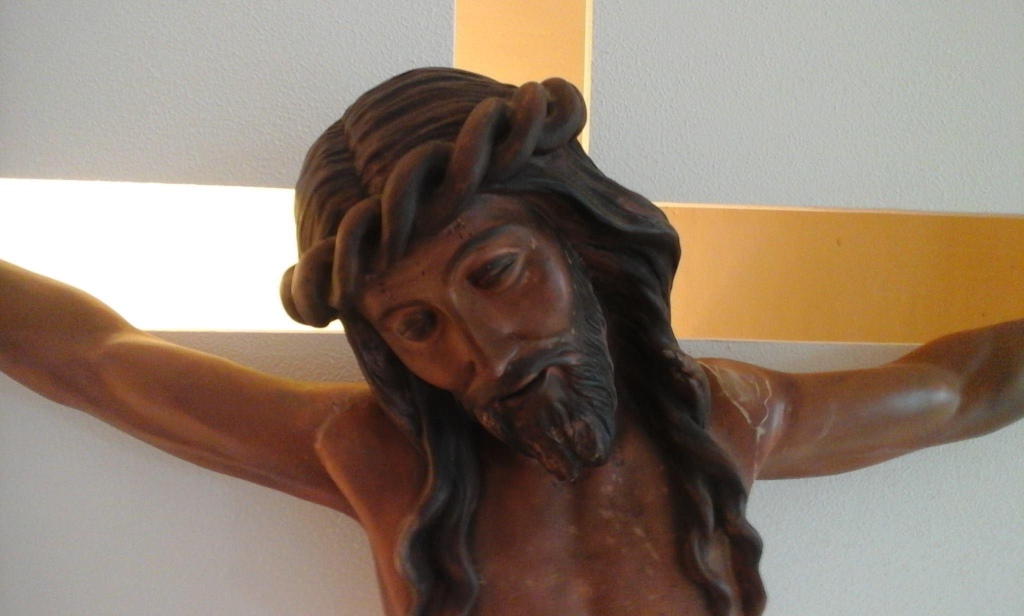
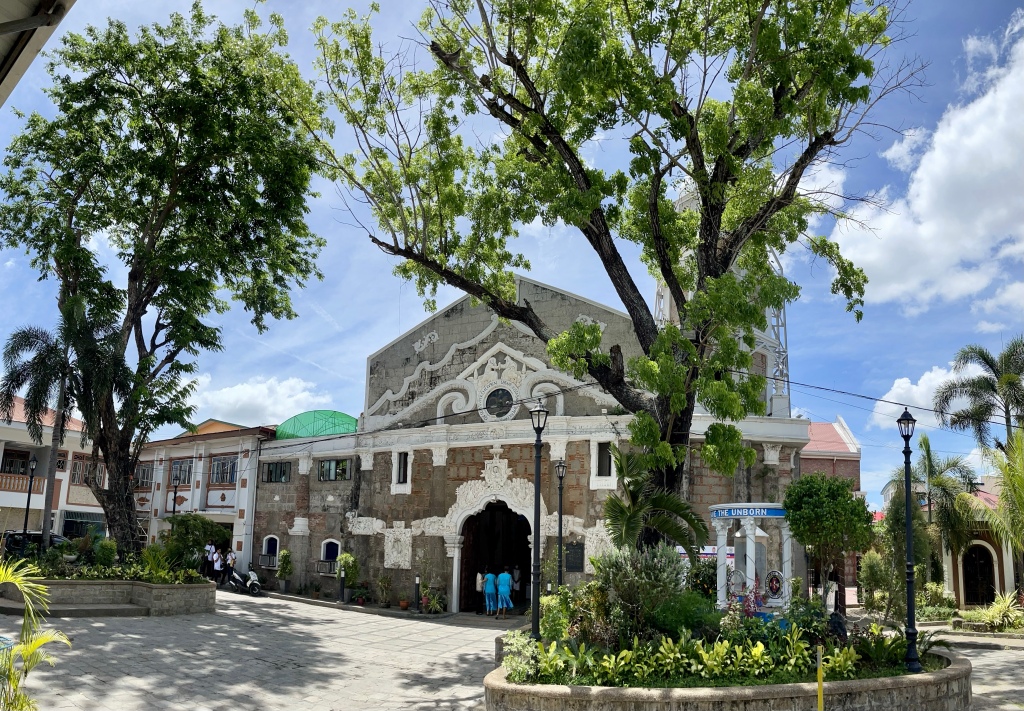
Photo by author, Chapel of the Holy Family, Sacred Heart Novitiate, Novaliches, Quezon City, 2014.
Standing by the cross of Jesus were his mother and his mother’s sister, Mary the wife of Clopas, and Mary of Magdala. When Jesus saw his mother and the disciple there whom he loved, he said to his mother, “Woman, behold, your son.” Then he said to the disciple, “Behold, your mother.” And from that hour the disciple took her into his home.
John 19:25-27
What a lovely scene we have at the foot of the Cross with our Lord Jesus Christ during His final moments, His Mother Mary, our “model disciple” and John, His “beloved disciple”. Both disciples standing for us all, Mary signifying the Mother Church, the Body of Christ, with us her children, each a beloved disciple of the Lord.
These words spoken by Jesus as He hung upon the Cross continue to be fulfilled in our own days in many concrete ways. These words are constantly repeated to both Mother and disciple, and each one of us today are called to relive them in our own life.
Every day we the disciples are called to take Mary as an individual and as the Church into our own home to carry out the Lord’s instructions by imitating her as a companion in the mission. Mary is actually the first disciple of the Lord because she was the first to welcome and receive Him at the Annunciation of His birth. Mary is also the first to truly believe in Jesus Christ when she “immediately” told Him how the newly-wed couple at Cana had ran out of wine. At the foot of the Cross, Mary is the first to remain in Christ, teaching us the most important aspect of discipleship which is intimacy in Jesus and with Jesus in prayer.
While preparing for this series, I wondered what was Mary really doing at the foot of the Cross of Jesus Christ? What were the thoughts running through her mind? What were the feelings and emotions forming, massing in her heart?
Notice the dignity of Mary in the face of extreme sorrow and suffering. She was standing firm, not seated, freaking out like crazy at the sight of her crucified Son. More than the tears and sorrow on her face as portrayed in arts, one can see this dignity of a woman and a disciples so absorbed in prayer, so united and close to Jesus our Lord!
How sad that many of us have forgotten this crucial aspect of discipleship Mary had shown us not only there at the Cross but from the very beginning until called to give birth to our Savior – a life centered on prayer which is more than reciting prayers but residing, dwelling, and communing in Jesus Christ.
Let us learn to be like Mary, to truly take her like the disciple whom Jesus loved by being intimate with Jesus and the Father in prayers. Keep in mind that her standing there at the foot of the Cross did not simply happen at the spur of the moment but a result, a fruit of her long periods of time spent in prayers, of communing with Jesus and in Jesus as the Mysteries of Light try to show us. Unlike most of us, we come only to Jesus at the Cross when we are in trials and difficulties but when everything is going on smoothly in life, we hardly prayed at all.
All her life, Mary lived in prayer. At the Pentecost, Mary was praying with the Lord’s disciples at the Upper Room in Jerusalem awaiting the coming of the Holy Spirit. Mary is the most beautiful reminder next to Jesus that discipleship is essentially prayer, that whatever we do is borne out of prayer.
Let us pray with the Blessed Mother Mary:
Our Lady of Sorrows,
pray for us your children,
especially your priests
who are supposed to be
the Lord's beloved disciples
to immerse ourselves in prayer
above all
because before all else came,
there was Jesus Christ who came first
calling us, sending us on a mission
to proclaim His Good News
of salvation to everyone.
Amen.
“Mater Dolorosa” also known as “Blue Madonna” (1616) by Carlo Dolci. Photo from Wikimedia Commons.
40 Shades of Lent by Fr. Nicanor F. Lalog II
Holy Monday, 03 April 2023
Isaiah 42:1-7 >>> + <<< John 12:1-11
“Ecce Homo” painting by Vicente Juan Masip (1507-1579) from masterapollon.com
How glorious and yet so
gentle of You, dear Jesus Christ
to be our Lord and Servant at
the same time!
This You shall show at the
Last Supper when You knelt
and washed the feet of the Twelve,
reaching its highest point when
You offered Yourself on the Cross.
Give us the grace to be like You, Jesus:
may we work for justice,
not crying out,
not shouting;
help us to be gentle like You,
not breaking a bruised reed
nor quench a smoldering wick;
may Your light shine upon us, Jesus,
enabling the blind to see,
prisoners free and those in darkness
see light with our life of
witnessing Your servanthood
through our loving service
to others
(cf. Isaiah 42:1-3, 7).
Do not let us serve You
only in lip-service like
Judas Iscariot in the gospel
when he commented how Mary's
oil used to anoint You could have been
sold with proceeds given to the poor
(John 12:4-5);
in everything I do,
in everything I say,
let it all be in the spirit of
love and charity
based on my hope and trust
in You, Lord Jesus,
my light and my salvation.
Amen.
Quiet Storm by Fr. Nicanor F. Lalog II
The Seven Last Words, 01 April 2023
Photo by author, Chapel of the Holy Family, Sacred Heart Novitiate, Novaliches, Quezon City, 2014.
When they came to the place called the Skull, they crucified him and the criminals there, one on his right, the other on his left. Then Jesus said, “Father, forgive them, they know not what they do.”
Luke 23:33-34
Such is “the breadth, and length, and depth, and height of Christ’s love for us all” (Eph. 3:18-19) that right upon His crucifixion, Jesus begged God for our forgiveness. And that was not only for those who nailed Him on the cross on that Good Friday but also for us today who continue to crucify Him whenever we destroy our relationships.
In the Jewish thought, “to know” is not just of the mind but of the heart because to know is to have or enter into a relationship with others. Hence, Jesus begged first for our forgiveness when crucified because if there is something we must “know” above all is the fact that we are brothers and sisters in Him, one family in God our Father.
Every time there is a breakdown in our relationships, when we destroy our ties with one another, that is when we sin and know not what we do. And crucify Jesus anew.
We sin and know not what we do when we hurt those dearest to us – our mom and dad, sisters and brothers, relatives and friends – when we speak harsh words to them, calling them names, denigrating their persons as things.
We sin and know not what we do when we betray the trust of those with whom we promised to love forever, keep their secrets and protect them like your husband or wife, your children, your BFF, your student, your ward.
We sin and know not what we do when we lose hope in persons around us, choosing to do them evil because we thought they could no longer change for better, that they could never learn and overcome life’s pains and tragedies, that they could no longer get well from an illness or, sadly, because they are old and dying.
We sin and know not what we do when we cheat on those true to us, when we hide from those open to us, when we back stab those who believe and support us.
We sin and know not what we do when we abuse and use those people we are supposed to serve and protect, when we regard persons as objects to be possessed even if we do not know them personally.
Is there anyone whom you might have hurt in words or in deeds which you might not be aware of?
Who are the people who cause you pains and sufferings, who do not know what they are doing?
Let us pray:
Lord Jesus Christ,
I am sorry in crucifying You again,
when I know not what I am doing
like hurting the people You give and send me
to experience your love and mercy,
your trust and confidence
your kindness and fidelity;
I pray also for those who make me
suffer physically and emotionally,
those who do not know what they are doing;
help us build again
our many broken relationships;
make us humble and true;
let us believe in Your love
expressed by our family and friends
and by everyone who cares for us.
Amen.
Photo above is a sculpture called “Love” by Ukrainian artist Alexander Milov he created in 2015 showing two adults after a disagreement sitting with their back to each other while their inner child in both of them wanting to connect. A beautiful expression of how we are all interconnected and related as brothers and sisters. This Holy Week, let us mend and heal our broken relationships, let the inner child within us come out and simply say “I am sorry” or “I forgive you” and most especially, “I love you”. Photo from reddit.com. See also our blog, https://lordmychef.com/2023/01/14/the-human-child-mystery-of-gods-love/.
Quiet Storm by Fr. Nicanor F. Lalog II
Holy Saturday, 16 April 2022
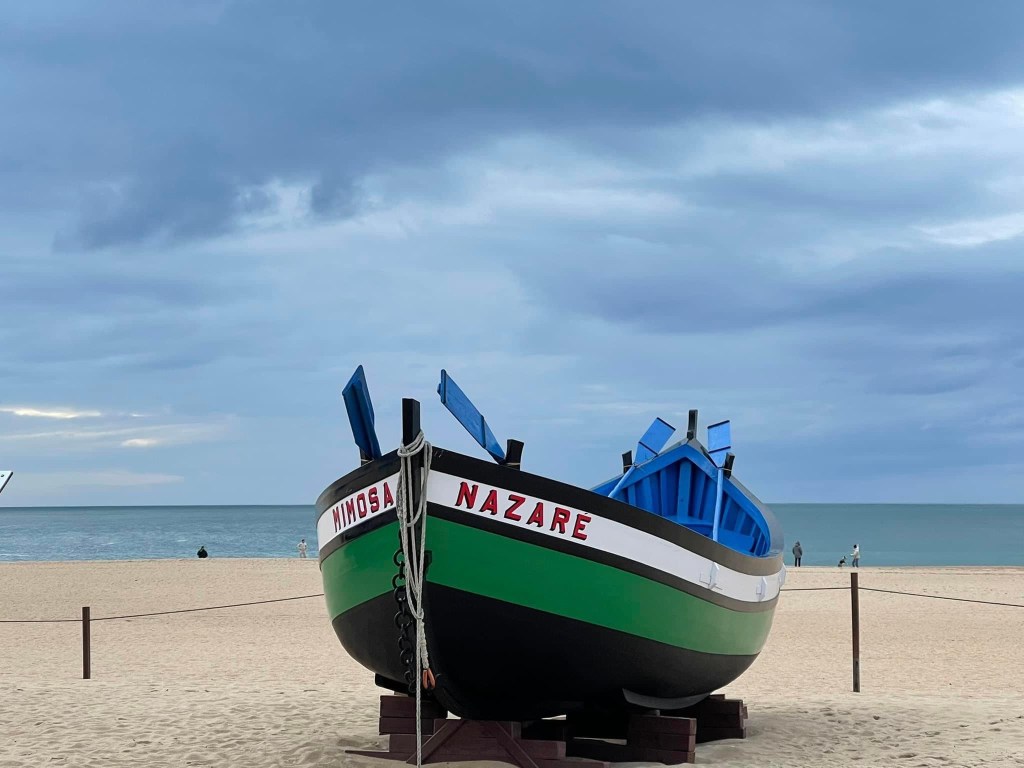
Photo by Dr. Mylene A. Santos, MD, at Nazare, Portugal March 2022.
A blessed Holy Saturday to you. One of the most unforgettable scenes of COVID-19 pandemic when it started in the summer of 2020 was like what we have every Holy Saturday or, as we aptly call, Black Saturday: empty spaces, empty buildings, with everything and everyone so silent.
Holiness is being at home with silence, the very language of God. In the bible, we find that in every revelation and appearance of God to man, it is always preceded by silence. Before everything was created, according to the Book of Genesis, there was great silence. In his prologue to the fourth gospel, John said “In the beginning was the word” – clearly, there was only silence – “and the word became flesh” (Jn.1:1, 14).
And when Jesus, the Word who became flesh, came, he was totally silent during his growing up years in Nazareth and when he stared his ministry, he would always go into prayers and silence.
On this Holy Saturday, the whole creation comes to full circle. In the beginning, after completing God’s work of creation, God rested on the seventh day and made it holy (Gen.2:3). On the seventh day after completing his mission here on earth, Jesus Christ was laid to rest.
Photo by Dr. Mylene A. Santos, MD, at Lourdes, France, March 2022.
Silence and rest always go together. To be silent is not merely being quiet but listening more to your voice coming from the depths of our being; hence, it is not emptiness but fullness with God, in God. It is in silence where we truly hear ourselves and others better.
On the other hand, to rest is not merely to stop work nor stop from being busy. We rest to reconnect with God to be filled with the Holy Spirit. In Filipino, to rest is magpahinga which means “to be breathed on”. To rest is therefore to be silent and be breathed on with the breath of God. Like in the creation of the first man who was breathed on by God to be alive; on the evening of Easter, Jesus came to visit his disciples locked in the upper room and after greeting them with peace twice, he breathed on them the Holy Spirit.
Holiness is therefore found in silence and in rest, when we listen more God and allow him to breathe on us that we are filled with him. And that is holiness as we have stated at the start of this series, which is not being sinless but being filled with God.
When we rest, we return to Eden, like the garden where Jesus was buried.
Now in the place where he had been crucified there was a garden, and in the garden a new tomb, in which no one had yet been buried. So they laid Jesus there because of the Jewish preparation day; for the tomb was close by.
John 19:41-42
Photo by author, garden beside Church of St. Agnes in Jerusalem, May 2017.
How beautiful is that image, of God’s rest and silence in Eden and of Jesus laid to rest at a tomb in a garden: to rest in silence is therefore to stop playing God as we return to him as his image and likeness again!
Maybe that is why many of us these days are afraid of silence because it is the realm of trust and of truth. We have always been afraid to trust and be truthful so that we crucify Jesus Christ over and over again.
Let us be like those women who rested on the sabbath when Jesus was laid to rest. That like them, we may trust God more by being true to ourselves even in the midst of this ongoing COVID-19 pandemic.
The women who had come from Galilee with him followed behind, and when they had seen the tomb and the way in which his body was laid in it, they returned and prepared spices and perfumed oils. Then they rested on the sabbath according to the commandment.
Luke 23:55-56
Silence is the domain of trust; people afraid of silence are afraid to trust.
It is said that the Sony Walkman is the most revolutionary invention in the last 40 years that had changed our way of life. It is not the computer. It is the Walkman, the ancestor of that ubiquitous ear pods, earphones and bluetooth everybody is wearing these days, having each one’s own world, unmindful of others.
Today let us cultivate anew the practice of silence, of listening to the various sounds around us and within us and most of all, trying to listen to the most faint, the softest sound that is often the voice of God, the sound of silence who reassures us always that in the midst of his silence, he never leaves us, that with him we are rising again to new life.
Help us to be silent today, O God our Father as we remember your Son Jesus Christ’s Great Silence – Magnum Silentium – when he was “crucified, died and was buried; he descended to the dead and on the third day he rose again.”
Breathe on us your Spirit of life and joy,
O God as we rest in you,
listening to your voice within us
so that we may follow always Jesus Christ's
path to Easter in the Cross.
Amen.
Photo by Dr. Mylene A. Santos, MD, Lourdes, France, March 2022.
Quiet Storm by Fr. Nicanor F. Lalog II
Holy Thursday, 14 April 2022
Exodus 12:1-8, 11-14 + 1 Corinthians 11:23-26 + John13:1-15
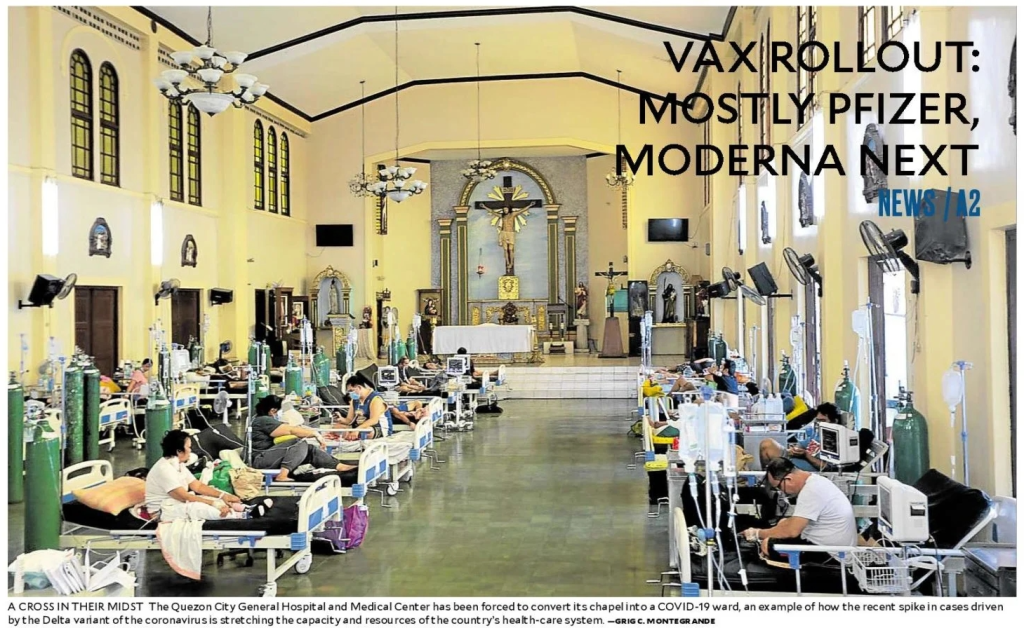
Photo from inquirer.net, 20 August 2021.
A blessed Holy Thursday everyone. Tonight we begin the most holiest days of the year, the Holy Triduum of the Lord’s Passion, Death, and Resurrection known as the pasch of the Lord. From the Hebrew word pesach, a pasch is a passing over, the journey of the Hebrew people from Egypt into the promised land of God.
A journey does not necessarily involve physical distance as it can be something within one’s self like an inner journey to God dwelling within us. Journey is a process that leads us to growth and maturity from the many difficulties and trials we experience as we travel in life.
And whatever journey we take outside or within ourselves, we always need a companion to travel with. From the Latin words cum panis that literally mean “someone you break bread with”, a companion is someone who helps us in our journey, a friend who shares life with us, guiding us, protecting us. Like the bread we break and share, a companion sustains and nourishes us in our journey.
That is exactly the companionship of Jesus which is holiness. Having Jesus as our companion in life’s journey is to have him as our daily Bread who fills us with God in every celebration of the Holy Eucharist. I used to tell our students in elementary school that every Mass is a journey into heaven, a dress rehearsal of our entrance into heaven when we have a foretaste of eternal life we all hope for until Christ comes again. That is why last Tuesday we said the first test of our fidelity in found in our celebration of the Sunday Eucharist.
We are all travellers and journeyers on earth; our true home is in heaven with God our Father. We are merely passing over this planet temporarily. That is why we always say life is a daily lent, a daily passing over.
By celebrating the Lord’s Supper that Thursday evening with his disciples who represented all peoples of all time, Jesus established for us the everlasting memorial of his loving presence as our companion and our very Bread and Wine in the journey back to the Father that is often dark and difficult.
What he did that Thursday evening foreshadowed what he would do on Good Friday when he did his greatest act of love for us by dying on the Cross. What is most beautiful meaning we can find here is the importance of communion, of oneness as a community, as a family that are expressions of our companionship in Jesus. Every journey becomes wonderful when done in the context of a community, with true companions beginning in our very family.
At the very core of every companionship, of every community is LOVE. To become bread for someone in a journey is to become LOVE – like Jesus Christ at the last supper.
Love can never be defined for it has no limits; love can only be described like how Jesus described to us in his actions on that night of his supper, his kind of love we all must emulate:
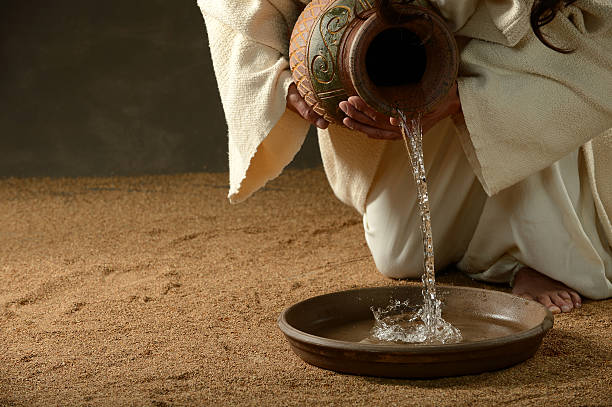
So, during supper, fully aware that the Father had put everything into his power and that he had come from God and was returning to God, he rose from supper and took off his outer garments. He took a towel and tied it around his waist. Then he poured water into a basin and began to wash the disciples’ feet and dry them with the towel around his waist.
John 13:3-5
Photo from GettyImages/iStockPhotos.
During the time of Christ, restaurants were stops not only for meals but for rest that consisted of soaking their feet on a basin of water. It was therapeutic that gave travelers enough strength to travel far again as there were no other modes of transportation at that time and not everybody could afford an animal to ride on. Any hiker and mountaineer can attest that after so much trekking, one thing you would always hope for is a stream or tiny brook with cool, crisp, running water to dip your feet and rest!
This Holy Thursday, let us be a companion in Jesus Christ with others, beginning with our family members. Do not get tired of being broken and shared like bread, of loving and caring when the journey becomes so tiring like in this time of pandemic that seems to be still far from over.
“Do you realize what I have done for you? You call me ‘teacher’ and ‘master,’ and rightly so, for indeed I am. If I, therefore, the master and teacher, have washed your feet, you ought to wash one another’s feet. I have given you a model to follow, so that as I have done for you, you should also do.”
John 13:12-15
Lord Jesus Christ,
may we never get tired
walking in love
as a companion and
bread to one another like you
by giving rest to others
already tired and about to give up.
Let us all be together in welcoming Easter!
Amen.
Quiet Storm by Fr. Nicanor F. Lalog II
Holy Tuesday, 12 April 2022
Isaiah 49:1-6 + John 13:21-33, 36-38
Photo by Ms. Ria De Vera, Christ the King Procession, 2020.
Maybe so many times you have felt nothing seems to be happening with all your efforts in school or office, in your relationships, and even in your prayers and devotions. Everything seems to be going to nothing at all.
Have a heart. Just be faithful in your studies, in your work, with your family and friends, most especially with God.
Though I thoughts I had toiled in vain, and for nothing, uselessly, spent my strength, yet my reward is with the Lord, my recompense is with my God.
Isaiah 49:4
When I was still a seminarian, there was a moment after our class when I went straight into our chapel and slouched on a pew, complaining and whining to God for the many problems that never stopped coming my way despite my efforts to be good. With my head bowed down, I had a litany of complaints to God that I felt like packing my things, go home and forget all about the priesthood. But after getting tired with my monologue and as I raised my head, something struck me that I felt so good while looking at our huge image of the Crucifixion at the altar of the chapel. As I looked in silence, I felt myself praying,
"Lord Jesus Christ,
before all these pains and sufferings came,
before all these problems happened,
you were there first on the Cross -
suffering for me, dying for me first."
Photo by author, ICMAS Chapel (Theology Dept.), 2020.
My dear friends, holiness is being faithful to God in Jesus Christ. St. Mother Teresa perfectly said that, “We are called to be faithful, not successful.” In my 24 years in the priesthood, I have realized that many times, our success are actually failures with God while our failures are what he often considers as success!
Of course, we need to plan and set goals in life and in work but we need to focus more on Jesus Christ as center of our lives, trying to see everything in his light not in our own limited views and perceptions. There so many things in life that cannot be quantified like our spiritual and emotional well-being on which actually depend many of our other aims in our personal and professional life.
Notice how in our gospel today the Apostles were so focused on themselves instead with Jesus that they totally missed what he was telling them about his coming betrayal by “one of them”. Particularly interesting was Simon Peter who asked the beloved disciple, John, to clarify it with Jesus since he was seated closest to him.
He leaned back against Jesus’ chest and said to him, “Master, who is it?” Jesus answered, “It is the one to whom I had the morsel after I have dipped it.” So he dipped the morsel and took it and handed it to Judas, son of Simon the Iscariot. After Judas took the morsel, Satan entered him. So Jesus said to him, “What you are going to do, do quickly.” Now none of those reclining at table realized why he said this to him.
John 13:25-28
Did you see the comedy, the humor?
Everybody was so focused on everyone and with each self except with Jesus! Were they so dumb not to understand the words of Jesus that to whomever he would give the morsel dipped in wine is the one who would betray him? Not really. Most likely, they were not listening, they were not focused on Jesus but with their very selves.
Being faithful is first of all being focused on God, in Jesus.
How can God fill us with his holiness when our thoughts and our being are always somewhere else or with somebody else? How can God fill us with his holiness when we cannot spend time with him every day in prayer?
Photo by author, Mass by the shore of Galilee, the Holy Land, 2017.
How lovely is the context of Simon Peter’s question that it happened during their Last Supper because that is where our fidelity to God is first nurtured to grow and deepened – at the Holy Eucharist of the Mass.
Remember, the minimum requirement for anyone to be called a good, practicing Catholic is to go Mass every Sunday. That is the most minimum but, have we kept it? It has been more than two months since we returned to alert level 1 in this time of the pandemic with almost everybody going to the malls and many vacation spots but what a shame when many still refuse to go to churches for the Sunday Mass!
Being faithful to Jesus to become holy begins with the Sunday Eucharist where we are nourished by the words of God and by the Body and Blood of Jesus Christ himself who enables us to overcome the many trials and difficulties of this life and make it into the Father’s house in eternity.
Have you gone back to your parish church for the Sunday Masses?
Forgive us, Lord Jesus Christ,
for being unfaithful to you,
for betraying you like Judas Iscariot
right in the context of the Holy Eucharist
when we skip Sunday Masses;
when we come to Mass not for you
but for our friends to whom we listen more;
and most especially when we refuse or fail
to practice the essence of the Eucharist
of sharing the love of Christ to everyone.
Amen.
Photo by author, Parish of St. John the Baptist in Calumpit, Bulacan, 31 March 2022.
Quiet Storm by Fr. Nicanor F. Lalog II
Holy Monday, 11 April 2022
Isaiah 42:1-7 + John 12:1-11
Photo from Pinterest.
A blessed Holy Monday to you and your loved ones!
Every year beginning with the Palm Sunday of the Passion of the Lord until the morning of Holy Thursday, the Church has regarded since the fourth century these days as holy and sacred in commemoration of the Lord’s Passion in Jerusalem.
These days, people frown and withdraw from any discussions about holiness, believing it is just for a selected few like saints and angels, and religious men and women like priests and nuns. For many, holiness is being sinless like God.
Not really.
The word holy came from the Greek holos meaning whole or perfect; holiness is being filled with God who fills in the gaps and broken corners in us, making us whole, a person of integrity and character. Holiness is an ongoing process, never a one-shot deal. That is why Jesus said “be perfect (or holy) as your heavenly Father is perfect (or holy).”
Photo by Ezra Acayan/Getty Images.
One beautiful aspect of holiness is being gentle, something that has become so rare in our highly competitive world today. Jesus described himself as being “humble and gentle of heart” in whom we can find rest for his “yoke is easy” and his “burden is light” (cf. Mt. 11:29).
Being gentle means being open to everyone, especially those burdened in life like the poor and the sick, the elderly, the orphans, the widowed, the marginalized.
Being gentle is to be welcoming or hospitable and caring of others instead of threatening and indifferent. Hospitality is from the Latin word hospis which means to welcome like hospital while hostility is from the Latin word hostes which means to hostage.
Just like Jesus who was prefigured as the Suffering Servant in today’s first reading described by God as one who “shall bring forth justice to the nations, not crying out, not shouting, not making his voice heard in the street. A bruised reed he shall not break, and a smoldering wick he shall not quench” (Is.42:1-3).
Photo by author, Sacred Heart Center for Spirituality, Novaliches, QC, 2016.
In our world where everyone has all the means to be heard and seen loudly and clearly in high definition, gentleness has become so rare, almost extinct! Lahat na lang “mema” may masabi. What is sad is how we speak and get our messages across in every media platform, from the simple text messages to the giant tarps and screaming stickers on vehicles that are always harsh and laden with insults and sarcasms.
In this world where “size always matters” while power is expressed in force and violence, gentleness is being one with the weak and the suffering, the broken ones like the “bruised reed” that the Suffering Servant “would not break or smoldering wick he shall not quench.”
Wherever there is gentleness, there is always hospitality, there is God; without gentleness, we get hostilities like war and violence.
See the attitude of Jesus in today’s gospel, how he welcomed Mary at a dinner in Bethany who anointed his feet with a liter of costly perfumed oil and later dried them with her hair that the house was filled with fragrance. Notice the hostile attitude of Judas Iscariot pretending to care for the poor when he asked “Why was this oil not sold for three hundred days’ wages and given to the poor?” (Jn.12:5).
Jesus simply told Judas to leave Mary alone with what she was doing that was a preparation for his burial soon to happen, adding, “You always have the poor with you, but you do not always have me” (Jn.12:8).
Very loaded words from the Lord, telling us to be gentle with everyone’s devotion and expression of faith and love in God while reminding us all how the poor must always be welcomed and cared for even after he had gone back to the Father.
Photo by author, Sacred Heart Center for Spirituality, Novaliches, QC, 2016.
Gentleness is more than offering a seat to an elderly or opening the door for a woman; being gentle is having that disposition to care for everyone, consciously guarding against hurting them physically and emotionally.
Gentleness is holiness because it is an act of loving others, of finding Christ in everyone because whatsoever you do to the least of his brethren, that you do unto him.
There is a beautiful saying I have found from an unknown author who said “if you have love in your heart, you have been blessed by God; if you have been loved, you have been touched by God.” So many among us could not know nor experience God because many of us refuse to be gentle with everyone; many could not understand nor imagine a loving and merciful God when everybody is hostile and violent.
This Holy Monday, let us examine ourselves, our attitude with others, if we have been welcoming, hospitable and caring. It costs us nothing to adjust ourselves, to be more gentle in words and in deeds – and looks, too! It could be your step closer to simple holiness as God fills you with himself in Christ who is humble and gentle of heart.
Lord Jesus Christ,
teach us to be gentle like you;
make us feel more our being human
and stop feeling superior with others,
always analyzing, always thinking
that in the process we have forgotten
to feel the persons around us.
Make us gentle in our thoughts
and in our words. Amen.
The Lord Is My Chef Breakfast Recipe for Holy Saturday, 03 April 2021
Photo by author, sunrise at the Dead Sea, the Holy Land, 2019.
Help us to be silent today, O God our Father as we remember your Son Jesus Christ’s Great Silence – Magnum Silentium – when he was “crucified, died and was buried; he descended to the dead and on the third day he rose again.”
On this Holy Saturday, your whole creation comes to full circle. In the beginning, after completing your work of creation, you rested on the seventh day and made it holy (Gen.2:3). On the seventh day after completing his mission here on earth, Jesus Christ was laid to rest.
Silence and rest always go together.
To be silent is not merely being quiet but listening more to your voice coming from the depths of our being; hence, it is not emptiness but fullness with you, dear God. It is in silence where we truly discover our selves and others too.
On the other hand, to rest is not merely to stop work nor stop from being busy. We rest to reconnect with you to be filled with your Holy Spirit. You do not actually rest, O God, because you never get tired; it is us who need to rest so we may continue your work of creation and, now of redemption and renewal by Jesus Christ.
When we rest, we return to Eden, like the garden where Jesus was buried: “Now in the place where he had been crucified there was a garden, and in the garden a new tomb, in which no one had yet been buried. So they laid Jesus there because of the Jewish preparation day; for the tomb was close by”(Jn. 19:41-42).
How beautiful is that image, O dear Father, of your rest and silence in Eden and of Jesus laid to rest at a tomb in a garden: to rest in silence is therefore when we stop playing God as we return to you as your image and likeness again!
Maybe that is why many of us these days are afraid of silence because it is the realm of trust and of truth. We have always been afraid to trust you and be truthful to you and ourselves that have caused the crucifixion and death of Jesus Christ.
Teach us to be like those women who rested on the sabbath when Jesus was laid to rest. That like them, we may trust you more by being true to ourselves even in the midst of a raging second wave of COVID-19 this Holy Saturday.
May your silence and rest reassure us that we shall rise with you again. Amen.
The women who had come from Galilee with him followed behind, and when they had seen the tomb and the way in which his body was laid in it, they returned and prepared spices and perfumed oils. Then they rested on the sabbath according to the commandment.
The Lord Is My Chef Easter Triduum Recipe by Fr. Nicanor F. Lalog II
Maundy Thursday, 01 April 2021
Exodus 12:1-8, 11-14 ><)))*> 1Corinthians 11:23-26 ><)))*> John 13:1-25
"A journey of a thousand miles
begins with a single step."
- Lao Tzu
We often hear and use this wise saying that is also most applicable to our celebration of the Holy Triduum of the Lord’s Passion, Death and Resurrection also known as the “Sacred Paschal Triduum”.
From the Hebrew word pesach, a pasch is a passing over. It is a journey which is a long trip taken over long period of time to different places. A journey does not necessarily involve physical distance as it can be something within one’s self like an inner journey to God dwelling within us. Hence, a journey is also a process that leads us to growth and maturity from the many difficulties and trials we experience as we travel, entailing a lot of sacrifices from us.
And whatever journey we take outside or within our selves, we always need a companion to travel with. From the Latin words cum panis that literally mean “someone you break bread with”, a companion is someone who helps us in our journey, a friend who shares life with us, guiding us, protecting us. Like the bread we break and share, a companion sustains and nourishes us in our journey.
Let us keep these three words of journey, companion, and bread in reflecting our celebration tonight of the Lord’s Supper that begins the Sacred Triduum.
We are all pilgrims on a journey to heaven
More than 40 days ago on Ash Wednesday, we said Lent is a daily journey to Easter where we find our very selves, others, and God who is our ultimate origin and end. It is a journey that reaches its summit in the Holy Eucharist where we make present the pasch or passover of Jesus Christ
Every Mass is a journey into heaven, a dress rehearsal of our entrance into heaven when we have a foretaste of eternal life we all hope for until Christ comes again. It is the Passover of the New Testament, a perfection of the Jewish Passover when God’s chosen people led by Moses went into exodus from Egypt into the Promised Land.
This “heavenly” journey had its ancient roots among nomadic Semites who used to celebrate a feast on the first full moon of spring as they prepared to lead their flocks to summer pastures. They ate a roasted lamb from the flock with unleavened bread and bitter herbs. It was an important event of migration filled with many dangers for those nomads who marked their tent-pegs with the blood of the lamb to keep their journey safe.
Eventually this found place in the Jewish Passover which we heard in our first reading when God told his chosen people to begin their journey of exodus from Egypt “on the tenth of their first month” that happens on the second full moon of the spring equinox.
Notice that it happens at night that is coincidentally the usual start of every journey we usually make!
Before their Exodus, each family was told to roast an unblemished lamb to be eaten with unleavened bread and bitter herbs “with your loins girt, sandals on your feet and your staff in hand, you shall eat like those who are in flight. It is the passover of the Lord” (Ex.12:11). It has to be done in a hurry, as in a flight, a journey.
And to keep them safe in their journey, God instructed them to paint their door posts with the blood of the slaughtered lamb so that when his angel comes at night to strike death of every first born male child and animal, their homes would be “passed over” and be saved from death that night.
We are all travelers and journeyers on earth;
our true home is in heaven with God our Father. We are merely "passing over" this planet temporarily.
Photo by author, Egypt, 2019.
Jesus our companion and family in the journey
The Jewish Passover or Exodus became the actual event of God’s covenant with Israel as his people on a journey to their Promised Land. Unfortunately, they would break this covenant with God so many times that it would take them 40 years of wandering in the desert before finally got into the Promised Land.
And their stubbornness continued when they would always turn away from God with sins that led to the division of their nation until its conquest by foreign powers that led them anew into another exile. God would restore them as a nation but, again, they would turn away from him until the Romans ruled over them when Jesus came to perfect God’s covenant.
In perfecting and fulfilling the Jewish Passover, Jesus became the new and everlasting Lamb, perfect without any blemish, offering himself to God for the forgiveness of our sins and our liberation from all forms of evil especially sickness and death. It is no longer the blood of the lamb that we now offer but Jesus Christ’s Body and Blood which he established in the Sacrament of the Eucharist “on the night before he was betrayed” on Holy Thursday.
By celebrating the Lord’s Supper that Thursday evening with his disciples who represented all peoples of all time, Jesus established for us the everlasting memorial of his loving presence as our companion and our very Bread and Wine in the journey back to the Father always filled with darkness and sufferings.
What he did that Thursday evening foreshadowed what he would do on Good Friday when he did his greatest act of love for us by dying on the Cross at about 3PM, the same time when the lambs were being slaughtered in the temple for the coming passover feast.
Brothers and sisters: I received from the Lord what I also handed on to you, that the Lord Jesus, on the night he was handed over, took bread, and, after he had given thanks, broke it and said, “This is my body that is for you. Do this in remembrance of me.” In the same way also the cup, after supper, saying, “This cup is the new covenant in my blood. ?Do this in remembrance of me.”
1 Corinthians 11:23-25
Here we find again the darkness of the night as the beginning of our journey back to God perfected by Jesus Christ as our companion and very bread of life to sustain and nourish us.
What is most beautiful meaning we can find here is the importance of communion, of oneness as a community, as a family.
In the Old Testament, God instructed his people to take the passover meal together as a family; at the Lord’s supper, Jesus celebrated it with his “friends”, the Twelve Apostles. Even Judas Iscariot was present at the start but had to leave in the “darkness of the night” when he broke off from the unity of Jesus.
Perhaps, one reason why we are again together this Holy Thursday not in churches but in our homes, with our family so we may be one again in Jesus Christ in prayers and celebrating Mass on-line.
Therefore, do not be a Judas Iscariot! Go back to your family, to your loved ones – your most faithful and truest companions in this journey of life. You’ll never get to heaven, as Dionne Warwick sang, if you break somebody’s heart, when you refuse to love by turning your back from those who love you.
Holy Thursday reminds us in the Eucharist that no one is saved alone. Every journey becomes wonderfulwhen done in the context of a community, with true companions beginning in our very family.
Photo from wikipediacommons.org of Christ’s washing of feet of Apostles at Montreale Cathedral in Palermo, Italy
The commandment of love
Completing the picture of our celebration tonight with the key concepts of journey, companion and bread is LOVE, the very essence of everything in this life, the reason why we are in a journey in the first place since the Exodus up to this time.
At the very core of every companionship, of every community is LOVE.
To become bread for someone in a journey is to become LOVE.
Jesus Christ as the bread broken, as the cup of wine shared is essentially LOVE.
Love can never be defined but merely described.
And on the night before he was betrayed, Jesus described to us in his actions a very beautiful expression of his love we all must imitate:
So, during supper, fully aware that the Father had put everything into his power and that he had come from God and was returning to God, he rose from supper and took off his outer garments. He took a towel and tied it around his waist. Then he poured water into a basin and began to wash the disciples’ feet and dry them with the towel around his waist.
John 13:3-5
When Jesus washed his disciples’ feet, he showed us one beautiful aspect of LOVE which is tenderness.
Yes, I have been speaking about tenderness lately as something we badly need these days of the pandemic. Tenderness is an expression of love when we realize amid our own suffering the sufferings of others too. To be tender and loving amidst many sufferings is to offer rest to fellow journeyers like what Jesus did on that Holy Thursday evening.
Again, we find here something prevalent during that time which is the concept of “restaurants” where travelers used to stop during their journey not only to eat but to rest that meant soaking their feet on a basin of water. It was therapeutic that gave travelers enough strength to travel far again.
Remember there were no other modes of transportation at that time and not everybody could afford an animal to ride on. Any hiker and mountaineer can attest that after so much trekking, one thing you would always hope for is a stream or tiny brook with cool, crisp, running water to dip your feet and rest!
Photo by Mr. Raffy Tima of GMA-7 News, April 2020.
Everybody is tired of this journey in the pandemic, almost exhausted.
What a shame especially when local officials like that one who refused food delivery because she considered the lowly lugaw as non essential. Lest we forget, Jesus chose one of the most lowly food, the unleavened bread, as the sign of his loving presence among us until the end of time when he comes again.
Indeed, this could be the holiest Holy Week of our lives in this most unholy time of history as it gives us great opportunities to love.
Just be tender with those around you!
Never get tired of loving, of understanding, of caring as everyone is already tired with this journey of ours in the pandemic that seems to be still far from over.
“Do you realize what I have done for you? You call me ‘teacher’ and ‘master’, and rightly so, for indeed I am. If I, therefore, the master and teacher, have washed your feet, you ought to wash one another’s feet. I have given you a model to follow, so that as I have done for you, you should also do.”
John 13:12-15
One of the most moving images of the pandemic for me lately is the one taken by our parishioner on the first day of the ECQ last March 22 when our Parochial Vicar, Fr. Howard John celebrated Mass without a congregation. He said, “the table of the Lord is full, but the pews are empty.”
And that is what we will continue to do in this pandemic. Even without the people, we shall continue to journey in Christ by still celebrating the Mass to give us all nourishment and sustenance and rest in this prolonged journey in the pandemic.
May we never get tired walking in love as a companion and bread to one another in Christ and like Christ by giving rest to others already tired and about to give up. Let us all be together in welcoming Easter! Amen.
El anda que en amor ni cansa ni se cansa.
(The soul that walks in love neither tires others nor grows tired.)
Saint John of the Cross
Photo by Ms. Kysia Cruz, National Shrine of Our Lady of Fatima, Valenzuela City.
40 Shades of Lent by Fr. Nicanor F. Lalog II
Holy Tuesday, 30 March 2021
Isaiah 49:1-6 ><}}}*> John 13:21-33, 36-38
Photo by author, December 2020
Though I thought I had toiled in vain,
and for nothing, uselessly, spent my strength,
yet my reward is with the Lord,
my recompense is with my God.
(Isaiah 49:4)
So many times, dear Father in heaven, I feel like your “Suffering Servant” feeling that nothing is happening with all my efforts, with things I persevere, as if they are all useless until I realize what matters most is my being faithful to you.
Thank you for the sign of the Cross of Jesus Christ your Son, our Lord and Master: when things become so difficult and frustrating for me, I just look at him there on the cross, “dead” like me who had failed in your mission.
But as I contemplate his Cross, I remember how before all my sadness and sufferings, Jesus was there first for me to be good with others, to be kind, to be understanding, to be merciful and forgiving, to be patient, and most of all, first to be holy in being faithful to you and your call, Father.
Remind me the words of St. Mother Teresa of Calcutta that we are called to be faithful, not successful.
Let me focus more on you, Lord, instead of wondering how I have been doing, how good I have been.
Let me stop competing with others, asking who is not faithful to you, who is going to betray you like Peter during the last supper when he told the beloved disciple to clarify it with Jesus:
He leaned back against Jesus' chest
and said to him,
"Master, who is it?"
(John 13:25)
How lovely is the context of that question when what we must contemplate with is whether we have been faithful to Jesus in his Holy Eucharist.
How sad, O dear Father, that we are most unfaithful to you when we betray you right in the Eucharist – when do not listen to your words and message to us, when we do not live and practice the essence of thanksgiving to you by being faithful in witnessing Christ’s sacrifice on the Cross in our daily lives. Amen.