Isaiah 25:6-10 ><)))*> ><)))*> ><)))*> Matthew 15:29-37
The Manor House, Camp John Hay, Baguio City, 2017.
Praise and glory to you, O Lord Jesus Christ for coming to us, in fulfilling our lives, in making our joy complete. Unfortunately, no one seem to be waiting for you or worst, we live as if you have not come at all.
How sad, O Lord, that often even if we are so excited with Christmas, it does not necessarily mean we are excited of you as a person coming to us. Even if we love to sing and hear that carol “Joy to the World”, we are not really joyful because our hearts are far from you.
Forgive us, Jesus, in being focused with time and dates, than with your person and with your coming.
The more we get focused with dates and gifts and carols and other trimmings of Christmas, the less we think of you and of others too.
Open our hearts to receive you in us.
On that day it will be said: “Behold our God, to whom we looked to save us! This is the Lord for whom we looked; let us rejoice and be glad that he has saved us!” For the hand of the Lord will rest on this mountain.
Isaiah 25:9-10
Open our hearts to you, Jesus, that you are more than enough than anything we could wish for.
Make us desire more of you than of things so we may always have an abundance of you as our “bread” or everything in this life. Amen.
2 Maccabees 7:1, 20-31 ><)))*> <*(((>< Luke 19:11-28
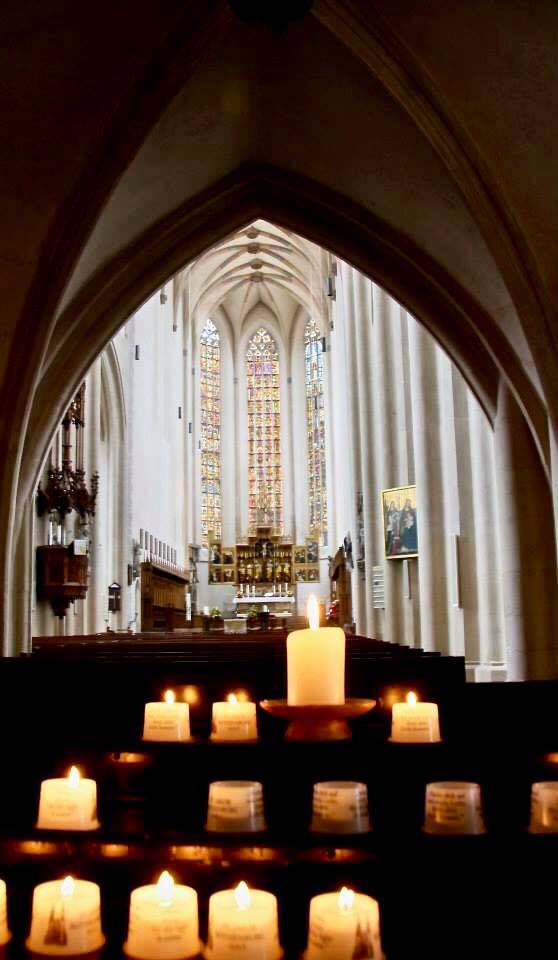
Candle and ordo in our sacristy, 17 November 2019.
Today’s first reading is very interesting, Lord, especially that part describing the disposition of the mother of the seven Maccabean brothers facing execution:
Filled with a noble spirit that stirred her womanly heart with manly courage, she exhorted each of them in the language of their forefathers…
2 Maccabees 7:21
I really wonder the meaning of “womanly heart with manly courage” but something tells me it is exactly what we need these days.
A womanly heart is a faithful heart, like a mother who would never forsake her child (Is. 49:15). It is a heart willing to bear all pains in life, suffering in silence, totally empty for the beloved and filled with God.
In this age of “instants” where lines are always moved to accommodate our whims and selfish desires, we need a womanly heart that is rooted and inclined to you O God.
Like the mother of the Maccabean brothers, she freely gave up her sons and exhorted them to look more intently to you, God, than to her herself, insisting that in the end, we are all answerable to you alone, O Lord.
Our sacristy table, 17 November 2019.
Manly courage, on the other hand, Lord is perhaps our ability to muster our strength to be truthful about our very selves.
It is something that still pertains to the heart because the word “courage” is from “cor” or heart.
A manly heart is a sincere heart that gallantly accepts one’s limitations than pretend to be somebody else.
In our suffocating world of social media where everybody is blowing out of proportion everything including one’s self, it is very ironic that while everybody claims to be the best, the more our lives are in a mess.
Like those servants in your parable, O Lord, grant us a manly heart so we may graciously accept our role and mission in this life to please you than pretend to be somebody else who really has nothing at all. Amen.
Photo by the author. Baguio City Cathedral, January 2019.
We have reflected last Sunday that prayer is an expression of our faith.
Where there is faith and prayer, there is always love.
And when we have prayer, faith and love, we have a relationship and community of two or three and more persons together as one, rooted in God.
Today we hear another parable by Jesus only St. Luke has, that of the Pharisee and the tax collector to show us another dimension of faith expressed in prayer.
Photo by the author at the Wall of Jerusalem, May 2017.
Like last week, St. Luke tells us anew the Lord’s purpose in narrating this parable:
Jesus addressed this parable to those who were convinced of their own righteousness and despised everyone else.
Luke 18:9
Were you moved or affected in any way upon hearing our parable today?
Did you feel a silent but swift, sharp thud inside your heart while your mind tried to reason out that the parable is not meant for you?
Listen again and pause, let the Lord’s words sink deeper into your heart:
“Two people went to the temple area to pray; one was a Pharisee and the other was a tax collector. The Pharisee took up his position and spoke this prayer to himself, ‘O God, I thank you that I am not like the rest of humanity — greedy, dishonest, adulterous —- or even like this tax collector. I fast twice a week, and I pay tithes on my whole income.’ But the tax collector stood off at a distance and would not even raise his eyes to heaven but beat his breast and prayed, ‘O God, be merciful to me a sinner.’
Luke 18:10-13
If prayer creates a relationship, Jesus is teaching us today the right attitude we must have to keep this communion we have in faith and love. Any relationship is bound to fail, or would not even exist at all despite the formalities of having ties and links like what we see or even have in our various social circles where roles are just acted out.
We call it “plastic” or fake. Untrue!
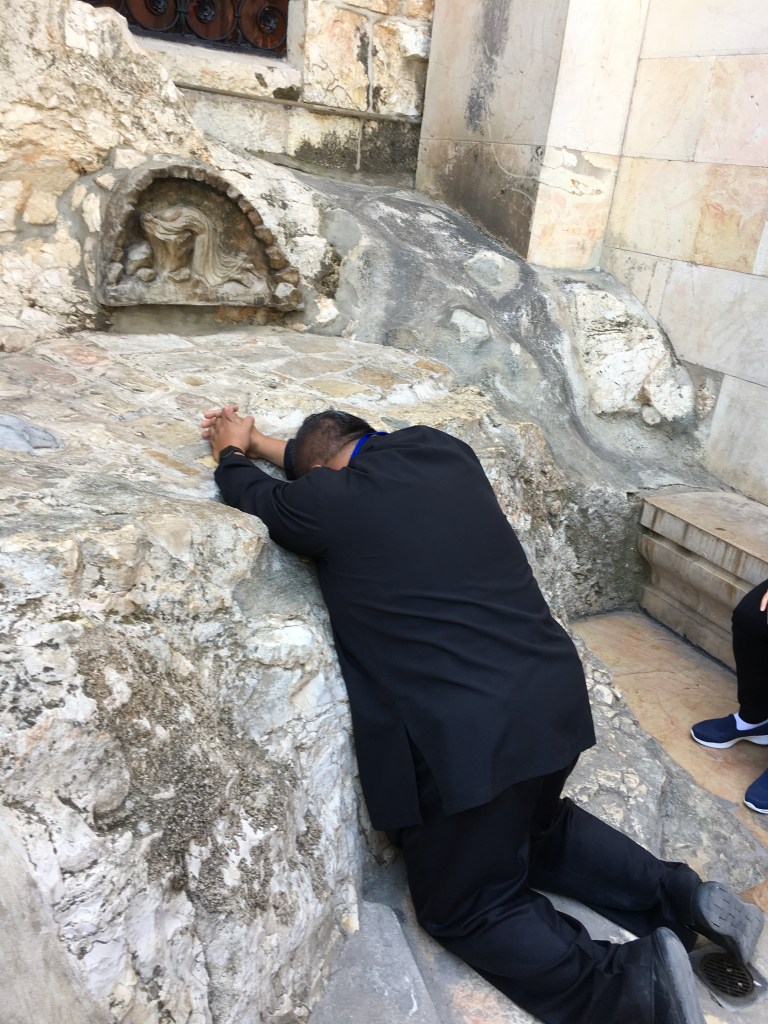
Praying at the Garden of Gethsemane, May 2019.
Prayer to be efficacious like any relationship must always be true.
Here Jesus directs our attention in the “where” when we pray – not just the location or locus of our prayer but our “place” in that relationship first with God who is our very foundation.
When all we see is our self in prayer like in any relationship, there is always a problem. It is clearly a one way street, a monologue.
Worst of all, it is an indication of the absence of God or even others because the pray-er is so preoccupied with his or her very self!
The Pharisee was clearly not in God even if he were in front of the temple. His very self was very far from God and all he had was his bloated ego. He may be a very pious person but not really good at all for he has no space for God and for others. He is a very closed man without any room for others.
The tax collector, on the other hand, may be physically far outside the temple but was the one actually nearest to God with his self-acceptance and ownership of his sinfulness, of his need for God. He was closest to God because he was more open with God and with others by admitting his own sinfulness.
Again we find the key to tis Sunday’s parable towards the end:
(Jesus said) ‘I tell you, the latter (tax collector) went home justified, not the former; for whoever exalts himself will be humbled, and the one who humbles himself will be exalted.'”
Luke 18:14
Photo by Dra. Mai B. Dela Pena, Germany, 2016.
Prayer is more than entering a church or a prayer room, or finding our most suitable spot or space to pray.
Prayer is being one with God, of being suffused in God.
“Where” are we when we pray?
First, we become one with God, one in him in prayer when we first admit our sinfulness, when we confess our sins to him, and own them without any “ifs” and “buts”.
God always comes to those who truly open themselves to him by emptying themselves of their sins and inadequacies.
The tax collector was justified in his prayer more than the Pharisee because in confessing his sins, he admitted his need for God. He knew very well his place, so unlike the Pharisee who felt God owes him so much!
When Pope Francis granted his first media interview (to their Jesuit Magazine!), the first question asked of him was, “who is Jose Mario Bergoglio?”
The Holy Father quickly answered, “I am a sinner.”
No wonder when he was elected Pope on March 13, 2013 at the Vatican, he first asked for prayers from the huge crowd gathered before he bestowed his apostolic blessing to them. It clearly showed that despite his holding the highest post in the Church, he considers himself a sinner, so weak needing prayers from the people.
I always tell couples during weddings that when they have a quarrel, the first one to speak and make the move for reconciliation is the one with most love, the one who is most willing to bow to start anew.
Most often in life, friendships and relationships are kept when we are willing to take the lower stance, not necessarily admitting fault or guilt in any misunderstanding because being lowly indicates the person’s need for the other person and of one’s love to work on that relationship despite its fragility.
Ordination of deacons, Malolos Cathedral, 12 June 2019.
Second, we are in God and with God in prayer when we have that attitude and inner disposition of being poor and lowly. Being lowly or poor means having the conviction to leave everything behind and go down with God into the lowest point because one is so confident of the efficacy of prayer like what Ben Sirach tells us in the first reading.
Most of all, like Mary the Mother of Jesus during the Annunciation of the Christ’s birth.
The one who serves God willingly is heard; his petition reaches the heaven. The prayer of the lowly pierces the clouds; it does not rest till it reaches its goal.
And thirdly, we are in God in prayer when there is an offering daily of one’s self to God.
It is not enough to be lowly and sorry for our sins in prayer. It has to be sustained because prayer is also a discipline like any sport. In the second reading, St. Paul calls us to persevere and endure until the end for Jesus Christ.
We need to be passionate with our prayer life, willing to go to all extent to offer everything for the Lord, to fulfill his will “who shall award us with the crown of righteousness in heaven.”
We are all sinners forgiven and beloved by God.
May we find ourselves in God and with God always both in our sinfulness and lowliness. Amen.
What a beautiful way to end the week of work and studies, O Lord, when you asked us to read the signs of the times.
Jesus said to the crowds, “When you see a cloud rising in the west you say immediately tat it is going to rain — and so it does; and when you notice that the wind is blowing from the south you say that it is going to be hot — and so it is. You hypocrites! You know how to interpret the appearance of the earth and the sky; why do you not know how to interpret the present time? Why do you not judge for yourselves what is right?”
Luke 12:54-57
In this age of social media where everything is being shown and seen by everyone, it is very unfortunate that we still fail to see beyond the physical realities.
In an age when everything and everyone is seen, we have become more superficial than ever and have refused to see more deeper than what appears to the eyes.
We look outside of us to explain everything like in the news and in the internet, at YouTube and Facebook, Google and Wikipedia.
Rarely do we look deep inside ourselves like St. Paul to realize the greater battle going on deep within each one of us between good and evil.
Teach us Lord to see more the spiritual meanings of the things happening in us and around us, to always look deep into our hearts to see and realize the need to be good and just, kind and loving.
Maybe if we can look more often into our hearts and look piercingly into the heavens to find you, perhaps we can have a better world with lesser crimes and hatred among peoples. Amen.
Tuesday, Memorial of St. Therese of the Child Jesus, 01 October 2019
Zechariah 8:20-23 ><)))*> ><)))*> ><)))*> Luke 9:51-56
White roses for you, dearly beloved devotee of St. Therese of the Child Jesus. Christ heard your prayers and had asked St. Therese to send you these white roses as the sign you have been asking regarding what you have been praying for through our daily prayer blog, The Lord Is My Chef Breakfast Recipe for the Soul. God bless you more today, my friend! (Photo by Ms. Jo Villafuerte at the Atok Blooms, Benguet, 01 September 2019.)
On behalf, O Lord, of the many people praying for a “little miracle” today through St. Therese of the Child Jesus, thank you very much for these beautiful white roses. And most especially for answering our prayers!
Thank you again for the gift of another saint today close to our modern time, a woman so young, and most of all, so simple in her faith and in her ways. Just like you, God, when she proclaimed…
“O Jesus, my love, at last I have found my calling: my call is love. Certainly I have found my proper place in the Church, and you gave me that very place, my God. In the heart of the Church, my mother, I will be love, and thus I will be all things, as my desire finds its direction.”
St. Therese of the Child Jesus, from the Liturgy of the Hours
It is this simple yet profound truth of being love, of doing everything in love that we always forget or take for granted that elevated St. Therese to be the youngest and one of the only five women Doctors of the Church.
In her life you have showed us the need to find the points of convergence of doctrine and experience, of teaching and practice in order to truly be holy and filled with God that fulfilled the Lord’s own words spoken among the crowds more than 2000 years ago:
“I thank you Father, Lord of heaven and earth, that you have hidden these things from the wise and understanding, and revealed them to babes.”
Matthew 11:25
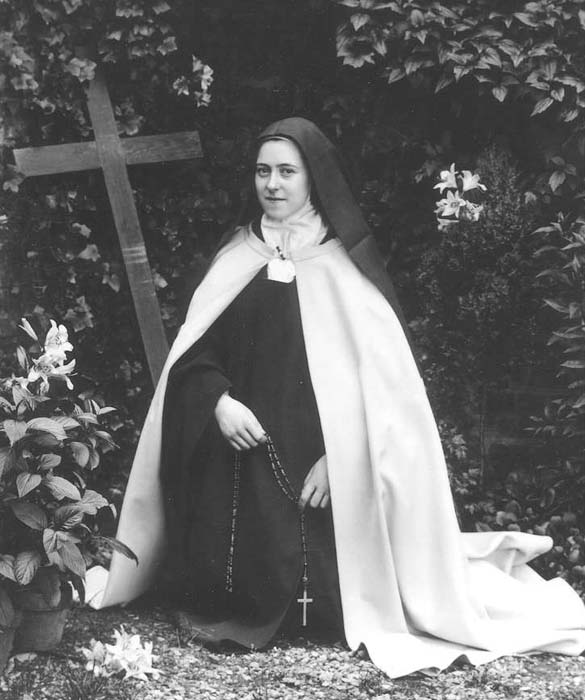
Born Marie-Francoise-Therese Martin at Alencon, France in 1873, St. Therese entered the Carmelite monastery of Lisieux at the age of 15 following a special permission from Church officials. She claimed no visions or extraordinary moments except that she followed a simple path to faith, especially after contracting TB that caused her death in 1897 at the young age of 24. Photo from Google.
Open our minds and our hearts, our very selves, Lord, like St. Therese to humbly embrace this simple truth of love by intensely and passionately living in love, doing ordinary things in the most extraordinary way of love. May we follow your Son Jesus as “he resolutely determined to journey to Jerusalem”(Lk.9:51) to face his passion, death, and resurrection out of love for you and for us. Amen.
The Lord Is My Chef Sunday Recipe XXVI-C, 29 September 2019
Amos 6:1.4-7 ><)))*> 1 Timothy 6:11-16 . ><)))*> Luke 16:19-31
Photo by Mr. Jim Marpa, 2018.
Last Sunday we focused on our hands that we use to pray and serve in reflecting the parable of the wise steward. Today, let us “look” into our eyes that see God in others as we reflect on another parable only St. Luke has, the rich man and Lazarus.
Eyes are the “windows of one’s soul”.
Eyes reveal what is inside us: how we look and move our eyes, the sparkle or dullness in our eyes indicate the kind of person within. Eyes never lie for they reveal if we are telling the truth or not. Most of all, eyes do not only direct us to sights outside but even visions to beyond what we can see.
This is very clear in the parable of the rich man and Lazarus, inviting us to take a deeper look into ourselves, on others, and with the things we possess like money and wealth.
Jesus said to the Pharisees: “There was a rich man who dressed in purple garments and fine linen and dined sumptuously each day. And lying at his door was a poor man named Lazarus, covered with sores, who would gladly have eaten his fill of scraps that fell from the rich man’s table. Dogs even used to come and lick his sores. When the poor man died, he was carried away by angels to the bosom of Abraham. The rich man also died and was buried, and from the netherworld, where he was in torment, he raised his eyes and saw Abraham far off and Lazarus at his side.”
Luke 16:19-23
Photo by Mr. Jim Marpa, September 2019.
For the third consecutive Sunday, we again heard another well-known parable proper to St. Luke like the prodigal son two weeks ago and the wise steward last Sunday. Today’s parable of the rich man and Lazarus follows the same thread of last week’s wise steward which is about the thorny issue of money. But again, there is something deeper than that which is the call for daily conversion by always looking beyond what we can see.
In this parable, Jesus never said the rich man was bad that is why he went to hell or the “netherworld”. Neither did he also claim that the poor man was holy that led him into the “bosom of Abraham” which is heaven. Jesus only described their daily life: the rich man lived in affluence with fine clothings and sumptuous meals while the poor was very destitute feeding on scraps falling from the former’s table as dogs licked the sores that covered his body.
The only critical clues Jesus gives us are the name of the poor man – Lazarus – which means “God has rescued” or El’azar in Hebrew and the final scene in the afterlife.
Let it be clear that the issue here is how people, rich and poor alike, can be blinded by money and wealth that they fail or even refuse to see God and others as brothers and sisters that lead them into evil and sins.
Abraham replied (to the rich man), “My child, remember that you received what was good during your lifetime while Lazarus likewise received what was bad; but now he is comforted here, whereas you are tormented. Moreover, between us and you a great chasm is established to prevent anyone from crossing who might wish to go from our side to yours or from your side to ours.”
The sad reality is that this parable continues to happen in our days when so many of us are oblivious of the poverty and miseries afflicting many of the poor among us.
We are that rich man who has no name but have eyes that refuse to see and recognize Jesus in everyone especially the poor and suffering. How tragic in this age of social media where everything and everyone is exposed and seen, we have become blind to the plight of those around us. No need to look far but right in our own family when members are on their own without bothering to know how everyone is doing in life.
In my 21 years of priesthood, I have realized that most often, the people who truly suffer are often the Lazarus among us who prefer to be silent, to bear all their pains trusting only in God who would vindicate and raise them in the end. The Lazarus are the poor not just in material wealth but “poor in spirit for theirs is the kingdom of heaven” (Mt. 5:3) who completely trust in God.
Reading further that version of the Beatitudes of St. Matthew, we find Jesus saying
Blessed are the clean of heart, for they will see God.
The clean of heart are the Lazarus, the poor who try to find God in this life even amid the many sufferings. Our minds and intellect, including our eyes can never see God. As the Little Prince would say, “what is essential is invisible to the eye; it is only with the heart that one can truly see”. Very true!
A clean heart is a loving heart. When we speak of the heart, we also mean person for the heart embodies the whole person. Therefore, a loving heart is the Lazarus, the one who tries to see God, the one who envisions the end that he is willing to sacrifice, to forgive and to welcome the lost.
Lazarus the poor beggar went to heaven because he has a clean heart unlike the rich man who refused to see beyond himself and his affluence. They are the ones being reprimanded in the first reading by the Prophet Amos, the “complacent” people who may have also included the priestly class of Israel unmindful of the real situation of the people because they have been insulated from realities by the perks and good life of wealth and power (Amos 6:1).
Most people have eyes that have sights but only a few have a vision in life. People with a vision in life are the ones who can see beyond the ordinary, they are the dreamers who dream with eyes wide open working hard to make their dreams happen in reality.
Lazarus is a visionary and a dreamer who saw beyond the door of the rich man, beyond his hunger and sickness the glory of God in eternal life. The rich man on the other hand only had sights for what is “here and now”; and, that is what he is so afraid of with his five brothers still alive who have no vision of the afterlife, no vision of God among others in the present life like him.
My dear friends, Jesus is inviting us today while there is still time to go back to the path of conversion, to see beyond ordinary things and see the more essential, the more lasting things that according to St. Paul in the second reading prepare us for eternal life like “righteousness, devotion, faith, love, patience, and gentleness” (1Tim. 6:11).
Let us listen to the words of God found in the Sacred Scriptures that Abraham referred to in the parable as “Moses and the prophets” (Lk.16:29).
Most of all, let us listen to Jesus Christ, the only one who had risen from the dead (cf. Lk. 16:31) who enables us to see him on the face of everyone we meet, giving us a vision of heaven by helping us in fulfilling our mission as his disciples in proclaiming the coming of the kingdom of God. Amen.
Colossians 1:1-8 ><)))*> ><)))*> ><)))*> Luke 4:38-44
Photo by Ms. Jo Villafuerte, Atok, Benguet, 01 September 2019.
Heavenly Father, I always thank you in my prayers. Early in life, I have been told to always say “thank you” and I have diligently kept that, always thanking people especially you for your goodness to me.
But, now I wonder if I have been “thanking” so much without being truly grateful?
There are “thank you’s” that come from lips and there are “thank you’s” that come from the heart which is what gratitude is all about. So often, I say “thank you” out of habit without really looking into the heart, the goodness of the one doing or giving me a favor. Too often, I thank for the thing or favor, not the person.
“We always give thanks to God, the Father of our Lord Jesus Christ, when we pray for you, for we have heard of your faith in Christ Jess and the love that you have for all the holy ones because of the hope reserved for you in heaven.”
Colossians 1:3-5
How lovely it is to dwell on St. Paul’s expression of his gratitude, his thanksgiving that is clearly directed to persons – including you, O God!
Like the people of Capernaum where you have healed Simon’s mother-in-law and others, they saw your person to thank that they begged you to stay in their town.
Remind me always, Lord, that whenever I say “thank you”, I may first try to feel the heart and experience the goodness of the person doing me good for a grateful heart always sees the loving face. Amen.
Tuesday, Memorial of St. Gregory the Great, 03 September 2019
1 Thessalonians 5:1-6, 9-11 ><)))*> ><)))*> Luke 4:31-37
Photo by Jo Villafuerte, Atok, Benguet, 31 August 2019.
“For God did not destine us for wrath, but to gain salvation through our Lord Jesus Christ, who died for us, so that whether we are awake or asleep we may live together with him. Therefore, encourage one another and build one another up, as indeed you do.”
1 Thessalonians 5:9-11
Dearest God our Father: Yesterday your words moved me to pray for consolation, to accompany those “alone”. Today, your words call me to “encourage one another and build up one another.”
How beautiful and wonderful indeed are your words, so powerful and fulfilling, indicating your very presence!
In this highly competitive world, it is not enough that we encourage people but also to build them up. From the Latin words “en” and “cor”, literally meaning to hearten or strengthen the heart, there are times that encouragement without community can be misleading and even destructive too.
Encouragement is going within every person, right into one’s heart like in your Son’s exorcism of a man possessed by “unclean demon” who “left the man without harming him” (Lk.4:35). From the heart, true encouragement moves outward to touch others’ hearts to form a community. Every time you heal the sick, Lord, people are moved to build up their families and community.
Encouragement is not pushing people to do and achieve things. Encouragement is bringing others closer to you through Jesus Christ our Lord. It is actually Jesus Christ who encourages for it is him alone who touches hearts and moves them to build up a person, families, and communities.
Like your servant St. Gregory the Great he encouraged not only Christians but also pagans to work for unity and to pursue so many efforts that built up not only persons and families, nations and tribes, monasteries and churches but most of all, an entire civilization now slowly turning away from you.
Fill us with more courage and wisdom, holiness and patience in encouraging one another to build up communities as we await for your joyful coming again. Amen.
Today, O Lord, I pray for my hardening heart. I have a festering anger deep in my heart against some people who have hurt me. And I am harboring a grudge against them like Herodias, the mistress of Herod.
Herodias harbored a grudge against John the Baptist and wanted to kill him but was unable to do so. She had an opportunity one day when Herod, on his birthday, gave a banquet for is courtiers, his military officers, and the leading men of Galilee. Herodias’s own daughter came in and performed a dance that delighted Herod and his guests. The king said to the girl, “Ask of me whatever you wish and I will grant it to you.” So she went out and said to her mother, “What shall I ask for?” She replied, “The head of John the Baptist.”
Mark 6:19, 21-22, 24
What is so shameful, O Lord, like Herodias, I want to have the heads of those people. I want to get even with the pains they have inflicted against me. I want revenge.
But more shameful, Lord Jesus, is, unlike Herodias, I have not done anything wrong against these people. And no amount of pain can justify my grudge, my anger, my hatred against them.
This is what makes it more painful with me: the festering anger in my heart is slowly poisoning my soul, my very being.
Teach me, Jesus, to bear all pains like John the Baptist, suffering for you, suffering with you.
Give me the courage and strength to “gird my loin” as you told the Prophet Jeremiah so I may be able to control myself and be on guard against becoming like Herodias or, worst, Herod, who beheaded John in prison.
Let me rise above my instincts and feelings to be not like the evil doers and fake people who fight and malign me because you have assured me that they will never prevail over me, that you will deliver me for you are always with me. Amen.
“The Severed Head of John the Baptist”, a sculpture by the French artist Auguste Rodin in 1875. This is probably a representation of a guillotined criminal’s head during that time. From Google.
Judges 2:11-19 ><)))*> ><)))*> ><)))*> Matthew 19:16-22
Grotto at Baguio (Mirador Hill), February 2019.
Whenever the Lord raised up judges for them, he would be with the judge and save them from the power of their enemies as long as the judge lived; it was thus the Lord took pity on their distressful cries of affliction under their oppressors. But when the judge died, they would relapse and do worse than their ancestors, following other gods in service and worship, relinquishing none of their evil practices or stubborn conduct.
Judges 2:11-19
Sometimes I wonder why, O God, you did not just fix our hearts on you so we would remain in you?
Like the experiences of your people during the time of judges in Israel, our lives have become like one big vicious circle too difficult to break but so easy to predict: we turn away from you, our lives go wayward, we repent, you forgive us, then we go back to you, we are blessed and then, after some period of peace and prosperity, we again turn away from you, our lives go wayward and the cycle continues.
What a foolish heart we have, O Lord.
But, you are so filled with love and mercy for us, believing in us always for the ability to change and remain in you despite our weaknesses.
Thank you for never completely abandoning us, for always having that gaze filled with love like Jesus looking onto that young man in the gospel who walked away sad because he could not completely commit himself to serving you and loving you with all his heart.
Keep us faithful to you, enlighten our minds and our hearts to trust only in you even if the journey is full of dangers and difficulties.
We pray in a special way for our brothers and sisters suffering with various forms of cancer. May the prayers of St. Ezequiel Moreno grant them healing. Amen.