The Lord Is My Chef Daily Recipe for the Soul by Fr. Nicanor F. Lalog II
Thursday in the Fourth Week of Ordinary Time, Year II, 01 February 2024
1 Kings 2:1-4, 10-12  ><]]]]'> + ><]]]]'> + ><]]]]'>  Mark 6:7-13
Photo by author, Camp John Hay, Baguio City, 12 July 2023.
Praise and glory
to you God our loving Father!
Thank you for January,
thank you very much for February;
as we start this second month
of the year, you remind us
how in life every ending is also
a beginning.
When the time of David’s death drew near, he gave these instructions to his son Solomon: ”I am going the way of all flesh. Take courage and be a man. Keep the mandate of the Lord, your God, following his ways and observing his statutes, commands, ordinances, and decrees as they are written in the law of Moses, that you may succeed in whatever you do, wherever you turn.”
1 Kings 2:1-3
Give us the grace of
ageing gracefully, Father,
like your servant David;
give us the courage
and sincerity to accept,
to embrace when we are
"going the way of all flesh";
yes, we all wish a life of joy
and happiness with less pains
and difficulties but as we forge on
life, we have experienced,
we have realized,
and proven so many times
that hardships and hurts
are inevitable parts of this life,
even separations and death
that David perfectly called
as way of the flesh.
Joy and fulfillment
happen when we embrace
these shadows and darkness
for it is in those spaces
where lights are most visible
and life is most meaningful;
give us, Lord Jesus,
the courage to let go,
to leave our extra baggages
behind in order to travel light
in this life proclaiming your
good news;
make us realize that true wealth
is in having less of the material
and more of the spiritual;
most of all, every ending
is also a beginning,
hence, the need for us
to prepare those next to us.
Amen.
The Lord Is My Chef Daily Recipe for the Soul by Fr. Nicanor F. Lalog II
Wednesday, Memorial of St. Cecilia, Virgin & Martyr, 22 November 2023
2 Maccabees 7:1, 20-31   ><]]]]'> + ><]]]]'> + ><]]]]'>   Luke 19:11-28
Photo by Dra. Mylene A. Santos, MD, in Tagalag, Valenzuela City, 13 September 2023.
Praise and glory to you,
God our loving Father!

Today I pray to you for
the gift of a "noble spirit"
like that courageous mother
of seven brothers who died on
the same day before her as she
extolled them to resist temptations
and remained faithful to you:
"Filled with a noble sprit that
stirred her womanly heart with
manly courage" (2 Maccabees 7:21).
What a beautiful description of that
woman's great courage and faith
in you, dear God!
Give us a noble spirit, Lord,
a selfless soul that thinks more
of others than one's self especially
in this age when we are so self-conscious
and conceited with our bloated egos
always on the take, as if the world
revolves around us; a soul that is
not selfish and other centered
because of deep faith and trust
in you, Father.
Stir your noble spirit in us, Lord;
let us find anew our moral compass,
our moral grounding in you and your
laws especially in this age when
"everything and anything goes"
regardless of morals and virtues,
an age that glorifies every person as
a universe in himself,
crowning himself as god,
yet so afraid of the truth,
so ignorant of freedom,
without any idea of
the real meaning of living
and loving that in the end,
could not accept death.
Like that courageous woman
and St. Cecilia, stir the noble spirit
within us, Lord Jesus,
to embrace wholeheartedly
our being human,
our being finite,
our being-towards-death
so that we may start living
as you have taught us by
giving and sharing ourselves
and everything we have
in order to be fulfilled,
by facing death so that
we may live in you.
Amen.
The Lord Is My Chef Daily Recipe for the Soul by Fr. Nicanor F. Lalog II
Thursday, Feast of the Exaltation of the Cross, 14 September 2023
Numbers 21:4-9 ><]]]]'> Philippians 2:6-11 ><]]]]'> John 3:13-17
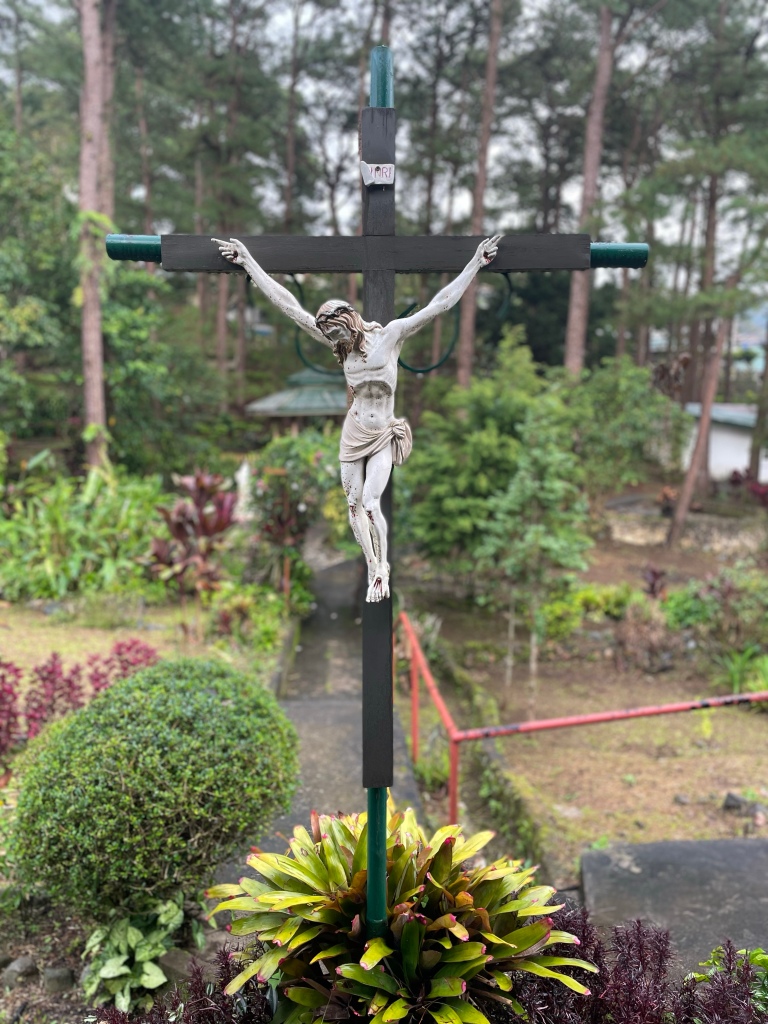
Photo by author, Sacred Heart Novitiate, Novaliches, QC, 2017.
The cross is perhaps one of the most widely used but also abused and misunderstood sign in almost every generation. In fact, we are so accustomed to the cross of Jesus Christ found everywhere like in churches and cemeteries, offices and classrooms, hospitals, inside every kind of vehicle and, of course, houses. Almost everybody carry it on our persons for various reasons: as an object of veneration, as a badge, or as a jewel.
On the cross we find Jesus shown in glory, peacefully sleeping in death, sometimes with his body broken by suffering. Hence, many times we use the word “cross” like in “cross my heart” to indicate our sincerity and truthfulness. But, are we truly aware of its meaning and significance in our faith, of its centrality as the symbol of God’s love for us expressed by the self-sacrificing death of Jesus Christ his Son?
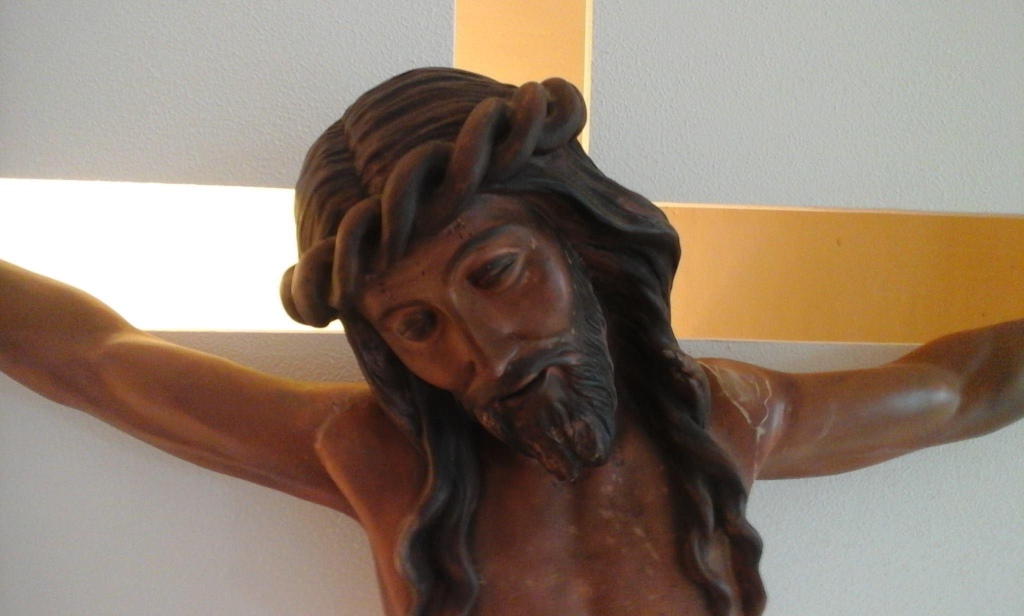
Photo by author, St. Scholastica Convent, Baguio City, 23 August 2023.
Today we celebrate the Exaltation of the Cross which started in the fourth century. According to legend it began with the miraculous discovery of the True Cross by Helena, mother of the Emperor Constantine, on 14 September 326, while she was on a pilgrimage to Jerusalem. She then ordered through her son the emperor the building of the Church of the Holy Sepulchre that was dedicated nine years later with a portion of the True Cross placed inside it in September 13, 335. The following day, the Cross was brought outside of the church to be venerated by the clergy and the faithful.
In the year 627, during the reign of the Emperor Heraclius I of Constantinople, the Persians conquered the city of Jerusalem and removed a major part of the Cross from its sanctuary. The emperor then launched a campaign to recover the True Cross which he regarded as the new Ark of the Covenant for the new People of God. Before embarking into war, Emperor Heraclius went to church wearing black as a sign of penance, then prostrated himself before the altar and begged God for courage. His prayer was granted as he won the war and recovered the Cross from the Persians. He brought the Cross back to Jerusalem in 641 amid great celebrations by carrying it on his shoulders. Upon reaching the gate leading to Calvary, the emperor could not go forward! Heraclius and his retinue were astonished and could not understand what had happened until the Patriarch Zachary of Jerusalem told him, “Take care, O Emperor! In truth, the imperial clothing you are wearing does not sufficiently resemble the poor and humiliated condition of Jesus carrying His cross.”
Upon hearing those words, the emperor removed his shoes and bejewelled robes, put on a poor man’s clothing and was eventually able to proceed to Calvary and replaced the Cross inside the Church of the Holy Sepulchre where a number of miracles happened during the occasion: a dead man returned to life, four paralytics were cured, ten lepers were healed, 15 blind men were given their sight, with several possessed people exorcised and many sick people totally healed!
Photo by author, Mirador Jesuit Villa & Retreat House, Baguio City, 24 August 2023.
Very notable in this story were the words of the Patriarch of Jerusalem. It was only after the emperor had taken off his royal clothings and put on those of the poor was he able to carry the Cross.
It is the same thing that is asked of us today: it is so easy to display the cross inside our homes and cars, or wear it as a jewelry or even as a tattoo on our skin. But that would amount to nothing unless we have the cross inside our hearts, our very being. More than the many signs of the cross and imaginary drawing of its lines we draw on our chest is the need for us to empty ourselves of our pride and sins so that we can be filled by Jesus Christ.
Brothers and sisters: Christ Jesus, though he was in the form of God, did not regard equality with God something to be grasped. Rather, he emptied himself, taking the form of a slave, coming in human likeness; and found human in appearance, he humbled himself, becoming obedient to death, even death on a cross.
Philippians 2:6-8
Called kenosis in Greek, self-emptying is the way of the Cross of Christ. It is choosing love and mercy than self-centeredness and self-righteousness; sacrifice than satisfaction; fairness and justice than greed and possession; bearing all the pains and perseverance than complaining and whining about difficulties and trials in life like the Israelites in the wilderness (first reading); and, thinking more of others than of one’s self.
Photo by author, 02 September 2023.
The recent COVID-19 pandemic had taught something very amusing about the positivity of being negative, when negative was actually positive – healthy and COVID free! Remember how during those days when we would always wish we would yield negative results in our swab tests for COVID?
When we look at the sign of the cross (+), it is a positive sign, a plus sign. Though the cross calls us to let go, to be detached and dispossessed, it is actually an invitation to have more of God, of life and fulfillment! In this time of affluence when everything is practically easily available for as long as you have the means and the resources, the sign of the Cross reminds us that life is more of letting go and of giving than of having like God who “so loved the world that he gave his only Son, so that he who believes in him might not perish but might have eternal life” (Jn.3:16). St. Francis of Assisi said it perfectly why the Cross is an exaltation, a triumph:
For it is in giving that we receive,
it is in pardoning that we are pardoned,
and it is in dying that we are born to eternal life.
Amen.Have a blessed Thursday!
Lord My Chef Daily Recipe for the Soul by Fr. Nicanor F. Lalog II
Friday in the Twentieth Week of Ordinary Time, 25 August 2023
Ruth 1:1, 3-6, 14-16, 22   <*{{{{>< + ><}}}}*>   Matthew 22:34-40
Photo by Mr. Jay Javier at Tayabas, Quezon, 13 August 2023.
O how often,
Lord Jesus Christ
that we ask you until now
the same question by
a scholar of the law:
"Teacher,
which commandment
of the law is the greatest?"
(Matthew 22:34).
And we have always known
your answer, which is, loving God
with one's total self
and loving others as we love our
very selves.
But why do we keep on asking
the same question until now?

Because, we have always believed
that loving is having,
that loving is fullness,
when in fact, it is the
exact opposite:
loving is not having,
loving is being poor,
loving is emptiness,
loving is letting go,
loving is surrendering
for the one you love.
Just like Ruth,
that Moabite woman,
a pagan who left everything
to join her widowed
mother-in-law Naomi to go
back to Bethlehem;
both of them were
widowed, both were
childless and empty,
so poor without anything
except each other
and God.
Let the words of Ruth
be our prayer today
to those we love
without if nor buts,
especially those empty
and poor, sick and dying:
"Do not ask me to abandon
or forsake you! for wherever
you go I will go, wherever
you lodge I will lodge,
your people shall by my people,
and your God my God"
(Ruth 1:16).
God our Father,
help us to remain faithful
and to keep loving when
in the midst of sufferings
and trials, of emptiness
and nothingness like Ruth
to Naomi; how lovely to recall
that Ruth's love for Naomi led
to her becoming the grandmother
of King David and one of the four women
in Matthew's genealogy of Jesus
for it is loving without nothing in return
that we gain, and it is in loving
even in losing ourselves
that we find ourselves in you.
Amen.
The Lord Is My Chef Daily Recipe for the Soul by Fr. Nicanor F. Lalog II
Thursday, Feast of St. Lawrence, Deacon & Martyr, 10 August 2023
2 Corinthians 9:6-10   <*[[[[><< + >><]]]]'>   John 12:24-26
Photo by author, Sacred Heart Novitiate, Novaliches, QC, 2017.
God our loving Father,
help us to see and follow Jesus
your Son like your servant
St. Lawrence, Deacon and Martyr.
Though there may be less
persecutions these days
of Christians, the call to be
Christ's witnesses is more
compelling today as we live
in world that tries to forget you
and negate you.
Like the Greek visitors in
Jerusalem who asked help
from Philip and Andrew
to see Jesus, we too want
to see him.
“Amen, amen, I say to you, unless a grain of wheat falls to the ground and dies, it remains just a grain of wheat; but if it dies, it produces much fruit.”
John 12:24
To see you, O Lord Jesus
is more than laying one's eyes
on your image
or your Blessed Sacrament;
to see you like St. Lawrence
is to have an insight,
to penetrate your inner mind
of self-sacrifice,
of losing one's self like
the grain of wheat that falls
on the ground to die, disintegrate
and be transformed
as new wheat bearing
much grain to feed more people.
Like St. Lawrence,
let us see that reality
to have the courage to offer
ourselves to you through others
in a life of service and sacrifice
so we may inspire more to serve you,
most especially see you too.
Let us not count the costs
of what we give up for they have
all been paid for by Jesus;
like St. Lawrence,
let us consider everything
as a pure grace from you
meant to be shared
for indeed, "you love a cheerful giver";
may we keep in mind and heart
that "God is able to make every grace
abundant for us,
so that, always having all we need,
we may have an abundance
for every good work"
(2Cor.9:8).

In this world of affluence
amid the ironic poverty of so many,
may we emulate St. Lawrence
in learning and living Christ's teaching
that true wealth is found
not in having things for ourselves
but in sharing and giving
with the others the gifts
we have received.
Amen.
The Lord Is My Chef Daily Recipe for the Soul by Fr. Nicanor F. Lalog II
Tuesday in the Eighth Week of Ordinary Time, Year I, 30 May 2023
Sirach 35:1-12   ><]]]]'> + ><]]]]'> + ><]]]]'>   Mark 10:28-31
Photo by Mr. John Ryan Jacob, December 2022, Paco, Obando, Bulacan.
Why give at all, Lord?

Today you answer this
"frequently asked question"
of so many people especially
Christians:  why should I give?
Appear not before the Lord empty-handed, for all that you offer is in fulfillment of the precepts. The just one’s offering enriches the altar and rises as a sweet odor before the Most High. The just one’s sacrifice is most pleasing nor will it ever be forgotten.
Sirach 35:4-6
There are so many reasons
why we should give but in the
wise words by Ben Sirach today,
one clear reason why we should
give is because everything is yours,
O God; we own nothing at all!

Whatever we have is yours
and the more we give,
the more we share,
the more you bless us!
Teach us, O God,
not to be selfish,
to be open,
to be generous
for we are mere channels
of your blessings and
grace; forgive us, Jesus,
when we are like the rich man
who asked you about gaining
eternal life but unwilling to give
up his possession to share with others
or like Simon Peter counting
whatever we have given
and shared, most especially
what we have given up for you
as if everything we have is
totally ours, that we owe no one
except ourselves in having them
without realizing we are your mere
stewards of whatever we have;
so often, we fail to realize
the simple truth
that when everyone
gives, everyone receives.
That is why we must give.
Amen.
40 Shades of Lent by Fr. Nicanor F. Lalog II
Thursday in the First Week of Lent, 02 March 2023
Esther C:12, 14-16, 23-25   > + + + <   Matthew 7:7-12
Photo by Dra. Mylene A. Santos, MD, 2022.
God our loving Father,
let me desire only you in my life
so that it is YOU whom I always ask for
and receive,
YOU whom I seek and find,
YOU whom I knock for
the door to be opened
(Mt. 7:7).
Thank you, Lord,
for allowing
me to tell you my
needs and plans,
thank you for listening
even if there is no need
because YOU know best
and that is why,
here I am to you
asking for your grace
of enlightenment to put on my lips
the words I must speak
and in my heart the grace of
docility and surrender to
your holy will.
Thank you, O God,
for always answering my calls,
for building up strength
within me (Ps.138:3);
I am still learning
and struggling to pray,
of totally submitting myself
to you like Queen Esther
in the first reading when she,
like Jesus your Son,
offered her very self
in total submission
to you.
Amen.
The Lord Is My Chef Simbang Gabi Recipe for the Soul by Fr. Nicanor F. Lalog II
Fourth Sunday in Advent, Third Simbang Gabi, 18 December 2022
Isaiah 7:10-14 ><]]]]'> Romans 1:1-7 ><]]]]'> Matthew 1:18-24
Photo from vaticannews.va, 14 December 2020.
We are now at the final stretch of our Advent Season, getting closer to Christmas Day with our gospel today directly telling us how it all happened. And it was not very easy – in fact so difficult – just like with most of us in our many experiences in life when everything did not go so well as planned.
It would not be surprising at all that so many times, many of us would have also thought of giving up, of letting go everything like St. Joseph!
Now this is how the birth of Jesus Christ came about. When his mother Mary was betrothed to Joseph, but before they lived together, she was found with child through the holy Spirit. Joseph her husband, since he was a righteous man, yet unwilling to expose her to shame, decided to divorce her quietly.
Matthew 1:18-19
Christmas is a story of accepting difficulties in life especially persons dearest to us suddenly thrown into challenging situations. Exactly what happened to St. Joseph and Mama Mary.
Many times in life, we advise people going through problems to just simply accept how things are –“tanggapin na lang” – with some sense of resignation as if there is nothing we can do.
Sometimes it is true but many times, not at all true like with St. Joseph’s predicament. He accepted first Mary and then Jesus on a totally different manner worthy of our emulation. It was not out of resignation to the situation but was first of all focused in accepting and valuing persons.
St. Joseph decided to silently leave Mary because of his great love for her. He did not want to expose her to shame and public humiliation that would surely result in being pregnant with a child not his. He did not merely accept the situation as if it were his lot to be “scooped” out by somebody else faster than him with Mary. Keep in mind how the evangelist described St. Joseph as a righteous man, a holy man that despite Mary’s pregnancy, he loved and valued her so much, totally as a person. His leaving her silently was a testimony to his great love and respect for her!
We demand "understanding" in order to "accept"
without realizing that it is different
with persons and with life in general
when we must first "accept" in order to "understand"!
Unlike with us these days when everything has to be explained and spelled out in details before anything or anyone may be accepted. In this age of instants, we want instant explanations too on everything before making any decision, demanding many information to understand anything.
And everyone.
We demand “understanding” in order to “accept” without realizing that it is different with persons and with life in general when we must first “accept” in order to “understand”!
That was exactly the accepting attitude of St. Joseph. He might have not totally understood everything when explained to him by the angel in a dream. Imagine how very difficult it must have been to listen to instructions and explanations in a dream that are already difficult to grasp when done in normal circumstances while awake. But that shows the great maturity and deep spirituality of St. Joseph, of how he accepted everything told to him by the angel in a dream that upon waking up, he absolutely obeyed God’s instruction by taking Mary as his wife.
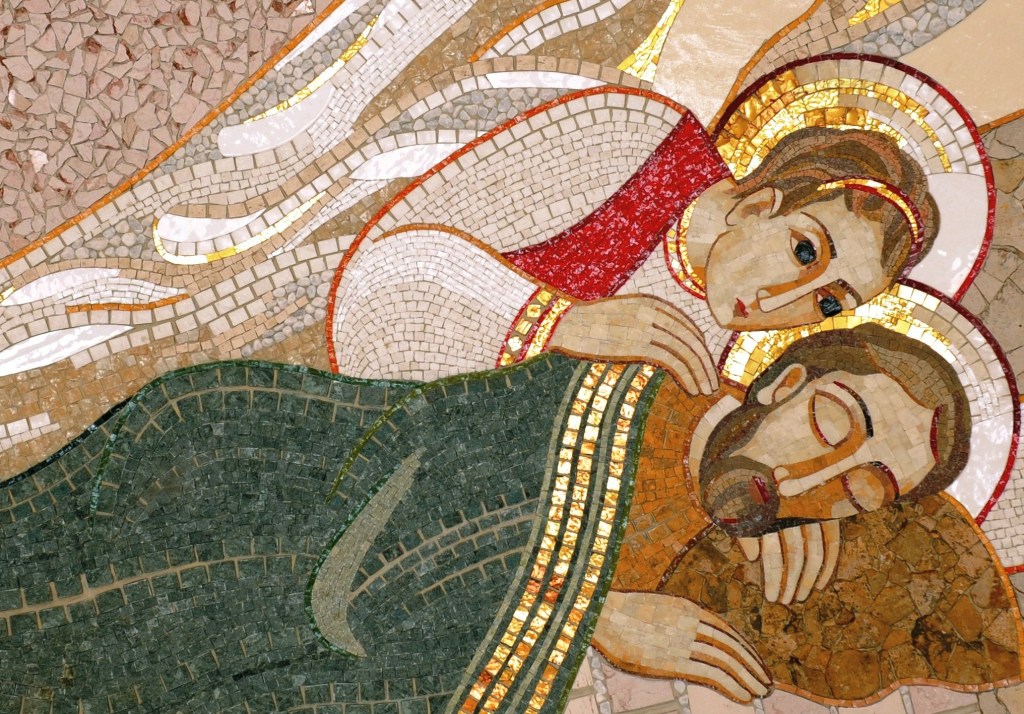
Photo by Arch. Philip Santiago, Basilica of San Padre Pio, Italy, 2017.
One of my favorite singers is the late Marvin Gaye whose 1971 hit What’s Going On I have used extensively in lessons and recollections to young people. Its lyrics are so poetic yet so deep, with its first two stanzas calling for “loving” before it could lead to “understanding” at the third stanza after the chorus. It calls for acceptance first of everyone, of respect so we could love and understand more.
Picket lines and picket signs Don’t punish me with brutality Talk to me So you can see Oh, what’s going on (What’s going on) What’s going on (What’s going on) What’s going on (What’s going on) What’s going on (What’s going on)
People can never be understood really. There are some people who are truly difficult to understand or as we say, “mahirap ispellengin”. Many times in life I have learned that we simply just have to accept everyone as unique, that God comes through everyone in each one’s uniqueness and peculiarities.
Situations become more difficult to accept unless we accept first the persons involved.
That begins with our very selves when we have to set aside our pride, our own good, even our own plans and agendas like St. Joseph in order to let God lead us truly to fulfillment.
Very often this is the problem with us when we insist on ourselves, on our own ideas and own plans. We get blinded with what we know and even with what we believe in like King Ahaz in the first reading.
Photo from Aleteia.org, “Let Mum Rest”, 2019
St. Joseph as an accepting person was also a very welcoming man like St. Paul in the second reading who took pride in being called and sent by God to proclaim the good news of Jesus Christ. A truly accepting person is always a welcoming one, full of warmth and joy because he/she has Jesus!
See the beauty of St. Joseph’s acceptance of God’s plan: when he accepted Mary, that is when Jesus came.
Thus, we must first accept God.
If we truly accept God, we must accept others as his gifts to us. No matter what.
It is in accepting others with all their differences when Jesus Christ truly comes.
When we learn to accept and welcome people, that is when Christmas truly happens. Not only in December but all year through! Let us pray:
Lord Jesus Christ,
thank you for coming to us daily
not only in our very selves and the many
events that happen to us but most especially
among people you send us;
there are times they are good and so faithful
like St. Joseph who are easy to accept;
but there are also times, they are very
difficult to accept or even understand
especially when they happen to be those
closes to us whom we also love.
Teach us to appreciate the value of silence
like St. Joseph so we may be accepting like him
because it is in our accepting of people and difficult
situations in life when you often come.
Amen.
The Lord Is My Chef Sunday Recipe for the Soul by Fr. Nicanor F. Lalog II
Sunday Week V-C in Ordinary Time, 06 February 2022
Isaiah 6:1-2, 3-8 ><}}}}*> 1 Corinthians 15:1-11 ><}}}}*> Luke 5:1-11
Photo by Mr. Jim Marpa, 2018.
The word catch is a very catchy one, like when we catch our breath. Or, when we catch a train or bus or catch a ball. Recently, we have been catching colds and have also started catching movies. But the most beautiful of all is catching a glimpse of someone special until we catch a person, like a bride or a groom.
To catch means “to have”. It may be something. Or someone. Wholly or partially.
There is always that sense of possession in catching. This Sunday, Jesus wants to catch us all by making us catch others for him, too!
After he had finished speaking, he said to Simon, “Put out into deep water and lower your nets for a catch.” Simon said in reply, “Master, we have worked hard all night and have caught nothing, but at your command I will lower the nets.” When they had done this, they caught a great number of fish and their nets were tearing. When Simon Peter saw this, he fell at the knees of Jesus and said, “Depart from me, Lord, for I am a sinful man.” For astonishment at the catch of fish they had made seized him and all those with him, and likewise James and John, the sons of Zebedee, who were partners of Simon. Jesus said to Simon, “Do not be afraid; from now on you will be catching men.”
Luke 5:4-6, 8-10
From their synagogue at Nazareth, Jesus came to the nearby shore of Galilee Lake at Capernaum preaching his good news of salvation. A large crowd of people followed him, listening to his teachings as he sat on the boat of Simon he had borrowed.
Simon and company were washing their nets, on their way home after a fruitless night of fishing when Jesus came. Simon Peter must have heard – “caught” – the words of Jesus while teaching and soon enough, he was caught with fear with their miraculous catch.
Photo by author, Lake of Galilee, 2017.
Again, we have Jesus with his powerful words making such impact on the people, being fulfilled in their hearing most especially to Simon: After he had finished speaking, he said to Simon, “Put out into deep water and lower your nets for a catch.” Simon said in reply, “Master, we have worked hard all night and have caught nothing, but at your command I will lower the nets.”
The fish has always been there in the lake but what made the big difference that morning was Jesus – he was not only with them but most of all, Simon believed in the words of the Lord!
Here we find again the words of Jesus being fulfilled because somebody listened and believed.
Last week we heard how Jesus was driven out of the synagogue by his own folks who doubted him and his words despite their amazement at the start; today, here at the shore of Capernaum, the people came to Jesus to listen to his words again.
But, the most beautiful part of our story this Sunday is how Jesus came at the most ordinary time and circumstances of the lives of the people. Too often, many people think Jesus comes only in dramatic and miraculous ways to invite us to come and follow him.
Not really. In fact, he comes when we least expect him like in this scene when Simon must have been feeling so down, coming home empty with nothing to feed his family after a fruitless night of fishing.
The good news of our Gospel this Sunday is how Jesus makes us all his worthy followers when we allow him to catch us. That is how the Gospel works – let yourself be caught by the Lord first and soon you shall find yourself being caught up in so many wonderful surprises: When Simon Peter saw this, he fell at the knees of Jesus and said, “Depart from me, Lord, for I am a sinful man.” For astonishment at the catch of fish they had made seized him and all those with him.
Photo by author, statue of Simon Peter after the miraculous catch of fish,asking the Lord to depart from him at the shore of Galilee in Capernaum, 2017.
Jesus does not ask us for great things and deeds; he knows us very well and loves us so much, believing in us that he simply invites us to respond to his calls, to his words in the little everyday things of our lives like being faithful to your husband or wife, being obedient to our parents, being true to our friends, being honest in our work and studies, being kind and open to others. When bad things happen to us, all Jesus asks us is to go deeper in him in faith by being more patient or even uncomplaining to our pains and difficulties.
Of course, these are all easier said than done but this is what we always tell Jesus just before receiving him in the Holy Communion like that Roman official who said, “Lord, I am not worthy that you should enter under my roof, but only say the word and I shall be healed”.
Nobody is truly worthy before the Lord but that is why Jesus came to invite us personally to let ourselves be caught by him like Simon and his brother Andrew along with their fishing partners, the sons of Zebedee, James and John, who left everything to follow him.
Every encounter with Jesus and his words always result in a self-discovery of our unworthiness and sinfulness like Simon Peter and Isaiah in the first reading. But, the good news is that every time God comes to call us, he also gives us the strength and gifts necessary to accomplish his mission for us. What is important is our willingness to follow, like Isaiah who said, “Here I am, send me” (Is.6:8) and be ready to leave everything behind like the first four disciples.
Photo by Dr. Mylene A. Santos, MD, 2020.
At the center of every call and mission is Jesus Christ, our Lord and Master, the Word who became flesh and dwelled among us by being one with us in our pains and sufferings, even in death, so that we may become like him, holy and blessed.
To be holy like God is to share in his work of gathering his people into the Body of Christ which St. Paul had reflected these past three Sundays to remind us of the preeminence of love in fulfilling our mission from Jesus.
Every day, Jesus comes, trying to catch us, asking us to cast our nets, inviting us to catch others for him so we may all be one in him in his love.
Let us all be caught by Jesus, be totally his and experience his amazing love and mercy. Amen.
The Lord Is My Chef Daily Recipe for the Soul by Fr. Nicanor F. Lalog II
Monday, Memorial of St. Cecilia, Virgin and Martyr, 22 November 2021
Daniel 1:1-6, 8-20  ><]]]]'> + ><]]]]'> + ><]]]]'>  Luke 21:1-4
Very often in life, we rarely
think of you dear God our Father
when we try to consider the best
we could ever have; if ever we
remember you, you always come
last because we always want
the finest and most premium as
something tangible, something we
can hold and even possess.
On this final stretch of our
liturgical calendar before we move
to our "new year" with the First Sunday
of Advent, your words remind us
very well how we continue that practice
of searching and possessing the best -
food, clothes, vessels, gadgets,
even minds and talents or persons
like King Nebuchadnezzar of Babylon,
the conqueror of Judah who ransacked
your Temple of its precious vessels and
threw your people into exile.
When he asked for the brightest and
best men of Judah be separated to serve
at his court, he gave them the best food
and wine to ensure that they function well
when summoned; how amazing were your
servants led by Daniel who refused to eat
the king's food and wine in your honor;
despite their simple meals of vegetables
and water, Daniel and his company emerged
as the best young men in the king's court.
In any question of wisdom or prudence which the king put to them, he found them ten times better than all the magicians and enchanters in his kingdom.
Daniel 1:20
Meanwhile at the donation box
of the temple, your Son Jesus
found the widow who gave two
small coins as the best donor
of all because she gave her very self
to God unlike the rich who gave only
a portion of what they no longer needed.
Teach us, dear God, that you are
the very best of the best we can ever
have and offer in this life;
may we aspire to have you more -
your love and kindness,
your mercy and justice,
your wisdom and understanding,
your very life and presence
so that we may also learn to give
our total self to you.
Like St. Cecilia, may we sing
your song, O God in our hearts,
giving our very selves to your
loving service for others.  Amen.















 lordmychef.com