Daniel 7:2-14 ><)))*> ><)))*> ><)))*> Luke 21:29-33
Praise and glory to you, O God! Thank for this blessed Friday, the last working day of November 2019. Most of all, thank you for keeping us safe always in your protection despite our sins and being stubborn.
Like the vision of Prophet Daniel in the first reading, so many “beasts” have tried destroying us. In fact, these “beasts” are so “horrible” that so many people have come to believe them, accepting them and all their lies and malice.
Red Wednesday 2019, Parokya ng San Juan Apostol at Ebanghelista, Bagbaguin, Santa Maria, Bulacan.
There are times that we lose hope, fearing that everything is going to nothing.
Sometimes, it is so difficult to find meaning in life at all amidst all the sufferings and miseries around us and even within us!
May we always trust in your Word, Jesus Christ who became flesh to be with us.
In the many trials and tribulations that come our way, may we always hold on to his assurance:
“Heaven and earth will pass away, but my words will not pass away.”
Daniel 1:1-6, 8-20 ><)))*> ><)))*> ><)))*> Luke 21:1-4
Davao City, August 2018.
Lord Jesus Christ,
November is about to end and on this first day of work and school, we are saddled with so many burdens and worries we need to hurdle this week.
We worry so much, thinking a lot of bigger things that could happen: bigger problems, bigger tasks, bigger responsibilities that compel us to think so big in our own terms, forgetting we have a greater God in you than all our problems in life.
Give us the courage to think more of you, of relying in your powers through simple things like Daniel and his company who chose to just have vegetables and water than partake in the banquet of Nebuchadnezzar and defile your holy name, O Lord, with unclean food.
Let us be more generous inside, to offer you our broken and weak selves like that poor widow at the temple who put two coins in the collection box.
Remind us Lord to have more of you always, and less of ourselves, less of the world in this life for it is in little things or even nothing can we gain everything. Amen.
Friday, Memorial of St. Cecilia, Virgin and Martyr, 22 November 2019
1 Maccabees 4:36-37, 52-59 ><)))*> <*(((>< Luke 19:45-48
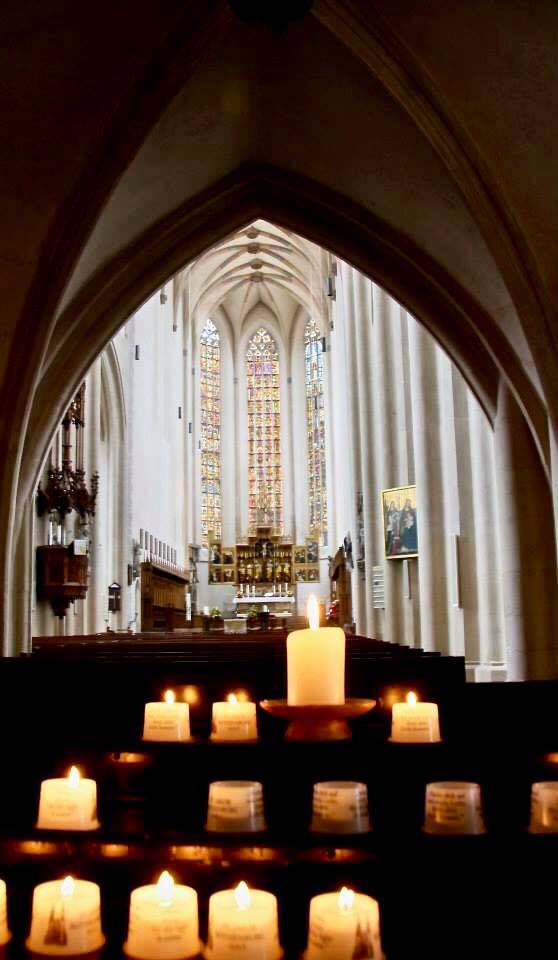
Candles seen from our altar onto our church rear, 18 November 2019.
Lord Jesus Christ, Light of the World, please keep your fire burning within us, always aglow with your firm faith, fervent hope and unceasing charity and love.
On this memorial of your virgin and martyr, St. Cecilia who is also the patroness of sacred music, may we imitate her to keep on “singing the song of God in our hearts”, whether in good times or in bad.
Let us praise you both in words and in deeds without ceasing.
How sad that we are like the Jews after their victory over the Gentiles in the Maccabean revolt: very enthusiastic at first that eventually waned, becoming complacent that after a hundred years, the Romans easily conquered and subdued Jerusalem.
On the anniversary of the day on which the Gentiles had defiled the temple, on that very day it was reconsecrated with songs, harps, flutes, and cymbals. All the people prostrated themselves and adored and praised heaven, who had given them success.
1 Maccabees 4:55-56
Forgive us, Lord, on the many occasions when we are so eager and full of zeal in praising you and doing your will after we have gained particular blessings and intentions from you that later on, we become complacent like your contemporaries.
Jesus entered the temple area and proceeded to drive out those who were selling things, saying to them, “It is written, my house shall be a house of prayer, but you have made it a den of thieves.”
Luke 19:45-46
Candle in our sacristy, 19 November 2019.
Let us not be complacent, Lord.
Remind us that our work and mission from you will continue until we rest in you, O Lord.
Our gospel today helps us to further reflect the meaning of last week’s All Saints’ Day and All Souls’ Day when we honored our departed loved ones with prayers, believing and hoping that some day we shall be with them in heaven at “the resurrection of body and life everlasting”.
Every Sunday this is what we profess and so today, our readings invite us to reflect anew this last but crucial article of our faith, theresurrection of body and life everlasting.
Some Sadducees, those who deny that there is a resurrection, came forward and put this question to Jesus, saying, “Teacher, Moses wrote for us, If someone’s brother dies leaving a wife but no child, his brother must take the wife and raise up descendants for his brother. Now there were seven brothers; the first married a woman but died childless. Then the second and the third married her, and likewise all the seven died childless. Finally the woman also died. Now at the resurrection whose wife will that woman be? For all seven had been married to her.”
Luke 20:27-33
The Jewish Cemetery at the Mount of Olives facing Jerusalem, May 2019.
Jesus had finally entered Jerusalem. What an extraordinary manner for him to discuss death and resurrection right in the city he knew where he would eventually die and rise again in a few days later!
And the first to confront him there were the Sadducees, Israel’s elite from whose ranks came the high priests who later conspired with Rome to put Jesus to death.
Jews at the wailing Wall, May 2017.
Very conservative and rigorous in their practice of religion, the Sadducees were basically fundamentalists who refused to accept oral traditions on equal footing with the Pentateuch. They only accepted whatever was explicitly written on the Pentateuch, discarding anything that the Torah does not mention at all like the resurrection, existence of spiritual beings like angels and immortality of the soul.
Don’t we find ourselves into the same situation too when despite our professed religiosity, we subscribe to other beliefs like reincarnation and fortune-telling because of “proofs” we find about their veracity unlike the resurrection that seems to be so difficult to think of in the first place?
We have those vestiges of fundamentalism within, always searching and asking for proofs on so many things about our religious beliefs, especially about God and Jesus Christ.
Jesus said to them, “The children of this age marry and remarry; but those who are deemed worthy to attain to the coming age and to the resurrection of the dead neither marry nor are given in marriage. They can no longer die, for they are like angels… That the dead will rise even Moses made known in the passage about the bush, when he called ‘Lord’ the God of Abraham, the God of Isaac, and the God of Jacob; and he is not God of the dead, but of the living, for to him all are alive.”
Luke 20:34-38
Photo by Mr. Raffy Tima of GMA-7 News, 2018.
Notice how Jesus right away told them analogies and comparisons are not applicable because marriage and resurrection are of two different realms. The Sadducees were thinking on ground level when resurrection is definitely of a higher plane.
Jesus finds no need to prove anything at all to them – even to us! What he is more concerned is for us to “level-up” our thoughts, to set our sights to him, the Son of the Living God.
Now in Jerusalem to fulfill his mission, Jesus in the next two weeks will summarize for us all his teachings that lead to our coming home to the Father in heaven upon our death. Like Jesus Christ who died and rose again, we shall experience the same in the end.
How? Nobody really knows but our faith teaches us that resurrection is more than being restored to life; resurrection is life perfected in Christ. Life is surely changed and that is why it is on a different and higher level of existence.
Every time we experience our little deaths on our daily cross with Christ, we also experience our little resurrection when our lives are changed for the better. Amidst our many struggles in this life, we experience God’s loving presence, his very revelation of himself that moves us to deeper faith in him for indeed, he “is not God of the dead” – nor a dead God – because “for him all is alive” .
This faith in the resurrection is faith in the living God “who has loved us and given us everlasting encouragement and good hope through his grace” (2 Thes. 2:16) in Jesus Christ.
It is a faith borne out of our encounter with him as our loving and merciful Father that we are filled with passion to do everything for him because he is so true, so real, like in the experiences of the seven Maccabean brothers who heroically accepted death than sin against God in the first reading.
In 2013, I lost my best friend from high school to cancer.
One week before he died, I visited him three more times and that was when I noticed something so different: during the early months of his sickness, he would always cry to me, expressing his fears and anger but, during that final week of his life, I was the one crying to him while he was the one who would console and explain things to me!
Later, I experienced the same thing with some friends and parishioners I have accompanied in their final journey as a priest.
I have learned that the dying stop crying, stop fearing death because they could already see their final destination. They could feel God so close already that they no longer resist dying, so certain of their own resurrection. We who are left behind cry not only in losing our loved ones but unconsciously because we are afraid, unsure of where our lives are leading to.
In one of the beautiful scenes of the Netflix series The Kominski Method, Sandy (Michael Douglas) told his friend Norman (Alan Larkin) how everyone else is also afraid because nothing is so certain in this life. But, Sandy added, we continue to live because we have others with us journeying together in this life.
Let that Other be Jesus Christ who has come to accompany us in this life and back to the Father in heaven. Amen.
The Lord Is My Chef Sunday Music, 03 November 2019
My cousin Joyce Pollard-Lopez with Tony during their honeymoon 40 years ago in Greece, still together and very much in love with each other!
It’s the end of a long weekend of bonding and prayers for the All Saints’ Day and All Souls’ Day that ushered in the penultimate month of every year that is November.
Let us not forget that on these days dedicated for our departed loved ones, we are also reminded to remember more of God and those people he sends us to experience his immense love for us.
They are the people who have profoundly changed us into who we are today, that made us live like we never existed before…
So you ask me what do I see When I look in your eyes I see things that have never existed before Shall I tell you all that I find In those beautiful eyes I can try But it never existed before
The silvery moon… a walk in the park The tunnel of love… a kiss in the dark The light of the stars… the clouds in the sky The fireworks on the fourth of july And you ask me what do I hear When you whisper my name Music plays that has never existed before
Oh, and I don’t know why But it’s there just the same And it’s plain that it never existed before The song of the rain the flowers in spring The wind in the willow trees murmuring The laughter that falls the children at play Like church bells that call all the people to pray So you ask me why do I glow Well, I think you should know I’m in love and I never existed before
Minnie Riperton co-wrote this song released in May 9, 1979 as part of her fifth and final album called Minnie.
Two months later, Minnie died of cancer at the age of 31.
Never Existed Before speaks so well of how Minnie had experienced the great love of her husband Richard Rudolph especially in her long struggle against cancer.
The song leaves no trace of her great sufferings as Minnie herself was filled with joy by actively working for her advocacies in cancer prevention and research.
Beautiful voice, beautiful woman, and beautiful song.
Just like Zacchaeus.
He only had one desire – to see Jesus who surprised him by coming into his house as a guest!
It is a story of faith, no matter how little it may be for as long as there is that desire for God.
Jesus comes first in our hearts, to those who truly seek him in their hearts.
And the mark of being saved and loved by Jesus is to be filled with joy like Zacchaeus who promised to change his life and even repay those he had cheated.
Truly, any encounter with the Lord Jesus Christ can change us deeply to live differently, like we never existed before.
The Lord Is My Chef Sunday Recipe, Week XXXI-C, 03 November 2019
Wisdom 11:22-12:2 ><}}}*> 2 Thessalonians 1:11-2:2 ><}}}*> Luke 19:1-10
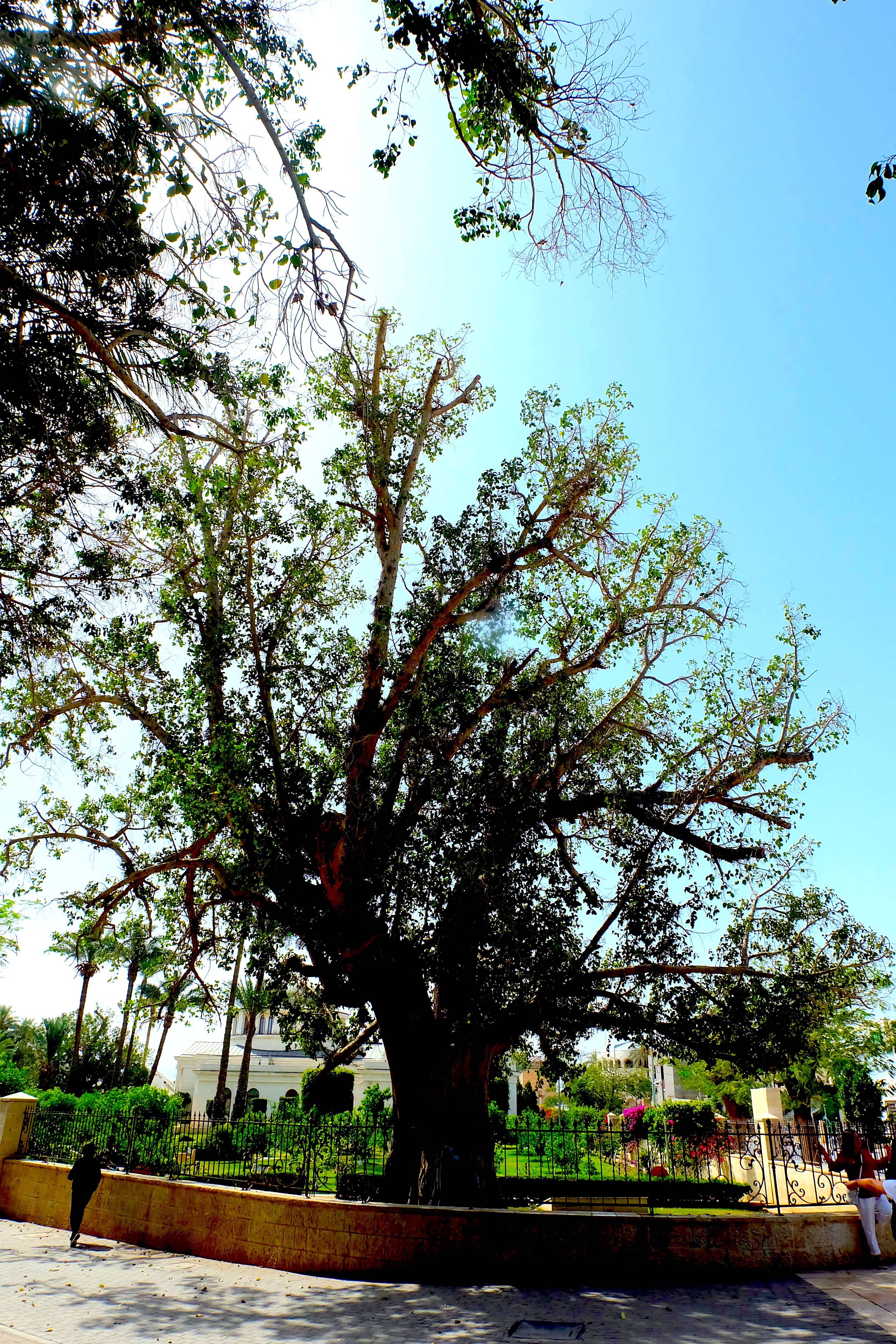
A giant sycamore tree at the center of Jericho, the world’s oldest city. Photo by author, May 2019.
Jesus is now on the final leg of his “resolute journey to Jerusalem” as he passed by the world’s oldest city of Jericho. Next week, he would be teaching at the Temple area in Jerusalem where his enemies would gang up against him, eventually sending him to death as we shall hear on the 24th of this month, the Solemnity of Christ the King.
Today we find a very interesting story that is in stark contrast with last Sunday’s parable of the Pharisee and tax collector praying at the Temple.
And this time, our story is not a fiction but an event found only in St. Luke’s gospel about a real tax collector named Zacchaeus, a very wealthy man indeed.
The fictional Pharisee Jesus narrated in his parable last week was a very proud one, of high stature literally and figuratively speaking that he would always stand and pray inside the Temple to be seen by everyone.
He was a self-righteous man who despised everyone else, especially tax collectors.
But, according to Jesus, the Pharisee’s prayer was not heard by God because he was not really seeking God but seeking adulation for himself!
Treetop of a sycamore tree in Jericho today.
Contrast that Pharisee with the chief tax collector in Jericho named Zacchaeus: he was of small stature, literally and figuratively speaking, that he had to climb a sycamore tree in order to see “who Jesus was” (Lk.19:3).
We can safely surmise that from St. Luke’s narration, nobody loved Zacchaeus in Jericho: he must be really so small in their eyes that he is hardly noticed maybe except when people paid taxes.
And that is why when he learned Jesus of Nazareth was passing by their city, he went to climb a sycamore tree to have a glimpse of the man he must have heard so often performing miracles and doing all good things for sinners like him.
Then, a strange thing happened…
When he reached the place, Jesus looked up and said, “Zacchaeus, come down quickly, for today I must stay at your house.” And he came down quickly and received him with joy. When they all saw this, they began to grumble, saying, “He has gone to stay at the house of a sinner.” But Zacchaeus stood there and said to the Lord, “Behold, half of my possessions, Lord, I shall give to the poor, and if I have extorted anything from anyone I shall repay it four times over.” And Jesus said to him, “Today salvation has come to this house because this man too is a descendant of Abraham. For the Son of Man has come to seek and to save what was lost.”
Luke 19:5-10
Was it serendipity or divine destiny?
Jesus was just passing through Jericho while Zacchaeus was merely interested in seeing the Lord. Never in his wildest dream, so to speak, did he intend to meet him personally.
From Google.
But, as we all believe and have realised, there are no coincidences or accidents in life.
Everything that happens in our lives has a purpose, a meaning that may either make us or unmake us.
It all depends on us whether we make the right decision in making the most out of whatever life offers us, of what comes to us. Either we become better or bitter – so choose wisely.
More so with salvation from God who never stops coming to us everywhere, anytime like with Zacchaeus when Jesus suddenly came to meet him.
The Catholic Parish Church in Jericho run by the Franciscans, May 2019.
Here we find again a story about faith that leads to conversion and salvation or justification.
It does not really matter how little faith we have like when the Apostles asked Jesus on the first Sunday of October, “Lord, increase our faith in God” (Lk. 17:5,Wk. 27). What matters is that we always have that option for God, a desire for God.
This is specially true as St. Paul assures us in the second reading that Christ will come again at the end of time. Nobody knows when or how he will come again but like Zacchaeus, we must have that desire for Jesus who first comes into our hearts before entering into our homes or churches, no matter how grandiose they may be.
Every desire for God in itself is an expression of faith in him. And God comes to those who truly seek him because that is how great God is: not in his power to do everything but to be small and forgiving!
Before the Lord, the whole universe is as a grain from a balance, or a drop of morning dew come down upon the earth. But you have mercy on all, because you can do all things; and you overlook people’s sins that they may repent. But you spare all things, because they are yours, O Lord and lover of souls.
Wisdom 11:22-23, 26
Inside the Catholic Parish of the Good Shepherd in Jericho, May 2019.
Like in the parable of the persevering widow and judge as well as that of the Pharisee and tax collector praying at the temple last Sunday, today’s story of Zacchaeus meeting Jesus shows us how God never abandons us his children, always ready to grant our desires and wishes even beyond what we are asking for — if we have faith in him.
Our salvation depends solely in our faith to God in Christ Jesus, like Abraham in the Old Testament that we can now rightly be called as his children like Zacchaeus.
No one is excluded from this tremendous grace of God brought to us through Jesus Christ who had come to seek those who are lost.
Like Zacchaeus upon receiving salvation from the Lord on that simple day, may we joyfully turn away from sins and most of all, cheerfully rid ourselves of so many other things that hamper us from following Jesus resolutely to Jerusalem. Amen.
We have reflected last week that prayer is an expression of our faith by citing Dione Warwick’s 1967 hit, “I Say a Little Prayer”.
When there is faith expressed in prayer, there is also love.
And when there are faith, prayer and love, then we have a relationship like family and friends, and community.
Today in our gospel, Jesus tells us the right attitude we must have in maintaining our relationships, not only with him but also with others.
Jesus addressed this parable to those who were convinced of their own righteousness and despised everyone else. “Two people went up to the temple area to pray; one was a Pharisee and the other was a tax collector. The Pharisee took up his position and spoke this prayer to himself, ‘O God, thank that I am not like the rest of humanity – greedy, dishonest, adulterous – or even like this tax collector.’ But the tax collector stood off at a distance and would not even raise his eyes to heaven but beat his breast and prayed, ‘O God, be merciful to me, a sinner.’ I tell you, the latter went home justified, not the former.”
Luke 18:9-11, 13-14
From Dione Warwick’s 1967 “I Say a Little Prayer”, we move to the following year when Sylvia Robinson and Bert Keyes composed Love on a Two-Way Street recorded by The Moments as a filler for their 1968 album Not on the Outside, But the Inside, Strong!
It did not fare well in the charts and was released again as a single in 1970 when it spent five weeks at number one on Billboard’s Soul Singles chart. It become one of the greatest R&B song of that year that was later covered by other artists.
In 1981, 14-year-old Staci Lattisaw did a cover of the song that became so popular that others have thought it as her original.
But with all due respect to Staci, I have also always felt her version very cheesy that I prefer the originals singing it because they give more character and soul to the song.
I found love on a two way street and lost it on a lonely highway Love on a two way street and lost it on a lonely highway
There was no specific experience behind the composition of Love on a Two-Way Street except that it was just a product of a play on words and poetry by Robinson supported by Keyes’ music.
The moment we become convinced of our righteousness that we despise everyone else (cf. Lk.18:9), then we shut ourselves in and leave no space for others even God.
Love as a two-way street based on today’s parable by Jesus requires three attitudes so our relationships would mature and grow deeper: a sense of sinfulness, self-surrender, and self-offering.
No love and faith would ever grow on a lonely highway, with no one else to relate with. That’s when we stop communicating and relating until we break up with others and end up alone and isolated.
That is when we become a “lonely highway” with nobody else but I, me, and myself.
Go back to the two-way street of God and others.
Though crowded with some traffic jams, there is always a space for everyone.
Photo by the author. Baguio City Cathedral, January 2019.
We have reflected last Sunday that prayer is an expression of our faith.
Where there is faith and prayer, there is always love.
And when we have prayer, faith and love, we have a relationship and community of two or three and more persons together as one, rooted in God.
Today we hear another parable by Jesus only St. Luke has, that of the Pharisee and the tax collector to show us another dimension of faith expressed in prayer.
Photo by the author at the Wall of Jerusalem, May 2017.
Like last week, St. Luke tells us anew the Lord’s purpose in narrating this parable:
Jesus addressed this parable to those who were convinced of their own righteousness and despised everyone else.
Luke 18:9
Were you moved or affected in any way upon hearing our parable today?
Did you feel a silent but swift, sharp thud inside your heart while your mind tried to reason out that the parable is not meant for you?
Listen again and pause, let the Lord’s words sink deeper into your heart:
“Two people went to the temple area to pray; one was a Pharisee and the other was a tax collector. The Pharisee took up his position and spoke this prayer to himself, ‘O God, I thank you that I am not like the rest of humanity — greedy, dishonest, adulterous —- or even like this tax collector. I fast twice a week, and I pay tithes on my whole income.’ But the tax collector stood off at a distance and would not even raise his eyes to heaven but beat his breast and prayed, ‘O God, be merciful to me a sinner.’
Luke 18:10-13
If prayer creates a relationship, Jesus is teaching us today the right attitude we must have to keep this communion we have in faith and love. Any relationship is bound to fail, or would not even exist at all despite the formalities of having ties and links like what we see or even have in our various social circles where roles are just acted out.
We call it “plastic” or fake. Untrue!
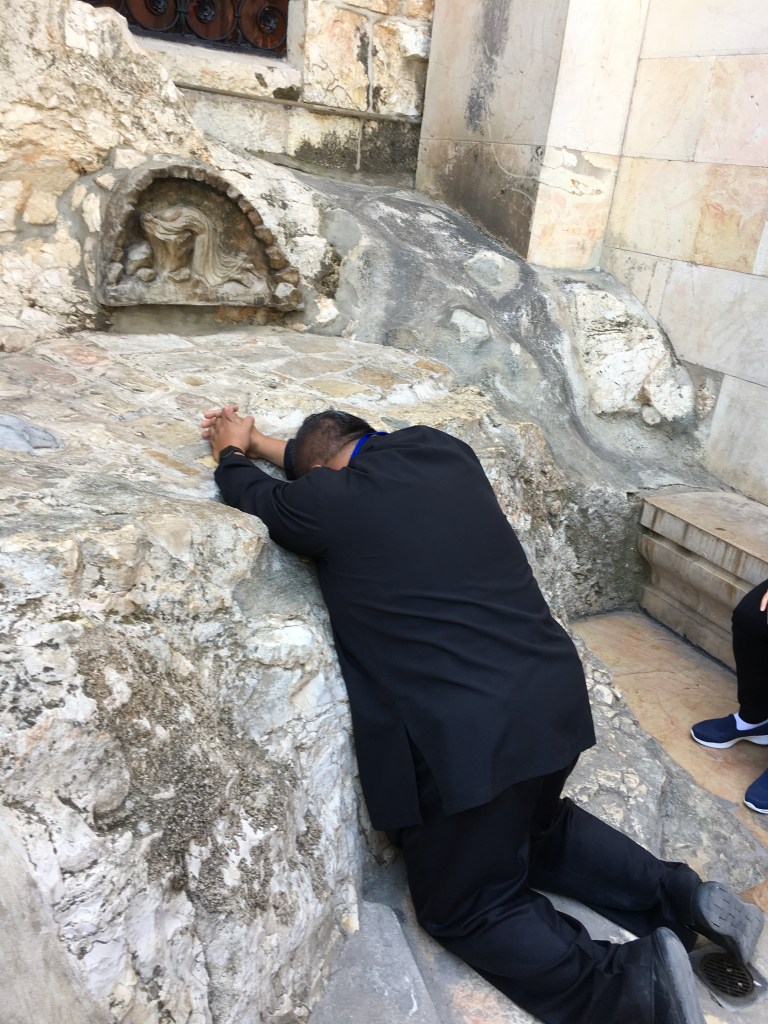
Praying at the Garden of Gethsemane, May 2019.
Prayer to be efficacious like any relationship must always be true.
Here Jesus directs our attention in the “where” when we pray – not just the location or locus of our prayer but our “place” in that relationship first with God who is our very foundation.
When all we see is our self in prayer like in any relationship, there is always a problem. It is clearly a one way street, a monologue.
Worst of all, it is an indication of the absence of God or even others because the pray-er is so preoccupied with his or her very self!
The Pharisee was clearly not in God even if he were in front of the temple. His very self was very far from God and all he had was his bloated ego. He may be a very pious person but not really good at all for he has no space for God and for others. He is a very closed man without any room for others.
The tax collector, on the other hand, may be physically far outside the temple but was the one actually nearest to God with his self-acceptance and ownership of his sinfulness, of his need for God. He was closest to God because he was more open with God and with others by admitting his own sinfulness.
Again we find the key to tis Sunday’s parable towards the end:
(Jesus said) ‘I tell you, the latter (tax collector) went home justified, not the former; for whoever exalts himself will be humbled, and the one who humbles himself will be exalted.'”
Luke 18:14
Photo by Dra. Mai B. Dela Pena, Germany, 2016.
Prayer is more than entering a church or a prayer room, or finding our most suitable spot or space to pray.
Prayer is being one with God, of being suffused in God.
“Where” are we when we pray?
First, we become one with God, one in him in prayer when we first admit our sinfulness, when we confess our sins to him, and own them without any “ifs” and “buts”.
God always comes to those who truly open themselves to him by emptying themselves of their sins and inadequacies.
The tax collector was justified in his prayer more than the Pharisee because in confessing his sins, he admitted his need for God. He knew very well his place, so unlike the Pharisee who felt God owes him so much!
When Pope Francis granted his first media interview (to their Jesuit Magazine!), the first question asked of him was, “who is Jose Mario Bergoglio?”
The Holy Father quickly answered, “I am a sinner.”
No wonder when he was elected Pope on March 13, 2013 at the Vatican, he first asked for prayers from the huge crowd gathered before he bestowed his apostolic blessing to them. It clearly showed that despite his holding the highest post in the Church, he considers himself a sinner, so weak needing prayers from the people.
I always tell couples during weddings that when they have a quarrel, the first one to speak and make the move for reconciliation is the one with most love, the one who is most willing to bow to start anew.
Most often in life, friendships and relationships are kept when we are willing to take the lower stance, not necessarily admitting fault or guilt in any misunderstanding because being lowly indicates the person’s need for the other person and of one’s love to work on that relationship despite its fragility.
Ordination of deacons, Malolos Cathedral, 12 June 2019.
Second, we are in God and with God in prayer when we have that attitude and inner disposition of being poor and lowly. Being lowly or poor means having the conviction to leave everything behind and go down with God into the lowest point because one is so confident of the efficacy of prayer like what Ben Sirach tells us in the first reading.
Most of all, like Mary the Mother of Jesus during the Annunciation of the Christ’s birth.
The one who serves God willingly is heard; his petition reaches the heaven. The prayer of the lowly pierces the clouds; it does not rest till it reaches its goal.
And thirdly, we are in God in prayer when there is an offering daily of one’s self to God.
It is not enough to be lowly and sorry for our sins in prayer. It has to be sustained because prayer is also a discipline like any sport. In the second reading, St. Paul calls us to persevere and endure until the end for Jesus Christ.
We need to be passionate with our prayer life, willing to go to all extent to offer everything for the Lord, to fulfill his will “who shall award us with the crown of righteousness in heaven.”
We are all sinners forgiven and beloved by God.
May we find ourselves in God and with God always both in our sinfulness and lowliness. Amen.
The Lord Is My Chef Recipe for 40th Wedding Anniversary
Tony and Joyce Lopez, 20 October 2019
Presentation of Our Lord Parish, Filinvest 1, Batasan Hills, QC
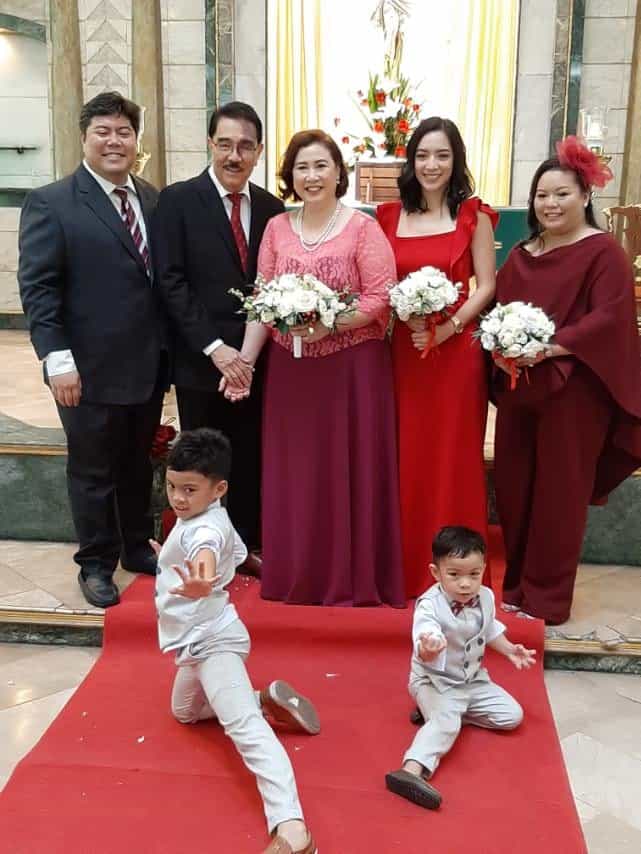
Tony and Joyce on their 40th Wedding Anniversary, 20 October 2019 at the Presentation of the Lord Parish, Filinvest I, QC joined by their son Atty. JA and wife Kathleen with two kids, and youngest daughter Rosella.
Every Sunday I write a blog connecting the gospel with a secular song.
As I prepared my homily for your anniversary, Joyce and Tony… “the moment I woke up and before your Mommy Fely put on her make-up, I said a little prayer for you.”
Joyce mom Fely Pollard with late husband Charles’ cousin, Beth Javier.
Of course that is not the theme song of Joyce and Tony. They haven’t met yet in 1967 when Dione Warwick recorded I Say a Little Prayer. But they were already married when it became one of the tracks in the movie “My Best Friend’s Wedding” starring Julia Roberts.
And since this is my “best cousin’s wedding anniversary” in this part of the city, I have thought of reflecting on married life as a form of prayer.
In our gospel we have heard Jesus Christ narrating the parable of the unjust judge and persistent widow to underscore “the necessity to pray always without becoming weary” (Lk. 18:1).
Prayer is an expression of faith.
When there is faith, there is also love.
And when there is prayer, faith, and love, what we have is a relationship, a community of believers who love each other.
People who love and believe with each other always talk and communicate. They make time to be with one another. And most often, that is what really matters with people who love and believe – simply to be together.
Even in silence.
Like prayer.
Joyce: “During our first few years as couple, I was the one always embracing Tony; but, later until now, it is Tony who often hugs and embraces me! Nabaligtad ang scenario.”
Prayer is more than asking things from God but most of all, prayer is a relationship with God expressed with others. That is the beauty of the Sacrament of Holy Matrimony: husband and wife are bound together in marriage to become signs of the saving presence of Jesus Christ.
Marriage as a sacrament means it is a prayer as well, a relationship of a man and woman with God as its source and foundation.
I am sure, Joyce and Tony along with all the other married couples here today will agree that married life requires a lot of prayers. In fact, married life is a prayer, a very difficult one that is much needed.
Like in that movie My Best Friend’s Wedding, there are real forces of evil that are trying to destroy couples. So many couples have already fallen, going their separate lives after several years of being together while on the other hand, more and more couples are refusing to get married at all due to this reality of breakups and separations.
And that is why we are celebrating today on this 40th anniversary of Joyce and Tony’s wedding! We are praying with them in expressing our faith and love for them in Christ Jesus. Prayers have kept them together, transforming them into better persons.
At the end of the parable of the persistent widow and unjust judge, Jesus posed a very crucial question for us, especially to every married couple here today: When the Son of Man comes again at the end of time, will he find faith on earth? (Lk.18:8)
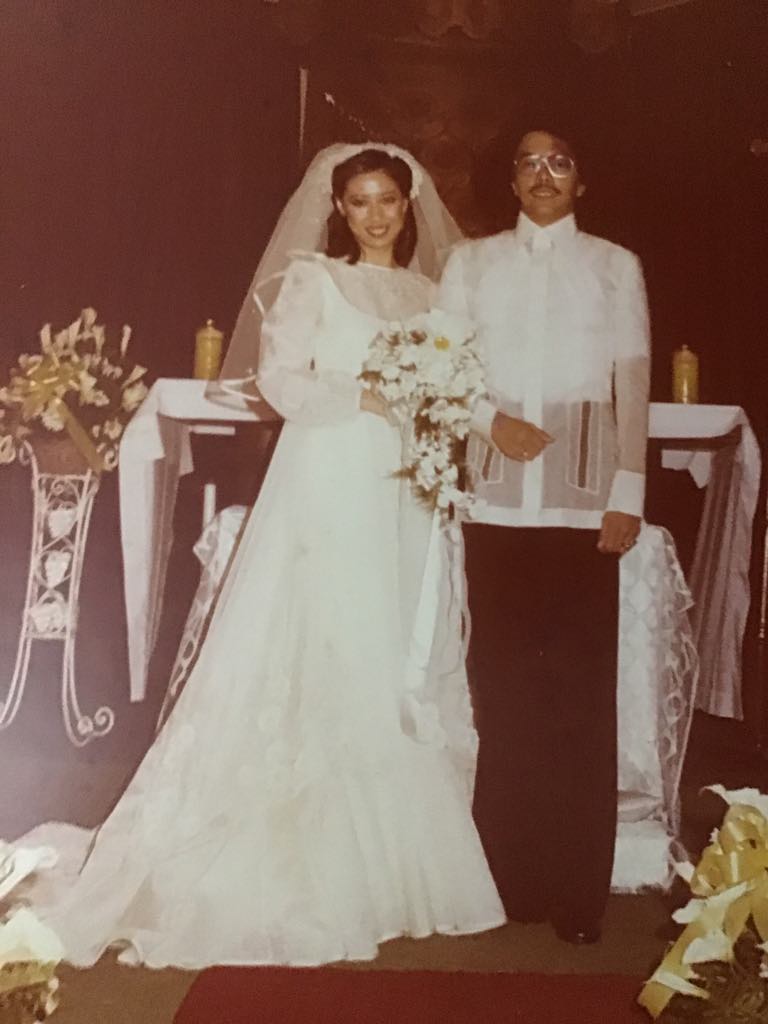
Tony and Joyce at Villa San Miguel, Mandaluyong 1979.
And what shall be our response?
“Yes, Lord, you shall find faith when you come again in Joyce and Tony!”
Like Moses in the first reading, they both prayed hard with arms outstretched on many occasions as they battled life’s many challenges and struggles.
“Yes, Lord, you shall find faith when you come again in Joyce and Tony” because they have both proclaimed your word with persistence, whether it is convenient or inconvenient like St. Paul in his second letter to Timothy. They have weathered so many storms in the past 40 years and your words, O Lord, have kept them together, sharing these with their children and with everyone in their life of fidelity and love.
“Yes, Lord, you shall find faith when you come again in Joyce and Tony” now before your altar to renew their vows to love and cherish each other for the rest of their lives!
“Yes, Lord, you shall find faith when you come again” among the many couples gathered here who have remained faithful to each other despite their many sins and failures, weaknesses and shortcomings.
Joyce and Tony, you are not only a prayer of faith but also a homily of the Holy Matrimony, showing us the light and power of Jesus Christ to transform people in prayer and bring them to fulfillment.
Prayer does not change things like typhoons and earthquakes. We cannot ask God in prayer to spare us from getting sick or be exempted from life’s many trials and sufferings. Prayer cannot stop those from happening.
What prayer does is change us, change our attitude so we may hurdle life’s many blows and obstacles. Especially with couples who always find God in their lives, in good times and in bad.
Prayers transform us into better persons as children of God, especially couples who eventually look like brothers and sisters after living together in faith, hope and love.
Tony and Joyce, I am sure everyone in our family and among your friends here can attest to the many good things that have transformed you in the past 40 years.
You have changed to become the best for each other.
In the bible, the number 40 means perfect.
May God continue to perfect you, Tony and Joyce.
Keep us too in your prayers as we pray for you. Amen.
God our Father, so often we profess our faith in you.
But so often, it is not authentic faith at all because it is more of manipulating you for we can actually see all possibilities.
Like that someone in the crowd who said to Jesus:
“Teacher, tell my brother to share the inheritance with me.” Jesus replied to him, “Friend, who appointed me as your judge and arbitrator?” Then he said to the crowd, “Take care to guard against all greed, for though one may be rich, one’s life does not consist of possessions.”
Luke 12:13-15
Forgive us Lord in believing more in our selves than in you, in believing our selves that we can use you for our selfish ends even if it something rightly ours.
Give us an authentic faith like that one Abraham had when he believed in you, O God, that you would still fulfill your promise to make him the father of all nations despite his advanced age as well as Sarah’s condition.
As explained by St. Paul in today’s first reading, teach us to have the same faith of Abraham who showed a kind of resurrection faith – of faith that God could bring forth life from the barren or “dead” womb of Sarah.
A “faith that justifies” like that of Abraham is a faith that saves because more than fulfilling his promise, Abraham believed that God can bring back to life anyone already dead like the womb of wife Sarah who was already old and barren.
Let us grow in having an authentic faith like Abraham who entrusted his total self to you, Lord, even if human reason reason tells us there is no hope at all. Amen.
Kindly say a prayer for the recovery of our brother priest, Fr. Federico dela Cruz, who had brain surgery last night due to a head injury he sustained in an accident Saturday night. Thank yo.


















 lordmychef.com