Lent and the Contemplative Spirit

40 Shades of Lent, 5th Sunday-C, 07 April 2019
Isaiah 43:16-21///Philippians 3:8-14///John 8:1-11 
From Google.
Sunrise at Lake of Galilee. Photo by author April 2017.

Today is the last Sunday of Lent. It is hoped that by this time since Ash Wednesday, we have slowly acquired or even regained our contemplative spirit of prayerful silence. It is something very essential not only during these 40 days and in the coming Holy Week. It is only in silent prayers can we truly find balance in life as we discover what is valuable and what is worthless, things that last and things that pass. Prayerful silence teaches us to slow down, to be more discerning, and more trusting. The contemplative spirit thus leads us to grow deeper in our faith, hope and love in God. It is in the contemplative spirit where God works best in us.

We find this invitation to a contemplative spirit in our beautiful gospel today of a woman caught committing adultery whom Jesus refused to condemn. Unlike the previous four weeks when we heard all gospels taken from Luke, this Sunday’s story is from John that perfectly fits last week’s parable of the prodigal son to show us God’s immense love and mercy for us sinners. Every conversion, every contrition of sins presupposes silence. Recall how the lost son last Sunday realized his sinfulness while silently tending swine in a far away land.

From Google.

Jesus went to the Mount of Olives. But early in the morning he arrived again in the temple area, and all the people started coming to him, and he sat down and taught them. Then the scribes and the Pharisees brought a woman who had been caught in adultery and made her stand in the middle. They said to him, “Teacher, this woman was caught in the very act of committing adultery. Now in the law, Moses commanded us to stone such women. So what do you say?” They said this to test him, so that they could have some charge to bring against him. Jesus bent down and began to write on the ground with his finger.

John 8:1-6

From Google.

We have seen how Jesus foiled other insidious plots against him through tricky questions but this one involving a woman caught committing adultery shows us a fine image of him as the Christ. His silence, his bending down and his writing on the ground are moving moments that touch our hearts and make us wonder all the more, who is this man?

More than addressing a question that concerns the many dilemmas we face in life, this episode shows us that it is something that directly concerns Jesus Christ himself, his being our Savior. Notice at the start of the story where Jesus is presented always going to the Mount of Olives to pray, to be one with the Father. This episode happened after he had entered Jerusalem on Palm Sunday, showing us how Jesus became more intense in praying, in being one with the Father when his final days were approaching. That is the contemplative spirit.

Now feel the atmosphere of those tense moments when people brought the woman caught committing adultery to Jesus: everybody was saying something, emotions were running high, just like us in our own time with social media around us. We live in so much noises where everybody and everything is talking that we fail to listen to our very selves, to others and most especially to God always silent. See how Jesus was so cool – or “chillax” as young people would say. It was an astonishing reaction to the situation. Only a person with deep contemplative spirit like Jesus can be so composed and silent in a tense situation like that. It is always easier to react and say something than be silent to weigh everything. Too often in the world today, words are so empty that they have to be shouted all around and repeated so often in the hope they become true, exactly what every election candidate is doing!

From Bing.com.

Jesus chose to be silent so we may realize that issues of sin and evil are best resolved in a contemplative spirit where we find the value of every person that we condemn the sin not the sinner. History has shown time and again how wars and violence or any other harsh methods like death penalty have proven ineffective in correcting any injustice or wrongdoing and preventing crimes. Where there is severity in measures against evil, we find only more deaths and burials happening but never peace and justice.

Now more than ever in Jesus Christ, we have found and experienced God’s mercy so abounding and closest to us sinners if we are truly sorry and ready to change. Like the woman caught committing adultery or the prodigal son last Sunday, we have to reach out to Christ to be forgiven from our sins. He assures us of never being condemned, of deleting our past sins and assuring us with a bright future to receive his promises if we “go and sin no more.”

We have to stress that Jesus does not approve sins. Never. He recognized the sinfulness of the woman when he told her “go and sin no more.” Likewise, Jesus never asked us to stop fighting sins. When he dared the people of whoever has no sin be the first to cast the stone, Jesus never meant us to be silent with the evil and wrongdoings happening around us. This encounter between Jesus and the woman committing adultery invites us to examine first, our own attitudes toward others guilty of serious sins. And secondly, to examine our own reactions when our misery meets with God’s mercy especially in the sacrament of penance or reconciliation.

Do we choose to be harsh like the crowd or be gentle like Christ?

How sad that even with our very selves we are so unforgiving, so severe that we hardly move on in life. Only in a contemplative spirit can we truly experience God’s liberating mercy and forgiveness within us and with others. The contemplative spirit enables us to trust God that no matter how sinful we are, his love and mercy are more powerful, able to transform us all into better persons, even saints! This is the promise of God in the first reading that he would do something greater than what he had done in liberating his people from Egypt – that he would send our Savior not only to forgive our many sins but even to share in his glory as saints.
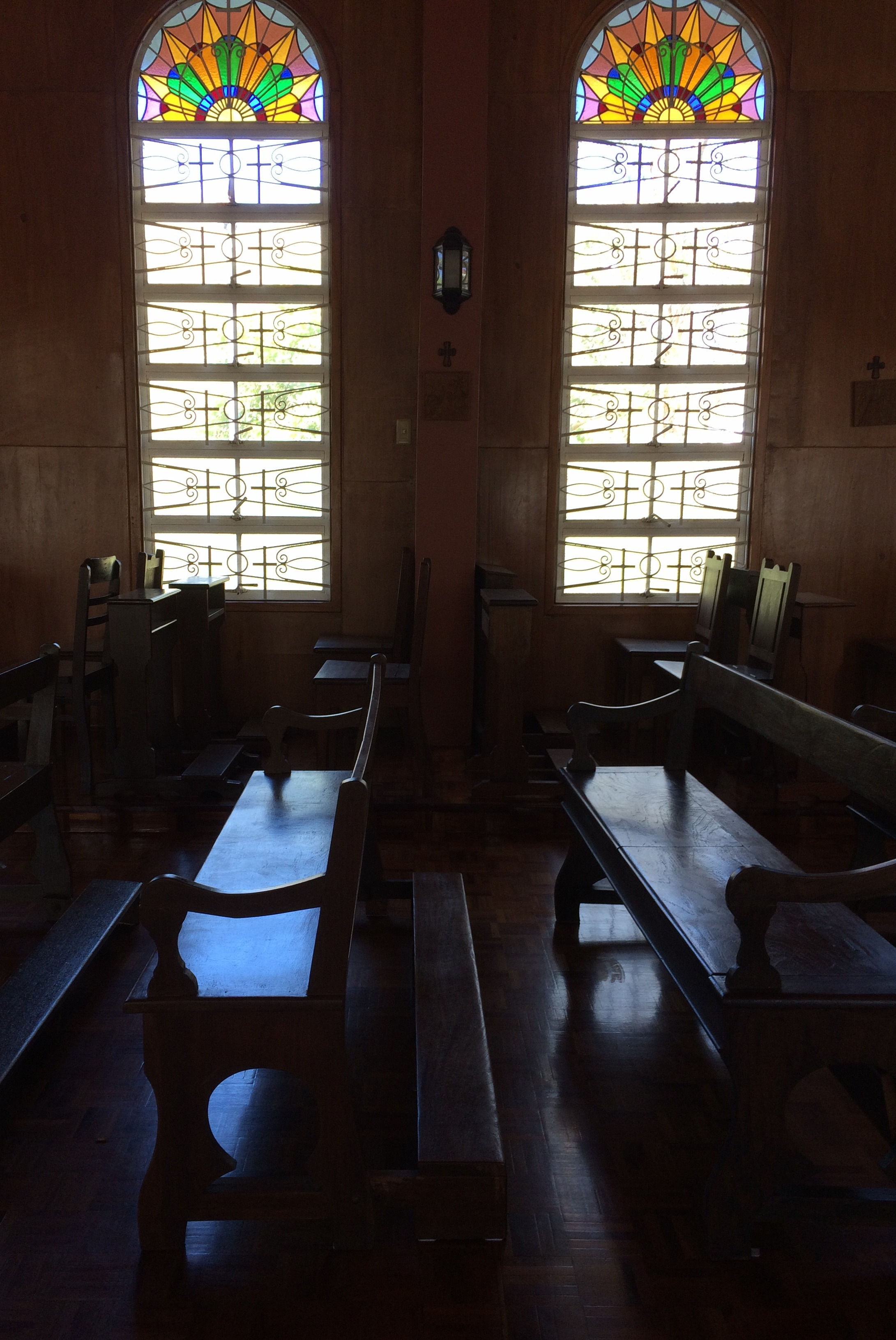
Assumption Sabbath Baguio, January 2019.

St. Paul in the second reading could speak of “considering everything as a loss in knowing Christ Jesus” because of the contemplative spirit he acquired after his conversion. His letters all reveal to us St. Paul’s contemplative spirit and intimacy with Jesus Christ that flowed out into his daily life, reaching its summit in his martyrdom.

As the season of Lent comes to a close on this fifth Sunday, we are reminded of the path of conversion we have followed these past four weeks under St. Luke’s guidance. Conversion leads to contemplation, a daily communion with God in prayerful silence and allow him to suffuse us with his love. Its fruits are seen in our daily lives. It is the work of God, not us. It is God who renews us in silence into a new creation. We simply have to remain in Christ and strive always “to go and sin no more”. Amen.

Lent is praying for the wicked among us

40 Shades of Lent, Friday, Week-IV, 05 April 2019
Wisdom 2:1, 12-22///John 7:1-2, 10, 25-30
From Google.

We know it deep in our hearts, Lord. We knew it all along because we have felt being the object of their evil thoughts and plans:

The wicked said among themselves, thinking not aright: “Let us beset the just one, because he is obnoxious to us; he sets himself against our doings, reproaches us for transgressions of the law and charges us with violations of our training.”

These were their thoughts, but they erred; for their wickedness blinded them, and they knew not the hidden counsels of God; neither did they count on a recompense of holiness nor discern the innocent of souls’ reward.

Wisdom 2:1, 12,21-22

When will the evil people ever stop plotting all plans against us, O Lord? When will they realize their errors, their mistakes, their sins? When will they ever get tired with the unnecessary burdens of thinking evil against others?

On this first Friday of April, O God, we pray for those who persecute us, for those who malign us, for those who make life so difficult for us without realizing the goodwill we have for them. We pray for the wicked who are bent on crushing us but would never truly succeed because you would never allow evil to triumph over what is good.

So many times, they are all talk because they never have the guts and courage to be true and honest. They are always hiding. Like Jesus openly exposing Himself at the temple area, yet nobody could lay their hands on Him because it was not yet His hour.

Our merciful Father, grant us the courage and strength to endure every evil and lies when our time finally comes to stand up for you like Jesus. Amen.

From Google.

Alibughang ama ng mga alibughang anak?

Lawiswis ng Salita ni P. Nicanor F. Lalog II, ika-01 ng Abril 2019

Sisihin aking mapaglarong isipan
Dahil panahon ng halalan
Paano nga kaya kung minsan
Mabaligtad naman takbo nitong kwentuhan?
Mayroong magkakapatid
Ang ama nila ay hindi maintindihan
Hindi nila maramdaman 
Kung sila'y ganan niya na sobrang yabang.
Wala siyang hindi pinapatulan maging kababaihan man
Dinaraan sa mararahas na usapan
Pero kung maiipit sa mga salitang binitiwan
Sasabihin niya na ang lahat ay biruan at kunwari lamang.
Humingi ng paumanhin nang murahin Santo Papa natin
Ngunit nang ang Diyos ang kanyang lapastanganin
Hindi na mailihim kanyang tililing at pagka halimaw na rin 
Nang ang lahat ay ibig patayin maging mga alagad ng Simbahan natin.
Kaibayo pagkakaiba niya sa lahat ng ama
Na sa halip buhayin, lahat ay ibig niyang tokhangin
Masasamang loob at mga makasalanan sa kanya ay walang kabuluhan
Hindi niya alintana kanilang kahirapan dahilan ng kawalanghiyaan.
Sa talinghaga nagdalita ang alibughang anak
Nagtika sa malaking pagkakasala saka nagbalik-loob;
Kumpara sa ating nararanasan, matatagalan pa pagsadsad sa kailaliman
Kaya kahambugan at kasinungalingan hindi matitigilan.
Mas mahirap pala kung ama ang siyang alibugha
Dahil higit sa lahat bago maging ama ang sino man
Kailangan siya muna kakitaan di lamang ng kahusayan at kagalingan
Kungdi higit sa lahat ng kabutihan at katinuan.
Kung paano naluklok ang isang alibughang ama
Madaling malalaman bagama't walang pupuntahan ating sisihan
Mabuti pa'y tingnan ating kalooban sa sinapit nating kalagayan
Di kaya dahil tayong mga anak ay alibughang puno ng pagkukulang?

Lent is understanding Sin

40 Shades of Lent, Sunday Week IV-C, 31 March 2019
Joshua 5:9,10-12///2Corinthians 5:17-21///Luke 15:1-3,11-32

Sin can be mysterious at times because it can also be a religious experience that leads us back to God and holiness. We have a saying that “every saint has a sinful past and every sinner can have a saintly future.” So many men and women who were so notorious in their lives have proven this so true like St. Paul and St. Augustine.

After reflecting on the call for conversion last Sunday, our gospel today tells us a lot about the nature of sin. Unless we understand what is sin and why we sin, then we get imprisoned by sin as we keep on committing it no matter how hard we try to be better persons. But once we understand even a little bit of it, its hows and whys, then we sin less often as we slowly break free from its bondage.

“A man had two sons, and the younger son said to his father, ‘Father, give me the share of your estate that should come to me.’ So the father divided the property between them.”

Luke 15:11-12

Sin is when we separate from the Father like the younger son when we ask for our “share of your estate that should come to me” referring to that part of this whole life only God can have in its fullness. We always have the idea that it must be so vast and huge that even just a part of it would be more than enough for us. We want to be on our own that we break away from Him, thinking wrongly that the share we have is more than enough for us without truly realizing how great and so vast is the Father’s estate which is life itself!

And so it happens, we break away from God and live on our own that sooner or later, our share dissipates until we lose everything.

This estate, this very life of God will never be gone like Him, will never diminish nor dissipate. We shall always have it, enjoy it for as long as we are with Him, our loving Father! This is also the point of the Father to the elder son when he refused to join their celebration when his younger brother returned. Life, love, kindness, family, everything that is good dissipates when held individually away from God. But when we share it with the Father through Christ, it is like the river that never runs dry.

When he had freely spent everything, a severe famine struck that country, and he found himself in dire need… And he longed to eat his fill of the pods on which the swine fed, but nobody gave him any.

Luke 15:14,16

Sin always gives us the sense of “freedom” like the young son who “freely spent everything”. There is always that wrong understanding of freedom as the ability to do everything and anything, feeling that everything in this life is ours alone. Freedom is first of all choosing what is truly good. To be free is to be loving, being a part of the whole and never separated from the whole. To be truly free is always to be one. This explains why when we are deep into sin and all alone, separated from others, we suddenly long to be one with others. The sense of belonging suddenly pops up within us because we find ourselves incomplete when in sin.


“My son, you are here with me always; everything I have is yours.”

Luke 15:31

Here lies the problem also with the elder son who has always been present with their father but had never been one with him, never belonging to him. He is guilty of “sin of omission” when he felt nothing seems to be wrong with him as he breaks no rules of their father – except their relationship and ties. The apostle James wrote in his letter that “a person is tempted when he is lured and enticed by own desire” (Jas.1:14). Sin is always the desire to be sufficiently alone, to be powerful, to be God! See how since the beginning, we have never outgrown that sin of Adam and Eve of becoming like God, of playing god.

My dear sisters and brothers, like Paul in our second reading today, let us be reconciled to God in Christ. To be reconciled is to be one, to belong, to become a part again of God. In the dryness and desolation of sin like the desert in the experience of Joshua and the Hebrew people, God continues to bless us with so many gifts, so many blessings. The two brothers in the parable are both sinners but loved by their father. And so are we.

More than avoiding sins, our gospel parable this Sunday invites us to love God more by seeking His will always. Yes, we have all been hurt by someone else’s sins and we have also caused pain on others with our sins. Let us focus more on this vast gift of life and love expressed in God’s mercy and forgiveness that no sin could ever diminish. And the good news is that it is all free and totally being given to us by Jesus Christ especially in our Sunday Eucharist. A blessed week to you!

*All images from Google.

Lent is confronting evil

40 Shades of Lent, Thursday, Week III, 28 March 2019
Jeremiah 7:23-28///Luke 11:14-23

What a shame, dear God, to read in the gospel today your Son Jesus Christ busy confronting evil, driving out a demon that was mute from a man while we in this age deny its very existence.

In the name of modernity and keeping up with the time, we have taken sin and evil for granted, short of imitating the contemporaries of Jesus of accusing Him of driving out demons by the power of Beelzebul, the prince of demons.

How true were the words of your prophet Jeremiah that “we have walked in the hardness of our hearts and turned our back, not our faces, to you. Faithfulness has disappeared, even the very word from our speech.” (Jer.7:24,28)

Let us heed today’s responsorial psalm, “If today you hear his voice, harden not your hearts.”

Give us the courage, O God, to be like your Son Jesus Christ fighting evil and sin by being firm in keeping your commandments. Amen.

Images from Google; above is The Temptations of Christ, a 12th century mosaic at St. Mark’s Basilica, Venice, Italy.