Loving like St. Joseph in the time of pandemic

40 Shades of Lent by Fr. Nicanor F. Lalog II
Friday, Solemnity of St. Joseph, Spouse of the Blessed Virgin Mary
2 Samuel 7:4-5, 12-14, 16  +  Romans 4:13, 16-18, 22  +  Matthew 1:16, 18-21, 24
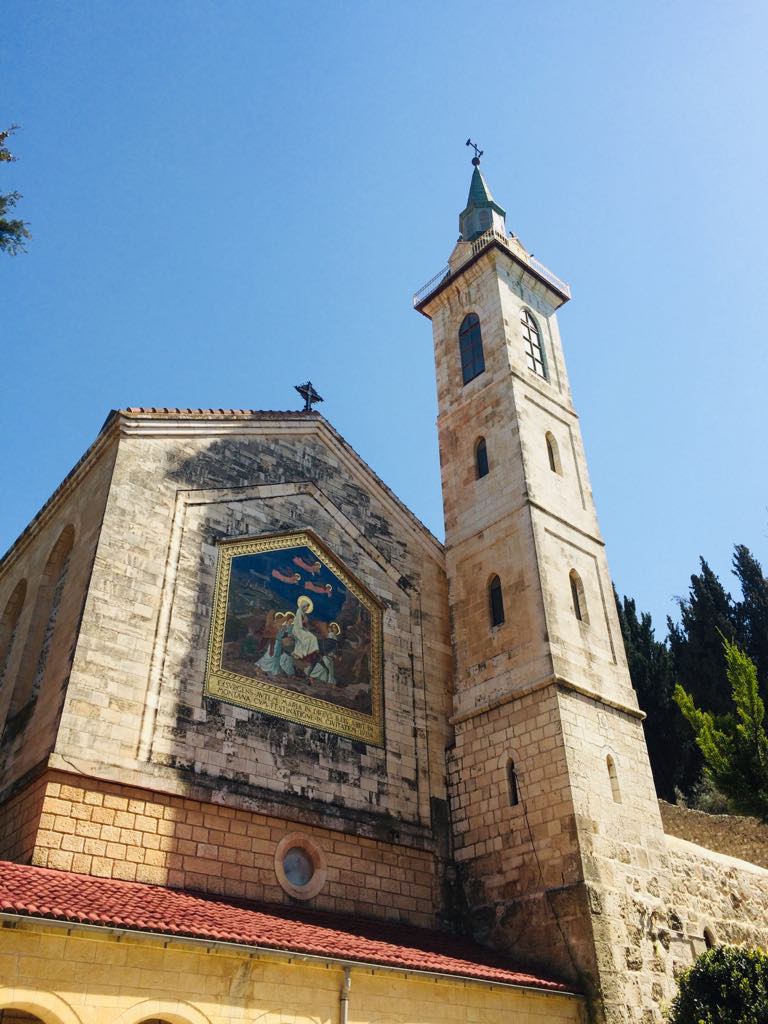
Photo by author of the site believed to be the workshop of St. Joseph in Nazareth, 2017.

Today’s celebration of the Solemnity of St. Joseph as most chaste spouse of the Blessed Virgin Mary is a very special one being in the “Year of Saint Joseph” that began last December 8, 2020 until December 8, 2021 in commemoration of the 150th year anniversary of Pope Pius IX’s declaration of the beloved saint as Patron of the Universal Church.

In launching this Year of Saint Jospeh last year, Pope Francis wrote in his Apostolic Letter “Patris Corde” (With a Father’s Heart) how the COVID-19 pandemic has helped us see more clearly the importance of “ordinary” people who, though far from the limelight, exercise patience and offer hope every day.

The Holy Father explained that the “ordinary” people like those who kept our lives going especially during the lockdowns resemble Saint Joseph, “the man who goes unnoticed, a daily, discreet and hidden presence,” who nonetheless played “an incomparable role in the history of salvation” (Vatican News, 12 December 2020).

I really hope you can have time to read today this very short letter by Pope Francis who is a known devotee of Saint Joseph having popularized among us during his 2015 Papal Visit the image of “Sleeping Saint Joseph”.

In Patris Corde, Pope Francis gives us some helpful points on how we can love with the heart of God our Father like Saint Joseph during this time of the COVID-19 pandemic. One of these traits the Pope invites us to imitate from Saint Joseph is his “creative courage” in loving God and loving others.

If the first stage of all interior healing is to accept our personal history and embrace even the things in life we did not choose, we must now add another important element: creative courage. This emerges especially in the way we deal with difficulties. In the face of difficulty, we can either give up and walk away, or somehow engage with it. At times, difficulties bring out resources we did not even think we had.

Pope Francis, Patris Corde #5

A creative person is always someone who is deeply in love with another person or with one’s craft, art, career or whatever passion.

The most loving person is always the most creative like Saint Joseph who sought ways expressing his love for Mary and her child by deciding to silently divorce her as the gospel tells us.

This is how the birth of Jesus Christ came about. When his mother Mary was betrothed to Jospeh, but before they lived together, she was found with child through the Holy Spirit. Joseph her husband, since he was a righteous man, yet unwilling to expose her to shame, decided to divorce her quietly.

Matthew 1:18-19
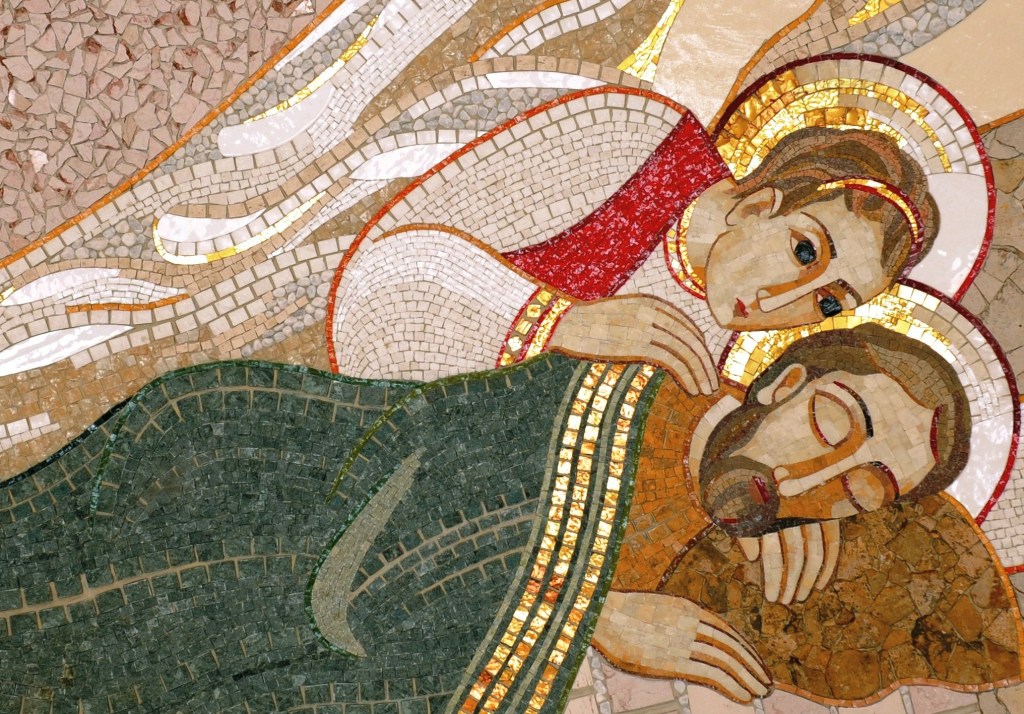
Photo by Arch. Philip Santiago of a mosaic at the San Padre Pio Shrine at Rotondo, Italy of the angel appearing to Saint Joseph in his dream.

Holiness is having creative courage like Saint Joseph.

Notice how the Pope’s description of Saint Joseph is not far from St. Matthew’s calling him a “righteous man” – a holy man – who obeys the Laws of God handed down to them by Moses, including their other traditions meant to keep them clean and pure before God.

Problem during that time is how people have lost sight of God and of others that they were so focused on the letters of the law than its spirit, becoming impersonal in the process as we have seen in instances when they would ask Jesus why he healed the sick even on sabbath day. Worst is when people brought to Jesus a woman caught committing adultery, reminding him of Moses’ instruction to stone her in public.

Such was the dilemma faced by Saint Joseph with Mary being pregnant with a child definitely not his!

In deciding to silently leave Mary, Saint Joseph expressed his righteousness or holiness wherein he showed the true interpretation of their Laws by upholding the dignity of every person, respecting life above all. Like Jesus Christ, Saint Joseph showed that real holiness is authentic love that is willing to sacrifice for the beloved by having the courage to be in pain in giving up or losing a beloved.

Here we find Saint Joseph was not only courageous in facing the painful truth about Mary having a baby not his but also very creative in the sense that because of his great love for the Blessed Virgin, he did not want her exposed to shame and public humiliation in allegedly breaking the seal of their betrothal.

Having courage is more than being able to do death-defying acts that is more on physical strength; courage is a spiritual virtue, a spiritual strength when we do extraordinary things because of higher ideals and values like the love of Jesus who offered us his life on the Cross.

Courage is from the Latin word “cor” for heart which is the seat of our being. And to have courage is to be true and loving that we have such expressions to speak from the heart, to listen to our heart, and to act from our heart when we dare to lose ourselves because of love.

Photo from Aleteia.org of “Let Mum Rest” image St. Joseph nursing the Infant Jesus while Mary sleeps, 2019.

A person who truly loves is always creative, 
finding ways in expressing one's love even sometimes 
it may be painful and difficult.

A “creatively courageous” person like Saint Joseph is someone so deeply in love with Mary and with God: after learning the circumstances surrounding Mary’s pregnancy, St. Matthew tells us “When Joseph awoke, he did as the angel of the Lord had commanded him and took his wife into his home” (Mt.1:24).

Saint Joseph’s love for Mary found ways to spare her all the pains and hurts that may result if found with a baby not his; but after learning the truth, the more we find him creatively courageous when he sought many ways to save Mother and Child from all harm and even death like bringing them to Egypt in the time of Herod.

See that when Saint Joseph accepted Mary, Jesus came forth to us while at the same time, when Saint Joseph accepted God through the angel as expression of his deep faith and love, he took Mary as wife.

And this is what Pope Francis further explains in Patris Corde that at the end of every account in which Saint Joseph plays a role, the Gospel tells us that he gets up and takes Jesus and Mary who are the most precious treasure of our faith.

Taking Jesus and Mary like Saint Joseph as creative courage calls us Christians to always love the Church and in loving the Church, we love the poor for whom Jesus came and Mary identified herself with in her Magnificat which she sang after accepting the Annunciation by the Angel of Christ’s birth which we celebrate next week on March 25.

In this time of the pandemic, we are called to be creatively courageous in finding Jesus among those people too familiar with us as well as with those so different from us. Don’t you find it so funny that the people we always take for granted are those either so close to us like family or completely strangers?

Being creatively courageous in this time of the pandemic means being more sensitive with others especially in our words and actions like Saint Joseph.

I was wondering during prayers why did he not ask Mary about the truth of her pregnancy so that he would have been spared with all the thinking and praying? That is when I realized the value of Saint Joseph’s silence: he did not speak at all to Mary as a sign of his love and oneness with her who must have been into some difficulties too with the situation of being the Mother of Christ. sympathy.

In his silence, Saint Joseph expressed his complete trust in Mary and in God. And in his being silent, Saint Joseph was creatively courageous expressing aloud his tenderness and care for Mary and her Child, something we need so much in this time of the pandemic.

Let us pray to Saint Joseph in this time of social distancing that like him, we may have the creative courage in touching others with the love of God, especially those who are sick and suffering, those in difficult situations, and those forgotten by their families and friends and even by the society. Have a blessed Friday, everyone!

Saint Joseph, Patron of the Universal Church, pray for us!

Photo from Vatican News, St. Joseph and the Child Jesus, 14 December 2020.

Becoming the TLC of God

40 Shades of Lent by Fr. Nicanor F. Lalog II
Homily, Wednesday in Lent Week IV, 17 March 2021
Isaiah 49:8-15     + ++     John 5:17-30    
Photo by Mr. Jim Marpa, 2019.

Today we resumed the community Masses on a limited basis at the Our Lady of Fatima University (OLFU) and Fatima University Medical Center (FUMC) in Valenzuela where I am now serving as their chaplain.

Our aim is very simple:  to share Jesus with everyone in our Fatima community including their families and friends.

Sharing Jesus means being tender and caring with one another like God our Father in heaven who gave us the loveliest description of these attributes in the first reading today by being like a mother.

Thus says the Lord:  “Can a mother forget her infant, be without tenderness for the child of her womb?  Even should she forget, I will never forget you.”

isaiah 49:15

If there is one thing missing in our country
 in this one year old pandemic and lockdown, 
it must be tenderness.

In the gospel of St. Luke, we find Zechariah singing praises to God at the birth of his son John the Baptist:

“In the tender compassion of our God the dawn from on high shall break upon us, to shine on those who dwell in darkness and the shadow of death, to guide our feet into the path of peace.”

Luke 1:78-79

St. Luke used the Greek word “splaghna” to designate tenderness as “tender mercy of God”

Mercy, or “misericordia” which is also our University motto is from the Latin “misereor” that means to stir, to move. More than a feeling, mercy is compassion in action wherein one is moved or stirred in the heart to go down, reach out and be one with the suffering like Jesus Christ.  And that is when we are filled with tenderness of God. Then we become caring.

Tenderness of God as tender compassion is misericordia that is “tagos sa buto” as in “sagad-sagad” that even if we feel tired and hungry, or afraid and anxious, we still go out to help, to uplift, to keep company and inspire those in pain and suffering, those about to give up in life, those who are lost because of sickness, poverty, and other difficulties.

This we find and do in Jesus, through Jesus, with Jesus who said in our gospel today, “My Father is at work until now, so I am at work” (Jn.5:17).

Remember that scene of the feeding of five thousand in the wilderness when Jesus and the Twelve crossed the lake to the other side to rest but a vast crowd followed them and even got ahead of them to the site.  When Jesus saw them, he was moved with pity because they were like “sheep without shepherd” that despite his being hungry and tired, he taught them many things, healed their sick, exorcised the possessed and later, fed and satisfied them all from just five loaves of bread and three pieces of fish.

Tenderness is when we are moved to help those in need while we ourselves are also suffering. Hence, it is not surprising at all to find that the most tender and caring people are also the ones who suffer most. Like moms and these days, the medical front liners who continue to serve us amid the risks they face!


Being tender and caring
are essentially the works of God
made known to us in Jesus Christ.

It has been a year since we had the longest lockdown in the world. It is fitting that as we recall those days even if dark clouds still loom above us these days that we remember the people who have cared for us and made life bearable: all those working in the hospitals supporting our doctors and nurses; the market vendors who ensured we have food on the table; the staff members of the botica we usually visited to get our medicines; the panadero who prepared our daily bread; our teachers who braved the digital world so we may continue with our schooling and learning process, and many more.

It is a tremendous grace from God to be able to be tender with someone because that means we care like Jesus Christ.

Photo from GMA-7 News of Mang Dodong.

Today, God reminds us that amid this great darkness still looming above us in this time of the pandemic, He cares for us very much and wants us to care for one another too, especially for those going through many trials and difficulties in life.

Let us give Jesus our hands and our hearts to be vessels of his divine Tender Loving Care. Amen.

Lent is TLC of God

40 Shades of Lent by Fr. Nicanor F. Lalog II
Wednesday, Fourth Week in Lent, 17 March 2021 (St. Patrick's Day)
Isaiah 49:8-15     <*{{{><  +  ><}}}*>     John 5:17-30
Photo by author, December 2020.
"Can a mother forget her infant,
be without tenderness for the child of her womb?
Even should she forget, 
I will never forget you." 
(Isaiah 49:15)

If there is one thing we terribly miss these days a year since the start of this pandemic is tenderness, your kind of Tender Loving Care (TLC) only you, God our Father, can give like a mother to her child.

How sad that in this time of difficulties when there are so many sufferings and darkness around us, there are also much arrogance and apathy afflicting many of us.

More sad is how everybody is solely focused in finding a cure to control spread of COVID-19, often in drastic measures that only worsen the plight of the weak and marginalized, many have forgotten the need for more care for everyone, not only for those sick but also for our front liners who have lost so many of their family and friends in this time of the corona.

In this continuing darkness of our lives despite the sparkle from vaccines that are still unavailable to many of us, we know you continue to work to save us in Jesus Christ your Son who assured us, “My Father is at work until now, so I am at work” (Jn.5:17).

Let us do your work, Lord, especially today as we celebrate the feast of St. Patrick. Use our hands and our hearts to tenderly serve others especially those deep in darkness with sins and sufferings.

Teach us not only to be compassionate willing to suffer with others but most of all, fill us with the Father’s tenderness to care like you so that we are moved to reach out, going down to the level of those crying, of those so tired and about to give up in life.

Soften our hearts that have been hardened with negativities and cynicisms of time.

Stir our hearts, O Lord, that like you even in our hunger and pain, we may realize there are others more hungry and more in pain than us, hoping for some comfort and care, healing and encouragement, or simply company and inspiration and reason to live.

Let our hands and our hearts, our whole selves be an extension of your tender mercy and care so that “the dawn from on high shall break upon us, to shine on those who dwell in darkness and the shadow of death, and to guide our feet into the path of peace” (Lk.1:78-79). Amen.

A new world begins in a new me

40 Shades of Lent by Fr. Nicanor F. Lalog II
Monday, Fourth Week in Lent, 15 March 2021
Isaiah 65:17-21   ><}}}*>  +  <*{{{><   John 4:43-54
Photo by author at Jaffa, Israel, May 2017.

Praise and glory to you, O God our Father for this blessed Monday as we go halfway through March, a year after the start of the longest lockdown due to COVID-19 pandemic.

Once again, we face the threats of a surge of infections after we have been unmindful that the corona virus is still among us as it comes close to our homes, infecting our family and friends with some of them now in serious condition.

We have forgotten, O Lord, that a new and better world always begins in us, when everyone changes one’s attitudes and ways of living as we continue to hold on to your promise of creating “new heavens and a new earth” (Is. 65:17).

That promise has started to be fulfilled in the coming of your Son Jesus Christ but unfortunately, until now many of us still refuse to believe in him, to live in him as we still seek signs from him like the people of his time.

Give us that same firm faith of the royal official from Capernaum who had come to Jesus in Cana, Galilee “and asked him to come down and heal his son, who was near death” (Jn.4:47).

Jesus said to him, “You may go; your son will live.” The man believed what Jesus said to him and left. while the man was on his way back, his slaves met him and told him that his boy would live. He asked them when he began to recover. They told him, “The fever left him yesterday, about one in the afternoon.” The father realized that just at that time Jesus had said to him, “Your son will live,” and he and his whole household came to believe.

John 4:50-53

So many times in life, O Lord, our faith do not match our lives. We say we believe in you only with our lips, or simply as an expression out of habit and routine. We never dare to truly believe by living out our faith, testing our faith like that royal official who was not only relieved and overjoyed when Jesus told him to go home because his son will live; he still enquired his servants who have met him along the way when exactly his son recovered from fever to confirm the faith he had placed in the words of Jesus.

Like that royal official, give us the courage to dare examine our selves, to look into the many darkness within us like fears, guilt, and anxieties mostly caused by our past sins.

Let Jesus our light dispel the many darkness within us, dear Father, so we may vibrantly live our faith in you so that your promised new heavens and a new earth begin right within us. Amen.

A Lenten Prayer in COVID-19

40 Shades of Lent by Fr. Nicanor F. Lalog II
Ash Wednesday, 17 February 2021
It is Lent again, Lord;
forty days of prayer
forty days of sacrifices
forty days of good works
forty days of silence and self-control
forty days of preparations for Easter.
Forgive us that we always forget our daily life
is essentially a daily Lent:
a daily exodus of going to the wilderness
filled with temptations 
and calls for fidelity 
to your love and person.
In this time of COVID-19
when so many of us are suffering,
help me, O Lord
not to be carried by feelings
and emotions of the Lenten Season;
give me the courage to see
beyond ordinary things,
to care more and share
even with the least that I have,
to find more reasons
to forgive and understand
most of all, to be fair and just with everyone.
Let me find my way back to you, Lord
in this time when everything and everyone I have
is quickly disappearing or have been gone or lost;
despite the face masks we wear,
let me look more into the eyes
of others to see your image and likeness;
let me wash my hands clean of evil and deceit
as I keep distance from occasions of sins
and most of all, let me empty myself of pride
to realize and experience again
my one and only, first true love is you,
alone, O dearest God.  Amen.
Photo by author, Pulilan bypass road in Bulacan, February 2020.

The “gift” of face masks

The Lord Is My Chef Breakfast Recipe for the Soul
Tuesday, Fifth Week in Ordinary Time, Year I, 09 February 2021
Genesis 1:20-2:4     >><)))*>   +   <*(((><<     Mark 7:1-13
Photo by Mr. Raffy Tima of GMA7-News, March 2020.

Praying over your words today, O Lord our God, made me rejoice and thank you in giving us the face masks that remind us of our being “created in your own image and likeness (Gen.1:26-27)”, helping us heal our broken relationships as brothers and sisters in Christ.

Thank you Lord for this face mask because we now look longer into the eyes of one another, trying to recognize everyone but most of all, trying to find you in every face we meet each day. Before the pandemic, we have taken everyone for granted. We would hardly even look into each one’s face and eyes but now, with masks covering our faces, we strive to recognize each one by looking into each other’s eyes, trying to listen to each one’s voice, trying hard to recall how we have met, trying to figure out how have we known each other.

Suddenly with the face masks, we have finally tried to look into each other’s face again to recognize each one as a friend, a brother and sister in you and to finally find you, too, sweet Jesus!

But there is still another blessing in disguise for us in the wearing of these face masks when we finally learned to become silent and appreciate silence too!

Before the pandemic without the face masks, we spoke too much, never looking into one another. We would rather speak and speak and speak without hearing nor listening nor feeling the other person, hardly looking into each other’s eyes, numbing our selves of our connectedness in the invisible ties that bind us as your children, almighty God our Father.

So true are your words today, Lord Jesus, especially before the pandemic when our mouths were exposed without masks that we have become a people more on lip service, “honoring you with our lips while our hearts are so far from you and from others that we nullify your words in favor of our traditions empty of meaning” (Mk.7:6, 13).

May we learn to internalize in our hearts the words we are about to speak so that like you, may we share in the power of your words that create than destroy, enlighten than darken so that one day, sooner or later, may contribute to the end of this pandemic.

Help us realize, God our Father, during these trying times that a more lasting solution to this pandemic is to go back to you in paradise, to experience true sabbath of having you as our God at the center of our lives, always listening and trusting in your voice and words. Amen.

Photo by Mr. Raffy Tima of GMA7-News, March 2020.

Celebrating family in COVID-19

Quiet Storm by Fr. Nicanor F. Lalog II, 30 December 2020
The Holy Family of Jesus, Mary and Joseph.

Trying to relax a day after Christmas, I felt so good watching the limited BBC series at Netflix called “JAPAN with Sue Perkins”. It is so unique that it presents the Land of the Rising Sun in a different perspective by this spunky and bubbly British journalist not afraid to admit her prejudices then be rectified in this short documentary.

At the same time, Ms. Perkins presents us with the latest trends in Japan, others are good while others are not so good especially its aging population with falling birth rates and many Japanese men delaying or not getting married at all.

One solution the ingenious Japanese have found are “wives for hire” – a growing business that offers women who act as wives to unmarried men who present to their aged parents as their “wives”. One man explained to Ms. Perkins how his elderly mother enjoys more in spending time together with a “family member” like a “daughter-in-law” than just with a care-giver. They tend to converse more freely and joyfully about so many things as a “family” — at least for a day.

That is how important a family is! That is why it is called the basic unit of the society from which springs forth life itself – biologically, emotionally, and spiritually.

That is why Vatican II rightly inserted in the Christmas Season the Feast of the Holy Family to remind us of the deep character of the mystery of the Incarnation that the Son of God came into the world to save us through the family, through the husband and wife of Joseph and Mary.

It is a great reminder to us in this time when family is quickly disintegrating and maybe in a funny twist, we have in the COVID-19 pandemic a great opportunity for us to go back to our family.

Photo by author, entrance to the Flight to Egypt Cavern Church in Cairo, 2019.

Human family a creation by God, a call from God

Since the very beginning, men and women have always banded together not only as a family we know of today, a nuclear unit of father, mother, and children. It was really more of an extended family like a clan or a kin who lived together as siblings and cousins, uncles and aunts along with neighbors who all would have been in and out of the house.

Some peoples like the Hebrews do not really have the term cousins where everyone is a brother or a sister, a kin; hence, we find in the gospels Jesus being told of having brothers and sisters.

To understand this is to think of our own concepts and terms in our extended Filipino family. Like the word pinsan for cousin. When I was in kindergarten until elementary, every summer some cousins would come home to the province for vacation. We would all sleep together on the sahig (floor) with banig (local mat) like puppies or kittens together — that is, magkakapisan usually in the old house or bahay na matanda of our grandparents.

My nieces, 2017.

On the other hand, uncles and aunties refer to their nephews and nieces in Filipino as pamangkin, from the expression “para namang akin” that literally means “just like my own child”.

Both pinsan or cousin and pamangkin or nephew/niece express togetherness, of being one as a family.

But in the Bible, we find something deeper in this banding together of peoples as families sharing joys and sorrows, work and play but also coming together as a creation by God as well as a call from Him.

See how in the Ten Commandments that only the fourth commandment carries a promise from God to underscore the importance of family life and of our parents: “Honor your father and your mother, that you may have a long life in the land which the Lord, your God, is giving you” (Ex.20:12).

In the assigned first reading for the Feast of the Holy Family from the Book of Sirach we find the author elaborating and reflecting further on this beautiful nature of the human family that is divine in origin and orientation. We find at its first part the emphasis on children honoring and obeying their parents, the father and mother. This instruction is then capped by a touching reflection on the solemn duty of taking care for an aging parent with all the respect and patience due him/her. Likewise, we find at its conclusion something that echoes God’s covenant, of the need to be kind and merciful to everyone especially those in need.

Kindness to a father will not be forgotten, firmly planted against the debt of your sins — a house raised in justice to you.

Sirach 3:14

In the second reading, we find several challenges to every family to be kind, merciful, forgiving and peaceful because we are “God’s chosen ones, holy and beloved” (Col.3:12). That is our identity as children of God our Father, making us members of His one, big family.

This is something many families have seemed to have forgotten due to so many concerns in life like the need to earn money, pursue one’s career that is interspersed with breaks that sometimes costly to family members like separation or migration, by choice or by circumstances.

This is one value that we hope to recover at this time of the pandemic when most parents and children are all working and studying from home. May families take this opportunities to renew their ties with one another, to pray anew together and renew or adjust their visions and dreams where they may all grow to maturity in Christ.

Photo of my mom with my two nieces, 2017.

Purifying our family in Christ

One beautiful thing that is so outstanding with the Holy Family is the fidelity of Joseph and Mary to God through temple worship, of how they sincerely and dutifully strive to fulfill all obligations stipulated by the Laws that we find reflective of Jesus in his adult life when He would come to attend synagogue worship.

When the days were completed for their purification according to the law of Moses, they took him up to Jerusalem to present him to the Lord, just as it is written in the law of the Lord… and to offer sacrifice of a pair of turtledoves or two young pigeons, in accordance wit the dictate of the law of the Lord. Now there was a man in Jerusalem whose name was Simeon… and Simeon blessed them and said to Mary is mother, “Behold, this child is destined for the fall and rise of many in Israel, and to be a sign that will be contradicted — and you yourself a sword will pierce — so that the thoughts of many hearts may be revealed.”

Luke 2:22-25, 34-35

Part of the good news of this feast is for us to realize too that the Holy Family was not spared of problems and trials just like us. In our gospel today, Simeon assured Mary of her heart being pierced with a sword, of facing trials and conflicts to happen like when Jesus was lost only to be found a day later in the temple when he was 12 years old. It must have caused too much stress and worries to Mary and Joseph.

Or when Jesus finally left home to begin His public ministry when people, including relatives thought he had lost his mind in His preaching!

And finally, when He was crucified. It must have been a terrible experience for the Blessed Virgin Mother.

No family is so perfect to escape trials and conflicts but the Holy Family teaches us something so perfectly valuable that can help us resolve our many imperfections in our family — of remaining in God, of being rooted in Him who is our identity as family, as a person.

The Presentation of Jesus by Mantegna from wikipediacommons.org.

It is in the family where we first encounter and experience God, both His presence and His “absence” if we may call that.

There are times when we feel so close, so near with God especially when everything is going so well with our lives when we have everything; but when the going gets rough and tough, sometimes that is when we feel too far from God or He is totally nowhere around us.

What a paradox that it is both in the family where we first experience love and care but at the same time where we also first taste our pains and hurts, and disappointments.

But between those two extreme realities of life, that is also when we find the conviction that God is real, Who is one with us in our joys and sufferings, never leaving us.

It is during those moments when the sword pierces our hearts when we discover who is inside us really, the ones most valuable to us, the ones we look up to, the treasures we have always kept and cared.

Sometimes, it is only when the heart is pierced by the sword do we find the treasures we keep inside.

This Christmas amid a pandemic, may we find anew the more important we need in our hearts — not things but persons we care most, who remind us of our identity as blessed and beloved. This pandemic period is the most opportune time for families to resolve conflicts, face trials in the light of Jesus Christ through prayers and openness to one another. Let us not take it for granted. See it as a blessing in disguise when we are finally able to heal all those festering wounds in us that have eaten us up as persons, families and Christians.

How sad that families often compete for material things that can always be easily superseded; but if we compete for kindness, for understanding, for love, for forgiveness, then nobody loses, everybody wins.

Sometimes, true peace in the family happens when we are willing to disarm ourselves of our natural defenses so we can carry or hold Jesus into our arms like Simeon, or like Mary when our heart is pierced with the Word to expose Jesus within who is love and mercy. Amen.

Photo from Aleteia.com.

Prayer for our own “flight to Egypt”

The Lord Is My Chef Breakfast Recipe for the Soul
Monday, Feast of the Holy Innocents, 28 December 2020
1 John 1:5-2:2   >><)))*> + >><)))*> + >><)))*>     Matthew 2:13-18
Photo by Ms. Janine G. Lloren, metal engraving of the flight to Egypt by the Holy Family on one of the doors of a church in Florence, Italy taken in 2015.

In this time of COVID-19 pandemic with news of a new and more vicious strain possibly now spreading, I have come to realize this Christmas how you also went through worst scenarios during your birth and infancy.

From the moment of your birth, Lord, you have experienced so much dangers and uncertainties just like us today with many women giving birth in harsh and hostile situations like in the middle of an armed conflict or in a refugee camp, or maybe while being held hostage in human trafficking.

When I imagine how difficult it must have been during your time when you fled to Egypt because of Herod’s murderous ways, I feel so sad at how things have not really changed yet, of how such things continue to happen daily in so many parts of the world.

But with your coming, Lord Jesus, though there are still those dark clouds looming above us as Pope Francis had noted in his latest encyclical, hope and joy abound.

Beloved: This is the message that we have heard from Jesus Christ and proclaim to you: God is light, and in him there is no darkness at all.

1 John 1:5

So consoling are the words of your beloved disciple, Lord! Let your light shine on us! May our love and kindness to one another dispel the many darkness around us specially this year. And yes, forgive us too, Lord Jesus, at how we have been “treating” and calling this year 2020 with so many taunts and ridicules.

If there is one thing we have always been good at, it is the blaming game – we keep on blaming others except ourselves. Like Herod. At such great costs.

As we near the closing of this year, help us to remember how with your coming you have sanctified and made us all holy like you. Each year is always a blessed and good year from you. It is us who make it so bad, so defiled. We caused this pandemic. Long before it came, we have been distant from one another, have always washed hands, refusing to take a stand for what is true and just. Most of all, we have stopped looking at each other’s face to see you again.

May this pandemic be an “Egypt” for us all —- a time to pray and reflect about your light and coming, Lord Jesus. Amen.

Advent is a quarantine

The Lord is My Chef Simbang Gabi Recipe-4 for the Soul
by Fr. Nicanor F. Lalog II
Saturday, Advent Week III, 19 December 2020
Judges 13:2-7, 24-25     <*(((><<   +   >><)))*>     Luke 1:5-25
Photo by author of our altar after a “private Mass” at the height of the lockdown last summer when public Masses were suspended.

I just realized the other day how fast really time flies after seeing photos of some of the couples I have married early this year now happily cuddling their babies… It did hit me hard that we have been in quarantine for nine months already, enough time to conceive and deliver a baby!

It sounds funny but it is the reality showing us how the birth of every child is a milestone not only to the parents but even to everyone and to history in general. We shall wait until next year to find out if there was a big increase in babies born this 2020 due to the long imposition of lockdowns and the quarantine we are into.

It is interesting to know that “quarantine” was actually borrowed from our Catholic practice of Lent, the 40 days of preparation for Easter called Quadragesima or Quaresma, from the Spanish word for forty.

When plagues became so common in Europe with devastating effects even before the middle ages, officials in the port of Venice in Italy ordered all incoming ships to spend “quaranta giorni” or 40 days of being moored first before entry to ensure they carry no plagues. Quarantine had always meant a period of time until lately it had also referred to a place or holding area as in “quaratnine area” to cleanse and disinfect people, animals, plants and things.

Advent 2019.

Its concept of spending days for purification had always been in our Judaeo-Christian traditions dating back to the Old Testament when the prophets of God would go to mountains and desert to meet Him who were later emulated by holy people including John the Baptist, Jesus, monks and hermits.

The Church imitated that practice that led to our Seasons of Lent and Advent. In fact, Advent used to be as long as Lent in duration, starting a day after the Martin Mass, the feast of St. Martin of Tours on November 11 but was later reduced to four Sundays to distinguish it from Lent that is meant to be more serious in preparation for Holy Week and Easter.

Now you see, my dear Reader, how interesting it is this year 2020 when we actually went back to our old practices of Lent, and now Advent in truly preparing for the Lord’s coming going through the quarantine.

Going back now to our gospel which is from Luke, we have heard how Zechariah doubted the good news he and Elizabeth would finally have a son after so many years of praying to God. For that, the angel Gabriel chastised Zechariah and made him speechless that people waiting outside the temple were amazed when he emerged from the Holy of holies unable to speak.

Then, when his (Zechariah) days of ministry were completed, he went home. After this time his wife Elizabeth conceived, and she went into seclusion for five months, saying, “So has the Lord done for me at a time when he has seen fit to take away my disgrace before others.”

Luke 1:23-25
Photo by author, Church of the Visitation at Ein Karem (2017) where Elizabeth and Zechariah had a summer residence where they stayed when Elizabeth went into seclusion after getting pregnant with John.

Opening our selves to God and others

I find our gospel today so timely: Zechariah went home while his wife Elizabeth went into seclusion. They went into an Advent preparation for their son John the Baptist. They both went into a quarantine but not for the same reason: it was imposed on Zechariah while Elizabeth went into it voluntarily.

To lose one’s voice is to lose power and ability to lead. Zechariah was forced into silence in order to meditate and reflect more on the good news he had received from the angel. He was forced to go into silence to listen more to his true self, to others and to God to find new perspectives in life. As a priest, he must have been much sought after in their town for his wisdom and intelligence. Now that he is speechless, Zechariah was confined inside his home, to his very self to listen and most of all, to renew himself in God.

On the other hand, Luke shows us how Elizabeth seem to know better than her husband in dealing with their unusual situation by going into seclusion for five months. Observe how Elizabeth right away prayed to thank God as she meditated His mystery in “taking away her disgrace before others”. Remember that during that time, the only reason why a woman marries was to bear a child; failure to have a baby was seen as an embarrassment, almost like a curse or punishment from God.

In the first reading, we have seen this reality too but unlike Zechariah, the wife of Manoah believed the angel from God who told her she would bear a child despite her old age and being a barren. She was also instructed to go through a quarantine during her pregnancy when she was instructed to “be careful to take no wine or strong drink and to eat nothing unclean” (Judges 13:4). Furthermore, she was told not to cut the hair of her son to be born and named Samson “for this boy is to be consecrated to God… who will begin the deliverance of Israel from the power of the Philistines” (Judges 13:5).

Here we find the concept of quarantine, of separation from the usual things and people because of a special mission from God. If we can just truly appreciate the rich lessons we can learn from this pandemic, how wonderful to see that we are being quarantined like Elizabeth and wife of Manoah because God is preparing us for something greater.

From these stories of two old, barren women bearing a child we find Advent as the season that reminds us God comes to us hidden in our very time and space when we need to go to quarantine to create a space within us where we can be silent and be transformed as we listen more to ourselves, to others, and to God.

How sad that in our 24/7 world where we have made nighttime like daytime earning money to have everything, we have become more empty, more alienated, more sad and incomplete. Quarantine is essentially a sabbath when we are supposed to rest and be breathed on by the Lord with His Spirit, exactly what we like Zechariah needed so much

Photo by Ms. Jonna S. De Guzman, 06 December 2020.

Christmas negativity or Nativity?

One of the blogs I have been following for the past one and a half years is by a young Catholic lady in New York who is so full of enthusiasm in sharing Jesus in her writings as well as in the tasty recipes she dishes out weekly. Last week I found her blog so interesting, titled: “Christmas — negativity or Nativity?” (https://beautybeyondbones.com/2020/12/10/christmas-negativity-or-nativity/).

How sad that we are missing a very rare opportunity today during this pandemic not only to spiritually prepare for Christmas but to truly understand the things going on around us and in our very lives amid this pandemic. I have always believed COVID-19 has a spiritual dimension that we must face and address lest it happens all over again despite the discovery of a vaccine.

And what is that spiritual ailment? Too much negativities like Zechariah!

Imagine the very rare opportunity to incense the Holy of holies of the Jerusalem temple once a year with many other priests present and Zechariah was “chosen by lot to enter the sanctuary of the Lord to burn incense” (Lk.1:9)? That in itself could have been a great sign for him that something good may be happening.

Then, while inside the sanctuary of the Lord, an angel appeared to him with the good news, his news of a lifetime, something he and Elizabeth must have been praying all their lives: “Do not be afraid, Zechariah, because your prayer has been heard. Your wife Elizabeth shall bear you a son, and you shall name him John (Lk.1:13).”

And we really wonder why did he doubt the angel’s good news? Did he not see it coming or at least, was it not the only thing he was always wishing for?

It is really so unthinkable. “Wow, ang labo naman” as teenagers would say.

What happened to Zechariah could also be going on to many among us these days that even if we have been praying and celebrating the Mass weekly or even daily with all of our professed faith, hope and love in God, we have also grown accustomed to the darkness of this pandemic with all its fears that unconsciously, we sully ourselves with many negativities, even cynicism and pessimism as if we would never make into better days.

Photo by Ms. Jonna S. De Guzman, 06 December 2020.

Sometimes it happens in our lives that our prayers have become mechanical and worst, our hearts have grown apart from God that we have become so resigned to our plight or predicament that we just pray and believe in God because we have to.

Here we need the creative courage of St. Joseph we reflected yesterday by keeping our love alive.

In telling us the story of the coming of John first before Jesus Christ, Luke is telling us to be ready for greater things about to happen with us if we become silent, take a few steps backwards and rest in the Lord to experience his presence in us and among us.

Whenever I feel low with my life, I just think of my other brother priests striving in the Lord’s vineyard or think of the cops and soldiers and simple folks who work so hard because they believe there is meaning in this life.

Let us drive away all negativities and focus more on the Nativity! Believe always in God and most of all, remain in love with Him, that He has plans for us and mission to make Him known into the world that has forgotten Him.

The fact that after almost a year of pandemic there are still so many women anywhere in the world delivering a baby every second, every minute means this planet is filled with life, is suffused in life that comes only from Life Himself, Jesus Christ.

Each one of us is a “John” – a grace of God, a reminder that Jesus Christ had come, will come again, most of all, is come! Cheer up, energize the sagging spirits of our many brothers and sisters who have become so negative this Christmas. Let them see the Nativity in our enthusiasm to live and to celebrate Christmas meaningfully despite the pandemic.

A blessed Saturday to everyone! Amen.

Tuloy pa rin ang Pasko!

Lawiswis ng Salita ni P. Nicanor F. Lalog II, Ika-01 ng Disyembre 2020
Larawan kuha ng may-akda, Unang Linggo ng Adbiyento, 29 Nobyembre 2020.
Tuloy pa rin ang Pasko 
sa gitna ng COVID-19
maski na kaunti
at mahina 
taginting ng mga kaha
dahil walang regalong 
iintindihin 
bibilhin o sale na susugurin;
simbahan sana ang tunguhin
upang manalangin
at linisin
puso at kalooban 
para kay Kristong
darating.
Tuloy pa rin ang Pasko
sa gitna ng COVID-19
at sana'y wala nang umawit
ng mga huwad na caroling
na paksa ay pag-ibig 
na sinungaling
puro lamang damdamin;
nang si Kristo ay dumating
ipinadama Niya sa atin
tunay na pag-ibig
handang hubarin
at limutin ang sarili
upang maging katulad
at samahan maski mahirap mahalin. 
Larawan kuha ng mga may-akda, Unang Linggo ng Adbiyento, 29 Nobyembre 2020.
Tuloy pa rin ang Pasko
sa gitna ng COVID-19
kahit kakaunti
ang pagkaing nakahain
sa mesa ng noche buena; 
mas masarap pa sa quezo de bola
ating mga kuwento at alaala 
ng mga pinagsamahan
sa nakaraan
na nagpapalakas
nagpapatibay 
sa ating buhay
na siyang ating gabay
patungo sa bukang liwayway.
Tuloy pa rin ang Pasko
sa gitna ng COVID-19
mayroon mang quarantine
at social distancing;
ang mahalaga'y 
patawarin nagkasala sa atin,
alisin na mga tampo
hinanakit, pait at galit
pati na pakla at asim
sa bibig at damdamin
upang malasap muli
at namnamin
sarap ng kahulugan
nitong buhay natin!
Tuloy pa rin ang Pasko
ngayong COVID-19
balot man ng kadiliman
itong ating buhay 
katulad ng gabing kulimlim
mas maliwanag mga bituwin
nagniningning, parang nakangiti
sa ati'y nakatingin;
sa tuwing puso at kalooban
ay ating binubuksan 
upang mahalin at paglingkuran
kapwa nangangailangan
Panginoong Hesus ay sumisilang,
Pasko ay tunay na ipinagdiriwang 
kaligtasan nararanasan
lahat ng hirap nalalampasan
Diyos sa ati'y nananahan
tayo ang kanyang sabsaban
pagkain pinagsasaluhan
tungo sa buhay na walang hanggan.

Larawan kuha ng may-akda, Pasko 2019.