“Midnight Diner: Tokyo Stories” are recipes for troubled hearts and lonely souls

Quiet Storm by Fr. Nick F. Lalog II, 20 November 2019

A chef is basically a person who loves people. And that is why for any chef, cooking is both a passion and an art. His menu are not only meant to feed the body but most especially enrich the heart and soul of every diner.

Welcome to Netflix original series “Midnight Diner: Tokyo Stories”!

Each episode is exactly like every recipe the main character called “Master” dishes out to his patrons and customers who come from all walks of life with their unique burdens and story to share and eventually, resolve after tasting his fresh and easy to cook meals.

Midnight Diner is as Japanese as the ramen and sake the Master serves his guests. Everything is in Nihongo with English subtitles that demand one’s total attention to understand the conversations briefly interspersed with first person accounts by the Master.

At the opening, the Master gives us the warm and nice ambience of the series set at midnight until seven in the morning for people who do not wish to go home straight after their office hours.

It turns out that they are not only looking for good food but for warm company as well which the Master ably provides with his total attention and communion.

Very interesting to note that the Master is a celibate, reason why he can devote himself wholly to his diners, listening to their joys and sorrows, victories and defeats. So far, from what I have seen in its two seasons, he has no love interests although it won’t be surprising if in the third season he turns out to be a character from one of Murakami’s novels or short stories.

Though he is a fictional character, he is rightly called “Master” for his commanding presence that is not intimidating but so warm and gentle, so unlike the celebrity chefs we see on TV.

The Master can cook anything, including fancy corndogs and pancakes that are very American. He always has a “menu of the day” as title of each episode.

Should anyone ask for any kind of dish, he willingly prepares it subject to availability of ingredients that turns out he always has or sometimes, like a true chef, finds other alternatives just to fulfill a customer’s cravings. In one episode, a patron comes nightly with his own three pieces of bread so the Master can make him “yakisoba sandwiches” — exactly how we Filipinos eat pancit with another carbohydrate!

What makes the series so good is that the Master is more than a chef — he is the Tokyo counterpart of Paris’ Cafe Anglais famed lady chef “Babette” of the 1987 Danish film “Babette’s Feast” and James Taylor’s 1977 hit single “Handy Man” rolled into one.

More than the food he passionately serves, the Master delights and comforts every troubled heart and lonely soul longing for love and relationships, forgiveness and kindness they finally find in his Midnight Diner.

Most of all, neither the Master nor his food is the main focus of each episode but the story of every customer who comes to his diner at the most unholiest hours – between 12 midnight and seven in the morning – searching for food for their souls!

Mainstays of the Midnight Diner.

Helping the Master in processing every customer are his interesting mix of characters of regular patrons: LGBTQ members, career ladies mostly single, retirees, professional gamblers and of course, Yakuza gang members.

They are the Master’s “secret spices” who bring out all the flavors and aroma of every customer’s life story like a widowed lawyer searching for his lost step brother to a nightclub stripper sought and saved from miserable life by her high school teacher suffering the early stage of Alzheimer’s disease. Sometimes they act like the Master’s garnishings, adding taste and beauty with some sprinklings of life lessons to lost customers.

Though most stories are understandably peculiar to Japanese culture, they all touch a common chord within us for our basic need of acceptance which the Master warmly provides like his steaming hot dishes.

Unlike most TV series, Midnight Diner’s pacing is so fast and without any pretensions that prevent it from becoming dragging and boring. In less than 30 minutes, each episode is deftly resolved just as magically how the Master came out with a superb meal from his limited resources and tiny kitchen.

But the best attraction of the show is how the viewer eventually finds one’s self warmly welcomed into the diner, laughing or crying, sympathizing or objecting to whatever situation is presented by every guest.

It is a very lovely series that transcends language barriers and cultures because it nourishes and warms our soul that never rest nowadays due to the demands of modern living. Somehow, inside the little Midnight Diner, there is always a space welcoming everyone including us viewers to unwind and be fulfilled with good food, nice people, and meaningful conversations.

Hoping for the next season soon.

Irasshaimase!

Who is my Neighbor.com?

Quiet Storm by Fr. Nicanor F. Lalog II, 15 July 2019
Photo by John Bonding, Architecture&Design Magazine, 25 May 2019 via Facebook.

This is not another homily about yesterday’s Parable of the Good Samaritan. I am very sure you have heard so much about it. In fact, you must have memorized that parable, too. And most likely, you also believe there is nothing else new in that parable. Its conviction remains true that we are all neighbors, that the question we must be asking is not “who is my neighbor” but, “do I act as a neighbor to others”?

However, in this complicated age of tweets and hashtags when everything is shortened, either abbreviated or initialized, the question “who is my neighbor” has become very legitimate again these days when technology has taken the center stage of our lives and relationships.

Two months ago I officiated the wedding of a friend’s youngest brother who sent me a gist of their “love story” that I may incorporate in my homily. Fact is, I have already worked out the outline of my homily for his wedding except that I really had a hard time deciphering the meaning of the three letters he had mentioned about their love story: “LDR”.

After several minutes, I finally got what he meant with those letters that stand for “Long Distance Relationship”.

Okay, I admit being too old for those kind of talkies with so many abbreviations that litter Facebook posts from “OMG” to “ootd” with a host of other letter combinations that I really do not understand at all even when given with their meanings.

This sudden surge in usage of so many abbreviations and initials is spawned by modern technologies in communication that still continue to evolve. Truly, the medium is the message. When we were growing up in the 70’s and 80’s, typewriters reigned supreme. We knew only two important abbreviations that time, “cc” for “carbon copy” and “asap” for “as soon as possible”.

With the demise of Messrs. Remington and Underwood following the rise of PC’s and Macs along with smartphones that all use the venerable “qwerty” board of old, we are now deluged with all of these initials and abbreviations. At least, those hardly used signs on the typewriter keys like @, #, and _ finally came more alive in this age of dot.coms.

There is nothing wrong with these developments but when these abbreviations and initials as well as signs and symbols are applied onto humans, problems begin to happen. This is when people are “materialized” while things are “personalized”. See how the benighted souls on television, from program hosts and celebrities to journalists using the Filipino personal pronoun “siya” for he/she/his/her when speaking of food and typhoons like “masarap siya” (he/she is delicious) or “siya ay magbubuhos ng ulan” (he/she will pour rains). How insanely they use the Filipino demonstrative pronoun “ito” or this for persons like “ito ang nanay ko” (this is my mother instead of she is my mother) or “ito ang mahal ko” (this is my beloved instead of he/she is my beloved)!

You see how we have now come to regard persons as things and things as persons?

And worst, we now see persons as food to be eaten and consumed when good looking men and women are described as “yummy” and “delicious”. It is utilitarianism at its worst when people are seen like food as if they are good only when “fresh, hot and tasty” but when already old and sickly, they are regarded like leftovers kept on the fridge, even discarded. In the same manner, see how in our country we take people like ice cream with those belonging to the “AB” crowd or the rich and famous as “flavor of the month” or “all-time favorite” while those from the lower segment of the society, the “CDE” or “chineleas-duster-estero” crowd as “dirty ice cream” or sorbetes.

From Google.

Here lies the legitimacy of the question who is my neighbor? — when we not only shorten words for the sake of convenience and do the same to persons, shortchanging them with the respect and dignity we all deserve.

A friend and fellow blogger recently wrote a piece about the growing number of young people who are so inconsiderate in using specific lanes and counters reserved for seniors and PWD’s in malls and stores. Even in churches, there are also inconsiderate, and hypocrite or unChristian, able-bodied people occupying pews reserved for seniors and PWD’s, claiming they will just leave and move when they arrive?! How I really feel like adding to our notes that “This pew is reserved for seniors and PWD’s. And morons too.”

How ironic that in this age when almost everyone is supposed to be tech savvy, being able to read every sign and logo yet refuse to respect give way to our seniors and PWD’s. Here is a classic case of us having smartphones but not so smart people, guided missiles and misguided children. They are like the Levite and the priest in the parable of the Good Samaritan who simply “saw” the victim lying on the road, failing to see him as another person in need. Unlike the Samaritan who saw the victim and was moved with compassion to help him.

From Google.

The question “who is my neighbor” becomes more legitimate and pressing when we in the Church, in our own homes and family are overtaken by things of the world, from money and gadgets to fame and convenience that we not only forget one another but ultimately Jesus Christ our Lord and Master.

When we are more concerned with raising funds or earning money for more buildings, more gadgets, for more privileges and convenience, becoming vain even if beyond our means or not in our calling and state of life, that is when people start asking again “who is my neighbor” because nobody seem to care anymore. No one is with compassion and mercy anymore that everybody seem to have become robots and sadly, inhuman when all we see are things than persons.

The Church since Vatican II has always seen these modern means of communications as gifts from God meant to be used for the the “advancement and unity” of man (Communio et Progressio). Let us put technology and things at their proper place. And that is always at the service of mankind and glory of God.

Kalaswaan at katatawanan

Lawiswis ng Salita ni P. Nicanor F. Lalog, ika-27 ng Mayo 2019
Larawan mula sa Google.
Ipagpaumanhin kahit ako'y hindi naman mahinhin
Bakit tila baga tayo ay nahuhumaling sa mga usapin
At paksang karimarimarim kung saa'y
Kalaswaan nagiging isang katatawanan?
Hindi lamang minsan kungdi kadalasan
Ito na nga yata katauhan ng mama sa Malakanyang
Na kung hindi kasinungalingan o kalokohan
Kasalahulaan at kalaswaan laging binibitiwan.
Kailanman ay hindi katatawanan
Gawing biro lamang o paksa sa usapan
Na wala namang katuturan
Panghahalay sa kababaihan.
Larawan mula sa Google.
Simula't sapul palagi na lamang
Kababaihan tampulan ng mga panlalait at sisihan
Na tila baga walang kasalanan
Mga kalalakihan sakdal sa kalinisan at kahusayan.
Madalas hindi nalalaman ng kalalakihan
Hinugot ang babae sa kanyang tadyang
Hindi lamang upang siya ay ingatan at pangalagaan
Kungdi dahil kapantay sa dangal at katauhan.
Sa lahat ng paglapastangan sa kababaihan
Panghahalay ang kasukdulan
Dahil niyuyurakan sinapupunan
Na siyang pinanggalingan ng sangkatauhan.
Larawan mula sa Google.
Napakinggan mo na ba
Daing na hindi maisigaw o maibulalas
Ng isang hinalay, lalo na yaong nag-alay ng buhay
Upang mamasukan sa ibang bansa?
Nakita mo na ba mga mata na hindi makatingin
Ulo ay nakatungo dahil sa bangungot na hindi magising
Luha hindi mapahirin sa bigat at sakit ng damdamin
Ng isang babaeng hinalay o puri'y nadungisan?
Aynakupo...! Nag-aalimpuyong galit kasabay
Ang pait at sakit sa tiyan at dibdib
Na halos ika'y mabuwal at maduwal
Sa gayong sinapit na dama pa rin ang sakit.
Ang pinakamalupit kapag babae ay hinalay
Ay iyong mapagtanto na isa itong impakto
Nagkukubli sa inapi na maaring babaeng iyong itinatangi:
Sariling ina o asawa, kapatid o anak.
Kapag kalaswaan ay nagiging isang katatawanan
Dangal ng katauhan di lamang ng kababaihan
Ang hindi na pinahahalagahan hanggang maubos ang halakhakan
Dahil mga tao'y magsasakmalan na parang mga hayop na lamang.
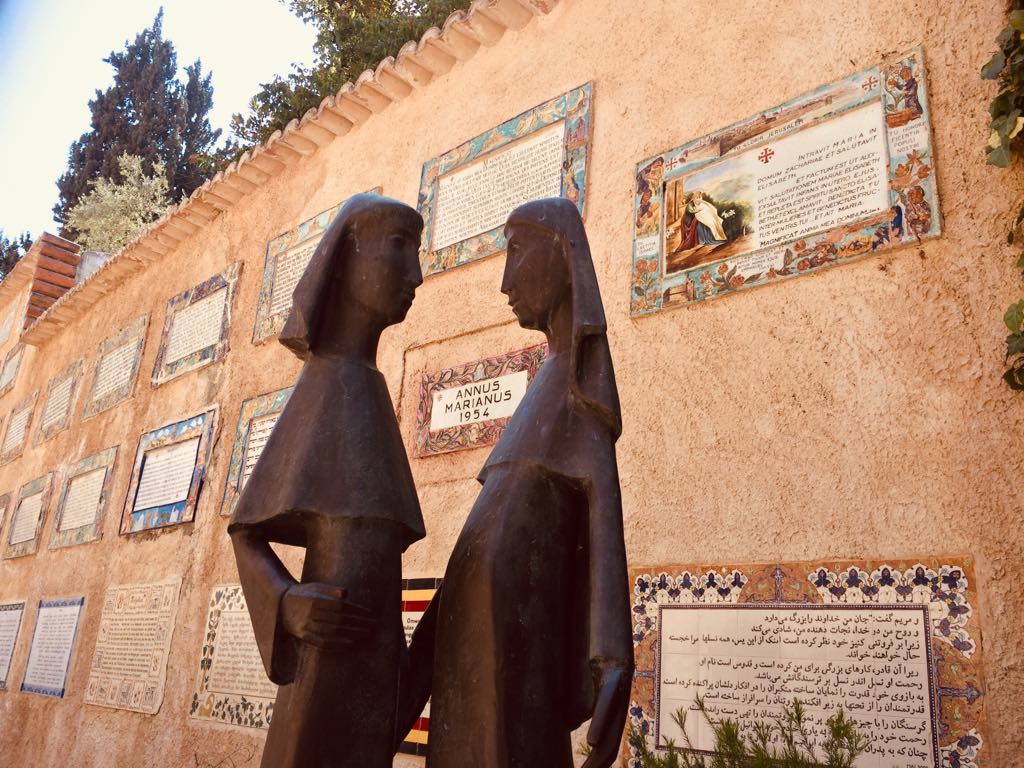
Estatwa ni Maria nang dalawin niya si Elizabeth sa kaburulan ng Judea; mula sa kanilang sinapupunan sumilang ating kaligtasang hatid ni Hesus na inihanda ni Juan Bautista. Dalawang kababaihan kumakatawan sa kadakilaan at karangalan ng mga babae sa ating buhay: ina, asawa, kapatid, anak, at kaibigan. Larawan ng may-akda, Abril 2017.

Where is God?

Quiet Storm by Fr. Nicanor F. Lalog II, 23 May 2019
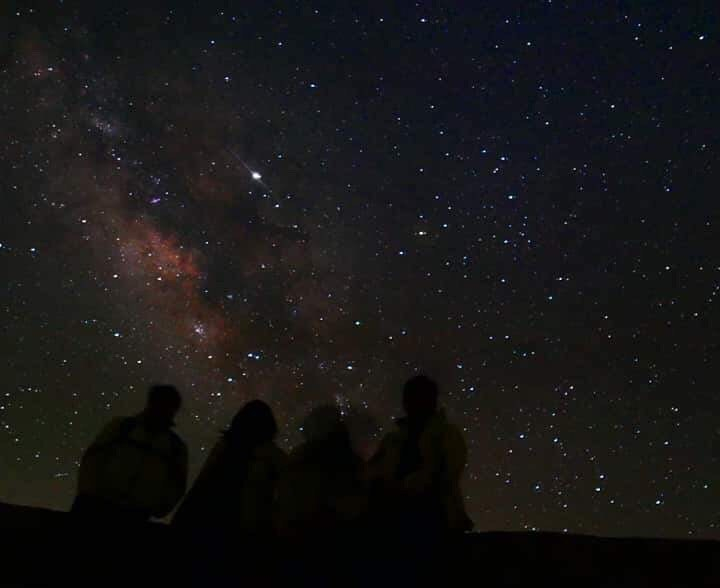
Our fellow pilgrims to the Holy Land who made it to the top of Mt. Sinai in Egypt, 06 May 2019. Photo by Atty. Grace Polaris Rivas-Beron.

A catechist asked her class, “where is God?”

A small boy right away raised his hand and boldly answered “God is in our toilet!”

The catechist was shocked with the boy’s answer but did not want to put him on the spot so she asked, “how did you know God is in your toilet?”

And he said, “every morning I see my dad knocking at our toilet door, asking, ‘my God, are you still there?'”

The shore of Lake of Galilee in Capernaum where Jesus used to visit the synagogue nearby. Photo by author, 02 May 2019.

Main reason I always encourage people to go on a pilgrimage to the Holy Land is to experience God.

The Franciscans who safeguard the holy sites in Jordan, Israel, and Egypt teach that the Holy Land is the “fifth gospel” after Matthew, Mark, Luke, and John found in our bible. In the Holy Land, one can surely experience God speaking and conversing with you in the very places where he had appeared to the great prophets or had come in Christ Jesus and did wondrous deeds to his people. There is a different level of understanding and appreciation of the many stories found in our bible when you go to the Holy Land that can really be life-changing depending on your personal disposition.

There are two instances where we experience God in the Holy Land: first in the country of Israel and second in the churches at the holy sites.

Israel, the Promised Land.

How could God call this country “the Promised Land” when it is so small and sits on a vast tract of limestone and desert? Technically speaking, a desert is an area that receives an average rainfall of 25 centimeters or ten inches annually. That is why it is barren and desolate.

But not Israel.

Once you see the greenery abounding at Israel’s desert, you immediately feel God’s presence there, fulfilling his promise of blessing the land “flowing with milk and honey” as the bible says. Aside from their local date and fig trees with so many other varieties that are the best in the world, plants and trees imported from abroad like bougainvillea and acacia thrive so well in the Israeli desert. From the Philippines, they have imported and improved our mango trees that bear more fruits, yielding higher income to their farmers. Interspersing the greenery on their desert are the colonies of greenhouses that shine in their silvery color during the day while producing many varieties of fruits and vegetables inside. Likewise, exports of Israeli wines and dairy products are steadily growing due to increasing demand from abroad.

All these produced at the desert!

Resort at the Dead Sea area, April 2017.

Like any Filipino pilgrim to the Holy Land, one then remembers what foreigners say that our country is literally a paradise with the right amount of rain and sunshine throughout the year with very fertile soil when we cannot even have enough rice to feed our people? How tragic that we have to import rice from Vietnam and Thailand, our two neighbors in Asia that sent their farmers to Los Banos 40 years ago to learn growing rice scientifically! And it is not only rice that we import but even other basic food stuffs like onions, garlic, and fruits that include cut flowers lately. Drive for two hours outside Manila and you find vast tracts of land with so much grass but we have to import beef, chicken and pork to satisfy our local cravings even for the simple chicharon (pork cracklings) because our local farmers cannot meet the demands.

Where is God?

God has blessed our country with wide arrays of flora and fauna, more amazing beaches and mountains, and friendlier climate and weather. But, God is nowhere to be found because we have lost him in ourselves. We have lost him in our hearts that we took our country for granted, molesting and abusing her like Boracay or the Manila Bay. God dwells among the people, not on the land. Pope Francis reminds us in his encyclical about the care for the environment “Laudato Si” that “we have only one heart and every act of cruelty against nature is contrary to human dignity.”

If we wish to find and experience God blessing our own land, we have to be like the people in Israel who kept him alive in their hearts by thinking bigger than themselves.

Our group posing with two 19-year old Israeli female soldiers at the Jordan River where Jesus was baptized. It used to be a part of Jordan that Israel had occupied after the 1967 Six-Day War.

God in the noble simplicity of a church.

For us Catholics, God is truly experienced present in the Holy Land through the many churches – all beautiful – spread out throughout Israel. But, what really makes the churches and chapels or oratories in the Holy Land so special and unique is not only the fact they are on the very sites or near the areas where Jesus had stood to preach or performed a miracle. Aside from the aesthetic factors that make these churches so beautiful and moving that you experience God inside is because of their “noble simplicity”.

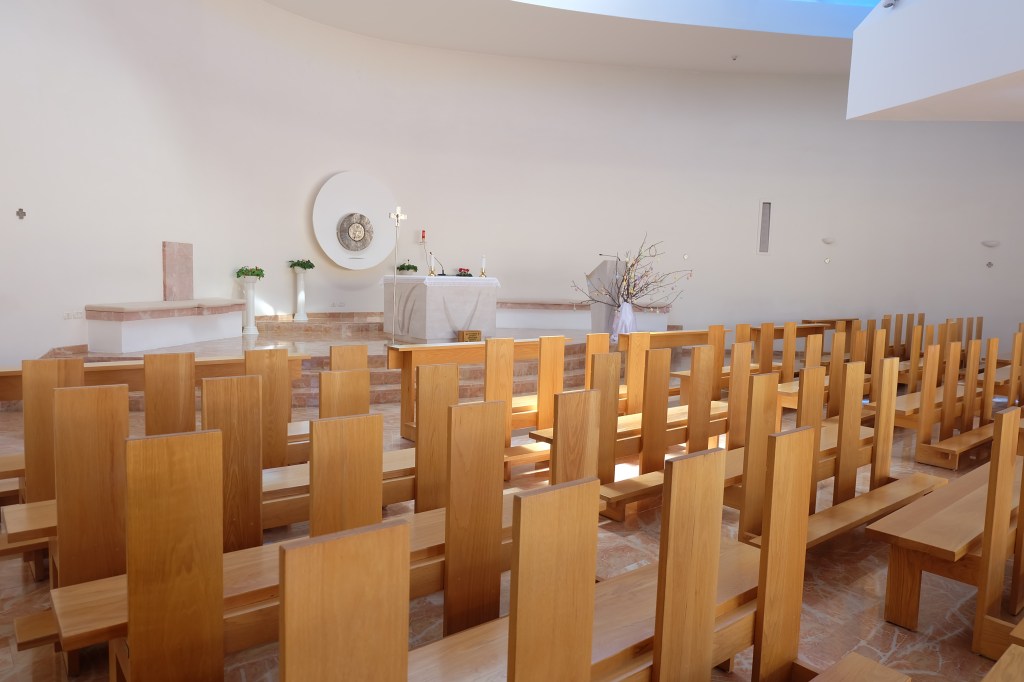
The inside of the modern main chapel of Our Lady of the Milk Grotto in Bethlehem, 05 May 2019.

Unlike the churches here in our country that have become so kitschy that look like cheap cakes with too much decorations and scandalous colors, those in the Holy Land are definitely clean cut, no clutter whatsoever. There is always the sense of the holy right upon entering every church and chapel despite the great crowd present. Most of all, with the church’s noble simplicity, there is always that sacred space for God to be encountered.

When the church is so cluttered and so mixed up, signs that should point to God fail miserably, leaving the church banal and empty of any transcendence or sense of the holy. And I must confess we priests are so guilty of this liturgical abuses when we have made our churches the extensions of our very selves and eccentricities, totally disregarding Jesus Christ. We have evicted God from our church as we priests lorded it over among people with us becoming more known and popular than Jesus Christ.

Can you really feel God present in your parish with all the tarpaulins and giant flat screens around with matching giant fans above? What would Jesus do if he comes today in our churches and finds all kinds of stores, not only those selling religious articles that are sanctioned and even maintained by priests right inside our church premises?

Inside the beautiful Church of the Beatitudes, April 2017.

What a church looks like indicates the kind of pastor and parishioners it has. No matter how big or small a church is, its true beauty lies on the sense and feeling of sanctity or sacredness it creates, not popularity or mass appeal. And as always, like anywhere else, holiness comes only from God who dwells on his people who pray together, moving as one body in the Holy Spirit.

Recently I guested in a radio talk show hosted by some former colleagues in the news who lamented at how our churches have become very “showbiz” with all the pomp and pageantry of telenovelas. So true! It is a reality that unconsciously shows how we in the Church are slowly losing that touch with the holy when everything has gone down to human level despite our pretentious claims of artistic expressions.

When God appeared in a burning bush at the Sinai desert, he asked Moses to take off his sandals for he was standing on sacred ground.

The whole Earth is a sacred ground, a holy land created by God. The challenge is for us to let go of ourselves and let God. And that is when we discover where God is.

A blessed day to you!

Facade of the St. Katherine Monastery of the Greek Orthodox at the foot of Mt. Sinai, Egypt. Inside is a chapel built on the site of the burning bush of Moses. At the back is the staging point of pilgrims’ ascent to Mt. Sinai where God gave Moses the Ten Commandments.

Colors and shades of life

Quiet Storm by Fr. Nicanor F. Lalog II, 03 April 2019

From Google.

A follower is protesting the title of my Lenten blogs called “40 Shades of Lent”. She, or he, wrote us that “Our Roman Catholic Church is pure and sacred to be associated with a title of a pornographic movie.”  Our follower also suggested to us to “Please inform your Bishop and Priests before posting these titles on social media.”

Our follower is absolutely right that the title of my lenten reflections is indeed from E.L. James’ novel published in 2011 and later adapted into a movie in 2015. I have never read it nor seen any of its movie adaptations that were both a hit and a trending topic in 2016. At that time, I thought of having a series of reflections for Lent distinct from my regular Sunday homilies I have called “The Lord Is My Chef Sunday Recipe” since 2006. I thought that if everybody was talking about “50 Shades of Grey”, why not ride on the strong recall of the brand by having my “40 Shades of Lent” where people can find the many colors and meanings of our sacred season?! After all, Lent’s motif of the color violet comes in many shades and hues, too!

That’s it, pancit! In no way does the title “40 Shades of Lent” becomes erotic or, as our follower described, pornographic simply because of its similarity with the book or movie title “50 Shades of Grey”. But her, or his, contention has opened for us a springboard for discussion regarding the way we deal with modern media if you can bear with me.

From Google.

We live in a “mass-mediated culture” where every baby is now born with a mouse. If Jesus were with us today, maybe He would have directed us priests to “feed my geeks” instead of telling us to “feed my sheep”. Since the time of the great St. John Paul II to Pope Francis today, the Holy Fathers have all recognized this reality, asking us to find ways in proclaiming the Gospel among the young people without losing our Christian identity.

“The question confronting the Church today is not any longer whether the man in the street can grasp a religious message, but how to employ the communications media so as to let him have the full impact of the gospel message.”

St. Pope John Paul II , “Religion in the Mass Media” (Message, 1989 World Communication Day

The need for an equilibrium in our approach with media.

The two most media savvy Popes, St. John Paul II and Pope Francis have both noted in their speeches that young people today practically live in the world of media; hence, the need to reach out to them. Problem with us in the Church, both among the clergy and the laity, is when we respond in both extremes when some end up succumbing to the world of media while there are those at the other end rejecting it altogether or in some forms. What we need is some degree of equilibrium wherein we try to keep technology and media in their proper places. See the many instances when priests embrace media and technology so much that churches lose the sense of sacred with giant video screens all over with a barrage of tarpaulins in all sizes that make one wonder if it is a house of worship or videoke bar. On the other hand, there are those who reject media and technology, stepping back in history like in a parish in Poland recently where priests and the faithful burned some books including the Harry Potter series they deemed as sacrilegious and have evil forces.

It is difficult to achieve such equilibrium or balance in our dealing and use of modern media in the ministry for as long as we remain in our Pharisaical stage, of associating almost everything in the world and of the world as evil and sinful especially books and music. The gospel accounts teem with many instances when the Pharisees and scribes questioned Jesus eating and drinking with tax collectors and known sinners of His time. How sad that until now we still don’t get what He had said during that time.

Nothing that enters one from outside can defile that person; but the things that come out from within are what defile.

Mark 7:15
From Google.

Equilibrium is first achieved in the constant examination of our hearts so we can respond properly to the spirit of modernity not easily reconcilable with the demands of the Gospel of Jesus Christ. Attaining that equilibrium calls for a return to the contemplative spirit where we try to maintain our spirit of silence and prayer amid the constant changes in thoughts and beliefs including values often due to the growing efficiency of technology. Let me share with you the very words of a communication expert to conclude this piece that I hope may enlighten us to see the various shades of colors, including shadows and lights that surround us in this modern world today.

The contemplative spirit is not easily acquired, but without it people find it hard to discern the valuable from the worthless, or the enduring from the transitory. Contemplation puts us in touch with reality in a world in which a host of communication technologies work to sustain a multitude of illusions and images: a media world. The contemplative spirit helps us to see and hear beyond and through the sights and sounds we take for granted. The contemplative spirit is an attitude of mind and heart that enables us to focus on the essential, important things. It refuses to be hurried into premature rejection or acceptance of technology. If we Christians allow it to inform our use of communication technologies we shall learn to be realistic, but always hopeful, able to love and reverence our culture even as we strive, with God’s help, to transform it.

James McDonnell, “Communicating the Gospel in a Technological Age: Rediscovering the Contemplative Spirit”.
Sacred Heart Novitiate, Novaliches. Photo by author, July 2018.

Alibughang ama ng mga alibughang anak?

Lawiswis ng Salita ni P. Nicanor F. Lalog II, ika-01 ng Abril 2019

Sisihin aking mapaglarong isipan
Dahil panahon ng halalan
Paano nga kaya kung minsan
Mabaligtad naman takbo nitong kwentuhan?
Mayroong magkakapatid
Ang ama nila ay hindi maintindihan
Hindi nila maramdaman 
Kung sila'y ganan niya na sobrang yabang.
Wala siyang hindi pinapatulan maging kababaihan man
Dinaraan sa mararahas na usapan
Pero kung maiipit sa mga salitang binitiwan
Sasabihin niya na ang lahat ay biruan at kunwari lamang.
Humingi ng paumanhin nang murahin Santo Papa natin
Ngunit nang ang Diyos ang kanyang lapastanganin
Hindi na mailihim kanyang tililing at pagka halimaw na rin 
Nang ang lahat ay ibig patayin maging mga alagad ng Simbahan natin.
Kaibayo pagkakaiba niya sa lahat ng ama
Na sa halip buhayin, lahat ay ibig niyang tokhangin
Masasamang loob at mga makasalanan sa kanya ay walang kabuluhan
Hindi niya alintana kanilang kahirapan dahilan ng kawalanghiyaan.
Sa talinghaga nagdalita ang alibughang anak
Nagtika sa malaking pagkakasala saka nagbalik-loob;
Kumpara sa ating nararanasan, matatagalan pa pagsadsad sa kailaliman
Kaya kahambugan at kasinungalingan hindi matitigilan.
Mas mahirap pala kung ama ang siyang alibugha
Dahil higit sa lahat bago maging ama ang sino man
Kailangan siya muna kakitaan di lamang ng kahusayan at kagalingan
Kungdi higit sa lahat ng kabutihan at katinuan.
Kung paano naluklok ang isang alibughang ama
Madaling malalaman bagama't walang pupuntahan ating sisihan
Mabuti pa'y tingnan ating kalooban sa sinapit nating kalagayan
Di kaya dahil tayong mga anak ay alibughang puno ng pagkukulang?

Friends always talk straight from their hearts

The Lord Is My Chef Quiet Storm, 01 March 2019

I have been dreaming of former classmates lately. Last Tuesday night I dreamt of a classmate in high school seminary now a priest but have not seen in months. Later that day I met another classmate, told him of my dream, and inquired about him. Unfortunately, he has not seen him too for so long though he presumed he must be doing well in the ministry.

Thursday morning upon waking up, I was thinking hard for the possible meaning of another dream I had the night before about my two seatmates in elementary school. Two dreams in a row about three good, old friends very much still alive but have not seen for so long. And how ironic that until now, I have not reached out to them personally or through the many social media platforms available except for a Facebook post that Thursday morning for a possible explanation about my two dreams!

That is the great irony – or, tragedy of our time when we have all modern means of communications that include extensive road networks and yet we could not even get in touch with those people dear to us. See the simplicity of Jesus Christ in calling us his friends: on the night he was betrayed during supper, he told his disciples, “You are my friends if you do what I command you (i.e., love one another). I have called you friends, because I have told you everything I have heard from my Father” (Jn.15:14,15).

Jesus does not need to dial numbers, text SMS, compose emails, or send invitations in Facebook to become friends with us. Jesus simply reveals to us in the most personal manner everything the Father wants to tell us and right away, we are already friends! Of course, it would be difficult to enumerate everything that the Father had told Jesus to relay to us but the greatest of these is the fact that God loves us very, very much. Period.

That is the greatest thing Jesus had achieved in his coming to us by bringing God closest to us by speaking straight to us by himself of his love, his mercy, his forgiveness, and his plans for us. That is one of the great joys of friendship when we talk straight, speak our hearts out freely to our friends without any fears of being rejected or misunderstood. There is always that sense of respect for the other person as a subject to be loved and cherished, not an object to be possessed and used like tools and gadgets.

In our mass-mediated culture, expressing our true feelings to our friends have become more complicated as we become less personal in our relationships. How I hate it when some people would always invite me for breakfast or lunch in some expensive restaurants or hotels only to ask some special favors after the meal that I feel like throwing out the food I have ingested! It is not social grace to treat people to fine dining or gift them with expensive or special things only to ask for some favors in the end. That is corruption or bribery. Simply put, it is lack of respect especially if done by people we regard as friends.

Going back to that Last Supper scene with Jesus Christ when he called us his friends, notice the word “friend”: there is only one letter that makes the difference to make it mean exactly the opposite, “fiend”. It is the letter “r” that stands for respect, from two Latin terms that literally mean “to look again”. To respect is to look again at another human as a person with equal dignity as yourself. Respect is the starting point of love that cannot exist in any situation where there is inequality or feelings of superiority over another person.

Our words coming from our hearts are some of the most wonderful things that create true and lasting friendships. The rest are the actions expressed when these words run out.

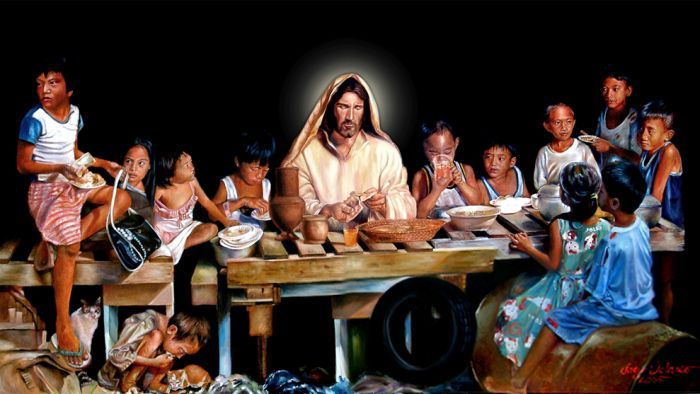
“Hapag ng Pag-Asa” by the late Joey Velasco.  From Google.

It is where we stand that matters most, not where we sit

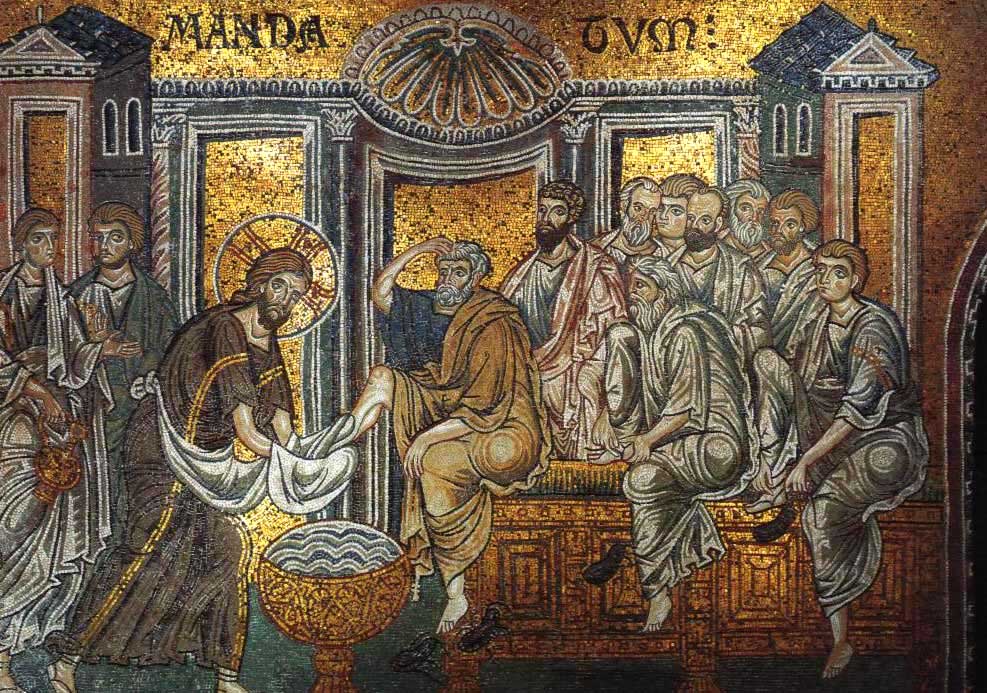
Christ_washes_apostles'_feet_(Monreale)
During His Last Supper, Jesus rose from His seat to wash the feet of His apostles to show them what position is all about:  loving service to one another.  See in this icon from Google there are only 11 apostles present; Judas left the Last Supper to “unseat” the Lord.  Above is the word “mandatum”, Latin for “command”, Christ’s command for us to love by leaving our seats of power and comfort to stand with Him at His Cross.

Quiet Storm by Fr. Nicanor F. Lalog II, 22 February 2019
If you are a Catholic and a regular Mass-goer, most likely you always follow the “Roman seating position” – that is, you always sit at the back, avoiding the front seats even in other gatherings outside the church.

According to Msgr. Gerry Santos who used to give us retreats and recollections while we were seminarians, the “Roman seating position” is a carry-over from the martyrdom of the early Christians who were always seated at the front rows of the Colosseum in Rome who were forcibly pushed to be devoured by hungry lions and beasts below.

Of course it is a joke but it holds so much grain of truth because we often refuse to take the front row seats for fears of being put on the spot, of making a stand.  How ironic that in this age when seating positions matter so much for us, we have forgotten that more important than the position and prestige that come with the seats we occupy – literally and figuratively speaking – is the stand we take in every issue we face.  Protocols dictate in so many occasions how seats indicate power and authority; the throne is always reserved to the highest in rank like kings and presidents.  And the closer one is seated to the one in command, the wider is one’s sphere of power and influence too.  Unfortunately, this is not everything because every seat of power and authority is always a call to serve, to make a stand for what is true and what is good.

Jesus Christ showed us the true meaning of our seating positions during the Last Supper on Holy Thursday evening when He rose to remove His outer garments to wash the feet of His apostles (Jn.13:1-15).  It was a task left for slaves only but Jesus used it as a gospel parable in action to show us that what matters most in life is not where we are seated with Him but where we stand with Him.  It was exactly what He meant when He said that anyone who wishes to be the greatest must be the least and the servant of all.

Recall my dear readers how during that evening of the Holy Thursday when John the beloved disciple sat not only beside Jesus but even rested his head on His chest to signify their intimacy as friends (Jn. 13:23).  That touching gesture of friendship and love took its summit the following Good Friday when John the beloved was the only one of the Twelve who remained standing with the Lord at the foot of His Cross with the Blessed Mother Mary.  In that scene we see how John literally stood his ground as the beloved disciple by remaining faithful and loving with the Lord from His Last Supper to His Crucifixion.  Peter, the prince of the Apostles, was nowhere to be found on Good Friday after denying Jesus thrice during His trial before the Sanhedrin the night of His arrest.  Very interesting was Judas Iscariot who committed suicide after realizing his grave sin in betraying the Lord.  See how he had left the Lord’s Supper to deal with His enemies for His arrest.  What an image of the traitor who could not stay on his seat during the Lord’s Supper was the same one who could not stand to face Him again at the foot of the Cross.  See how those people who refuse to sit with us are also the ones who never stand with us, stand for us like Judas, a traitor!

I tell you these things even if Holy Week is still more than six weeks from now but in the light of the Feast of the Chair of St. Peter which is about the Primacy of Rome or the Pope as Vicar of Christ and successor of St. Peter.  We celebrate this Feast to remember St. Peter and his successors love and service to the Church as examples we must all emulate.  In 110 AD, St. Ignatius of Antioch wrote the Christians in Rome to describe to them the Church of Rome as the “primacy of love” and the “primacy of faith”.  Every power and every authority signified by the chair or cathedra in the Church as well as in the world when we speak of “seat of power” must always be seen in the light of Jesus Christ’s example of loving service at His Last Supper.  This is especially true for us priests who are united in Christ and with Christ in the Eucharist.

This festering problem of sexual abuse in the Church is largely due to our deviation from this primacy in love for Jesus as priests.  We have been so focused with our seats – positions and titles – that we have forgotten to stand with Christ at the foot of His cross, standing for what is good and true, just and right.  We have been so focused with the “party” of the Supper of the Lord and have forgotten Jesus Himself.  Seminarians have been so focused with the vocation and the call, with ordination, forgetting the more essential, the Caller Jesus Himself!  And that explains why some in the clergy and those in the hierarchy come up with so many excuses and alibis for the many things we do in our ministry, in our churches, in our parishes, and in our lives because we are only concerned with our office and position but never the Master.

When we love Jesus or any other person, we do not have to justify our actions.  Love that is true and pure does not need justifications.  But the moment we start making justifications, something is wrong like when we justify our special relationships, no matter how deep or shallow it may be for clearly, there is no primacy in love for Jesus and the Church.

When we justify our vices, our lifestyles, our business endeavors that Canon Law prohibits, clearly there is no primacy in love for we cannot be poor for Christ.

There is no problem with having advocacies as priests but when we are aligned with ideologies contrary to Christ, or when we play in partisan politics, there is neither primacy of faith nor primacy of love.  It is the Lord who changes the world, not us, not our programs, not our ideas.

It is our duty as priests to love like Christ but to adopt children and raise them as our own children using our names, there is no celibacy, only stupidity.

Like Jesus, we need money to get our programs going but when we lack transparency and accountability, that is stealing and banditry.

When all we have is the ministry, the priesthood without prayer periods, without the Eucharist, we only have the call but not the Caller Jesus Christ Himself.

More than ever, today Jesus Christ is asking us all His priests to make a stand for Him, to stand with Him, to suffer with Him and to die with Him by leaving our seats of comfort and seats of power.


Of Blessings And Curses

balaamcatacomb
Quiet Storm by Fr. Nicanor F. Lalog II, 08 November 2018

            Events and news reports during the recent long weekend reminded me of the story in the Old Testament of a pagan prophet named Balaam who was commissioned to curse the Israelites while encamped at the plains of Moab, ready to enter the Promised Land 40 years after their Exodus from Egypt.  It is a story filled with humorous twists and turns that instead of cursing the Israelites, Balaam blessed them and even prophesied the coming to them of the Savior Jesus Christ.  It is a funny story like the movie “Shrek” with a talking donkey.

             When Balaam was riding his ass (pun intended) on his way to Moab to curse the Israelites, an angel of the Lord with a sword drawn stationed himself on the road to hinder him from proceeding. He did not see the angel but his ass saw the angel that she turned into the field.  Balaam beat his ass to bring her back on the road.  As they passed through a narrow lane between vineyards with a stone wall on each side, the ass saw the angel of the Lord again blocking their way that she shrank against the wall and squeezed Balaam’s leg onto it.  Again, Balaam did not see the angel that he beat his ass for backing out.  Upon reaching a passage so narrow without any space to move either to the right or the left, the ass again saw the angel of the Lord blocking their road.  The ass cowered under Balaam and in his anger, beat her again with his stick.  God opened the mouth of the ass to speak, asking Balaam why he would always beat her despite her services to him?!  It was during his conversation with his ass that God opened the eyes of Balaam to see His angel and get His message to bless the Israelites (cf. Num. 22:20-35).
           Is Baguio City a modern Moab with its new law prohibiting “cursing, cussing, expressing insults or the use of foul language to express anger or any other extreme emotion in establishments frequented by students, from pre-school to college level”?

I have always loved and admired Baguio City in its efforts to keep its morals intact despite the growing lamentable practice of many Filipinos these days of spending Holy Week vacationing there instead of praying in their homes and parishes.  It is perhaps the only city with a law calling on all people to pause during the Angelus.  And now, it is the only city too that prohibits the use of foul language.  Members of its city council have noted in their Anti-Profanity Ordinance how the habit of cursing has “already penetrated schools and educational system, business establishments and society as a whole, that even the very fabric of morals and human decency has deteriorated to such a degree that we have to prevent it before the damage would become irreparable.”  It defined profanity as “blasphemous or obscene language vulgar or irreverent speech or action; expletive oath, swearing, cursing, or obscene expression usually of surprise or anger.”

             Baguio City is deteriorating fast and though this Anti-Profanity Ordinance does not address anything at all in improving environmental conditions there, it shows us that unless we first cleanse whatever is within us, these are reflected with the problems around us.  “Ex abudantia cordis” is the Lord’s reminder to us all, “from the fullness of the heart the mouth speaks” (Matt. 12:34).  Though the ordinance is not really clear in its scope and purpose expressed only in three pages of paper, it is a good reminder that whatever is evil and bad would always be evil and bad, with or without any written law.  To curse or speak ill of anybody, wishing evil or harm to someone is always bad.  And despite the claims by the defenders of the President that saying bad words does not make anyone entirely bad, recent events have shown exactly the opposite of their claims, that anyone speaking of good things does not make him or her good at all.

             On Halloween day which the benighted souls have insisted on celebrating the pagan way by dressing as ghosts, actor and former tourism official Cesar Montano’s selfie with a naked woman at the background went viral and spawned many spoofs.  How I wish I have the vocabulary of Nabokov but I could not find the proper English words to describe those videos that are salaula, baboy, and kadiri!  And of course not to forget during the long weekend is the President’s usual dose of follies of the highest level when he spewed his usual profanities against the Church and the All Saints’ and All Souls’ Day celebrations, a day after calling on the nation to “emulate our saints, pray for the eternal repose of souls and deepen our engagement with our communities as we work for real and lasting change.”  Not contented with the foul language, the President even declared himself a saint.

             Blessing is from the Latin term benedicere that literally means “to speak or say good things.”  To wish somebody “God bless you” in the midst of a malicious situation, in a life far from being a blessed one or simply just because as in “wala lang” is not only a profanity but also a blasphemy. Of course, priests who are supposed to be channels of God’s blessings commit the highest level of profanity and blasphemy if they lead lives of sin and corruption, abusing not only children and women but the entire people of God, including God Himself.  This is what the anti-profanity law of Baguio is missing, skipping that portion on who should not use obscene language.  The evil of foul language is similar with pornography:  it is always immoral regardless of age because it is a lack of respect to the dignity of persons.

Why-Was-God-Mad-at-Balaam--JM2

              The story of Balaam and of his ass reminds us that we are all a blessing to everyone.  Listen to what the donkey told Balaam:  “What have I done to you that you should beat me these three times?  Am I not you’re your own beast, and have you not ridden upon me until now?  Have I been in the habit of treating you this way before?” (Num.22: 28, 30)   How ironic that the dumbest creature in the universe was the one to remind Balaam and us that we should never treat badly and speak ill of anyone because we are all a blessing to everyone.  Most of all, the talking donkey of Balaam reminds us how blessings can turn into a curse someday and curses could eventually be a blessing too.  It has happened so many times in history, not only to nations and corporations but even in the Church that is still rocked by sexual scandals committed long time ago.  The early Christians have depicted the story of Balaam and his ass in their early arts like in the Roman catacombs (photo above) and in some churches in Europe to show how God works in mysterious ways, especially with the power of our words to bless, or to curse. Be a blessing!

*Photos from Google.

Our Hallowed Hiddenness

RaffySunset1
Quiet Storm by LordMyChef, 31 October 2018:

            Whether you choose to celebrate today’s Halloween in its truest, Christian sense that is sacred or in the more popular pagan manner that is scary, today’s feast that literally means All Hallowed (Holy) Eve reminds us of things that are not seen, always hidden.  Hiddenness is a sacred presence where each one of us is all by one’s self focused on God who is the root of our being and existence no matter how one may call Him.  In one of his writings which I could no longer recall despite the help of Google, St. John Paull II explained that God created man first to be alone with Him.  And that is how it has always been even if people get married for eventually in the end, we die alone with God.

             This gift of hiddenness within each one of us is manifested in our desire to once in a while be still, to go to the mountains or anywhere for a retreat or introspection, for “me” time to rediscover and “find” one’s self anew.  Hiddenness is the passageway to the great gifts of silence and stillness that everyone needs to maintain balance in this highly competitive world filled with so much noise where everybody is talking, even cars, ATM’s, and elevators.  How funny that we complain of not having enough time for ourselves but we never cease to stop talking and listening.  And not only that:  we have allowed everything about us not only heard but even seen on cameras.  First came the Sony Walkman almost 40 years ago that became the ancestor of every gadget that have invaded our hiddenness; now, we have camera everywhere, shooting and recording everything that nothing is hidden anymore in us and from us.  We have stripped ourselves of the innate mystery of being human, of the beauty and gift of personhood that some have tried to reveal using the camera but failed because we are beyond seeing and appreciation.

             While it is true that cameras are essential in keeping our surroundings safe and secured that it is referred to as “big brother”, again we find here another case of abusing technology to the detriment of our humanity.  As I have told you here last week (Respect In Digital Age), we need to put technology at its right place, particularly the camera that robs us of that essential thing we call respect.  But the greatest threat and danger posed on us by the camera is how we have allowed it to invade our hiddenness with almost everybody wanting to be on camera without realizing it often backfires, sometimes painfully.

            The camera is a projector, trying to show in a bigger picture deeper realities notably the plain truth.  Here lies our quiet storm when we are so eager to project everything and everyone including our very selves on the camera when we do not realize nor examine what we are really showing.  The great paradox is that the camera does not lie that always seem to show what is negative than what is positive in us.  Keep in mind the TV is called “idiot box”because those inside the television presuppose everybody watching them is an idiot when in fact, they are more idiots.  Watching television – news or entertainment – can reveal who are superficial and those with substance.  Sometimes TV can be deceiving that we take some people and things appearing on the screen as good and credible without us realizing these are “presentations” that are manipulated to produce a desired effect called the hypodermic theory.  This explains the popularity of YouTube as people prefer “raw footages” that show people and events “as it happened.”  Even movie directors are adapting to this style to show action “as it is” to give the film a more realistic feel that contribute to the blurring of lines between reality and virtual reality.

            We need to regain our hallowed hiddenness if we wish to grow and mature truly as persons – emotionally, psychologically and spiritually.  With the camera always around us even in the church, sad to say, everybody and everything has become so ordinary and cheap.  Even God has to keep His hiddenness simply because that is how He had created everything.  See the beautiful speech of God before Job that can transport you to the sublime beauty of nature and creation.  The beloved apostle also tells us of the hiddenness of Jesus Christ who “In the beginning was the word.” (Jn.1:1)  All four evangelists likewise have no records of the “hidden years” of Jesus before the age of 30 except for Matthew and Luke who gave us little glimpses of the birth and childhood of the Lord.  These are all meant to teach us of the value of hiddenness, of being rooted always in our being and with God.  Appearances in life are very fleeting and for more impact, we have to spend more time in hiddenness as revealed to us by Christ, the saints, artists and other great men and women of the world who came to be known and popular only after upon death.  So many times we have also experienced in the funeral of our relatives and friends that we discover their hidden goodness and kindness from stories of those condoling with us.

            This November 1 and 2 as we remember all those who have left us in this world, let us keep its sacred origins:  All Saints Day for those souls already in heaven and All Souls’ Day for those who have departed but still being purified or staying at the purgatory.  Both dates invite us to hide also in some prayer, remembering God and our loved ones whom we shall surely follow someday without any camera at all.  Like them in hiddenness from us, let us be focused more on God than on self and things that pass.  Here is the late Fr. Henri Nouwen on hiddenness:

“In our society we are inclined to avoid hiddenness. We want to be seen and acknowledged. We want to be useful to others and influence the course of events. But as we become visible and popular, we quickly grow dependent on people and their responses and easily lose touch with God, the true source of our being. Hiddenness is the place of purification. In hiddenness we find our true selves.”

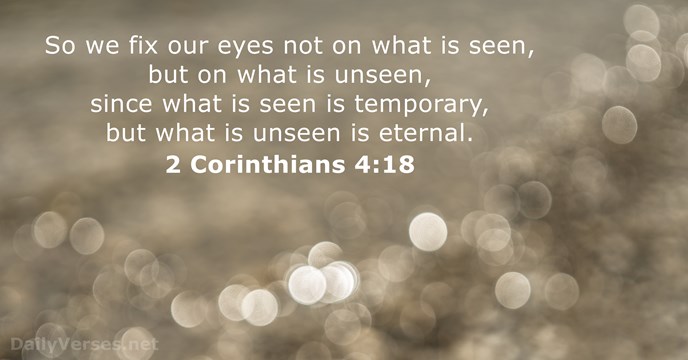
2-corinthians-4-18-2

*Photo by Mr. Raffy Tima of GMA-7 News, sunset on a flight to Dubai, October 2018.  Used with permission.  Bible verse from Google.