The Lord Is My Chef Sunday Music by Fr. Nick F. Lalog II, 13 September 2020
Entering through the narrow door of the Church of Nativity in Bethlehem, the Holy Land, May 2019.
Above is a photo I have taken of some pilgrims entering through the small door of the Church of the Nativity in Bethlehem last year. I have always loved the story why this entrance door is so small as it leads to a huge and very important church where the site of Jesus Christ’s birth is located.
According to tradition, pilgrims used to bring even their animals inside the church whenever they would come to worship at the site of the Lord’s birth. The priests and monks were so kind that they could not tell them to leave their horses outside to keep the church clean; and so, they built another entrance into the church with a door so small that even pilgrims have to bow in order to get inside.
Eventually, the small door taught everyone especially pilgrims the important lesson that to experience the coming of the Son of God to the world, one must learn to be humble, to bow or get low to get inside the Church of Nativity.
I know Christmas is still four months away but that is one reality we always forget, the we are all brothers and sisters in Jesus Christ. That is the meaning of Christ’s call in today’s gospel to “forgive from one’s heart” son we can forgive without limits because we are all brothers and sisters in God the Father who loves and forgives us all (https://lordmychef.com/2020/09/12/forgiving-from-the-heart-2/).
It is for this reason that we have chosen for our Sunday music “Every Kinda People” by the late English singer-songwriter Robert Palmer. It was his first top 40 hit released in 1978 that was rereleased in 1992 climbing the charts again for its beautiful music and superb lyrics that convey love and respect for every person.
Though the word forgiveness is nowhere to be found in the lyrics, it is implied because after all, the best expression of any love as shown to us by Jesus Christ is also the ability to forgive others and forego any revenge.
There’s no profit in deceit Honest men know that Revenge do not taste sweet Whether yellow, black or white Each and every man’s the same inside
What really hurts us most that we find it difficult to forgive those who have sinned against us is not only the injustice done to us but our being disrespected as a person who is a family like a spouse or a wife, a brother or a sister, a son or a daughter, a father or a mother, a kin or a friend, a confidant.
Our offenders thought only of themselves and forgot all about us, our love and kindness to them. Our oneness with them.
That is the unkindest cut of all, my brothers and sisters.
Have a blessed Sunday and a week ahead, keep loving and forgiving even if others do not. At least we remind them of that basic reality of every kinda people…
Music video by Robert Palmer performing Every Kinda People. (C) 1978 Universal Island Records Ltd. A Universal Music Company.
The Lord Is My Chef Sunday Recipe for the Soul by Fr. Nicanor F. Lalog II
Week XXIV, Cycle A in Ordinary Time, 13 September 2020
Sirach 27:30-28:7     >><)))*>   Romans 14:7-9   >><)))*>   Matthew 18:21-35
Photo by author, dusk in our parish, July 2020.
This Sunday we go deeper into the lessons gathered by Matthew from Jesus regarding love as the basis of our relationships. Last week we were told how mutual love is the sole reason why we correct brothers and sisters going stray in life.
But, more sensitive and delicate, not to mention most difficult than fraternal correction is the question of forgiving.
How many times should we forgive?
Peter approached Jesus and asked him, “Lord, if my brother sins against me, how often must I forgive? As many as seven times?” Jesus answered, “I say to you, not seven times but seventy-seven times. That is why the kingdom of heaven may be likened to a kind who decided to settle accounts wit his servants. When he began the accounting, a debtor was brought before hm who owed him a huge amount. Since he had no way of paying it back, his master ordered him to be sold, along with his wife, his children, and all is property, in payment of the debt. At that, the servant fell down, did him homage, and said, ‘Be patient with me, and I will pay you back in full.’ Moved with compassion the master of that servant let him go and forgave him the loan.
Matthew 18:21-27
Forgiving is always difficult because it is from God, calling us to be one with him, one in him, and be like him as that saying perfectly summed up, “To err is human, to forgive is divine.” It is beyond human abilities, reserved only for God until he became human like us in Jesus Christ who made us share in his greatest expression of love which is forgiveness. Hence, every time we forgive, we also become like God, divine and holy that unfortunately, we refuse and even hate!
Yes, it is very difficult because like love, forgiving is the nature of God. In fact, any kind of love is best expressed when it is forgiving. The good news is that we now share in this great love of God in forgiving others like him as we shall see in today’s parable, keeping in mind also that it was the Risen Lord’s commission to his disciples when he appeared to them on that Easter evening (John 20:22-23).
Photo by author, Baguio Cathedral, January 2018.
Forgiving like God our Father
The beauty of forgiving is that it is always a grace from God freely given to us. It is doable in Jesus Christ. The problem is when we refuse to let God work in us, when we refuse to level up our relationships to that of brothers and sisters in Jesus Christ.
There is always that pride in us exhibited by Peter at the start of the gospel today when he asked Jesus how many times he must forgive his brother. Must it be seven times?
Of course, seven being a “perfect number” does not specify a numerical figure of times to forgive except that it gives enough room to let go of a sinner or an offender. However, it still connotes some form of “counting” or taking tabs at how many times must one forgive, implying a limit.
But Jesus pushed it further when he told Peter to forgive “not seven times but seventy-seven times” — that is, twice the perfect number he had cited!
The Lord is telling Peter, and us today, to forget all about keeping tabs, of counting how many times you must forgive because God forgives us without limits which his parable tells us.
The king or master in the parable is God, so wealthy that he could lend sums exceeding the normal level of what one can borrow. Most surprising is like God, the master lent so much amount beyond the debtor’s ability to pay!
That is how rich our God is — so rich in love and mercy, giving us with so much even beyond our ability to pay him back in return. Exactly what we have in the responsorial psalm: “The Lord is kind and merciful; slow to anger and rich in compassion.”
And when that servant prostrated before his master, then the more we see in that religious gesture the deeper meaning of the parable: the rich mercy of God forgiving us for our debts even after we have lost everything like that debtor with nothing enough to pay his loans, not even his wife and children.
See the contrast of the king moved with compassion echoing the same attitude of Jesus so often like in the wilderness where he fed more than 5000 people and that servant so lost with nothing else left but still forgiven.
The parable could have stopped there but Jesus went on to continue what happened next to teach us the deeper truth of forgiving, which is imitating God our Father because we are brothers and sisters in him.
From Google.
When this servant had left, he found one of his fellow servants who owed him a much smaller amount. He seized him and started to choke him, demanding, ‘Pay back what you owe.’ Falling to his knees, his fellow servant begged him… but he refused. Instead, he had the fellow servant put in prison until he paid back the debt. Now when his fellow servants saw what had happened, they were deeply disturbed, and went to their master and reported the whole affair. His master summoned him and said to him, ‘You wicked servant! I forgave you your entire debt because you begged me to. should you not have had pity on your fellow servant, as I had pity on you?’ Then in anger is master handed him over to the torturers until he should pay back the whole debt. So will my heavenly Father do to you, unless each of you forgives his brother from his heart.”
Matthew 18:28-35
Forgiving from the heart
After hearing the second part of the parable, we all felt like the master, angry and indignant with that merciless servant whose action was very shameless and scandalous. But, more than being like the king who properly judged the conduct of that merciless servant, Jesus is also inviting us to probe deeper into our hearts the realities why we felt like the king in the parable?
How many times have we felt so angry and frustrated during this pandemic period at the many occasions when we heard news of injustices and abuse of powers against the little ones like Mang Dodong or the Marawi verteran shot to death in Quezon City? Of those punished in violating the protocols when its chief implementor got away free after attending a mañanita party?
The list goes on specially in our country where laws favor the abusive rich and powerful, those with connections while ordinary citizens with lesser violations, even without any crimes at all suffer the same fate as the servant with lesser debts.
Photo by author, “patak-dugo”, 2019.
We all feel so angry and very sad because more than the injustices and lack of mercies committed by those in powers, they have forgotten we are brothers and sisters in one God our Father. Parang sila lang ang anak ng Diyos…
We feel like the king in the parable because we felt left out, disregarded, and disrespected despite our kindness and mercy with others.
Forgiving from the heart means to forgive others not because we are fellow servants but most of all as brothers and sisters of a loving and merciful Father who forgives us always from our unpayable debts of sin and evil against each other.
This is the very thing St. Paul is telling us in the second reading, that “None of us lives for oneself, and no one dies for oneself” (Rom.14:7). Sometimes we need to be in control of our lives but the truth is, when we try to live St. Paul’s message that our lives belong to one another in Christ, the more we become truly free and happy.
It is the same reminder from Ben Sirach in the first reading telling us how we must avoid anger and resentment specially revenge because it is contrary to our faith in God. Most of all, we also know so well that we need the mercy of God in forgiving our countless sins.
The example of St. John Paul II about forgiving like God
I know what I am telling you are easier said than done. And I confess that I also find it so hard to forgive people who have wronged me, specially those I have loved and helped. Allow me to end this reflection with this beautiful bit of history that happened in our lifetime.
We were in high school seminary when Mehmet Agca shot and almost killed St. John Paul II at St. Peter’s Square on May 13, 1981. We were shocked, so sad for him and very angry with Agca. But, two years later after Christmas in 1983, we were more shocked in disbelief while at the same time in tears with joy when news came out that St. John Paul II came to visit Agca in his cell to forgive him!
It was a major news that landed on TIME magazine the following year with the cover story so relevant with our gospel today:
From Pinterest.
Those who do not forgive are those who are least capable of changing the circumstances of their lives…
Not to forgive is to be imprisoned by the past, by old grievances that do not permit life to proceed with new business.
Not to forgive is to yield oneself to another’s control. If one does not forgive, then one is controlled by the other’s initiatives and is locked into a sequence of act and response, of outrage and revenge, tit for tat, escalating always. The present is endlessly overwhelmed and devoured by the past. Forgiveness frees the forgiver. It extracts the forgiver from someone else’s nightmare. “Unless there is a breach with the evil past,” says Donald Shriver, “all we get is this stuttering repetition of evil.”
Lance Morrow, TIME Magazine, 19 January 1984
As I searched for photos of the assassination attempt on him by Agca, I came across this photo below of their meeting with an accompanying report that made me admire and love St. “JP2” more than ever.
It said that while recuperating in the hospital, St. JP2 learned from the news how people hated Agca, prompting him to ask everyone to “pray for my brother (Agca)… whom I have sincerely forgiven.” That is how holy is this great Pope of our time! Long before visiting Agca in 1983, St. JP2 had already forgiven him, calling him a “brother” despite the evil and sin done to him.
What a great Amen!
Have a blessed and wonderful week ahead, brothers and sisters in Christ!
Photo by Ms. Ria De Vera, sunrise at lockdown in our Parish, March 2020.
Almost daily in my prayers I give you praise, O God, without really bothering myself to dwell on what is the meaning of your glory, of that scene from the first reading that says:
Then the glory of the Lord left the threshold of the temple and rested upon the cherubim… They stood at the entrance of the eastern gate of the Lord’s house, and the glory of the God of Israel was up above them. Then the cherubim lifted up their wings, and the wheels went along with them, while up above them was the glory of the God of Israel.
Ezekiel 10:18, 19b-20
It is so difficult to imagine of your glory, O God, when I am in dirt and sin.
Your glory is your purity.
Cleanse us, merciful Father of our many sins and iniquities that have darkened the world and our very lives with evil and sin.
At the same time, teach us to be like you in Christ Jesus, full of mercy and forgiveness for those who sin because every time we are able to bring back a sinner to you, the more we see and experience your glory.
Most of all, keep on purifying us so that our gathering together becomes your indwelling, fulfilling Christ’s words
Photo by author, sunset in our parish church, April 2020.
“For where two or three are gathered together in my name, there I am in the midst of them.”
Matthew 18:20
Lord Jesus, more sinister than all the dirt of sin and evil in us and around us today is our refusal to stand against the immoralities going on.
Worst, O Lord, is our attitude of always “moving the lines” when some people cross the boundary between what is right and wrong, good and evil, decent and indecent.
Forgive us and bring us back to your path, Lord, when truth and morality have suddenly become relative for us without realizing how these have muddled our relationships with you and with others, hiding your glory among us. Amen.
The Lord Is My Chef Breakfast Recipe for the Soul by fr. Nicanor F. Lalog II
Monday, Week XVII, Year II in Ordinary Time, 27 July 2020
Jeremiah 13:1-11 >><)))*> >>><)))*> >><)))*> Matthew 13:31-35
Photo from Google.
What a great way to start our last week of work and studies in July with your sense of humor, O God! Your words are so witty and funny but with a strong punch. Hard-hitting, so biting. And so revealing.
For, as close as the loincloth clings to a man’s loins, so I had made the whole house of Israel and the whole house of Judah cling to me, says the Lord; to be my people, my renown, my praise, my beauty. But they did not listen.
Jeremiah 13:11
You really got me, Lord.
What can I say?
Our underwear, that is, the loincloth of Jeremiah’s time, is our most intimate clothing, always in contact with our very selves, in that part of our body that we always guard and keep to ourselves.
But, what happens when we “dirty” ourselves with sins, when we put on all those filth in ourselves, we also feel the same way inside, no matter how clean and crisp our clothes are but when deep down our loincloth – underwear – is rotted and good for nothing?
We can always hide it from others and they will never know the kind of underwear we have but we cannot deceive ourselves of how dirty we are with sins and evil.
And so far from you, O God.
Forgive us when you are supposed to be the closest to us, the one we are always in contact with but we have totally disregarded because of our many sins, when we thought we can always have our own ways without you, denying the fact it simply cannot be for indeed, you have made us to be that closest to you.
Forgive us in your Son and our Lord Jesus Christ. Renew us inside, cleanse us and refresh us to be in close contact with you again, O God.
Help us to remain good and clean inside like the little mustard seed so we may grow to have leafy branches for birds to come and dwell in us.
In your mercy, cleanse us of our sins and be our yeast to mix with us again to leaven into a dough to make your kingdom come here on earth. Amen.
The Lord Is My Chef Breakfast Recipe for the Soul by Fr. Nicanor F. Lalog II
Tuesday, Week XVI, Year II in Ordinary Time, 21 July 2020
Micah 7:14-15, 18-20 >><)))*> ] + [ <*(((><< Matthew 12:46-50
Photo by author of sheep grazing at Sacred Heart Novitiate in Novaliches, QC, 2018.
What a beautiful prayer today to you, O God our Father by your prophet Micah:
Shepherd your people with your staff, the flock of your inheritance that dwells apart in a woodland, in the midst of Carmel. Let them feed in Bashan and Gilead, as in the days of old; as in the days when you came from the land of Egypt, show us wonderful signs.
Micah 7:14-15
Shepherd us like a true father, God, the old fashioned and right way symbolized by your staff: strong and sturdy to discipline us especially when we wander far from you, and yet at the same time, so tender and forgiving – full of clemency as Micah mentioned – when we are lost or stuck in a cliff or a crevice.
This is probably the one combination we are terribly missing these days, discipline and tenderness, the cornerstone of formation in every family expressed in the adage from the Sacred Scriptures, “Spare the rod, spoil the child” which the modern society strongly objects and frowns upon:
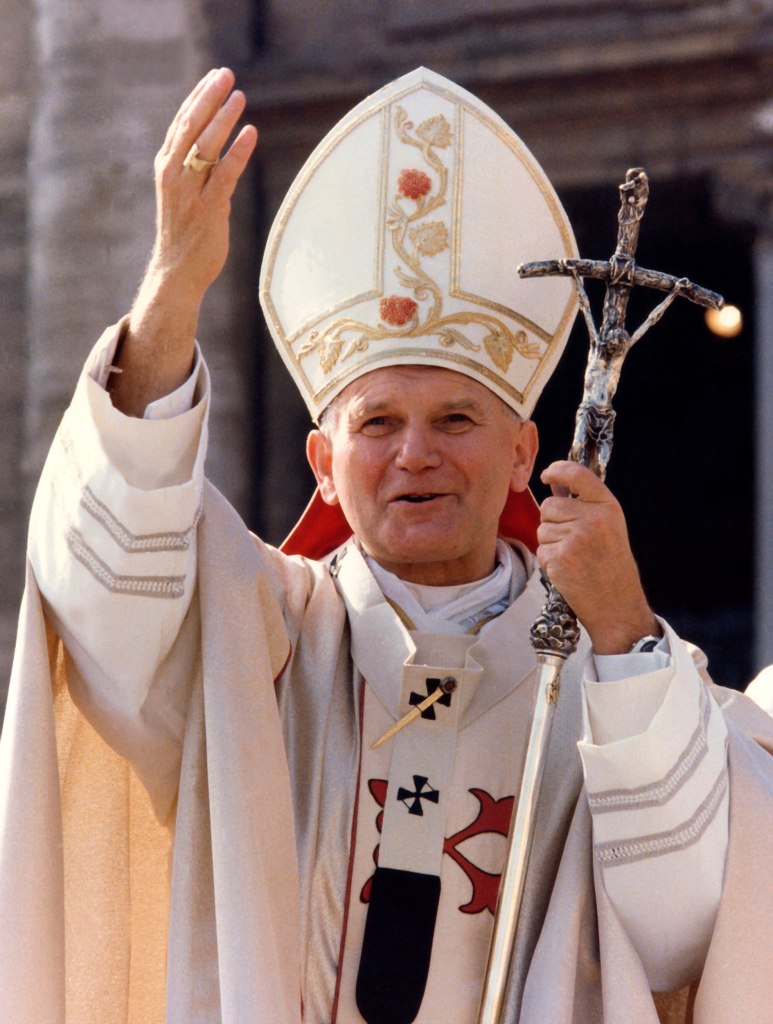
St. John Paul II waves to well-wishers in St. Peter’s Square at the Vatican in 1978 when elected as Pope, holding his staff, symbol of his being a shepherd.
He who spares his rod hates his son, but he who loves him takes care to chastise him.
Proverbs 13:24
Discipleship or being a disciple is primarily about discipline, of following not only the steps of the Lord and Master but also his ways.
From the word discipulos or to follow came the words follower and discipline alike.
Jesus Christ your Son perfectly said it in our gospel today when he rightly claimed that “whoever does the will of my heavenly Father is my brother, and sister, and mother” (Mt.13:50).
Give us the grace, O Lord, to take the right path anew of discipline to form our moral backbones tempered with your tenderness and mercy so we may truly work for a just and humane society here on earth so that your kingdom may finally come! Amen.



 lordmychef.com