The Lord Is My Chef Breakfast Recipe for the Soul by Fr. Nicanor F. Lalog II
Monday, Week X in Ordinary Time, 07 June 2021
2 Corinthians 1:1-7   ><)))*>  +  <*(((><   Matthew 5:1-12
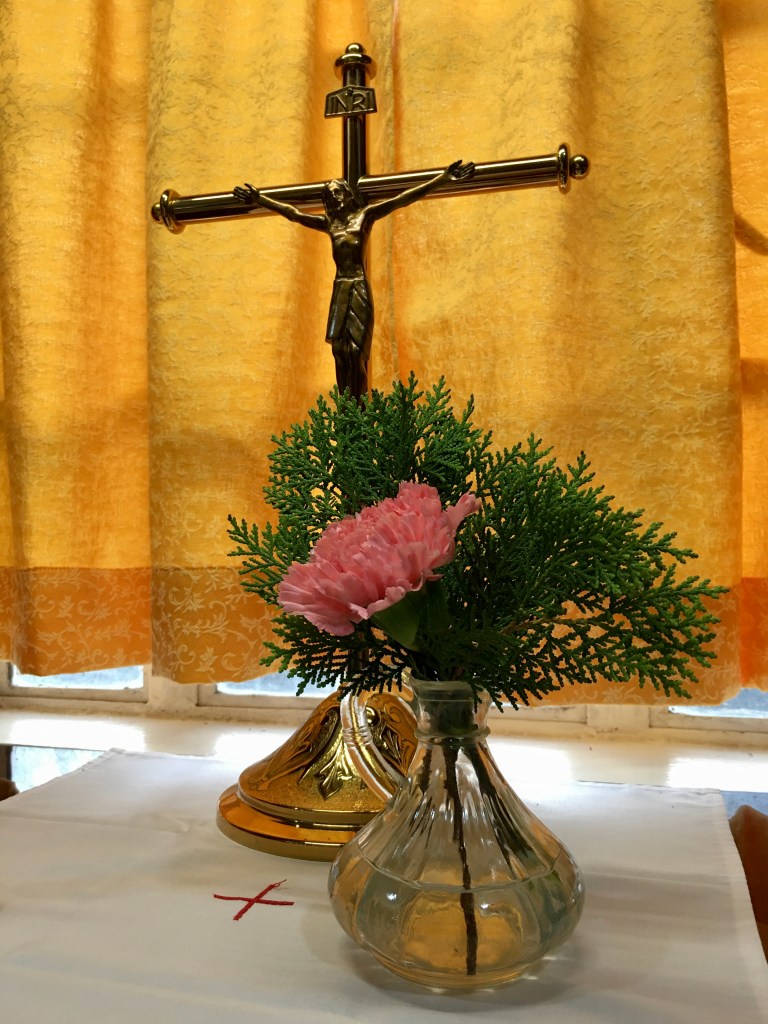
Photo by author, Nazareth in Israel, 2019.
Your words today, O Lord, from St. Paul’s second letter to the Corinthians are so encouraging, so comforting as they are truly meant for us, too, in this time of trials and difficulties due to the pandemic.
In greeting the Corinthians as well as other Christians in the region who were facing tremendous tests and sufferings, St. Paul prayed fervently for them by introducing the virtue of “encouragement” – mentioning it ten times that we can feel his deep concern not only for the Corinthians but with anyone in any period of time like us going through severe tests like in this time of COVID-19.
 Blessed be the God and Father of our Lord Jesus Christ,
the Father of compassion and God of all encouragement,
who encourages us in our every affliction,
so that we may be able to encourage those
 who are in any affliction with the encouragement
with which we ourselves are encouraged by God.
(2 Corinthians 1:3-4)
Encouragement or comfort is what we really need at this time, Lord Jesus, in order to strengthen us “in enduring the sufferings” (2Cor.1:6) we are going through. It can only come from you for it is a grace that enables us to live out true blessedness found in your Beatitudes we heard in the gospel today.
So many among us are getting weak not only physically but also emotionally, mentally and spiritually in this prolonged quarantine periods when our mobility is so limited.
So many among us have lost their jobs and livelihood, with still many others so limited in their earning abilities while financial obligations are piling up.
So many among us feel so uncertain about the future, finding it so hard to focus on whatever we have at the moment so we can make the most out of every opportunity that comes out from this pandemic.
Worst of all, there are some of us who are in deep emotional traumas at this time when problems arise in their marriage and family life.
O God, you know the situation we are into, even the mess some of us have got involved with due to our own sinfulness and carelessness.
Send us the Holy Spirit, the Paraclete, the Comforter and Encourager par excellence for us to be encouraged to persevere and to strive, to remain blessed so that we may encourage others too. Amen.
The Lord Is My Chef Sunday Music by Fr. Nick F. Lalog II, 06 June 2021
It’s a lovely and warm Sunday perfect for reminiscing our pre-COVID-19 days when we could all be together with family and friends without fears of getting sick, sharing meals and conversations as we unwind and prepare for another week of work and school.
It is what we miss most in this more than a year of pandemic and quarantine – the gift of presence of everyone.
It is also the essence of our Sunday celebration of the Solemnity of the Body and Blood of Jesus when our Lord gave a new meaning to our most common human activity of sharing meal to become his everlasting sign of presence among us (https://lordmychef.com/2021/06/05/god-simply-present-always-here/).
That is why we have chosen Michael Jackson’s debut solo single released in 1971 called Got to Be There which also became the title of his first solo album released the following year.
Though it is a characteristically Jackson 5 song, Got to Be There is so irresistibly a Michael Jackson masterpiece with his artful grace of a voice so moving and touching that was still full of innocence when recorded in 1971-72.
It is a classic MJ song when listened to in this time of the pandemic that makes you miss him and our era of good old days.
Imagine it is Jesus Christ telling us how he would always be here present with us to face every challenge in life, to fill us with his love, and share his life with us. That is the meaning of God becoming human, of being present Body and Blood among us so we can also be present with others with our very own presence.
Got to be there, got to be there (got to be there) In the morning When she says hello to the world Got to be there, got to be there (got to be there) Bring her good times And show her that she’s my girl Oh, what a feeling there’ll be The moment I know she loves me ‘Cause when I look in her eyes I realize I need her sharing the world beside me
So I got to be there, got to be there (got to be there) In the morning And welcome her into my world And show her that she’s my girl When she says, “hello world!” (got to be there) I need her sharing the world beside me
Try being a present – a gift – with those in need, especially the lonely and sick.
Thank you very much, O dear God our Father, in giving us a most unique Season of Lent this 2021in the midst of the COVID-19 pandemic, disturbing us and forcing us to finally examine something we have taken for granted so long: our refusal to make final choices in life.
So many times, we would want to “have our cake and eat it too” wherein we keep on postponing major decisions in life in the hope things would take care of itself, that everything would be better without realizing that the longer we refuse to make a definite choice in life, the more we actually choose something wrong and even wasteful.
Moses said to the people: “Today I have set before you life and prosperity, death and doom… I call heaven heaven and earth today to witness against you: I have set before you life and death, the blessing and the curse. Choose life, then, that you and your descendants may live, by loving the Lord, your God, heeding his voice, and holding fast to him.”
Deuteronomy 30:15, 19-20
Teach us to finally take into our hearts this Lent, O Lord, that to choose life means taking the difficult path of life, your route of the Passion and Death and Resurrection. Life is not about pleasures and comforts, nor lack of responsibilities nor absence of pain and sufferings.
Too often, we are afraid to choose life because we are afraid of responsibilities, of getting hurt, of letting go, and of forgetting one’ s self; hence, we postpone making any choices at all!
Life is lent, a daily choosing of the cross of Jesus Christ in love and respect, humility and justice through others by denying one’s self, taking one’s cross daily to follow the Lord everywhere. Amen.
The Lord Is My Chef Breakfast Recipe for the Soul
Tuesday, Week-I, Year-I in Ordinary Time, 12 January 2021
Hebrews 2:5-12   +   >><)))*>  +  <*(((><<   +   Mark 1:21-28
Praise and glory to you, O God our Father in giving us your Son Jesus Christ. Not just as Savior but as a brother by suffering and dying for us.
What a great mystery You have revealed to us when Jesus could have just come and simply be our brother through a declaration from You when He was baptized at Jordan; but, He chose to obediently go through Passion and Death.
So often, we take this so ordinarily without realizing its deeper meaning that Your glory and our salvation should be brought about by Jesus becoming one of us but that He should go through so much pain and suffering on the cross, not to mention the indescribable humiliation He went through.
You know so well, O God, how we see sufferings as punishment but in Jesus Christ you have shown and taught us that in fact it is a source of Your abounding grace.
In “subjecting” all things to him, he left nothing not “subject to him.” Yet at present we do not see “all things subject to him,” but we do see Jesus “crowned with glory and honor” because he suffered death, he who “for a little while” was made “lower than the angels,” that by the grace of God he might taste death for everyone. For it was fitting that he, for whom and through whom all things exist, in bringing many children to glory, should make the leader to their salvation perfect through suffering.
Hebrews 2:8-10
How sad that like in Capernaum during His time, we are amazed, wondering, asking: “What is this? A new teaching with authority. He commands even the unclean spirits and they obey him” (Mk.1:27).
Help us, O God, to embrace this beautiful mystery and reality of Jesus Christ’s coming that through His obedience to You even in suffering and death, He is able to help us, consecrating us to You because we are His brothers and sisters in suffering and death. Amen.
The Lord Is My Chef Breakfast Recipe for the Soul
Thursday, Seventh Day in the Christmas Octave, 31 December 2020
1 John 2:18-21     >><)))*>   +   <*(((><<     John 1:1-18
Photo by Ms. Ria De Vera, sunrise in our Parish amid the summer lockdown of 2020.
O God our Father, on this last day of 2020, we thank you so much for all the blessings you have given us these past 365 days. Yes, we shall always remember this year as the most difficult and most life-changing we ever had but we are grateful to you.
No matter how much people would ridicule and play jokes on 2020, despite its being so heavy for many of us who have lost loved ones, lost jobs and livelihood, and forced us to change plans and directions in life, we still thank you Lord for letting us make it through.
The problem, Lord, is not the year 2020 which means “perfect vision”; the problem is us who have lost all our vision for moral and upright living, decency, and good governance. We have lost vision, of the ability to see beyond the surface of things we have gone through this year.
How sad when many of us have seen only the year, the days and the months without realizing the deeper meaning of the events that resulted from our poor and wrong decisions, inactions and indifference to the calumnies and lies dished out daily by those in power.
Open our minds and our hearts that the presence of so many antichrists in our midst who lie and speak without thinking so well what they say signal the final hour of Christ’s coming and judgment as well as the final hour for us to do something concrete to end the reign of evil.
Children, it is the last hour; and just as you heard that the antichrist was coming, so now many antichrists have appeared. Thus we know this is the last hour.
1 John 2:18
Let us claim, dear Jesus, on this last day of 2020 and into the coming new year the two great gifts you have given us in your coming — light and life (Jn.1:4).
Your light has always been there present among us. Give us the courage to bring out your light, sweet Jesus so there may be more truth, goodness, justice, love, beauty, compassion, kindness, freedom, and peace in this world that have ironically reached great new heights in science and technology but has remained inside the caves of evil and malice.
May we rediscover anew the value of every life, that one life being lost is too many, whether due to the pandemic or the war on drugs.
On this last day of the year, may we do something so good, so kind, so true as if today were also our last day on earth. Amen.
Photo by author, Gaudete Sunday (13 December 2020).
The Lord Is My Chef Christmas 2020 Recipe for the Soul by Fr. Nicanor F. Lalog II
“The Adoration of the Shepherds”, a painting of the Nativity scene by Italian artist Giorgione before his death at a very young age of 30 in 1510. From wikipediacommons.org.
A blessed Merry Christmas to you, my dear Reader! As I have been telling you these past weeks, this Christmas may be the bleakest and saddest we have in our lifetime due to the pandemic but at the same time it may be our most meaningful of all. Consider the following:
We may have less material things this Christmas, but we have more spiritual values
like faith, hope, and love along with kindness, compassion, and tenderness;
We may have less of ourselves but finally, we have more of others,
especially family;
 Most of all, we may have less of all the trimmings of the season
to have more of the Reason, Jesus Christ our everything!
Last Holy Week and Easter, I have told you that while we were so sad in the midst of a strict lockdown when COVID-19 hit us so bad, Jesus must be more sad than us with what we were going through at that time.
However, while many of us may still be sad this Christmas, Jesus must be happy not for our misery but because finally, He can have us completely as we continue to learn the many lessons of the pandemic, of finding the more important and essential and valuable in life.
But, can He finally have us completely this Christmas 2020 and hereafter?
How sad and alarming that after nine months in the pandemic, many of us have gone back to our old ways of not praying, not celebrating Sunday Mass, and worst, still emotionally distant from God and others.
Photo by author, Christmas 2019.
Christmas is Jesus reminding
us life is precious because it is fragile;
He came to us an infant born in precarious
situations like us.
In those days a decree went out from Caesar Augustus that the whole world should be enrolled. This was the first enrollment, when Quirinius was governor of Syria. So all went to be enrolled, each to his own town. And Joseph too went up from Galilee from the town of Nazareth to Judea, to the city of David that is called Bethlehem, because he was of the house and family of David, to be enrolled with Mary, his betrothed, who was with child. While they were there, the time came for her to have her child, and she gave birth to her firstborn son. She wrapped him in a manger, because there was no room for them in the inn.
Luke 2:1-7
If Luke were to write the gospel today, he would have surely mentioned the COVID-19 pandemic that has greatly altered our lives in less than a year. And that is the good news of Christmas: Jesus comes to us in the most trying time of our lives like 2000 years ago when He was born in Bethlehem.
See the beautiful contrast presented by Luke: the powerful Caesar Augustus of the Roman empire and the true King of kings being born like any infant in a manger for there was no room for them in the inn.
Yes, in our time there are so many women delivering their babies in difficult situations even worst like those fleeing their own countries due to wars and persecution. Here we find the Son of God from the moment of his birth had experienced the uncertainty and insecurity we ourselves are into. I have always told in my funeral Masses how easy it is these days to just die and pass away: recall the people we knew who simply died from COVID-19 and other sickness this year alone. Everybody says the difficulty of seeking medical attention due to the corona virus.
But that is how life is truly is: it is most precious because it is fragile, precarious, so delicate like an infant and a child.
That is what Jesus is showing us in coming to us born as an infant, in a manger, wrapped in swaddling cloth: the all-powerful and mighty God and King asking us to be tender and kind with Him born among everyone of us.
I love Zechariah’s description of God’s mercy in his Benedictus or canticle to God after he regained his speech when he confirmed the name of his son John:
“In the tender compassion of our God the dawn from on high shall break upon us, to shine on those who dwell in darkness and the shadow of death, to guide our feet into the path of peace.”
Luke 1:78-79
And that is perhaps one of the things we sorely miss so much these days from everyone, tender compassion. The tender compassion, tender mercy of Jesus. Recall how during His ministry all four evangelists would narrate how Jesus was moved with pity and compassion to the people who were lost, tired and sick “like sheep without a shepherd” that no matter how tired He may be, He would always find time to teach them, heal their sick, and even feed them.
Like courage, tenderness or mercy is a movement in the heart called misericordia in Spanish from the Latin mittere, meaning to be moved, to be stirred that is why it is soft. It is something dynamic, not static. It is a deep feeling that moves toward someone in pain and suffering — an identification of Jesus right at the moment of His birth with every person going through so much hardships and sufferings in life.
Let God stir your hearts this Christmas, especially for the poor and the weak, for those closest to us we have taken for granted. Share the joy of the newborn Jesus by considering always the fragility of this life we have, of being kind, not hurting others physically or verbally. Enough with all the violence and brutality around us.
Christmas is Jesus coming to us
to affirm our very first love:  God.
Photo by Marc Angelo Nicolas Carpio, 06 December 2020.
At the time of Jesus, rabbis used to teach that God had intervened in the history of the world during “four great nights”: the first night is the beginning of creation (Gen. 1); the second was when God made a covenant with Abraham (Gen. 15); the third night was the liberation of Israel from Egypt or Exodus.
The fourth is the future one, the night when God will break all chains to put an end to all kinds of misery, to create a new world and begin His kingdom here on earth. For us Christians, Christmas is that fourth night when Jesus was born in Bethlehem as well as when He rose from the dead.
December 24 is always believed to be the darkest night of the year, the perfect setting of the coming of our Savior Jesus Christ so vividly presented to us by Luke in his Christmas story when he juxtaposed the misery of humanity (darkness) and the glory from high of angels announcing His birth.
What a mysterious exchange, an eternal presence of the Son of God entering into our history as a human like us in everything except sin.
See the paradox of his birth: poverty and glory when Jesus was born into destittion under the decree of the pagan emperor, childbirth far from home without any help to His Mother, and then honored by the lowest kind of people of his time , the shepherds yet glorified by the angels of heaven!
All of these to affirm to us humans that we are God’s first love!
We may be living in the darkness of the night with no clear sight yet of the end of this pandemic despite the discovery of a vaccine. Both the government and big businesses do not give a damn on the people, not even provide the basic services like good internet or efficient toll system. Violence and vile becoming a daily staple among those in power.
It is so dark indeed but the love of Christ Jesus can brighten and illumine even the darkest corners of our lives if we come to Him in firm and consistent faith like Mary His Mother. Christmas reminds us that the night has been overcome and conquered by the love of Jesus Christ, our Savior.
Take note that Luke is the only evangelist who calls Jesus so often as “Savior”: 14 times in his gospel and at least 40 times in the Acts of the Apostles. Likewise, Luke insists in his Christmas story using the word “today” to show that God’s salvation continues to happen at this very moment because He loves us so much!
Photo by author, Gaudete Sunday 2020.
Let me end these reflections with a prayer as I tried to silence myself these past nine days of Simbang Gabi:
Dearest Lord Jesus Christ:

Thank you for still coming, not only today but every day, in good times and in bad times.
Thank you for loving us in spite and despite our sinfulness, especially when we have no time for you, when we are so busy with so many other things we claim for our loved ones and sometimes, for you.

Despite the clouds of darkness above us, you continue to come to us, bringing light to dispel the many darkness especially in our hearts, in our relationships.  So many times, we have lacked tenderness and mercy with one another despite our profession of faith and love for you.

In this time of COVID-19, help us go back to the basic truths and realities your birth and coming teach us:  the value of our family, of simplicity, of humility, of smallness or littleness, of love and mercy, kindness and sincerity.

O dear sweet child Jesus, move our hearts to be kind and loving to others; to always be careful not to hurt you in every person we meet so they may realize despite the miseries of this world, there is always your glory, your salvation to anyone who trusts in you.

Bless us with your grace and truth, Jesus, so that through us, through our lives of witnessing, God may dwell upon us and be made known to everyone not only this Christmas but all year through.
Amen.
The Lord Is My Chef Breakfast Recipe for the Soul by Fr. Nicanor F. Lalog II
Monday, Advent Week-II, 07 December 2020
Isaiah 35:1-10     >><)))*>  >><)))*>  >><)))*>     Luke 5:17-26
Photo by author, sacristy altar, 05 December 2020.
Your words today, O God are so uplifting, evoking in us springtime when everything is bursting into new life making this Season of Advent a prelude to Easter. And rightly so!
The desert and the parched land will exult; the steppe will rejoice and bloom. They will bloom with abundant flowers, and rejoice with joyful song. Then will the eyes of the blind be opened, ears of the deaf be cleared; then will the lame leap like a stag, the tongue of the dumb will sing. Streams will burst forth in the desert, and rivers in the steppe. The burning sands will become pools, and the thirsty ground, springs of water.
Isaiah 35:1-2, 5-7
But for us to see life bursting forth around us, let us in our selves first desire life, persevere our healing, and keep your gifts of mercy and forgiveness like the men who lowered through the roof a paralyzed man on a stretcher before Jesus while preaching inside a packed house.
Strengthen us to go out and find ways in meeting you, Jesus, like those men.
Forgive us for the many occasions of cynicisms and indifference, as well as arrogance and pride like the scribes and Pharisees who questioned your authority to forgive sins.
As we have reflected yesterday, Advent is a two-way street: you always come, Lord Jesus but we must also come to meet you. So many times you have come to our lives but we never met you, never experienced you nor even felt you because we have always been full of ourselves, of our sins, and of so many other people and things.
Keep us one with you always, Jesus – in your cross, in your humility, in your love.
Like St. Ambrose your great Bishop of Milan, may we lead more souls discover you, Jesus, and experience life anew like St. Augustine, his famous convert. Amen.
The Lord Is My Chef Breakfast Recipe for the Soul by Fr. Nicanor F. Lalog II
Wednesday, Week XXVIII, Year II in Ordinary Time, 14 October 2020
Galatians 5:18-25     >><)))*> + >><)))*> + >><)))*>     Luke 11:42-46
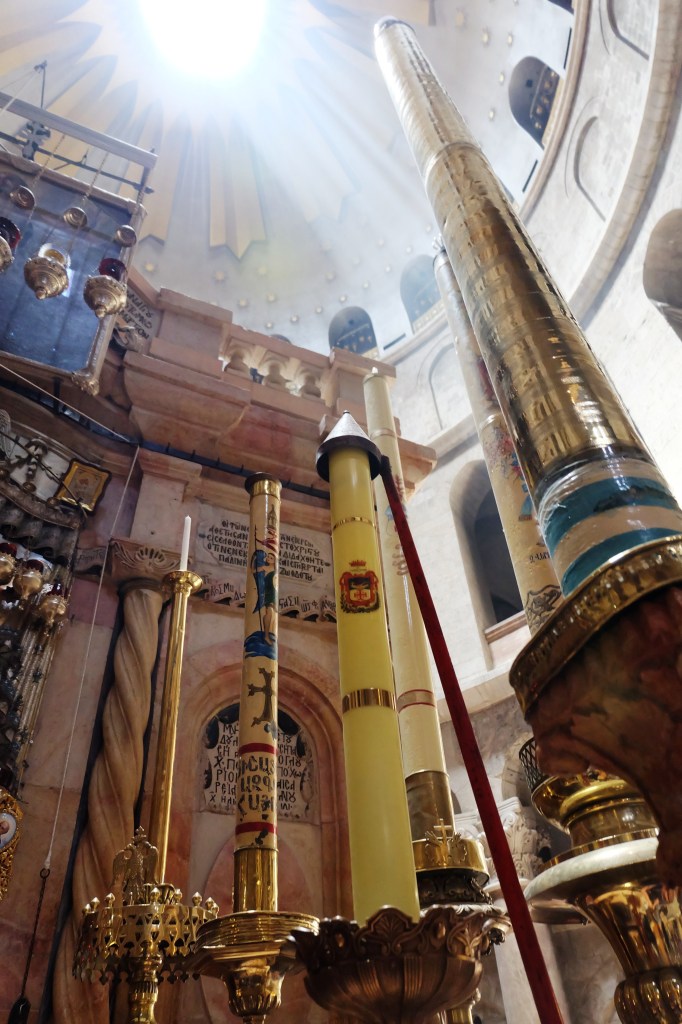
Photo by author, Church of Holy Sepulcher, May 2017.
It was a very enriching week of lessons about faith as reflected by St. Paul in his Letter to the Galatians, God our Father. We have learned so much to appreciate this gift from you we rarely recognize and give importance to.
As we end the readings from the Letter to the Galatians today, teach us through Jesus Christ how to live faithfully in your Holy Spirit to reap its fruits in our lives we badly need these days amid the pandemic and follies going on around us especially among our elected officials.
Brothers and sisters: If you are guided by the Spirit, you are not under the law. Now the works of the flesh are obvious: immorality, impurity, licentiousness, idolatry, sorcery, hatred, rivalry, jealousy, outbursts of fury, acts of selfishness, dissension, factions, occasions of envy, drinking bouts, orgies, and the like. In contrast, the fruit of the Spirit is love, joy, peace, patience, kindness, generosity, faithfulness, gentleness, self-control.
Galatians 5:18-23
Forgive us Lord when we choose to be prisoners of so many rules that govern our lives forgetting the more important things of living faithfully in you like the Pharisees in today’s gospel. We are so concerned with little things that we make so big a fuss; worst, we refuse to “lift one finger to touch them” by passing them on to others, subjecting them to so many things that they miss the beauty of your gift of life.
Make us grow deeper in faith in you and may the Holy Spirit enlighten our minds and our hearts to always seek and follow your most Holy Will. Amen.
Quiet Storm by Fr. Nicanor F. Lalog II, 22 September 2020
Photo by Ms. Ria De Vera of our parish church, August 2020.
Lately I have been watching old movies that I wonder why I still cry even if I have seen them more than twice before at the cinema and cable TV. It seems that my being born with “mababa ang luha” (easy to cry) is getting more “mababa” as I get old.
Tears are a gift from God, the most beautiful prayer we can ever express courtesy of the Holy Spirit because when we run out of words for our pains and sadness or when we are overjoyed, he makes us cry to heal and comfort us or complete our joys, assuring us of his loving presence.
That is the reason why we call “home” in Tagalog as “tahanan”: home is where we “stop crying”, that is, “tahan na” because that is where we find all the support we need in times of crisis. Indeed, home is where the heart is.
True to its function, tears cleanse us physically, emotionally and spiritually. I have read two decades ago that researchers at a university in the US have found the chemical composition of our tears differ if we cry because of pain and sadness or due to joy and laughter.
Is it not wonderful and amazing how we take for granted crying and tears without realizing its chemical process within that can transform our very selves?
Photo from Reuters.com, July 2020.
Tears and crying mark our life's coming to full circle.
When I was five years old, I saw the picture of a newborn baby crying in the Book Section of the Reader’s Digest. I asked my mom why the baby was crying. In her usual motherly way of explaining things, she told me that if the baby cries upon birth, it means he/she is alive; if the baby does not cry, he/she is dead.
“Kapag umiyak, buhay; walang iyak, patay.“
My young mind easily absorbed her words that would remain to be one of the most profound lessons I had ever learned about life at a very young age. As I grew up watching TV and movies, I would always sigh with relief whenever I heard the sounds “uha-uha” because the story would surely be nice and not tragic.
Imagine the great inverse that happens with crying and tears to signal the coming to the outside world of life of another human, of how we have to cry to be alive from then on until we die when it becomes our family and friends’ turn to cry and shed tears for us when we are gone.
But there is something more deeper than this great inverse on crying in life and death I had learned only in 2013 through my best friend Gil, a classmate in our minor seminary.
It was late February of that year on the 40th day of the death of his youngest sister Claire when he was diagnosed with cancer. We could not believe the news because Gil was the most health conscious in our “band of brothers” from high school who never smoked, rarely ate meat, and was active in sports like golf and badminton. Unlike most of us, he was never overweight, looked so healthy in our mid-40’s.
Imagine the hurt within him that every time we would visit him, he would cry not really in pain but more on the why of getting cancer. We tried visiting him as often as we can to cheer him up and lift his spirits specially after his surgery when his chemotherapy sessions began.
By September on that same year, we all had to rush and visit him at Makati Med one Sunday afternoon when informed by his Ate Lily that doctors have given up on him. His cancer cells were “ferocious” and nothing could be done anymore except to wait for the inevitable.
That was when I noticed the greater inverse about crying when Gil had finally accepted his condition and life direction, that was when he was most joyous and peaceful too while we were the ones so sad and worried, crying. How our roles were reversed with Gil now telling us to stop crying – tahan na – which we used to tell him months earlier! (Gil died peacefully the following Sunday, 22 September 2013.)
“Mater Dolorosa” as “Blue Madonna” (1616) by Carlo Dolci. Photo from Wikimedia Commons.
I noticed it happening so many times with some friends and parishioners I have come to love in my ministry, those I have pastorally cared for some time after being diagnosed with serious conditions like cancer.
Yes, I have cried despite holding my tears for them while administering the Holy Viaticum and Anointing of Oil. The patients in turn would just glance at me, so dignified and calm like Mary our Lady of Sorrows as if trying to comfort me with their sweet thank you.
As I prayed on those experiences, I realized how life comes to full circle through our crying and tears.
I believe that patients cry when they start undergoing treatment of their sickness due to fears and uncertainty of what would happen next to them; later as they come to terms with their condition, they stop crying because they already knew where they were going, of what was coming next.
We who would be left behind cry and begin to shed tears at thoughts of their dying because admittedly, we are actually the ones more uncertain of where we are going to or how our lives would go through when our loved ones are gone.
That is the greatest pain we feel in the death of a beloved when we grapple with the realities of the many uncertainties of life without them.
And that is why we need to love as much as we can our family and friends while still alive. This quarantine period of the pandemic are grace-filled moments to shower them with our love and presence we have taken for granted for so long as we pursued many things in our lives.
Photo by Dr. Mylene A. Santos, MD at Infanta, Quezon, April 2020.
Tears and crying lead us to heaven.
Death and sickness, like life, become a blessing if we are filled with gratitude not regrets because we have truly loved. When a beloved is gone and we begin to cry, the tears wash away our pains of losing them, cleansing us within to leave us with all the beautiful memories and love we have shared. Then, every remembering becomes truly a re-membering, making a lost loved one a member of the present again.
When we cry, tears polish the love we have shared with everybody until later when our time comes, our visions are also cleared of what is going to happen next, of where we are going. Crying becomes wonderful and truly a grace after all not only in sharing and being one with the grief and pain of another in the present but sooner or later, in having a glimpse of the life after.
In the Gospel of John (11:1-44), we find the story of the raising of Lazarus whom Jesus loved so much that he wept – not just cried – at his death. Jesus raised him up back to life, his final miracle – or “seventh sign” according to John – to show he is the Christ before his own Resurrection at Easter after his “final hour” of Crucifixion on Good Friday.
From then on, Christ sanctified crying and tears to enable us to see beyond pains and hurts, even death especially if you have truly loved.
Sometimes in life, it is always good to let those tears flow, like love even if it is painful, to have a good cry and real cleansing inside. A blessed day to you!
The Lord Is My Chef Breakfast Recipe for the Soul by Fr. Nicanor F. Lalog II
Friday, Week XXIV, Year II in Ordinary Time, 18 September 2020
1 Corinthians 15:12-20   ///   Luke 8:1-3
Photo by author, “private Mass” during lockdown, March 2020.
Another week is about to close, loving Father. Praise and thanksgiving to you for the grace of making it through, of passing over doubts to certainty, darkness to light, sickness to health, and death to new life in Jesus Christ your Son.
What a pity indeed if there is no resurrection of the dead nor resurrection of Jesus Christ.
Brothers and sisters: If Christ is preached as raised from the dead, how can some among you say there is no resurrection of the dead? If there is no resurrection of the dead, then neither has Christ been raised. And if Christ has not been raised, then empty too is our preaching; empty, too, your faith.
1 Corinthians 15:12-14
In this time of so much divisions fueled by dictatorship of relativism without any absolute truth nor good, many among us have stopped believing not only in resurrection of the dead but even in you, O God. Many have created themselves as their own god or have turned to other gods and idols. Sadly, many even have the guts to blaspheme you and dare challenge you and your precepts.
We are sorry, Lord , at how many of us have gone astray from you, relying more on science and technology and modern thoughts, leading lives empty of meaning, without directions. Aimless and worst, homeless.
Show us, Lord, the path we have to take to lead people back to you.
Give us the clarity of mind, purity of heart and intentions of St. Paul in leading our lives in Christ Jesus.
Enable us to embrace the new life in Christ like those women who followed Jesus in his ministry, “providing for them out of their resources” (Lk.8:3).
May our lives glow with your loving presence Jesus to lead others back to you. Amen.