Lord My Chef Daily Recipe for the Soul by Fr. Nicanor F. Lalog II
Tuesday in the Tenth Week of Ordinary Time, Year I, 10 June 2025
2 Corinthians 1:18-22     <*[[[[><  +  ><]]]]*>     Matthew 5:13-16
What a great way to resume
the Ordinary Time this Tuesday,
Lord Jesus Christ as your words
today invite us to examine
some of the most "ordinary" things
in life we take for granted.
Brothers and sisters: As God is faithful, our word to you is not “yes” and “no.” For the Son of God, Jesus Christ, who was proclaimed to you by us, Silvanus and Timothy and me, was not “yes” and “no,” but “yes” has been in him (2 Corinthians 1:18-19).
Many times in our answers
of yes or no we cannot even make
a clear stand in you, Jesus;
like Paul,
give us the strength and courage
to mean "yes" in you, Jesus;
let our "yes"
to your gospel,
to your love and justice,
to your kindness and forgiveness
be a resounding "Amen"
in Christ, without any reservations,
without ifs nor buts
but a firm "yes, Lord!"
Teach to become
the salt of the earth bringing out
the flavor and goodness
of every person like what salt
does to our food;
at the same time,
let your light shine in us,
Jesus, to bring out the light,
the beautiful colors of every person
around us with our witnessing
to you, Jesus.
Amen.
Lord My Chef Daily Recipe by Fr. Nicanor F. Lalog II
Monday, Feast of the Blessed Virgin Mary, Mother of the Church, 09 June 2025
Acts 1:12-14     <*{{{{>< <*{{{{><  +  ><}}}}*> ><}}}}*>     John 19:25-27
Painting by El Greco, “Pentecostes” (1597) from commons.wikimedia.org.
Praise and glory to you,
Lord Jesus in inspiring the Church
in its most recent celebration of
the Feast of the Blessed Virgin Mary,
Mother of the Church every Monday
after Pentecost when we resume
Ordinary Time; it is so right and fitting
that after your return to heaven,
you send us to the world to continue
your work of salvation by being rooted
in you in prayer,
not just by ourselves
but with Mary your Mother,
your first disciple,
the first doer of your word,
the first to receive you,
Jesus the Christ.
Then they returned to Jerusalem from the mount called Olivet…Peter and John and James and Andrew, Philip and Thomas, Bartholomew and Matthew, James son of Alphaeus, and Simon the Zealot, and Judas son of James. All these devoted themselves with one accord to prayer, together with some women, and Mary the mother of Jesus, and his brothers (Acts 1:12, 13-14).
Icon of Mary “Mater Ecclesiae” (Mother of the Church) in St. Peter’s Square from opusdei.org.
Since the very start of the Church,
you have always been with her,
truly her Mother being the
Body of Christ your Son;
all your life,
you have devoted yourself
into prayer as a communion
in Jesus Christ which is essentially
what discipleship is - prayer!

As we resume the Ordinary Time,
teach us Mother Mary to remain in
union with Jesus in prayer:

let us be one with Jesus your Son
to make our joy complete
not only in listening and receiving
his word but most especially
in doing his words;

let us be one with Jesus your Son
for us to persevere in our sorrows
by finding him always in every suffering
by embracing his Cross;

let us be one with Jesus your Son
so that glory and victory may not
inflate our ego,
realizing everything
is for God's greater glory;

let us be one with Jesus your Son
for us to remain in his light of the
Holy Spirit in this time
we are engulfed in darkness of sin
and materialism,
pride and power,
vanity and self-centeredness.
Photo by author, Sacred Heart Novitiate, Novaliches, Quezon City, 20 March 2025.
O most Blessed Virgin Mary,
Mother of the Church,
Mother of Christ
and our Mother too,
be our companion in this
long journey in Ordinary Time,
knowing Jesus,
loving Jesus,
following Jesus,
always leading and pointing
others to Jesus
to be like Jesus.
Amen.
The Lord Is My Chef Daily Recipe for the Soul by Fr. Nicanor F. Lalog II
Wednesday, Week I in Ordinary Time, Year I, 15 January 2025
Hebrews 4:12-16     ><))))*> + ><))))*> + ><))))*>     Mark 2:13-17
Photo by author, Northern Blossom Farm, Atok, Benguet, 27 December 2024.
therefore, he (Jesus) had to become like his brothers and sisters in every way, that he might be a merciful and faithful priest before God to expiate the sins of the people. Because he himself was tested through what he suffered, he is able to help those who are being tested (Hebrews 2:17-18).
How lovely are your words today,
dearest Jesus!
They are so true!
While others are still wondering,
asking "what if God is one of us",
we have always believed
and have experienced
God truly one of us,
among us,
and within us
in you,
Jesus Christ.
How sad that many of us humans
are more inclined to believe
in things and persons bigger than
than ourselves,
not realizing our greatness
in being small that even you,
O Son of God,
chose to be like us,
little and vulnerable
so that we can be like you,
divine and eternal.
Teach us to see more of your
person, of your being one of us,
dearest Jesus,
for us to experience your
authority and power;
like Simon and Andrew,
teach us to have that intimacy
with you Lord that,
"immediately" they told you about
Simon's mother-in-law being sick;
most of all, let me be one with
my own brothers and sisters
like you, Jesus,
"approaching them,
grasping them,
and helping them
rise up when they are
down"
(Mark 1:31)
Amen.
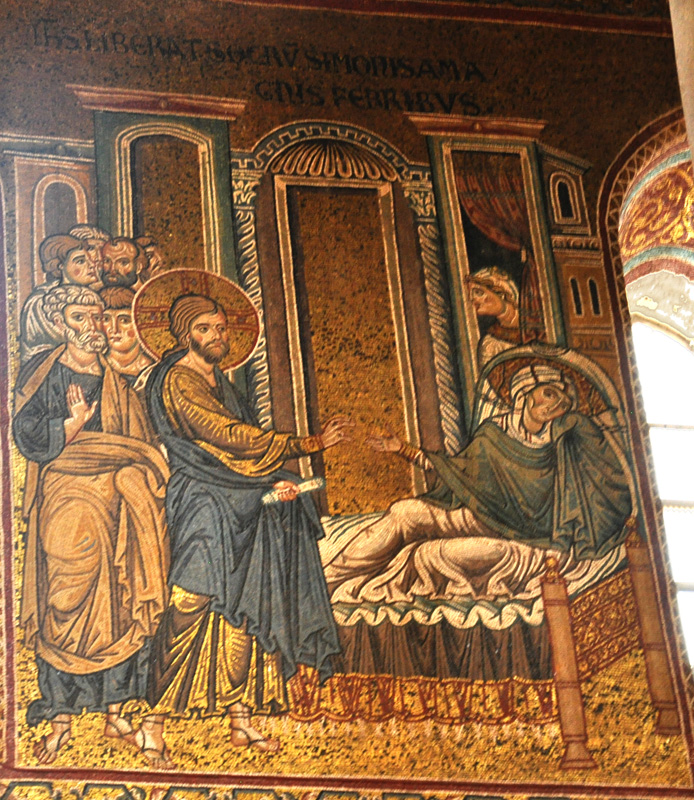
Jesus Heals Peter’s Mother-in-Law, a mosaic in the Cathedral of the Assumption, Monreale, Sicily, from christianiconography.info.
The Lord Is My Chef Daily Recipe for the Soul by Fr. Nicanor F. Lalog II
Tuesday, First Week in Ordinary Time, Year II, 14 January 2025
Hebrews 2:5-12     <'[[[[><  +  ><]]]]'>     Mark 1:21-28
Photo by author, Sakura Park, Atok, Benguet, 27 December 2024.
"Jesus came to Capernaum
with his followers,
and on the sabbath he entered
the synagogue and taught.
The people were astonished
at his teaching,
for he taught them as one having authority...
All were amazed and asked
one another, 'What is this?
A new teaching with authority'"
(Mark 1:21-22, 27).
When does a teaching
sound new?
When the teaching makes
an impact on me.
But how?

I have been wondering,
Jesus, of being there with you
in the synagogue that sabbath;
what was so new with your
teaching?
It was and still is the authority,
and your authority comes not
from your power nor position,
Lord Jesus: your authority is so felt
because you are one with us,
you have always been with us.

What's new with your teaching,
Jesus, is the authority that inversely
makes us free,
liberates us from fears
and false presuppositions,
never oppressive nor
subjugating.
A teaching is new when
there is authority that does
not impose but rather
liberates others
because
it is the Truth (John 8:32) -
Jesus himself who claimed
"A am the way the truth and the life"
(John 14:6).
More than words and power,
teaching and authority
are felt and become liberating
in the real sense,
ever new,
so fresh
that it is not subjugating
because
in the final analysis
it is the person
who loves and cares,
wiling to sacrifice and suffer
for another.
Exactly like Jesus.
This new year, O Lord,
make me new
a teaching so true
as a person so loving
and caring like you.
Amen.
Photo by authoir, Northern Blossom, Atok, Benguet, 27 December 2025.
The Lord Is My Chef Daily Recipe for the Soul by Fr. Nicanor F. Lalog II
Monday, Week I in Ordinary Time, Year I, 13 January 2025
Hebrews 1:1-6     <*((((><  +  ><))))*>     Mark 1:14-20
Photo by author, Mt. St. Paul Spirutality Center, Pico, La Trinidad, Benguet, 04 January 2025.
Brothers and sisters: In times past, God spoke in partial and various ways to our ancestors through the prophets; in these last days, he spoke to us through the Son, whom he made heir of all things and through whom he created the universe, who is the refulgence of his glory, the very imprint of his being, and who sustains all things by his mighty word (Hebrews 1:1-3).
O how lovely and so deep,
dear God are your words
on this first day of Ordinary Time;
they are so touching and personal
yet very ordinary,
common,
and typical.
That is how we take the word
"ordinary" so often -
lacking in special or
distinctive features
that we take for granted
anything ordinary
because it is...
ordinary.
Maybe this is the reason why we
find it so hard to really believe
in you, Father;
when you sent us your Son,
Jesus Christ, the "refulgence" or
reflection of your glory and
"imprint" of your being,
we find him so ordinary
because we wanted someone more,
someone bombastic,
someone so different from us,
not so like us
because we feel so ordinary.
It is so funny and silly
of us, God, that we
cannot accept you in Jesus
who became human like us,
who chose to be ordinary,
preferring to be poor than rich,
simple than complicated
yet so kind, so very much akin to us
in everything except sin;
instead of being honored
and grateful in your choosing
to be ordinary like us,
we rejected him
and us in the process.
Open our minds and our hearts
to your coming to us in Jesus like
the brothers Simon and Andrew,
James and John
who left everything behind to follow
Jesus whom they have found to be
extraordinarily ordinary;
may we find meaning in life
in Jesus your Son in whom
the ordinary is actually the
orderly order of things in life
with you Father always above all.
Amen.
Photo by author, sunrise at Mt. St. Paul Spirituality Center, Pico, La Trinidad, Benguet, 06 January 2025.
The Lord Is My Chef Sunday Recipe for the Soul by Fr. Nicanor F. Lalog II
Solemnity of the Most Holy Trinity-B, 26 May 2024
Deuteronomy 4:32-34, 39-40 ><}}}*> Romans 8:14-17 ><}}}*> Matthew 28:16-20
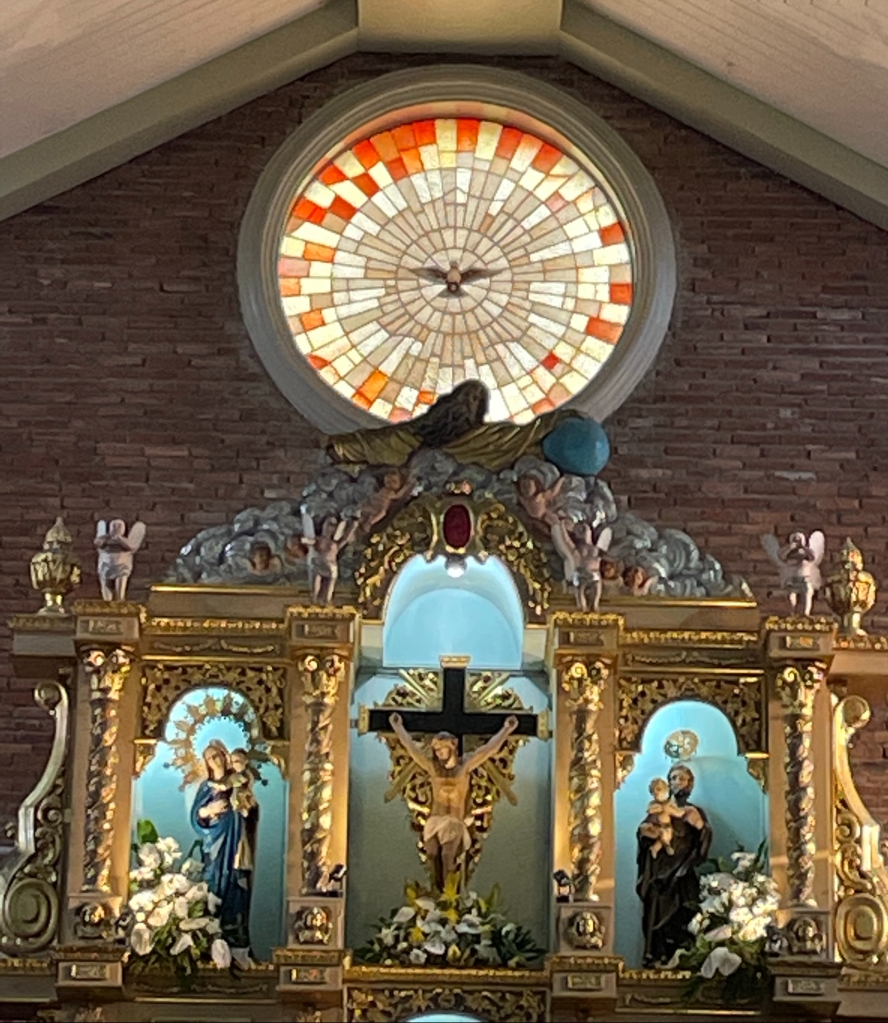
Photo by author, the Holy Trinity as depicted at the Parish of St. John the Baptist, Calumpit, Bulacan, March 2021.
We are now into the Ordinary Time and for the next two consecutive Sundays we are celebrating three important Solemnities in the next three weeks.
First in these series of Solemnities in Ordinary Time is that of the Most Holy Trinity, the highest truth in our faith which is our belief in One God in three Persons. Contrary to common beliefs, mysteries can be explained and understood, but, not fully well. After all, mysteries are not really meant to be solved but simply be lived and enjoyed like the mystery of the person which is in the heart of the Most Holy Trinity: How can there be three Persons in one God?
Moses said to the people: “Ask now of the days of old, before your time, ever since God created man upon the earth; ask from one end of the sky to the other: Did anything so great ever happen before? Was it ever heard of? Did a people ever hear the voice of God speaking from the midst of fire, as you did, and live? Or did any god venture to go and take a nation for himself from the midst of another nation, by testings, by signs and wonders, by war, with his strong hand and outstretched arm, and by great terror, all of which the Lord, your God, did for you in Egypt before your very eyes?”
Deuteronomy 4:32-34
Photo by author, sunrise at the Lake of Galilee in Israel, May 2019.
Our first reading this Sunday invites us too to examine ourselves and our lives to see how God has been so personal, so relational with us. As we say in Tagalog, “Sigue nga, paano mo naranasan ang Diyos?”
How did you experience God? Was it not just like the way we experienced other people in our relationships?
Very often when we meet people, our tendency to welcome or accept them were a result of their conduct, of their approach to us. If they are kind and good natured and warm, we are easily disarmed and we feel like knowing them.
That is what Moses was telling his people at that time, including us today: recall how personal was God in dealing with us with all His warmth and love because they indicate relationships and therefore, another person to relate with.
“The Trinity” (1425-27), an icon by Russian artist Andrei Rublev from wikipedia.org.
Remember how the books of the bible were written: the first questions the biblical writers asked were not the origins of the world but those asked by Moses today. After they have experienced the kindness and love of God that they eventually asked and reflected on the origins (genesis) of everything on earth and the universe.
In that experience, they felt a relationship with a Father as source of all life like dads giving life as well as protecting life and giving back life to those who may have lost it. That personal experience of God as a Father so loving and caring moved the biblical writers too to ask and reflect on the presence of evil and sufferings as we find in the Wisdom books like the Psalms and the Book of Job.
There is always the primacy of God’s personal relationship and of His conduct towards us humans that prompt us to “know” Him, to believe Him. Like people dear to us, God first revealed Himself to us in the most personal manner through a succession of events and other people we have met and known. That is why when we say “I believe in God”, we not only express a concept but also a relationship. Most of all, in this relationship is a commitment too to get to know God as a person! Before knowing any details about God or people, we first have relationships no matter how little it may be at the start. Later, we get phone numbers and other contact details with people we meet because we feel “committed” to getting to know them more in the future. In a sense, we believe them that is why we keep in touch with them. The same is true with God.
Photo by author, St. Catherine’s Monastery at the foot of Mt. Sinai in Egypt, May 2019.
The word person means “a conscious relating being”. Whether with God or with others, we experience the person and the relationship unfolding through time. There is always first the experience of a conduct like kindness before questions and details of a person come.
That word “kindness” actually indicates a relationship because its root is kin that means “one of us” or “of same tribe”. When we say “he is so kind to me”, it means he treats me as one of his family or his own. In that kindness and whatever good conduct present, there seems to be an “invisible line” linking us with people we meet. Or with God which the Holy Spirit does.
Of the Trinity, the Holy Spirit is the most elusive in nature and yet, it is the most frequently and concretely in contact with us. It is the principle of unity in the Trinity and among us as we have reflected last Pentecost Sunday. Today, St. Paul explains to us how the Holy Spirit as a Person keeps these relationships among us and with God united and strong, enabling us to cry out “Abba” or “Our Father”. It is the Holy Spirit who gives us the courage to keep our relationships as persons and with God especially at this modern time when some people refuse to recognize God and worst, some are bent in deleting God entirely from life.
That is why in today’s gospel, Jesus instructed His disciples including us today to “Go, therefore, and make disciples of all nations, baptizing them in the name of the Father, and of the Son, and of the Holy Spirit, teaching them to observe all that I have commanded you” (Mt.28:19-20). Persons always presuppose relationships; hence, the need to gather others always like what God did and continues to do in His Church.
It has been three weeks since my mother peacefully passed away. People ask me how am I doing. Truth is, I am not so well. I miss mommy so much. It is true we only realize the value of a person after he/she is gone. And it is most difficult with mothers!
Photo by author, Mt. Sinai in Egypt, May 2019.
Every time I come home, I have that strange feeling, wondering deep inside me of that great mystery, how did it happen that it was my mom – just one person – who had left us but our home has become so empty? Since May 7, that image of mommy’s empty room after her body was taken to the funeral had remained in my mind and as days passed, I have noticed how our home has been so hollowed when there are still my siblings and niece staying in the house?
That is the gift of person. A person fills not only spaces and homes but most of all, fills us. Every person fills another person in the same manner God first fills us with His love through persons dearest to us. That is why we believe in God.
Let us have good relationships with others so they may experience God too in their lives. Let us gather in the Father’s love in Jesus Christ to celebrate the gift of life together in the Holy Spirit through one another. Let us pray:
God our loving Father,
thank you for the gift of life,
for my gift of person
and for the gift of so many
persons in my life;
dwell in me, Holy Spirit,
fill me with your fire and life,
animate me with the Son's
justice and love
so that in myself
the mystery
of the Blessed Trinity
be alive.
Amen.
The Lord Is My Chef Daily Recipe for the Soul by Fr. Nicanor F. Lalog II
Tuesday in the Seventh Week of Ordinary Time, Year II, 21 May 2024
James 4:1-10     ><))))*> + ><))))*> + ><))))*>     Mark 9:30-37
Photo by author, September 2020.
"Beloved:
Where do the wars and
where do the conflicts
among you come from?"
(James 4:1)
What a beautiful question
to ponder upon on this
second day of Ordinary Time,
Lord Jesus: the "where",
the origin,
the source,
the root
of our many desires
in life;
ultimately,
the question You have asked
Your disciples "What were
you arguing about on the
way?" (Mark 9:33)
leads also to the same
question of James of
"where".
Many times,
O Lord, we presume
and insist we are on the
right tracks,
on the right path
following the world
even if deep inside
we know we are lost,
we have gone astray,
that we are on the wrong
bearings in life
because we merely
follow the rest that like
everybody, we end up
lost and more confused
than ever.
You covet but do not possess. You kill and envy but you cannot obtain; you fight and wage war. You do not possess because you do not ask. You ask but do not receive, because you ask wrongly, to spend it on your passions.
James 4:2-3
Teach us, Jesus,
to bravely ask ourselves
from "where" are we coming from
in everything we are doing,
saying, and pursuing;
help us to be sincere
and humble of our "where"
wherever it may be;
most of all,
let us ask too
"where" we are going to
"where" do we want to be.

During these 33 to 34 weeks
in Ordinary Time,
let us find,
our bearing in YOU, Jesus
so that our "where" from
and "where" to would only
be YOU.
Amen.
Photo by Mr. Vigie Ongleo, Sagada, Mt. Province, 2014.
The Lord Is My Chef Daily Recipe for the Soul by Fr. Nicanor F. Lalog II
Monday, Memorial of Mary, Mother of the Church, 20 May 2024
Acts 1:12-14     ><}}}}*> + ><}}}}*> + ><}}}}*>     John 19:25-34
Icon of Mary “Mater Ecclesiae” (Mother of the Church) in St. Peter’s Square from opusdei.org.
What a wonderful way
of assuring us today, dear Jesus,
at the resumption of Ordinary Time
of Your presence and guidance
throughout this year in giving
us Your Mother the Blessed Virgin Mary
as "Mater Ecclesiae",
Mother of the Church.
From the very beginning,
during Your public ministry
until Your death on the Cross,
Mary Your Mother has always
stood by Your side, Jesus;
when You sent the Holy Spirit
on that Pentecost day in Jerusalem,
Mary was also present with
Your disciples praying in the
Upper Room: "All these
devoted themselves
with one accord to prayer,
together with some women,
and Mary the mother of Jesus,
and his brothers" (Acts 1:12).
What a beautiful portrayal
of the Church on its very first day
as Your Body, O Christ,
gathered in prayer with Mary
whom You have given to us through
Your beloved disciple at the Cross:
"When Jesus saw his mother
and the disciple there whom he loved,
he said to his mother, 'Woman,
behold your son.'
Then he said to the disciple,
'Behold, your mother'" (John 19:26-27).
Photo by author, Sacred Heart Novitiate, Novaliches, QC, 20 March 2024.
As we resume today
Ordinary Time,
may we imitate Mary
Your Mother, O Lord,
in being a faithful disciple,
open to welcome
and accept You, Jesus,
saying "Yes" to Your will
like at the Annunciation;
let our faith in You be firm
like hers at the wedding at Cana
when she told You immediately
how the newly-weds have ran out
of wine, instructing the servants
to do whatever "he tells you";
most of all, like Mary,
let us remain intimate with You,
Jesus in prayers,
her most important trait
as Your faithful and model disciple.
Teach us, dear Jesus,
to be like Mary,
deeply absorbed in You
in prayers;
her standing at the Cross
was not a result of a spur in the moment
but the fruit of her long, vibrant prayer
life centered in You her Son;
unlike us, we come and pray
 to You only when we are
 going through trials and difficulties
but when everything is going well
in life, we hardly remember You, Lord,
nor pray at all.
All her life,
Mary lived in prayer,
in communion and oneness
in You, Jesus
that is why when the Church
was born on Pentecost,
Mary was there.
She has always been
with us as our Mother
and companion in mission;
let us be like Mary
in her discipleship that
is essentially
a prayer life.
Amen.
Photo by author, Della Strada Chapel, Sacred Heart Novitiate, Novaliches, QC, 20 March 2024.
The Lord Is My Chef Daily Recipe for the Soul by Fr. Nicanor F. Lalog II
Tuesday in the First Week of Ordinary Time, Year II, 09 January 2024
1 Samuel 1:9-20  <*((((>< + ><))))*>  Mark 1:21-28
Photo by Mr. Jay Javier, Quiapo, 09 January 2020.
Praise and glory to you,
Lord Jesus Christ,
that today we shift into Ordinary Time
in our liturgy that coincides with
the annual Traslacion of the image
of the Black Nazarene in Quiapo,
Nuestro Padre Jesus Nazareno
as you remind us too in our readings
true meaning of authority
we often relate with power.
Jesus came to Capernaum with his followers, and on the sabbath he entered the synagogue and taught. The people were astonished at his teaching, for he taught them as one having authority not as the scribes.
Mark 1:21-22
People were astonished with your
authority, Lord Jesus, not only because
it is all-powerful but most of all,
it is most kind,
most compassionate,
most humane
because in your life,
in your very self as Jesus Nazareno,
you have shown us that
authority is not just having
power to make thing happen nor
lording over others;
like in Quiapo today as in Capernaum,
we are astonished with your
authority not because of its
powers of being efficacious
but because of your being so close
with us who are weak and suffering;
true authority for you, dear Jesus,
is to be one with the people -
in our miseries and anxieties,
in our pains and hurts,
as well as in our aspirations and dreams;
authority is most real,
most powerful
and most appreciated
when that authority
is felt as power for the people
to be healed and comforted,
raised up and inspired
like you have shown in your
coming to us,
in your carrying the cross,
of your bearing our infirmities.
Like Hannah in the first reading,
we beg those authorities above us
to "think kindly" of us people;
many times,
people in authority lord it over us
like Eli initially, suspecting
Hannah being drunk,
scolding us,
reprimanding us,
worst, judging us
without even knowing
our plight, so unlike you
who became poor like us,
most of all,
died for us.
Amen.
The Lord Is My Chef Sunday Recipe for the Soul by Fr. Nicanor F. Lalog II
Feast of the Transfiguration of the Lord, Cycle A, 06 August 2023
Daniel 7:9-10, 13-14 ><}}}*> 2 Peter 1:16-19 ><}}}*> Matthew 17:1-9
Photo of the mosaic inside the Basilica of the Transfiguration on Mt. Tabor, Israel (from commons.wikimedia.org).
Today we take a break from our gospel readings to celebrate the Feast of Transfiguration (August 06) that falls on a Sunday this year. The segue fits perfectly the series of parables we heard these past three Sundays that mentioned judgment day at the end of time.
Recall how Jesus interpreted his parables especially the separation of the weeds and wheat at harvest time as well as keeping the good fish caught in the net, throwing the bad ones that all evoke of judgement day in the end of time. For Matthew, the transfiguration of Jesus is exactly about the end of time when Christ’s glory is revealed at his Resurrection and ultimately in his Second Coming.
Jesus took Peter, James, and his brother, John, and led them up a high mountain by themselves. And he was transfigured before them; his face shone like the sun and his clothes became white as light.
Matthew 17:1-2
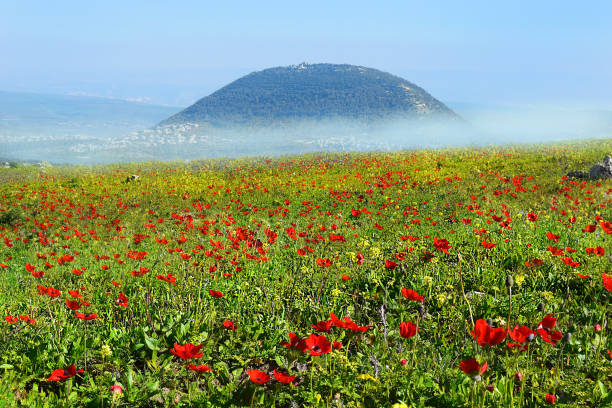
Mt. Tabor, believed to be the site of the Transfiguration of Jesus. Photo from iStockphoto.com.
In the Gospel according to Matthew, major events in the life of Jesus Christ mostly happened on a mountain: his temptation (Mt. 4:8), his inaugural teaching, the sermon on the mount (Mt. 5:1) and the sending of his apostles on their mission throughout the world until the end of time (Mt. 28:16).
Here at his transfiguration on top of the “high mountain” of Tabor we find glimpses of Christ’s explanation of the parable of the weeds among the wheat when he said that “the righteous will shine like the sun in the kingdom of their Father” (Mt. 13:43). See how this transfiguration of the elect at the end of time that was shown to Daniel in the first reading is expressed exactly in the same way as that of the face of Jesus on Mount Tabor that had “shone like the sun” as witnessed by the three apostles. Peter strongly attested to it later as we have heard in the second reading.
Last week in the daily readings from Exodus we have heard how the face of Moses also shone like the sun after he had conversed with God on Mount Sinai and every time he would see God at his tent called the dwelling in their journey in the desert. That is the context why Peter volunteered to build three tents for Jesus, Moses and Elijah during the transfiguration. The Jews have a celebration called feast of booths or tents they called sukkoth. The tent is the dwelling place of God in the wilderness that eventually became the temple of Jerusalem. It was the closest thing they have with God and with heaven. At the transfiguration of Jesus, the three apostles were enthralled at the experience and sight they did not want to go down because it was literally heaven, being with God. The transfiguration event itself for them was the fulfillment of their faith and everything in the Old Testament.
They would realize later that to dwell with God means to continue the journey in Christ, with Christ marked with many ascents and descents happening not just in space or physically but more of the interior kind. That is how we are transfigured, always inside. Right in our heart and soul. That was the deeper meaning of Moses entering God’s dwelling in the desert – of him being one in God, with God – that his face would shone after, prompting him to cover it because people were scared.
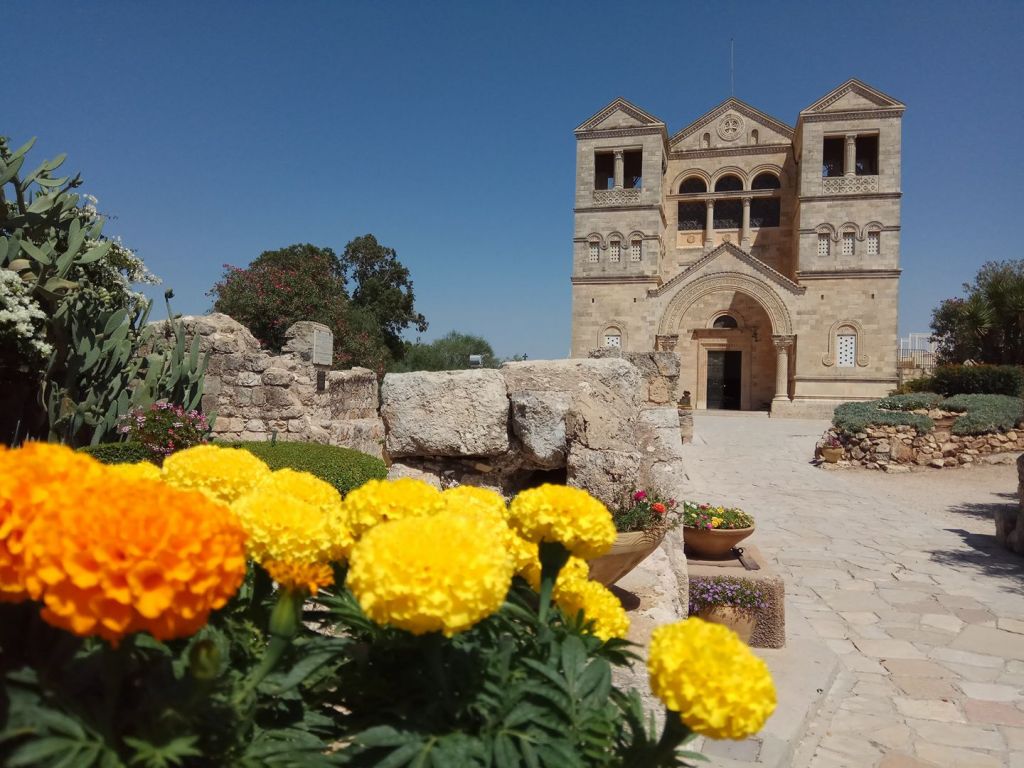
Photo from custodia.org, Basilica of the Transfiguration on Mt. Tabor, Israel.
Whatever is found on the face is always a reflection of what is in the heart and soul. No amount of cosmetics and beauty procedures can ever bring out that glow and radiance of anyone’s face beaming with joy and fulfillment, peace and contentment.
The face is the reflection of the depths – or shallowness – of one’s heart and soul. There is an English word used to describe this inner dynamics of the face – countenance. Any change in our countenance indicates something is being transformed within us as a result of our communion with God. That is why we describe some people even we do not know them as malalim or deep, or magaling magdala ng problema because of their countenance. In the same manner, we easily notice something rotting inside a person when despite one’s having good features like flawless skin or aquiline nose, beautiful eyes and the like. This is what the young people would call as “uma-aura” when they pose for FB or IG. Aura is the spirit within evoked by one’s face that cannot be manipulated.
The face of Jesus shone like the sun at his transfiguration primarily because deep inside him is his complete and perfect union in the Father. Jesus would always insist on this reality within him, his perfect communion in the Father from which also flows his total obedience which will reach its highest point at his Passion and Death on the Cross, his own Pasch or exodus.
There at Mount Tabor in his transfiguration, we are shown that Christ’s glory cannot be separated from the Cross. His majesty and triumph shall come from his pasch. And so are we his disciples. That is why the voice heard by the apostles said, “This is my beloved Son, with whom I am well-pleased; listen to him”. From now on, Christ would be speaking of his coming Passion, Death and Resurrection. All his lessons after Mount Tabor are about our participation in his paschal mysteries. Do we listen?
The apostles learned and embraced all these lessons in a process slowly with the guidance of the Holy Spirit after Pentecost. That is why Jesus told them to come down from Tabor to continue their journey to Jerusalem to fulfill his mission. Through them we have believed despite our not having seen Jesus that is how he would appear as “Lord” on the mountain that we the faithful are climbing to participate in the ultimate manifestation of his return at the end of time.
And there lies the good news of this Feast of Transfiguration happening in this dry month of August, often described as ghost month too. As we go through the last half of Ordinary Time’s remaining 17 weeks, may we continue to ascend in Christ, with Christ with his Cross in sharing his paschal mysteries in our daily lives. After the euphoria of Easter Season that had closed on Pentecost Sunday, we are reminded anew this sixth of August to never lose sigh of the Cross of Good Friday as our path to glorious transfiguration of Jesus Christ.
To journey with Christ, listening and obeying his voice is something of the inside and not just of space or place. Discipleship demands persistent practice of the Lord’s teachings and examples as we shall hear from the gospel these coming Sundays.
As COVID-19 virus wanes that we resume most of our activities minus the many protocols before while still being cautious and careful, may we face our inner issues in Christ and the Holy Spirit to be transfigured in him. Amen.Have a blessed week ahead. It is a Sunday, celebrate Mass with others in your Parish, pray for those still suffering from the effects of typhoon Egay and Falcon.
Painting of the Transfiguration by Italian artist Duccio di Buoninsegna between 1308 and 1311 from commons.wikimedia.org.