Be gentle to be in the banquet

Lord My Chef Sunday Recipe for the Soul, 28 September 2025
Twenty-Sixth Sunday in Ordinary Time, Cycle C
Amos 6:1, 4-7 ><}}}}*> 1 Timothy 6:11-16 ><}}}}*> Luke 16:19-31
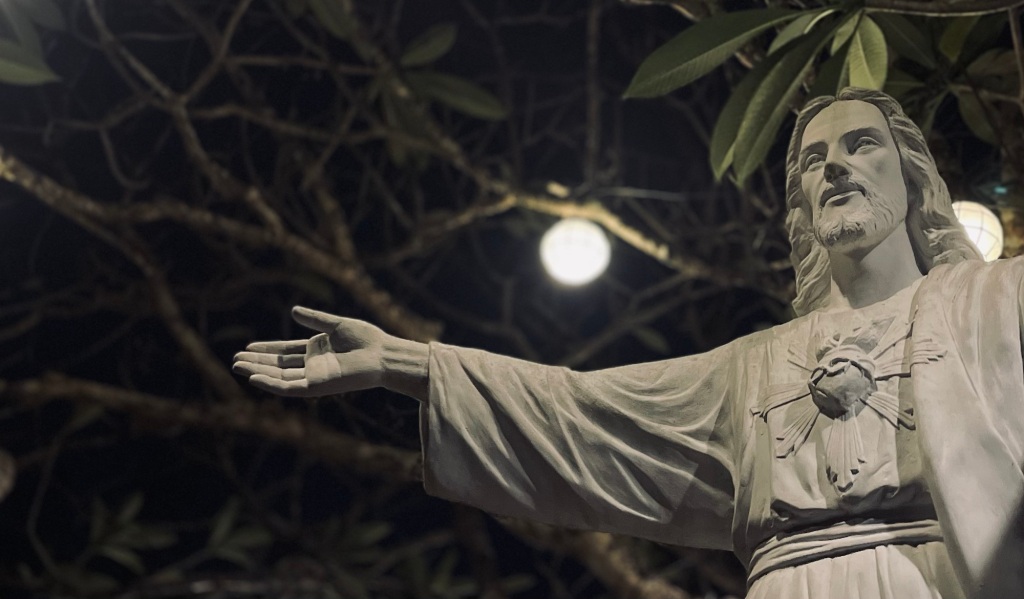
Photo by author, Carmel of the Holy Family Monastery, Guiguinto, Bulacan, 25 September 2025.

But you, man of God, pursue righteousness, devotion, faith, love, patience, and gentleness (1Timothy 6:11).

How lovely and so apt these days are the qualities Paul required through Timothy every man and woman of God must have. Of the six qualities Paul had cited, I like most “gentleness” which Jesus also asked us to have, “learn from me, for I am meek and gentle ( or humble) of heart” (Mt. 11:29).

From the Greek word prauteis, gentleness implies consideration, meekness, humility, calmness and strength amid adversities and difficulties. True power is expressed kindly and gently, not with harshness. Parents and teachers know this so well as children learn discipline better when authority and power are expressed gently than harshly.

Photo by author, Carmel of the Holy Family Monastery, Guiguinto, Bulacan, 25 September 2025.

Lately we have been sliding towards this kind of arrogance in our anger and frustrations following the wholesale corruption in Congress. Everybody feels the weight and pains of the ghost flood control projects but cursing and wishing death upon the corrupt officials are off bounds because that make us just like Duterte and his followers whose mouths spew expletives and death to their detractors.

Our readings are so timely this Sunday again, calling us to be gentle with one another because eternal life begins in the here and now of our earthly existence. How we live today determines our entrance or not into the eternal banquet of the Lord.

Jesus said to the Pharisees: “There was a rich man who dressed in purple garments and fine linen and dined sumptuosly each day. And lying at his door was a poor man named Lazarus, covered with sores, who would gladly have eaten his fill of the scraps that fell from the rich man’s table. dogs even used to come and lick his sores. When the poor man died, he was carried away by angels to the bosom of Abraham. The rich man also died and was buried, and from the netherworld, where he was in torment, he raised his eyes and saw Abraham far off and Lazarus at his side” (Luke 16:19-23).

Photo by author, Carmel of the Holy Family Monastery, Guiguinto, Bulacan, 25 September 2025.

Our readings continue to pursue that thorny issue of money, of how we use and manage it for God’s greater glory in the service of others not for our shameful selfish interests.

That is why we find Paul’s admonition to Timothy and to us today as men and women of God to be gentle in the midst of too much materialism. In the preceding verses Paul warned Timothy of the dangers of false teachings and the love of riches which he concluded with an exhortation to rely more on God than in wealth in verse 17. It is a timely reminder from over 2000 years ago against this growing trend among us spawned by social media of people flaunting their wealth as if finding their own value as a person in possessions than in their very selves.


Gentleness like Jesus is first of all finding our being’s sacredness. It is an expression of our being loving and charitable because we are children of one loving God we relate with as a Father.

How tragic we no longer see each other’s worth as a person, as an image and likeness of God as we seek more the face of money than the face of God in every person. Pera pera na lang lahat – even in the church, sad to say. Every consideration boils down to money like leadership in church activities or hermanidad in fiestas being reserved for the rich and famous who are always the politicians to whom many priests and bishops have become beholden, consciously or unconsciously. We have too much collections and envelopes that further drive away the poor from celebrating our Sunday Eucharist which is essentially a foretaste of the Lord’s banquet in heaven.

Photo by author, Carmel of the Holy Family Monastery, Guiguinto, Bulacan, 25 September 2025.

Amos continues his tirades against the priests of the temple of his time with their hypocrisies of hiding selfish motives in religious celebrations and practices that sadly continue to this day among us in the church.

Thus says the Lord the God of hosts: “Woe to the complacent of Zion! Lying upon beds of ivory, stretched comfortably on their couches, they eat lambs taken from the flock, and calves from the stall! They drink wine from bowls and anoint themselves with the best oils; yet they are not made ill by the collapse of Joseph!” (Amos 6:1, 4, 6).

That “eating lambs from the flock” and “calves from the stall” are the animals reserved for offering in the temple their priests have taken for themselves while “drinking from bowls” and “anointing with the best oils” harp on our rituals we have taken as our own like commercialization of Masses and sacraments. It is the color of money perfectly described by the purple clothing of the rich man in the parable that pervades us in the church that people no longer see and experience God as they have become so cautious asking about the price or the fees that come with every service we give.

Photo by author, Carmel of the Holy Family Monastery, Guiguinto, Bulacan, 25 September 2025.

Gentleness like Christ is using our power and authority at the service of the poor and disadvantaged, ensuring our Eucharistic banquet is a reflection of the eternal banquet in heaven where everyone is welcomed.

How sad this parable is repeated daily in the church that is why Jesus directed it to the Pharisees, one of the ruling class in the Jewish society at that time associated with temple worship and religion. Though Jesus did not say at all if the rich man is a good person or not, it is very clear that he lacked gentleness in his flamboyance, wearing purple clothes as if screaming to be noticed by everyone as a somebody while everybody is a nobody.

Maybe we should add “nepo Fathers” to the list of nepo babies and nepo wives who flaunt their wealth, looking more like showbiz kids than priests, feeling superstars who are more like entertainers than preachers who relish the tag “influencer” than remain hidden doing the work of Christ. They refuse wearing the proper liturgical vestments due to our tropical climate but would not mind at all wearing signature clothes with their perfumes leaving traces in their favorite stomping grounds like malls and cafes during offs.

Where is our gentleness or concern and consideration for the majority of our people who are poor further pushed out of our churches literally and figuratively speaking simply because we do not smell and look like them our flock of sheep as Pope Francis reminded us early in his pontificate?

Photo by author, Carmel of the Holy Family Monastery, Guiguinto, Bulacan, 25 September 2025.

Gentleness of Jesus is solidarity with the people, especially the poor and suffering who experience being uplifted or empowered in his mere presence so filled with warmth and love.

People understand us priests for being strict even stern-looking but what they find so difficult is when pastors are detached from them, always out of the parish for so many reasons, when priests are selective in their company even having cliques. How sad when priests are unapproachable and indifferent like the rich man who was oblivious to the presence of Lazarus at his door, who never gave him any attention at all while still on earth when in fact, they knew each other as mentioned in the parable after they have both died. Kakilala naman pala niya si Lazaro pero doon na lang sa kabilang buhay siya kinausap at pinansin kung kailan huli na ang lahat.

Pope Francis used to describe the church as a hospital where the sick in body and soul come to find solace and comfort in the presence of God. But, instead of hospitality, many times it is hostility that people experience in our parish when they are held hostage by our many rules and regulations that they never feel welcomed at all. Some get scolded that instead of their burdens being eased, they are traumatized by the priests or the office staff and volunteers.

Photo by author, Carmel of the Holy Family Monastery, Guiguinto, Bulacan, 25 September 2025.

If we could be a little more gentle with every Lazarus, perhaps we could be truly rich as we find God in everyone in our doors that lead to our banquet table, whether here on earth or in the afterlife.

Let me end with this parable within me these past five years as a chaplain in the hospital.

Have you ever noticed how the rich with all their wealth and resources are often afflicted with rare diseases without any cure and medication at all while so many poor people without money at all could not avail of the many procedures and medications available for their illness?

It is a parable in this life that begs us to be gentle, even extra gentle many times to ease each other’s sufferings with the rich sharing their material wealth and the poor sharing their gift of self in the face of death. Amen. Have a gentle week ahead everyone. Fr. Nicanor F. Lalog II, Our Lady of Fatima University, Valenzuela City (lordmychef@gmail.com).
Jesus wants YOU.

Lord My Chef Sunday Recipe for the Soul, 03 August 2025
Eighteenth Sunday in Ordinary Time, Cycle C
Ecclesiastes 1:2; 2:21-23 ><}}}*> Colossians 3:1-5, 9-11 ><}}}*> Luke 12:13-21
Photo by author, Sacred Heart Novitiate, Novaliches, QC, March 2024.

Our gospel this Sunday is very interesting as it is similar with what we have heard last July 20, the sixteenth Sunday when Jesus visited the home of Martha who asked him, “Lord, do you not care that my sister has left me by myself to do the serving? Tell her to help me” (Lk.10:40).

Compare that with our gospel today:

Someone in the crowd said to Jesus, “Teacher, tell my brother to share the inheritance with me.” He replied to him, “Friend, who appointed me as your judge and arbitrator?” Then he said to the crowd, “Take care to guard against all greed, for though one may be rich, one’s life does not consist of possessions” (Luke 12:13-15).

Photo by author, PDDM Chapel, Araneta Ave., QC, August 2024.

“Tell my sister…tell my brother.”

How funny we waste energy complaining to Jesus about others when he is not interested at all because he is actually most interested with us! In Martha’s home and in this scene, the Lord shows us that he came here for each of us personally, as if telling us to stop all those pointing to others because each one of us will definitely be dealt with individually, personally by him in the end. But, are we ready like that rich man in the parable?

That is why Luke tells us this amusing anecdote in the journey of Jesus to Jerusalem to remind us anew that in the spirit of Christ’s teaching last week on prayer, he is most concerned with our relationship with God our Father – not with our petty quarrels on money and inheritance or politics. We have to stop that “holier-than-thou” attitude, of being sanctimonious pointing at others without looking deep into ourselves, “Why do you notice the splinter in your brother’s eye, but do not perceive the wooden beam in your own eye?” (Mt.7:1,3).

This Sunday, we hear one of Jesus Christ’s many warnings against relying on wealth, possession and even status for our well-being and security. He invites us to look deep into ourselves than look at others.

Photo by author, Sacred Heart Novitiate, Novaliches, QC, March 2024.

“Take care to guard against all greed, for though one may be rich, one’s life does not consist of possessions.”

A very tough warning from Jesus that sends chills down our spine. It is always easier to point at others than look into ourselves in responding to him, on what is to be “rich in the sight of God” we are all struggling with, though, admittedly many of us truly aspire to be.

There are so many anxieties and other feelings within each of us that push us against the words of Jesus not only here. And Jesus knows very well how we turn to many things other than God for our security and well-being like the rich man in the parable he told the crowd.

We call that “security blanket” which we use to cover ourselves that often temporarily relieves us of our fears and anxieties but ultimately gives us away in the end like that rich man in the parable. He thought he would be safe and secured by building a bigger barn for his “bountiful harvest” that year that would sustain all his needs. But, that night he was taken by the Lord and died, leaving everything behind him.

We can easily identify with that rich man in the parable who portrays what each of us harbors in the depth of our hearts of never having enough. Palaging kulang, palaging bitin at kapos ano man mayroon tayo. We are always afraid that what we have may not be enough that we want to increase, to have more of whatever we think gives us security and well-being in the face of life’s many exigencies and unpredictability.

But, when is enough really enough? In this age of affluence, we have totally forgotten about the value of contentment, of relying more to God than to ourselves. It is not really a question of what we have but of our attitude in what we have, no matter how much or how less that may be.

Of course, we need to be prudent and wise in responsibly planning for our future but Jesus tells us in this parable that what really matters in life is our relationship with God expressed in the Our Father last week. What we need to store in our “barn” is not material things but more of spiritual values like love, kindness, compassion, fidelity, mercy and compassion.

Photo by Pixabay on Pexels.com

Jesus is inviting us today to examine and clean out of our “barn” to make room for God who alone matters in the end. Let God be the only possession we have who possesses us in the end – not our cellphones and gadgets nor our popularity nor negatives feelings like bitterness we have kept so long in our hearts.

Qoheleth in the first reading is neither promoting cynicism nor any negative thoughts about life but simply warned us of the great “sorrow and grief” of too much focus on things of the world that vanish like vapor. The reason we work so hard, fulfilling many tasks and obligations is not merely to earn a living and have nice homes, wonderful vacations here and abroad, education of children and better retirement; we work because we want to have fullness of life. That is why I prefer the Pilipino word for “work” – hanap buhay that literally means “to search life” because we work to find the meaning of life. But, what happens if we become enslaved by our jobs and professions while our possessions eventually possess us that in the process, we lost our very selves and those dearest to us in our relationships?

Photo by Pixabay on Pexels.com

Fullness of life can only be found in God through Jesus who gave us himself totally on the Cross we receive every Mass in the Eucharist. That is why beginning this Sunday and in the next three weeks, we find Luke presenting to us various teachings of Jesus on the way to Jerusalem with a stress on the need to always consider the End, that is, God himself who alone gives us fullness of life. St. Paul speaks of this in the second reading that amid our many concerns in life, let us be focused into things of heaven that are eternal, not of earth that are passing.

Last Friday I read a beautiful story of a man taking care of his critically sick mother that he fell asleep by her side. When he woke up, she was gone forever. He checked their CCTV and saw how in her final moments, the mother saw her son not properly covered that she used all her remaining strength to pull the blanket over him. Then she closed her eyes and died peacefully. It was her final act of love: she tucked her son in bed the day he was born, she tucked him the day she died.

We reflected last Sunday that prayer changes us not the situations. This Sunday, let us pray to Jesus to help us clean and clear our “barn” of worldly things to make more room for God in ourselves to become better persons. And – beginning today – for us to stop pointing at others, asking Jesus to check on them; instead. let us focus on our personal transformation into Christ as better disciples and witnesses. Amen. Have a blessed week ahead! Fr. Nicanor F. Lalog II, Our Lady of Fatima University, Valenzuela City (lordmychef@gmail.com).
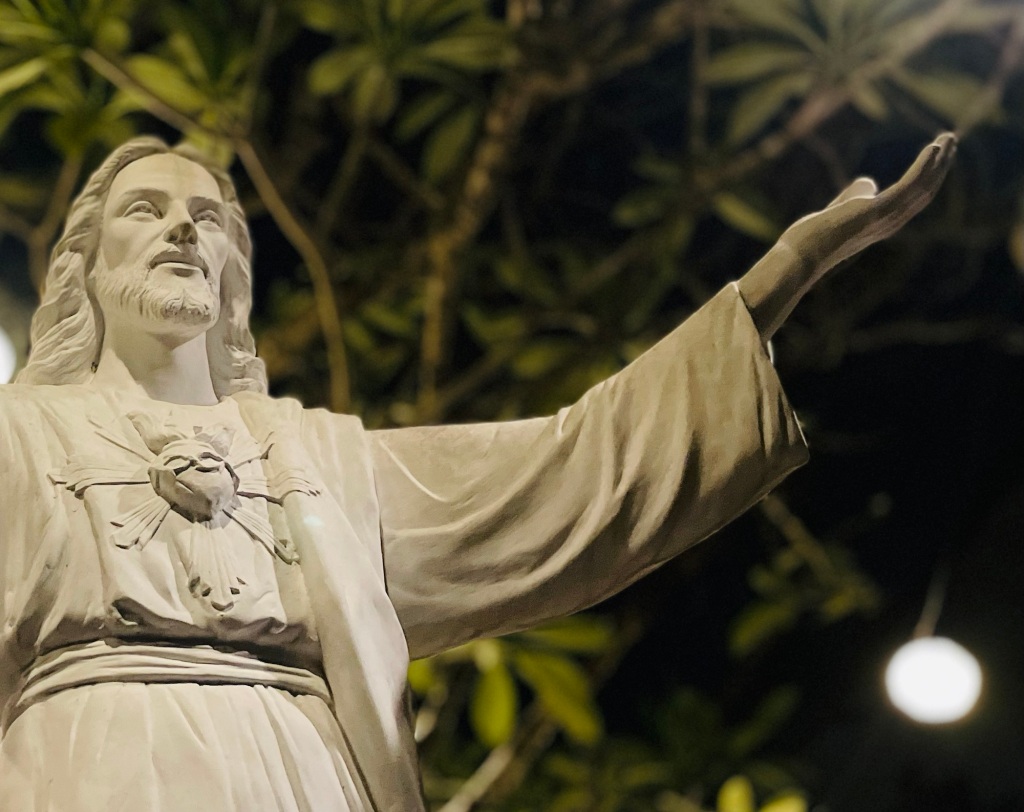
Photo by Mr. Sean Pleta in Australia,

Remaining in Jesus

The Lord Is My Chef Daily Recipe for the Soul by Fr. Nicanor F. Lalog II
First Friday, Fourth Week in Ordinary Time, 07 February 2025
Hebrews 13:1-8 ><}}}}*> + ><}}}}*> + ><}}}}*> Mark 6:14-29
Photo by Mr. Gelo Carpio Nicolas, January 2020.
Keep me faithful and true
to you,
Jesus
because
you are
"the same yesterday,
today,
and forever"
(Hebrews 13:8);
it is I who forgets
all the time,
who chooses to turn away
from you and be unloving,
unkind,
unforgiving.
Forgive me, Jesus
when you tell me
"Let brotherly love continue"
(Hebrews 13:1)....
...but many times
I can't look or even consider
each one a brother or a sister
because of our many differences.
"Do not neglect hospitality,
for through it some have unknowingly
entertained angels"
(Hebrews 13:2)...
...I think,
more than the angels
but on many occasions it was
you whom I have turned away,
Jesus because I am
so suspicious of others
who come to me for whatever
needs.
"Be mindful of prisoners
as if sharing their imprisonment,
and of the ill-treated as of yourselves,
for you are also in the body"
(Hebrews 13:3)...
I'm sorry,
Jesus for the many times
I have imprisoned others
in my narrow mind
of many biases
and prejudices.
"Let marriage be honored
among all and the marriage bed
be kept undefiled"
(Hebrews (13:4)...
what a shame,
Jesus in our age when
marriage is no longer honored
and just taken for granted
with many couples
defiling their bed.
"Let your life be free
from love of money but
be content with what you have"
(Hebrews 13:5)...
alas!
my dearest Jesus,
save us your priests
our diocese so in love
with money,
with the rich
and powerful with whom
we are so close
and identified with,
totally neglecting
the poor and the suffering
among us with our
many excuses and alibis,
always at their beck and calls.
Yes, Jesus,
many times we feel like
Herod: bothered
only by the gospel,
bothered only of your
presence among the poor
and suffering
but so much like Herod,
we never bothered ourselves
to truly find you
and follow you.
Amen.
Photo from Wikipedia, mosaic of Jesus with Mary and John the Baptist at the Hagia Sophia in Turkey.