40 Shades of Lent by Fr. Nicanor F. Lalog II
Thursday in the Third Week of Lent, 24 March 2022
Jeremiah 7:23-28   <*(((>< + ><)))*>   Luke 11:14-23
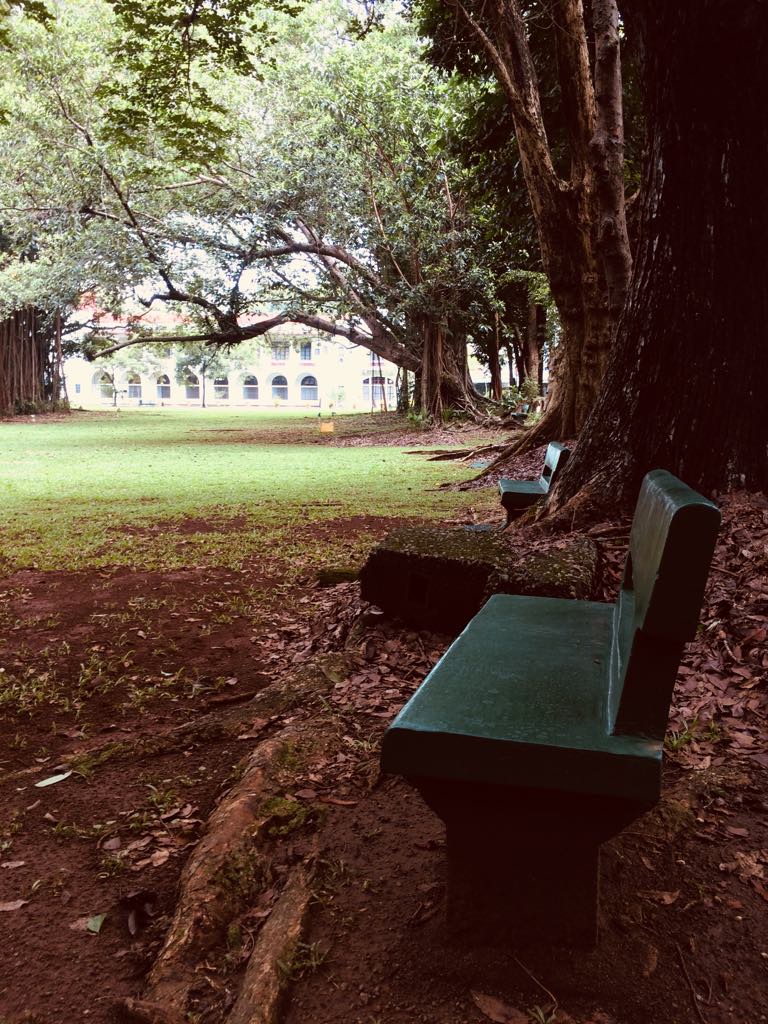
Photo by author, 11 March 2022.
Bless us, dear God our Father
this Lent which happens to be
the campaign period for our
coming elections in May, a day
of deliverance towards true
freedom and democracy,
most of all, political maturity
if we choose rightly.
But, I have long felt so saddened
at how this election campaign has
been going on, pushing aside the
beautiful and rich and meaningful
lessons of Lent:  we have not only
forgotten that we are in a 40-day journey
in you and to you with Jesus Christ
but we have forgotten to listen to
your voice.
This is the nation that does not listen to the voice of the Lord, its God, or take correction. Faithfulness has disappeared; the word itself is banished from their speech.
Jeremiah 7:28
Awake us, O Lord,
before we perish and lost again:
many among us in the Church
have taken side with candidates
pretending to take side with
truth and with you; many among
us have drag your holy name
in the pulpit, trying to be modern
prophets when our lives are not
prophetic at all, when we have forgotten
to tend the sick and poor among your flock,
when we smell more like politicians we
rub elbows so often than smell like
your sheep; worst of all, O God, is how
we hurl harsh words, spewing them like
an erupting volcano when deep within
us are all the dirt and sins
we have refused to face and clean
amid our many double standards.
How easy, indeed, for us to find
the devil, the power of Beelzebul
present in our society specially in
politics without seeing more
and presenting more your Son,
Jesus Christ to everyone that too often,
we scatter than unite; teach us to
speak and act more to unite your
people than divide them.  Amen.
40 Shades of Lent by Fr. Nicanor F. Lalog II
Tuesday in the Third Week of Lent, 22 March 2022
Daniel 3:25, 34-43   <*[[[[>< + ><]]]]*>   Matthew 18:21-35
Image from wallpaperuse.com.
Like your servant Azariah,
I praise and thank you today,
dear God our loving Father,
for delivering us always from many
dangers and trials, enabling us
to make it through many fires -
still whole, still sane, still blessed.
Yes, like Azariah and his fellow Jews
exiled in Babylon at that time, we have
turned away from you with our many
sins and transgressions:
But with contrite heart and humble spirit let us be received; as though it were burnt offerings of rams and bullocks, or thousands of fat lambs, so let our sacrifice be in your presence today as we follow you unreservedly; for those who trust in you cannot be put to shame. And now we follow you with our whole heart, we fear you you and we pray to you. Do not let us be put to shame, but deal with us in your kindness and great mercy.
Daniel 3:39-42
It is not enough, O God,
that we be sorry for our sins;
like in the parable and the very
example of your Son Jesus Christ
our Lord, penance and contrition are
meant to fix and restore our many
broken relationships with you and with
one another, especially those dearest
to us, those closest to us we have hurt or
have hurt us with words and/or deeds.
Like you dear Father,
may we realize that forgiveness is
more than deletion of sins but
most of all, about reconciliation,
of being one again as brothers and
sisters in Christ.  Amen.
40 Shades of Lent by Fr. Nicanor F. Lalog II
Monday in the Third Week of Lent, 21 March 2022
2 Kings 5:1-15  <*{{{>< + ><}}}*>  Luke 4:24-30
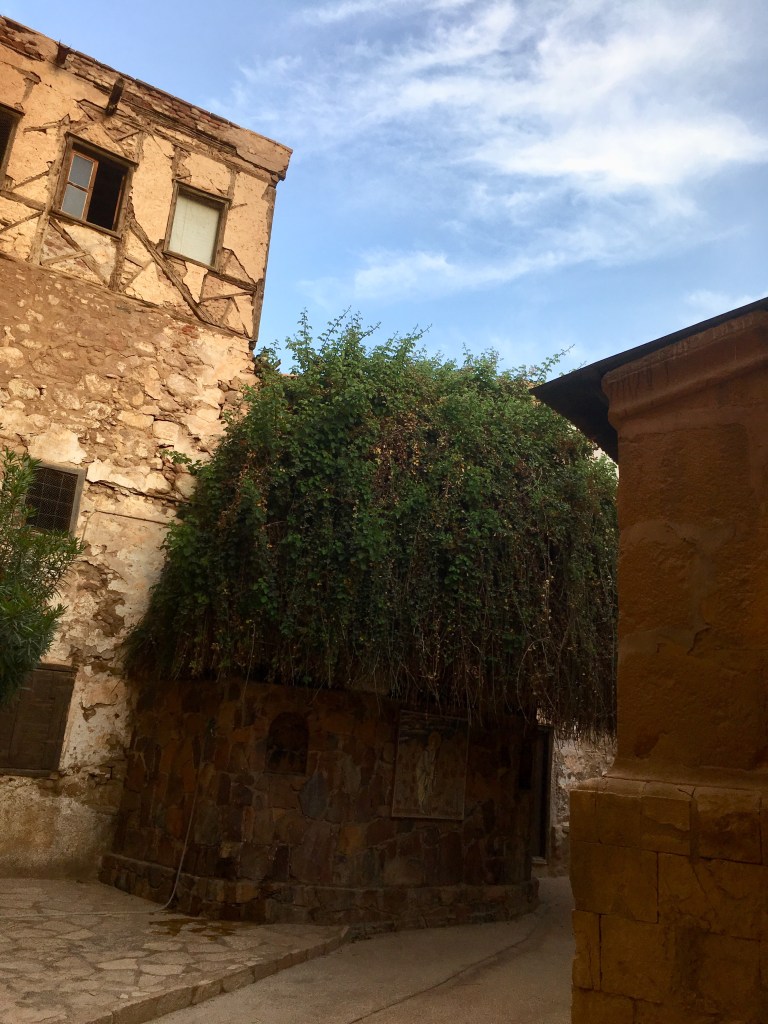
Photo by author, St. Catherine’s Monastery at the foot of Mt. Sinai, Egypt, May 2019.
Thank you dear Father
in bringing us to this third week
of Lent, of experiencing your loving
presence, your mystery, your
person; but, still, O God, I continue
to seek you.
Or, do I really seek you?
So many times I seek you
God like a lost object, a thing
I need at the moment like Naaman
seeking for a cure to my sickness that
in the process, I try to pull strings
around, asking help from everyone -
the more knowledgeable, the more
famous and credible, the better.
Why can't I just take the word of a believer
like that captured slave girl
in our first today?
So many times I seek you
God like an idea, merely with
an operation of my intellect
that I reason out a lot, even arguing
with all my preconceived ideas of
who you are, of what you like, even of
what must be done like Naaman
who felt insulted when your prophet Elisha
merely sent him a message to wash seven times
in Jordan river; why can't I just be like
his servants who knew better of
simply obeying orders, of keeping
things simple than our preference
for complicated ones?
Worst, O God, are the many times like
the people of Nazareth when I seek you
to dominate you, to insist myself on
you than me surrendering to you!
Remove my many blindspots,
Lord Jesus in truly seeking God
especially in this season of Lent;
teach me to seek him by surrendering
myself to his will like you,
simply believing in him who
dwells within me and in others
through my loving service
and kindness to everyone.
Amen.
40 Shades of Lent by Fr. Nicanor F. Lalog II
Third Sunday in Lent-C, 20 March 2022
Exodus 3:1-8, 13-15 ><}}}*> 1 Corinthians 10:1-6, 10-12 ><}}}*> Luke 13:1-9
Photo by author, July 2020 in Bagbaguin, Santa Maria, Bulacan.
As I have told you at the start of this 40-day journey, Lent is like a coming home to God with Ash Wednesday until Saturday after as the porch and each Sunday a door leading us into the inner rooms closer to God.
At each door these past two Sundays, we were opened to God’s majesty and wonder, love and mercy in Jesus Christ who had come to help us triumph over many temptations in life, to be transformed and transfigured in him.
With Luke as our guide this year, he had opened to us each Sunday a very unique door to experience God’s majesty and mystery, his love and mercy offered in Jesus Christ.
This becomes most pronounced this Third and Fourth Sundays when we find his gospel stories as exclusively his alone: Christ’s call to repentance following the news of Pilate’s massacre of 18 Galileans during a temple worship and the parable of the Merciful Father more known as parable of the Prodigal Son.
Some people told Jesus about the Galileans whose blood Pilate had mingled with the blood of their sacrifices. Jesus said to them in reply, “Do you think that because these Galileans suffered in this way they were greater sinners than all other Galileans? By no means! But I tell you, if you do not repent, you will all perish as they did! Or those eighteen people who were killed when the tower at Siloam fell on them – do you think they were more guilty than everyone else who lived in Jerusalem? By no means! But I tell you, if you do not repent, you will all perish as they did!”
Luke 13:1-5
Photo by author, parish Via Crucis, 11 March 2022.
Our “blaming game”
At first hearing, our gospel today sounds like a news broadcast of brutalities and mishaps, trials and sufferings happening almost daily around the world. So many times, they happen closest to us personally or within our own circles of family and friends.
Only Luke has this account of teaching by Jesus; nowhere would you find in the gospels any account of Pilate ordering this massacre of Galileans but the Jewish historian Josephus had recorded many instances of the Roman governor’s ruthless reign.
And here we find the artistry of Luke in inserting this scene in his gospel the Church has chosen as part of our Lenten itinerary. So often in life, we keep on blaming somebody else except our very selves for every negative things happening to us and around us, even considering it as “divine chastisements” or karma to those people we consider as evil.
It is true that evil begets evil, but the seeming dominion of sin and evil in the world is so wide for us to attribute blame only to certain persons as if others, including ourselves, had no part in it. It always takes two to tango!
Worst case of this “blaming game” of ours is to even link our sufferings and trials with God.
Nothing bad can ever come from God like disasters and catastrophes, sickness and turmoils because God is love. God offers only life, never death nor destruction for he does only what is good. It is very wrong to think at all that God has something to do with any of these problems happening in the world like the pandemic or in our personal lives.
Photo by author, Sinai Mountain Range in Egypt, May 2019.
This is the gist of the Lord’s response to the people bringing him the bad news of the 18 Galileans ordered massacred by Pilate, “Do you think that because these Galileans suffered in this way they were greater sinners than all other Galileans? By no means!”. God does not punish at all! Bad things happen because of sins and that is what we always have to look inside us, how have we contributed to the evil happening.
And to make it clearer that God has nothing to do whatsoever with all these bad things happening to us, Jesus added, “Or those eighteen people who were killed when the tower at Siloam fell on them – do you think they were more guilty than everyone else who lived in Jerusalem? By no means!”.
However, Jesus is not telling us to be resigned to the absurdities of the world and of humankind. We can all do something to greatly prevent and reduce all these misfortunes and sufferings around us and that is the way of repentance, of conversion – the very calls of the prophets in the Old Testament and by John the Baptist.
Now, Jesus our Savior, the Son of God, is voicing out this call of repentance with urgency and new authority not only because it is the only way back to God but precisely due to his very nature of being loving and patient, merciful and forgiving.
The kind of God we have, the only one there is
The grace of this third Sunday of Lent is the revelation of the kind of God we have, the only one there is: a very loving and patient, merciful and forgiving God who is also perfectly present among us in Jesus Christ.
Photo by author, site of the burning bush in Sinai now inside St. Catherine’s Monastery in Egypt.
In the first reading, we are told of that unforgettable scene of Moses at the burning bush where God revealed himself as “I AM WHO AM” – the One who is always present with us in the past, in the future, and most especially in every here and now, the present moment.
When we think of God, what comes to our mind, what do we say about him?
God told Moses “Thus you say to the Israelites: The Lord, the God of your fathers, the God of Abraham, the God of Isaac, the God of Jacob, has sent me to you” (Ex. 3:15) to remind them that this God has always been present with his people.
With Abraham, God first made the promise of being the father of all nations (last Sunday’s first reading), to Isaac he revealed himself in the stairway to heaven, and to Jacob that he would bring them to Egypt and liberate them after. Now in Moses, everything is coming into fulfillment of this great nation to be set free by God, a prefiguration Christ and his saving mission.
Throughout history, God never left his people, working great marvels in the past to deliver them from slavery, a passing over and exodus, assuring us of his presence and salvation in the future by remaining at our side.
History is cyclic, everything seems to be happening again but with an upward trajectory towards God; in every repetition of history, the question is where are we standing with God, are we still the same the first time we encountered him, descending to vice and sins or have we grown in virtues and holiness?
Salvation history and secular history continue to unfold for both are one in God; hence, we must not waste every moment to return to God, to repent and be converted. Beware of Paul’s warning, “Therefore, whoever thinks he is standing secure should take care not to fall” (1 Cor. 10:12)! Remember those Galileans massacred by Pilate or those 18 people at Siloam crushed to death by tower that had fallen – anything can happen with us, so be ready. Never leave God who is always with us, assuring us with salvation in Jesus.
Beginning this Sunday, continuing to next week with the parable of the prodigal son and finally on the fifth Sunday of Lent when we skip Luke’s gospel to borrow from John for the story of the woman caught in adultery, we are being immersed into the deeper mystery of this God we call Father made known to us by Jesus Christ through his own passion, death and resurrection.
The more we enter God’s mystery every Sunday of Lent, the more his “height, breath and depth” (Eph. 3:18) appear to us, making us realize he is real, very true like another person we can feel and hear, always with us, patiently waiting for us to bear fruit like the owner of the fig tree in the parable.
How have you experienced God’s presence this past week?
What else do we need to be convinced of his love and mercy that we still refuse to repent and be converted in Jesus Christ?
The time is now, not yesterday or tomorrow for God is I AM WHO AM, one who is in the present. Amen.Have a blessed week.
Thank you for the prayers; I am home trying to recuperate from my surgery.
Photo by author, inside St. Catherine Monastery with Mt. Sinai at the background in Egypt, May 2019.
40 Shades of Lent by Fr. Nicanor F. Lalog II
Wednesday in the Second Week of Lent, 16 March 2022
Jeremiah 18:18-20   <'[[[[>< + ><]]]]'>   Matthew 20:17-28
Photo by author, Pater Noster Church outside Jerusalem, 2019.
Praise and glory to you,
O Lord our God, our loving
Father!  Thank you very much
for every blessing you send me
even in the midst of sickness,
trials and blessings.  Indeed,
everything is pure grace from you.
Cleanse my mind and my heart
of my sins and negative thoughts;
may you be alone the first and
the last in my mind and in my heart.
Like Jeremiah:
Heed me, O Lord, and listen to what my adversaries say. Must good be repaid with evil that they should dig a pit to take my life? Remember that I stood before you to speak in their behalf, to turn away your wrath from them.
Jeremiah 18:19-20
How inspiring is your prophet Jeremiah,
Lord!  Amid grave dangers as he heard
the words of his enemies whom he had
pleaded before you, the only thing he had
in his mind and his heart was you - just
to remember him.
In the same manner,
give me such courage and
lucidity to remain faithful to
you even in grave dangers!
Please, purify me in the same
manner you cleansed the brothers
James and John along with their
mother who pleaded to your Son
for power and position when he
was nearing his passion, death
and resurrection.  Turn away our
minds and hearts from things of
the world, of selfish interests
most especially in moments of
trials and difficulties.  Amen.
40 Shades of Lent by Fr. Nicanor F. Lalog II
Tuesday in the Second Week of Lent, 15 March 2022
Isaiah 1:10, 16-20   <'[[[[>< + ><]]]]'>   Matthew 23:1-12
Photo by author, Parish Via Crucis, 11 March 2022.
Come now, let us set things right, says the Lord: Though your sins be like scarlet, they may become white as snow; though they be crimson red, they may become white as wool. If you are willing, and obey, you shall eat the good things of the land; but if you refuse and resist, the sword shall consume you: for the mouth of the Lord has spoken!
Isaiah 1:18-20
Let us heed your call,
dear Lord, let us set things
right this season of Lent;
let us be sorry for our sins,
be humble for who we really are
before you and one another.
Teach us through your Son
Jesus Christ to be true to ourselves,
practicing what we preach
and doing things for you and not
for others admiration; let us realize
that authority is not for power but
for empowering and enabling others;
most of all, let us realize that
authority is service, never a way of control
or domination or a claim to special
perks and privileges.
Let us set things right, Lord,
by breaking this cycle of trying
to be someone else, of being
somebody to be admired and
looked up to when what is most
essential is for us to see one
another as brothers and sisters
in one God as our Father.  Amen.
40 Shades of Lent by Fr. Nicanor F. Lalog II
Monday in the Second Week of Lent, 14 March 2022
Daniel 9:4-10   <*(((>< + ><)))*>   Luke 6:36-38
Photo by author, Sacred Heart Novitiate, Novaliches, QC, 2017.
Praise and glory to you,
O God Our Father,
despite our sinfulness
you continue to bless us!

In this season of Lent
teach us the true meaning
of penance by getting into
the root of our sinfulness,
of being radical, shamefaced
in fact like Daniel by wholeheartedly
admitting our wickedness in
rebelling and departing from your side, Lord:
“Lord, great and awesome God, you who keep your merciful covenant toward those who love you and observe your commandments! We have sinned, been wicked and done evil; we have rebelled and departed from your commandments and your laws. We have not obeyed your servants the prophets, who spoke in your name ton our kings, our princes, our fathers, and all the people of the land. Justice, O Lord, is on your side; we are shamefaced ever to this day like our kings, our princes, and our fathers, for having sinned against you.
Daniel 9:4-7, 8
Indeed, we are shamefaced,
O Lord, even to this day
for our many sins against you
when we neglected you
in our brothers and sisters in need,
unmindful of their great sufferings
not only for their physical needs
but most especially for their emotional
and spiritual needs; we are shamefaced,
 O Lord in thinking the good times
would never end, when we lived in excesses,
bloating our egos as if we were gods.
Help us to return to you,
O God through Jesus Christ
your Son by turning our hearts
back to you, by going into the very
roots of our sins so that when we
have understood our sins, we may
no longer fall into its traps as we
get closer to you, becoming holy
and merciful like you.
Amen.
40 Shades of Lent by Fr. Nicanor F. Lalog II
Second Sunday in Lent-C, 13 March 2022
Genesisn15:5-2, 17-18 ><}}}*> Philippinas 3:17-4:1 ><}}}*> Luke 9:28-36
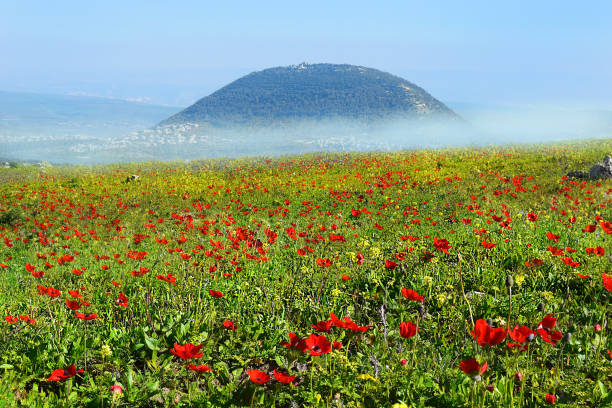
Spring blooming of poppies in Galilee near the Nazareth, against the background biblical Mount Tabor, Israel, from iStockphoto.com.
From the desert where Jesus was tempted by the devil last Sunday, Luke now takes us on top of Mount Tabor for the Lord’s Transfiguration.
In the Bible, the mountain is like the desert that signifies a deeper reality and meaning. It is more than a place that shows communion and oneness with God, indicating an inner ascent within us to unite with God especially in this season of Lent.
And like in the temptation of Jesus in the desert last Sunday, it is very interesting how Luke tells us again two important details not mentioned by Mark and Matthew in their versions of the Lord’s Transfiguration:
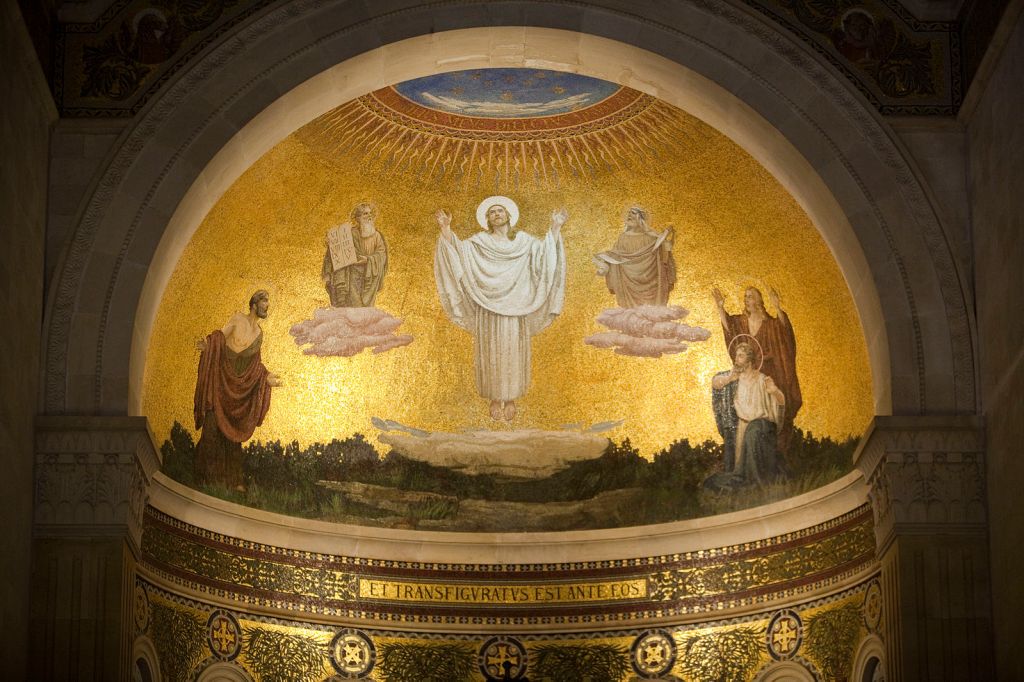
Jesus took Peter, John, and James and went up the mountain to pray. While he was praying his face changed in appearance and his clothing became dazzling white. And behold, two men were conversing with him, Moses and Elijah, who appeared in glory and spoke of his exodus that he was going to accomplish in Jerusalem.
Luke 9:28-31
First, only Luke tells us the reason why Jesus went up the mountain which is to pray. Here we find that the transfiguration of Jesus is a prayer event. That is why we need to pray always because prayer transfigures us like Jesus Christ.
Second, as Jesus transfigured while praying, only Luke informs us the topic Moses and Elijah discussed with the Lord which is his coming “exodus” or passion, death, and resurrection on Good Friday. When we pray, the more we accept and embrace the Cross that truly transfigures us into becoming like Jesus Christ.
But the problem is, we always refuse and avoid prayer because it is always difficult to pray. Prayer is a discipline. Despite its being a grace from God to be able to pray which he freely gives to each one of us, it is gift that also requires from us total surrender and consistency.
Prayer does not necessarily change things like stop calamities or sickness; prayer primarily changes the person, enabling us to respond properly to problems, trials and sufferings that come to us; hence, prayer in itself is an exodus, a pasch that leads us to transfiguration.
Usually, when we pray we feel nothing is happening, that it is a “waste” of time, of being “idle” in one place that could have been used to other productive activities like fixing one’s problems. But it is in prayer when we first experience how “staying” and “going” merge to become one in Jesus Christ.
This we find in the only detail that Luke shared with Matthew and Mark when Peter woke up and saw Jesus transfigured, conversing with Moses and Elijah.
As they were about to part from him, Peter said to Jesus, “Master, it is good that we are here; let us make three tents, one for you, one for Moses, and one for Elijah.” But he did not know what he was saying.
Luke 9:33
Photo from commons.wikimedia.org, mosaic inside the Basilica of the Transfiguration on Mt. Tabor, Israel.
The Transfiguration, a preview of Christ’s glory via his pasch
Very often in life, we want every beautiful and good experience we have to be preserved, wishing they would never end, like Peter asking Jesus if they could just stay on top of the mountain to keep their “cloud nine” experience.
On the other hand, we are quick to beg Jesus to end soonest every pain and suffering, trials and difficulties we are going through in life that if possible, have them erased or deleted from our memories too!
For us, “staying” and “going” are opposites but Jesus is telling us in his transfiguration that these two come together.
In his transfiguration, Jesus is telling us that discipleship is both “staying” and “going” in him. It is only in Christ that we can “keep” the good time of being one with him while we “passover” from life’s many darkness, trials and sufferings by remaining one with him.
After assuring us last Sunday that we can overcome life’s many temptations through him, Jesus tells us today that our transfiguration and glory can only come through the Cross like him. Before Easter comes, there is Good Friday first.
At his transfiguration, Jesus showed us that his divinity belongs with the Cross and cannot be separated because that is his identity as the Suffering Messiah whose glory and pasch are always together. Hence, his transfiguration was the “preview” to his coming glory whereby he remained one in the Father in prayer expressed perfectly in his exodus on Good Friday which Moses and Elijah discussed with him on Mount Tabor.
Recall that his transfiguration occurred after he was recognized by Peter as the Christ while they were at Caesarea Philippi where Jesus also bared for the first time to the Twelve his coming passion, death and resurrection. It was also at that time when Jesus laid to the Twelve the very foundations of discipleship in him which is to forget one’s self, take up one’s cross daily, and follow him.
From Caesarea in Philippi, Jesus and the Twelve made a U-turn to go back to Jerusalem with a stop-over at Mount Tabor for his transfiguration where he reiterated his teachings about himself and his mission. See that during the transfiguration as Peter, James, and John watched in awe, they were frightened when a voice was heard from the cloud that declared “this is my chosen one; listen to him” (v.35).
And what do we hear from Jesus after his transfiguration? His two other predictions of his coming passion, death and resurrection plus his repeated calls to everyone to deny one’s self, to take up one’s cross daily and to come follow him!
It is interesting to note that while the fourth gospel does not have this story of the transfiguration, John rightly refers to the Crucifixion as the “exaltation” of Jesus Christ – his going down, his suffering and dying on the Cross is actually his rising to glory!
The same thing is true to us disciples of Jesus.
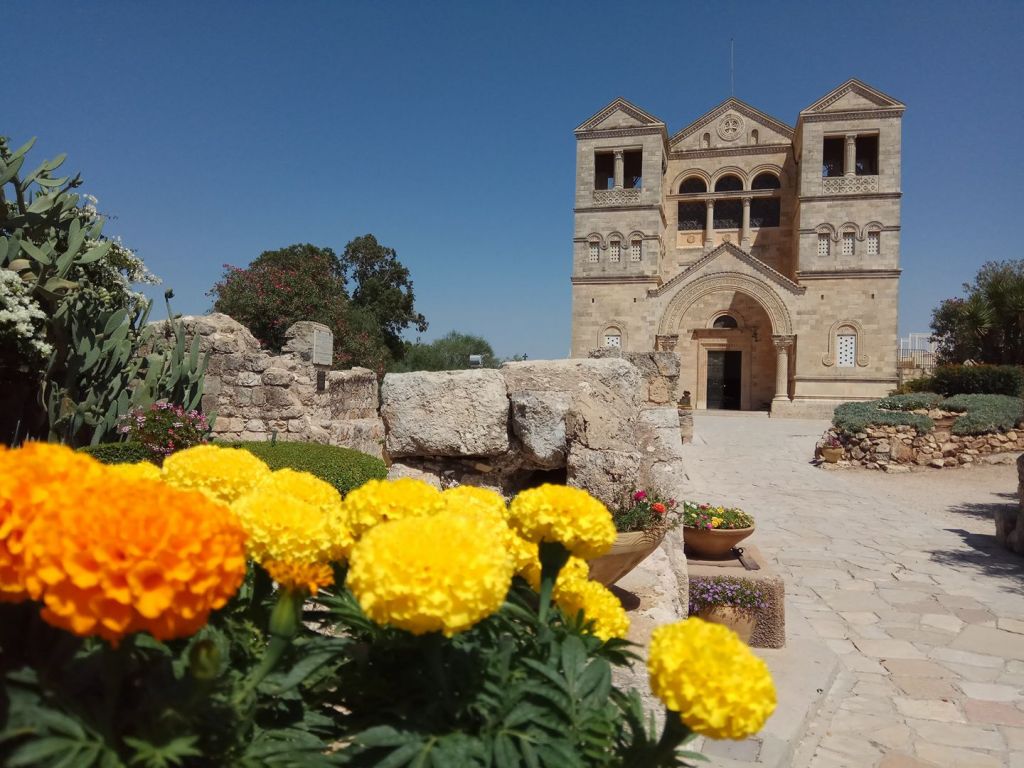
Photo from custodia.org, Basilica of the Transfiguration on Mt. Tabor, Israel.
Staying and going in Christ, with Christ
The grace of this second Sunday in Lent when we hear every year the story of Christ’s transfiguration is his assurance of his love for us by going through his exodus which is his self-offering on the Cross.
The question is not whether we should stay or go but are we willing to both stay and go in Jesus, with Jesus? Discipleship is remaining in Jesus, going with Jesus up to the Cross!
According to Luke, Peter, James, and John did not tell to anyone what they saw and heard on Mount Tabor. Like Mary, they kept everything in their hearts as they remained with Jesus, going with him in all his journeys especially at the Garden of Gethsemane before he was arrested, listening to his words and teachings, witnessing and experiencing his many healings and exorcisms including his passion and death from afar except for John.
They never fully understood everything they saw and heard from Jesus until the coming of the Holy Spirit on Pentecost day but, their “staying” and “going” with him transfigured them without realizing how the Lord was already transforming them inside.
The same thing happens to us when we “stay” and “remain” in Jesus through prayers and reflections of the Sacred Scriptures, through the Sacraments especially the Holy Eucharist every Sunday, through the guidance of other faithful disciples like our family and friends who witness Christ to us with their living examples. Akala natin wala namang nangyayari pero mayroon palagi dahil kasama natin ang Panginoon!
As we stay in the glorious presence of Jesus in prayers and penance, the more we go forward in our dying to self and rising to life in our loving service to everyone, in our kindness, in our patience and understanding, and in our mercy and forgiveness. When we offer ourselves wholly to Jesus, he does everything like what God did to the animals offered by Abraham in the first reading. Notice how Abraham on that night fell into a trance as if he could not believe what was happening while in the presence of the Lord. Palagi naman ganoon sa harap ng Diyos – nakakapangilabot, nakakatakot kasi totoong-totoo!
Lent is not just a preparation for Easter but also a journey for us all to purify and renew and rekindle our faith in Christ’s resurrection by remaining in him, ascending with him through mountains of sacrifices, and being tested in the desert of temptations.
These 40 days of Lent involve many stopovers where we are invited to examine our hearts, our inner selves to see who is inside us, of who are we dwelling with, of who we are going with. Let us heed Paul’s call in the second reading to “stand firm in the Lord”(Phil. 4:1) because our “citizenship is in heaven and Jesus will change our lowly body to conform with his glorified body” (Phil. 3:20, 21).
Let me end this reflection with a quote I got and memorized as a child waiting in our former family dentist, Dr. Eddie Calalec of Meycauayan, Bulacan:
Time is fast for those who rush;
Time is slow for those who waith;
Time is not for those who Love.
Have a blessed week and please say a prayer for me on Wednesday (March 16) when I go through a surgery. Thank you and God bless you!
40 Shades of Lent by Fr. Nicanor F. Lalog II
Friday in the First Week of Lent, 11 March 2022
Ezekiel 18:21-28   <'[[[[>< + ><]]]]'>   Matthew 5:20-26
Photo by author, Chapel of the Holy Family, Sacred Heart Novitiate, 2017.
You, O God,
are indeed so good and loving!
How true is our Responsorial Psalm
as we close Lent’s first week,
“If you, O Lord, mark iniquities,
who can stand?” because nothing
can be hidden from you;
yet, so many times you pretend like
a dumb - “nagtatanga- tangahan" po kayo -
as if not knowing our sins and evil
just because you love us like when
Jesus said in the gospel,
“if you bring your gift to the altar,
and there recall that your brother
has anything against you,
leave your gift there at the altar,
go first and be reconciled with your brother,
and then come and offer your gift (Mt.5:23-24).”
When does
a “brother has anything against us?”, Lord?
If you mean, dear Jesus,
that a brother/sister has something
against us because of his/her wrongdoing,
then we could never be able
to offer anything at all to you
because we all have something
against each other!
But here, it is very clear,
“a brother has anything against you”
because we have done something wrong
against somebody; the burden is on us
that is why we are obliged,
even ought to be
“reconciled with him first then offer our gift”
because we’re the guilty one.
Forgive us, Jesus,
for always pretending to be
the offended or aggrieved ones
when in fact, we are the offender,
the sinner who had done wrong
to another that is why he/she
has anything against us".
We pray for those who have something
against us because of our own making,
of our own provocations; let us be real
with you, O God, to change our ways
beginning this Lent as you assure us
through Prophet Ezekiel,
“When someone virtuous
turns away from virtue to commit iniquity,
and dies, it is because of the iniquity
he committed that he must die.
But if the wicked, turning from wickedness
he has committed, does what is right and just,
he shall preserve his life;
since he has turned away from all the sins
that he committed, he shall surely live,
he shall not die (18:26-28).”Amen.
40 Shades of Lent by Fr. Nicanor F. Lalog II
Thursday in the First Week of Lent, 10 March 2022
Esther C12, 14-16, 23-25  <*(((>< + ><)))*>  Matthew 7:7-12
Photo by author, Sacred Heart Novitiate, Novaliches, Quezon City, 2017.
In this season of Lent,
help us rediscover you, God
as our Father, one who truly
relates with us your beloved
children; and as we rediscover
you God as our Father, may we
begin to realize more deeply that
prayer is not about for asking
never ending petitions from you
but an expression of our relationship
with you in Jesus Christ.
Forgive us, dear God,
when we pray only because
we need something from you;
may we absorb deeply the
beautiful attitude of Queen Esther
to you on that grave situation when
she prayed to you, expressing her
total abandonment to you,
speaking more of her relationship
with you nurtured by her forefathers
through the Sacred Scriptures:
Queen Esther, seized with mortal anguish, had recourse to the Lord. She lay prostrate upon the ground… and said: God of Abraham, God of Isaac, and God of Jacob, blessed are you. Help me, who am alone and have no help but you, for I am taking my life in my hand. As a child I used to hear from the books of my forefathers that you, O Lord, always free those who are pleasing to you. Now help me, who am alone and have no one but you, O Lord, my God.
Esther 12, 14-16, 23
Create a clean heart in me,
God; give me that sense of
belonging to you, that experience
of personal relationship that
you are the very one whom I ask for
and seek first above all.  Amen.









 lordmychef.com