Quiet Storm by Fr. Nick F. Lalog II, 13 February 2020
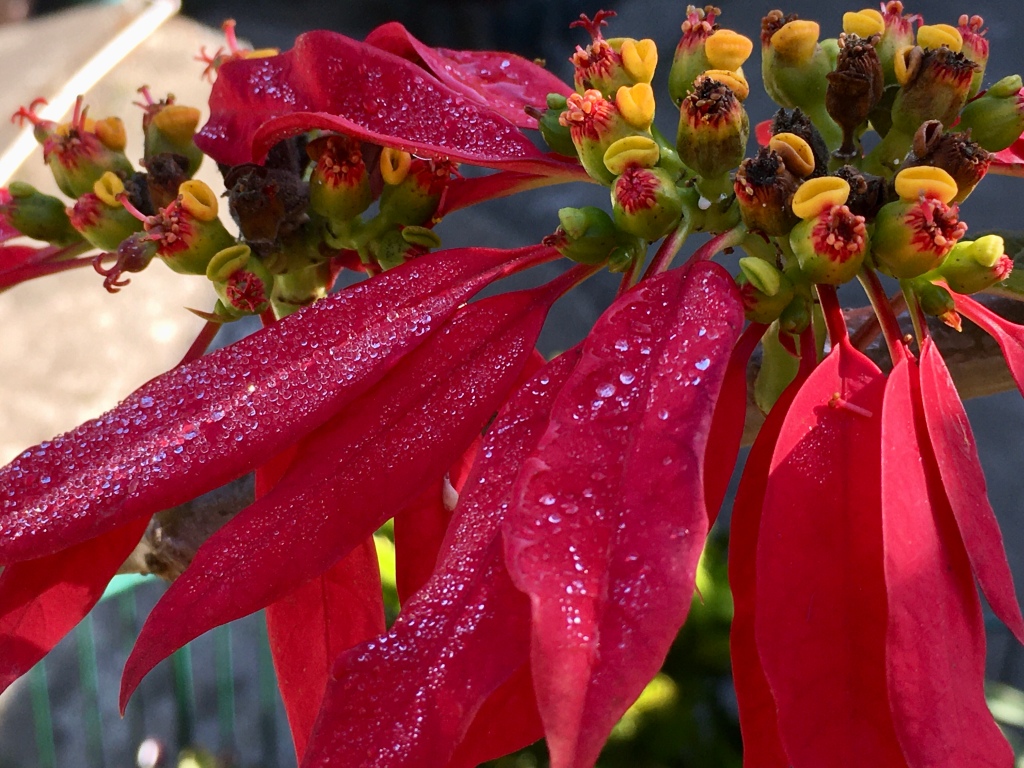
Photo by author, Mt. St. Paul, Trinidad, Benguet, 04 February 2020.
At the Ascension of the Lord, St. Luke tells us something very unique and unusual: the disciples returned to Jerusalem filled with joy.
Unusual and unique because when someone leaves us, either permanently like death or temporarily due to change of residence or jobs, we always feel sad.
But not the Apostles of Jesus along with the other disciples including Mary who were filled joy!
And so are we today because when someone dies, the person or our beloved does not leave us entirely. Though we do not see and feel them physically anymore, we continue to experience them personally.
Sometimes, we even grow more personal that there are people we feel getting closer with them after they have died.
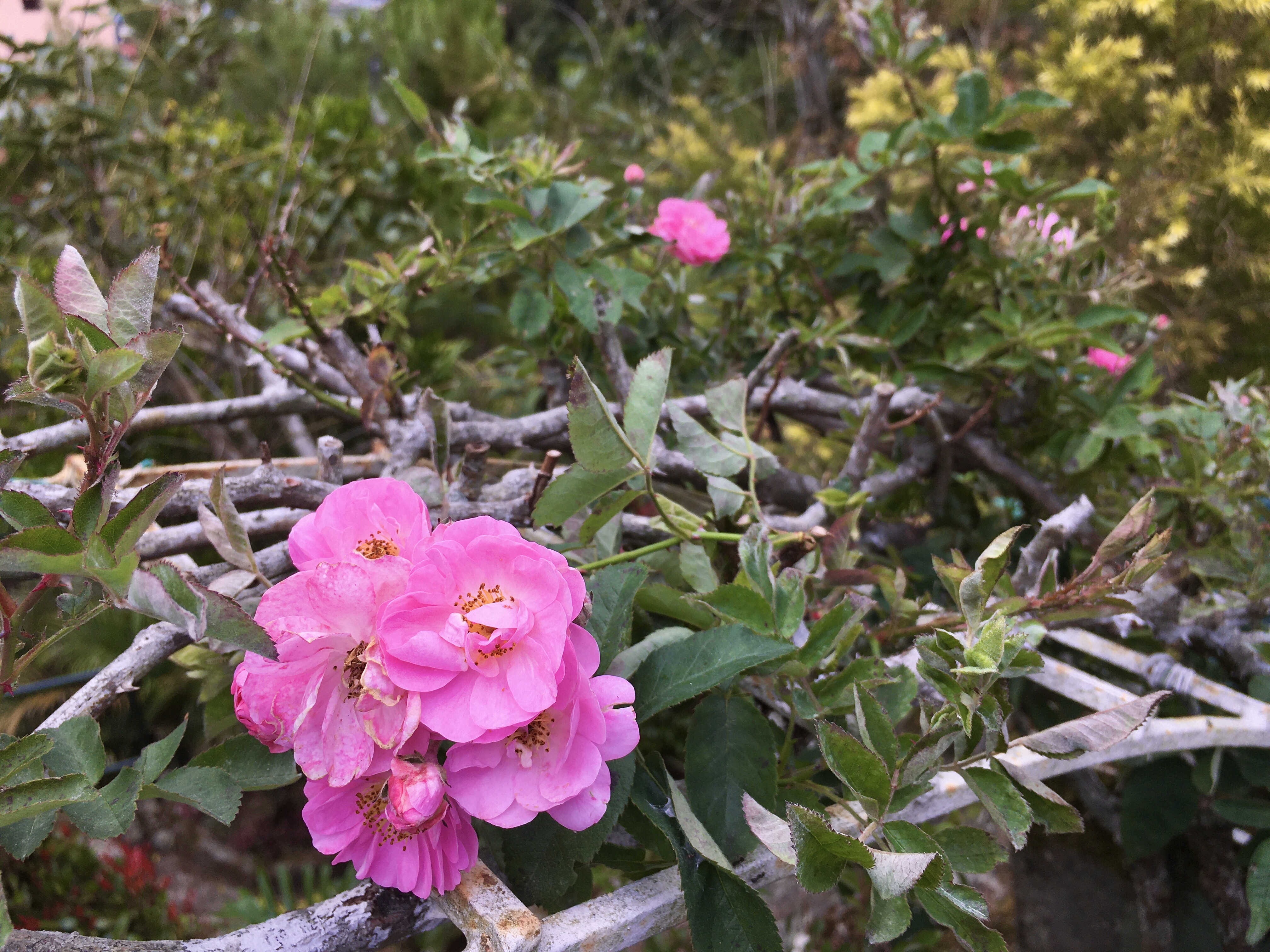
Photo by author, Mt. St. Paul, Trinidad, Benguet, 05 February 2020
As I have been telling you, 2020 for me is tough with so many deaths in our Parish, in my family, and among my friends. Since last week of Christmas until the other week, I have been praying and celebrating funeral Masses almost everywhere.
This week, funeral Masses continue while at the same time, I have started celebrating the 40th days of those relatives and friends who have died last month.
In 1995, my father’s younger sister was stricken with pancreatic cancer. Being the eldest at that time among his nine surviving siblings, another aunt called me to ask my dad’s decision regarding their sick sister, if she would still go through surgery and just go home to Los Banos and wait for the inevitable.
He simply told me, “tell your Tita to just bring home Tita Rose; she had suffered enough and had lived a full life.”
Photo by author, Los Banos, Laguna, 13 February 2020.
That is when I realized that coming to terms with death iscoming toterms with life, and vice versa.
I know it is easier to say but that is how life is: we are often afraid to die because we know we have not fulfilled something yet, a mission or a promise made.
People who enjoy life, people with a sense of contentment are always the ones without regrets, always fulfilled, and ready to go.
And always, they are the ones who truly love that is why they live fullest, Valentine’s day or not.
God bless you and keep loving!
Photo by author, Collegeville Subd., Los Banos, Laguna, 13 February 2020.
2 Samuel 18:9-10, 15, 24-25, 30-19:3 ><)))*> <*(((>< Mark 5:21-43
Photo by author, Mt. St. Paul Spirituality Center, La Trinidad, Benguet, 03 February 2020.
Thank you very much, Lord Jesus Christ, for this gift of rest in you. Thank you for reminding us last Friday how you would always explain everything about your parables “in private” to your Twelve apostles (Mk.4:34).
Today I feel that if there is one thing you would really want to ask each one of us is to have some private, personal time with you.
We have always been so busy with so many things in life except with you, Lord.
Like that woman in today’s gospel afflicted with hemorrhages for 12 years seeking to touch even your clothes to be healed, many of us still feel so alone, even alienated in the midst of the crowds, of so many friends and followers in social media and of all kinds of BFF’s.
Many of us have forgotten that of all the bestest friends we can ever have in life is no one but you, Lord. And that’s the good news!
You are always here for us, Lord Jesus, always looking for us, searching us, wanting to enter into a personal relationship with us that is vibrant and alive.
Jesus, aware at once that power had gone out from him, turned around in the crowd and asked, “Who has touched my clothes?’ But his disciples said to him, “You see how the crowd is pressing upon you, and yet you asked, ‘Who has touched my clothes?'” And he looked around to see who had done it.
Mark 5:30-32
Photo by author, Mt. St. Paul Spirituality Center, La Trinidad, Benguet, 03 February 2020.
After meeting the woman you have healed, people came to inform Jairus that his sick daughter had died, that he should no longer bother you. But, you assured Jairus that his daughter was asleep and has not died, asking him to just have faith in you. Again, you asked him for some private time with you:
Then Jesus put them all out. He took along the child’s father and mother and those who were with him (Peter, James, and John) and entered the room where the child was.
Mark 5:40
Give us O Lord Jesus the grace to make that precious moment to spend time with you in private to experience your healing and loving presence.
May we always keep in mind that in the beginning when God created the first man, it has always been your desire that we be alone with you, first of all. Amen.
The Lord Is My Chef Sunday Recipe for the Soul, Feast of the Presentation of the Lord, 02 February 2020
Malachi 3:1-4 ><)))*> Hebrews 2:14-18 ><)))*> Luke 2:22-40
Photo by author of Baby Jesus at the Bishop’s Chapel, Malolos Cathedral, 07 January 2020.
We take a break from our Ordinary Sunday to celebrate today the Feast of the Presentation of the Lord at the temple, 40 days after Christmas. It is a prolongation of the celebration of the Lord’s Nativity with a paschal undertone recognizing Christ as Light who had come to us to lead us back to the Father through his Passion, Death, and Resurrection.
This feast used to be known in the East as the Ypapante or the Encounter of Jesus by the two elderly people at the temple, Simeon and Anna. When it reached Europe, it came to be known as the “Purification of the Blessed Virgin Mary” based on St. Luke’s description, evolving into Candlemass or Candelaria when Pope Sergius I in Rome adopted in the eighth century the French tradition of procession of lighted candles at dawn before the Mass to signify Jesus as the light of the world who had come to bring us back to the Father expressed by Simeon in his canticle.
“Now, Master, you may let your servant go in peace, according to your word, for my eyes have seen your salvation, which you prepared in sight of all the peoples, a light for revelation to the Gentiles, and glory for your people Israel.”
Luke 2:29-32
Despite its evolution through the ages with its many names and practices, the Feast of the Presentation of the Lord is a good reminder to us in recognizing, meeting, and sharing Jesus Christ to everyone as the light of the world.
Photo by author of a view from the Temple of Jerusalem, May 2017.
Being devout leads us to recognize and meet Jesus
Only St. Luke reports the story of the Presentation of Jesus at the temple because he wanted to show his audience who were Gentiles or pagan converts that Jesus came not only for the Jews but for everyone.
This remains true to us especially in these modern times when people live in artificial lights and “Klieg lights” that put us on the centerstage only to leave us later groping in the dark, even blinded to false hopes of virtual realities.
St. Luke invites us today to emulate both Simeon and Anna in recognizing and meeting Jesus, the only Light of the world who dispels darkness within and around us.
Now there was a man in Jerusalem whose name was Simeon. This man was righteous and devout, awaiting the consolation of Israel, and the Holy Spirit was upon him. It had been revealed to him by the Holy Spirit that he should not see death before he head seen the Christ of the Lord. He came in the Spirit into the temple; and when the parents brought in the cild Jesus to perform the custom of the law in regard to him, he took him into his arms and blessed God.
Recall how during our Simbang Gabi that for the Jews, a “righteous” person is someone who is holy because he faithfully keeps the Laws of God like St. Joseph, the husband of Mary.
But more than being holy and just, St. Luke also described to us Simeon – as well as Anna implicitly – as “devout” Jews. It is a word rarely used in the Bible. In fact, St. Luke used it only four times: once here in this scene and thrice in the Acts of the Apostles.
In Acts 2:5, St. Luke called the Jews who came to Jerusalem for Pentecost as “devout” ones; then in 8:2, he said “devout men buried” the first martyr of the Church, St. Stephen; and finally in 22:12, he gave the distinction to Ananias as “a devout observer of the law” who came upon instructions from God to pray over and heal Saul who was blinded by Christ’s light on the way to Damascus.
In all four instances, St. Luke described people as “devout” including Simeon and Anna as those of “good heart, ready to believe, and then to act openly and with courage” (Timothy Clayton, Exploring Advent with Luke; page 125). Devout people or devoted persons are a notch higher than just being faithful because they do not merely wait but look forward to the fulfillment of what they believe.
Devoted people make things happen; they do not wait for things to unfold. And that is why they are always at the right place in the right time. Like Simeon and Anna, they give themselves to God wholly to stay attuned with the Holy Spirit and be ready to follow its promptings and leads.
Anna meeting Jesus from catholicfunfacts.com.
See the common trait of both Simeon and Anna as devout people — the presence of the Holy Spirit in them that amid the crowd in the temple on that day, they were able to spot the Child and Savior Jesus Christ being presented by his parents Mary and Joseph!
There was also a prophetess, Anna, the daughter of Phanuel, of the tribe of Asher. She was advanced in years, having lived seven years with her husband after her marriage, and then as a widow until she was eighty-four. She never left the temple, but worshipped night and day with fasting and prayer. And coming forward at that very time, she gave thanks to God and spoke about the child to all who were awaiting the redemption of Jerusalem.
Luke 2:36-38
Jesus comes to us everyday in various ways, in many occasions. He is always passing by, calling us. We have to be on guard in these moments so that we do not miss him. Like reporters following the news, we have to be focused or “tutok” and immersed or “babad” so that nothing or no one escapes us.
Three ways of being devout like Simeon and Anna
It is imperative that we have to be devout first with God so that we recognize and meet his Son Jesus Christ coming to us so we may eventually share him to enlighten everyone. Simeon and Anna show us three important things to keep for us to be devoted to God to encounter Jesus Christ.
First, we have to be faithful in our prayer life. There is no other way in meeting Christ except in having a life of prayer which is a discipline. It is something we do as a habit, every day, every night. Not just once a year like those going to Quiapo every January 9 or completing any novena and then the whole year does nothing.
Devotion is more than collecting images of Jesus, the Virgin Mary, and the saints, joining processions during fiesta or Holy Week, then nothing. Devotion is life, not a show.
Like Simeon and Anna, we have to grow intimately with the Lord by cultivating personal prayers and joining communal activities like the Sunday Mass so that we may know personally and vibrantly God who always leads us to various directions and mission. God is never static but dynamic, unlike us people who keep on insisting on some of our traditions and ways no longer applicable.
Notice how in the first reading the Prophet Malachi said the Lord will suddenly come in the temple, calling on people to always await him (Mal.3:1).
The Old Jerusalem from the inside of the Church of Dominus Flevit (The Lord Cried) at the Mount of Olives, Jerusalem. Photo by author, May 2017.
Second, we can only recognize, meet and share Jesus Christ as Light when we care, love, and respect others. See how Simeon spoke to Mary about his coming mission and its harsh realities. He recognized not only Jesus but also Mary and Joseph. Simeon’s speaking to Mary and Joseph means he recognized the important roles of the parents in being instrumental that he met the Lord.
Any devotion to God and his saints and the blessed Mother Mary without any concern for the people especially the poor and the needy is merely a show and a pageantry of clerical and liturgical excesses. It is triumphalism in its purest sense and hypocrisy at its worst.
We meet Jesus among other people not only within us. This is the gist of the author of the Letter to the Hebrews today when he claimed how Jesus suffered and endured sufferings and death to help those facing trials and tests in life.
Third, we can only recognize, meet, and share Jesus Christ as Light when there is joy in our hearts. And not just being joyful but overflowing with joy like Simeon and Anna that upon encountering the Child Jesus, the more they felt eager to share the good news with others. In fact, they were overjoyed that they even felt so ready to die.
Our parish church on a Sunday afternoon. Photo by Angelo Nicolas Carpio, 12 January 2020.
Fruit of devotion is finally embracing Jesus Christ
Every night before we priests and religious pray Simeon’s Canticle in our Compline (Night prayer), we recite a responsory that says, “Into your hands, Lord, I commend my spirit”. And after that, the antiphon: “Protect us, Lord, as we stay awake; watch over us as we sleep, that awake, we may keep watch with Christ, and asleep, rest in his peace.”
It is only then that we recite or chant Simeon’s Canticle or Nunc Dimittis. It is then followed by the final prayer closed with a blessing that says, “May the all-powerful Lord grant us a restful night and peaceful death. Amen.”
Without sounding morbid or anything, it is my most favorite prayer of all our prayers because it is filled with joy, filled with Jesus, filled with Light. At the end of the day, what a consolation to be filled with joy of Christ that you have had a glimpse of him that you rest in peace hoping to meet him again as well as share him with others too.
I think it is only when we are overflowing with joy that we realize its fullness is found only in Christ, whether in this life or in eternal life. Amen.
Quiet Storm by Fr. Nick F. Lalog II, 13 January 2020
Photo by my high school seminary friend, Mr. Chester Ocampo, taken at the UST Senior High where he teaches art (2019).
Life goes on, long after the thrill of living is gone..
John Mellencamp, “Jack & Diane” (1982)
Maybe this is part of getting old, of maturing. Of learning to grapple with life’s mortal realities and still be excited with living. It is a grace that is both fulfilling but also deeply moving and often, chilling.
An uncle and a friend have commented to me in our recent chats how 2020 had come in hard and difficult with so many sickness and deaths in the family.
Some relatives have to fly to Singapore on New Year’s Day to support a cousin whose husband had an office accident that left him in comatose for five days following a brain surgery. He eventually died and had to be cremated a few days later.
December 11 I had to drive to Manila to visit and anoint the father of my best friend from high school seminary who arrived December 2 from the States, fell ill December 4, and had to spen Christmas and New year in the hospital.
Less than 24 hours after being discharged January 3, he died the following morning after talking with my friend based in Chicago, three days short before eldest daughter arrived to accompany him and wife back to New Jersey this week.
Meanwhile last January 2, I had to rush again this time to Quezon City for the wake of our high school seminary classmate Rommel who had died of multiple complications morning of December 31.
He is the third to “rest in peace” in our batch of 18 men who graduated the minor seminary in 1982. We last saw him in our reunion, September 9, 1990 (9-9-90).
Suddenly, I felt myself in some kind of a time warp when everything seemed to be not too long ago, as if we have just graduated recently, or that my dad and their dads have just passed away one after the other these past months.
Death can sometimes be magical when life is lived in love
I realized that when we have so much love for everyone like relatives and friends, including parishioners in the last eight years, time stands still after their deaths. You do not count the days and weeks and months and years you were together and when they have all gone.
They all seem to be still present because you are focused on how those departed have enriched your very life, your very person no matter how fleeting or long ago you were together.
Death can sometimes be magical, most of all grace-filled, when our lives are lived in love.
Life goes on, long after the thrill of living is gone…
John Mellencamp, “Jack & Diane” (1982)
Photo by author, our sacristy 2019.
Memories and knowledge fade, but love remains
Finally I had the chance to visit my mom – for Christmas! – evening of January 6. It was so good that just before leaving, a cousin arrived with his family to visit also my mother who is the younger sister of his mother, my Tita Celia.
It was only at that evening we have finally confirmed that Tita Celia has Alzheimer’s, the reason why her ways and attitudes have been noticeably erratic in 2019 as she was slowly losing grip of her senses.
And now, it is almost all gone according to my cousin whose sadness I strongly felt as he narrated to me the deterioration of his mother, of forgetting and losing so many things, of not recognizing familiar people like relatives and friends.
That same night, we also learned from him how our moms’ younger brother seem to be having signs of the onset of Alzheimer’s disease that are very similar with Tita Celia.
Again, I found myself in a “time warp” while they were happily conversing I was silently trying to recall the last time I have seen my mother’s siblings now afflicted with Alzheimer’s disease, wondering if they will still recognize me if I visit them later.
Moreover, I also realized how afraid I am with the prospects of getting sick in old age than of dying, sooner or later!
In fact, I was so scared that I had a nightmare that same night: in my dream I found myself lost, apparently with Alzheimer’s as I was searching for my parish rectory, looking for my bedroom, asking people about my parish staff, crying like a child.
What a relief when I woke up Tuesday morning that it was just a dream, that I was in fact in my bed, inside my room, in my parish rectory, so alive and still whole!
It seems it is easier to think and accept of one’s death than of getting sick and incapacitated later in old age. It is something we have to slowly come to terms with while still younger and stronger, and perhaps wiser.
How?
As I recalled our conversations with my cousin Louie that Monday night at home, I was amazed at his great love for his mother, Tita Celia. I remembered how he would always have pasalubong for his mother even upon coming home from school!
Maybe that is why even she had forgotten most of us her relatives, she always remembers Louie her son because he is the one who has truly loved her next to the late Tito Memo, her husband. The same is true with others taking care of their old parents afflicted with Alzheimer’s: they are recognized and remembered because they love.
Our memories and knowledge may be erased but the love we have in our hearts, the love we have experienced always remain even if everything has failed in life. That is why St. Paul declared that “love is the greatest of all gifts of God”.
Life goes on, long after the thrill of living is gone…
John Mellencamp, “Jack & Diane” (1982)
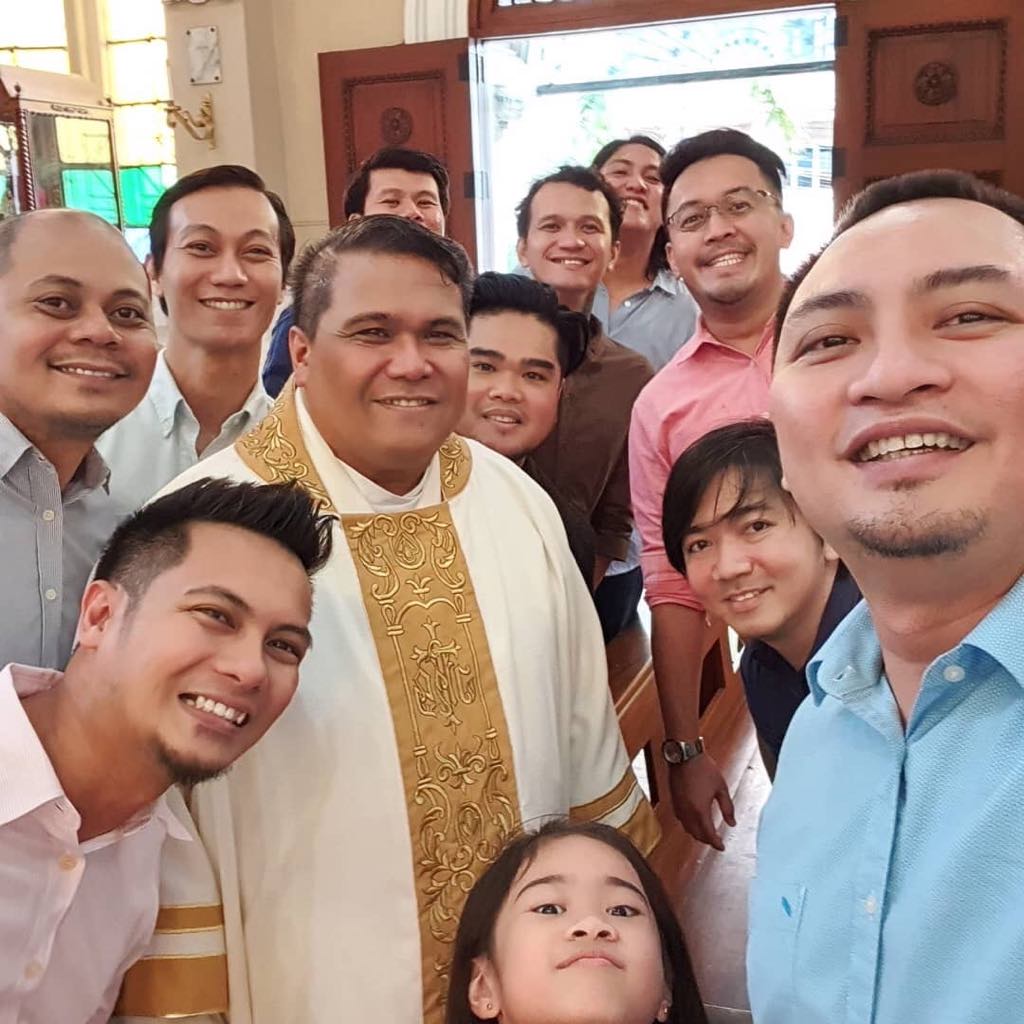
With my former students at the Cubao Cathedral after the wedding of their classmate. I felt so proud, and old, that afternoon seeing them all with their career and family, of how they have maintained their friendships all these years like brothers, of they love one another. Photo by Peter dela Cruz, one in blue.
To live is to love
December 2019 and January 2020 are perhaps my most “marrying months” in my 21 years of priesthood.
Aside from the weddings of friends and students I have officiated these past two months, three more are coming next month of February.
Again, as I saw friends and especially former students getting married, I could not believe at how fast time had passed.
Should I really be surprised when I find out my former students already in their early 30’s, some with families of their own and children whom they instruct to kiss my hand, calling me Lolo Fr. Nick?
It was a very “existential” experience that they are already old, and most of all, I am really that old after all!
Maybe that is what my married friends are telling me of the joy of fatherhood, of having your kids getting married, of having grandchildren, of the inner satisfaction that you have brought life to fruition.
That you have truly loved and now being loved.
It is perhaps the joy of getting old, of maturing, of dying or even forgetting everything when afflicted later with Alzheimer’s that you start to fade from the scene and hand over the stage to the next generation, thinking that life will still go on after us because you have loved much.
What really matters in the end is how we have lived and loved the people around us, of how we have enriched each other’s lives so that as the young ones discover life’s meaning in love, we who are older find life’s fulfillment still in the love from the relationships we keep.
Here’s a hill-billy rock music about love to drive your Monday’s blues away.
Quiet Storm by Fr. Nicanor F. Lalog II, 27 December 2019
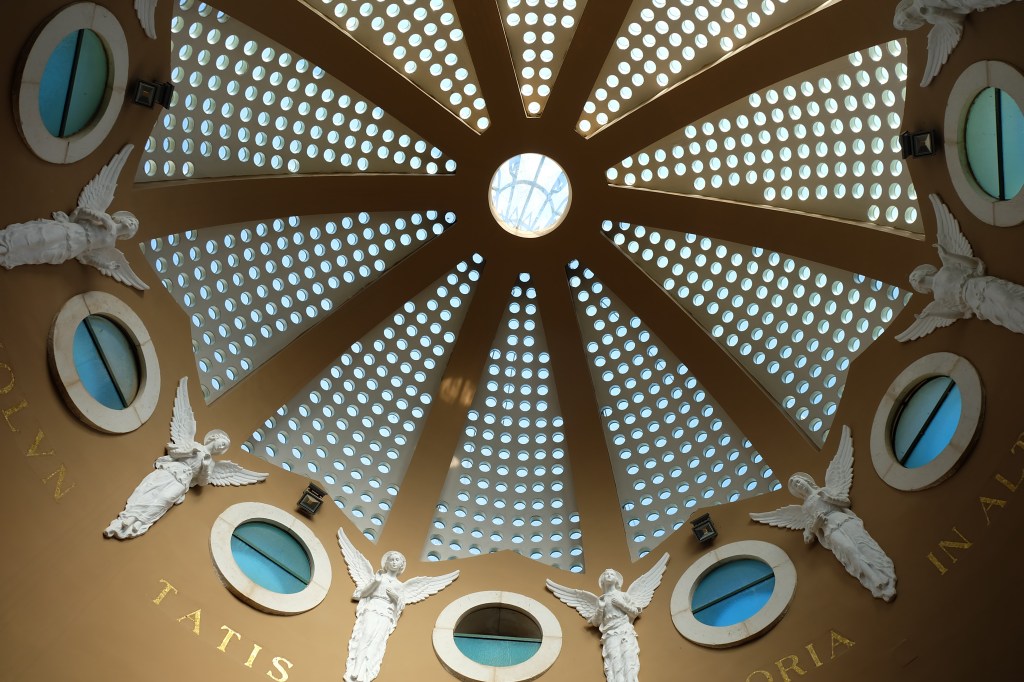
Dome of the chapel at Shepherd’s Field near Bethlehem where the angels appeared to some shepherds to announce the birth of Jesus Christ more than 2000 years ago.
By this time, many of you must have opened the gifts you have received this Christmas. Some are happy, some are not – even disappointed – while there are others who simply do not care at all with the gifts they have received.
But gifts are not everything. What really matters most are the persons and the love and thoughts that come with every gift we have received this blessed season.
Below are some spiritual gifts I feel we need to be thankful too!
The “little door” that leads into the Church of Nativity in Bethlehem that has come to mean the need to bow low and be humble in order to meet Jesus Christ not only inside but also in our daily life. Photo by author, May 2019.
The gift of hope. Hope is not thinking positively that things can get better like the weather. Hope is having a firm belief that even if things get worst, there is God who always loves us, who takes care of us. People with hope always look forward in the future whether here or in eternal life. They are also the most loving people around, the most understanding and most forgiving. They always strive, work hard to make things better for them and for others. Those without hope are the most evil: they will kill and destroy everything and everyone because they have nothing to look forward to in this life or hereafter. The kind of life we live always indicates the kind of hope we have. Or do not have.
The gift of desert. Sometimes, life becomes a desert for us, when we are desolate and so barren with everything dry and even lifeless. But it is during our desert moments in life when we not only meet our true selves but most of all, that is when we meet God. It is in this meeting with God in our desert we experience healing from all our hurts and disappointments in life. We need to withdraw once in a while to our desert to silently pray in order to hear God’s voice anew in our inner selves. In our mass mediated world today when we are bombarded with wants and needs to be rich and famous, the more we end up empty and lost. But when we dare stay in our desert and try to listen in silence, the more we are attuned with life’s realities, the more we are enriched and deepened in our lives.
The gift of intimacy. From our desert experiences of barrenness and desolation, of silence and prayer, and a lot of reflections and introspections come the great gift of intimacy with God and with others. We come to realize who our true friends are when our chips are down, when we are alone and badly bruised and beaten in life. How ironic that when we are so filled with material things, that is when life for us becomes superficial and shallow. But whenever we go through many desert storms, that is when we come to realize the most important in life – the persons who have touched us for better or for worse, the persons who make us experience to be loved and to love.
An oasis at the Dead Sea desert. Photo by author, May 2017.
We shall continue with our other lists of spiritual gifts this Christmas tomorrow.
How about you, what are the spiritual gifts you wish to share with us that may also help us deepen our Christmas celebrations this 2019?
A friend from the mid-80’s recently invited me for lunch when in the midst of our conversation she asked me how I unwind and take breaks as a priest considering my toxic schedules.
Suddenly, I just felt so light inside being filled with joy when I answered, “good old friends like you”!
We had a hearty laugh together as we remembered those good old days and nights with our other friends, wondering together how far we have all come in life, hurdling all those many struggles of our younger years.
When I was ordained priest in 1998, I promised to “leave behind” my family and relatives as well as friends to give myself totally in serving Jesus Christ among those people entrusted to my care.
I am so glad when I recently found out that I have not really turned away from them when I embraced a lifetime service to God because they have continued to keep me too as friend!
Old friends are always special because they have stood the test of time, standing by our side, believing in us during those many dark nights we have gone through even without us knowing it!
True friends are indeed a treasure especially those we have known and kept over the years because even if we no longer see each other so often or even communicate with them despite the suffocating social media around us, we have remained good friends deep in our hearts.
It is something we mutually feel deep inside for each other because despite our separation from college and from work or residence, we have never grown apart from each other as if there is an invisible thread that links us together.
I used to tell young people in my recollections that friends are always a gift from God. Each friend is unique, each with his/her own strengths and limitations. There are no perfect friends but if we can allow our friendships to have spaces for love and kindness, respect and understanding, mercy and forgiveness, friends can truly be the best gifts we can have in life.
Friends are a gift because they are always wrapped in mystery: the moment we receive them, we really do not know what is in store for us. In a similar manner like the lyrics of a song we loved singing in our daily Masses in the Minor Seminary (high school), friends are “gifts of God to me, who come all wrapped so differently: others so tightly, others so loosely, but wrappings are not the gift.”
Our task in every friendship is to uncover a friend’s “giftedness” to us, something which we cannot change. We can nurture and cultivate our friendships but we cannot force our friends into becoming someone they are not meant to be.
Every friend’s giftedness is from God because every friend is a signpost for us to be closer with God: some eventually become partners in life as husband and wife while others become the bestest of friends as “emotional shock absorbers” or a inspirations to another.
That, my friend, is something we cannot and must not dare alter because as the saying goes, people come to our lives for a reason, for a season, and for love.
Lately I have been seeing – “catching up” – some good old friends. What I like best when we are together is the ability and gift to laugh our hearts out like never before. There is something so deep with old friends laughing together not only with old jokes and anecdotes we cannot forget but also with some new realizations that come with our age.
And we laugh together, we realize we are not alone after all. There is still somebody very much like us, somebody we continue to grow up with, somebody who understands our fears and anxieties because he/she is also going through the same phase in life or have just gone through something similar.
That is why good old friends are the best because despite our long separation, we still find each other traveling, walking through the same path albeit for sometime in parallel manner.
They are the best because good old friends eventually teach us to be more appreciative and grateful with life and with friends who continue to journey with us no matter how slow and cranky we have become.
Cheers to all our old friends! Make time to reach out to them. Your message or text or call could mean so much to them!
Blessed Sacrament Chapel of the Sanctuary of San Pietro Pietrelcina-Nuovo Chiesa in Italy. Photo by Rev. Fr. Gerry Pascual, February 2019.
“Brothers and sisters: As you received Christ Jesus the Lord, walk in him, rooted in him and built upon him and established in the faith as you were taught, abounding in thanksgiving. You were buried with him in baptism, in which you were also raised with him through faith in the power of God, who raised him from the dead… he brought you to life along with him.”
Colossians 2:6, 12, 13b
Praise and glory to you, our Lord Jesus Christ! Thank you for dying with us in our sins, forgiving us and raising us to new life in you in the sacrament of baptism!
Let us be immersed in you, Lord Jesus.
Let us claim our new life in you by walking with you who is our Way and Truth and Life.
To be immersed in you, O Christ, is to be free and faithful to lovingly serve you with all our mind, heart and soul. Being immersed in you is letting go of our pains and hurts in the past to start anew in you. To be immersed in you, O Christ, is to see more the goodness within each one of us because of you, the most holy one.
May we heed the call of St. Paul today not to be swayed by false beliefs and other philosophies not rooted in you, claiming elemental and dark powers here on earth.
You alone are the sovereign power here on earth and the entire universe, Lord Jesus.
And the good news is that through baptism, you have made us share in your “cosmic victory” of the Resurrection. More than a rite of initiation, our baptism is a sharing in your great power here on earth to conquer evil with good.
Let us be your modern “apostles” — an apostolein, someone sent ahead of you, someone with special relationship with you, someone truly immersed in you, very personal with you, Lord Jesus, who reign forever and ever. Amen.
Proverbs 8:22-31 >< )))*> Romans 5:1-5 >< )))*> John 16:12-15
From Google.
I know.
You must be saying our title is from a hit song by the late Luther Vandross Jr. with Richard Marx, “Dance with My Father”.
Since its release in May 2003, I have always loved that song. Like Vandross Jr., I sometimes ask God to return my father even for a while not only for me but most especially for my mother who was celebrating her birthday when he suddenly died of a heart attack in 2000.
Though my father did not dance much like Vandross Sr., one of the things I miss so much from him were how he would discuss so many things to me especially whenever I would join him in our library. And when I could not understand everything, he would always tell me, “paglaki mo maiintindihan mo rin yan, anak” (you will understand that when you grow up, son).
Eventually those words came to sound like music to me as a I grew up until later in life I realized that indeed, I have come to understand the many things we have discussed when I was still a child! Most of all, now that I am a grown up man still having a hard time comprehending many things in life, my father’s words still soothe me. Although he is no longer around, I always tell myself when facing difficult situations or questions that someday, I’m going to understand this – “paglaki ko maiintindihan ko rin yan”.
Jesus said to his disciples: “I have much more to tell you, but you cannot bear it now. But when he comes, the Spirit of truth, he will guide you to all truth.”
John 16:12-13
Jesus during his Last Supper Discourse telling the Apostles his departure and sending of the Holy Spirit. From a depiction found on the Maesta in Siena by Duccio (1308-1311). From Google.
On this Eleventh Sunday in the continuation of our Ordinary Time after Lent and Easter, we celebrate the Solemnity of the Blessed Trinity. In the past Sundays we have been slowly introduced by the Lord in his teachings about the Holy Spirit. Today we come to full circle with this celebration of the Holy Trinity, the highest mystery in our faith that there are three Persons in One God.
For many Christians, especially Catholics, they feel that believing in One God is enough. To speak of God – Father, Son, and Holy Spirit – matters very little for them that they fail to see what the mystery of the Trinity evokes concretely in our lives.
It is true that we cannot find an explicit statement in the whole Bible telling us there is One God in Three Persons. It is a doctrine that slowly unfolded in the Sacred Scriptures reaching its highest point of revelation in Jesus Christ’s Incarnation and sending of the Holy Spirit.
This is the essence of Christ’s farewell discourse during their Last Supper together: the Holy Spirit will not introduce anything new to them. The Holy Spirit will just enlighten and bring out to the open the many dimensions of the teachings of Jesus that were mostly found also or rooted in the Old Testament. Sometimes in life, there are so many realities already present but we do not recognize right away because of so many factors that hide them from us. But the moment we discover some new dimensions of life’s truth and reality, the more we find its beauty! That is why we have to somehow understand the Trinity to fully appreciate the beauty and wonder of God in our lives.
In the Old Testament, God did not speak about himself being a Person per se, as a full, conscious relating Being like humans. Moreover, God never spoke about his being One in Three Persons to the people at that time because they would never even feel such mystery as they were surrounded by polytheistic nations. It was enough at that time to insist on the people that there is only One God who relates personally like humans, seeking intimacy.
thus says the wisdom of God: “…then was I beside him as his craftsman, and I was his delight day by day, playing before him all the while, playing on the surface of his earth; and I found delight in the human race.”
Proverbs 8:22,30-31
In the first reading, God presents himself as a person, one who relates with others personified in wisdom juxtaposed in two images equally evocative, as an artisan or creator and as a child happy and proud to be around his parent.
Here I find Luther Vandross Jr.’s “Dance with My Father” so applicable: he was seven and a half years old when his father died of complications in diabetes. But his fondest memory of him was how he would dance with his mother at home and would always pull him to dance with them!
Isn’t that beautiful, three people dancing together like one entity?
Incidentally in theology, we also have this explanation of the Trinity as a “circle dance” called perichoresis. It is a way of seeing the Trinity as action than definition. If you ahve been to Turkey, you must have visited Cappadocia where once lived great thinkers of the Church called Cappadocian Fathers who thought of perichoresis.
According to the Cappadocian Fathers, in perichoresis, each Divine Person is like a dance partner who contributes and has a specific role in the choreography so that what they do together make up the dance. The Persons like partners in the dance pull and push against one another, not in resistance or force but in support and unity. The dance is in constant motion and the partners are not focused on themselves but on the others. Likewise as we experience in “club party”, the dance circle is never closed so that more people are invited to join in the celebration until each becomes a part of the dance, sharing in the joy and unity.
From Google.
In perichoresis, the Trinity is presented more as a relationship of Persons: the Father is the Creator, the Son is the Redeemer and the Holy Spirit is the sanctifier. Applied to us, we are all children of the Father who are brothers and sisters in Jesus as indwelling of the Holy Spirit. The Blessed Trinity invites us to their dance of life and grace as we find here the gist of St. Paul’s Letter to the Romans today that through our faith in Christ, we have found the peace of God through the outpouring of so many gifts upon us by the Holy Spirit that we now have a relationship of friendship and trust in him, culminating in participation “in the glory of God” (Rom.5:2).
This Sunday, we are all invited to join in the dance of God, the dance of the Father, of the Son and of the Holy Spirit. In that dance, the Father reveals to us his hidden plans for us in Christ through the Holy Spirit of how he wants us to live to the fullest in him. It is only in dancing in him and with him can we know this mystery of God, mystery of self, and mystery of life in general. Though we cannot fully understand his mystery, God slowly unfolds to us his many dimensions that little by little, we see more of him, nmore of ourselves, and more of others.
That is when we find GUIDANCE, for God-U-and-I Dance.
When there is guidance, we find direction and do not get lost.
The Lord Is My Chef Breakfast Recipe for the Soul, Tuesday, Easter Octave, 23 April 2019
Acts 2:36-41///John 20:11-18
Photo from Google.
Now, when they heard this, they were cut to the heart, and they asked Peter and the other Apostles, “What are we to do, my brothers?”
Acts 2:37
What a powerful expression, O Lord Jesus Christ: “they were cut to the heart” upon hearing the preaching by St. Peter about you on Pentecost day, on how the people have killed you, on how they failed to recognize you as the Christ.
They were cut to the heart, they were so moved.
Yesterday O Lord, many of us were also cut to the heart with the powerful earthquake that rocked us hard late afternoon. Many prayed, many wondered what’s going to happen next. And many asked what are we to do?
Suddenly, people remembered you and called on you. That is always the case when calamities strike us, when problems arise in our families. We are cut to the heart. Our faith is awakened, we become conscious not only of you but of others we used to take for granted.
But there is something more wonderful in being cut to the heart, O Lord.
Mary Magdalene was also cut in the heart upon discovering your empty tomb that Easter morning. Give us that same grace of always seeking you, looking for you whenever we feel we have lost you.
So often, you come to us, calling us with our name but we never listen to you, always forgetting how much you love us, how much you have forgiven us with our many sins, how you have changed us.
Remind us like Mary not to touch you because from now on, we must relate with you in a higher level, that the most important thing to do is to proclaim to others most especially with our lives that we have seen you, that you are risen.
That is the most kindest and wonderful kind of cut of all, Jesus. Amen.
Jesus telling Mary Magdalene not to touch him in a painting at the Basilica of St. Francis of Assisi in Italy. Photo from Google.
The Lord Is My Chef Sunday Recipe, Palm Sunday of the Lord’s Passion, Year C, 14 April 2019
Isaiah 50:4-7///Philippians 2:6-11///Luke 22:1-49
Photo from Bing.com.
Today we begin the Holy Week with two celebrations merged into one, Palm Sunday of the Lord’s Passion. The Palm Sunday is a tradition started by the early Christians in Jerusalem in the fourth century while in Rome during the 12th century, the Pope proclaimed the long gospel account of the Lord’s Passion on this Sunday to signal the start of Holy Week. Almost 2000 years later in reforming the liturgy, Vatican II merged these two traditions into one to usher in our holiest days of the year.
Like in the four Sundays of Lent except last week, St. Luke guides us today in reflecting the Lord’s Passion with emphasis on the Cross with its call to conversion. For St. Luke, the cross is the object of discipleship in Christ. Join me in reflecting on the last three words our evangelist had recorded when Jesus was crucified.
First word:
When they came to the place called the Skull, they crucified him and the criminals there, one on his right, the other to his left. Then Jesus said, “Father, forgive them, they know not what they do.”
Luke 23:33-34
Mosaic of the Crucifixion at the crypt of the Manila Cathedral. Photo by Arch. Philip Santiago, October of the Jubilee of Mercy 2016.
This is very striking. Immediately upon his crucifixion, Jesus prayed for the forgiveness of his enemies! It is a total adherence to his preaching during his sermon on the plain, “love your enemies, do good to those who hate you, bless those who curse you, pray for those who mistreat you” (Lk. 6:27-28, Seventh Week Ordinary Time, 24 February 2019). Here we find the immense love and mercy of Jesus — no hatred, no calls for revenge or threats like “karma” against those who crucified him. He simply begged for their forgiveness because “they know not what they do.”
In Jewish thought, to know means more than an intellectual knowledge for it implies relationship. Knowing somebody for them is more than knowing one’s name but having ties with the person. And to know something is always to see things in this perspective, always in relation with a person. Had they known Jesus is the Christ, they would have not crucified him! Exactly the preaching of St. Peter at the healing of a lame man after Pentecost at the temple when he told them they have “acted in ignorance” in “killing the Author of life whom God raised from the dead” (Acts 3:15). St. Luke also notes in his Acts of the Apostles how the crowd upon hearing St. Peter’s preaching were moved or “cut to the heart” (2:37) that many were baptized on that day. Recall also how at the arrival of the wise men from the East searching for the child Jesus: the scholars of Jerusalem “knew” from the books how the Christ would be born in Behtlehem yet he was found by the pagan magis! Even the most learned man in the New Testament, St. Paul admits how ignorant he had been in persecuting and blaspheming Jesus before (1Tim.1:13) experiencing God’s loving mercy.
In the bible we always see this combination of knowing and ignorance at the same time to indicate that more than factual and cerebral knowledge, there is that deeper knowing of relating and of loving. If we really know somebody, the more we love, the lesser we sin. St. Thomas Aquinas used to say that the more we know and become intelligent, the more we realize the truth, the more we must become good and holy. That is why saints are the most intelligent people that they were able to do what is good and what is right.
In this age of Google and Wikipedia , Jesus is challenging us that if we truly know so much that we have become smart and more intelligent, then, how much do we really love and care for others?
Photo from Google.
Second word:
Then he said, “Jesus, remember me when you come into your kingdom.” He replied to him, “Amen, I say to you, today you shall be with me in Paradise.”
Luke 23:42-43
The Venerable Archbishop Fulton Sheen used to claim that Dimas was indeed a great thief who was able to steal or snatch Paradise from Jesus just before dying on the Cross. It may be funny but very true. But more than “stealing” his salvation from the Lord, Dimas had displayed on the cross what we have discussed earlier about the combination of knowing and ignorance. I would say Dimas is perhaps the “most learned thief” of all time who truly knew what is most essential in life which is to know Jesus. The moment he called out to him “Jesus”, Dimas expressed his knowing Jesus, of belonging to Jesus. As we have reflected earlier, to know is to relate. Anyone who truly relates must first believe in order to love dearly. Dimas believed in Jesus that he called out to him while hanging on the Cross.
Today, Jesus is reminding us that the door to Paradise is him alone. And we begin to enter Paradise the moment we entrust our total self to Jesus like Dimas who came to know Christ at the Cross, and then believed him and loved him. If we really know, do we believe?
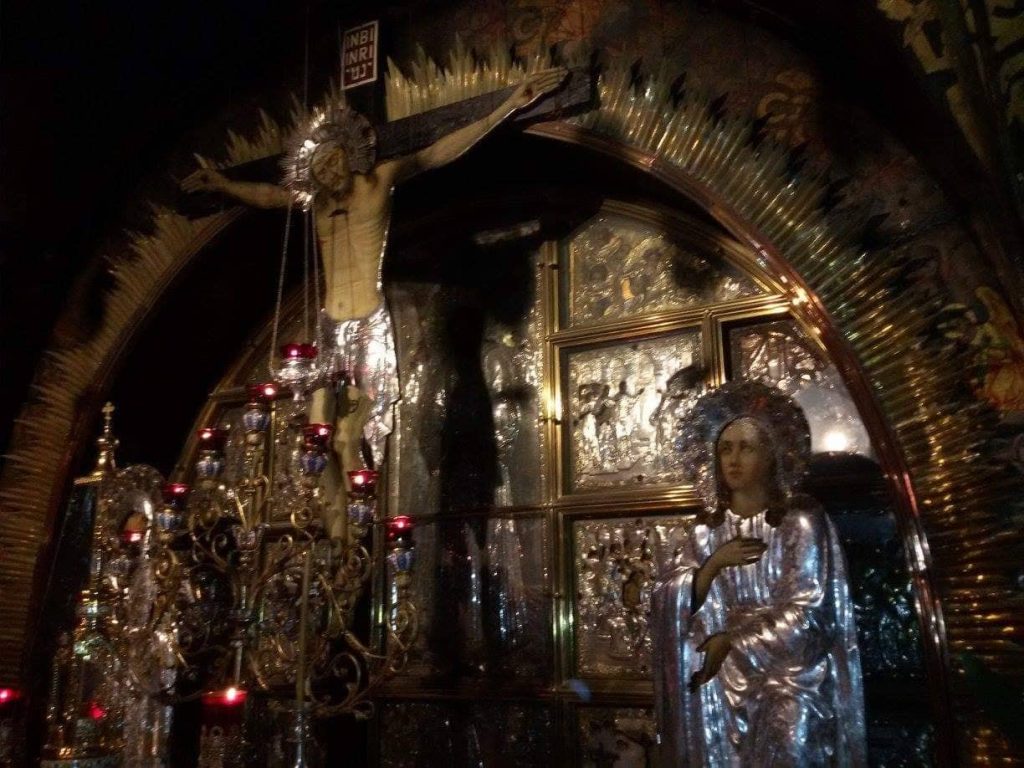
Altar of the Church of the Holy Sepulchre over the exact site where Jesus was crucified outside Jerusalem. Photo by Arch. Philip Santiago, October 2017.
Third word:
Jesus cried out in a loud voice, “Father, into your hands I commend my spirit,” and when he had said this he breathed his last.
Luke 23:46
One of St. Luke’s unique feature is always presenting to us Jesus at prayer. Especially here at his crucifixion. See how his first words were prayer of forgiveness for his persecutors. Now at his death, St. Luke presents Jesus again at prayer, reciting Psalm 31:5, “Father, into your hands I commend my spirit.”
Here we find the whole picture of Jesus Christ’s life which is a prayer and his prayer is his very life. From the very start, Jesus has always been one with the Father which is the essence of every prayer called communion. And that is the important aspect of his being our Savior: everything he said and did was everything the Father had told and asked him. There is that perfect communion of the Father and the Son in the Holy Spirit so that in his death, Jesus offered his total self with us to God. Everyone and everything is thus sanctified anew in Christ. This became possible only with his kenosis, his self-emptying eloquently expressed to the Philippians by St. Paul in our second reading.
On the Cross, everything in the life of Jesus Christ came to a full circle, God’s whole picture emerged. Now more than ever, we have become closest to God in love. In his dying on the Cross, Jesus made known to us God, brought him closest to us so we can relate and be intimate with him more than ever. In his becoming human like us by bearing all the pains and sufferings expressed in the first reading from Isaiah, God proved to us his love in Jesus. Most of all, he enabled us too to be capable of knowing and loving like Jesus Christ by being intimate with him always. This is why these days are called Holy Week when we are filled with God so we experience him anew and have him more than ever in our hearts, in our very selves. Amen.