Why old friends are the best

Quiet Storm by Fr. Nick F. Lalog II, 16 November 2019

Photo by Pixabay on Pexels.com

A friend from the mid-80’s recently invited me for lunch when in the midst of our conversation she asked me how I unwind and take breaks as a priest considering my toxic schedules.

Suddenly, I just felt so light inside being filled with joy when I answered, “good old friends like you”!

We had a hearty laugh together as we remembered those good old days and nights with our other friends, wondering together how far we have all come in life, hurdling all those many struggles of our younger years.

When I was ordained priest in 1998, I promised to “leave behind” my family and relatives as well as friends to give myself totally in serving Jesus Christ among those people entrusted to my care.

I am so glad when I recently found out that I have not really turned away from them when I embraced a lifetime service to God because they have continued to keep me too as friend!

Old friends are always special because they have stood the test of time, standing by our side, believing in us during those many dark nights we have gone through even without us knowing it!

True friends are indeed a treasure especially those we have known and kept over the years because even if we no longer see each other so often or even communicate with them despite the suffocating social media around us, we have remained good friends deep in our hearts.

It is something we mutually feel deep inside for each other because despite our separation from college and from work or residence, we have never grown apart from each other as if there is an invisible thread that links us together.

Photo by Negative Space on Pexels.com

I used to tell young people in my recollections that friends are always a gift from God. Each friend is unique, each with his/her own strengths and limitations. There are no perfect friends but if we can allow our friendships to have spaces for love and kindness, respect and understanding, mercy and forgiveness, friends can truly be the best gifts we can have in life.

Friends are a gift because they are always wrapped in mystery: the moment we receive them, we really do not know what is in store for us. In a similar manner like the lyrics of a song we loved singing in our daily Masses in the Minor Seminary (high school), friends are “gifts of God to me, who come all wrapped so differently: others so tightly, others so loosely, but wrappings are not the gift.”

Our task in every friendship is to uncover a friend’s “giftedness” to us, something which we cannot change. We can nurture and cultivate our friendships but we cannot force our friends into becoming someone they are not meant to be.

Every friend’s giftedness is from God because every friend is a signpost for us to be closer with God: some eventually become partners in life as husband and wife while others become the bestest of friends as “emotional shock absorbers” or a inspirations to another.

That, my friend, is something we cannot and must not dare alter because as the saying goes, people come to our lives for a reason, for a season, and for love.

Photo by Roberto Nickson on Pexels.com

Lately I have been seeing – “catching up” – some good old friends. What I like best when we are together is the ability and gift to laugh our hearts out like never before. There is something so deep with old friends laughing together not only with old jokes and anecdotes we cannot forget but also with some new realizations that come with our age.

And we laugh together, we realize we are not alone after all. There is still somebody very much like us, somebody we continue to grow up with, somebody who understands our fears and anxieties because he/she is also going through the same phase in life or have just gone through something similar.

That is why good old friends are the best because despite our long separation, we still find each other traveling, walking through the same path albeit for sometime in parallel manner.

They are the best because good old friends eventually teach us to be more appreciative and grateful with life and with friends who continue to journey with us no matter how slow and cranky we have become.

Cheers to all our old friends! Make time to reach out to them. Your message or text or call could mean so much to them!

Being immersed in Christ

The Lord Is My Chef Breakfast Recipe for the Soul

Tuesday, Week XXIII, Year I, 10 September 2019

Colossians 2:6-15 >< )))*> <*(((>< Luke 6:12-19

Blessed Sacrament Chapel of the Sanctuary of San Pietro Pietrelcina-Nuovo Chiesa in Italy. Photo by Rev. Fr. Gerry Pascual, February 2019.

“Brothers and sisters: As you received Christ Jesus the Lord, walk in him, rooted in him and built upon him and established in the faith as you were taught, abounding in thanksgiving. You were buried with him in baptism, in which you were also raised with him through faith in the power of God, who raised him from the dead… he brought you to life along with him.”

Colossians 2:6, 12, 13b

Praise and glory to you, our Lord Jesus Christ! Thank you for dying with us in our sins, forgiving us and raising us to new life in you in the sacrament of baptism!

Let us be immersed in you, Lord Jesus.

Let us claim our new life in you by walking with you who is our Way and Truth and Life.

To be immersed in you, O Christ, is to be free and faithful to lovingly serve you with all our mind, heart and soul. Being immersed in you is letting go of our pains and hurts in the past to start anew in you. To be immersed in you, O Christ, is to see more the goodness within each one of us because of you, the most holy one.

May we heed the call of St. Paul today not to be swayed by false beliefs and other philosophies not rooted in you, claiming elemental and dark powers here on earth.

You alone are the sovereign power here on earth and the entire universe, Lord Jesus.

And the good news is that through baptism, you have made us share in your “cosmic victory” of the Resurrection. More than a rite of initiation, our baptism is a sharing in your great power here on earth to conquer evil with good.

Let us be your modern “apostles” — an apostolein, someone sent ahead of you, someone with special relationship with you, someone truly immersed in you, very personal with you, Lord Jesus, who reign forever and ever. Amen.

Dance with My Father

The Lord Is My Chef Sunday Recipe for the Soul
Solemnity of the Blessed Trinity, 16 June 2019
Proverbs 8:22-31 >< )))*> Romans 5:1-5 >< )))*> John 16:12-15
From Google.

I know.

You must be saying our title is from a hit song by the late Luther Vandross Jr. with Richard Marx, “Dance with My Father”.

Since its release in May 2003, I have always loved that song. Like Vandross Jr., I sometimes ask God to return my father even for a while not only for me but most especially for my mother who was celebrating her birthday when he suddenly died of a heart attack in 2000.

Though my father did not dance much like Vandross Sr., one of the things I miss so much from him were how he would discuss so many things to me especially whenever I would join him in our library. And when I could not understand everything, he would always tell me, “paglaki mo maiintindihan mo rin yan, anak” (you will understand that when you grow up, son).

Eventually those words came to sound like music to me as a I grew up until later in life I realized that indeed, I have come to understand the many things we have discussed when I was still a child! Most of all, now that I am a grown up man still having a hard time comprehending many things in life, my father’s words still soothe me. Although he is no longer around, I always tell myself when facing difficult situations or questions that someday, I’m going to understand this – “paglaki ko maiintindihan ko rin yan”.

Jesus said to his disciples: “I have much more to tell you, but you cannot bear it now. But when he comes, the Spirit of truth, he will guide you to all truth.”

John 16:12-13
Jesus during his Last Supper Discourse telling the Apostles his departure and sending of the Holy Spirit. From a depiction found on the Maesta in Siena by Duccio (1308-1311). From Google.

On this Eleventh Sunday in the continuation of our Ordinary Time after Lent and Easter, we celebrate the Solemnity of the Blessed Trinity. In the past Sundays we have been slowly introduced by the Lord in his teachings about the Holy Spirit. Today we come to full circle with this celebration of the Holy Trinity, the highest mystery in our faith that there are three Persons in One God.

For many Christians, especially Catholics, they feel that believing in One God is enough. To speak of God – Father, Son, and Holy Spirit – matters very little for them that they fail to see what the mystery of the Trinity evokes concretely in our lives.

It is true that we cannot find an explicit statement in the whole Bible telling us there is One God in Three Persons. It is a doctrine that slowly unfolded in the Sacred Scriptures reaching its highest point of revelation in Jesus Christ’s Incarnation and sending of the Holy Spirit.

This is the essence of Christ’s farewell discourse during their Last Supper together: the Holy Spirit will not introduce anything new to them. The Holy Spirit will just enlighten and bring out to the open the many dimensions of the teachings of Jesus that were mostly found also or rooted in the Old Testament. Sometimes in life, there are so many realities already present but we do not recognize right away because of so many factors that hide them from us. But the moment we discover some new dimensions of life’s truth and reality, the more we find its beauty! That is why we have to somehow understand the Trinity to fully appreciate the beauty and wonder of God in our lives.

In the Old Testament, God did not speak about himself being a Person per se, as a full, conscious relating Being like humans. Moreover, God never spoke about his being One in Three Persons to the people at that time because they would never even feel such mystery as they were surrounded by polytheistic nations. It was enough at that time to insist on the people that there is only One God who relates personally like humans, seeking intimacy.

thus says the wisdom of God: “…then was I beside him as his craftsman, and I was his delight day by day, playing before him all the while, playing on the surface of his earth; and I found delight in the human race.”

Proverbs 8:22,30-31

In the first reading, God presents himself as a person, one who relates with others personified in wisdom juxtaposed in two images equally evocative, as an artisan or creator and as a child happy and proud to be around his parent.

Here I find Luther Vandross Jr.’s “Dance with My Father” so applicable: he was seven and a half years old when his father died of complications in diabetes. But his fondest memory of him was how he would dance with his mother at home and would always pull him to dance with them!

Isn’t that beautiful, three people dancing together like one entity?

Incidentally in theology, we also have this explanation of the Trinity as a “circle dance” called perichoresis. It is a way of seeing the Trinity as action than definition. If you ahve been to Turkey, you must have visited Cappadocia where once lived great thinkers of the Church called Cappadocian Fathers who thought of perichoresis.

According to the Cappadocian Fathers, in perichoresis, each Divine Person is like a dance partner who contributes and has a specific role in the choreography so that what they do together make up the dance. The Persons like partners in the dance pull and push against one another, not in resistance or force but in support and unity. The dance is in constant motion and the partners are not focused on themselves but on the others. Likewise as we experience in “club party”, the dance circle is never closed so that more people are invited to join in the celebration until each becomes a part of the dance, sharing in the joy and unity.

From Google.

In perichoresis, the Trinity is presented more as a relationship of Persons: the Father is the Creator, the Son is the Redeemer and the Holy Spirit is the sanctifier. Applied to us, we are all children of the Father who are brothers and sisters in Jesus as indwelling of the Holy Spirit. The Blessed Trinity invites us to their dance of life and grace as we find here the gist of St. Paul’s Letter to the Romans today that through our faith in Christ, we have found the peace of God through the outpouring of so many gifts upon us by the Holy Spirit that we now have a relationship of friendship and trust in him, culminating in participation “in the glory of God” (Rom.5:2).

This Sunday, we are all invited to join in the dance of God, the dance of the Father, of the Son and of the Holy Spirit. In that dance, the Father reveals to us his hidden plans for us in Christ through the Holy Spirit of how he wants us to live to the fullest in him. It is only in dancing in him and with him can we know this mystery of God, mystery of self, and mystery of life in general. Though we cannot fully understand his mystery, God slowly unfolds to us his many dimensions that little by little, we see more of him, nmore of ourselves, and more of others.

That is when we find GUIDANCE, for God-U-and-I Dance.

When there is guidance, we find direction and do not get lost.

A blessed week ahead to everyone. Amen.

Photo by Jens Johnsson on Pexels.com

Cut to the heart

The Lord Is My Chef Breakfast Recipe for the Soul, Tuesday, Easter Octave, 23 April 2019
Acts 2:36-41///John 20:11-18
Photo from Google.

Now, when they heard this, they were cut to the heart, and they asked Peter and the other Apostles, “What are we to do, my brothers?”

Acts 2:37

What a powerful expression, O Lord Jesus Christ: “they were cut to the heart” upon hearing the preaching by St. Peter about you on Pentecost day, on how the people have killed you, on how they failed to recognize you as the Christ.

They were cut to the heart, they were so moved.

Yesterday O Lord, many of us were also cut to the heart with the powerful earthquake that rocked us hard late afternoon. Many prayed, many wondered what’s going to happen next. And many asked what are we to do?

Suddenly, people remembered you and called on you. That is always the case when calamities strike us, when problems arise in our families. We are cut to the heart. Our faith is awakened, we become conscious not only of you but of others we used to take for granted.

But there is something more wonderful in being cut to the heart, O Lord.

Mary Magdalene was also cut in the heart upon discovering your empty tomb that Easter morning. Give us that same grace of always seeking you, looking for you whenever we feel we have lost you.

So often, you come to us, calling us with our name but we never listen to you, always forgetting how much you love us, how much you have forgiven us with our many sins, how you have changed us.

Remind us like Mary not to touch you because from now on, we must relate with you in a higher level, that the most important thing to do is to proclaim to others most especially with our lives that we have seen you, that you are risen.

That is the most kindest and wonderful kind of cut of all, Jesus. Amen.

Jesus telling Mary Magdalene not to touch him in a painting at the Basilica of St. Francis of Assisi in Italy. Photo from Google.

Knowing is Intimacy

The Lord Is My Chef Sunday Recipe, Palm Sunday of the Lord’s Passion, Year C, 14 April 2019
Isaiah 50:4-7///Philippians 2:6-11///Luke 22:1-49
Photo from Bing.com.

Today we begin the Holy Week with two celebrations merged into one, Palm Sunday of the Lord’s Passion. The Palm Sunday is a tradition started by the early Christians in Jerusalem in the fourth century while in Rome during the 12th century, the Pope proclaimed the long gospel account of the Lord’s Passion on this Sunday to signal the start of Holy Week. Almost 2000 years later in reforming the liturgy, Vatican II merged these two traditions into one to usher in our holiest days of the year.

Like in the four Sundays of Lent except last week, St. Luke guides us today in reflecting the Lord’s Passion with emphasis on the Cross with its call to conversion. For St. Luke, the cross is the object of discipleship in Christ. Join me in reflecting on the last three words our evangelist had recorded when Jesus was crucified.

First word:

When they came to the place called the Skull, they crucified him and the criminals there, one on his right, the other to his left. Then Jesus said, “Father, forgive them, they know not what they do.”

Luke 23:33-34
Mosaic of the Crucifixion at the crypt of the Manila Cathedral. Photo by Arch. Philip Santiago, October of the Jubilee of Mercy 2016.

This is very striking. Immediately upon his crucifixion, Jesus prayed for the forgiveness of his enemies! It is a total adherence to his preaching during his sermon on the plain, “love your enemies, do good to those who hate you, bless those who curse you, pray for those who mistreat you” (Lk. 6:27-28, Seventh Week Ordinary Time, 24 February 2019). Here we find the immense love and mercy of Jesus — no hatred, no calls for revenge or threats like “karma” against those who crucified him. He simply begged for their forgiveness because “they know not what they do.”

In Jewish thought, to know means more than an intellectual knowledge for it implies relationship. Knowing somebody for them is more than knowing one’s name but having ties with the person. And to know something is always to see things in this perspective, always in relation with a person. Had they known Jesus is the Christ, they would have not crucified him! Exactly the preaching of St. Peter at the healing of a lame man after Pentecost at the temple when he told them they have “acted in ignorance” in “killing the Author of life whom God raised from the dead” (Acts 3:15). St. Luke also notes in his Acts of the Apostles how the crowd upon hearing St. Peter’s preaching were moved or “cut to the heart” (2:37) that many were baptized on that day. Recall also how at the arrival of the wise men from the East searching for the child Jesus: the scholars of Jerusalem “knew” from the books how the Christ would be born in Behtlehem yet he was found by the pagan magis! Even the most learned man in the New Testament, St. Paul admits how ignorant he had been in persecuting and blaspheming Jesus before (1Tim.1:13) experiencing God’s loving mercy.

In the bible we always see this combination of knowing and ignorance at the same time to indicate that more than factual and cerebral knowledge, there is that deeper knowing of relating and of loving. If we really know somebody, the more we love, the lesser we sin. St. Thomas Aquinas used to say that the more we know and become intelligent, the more we realize the truth, the more we must become good and holy. That is why saints are the most intelligent people that they were able to do what is good and what is right.

In this age of Google and Wikipedia , Jesus is challenging us that if we truly know so much that we have become smart and more intelligent, then, how much do we really love and care for others?

Photo from Google.

Second word:

Then he said, “Jesus, remember me when you come into your kingdom.” He replied to him, “Amen, I say to you, today you shall be with me in Paradise.”

Luke 23:42-43

The Venerable Archbishop Fulton Sheen used to claim that Dimas was indeed a great thief who was able to steal or snatch Paradise from Jesus just before dying on the Cross. It may be funny but very true. But more than “stealing” his salvation from the Lord, Dimas had displayed on the cross what we have discussed earlier about the combination of knowing and ignorance. I would say Dimas is perhaps the “most learned thief” of all time who truly knew what is most essential in life which is to know Jesus. The moment he called out to him “Jesus”, Dimas expressed his knowing Jesus, of belonging to Jesus. As we have reflected earlier, to know is to relate. Anyone who truly relates must first believe in order to love dearly. Dimas believed in Jesus that he called out to him while hanging on the Cross.

Today, Jesus is reminding us that the door to Paradise is him alone. And we begin to enter Paradise the moment we entrust our total self to Jesus like Dimas who came to know Christ at the Cross, and then believed him and loved him. If we really know, do we believe?

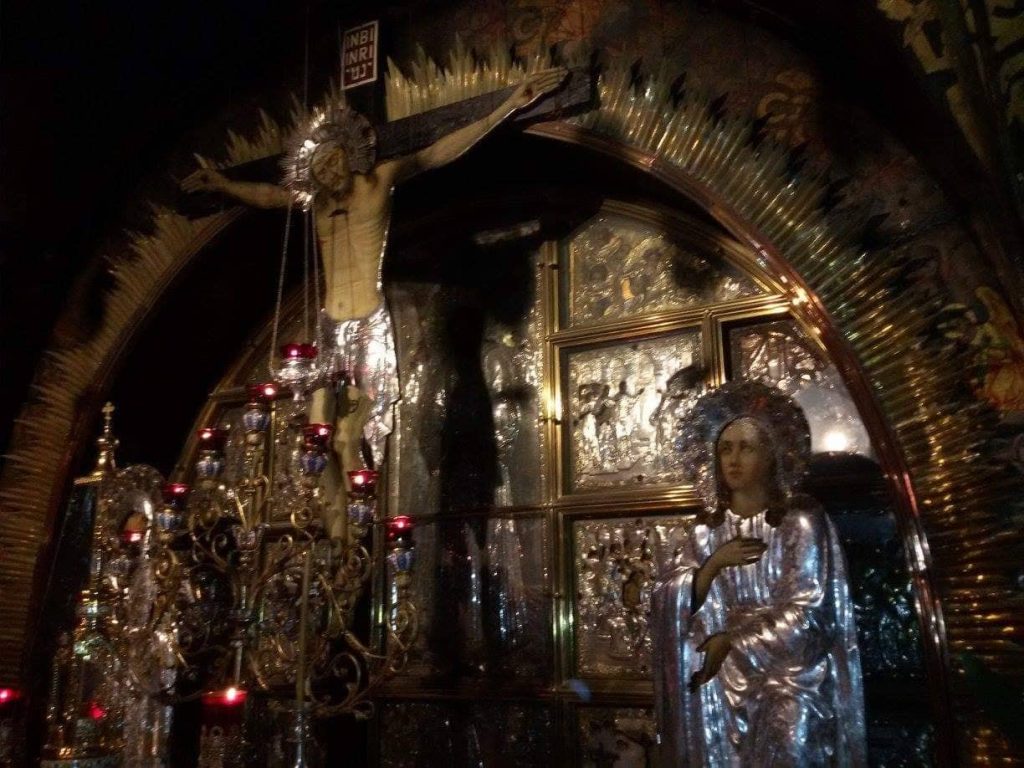
Altar of the Church of the Holy Sepulchre over the exact site where Jesus was crucified outside Jerusalem. Photo by Arch. Philip Santiago, October 2017.

Third word:

Jesus cried out in a loud voice, “Father, into your hands I commend my spirit,” and when he had said this he breathed his last.

Luke 23:46

One of St. Luke’s unique feature is always presenting to us Jesus at prayer. Especially here at his crucifixion. See how his first words were prayer of forgiveness for his persecutors. Now at his death, St. Luke presents Jesus again at prayer, reciting Psalm 31:5, “Father, into your hands I commend my spirit.”

Here we find the whole picture of Jesus Christ’s life which is a prayer and his prayer is his very life. From the very start, Jesus has always been one with the Father which is the essence of every prayer called communion. And that is the important aspect of his being our Savior: everything he said and did was everything the Father had told and asked him. There is that perfect communion of the Father and the Son in the Holy Spirit so that in his death, Jesus offered his total self with us to God. Everyone and everything is thus sanctified anew in Christ. This became possible only with his kenosis, his self-emptying eloquently expressed to the Philippians by St. Paul in our second reading.

On the Cross, everything in the life of Jesus Christ came to a full circle, God’s whole picture emerged. Now more than ever, we have become closest to God in love. In his dying on the Cross, Jesus made known to us God, brought him closest to us so we can relate and be intimate with him more than ever. In his becoming human like us by bearing all the pains and sufferings expressed in the first reading from Isaiah, God proved to us his love in Jesus. Most of all, he enabled us too to be capable of knowing and loving like Jesus Christ by being intimate with him always. This is why these days are called Holy Week when we are filled with God so we experience him anew and have him more than ever in our hearts, in our very selves. Amen.

Lent and the Contemplative Spirit

40 Shades of Lent, 5th Sunday-C, 07 April 2019
Isaiah 43:16-21///Philippians 3:8-14///John 8:1-11 
From Google.
Sunrise at Lake of Galilee. Photo by author April 2017.

Today is the last Sunday of Lent. It is hoped that by this time since Ash Wednesday, we have slowly acquired or even regained our contemplative spirit of prayerful silence. It is something very essential not only during these 40 days and in the coming Holy Week. It is only in silent prayers can we truly find balance in life as we discover what is valuable and what is worthless, things that last and things that pass. Prayerful silence teaches us to slow down, to be more discerning, and more trusting. The contemplative spirit thus leads us to grow deeper in our faith, hope and love in God. It is in the contemplative spirit where God works best in us.

We find this invitation to a contemplative spirit in our beautiful gospel today of a woman caught committing adultery whom Jesus refused to condemn. Unlike the previous four weeks when we heard all gospels taken from Luke, this Sunday’s story is from John that perfectly fits last week’s parable of the prodigal son to show us God’s immense love and mercy for us sinners. Every conversion, every contrition of sins presupposes silence. Recall how the lost son last Sunday realized his sinfulness while silently tending swine in a far away land.

From Google.

Jesus went to the Mount of Olives. But early in the morning he arrived again in the temple area, and all the people started coming to him, and he sat down and taught them. Then the scribes and the Pharisees brought a woman who had been caught in adultery and made her stand in the middle. They said to him, “Teacher, this woman was caught in the very act of committing adultery. Now in the law, Moses commanded us to stone such women. So what do you say?” They said this to test him, so that they could have some charge to bring against him. Jesus bent down and began to write on the ground with his finger.

John 8:1-6

From Google.

We have seen how Jesus foiled other insidious plots against him through tricky questions but this one involving a woman caught committing adultery shows us a fine image of him as the Christ. His silence, his bending down and his writing on the ground are moving moments that touch our hearts and make us wonder all the more, who is this man?

More than addressing a question that concerns the many dilemmas we face in life, this episode shows us that it is something that directly concerns Jesus Christ himself, his being our Savior. Notice at the start of the story where Jesus is presented always going to the Mount of Olives to pray, to be one with the Father. This episode happened after he had entered Jerusalem on Palm Sunday, showing us how Jesus became more intense in praying, in being one with the Father when his final days were approaching. That is the contemplative spirit.

Now feel the atmosphere of those tense moments when people brought the woman caught committing adultery to Jesus: everybody was saying something, emotions were running high, just like us in our own time with social media around us. We live in so much noises where everybody and everything is talking that we fail to listen to our very selves, to others and most especially to God always silent. See how Jesus was so cool – or “chillax” as young people would say. It was an astonishing reaction to the situation. Only a person with deep contemplative spirit like Jesus can be so composed and silent in a tense situation like that. It is always easier to react and say something than be silent to weigh everything. Too often in the world today, words are so empty that they have to be shouted all around and repeated so often in the hope they become true, exactly what every election candidate is doing!

From Bing.com.

Jesus chose to be silent so we may realize that issues of sin and evil are best resolved in a contemplative spirit where we find the value of every person that we condemn the sin not the sinner. History has shown time and again how wars and violence or any other harsh methods like death penalty have proven ineffective in correcting any injustice or wrongdoing and preventing crimes. Where there is severity in measures against evil, we find only more deaths and burials happening but never peace and justice.

Now more than ever in Jesus Christ, we have found and experienced God’s mercy so abounding and closest to us sinners if we are truly sorry and ready to change. Like the woman caught committing adultery or the prodigal son last Sunday, we have to reach out to Christ to be forgiven from our sins. He assures us of never being condemned, of deleting our past sins and assuring us with a bright future to receive his promises if we “go and sin no more.”

We have to stress that Jesus does not approve sins. Never. He recognized the sinfulness of the woman when he told her “go and sin no more.” Likewise, Jesus never asked us to stop fighting sins. When he dared the people of whoever has no sin be the first to cast the stone, Jesus never meant us to be silent with the evil and wrongdoings happening around us. This encounter between Jesus and the woman committing adultery invites us to examine first, our own attitudes toward others guilty of serious sins. And secondly, to examine our own reactions when our misery meets with God’s mercy especially in the sacrament of penance or reconciliation.

Do we choose to be harsh like the crowd or be gentle like Christ?

How sad that even with our very selves we are so unforgiving, so severe that we hardly move on in life. Only in a contemplative spirit can we truly experience God’s liberating mercy and forgiveness within us and with others. The contemplative spirit enables us to trust God that no matter how sinful we are, his love and mercy are more powerful, able to transform us all into better persons, even saints! This is the promise of God in the first reading that he would do something greater than what he had done in liberating his people from Egypt – that he would send our Savior not only to forgive our many sins but even to share in his glory as saints.

Assumption Sabbath Baguio, January 2019.

St. Paul in the second reading could speak of “considering everything as a loss in knowing Christ Jesus” because of the contemplative spirit he acquired after his conversion. His letters all reveal to us St. Paul’s contemplative spirit and intimacy with Jesus Christ that flowed out into his daily life, reaching its summit in his martyrdom.

As the season of Lent comes to a close on this fifth Sunday, we are reminded of the path of conversion we have followed these past four weeks under St. Luke’s guidance. Conversion leads to contemplation, a daily communion with God in prayerful silence and allow him to suffuse us with his love. Its fruits are seen in our daily lives. It is the work of God, not us. It is God who renews us in silence into a new creation. We simply have to remain in Christ and strive always “to go and sin no more”. Amen.

It is where we stand that matters most, not where we sit

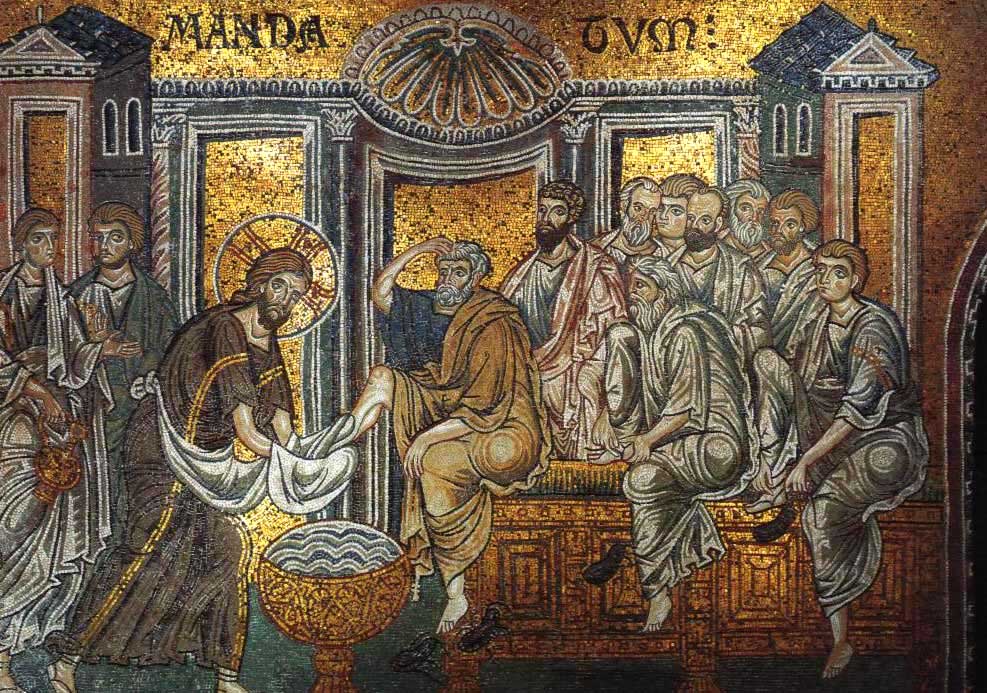
Christ_washes_apostles'_feet_(Monreale)
During His Last Supper, Jesus rose from His seat to wash the feet of His apostles to show them what position is all about:  loving service to one another.  See in this icon from Google there are only 11 apostles present; Judas left the Last Supper to “unseat” the Lord.  Above is the word “mandatum”, Latin for “command”, Christ’s command for us to love by leaving our seats of power and comfort to stand with Him at His Cross.

Quiet Storm by Fr. Nicanor F. Lalog II, 22 February 2019
If you are a Catholic and a regular Mass-goer, most likely you always follow the “Roman seating position” – that is, you always sit at the back, avoiding the front seats even in other gatherings outside the church.

According to Msgr. Gerry Santos who used to give us retreats and recollections while we were seminarians, the “Roman seating position” is a carry-over from the martyrdom of the early Christians who were always seated at the front rows of the Colosseum in Rome who were forcibly pushed to be devoured by hungry lions and beasts below.

Of course it is a joke but it holds so much grain of truth because we often refuse to take the front row seats for fears of being put on the spot, of making a stand.  How ironic that in this age when seating positions matter so much for us, we have forgotten that more important than the position and prestige that come with the seats we occupy – literally and figuratively speaking – is the stand we take in every issue we face.  Protocols dictate in so many occasions how seats indicate power and authority; the throne is always reserved to the highest in rank like kings and presidents.  And the closer one is seated to the one in command, the wider is one’s sphere of power and influence too.  Unfortunately, this is not everything because every seat of power and authority is always a call to serve, to make a stand for what is true and what is good.

Jesus Christ showed us the true meaning of our seating positions during the Last Supper on Holy Thursday evening when He rose to remove His outer garments to wash the feet of His apostles (Jn.13:1-15).  It was a task left for slaves only but Jesus used it as a gospel parable in action to show us that what matters most in life is not where we are seated with Him but where we stand with Him.  It was exactly what He meant when He said that anyone who wishes to be the greatest must be the least and the servant of all.

Recall my dear readers how during that evening of the Holy Thursday when John the beloved disciple sat not only beside Jesus but even rested his head on His chest to signify their intimacy as friends (Jn. 13:23).  That touching gesture of friendship and love took its summit the following Good Friday when John the beloved was the only one of the Twelve who remained standing with the Lord at the foot of His Cross with the Blessed Mother Mary.  In that scene we see how John literally stood his ground as the beloved disciple by remaining faithful and loving with the Lord from His Last Supper to His Crucifixion.  Peter, the prince of the Apostles, was nowhere to be found on Good Friday after denying Jesus thrice during His trial before the Sanhedrin the night of His arrest.  Very interesting was Judas Iscariot who committed suicide after realizing his grave sin in betraying the Lord.  See how he had left the Lord’s Supper to deal with His enemies for His arrest.  What an image of the traitor who could not stay on his seat during the Lord’s Supper was the same one who could not stand to face Him again at the foot of the Cross.  See how those people who refuse to sit with us are also the ones who never stand with us, stand for us like Judas, a traitor!

I tell you these things even if Holy Week is still more than six weeks from now but in the light of the Feast of the Chair of St. Peter which is about the Primacy of Rome or the Pope as Vicar of Christ and successor of St. Peter.  We celebrate this Feast to remember St. Peter and his successors love and service to the Church as examples we must all emulate.  In 110 AD, St. Ignatius of Antioch wrote the Christians in Rome to describe to them the Church of Rome as the “primacy of love” and the “primacy of faith”.  Every power and every authority signified by the chair or cathedra in the Church as well as in the world when we speak of “seat of power” must always be seen in the light of Jesus Christ’s example of loving service at His Last Supper.  This is especially true for us priests who are united in Christ and with Christ in the Eucharist.

This festering problem of sexual abuse in the Church is largely due to our deviation from this primacy in love for Jesus as priests.  We have been so focused with our seats – positions and titles – that we have forgotten to stand with Christ at the foot of His cross, standing for what is good and true, just and right.  We have been so focused with the “party” of the Supper of the Lord and have forgotten Jesus Himself.  Seminarians have been so focused with the vocation and the call, with ordination, forgetting the more essential, the Caller Jesus Himself!  And that explains why some in the clergy and those in the hierarchy come up with so many excuses and alibis for the many things we do in our ministry, in our churches, in our parishes, and in our lives because we are only concerned with our office and position but never the Master.

When we love Jesus or any other person, we do not have to justify our actions.  Love that is true and pure does not need justifications.  But the moment we start making justifications, something is wrong like when we justify our special relationships, no matter how deep or shallow it may be for clearly, there is no primacy in love for Jesus and the Church.

When we justify our vices, our lifestyles, our business endeavors that Canon Law prohibits, clearly there is no primacy in love for we cannot be poor for Christ.

There is no problem with having advocacies as priests but when we are aligned with ideologies contrary to Christ, or when we play in partisan politics, there is neither primacy of faith nor primacy of love.  It is the Lord who changes the world, not us, not our programs, not our ideas.

It is our duty as priests to love like Christ but to adopt children and raise them as our own children using our names, there is no celibacy, only stupidity.

Like Jesus, we need money to get our programs going but when we lack transparency and accountability, that is stealing and banditry.

When all we have is the ministry, the priesthood without prayer periods, without the Eucharist, we only have the call but not the Caller Jesus Christ Himself.

More than ever, today Jesus Christ is asking us all His priests to make a stand for Him, to stand with Him, to suffer with Him and to die with Him by leaving our seats of comfort and seats of power.


When Being Near Is Not Enough

Yehliu1
Photo I have taken at the Yehliu Geopark, Taiwan of a unique rock formation depicting intimacy. (29 January 2019)

The Lord Is My Chef Breakfast Recipe for the Soul
Tuesday, 05 February 2019, Week IV, Year I
Hebrews 12:1-4///Mark 5:21-43

            Everyday O Jesus I pray to be near you like Jairus falling at your feet, begging for something or someone so dear to me.  Or like that woman afflicted with hemorrhages for twelve years, hoping to be close to you, contented in just touching your cloak (Mk.5:22, 27).

            But being near you O Jesus is not enough for you.  You desire us to be intimate with you, to be one in you not simply be with you.

            Every time I touch you, I get near you, you always look for me, asking me to step forward like what you did to that woman because you want more than a mere encounter but a relationship, face to face, heart to heart.  Every time I beg you to walk with me in darkness and dangers, you always demand complete faith and trust in you like Jairus when things get worst, insisting that I dismiss what I know, disregard my plans, and ignore what others say so I can rise up and be alive and free to be myself.


           O Jesus, help me to trust you more, to believe you more.  How foolish I am, O Jesus, when so often you ask simple things from me like looking at you, staying with you, remaining in you to always remember that “in my struggle against sin I have not yet resisted to the point of shedding blood” (Heb. 12:4) like you.  Amen.  Fr. Nicanor F. Lalog II, Parokya ng San Juan Apostol at Ebanghelista, Gov. F. Halili Ave., Bagbaguin, Sta. Maria, Bulacan. 

intimacyNouwen